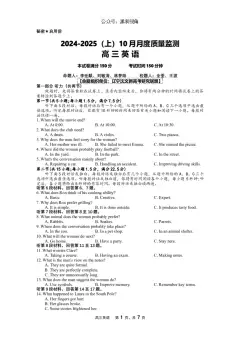
2025-2026(上)10 月月度质量监测高 一 英 语
本试卷满分150分 考试时间120分钟
第一部分 听力(共两节)
做题时,先将答案标在试卷上。录音内容结束后,你将有两分钟的时间将试卷上的答案转涂到答题卡
上。
第一节(共5小题;每小题1.5分,满分7.5分)
听下面5段对话。每段对话后有一个小题,从题中所给的A、B、C三个选项中选出最佳选项。听完每
段对话后,你都有10秒钟的时间来回答有关小题和阅读下一小题。每段对话仅读一遍。
1. What time is it now?
A. 10:20. B. 10:35. C. 10:50.
2. Where are the speakers?
A. In a bookstore. B. In a library. C. In a classroom.
3. What does the woman plan to do during holiday?
A. Do a part-time job. B. Travel to Australia. C. Visit her parents.
4. What is the main reason for the popularity of Zibo kebabs?
A. The reasonable price. B. The good taste. C. The locals' friendliness.
5. Who gave Jenny a bicycle?
A. Her parents. B. Her aunt. C. Her grandmother.
第二节(共15小题;每小题1.5分,满分22.5分)
听下面5段对话或独白。每段对话或独白后有几个小题,从题中所给的A、B、C三个选项中选出最佳
选项。听每段对话或独白前,你将有时间阅读各个小题,每小题 5秒钟;听完后,各小题将给出5秒钟的作
答时间。每段对话或独白读两遍。
听第6段材料,回答第6、7题。
6. What will Joseph do this Friday evening?
A. Go to the cinema. B. Deal with his work. C. Have supper with Jenny.
7. When will the speakers meet?
A. On Wednesday. B. On Saturday. C. On Sunday.
听第7段材料,回答第8、9题。
8. Why is the woman so angry with Charlie?
A. He handed in his homework one day later.
B. He had a fight with his classmate.
C. He didn't go to school today.
9. How might the speakers punish Charlie?
A. Take away his toys. B. Cut off his allowance. C. Ground him for a month.
听第8段材料,回答第10至12题。
10. What is the weather like now?
A. Rainy. B. Sunny. C. Windy.
11. What would the man like to order?
A. A pancake. B. A milk shake. C. A beef salad.
12. What is the relationship between the speakers?
A. Waitress and customer.
B. Husband and wife.C. Strangers.
听第9段材料,回答第13至16题。
13. Why is the woman unwilling to join the photography club?
A. She doesn't have a camera.
B. She thinks it too expensive.
C. She prefers to take photos alone.
14. Which of the following does the woman like doing?
A. Walking. B. Running. C. Cycling.
15. What can we learn about the yoga club?
A. More and more people are joining it.
B. Most members stop going within a week.
C. The number of regular members is small.
16. What kind of club does the woman choose?
A. The film club. B. The yoga club. C. The hiking club.
听第10段材料,回答第18至20题。
17. What subject did the speaker do well in?
A. English. B. Science. C. Maths.
18. Who is the speaker talking to?
A. His child. B. His student. C. His friend.
19. Why did the speaker get a "C" in English?
A. The exam was difficult.
B. He spent less time on English.
C. He got little attention from his teacher.
20. What is the speaker mainly talking about?
A. Importance of attitude in learning.
B. The influence from his parents.
C. His personal study experience.
第二部分 阅读理解(共两节,满分50分)
第一节(共15小题;每小题2分,满分37.5分)
阅读下列短文, 从每题所给的A、B、C和D四个选项中, 选出最佳选项。
A
Notice on the Orderly Opening of the National Museum of China
The National Museum of China (NMC) has limited the daily visitor arrivals with a new timetable and
adopted an online booking system. We hereby inform you of the following regulations:
* The NMC is open from 9:00 to 17:00 (last admission at 16:00) and closes on Monday.
* Visitors must make appointments 1-7 days in advance. Group reservations and on-site reservations are not
accepted.
* Visitors can make online appointments through our official website or official social media platform
account.
* On the day of the visit, please enter the museum with Chinese ID cards. For other documents holders,
please bring the copies of the original documents used at the time of reservation.
* Visitors must enter the museum during their reserved time period to avoid crowding. If visitors miss their
reserved time period, they will be refused. If visitors cannot make it on time, please apply for a cancellation in the
reservation system before 15:00 on the day of the visit. Reservations cannot be cancelled after the reserved date,and the system will automatically record one’s account as “absent”. For anyone whose account contains three times
of absence, the visitor will not be able to make new reservations within 90 days.
* Staff-guided tours are cancelled temporarily. Visitors must be in an orderly manner throughout the visit.
The NMC will take measures to ensure orderly and safe visits. Thanks for your support and cooperation.
National Museum of China
21.When can visitors enter the NMC?
A.At 11:00, Monday. B.At 10:30, Sunday.
C.At 17:00, Thursday. D.At 16:30, Friday.
22.What do we know about the NMC reservation?
A.It should be made on site.
B.It can be made in groups.
C.It must be made a week ahead.
D.It can be made through official website.
23.What if a visitor misses the reserved time period?
A.He should reserve in three months.
B.He must reserve again before 15:00.
C.He will be refused to enter the museum.
D.He can cancel the reservation the next day.
B
Fear started taking over. I was walking into my first school in Peru. I had traveled a long distance from India
in order to join my parents, who had been here for three years, hoping Peru would help my future. My father
decided that I would be better off going to school here, so I enrolled (登记) in the local high school in my new
town.
I was afraid how I would do. On the first day, I went to my second period class after I had missed my first.
With anxiety, I reached for the door, opening it slowly: Without paying attention to my classmates, I went straight
to the teacher and asked if this was the right class. With a soft voice he answered. “Yes.” His voice comforted me a
little. He gave me a piece of paper called Course Requirements, which I would never get in India because we didn’t
have anything like that. Then he asked me to choose where I would sit. I didn’t actually want to pick a seat. In India
we had fixed seats, so I never needed to worry about that. I spent the rest of the class taking notes from the image
produced by the overhead projector. In Indian schools, we didn’t use the technology we had. We had to take notes
as the teacher spoke.
It was noon. I was very confused about when I would have lunch. I went to my next class and the bell rang
as I entered. I went through the regular process of asking the teacher if I was in the right class. She said, “It’s still
fourth period.”
“But the bell just rang,” I said.
Changing from a gentle tone to a harsher (刺耳的) one, she said, “That is the lunch bell, young man.”
I apologized. Without another word I headed for the cafeteria. I felt lucky because we didn’t have this in
India. Every confusion seemed like a barrier I had to get through to reach my goal. At the end of the day, I was on
my way to the bus which we didn’t have in India either. I spotted my bus and sat down inside happily. I was
thinking, today wasn’t so bad.
24.The author attended a Peru’s high school because ________.
A.his father preferred Peru’s schools
B.his family wanted him to have a bright future
C.his mother had worked in it for 3 yearsD.he had been longing to leave his homeland
25.What do we know about the author’s first day of school?
A.He went to the wrong class for the second period.
B.He met some enthusiastic teachers and classmates.
C.He got the Course Requirements sheet from his classmate.
D.He experienced differences from the Indian schools in many ways.
26.How did the author feel at the end of the day?
A.Worried B.Confused C.Relieved D.Excited
27.What’s the best title of the passage?
A.I Began to Go to School B.My First Day of School
C.To Spend a School Day Isn’t Easy D.My Work at School
C
Space tourism is not all about rockets — giant space balloons can do it too! The Spain-based company
HALO Space completed the first test flight of its balloon in December 2023. This marked another company’s
joining the competition of making space tourism a reality.
During the test flight, the balloon reached an altitude of 37 kilometers where passengers would be able to
view Earth from the blackness of space, according to Daily Mail. When the flights are available, the company aims
to carry 3,000 passengers on 400 trips every year.
The balloon is usually filled with helium (氦气) or hydrogen, which are both much lighter than air, and it
flies because of the buoyancy force (浮力). According to NASA, the balloon is filled with the amount of gas that
will give it enough lift to get off the ground and rise. As it rises, the gas inside the balloon expands because
atmospheric pressure drops. The atmosphere is 100 to 200 times less dense (稠密的) at float altitudes than on the
ground. The balloon stops when the density of the gas inside and the air outside is about the same — neutral
buoyancy (中性浮力) is achieved. It then begins to descend (下降) as gas is let out.
Therefore, the whole trip is not stressful. Another company that gives out space tours by balloons, the US-
based Space Perspective claims that the trips are about relaxation. The craft (飞行器) rises slowly at 12 miles
(about 19.3 kilometers) per hour, and it takes about two hours to get to the 30 km altitude.
Since its successful test flight in June 2022, Space Perspective started selling tickets for spaceflights in 2024
— and it has already sold out. The company now buys ships to turn them into “floating spaceports”, reported Daily
Mail. By lifting the craft from ships on the sea, there will be more launch opportunities, such as flights at sun rise
and sunset.
28.What is the purpose of the test flight of the balloons?
A.To teach people life skills in space. B.To make space travel come true.
C.To test the speed of the balloons. D.To sell more tickets for space research.
29.What’s the height of HALO Space’s first test flight?
A.12 miles B.19.3 kilometers C.30 kilometers D.37 kilometers
30.What is paragraph 3 mainly about?
A.The similarity of helium or hydrogen.
B.The reason for air pressure.
C.The space balloon’s working principle.
D.The features of the buoyancy force.
31.Which of the following is a suitable title for the text?
A.Giant Space Balloons: A New Way for Space Tourism
B.Different Kinds of Spacecraft for TourismC.The Future of Rockets in Space Tourism
D.The Challenges of Space Tourism
D
The big day is finally here. You and your team have made it to the final game of the soccer tournament.
You’re ready to win... but so is the other team. Then, suddenly, someone scores! The game is over. The other team
has won and earns a shiny gold cup. But then the coaches start giving out something else to you and the other
players: participation (参与) awards. Everyone reacts differently. Some glow with pride. Others look disappointed.
And you? You don’t know how to feel...
Participation awards have been around since the 1920s, when they were invented to make sports safer for
kids. That’s because when the first youth sports leagues were created in the early 1900s, games were even more
competitive than they are today. Many kids were badly hurt in their effort to win. Adults were concerned. Some
schools even canceled sports programs altogether.
But then came a solution: participation awards. The point was to take the spotlight away from winning and
put it on other values, like teamwork and commitment, or sticking with something. Many people today say that’s
why participation awards are still needed. “Winning isn’t everything,” says Kenneth Barish, a scientist who studies
kids’ feelings and behavior. “The more important thing is to let kids know that we’re proud of them — not for
winning, but for their effort. Praising effort has amazing benefits. It makes it easier for young people to try new
things without fear, learn from mistakes, and take on new challenges with a positive attitude.”
But some people worry that giving awards to everyone sends the wrong message. In real life, people are not
always rewarded for just showing up. After all, you don’t get an A just for going to class. Participation awards,
some say, could teach kids to expect awards when they aren’t deserved.
So what do you think? Does everyone deserve a participation award? Or is it time to toss them aside for
good?
32.What’s the writing purpose of the first paragraph?
A.To share a competitive game.
B.To compare two kinds of awards.
C.To show the reactions to the awards.
D.To introduce the participation awards.
33.What can be learned about participation awards from paragraph 2?
A.They were introduced to make sports safer for young players.
B.They were created in the first youth sports leagues in the 1900s.
C.They were aimed at making the games less competitive than before.
D.They were the only way to remove concern about the safety of sports.
34.What does Kenneth Barish intend to convey?
A.The limitations of winning the game.
B.The applications of praising the effort.
C.The significance of developing the teamwork spirit.
D.The importance of forming a healthy view of effort.
35.What’s the author’s attitude towards participation awards?
A.Supportive. B.Objective. C.Doubtful. D.Indifferent.
第二节(共5小题;每小题2.5分,满分12.5分)
阅读下面短文,从短文后的选项中选出可以填入空白处的最佳选项。选项中有两项为多余选项。
Unfortunately, the post-work hours always seem to fly by all too quickly. Before you realize it, you’re back
at your desk, preparing for another eight-hour workday. In other words, the time between work and bed is short andis often full of responsibilities and to-dos that aren’t very exciting. 3 6 Read the following and find out
how.
First, change out of your work clothes. Put on your sleepwears or some sports suits once your workday ends
or you get home. This signals to your body that you’re done with work. 3 7
Create an after-work routine (常规). It gives you something to look forward to after a workday and helps you
just wind down, so your body and your mind can rest. 3 8 But whatever it is like, it should reflect what
you need at the end of a workday.
3 9 Put your cell phone in a different room, close the laptop, and hide the remote control of the TV.
This will allow you to be more present with yourself, your partner and your family. Often, people don’t realize that
being online and spending more time in front of the TV are likely not going to give you what you need to feel
recharged or relaxed or fulfilled.
Do something different. 4 0 To change this, you should add some newness to your weeknights. But
it doesn’t have to be something big. This adds some excitement to your week and will help you feel more rewarded
once the next workday comes.
A.Stay away from all screens.
B.Remove your work out of the way.
C.It will differ from person to person.
D.And it can relax you for the whole evening.
E.Usually, you get home and you’re in the same routine.
F.That is why it’s important to make the most of this short time.
G.Either way, it can help you feel relaxed and ready for your after-work routine.
第三部分 语言知识与运用(共两节,满分30分)
第一节:完形填空(共15题,每小题1分,满分15分)
阅读下面短文,从短文后各题所给的四个选项(A、B、C和D)中,选出可以填入空白处的最佳选项。When I was a child, there was nothing I loved more than painting. It was my. 4 1 of joy. I could
spend hours being lost in my 4 2 , bringing to life the images in my mind.
However, after graduating from college, the 4 3 of work took hold. The hobby that filled my
childhood with happiness 4 4 faded away (逐渐消失).
One sunny day I found myself 4 5 in a nearby park. I. 4 6 a group of children sitting
together, their eyes. 4 7 wonder and their hands covered in paint. They were laughing describing their
dreams on 4 8 , and at that moment, I was transported back to my own childhood.
4 9 those kids, I realized that I had lost something precious (宝贵的) along the way. It was time to
reconnect with the 5 0 within, to rediscover the world of colours and imagination. Despite the 5 1
life, I decided to pick up my brushes and 5 2 to the world of art.
Painting has become a way to 5 3 the beautiful moments of my life, whether it is a golden sunset, a
beautiful flower, or a lazy afternoon. I paint not to become a famous artist, but to 5 4 the joy of my
childhood, to 5 5 the simple pleasures of life, and to hold onto the magical world of imagination.
41.A.price B.source C.flash D.result
42.A.imagination B.homework C.fear D.confusion
43.A.excitement B.power C.pressure D.expectation
44.A.gradually B.probably C.wildly D.hopefully
45.A.chatting B.sweating C.cheating D.walking
46.A.taught B.noticed C.recognized D.remembered
47.A.waiting for B.begging for C.filled with D.alarmed with
48.A.paper B.wood C.books D.novels
49.A.Watching B.Holding C.Helping D.Checking
50.A.architect B.soldier C.adult D.artist
51.A.free B.quiet C.busy D.boring
52.A.agree B.adapt C.refer D.return
53.A.plan B.record C.face D.recover
54.A.reduce B.balance C.relive D.destroy
55.A.trap B.appreciate C.expect D.hide
第二节:语法填空(共10小题,每小题1.5分,满分15分)
阅读下面材料, 在空格处填入适当的内容(1个单词)或括号内单词的正确形式。
International Workers’ Day, is a time to honor the contributions of workers around the world. This festival
5 6 (celebrate) on the first day of May in many countries, including China. It not only recognizes the value of
labor 5 7 also reminds us of the importance of fairness and respect for all workers. In China, various
5 8 (activity) are held every year to celebrate this special day. Schools often organize events 5 9
(teach) students about the spirit of hard work. For example, they may invite model workers to share their stories of
dedication and innovation. These stories inspire young people to take pride in 6 0 (they) future roles as
builders of society.
One of the most touching aspects of Workers’ Day is the focus 6 1 ordinary heroes. Take Li Hua,
6 2 street cleaner in Beijing, for an example. He has been working in his position for over 15 years, 6 3
(keep) the city clean even on the coldest winter mornings. 6 4 (actual), his story tells us that every job, no
matter how small, plays a part in making our world better. As we enjoy the holiday, let us remember that happiness
is created by hard work. Whether we are students, teachers, or future workers, we can all take pride in the labor
6 5 shapes our lives and our society.
第四部分:写作(共两节,满分40分)第一节:应用文写作(满分15分)
66. 最近,你校英文报想要了解学生平时使用手机的情况,因此举行了一次征文活动。请你写一篇短文投
稿,内容包括:1. 介绍你班同学使用手机的情况; 2. 你的感受和建议。
注意: 1. 写作词数应为80个左右;2. 可以适当增加细节,以使行文连贯。
____________________________________________________________________________________________
____________________________________________________________________________________________
____________________________________________________________________________________________
____________________________________________________________________________________________
____________________________________________________________________________________________
______________
第二节 读后续写(满分25分)
67. 阅读下面材料,根据其内容和所给段落开头语续写两段,使之构成一篇完整的短文。
Ms. Carter’s classroom was always warm, even in winter. The walls were covered with student essays and
faded world maps. 14-year-old Jamie sat in the back row, his head hanging low and eyes fixed on his worn shoes.
He hadn’t turned in his assignments for several days.
“Stay after class, Jamie,” Ms. Carter said softly one December afternoon. Her voice wasn’t angry — just
worried. “I know you’re capable,” she said, sliding his blank notebook across the desk. “But you’ve missed every
deadline. Is there anything wrong?”
Jamie, struggling with something he couldn’t express, held back his words and remained silent. Outside,
raindrops tapped the windows like impatient fingers.
The next day, Ms. Carter drove to Jamie’s home after school. As she knocked on a half-open door, she heard
a child’s cry. Jamie answered her knock. He was so surprised to see Ms. Carter, his face red with panic. A baby girl
was on his back, and an oxygen machine hummed (嗡嗡响) beside a sofa where a weak woman slept.
“My mom... she has pneumonia (肺炎),” Jamie explained in a low voice, blocking the doorway. “I have to
take care of my sister after school. The daycare kicked her out last month because Mom missed payments. You see,
she can’t go to work now.”
Ms. Carter’s throat tightened. She noticed the microwave meals piled on the table. A photo on the fridge
showed Jamie wearing a big smile, his mother’s arms around him — a lifetime ago.
“Why didn’t you tell me?”
“You’d think I’m lying.” he said, voice shaking. “But... I’ll catch up on my study, I promise.”
That evening, after returning home, Ms. Carter contacted a charity organization in the town and explained
the family’s difficult situation. The organization readily promised to help Jamie and his family. The next day, the
head of the organization came to the school with funds in an envelope, which were enough to cover the expenses of
daycare for at least one month.
注意:
1. 续写词数应为150个左右;
2. 请按如下格式在答题卡的相应位置作答。
Ms. Carter called Jamie to the
office._______________________________________________________________________________________
____________________________________________________________________________________________
____________________________________________________________________________________________
____________________________________________________________________________________________
____________________________________________________________________________________________
_____After school, Jamie got home and handed the envelope to his
mom.________________________________________________________________________________________
____________________________________________________________________________________________
____________________________________________________________________________________________
____________________________________________________________________________________________
____________________________________________________________________________________________
__________________________1 2 3 4 5 6 7 8 9 10
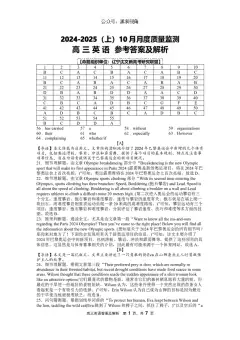
A B A C B B C B C A
11 12 13 14 15 16 17 18 19 20
C C C A C B A A B C
21 22 23 24 25 26 27 28 29 30
B D C B D C B B D C
31 32 33 34 35 36 37 38 39 40
A D A D B F D C A E
41 42 43 44 45 46 47 48 49 50
B A C A D B C A A D
51 52 53 54 55
C D B C B
56.is celebrated 57.but 58.activities 59.to teach 60.their 61.on 62.a 63.
keeping 64.Actually 65.which/that
66.小作文范文:
As far as I know, many of my classmates are addicted to social media platforms, playing games or chatting
with friends on their phones, rather than using them as a means of learning knowledge. I think such behaviors are a
waste of time. It’s time for them to seriously consider how to use their phones reasonably. I strongly recommend
that everyone limit cell phone use to no more than half an hour a day. Moreover, it is wise to play less video games
and read less useless information online.
67.大作文范文:
Ms. Carter called Jamie to the office. Sunlight pooled around the envelope as Ms. Carter pushed it toward
Jamie. “This will settle the problem.” she said, her eyes reflecting the hopes in the young boy and his family.
Jamie’s fingertips brushed the seal — thicker than his math textbook — where the charity’s name shone. His throat
tightened, tears clouded with tears. “Thank you Ms. Carter. I didn’t expect...” Ms. Carter patted Jamie on the
shoulder and smiled, “I believe you and your family will get through this soon.” Biting his lips, Jamie nodded.
After school, Jamie got home and handed the envelope to his mom. The envelope felt so heavy in Mom’s
trembling hands. “They’re... like angels?” Mom’s whisper melted all the messes in the house. The money meant so
much to them. With the medicine bought and the baby taken care of, Jamie’s mom was recovering day by day. That
night, Jamie’s pencil moved freely across homework for the first time in weeks, its shadow dancing alongside
mom’s steady breathing on the monitor. When Jamie finally handed his homework to Ms. Carter, the classroom
hummed with life, no longer just warmth, but light.