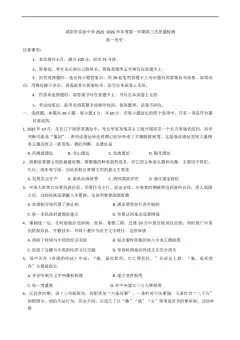
咸阳市实验中学 2025~2026 学年度第一学期第三次质量检测
高一英语
第一部分 听力(共两节,满分30分)
做题时,先将答案标在试卷上。听力部分结束前,你将有两分钟的时间将试卷上的答案转涂
到答题卡上。
第一节(共5小题;每小题1.5分,满分7.5分)
听下面5段对话。每段对话后有一个小题,从题中所给的A、B、C三个选项中选出最佳选项。
听完每段对话后,你都有10秒钟的时间来回答有关小题和阅读下一小题。每段对话读两遍。
例: How much is the shirt?
A. £ 19.15. B. £ 9.18. C. £ 9.15.
答案是C。
1. What does the woman want to do tomorrow?
A. Go shopping. B. Visit her aunt. C. Attend a birthday party.
2. What did the woman do this morning?
A. She went on a trip. B. She did the packing. C. She checked the windows.
.
3 What is mentioned in the email about the fitness center?
A. It will be in use next month. B. It will lengthen business hours.
C. It will be open to the employees.
4. How does the man feel about the news?
A. Happy. B. Confused. C. Surprised.
5. What is the probable relationship between the speakers?
A. Delivery man and customer. B. Baker and customer.
C. Co-workers.
第二节(共15小题;每小题1.5分,满分22.5分)
听下面5段对话或独白。每段对话或独白后有几个小题,从题中所给的A、B、C三个选项中
选出最佳选项。听每段对话或独白前,你将有时间阅读各个小题,每小题5秒钟;听完后,
各小题将给出5秒钟的作答时间。每段对话或独白读两遍。
听第6段材料,回答第6、7题。
6. What does the man like doing in the park?
A. Hiking. B. Bird-watching. C. Picnicking.
7. What does the man ask the woman to do in the end?A. Book a tour guide. B. Show him around. C. Have something to eat together.
听第7段材料,回答第8、9题。
8. What sport does the man learn to do?
A. Tennis. B. Football. C. Basketball.
9. What did the man do first in the lesson?
A. He played a game. B. He jumped. C. He ran.
听第8段材料,回答第10至12题。
10. How many parts are there in the smartwatch?
A. Five. B. Six. C. Eleven.
11. Where is the power button of the smartwatch?
A. At the back. B. On the right side. C. At the bottom left.
12. Which function does the man care about most?
A. The microphone. B. Heart rate monitor. C. The touch screen.
听第9段材料,回答第13至16题。
13. What are the speakers mainly talking about?
A. How Martina chose her course.
B. What Martina’s teacher looks like.
C. Whether Martina enjoys her campus life.
14. What do we know about the art teacher?
A. He is from France.
B. He has a bad accent.
C. He advises Martina on choices.
15. What subject does Martina like best?
A. Art. B. Science. C. History.
16. Why did Martina decide to major in English?
A. It was more practical for her future.
B. It is easier to learn than other subjects.
C. She liked the English teacher.
听第10段材料,回答第17至 20题。
17. Which building has a gym?
A. Blake Residence. B. Brown Hall . C. Queen’s Building.
18. Why is Blake Residence peaceful?
A. Only girls live there. B. No visitors can come in. C. Everyone has a private room.19. What is the advantage of Queen’s Building?
A. It has shower rooms. B. It has a computer room. C. It has its own private garden.
20. Why is the Parkway Flats expensive?
A. Parking there is charged. B. There are the largest rooms. C. The fees include the cost of meals.
第二部分 阅读(共两节,满分50分)
第一节(共15小题;每小题2.5分,满分37.5分)
阅读下列短文,从每题所给的A、B、C、D四个选项中选出最佳选项。
Chinese poetry through the guqin:
a practical tool to learn Chinese language and culture
Confucius said: “To educate somebody, you should start with poetry, and finish with music”. The North American
Guqin Association (NAGA) has developed a new class series that will combine (融合) poetry and music with guqin
study and aims to deepen the appreciation of Chinese poetry and guqin culture through the exploration of guqin songs.
Course description
The classes will consist of lectures and practical sessions (课). Students will not only learn how to play guqin
and sing poems by famous poets from different Chinese dynasties such as Farewell to Meng Haoran at Yellow Crane
Terrace by Li Bai, but also will learn standard Chinese through these poems. At the end of the course, students will
be able to sing at least five famous Chinese poems while playing guqin, and will have a broad appreciation of Chinese
culture.
Fees and schedules
Please select the appropriate options from the schedule below.
Time: Sundays 1:00 pm to 3:30 pm, 19/1/24, 26/1/24, 2/2/24, 9/2/24
Fee: $150 (one session) or $480 (4 sessions)
Venue (场地)
Union City, CA. Address to be announced after registration (登记). Public transportation is recommended.
Instruments
Instruments can be rented for the full 4 days duration of the course which they can take home to practice with
(normal cost $50). NAGA class sponsor will provide discounts for students who want to buy guqins in the class,
with prices starting from only $199 (see the description of each model recommended).
Registration
The number of places is limited, and space is available on a first-come-first-served basis, so please register now!
Please email your registration form (click here to download) directly to yaji@guqin.org and pay online at
http://naga4dayguqinclass.eventbee.com. For more details, please email yaji@guqin.org or call1-415-857-3918.1. What’s special about the new class series?
A. It discusses modern singing techniques. B. It offers sessions to practise writing poems.
C. It benefits both native speakers and foreigners. D. It combines Chinese poetry and guqin music.
2. How much at least does it cost to select 4 sessions and buy an instrument?
A. $530. B. $650. C. $679. D. $799.
3. What is the main purpose of the text?
A. To teach Chinese poetry. B. To spread guqin culture.
C. To advertise guqin classes. D. To popularize Chinese music.
Does handwriting matter? Not very much, according to many educators. However, scientists say it is far too
soon to declare handwriting is not important. New evidence suggests that the link between handwriting and
educational development is deep.
Children not only learn to read more quickly when they first learn to write by hand, but they are also better
able to create ideas and remember information. In other words, it’s not only what we write that matters ---- but how.
A study led by Karin James, a psychologist at Indiana University, gave support to that view. A group of
children, who had not learned to read and write, were offered a letter or a shape on a card and asked to copy it in
one of three ways: draw the image on a page but with a dotted outline(虚线), draw it on a piece of blank white
paper, or type it on a computer. Then the researchers put the children in a brain scanner and showed them the image
again.
It was found that when children had drawn a letter freehand without a dotted outline or a computer, the activity
in three areas of the brain were increased. These three areas work actively in adults when they read and write. By
contrast, children who chose the other two ways showed no such effect. Dr. James attributes the differences to the
process of free handwriting: not only must we first plan and take action in a way but we are also likely to produce a
result that is variable. Those are not necessary when we have an outline.
It’s time for educators to change their mind and pay more attention to children’s handwriting.
4. What do scientists mean by saying “it is far too soon to declare handwriting is not important”?
A. Handwriting is not very important to children.
B. Handwriting should not be ignored at present.
C. Handwriting has nothing to do with education.
D. Handwriting can not be learned in a short time.
.
5 What does “that view” in Para. 3 refer to?
A. How we write is as important as what we write.
B. Children read quickly when they write by hand.C. Children create ideas and remember information.
D. A group of students should know what to write.
6. Which is NOT the children’s task in the experiment?
A. Copy the image on a page but with a dotted outline.
B. Draw the image on a piece of blank white paper.
C. Put a brain scanner and show the image again.
D. Type the image directly on a computer.
7. According to the passage, the author obviously _______ giving up handwriting.
A. is for B. is against
C. is responsible for D. doesn’t care about
In New York City public schools, many different languages are spoken among the more than l million students.
For these children, English is not their first language. New York’s Department of Education makes learning better for
these students by providing dual-language (双语的) programs. Students are taught in two languages, English and
another one, like Russian or Chinese. Math, social culture, science and all other regular courses are taught in both
languages. This is different from other students in New York.
Milady Baez is Deputy Chancellor of English Language Learners and Student Support. She says these dual-
language programs will help children succeed in the future. “The jobs of the future require that our students know
more than one language. They are going to be traveling abroad, and they are going to be communicating with people
from all over the world. This will open doors for them.” Anastasia Hudikova came to the United States when she was
2-years old. She says the Russian-English program keeps her connected to her country and her parents. “They are
really happy about the program. They are really happy that I can protect my culture and my language.”
Shuya Zhang teaches a dual-language class. She thinks the program helps children get ready to work with people
in other countries. “Lots of factories have been built in China, and many companies move to China. They need people
with both language skills. So when the kids grow up, they already have this skill. For Jiang keqing, she likes keeping
up her first language, Mandarin. “It makes me feel that I am home because I can speak in Chinese, learn in Chinese,
while learning in English. So it makes me feel better and makes me understand more about the tasks I am learning.”
The New York schools also offer dual-language programs in seven other languages: Arabic, French, Haitian
Creole, Hebrew, Korean, Polish and Spanish. There are plans to add even more languages in the future.
8. Who receive dual-language programs in public schools in New York city?
A. Those who decide to learn better B. Those who are interested in Russian
C. Those whose first language is not English D. Those who are good at learning languages
9. How will dual-language programs help students according to Milady Baez?A. To achieve success in the future B. To become good guides someday
C. To talk with foreigners when traveling D. To find good jobs in a foreign country
10. Why does Jiang Keqing like the dual-language program?
A. It helps her get ready for future work B. It helps her preserve her culture
C. It helps her communicate with people D. It makes the courses more understandable
11. The author writes the passage in order to_________.
A. introduce dual-language programs in New York schools.
B. encourage us to learn more languages.
C. advertise the dual-language programs.
D. inspire more students to study in New York.
阅读理解
阅读下列四篇短文,从每小题后所给的A、B、C、D四个选项中,选出最佳选项,并在答题卡上将该选项
涂黑。
Why are newspapers and TV broadcasts filled with disaster, corruption and incompetence? It may be because we’re
drawn to depressing stories without realizing, according to psychologists.
When you read the news, sometimes it can feel like the only things reported are terrible, depressing events. Why do
the media concentrate on the bad things in life, rather than the good? In fact, many people often say that they would
prefer good news.
The researchers present their experiment as solid evidence of a so called “negativity bias(偏见)”, psychologists’
term for our collective hunger to hear, and remember bad news.
It isn’t just delight in other people’s misfortune, the theory goes, but that we’ve evolved to react quickly to potential
threats. Bad news could be a signal that we need to change what we’re doing to avoid danger.
As you’d expect from this theory, there’s some evidence that people respond quicker to negative words. In lab
experiments, flash the word “cancer”, “bomb” or “war” up at someone and they can hit a button in response quicker
than if that word is “baby”, “smile” or “fun”. We are also able to recognize negative words faster than positive
words, and even tell that a word is going to be unpleasant before we can tell exactly what the word is going to be.
There’s another interpretation (解释)that researchers put on their evidence: we pay attention to bad news, because
on the whole, we think the world is more hopeful than it actually is. When it comes to our own lives, most of us
believe we’re better than average, and that, like the cliches, we expect things to be all right in the end. This pleasant
view of the world makes bad news all the more surprising and arresting. It is only against a light background that
the dark spots are highlighted.So our attraction to bad news may be more complex than just journalistic prejudice or a hunger springing from the
darkness within.
12. What is “negativity bias” according to psychologists?
A. It is one’s delight in others’ misfortune.
B. It is one’s habit of reacting quickly to potential threats.
C. It is a signal with which we can avoid danger.
D. People are born to hear and remember bad news.
13. What can we infer from the passage?
A. Journalists only feel like reporting depressing bad news.
B. It is true that there are no good stories to be reported.
C. People unconsciously pay more attention to bad news.
D. People like to hear pleasant words rather than bad words.
14. What will be read first by most readers according to the theory?
A. Movie star arrested for taking drugs.
B. Movie star went on a campaign for ASL disease.
C. Movie star accepts Ice Bucket Challenge
D. Movie star awarded the third Oscar in three years.
15. What causes people to focus more on bad news than on good news?
A. The world is believed to be more hopeful than it actually is.
B. It is expected things will be all right in the end.
C. The world is believed to be full of darkness.
D. It is believed that we are better than others.
第二节(共5小题;每小题2.5分,满分12.5分)
阅读下面短文,从短文后的选项中选出可以填入空白处的最佳选项。选项中有两项为多余选
项。
With the development of globalization, “interconnectivity” has become a buzzword (流行词) of the modern
world. Although this trend brings lots of advantages, it can also present some challenges. ____16____
Understanding and overcoming cultural barriers is very important in daily life. Here are some tips on how to
properly handle cultural differences.
Be self-aware and acknowledge differences. Most cross-cultural misunderstandings come from a single-
minded opinion. If we judge others through our own culture, we may end up with wrong interpretations. Failing to
acknowledge differences may easily lead to misconceptions and even conflicts. ____17____
Do research and learn about other cultures. After cultural differences are acknowledged, it’s important to learnmore about them. ____18____ Understanding the reasoning behind one’s actions can reduce “wrong labeling” and
lead to a more effective cooperation and communication process.
____19____ Try your best to avoid quick judgments and be open to new beliefs and behavior. Find out what
you have in common and learn how to make the best use of each unique characteristic. Respect the fact that others
have distinct core values.
All in all, dealing with cultural differences is quite challenging and requires a lot of work. ____20____ When
you meet people from different cultures and backgrounds next time, just be mindful, and stay open-minded and
patient.
A. One of them is cultural barriers.
B. Be open-minded, adaptable and respectful.
C. You can either do your own research or simply ask others about them.
D. Employees should be prepared to work in a multicultural environment.
E. However, the results of overcoming these barriers far outweigh the effort.
F. Actually, travelling abroad is not the only way to overcome cultural barriers.
G. Therefore, we should accept differences and learn more about others’ backgrounds.
第三部分 语言运用(共两节,满分30分)
第一节(共15小题;每小题1分,满分15分)
阅读下面短文,从每题所给的A、B、C、D四个选项中选出最佳选项。
My husband Jeff and I were on a vacation in another city and having a bird’s view of the city on top of a mountain
nearby was on his bucket list. It was rated as a ____21____ hike with a distance of 10 miles round trip. I began to
____22____ because I wondered if I could make it. I hadn’t been ____23____, and I had fallen into the mindset that
as I was getting older, it was only ____24____ that I would have less energy and drive.
The next morning, we began our climbing. About halfway up, we met a discouraged couple who had
____25____ trying to reach the top. When I ____26____ how disappointed the husband seemed to be, I ____27____
right then to continue anyway.
____28____, as we walked, I stopped thinking about not being able to endure (忍受) the walking. Instead, I
began to ____29____ the beauty of the area and our conversation. As the day ____30____ and the road became
more challenging, Jeff was growing concerned about our ____31____. We had to get down before dark, or we would
have to find ____32____ from the cold and animals in the area.
Finally, we reached the top and were ____33____ with the charm of the bird’s eye view. Too soon, we had to
depart and we did it while it was still ____34____. Afterwards, I realized that I could do many things that I had
feared to do. I am excited that many adventures are ____35____ for me now that I have my new attitude.21. A. tough B. crucial C. organized D. reliable
22. A. imagine B. commit C. reflect D. panic
23. A. holding on B. working out C. giving up D. sitting around
24. A. wise B. essential C. natural D. rare
.
25 A. remembered B. avoided C. admitted D. quitted
26. A. noticed B. refused C. announced D. pretended
27. A. agreed B. hesitated C. resolved D. managed
28. A. Surely B. Strangely C. Principally D. Similarly
29. A. create B. ruin C. miss D. enjoy
30. A. progressed B. changed C. repeated D. approached
31. A. relation B. pace C. academy D. health
32. A. shelter B. suffering C. signal D. absence
33. A. accompanied B. consumed C. rewarded D. charged
34. A. legal B. alive C. late D. light
35. A. by nature B. on end C. in store D. at length
第二节(共10小题;每小题1.5分,满分15分)
阅读下面材料,在空白处填入适当的内容(一个词)或括号内单词的正确形式。
Anyone who has an interest in Dunhuang will have heard of Fan Jinshi. The Chinese archaeologist
____36____ has spent more than half a century researching and preserving the caves at the heart of the ancient
Silk Road in Gansu Province ____37____ (know) as the “Daughter of Dunhuang” in her field, though “protector
is probably a more fitting ____38____ (describe).
Fan has been studying the historical site since the early 1960s, first as an archaeology undergraduate from
Peking University, then as a conservationist when she ____39____ (become) the deputy director of the Dunhunag
Research Academy in 1984, which serves to prevent the ancient site from ____40____ (destroy).
“It is over a thousand years old. It is an old person, an ____41____ (extreme) weak old person. It has
____42____ (variety) illness. If you are a little careless, it could be gone. Gone forever,” Fan says.
Today, thanks ____43____ the work of great archaeologists such as Fan, Dunhuang is proud of the world’s
largest and best-reserved collection of Buddhist relics ____44____ (date) from the fifth to the 13th centuries. The
main Mogao site is made up of 735 caves spread across a 1,700.metre-wide cliff face, containing 45,000 square
metres of murals (壁画) _____45_____ more than 2,000 colorful sculptures (雕塑).
第四部分 写作(共两节,满分40分)
第一节(满分15分)46. 假定你是李华,为弘扬中国传统文化,你校将举办外国学生“诗歌朗诵大赛”(Poetry Recitation
的
Contest),请给你 英国朋友Bill写封邮件,邀请他参加比赛。内容包括:
(1)大赛的时间、地点;
(2)朗诵内容:唐诗(Tang poetry);
(3)报名方式。
注意:(1)词数80左右;
(2)可以适当增加细节,以使行文连贯。
Dear Bill,
____________________________________________________________________________________________
____________________________________________________________________________________________
____________________________________________________________________________________________
____________________________________________________________________________________________
___________________________________________________________________________________
Yours,
Li Hua
第二节(满分25分)
47. 阅读下面材料,根据其内容和所给段落开头语续写两段,使之构成一篇完整的短文。
I applied for a job with a Chinese-Canadian company in Vancouver. As you know, the Chinese are famous for
their food. They cook delicious food and obtain a simple pleasure from eating.
So, I was not surprised when my new boss invited me out to lunch to celebrate my new job. He said we were
going to eat in a Chinese restaurant in Chinatown. I was nervous. I knew we would be using chopsticks, and while I
had tried many times to master the technique, I had completely failed in every attempt. How would I be able to make a
good impression? Would I make a complete fool of myself?
That evening, I called a friend and asked her to explain exactly how to use chopsticks. She patiently explained
the proper way of holding them between the thumb, first and middle fingers.“ It is not that hard,” she said. “That is
easy for you to say,” I replied. “You’ve been eating with chopsticks all your life. It is natural for you!” I didn’t get
much sleep that evening. I kept turning around in bed all night, worrying about lunch the next day.
The next day, I could hardly contain my anxiety. It was difficult to get any work done in the morning. At noon,
I left with my boss and two co-workers and headed to the restaurant. We were seated at an excellent table. My boss
wrote out the food order, speaking to the server in Chinese. My heart was pounding, but then I noticed a strange thing.
Instead of the customary chopsticks, each of us had knives, forks, and spoons.I was confused at first, but then, it hit me. My boss knew that I would have trouble with the chopsticks. He
wanted to save me from embarrassment, so he had called ahead and arranged for us to be served with knives and
forks. I couldn’t believe how kind and helpful he was.
注意:(1) 续写词数应为150个左右;(2) 请按如下格式在答题纸的相应位置作答。
Instantly, I made up my mind and asked the server to bring me a pair of chopsticks.
____________________________________________________________________________________________
____________________________________________________________________________________________
____________________________________________________________________________________________
____________________________________________________________________________________________
____________________________________________________________________________________________
In the end, I wasn’t embarrassed at all.
____________________________________________________________________________________________
____________________________________________________________________________________________
____________________________________________________________________________________________
____________________________________________________________________________________________
____________________________________________________________________________________________咸阳市实验中学 2025~2026 学年度第一学期第三次质量检测
高一英语
第一部分 听力(共两节,满分30分)
做题时,先将答案标在试卷上。听力部分结束前,你将有两分钟的时间将试卷上的答案转涂
到答题卡上。
第一节(共5小题;每小题1.5分,满分7.5分)
听下面5段对话。每段对话后有一个小题,从题中所给的A、B、C三个选项中选出最佳选项。
听完每段对话后,你都有10秒钟的时间来回答有关小题和阅读下一小题。每段对话读两遍。
例: How much is the shirt?
A. £ 19.15. B. £ 9.18. C. £ 9.15.
答案是C。
1. What does the woman want to do tomorrow?
A. Go shopping. B. Visit her aunt. C. Attend a birthday party.
2. What did the woman do this morning?
A. She went on a trip. B. She did the packing. C. She checked the windows.
3. What is mentioned in the email about the fitness center?
A. It will be in use next month. B. It will lengthen business hours.
.
C It will be open to the employees.
4. How does the man feel about the news?
A. Happy. B. Confused. C. Surprised.
5. What is the probable relationship between the speakers?
A. Delivery man and customer. B. Baker and customer.
C. Co-workers.
第二节(共15小题;每小题1.5分,满分22.5分)
听下面5段对话或独白。每段对话或独白后有几个小题,从题中所给的A、B、C三个选项中
选出最佳选项。听每段对话或独白前,你将有时间阅读各个小题,每小题5秒钟;听完后,
各小题将给出5秒钟的作答时间。每段对话或独白读两遍。
听第6段材料,回答第6、7题。
6. What does the man like doing in the park?
A. Hiking. B. Bird-watching. C. Picnicking.
7. What does the man ask the woman to do in the end?A. Book a tour guide. B. Show him around. C. Have something to eat together.
听第7段材料,回答第8、9题。
8. What sport does the man learn to do?
A. Tennis. B. Football. C. Basketball.
9. What did the man do first in the lesson?
A. He played a game. B. He jumped. C. He ran.
听第8段材料,回答第10至12题。
10. How many parts are there in the smartwatch?
A. Five. B. Six. C. Eleven.
11. Where is the power button of the smartwatch?
A. At the back. B. On the right side. C. At the bottom left.
12. Which function does the man care about most?
A. The microphone. B. Heart rate monitor. C. The touch screen.
听第9段材料,回答第13至16题。
13. What are the speakers mainly talking about?
A. How Martina chose her course.
B. What Martina’s teacher looks like.
C. Whether Martina enjoys her campus life.
14. What do we know about the art teacher?
A. He is from France.
B. He has a bad accent.
C. He advises Martina on choices.
15. What subject does Martina like best?
A. Art. B. Science. C. History.
16. Why did Martina decide to major in English?
A. It was more practical for her future.
B. It is easier to learn than other subjects.
C. She liked the English teacher.
听第10段材料,回答第17至 20题。
17. Which building has a gym?
A. Blake Residence. B. Brown Hall . C. Queen’s Building.
18. Why is Blake Residence peaceful?
A. Only girls live there. B. No visitors can come in. C. Everyone has a private room.19. What is the advantage of Queen’s Building?
A. It has shower rooms. B. It has a computer room. C. It has its own private garden.
20. Why is the Parkway Flats expensive?
A. Parking there is charged. B. There are the largest rooms. C. The fees include the cost of meals.
第二部分 阅读(共两节,满分50分)
第一节(共15小题;每小题2.5分,满分37.5分)
阅读下列短文,从每题所给的A、B、C、D四个选项中选出最佳选项。
【1~3题答案】
【答案】1. D 2. C 3. C
【4~7题答案】
【答案】4. B 5. A 6. C 7. B
【8~11题答案】
【答案】8. C 9. A 10. D 11. A
【12~15题答案】
【答案】12. D 13. C 14. A 15. B
第二节(共5小题;每小题2.5分,满分12.5分)
阅读下面短文,从短文后的选项中选出可以填入空白处的最佳选项。选项中有两项为多余选
项。
【16~20题答案】
【答案】16. A 17. G 18. C 19. B 20. E
第三部分 语言运用(共两节,满分30分)
第一节(共15小题;每小题1分,满分15分)
阅读下面短文,从每题所给的A、B、C、D四个选项中选出最佳选项。
【21~35题答案】
【答案】21. A 22. D 23. B 24. C 25. D 26. A 27. C 28. B 29. D 30. A 31. B 32. A 33. C 34. D
35. C
第二节(共10小题;每小题1.5分,满分15分)
【36~45题答案】
【答案】36. who##that
37. is known
38. description39. became 40. being destroyed
41. extremely
42. various
43. to 44. dating
45. and
第四部分 写作(共两节,满分40分)
第一节(满分15分)
【46题答案】
【答案】
Dear Bill,
To promote traditional Chinese culture, the Students’ Union will hold a Poetry Recitation Contest, which is
aimed at promoting traditional Chinese culture.
The contest is scheduled to take place in the school hall at 8:00 a.m. on December 6th, 2025. The recitation
content should be Tang poetry. We sincerely invite all students from the International Department to participate. It’s
a great chance to experience the charm of Chinese poetry.
Looking forward to your coming and showing your love for Chinese culture!
Yours,
Li Hua
第二节(满分25分)
【47题答案】
【答案】One possible version:
Paragraph 1:
Instantly, I made up my mind and asked the server to bring me a pair of chopsticks. As soon as they were brought
in front me, I took them carefully in my hand. I looked over at my boss and we exchanged a smile. With determination, I
grasped the chopsticks and attempted to pick up some rice and a piece of meat. However, my fingers slipped and the
food fell back onto the plate. I was swamped with a sense of embarrassment due to my failed attempts. At that
moment, I saw my boss giving me a reassuring nod, which motivated me to keep trying. I plucked up the courage
and tried again, determined to master this skill. Through trial and error, I gradually got the hang of using
chopsticks.
Paragraph 2:
In the end, I wasn’t embarrassed at all. I was glad that my new boss was so thoughtful that he could take
everything into consideration. And I was really happy that I had decided to ask for chopsticks. After that, we oftenwent out for lunch in that restaurant. Despite facing a number of challenges, I persevered in my attempts to use
chopsticks. With the help of my friend and the patience of my boss, I was able to overcome my fear of using chopsticks
and practice until I became proficient. It struck me that diversity is not about how we differ, but about embracing one
another’s uniqueness.