i i
W
C a m b ri d g e En g lish
fOFFICIAL
飞
、
!
"
i
I E #
(cid:2)
#
$
AUTHENTIC EXAMINATION PAPERS FROM
CAMBRIDGE ENGLISH LANGUAGE ASSESSMENTTest 1
LISTENING
SECTION 1 Questions 1 +10
Questions 1-6
Complete the notes below.
Write ONE WORD for each answer.
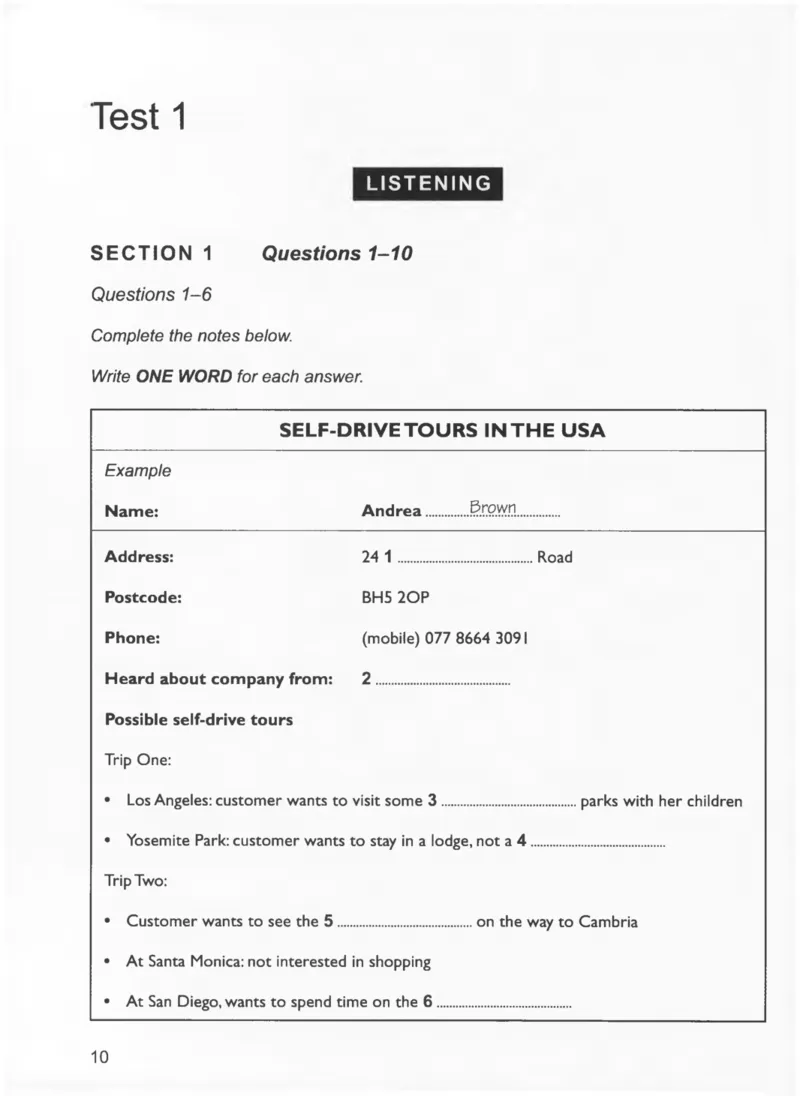
SELF-DRIVE TOURS IN THE USA
Example
PSQm...
Name: Andrea.........
Address: 24 1..................................Road
Postcode: BH5 20P
Phone: (mobile) 077 8664 3091
Heard about company from: 2 ..............................................
Possible self-drive tours
Trip One:
• Los Angeles: customer wants to visit some 3 ...............................parks with her children
• Yosemite Park: customer wants to stay in a lodge, not a 4 ...............................
Trip Two:
• Customer wants to see the 5 ...............................on the way to Cambria
• At Santa Monica: not interested in shopping
• At San Diego, wants to spend time on the 6...............................
10Listening
Questions 7-10
Complete the table below.
Write ONE WORD AND/OR A NUMBER for each answer.
Number Total distance Price Includes
of days (per person)
Trip One 12 days £525 • accommodation
7 ...............km
• car
• one 8 ...............
Trip Two 9 days 980 km • accommodation
9 £ ...............
• car
• 10
11Test 1
SECTION 2 Questions 11+20
Questions 11 12
一
Choose TWO letters A-E.
Which TWO facilities at the leisure club have recently been improved?
A the gym
B the tracks
C the indoor pool
D the outdoor pool
E the sports training for children
12Listening
Questions 13-20
Complete the notes below.
Write NO MORE THAN TWO WORDS for each answer.
Joining the leisure club
Personal Assessment
• New members should describe any 13...........................................................................
• The 14................................will be explained to you before you use the equipment.
• You will be given a six-week 15..................................
Types of membership
• There is a compulsory £90 16...............................fee for members.
• Gold members are given 17...............................to all the LP clubs.
• Premier members are given priority during 18...............................hours.
• Premier members can bring some 19................................every month.
• Members should always take their 20...............................with them.
13Test 1
SECTION 3 Questions 21+30
Questions 21-25
Choose the correct letter, A, B or C.
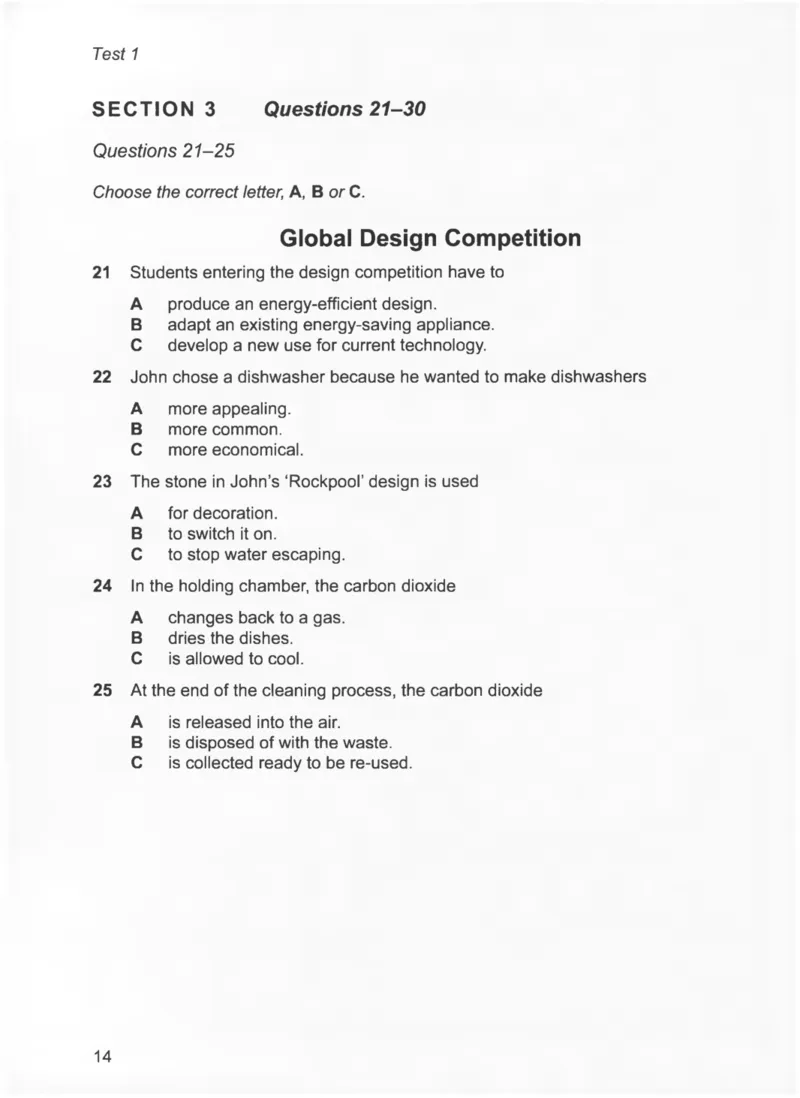
Global Design Competition
21 Students entering the design competition have to
A produce an energy-efficient design.
B adapt an existing energy-saving appliance.
C develop a new use for current technology.
22 John chose a dishwasher because he wanted to make dishwashers
A more appealing.
B more common.
C more economical.
23 The stone in John’s ‘Rockpool~design is used
A for decoration.
B to switch it on.
C to stop water escaping.
24 In the holding chamber, the carbon dioxide
A changes back to a gas.
B dries the dishes.
C is allowed to cool.
25 At the end of the cleaning process, the carbon dioxide
A is released into the air.
B is disposed of with the waste.
C is collected ready to be re-used.
14Listening
Questions 26-30
Complete the notes below.
Write ONE WORD ONLY for each answer.
• John needs help preparing for his 26..................
• The professor advises John to make a 27..............................of his design.
• John’s main problem is getting good quality 28
• The professor suggests John apply for a 29
• The professor will check the 30............................ ... information in John’s written
report.
15Test 1
SECTION 4 Questions 31+40
Complete the notes below.
Write ONE WORD ONLY for each answer.
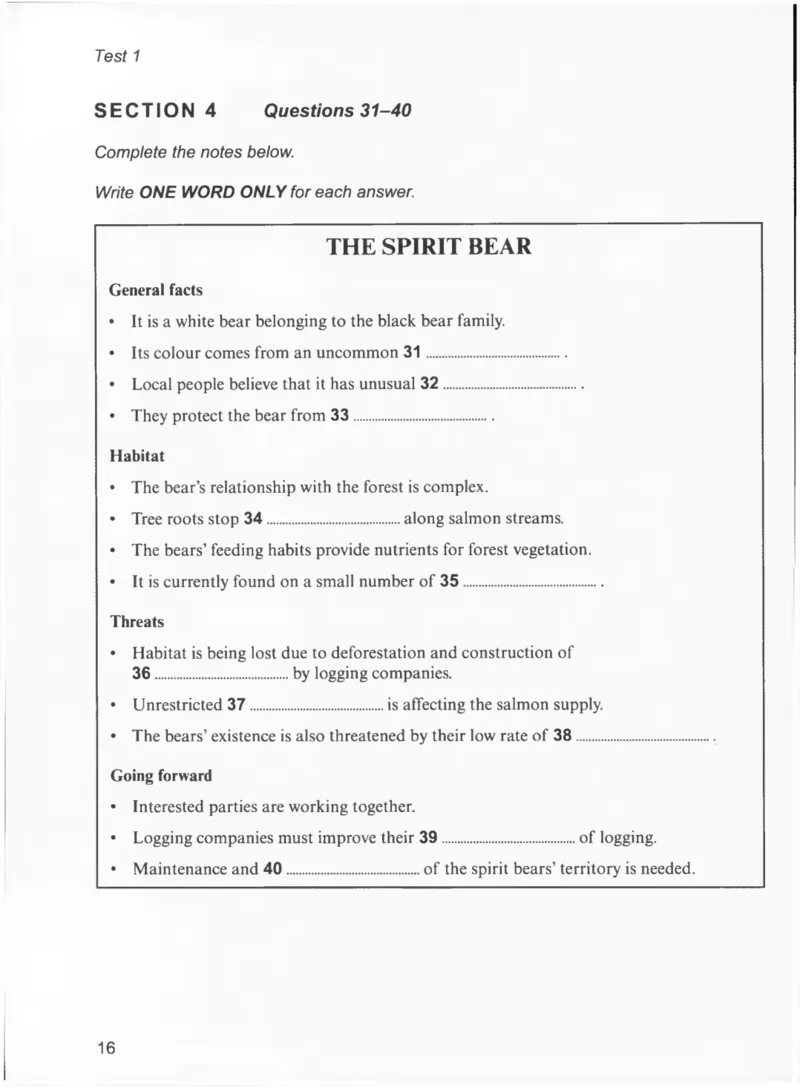
THE SPIRIT BEAR
General facts
• It is a white bear belonging to the black bear family.
• Its colour comes from an uncommon 31.................................
• Local people believe that it has unusual 32.................................
• They protect the bear from 33................................
Habitat
• The bear’s relationship with the forest is complex.
• Tree roots stop 34...............................along salmon streams.
• The bears’ feeding habits provide nutrients for forest vegetation.
• It is currently found on a small number of 35................................
Threats
• Habitat is being lost due to deforestation and construction of
36...............................by logging companies.
• Unrestricted 37...............................is affecting the salmon supply.
• The bears’ existence is also threatened by their low rate of 38............................
Going forward
• Interested parties are working together.
• Logging companies must improve their 39...............................of logging.
• Maintenance and 40...............................of the spirit bears9 territory is needed.
16Reading
READING
READING PASSAGE 1
You should spend about 20 minutes on Questions 1-13, which are based on
Reading Passage 1 below.
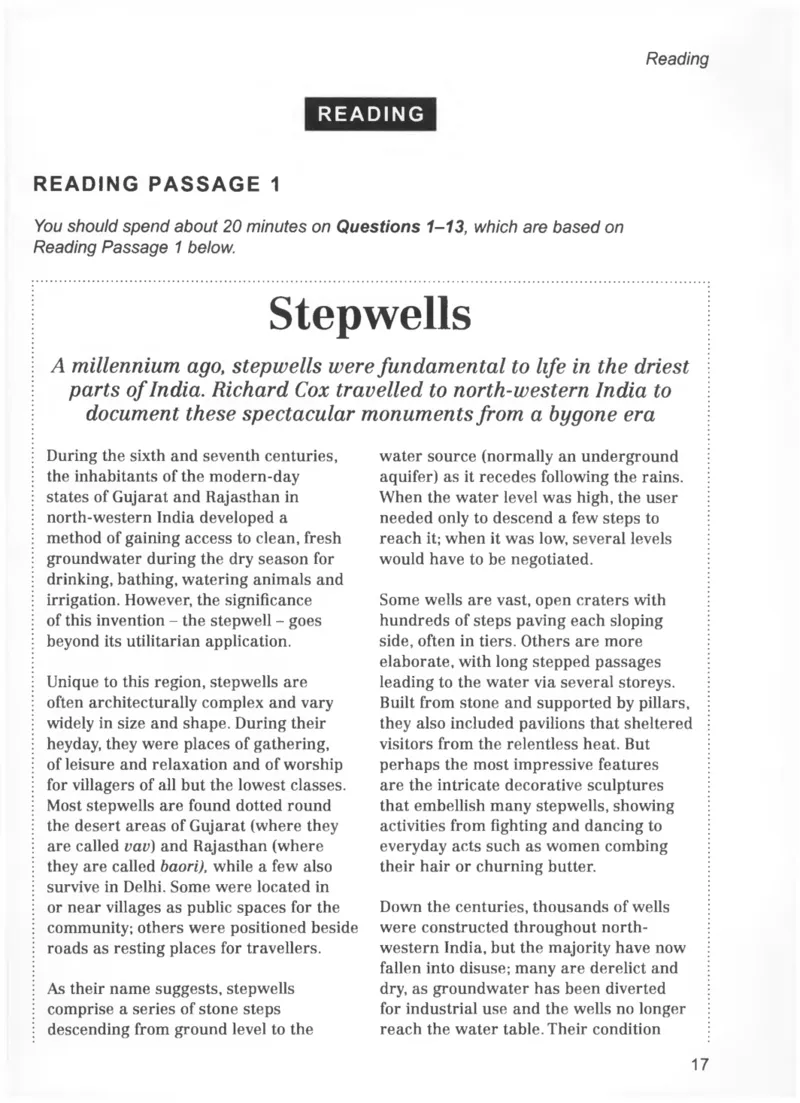
Stepwells
A millennium ago, stepwells were fundamental to life in the driest
parts of India. Richard Cox travelled to north-western India to
document these spectacular monuments from a bygone era
During the sixth and seventh centuries, water source (normally an underground
the inhabitants of the modern-day aquifer) as it recedes following the rains.
states of Gujarat and Rajasthan in When the water level was high, the user
north-western India developed a needed only to descend a few steps to
method of gaining access to clean, fresh reach it; when it was low, several levels
groundwater during the dry season for would have to be negotiated.
drinking, bathing, watering animals and
irrigation. However, the significance Some wells are vast, open craters with
of this invention - the stepwell - goes hundreds of steps paving each sloping
beyond its utilitarian application. side, often in tiers. Others are more
elaborate, with long stepped passages
Unique to this region, stepwells are leading to the water via several storeys.
often architecturally complex and vary Built from stone and supported by pillars,
widely in size and shape. During their they also included pavilions that sheltered
heyday, they were places of gathering, visitors from the relentless heat. But
of leisure and relaxation and of worship perhaps the most impressive features
for villagers of all but the lowest classes. are the intricate decorative sculptures
Most stepwells are found dotted round that embellish many stepwells, showing
the desert areas of Gujarat (where they activities from fighting and dancing to
are called vav) and Rajasthan (where everyday acts such as women combing
they are called baori), while a few also their hair or churning butter.
survive in Delhi. Some were located in
or near villages as public spaces for the Down the centuries, thousands of wells
community; others were positioned beside were constructed throughout north
roads as resting places for travellers. western India, but the majority have now
fallen into disuse; many are derelict and
As their name suggests, stepwells dry, as groundwater has been diverted
comprise a series of stone steps for industrial use and the wells no longer
descending from ground level to the reach the water table. Their condition
17Test 1
Raniji Ki
hasn’t been helped by recent dry spells: One of the larger examples is
Baori,
southern Rajasthan suffered an eight-year which was built by the queen of the
drought between 1996 and 2004. region, Nathavatji, in 1699. At 46 metres
deep, 20 metres wide and 40 metres long,
However, some important sites in the intricately carved monument is one of
baoris
Gujarat have recently undergone major 21 commissioned in the Bundi area
restoration, and the state government by Nathavatji.
announced in June last year that it plans
to restore the stepwells throughout the In the old ruined town of Abhaneri, about
Chand
state. 95 kilometres east of Jaipur, is
Baori
one of India’s oldest and deepest
,
In Patan, the state’s ancient capital, the wells; aesthetically it’s perhaps one of the
Rani Ki Vav
stepwell of (Queen’s Stepwell) most dramatic. Built in around 850 AD
is perhaps the finest current example. next to the temple of Harshat Mata, the
baori
It was built by Queen Udayamati during comprises hundreds of zigzagging
the late 11th century, but became silted steps that run along three of its sides,
up following a flood during the 13th steeply descending 11 storeys, resulting
century. But the Archaeological Survey in a striking pattern when seen from afar.
of India began restoring it in the 1960s, On the fourth side, verandas which are
and today it is in pristine condition. At supported by ornate pillars overlook the
65 metres long, 20 metres wide and 27 steps.
Rani Ki Vav
metres deep, features 500
Neemrana Ki Baori,
sculptures carved into niches throughout Still in public use is
the monument. Incredibly, in January located just off the Jaipur-Delhi highway.
2001, this ancient structure survived an Constructed in around 1700~it is nine
earthquake that measured 7.6 on the storeys deep, with the last two being
Richter scale. underwater. At ground level, there are
86 colonnaded openings from where the
Surya Kund
Another example is the in visitor descends 170 steps to the deepest
Modhera, northern Gujarat, next to the water source.
Sun Temple, built by King Bhima I in 1026
to honour the sun god Surya. It actually Today, following years of neglect, many of
(kund
resembles a tank means reservoir these monuments to medieval engineering
or pond) rather than a well, but displays have been saved by the Archaeological
the hallmarks of stepwell architecture, Survey of India, which has recognised the
including four sides of steps that descend importance of preserving them as part of
to the bottom in a stunning geometrical the country’s rich history. Tourists flock
formation. The terraces house 108 small, to wells in far-flung corners of north
intricately carved shrines between the western India to gaze in wonder at these
sets of steps. architectural marvels from hundreds of
years ago, which serve as a reminder of
Rajasthan also has a wealth of wells. both the ingenuity and artistry of ancient
The ancient city of Bundi, 200 kilometres civilisations and of the value of water to
south of Jaipur, is renowned for its human existence.
architecture, including its stepwells.
18Reading
Questions 1-5
Do the following statements agree with the information given in Reading Passage 1?
In boxes 1-5 on your answer sheet, write
TRUE if the statement agrees with the information
FALSE if the statement contradicts the information
NOT GIVEN if there is no information on this
1 Examples of ancient stepwells can be found all over the world.
2 Stepwells had a range of functions, in addition to those related to water collection.
3 The few existing stepwells in Delhi are more attractive than those found elsewhere.
4 It took workers many years to build the stone steps characteristic of stepwells.
5 The number of steps above the water level in a stepwell altered during the course
of a year.
Questions 6-8
Answer the questions below.
Choose ONE WORD ONLY from the passage for each answer.
Write your answers in boxes 6-8 on your a/7svi/e厂 sheet.
6 Which part of some stepwells provided shade for people?
7 What type of serious climatic event, which took place in southern Rajasthan, is
mentioned in the article?
8 Who are frequent visitors to stepwells nowadays?
19Test 1
Questions 9-13
Complete the table below.
Choose ONE WORD AND/OR A NUMBER from the passage for each answer.
Write your answers in boxes 9-13 on your answer sheet.
Stepwell Date Features Other notes
Rani Ki Vav Late As many as 500 Restored in the 1960s
11th sculptures decorate the
century monument Excellent condition, despite
the 9 ...............of 2001
Surya Kund 1026 Steps on the Looks more like a
10...............produce a 11...............than a well
geometrical pattern
Carved shrines
Raniji Ki 1699 Intricately carved One of 21 baoris in the area
Saon monument commissioned by Queen
Nathavatji
Chand Baori 850 AD Steps take you down 11 Old, deep and very
storeys to the bottom dramatic
Has 12...............which
provide a view of the steps
Neemrana 1700 Used by public today
Has two 13...............
Ki Baori
levels
20Reading
READING PASSAGE 2
You should spend about 20 minutes on Questions 14-26, which are based on Reading
Passage 2 on the following pages.
Questions 14-21
Reading Passage 2 has nine paragraphs, A-l.
Choose the correct heading for paragraphs A-E and G-l from the list of headings below.
Write the correct number, i-xi, in boxes 14-21 on your answer sheet.
List of Headings
i A fresh and important long-term goal
ii Charging for roads and improving other transport methods
iii Changes affecting the distances goods may be transported
iv Taking all the steps necessary to change transport patterns
V The environmental costs of road transport
vi The escalating cost of rail transport
vii The need to achieve transport rebalance
viii The rapid growth of private transport
ix Plans to develop major road networks
X Restricting road use through charging policies alone
xi Transport trends in countries awaiting EU admission
14 Paragraph A 19 Paragraph G
15 Paragraph B 20 Paragraph H
16 Paragraph C 21 Paragraph I
17 Paragraph D
18 Paragraph E
Example Answer
Paragraph F vii
21Test 1
EUROPEA N TRA NSPORT SYSTE M S
1 9 9 0 - 2 0 1 0
What have been the trends and what are the prospects for
European transport systems?
A It is difficult to conceive of vigorous economic growth without an efficient transport
system. Although modern information technologies can reduce the demand for physical
transport by facilitating teleworking and teleservices, the requirement for transport
continues to increase. There are two key factors behind this trend. For passenger
transport, the determining factor is the spectacular growth in car use. The number
of cars on European Union (EU) roads saw an increase of three million cars each year
from 1990 to 2010, and in the next decade the EU will see a further substantial
increase in its fleet.
B As far as goods transport is concerned, growth is due to a large extent to changes in
the European economy and its system of production. In the last 20 years, as internal
frontiers have been abolished, the EU has moved from a ‘stock’ economy to a 'flow*
economy. This phenomenon has been emphasised by the relocation of some industries,
particularly those which are labour intensive, to reduce production costs, even though
the production site is hundreds or even thousands of kilometres away from the final
assembly plant or away from users.
C The strong economic growth expected in countries which are candidates for entry to
the EU will also increase transport flows, in particular road haulage traffic. In 1998,
some of these countries already exported more than twice their 1990 volumes and
imported more than five times their 1990 volumes. And although many candidate
countries inherited a transport system which encourages rail, the distribution between
modes has tipped sharply in favour of road transport since the 1990s. Between
1990 and 1998~road haulage increased by 19.4%, while during the same period rail
haulage decreased by 43.5%, although - and this could benefit the enlarged EU 一 it is
still on average at a much higher level than in existing member states.
D However, a new imperative - sustainable development - offers an opportunity for
adapting the EU,s common transport policy. This objective, agreed by the Gothenburg
European Council, has to be achieved by integrating environmental considerations
into Community policies, and shifting the balance between modes of transport lies at
the heart of its strategy. The ambitious objective can only be fully achieved by 2020,
but proposed measures are nonetheless a first essential step towards a sustainable
transport system which will ideally be in place in 30 years’ time, that is by 2040.
22Reading
E In 1998,energy consumption in the transport sector was to blame for 28% of
emissions of CCI2~the leading greenhouse gas. According to the latest estimates, if
nothing is done to reverse the traffic growth trend, GO2 emissions from transport can
be expected to increase by around 50% to 1,113 billion tonnes by 2020, compared
with the 739 billion tonnes recorded in 1990. Once again, road transport is the main
culprit since it alone accounts for 84% of the CO2 emissions attributable to transport.
Using alternative fuels and improving energy efficiency is thus both an ecological
necessity and a technological challenge.
F At the same time greater efforts must be made to achieve a modal shift. Such a
change cannot be achieved overnight, all the less so after over half a century of
constant deterioration in favour of road. This has reached such a pitch that today rail
freight services are facing marginalisation, with just 8% of market share, and with
international goods trains struggling along at an average speed of 1 巳km/h. Three
possible options have emerged.
G The first approach would consist of focusing on road transport solely through pricing.
This option would not be accompanied by complementary measures in the other modes
of transport. In the short term it might curb the growth in road transport through
the better loading ratio of goods vehicles and occupancy rates of passenger vehicles
expected as a result of the increase in the price of transport. However, the lack of
measures available to revitalise other modes of transport would make it impossible for
more sustainable modes of transport to take up the baton.
H The second approach also concentrates on road transport pricing but is accompanied
by measures to increase the efficiency of the other modes (better quality of services,
logistics, technology). However, this approach does not include investment in new
infrastructure, nor does it guarantee better regional cohesion. It could help to achieve
greater uncoupling than the first approach, but road transport would keep the lion’s
share of the market and continue to concentrate on saturated arteries, despite being
the most polluting of the modes. It is therefore not enough to guarantee the necessary
shift of the balance.
I The third approach, which is not new, comprises a series of measures ranging from
pricing to revitalising alternative modes of transport and targeting investment in the
trans-European network. This integrated approach would allow the market shares of
the other modes to return to their 1998 levels and thus make a shift of balance. It is
far more ambitious than it looks, bearing in mind the historical imbalance in favour of
roads for the last fifty years, but would achieve a marked break in the link between road
transport growth and economic growth, without placing restrictions on the mobility of
people and goods.
23Test 1
Questions 22-26
Do the following statements agree with the information given in Reading Passage 2?
In boxes 22-26 on your answer sheet, write
TRUE if the statement agrees with the information
FALSE if the statement contradicts the information
NOT GIVEN if there is no information on this
22 The need for transport is growing, despite technological developments.
23 To reduce production costs, some industries have been moved closer to their
relevant consumers.
24 Cars are prohibitively expensive in some EU candidate countries.
25 The Gothenburg European Council was set up 30 years ago.
26 By the end of this decade, C〇2 emissions from transport are predicted to reach
739 billion tonnes.
24Reading
READING PASSAGE 3
You should spend about 20 minutes on Questions 27-40 which are based on Reading
,
Passage 3 below.
The psychology of innovation
Why are so few companies truly innovative?
Innovation is key to business survival, and who owned Sun, wanted to revolutionise
companies put substantial resources into popular music with songs that fused
inspiring employees to develop new ideas. black and white music, and country and
There are, nevertheless, people working in blues. Presley, Cash, Perkins and Lewis
luxurious, state-of-the-art centres designed instinctively understood Phillips’s ambition
to stimulate innovation who find that their and believed in it. Orbison wasn’t inspired
environment doesn’t make them feel at all by the goal, and only ever achieved one hit
creative. And there are those who don’t with the Sun label.
have a budget, or much space, but who
innovate successfully. The value fit matters, says Cialdini,
because innovation is, in part, a process
For Robert B. Cialdini, Professor of of change, and under that pressure we,
Psychology at Arizona State University, as a species, behave differently, ‘When
one reason that companies don’t succeed things change, we are hard-wired to
as often as they should is that innovation play it safe.~Managers should therefore
starts with recruitment. Research shows adopt an approach that appears counter
that the fit between an employee’s values intuitive - they should explain what stands
and a company’s values makes a difference to be lost if the company fails to seize a
to what contribution they make and particular opportunity. Studies show that
whether, two years after they join, they’re we invariably take more gambles when
still at the company. Studies at Harvard threatened with a loss than when offered a
Business School show that, although some reward.
individuals may be more creative than
others, almost every individual can be Managing innovation is a delicate art.
creative in the right circumstances. It’s easy for a company to be pulled in
conflicting directions as the marketing,
One of the most famous photographs in the product development, and finance
story of rock’n’roll emphasises Cialdini’s departments each get different feedback
views. The 1956 picture of singers Elvis from different sets of people. And without
Presley, Carl Perkins, Johnny Cash and a system which ensures collaborative
Jerry Lee Lewis jamming at a piano in Sun exchanges within the company, it’s also
Studios in Memphis tells a hidden story. easy for small ‘pockets of innovation~to
Sun’s ‘million-dollar quartet~could have disappear. Innovation is a contact sport.
been a quintet. Missing from the picture You can’t brief people just by saying, ‘We’re
is Roy Orbison, a greater natural singer going in this direction and I~m going to take
than Lewis, Perkins or Cash. Sam Phillips, you with me/
25Test 1
Cialdini believes that this ‘follow-the- packets encouraged us to write in saying,
leader syndrome,is dangerous, not least in no more than 10 words: ‘I like Kellogg’s
because it encourages bosses to go it Com Flakes because... •’ The very act of
alone. ‘It’s been scientifically proven that writing makes us more likely to believe it.
three people will be better than one at
solving problems, even if that one person Authority doesn’t have to inhibit innovation
is the smartest person in the field.,To but it often does. The wrong kind of
prove his point, Cialdini cites an interview leadership will lead to what Cialdini calls
with molecular biologist James Watson. ‘captainitis~the regrettable tendency
Watson, together with Francis Crick, of team members to opt out of team
discovered the structure of DNA, the responsibilities that are properly theirs' He
genetic information carrier of all living calls it captainitis because, he says, ‘crew
organisms. ‘When asked how they had members of multipilot aircraft exhibit a
cracked the code ahead of an array of sometimes deadly passivity when the flight
highly accomplished rival investigators, he captain makes a clearly wrong-headed
said something that stunned me. He said decision’. This behaviour is not, he says,
he and Crick had succeeded because they unique to air travel, but can happen in any
were aware that they weren’t the most workplace where the leader is overbearing.
intelligent of the scientists pursuing the
answer. The smartest scientist was called At the other end of the scale is the 1980s
Rosalind Franklin who, Watson said, “was Memphis design collective, a group of
so intelligent she rarely sought advice' , young designers for whom ‘the only
rule was that there were no rules' This
Teamwork taps into one of the basic environment encouraged a free interchange
drivers of human behaviour. ‘The principle of ideas, which led to more creativity with
of social proof is so pervasive that we don’t form, function, colour and materials that
even recognise it~~says Cialdini. ‘If your revolutionised attitudes to furniture design.
project is being resisted, for example, by a
group of veteran employees, ask another Many theorists believe the ideal boss
old-timer to speak up for it.’ Cialdini is not should lead from behind, taking pride in
alone in advocating this strategy. Research collective accomplishment and giving
shows that peer power, used horizontally credit where it is due. Cialdini says:
not vertically, is much more powerful than ‘Leaders should encourage everyone to
any boss’s speech. contribute and simultaneously assure all
concerned that every recommendation is
Writing, visualising and prototyping can important to making the right decision and
stimulate the flow of new ideas. Cialdini will be given full attention., The frustrating
cites scores of research papers and thing about innovation is that there are
historical events that prove that even many approaches, but no magic formula.
something as simple as writing deepens However, a manager who wants to create
every individual^ engagement in the a truly innovative culture can make their
project. It is, he says, the reason why all job a lot easier by recognising these
those competitions on breakfast cereal psychological realities.
26Reading
Questions 27-30
Choose the correct letter, A, B, C or D.
Write the correct letter in boxes 27-30 on your answer sheet
27 The example of the ‘million-dollar quartet~underlines the writer’s point about
recognising talent,
!
working as a team,
"
having a shared objective,
# being an effective leader.
28 James Watson suggests that he and Francis Crick won the race to discover the
DNA code because they
A were conscious of their own limitations.
B brought complementary skills to their partnership.
C were determined to outperform their brighter rivals.
D encouraged each other to realise their joint ambition.
29 The writer mentions competitions on breakfast cereal packets as an example of
how to
A inspire creative thinking.
B generate concise writing.
C promote loyalty to a group.
D strengthen commitment to an idea.
30 In the last paragraph, the writer suggests that it is important for employees to
be aware of their company s goals.
!
feel that their contributions are valued.
"
have respect for their co-workers’ achievements.
# understand why certain management decisions are made.
27Test 1
Questions 31—35
Complete each sentence with the correct ending, A-G, below.
Write the correct letter A-G, in boxes 31-35 on your answer sheet.
,
31 Employees whose values match those of their employers are more likely to
32 At times of change, people tend to
33 If people are aware of what they might lose, they will often
34 People working under a dominant boss are liable to
35 Employees working in organisations with few rules are more likely to
A take chances.
B share their ideas.
C become competitive.
D get promotion.
E avoid risk.
F ignore their duties.
G remain in their jobs.
28Reading
Questions 36-40
Do the following statements agree with the claims of the writer in Reading Passage 3?
In boxes 36-40 on your answer sheet, write
YES if the statement agrees with the claims of the writer
NO if the statement contradicts the claims of the writer
NOT GIVEN if it is impossible to say what the writer thinks about this
36 The physical surroundings in which a person works play a key role in determining
their creativity.
37 Most people have the potential to be creative.
38 Teams work best when their members are of equally matched intelligence.
39 It is easier for smaller companies to be innovative.
40 A manager’s approval of an idea is more persuasive than that of a colleague.
29Test 1
WRITING
WRITING TASK 1
You should spend about 20 minutes on this task.
The first chart below shows how energy is used in an average Australian
household. The second chart shows the greenhouse gas emissions which
result from this energy use.
Summarise the information by selecting and reporting the main features, and
make comparisons where relevant
Write at least 150 words.
Australian household energy use
water heating
30%
heating
42%
refrigeration
7%
cooling other appliances
2% 15%
lighting
4%
Australian household greenhouse gas emissions
heating
30Writing
WRITING TASK 2
You should spend about 40 minutes on this task.
Present a written argument or case to an educated reader with no specialist knowledge
of the following topic.
It is important for children to learn the difference between right and wrong at
an early age. Punishment is necessary to help them learn this distinction.
To what extent do you agree or disagree with this opinion?
What sort of punishment should parents and teachers be allowed to use to
teach good behaviour to children?
Give reasons for your answer and include any relevant examples from your own
knowledge or experience.
Write at least 250 words.
31Test 1
SPEAKING
PART 1
The examiner asks the candidate about him/herself, his/her home, work or studies and
other familiar topics.
EXAMPLE
Weekends
• How do you usually spend your weekends? [Why?]
• Which is your favourite part of the weekend? [Why?]
• Do you think your weekends are long enough? [Why/Why not?]
• How important do you think it is to have free time at the weekends? [Why?]
PART 2
Describe someone you know who You will have to talk about the topic for
does something well. one to two minutes.
You have one minute to think about
You should say: what you are going to say.
who this person is You can make some notes to help you
how you know this person if you wish.
what they do well
and explain why you think this
person is so good at doing this.
PART 3
Discussion topics:
Skills and abilities
Example questions:
What skills and abilities do people most want to have today? Why?
Which skills should children learn at school? Are there any skills which they should learn
at home? What are they?
Which skills do you think will be important in the future? Why?
Salaries for skilled people
Example questions:
Which kinds of jobs have the highest salaries in your country? Why is this?
Are there any other jobs that you think should have high salaries? Why do you think that?
Some people say it would be better for society if everyone got the same salary. What do
you think about that? Why?
32Listening
Test 2
LISTENING
SECTION 1 Questions 1+10
Complete the notes below.
Write ONE WORD AND/OR A NUMBER for each answer.
Transport Survey
Example
Travelled to town today: by............bus............
Name: Luisa 1...............................
Address: 2 ...............................White Stone Rd
Area: Bradfield
Postcode: 3 ...............................
Occupation: 4 ...............................
Reason for visit to town: to go to the 5............................
Suggestions for improvement:
• better 6 ...............................
• have more footpaths
• more frequent 7 ................................
33Test 2
Things that would encourage cycling to work:
• having 8 ...............................parking places for bicycles
• being able to use a 9 ...............................at work
• the opportunity to have cycling 10...............................on busy roads
34Listening
SECTION 2 Questions 11+20
Questions 11-14
Choose the correct letter, A, S or C.
New city developments
11 The idea for the two new developments in the city came from
! local people,
$ the City Council,
the SWRDC.
12 What is unusual about Brackenside pool?
its architectural style
!
its heating system
$
its method of water treatment
13 Local newspapers have raised worries about
A the late opening date.
B the cost of the project.
C the size of the facilities.
14 What decision has not yet been made about the pool?
A whose statue will be at the door
B the exact opening times
C who will open it
35Test 2
Questions 15-20
Which feature is related to each of the following areas of the world represented in the
playground?
Choose SIX answers from the box and write the correct letter, A-l, next to questions
15-20.
Features
A ancient forts
B waterways
C ice and snow
D jewels
E local animals
F mountains
G music and film
H space travel
I volcanoes
Areas of the world
15 Asia ......
16 Antarctica ......
17 South America ......
18 North America ......
19 Europe ‹
20 Africa ‹
36Listening
SECTION 3 Questions 21 +30
Questions 21 and 22
Choose TWO letters, A-E.
Which TWO hobbies was Thor Heyerdahl very interested in as a youth?
camping
!
climbing
" collecting
# hunting
%
reading
Questions 23 and 24
Choose TWO letters, A-E.
Which do the speakers say are the TWO reasons why Heyerdahl went to live on
an island?
to examine ancient carvings
!
to experience an isolated place
" to formulate a new theory
# to learn survival skills
%
to study the impact of an extreme environment
37Test 2
Questions 25-30
Choose the correct letter, A, B or C.
The later life of Thor Heyerdahl
25 According to Victor and Olivia, academics thought that Polynesian migration from
the east was impossible due to
A the fact that Eastern countries were far away.
B the lack of materials for boat building.
C the direction of the winds and currents.
26 Which do the speakers agree was the main reason for Heyerdahl’s raft journey?
A to overcome a research setback
B to demonstrate a personal quality
C to test a new theory
27 What was most important to Heyerdahl about his raft journey?
A the fact that he was the first person to do it
B the speed of crossing the Pacific
C the use of authentic construction methods
28 Why did Heyerdahl go to Easter Island?
A to build a stone statue
B to sail a reed boat
C to learn the local language
29 In Olivia's opinion, Heyerdahl’s greatest influence was on
A theories about Polynesian origins.
B the development of archaeological methodology.
C establishing archaeology as an academic subject.
30 Which criticism do the speakers make of William Oliver’s textbook?
A Its style is out of date.
B Its content is over-simplified.
C Its methodology is flawed.
38Listening
SECTION 4 Questions 31 +40
Complete the notes below.
Write ONE WORD ONLY for each answer.
THE FUTURE OF MANAGEMENT
Business markets
• greater 31...............................among companies
• increase in power of large 32..................................companies
• rising 33................................in certain countries
External influences on businesses
• more discussion with 34................................before making business decisions
• environmental concerns which may lead to more 35................................
Business structures
• more teams will be formed to work on a particular 36................................
• businesses may need to offer hours that are 37............................... or the
chance to work remotely
Management styles
• increasing need for managers to provide good 38.................................
• changes influenced by 39.................................taking senior roles
39Test 2
Changes in the economy
• service sector continues to be important
• increasing value of intellectual property
• more and more 40...............................workers
40Reading
READING
READING PASSAGE 1
You should spend about 20 minutes on Questions 1-13, which are based on Reading
Passage 1 on the following pages.
Questions 1-7
Reading Passage 1 has seven paragraphs, A-G.
Choose the correct heading for each paragraph from the list of headings below.
Write the correct number, i-ix, in boxes 1-7 on your answer sheet.
List of Headings
i The search for the reasons for an increase in population
ii Industrialisation and the fear of unemployment
iii The development of cities in Japan
iv The time and place of the Industrial Revolution
V The cases of Holland, France and China
vi Changes in drinking habits in Britain
vii Two keys to Britain's industrial revolution
viii Conditions required for industrialisation
ix Comparisons with Japan lead to the answer
1 Paragraph A
2 Paragraph B
3 Paragraph C
4 Paragraph D
5 Paragraph E
6 Paragraph F
7 Paragraph G
41Test 2
Tea and the Industrial Revolution
A Cambridge professor says that a change in drinking habits was the reason for
the Industrial Revolution in Britain. Anjana Ahuja reports
A Alan Macfarlane, professor of anthropological science at Kings College, Cambridge, has, like
other historians, spent decades wrestling with the enigma of the Industrial Revolution. Why
did this particular Big Bang the world-changing birth of industry — happen in Britain? And
—
why did it strike at the end of the 18th century?
B Macfarlane compares the puzzle to a combination lock. 'There are about 20 different
factors and all of them need to be present before the revolution can happen,5 he says. For
industry to take off, there needs to be the technology and power to drive factories, large
urban populations to provide cheap labour, easy transport to move goods around, an
affluent middle-class willing to buy mass-produced objects, a market-driven economy and
a political system that allows this to happen. While this was the case for England, other
nations, such as Japan, the Netherlands and France also met some of these criteria but were
not industrialising. All these factors must have been necessary but not sufficient to cause the
revolution,,says Macfarlane. ‘After all, Holland had everything except coal, while China also
had many of these factors. Most historians are convinced there are one or two missing factors
that you need to open the lock.,
C The missing factors, he proposes, are to be found in almost every kitchen cupboard. Tea and
beer, two of the nations favourite drinks, fuelled the revolution. The antiseptic properties
of tannin, the active ingredient in tea, and of hops in beer - plus the fact that both are
made with boiled water 一 allowed urban communities to flourish at close quarters without
succumbing to water-borne diseases such as dysentery. The theory sounds eccentric but once
he starts to explain the detective work that went into his deduction, the scepticism gives
way to wary admiration. Macfarlanes case has been strengthened by support from notable
quarters - Roy Porter, the distinguished medical historian, recently wrote a favourable
appraisal of his research.
D Macfarlane had wondered for a long time how the Industrial Revolution came about.
Historians had alighted on one interesting factor around the mid-18th century that required
explanation. Between about 1650 and 1740, the population in Britain was static. But then
there was a burst in population growth. Macfarlane says: ‘The infant mortality rate halved
in the space of 20 years, and this happened in both rural areas and cities, and across all
classes. People suggested four possible causes. Was there a sudden change in the viruses and
bacteria around? Unlikely. Was there a revolution in medical science? But this was a century
before Listers revolution*. Was there a change in environmental conditions? There were
improvements in agriculture that wiped out malaria, but these were small gains. Sanitation
did not become widespread until the 19th century. The only option left is food. But the
height and weight statistics show a decline. So the food must have got worse. Efforts to
explain this sudden reduction in child deaths appeared to draw a blank.,
* Joseph Lister was the first doctor to use antiseptic techniques during surgical operations to prevent infections.
42Reading
E This population burst seemed to happen at just the right time to provide labour for the
Industrial Revolution. ‘When you start moving towards an industrial revolution, it is
economically efficient to have people living close together,’ says Macfarlane. ‘But then you
get disease, particularly from human waste.’ Some digging around in historical records
revealed that there was a change in the incidence of water-borne disease at that time,
especially dysentery. Macfarlane deduced that whatever the British were drinking must have
been important in regulating disease. He says, ‘We drank beer. For a long time, the English
were protected by the strong antibacterial agent in hops, which were added to help preserve
the beer. But in the late 17th century a tax was introduced on malt, the basic ingredient of
beer. The poor turned to water and gin and in the 1720s the mortality rate began to rise
again. Then it suddenly dropped again. What caused this?,
F Macfarlane looked to Japan, which was also developing large cities about the same time,
and also had no sanitation. Water-borne diseases had a much looser grip on the Japanese
population than those in Britain. Could it be the prevalence of tea in their culture?
Macfarlane then noted that the history of tea in Britain provided an extraordinary
coincidence of dates. Tea was relatively expensive until Britain started a direct clipper trade
with China in the early 18th century. By the 1740s, about the time that infant mortality
was dipping, the drink was common. Macfarlane guessed that the fact that water had to
be boiled, together with the stomach-purifying properties of tea meant that the breast
milk provided by mothers was healthier than it had ever been. No other European nation
sipped tea like the British, which, by Macfarlanes logic, pushed these other countries out of
contention for the revolution.
G But, if tea is a factor in the combination lock, why didn’t Japan forge ahead in a tea-soaked
industrial revolution of its own? Macfarlane notes that even though 17th-century Japan had
large cities, high literacy rates, even a futures market, it had turned its back on the essence
of any work-based revolution by giving up labour-saving devices such as animals, afraid that
they would put people out of work. So, the nation that we now think of as one of the most
technologically advanced entered the 19th century having abandoned the wheel5.
43Test 2
Questions 8-13
Do the following statements agree with the information given in Reading Passage 1?
In boxes 8-13 on your answer sheet, write
TRUE if the statement agrees with the information
FALSE if the statement contradicts the information
NOT GIVEN if there is no information on this
8 China’s transport system was not suitable for industry in the 18th century.
9 Tea and beer both helped to prevent dysentery in Britain.
10 Roy Porter disagrees with Professor Macfarlane’s findings.
11 After 1740~there was a reduction in population in Britain.
12 People in Britain used to make beer at home.
13 The tax on malt indirectly caused a rise in the death rate.
44Reading
READING PASSAGE 2
You should spend about 20 minutes on Questions 14-26, which are based on
Reading Passage 2 below.
Gifted children and learning
A Internationally, /giftedness/ is most frequently determined by a score on a
general intelligence test, known as an IQ test, which is above a chosen cut
off point, usually at around the top 2-5%. Children's educational environment
contributes to the IQ score and the way intelligence is used. For example,
a very close positive relationship was found when children's IQ scores were
compared with their home educational provision (Freeman, 2010). The higher
the children's IQ scores, especially over IQ 130, the better the quality of their
educational backup, measured in terms of reported verbal interactions with
parents, number of books and activities in their home etc. Because IQ tests are
decidedly influenced by what the child has learned, they are to some extent
measures of current achievement based on age-norms; that is, how well the
children have learned to manipulate their knowledge and know-how within the
terms of the test. The vocabulary aspect, for example, is dependent on having
heard those words. But IQ tests can neither identify the processes of learning
and thinking nor predict creativity.
B Excellence does not emerge without appropriate help. To reach an
exceptionally high standard in any area very able children need the means to
learn, which includes material to work with and focused challenging tuition
- and the encouragement to follow their dream. There appears to be a
qualitative difference in the way the intellectually highly able think, compared
with more average-ability or older pupils, for whom external regulation by the
teacher often compensates for lack of internal regulation. To be at their most
effective in their self-regulation, all children can be helped to identify their own
ways of learning - metacognition - which will include strategies of planning,
monitoring, evaluation, and choice of what to learn. Emotional awareness is
also part of metacognition, so children should be helped to be aware of their
feelings around the area to be learned, feelings of curiosity or confidence, for
example.
C High achievers have been found to use self-regulatory learning strategies
more often and more effectively than lower achievers, and are better able to
transfer these strategies to deal with unfamiliar tasks. This happens to such a
high degree in some children that they appear to be demonstrating talent in
particular areas. Overviewing research on the thinking process of highly able
45Test 2
children, (Shore and Kanevsky, 1993) put the instructor's problem succinctly:
If they [the gifted] merely think more quickly, then we need only teach more
quickly. If they merely make fewer errors, then we can shorten the practice'. But
of course, this is not entirely the case; adjustments have to be made in methods
of learning and teaching, to take account of the many ways individuals think.
D Yet in order to learn by themselves, the gifted do need some support from their
teachers. Conversely, teachers who have a tendency to 'overdirect' can diminish
their gifted pupils' learning autonomy. Although 'spoon-feeding' can produce
extremely high examination results, these are not always followed by equally
impressive life successes. Too much dependence on the teacher risks loss of
autonomy and motivation to discover. However, when teachers help pupils to
reflect on their own learning and thinking activities, they increase their pupils'
self-regulation. For a young child, it may be just the simple question 'What have
you learned today?' which helps them to recognise what they are doing. Given
that a fundamental goal of education is to transfer the control of learning from
teachers to pupils, improving pupils' learning to learn techniques should be a
major outcome of the school experience, especially for the highly competent.
There are quite a number of new methods which can help, such as child-
initiated learning, ability-peer tutoring, etc. Such practices have been found to
be particularly useful for bright children from deprived areas.
E But scientific progress is not all theoretical, knowledge is also vital to
outstanding performance: individuals who know a great deal about a specific
domain will achieve at a higher level than those who do not (Elshout, 1995).
Research with creative scientists by Simonton (1988) brought him to the
conclusion that above a certain high level, characteristics such as independence
seemed to contribute more to reaching the highest levels of expertise than
intellectual skills, due to the great demands of effort and time needed for
learning and practice. Creativity in all forms can be seen as expertise mixed
with a high level of motivation (Weisberg, 1993).
F To sum up, learning is affected by emotions of both the individual and
significant others. Positive emotions facilitate the creative aspects of learning
and negative emotions inhibit it. Fear, for example, can limit the development
of curiosity, which is a strong force in scientific advance, because it motivates
problem-solving behaviour. In Boekaerts' (1991) review of emotion in the
learning of very high IQ and highly achieving children, she found emotional
forces in harness. They were not only curious, but often had a strong desire to
control their environment, improve their learning efficiency, and increase their
own learning resources.
46Reading
Questions 14-17
Reading Passage 2 has six paragraphs, A-F.
Which paragraph contains the following information?
Write the correct letter, A-F, in boxes 14-17 on your answer sheet
NB You may use any letter more than once.
14 a reference to the influence of the domestic background on the gifted child
15 reference to what can be lost if learners are given too much guidance
16 a reference to the damaging effects of anxiety
17 examples of classroom techniques which favour socially-disadvantaged children
Questions 18-22
Look at the following statements (Questions 18-22) and the list of people below.
Match each statement with the correct person or people, A-E.
Write the correct letter A-E, in boxes 18-22 on your answer sheet.
,
18 Less time can be spent on exercises with gifted pupils who produce accurate work.
19 Self-reliance is a valuable tool that helps gifted students reach their goals.
20 Gifted children know how to channel their feelings to assist their learning.
21 The very gifted child benefits from appropriate support from close relatives.
22 Really successful students have learnt a considerable amount about their subject.
List of People
A Freeman
B Shore and Kanevsky
C Elshout
D Simonton
E Boekaerts
47Test 2
Questions 23-26
Complete the sentences below.
Choose NO MORE THAN TWO WORDS from the passage for each answer.
Write your answers in boxes 23-26 on your answer sheet.
23 One study found a strong connection between children’s IQ and the availability
of...............and................at home.
24 Children of average ability seem to need more direction from teachers because
they do not have.................
25 Metacognition involves children understanding their own learning strategies, as well
as developing.................
26 Teachers who rely on what is known as...............often produce sets of impressive
grades in class tests.Reading
READING PASSAGE 3
You should spend about 20 minutes on Questions 27-40, which are based on Reading
Passage 3 below.
Museums of fine art and their public
The fact that people go to the Louvre museum in
Paris to see the original painting Mona Lisa when
they can see a reproduction anywhere leads us
to question some assumptions about the role of
museums of fine art in today's world
One of the most famous works of art in content to assign
the world is Leonardo da Vinci's Mona the reproduction
Lisa. Nearly everyone who goes to see the of their creations
original will already be familiar with it from to their workshop
reproductions, but they accept that fine art apprentices as
is more rewardingly viewed in its original regular 'bread and butter' work. And
form. today the task of reproducing pictures is
However, if Mona Lisa was a famous incomparably more simple and reliable,
novel, few people would bother to with reprographic techniques that allow
go to a museum to read the writer's the production of high-quality prints made
actual manuscript rather than a printed exactly to the original scale, with faithful
reproduction. This might be explained by colour values, and even with duplication of
the fact that the novel has evolved precisely the surface relief of the painting.
because of technological developments But despite an implicit recognition that
that made it possible to print out huge the spread of good reproductions can be
numbers of texts, whereas oil paintings have culturally valuable, museums continue to
always been produced as unique objects. In promote the special status of original work.
addition, it could be argued that the practice Unfortunately, this seems to place severe
of interpreting or 'reading' each medium limitations on the kind of experience offered
follows different conventions. With novels, to visitors.
the reader attends mainly to the meaning of One limitation is related to the way the
words rather than the way they are printed museum presents its exhibits. As repositories
on the page, whereas the 'reader' of a of unique historical objects, art museums
painting must attend just as closely to the are often called 'treasure houses'. We are
material form of marks and shapes in the reminded of this even before we view
picture as to any ideas they may signify. a collection by the presence of security
Yet it has always been possible to make guards, attendants, ropes and display cases
very accurate facsimiles of pretty well any to keep us away from the exhibits. In many
fine art work. The seven surviving versions cases, the architectural style of the building
of Mona Lisa bear witness to the fact that further reinforces that notion. In addition,
in the 16th century, artists seemed perfectly a major collection like that of London's
49Test 2
National Gallery is housed in numerous the audience encounters an opera or a play
rooms, each with dozens of works, any over a specific time, which is the duration
one of which is likely to be worth more of the performance. Similarly, novels and
than all the average visitor possesses. In a poems are read in a prescribed temporal
society that judges the personal status of the sequence, whereas a picture has no clear
individual so much by their material worth, place at which to start viewing, or at
it is therefore difficult not to be impressed by which to finish. Thus art works themselves
one's own relative 'worthlessness' in such an encourage us to view them superficially,
environment. without appreciating the richness of detail
Furthermore, consideration of the Value' and labour that is involved.
of the original work in its treasure house Consequently, the dominant critical
setting impresses upon the viewer that, approach becomes that of the art historian,
since these works were originally produced, a specialised academic approach devoted to
they have been assigned a huge monetary 'discovering the meaning' of art within the
value by some person or institution more cultural context of its time. This is in perfect
powerful than themselves. Evidently, harmony with the museum's function, since
nothing the viewer thinks about the work the approach is dedicated to seeking out and
is going to alter that value, and so today's conserving 'authentic', 'original' readings of
viewer is deterred from trying to extend that the exhibits. Again, this seems to put paid
spontaneous, immediate, self-reliant kind of to that spontaneous, participatory criticism
reading which would originally have met the which can be found in abundance in
work. criticism of classic works of literature, but is
The visitor may then be struck by the absent from most art history.
strangeness of seeing such diverse paintings, The displays of art museums serve
drawings and sculptures brought together as a warning of what critical practices
in an environment for which they were not can emerge when spontaneous criticism
originally created. This 'displacement effect' is suppressed. The museum public, like
is further heightened by the sheer volume of any other audience, experience art more
exhibits. In the case of a major collection, rewardingly when given the confidence
there are probably more works on display to express their views. If appropriate
than we could realistically view in weeks or works of fine art could be rendered
even months. permanently accessible to the public by
This is particularly distressing because means of high-fidelity reproductions, as
time seems to be a vital factor in the literature and music already are, the public
appreciation of all art forms. A fundamental may feel somewhat less in awe of them.
difference between paintings and other art Unfortunately, that may be too much to ask
forms is that there is no prescribed time from those who seek to maintain and control
over which a painting is viewed. By contrast, the art establishment.
50Reading
Questions 27-31
Complete the summary using the list of words A-L, below.
,
Write the correct letter A-L, in boxes 27-31 on your answer sheet.
,
The value attached to original works of art
People go to art museums because they accept the value of seeing an original work of art.
But they do not go to museums to read original manuscripts of novels, perhaps because the
availability of novels has depended on 27................for so long, and also because with novels, the
28...............are the most important thing.
However, in historical times artists such as Leonardo were happy to instruct 29...............
to produce copies of their work and these days new methods of reproduction allow excellent
replication of surface relief features as well as colour and 30.................
It is regrettable that museums still promote the superiority of original works of art, since
this may not be in the interests of the 31.................
A institution B mass production C mechanical processes
D public E paints F artist
G size H underlying ideas I basic technology
J readers K picture frames L assistants
51Test 2
Questions 32-35
Choose the correct letter A, B, C or D.
,
Write the correct letter in boxes 32-35 on your answer sheet.
32 The writer mentions London’s National Gallery to illustrate
the undesirable cost to a nation of maintaining a huge collection of art.
!
" the conflict that may arise in society between financial and artistic values,
# the negative effect a museum can have on visitors’ opinions of themselves,
the need to put individual well-being above large-scale artistic schemes.
33 The writer says that today, viewers may be unwilling to criticise a work because
A they lack the knowledge needed to support an opinion.
B they fear it may have financial implications.
C they have no real concept of the work’s value.
D they feel their personal reaction is of no significance.
34 According to the writer, the ‘displacement effect’ on the visitor is caused by
the variety of works on display and the way they are arranged,
!
the impossibility of viewing particular works of art over a long period,
"
the similar nature of the paintings and the lack of great works,
# the inappropriate nature of the individual works selected for exhibition.
35 The writer says that unlike other forms of art, a painting does not
involve direct contact with an audience,
!
require a specific location for a performance,
"
need the involvement of other professionals,
# have a specific beginning or end.
52Reading
Questions 36-40
Do the following statements agree with the views of the writer in Reading Passage 3?
In boxes 36-40 on your answer sheet, write
YES if the statement agrees with the views of the writer
NO if the statement contradicts the views of the writer
NOT GIVEN if it is impossible to say what the writer thinks about this
36 Art history should focus on discovering the meaning of art using a range of media.
37 The approach of art historians conflicts with that of art museums.
38 People should be encouraged to give their opinions openly on works of art.
39 Reproductions of fine art should only be sold to the public if they are of high quality.
40 In the future, those with power are likely to encourage more people to enjoy art.
53Test 2
WRITING
WRITING TASK 1
You should spend about 20 minutes on this task.
The tables below give information about sales of Fairtrade*-labelled coffee
and bananas in 1999 and 2004 in five European countries.
Summarise the information by selecting and reporting the main features,and
make comparisons where relevant
Write at least 150 words.
Sales of Fairtrade-labelled coffee and bananas (1999 & 2004)
Coffee 1999 2004
(millions of euros) (millions of euros)
UK 1.5 20
Switzerland 3 6
Denmark 1.8 2
Belgium 1 1.7
Sweden 0.8 1
Bananas 1999 2004
(millions of euros) (millions of euros)
Switzerland 15 47
UK 1 5.5
Belgium 0.6 4
Sweden 1.8 1
Denmark 2 0.9
* Fairtrade: a category of products for which farmers from developing countries have been paid an
officially agreed fair price.
54Writing
WRITING TASK 2
You should spend about 40 minutes on this task.
Write about the following topic:
Some people think that all university students should study whatever they
like. Others believe that they should only be allowed to study subjects that
will be useful in the future, such as those related to science and technology.
Discuss both these views and give your own opinion.
Give reasons for your answer and include any relevant examples from your own
knowledge or experience.
Write at least 250 words.
55Test 2
SPEAKING
PART 1
The examiner asks the candidate about him/herself, his/her home, work or studies and
other familiar topics.
EXAMPLE
Music
• What types of music do you like to listen to? [Why?]
• At what times of day do you like to listen to music? [Why?]
• Did you learn to play a musical instrument when you were a child? [Why/Why not?]
• Do you think all children should learn to play a musical instrument? [Why/Why not?]
PART 2
Describe a shop near where you live You will have to talk about the topic for
that you sometimes use. one to two minutes.
You have one minute to think about
You should say: what you are going to say.
what sorts of product or You can make some notes to help you
service it sells if you wish.
what the shop looks like
where it is located
and explain why you use this shop.
PART 3
Discussion topics:
Local business
Example questions:
What types of local business are there in your neighbourhood? Are there any
restaurants, shops or dentists for example?
Do you think local businesses are important for a neighbourhood? In what way?
How do large shopping malls and commercial centres affect small local businesses?
Why do you think that is?
People and business
Example questions:
Why do some people want to start their own business?
Are there any disadvantages to running a business? Which is the most serious?
What are the most important qualities that a good business person needs? Why is that?
56Test 3
LISTENING
SECTION 1 Questions 1+10
Complete the form below.
Write ONE WORD AND/OR A NUMBER for each answer.
Early Learning Childcare Centre
Enrolment Form
Example
Parent or guardian: Carol.........Smith..........
Personal Details
Child’s name: Kate
Age: 1...............................
Address: 2 ..................................Road, Woodside, 4032
Phone: 3345 9865
Childcare Information
Days enrolled for: Monday and 3 ...............................
Start time: 4 ..................................................................am
Childcare group: the 5 ...............................group
Which meal/s are required each day? 6 ...............................
Medical conditions: needs 7 ...............................
Emergency contact: Jenny 8 ...............................Phone: 3346 7523
Relationship to child: 9 ...............................
Fees
Will pay each 10...............................
57Test 3
SECTION 2 Questions 11+20
Questions 11 and 12
Choose TWO letters, A-E.
Which TWO things does Alice say about the Dolphin Conservation Trust?
Children make up most of the membership.
! It’s the country’s largest conservation organisation.
" It helps finance campaigns for changes in fishing practices.
# It employs several dolphin experts full-time.
% Volunteers help in various ways.
Questions 13- 15
Choose the correct letter, A, B, or C.
13 Why is Alice so pleased the Trust has won the Charity Commission award?
It has brought in extra money.
!
It made the work of the trust better known.
$
It has attracted more members.
14 Alice says oil exploration causes problems to dolphins because of
A noise.
B oil leaks.
C movement of ships.
15 Alice became interested in dolphins when
she saw one swimming near her home,
!
she heard a speaker at her school,
$
she read a book about them.
58Listening
Questions 16-20
Which dolphin does Alice make each of the following comments about?
Write the correct letter, A, B, C or D, next to questions 16-20.
Dolphins
A Moondgncer
B Echo
C Kiwi
D Samson
Comments
16 It has not been seen this year.
17 It is photographed more than the others.
18 It is always very energetic.
19 It is the newest one in the scheme.
20 It has an unusual shape.
59Test 3
SECTION 3 Questions 21+30
Questions 21-25
Choose the correct letter, A, B or C.
Theatre Studies Course
21 What helped Rob to prepare to play the character of a doctor?
A the stories his grandfather told him
B the times when he watched his grandfather working
C the way he imagined his grandfather at work
22 In the play’s first scene, the boredom of village life was suggested by
A repetition of words and phrases.
B scenery painted in dull colours.
C long pauses within conversations.
23 What has Rob learned about himself through working in a group?
A He likes to have clear guidelines.
B He copes well with stress.
C He thinks he is a good leader-
24 To support the production, research material was used which described
A political developments.
B changing social attitudes.
C economic transformations.
25 What problem did the students overcome in the final rehearsal?
A one person forgetting their words
B an equipment failure
C the injury of one character
60Listening
Questions 26-30
What action is needed for the following stages in doing the ‘year abroad’ option?
Choose FIVE answers from the box and write the correct letter, A-G, next to
questions 26-30.
Action
A be on time
B get a letter of recommendation
C plan for the final year
D make sure the institution’s focus is relevant
E show ability in Theatre Studies
F make travel arrangements and bookings
G ask for help
Stages in doing the ‘year abroad' option
26 in the second year of the course ......
27 when first choosing where to go
28 when sending in your choices
29 when writing your personal statement ......
30 when doing the year abroad
61Test 3
SECTION 4 Questions 31+40
Complete the notes below.
Write ONE WORD ONLY for each answer.
'Self-regulatory focus theory' and leadership
Self-regulatory focus theory
People's focus is to approach pleasure or avoid pain
Promotion goals focus on 31...............................
Prevention goals emphasise avoiding punishment
Factors that affect people's focus
The Chronic Factor
• comes from one's 32...............................
The 33...............................Factor
• we are more likely to focus on promotion goals when with a 34............................
• we are more likely to focus on prevention goals with our boss
How people's focus affects them
Promotion Focus: People think about an ideal version of themselves, their
35...............................and their gains.
Prevention Focus: People think about their 'ought' self and their obligations
62Listening
Leaders
Leadership behaviour and 36...............................affects people's focus
Transformational Leaders:
• pay special attention to the 37...............................of their followers
• passionately communicate a dear 38................................
• inspire promotion focus in followers
Transactional Leaders:
• create 39...............................to make expectations clear
• emphasise the results of a mistake
• inspire prevention focus in followers
Conclusion
Promotion Focus is good for jobs requiring 40...............................
Prevention Focus is good for work such as a surgeon
Leaders' actions affect which focus people use
63Test 3
READING PASSAGE 1
You should spend about 20 minutes on Questions 1-13, which are based on Reading
Passage 1 on the following pages.
Questions 1-4
Reading Passage 1 has five paragraphs, A-E.
Choose the correct heading for paragraphs S-E from the list of headings below.
Write the correct number, i-vii in boxes 1-4 on your answer sheet.
,
List of Headings
i Economic and social significance of tourism
ii The development of mass tourism
iii Travel for the wealthy
iv Earning foreign exchange through tourism
v Difficulty in recognising the economic effects of tourism
vi The contribution of air travel to tourism
vii The world impact of tourism
viii The history of travel
Example Answer
Paragraph A viii
1 Paragraph B
2 Paragraph C
3 Paragraph D
4 Paragraph E
64Reading
The Context, M eaning
and Scope of Tourism
A Travel has existed since the beginning of time, when primitive man set out, often
traversing great distances in search of game, which provided the food and clothing
necessary for his survival. Throughout the course of history, people have travelled
for purposes of trade, religious conviction, economic gain, war, migration and other
equally compelling motivations. In the Roman era, wealthy aristocrats and high
government officials also travelled for pleasure. Seaside resorts located at Pompeii
and Herculaneum afforded citizens the opportunity to escape to their vacation villas
in order to avoid the summer heat of Rome. Travel, except during the Dark Ages,
has continued to grow and, throughout recorded history, has played a vital role in the
development of civilisations and their economies.
B Tourism in the mass form as we know it today is a distinctly twentieth-century
phenomenon. Historians suggest that the advent of mass tourism began in England
during the industrial revolution with the rise of the middle class and the availability
of relatively inexpensive transportation. The creation of the commercial airline
industry following the Second World War and the subsequent development of the
jet aircraft in the 1950s signalled the rapid growth and expansion of international
travel. This growth led to the development of a major new industry: tourism. In turn,
international tourism became the concern of a number of world governments since
it not only provided new employment opportunities but also produced a means of
earning foreign exchange.
C Tourism today has grown significantly in both economic and social importance. In
most industrialised countries over the past few years the fastest growth has been
seen in the area of services. One of the largest segments of the service industry,
although largely unrecognised as an entity in some of these countries, is travel
and tourism. According to the World Travel and Tourism Council (1992),‘Travel
and tourism is the largest industry in the world on virtually any economic measure
including value-added capital investment, employment and tax contributions,. In
1992,the industry’s gross output was estimated to be $3.5 trillion, over 12 per cent
of all consumer spending. The travel and tourism industry is the world’s largest
employer with almost 130 million jobs, or almost 7 per cent of all employees. This
industry is the world’s leading industrial contributor, producing over 6 per cent of
the world’s gross national product and accounting for capital investment in excess
of $422 billion in direct, indirect and personal taxes each year. Thus, tourism has a
profound impact both on the world economy and, because of the educative effect of
travel and the effects on employment, on society itself.
65Test 3
D However, the major problems of the travel and tourism industry that have hidden,
or obscured, its economic impact are the diversity and fragmentation of the
industry itself. The travel industry includes: hotels, motels and other types of
accommodation; restaurants and other food services; transportation services and
facilities; amusements, attractions and other leisure facilities; gift shops and a
large number of other enterprises. Since many of these businesses also serve
local residents, the impact of spending by visitors can easily be overlooked or
underestimated. In addition, Meis (1992) points out that the tourism industry
involves concepts that have remained amorphous to both analysts and decision
makers. Moreover, in all nations this problem has made it difficult for the industry
to develop any type of reliable or credible tourism information base in order to
estimate the contribution it makes to regional, national and global economies.
However, the nature of this very diversity makes travel and tourism ideal vehicles
for economic development in a wide variety of countries, regions or communities.
E Once the exclusive province of the wealthy, travel and tourism have become an
institutionalised way of life for most of the population. In fact, McIntosh and
Goeldner (1990) suggest that tourism has become the largest commodity in
international trade for many nations and, for a significant number of other countries,
it ranks second or third. For example, tourism is the major source of income in
Bermuda, Greece, Italy, Spain, Switzerland and most Caribbean countries. In
addition, Hawkins and Ritchie, quoting from data published by the American
Express Company, suggest that the travel and tourism industry is the number
one ranked employer in the Bahamas, Brazil, Canada, France, (the former) West
Germany, Hong Kong, Italy, Jamaica, Japan, Singapore, the United Kingdom and
the United States. However, because of problems of definition, which directly affect
statistical measurement, it is not possible with any degree of certainty to provide
precise, valid or reliable data about the extent of world-wide tourism participation
or its economic impact. In many cases, similar difficulties arise when attempts are
made to measure domestic tourism.
66Reading
Questions 5-10
Do the following statements agree with the information given in Reading Passage 1?
In boxes 5-10 on your answer sheet, write
TRUE if the statement agrees with the information
FALSE if the statement contradicts the information
NOT GIVEN if there is no information on this
5 The largest employment figures in the world are found in the travel and tourism
industry.
6 Tourism contributes over six per cent of the Australian gross national product.
7 Tourism has a social impact because it promotes recreation.
8 Two main features of the travel and tourism industry make its economic significance
difficult to ascertain.
9 Visitor spending is always greater than the spending of residents in tourist areas.
10 It is easy to show statistically how tourism affects individual economies.
Questions 11-13
Complete the sentences below.
Choose NO MORE THAN THREE WORDS from the passage for each answer.
Write your answers in boxes 11-13 on your answer sheet.
11 In Greece, tourism is the most important.................
12 The travel and tourism industry in Jamaica is the major.................
13 The problems associated with measuring international tourism are often reflected in
the measurement of.................
67Test 3
READING PASSAGE 2
You should spend about 20 minutes on Questions 14-26, which are based on Reading
Passage 2 below.
Autum n leaves
Canadian writer Jay Ingram investigates the
mystery of why leaves turn red in the fall
A One of the most captivating natural events of the year in many areas throughout
North America is the turning of the leaves in the fall. The colours are magnificent,
but the question of exactly why some trees turn yellow or orange, and others red or
purple, is something which has long puzzled scientists.
B Summer leaves are green because they are full of chlorophyll, the molecule that
captures sunlight and converts that energy into new building materials for the tree.
As fall approaches in the northern hemisphere, the amount of solar energy available
declines considerably. For many trees - evergreen conifers being an exception 一
the best strategy is to abandon photosynthesis* until the spring. So rather than
maintaining the now redundant leaves throughout the winter, the tree saves its
precious resources and discards them. But before letting its leaves go, the tree
dismantles their chlorophyll molecules and ships their valuable nitrogen back into
the twigs. As chlorophyll is depleted, other colours that have been dominated by it
throughout the summer begin to be revealed. This unmasking explains the autumn
colours of yellow and orange, but not the brilliant reds and purples of trees such as
the maple or sumac.
C The source of the red is widely known: it is created by anthocyanins, water-soluble
plant pigments reflecting the red to blue range of the visible spectrum. They belong to
a class of sugar-based chemical compounds also known as flavonoids. What’s puzzling
is that anthocyanins are actually newly minted, made in the leaves at the same time as
the tree is preparing to drop them. But it is hard to make sense of the manufacture of
anthocyanins - why should a tree bother making new chemicals in its leaves when it’s
already scrambling to withdraw and preserve the ones already there?
D Some theories about anthocyanins have argued that they might act as a chemical
defence against attacks by insects or fungi, or that they might attract fruit-eating
birds or increase a leafs tolerance to freezing. However there are problems with
each of these theories, including the fact that leaves are red for such a relatively
short period that the expense of energy needed to manufacture the anthocyanins
would outweigh any anti-fungal or anti-herbivore activity achieved.
* photosynthesis: the production of new material from sunlight, water and carbon dioxide
68Reading
E It has also been proposed that trees may produce vivid red colours to convince
herbivorous insects that they are healthy and robust and would be easily able
to mount chemical defences against infestation. If insects paid attention to
such advertisements, they might be prompted to lay their eggs on a duller,and
presumably less resistant host. The flaw in this theory lies in the lack of proof
to support it. No one has as yet ascertained whether more robust trees sport the
brightest leaves, or whether insects make choices according to colour intensity.
F Perhaps the most plausible suggestion as to why leaves would go to the trouble
of making anthocyanins when they’re busy packing up for the winter is the
theory known as the ‘light screen,hypothesis. It sounds paradoxical, because the
idea behind this hypothesis is that the red pigment is made in autumn leaves to
protect chlorophyll, the light-absorbing chemical, from too much light. Why does
chlorophyll need protection when it is the natural world’s supreme light absorber?
Why protect chlorophyll at a time when the tree is breaking it down to salvage as
much of it as possible?
G Chlorophyll, although exquisitely evolved to capture the energy of sunlight,
can sometimes be overwhelmed by it, especially in situations of drought, low
temperatures, or nutrient deficiency. Moreover, the problem of oversensitivity
to light is even more acute in the fall, when the leaf is busy preparing for winter
by dismantling its internal machinery. The energy absorbed by the chlorophyll
molecules of the unstable autumn leaf is not immediately channelled into useful
products and processes, as it would be in an intact summer leaf. The weakened fall
leaf then becomes vulnerable to the highly destructive effects of the oxygen created
by the excited chlorophyll molecules.
H Even if you had never suspected that this is what was going on when leaves turn
red, there are clues out there. One is straightforward: on many trees, the leaves that
are the reddest are those on the side of the tree which gets most sun. Not only that,
but the red is brighter on the upper side of the leaf. It has also been recognised for
decades that the best conditions for intense red colours are dry, sunny days and cool
nights, conditions that nicely match those that make leaves susceptible to excess
light. And finally, trees such as maples usually get much redder the more north you
travel in the northern hemisphere. It’s colder there, they’re more stressed, their
chlorophyll is more sensitive and it needs more sunblock.
I What is still not fully understood, however, is why some trees resort to producing
red pigments while others don’t bother, and simply reveal their orange or yellow
hues. Do these trees have other means at their disposal to prevent overexposure to
light in autumn? Their story, though not as spectacular to the eye, will surely turn
out to be as subtle and as complex.
69Test 3
Questions 14-18
Reading Passage 2 has nine paragraphs, A-l.
Which paragraph contains the following information?
Write the correct letter, A-l, in boxes 14-18 on your answer sheet.
NB You may use any letter more than once.
14 a description of the substance responsible for the red colouration of leaves
15 the reason why trees drop their leaves in autumn
16 some evidence to confirm a theory about the purpose of the red leaves
17 an explanation of the function of chlorophyll
18 a suggestion that the red colouration in leaves could serve as a warning signal
Questions 19-22
Complete the notes below.
Choose ONE WORD ONLY from the passage for each answer.
Write your answers in boxes 19-22 on your answer sheet.
Why believe the ‘light screen hypothesis?
,
• The most vividly coloured red leaves are found on the side of the tree facing the
19.................
• The 20...............surfaces of leaves contain the most red pigment.
• Red leaves are most abundant when daytime weather conditions are 21............
and sunny.
• The intensity of the red colour of leaves increases as you go further 22...............
70Reading
Questions 23-25
Do the following statements agree with the information given in Reading Passage 2?
In boxes 23-25 on your answer sheet, write
TRUE if the statement agrees with the information
FALSE if the statement contradicts the information
NOT GIVEN if there is no information on this
23 It is likely that the red pigments help to protect the leaf from freezing temperatures.
24 The ‘light screen’ hypothesis would initially seem to contradict what is known about
chlorophyll.
25 Leaves which turn colours other than red are more likely to be damaged by
sunlight.
Question 26
Choose the correct letter A, B, C or D.
Write the correct letter in box 26 on your answer sheet.
For which of the following questions does the writer offer an explanation?
A why conifers remain green in winter
B how leaves turn orange and yellow in autumn
C how herbivorous insects choose which trees to lay their eggs in
D why anthocyanins are restricted to certain trees
71Test 3
READING PASSAGE 3
You should spend about 20 minutes on Questions 27-40, which are based on Reading
Passage 3 below.
Beyond the blue horizon
Ancient voyagers who settled the far-flung islands of the
Pacific Ocean
An important archaeological discovery on
the island of Efate in the Pacific archipelago Hawaii
of Vanuatu has revealed traces of an ancient Guam 識 :: ■
seafaring people, the distant ancestors of todays
Polynesians. The site came to light only by chance. Papua New Guinea
An agricultural worker, digging in the grounds of
a derelict plantation, scraped open a grave - the
first of dozens in a burial ground some 3,000 IHH9 Samoa
Vanuatu ...
years old. It is the oldest cemetery ever found in the Tahiti
HHBM
Pacific islands, and it harbors the remains of an
ancient people archaeologists call the Lapita. the international team digging up the site, Tor it
conclusively identifies the remains as Lapita.’
They were daring blue-water adventurers
who used basic canoes to rove across the ocean. DNA teased from these human remains may
But they were not just explorers. They were also help answer one of the most puzzling questions in
pioneers who carried with them everything they Pacific anthropology: did all Pacific islanders spring
would need to build new lives — their livestock, from one source or many? Was there only one
taro seedlings and stone tools. Within the span outward migration from a single point in Asia, or
of several centuries, the Lapita stretched the several from different points? ‘This represents the
boundaries of their world from the jungle-clad best opportunity we’ve had yet/ says Spriggs, to
volcanoes of Papua New Guinea to the loneliest find out who the Lapita actually were, where they
coral outliers of Tonga. came from, and who their closest descendants are
today/
The Lapita left precious few clues about
themselves, but Efatd expands the volume of data There is one stubborn question for which
available to researchers dramatically. The remains archaeology has yet to provide any answers: how
of 62 individuals have been uncovered so far, did the Lapita accomplish the ancient equivalent
and archaeologists were also thrilled to find six of a moon landing, many times over? No-one
complete Lapita pots. Other items included a has found one of their canoes or any rigging,
Lapita burial urn with modeled birds arranged which could reveal how the canoes were sailed.
on the rim as though peering down at the human Nor do the oral histories and traditions of later
remains sealed inside. ‘It’s an important discovery,J Polynesians offer any insights, for they turn into
says Matthew Spriggs, professor of archaeology at myths long before they reach as far back in time
the Australian National University and head of as the Lapita.
72Reading
All we can say for certain is that the Lapita easy. Vanuatu, for example, stretches more than
had canoes that were capable of ocean voyages, 500 miles in a northwest-southeast trend, its
and they had the ability to sail them,,says Geoff scores of intervisible islands forming a backstop
Irwin, a professor of archaeology at the University for mariners riding the trade winds home.
of Auckland. Those sailing skills, he says, were
All this presupposes one essential detail, says
developed and passed down over thousands of
Atholl Anderson, professor of prehistory at the
years by earlier mariners who worked their way
Australian National University: the Lapita had
through the archipelagoes of the western Pacific,
mastered the advanced art of sailing against the
making short crossings to nearby islands. The real
wind. And there’s no proof they could do any
adventure didn’t begin, however, until their Lapita
such thing,,Anderson says. ‘There has been
descendants sailed out of sight of land, with
this assumption they did, and people have built
empty horizons on every side. This must have
canoes to re-create those early voyages based on that
been as difficult for them as landing on the moon
assumption. But nobody has any idea what their
is for us today. Certainly it distinguished them
canoes looked like or how they were rigged/
from their ancestors, but what gave them the
courage to launch out on such risky voyages?
Rather than give all the credit to human
skill, Anderson invokes the winds of chance. El
The Lapitas thrust into the Pacific was
Nino, the same climate disruption that affects the
eastward, against the prevailing trade winds,
Pacific today, may have helped scatter the Lapita,
Irwin notes. Those nagging headwinds, he argues,
Anderson suggests. He points out that climate data
may have been the key to their success. ‘They
obtained from slow-growing corals around the
could sail out for days into the unknown and assess
Pacific indicate a series of unusually frequent El
the area, secure in the knowledge that if they
Ninos around the time of the Lapita expansion. By
didn’t find anything, they could turn about
reversing the regular east-to-west flow of the trade
and catch a swift ride back on the trade winds.
winds for weeks at a time, these super El Nifios’
This is what would have made the whole thing
might have taken the Lapita on long unplanned
work.,Once out there, skilled seafarers would
voyages.
have detected abundant leads to follow to land:
seabirds, coconuts and twigs carried out to sea by
However they did it, the Lapita spread
the tides, and the afternoon pile-up of clouds on
themselves a third of the way across the Pacific,
the horizon which often indicates an island in the
then called it quits for reasons known only to
distance.
them. Ahead lay the vast emptiness of the central
Pacific and perhaps they were too thinly stretched
For returning explorers, successful or not, the
to venture farther. They probably never numbered
geography of their own archipelagoes would have
more than a few thousand in total, and in their
provided a safety net. Without this to go by,
rapid migration eastward they encountered
overshooting their home ports, getting lost and
hundreds of islands — more than 300 in Fiji alone.
sailing off into eternity would have been all too
73Test 3
Questions 27-31
Complete the summary using the list of words and phrases, A-J, below.
Write the correct letter, A-J, in boxes 27-31 on your answer sheet.
The Efate burial site
A 3,000-year-old burial ground of a seafaring people called the Lapita has been found
on an abandoned 27...............on the Pacific island of Efate. The cemetery, which is a
significant 28................was uncovered accidentally by an agricultural worker.
The Lapita explored and colonised many Pacific islands over several centuries. They
took many things with them on their voyages including 29...............and tools.
The burial ground increases the amount of information about the Lapita available to
scientists. A team of researchers, led by Matthew Spriggs from the Australian National
University, are helping with the excavation of the site. Spriggs believes the 30...............
which was found at the site is very important since it confirms that the 31...............found
inside are Lapita.
A proof
B plantation
C harbour
D bones
E data
F archaeological discovery
G burial urn
H source
I animals
J maps
74Reading
Questions 32-35
Choose the correct letter A, B, C or D.
,
Write the correct letter in boxes 32-35 on your answer sheet
32 According to the writer, there are difficulties explaining how the Lapita
accomplished their journeys because
A the canoes that have been discovered offer relatively few clues,
B archaeologists have shown limited interest in this area of research,
C little information relating to this period can be relied upon for accuracy,
D technological advances have altered the way such achievements are viewed.
33 According to the sixth paragraph, what was extraordinary about the Lapita?
They sailed beyond the point where land was visible.
! Their cultural heritage discouraged the expression of fear.
" They were able to build canoes that withstood ocean voyages.
# Their navigational skills were passed on from one generation to the next.
34 What does ‘This’ refer to in the seventh paragraph?
A the Lapita s seafaring talent
B the Lapita~s ability to detect signs of land
C the Lapita’s extensive knowledge of the region
D the Lapita’s belief they would be able to return home
35 According to the eighth paragraph, how was the geography of the region
significant?
It played an important role in Lapita culture.
! It meant there were relatively few storms at sea.
"
It provided a navigational aid for the Lapita.
# It made a large number of islands habitable.
75Test 3
Questions 36-40
Do the following statements agree with the views of the writer in Reading Passage 3?
In boxes 36-40 on your answer sheet, write
YES if the statement agrees with the views of the writer
NO if the statement contradicts the views of the writer
NOT GIVEN if it is impossible to say what the writer thinks about this
36 It is now clear that the Lapita could sail into a prevailing wind.
37 Extreme climate conditions may have played a role in Lapita migration.
38 The Lapita learnt to predict the duration of El Ninos.
39 It remains unclear why the Lapita halted their expansion across the Pacific.
40 It is likely that the majority of Lapita settled on Fiji.
76Writing
WRITING
WRITING TASK 1
You should spend about 20 minutes on this task.
The charts below show what UK graduate and postgraduate students who did
not go into full-time work did after leaving college in 2008.
Summarise the information by selecting and reporting the main features, and
make comparisons where relevant.
Write at least 150 words.
Destination of UK graduates (excluding full-time work) 2008
29,665
%"
&"
if
a)&"
117,735
(/
'"
ro
TJ
'
OJ
vf
3,500
5,
乃
Part-time work Voluntary work Further study Unemployment
Destination of UK postgraduates (excluding full-time work) 2008
3,000
Part-time work Voluntary Further study Unemployment
77Test 3
WRITING TASK 2
You should spend about 40 minutes on this task.
Write about the following topic:
Countries are becoming more and more similar because people are able to
buy the same products anywhere in the world.
Do you think this is a positive or negative development?
Give reasons for your answer and include any relevant examples from your own
knowledge or experience.
Write at least 250 words.
78Speaking
PART 1
The examiner asks the candidate about him/herself, his/her home, work or studies and
other familiar topics.
EXAMPLE
Travel
• Do you enjoy travelling? [Why/Why not?]
• Have you done much travelling? [Why/Why not?]
• Do you think it’s better to travel alone or with other people? [Why?]
• Where would you like to travel in the future? [Why?]
PART 2
Describe a child that you know. You will have to talk about the
topic for one to two minutes.
You should say: You have one minute to think
who this child is and how often you about what you are going
see him or her to say.
how old this child is You can make some notes to
what he or she is like help you if you wish.
and explain what you feel about this child.
PART 3
Discussion topics:
Relationships between parents and children
Example questions:
How much time do children spend with their parents in your country? Do you think that
is enough?
How important do you think spending time together is for the relationships between
parents and children? Why?
Have relationships between parents and children changed in recent years? Why do you
think that is?
Children’s free-time activities
Example questions:
What are the most popular free-time activities with children today?
Do you think the free-time activities children do today are good for their health? Why is that?
How do you think children’s activities will change in the future? Will this be a
positive change? ygTest 4
LISTENING
SECTION 1 Questions 1+10
Questions 1-6
Complete the notes below.
Write ONE WORD ONLY for each answer.
THORNDYKE’S BUILDERS
Example
Customer heard about Thorndyke’s from a.................................
Name: Edith 1...............................
Address: Flat 4,
2 ................................Park Flats
(Behind the 3 ...............................)
Phone number: 875934
Best time to contact customer: during the 4 ..............................
Where to park: opposite entrance next to the 5 ............................
Needs full quote showing all the jobs and the 6 .................................
80Listening
Questions 7-10
Complete the table below.
Write ONE WORD ONLY for each answer.
Area Work to be done Notes
Kitchen Replace the 7 ............... Fix tomorrow
in the door
Paint wall above Strip paint and plaster
the 8 ............... approximately one
9 ...............in advance
Garden
One 10...............needs
replacing (end of garden)
81Test 4
SECTION 2 Questions 11+20
Questions 11-15
Choose the correct letter, A, B or C.
MANHAM PORT
11 Why did a port originally develop at Manham?
A It was safe from enemy attack.
B It was convenient for river transport.
C It had a good position on the sea coast.
12 What caused Manham’s sudden expansion during the Industrial Revolution?
A the improvement in mining techniques
B the increase in demand for metals
C the discovery of tin in the area
13 Why did rocks have to be sent away from Manham to be processed?
A shortage of fuel
B poor transport systems
C lack of skills among local people
14 What happened when the port declined in the twentieth century?
A The workers went away.
B Traditional skills were lost.
C Buildings were used for new purposes.
15 What did the Manham Trust hope to do?
A discover the location of the original port
B provide jobs for the unemployed
C rebuild the port complex
82Listening
Questions 16-20
Complete the table below.
Write NO MORE THAN TWO WORDS for each answer.
Tourist attractions in Manham
Place Features and activities Advice
copper mine specially adapted miners’ the mine is 17...............
16...............take visitors into and enclosed — unsuitable
the mountain for children and animals
village school classrooms and a special a 19...............is
exhibition of 18............... recommended
The George, the ship’s wheel (was lost but children shouldn’t use the
(old sailing ship) has now been restored) 20...............
83Test 4
SECTION 3 Questions 21+30
Questions 21 and 22
Choose TWO letters, A-E.
Which TWO skills did Laura improve as a result of her work placement?
A communication
B design
C IT
D marketing
E organisation
Questions 23 and 24
Choose TWO letters, A-E.
Which TWO immediate benefits did the company get from Laura’s work placement?
A updates for its software
B cost savings
C an improved image
D new clients
E a growth in sales
84Listening
Questions 25-30
What source of information should Tim use at each of the following stages of the work
placement?
Choose SIX answers from the box and write the correct letter, A-G, next to questions
25-30.
Sources of information
A company manager
B company’s personnel department
C personal tutor
D psychology department
E mentor
F university careers officer
G internet
Stages of the work placement procedure
25 obtaining booklet .........
26 discussing options .........
27 getting updates .........
28 responding to invitation for interview .........
29 informing about outcome of interview .........
30 requesting a reference .........
85Test 4
SECTION 4 Questions 31+40
Questions 31-33
Choose the correct letter, A, B or C.
Nanotechnology: technology on a small scale
31 The speaker says that one problem with nanotechnology is that
! it could threaten our way of life,
$ it could be used to spy on people,
it is misunderstood by the public.
32 According to the speaker, some scientists believe that nano-particles
should be restricted to secure environments.
!
should be used with more caution.
$
should only be developed for essential products.
33 In the speaker s opinion, research into nanotechnology
has yet to win popular support,
!
could be seen as unethical,
$
ought to be continued.
86Listening
Questions 34-40
Complete the notes below.
Write ONE WORD ONLY for each answer.
Uses of Nanotechnology
Transport
• Nanotechnology could allow the development of stronger 34................
• Planes would be much lighter in weight.
• 35...............................travel will be made available to the masses.
Technology
• Computers will be even smaller, faster, and will have a greater
36................................
• 37...............................energy will become more affordable.
The Environment
• Nano-robots could rebuild the ozone layer.
• Pollutants such as 38.................................could be removed from water
more easily.
• There will be no 39..............................from manufacturing.
Health and Medicine
• New methods of food production could eradicate famine.
• Analysis of medical 40.................................................will be speeded up.
• Life expectancy could be increased.
87Test 4
READING
READING PASSAGE 1
You should spend about 20 minutes on Questions 1-13 which are based on
,
Reading Passage 1 below.
The megafires of California
Drought, housing expansion, and oversupply of tinder make for
bigger, hotter Gies in the western United States
Wildfires are becoming an increasing been to halt the natural eradication of
menace in the western United States, underbrush, now the primary fuel for
with Southern California being the megafires.
hardest hit area. There’s a reason fire Three other factors contribute to the
squads battling more frequent blazes trend, they add. First is climate change,
in Southern California are having such marked by a 1-degree Fahrenheit rise in
difficulty containing the flames, despite average yearly temperature across the
better preparedness than ever and western states. Second is fire seasons
decades of experience fighting fires that on average are 78 days longer
fanned by the 'Santa Ana Winds’. The than they were 20 years ago. Third
wildfires themselves, experts say, are is increased construction of homes in
generally hotter, faster, and spread more wooded areas.
erratically than in the past. ‘We are increasingly building our
Megafires, also called ‘siege fires’, homes in fire-prone ecosystems,1 says
are the increasingly frequent blazes that Dominik Kulakowski, adjunct professor
burn 500,000 acres or more - 10 times of biology at Clark University Graduate
the size of the average forest fire of 20 School of Geography in Worcester,
years ago. Some recent wildfires are Massachusetts. 1 Doing that in many
among the biggest ever in California in of the forests of the western US is like
terms of acreage burned, according to building homes on the side of an active
state figures and news reports. volcano.’
One explanation for the trend to In California, where population
more superhot fires is that the region, growth has averaged more than 600,000
which usually has dry summers, has had a year for at least a decade, more
significantly below normal precipitation residential housing is being built. ‘What
in many recent years. Another reason, once was open space is now residential
experts say, is related to the century- homes providing fuel to make fires
long policy of the US Forest Service to burn with greater intensity,’ says Terry
stop wildfires as quickly as possible. McHale of the California Department
The unintentional consequence has of Forestry firefighters’ union. ‘With so
88Reading
much dryness, so many communities invested in better command-and-control
to catch fire, so many fronts to fight, it facilities as well as in the strategies
becomes an almost incredible job.1 to run them. ‘In the fire sieges of
That said, many experts give earlier years, we found that other
California high marks for making jurisdictions and states were willing
progress on preparedness in recent to offer mutual-aid help, but we were
years, after some of the largest fires not able to communicate adequately
in state history scorched thousands with them/ says Kim Zagaris, chief
of acres, burned thousands of homes, of the state’s Office of Emergency
and killed numerous people. Stung in Services Fire and Rescue Branch.
the past by criticism of bungling that After a commission examined and
allowed fires to spread when they revamped communications procedures,
might have been contained, personnel the statewide response ‘has become
are meeting the peculiar challenges of far more professional and responsive/
neighborhood - and canyon- hopping he says. There is a sense among both
fires better than previously, observers government officials and residents that
say. the speed, dedication, and coordination
State promises to provide more of firefighters from several states and
up-to-date engines, planes, and jurisdictions are resulting in greater
helicopters to fight fires have been efficiency than in past ‘siege fire’
fulfilled. Firefighters’ unions that in situations.
the past complained of dilapidated In recent years, the Southern
equipment, old fire engines, and California region has improved building
insufficient blueprints for fire safety are codes, evacuation procedures, and
now praising the state's commitment, procurement of new technology. ‘I
noting that funding for firefighting has am extraordinarily impressed by the
increased, despite huge cuts in many improvements we have witnessed,’ says
other programs. ‘We are pleased that Randy Jacobs, a Southern California-
the current state administration has based lawyer who has had to evacuate
been very proactive in its support of us, both his home and business to escape
and [has】 come through with budgetary wildfires. ‘Notwithstanding all the
support of the infrastructure needs we damage that will continue to be caused
have long sought,1 says Mr. McHale of by wildfires, we will no longer suffer the
the firefighters’ union. loss of life endured in the past because
Besides providing money to upgrade of the fire prevention and firefighting
the fire engines that must traverse measures that have been put in place,’
the mammoth state and wind along he says.
serpentine canyon roads, the state has
89Test 4
Questions 1-6
Complete the notes below.
Choose ONE WORD AND/OR A NUMBER from the passage for each answer.
Write your answers in boxes 1-6 on your answer sheet
Wildfires
• Characteristics of wildfires and wildfire conditions today compared to the past:
- occurrence: more frequent
- temperature: hotter
- speed: faster
- movement: 1...............more unpredictably
- size of fires: 2 ...............greater on average than two decades ago
• Reasons wildfires cause more damage today compared to the past:
一 rainfall: 3 ...............average
- more brush to act as 4 ...............
- increase in yearly temperature
- extended fire 5 ...............
- more building of 6 ...............in vulnerable places
90Reading
Questions 7—13
Do the following statements agree with the information given in Reading Passage 1?
In boxes 7- 13 on your answer sheet,write
TRUE if the statement agrees with the information
FALSE if the statement contradicts the information
NOT GIVEN if there is no information on this
7 The amount of open space in California has diminished over the last ten years.
8 Many experts believe California has made little progress in readying itself to
fight fires.
9 Personnel in the past have been criticised for mishandling fire containment.
10 California has replaced a range of firefighting tools.
11 More firefighters have been hired to improve fire-fighting capacity.
12 Citizens and government groups disapprove of the efforts of different states and
agencies working together.
13 Randy Jacobs believes that loss of life from fires will continue at the same levels,
despite changes made.
91Test 4
READING PASSAGE 2
You should spend about 20 minutes on Questions 14^26, which are based on Reading
Passage 2 below.
Second nature
Your personality isn't necessarily set in stone. With a little experimentation,
people can reshape their temperaments and inject passion, optimism, joy and
courage into their lives
A Psychologists have long held that a person's character cannot undergo a
transformation in any meaningful way and that the key traits of personality are
determined at a very young age. However, researchers have begun looking more
closely at ways we can change. Positive psychologists have identified 24 qualities
we admire, such as loyalty and kindness, and are studying them to find out why
they come so naturally to some people. What they're discovering is that many of
these qualities amount to habitual behaviour that determines the way we respond
to the world. The good news is that all this can be learned.
Some qualities are less challenging to develop than others, optimism being one of
them. However, developing qualities requires mastering a range of skills which are
diverse and sometimes surprising. For example, to bring more joy and passion into
your life, you must be open to experiencing negative emotions. Cultivating such
qualities will help you realise your full potential.
B 'The evidence is good that most personality traits can be altered/ says Christopher
Peterson, professor of psychology at the University of Michigan, who cites himself
as an example. Inherently introverted, he realised early on that as an academic,
his reticence would prove disastrous in the lecture hall. So he learned to be
more outgoing and to entertain his classes. 'Now my extroverted behaviour is
spontaneous/ he says.
C David Fajgenbaum had to make a similar transition. He was preparing for
university, when he had an accident that put an end to his sports career. On
campus, he quickly found that beyond ordinary counselling, the university had no
services for students who were undergoing physical rehabilitation and suffering
from depression like him. He therefore launched a support group to help others in
similar situations. He took action despite his own pain ω a typical response of an
optimist.
D Suzanne Segerstrom, professor of psychology at the University of Kentucky,
believes that the key to increasing optimism is through cultivating optimistic
behaviour, rather than positive thinking. She recommends you train yourself to pay
attention to good fortune by writing down three positive things that come about
each day. This will help you convince yourself that favourable outcomes actually
happen all the time, making it easier to begin taking action.
92Reading
E You can recognise a person who is passionate about a pursuit by the way they
are so strongly involved in it. Tanya Streeter's passion is freediving ω the sport
of plunging deep into the water without tanks or other breathing equipment.
Beginning in 1998, she set nine world records and can hold her breath for
six minutes. The physical stamina required for this sport is intense but the
psychological demands are even more overwhelming. Streeter learned to untangle
her fears from her judgment of what her body and mind could do. 'In my career
as a competitive freediver, there was a limit to what I could do - but it wasn't
anywhere near what I thought it was/ she says.
F Finding a pursuit that excites you can improve anyone's life. The secret about
consuming passions, though, according to psychologist Paul Silvia of the
University of North Carolina, is that 'they require discipline, hard work and ability,
which is why they are so rewarding/ Psychologist Todd Kashdan has this advice
for those people taking up a new passion: 'As a newcomer, you also have to tolerate
and laugh at your own ignorance. You must be willing to accept the negative
feelings that come your way/ he says.
G In 2004, physician-scientist Mauro Zappaterra began his PhD research at Harvard
Medical School. Unfortunately, he was miserable as his research wasn't compatible
with his curiosity about healing. He finally took a break and during eight months
in Santa Fe, Zappaterra learned about alternative healing techniques not taught
at Harvard. When he got back, he switched labs to study how cerebrospinal fluid
nourishes the developing nervous system. He also vowed to look for the joy in
everything, including failure, as this could help him learn about his research and
himself.
One thing that can hold joy back is a person's concentration on avoiding failure
rather than their looking forward to doing something well. 'Focusing on being safe
might get in the way of your reaching your goals/ explains Kashdan. For example,
are you hoping to get through a business lunch without embarrassing yourself, or
are you thinking about how fascinating the conversation might be?
H Usually, we think of courage in physical terms but ordinary life demands
something else. For marketing executive Kenneth Pedeleose, it meant speaking
out against something he thought was ethically wrong. The new manager was
intimidating staff so Pedeleose carefully recorded each instance of bullying and
eventually took the evidence to a senior director, knowing his own job security
would be threatened. Eventually the manager was the one to go. According to
Cynthia Pury, a psychologist at Clemson University, Pedeleose's story proves the
point that courage is not motivated by fearlessness, but by moral obligation. Pury
also believes that people can acquire courage. Many of her students said that faced
with a risky situation, they first tried to calm themselves down, then looked for a
way to mitigate the danger, just as Pedeleose did by documenting his allegations.
Over the long term, picking up a new character trait may help you move toward
being the person you want to be. And in the short term, the effort itself could be
surprisingly rewarding, a kind of internal adventure.
93Test 4
Questions 14~18
Complete the summary below.
Choose NO MORE THAN TWO WORDS from the passage for each answer.
Write your answers in boxes 14-18 on your answer sheet.
Psychologists have traditionally believed that a personality 14...............was impossible
and that by a 15.................a person's character tends to be fixed. This is not true
according to positive psychologists, who say that our personal qualities can be seen
as habitual behaviour. One of the easiest qualities to acquire is 16.................However,
regardless of the quality, it is necessary to learn a wide variety of different 17...............
in order for a new quality to develop; for example, a person must understand and feel
some 18...............in order to increase their happiness.
94Reading
Questions 19-22
Look at the following statements (Questions 19-22) and the list of people below.
Match each statement with the correct person, A-G.
Write the correct letter, A-G, in boxes 19-22 on your answer sheet.
19 People must accept that they do not know much when first trying something new.
20 It is important for people to actively notice when good things happen.
21 Courage can be learned once its origins in a sense of responsibility are understood.
22 It is possible to overcome shyness when faced with the need to speak in public.
List of People
A Christopher Peterson
B David Fajgenbaum
C Suzanne Segerstrom
D Tanya Streeter
E Todd Kashdan
F Ken门6th Pedeleose
G Cynthia Pury
95Test 4
Questions 23-26
Reading Passage 2 has eight sections, A-H.
Which section contains the following information?
Write the correct letter, A-H, in boxes 23-26 on your answer sheet.
23 a mention of how rational thinking enabled someone to achieve physical goals
24 an account of how someone overcame a sad experience
25 a description of how someone decided to rethink their academic career path
26 an example of how someone risked his career out of a sense of duty
96Reading
READING PASSAGE 3
You should spend about 20 minutes on Questions 27-40, which are based on Reading
Passage 3 below.
When evolution runs backwards
Evolution isn’t supposed to run backwards - yet an increasing number
of examples show that it does and that it can sometimes represent the
future of a species
The description of any animal as an in terms of probability, stating that there is no
‘evolutionary throwback’ is controversial. reason why evolution cannot run backwards
For the better part of a century, most - it is just very unlikely. And so the idea of
biologists have been reluctant to use those irreversibility in evolution stuck and came to
words, mindful of a principle of evolution be known as ‘Dollo’s law~.
that says ‘evolution cannot run backwards~.
But as more and more examples come to If Dollo’s law is right, atavisms should
light and modern genetics enters the scene, occur only very rarely, if at all. Yet almost
that principle is having to be rewritten. Not since the idea took root, exceptions have
only are evolutionary throwbacks possible, been cropping up. In 1919, for example,
they sometimes play an important role in the a humpback whale with a pair of leg-like
forward march of evolution. appendages over a metre long, complete
with a full set of limb bones, was caught
The technical term for an evolutionary off Vancouver Island in Canada. Explorer
throwback is an ‘atavism~~from the Latin Roy Chapman Andrews argued at the time
atavus~meaning forefather. The word has that the whale must be a throwback to a
ugly connotations thanks largely to Cesare land-living ancestor. ‘I can see no other
Lombroso, a 19th-century Italian medic who explanation~~he wrote in 1921.
argued that criminals were born not made
and could be identified by certain physical Since then, so many other examples
features that were throwbacks to a primitive, have been discovered that it no longer
sub-human state. makes sense to say that evolution is as good
as irreversible. And this poses a puzzle:
While Lombroso was measuring how can characteristics that disappeared
criminals, a Belgian palaeontologist called millions of years ago suddenly reappear?
Louis Dollo was studying fossil records In 1994, Rudolf Raff and colleagues at
and coming to the opposite conclusion. Indiana University in the USA decided
In 1890 he proposed that evolution was to use genetics to put a number on the
irreversible: that ‘an organism is unable to probability of evolution going into reverse.
return, even partially, to a previous stage They reasoned that while some evolutionary
already realised in the ranks of its ancestors’. changes involve the loss of genes and are
Early 20th-century biologists came to a therefore irreversible, others may be the
similar conclusion, though they qualified it result of genes being switched off. If these
97Test 4
silent genes are somehow switched back history of a group of South American lizards
on, they argued, long-lost traits could called Bachia. Many of these have minuscule
reappear. limbs; some look more like snakes than
lizards and a few have completely lost the
Raff’s team went on to calculate the toes on their hind limbs. Other species,
likelihood of it happening. Silent genes however, sport up to four toes on their
accumulate random mutations, they hind legs. The simplest explanation is that
reasoned, eventually rendering them useless. the toed lineages never lost their toes,
So how long can a gene survive in a species but Wagner begs to differ. According to
if it is no longer used? The team calculated his analysis of the Bachia family tree, the
that there is a good chance of silent genes toed species re-evolved toes from toeless
surviving for up to 6 million years in at least ancestors and, what is more, digit loss
a few individuals in a population, and that and gain has occurred on more than one
some might survive as long as 10 million occasion over tens of millions of years.
years. In other words, throwbacks are
possible, but only to the relatively recent So what’s going on? One possibility is
evolutionary past. that these traits are lost and then simply
reappear, in much the same way that
As a possible example, the team pointed similar structures can independently arise
to the mole salamanders of Mexico and in unrelated species, such as the dorsal
California. Like most amphibians these fins of sharks and killer whales. Another
begin life in a juvenile ‘tadpole’ state, then more intriguing possibility is that the genetic
metamorphose into the adult form - except information needed to make toes somehow
for one species, the axolotl, which famously survived for tens or perhaps hundreds of
lives its entire life as a juvenile. The simplest millions of years in the lizards and was
explanation for this is that the axolotl lineage reactivated. These atavistic traits provided
alone lost the ability to metamorphose, while an advantage and spread through the
others retained it. From a detailed analysis population, effectively reversing evolution.
of the salamanders’ family tree, however,
it is clear that the other lineages evolved But if silent genes degrade within 6 to
from an ancestor that itself had lost the 10 million years, how can long-lost traits
ability to metamorphose. In other words, be reactivated over longer timescales? The
metamorphosis in mole salamanders is an answer may lie in the womb. Early embryos
atavism. The salamander example fits with of many species develop ancestral features.
Raff’s 10-million-year time frame. Snake embryos, for example, sprout hind
limb buds. Later in development these
More recently, however, examples have features disappear thanks to developmental
been reported that break the time limit, programs that say ‘lose the leg’. If for any
suggesting that silent genes may not be the reason this does not happen, the ancestral
whole story. In a paper published last year, feature may not disappear, leading to an
biologist Gunter Wagner of Yale University atavism.
reported some work on the evolutionary
98Reading
Questions 27- 31
Choose the correct letter, A, B, C or D.
Write the correct letter in boxes 27-31 on your answer sheet
27 W hen discussing the theory developed by Louis Dollo, the writer says that
!
" it was immediately referred to as Dollo’s law.
# it supported the possibility of evolutionary throwbacks.
it was modified by biologists in the early twentieth century,
it was based on many years of research.
28 The humpback whale caught off Vancouver Island is mentioned because of
the exceptional size of its body,
!
" the way it exemplifies Dollo’s law.
# the amount of local controversy it caused,
the reason given for its unusual features.
29 What is said about ‘silent genes’?
Their numbers vary according to species.
!
Raff disagreed with the use of the term.
"
They could lead to the re-emergence of certain characteristics.
# They can have an unlimited life span.
30 The writer mentions the mole salamander because
it exemplifies what happens in the development of most amphibians.
!
it suggests that Raffs theory is correct.
"
it has lost and regained more than one ability.
# its ancestors have become the subject of extensive research.
31 Which of the following does Wagner claim?
Members of the Bachia lizard family have lost and regained certain features
several times.
!
Evidence shows that the evolution of the Bachia lizard is due to the
6 门 vironment.
$
# His research into South American lizards supports Raff’s assertions.
His findings will apply to other species of South American lizards.
99Test 4
Questions 32-36
Complete each sentence with the correct ending A-G, below.
,
Write the correct letter A-G, in boxes 32-36 on your answer sheet
,
32 For a long time biologists rejected
33 Opposing views on evolutionary throwbacks are represented by
34 Examples of evolutionary throwbacks have led to
35 The shark and killer whale are mentioned to exemplify
36 One explanation for the findings of Wagner’s research is
A the question of how certain long-lost traits could reappear.
B the occurrence of a particular feature in different species.
C parallels drawn between behaviour and appearance.
D the continued existence of certain genetic information.
E the doubts felt about evolutionary throwbacks.
F the possibility of evolution being reversible.
G Dollo’s findings and the convictions held by Lombroso.
Questions 37- 40
Do the following statements agree with the claims of the writer in Reading Passage 3?
In boxes 37-40 on your answer sheet,write
YES if the statement agrees with the claims of the writer
NO if the statement contradicts the claims of the writer
NOT GIVEN if it is impossible to say what the writer thinks about this
37 Wagner was the first person to do research on South American lizards.
38 Wagner believes that Bachia lizards with toes had toeless ancestors.
39 The temporary occurrence of long-lost traits in embryos is rare.
40 Evolutionary throwbacks might be caused by developmental problems in the womb.
100Writing
WRITING
WRITING TASK 1
You should spend about 20 minutes on this task.
The diagrams below show the life cycle of a species of large fish called the
salmon.
Summarise the information by selecting and reporting the main features, and
make comparisons where relevant
Write at least 150 words.
101Test 4
WRITING TASK 2
You should spend about 40 minutes on this task.
Write about the following topic:
Many museums charge for admission while others are free.
Do you think the advantages of charging people for admission to museums
outweigh the disadvantages?
Give reasons for your answer and include any relevant examples from your own
knowledge or experience.
Write at least 250 words.
102Speaking
SPEAKING
PART 1
The examiner asks the candidate about him/herself, his/her home, work or studies and
other familiar topics.
EXAMPLE
School
• Did you go to secondary/high school near to where you lived? [Why/Why not?]
• What did you like about your secondary/high school? [Why?]
• Tell me about anything you didn’t like at your school.
• How do you think your school could be improved? [Why/Why not?]
PART 2
Describe something you don’t have now but You will have to talk about the
would really like to own in the future. topic for one to two minutes.
You have one minute to think
You should say: about what you are going
what this thing is to say.
how long you have wanted to own it You can make some notes to
where you first saw it help you if you wish.
and explain why you would like to own it.
PART 3
Discussion topics:
Owning things
Example questions:
What types of things do young people in your country most want to own today?
Why is this?
Why do some people feel they need to own things?
Do you think that owning lots of things makes people happy? Why?
Salaries for skilled people
Example questions:
Do you think television and films can make people want to get new possessions?
Why do they have this effect?
Are there any benefits to society of people wanting to get new possessions?
Why do you think this is?
Do you think people will consider that having lots of possessions is a sign of success
in the future? Why? 1 QgGeneral Training Reading and Writing
Test A _______
READING
SECTION 1 Questions 1+14
Read the text below and answer Questions 1-7.
Smoke alarms in the home
Smoke alarms are now a standard feature in Australian
homes and are required by the National Building Code in
any recently built properties. They are installed to detect the
presence of smoke and emit a clear sound to alert you in the
event of fire to give you time to escape.
There are two principal types of smoke alarms. Ionization
alarms are the cheapest and most readily available smoke
alarms. They are also very sensitive to 'flaming fires' - fires
that burn fiercely - and will detect them before the smoke
gets too thick. However, photoelectric alarms are more
effective at detecting slow-burning fires. They are less likely to go off accidentally and
so are best for homes with one floor. For the best protection, you should install one of
each.
Most battery-powered smoke alarms can be installed by the home owner and do
not require professional installation. For the installation of hard-wired smoke alarms,
powered from the mains electricity supply, however, you will need the services of a
licensed professional. Smoke alarms are usually most effective when located on the
ceiling, near or in the middle of the room or hall.
Photoelectric smoke alarms in any quantity may be disposed of in domestic waste. If you
have fewer than ten ionization alarms to get rid of, you may put them in your domestic
waste. If you have more than ten to dispose of, you should contact your local council.
Your battery-powered smoke alarm will produce a short beep every 60 second to alert
you when the battery is running out and needs replacing. Nevertheless, it should be
tested every month to ensure that the battery and the alarm sounder are working. Note
that the sensitivity in all smoke alarms will reduce over time.
104Reading
Questions 1-7
Do the following statements agree with the information given in the text on page 104?
In boxes 1-7 on your answer sheet, write
TRUE if the statement agrees with the information
FALSE if the statement contradicts the information
NOT GIVEN if there is no information on this
1 All new houses in Australia must have smoke alarms.
2 Photoelectric smoke alarms cost less than ionization smoke alarms.
3 It takes a short time to fit most smoke alarms.
4 Any hard-wired smoke alarm must be fitted by a specialist technician.
5 You should get in touch with your local council before placing any ionisation smoke
alarms in household rubbish.
6 Smoke alarms give a warning sound to indicate that battery power is low.
7 Old smoke alarms need to be checked more than once a month.
105General Training Reading and Writing
Read the text below and answer Questions 8-14.
Sydney House Tours
Opera
We offer three different tours of this iconic building.
A The Essential Tour brings to life the story E Takes place: Daily at 7am
behind the design and construction of one
Prices: $155. No concessions.
of the worlds most famous landmarks.
Using interactive audio-visual technology, To purchase: Bookings are essential.
your guide will take you on a memorable Limited to 8 people per tour.
journey inside the youngest building ever
Online sales expire at 4.30pm two days
to be World Heritage listed.
prior.
B Afterwards, why not stay around and
Notes:
eat at the Studio Cafe, with its modern
The tour includes up to 300 steps.
Australian menu? Not only can you enjoy
Flat, rubber-soled shoes must be worn.
the best views in Sydney, you can claim a
For safety reasons, children of 12 years old
20% reduction on the total cost of your
and under are not permitted.
meal. (Don’t forget to show your ticket in
order to claim your discount.) Opera High Tea consists of a tour where
you will walk in the footsteps of world-
C Languages: English, French, German
class singers, dancers and musicians,
Takes place: Daily between 9am and 5pm followed by fine food and music in the
spectacular surroundings of the Bennelong
I
Prices: Adults $35 Online $29.75
Dining Room. What could be better
Concessions: Australian seniors and than a treat of delicious light snacks and
pensioners; students and soft drinks followed by a live recital by a
children of 16 and under leading Australian singer?
$24.50. An unforgettable treat for young and old!
Prior bookings are not essential. G Takes place: Every second Wednesday,
2pm
D The Backstage Tour gives you backstage
access to the Sydney Opera House. It is Duration: 1.5 hours
a unique opportunity to experience the
Prices: $145 per person
real-life dramas behind the stage! You
might even get to stand on the concert hall Book online or visit the Guided Tours
stage, take up a conductors baton in the Desk.
orchestra pit and imagine you are leading
the performance. You will also get to see
inside the stars,dressing rooms. The tour
concludes with a complimentary breakfast
in the Green Room, the private dining area
of performers past and present.
106Reading
Questions 8-14
The text on page 106 has seven sections A-G. Which section mentions the following?
Write the correct letter A-G in boxes 8-14 on your answer sheet
NB You may use any letter more than once.
8 discounts available to younger visitors
9 the need for suitable footwear
10 the opportunity to pretend you are taking part in a concert
11 a restriction on the number of participants
12 a reduction that applies to purchases using the internet
13 the need to book your ticket in advance
14 the length of one of the tours
107General Training Reading and Writing
SECTION 2 Questions 15+27
Read the text below and answer Questions 15-21.
USING DIRECT MAIL TO SELL YOUR PRODUCT
When you have set up your own business, you must, of course, start selling your
goods or services. One way is by using direct mail - in other words, sending a sales
letter (or email) directly to companies that might want to do business with you.
One important factor is your mailing list - that is, who you contact. You can build
this up from your own market research, existing clients and advertising responses,
or you can contact list brokers and rent or buy a compiled list. If you are contacting
a business, it is important to address the letter to the decision maker, ideally by
name or at least by job title.
While the desirability and price of the product on offer will obviously influence sales,
you also need to gain the maximum impact from your sales letter. To achieve that,
bear the following points in mind:
• You have no more than two seconds from when the reader starts the letter to
convince them to continue. If you fail, they will throw it away. The opening is
crucial to attract their attention. And so that they don't lose interest, avoid having
too much text.
• Try to send each mailing in a white envelope. It might be cheaper to use a brown
envelope but it doesn't make for such good presentation.
• Include a brochure. Depending on the volume and on whether you can afford the
cost, try to use at least two-colour printing for this. If practicable, it may be worth
enclosing a free sample - this is a much greater incentive than photographs.
• However interested your potential clients are in buying, they will only do so if it
can be done easily. So, include an order form (and of course details of how to
return it) with your letter.
• When you receive your replies, assess your response rate and monitor the sales.
If necessary, the sales letter can then be amended to attract other clients on
subsequent mail shots; make sure each different letter is coded so that monitoring
is easy and effective.
• Ensure that each reply is dealt with quickly and professionally. If further details
are requested, these must be sent out promptly. There is no point in encouraging
potential customers to contact you if your service is slow or non-existent.
108Reading
Questions 15-21
Complete the sentences below.
Choose NO MORE THAN TWO WORDS from the text for each answer.
Write your answers in boxes 15-21 on your answer sheet.
15 Sales letters should be sent to the.........................................in a company.
16 Your letter should make as much..............................................as possible.
17 The reader’s attention needs to be caught by the................of your letter.
18 Letters should be sent in a ................
19 It is best to print the...........................in two or more colours.
20 Consider sending a .as this is more effective than a picture.
21 You should calculate the...............to your letter.
109General Training Reading and Writing
Read the text below and answer Questions 22-27.
IFCES, the International Federation of Chemical Engineering Societies
Job Specification: Communications Manager
Contract: Permanent (with 3-month probationary period)
Reports to: Chief Executive
Hours: 9:15am - 5:30pm with 1 hour for lunch
Holidays: 23 days per annum + statutory public holidays
Job Summary
To raise the international profile of IFCES. To communicate our objectives, programmes and services to
members, the chemical engineering community, the media and the wider public.
Key Responsibilities Employee Specification
• Develop and implement a programme of Essential
communications to member associations, the
• Degree (any discipline)
chemical engineering industry, sponsors and the
media • Minimum 4 years’ experience in a
communications role
• Plan and implement marketing strategies for all
IFCES programmes including the World Chemical • Excellent copy writing skills with strong attention
to detail, a keen sense of audience and an ability to
Engineering Congress
tailor writing to its particular purpose
• Write and edit copy for publications intended
Chemical • Demonstrable track record of producing high
for internal and external use including
Engineer Monthly quality corporate publications and marketing
materials
• Work with design agencies, web developers and
other external contractors to produce high quality • Excellent interpersonal and organisational skills
corporate and marketing materials • Sound IT skills, including working knowledge of
Microsoft Office applications
• Research, write and distribute news releases as
required, often at short notice and under pressure • Willingness to travel internationally
• Deal with media enquiries and interview requests.
Desirable
Ensure that good relationships with both
mainstream and chemical engineering media are • Recognised post-graduate qualification in public
developed and maintained relations / journalism / marketing communications
• Assist in the production of presentations and • Knowledge of the global chemical engineering
speeches for board members industry and the production of new materials in
particular
• Ensure website content is up to date and consistent
• Understanding of the concerns surrounding
• Develop a consistent corporate identity and ensure
sustainability in chemical engineering
its application by all member associations and
partner organisations • Ability to speak a foreign language
• Carry out specific duties and projects as directed
from time to time
110Reading
Questions 22-27
Complete the notes below.
Choose NO MORE THAN TWO WORDS from the text for each answer.
Write your answers in boxes 22-27 on your answer sheet.
Position: Communications Manager
Summary of role: to improve IFCES’s 22...............around the world
Responsibilities include:
• writing for a number of 23..............., produced for both IFCES and a
wider readership
• producing news releases quickly when necessary
• making sure the 24...............contains current information.
Employee specification (essential) includes:
• high level skill in writing appropriately
- for the 25...............to read
- to achieve a specific 26...............
• good IT skills.
Employee specification (desirable) includes:
• relevant qualification at a 27...............level
• awareness of issues of sustainability in relation to the industry
• knowledge of a foreign language.
111General Training Reading and Writing
SECTION 3 Questions 28+40
Read the text on pages 112 and 113 and answer Questions 2&~40.
KAURI GUM -
a piece of New Zealand's history
A
The kauri tree is a massive forest tree native to New Zealand. Kauri once
formed vast forests over much of the north of the country. Whereas
now it is the wood of the kauri which is an important natural resource,
in the past it was the tree's sap (the thick liquid which flows inside a
tree) which, when hardened into gum, played an important role in New
Zealand's early history.
After running from rips or tears in the bark of trees, the sap hardens
to form the lumps of gum which eventually fall to the ground and are
buried under layers of forest litter. The bark often splits where branches
fork from the trunk, and gum accumulates there also.
The early European settlers in New Zealand collected and sold the gum. Gum fresh from
the tree was soft and of low value but most of the gum which was harvested had been
buried for thousands of years. This gum came in a bewildering variety of colours, degree of
transparency and hardness, depending on the length and location of burial, as well as the
health of the original tree and the area of the bleeding. Highest quality gum was hard and
bright and was usually found at shallow depth on the hills. Lowest quality gum was soft,
black or chalky and sugary and was usually found buried in swamps, where it had been in
contact with water for a long time. Long periods in the sun or bush fires could transform
dull, cloudy lumps into higher quality transparent gum.
B
Virtually all kauri gum was found in the regions of New Zealand where kauri forests grow
today _ from the middle of the North Island northwards. In Maori and early European times
up until 1850,most gum collected was simply picked up from the ground, but, after that, the
majority was recovered by digging.
C
The original inhabitants of New Zealand, the Maori, had experimented with kauri gum well
before Europeans arrived at the beginning of the nineteenth century. They called it kapia,
and found it of considerable use.
Fresh gum from trees was prized for its chewing quality, as was buried gum when softened
in water and mixed with the juice of a local plant. A piece of gum was often passed around
from mouth to mouth when people gathered together until it was all gone, or when they
tired of chewing, it was laid aside for future use.
Kauri gum burns readily and was used by Maori people to light fires. Sometimes it was
bound in grass, ignited and used as a torch by night fishermen to attract fish.
112Reading
D
The first kauri gum to be exported from New Zealand was part of a cargo taken back to
Australia and England by two early expeditions in 1814 and 1815. By the 1860s, kauri gum's
reputation was well established in the overseas markets and European immigrants were
joining the Maoris in collecting gum on the hills of northern New Zealand. As the surface
gum became more scarce, spades were used to dig up the buried 'treasure; The increasing
number of diggers resulted in rapid growth of the kauri gum exports from 1,000 tons in 1860
to a maximum of over 10,000 tons in 1900.
For fifty years from about 1870 to 1920, the kauri gum industry was a major source of income
for settlers in northern New Zealand. As these would-be farmers struggled to break in the
land, many turned to gum-digging to earn enough money to support their families and
pay for improvements to their farms until better times arrived. By the 1890s,there were
20,000 people engaged in gum-digging. Although many of these, such as farmers, women
and children, were only part-time diggers, nearly 7,000 were full-timers. During times of
economic difficulty, gum-digging was the only job available where the unemployed from
many walks of life could earn a living, if they were prepared to work.
E
The first major commercial use of kauri gum was in the manufacture of high-grade furniture
varnish, a kind of clear paint used to treat wood. The best and purest gum that was exported
prior to 1910 was used in this way. Kauri gum was used in 70% of the oil varnishes being
manufactured in England in the 1890s. It was favoured ahead of other gums because it was
easier to process at lower temperatures. The cooler the process could be kept the better, as it
meant a paler varnish could be produced.
About 1910, kauri gum was found to be a very suitable ingredient in the production of some
kinds of floor coverings such as linoleum. In this way, a use was found for the vast quantities
of poorer quality and less pure gum, that had up till then been discarded as waste. Kauri
gum's importance in the manufacture of varnish and linoleum was displaced by synthetic
alternatives in the 1930s.
F
Fossil kauri gum is rather soft and can be carved easily with a knife or polished with fine
sandpaper. In the time of Queen Victoria of England (1837-1901),some pieces were made
into fashionable amber beads that women wore around their necks. The occasional lump
that contained preserved insects was prized for use in necklaces and bracelets. Many of the
gum-diggers enjoyed the occasional spell of carving and produced a wide variety of small
sculptured pieces. Many of these carvings can be seen today in local museums.
Over the years, kauri gum has also been used in a number of minor products, such as an
ingredient in marine glue and candles. In the last decades it has had a very limited use in
the manufacture of extremely high-grade varnish for violins, but the gum of the magnificent
kauri tree remains an important part of New Zealand's history.
113General Training Reading and Writing
Questions 28-33
The text has six sections, A-F.
Which section contains the following information?
Write the correct letter, A-F, in boxes 28-33 on your answer sheet.
NB You may use any letter more than once.
28 an example of a domestic product made of high-quality gum
29 factors affecting gum quality
30 how kauri gum is formed
31 how gum was gathered
32 the main industrial uses of the gum
33 recent uses of kauri gum
114Reading
Questions 34-39
Look at the following events in the history of kauri gum in New Zealand
(Questions 34-39) and the list of time periods below.
Match each event with the correct time period, A-l.
Write the correct letter, A-l, in boxes 34-39 on your answer sheet
34 Kauri gum was first used in New Zealand.
35 The amount of kauri gum sent overseas peaked.
36 The collection of kauri gum supplemented farmers’ incomes.
37 Kauri gum was made into jewellery.
38 Kauri gum was used in the production of string instruments.
39 Most of the kauri gum was found underground.
List of Time Periods
A before the 1800s B in 1900
C in 1910 D between the late 1800s and
the early 1900s
E between the 1830s and 1900 F in 1814 and 1815
G after 1850 H in the 1930s
I in recent times
Question 40
Choose the correct letter, A, B, C or D.
Write the correct letter in box 40 on your answer sheet
40 What was most likely to reduce the quality of kauri gum?
how long it was buried
!
exposure to water
"
how deep it was buried
# exposure to heat
115General Training Reading and Writing
WRITING
WRITING TASK 1
You should spend about 20 minutes on this task.
You are going to another country to study. You would like to do a part-time
job while you are studying, so you want to ask a friend who lives there for
some help.
Write a letter to this friend. In your letter
• give details of your sfudy plans
• explain why you want to get a part-time job
• suggest how your friend could help you find a job
Write at least 150 words.
You do NOT need to write any addresses.
Begin your letter as follows:
Dear............,
WRITING TASK 2
You should spend about 40 minutes on this task.
Write about the following topic:
In many countries, the amount of crime is increasing.
What do you think are the main causes of crime?
How can we deal with those causes?
Give reasons for your answer and include any relevant examples from your own
knowledge or experience.
Write at least 250 words.
116General Training Reading and Writing
Test B
READIN a
SECTION 1 Questions 1+14
Read the text below and answer Questions 1-7.
PASSPORT APPLICATION
You will need to fill in an application for a Please provide two identical passport
passport in the following circumstances: photos of yourself. Both photos must be
if you are applying for a passport for the same in all respects and must be less
the first time, if you wish to replace your than 12 months old.
current passport, if your passport has
expired, or if it has been lost or stolen. Ask someone who can identify you to fill
Your application form must be completed in the ‘Proof of Identity’ information and
in your own handwriting. identify one of your photos. This person
will be called your witness and needs
As proof of your citizenship and identity, to meet the following requirements:
you must enclose either your passport or a witness must be aged 16 years or
your birth certificate. All documents must over, be contactable by phone during
be originals; these will be returned with normal office hours and be the holder of
your passport. a valid passport. A witness should fill in
the ‘Proof of Identity’ page in their own
The standard time to process an handwriting. A witness must also write
application is up to 10 working days. the full name of the person applying for
The processing begins from when we the passport on the back of one of the
have received the completed application photos, sign their own name and date
form. Applicants should expect delays if the back of the same photo. Photos with
the Passport Office receives a form with this identifying information written in the
missing information. Extra time should applicant’s own handwriting will not be
be allowed for delivery to and from the accepted.
Passport Office.
117General Training Reading and Writing
Questions 1-7
Do the following statements agree with the information given in the text on page 117?
In boxes 1-7 on your answer sheet, write
TRUE if the statement agrees with the information
FALSE if the statement contradicts the information
NOT GIVEN if there is no information on this
1 A husband can fill in an application form for his wife.
2 Photocopies of documents are acceptable in some circumstances.
3 An incomplete application will affect processing time.
4 The passport photos included with your application must be in colour.
5 A witness can be a relative of the applicant.
6 Anyone acting as a witness must have a passport.
7 The passport applicant must sign their name on the back of both photos.
118Reading
Questions 8-14
The text on page 120 has seven sections, A-G.
Choose the correct heading for each section from the list of headings below.
Write the correct number, i-x, in boxes 8-14 on your answer sheet.
List of Headings
i Departure procedures
ii Observation area
iii Baggage services
iv Meeting facilities
V Healthcare services
vi Flight information
vii Currency exchange
viii Health and safety advice
ix Departure fees
X Tourist travel centre
Section A
i Section B
0 Section C
1 Section D
2 Section E
3 Section F
4 Section G
119General Training Reading and Writing
Auckland International
Airport Services
A The second floor of the international E Every international passenger, with the
terminal offers a view of the airfield exception of children under 12 years of
and all incoming and outgoing flights. age and transit passengers in Auckland
There is a cafe situated here as well as for less than 24 hours, is required to
a restaurant, which is available for all make a payment of $25 when leaving
airport visitors to use. the country. This can be arranged at the
National Bank on the ground floor.
B We are open for all international flights
and provide a comprehensive service F As Auckland International Airport has
for visitors to the city. Brochures on a adopted the 'quiet airport' concept,
range of attractions are available, and there are usually no announcements
we also offer a booking service for made over the public address system.
accommodation and transport. Shuttle Details of all arrivals and departures are
buses into the city centre are provided at displayed on the monitors located in the
a competitive price. terminal halls and lounge areas.
C Passengers who require urgent medical G The airport caters for the needs of
attention should dial 9877 on any public business travellers and has several
telephone in the terminal. The airport rooms available for seminars or business
pharmacy is located on the ground floor gatherings. These are located adjacent
near the departure lounge, and stocks a to the airport medical centre on the first
comprehensive range of products. floor. For information and bookings
please contact the Airport Business
D Departing passengers can completely seal Manager on extension 5294.
their luggage or packages in recyclable
polythene to protect them from damage.
Luggage storage, charged at $10 per
hour, is available on the first floor.
Transit passengers have free access to
storage facilities.
120Reading
SECTION 2 Questions 15+27
Read the text below and answer Questions 15-20.
Shooting Star is an organisation which offers special
training for school leavers.
The best reason to take a gap year between school and work or higher education is to
improve your CV with experience overseas. This is why some school leavers in Britain
now consider a year out to be essential. Many want to travel, with Sydney the favourite
destination. Shooting Star is an organisation that helps school leavers by offering training
followed by appropriate employment.
We at Shooting Star offer much more than a trip abroad. At Shooting Star you acquire
skills that lead to interesting jobs both for your gap year and future holidays. Magazines
are full of ‘Wanted’ adverts for washing up in a restaurant. Well, we don’t do that ω it’s not
our idea of excitement. We offer school leavers the chance for outdoor adventure, to teach
things like sailing and snowboarding. No choice, really! In your year out you train, travel
and work; you can combine work with pleasure and reap the rewards. You could become
an experienced yacht skipper or instructor and many people go on to spend their future
holidays being paid to enjoy their favourite sport.
Australians and New Zealanders travel to Europe and North America in large numbers to
gain overseas experience. Those who qualify with Shooting Star are very soon using their
skills in jobs they could only dream about before, working outdoors and seeing more of the
world. Wherever you come from, a gap year with Shooting Star means professional training
and international adventure.
Top tips for a successful gap year:
☆ Design your gap year in outline before applying for a permanent job or a college place.
Human Resources officers or Admissions tutors will be impressed by a thought-out plan.
☆ What’s more important to you - travel or work experience? You can be flexible with
travel plans but you must research job opportunities in advance. Go to our website and
click on Recruitment for ideas.
☆ Who do you know who has taken a gap year before? Shooting Star can put you in touch
with someone who has just completed one.
☆ Sort out the admin in plenty of time - air tickets, visas, insurance and medical matters
such as vaccinations for some destinations. These are your responsibility.
☆ Who is in charge of your affairs while you are away? There will be forms to fill and
letters to answer.
☆ Allow plenty of time to settle back home on your return - and don’t be surprised if it
takes some time to reac^ust to everyday life!
121General Training Reading and Writing
Questions 15-20
Do the following statements agree with the information given in the text on page 121?
In boxes 15-20 on your answer sheet, write
TRUE if the statement agrees with the information
FALSE if the statement contradicts the information
NOT GIVEN if there is no information on this
15 For some young British people, the purpose of a gap year is to improve their
academic qualifications.
16 Shooting Star finds employment for young people in the catering industry.
17 Training with Shooting Star can be expensive.
18 New trainees find it easy to get the sort of work they want.
19 New trainees who want work experience should check out vacancies before they
depart.
20 Shooting Star helps with travel arrangements.
122Reading
Questions 21-27
Read the text below and answer Questions 21-27.
Succeeding at Interviews
A Getting invited to an interview means E It is also crucial to give plenty of thought
you have passed the first hurdle - your to what you are going to wear. This will
application must have made a good depend on the job you are going for. There
impression. Now you need to prepare is no need to buy a new outfit, but aim to
yourself for the interview to make sure you look neat and tidy. Remember, if you look
make the most of this opportunity. There good it will help you feel good.
are a number of things you can do.
F You need to make a good impression.
B Firstly you can do some research. Find out Interviews can vary from a relatively
about the employer and the job, ask for an informal ‘one-to-one chat to a very
information pack or speak to people you formal panel situation. Whatever the
know who work for the company. Try to circumstances, you will give yourself an
plan for the interview by asking who will advantage by being friendly and polite, by
be interviewing you and whether there making eye contact with the interviewer
will be a test to take. and by selling yourself by focusing on your
strengths.
C Prepare for questions you might be asked.
Some common ones are the reason why G There are also things you should avoid
you want the job, whether you have doing at your interview. First of all, don’t
done this kind of work before, what your exaggerate. For example, if you don’t
strengths and weaknesses are, and which have the exact experience the employer
leisure pursuits you enjoy. is looking for, say so and explain you are
willing to learn. Don’t simply give ‘yes,
D Another important point is never to run and ‘no,answers, but answer questions as
the risk of arriving late. For example, fully as you can. And lastly don’t forget to
consider making a 'dummy run in ask questions as well as answering them.
advance to see how long the journey will
take. Check out public transport or, if H One final thing to remember: it is
you are going by car, the nearest parking. important to show good team spirit, that
Aim to arrive about 10 minutes before the you possess good people skills and that
interview is due to start. you are friendly and approachable. Finally,
remember to be enthusiastic and show
that you can be flexible.
123General Training Reading and Writing
Questions 21-27
The text on page 123 has eight sections, A-H.
Which section mentions the following?
Write the correct letter, A-H, in boxes 21-27 on your 3 sw6r shoot.
门
NB You may use any letter more than once.
21 the importance of good manners
22 using your contacts
23 giving adequate responses
24 getting on well with colleagues
25 the information you may need to provide
26 being honest with the interviewer
27 being punctual
124Reading
SECTION 3 Questions 28+40
Read the text on pages 125 and 126 and answer Questions 28-40.
Serendipity accidental
一
discoveries in science
What do photography, dynamite, insulin and artificial sweetener have in
common? Serendipity! These diverse discoveries, which have made our everyday
living more convenient, were discovered partly by chance. However, Louis Pasteur
noted the additional requirement involved in serendipity when he said, chance
favours only the prepared mind'.
The discovery of modern photography provides an example of serendipity.
In 1838, L. J. M. Daguerre was attempting to 'fix' images onto a copper
photographic plate. After adding a silver coating to the plate and exposing it to
iodine vapour, he found that the photographic image was improved but still very
weak. Desperate after an investigation lasting several months, Daguerre placed a
lightly exposed photographic plate in the cupboard in which laboratory chemicals
such as alcohol and collodion were stored. To his amazement, when he removed
the plate several days later, Daguerre found a strong image on its surface.
This image had been created by chance. It was at this point that Louis Pasteur's
'additional requirement' came into play: Daguerre's training told him that one or
more of the chemicals in the cupboard was responsible for intensifying the image.
After a break of two weeks, Daguerre systematically placed new photographic
plates in the cupboard, removing one chemical each day. Unpredictably, good
photographic images were created even after all chemicals had been removed.
Daguerre then noticed that some mercury had spilled onto the cupboard shelf,
and he concluded that the mercury vapour must have improved the photographic
result. From this discovery came the universal adoption of the silver-mercury
process to develop photographs.
Daguerre's serendipitous research effort was rewarded, a year later, with a medal
conferred by the French government. Many great scientists have benefited from
serendipity, including Nobel Prize winners. In fact the scientist who established
the Nobel Prize was himself blessed with serendipity. In 1861, the Nobel
family built a factory in Stockholm to produce nitroglycerine, a colourless and
highly explosive oil that had first been prepared by an Italian chemist fifteen
years earlier. Nitroglycerine was known to be volatile and unpredictable, often
exploding as a result of very small knocks. But the Nobel family believed that this
new explosive could solve a major problem facing the Swedish State Railways -
the need to dig channels and tunnels through mountains so that the developing
railway system could expand.
125General Training Reading and Writing
However, as turnover increased, so did the number of accidental explosions
resulting from the use of nitroglycerine. Some people blamed the people who
used the explosive more than the substance itself, because nitroglycerine had
become popular for inappropriate purposes such as polishing the leather of
shoes.
At the age of thirty, Alfred Nobel made the first of his major inventions: an
innovative blasting cap, a device designed to control the nitroglycerine explosion.
Nobel was also determined to discover a way to make this explosive safer to
manufacture, transport and use. Firstly, he experimented with adding chemicals
to nitroglycerine, but because the chemicals required huge amounts of resources
and energy to wash out, this process was considered to be impractical. He then
tried to use fibrous material such as sawdust, charcoal or paper to stabilise the
explosive, but these combustible materials tended to catch fire when placed
near nitroglycerine. As an alternative, he added powdered brick dust to tame
the explosive, as he knew that brick dust would not catch fire. However, the brick
dust reduced the explosive power of the product, and so was also found to be
unsatisfactory.
According to one version of how the eventual solution was found, a metal
container of nitroglycerine sprang a leak, and some of the liquid soaked into
packaging material that lay around the container. Nobel immediately set to
work to examine the connection between the two materials and found that
when the packaging material was mixed with nitroglycerine it could be pressed
into a compact solid. This solid retained the explosive power of the liquid,
but was entirely safe and reliable because it would not ignite until set off by a
blasting cap.
As a scientist who had worked systematically towards a solution for a number of
years, Nobel immediately understood the importance of this discovery. But the
discovery had only come about because of his perseverance. Through Nobel's
dear vision, systematic research and his quick grasp of the significance of his
discovery, he set himself apart from the many scientists who were not 'fortunate'
enough to create new products that would make them famous.
Alfred Nobel, a lifelong pacifist, hoped that his explosive would be a powerful
deterrent to warfare. Nobel sought to achieve permanent worldwide peace.
In setting up the Nobel Foundation and the Nobel Peace Prizes, he hoped
to accomplish what he had not been able to do during his lifetime: to
encourage research and activities that would bestow the 'greatest benefit to
mankind', especially peace and fraternity between nations. His vision was of a
peaceful world.
126Reading
Questions 28-31
Complete each sentence with the correct ending, A-G, below.
Write the correct letter, A-G, in boxes 28-31 on your answer sheet
28 Nobel found that adding chemicals 30 Nobel found that adding brick dust
29 Nobel found that adding sawdust and 31 Nobel found that mixing nitroglycerine
paper with packaging
A decreased the energy of the E made the process safer.
explosion.
F increased the flammability of
B lengthened the time required. the mixture.
C made the process unworkable. G resulted in lower reliability.
D reduced the manufacturing
costs.
Questions 32-37
Look at the following statements (Questions 32-37) and the list of options below.
Match each statement with the correct option, A, B or C.
Write the correct letter, A, B or C, in boxes 32-37 on your answer sheet
NB You may use any letter more than once.
32 He recognised the significance of an unexpected result.
33 He depended on the help of colleagues to solve a problem.
34 He used different methods to find a solution to the problem.
35 He was encouraged to do this research by his government.
36 He received an award in recognition of his scientific work.
37 He worked for a long time to find a way of keeping a process under control.
List of Options
A true of both Daguerre and Nobel
B true of neither Daguerre nor Nobel
C true of only one of them
127General Training Reading and Writing
Questions 38-40
Complete the summary below.
Choose NO MORE THAN TWO WORDS from the text for each answer.
Write your answers in boxes 38-40 on your answer sheet.
Daguerre s Experiments
Daguerre’s work illustrated the comment made by Louis Pasteur that in order to take full
advantage of a lucky discovery, scientists need to have a 38.................He found that
exposure to 39...............had the desired effect on a silver-coated photographic plate,
but only to a very limited extent. To his great surprise the image then became much
clearer when it was stored in a cupboard. By a process of elimination, he discovered that
collodion and alcohol were not responsible for this improvement. In fact, the removal of
all the 40...............did not affect the quality of the image. It was some spilt mercury that
had produced the effect.
128Writing
WRITING
WRITING TASK 1
You should spend about 20 minutes on this task.
You and some friends ate a meal at a restaurant to celebrate a special
occasion, and you were very pleased with the food and service.
Write a letter to the restaurant manager. In your letter
• give details of your visit to the restaurant
• explain the reason for the celebration
• say what was good about the food and the service
Write at least 150 words.
You do NOT need to write any addresses.
Begin your letter as follows:
Dear Sir or Madam,
WRITING TASK 2
You should spend about 40 minutes on this task.
Write about the following topic:
Some parents buy their children a large number of toys to play with.
What are the advantages and disadvantages for the child of having a large
number of toys?
Give reasons for your answer and include any relevant examples from your own
knowledge or experience.
Write at least 250 words.
129Audioscripts
TEST 1
SECTION 1
TRAVEL AGENT: Good morning. World Tours. My name is Jamie. How can I help you?
ANDREA: Good morning. I want some information on self-drive tours in the USA.
Could you send me a brochure?
TRAVEL AGENT: Of course. Could I have your name please?
ANDREA: Andrea Brown. Example
TRAVEL AGENT: Thank you. And your address?
ANDREA: 24, Ardleiah Road. Q1
TRAVEL AGENT: Can you spell that?
ANDREA: A-R-D-L-E-l-G-H Road.
TRAVEL AGENT: Postcode?
ANDREA: BH520P
TRAVEL AGENT: Thanks. And can I have your phone number?
ANDREA: Is a mobile alright?
TRAVEL AGENT: Fine.
ANDREA: It’s 07786643091.
TRAVEL AGENT: Thank you. And can I ask you where you heard about World Tours? From
a friend? Or did you see an advert somewhere?
ANDREA: No, I read about you in the newspaper. Q2
TRAVEL AGENT: OK, I’ll get the brochures in the post to you but can I give you some
information over the phone. What kinds of things do you want to do on
your holiday?
ANDREA: i’m interested in going to California with my family. I’ve got two children
and we want to hire a car.
TRAVEL AGENT: OK. We have a couple of self-drive tours there visiting different places
of interest in California. The first one begins in Los Angeles and there’s
plenty of time to visit some of the theme parks there. Q3
ANDREA: That’s something on my children’s list so I’d want to include that.
TRAVEL AGENT: Good. Then you drive to San Francisco. From San Francisco you can
drive to Yosemite Park where you spend a couple of nights. You can
choose to stay in a lodge or on the campsite.
ANDREA: I don’t like the idea of staying in a tent. It~d be too hot. Q4
TRAVEL AGENT: Right. And the tour ends in Las Vegas.
ANDREA: OK.
TRAVEL AGENT: The other trip we can arrange is slightly different. It starts in San
Francisco. Then you drive south to Cambria.
ANDREA: Someone told me there’s a really nice castle near Cambria. Will we go Q5
near that?
TRAVEL AGENT: Hearst Castle is on that road so you could stop there.
ANDREA: Good. I’d like to do that. Does this trip also go into the desert?
TRAVEL AGENT: No, it continues to Santa Monica where most people like to stop and do
some shopping.
ANDREA: We have enough of that at home so that doesn’t interest us.
130Test 1
travel agent: OK. Well you could go straight on to San Diego.
andrea: That’s good for beaches isn’t it? Q6
travel agent: That’s right, that’s a good place to relax and your children might like to
visit the zoo before flying home.
andrea: I don’t think so. We want some time for sunbathing and swimming.
ANDREA: So how many days are the trips and how much do they cost?
TRAVEL AGENT: The first one I told you about is a self-drive tour through California which
lasts twelve days and covers 2.020 kilometres. The shortest journey is Q7
206 km and the longest is 632 kilometres. The cost is £525 per person.
That includes accommodation, car rental and a flight but no meals. Q8
ANDREA: OK. And the other trip?
TRAVEL AGENT: That lasts nine days but you spend only three days on the road. You cover
about 980 kilometres altogether.
ANDREA: So is that cheaper then?
TRAVEL AGENT: Yes, it’s almost a hundred pounds cheaper. It’s £429 per person, which is Q9
a good deal.
ANDREA: So that covers accommodation and car hire. What about flights?
TRAVEL AGENT: They aren’t included. But these hotels offer dinner in the price. Q10
ANDREA: OK. Well, thank you very much. I’ll be in touch when I’ve had a chance to
look at the brochure.
TRAVEL AGENT: I’m pleased to help. Goodbye.
ANDREA: Goodbye.
SECTION 2
On behalf of LP Clubs, l~d like to welcome you all here today. My name’s Sandy Fisher
and I’m one of the fitness managers here. Before we start our tour of the club l~ll just
run through some basic information about the facilities we have here, including recent
improvements, and explain the types of membership available.
Our greatest asset is probably our swimming pool which at 25 metres isn’t Olvmpic-sized. Q11 & 12
but now we’ve expanded it to eight lanes, it’s much wider. 丁his means there are rarely
more than a couple of people at a time in each lane. Unfortunately, there isn’t space for
an outdoor pool here but the glass roof on the swimming pool is partly retractable, which
means you can enjoy something of the open-air experience on warmer days.
Our recently refurbished fitness suite has all the latest exercise equipment including ten Q11 & 12
new running machines, and a wide range of weight-training machines. Each member is
given full training in how to operate the equipment and there is always a trainer on duty to
offer help and advice. Although we do have adult-only times after 6 and at certain times
at weekends, children are well catered for. Older children continue to benefit from a wide
range of tuition; anything from trampolining to yoga.
One thing all our members appreciate about us is that we take very good care of
them. This starts on day one with your personal assessment. You are asked to fill in a
questionnaire giving details of anv health problems. One of our personal trainers will then Q13
go through this with you.
The trainer will then take vou through the safety rules for using the equipment in the fitness Q14
suite. During your next exercise session a personal trainer will work with you to make sure
you understand these. It~s very important to do this because we really do want to avoid
131Audioscripts
having any sports injuries. There’s a lot more to looking after yourself than simply lifting
weights!
At the end of the personal assessment, the trainer will draw up a plan, outlining what you Q15
should trv to achieve within a six-week period. This will then be reviewed at the end of the
six weeks.
Now, I’ll just quickly run through the types of membership we have available. All members Q16
must oav a joining fee of £90 in addition to the rates for the monthly membership fees.
Gold membership entitles vou to free entry at all LP Clubs. There are now LP clubs in all Q17
major cities and towns so if you travel a lot this will be a great advantage. Individual gold
membership costs £50 a month and joint membership for you and your partner will cost
£75.
Premier membership is for professional people whose work commitments make it difficult
for them to use the club during the day and so LP gives booking preferences to Premier Q18
members at peak times. This means you will find it easier to book the sessions at times
that suit you. Reciprocal arrangements with other LP Clubs are available to Premier
members. Premier membership is for individuals only, but vou will be sent passes for Q19
quests every month. The monthly fee is £65.
You don’t have to have any special clothes or equipment when you visit the club. We
provide robes and hairdryers in the changing rooms, but it’s very important to remember Q20
vour Dhoto card because you won’t be able to get in without it.
For people who aren’t working during the day then ...
SECTION 3
JOHN: Erm ... hello Professor, I’m John Wishart. I’m working on my entry for the
Global Design Competition. My tutor said you might be able to help me
with it.
PROFESSOR: Ah, yes, I got a copy of your drawings. Come in and tell me about it. What
sort of competition is it?
JOHN: Well, it’s an international design competition and we have to come up with Q21
a new design for a typical domestic kitchen appliance.
PROFESSOR: I see, and are there any special conditions? Does it have to save energy
for example?
JOHN: Actually that was the focus in last year’s competition. This year’s different.
We have to adopt an innovative approach to existing technology, using it
in a way that hasn’t been thought of before.
PROFESSOR: I see, that sounds tricky. And what kitchen appliance have you chosen?
JOHN: Well,丨 decided to choose the dishwasher.
PROFESSOR: Interesting, what made you choose that?
JOHN: Well, they’re an everyday kitchen appliance in most Australian houses
but they’re all pretty boring and almost identical to each other. I think Q22
some people will be prepared to pav a little extra for something that looks
different.
PROFESSOR: That’s a nice idea. I see you~ve called your design ‘the Rockpool’; why is
that?
JOHN: Basically because it looks like the rock pools you find on a beach. The top
is made of glass so that you can look down into it.
PROFESSOR: And there’s a stone at the bottom. Is that just for decoration?
132Test 1
JOHN: Actually it does have a function. Instead of pushing a button, vou turn Q23
the stone.
PROFESSOR: So it’s really just a novel way of starting the dishwasher.
JOHN: That’s right.
PROFESSOR: It~s a really nice design, but what makes it innovative?
JOHN: Well, I decided to make a dishwasher that uses carbon dioxide.
PROFESSOR: In place of water and detergent? How will you manage that?
JOHN: The idea is to pressurise the carbon dioxide so that it becomes a liquid.
The fluid is then released into the dishwasher where it cleans the dishes
all by itself.
PROFESSOR: Sounds like a brilliant idea! Your system will totally do away with the need
for strong detergents. So what happens once the dishes are clean?
JOHN: Well, to allow them to dry, the liquid carbon dioxide and the waste
materials all go to an area called the holding chamber. That’s where the Q24
liquid is depressurised and so it reverts to a aas. Then the oil and grease
are separated out and sent to the waste system.
PROFESSOR: It sounds like you’ve thought it all out very thoroughly. So, what happens
to the carbon dioxide once the process is complete? Not wasted I hope.
JOHN: Actually, that’s where the real savings are made. The carbon dioxide is Q25
sent back to the cylinder and can be used again and again.
PROFESSOR: What a terrific idea. Do you think it will ever be built?
JOHN: Probably not, but that’s OK.
PROFESSOR: Well, I’m sure a lot of positive things will come out of your design.
PROFESSOR: Now, you seem to have thought about everything so what exactly did you
need me to help you with?
JOHN: Well, my design has made it to the final stage of the competition and, in a Q26
few months’ time. I have to give a presentation, and that’s the part 丨 was
hoping vou could help me with.
PROFESSOR: Right, well that should be easy enough. What have you managed to do so
far?
JOHN: Well, I’ve got detailed drawings to show how it will work and I’ve also
written a 500-word paper on it.
PROFESSOR: I see. Well, if vou want to stand a good chance of winning vou really need Q27
a model of the machine.
JOHN: Yes, I thought I might but I’m having a few problems.
PROFESSOR: What is the main difficulty so far? Let me guess - is it the materials?
JOHN: Yes.丨 want it to look professional but everything that’s top quality is also Q28
very expensive.
PROFESSOR: Look, projects like this are very important to us. They really help lift our
profile. So whv don't vou talk to the university about a grant? I can help Q29
you fill out the application forms if you like.
JOHN: That would be great.
PROFESSOR: You~d better show me this paper vou’ve written as well. For a global Q30
competition such as this vou need to make sure the technical details
vouVe given are accurate and thorough.
JOHN: That would be a great help.
PROFESSOR: Is there anything else I can do?
JOHN: Well, I’m really ...
133Audioscripts
SECTION 4
Today we continue our series on ecology and conservation with a look at a particularly
endangered member of the black bear family. One in ten black bears is actually born with Q31
a white coat, which is the result of a special aene that surfaces in a few. Local people have
named it ‘the spirit bear’. And according to the leaends of these communities, its snowv fur Q32
brings with it a special power. Because of this, it has always been highly regarded by them
一 so much that they do not speak of seeing it to anyone else. It is their wav of protecting it Q33
when strangers visit the area.
The white bear’s habitat is quite interesting. The bear’s strong relationship with the old-
growth rainforest is a complex one. The white bear relies on the huge centuries-old trees in
the forest in many ways. For example, the old-arowth trees have extremely Iona roots that Q34
help prevent erosion of the soil along the banks of the many fish streams. Keeping these
banks intact is important because these streams are home to salmon, which are the bear’s
main food source. In return, the bear’s feeding habits nurture the forest. As the bears eat
the salmon, they discard the skin and bones in great amounts on the forest floor, which
provide vital nutrients. These produce lush vegetation that sustains thousands of other
types of life forms, from birds to insects and more.
Today, the spirit bear lives off the coast of the province of British Columbia on a few Q35
islands. There is great concern for their survival since it is estimated that less than two
hundred of these white bears remain. The best way to protect them is to make every
effort to preserve the delicate balance of their forest environment - in other words, their
ecosystem.
The greatest threat to the bear’s existence is the loss of its habitat. Over many years,
logging companies have stripped the land by cutting down a large number of trees. In
addition, they have built roads which have fractured the areas where the bear usually 036
feeds, and many hibernation sites have also been lost. The logging of the trees along
the streams has damaged the places where the bears fish. To make matters worse, the Q37
number of salmon in those streams is declining because there is no legal limit on fishing
at the moment.
All these influences have a negative impact on the spirit bear’s very existence, which is Q38
made all the more fragile bv the fact that reproduction among these bears has always been
disappointingly low.
And so, what’s the situation going forward? Community organizations, environmental
groups and the British Columbia government are now working together on the problem.
The government is now requiring logging companies to adopt a better loaaina method, Q39
which is a positive step. However, these measures alone may not be sufficient to ensure a
healthy population of the spirit bear in the future.
Other steps also need to be taken. While it is important to maintain the spirit bear's habitat,
there also needs to be more emphasis on its expansion. 丁he move is justified as it will also Q40
create space for other bears that are losing their homes ...
134Test 2
TEST 2
SECTION 1
INTERVIEWER: Excuse me.
LUISA: Yes?
INTERVIEWER: I wonder if you could spare a few minutes to do a survey on transport.
It won’t take long.
LUISA: No, that’s fine.
INTERVIEWER: Lovely. The survey is on behalf of the local council. They’d like to know
about what transport you use and any suggestions for improvement.
Can I start by asking you how you travelled to town today?
LUISA: Sure. I came on the bus. Example
INTERVIEWER: Great. Now can I get a few details about yourself?
LUISA: OK.
INTERVIEWER: What’s your name?
LUISA: It’s Luisa ....
INTERVIEWER: Yes.
LUISA: Hardie. Q1
INTERVIEWER: Can you spell that, please?
LUISA: Yes, it’s H-A-R-D-l-E.
INTERVIEWER: Great. Thanks. And can I have your address?
LUISA: It’s 19, White Stone Road. Q2
INTERVIEWER: Oh, right. I know that area. It’s Bradfield, isn’t it?
LUISA: That’s right.
INTERVIEWER: Is the postcode GT7?
LUISA: It s actually G-T-8. 2-L-C. Q3
INTERVIEWER: Great. And could I ask what your job is? Are you a student?
LUISA: I’ve actually just finished my training. I’m a hairdresser. Q4
INTERVIEWER: Oh, right. And one more question in this section. What is the reason for
you coming into town today?
LUISA: Actually ti~s not for shopping today, which would be my normal reason, but
to see the dentist. Q5
INTERVIEWER: Right. Thanks.
INTERVIEWER: Now in this last section l~d like you to give us some ideas about the
facilities and arrangements in the city for getting to and from work, er~any
suggestions you have for improvements.
LUISA: Well, something l~ve thought about for some time is that when I do walk
and I’m doing a later shift~I think the lighting should be better. Q6
INTERVIEWER: Yes, good point.
LUISA: And of course, I think ti~s a real shame they’ve been cutting down on the
number of footpaths. They should have more of those. Then people would
walk more.
INTERVIEWER: Yes, right.
LUISA: And, I don’t think there are enough trains. That’s why I don’t use them - Q7
vou have to wait so long.
INTERVIEWER: Thanks. And finally I’d like to ask your opinion on cycling. As you may
know, there’s a drive in the city to get more people to cycle to work.
135Audioscripts
LUISA: Right.
INTERVIEWER: But we realise that there are things which the council, but also employers,
might do to help encourage workers to cycle to work.
LUISA: Yep. Well, I have thought about it and where I work there are no safe Q8
places to leave vour bikes.
INTERVIEWER: OK.
LUISA: And also, I’d have to cycle uphill and on a hot day I’d arrive at work pretty
sweaty so 1 think I’d need a shower somewhere at work. Q9
INTERVIEWER: Right.
LUISA: And I suppose the last thing is that I wouldn’t be all that confident about Q10
cycling on such busy roads. I think l~d like to see vou offering training for
that, you know, l~d feel a lot better about starting if that was the case.
INTERVIEWER: Well, that’s very helpful. Thank you very much for your time.
LUISA: No problem. Bye.
SECTION 2
Good morning. I’m very pleased to have this opportunity to say a little about two exciting
new developments in the city: the Brackenside Open-Air Swimming Pool and the children’s
Adventure Playground in Central Park. As many of you may know, the idea for these Q11
initiatives came from vou. the public, in the extensive consultation exercise which the City
Council conducted last year. And they have been realised using money from the SWRDC -
the South West Regional Development Commission.
First of all, Brackenside Pool. As many of the older members of the audience will
remember, there used to be a wonderful open-air pool on the sea front 30 years ago but it
had to close when it was judged to be unsafe. For the design of this new heated pool, we
were very happy to secure the talents of internationally renowned architect 曰len Wendon,
who has managed to combine a charming 1930s design, which fits in so well with many of
the other buildings in the area, with up-to-the-minute features such as a recycling system - Q12
the only one of its kind in the world - which enables seawater to be used in the pool.
Now, there has been quite a bit of discussion in the local press about whether there Q13
would be enough room for the number of visitors we’re hoping to attract, but the design
is deceptive and there have been rigorous checks about capacity. Also, just in case you
were wondering, we're on schedule for a June 15th opening date and well within budget: a
testimony to the excellent work of local contractors Hickman’s.
We hope that as many people as possible will be there on June 15th. We have engaged
award-winning actress Coral White to declare the pool open and there~" be drinks and
snacks available at the pool side. There’ll also be a competition for the public to decide Q14
on the sculpture we plan to have at the entrance: vou will decide which famous historical
figure from the citv we should have.
And now, moving on to the Central Park Playground, which we’re pleased to announce has
just won the Douglas Award for safety: the news came through only last week. The unique
design is based on the concept of the Global Village, with the playground being divided
into six areas showing different parts of the world - each with a representative feature. For
example, there is a section on Asia, and this is represented bv rides and equipment in the Q15
shape of snakes, orang-utans, tiaers and so on - fauna native to the forests of the region.
Moving south to the Antarctic - we couldn’t run to an ice rink I’m afraid but opted instead
136Test 2
for climbing blocks in the shape of mountains 一 I thought they could have had slides for the Q16
glaciers but the designers did want to avoid being too literal! Then on to South America -
and here the theme is El Dorado - games replicating the search for mines full of precious Q17
stones. And then moving up to North America, here there was considerable debate - I
know the contribution of cinema and jazz was considered but the designers finally opted Q18
for rockets and the International Space Station. Eastwards to Europe then, and perhaps
the most traditional choice of all the areas: medieval castles and other fortifications. Then Q19
last, but not least, moving south to Africa and a whole set of wonderful mosaics and trails Q20
to represent the great rivers of this fascinating and varied continent.
Now, the opening date for our Global Playground is 10th July. And again we~d love to see
you there - so make a date and come and see this magnificent, original new amenity right
in the heart of the city.
SECTION 3
victor: Right, well, for our presentation shall I start with the early life of Thor
Heyerdahl?
olivia: Sure. Why don’t you begin with describing the type of boy he was,
especially his passion for collecting things. Q21 & 22
victor: That’s right, he had his own little museum. And I think it’s unusual for
children to develop their own values and not join in their parents’ hobbies;
l~m thinking of how Heyerdahl wouldn’t go hunting with his dad, for
example.
olivia: Yeah, he preferred to learn about nature by listening to his mother read to
him. And quite early on he knew he wanted to become an explorer when
he grew up. That came from his camping trips he went on in Norway I
think ...
victor: No, it was dimbina that he spent his time on as a vouna man. Q21 & 22
olivia: Oh, right... After university he married a classmate and together, they Q23 & 24
decided to experience living on a small island, to find out how harsh Q23 & 24
weather conditions shaped people's lifestyles.
victor: As part of their preparation before they left home, they learnt basic
survival skills like building a shelter. I guess they needed that knowledge
in order to live wild in a remote location with few inhabitants, cut off by the
sea, which is what they were aiming to do.
olivia: An important part of your talk should be the radical theory Heyerdahl
formed from examining mysterious ancient carvings that he happened to
find on the island. I think you should finish with that.
victor: OK.
olivia: All right, Victor, so after your part l~ll talk about Thor Heyerdahl’s adult life,
continuing from the theory he had about Polynesian migration. Up until
that time of course, academics had believed that humans first migrated to
the islands in Polynesia from Asia, in the west.
victor: Yes, they thought that travel from the east was impossible, because of Q25
the huge, empty stretch of ocean that lies between the islands and the
nearest inhabited land.
olivia: Yes, but Heyerdahl spent ages studying the cloud movements, ocean
currents and wind patterns to find if it was actually possible. And another
137Audioscripts
argument was that there was no tradition of large ship-building in the
communities lying to the east of Polynesia. But Heyerdahl knew they
made lots of coastal voyages in locally built canoes.
victor: Yes, or sailing on rafts, as was shown by the long voyage that Heyerdahl
did next. It was an incredibly risky journey to undertake ︼ sometimes I
wonder if he did that trip for private reasons, you know? To show others
that he could have spectacular adventures. What do you think, Olivia?
Olivia: Well, I think it was more a matter of simolv trying out his idea, to see if Q26
migration from the east was possible.
victor: Yes, that’s probably it. And the poor guy suffered a bit at that time
because the war forced him to stop his work for some years ...
olivia: Yes. When he got started again and planned his epic voyage, do you think
it was important to him that he achieve it before anyone else did?
victor: Um, I haven’t read anywhere that that was his motivation. The most 027
important factor seems to have been that he use only ancient techniques
and local materials to build his raft.
olivia: Yes. I wonder how fast it went.
victor: Well, it took them 97 days from South America to the Pacific Islands.
olivia: Mm. And after that, Heyerdahl went to Easter Island, didn’t he? We should
mention the purpose of that trip. I think he sailed there in a boat made out
of reeds.
victor: No, that was later on in Egypt, Olivia.
olivia: Oh, yes, that’s right.
victor: But what he wanted to do was talk to the local people about their old 028
stone carvings and then make one himself to learn more about the
process.
olivia: I see. Well, what a great life. Even though many of his theories have
been disproven, he certainly left a lasting impression on many disciplines,
didn’t he? To mv mind, he was the first person to establish what modern Q29
academics call practical archaeology. I mean, that they try to recreate
something from the oast today, like he did with his raft trip. It’s unfortunate
that his ideas about where Polynesians originated from have been
completely discredited.
victor: Yes. Right, well, I’ll prepare a PowerPoint slide at the end that
acknowledges our sources. I mainly used The Life and Work of Thor
Heyerdahl by William Oliver. I thought the research methods he used
were very sound, although I must sav I found the overall tone somewhat Q30
old-fashioned. I think they need to do a new, revised edition.
olivia: Yeah, I agree. What about the subject matter - I found it really challenging!
victor: Well, it’s a complex issue ...
olivia: I thought the book had lots of good points. What did you think o f...
SECTION 4
Well, l~ve been talking to managers in a number of businesses, and reading surveys about
the future of management. And what I’m going to present in this seminar is a few ideas
about how the activity is likely to change in the next ten years. It isn’t a scientific, statistical
analysis - just some ideas for us to discuss.
138Test 2
One area I want to mention is business markets, and l~m sure a really significant
development will be a major increase in competition, with companies from all round Q31
the world trying to sell similar products. Consumers will have much more choice - for
instance, food products sold in Australia might be manufactured in the USA, China, Finland
and dozens of other countries. At the same time, mergers and takeovers mean that
governments are actually losing power to major global corporations. We can probably all Q32
think of companies that exert a great deal of influence, which may be good for consumers.
A third point I want to make about markets is that in the rapidly expanding economies, such Q33
as India. China. Brazil and Russia, demand is growing very fast. This is putting pressure on
resources all over the world.
I think businesses are becoming more open to external influences. In particular, companies Q34
are consulting customers more and more before making their business decisions.
Companies are finding out what they want and providing it, instead of making products and
then trying to sell them, which is the model of years ago.
Another influence is that concerns about the environment will force manufacturers to Q35
extend product lifecycles, to reduce the amount of pollution and waste. And in some cases,
regulation will need to be strengthened.
Many societies are much more fluid and democratic, and the structure of companies is
changing to reflect that. I think we~re going to see a greater emphasis within companies on Q36
teams created with a specific project in mind. And when they’re completed, the teams will
be disbanded and new ones formed.
More and more people see work as simply one part of their lifestyle, and not the most
important one, and as the workforce is shrinking in some countries, businesses are having
to compete for staff instead of being able to choose among a lot of applicants. Typical Q37
examples that will attract and retain staff are traditional ones like flexible hours and -
something that has been made possible by advances in technology 一 remote working,
with people based at their home, abroad, or almost anywhere they choose.
Management styles will almost certainly continue to change. Senior managers will require
a lot more than the efficiency that they’ve always needed. Above all thevll need great skills Q38
in leadership, so that their organisation can initiate and respond to change in a fast-moving
world, where they face lots of competing requirements and potential conflicts.
In most of the world, the senior managers of large businesses are mainly men in their
fifties and sixties. The predominant stvle of management will almost certainly become Q39
more consultative and collaborative, caused above all, bv more women moving into senior
management positions.
Many of the changes are influenced by developments in the wider economy. The
traditional emphasis of business was manufacturing, and of course the service sector is
very important. But we shouldn’t overlook the growing financial contribution of IP, that is,
intellectual property. Some books and films generate enormous sums from the sale of
related DVDs, music, games, clothes, and so on.
Another point l~d like to make is that although I’ve been talking about companies, one trend
that they have to face is the move away from people working for the same employer for
years. Instead, more and more people are becoming self-emoloved. to gain the freedom Q40
and control over their lives that they’re unlikely to get from being employed.
OK, well that’s all I want to say, so let’s open it up for discussion.
139Audioscripts
TEST 3
SECTION
DIRECTOR: Good morning. Welcome to the Early Learning Childcare Centre. How
may I help you?
CAROL: Hi. I spoke to you last week about enrolling my daughter for next year.
DIRECTOR: Oh, yes. I’ll just get some details from you. So, you’re her mother?
CAROL: That’s right.
DIRECTOR: And, can I have your name?
CAROL: It’s Carol, Carol Smith. Example
DIRECTOR: And your daughter’s name?
CAROL: It’s Kate.
DIRECTOR: Now, we have several groups at the centre and we cater for children from
three to five years old. How old is your daughter?
CAROL: She~s three now but she turns four next month.
DIRECTOR: I’ll put four down because that’s how old she’ll be when she starts. Q1
CAROL: Fine, she’s so excited about her birthday and coming to the centre.
DIRECTOR: That’s good to hear. And what’s your address?
CAROL: It’s 46 Wombat Road, that’s W-O-M-B-A-T. Woodside 4032. Q2
DIRECTOR: And what’s the phone number?
CAROL: Oh ... it’s ... 3345 9865.
DIRECTOR: So, have you decided on the days you'd like to bring your daughter here?
CAROL: I’d prefer Monday and Wednesday if possible.
DIRECTOR: Mmm. I’ll check, Monday’s fine, but I think the centre is already full for
Wednesday. Erm. Yes. Sorry. It seems to be a very popular day. We can
offer you a Thursday or a Friday as well.
CAROL: Oh dear. I suppose Thursday would be all right because she has Q3
swimming on Friday.
DIRECTOR: OK, got that. Because a lot of parents work, we do offer flexible start and
finish times. We are open from 7:30 in the morning until 6 o’clock at night.
What time would you like your daughter to start?
CAROL: I need to get to work in the city by 9:00 so i'll drop her off at 8:30. You’re Q4
pretty close to the city here so that should give me plenty of time to get
there.
DIRECTOR: That’s fine. Now, we also need to decide which group she’ll be in. We
have two different groups and they’re divided up according to age. There’s
the green group, which is for three- to four-year-olds. And then there’s the
red group which is for four- to five-year-olds.
CAROL: She's quite mature for her age and she can already write her name and
read a little.
DIRECTOR: Well, I’ll put her in the red group and we can always change her to the Q5
green one if there are any problems.
CAROL: That sounds fine.
DIRECTOR: OK. Let’s move on to meals. We can provide breakfast, lunch and dinner.
As she's finishing pretty early, she won’t need dinner, will you give her
breakfast before she comes?
CAROL: Yes, she’ll onlv need lunch. Q6
140Test 3
DIRECTOR: Now, does she have any medical conditions we need to know about?
Does she have asthma or any hearing problems for example?
CAROL: No. But she does need to wear glasses. Q7
DIRECTOR: Oh, ril make a note of that.
CAROL: Yes, she's pretty good about wearing them, she can~t see much without
them.
DIRECTOR: Right. OK. Now, I also need emergency contact details.
CAROL: So what sort of information do you need?
DIRECTOR: Just the name and number of a friend or family member we can contact in
case we can’t get hold of you at any time.
CAROL: OK. That’d better be my sister... Jenny Ball. That’s B-A-double L. Her Q8
phone number is 3346 7523.
DIRECTOR: Great. So she is the child’s aunt? Q9
CAROL: Yes, that’s right.
DIRECTOR: Ill make a note of that as well. Now, is there anything you~d like to ask?
CAROL: What about payment? How much are the fees each term?
DIRECTOR: Well, for two days and the hours you’ve chosen, that will be $450
altogether.
CAROL: OK, and do I have to pay that now?
DIRECTOR: No, we send out invoices once the children start at the centre. You can
choose to pay at the end of each term or we do offer a slightly discounted
rate if vou oav every month.
CAROL: Oh. ril do that then. I find it easier to budget that way and l~m not used to Q10
the term dates just yet.
DIRECTOR: Good, it makes it a lot simpler for us as well. Well, that’s everything.
Would you like me to show you around ?
2
SECTION
INTERVIEWER: Today we*re pleased to have on the show Alice Bussell from the Dolphin
Conservation Trust. Tell us about the Trust, Alice.
ALICE: Well, obviously its purpose is to protect dolphins in seas all around the
world. It tries to raise people’s awareness of the problems these marine
creatures are suffering because of pollution and other threats. It started
ten years ago and it’s one of the fastest growing animal charities in the
country - although it’s still fairly small compared with the big players
in animal protection. We are particularly proud of the work we do in
education - last year we visited a huge number of schools in different
parts of the country, going round to talk to children and young people
aged from five to eighteen. In fact, about thirty-five per cent of our
members are children. The charity uses its money to support campaigns Q11 & 12
- for example, for changes in fishing policy and so forth. It hopes soon to
be able to employ its first full-time biologist 一 with dolphin expertise - to
monitor populations. Of course, many people give their services on a
voluntary basis and we now have volunteers working in observation, office Q11 & 12
work and other things.
I should also tell you about the award we won from the Charity
Commission last year 一 for our work in education. Although it’s not meant
an enormous amount of money for us~it has made our activities even Q13
more widely publicised and understood. In the long term it may not bring
in extra members but we’re hoping it’ll have this effect.
141Audioscripts
interviewer: Is it possible to see dolphins in UK waters?
alice: Yes. In several locations. And we have a big project in the east part of
Scotland. This has long been a haven for dolphins because it has very
little shipping. However, that may be about to change soon because oil
companies want to increase exploration there. We’re campaigning against
this because, although there’ll be little pollution from oil, exploration Q14
creates a lot of underwater noise. It means the dolphins can’t rest and
socialise.
This is how I became interested in dolphin conservation in the first place.
I had never seen one and I hadn’t been particularly interested in them at
Q15
school. Then I came across this storv about a family of dolphins who had
to leave their home in the Moray Firth because of the oil companies and
about a child who campaigned to save them. I couldn’t out the book down
- 1 was hooked.
INTERVIEWER: I’m sure our listeners will want to find out what they can do to help. You
mentioned the ‘Adopt a Dolphin’ scheme. Can you tell us about that?
ALICE: Of course! People can choose one of our dolphins to sponsor. They
receive a picture of it and news updates. I~d like to tell you about four
which are currently being adopted by our members: Moondancer, Echo,
Q16
Kiwi and Samson. Unfortunately, Echo is being rather elusive this year
and hasn’t vet been sighted bv our observers but we remain optimistic
that he'll be out there soon. All the others have been out in force -
Q17
Samson and Moondancer are often photographed together but it is Kiwi
who~s our real ‘character~as she seems to love coming up dose for the
cameras and we’ve captured her on film hundreds of times. They all have
their own personalities - Moondancer is very elegant and curves out and
Q18
into the water very smoothly, whereas Samson has a lot of energy - he’s
always 丨eaDina out of the water with great vigour. You’d probably expect
Q19
him to be the youngest 一 he’s not quite 一 that’s Kiwi - but Samson’s the
latest of our dolphins to be chosen for the scheme. Kiwi makes a lot of
noise so we can often pick her out straightaway. Echo and Moondancer
Q20
are noisy too, but Moondancer’s easy to find because she has a
particularly 丨arae fin on her back, which makes her easy to identify. So,
yes, they’re all very different...
interviewer: Well, they sound a fascinating group ...
SECTION 3
mia: Hi, Rob. How’s the course going?
ROB: Oh, hi, Mia. Yeah, great. I can’t believe the first term’s nearly over.
mia: I saw your group’s performance last night at the student theatre. It was
good.
ROB: Really? Yeah ... but now we have to write a report on the whole thing, an
in-depth analysis. I don’t know where to start. Like, I have to write about
the role I played, the doctor, how I developed the character.
mia: Well, what was your starting point?
rob: E r... my grandfather was a doctor before he retired, and I just based it
on him.
142Test 3
MIA: OK, but how? Did you talk to him about it?
ROB: He must have all sorts of stories, but he never says much about his work,
even now. He has a sort of authority though.
MIA: So how did you manage to capture that?
ROB: I~d ... I’d visualise what he must have been like in the oast, when he was Q21
sitting in his consuitina room listening to his patients.
MIA: OK, so that’s what you explain in your report.
ROB: Right.
MIA: Then there’s the issue of atmosphere 一 so in the first scene we needed to
know how boring life was in the doctor’s village in the 1950s, so when the
curtain went up on the first scene in the waiting room, there was that long
silence before anyone spoke. And then people kept saving the same thing Q22
over and over, like ‘Cold, isn’t it?’
ROB: Yes, and everyone wore grey and brown, and just sat in a row.
MIA: Yes, all those details of the production.
ROB: And I have to analyse how I functioned in the group 一 what I found out
about myself. I know I was so frustrated at times, when we couldn't agree.
MIA: Yes. So did one person emerge as the leader?
ROB: Sophia did. That was OK - she helped us work out exactly what to do. for Q23
the production. And that made me feel better. I suppose.
MIA: When you understood what needed doing?
ROB: Yes. And Sophia did some research, too. That was useful in developing
our approach.
MIA: Like what?
ROB: Well, she found these articles from the 1950s about how relationships Q24
between children and their parents, or between the public and people like
bank managers or the police were shifting.
MIA: Interesting. And did you have any practical problems to overcome?
ROB: Well, in the final rehearsal everything was going fine until the last scene 一
that’s where the doctor’s first patient appears on stage on his own.
MIA: The one in the wheelchair?
ROB: Yes, and he had this really long speech, with the stage all dark except
for one spotlight 一 and then that stuck somehow so it was shining on the Q25
wrong side of the stage ... but anyway we got that fixed, thank goodness.
MIA: Yes, it was fine on the night.
ROB: But while you’re here, Mia, I wanted to ask you about the year abroad
option. Would you recommend doing that?
MIA: Yes, definitely. It’s a fantastic chance to study in another country for a
year.
ROB: I think I’d like to do it, but it looks very competitive - there’s only a limited
number of places.
MIA: Yes, so next year when vou are in the second year of the course, vou Q26
need to work really hard in all vour theatre studies modules. Only students
with good marks get places - vou have to prove that vou know vour
subject really well.
ROB: Right. So how did you choose where to go?
MIA: Well. | decided I wanted a programme that would fit in with what I wanted Q27
to do after I graduate, so I looked for a university with emphasis on acting
rather than directing for example. It depends on vou. Then about six
months before you go, you have to email the scheme coordinator with
143Audioscripts
your top three choices. I had a friend who missed the deadline and didn’t 028
get her first choice, so vou do need to get a move on at that stage. You~"
find that certain places are very popular with everyone.
rob: And don’t you have to write a personal statement at that stage?
mia: Yes.
rob: Right. I’ll get some of the final year students to give me some tips . • • Q29
maybe see if I can read what they wrote.
mia: I think that’s a very good idea. I don~t mind showing you what I did.
And while vou~re abroad don’t make the mistake I made. I aot so involved Q30
I forgot all about making arrangements for when I came back here for
the final year. Make sure vou stay in touch so they know vour choices for
the optional modules. You don’t want to miss out doing your preferred
specialisms.
rob: Right.
SECTION 4
Today,丨 want to talk about self-regulatory focus theory and how the actions of leaders
can affect the way followers approach different situations. Self-regulatory focus theory is
a theory developed by Tori Higgins. He says that a person’s focus at any given time is to
either approach pleasure or avoid pain. These are two basic motivations that each and
every one of us has, and they cause us to have different kinds of goals. Promotion goals in
different life situations emphasise achievement. Prevention goals are oriented towards the Q31
avoidance of punishment.
In a specific situation, our thoughts might focus more on promotion goals or more on
prevention goals. The theory suggests that two factors affect which goals we are focusing
on. First, there is a chronic factor. This factor is connected to a person’s personality and Q32
says that each person has a basic tendency to either focus more on promotion goals
or focus more on prevention goals as part of his or her personality. Second, there is a
situational factor which means that the context we are in can make us more likely to Q33
focus on one set of goals or the other. For example, we are more likely to be thinking
about pleasure and to have promotion goals when we are spending time with a friend. In Q34
contrast, if we are working on an important project for our boss, we are more likely to try to
avoid making mistakes and therefore have more prevention goals in our mind.
Research has shown that the goals we are focusing on at a given time affect the way we
think. For example, when focusing on promotion goals, people consider their idea丨 self.
their aspirations and gains. They don’t think about what they can lose, so they think in a Q35
happier mode. They feel more inspired to change.
When people are focusing on prevention goals, they think about their “ought” self. What
are they supposed to be? What are people expecting from them? They consider their
obligations to others. As a result, they experience more anxiety and try to avoid situations
where they could lose.
Now that I have talked about the two focuses and how they affect people, I want to look
at the idea that the wav leaders behave, or their style of leading, can affect the focus Q36
that followers adopt in a specific situation. In talking about leadership, we often mention
transformational leaders and transactional leaders. Transformational leaders, when
interacting with their followers, focus on their development. In their words and actions Q37
144Test 4
transformational leaders highlight change. Their speech is passionate and conveys a
definitive vision. All of these things can encourage followers to think about what could be. Q38
In other words, they inspire a promotion focus in their followers.
In contrast, transactional leaders focus on developing clear structures that tell their Q39
followers exactly what is expected of them. While they do explain the rewards people
will get for following orders, they emphasise more how a follower will be punished or
that a follower won’t get rewarded if his or her behaviour doesn’t change. In short, they
emphasise the consequences of making a mistake. This emphasis will clearly lead
followers to focus on avoiding punishment and problems. This is clearly a prevention focus.
In conclusion, it is important to understand that one focus is not necessarily better than
the other one. For a designer who works in a field where a lot of innovation is needed, a Q40
promotion focus is probably better. In contrast, a prevention focus which causes people
to work more cautiously and produce higher quality work might be very appropriate for a
job like a surgeon, for example. The main point of the research, though, is that the actions
of leaders can greatly influence whether people approach a situation with more of a
promotion focus or more of a prevention focus.
T E S T 4
S E C T IO N 1
MR THORNDYKE: Thomdyke’s.
EDITH: Good morning. Is that Mr Thorndyke?
MR THORNDYKE: Speaking. How can I help?
EDITH: I’ve got quite a few things which need painting and fixing in the flat and I
wonder whether you~d be able to do the work.
MR THORNDYKE: I~m sure l~d be able to help but let me take down a few details.
EDITH: Yes, of course.
MR THORNDYKE: Well, firstly, how did you hear about us?
EDITH: It was mv friend Mav Hamoton ... vou did some excellent work for her a Example
couple of years ago. Do you remember?
MR THORNDYKE: Oh, yes, that was in West Park Flats, lovely lady.
EDITH: Yes, she is.
MR THORNDYKE: And what’s your name, please?
EDITH: It’s Edith Paraetter. Q1
MR THORNDYKE: Edith ... can you spell your surname, please?
EDITH: It’s P-A-R-G-E-double T-E-R.
MR THORNDYKE: Double T, right. And do you live in West Park Flats as well?
EDITH: No, actually it’s East Park, Flat 4. Q2
MR THORNDYKE: Oh, right, that’s over the road, I seem to remember 一 quite difficult to get
to.
EDITH: Yes. it’s at the back of the librarv. Q3
MR THORNDYKE: Right, I know. And what’s your phone number?
EDITH: 875934 but I’m out a great deal in the afternoons and evenings.
MR THORNDYKE: So would the best time to rina vou be in the mornina? Q4
EDITH: Yes.
145Audioscripts
mr thorndyke: Fine. I’ve made a note of that. Can I just ask, I’ll be in a van and I know
parking’s rather difficult round your flats. Where would you recommend?
edith: Well, I always tell people in larger vehicles to park bv the postbox on the Q5
other side of the road from the entrance.
mr thorndyke: Good, thanks.
edith: And will you be able to give me a full itemised quote?
mr thorndyke: Oh, yes, 111 list all the jobs separately with individual prices. Q6
edith: That’d be a great help.
mr thorndyke: No problem.
mr thorndyke: Now, what would you like me to do?
edith: Firstly and most urgently is in the kitchen. With all the weather damage,
the glass in the door has cracked and I’d need that fixing ...
Q7
mr thorndyke: I presume vou mean replacing?
Oh,
edith: yes. And as soon as possible ...
mr thorndyke: What I’ll do is come round tomorrow morning and do that immediately.
edith: Thank you so much. The other things aren’t so urgent but...
mr thorndyke: Now, l~ll make a note of everything you want doing.
edith: Well, in the kitchen l~d like some painting doing.
mr thorndyke: All the kitchen walls?
edith: Just the area over the cooker. It’s very greasy ... 08
mr thorndyke: Right... it does tend to get that way!
edith: Yes!
Q9
mr thorndyke: Well, if you want a proper job done what l~d need to do is strip the old
paint and plaster it about a week before I paint it.
edith: Of course. Now, May tells me you also do work in the garden.
mr thorndyke: That’s right.
Q10
edith: Well, I’d like you to replace a fence.
MR THORNDYKE: Just One?
edith: Yes, at the far end.
mr thorndyke: Fine. Shouldn’t be a problem.
edith: And that’s the lot.
mr thorndyke: Fine. Yeah, as I say I can come round tomorrow morning to look over
things with you.
edith: That’s great, thank you.
mr thorndyke: So, I’ll look forward to seeing you tomorrow at...
SECTION 2
Welcome to Manham Port, where a thousand years of history are brought to life. All the
family can enjoy a day out at Manham: visit our copper mine, see models of the machinery
it used, have your photo taken in nineteenth-century costume, experience at first hand how
people lived at different stages throughout history, and especially how children studied,
worked and played.
The port of Manham is located in beautiful and peaceful countryside, on a bend in the
great River Avon, and developed here because it’s the highest navigable point of the Q11
Avon - boats can go no higher up this river - and proved a handv place to load and
unload cargo to and from the sea, which is over 23 miles away. A small port was already
146Test 4
established here when, about 900 years ago, tin was discovered nearby, though it wasn’t Q12
until the Industrial Revolution, when a tremendous need for metals of all kinds developed,
that Manham expanded to become one of the busiest ports in the country. And because
it was already so busy, prospectors began to look for other minerals, and by the end of
the nineteenth century, lead, copper, manganese and arsenic were added to the cargos
leaving Manham.
In the early days, the ores had been smelted - or processed 一 in the same area they were
mined. But, as demand grew, the smelting process required huge factory furnaces or fires
to melt the metal from the rock and there was not enough coal in the local area, so the Q13
rocks containing minerals had to be shipped Iona distances.
Sadly, in the twentieth century, the great port of Manham declined, and thousands of Q14
workers were forced to emigrate out of the area. The building at the port fell into disrepair,
and the place became almost forgotten. But then, the Manham Trust was formed to
conserve the historical resources of the area. It organised scores of local volunteers to
remove undergrowth to find the original outlines of the installations. It then brought in paid Q15
professionals to match installations with maps of the original port complex and to set about
reconstructing it. Today you can see the results of this ambitious programme of restoration.
The intention, and we believe this will be realised before the end of the year, is to return
Manham Port to the condition it reached at its peak as ‘the greatest copper port in the
country~.
But what can you do and see on your visit today? Here are just a few highlights. We
suggest you start with the visit to the copper mine. Travel on converted mining trains and Q16
journey into the depths of the mountain along seams once worked bv hundreds of miners.
Watch out especially for the great pumping machines which rid the mine of water. But
please be warned that, like all mines, ours is very dark and closed in and we do sav that Q17
children under five and also doas should NOT be taken into the mine.
The next recommended visit is to the village school. While 丨ookina round the classrooms. Q18
take a special look at our display of games, which is one of the 丨araest in the world. And it’s Q19
recommended that vou time vour visit to coincide with a guided tour. This will give you the
opportunity to ask lots of questions. Near the school is the beautiful old sailing ketch called
The George’. You are welcome to board the boat and look round the cabins. Look out for
the ship’s wheel which was missing until only five years ago when it was dredged out of
the silt by a local fisherman. We have no idea how it got there but it’s been polished and
proudly restored to its original place on the boat. Please take care going down the ladders Q20
if vou wish to visit the lower deck - we don’t recommend vou allow vouna children to use
them.
So we hope you have a memorable visit to Manham Port and will tell your friends all
about us.
SECTION 3
TIM: Hi, Laura 一 could you spare a few minutes to talk about the work
placement you did last summer? I~m thinking of doing one myself •
LAURA: Hi, Tim. Sure.
TIM: Didn’t you do yours at an environmental services company?
LAURA: That’s right... It~s only a very small company and they needed
147Audioscripts
someone to produce a company brochure, and I wanted to get some
business experience because I’m interested in a career in occupational
psychology in a business environment. It was good because I had overall
responsibility for the project.
TIM: What kind of skills do you think you developed on the placement? I mean,
apart from the ones you already had ... Did you have to do all the artwork
for the brochure, the layout and everything?
LAURA: We hired the services of a professional photographer for that. I did have
to use my IT skills to a certain extent because I cut and pasted text from
marketing leaflets, but that didn’t involve anything I hadn’t done before.
TIM: Do vou think you got anv better at managing vour time and prioritising Q21 & 22
things? You always used to sav vou had trouble with that...
LAURA: Oh. definitely. There was so much pressure to meet the project deadline.
And I also got better at explaining things and asserting mv opinions, Q21 & 22
because I had to have weekly consultations with the marketing manager
and give him a progress report.
TIM: It sounds as if you got a lot out of it then.
LAURA: Absolutely. It was really worthwhile ... But you know, the company
benefited too "•
TIM: Yes, they must have done. After all, if they’d used a professional
advertising agency to produce their brochure instead of doing it in-house,
presumably they~d have paid a lot more?
LAURA: Oh, yes. I worked it out - it would have been 250 per cent more. And I Q23 & 24
thought the end result was good, even though we did everything on site.
The company has quite a powerful computer and I managed to borrow
some scanning software from the university. The new brochure looks
really professional; it enhances the imaae of the company straight awav. Q23 & 24
TIM: So in the long run it should help them to attract clients, and improve their
sales figures?
LAURA: That’s the idea. Yeah.
TIM: Well, all in all it sounds very positive 一 I think I will go ahead and apply for
a placement myself. How do I go about it?
LAURA: It~s easy enough to do, because there’s a government agency called
STEP - S-T-E-P 一 that organises placements for students. You should
start by getting their booklet with all the details - I expect you can
download one from their website.
TIM: Actually, thevVe got copies in the psvcholoav department - I’ve seen Q25
them there. I’ll iust go to the office and Dick one up.
LAURA: Right. And then if I were you, after I’d looked at it I’d go over all the
options with someone • •.
TIM: I suppose I should ask my tutor’s advice. He knows more about me than
anyone.
LAURA: One of the career officers would be better, they’ve got more knowledge Q26
about the jobs market than your personal tutor would have.
TIM: OK ...
LAURA: And then when you know what you want you can register with STEP -
you~" find their address in the booklet. And once you’ve registered they
assign you to a mentor who looks after your application.
TIM: And then I suppose you just sit back and wait till you hear something?
LAURA: They told me at the careers office that it’s best to be proactive, and get Q27
148Test 4
updates vourself bv checking the website for new placement alerts. Your
mentor is supposed to keep you informed, but you can’t rely on that.
tim: I don’t suppose it~s a good idea to get in touch with companies directly, is
it?
Laura: Not really ... But it is the company who notifies vou if they want vou to go Q28
for an interview. You get a letter of invitation or an email from personnel
departments.
tim: And do Μ replv directly to them?
laura: Yes, vou do. STEP only gets involved again once you’ve been made a
job offer.
tim: Right • • • So. once vouVe had an interview vou should let vour mentor Q29
know what the outcome is? I mean whether vou’re offered a job, and
whether vouVe decided to accept it?
laura: That’s right. They’ll inform the careers office once a placement has been
agreed, so you don’t have to do that.
tim: is that all then?
laura: More or less. Only once you’ve accepted an offer you’ll probably have to
supply a reference, because the placement will be conditional on that.
And that’s something vou should ask vour own tutor to provide. He knows Q30
about your academic ability and also about your qualities, like reliability.
tim: Well, thanks very much for the information - I’m starting to look forward ...
SECTION 4
Today we,re going to look at an important area of science, namely nanotechnology. So
what is it? Nano means tiny, so it's science and engineering on the scale of atoms and
molecules. The idea is that by controlling and rearranging atoms, you can literally create
anything. However, as we’ll see~the science of the small has some big implications
affecting us in many ways.
There’s no doubt that nanotechnology promises so much for civilisation. However, all new
technologies have their teething problems. And with nanotechnology, society often gets the Q31
wrong idea about its capabilities. Numerous science-fiction books and movies have raised
people’s fears about nanotechnology - with scenarios such as inserting little nano-robots
into your body that monitor everything you do without you realising it~or self-replicating
nano-robots that eventually take over the world.
So how do we safeguard such a potentially powerful technology? Some scientists Q32
recommend that nano-particles be treated as new chemicals with separate safety tests and
clear labelling. They believe that greater care should also be taken with nano-particles in
laboratories and factories. Others have called for a withdrawal of new nano products such
as cosmetics and a temporary halt to many kinds of nanotech research.
But as far as I’m concerned there’s a need to plough ahead with the discoveries and Q33
applications of nanotechnology. I really believe that most scientists would welcome a way
to guard against unethical uses of such technology. We can’t go around thinking that all
innovation is bad, all advancement is bad. As with the debate about any new technology, it
is how you use it that’s important. So let’s look at some of its possible uses.
149Audioscripts
Thanks to nanotechnology, there could be a major breakthrough in the field of
transportation with the production of more durable metals. These could be virtually Q34
unbreakable, lighter and much more pliable leading to planes that are 50 times lighter than
at present. Those same improved capabilities will dramatically reduce the cost of travelling Q35
into space making it more accessible to ordinary people and opening up a totally new
holiday destination.
In terms of technology, the computer industry will be able to shrink computer parts down to
minute sizes. We need nanotechnology in order to create a new aeneratio门 of computers 036
that will work even faster and will have a million times more memory but will be about the
size of a suaar cube. Nanotechnology could also revolutionise the way that we generate
power. The cost of solar cells will be drastically reduced so harnessing this energy will be Q37
far more economical than at present.
But nanotechnology has much wider applications than this and could have an enormous
impact on our environment. For instance, tiny airborne nano-robots could be programmed
to actually rebuild the ozone layer, which could lessen the impact of global warming on
our planet. That’s a pretty amazing thought, isn’t it? On a more local scale, this new
technology could help with the clean-up of environmental disasters as nanotechnoioav will Q38
allow us to remove oil and other contaminants from the water far more effectively. And, if
nanotechnology progresses as expected - as a sort of building block set of about 90 atoms
- then you could build anything you wanted from the bottom up. In terms of production, this Q39
means that vou only use what vou need and so there wouldn’t be anv waste.
The notion that you could create anything at all has major implications for our health. It
means that we’ll eventually be able to replicate anything. This would have a phenomenal
effect on our society. In time it could even lead to the eradication of famine through the
introduction of machines that produce food to feed the hungry.
But ti~s in the area of medicine that nanotechnology may have its biggest impact. How we
detect disease will change as tinv biosensors are developed to analyse tests in minutes Q40
rather than davs. There’s even speculation nano-robots could be used to slow the ageing
process, lengthening life expectancy.
As you can see, I’m very excited by the implications that could be available to us in the
next few decades. Just how long it’ll take, I honestly don’t know.
150Listening and Reading Answer Keys
LISTENING
Section 1,Questions 1-10 Section 3, Questions 21-30
Ardleigh C
newspaper A
theme B
tent A
castle C
beach/beaches presentation
2020 model
flight material/materials
429 grant
dinner technical
Section 2,Questions 11-20 Section 4,Questions 31-40
11&12 IN EITHER ORDER gene
A power/powers
c strangers
health problems erosicm
safety rules islands
plan roads
joining fishing
free entry reproduction
peak method/methods
guests expansion
photo card I photo cards
If you score...
0-11 12—26 2740
you are unlikely to get an you may get an acceptable you are likely to get an
acceptable score under score under examination acceptable score under
examination conditions and conditions but we recommend examination conditions but
we recommend that you spend that you think about having remember that different
a lot of time improving your more practice or lessons institutions will find different
English before you take IELTS. before you take IELTS. scores acceptable.
151Listening and Reading Answer Keys
ACADEMIC READING
Reading Passage 1ÇQuestions 1+13 &"
&" iv
1 FALSE &" TRUE
2 TRUE &" FALSE
3 NOT GIVEN &" NOT GIVEN
4 NOT GIVEN &" NOT GIVEN
5 TRUE & FALSE
6 pavilions
7 drought
Reading Passage 3, Questions 27+40
8 tourists
9 earthquake 27 C
10 4/four sides 28 A
11 tank 29 D
12 verandas/verandahs 30 B
13 underwater 31 G
32 E
Reading Passage 2ÇQuestions 14+26 33 A
34 F
14 viii
35 B
15 iii
36 NO
16 xi 37 YES
17 i
38 NOT GIVEN
18 v
39 NOT GIVEN
19 x 40 NO
If you score...
0-11 12-27 28-40
you are unlikely to get an you may get an acceptable you are likely to get an
acceptable score under score under examination acceptable score under
examination conditions and conditions but we recommend examination conditions but
we recommend that you spend that you think about having remember that different
a lot of time improving your more practice or lessons institutions will find different
English before you take IELTS. before you take IELTS. scores acceptable.
152Listening and Reading Answer Keys
TEST 2
LISTENING
Section 1, Questions 1-10 Section 3, Questions 21-30
Hardie 21&22 IN EITHER ORDER
19 B
GT8 2LC
hairdresser &24 IN EITHER ORDER
dentist/dentist’s
lighting
trains
safe
shower
training
0
section 2,Qui ns 11-20
11
1 2
13
Section 4,Questions 31—40
competition
global
demand
customers
regulation
project
flexible
leadership
women
self-employed
If you score...
0-11 12-28 2940
you are unlikely to get an you may get an acceptable you are likely to get an
acceptable score under score under examination acceptable score under
examination conditions and conditions but we recommend examination conditions but
we recommend that you spend that you think about having remember that different
a lot of time improving your more practice or lessons institutions will find different
English before you take IELTS. before you take IELTS. scores acceptable.
153Listening and Reading Ansi/ver Keys
ACADEMIC READING
Rea 、 9 ssage Questions 1-13 22 c
23 IN EITHER ORDER; BOTH REQUIRED
iv
iv FOR ONE MARK
2 (
( books(and)
3 ( iv activities
4 丨 &" internal regulation I self-regulation
5 Vi &" emotional awareness
6 ix
& spoon-feeding
OT
Reading Passage 3, Questions 27-40
UE
F/SL 27 B
F/
28 H
SL
29 L
OT 30 G
31 D
adUmEg age 2, Qu 26 32 C
33 D
34 A
35 D
36 NOT GIVEN
37 NO
38 YES
39 NOT GIVEN
40 NO
If you sco
0-12 13-28 29-40
you are unlikely to get an you may get an acceptable you are likely to get an
acceptable score under score under examination acceptable score under
examination conditions and conditions but we recommend examination conditions but
we recommend that you spend that you think about having remember that different
a lot of time improving your more practice or lessons institutions will find different
English before you take IELTS. before you take IELTS. scores acceptable.
154Listening and Reading Answer Keys
TEST 3
LISTENING
Section 1, Questions 1-10 Section 3, Questions 21-30
4
46 Wombat
Thursday
8.30
red
limch
glasses
BALL
aunt
month
Section 2,Questions 11-20 Section 4,Questions 31-40
" &12 IN EITHER ORDER 31 achievement / achievements
32 personality / character
33 Situational
34 friend
35 aspirations / ambitions
36 style
37 development
38 vision
39 structures
40 innovation / innovations
If you score...
0-11 12-27 2840
you are unlikely to get an you may get an acceptable you are likely to get an
acceptable score under score under examination acceptable score under
examination conditions and conditions but we recommend examination conditions but
we recommend that you spend that you think about having remember that different
a lot of time improving your more practice or lessons institutions will find different
English before you take IELTS. before you take IELTS. scores acceptable.
155Listening and Reading Answer Keys
ACADEMIC READING
Reading Passage 1,Questions 1-13 upper
dry
1 ii north
2 i FALSE
3 V TRUE
4 vii NOT GIVEN
5 TRUE B
6 NOT GIVEN
7 NOT GIVEN
Reading Passage 3, Questions 27-40
8 TRUE
9 NOT GIVEN
10 FALSE
11 source of income 1 industry
12 employer
13 domestic tourism
.) ). -& 17 -‧) ,+)4- &(
,
/
3. P
&"
&"
&"
&"
&"
&"
&
27
28
29
30
) 31
32
Re.d/++ pa 33
gh 34
0 35
36 1
37 )
or
38 NOT GIVEN
SU 39 YES
40 NOT GIVEN
fv
y o SC
0-11 12-27 2840
you are unlikely to get an you may get an acceptable you are likely to get an
acceptable score under score under examination acceptable score under
examination conditions and conditions but we recommend examination conditions but
we recommend that you spend that you think about having remember that different
a lot of time improving your more practice or lessons institutions will find different
English before you take IELTS. before you take IELTS. scores acceptable.
156Listening and Reading Answer Keys
TEST 4
LISTENING
Section 1, Questions 1-10 Section 3, Qu< 'ons 2 30
pa rg er 21&22 in El
2 E li a g/ A
3 E
4 ar orrn 23&24 IN El
5 po
rn
6
rp
7 st
8
gl
9 ce
0
ss
weok
fe
Section 2, Questions 11-20
ek
ce
11 B
Section 4, Qw ons 3 0
12 B
13 A 31 C
14 A 32 B
15 C 33 C
16 trains 34 metal/metals
17 dark 35 2ac
18 games 36 me3m ry
19 guided tour 37 osar
2st
20 ladder/ladders 38
ts
39 io
2
40
wa
te
If you score...
)
0-11 12-27 2840
you are unlikely to get an you may get an acceptable you are likely to get an
acceptable score under score under examination acceptable score under
examination conditions and conditions but we recommend examination conditions but
we recommend that you spend that you think about having remember that different
a lot of time improving your more practice or lessons institutions will find different
English before you take IELTS. before you take IELTS. scores acceptable.
157Listening and Reading Answer Keys
ACADEMIC READING
Reading Passage 1, Questions 1+13 &"
&"
spread &"
10/ten times &"
below &"
fuel &"
seasons &
homes/housing
TRUE
Reading Passage 3ÇQuestions 27ô40
FALSE
TRUE 27 C
" TRUE 28 D
NOT GIVEN 29 C
" FALSE 30 B
FALSE 31 A
32 F
Reading Passage 2ÇQuestions 14^26 33 G
34 A
transformation/change
35 B
young age
36 D
optimism
37 NOT GIVEN
skills/techniques
38 YES
negative emotions / feelings
39 NO
E
40 YES
If you score...
0-11 12-28 2940
you are unlikely to get an you may get an acceptable you are likely to get an
acceptable score under score under examination acceptable score under
examination conditions and conditions but we recommend examination conditions but
we recommend that you spend that you think about having remember that different
a lot of time improving your more practice or lessons institutions will find different
English before you take IELTS. before you take IELTS. scores acceptable.
158Listening and Reading Answer Keys
GENERAL TRAINING TEST
Section 1,Qu ons 14 20 (free) sample
21 response rate
TRUE
22 (international) profile
FALSE 23 publications
NOT GIVEN 24 website content
TRUE 25 audience
FALSE 26 purpose
TRUE 27 post-graduate
NOT GIVEN
C
Section 3, Qui 'o 2&-40
E
" D !
E "
" C "
" E #
G !
$
Section 2,Questions 15-27 "
#
5 decision maker %
6 impact !
7 opening &
8 white envelope '
9 brochure #
If you score...
0-16 17-28 29-40
you are unlikely to get an you may get an acceptable you are likely to get an
acceptable score under score under examination acceptable score under
examination conditions and conditions but we recommend examination conditions but
we recommend that you spend that you think about having remember that different
a lot of time improving your more practice or lessons institutions will find different
English before you take IELTS. before you take IELTS. scores acceptable.
159Listening and Reading Answer Keys
GENERAL TRAINING TEST
Section 1,Questions 1-14 & Fy SE
)
& *
FALSE
& +
FALSE
,
TRUE &
-
NOT GIVEN &
+
NOT GIVEN
& .
TRUE
&
FALSE
ii &
Section 3. Qu ons 2< 0
x
" v 28 C
iii 29 F
" ix 30 A
" vi 31 E
iv 32 A
33 B
Section 2,Questions 15-27 34 C
35 B
FALSE 36 C
FALSE 37 C
NOT GIVEN 38 prepared mind
TRUE 39 iodine vapour/vapor
TRUE 40 chemical/chemicals
If you score...
0-18 19-30 31-40
you are unlikely to get an you may get an acceptable you are likely to get an
acceptable score under score under examination acceptable score under
examination conditions and conditions but we recommend examination conditions but
we recommend that you spend that you think about having remember that different
a lot of time improving your more practice or lessons institutions will find different
English before you take IELTS. before you take IELTS. scores acceptable.
160Model and sample answers for Writing tasks
Model and sample answers for
Writing tasks
TEST 1~WRITING TASK 1
SAMPLE ANSWER
This is an answer written by a candidate who achieved a Band 4.5 score. Here is the
examiner’s comment:
The response generally addresses the requirements of the task but there is no
clear overview. Key features of the two pie charts are presented but not adequately
covered, and there is a tendency to focus on details without referring to the bigger
picture. Organisation is evident. The relationship of ideas can be followed (and,
First, but, Secondly, The former, The latter) but the sentences are not fluently
linked to each other. Vocabulary is limited but just adequate for the task. Simple
vocabulary is used accurately but the range does not allow much variation in
expression. There are noticeable errors in spelling, though these do not cause
strain. A limited range of grammatical structures is used; subordinate clauses are
rare and most sentences are simple. Even simple sentences often contain errors
(The latter have), so grammatical errors are frequent and can cause severe strain
for the reader. Control over sentence formation is weak.
This chari s/iooj5 Me. energy cotridupiion of an Australian household and hooj propoiton of
ttr)iHinQ QrttnhouSt gaS in isjpt of
eac/i
FirSЌ,Ќhi /nos/ bigger di-F-Ftrtni irrforMaЌio*i5 are, using hto^ing and oihtr appliance, re.laie,Ќ?
and 15%, bmi Mey going up Side, Joojn in gas e.^iH'ions, ojhich is 15% and 28%.
Stcondlsj, using e,ne,rgy of IighЌing and re/Frige^aЌion are, Sifnilar change, in gre,e,nhouSe,
ttr)iHions. Tht -For/r^r using energy and produce double, nuhibe^r o-f ttr)iHions Ќ? 8%. The.
havt Me Same sifuaЌion obouЌ 7% in using energy buЌ Ќ IH% greenhouses gas.
T/)e /as/ Hjjo parH of ЌhingS are cua/er htaiinQ ojhich is Second large, Source, of us irig tne^rgy
and Ќhit 3n^alle^si cu^sufnirig one, - cooling. I n U , ihtrt areJusf a marginally change, in
grttnhouse, gas e./n/H'ions ojhich grooj -From 30% Ќ? 32% and rise. -Fro^n 2% io 3%.
161Model and sample answers for Writing tasks
TEST 1, WRITING TASK 2
MODEL ANSWER
This model has been prepared by an examiner as an example of a very good answer.
However, please note that this is just one example out of many possible approaches.
One important stage in a child's growth is certainly the development of a
conscience, which is linked to the ability to tell right from wrong. This skill comes
with time and good parenting, and my firm conviction is that punishment does not
have much of a role to play in this. Therefore I have to disagree almost entirely with
the given statement.
To some extent the question depends on the age of the child. To punish a very
young child is both wrong and foolish, as an infant will not understand what is
happening or why he or she is being punished. Once the age of reason is reached
however, a child can be rewarded for good behaviour and discouraged from bad.
This kind but firm approach will achieve more than harsh punishments, which might
entail many negative consequences unintended by the parents.
To help a child learn the difference between right and wrong, teachers and parents
should firstly provide good role modelling in their own behaviour. After that, if
sanctions are needed, the punishment should not be of a physical nature, as that
merely sends the message that it is acceptable for larger people to hit smaller ones
- an outcome which may well result in the child starting to bully others. Nor should
the punishment be in any way cruel.
Rather, teachers and parents can use a variety of methods to discipline their young
charges, such as detention, withdrawal of privileges, and time-out. Making the
punishment fit the crime is a useful notion, which would see children being made to
pick up rubbish they have dropped, clean up graffiti they have drawn, or apologise
to someone they have hurt. In these ways responsibility is developed in the child,
which leads to much better future behaviour than does punishment.
162Model and sample answers for Writing tasks
TEST 2~WRITING TASK 1
MODEL ANSWER
This model has been prepared by an examiner as an example of a very good answer.
However, please note that this is just one example out of many possible approaches.
The two tables contain sales data for Fairtrade coffee and bananas in 1999 and
2004~in five nations of Europe.
The first table shows low-level coffee sales increasing in all five countries, albeit to
widely varying degrees. In two places sales increased by the same small amount:
1.8-2 million euros in Denmark, and 0.8-1 million in Sweden. The increment was
slightly larger in Belgium, from 1-1.7 million euros. Meanwhile, in Switzerland sales
doubled from 3-6 million euros. Finally, in the UK there was an enormous increase,
from 1.5-20 million euros.
In the second table, it is Switzerland which stands out as buying far more Fairtrade
bananas than the other four countries. Swiss sales figures jumped from 15—47
million euros across these five years, while in the UK and Belgium sales only
grew from 1-5.5 and from 0.6-4 million euros respectively. Sweden and Denmark
showed a different pattern, with falls in banana sales from 1.8-1 and 2-0.9 million
euros.
Comparing the two tables, it is clear that in 1999 Fairtrade coffee sales ranged from
0.8-3 million euros in these five countries, while banana sales also mostly clustered
between 0.6 and 2 million euros, with Switzerland the outlier at a huge 15 million
euros. By 2004, sales figures for both products had risen across the board, except
for Sweden and Demark which recorded drops in banana sales.
163Model and sample answers for Writing tasks
TEST 2~WRITING TASK 2
SAMPLE ANSWER
This is an answer written by a candidate who achieved a Band 3.5 score. Here is the
examiner’s comment:
This response is too short at only 232 original words, so does not meet the
minimum length required for the task. It is difficult to work out what the writer
is trying to say, as his/her position is not made clear. The ideas do seem to be
relevant, but problems in the writing mean that no part of the task is adequately
addressed. Although some linking words and phrases are used, and the
paragraphing looks helpful on the page, the order of information is not coherent and
the response does not progress clearly to the end. The vocabulary is basic and the
writer has only limited control of word formation. The spelling errors cause strain
for the reader. Two lengthy phrases have been copied from the writing question
paper. Some complex grammatical structures are attempted but are all faulty. Some
simple structures are correct but overall errors predominate. Commas, fullstops and
capital letters are misused throughout so punctuation is faulty.
o\\
AW of uS^gfee LhaL UrvLversLLej sLoder\Ls have rrw^Lr>d car\ "TVvey uSe Lo LhLrJc
c\r\d cl^ooSe iLfe. "TT>e goverrr\er\Ls rveed Lo be beLLer Lr\ ^oLore.
cofs
TV>e bLg cijjLstLonf5 Hou> u>e fuLrvl fo rek^L-z-e LnLeresLed sLodervLs
the
FLrst of Lhe some people LhLrNk. aU orsLversLLy sLodervLs
study (Lke. "TV^ere are experts. TV^e experts coJd be aLv/e os Lhe
c\\son
reSoiL SolLaNe for the sLoder^Ls, arvd drevo for Lhe good choose. shooed
be TV>e gOverroenL pot for future, for eXvOvropk, Hcxo paHot, Mcxo rrvv\y
Irs \r^\p
LeaLcher or LuLer the coor^Lry need. Moreover, schoolsf sLodervLs for choose
L\ne.
^Lk.e of job. Fortherrrsore, cooroeL aU MLnsLor (LogaLher
couch better)
or\ Lde.c\ c\
Lhe other Karvd~ I LWLr\k r\oL good dreio Lhe for sLudervLs. SucW
c\S^
Lake uiho sLody Lr> ScUx^ Lo stody SOot^ecL ioe tLk.e NoL he \Lk.e.
cwl LheS Sc^rv>e as roe. u^herv I ioaS sLoder^,roe Loter LoUl roe “pAeo^Se sLodey
compoter science” ~arvd rv>y do noL iLk.e corrpuLer ScLence. NJcxo~ I u^LU sLody
cx>s\
another Sok^ecL. I c\Lro arvl I do I ^Lk.e. I aaree people.
SLc\d
OTN^y be cxikxoed Lo sLody Sok^ecLs LhovL be oSefol Lr\ Lhe future.
L\^oh
LfN cOfNckjSLOTv, I uiOjWl \Lk.e Lo Say Lhe 5Loder\Ls have rrv^Lrvd. TV^j uscLh CXX
fecororr^ervi Lo tV^ero. TV^ey u^LM be ^Lve or^e of Lhe good \LveS Ln cOjr^LrLeS a^SO Lhe
ScLersce c^rvd Lechrvok>gy p^c\yS fuk. LroportervL Lrs OjT ^Lfe.
I hop yOu
164Model and sample answers for Writing tasks
TEST 3~WRITING TASK 1
SAMPLE ANSWER
This is an answer written by a candidate who achieved a Band 6.5 score. Here is the
examiner’s comment:
This response reports the data on the bar charts accurately and gives an extended
overview at the end. Information is logically organised and there is a clear
progression throughout. The message can be followed with ease as a range of
cohesive devices are used flexibly. Referencing and substitution are also well
managed, however there are lapses in paragraphing. A range of vocabulary
is used with no spelling errors, though word choice is not always appropriate
{to seek further study, roughly almost, the percentage on the amount of, overuse
of sought). These errors do not detract from overall clarity but they do reduce the
communicative effect. A range of complex structures is also used accurately. Error-
free sentences are frequent and only a few mistakes occur (The graphs represents,
we will notice), so grammar and punctuation are generally well controlled.
The. graph* fepresen-t-s 十 UH gradoa-tes and pos十gcadoa十e-s did after leaving college
in ZOOS-
On -tine. graph, rt shows iina十 I7,75t> gfadoa十已 s+oden-f* sooglrrt ejmploymen十
in 200& 5,t>00 did volon十acij toork. and V),lolo^ decided 十o seek, fortiner s-tody.
According +o -tine graph, gradoa-te s-toden+s loere onemployed after college., u)hic.h is
fooglnli^ alrrosi十 -tine, same amoon-t as -those toho soogVrt par+--hme toorlc.
On -tine, second graph, see -t1na.-t 2,%t> UIC pos十gradoa¸十 did part-time toork. u)hile
only bAt did volon-t-ary u)ork.. 1,11^ UlfC postgradoa十 decided 十o £r\vd^ for+lner tohicln is
sligVrtiij moce. -tinan -tinose u)ho decided 十。 十 part--tln\e ejmplcxjmen十. La.5.-tiuj, I,&2¸’ UH
pos+gradoa+e s.-tvx3en+s toere not in -tine u)ofk. force. Tine, overall -trend shou)* 十na十 most
of -tine, s-toden-ts, gcadoa¸十&£> and pos-tgradoai-t-e* alik-e, sooglrrt oet fortiner edoca+ion u)hile
only a small number of s+uderrts in both groups, did volon-fafy u)ork. after leaving college.
We u>ill also ncrtice -tha+ about a -third in each gcoop loere one-mployed. Las-tiy, -tine, only
difference -t1na.+ u)e u)ill rvrtice be+u)e.en -the 十u>o groops is -the percentage^ on -tine arrvDon十
of s-toden-ts u)ho 十 on 十? do part--tlme. toork. lOiiin only one--tinird of -tine, -total amoon十
in -the gfadoa-te srtude>n十s and almos十 one-half toHin -iine po^-tgradoa+e s十od&rvts.
165Model and sample answers for Writing tasks
TEST 3~WRITING TASK 2
MODEL ANSWER
This model has been prepared by an examiner as an example of a very good answer.
However, please note that this is just one example out of many possible approaches.
It is said that countries are becoming similar to each other because of the global
spread of the same products, which are now available for purchase almost
anywhere. I strongly believe that this modern development is largely detrimental to
culture and traditions worldwide.
A country’s history, language and ethos are all inextricably bound up in its
manufactured artefacts. If the relentless advance of international brands into every
corner of the world continues, these bland packages might one day completely oust
the traditional objects of a nation, which would be a loss of richness and diversity
in the world, as well as the sad disappearance of the manifestations of a place’s
character. What would a Japanese tea ceremony be without its specially crafted
teapot, or a Fijian kava ritual without its bowl made from a certain type of tree bark?
Let us not forget either that traditional products, whether these be medicines,
cosmetics, toys, clothes, utensils or food, provide employment for local people. The
spread of multinational products can often bring in its wake a loss of jobs, as people
turn to buying the new brand, perhaps thinking it more glamorous than the one they
are used to. This eventually puts old-school craftspeople out of work.
Finally, tourism numbers may also be affected, as travellers become disillusioned
with finding every place just the same as the one they visited previously. To see
the same products in shops the world over is boring, and does not impel visitors to
open their wallets in the same way that trinkets or souvenirs unique to the particular
area do.
Some may argue that all people are entitled to have access to the same products,
but I say that local objects suit local conditions best, and that faceless uniformity
worldwide is an unwelcome and dreary prospect.
166Model and sample answers for Writing tasks
TEST 4~WRITING TASK 1
MODELANSWER
This model has been prepared by an examiner as an example of a very good answer.
However, please note that this is just one example out of many possible approaches.
Salmon begin life as eggs on a pebbly riverbed, hidden among reeds in the slow-
moving upper reaches of a river. After five to six months the eggs hatch into ‘fry’.
For approximately the next four years, these baby salmon will live in the lower,
faster-flowing waters of their river. During this time they measure between three
and eight centimetres in length.
By the time salmon reach twelve to fifteen centimetres, they are termed ‘smolt1, and
at this time they migrate further downriver into the open sea. After five years at sea
the salmon will have grown to adult size, which is between seventy and seventy-six
centimetres. They then begin swimming back to their birthplace, where they will lay
their eggs, and the cycle starts anew.
In summary, the salmon passes through three distinct physical stages as it grows
to maturity. Each of these stages takes place in a very different aquatic location.
It is noteworthy that the first two stages of this fish's life occur in a freshwater
environment, while the third stage is lived in saltwater.
167Model and sample answers for Writing tasks
TEST 4~WRITING TASK 2
SAMPLE ANSWER
This is an answer written by a candidate who achieved a Band 5.5 score. Here is the
examiner’s comment:
This script is too short at only 219 words, so fails to meet the minimum word
count required by the task. However it does address all parts of the prompt, and
presents a relevant position. The main ideas are clear and developed but could be
more fully extended and supported. Information is arranged coherently and there
is a clear overall progression, with adequate use of linking words (However, also,
Usually, since, but, So) and paragraphing. The vocabulary is generally adequate
and appropriate for the task [funds maintain) and meaning is generally clear.
,
However, misuse of the word admission and other slight inappropriacies (doing a
charity) show a lack of precision in word choice. Many different complex structures
are used but there are still fairly frequent errors. However, these rarely impede
communication; in general grammar and punctuation are fairly well controlled.
Museuhns are Lcnioue places vvhefe you get to experievice the history -frohn past to the
latest technology. Hov^evet adhnissioyi is irecfui^ecl w/?en
fAuseuhns ore popular places to go to on a v^eekenols Wcth -fdhnily or -frieyids.
/{dhnissioyis ore one o-f the -fuyids v\/hich keeps the hnuseutn ruyynhi^ ayid also to
inOiiKjtOiiil its exLbtts. Without aclhnissioin hnuseuhns would be dlrty) pourly yridlyrtolyiecl, orid
likely ihnpossLble to op&roie, unless -fuviclecl Aohn ^overhnevTt or chortty.
Ho\^/evet (iclhnissions OJre one thinq which tnay keep the custohne^ -/rotn ey^t&r'cn^ Usually
we have to pay orouYid 社 3¢ /or acfiriissLons. Chilclteyi or ■foJrily v^hich c/oesvi t eojrn inuch
sihiply can not oJ^orcf such ahnouyrt:. Uiey will go to hnuseuhn \^/hich is -tree or even not
OJndl expefrieyice the ^eoctyieSS erf the hnuseuhn^ ^/hich I think is ho\r\rib!e because ct
should be opevi -fo^ everyone.
I thiyik hdviyi^ an adhnissioyi is a discu^dyTta^e simce hnuseuhns should be opevi -fo^
everyone, but OLc/tnissioyis are esseyitldl /or y'uyvniY)^ the hnuseutns. So I thiyik tt is ve^y
ihnportayit to cohne up WctU a phvi so that hnuseuhns could be op&rotecl but also be
adiriissian -free, such as ^ove\ryne)rrt -fuyid'on^ or doing a chat tty. Aucklayid f^luseuhn is one
ojreot exahnple. It is one o-f the bi^qest hnuseuhns in A/ew Zea/anqf but 'ct is dlso -free
o-f Qiclhnissioh siyice ct s ^ove^hneyrt rundecl.
168Model and sample answers for Writing tasks
TEST A, WRITING TASK 1 (GENERAL TRAINING)
MODELANSWER
This model has been prepared by an examiner as an example of a very good answer.
However, please note that this is just one example out of many possible approaches.
Dear Sally,
My departure date for New Zealand is drawing near, and I am busy with
preparations. I have enrolled at an institution called 'ABC English' in Wellington,
for a six-month Advanced course, full-time. It is quite expensive but I am hopeful of
improving my pronunciation, especially.
To assist in covering the costs of my study, I aim to find a part-time job. Not only
are the college fees rather high, but also I know that rental accommodation in the
capital city will not be cheap, to say nothing of food and heating expenses! So I
would very much like to arrange some temporary employment before I arrive.
I was wondering if you could ask around among your friends and colleagues to see
if anyone wants a house-cleaner, gardener, or nanny for their children. I know you
have a wide social network in Wellington which you could canvas for me, if you
wouldn’t mind, i’d be so grateful.
I look forward to seeing you soon.
Best wishes,
Margot
169Model and sample answers for Writing tasks
TEST A, WRITING TASK 2 (GENERAL TRAINING)
SAMPLE ANSWER
This is an answer written by a candidate who achieved a Band 5 score. Here is the
examiner’s comment:
Both parts of the prompt are addressed, although the main ideas and the writer’s
position could be better developed. No clear conclusions are drawn so there is a
lack of overall progression. Organisation is evident but not always logical, and the
sentences are not fluently linked to each other, while each paragraph lacks a clear
topic. The vocabulary is limited but minimally adequate, with not much variation
in expression, and the frequent spelling errors are noticeable and cause some
difficulty for the reader. The range of sentence types is limited and rather repetitive.
Complex sentences are attempted but tend to be faulty, and there are a number of
basic errors. Punctuation is poorly controlled, with underuse of capital letters and
fullstops.
工 Osrr\ 0OiV\0 +o w ri十e obou+ how 十he 以 of crir^e \S iV\crea5in0 in coun+rie^
why
K/Ov/d^yS 十here
(XrQ Yy^OiYWj
couvrhries iV\crecWiV\0 On 十he
Ovrr\OU(^d
of crime
CXy\A
工 +hinl(
十he problems i5 十ha十 of 十he cnVr\ Y\c\s done 十he people which \s under
18 *frov> 十he o^e ^ou ccxy\ see ^ou ccxy\ unders十and wha+ is going on bu+ in
openion X 十hiV\k +he maiVy couses is 十he and 十he school,十he 工 +he
an dad 十he^ have +o looK a-f+er 十heire 十enO0er\s un+il 十he^ grow up and do no+ le+
十her^ waich -filwvs which has a -fighi or blod,十he school is 十he same as 十he second house
■for 十he ienager^ and 十he^ have +o 十each how +o grow up in good wa” and 十e^ich
十hem how 十。respec十十he old people
for example 工 have been 十old from olde^i brother 十ha+ in 十he UK 2 shears oop a
bo^ -from Qa十ar he \s it ^ears old has Killed t^groube of 十enO0ers in Hou>hV\0 and 十he^
Killed hina v/i+hou+ 0[Y\>j reasov^s and when +he Police asKed 十heyv> did ”ou do 十ha十十hev
said we wawf +o ^how of we are 十he be^+. So ^ou can so^ 十he^ leam -fror^ 十he ac+ion •
yy^ovies
工 hope all +he people coy\ help +he 十enagers 十o give 十 advice and 十o le+ +hew\
know wha十 will happen a-f+er 十he cnV^e. A\so in schoo\s 十he^ w\u5+ 十each 十hew> how 十。
avoied 十he bad movies and 十o grow up in safe wa)
170Model and sample answers for Writing tasks
TEST B~WRITING TASK 1 (GENERAL TRAINING}
SAMPLE ANSWER
This is an answer written by a candidate who achieved a Band 8 score. Here is the
examinees comment:
The response addresses all the bullet points very naturally, and expands fully on
two of them. The reason for the celebration is covered at the beginning and the
end, but could be more fully developed. The message is easy to follow, ideas
are logically sequenced and all aspects of cohesion are well managed. The
paragraphing is sufficient but could be improved: the three short, single-sentence
paragraphs would be better combined into one. A wide range of vocabulary is
fluently used to convey precise meanings. There are several spelling errors which
do not reduce the communicative effect. A wide range of grammatical structures
is accurately used, with full flexibility and control. Punctuation and grammar are
appropriate throughout, with no errors.
"Dear SLr or Madam,
I c\rrs usTLtLfNg Lo yCX) Lo ex^preSS rrvj de^Lght, LV>e ex^ce^r\L ServLce cwi WLgh
cjuoviLLy of food your resLc\orarvL provLded vjS Wxst SaLvjrday on Lhe
OccaSSLcx> of rrwj SOLh bLrtVvlay.
c\oSe. c\rvi
lOe u>ere a party of lohLch Lrvcioded my fcvr\Ly, frLervlS coWegueS
frorrs sLc\ff
uyxk.. Vour u^ervL Oot of LV\eLr Lo provLde seabLfNg ovrrarsgerrversLs
Dnoh UnojL
u^ere ecxsHy accessLbk, dLd r\ot Lrsterfere ot^ver dLr>ers. I 化rvl
LhLS LS otvjSoo^ Lrs rrvcv^j resLaorarsLs Lhese days. TV\e u^ai-Lers eXvLrerwe^
c\E>
profesSLorva^ cwi po^LLe, and u^ere obvLouS^j eXvperLenced Lhey dLd r\oL ervcroach
Loo mocW on t>ve procedLrvgS.
Vour correnL rr>ervj offers a areaL of c^vOLce, as does yOor u^Lrve Ust, arvl
ev/eryLhLr%0 c\v/c\Uab^e • TV>ere ioere r\o corrp^LrvLs c\bojt LVye. c^oaiLLy or cjjc\r>LLby
of dLsV\es Served, cwl Lhe presersLatLon of each dLsh ak-Lr> Lo Lhe dLsheS
prodoced Lr\ s^ou^s SocW as 4 MasLer CV\ef'
I ordered rack, of pork, ribs, u^hLc^v uxxs deiLcLouS^y Soccvj^ervL cvvi, Lf arvyLhLrNg,
Loo
rrvxybe U^fge. NJeverthekSS, I rrv^rNoyged Lo ^r>LsV-> LL\
r^\Li.or^\\
I ioc\S SLroLl^dy LmpreSSed u^Lth LV>e iarge varLeLy of k>cai arvl InLer
uiLr>es av/aLiaNe. TVve voLr>e LVv^L u^as ordered cxrrLved aL t>ve correct LeroperaLore
LV>aL eacW uiLr^ sV%oJd be conSorrsed c\L. TW ioaLLers u^ere faroHLar uscLh Lhe
eLcc^jeLLe of drLrNk-Lrvg cv\d er^OyLrvg 化r\e loLfNeS", arvd LV>e Service uias pararooorsL.
Aw-Ln-aW, our aroop er^oyed a de^LcLooS rrveai at yOor esLafc^LsWrvent 9 cv>d I Wad a
very bLrthday.
Corvgfo^Lu^LLor\S orsce o^gc^Ln.
Vojt s sncere^
171Model and sample answers for Writing tasks
TEST B, WRITING TASK 2 (GENERAL TRAINING)
MODEL ANSWER
This model has been prepared by an examiner as an example of a very good answer.
However, please note that this is just one example out of many possible approaches.
It is true that many parents purchase a multitude of playthings for their offspring.
Whether or not this is a good thing for the child, is a moot point. On the face of
it the advantages seem most apparent, but could there be a downside to this
phenomenon of devoted parenting as well?
Most people would consider children who have many toys to be the fortunate ones.
Interesting things to play with stimulate many positives in the young boy or girl,
such as optimum brain development, hand-eye coordination and colour recognition,
apart from the simple joy of playing. Modern toys are designed to be educational
as well as fun, and concerned parents carefully select products which might speed
their child’s acquisition of numbers or the alphabet.
Is it possible that owning multiple toys could be in any way detrimental to a
child? This is an unusual question, but there are some hidden pitfalls. For one,
wealthy parents might spoil their son or daughter by showering him/her with toys,
resulting in a negative effect on the child’s character. For another, a growing child's
concentration span may suffer if they are constantly surrounded by too many
tempting objects, so that they become unable to focus on any one game for a
decent length of time before being distracted. On the social side, older children may
become targets of envy from classmates, if they are perceived as having far more
possessions than their peers. Finally, the majority of toys today are made of plastic
which commonly contains the chemical BPA, proven to be dangerous for infants to
suck on or ingest.
It is clear then that this situation is not as straightforward as it first appears. It would
seem that one of the many duties of parents is to make an informed choice about
how many toys they buy for their young ones.
172IELTS
This loth collection of examination papers for IELTS provides all the exam practice you need. It contains:
• four complete tests for Academic candidates plus Reading and Writing modules for General Training candidates
• a useful introduction to these different modules together with an explanation of the scoring system used by
Cambridge English Language Assessment
• answer keys and recording scripts making it ideal for self-study
• photocopiable answer sheets so you can practise transferring your answers
• audio recorded material for the Listening paper as a download.
Also available:
Separate Audio CDs (Recorded material for the Listening paper)
Student’s Book with answers without audio