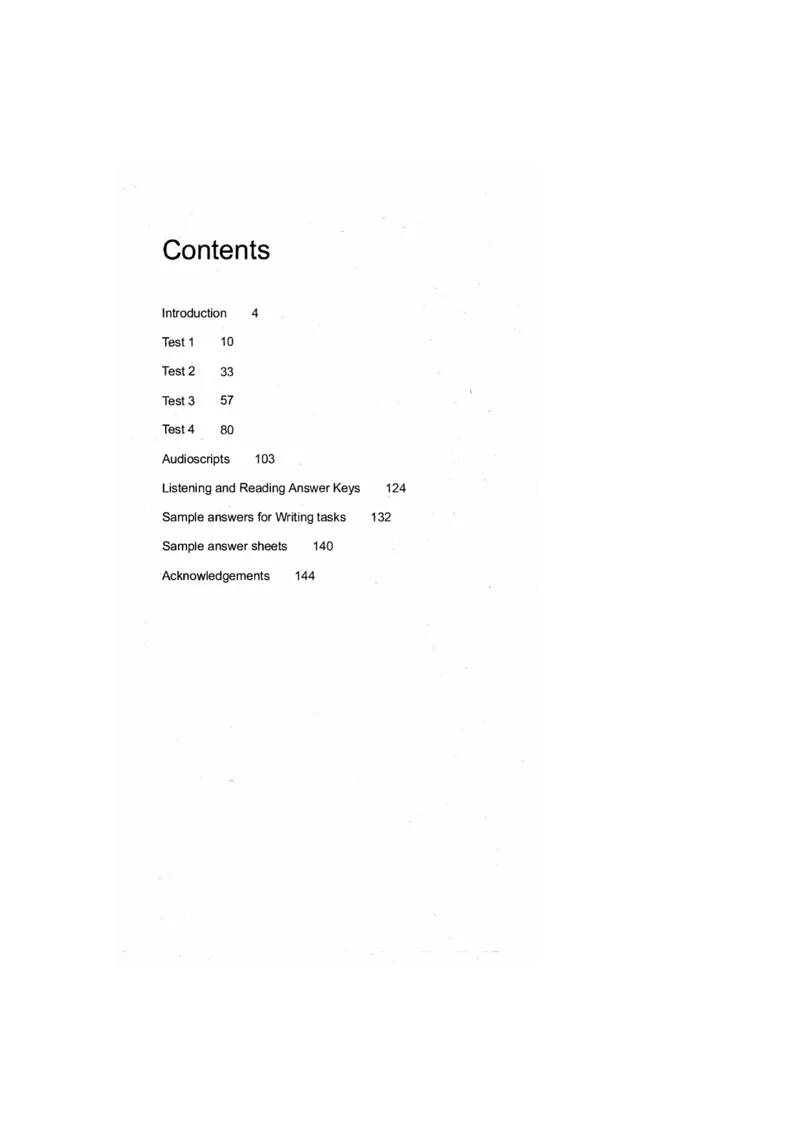
Contents
Introduction 4
Test1 10
Test 2 33
Test 3 57
Test4 80
Audioscripts 103
Listening and Reading Answer Keys 124
Sample answers for W「itingtasks 132
Sample answer sheets 140
Acknowledgements 144Introduction
The International English Language Testing System (IELTS) is widely recognised as
a reliable means of assessing the language ability of candidates who need to study
or work whe e English is the language of communication. These Practice Tests are
「
designed to give future IELTS candidates an idea of whethe their English is at the
「
equired level.
「
IELTS is owned by th「ee partners, Cambridge English Language Assessment, part of
the University of Cambridge, the British Council and IDP Education Pty Limited (through
its subsidia「y company, IELTS Australia Pty Limited). Further information on IELTS can
be found on the IELTS website www.ielts.org.
WHAT 15 THE TEST FORMAT?
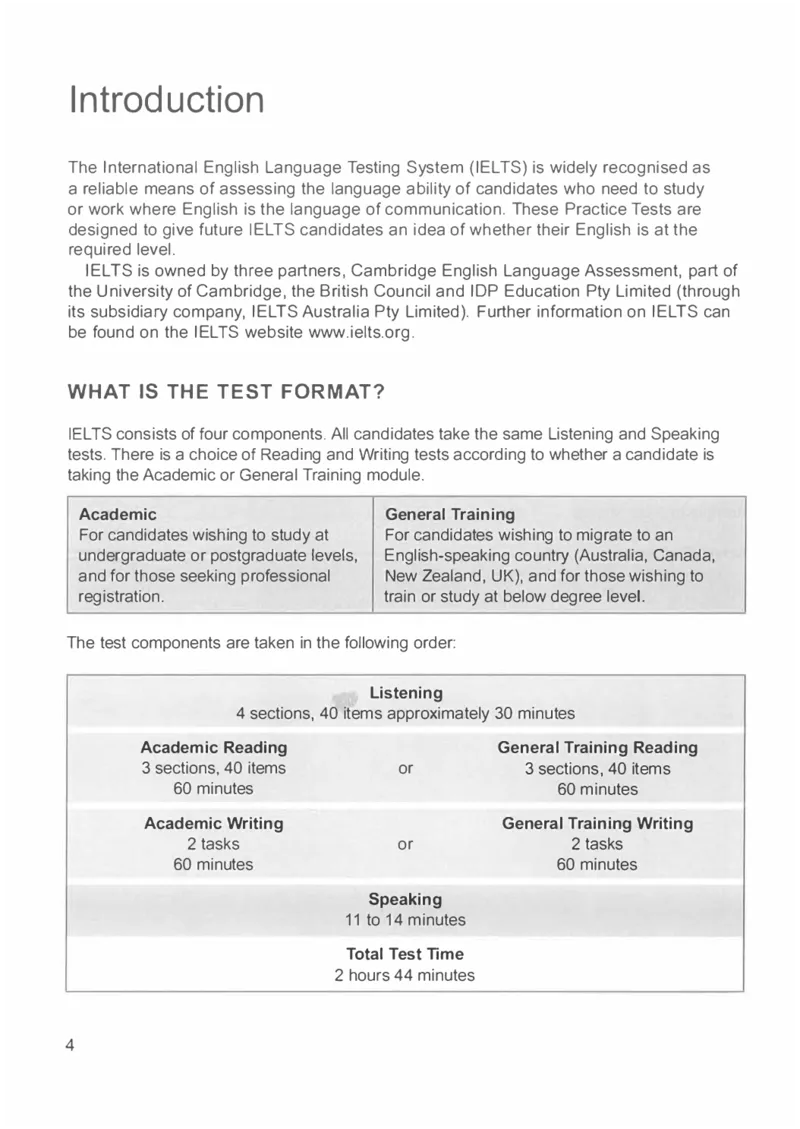
IELTS consists of four components. All candidates take the same Listening and Speaking
tests. There is a choice of Reading and Writing tests according to whether a candidate is
taking the Academic O General T aining module.
「 「
Academic General Training
For candidates wishing to study at For candidates wishing to migrate to an
undergraduate or postgraduate levels, English-speaking country (Australia, Canada,
and for those seeking professional New Zealand, UK), and for those wishing to
registration. train or study at below degree level.
The test components are taken in the fo川owingorder:
Listening
4 sections, 40 items approximately 30 minutes
Academic Reading General Training Reading
3 sections, 40 items or 3 sections, 40 items
60 minutes 60 minutes
Academic Writing General Training Writing
2 tasks or 2 tasks
60 minutes 60 minutes
Speaking
11 to 14 minutes
Total Test Time
2 hou s44 minutes
「
4ACADEMIC TEST FORMAT
Listening
This test consists of four sections, each with ten questions. The first two sections are
concerned with social needs. The first section is a conversation between two speakers and
the second section is a monologue. The final two sections a e concerned with situations
「
related to educational or training contexts. The third section is a conversation between up to
four people and the fourth section is a monologue.
A variety of question types is used, including: multiple choice, matching, plan/map/
diagram labelling, form completion, note completion, table completion, flow-cha completion,
「t
summ a叩completion, sentence completion, sho t-answerquestions.
「
Candidates hear the recording once only and answer the questions as they listen. Ten
minutes are allowed at the end for candidates to transfe theiranswers to the answer sheet.
「
Reading
This test consists of th ee sections with 40 questions. The eare three texts, which are
「 「
taken from journa怡 books, magazines and newspapers. The texts are on topics of general
,
interest. At least one text contains detailed logical argument.
A variety of question types is used, including: multiple choice, identifying information
(True/False/Not Given), identifying the writer’s views/claims (Yes/No/Not Given). matching
information, matching headings, matching features. matching sentence endings, sentence
completion, summary completio note completion, table completion, flow-chart completion,
门,
diagram label completion, short-answer questions.
Writing
This test consists of two tasks. It is suggested that candidates spend about 20 minutes on
Task 1, which requires them to W iteat least 150 wo ds, and 40 minutes on Task 2, which
「 「
requires them to W iteat least 250 wo ds. Task 2 contributes twice as much as Task 1 to the
「 「
Writing score.
Task 1 requires candidates to look at a diagram o somedata (graph, table or cha时)and
「
to present the information in thei own words. They are assessed on their ability to organise,
「
present and possibly compare data, desc
「
ibethe stages of a p
「
ocess. describe an object or
event, or explain how something works.
In Task 2, candidates are p esentedwith a point of view, a gument O problem. They a e
「 「 「 「
assessed on their ability to present a solution to the problem. p esentand justify an opinion,
「
com pa eand contrast evidence and opinions, evaluate and challenge ideas. evidence O
「 「
arguments.
Candidates a「ealso assessed on thei「ability to write in an appropriate style.
More information on assessing the Writing test. including Writing Assessment Criteria
(public version). is available on the IELTS website.
5Speaking
This test takes between 11 and 14 minutes and is conducted by a trained examiner.
There are three parts:
Part 1
The candidate and the examine introducethemselves. Candidates then answer general
「
questions about themselves, their home/family, their job/studies, thei interestsand a wide
「
range of simila familiartopic a eas. This pa lasts between fou andfive minutes.
「 「 「t 「
Part 2
The candidate is given a task card with prompts and is asked to talk on a particular topic.
The candidate has one minute to prepare and they can make some notes if they wish,
before speaking for between one and two minutes. The examine thenasks one or two
「
questions on the same topic.
Part 3
The examiner and the candidate engage in a discussion of more abstract issues which are
thematically linked to the topic in Part 2. The discussion lasts between four and five minutes.
The Speaking test assesses whether candidates can communicate e仔ectively in English.
The assessment takes into account Fluency and Coherence, Lexical Resource, Grammatica
Range and Accu acy, and Pronunciation. More information on assessing the Speaking test,
「
including Speaking Assessment Criteria (public version), is available on the IELTS website.
6HOW 15 IELTS SCORED?
IELTS results are reported on a nine-band scale. In addition to the sco efo overall language
「 「
ability, I ELT S provides a sco
「
ein the fo
「
mof a profile fo
「
each of the fou
「
skills (Listening,
Reading, W iting and Speaking). These scores are also repo巾don a nine-band scale. All
「
scores are ecordedon the Test Report Form along with details of the candidate’s nationality,
「
first language and date of bi内h. Each Overall Band Score corresponds to a desc
「
iptive
statement which gives a summa叩of the English language ability of a candidate classified at
that level. The nine bands and their descriptive statements a eas follows:
「
9 Expert User- Has fully operational command of the language: appropriate, accurate and
fluent with complete understanding.
8 Very Good User -Has fully operational command of the language with only occasional
unsystematic inaccuracies and inappropriacies. Misunderstandings may occur in
unfamiliar situations. Handles complex detailed argumentation well.
7 Good User- Has operational command of the language, though with occasional
inaccuracies, inappropriacies and misunderstandings in some situations. Generally
handles complex language well and understands detailed reasoning.
6 Competent User - Has generally effective command of the language despite some
inaccuracies, inappropriacies and misunderstandings. Can use and understand fairly
complex language, particularly in familiar situations.
5 Modest User - Has partial command of the language, coping with overall meaning in
most situations, though is likely to make many mistakes. Should be able to handle basic
communication in own field.
4 Limited User - Basic competence is limited to familiar situations. Has frequent problems
in understanding and expression. Is not able to use complex language.
3 Extremely Limited User - Conveys and understands only general meaning in ve叩
familiar situations. Frequent breakdowns in communication occur.
2 Intermittent User - No real communication is possible except for the most basic
information using isolated words or short formulae in familiar situations and to meet
immediate needs. Has great difficulty understanding spoken and written English.
1 Non User- Essentially has no ability to use the language beyond possibly a few isolated
words.
。
Didnot attempt the test -No assessable information provided.
7MARKING THE PRACTICE TESTS
Listening and Reading
The Answe Keysa eon pages 124-131
「 「
Each question in the Listening and Reading tests is wo hone mark.
「t
Questions which req山reletter I Roman numeral answers
For questions where the answers are letters or Roman nume_ ra怡 youshould write only
,
the number of answers equired.For example, if the answe isa single letter or numeral
「 「
you should write only one answer. If you have written more letters or numerals than are
required, the answer must be marked wrong.
Questions which require answers in the form of words or numbers
• Answers may be written in upper or lower case.
Wo dsin brackets are optional -they are correct, but not necessa叩-
「
Alternative answers a eseparated by a slash (/).
「
If you are asked to W itean answer using a certain number of words and/or (a)
「
numbe「(s), you will be penalised if you exceed this. For example, if a question specifies
an answer using NO MORE THAN THREE WORDS and the correct answer is 'black
leather coat, the answer 'coat of black leather’is incorrect.
’
In questions where you are expected to complete a gap, you should only t ansferthe
「
necessa叩missingword(s) onto the answer sheet. Fo example, to complete 'in the ...’
「 ,
and the cor ectanswer is 'morning’ the answer 'in the morning’ would be incorrect.
「 ,
All answers require correct spelling (including words in brackets).
• Both US and UK spelling are acceptable and are included in the Answer Key.
All standard alternatives fo numbers, dates and currencies a eacceptable.
「 「
All standard abbreviations are acceptable.
You will find additional notes about individual answers in the Answer Key.
Writing
The sample answers are on pages 132-139. It is not possible for you to give yourself a mark
fo「the W「iting tasks. We have provided sample answers (wri忧en by candidates), showing
their score and the examiner’s comments. These sample answers will give you an insight
into what is required for the Writing test.
8HOW SHOULD YOU INTERPRET YOUR SCORES?
At the end of each Listening and Reading Answer Key you will find a cha 「 twhich will help
you assess whether, on the basis of you 「 Practice Test results, you a 「 e ready to take the
IELTS test.
In interpreting your sco thereare a number of points you should bear in mind. Your
陀,
perfo「 mancein the real IELTS test will be repo『tedin two ways: the 「 ewill be a Band Score
from 1 to 9 for each of the components and an Overall Band Score f 「 om 1 to 9, which
is the average of you 「 scoresin the four components. However, institutions considering
your application are advised to look at both the Ove 「 all Band Score and the Bands for
each component in order to dete 「 minewhethe 「 youhave the language skills needed for a
particular course of study. For example, if your course has a lot of reading and writing, but
no lectures, listening skills might be less impo tantand a score of 5 in Listening might be
「
acceptable if the Ove allBand Score was 7. However, for a course which has lots of lectures
「
and spoken instructions, a score of 5 in Listening might be unacceptable even though the
Overall Band Score was 7.
Once you have marked your tests, you should have some idea of whether your listening
and reading skills are good enough for you to t叩the I ELT S test. If you did well enough in
one component, but not in others, you will have to decide for yourself whether you are ready
to take the test.
The Practice Tests have been checked to ensure that they are of approximately the same
level of difficulty as the 「eal IELTS test. Howeve「, wecannot gua「anteethat your score in the
Practice Tests will be reflected in the eal IELTS test. The Practice Tests can only give you
「
an idea of your possible future performance and it is ultimately up to you to make decisions
based on you sco e.
「 「
Different institutions accept different I EL TS scores for different types of courses. We have
based our ecommendationson the average sco eswhich the majority of institutions accept.
「 「
The institution to which you are applying may, of course, require a higher O「lowerscore than
most other institutions.
。
Further inf rmation
For more information about IELTS O「anyother Cambridge English Language Assessment
examination, write to:
Cambridge English Language Assessment
1 Hills Road
Cambridge
CB12EU
United Kingdom
https://support.cambridgeenglish.org
h忧p://www.ielts.org
9Test 1
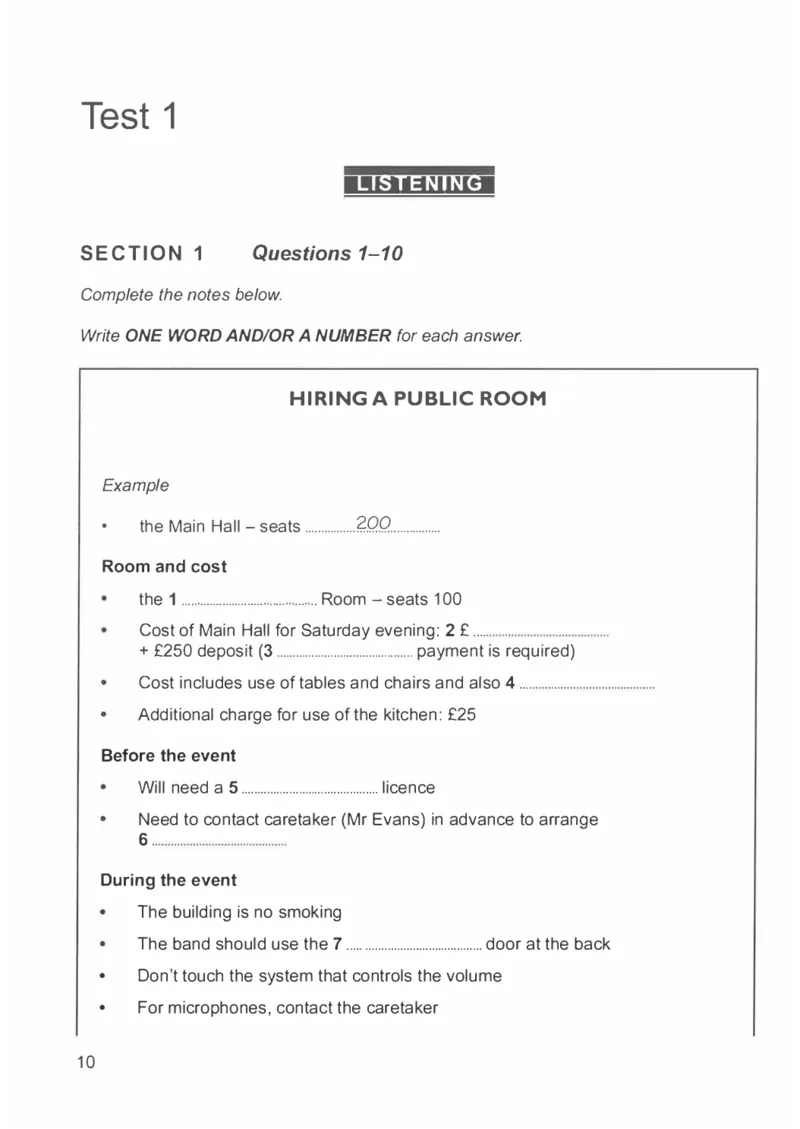
11.!l:l且呈且�
SECTION 1 Questions 1-10
Complete the notes below.
Write ONE WORD AND/OR A NUMBER for each answeκ
。。”
HIRING A PUBLIC R
Example
the Main Hall -seats .....……... ?.9.9. ..……·
。。
R m and cost
the 1 ..... .................... ..... . .. .. Room -seats 100
Cost of Main Hall fo Satu day evening: 2 £ ....
「 「
+ £250 deposit (3 ......................................... payment is required)
Cost includes use of tables and chairs and also 4 .....
Additional charge fo use of the kitchen: £25
「
。
Bef rethe event
Will need a 5 ............………··….............. licence
Need to contact caretake「(Mr Evans) in advance to arrange
6
During the event
The building is no smoking
The band should use the 7 .....…........….........…......... door at the back
• Don’t touch the system that controls the volume
• For microphones, contact the caretaker
10After the event
Need to know the 8 .... .. .................. ..... .. for the cleaning cupboard
The 9 .......………··-….. must be washed and rubbish placed in black bags
All 10 must be taken down
……· ·-……
Chairs and tables must be piled up
11SECTION 2 Questions 11-20
Questions 11-14
Complete the notes below.
Write ONE WORD for each answer.
Fiddy Working Heritage Farm
Advice about visiting the farm
Visitors should
• take care not to harm any 11
• not touch any 12 ..
• wear 13 ...............
• not bring 14 into the farm, with certain exceptions
... .....……….... ........
12Questions 15-20
Label the map below.
A
Write the correct letter 斗, nextto Questions 15-20.
Road
Farm Yard
公
〈h
、u -:
、 、、 i灿
、的γ
、
-
Z
VMW
n比
C
币
2
Car Park G
.You are here
15 Scarec「ow 18 Black Barn
16 Maze 19 Covered picnic area
17 Cafe 20 Fiddy House
13SECTION 3 Questions 21-30
Choose the correct letter, A, B or C.
Study on Gender in Physics
21 The students in Akira Miyake’s study were all majoring in
A physics.
B psychology or physics.
C science, technology, engineering or mathematics.
22 The aim of Miyake’s study was to investigate
A what kind of women choose to study physics.
B a way of improving women’s pe formance in physics.
「
C whether fewer women than men study physics at college.
23 The female physics students were wrong to believe that
A the teachers marked them in an unfair way.
B the male students expected them to do badly.
C their test results were lowe than the male students'.
「
24 Miyake’s team asked the students to write about
A what they enjoyed about studying physics.
B the successful experiences of other people.
C something that was important to them personally.
25 What was the aim of the w iting exercise done by the su同ects?
「
A to reduce stress
B to strengthen verbal ability
C to encourage logical thinking
26 What surprised the researchers about the study?
A how few students managed to get A grades
B the positive impact it had on physics esults for women
「
C the difference between male and female pe formance
「
27 Greg and Lisa think Miyake’s results could have been affected by
A the length of the writing task.
B the number of students who took part.
C the information the students were given.
1428 Greg and Lisa decide that in thei own p oject, they will compare the effects of
「 「
A two diffe ent writing tasks.
「
B a w itingtask with an oral task.
「
C two different oral tasks.
29 The main finding of Smolinsky’s research was that class teamwork activities
A were most effective when done by all-women groups.
B had no effect on the performance of men or women.
C improved the esultsof men more than of women.
「
30 What will Lisa and Greg do next?
A talk to a professo
「
B observe a science class
C look at the science timetable
15SECTION 4 Questions 31-40
Complete the notes below.
Write ONE WORD ONLY for each answer.
Ocean Biodiversity
Biodiversity hotspots
• areas containing many different species
• impo tantfor locating targets for 31
「
• at first only identified on land
Boris Worm, 2005
• identified hotspots for large ocean predators, e.g. sharks
• found that ocean hotspots:
were not always rich in 32 ...............
had higher temperatures at the 33 ...........
had SU忏icient34 .........…..........…… in the water
·φ....
Lisa Ballance, 2007
• looked for hotspots for marine 35 ..
• found these were all loζated where ocean currents meet
Census of Marine Life
• found new ocean species living:
under the 36 ....
near volcanoes on the ocean floor
丁6Global Marine Species Assessment
• want to list endangered ocean species, considering:
population size
geographical distribution
rate of 37 ..
• Aim: to assess 20,000 species and make a distribution 38
for each one
Recommendations to retain ocean biodiversity
• increase the number of ocean「eserves
• establish 39 .. .... ............... ..... .... corridors (e.g. for turtles)
• reduζe fishing quotas
• catch fish only for the purpose of 40 ... ... .
17�
READING PASSAGE 1
You should spend about 20 minutes on Questions 1-13, which are based on Reading
Passage 1 below.
℃ .
rop-grow1ng skyscrapers
j By the year 2050, nearly 80% of buildings in which food crops are
’
: the Earths population will live in grown in environmentally controlled
I urban centres. Applying the most conditions. Situated in the heart of
j conservative estimates to current urban centres, they would drastically
: demographic trends, the human reduce the amount of transportation
population will increase by about required to bring food to consumers.
:
: three billion people by then. An Vertical farms would need to be
: estimated 109 hectares of new land efficient, cheap to construct and
: (about 20% larger than Brazil) will be safe to operate. If successfully
: needed to grow enough food to feed implemented, proponents claim,
: them, if traditional farming methods vertical farms offer the promise
continue as they are practised today. of urban renewal, sustainable
: At present, throughout the world, production of a safe and varied
: over 80% of the land that is suitable food supply (through year-round
: for raising crops is in use. Historically, production of all crops), and the
: some 15% of that has been laid waste eventual repair of ecosystems that
j by poor management practices. What have been sacrificed for horizontal
: can be done to ensure enough food farming.
’
I for the worlds population to live on?
It took humans 10,000 years to
The concept of indoor farming is learn how to grow most of the crops
not new, since hothouse production we now take for granted. Along the
of tomatoes and other produce has way, we despoiled most of the land
been in vogue for some time. What we worked, often turning verdant,
is new is the urgent need to scale natural ecozones into semi-arid
up this technology to accommodate deserts. Within that same time frame,
another three billion people. Many we evolved into an urban species, in
believe an entirely new approach to which 60% of the human population
indoor farming is required, employing now lives vertically in cities. This
cutting-edge technologies. One such means that, for the m叫ority, we
‘
proposal is for the Vertical Farm'. humans have shelter from the
The concept is of multi-storey elements, yet we subject our food-
18: bearing plants to the rigours of the the efficiency of the system. Single-
: great outdoors and can do no more storey greenhouses have the benefit
I than hope for a good weather year. of natural overhead light: even so,
j However, more often than not now, many still need artificial lighting.
: due to a rapidly changing climate, A multi-storey facility with no natural
: that is not what happens. Massive overhead light would require far
: floods, long droughts, hurricanes and more. Generating enough light could
: severe monsoons take their toll each be prohibitively expensive. unless
: year, destroying millions of tons of cheap, renewable energy is available,
: valuable crops. and this appears to be rather a future
aspiration than a likelihood for the
j The supporters of vertical farming near future.
: claim many potential advantages for j
j the system. For instance, crops would One variation on vertical farming that
: be produced all year round, as they has been developed is to grow plants
: would be kept in artificially controlled, in stacked trays that move on rails.
optimum growing conditions. There Moving the trays allows the plants to
: would be no weather-related crop get enough sunlight. This system is
I failures due to droughts, floods or already in operation, and works well
: pests. All the food could be grown within a single-storey greenhouse
: organically, eliminating the need for with light reaching it from above: it
: herbicides, pesticides and fertilisers. is not certain, however, that it can be
: The system would greatly reduce the made to work without that overhead
incidence of many infectious diseases natural light.
:
that are acquired at the agricultural
: interface. Although the system would Vertical farming is an attempt to
I consume energy, it would return address the undoubted problems
: energy to the grid via methane that we face in producing enough
: generation from composting non- food for a growing population. At the
j edible parts of plants. It would also moment, though, more needs to be
: dramatically reduce fossil fuel use, done to reduce the detrimental impact :
by cutting out the need for tractors, it would have on the environment,
j
: ploughs and shipping. particularly as regards the use of
energy. While it is possible that
IA m叫or drawback of vertical farming, much of our food will be grown in
j however, is that the plants would skyscrapers in future, most experts
: re甲1ire artificial light. Without it, currently believe it is far more likely
: those plants nearest the windows that we will simply use the space
: would be exposed to more sunlight available on urban rooftops.
and grow more 甲1ickly, reducing
:
19Questions 1-7
Complete the sentences below.
Choose NO MORE THAN TWO WORDS from the passage for each answer.
Write your answers in boxes 1-7 on your answer sheet.
Indoor farming
1 Some food plants, including ....... .. ........ are already grown indoors.
2 Vertical farms would be located in ....… … ,meaning that there would be less
need to take them long distances to customers.
3 Ve「tical farms could use methane from plants and animals to produce .........
4 The consumption of ..................... would be cut because agricultural vehicles would be
unnecessa叩.
5 The fact that vertical farms would need …............….. light is a disadvantage.
6 One form of vertical fa「ming involves planting in ...................... which are not fixed.
7 The most probable development is that food will be grown on .........… ...... in towns
and cities.
Questions 8-13
Do the following statements agree with the information given in Reading Passage 1?
In boxes 8-13 on your answer sheet, write
TRUE if the statement agrees with the information
FALSE if the statement contradicts the information
NOT GIVEN if there is no information on this
8 Methods fo predicting the Earth’s population have recently changed.
「
9 Human beings are 「esponsible for some of the destruction to food producingland.
『
10 The crops p「oduced in vertical farms will depend on the season.
11 Some damage to food crops is caused by climate change.
12 Fertilisers will be needed for ce ain crops in vertical farms.
「t
13 Vertical farming will make plants less likely to be a仔ected by infectious diseases.
20READING PASSAGE 2
γou should spend about 20 minutes on Questions 14-26, which are based on Reading
Passage 2 below.
THE FALKIRK WHEEL
A unique engineering achievement
The Falkirk Wheel in Scotland is the headed axe, but also the vast turning
world’s first and only otatingboat lift. P opeller of a ship, the ibcageof a whale
「 「 「
Opened in 2002, it is cent alto the O thespine of a fish.
「 「
ambitious £84.Sm Millennium Link p
「
oject
to restore navigability ac 「 oss Scotland by The various parts of The Falkirk Wheel
reconnecting the historic wate waysof the we e all constructed and assembled, like
「 「
Forth & Clyde and Union Canals. one giant toy building set, at Butterley
Engineering’s Steelworks in De byshi e,
「 「
The major challenge of the p ojectlay in some 400 km from Falkirk. A team there
「
the fact that the Fo th & Clyde Canal is ca efullyassembled the 1,200 tonnes
「 「
situated 35 metres below the level of the of steel, painstakingly fitting the pieces
Union Canal. Historically, the two canals together to an accuracy of just 10 mm to
had been joined nea thetown of Falkirk ensu e ape fect final fit. In the summer of
「 「 「
by a sequence of 11 locks -enclosed 2001, the structu ewas then dismantled
「
sections of canal in which the water level and t anspo edon 35 lo iesto Falkirk,
「 「t 「「
could be raised or lowered -that stepped before all being bolted back together
down ac ossa distance of 1.5 km. This had again on the ground, and finally lifted into
「
been dismantled in 1933, the ebyb eaki 9 position in five large sections by c ane.The
「 「 「1 「
the link. When the p ojectwas launched Wheel would need to withstand immense
「
in 1994, the British Wate waysauthority and constantly changing st essesas it
「 「
were keen to create a dramatic twenty-first otated, so to make the structu emo e
「 「 「
century landma k which would not only be obust,the steel sections were bolted
「 「
a fitting commemoration of the Millennium, rather than welded together. Over 45,000
but also a lasti 9 symbol of the economic bolt holes were matched with their bolts,
「1
regeneration of the region. and each bolt was hand-tightened.
Nume ousideas we esubmitted fo the The Wheel consists of two sets of opposing
「 「 「
P oject,including concepts ranging f om axe-shaped arms, attached about 25
「 「
rolling eggs to tilting tanks, f omgiant see met esapa内to a fixed cent alspine.
「 「 「
saws to ove headmonorails. The eventual Two diametrically opposed water-filled
「
winner was a plan for the huge rotating ’gondolas’ each with a capacity of 360,000
,
steel boat lift which was to become The litres, are fitted between the ends of the
Falkirk Wheel. The unique shape of the arms. These gondolas always weigh the
structu e is claimed to have been inspi ed same, whethe ornot they a eca ying
「 「 「 「 「「
by various sources, both manmade and boats. This is because, acco dingto
「
natural, most notably a Celtic double- A chimedes’principleof displacement,
「
21floating objects displace thei 「 ownweight Wheel, which begin to 「 otateat a speed
in water. So when a boat enters a gondola, of 1/8 of a evolutionpe minute.As the
「 「
the amount of water leaving the gondola wheel otates, the gondolas are kept in
「
weighs exactly the same as the boat. This the up 「 ightposition by a simple gea 「 ing
keeps the Wheel balanced and so, despite system. Two eight-metre-wide cogs orbit
its eno mousmass, it rotates through 180。 a fixed inner cog of the same width,
「
in five and a half minutes while using ve y connected by two smaller cogs travelling
「
little powe Ittakes just 1.5 kilowatt-hou S in the opposite di ectionto the oute cogs
「 「 「 「
(5.4 MJ) of energy to rotate the Wheel一 -so ensu ingthat the gondolas always
「
oughlythe same as boiling eight small emainlevel. When the gondola eaches
「 「 「
domestic kettles of water. the top, the boat passes st aight onto the
「
aqueduct situated 24 met esabove the
「
Boats needing to be lifted up ente the canal basin.
「
canal basin at the level of the Fo h &
「t
Clyde Canal and then enter the lower The remaining 11 metres of lift needed
gondola of the Wheel. Two hyd aulicsteel to reach the Union Canal is achieved by
「
gates are raised, so as to seal the gondola means of a pai of locks. The Wheel could
「
o忏f omthe water in the canal basin. The not be const uctedto elevate boats over
「 「
wate betweenthe gates is then pumped the fu川35-met e difference between the
「 「
out. A hydraulic clamp, which p events two canals, owing to the p esence of the
「 「
the arms of the Wheel moving while the historically important Antonine Wall, which
gondola is docked, is emoved, allowing was built by the Romans in the second
「
the Wheel to turn. In the central machine century AD. Boats travel under this wall via
ooman a ray of ten hydraulic motors a tunnel, then through the locks, and finally
「 「
then begins to rotate the central axle. The on to the Union Canal.
axle connects to the outer arms of the
22Questions 14-19
Do the following statements agree with the information given in Reading Passage 2?
/n boxes 14-19 on your answer sheet, write
TRUE if the statement agrees with the information
FALSE if the statement contradicts the information
NOT GIVEN if there is no information on this
14 The Falkirk Wheel has linked the Fo「th & Clyde Canal with the Union Canal for the
first time in their history.
15 The 「 e was some opposition to the design of the Falkirk Wheel at first.
16 The Falkirk Wheel was initially put together at the location where its components
were manufactured.
17 The Falkirk Wheel is the only boat lift in the world which has steel sections bolted
together by hand.
18 The weight of the gondolas varies according to the size of boat being carried.
19 The construction of the Falki「K Wheel site took into account the p「esence of a
nearby ancient monument.
23Questions 20-26
Label the diagram below.
Choose ONE WORD from the passage for each answer.
Write your answers in boxes 20-26 on your answer sheet.
How a boat is lifted on the Falkirk Wheel
A pair of 20 ... ...... ..... a e lifted in order to
「
shut out wate fromcanal basin
「
A 21 ...................... is taken out, enabling Wheel to rotate
26 ...
Canal
Boat is raised,
floating in one
口 U oaφt u hd叫,IWe-厄 of Wheel’s two
u
忡w
oHU
nuu
h且,,、
u
me-
hυenOVndhRm
-an川
qL
p
…
b
Boat reaches top Wheel, then A range of different-sized 23
moves directly onto 24 ... ensu「esboat keeps up「ight
24READING PASSAGE 3
You should spend about 20 minutes on Questions 27-40, which are based on Reading
Passage 3 below.
Reducing the Effects of Climate Change
Mark Rowe rψ0附on the increasingly ambitious
geo-engineering projects
bei e.习pfo ·ed码y scie1仰tJ
刀ig 俨
A Such is our dependence on fossil fuels, and such is rhe volume of carbon dioxide already
released inro rhe armosphere, that many experts agree rhar significant global warming is now
inevitable.丁l1ey believe that the best we can do is keep ir at a reasonable level, and at present
the only serious option for doing rhis is cutting back on our carbon emissions. But while a few
countries arc making major strides in chis rega时,themajoriry are having great di而culryeven
stemming che rate of increase, let alone reversing ir. Consequently, an increasing numbe of
『
scientisrs arc beginning ro explore the alternative of ge。”engineering-a term which generally
refers ro the intentional large-scale manipularion of the environrnenr. According ro its
proponents, geo-engineering is the equivalent of a backup generaror: if Plan A一reducingour
dependency on fossil fuels -fails, we require a Plan B, employing grand schemes to slow down
or reverse the process of global warming.
B Geo-engineering has been shown ro wor丸atleast on a small localised scale. For d巳cades, May
Day parades in Moscow have taken place under clear blue skies, aircra仕having deposited dry
ice, silver iodide and cement po,vder to disperse clouds. Many of the sch巳mesnow suggesred
look to do the opposite, and reduce the amount of sunlight reaching the planer. The most
eye-carching idea of all is suggested by Professor Roger Angel of rhe Universiry of Arizona. His
scheme would employ up to 16 trillion minute spacecraft, each weighing about one gram, to
form a transparent, sunlight-refracting sunshade in an orbit 1.5 million km above the Earth.
This could, argues Angel, reduce the amount of light reaching the Earth by rwo per cent.
c τ11e majority of geo-engineering projects so far carried out -which include planting forests
in deserts and depositing iron in the ocean to stimulate the growth of algae -have focused on
achieving a general cooling of the Earth. But some look speci自callyat reversing the melting
at the poles, particularly the Arctic. TI1e reasoning is that if you replenish rhe ice sheets and
frozen waters of the high laritudes, more light will be reflected back into space, so reducing the
warming of the oceans and atmosphere.
D TI1e concept of releasing aerosol sprays into the stratosphere above the Arctic has been proposed
by several scientists. This would involve using sulphur or hydrogen sulphide aerosols so that
sulphur dioxid巳would form clouds ”which would in turn ’ lead to a Do[ obal dimming. TI1e idea
is modelled on historic volcanic explosions, such as that of Mount Pinatubo in the Philippines
in 1991, which led to a short-term cooling of global temperatures by 0.5 。C Scientists have
also scrutinised whether it’ s possible ro preserve the ice sheets of Greenland with reinforced
high-rension cables, preventino iceberos from rnovino into the sea. Meanwhile in the Russian
t, t, t,
Arctic, ge。”engineering plans include the planting of millions of birch trees. Whereas the
region's native evergreen pines shade the snow and absorb radiation, birches would shed their
25leaves in winter, thus enabling radiation ro be reAectcd by the snow. Re-routing Russian rivers
to increase cold water Aow to ice-forming areas could also be used to slow clown warming, say
some di mace scientists.
E Bue will such schemes ever be implemented? Generally speaking, chose who are mosc cautious
about oe。”cnoinecrinoare the scientists involved in the research. AnOoe ! saIy s that his tp' lan is 'no
’
substitute for developing renewable energy: the only permanent solution. And Dr Phil Rasch of
the US-based Pacific Northwest National Laboratory is equally guarded about the role of geo-
‘
engineering: l think all of us agree that if we were to end geo-engineering on a given day, then
the planet would return to its pre-engineered condition very rapidl民and probably within ten to
t飞ventyyears.币1at's certainly something to worry about.’
F TI1e US National Center for Atmospheric Research has already suggested that the proposal
to inject sulphur into the atmosphere might a仔ectrainfall patterns across the tropiαand the
outhern Ocean. 'Geo-engineering plans to inject srrarospheric aerosols or to seed clouds would
act to cool the planet, and act to increase the extent of sea ice,' says Rasch.‘But all the models
suggest some impact on the distribution of precipitation.’
‘ “ ”
G A further risk with geo-engineering projects is that you can overshoot ,’says Dr Dan
Lunt, from the University of Bristol's School of Geophysical Sciences, who has swdied the
likely impacts of the sunshade and aerosol schemes on the climate.‘You may bring global
temperawres back to pre-industrial levels, bur the risk is that the poles will still be warmer than
they should be and the tropics will be cooler than before industrialisation.’To avoid such a
scenario, Lunr says Angel's project would have to operate at half srreng巾,allof which reinforces
his view that the best option is to avoid the need for geo’engineering alt ogether.
H The main reason why geo-engineering is supported by many in the scienri自ccommuniry is that
most researchers have little faith in the ability of politicians ro agree -and then bring in -the
necessary carbon cuts. Even leading conservation organisations see the value of investigating the
potential of geo-engineering. According to Dr Marcin Sommerkorn, climate change advisor for
’
the World Wildlife Funds InrernationaJ Arctic Programme, 'Human-induced climate change
’
has btoughc humanity to a position where we shouldnt exclude thinking thoroughly about chis
topic and its possibilities.’
26Questions 27-29
Reading Passage 3 has eight paragraphs A-H.
Which parag「aph contains the following info「mation?
Write the correct letter, A-” , in boxes 27-29 on your answer sheet.
27 mention of a geo-engineering project based on an earlier natural phenomenon
2 8 an example of a successful use of geo-engineering
29 a common definition of geo-enginee 「 ing
27Questions 30-36
Complete the table below.
Choose ONE WORD from the passage for each answer.
Write your answers in boxes 30-36 on your answer sheet.
GEO-ENGINEERING PROJECTS
Procedure Aim
put a la ge number of tiny spacecraft into
「 to create a 30 .......…........... that would educe
「
orbit far above Earth
the amount of light eaching Earth
「
place 31 .................... in the sea to encourage 32 ..................... to form
eleaseaerosol sprays into the
「 to create 33 that would reduce
...…...
stratosphere
the amount of light reaching Earth
to prevent icebergs moving into the sea
fix st ong 34 ........……川....to G eenland ice
「 「
sheets
plant trees in Russian Arctic that would
to allow the 35 ............... to eflectradiation
「
lose their leaves in winter
to bring more cold wate into ice-forming
change the direction of 36 ... 「
a eas
「
28Questions 37-40
Look at the following statements (Questions 37-40) and the list of scientists below.
Match each statement with the correct scientist, A-D.
Write the correct letter, A-D, in boxes 37-40 on your answer sheet.
37 The effects of geo-engineering may not be long-lasting.
38 Geo-engineering is a topic wo「th exploring.
39 It may be necessary to limit the effectiveness of geo-engineering projects.
40 Research into non-fossil-based fuels cannot be replaced by geo-engineering.
List of Scientists
A Roger Angel
B Phil Rasch
C Dan Lunt
D Martin Sommerkorn
29l!lfilim团
WRITING TASK 1
You should spend about 20 minutes on this task.
The charts below show the percentage of water used for different purposes in
six areas of the world.
Summarise the information by selecting and reporting the main features, and
make comparisons where relevant.
Write at least 150 words.
Percentage of water used for different
purposes in six areas of the world
10%
19%
48%
53%
13%
NORTH AMERICA SOUTH AMERICA EUROPE
7% 12%
AFRICA CENTRAL ASIA SOUTH EAST ASIA
D
Industrial use 区�Agricultural use - Domestic use
30WRITING TASK 2
You should spend about 40 minutes on this task.
Write about the following topic:
Governments should spend money on railways rather than roads.
To what extent do you agree or disagree with this statement?
Give reasons for your answer and include any「elevant examples from your own
knowledge or experience.
Write at least 250 words.
31r...m.
Eli缸 且缸’
PART 1
The examiner asks the candidate about him/herself, his/he home, work O studies and
「 「
othe familiartopics.
「
EXAMPLE
。。 。。
F dand c king
• What so ts of food do you like eating most? [Why?]
「
Who normally does the cooking in your home? [Why/Why not?]
Do you watch cooke y programmes on TV? [Why/Why not?]
「
In general, do you prefe eating out or eating at home? [Why?]
「
PART 2
Describe a house/apartment that You will have to talk about the topic
。 。
some ney u know lives in. fo one to two minutes.
「
You have one minute to think about
You should say: what you are going to say.
whose house/apartment this is You can make some notes to help you
。
where the h use/apartment is if you wish.
what it looks like inside
。
and explain what you like rdislike
。
about this pers n’shouse/apartment.
PART 3
Discussion topics:
Different types of home
Example questions:
What kinds of home a emost popular in your country? Why is this?
「
What do you think are the advantates of living in a house atherthan an apa tment?
「 「
Do you think that everyone would like to live in a larger home? Why is that?
Finding a place to live
Example questions:
How easy is it to find a place to live in your count叩?
Do you think it’s better to rent or to buy a place to live in? Why?
Do you agree that there is a right age for young adults to stop living with their parents?
Why is that?
32Test 2
l!i::Imm
回
SECTION 1 Questions 1-10
Complete the notes below.
Write ONE WORD AND/OR A NUMBER for each answer
Enquiry about joining Youth Council
Example
Name: Roger. . .... . ...f?.r.<?.W..n. .... .
Age: 18
Currently staying in a 1 ........................…................ du ing the week
「
Postal address: 2 17, ........... .......... . ........ .. Street, Stamford, Lines
Postcode: 3 ............. .
Occupation: student and part-time job as a 4 ... ... .
Studying 5 ............….. ........... ..... .. (major subject) and history (minor subject)
Hobbies: does a lot of 6 .......................…................. , and is interested in the
7 .....
33On Youth Council, wants to work with young people who are
8 ...... .
Will come to talk to the Elections Officer next Monday at
9 ...................……................. pm
Mobile numbe「:10
34SECTION 2 Questions 11-20
New staff at theatre
Questions 11 and 12
Choose TWO letters, A-E.
Which TWO changes have been made so far during the refurbishment of the theatre?
A Some rooms now have a different use.
B A different type of seating has been installed.
C An elevator has been installed.
D
The outside of the building has been repai ed.
「
E
Extra seats have been added.
Questions 13 and 14
Choose TWO letters, A-E.
Which TWOf acilities does the theat e currently offer to the public?
「
AH rooms for hire
Ru
puv backstage tours
nu hire of costumes
E』
a bookshop
a cafe
Questions 15 and 16
Choose TWO letters, A-E.
WhichTWOwo「kshopsdoes the theatre currently o仔er?
AH sound
RM
产uv acting
nu making puppets
E』
make-up
lighting
35Questions 17-20
Label the plan below.
Write the correct letter, A-G, next to Questions 17-20.
Ground floor plan of theatre
entrance entrance
road
17 box office
18 theatre manager's office
19 lighting box
20 artistic director’s office
36SECTION 3 Questions 21-30
Questions 21-26
Choose the correct letter, A, B or C.
Rocky Bay field trip
21 What do the students ag eeshould be included in thei aims?
「 「
A factors affecting where organisms live
B the need to preserve endangered species
C techniques fo classifying different organisms
「
22 What equipment did they forget to take on the Field Trip?
A string
B a compass
C a ruler
23 In Helen’s p 「 ocedu 「 esection, Colin suggests a change in
A the order in which information is given.
B the way the information is divided up.
C the amount of info mationp ovided.
「 「
24 What do they say about the method they used to measure wave speed?
A It provided accurate results.
B It was simple to ca out.
「「y
C It requi ed special equipment.
「
25 What mistake did Helen make when first drawing the map?
A She chose the wrong scale.
B She stood in the wrong place.
C She did it at the wrong time.
26 What do they decide to do next with their map?
A scan it onto a computer
B check it using photog aphs
「
C add information from the internet
37Questions 27 and 28
Choose TWO letters, A-E.
W h ic h T W O p r o b le m s a 仔 e c t in g O 「 g a n is m s in t h e s p la s h z o n e a 「 e m e n t io n e d ?
lack of wate
「
strong winds
lack of food
high temperatures
large waves
ABCDE
Questions 29 and 30
Choose TWO letters, A-E.
Which TWO reasons for possible error will they include in their eport?
「
inaccurate records of the habitat of organisms
influence on behaviour of organisms by observer
incorrect identification of some organisms
making generalisations from a small sample
missing some O ganisms when counting
「
ABCDE
38SECTION 4 Questions 31-40
Complete the notes below.
Write ONE WORD ONLY for each answer.
DESIGNING A PUBLIC BUILDING:
THE TAYLOR CONCERT HALL
Introduction
The designer of a public building may need to consider the building’S
• function
physical and 3丁...........…·…......….........context
• symbolic meaning
。 。
Locati n and c nceptof the Concert Hall
On the site of a disused 32 .............. .
Beside a 33
The design is based on the concept of a mystery
39Building design
It’s app oached by a 34 ............”·· -山....········· fo pedestrians
「 「
The building is the shape of a 35 ............. .
One exterior wall acts as a large 36 ...
In the auditorium:
the floo is built on huge pads made of 37 ...... .
「
the walls are made of local wood and a e 38 ....…........………... in shape
「
• ceiling panels and 39 ........................................... on walls allow adjustment of
acoustics
。
Evaluati n
Some c iticssay the 40 ........... ........... ........... style of the building is inappropriate
「
40�固
READING PASSAGE 1
You should spend about 20 minutes on Questions 1-13, which are based on Reading
Passage 1 below.
Raising the Mary Rose
How a sixteenth-century warship was 「ecove「ed from the seabed
On 19 July 1545, English and French all of the sta board half survived intact.
「
fleets we e engaged in a sea battle o仔 During the seventeenth and eighteenth
「
the coast of southern England in the centuries, the entire site became covered
area of water called the Solent, between with a layer of hard grey clay, which
Portsmouth and the Isle of Wight. Among minimised further erosion.
the English vessels was a wa ship by the
「
name of Mary Rose. Built in Portsmouth Then, on 16 June 1836, some fishermen
some 35 years earli凹 she had had a long in the Solent found that their equipment
,
and successful fighting career, and was was caught on an underwater obstruction,
a favourite of King Hen y VIII. Accounts which turned out to be the Mary Rose.
「
of what happened to the ship vary: while Diver John Deane happened to be
witnesses agree that she was not hit exploring another sunken ship nearby,
by the F ench, some maintain that she and the fishermen approached him,
「
was outdated, overladen and sailing too asking him to free their gear. Deane dived
low in the wate othersthat she was down, and found the equipment caught
「
,
mishandled by undisciplined crew. What on a timber protruding slightly from the
is undisputed, however, is that the Mary seabed. Exploring fu ther, he uncovered
「
Rose sank into the Solent that day, taking several other timbe sand a bronze
「
at least 500 men with her. After the battle, gun. Deane continued diving on the
a忧emptswere made to recover the ship, site intermittently until 1840, recovering
but these failed. several more guns, two bows, various
timbers, part of a pump and various othe
「
The Mary Rose came to rest on the small finds.
seabed, lying on her sta board (right) side
「
at an angle of approximately 60 degrees. The Mary Rose then faded into obscurity
The hull (the body of the ship) acted as for another hundred yea s. But in 1965,
「
a trap for the sand and mud carried by military historian and amateur diver
Solent currents. As a result, the starboard Alexande McKee, in conjunction with the
「
side filled rapidly, leaving the e×posed British Sub-Aqua Club, initiated a pr叫ect
po时(left) side to be eroded by marine called 'Solent Ships'. While on paper
organisms and mechanical degradation. this was a plan to examine a number of
Because of the way the ship sank, nearly known wrecks in the Solent, what McKee
41really hoped for was to find the Mary hull was an open shell. This led to an
Rose. Ordinary search techniques proved impo antdecision being taken: namely to
「t
unsatisfacto叩 so McKee entered into ca yout the lifting operation in three very
, 「「
collaboration with Harold E. Edgerton, distinct stages. The hull was attached to
professor of electrical engineering at the a lifting frame via a network of bolts and
Massachusetts Institute of Technology. lifting wires. The problem of the hull being
In 1967, Edge ton’s side-scan sonar sucked back downwards into the mud was
「
systems revealed a large, unusually overcome by using 12 hyd aulic jacks.
「
shaped object, which McKee believed These raised it a few centimetres over a
was the Mary Rose. period of several days, as the lifting frame
rose slowly up its four legs. It was only
Furthe excavations revealed st ay when the hull was hanging f eely from
「 「 「
pieces of timbe 「 andan iron gun. But the lifting f 「 ame, clear of the seabed and
the climax to the operation came when, the suction effect of the surrounding mud,
on 5 May 1971, part of the ship’s frame that the salvage operation progressed to
was uncovered. McKee and his team the second stage. In this stage, the lifting
now knew for ce tain that they had found frame was fixed to a hook attached to a
「
the wreck, but were as yet unaware crane, and the hull was lifted completely
that it also housed a treasure trove of clear of the seabed and transfer ed
「
beautifully preserved a tefacts. Interest unde ater into the lifting cradle. This
「 川
in the project grew, and in 1979, The equired precise positioning to locate the
「
Mary Rose Trust was formed, with Prince legs into the ‘stabbing guides’ of the Ii仕ing
Charles as its President and Dr Ma garet cradle. The lifting cradle was designed
「
Rule its A chaeological Director. The to fit the hull using archaeological survey
「
decision whether or not to salvage the drawings, and was fitted with air bags to
wreck was not an easy one, although provide additional cushioning for the hull’s
an excavation in 1978 had shown that it delicate timbe framework. The third and
「
might be possible to raise the hull. While final stage was to lift the entire structure
the original aim was to raise the hull if at into the air, by which time the hull was
all feasible, the operation was not given also suppo时ed from below. Finally, on 11
the go-ahead until January 1982, when all October 1982, millions of people around
the necessary information was available. the world held their breath as the timber
skeleton of the Mary Rose was lifted clear
An important factor in trying to salvage of the water, ready to be returned home to
the Mary Rose was that the 「 emaining Po 「 tsmouth.
42Questions 1-4
Do the following statements agree with the information given in Reading Passage 1?
In boxes 1-4 on your answer sheet, write
TRUE if the statement agrees with the information
FALSE if the statement contradicts the information
NOT GIVEN if there is no information on this
1 There is some doubt about what caused the Mary Rose to sink.
2 The Mary Rose was the only ship to sink in the battle of 19 July 1545.
3 Most of one side of the Mary Rose lay undamaged unde the sea.
「
4 Alexander McKee knew that the wreck would contain many valuable
histo「ical objects.
Questions ι8
Look at the following statements (Questions frB) and the list of dates below.
Match each statement with the correct date, A一G.
Write the correct le伎凹 A-G, in boxes frB on your answer sheet.
,
5 A search fo「the Mary Rose was launched.
6 One person’s exploration of the Mary Rose site stopped.
7 It was agreed that the hull of the Mary Rose should be raised.
8 The site of the Mary Rose was found by chance.
。
List f Dates
A 1836 E 1971
B 1840 F 1979
C 1965 G 1982
D 1967
43Questions 9-13
Label the diagram below.
Choose NO MORE THAN TWO WORDS from the passage for each answer.
Write your answers in boxes 9-13 on your answer sheet.
Raising the hull of the Mary Rose: Stages one and two
9 2H2M户U』门eAU
b 』川u huVJWH Meu QM
H
legs
hull of ship
10 .............….. to
prevent hull being
sucked into mud
crane
国让///
hook
legs
hull of ship
legs are placed into
11 ....
hull is lowered into
12 .....
13 used as extra
………..
protection for the hull
44READING PASSAGE 2
You should spend about 20 minutes on Questions 14-26, which are based on Reading
Passage 2 on the following pages.
Questions 14-20
Reading Passage 2 has seven paragraphs, A-G.
Choose the correct heading for each paragraph from the list of headings below.
Write the correct number, i-ix, in boxes 14-20 on your answer sheet.
List of Headings
Evidence of innovative environment management practices
ii An undisputed answer to a question about the moai
iii The future of the moai statues
iv A theory which suppo sa local belief
「t
v The future of Easter Island
vi Two opposing views about the Rapanui people
vii Dest「uction outside the inhabitants' control
viii How the statues made a situation worse
ix Diminishing food resources
14 Paragraph A
15 Paragraph B
16 Paragraph C
17 Paragraph D
18 Paragraph E
19 Paragraph F
20 Paragraph G
45What destroyed the civilisation of Easter Island?
A Easte Island,or Rapu Nui as it is known locally, is home to several hundred
「
ancient human statues -the moai. After this remote Pacific island was settled by
the Polynesians, it remained isolated fo centu ies. All the energy and esou ces
「 「 「 「
that went into the moai - some of which a e ten metres tall and weigh ove 7,000
「 「
kilos -came from the island itself. Yet when Dutch explorers landed in 1722, they
met a Stone Age culture. The moai were carved with stone tools, then transported
for many kilometres, without the use of animals or wheels, to massive stone
platforms. The identity of the moai builders was in doubt until well into the twentieth
century. Thor Heyerdahl, the No egian ethnographer and adventurer, thought the
川
statues had been created by pre-Inca peoples from Peru. Bestselling Swiss author
Erich von Daniken believed they were built by stranded extraterrestrials. Modern
science -linguistic, archaeological and genetic evidence -has definitively proved
the moai builders were Polynesians, but not how they moved their creations.
Local folklore maintains that the statues walked, while researchers have tended to
assume the ancestors dragged the statues somehow, using opes and logs.
「
B When the Europeans arrived, Rapa Nui was g assla时 withonly a few scrawny
「 ,
t ees. In the 1970s and 1980s, though, researchers found pollen p eserved in
「 「
lake sediments, which proved the island had been covered in lush palm forests for
thousands of years. Only after the Polynesians arrived did those fo ests disappear.
「
US scientist Ja ed Diamond believes that the Rapanui people - descendants of
「
Polynesian settlers - w ecked their own environment. They had unfortunately
「
settled on an extremely fragile island -dry, cool, and too remote to be properly
fertilised by windblown volcanic ash. When the islanders cleared the forests for
firewood and farming, the forests didn’t grow back. As trees became scarce and
they could no longer construct wooden canoes for fishing, they ate bi ds. Soil
「
erosion decreased their c op yields. Before Europeans arrived, the Rapanui had
「
descended into civil war and cannibalism, he maintains. The collapse of their
isolated civilisation, Diamond writes, is a ‘worst-case scenario for what may lie
ahead of us in our own future’
C The moai, he thinks, accelerated the self-destruction. Diamond interprets them
as power displays by rival chieftains who, trapped on a remote little island, lacked
other ways of asse ing thei dominance. They competed by building ever bigger
「t 「
figures. Diamond thinks they laid the moai on wooden sledges, hauled over log
rails, but that required both a lot of wood and a lot of people. To feed the people,
even more land had to be cleared. When the wood was gone and civil war began,
the islanders began toppling the moai. By the nineteenth century none were
standing.
46D Archaeologists Terry Hunt of the University of Hawaii and Ca I Lipo of California
「
State University agree that Easter Island lost its lush forests and that it was an
'ecological catastrophe’ - but they believe the islanders themselves weren’t to
blame. And the moai certainly weren’t. Archaeological excavations indicate that the
Rapanui went to heroic efforts to protect the resources of their wind-lashed, infertile
fields. They built thousands of circula stone windbreaks and ga dened inside them,
「 「
and used broken volcanic rocks to keep the soil moist. In sho t, Hunt and Lipo
「
argue, the prehisto ic Rapanui were pioneers of sustainable farming.
「
E Hunt and Lipo contend that moai-building was an activity that helped keep the
peace between islanders. They also believe that moving the moai required few
people and no wood, because they were walked upright. On that issue, Hunt and
Lipo say, archaeological evidence backs up Rapanui folklo e. Recent expe iments
「 「
indicate that as few as 18 people could, with three st ongropes and a bit of
「
practice, easily manoeuvre a 1,000 kg moai replica a few hundred metres. The
figures’fat bellies tilted them forward, and a D-shaped base allowed handle sto roll
「
and rock them side to side.
F Mo 「 eover, Hunt and Lipo are convinced that the settlers were not wholly
esponsible for the loss of the island’s t ees. Archaeological finds of nuts from the
「 「
extinct Easter Island palm show tiny grooves, made by the teeth of Polynesian
rats. The rats arrived along with the settlers, and in just a few years, Hunt and Lipo
calculate, they would have overrun the island. They would have p eventedthe
「
reseeding of the slow-growing palm trees and thereby doomed Rapa Nui’s forest,
even without the settlers' campaign of deforestation. No doubt the rats ate birds’
eggs too. Hunt and Lipo also see no evidence that Rapanui civilisation collapsed
when the palm forest did. They think its population grew rapidly and then remained
more or less stable until the arrival of the Europeans, who introduced deadly
diseases to which islanders had no immunity. Then in the nineteenth century slave
traders decimated the population, which shrivelled to 111 people by 1877.
G Hunt and Lipo’S vision, therefore, is one of an island populated by peaceful and
ingenious moai builders and careful stewards of the land, rather than by reckless
destroyers ruining their own environment and society. 'Rather than a case of abject
failure, Rapu Nui is an unlikely sto叩of success’ they claim. Whichever is the case,
,
there are surely some valuable lessons which the world at la gecan learn from the
「
sto叩ofRapa Nui.
47Questions 21-24
Complete the summary below.
Choose ONE WORD ONLY from the passage for each answer.
Write your answers in boxes 21-24 on your answer sheet.
Jared Diamond’s View
Diamond believes that the Polynesian settlers on Rapa Nui destroyed its forests, cutting
down its trees for fuel and clearing land for 21 ........…........... Twentieth-century discoveries
of pollen prove that Rapu Nui had once been covered in palm fo ests, which had turned
「
into grassland by the time the Eu「opeans arrived on the island. When the islanders were
no longer able to build the 22 .... ..... .. . they needed to go fishing, they began using the
island’s 23 ..... .... . .. as a food source, according to Diamond. Diamond also claims that
the moai were built to show the power of the island’s chieftains, and that the methods of
trans po「ting the statues needed not only a great number of people, but also a great deal
of 24 ..............…
Questions 25 and 26
Choose TWO letters, A-E.
Write the correct letters in boxes 25 and 26 on your answer sheet.
On what points do Hunt and Lipo disagree with Diamond?
AH the period when the moai were c「eated
Ru
puv how the moai were transported
nu the impact of the moai on Rapanui society
E』
how the moai were carved
the origins of the people who made the moai
48READING PASSAGE 3
You should spend about 20 minutes on Questions 27-40, which are based on Reading
Passage 3 below.
Neuroaesthetics
An emerging discipline called neuroaesthetics is seeking to bring scient1而cobjectivity to
the study of art, and has already given us a better understanding of many masterpieces.
The blurred imagery of Impressionist paintings seems to stimulate the brain’s amygdala, for
instance. Since the amygdala plays a crucial role in our feelings, that白ndingmight explain why
many people find these pieces so moving.
Could the same approach also shed light on abstract twentieth-century pieces, from
Mondrian’s geometrical blocks of colOL汀,to Pollock’s seemingly haphazard arrangements
of splashed paint on canvas? Sceptics believe that people claim to like such works simply
because they are famous. We certainly do have an inclination to follow the crowd. When
asked to make simple perceptual decisions such as matching a shape to its rotated image, for
excimple, people often choose a definitively wrong answer if they see others doing the same.
It is easy to imagine that this mentality would have even more impact on a fuzzy concept like
art appreciation, where there is no right or wrong answer.
Angelina Hawley-Dolan, of Boston College, Massachusetts, responded to this debate by
asking volunteers to view pairs of paintings -either the creations of famous abstract artists or
the doodles of infants, chimps and elephants. They then had to judge which they preferred.
A third of the paintings were given no captions, while many were labelled incorrectly -
volunteers might think they were viewing a chimp’s messy brushstrokes when they were
actually seeing an acclaimed masterpiece. In each set of trials, volunteers generally preferred
the work of renowned artists, even when they believed it was by an animal or a child. It seems
that the viewer can sense the artist’s vision in paintings, even if they can’t explain why.
Robert Peppere川,anartist based at Cardiff University, creates ambiguous wo「ksthat
are neither entirely abstract nor clearly representational. In one study, Pepperell and his
collaborators asked volunteers to decide how ’powerful’they considered an artwork to be,
and whether they saw anything familiar in the piece. The longer they took to answer these
questions, the more highly they rated the piece under scrutiny, and the greater their neural
activity. It would seem that the brain sees these images as puzzles, and the harder it is to
decipher the meaning, the more rewarding is the moment of recognition.
49And what about artists such as Mondrian, whose paintings consist e×elusively of horizontal
’
and vertical lines encasing blocks of colour? Mondrians works are deceptively simple, but
eye-tracking studies con币rmthat they are meticulously composed, and that simply rotating a
piece radically changes the way we view it. With the originals, volunteers’eyes tended to stay
longer on certain places in the image, but with the altered versions they would flit across a
piece more rapidly. As a result, the volunteers considered the altered versions less pleasurable
when they later rated the work.
In a similar study, Oshin Vartanian of丁oronto University asked volunteers to compare original
paintings with ones which he had altered by moving objects around within the frame. He
found that almost everyone preferred the original, whether it was a Van Gogh still life or
an abstract by Mir6. Vartanian also found that changing the composition of the paintings
reduced activation in those brain areas linked with meaning and interpretation.
In another experiment, Alex Forsythe of the University of Liverpool analysed the visual
intricacy of different pieces of art, and her results suggest that many artists use a key level of
detail to please the brain. Too little and the work is boring, but too much results in a kind of
’perceptual overload: according to Forsythe. What’s more, appealing pieces both abstract and
representational, show signs of’fractals’- repeated motifs recurring in different scales. Fractals
are common throughout nature, for example in the shapes of mountain peaks or the branches
of trees. It is possible that our visual system, which evolved in the great outdoors,白ndsit
easier to process such patterns.
It is also intriguing that the brain appears to process movement when we see a handwritten
letter, as if we are replaying the writer’s moment of creation. This has led some to wonder
whether Pollock’s works feel so dynamic because the brain reconstructs the energetic actions
the artist used as he painted. This may be down to our brain’5’mirror neurons: which are
known to mimic others' actions. The hypothesis will need to be thoroughly tested, however. It
might even be the case that we could use neuroaesthetic studies to understand the longevity
of some pieces of artwork. While the fashions of the time might shape what is currently
popul町,worksthat are best adapted to our visual system may be the most likely to linger
once the trends of previous generations have been forgotten.
It’s still early days for the field of neuroaesthetics -and these studies are probably only a taste
of what is to come. It would, however, be foolish to reduce art appreciation to a set of scient的c
laws. We shouldn’t underestimate the importance of the style of a particular artist, their place
in history and the artistic environment of their time. Abstract art offers both a challenge and
the freedom to play with different interpretations. In some ways, it’s not so different to science,
where we are constantly looking for systems and decoding meaning so that we can view and
appreciate the world in a new way.
50Questions 27-30
Choose the correct letter, A, B, C or D.
Write the correct letter in boxes 27-30 on your answer sheet.
27 In the second pa 「 agraph, the write 「 refers to a shape-matching test in order to
illust ate
「
A the subjective nature of a时appreciation.
B the reliance of modern art on abstract forms.
C OU tendency to be influenced by the opinions of others.
「
D a common problem encountered when processing visual data.
28 Angelina Hawley-Dolan’s findings indicate that people
A mostly favour works of art which they know well.
B hold fixed ideas about what makes a good wo 「 k of art.
C are often misled by their initial expectations of a work of art.
D have the ability to perceive the intention behind works of art.
29 Results of studies involving Robert Pepperell’s pieces suggest that people
A can appreciate a painting without fully understanding it.
B find it satisfying to work out what a painting rep esents.
「
C va widely in the time they spend looking at paintings.
「y
D generally prefer epresentational art to abstract art.
「
30 What do the experiments described in the fifth paragraph suggest about the
paintings of Mondrian?
A They are more carefully put together than they appear.
B They can be interpreted in a number of different ways.
C They challenge our assumptions about shape and colour.
D They are easier to appreciate than many other abstract works.
51Questions 3丁-33
Complete the summary using the list of words, A-H, below.
Write the correct letters, A-H, in boxes 31-33 on your answer sheet.
Art and the Brain
The discipline of neuroaesthetics aims to bring scientific objectivity to the study of
art. Neurological studies of the brain, for example, demonstrate the impact which
Impressionist paintings have on ou 31 ...... .....“. Alex Forsythe of the University of
「
Liverpool believes many artists give their wo ks the precise degree of 32 .... ...... ...... which
「
most appeals to the viewer’s brain. She also observes that pleasing works of art often
contain ce「tainrepeated 33 ...................... which occu「frequently in the natural world.
A interpretation B complexity C emotions
D movements E skill F layout
G concern H images
52Questions 34-39
Do the following statements agree with the views of the writer in Reading Passage 3?
In boxes 34-39 on your answer sheet, write
YES if the statement agrees with the views of the writer
NO if the statement contradicts the views of the writer
NOT GIVEN if there is no information on this
34 Forsythe’s findings contradicted previous beliefs on the function of T 「 actals’ in art.
35 Certain ideas regarding the link between 'mirror neurons’and art appreciation
require fu「ther ve「ification.
36 People’s taste in paintings depends entirely on the current a「tistictrends of the
period.
37 Scientists should seek to define the p「ecise rules which govern people’s reactions
to works of art.
38 Art appreciation should always involve taking into consideration the cultu al context
「
in which an a「tist worked.
39 It is easier to find meaning in the field of science than in that of a「t
Question 40
Choose the correct letter, A, B, C or D.
Write the correct letter in box 40 on your answer sheet.
40 What would be the most app opriatesubtitle for the article?
「
A Some scientific insights into how the brain responds to abstract art
B Recent studies focusing on the neural activity of abst「act a「tists
C A comparison of the neurological bases of abstract and representational a「t
D How b「ain research has altered public opinion about abstract a「t
53�
WRITING TASK 1
You should spend about 20 minutes on this task.
The charts below show the propo时ions of British students at one university
in England who were able to speak other languages in addition to English, in
2000 and 2010.
Summarise the information by selecting and reporting the main features,
and make comparisons where relevant.
Write at least 150 wo「ds.
% of British Students able to speak languages other than English, 2000
Other language(s) spoken
• No other language
口
Frenchonly
囱Germanonly
• Spanish only
15 口
Anothe「language
因Twoother languages
% of British Students able to speak la『1guagesother than English, 2010
10
Other language(s) spoken
• No other language
口
Frenchonly
囱Germanonly
20 10
• Spanish only
口 Anotherlanguage
因Twoother languages
54WRITING TASK 2
You should spend about 40 minutes on this task.
W ite about the following topic:
「
Some people claim that not enough of the waste from homes is recycled.
They say that the only way to increase recycling is for governments to make
it a legal requirement.
To what extent do you think laws are needed to make people recycle more of
their waste?
Give easonsfor your answe and include any relevant examples fom your own
「 「 「
knowledge or expe ience.
「
W iteat least 250 words.
「
55E温�
PART 1
The examine「 asksthe candidate about him/herself, his/her home, work or studies and
other familiar topics.
EXAMPLE
Friends
• How often do you go out with friends? [Why/Why not?]
• Tell me about your best friend at �chool.
• How friendly are you with you 「 neighbours? [Why/Why not?]
• Which is more important to you, f 「 iends or family? [Why?]
PART 2
。
Describe a writer you would like t meet. You will have to talk about the
topic for one to two minutes.
You should say: You have one minute to think
who the writer is about what you are going to say.
what you know about this w 。 riter already You can make some notes to
what you would like to find utabout help you if you wish.
him/her 。
and explain why you would like t meetthis
writer.
PART 3
Discussion topics:
Reading and children
Example questions:
What kinds of book are most popular with children in your count叩? Why do you think
that is?
Why do you think some children do not read books ve叩often?
How do you think children can be encouraged to read more?
Reading for different purposes
Example questions:
Are there any occasions when reading at speed is a useful skill to have? What are they?
A时he盯nyjobs where people need to read a !ot? What are they?
Do you think that reading novels is more interesting than 「 eading factual books?
Why is that?
56Test 3
ll!Eimlm
理
SECTION 1 Questions 1-10
Questions 1-6
Choose the correct letter, A, B or C.
Free activities in the Burnham area
Example
The caller wants to find out about events on
A 27 June.
B 28 June.
⑥ 29 June.
1 The ‘Family Welcome’ event in the 4 Where will the 4 pm concert of Latin
art gallery begins at American music take place?
A 10 am. A in a museum
B 10.30 am. B in a theat 「 e
C 2 pm. C in a library
2 The film that is now shown in the 5 The boat race begins at
'Family Welcome' event is about
A Summe Pool.
「
A sculpture. B Charlesworth Bridge.
B painting. C Offord Marina.
C ceramics.
6 One of the boat race teams
3 When do most of the f「ee conce「ts
A won a regional competition
take place?
earlier this year.
A in the morning B has rep esented the region in a
「
B at lunchtime national competition.
C in the evening C has won several regional
competitions.
57Questions 7-10
Complete the sentences below.
Write ONE WORD ONLY for each answer.
Paxton Nature Reserve
7 Paxton is a good place for seeing rare ........................................... all yea「round.
8 This is a pa「ticularly good time for seeing certain unusual ........
9 Visitors will be able to learn about .......…........ .... .... ... ... and then collect some.
1 O Part of the ..............……............…........ has been made suitable fo swimming.
「
58SECTION 2 Questions 11-20
Questions 11-15
Choose the correct letter, A, B or C.
Changes in Barford over the last 50 years
11 In Shona’s opinion, why do fewer people use buses in Barford these days?
A The buses are old and uncomfortable.
B Fares have gone up too much.
C There are not so many bus routes.
12 What change in the road network is known to have benefited the town most?
A the construction of a bypass
B the development of cycle paths
C the banning of cars from ce叫ain streets
13 Wh画t is the problem a忏ecting shopping in the town centre?
A lack of pa king spaces
「
B lack of major retailers
C lack of restaurants and cafes
14 What does Shona say about medical facilities in Barford?
A There is no hospital.
B New medical practices are planned.
C The number of dentists is too low.
15 The largest number of people are employed in
A manufacturing.
B services.
C education.
59Questions 16-20
What is planned for each of the fo川owing facilities?
Choose FIVE answers from the box and write the correct letter, A-G, next to Questions
16-20.
Plans
A It will move to a new location.
B It will have its opening hours extended.
C It will be refurbished.
D It will be used for a different purpose.
E It will have its opening hours reduced.
F It will have new management.
G It will be expanded.
Facilities
16 「 ailway station car park
17 cinema
18 indoor market
19 Iib ra叩
20 nature reserve
60SECTION 3 Questions 21-30
2 -
Questions 丁 26
Complete the table below.
Write ONE WORD ONLY for each answer.
。
Subject fdrawing Change to be made
A 21 ............. ......................... surrounded by Add Malcolm and a 22
trees noticing him
Add Malcolm sitting on a tree trunk
People who are 23 .........…··
and 24 ..............
outside the forest
Ice-skaters on 25 ................ Add a 26 ..…·……··-…··-……........ for each
cove edwith ice person
「
61Questions 27-30
Who is going to write each of the following parts of the repo ?
「t
Write the correct letter, A-D, next to Questions 27-30.
A Helen only
B Je emy only
「
C both Helen and Jeremy
D neither Helen nor Jeremy
。 。
Parts fthe rep rt
27 how they planned the p「oject
28 how they had ideas for their stories
29 an interp etation of their stories
「
30 comments on the illustrations
62SECTION 4 Questions 31-40
Complete the notes below.
Write ONE WORD ONLY for each answer.
ETHNOGRAPHY IN BUSINESS
Ethnography: research which explores human cultures
It can be used in business:
• to investigate customer needs and 31 ..
to help companies develop new designs
。
Examples fethnographic research in business
Kitchen equipment
• Researchers found that cooks could not easily see the 32 ....
in measuring cups.
Cell phones
In Uganda, customers paid to use the cell phones of ent「epreneurs.
These customers wanted to check the 33 ... …............................... used.
Computer companies
There was a need to develop 34 to improve communication
...…·………
between system administrators and colleagues.
Hospitals
Nurses needed to access information about 35 ........................................... in different
parts of the hospital.
Airlines
Respondents recorded information about their 36 ........... ........... ............. while
t「avelling.
63。
Principles of ethn graphicresearch in business
• The researcher does not start off with a hypothesis.
Pa「ticipants may be selected by criteria such as age, 37 ......... ..........…......... .... or
product used.
• The pa「ticipants must feel 38 .... .......... ........... ........... about taking pa「tin the
resea ch.
「
There is usually direct 39 .....…................................... of the participants.
The interview is guided by the participant.
A lot of time is needed for the 40 ........……………….. of the data.
• Resea chers look fo ameaningful pattern in the data.
「 「
6411'.Dl!m
回
READING PASSAGE 1
You should spend about minutes on Questions 1-13, which are based on Reading
20
1 below.
Passage
THE STORY OF SILK
The history of the wοrld飞s most luxurious fabric,
from αncient Chinα to the present day
Silk is a fine, smooth material produced Originally, silkworm f盯mingwas solely
from the cocoons -soft protective shells restricted to women, and it was they
-that缸emade by mull】errysilkworm who were responsible for the growing,
(insect larvae). Legend has it that it was harvesting and weaving. Silk quickly grew
Lei Tzu, wife of the Yellow Emperor, into a symbol of status, and originally,
ruler of China in about 3000 BC, who only royalty were entitled to have clothes
discovered silkwonns. One account of the made of silk. The rules were gradually
sto月rgoes that as she was taki口ga walk relaxed over the years until finally during
in her husband ’ s gardens, she discovered the Qing D归asty (164ι1911 AD), even
that silkworms were responsible for the peasan怡, thelowest caste, were also
destruction of several mulberry trees. She entitled to we缸S且k Sometime during the
collected a number of cocoons and sat Han Dynas句(206BC-220 AD), silk was
down to have a rest. It just so happened so prized that it was剖soused as a unit of
that while she was sipping some tea, one currency. Government officials were paid
of the cocoons that she had collected their salary in silk, and farmers paid their
landed in the hot tea and started to taxes in grain and silk. Silk was also used
unravel into a fine thread. Lei Tzu found as diplomatic gif臼bythe empero卫 Fishing
that she could wind this thread around her lines, bowstrings, musical instruments
缸1gers. Subsequently, she persuaded her and paper were all made using silk. The
husband to allow her to re缸silkworms earliest indication of silk paper being used
on a grove of mulberry trees. She also was discovered in the tomb of a noble
devised a special reel to draw the fibres who is estimated to have died around
from the cocoon into a single thread so 168AD.
that they would be strong enough to be
woven into fabric. While it is unknown Demand for this exotic fabric eventually
just how much of this is true, it is certainly created the lucrative trade route now
known that silk cultivation has existed in known as the Silk Road, taking silk
China for several millennia. westward and bringing gold, silver and
65wool to the East. It was named the Silk swept through these lands. Andalusia in
Road after its most precious commodity, southern Spain was Europe’s main silk
which was considered to be wo1th more producing centre in the tenth century. By
than gold. The Silk Road stretched over the thirteenth century, however, Italy had
6,000 kilometres from Eastern China to become Europe’s leader in silk production
the Mediterranean Sea, following the and export. Venetian merchants traded
Great Wall of China, climbing the Pamir extensively in silk and encouraged silk
mountain range, crossing modern-day growers to settle in Italy. Even now,
Afghanistan and going on to the MidcUe silk processed in the province of Como
East, with a major trading market in in northern Italy enjoys an esteemed
Damascus. From there, the merchandise reputation.
wa5 shipped across the Mediterranean
Sea. Few merchants travelled the entir The nineteenth century and
route; goods were handled mostly by a industrialisation saw the downfall of the
series of middlemen. European silk industry. Cheaper Japanese
silk, trade in which was greatly facilitated
With the mulberry silkworm being native by the opening of the Suez Canal, was one
to China, the country was the world’s sole of the many factors driving the trend. Then
producer of silk for many hundreds of in the twentieth century, new manmade
years. The secret of silk-making eventually fibres, such as nylon, started to be used in
reached the rest of the world via the what had traditionally been silk products,
Byzantine Empire, which ruled over the such as stockings and parachutes. The two
,1editerranean region of southern Europe, world wars, which interrupted the supply
orth Africa and the Middle East during of raw material from Japan,剖so stifled the
the period 330-1453 AD. According to European silk industry. After the Second
another legend, monks working for the World War, Japan’s silk production was
Byzantine emperor Justinian smuggled restored, with improved production and
silkworm eggs to Constantinople quality of raw silk. Japan was to remain
(Istanbul in modern-day叽rrkey) in 550 the world’s biggest producer of raw silk,
AD, concealed inside hollow bamboo and practically the only major expo此er
walking canes. The Byzantines were as of raw silk, until the 1970s. However, in
secretive as the Chinese, however, and more recent decades, China has gradually
for many cent
旧
iesthe wea叽ngand recaptured i臼positionas the world’s
trading of silk fabric was a strict imperial biggest producer and expo1ter of raw
monopoly. Then in the seventh century, silk and silk yarn. Today, around 125,000
the Arabs conquered Persia, capturing metric tons of silk are produced in the
their magnificent silks in the process. world, and almost two thirds of that
Silk production thus spread through production takes place in China.
Africa. Sicily and Sp血nas the Arabs
66Questions 1-9
Complete the notes below.
Choose ONE WORD ONLY from the passage for each answer.
Write your answers in boxes 1-9 on your answer sheet.
THE STORY OF SILK
。
Early silk producti n in China
• Around 3000 BC, according to legend:
silkworm cocoon fell into emperor’S wife’s 1
emperor’s wife invented a 2 .... to pull out silk fibres
Only 3 ...................... were allowed to produce silk
Only 4 .... ... .. ... were allowed to wear silk
Silk used as a form of 5 .......
e.g. farmers' taxes consisted partly of silk
Silk used for many purposes
e.g. evidence found of 6 ......…........…. made from silk around 168 AD
。
Silk reaches rest of w rid
Merchants use Silk Road to take silk westward and b ingback 7 .... . ............ and
「
precious metals
550AD: 8 ............…....... hide silkworm eggs in canes and take them to Constantinople
• Silk production spreads across Middle East and Europe
• 20th century: 9 ....... .......... and other manmade fibres cause decline in silk production
67Questions 10-13
Do the following statements agree with the information in Reading Passage 1?
In boxes 10-13 on your answer sheet, write
TRUE if the statement agrees with the information
FALSE if the statement contradicts the information
NOT GIVEN if there is no information on this
10 Gold was the most valuable material transported along the Silk Road.
11 Most tradesmen only went along certain sections of the Silk Road.
12 The Byzantines spread the practice of silk production across the West.
13 Silk yarn makes up the majority of silk currently expo同ed from China.
68READING PASSAGE 2
You should spend about 20 minutes on Questions 14-26, which are based on Reading
Passage 2 below.
Great Migrations
A imal mig日tion, however it is defined, Reaζhing some g avelly coastline in the
「1 「
is far more than just the movement of Arctic, upon which othe「 a「ζtic terns have
animals. It can loosely be desζ ibedas t aveI conve ged, will serve its la ger pu pose
「 「 「 「 「
that takes place at regula intervals- often as shaped by evolution: finding a place, a
「
in an annual cycle -that may involve many time, and a set of circumstances in which it
members of a species, and is 「ewa「ded only can successfully hatζh and rea「 offsp「ing
afte a long journey. It suggests inhe ited
「 「
instinct. The biologist Hugh Dingle has But migration is a complex issue, and
identified five characteristiζs that appl讥|门 biologists define it differently, depending
varying degrees and combinatio to a川 in part on what sorts of animals they study
「毡,
migrations. They are prolonged movements Joe! Berger, of the University of Montana,
that carry animals outside familiar habitats; who wo kso the Ameriζan pronghorn
「 门
they tend to be linear, not zigzaggy; they and other large te estrialmammals, p efers
「「 「
involve special behaviours concerning what he calls a simple, practiζal definition
P「eparation (such as ove「feedi g) and suited to his beas毡 ’movements from
门
arrival; they demand special allocations a seasonal home a ea away to another
「
of ene gy. And one mo e mig ating home area and back again’. Gene ally the
「 「 「 「
animals maintain an intense attentiveness reason for such seasonal back-and-forth
to the greater mission, which keeps movement is to seek esou ces that a en’t
「 「 「
them undist「acted by temptations and available within a single area year-round.
undeterred by challenges that would turn
other animals aside. But daily ve「tical movements by
zooplankton in the ocean -upwa「dby
An arctic tern, o its 20,000 km flight night to seek food, downwa「dby day to
门
from the extreme south of South America escape predators -can also be conside「ed
to the Arctic circle, will take no notice mig「ation. So can the movement of aphids
of a nice smelly herring offered from a when, havi g depleted the young leaves
「1
bi d-watcher’s boat along the way. While on one food plant, their offspring then
「
local gulls will dive voraciously fo「 such fly onward to a different host plant, with
handouts, the tern flies o Why? The a「ct1c no one aphid ever eturning to where it
门. 「
te n resists distraction because it is driven sta「ted.
「
at that mome tby an instinctive sense of
「i
something we humans find admi「able: Dingle is an evolutiona y biologist who
「
larger purpose. In other wo「ds, it is studies insects. His definition is more
。
determined to reach its destination. The int icate than Berger’5 ting those five
「 ,
bird senses that it can eat, rest a d mate features that distinguish migration f「om
「1
later. Right now it is totally focused on other forms of movement. They allow
the journey; its undivided intent is a ival. for the fact that, for example, aphids will
「「
69become sensitive to blue light (from the pass through again in autumn, escaping
’
sky) when its time fo「takeoff on their south onto those windblown plains, they
big journe弘andsensitive to yellow light are likely to die trying to overwinter in the
(「eflected from tend e「 young leaves) when deep s门ow. Pronghorn, dependent on
’
its appropriate to land. Birds will fatten distance vision and speed to keep safe from
themselves with heavy feeding in advance predators, traverse high, open shoulders
of a long mig「ational flight. The value of his of land, where they can see and run. At
definitio门, Di「1gleargues, is that it focuses one of the bottlenecks, forested hills 「iseto
attention on what the phenomenon fo「m a飞leavinga corrido「of open ground
of wildebeest migration shares with only about 150 metres wide, filled with
the phenomenon of the aphids, and private homes. Increasing development is
therefore helps guide researchers towards leading towa「d a c门sisfor the pronghorn,
understandi「19 how evolution has p「oduζed th「eatening toζhoke o忏their passageway.
them all.
Conservation scientists, along with some
Human behavioL汀,however, is having a biologists and land managers within the
’
detrimental impact on animal migration. USAs National Pa「k Se「viceand other
The p「onghorn, which 「esemblesan agencies, are now wo「king to preserve
antelope, though they are unrelated, migrational behaviou巧, notjust species
is the fastest land mammal of the New and habitats. A National Forest has
World. One population, which spends the recognised the path of the p「onghorn,
summer in the mountainous Grand Teton much of which passes across its land, as a
National Pa「k of the western USA, follows a protected migration co「「idor. But neither
narrow route from its summer range in the the Forest Se「vice nor the Park Se「vice
mountains, across a 「ive「, and down onto can control what happens on p「ivate
the plains. He「e they wait out the f「ozen land at a bottleneck. And with certain
months, feeding mainly on sagebrush othe「 migratingspecies, the ζhal ie「1ge is
blown clear of snow. These pronghorn a「e complicated further - by vastly g「eater
notable for the invariance of their mig日tion distanζes trave「sed, more jurisdictions,
「outeand the severity of its constriction more borders, mo「e dangers along the way.
’
at three bottlenecks. If they cant pass We will requi「ewisdom and resoluteness to
through each of the th「ee during their ensu「e that migrating species can continue
’
sp「ingmig「ation, they can t 「each thei「 their journeying a while longer.
bounty of su1 nmer g「azing; if they can
’t
70Questions 14-18
Do the following statements agree with the information given in Reading Passage 2?
In boxes 14-18 on your answer sheet, write
TRUE if the statement agrees with the information
FALSE if the statement contradicts the information
NOT GIVEN if there is no information on this
14 Local gulls and migrating arctic terns behave in the same way when offered food.
15 Experts' definitions of migration tend to vary according to thei area of study.
「
16 Very few experts agree that the movement of aphids can be considered migration.
17 Aphids’journeys a「e affected by changes in the light that they perceive.
18 Dingle’s aim is to distinguish between the migratory behaviou s of diffe ent species
「 「
71Questions 19-22
Complete each sentence with the correct ending, A-G, below.
Write the correct letter, A-G, in boxes 19-22 on your answer sheet.
19 According to Dingle, migratory routes are likely to
20 丁o prepare for migration, animals are likely to
21 During migration, animals are unlikely to
22 Arctic terns illustrate migrating animals’ ability to
A be discouraged by difficulties.
B t avelon open land where they can look
「
out for predators.
C eat more than they need for immediate
purposes.
D be repeated daily.
E igno e distractions.
「
F be governed by the availability of wate
「.
G follow a straight line.
Questions 23-26
Complete the summary below.
Choose ONE WORD ONLY from the passage for each answer.
Write your answers in boxes 23-26 on your answer sheet.
The migration of pronghorns
Pronghorns elyon their eyesight and 23 ...... .... to avoid predators. One pa同icular
「
population’s summer habitat is a national park, and their winter home is on
the 24 ..... .... , where they go to avoid the danger presented by the snow at that time
of year. However, their route between these two a eas contains three 25 ..........….........
「
One problem is the const uction of new homes in a narrow 26. ..................... of land on the
「
pronghorns’route.
72READING PASSAGE 3
You should spend about 20 minutes on Questions 27-40, which are based on Reading
Passage 3 below.
Preface to 'How the other half thinks:
Adventures in mathematical reasoning’
A Occasionally, in some difficult musical compositions, there a ebeautiful, but easy
「
parts -parts so simple a beginner could play them. So it is with mathematics as
well. The e are some discoveries in advanced mathematics that do not depend on
「
specialized knowledge, not even on algebra, geometry, o trigonomet y. Instead
「 「
they may involve, at most, a little arithmetic, such as ‘the sum of two odd numbers
is even', and common sense. Each of the eight chapters in this book illustrates this
phenomenon. Anyone can understand every step in the easoning.
「
The thinking in each chapter uses at most only elementary arithmetic, and
sometimes not even that. Thus all readers will have the chance to pa时icipate in a
mathematical experience, to appreciate the beauty of mathematics, and to become
familiar with its logical, yet intuitive, style of thinking.
B One of my purposes in writing this book is to give readers who haven’t had the
oppo时unity to see and enjoy real mathematics the chance to appreciate the
mathematical way of thinking. I want to reveal not only some of the fascinating
discove ies, but, more importantly, the reasoning behind them.
「
In that respect, this book differs from most books on mathematics written for the
general public. Some present the lives of colorful mathematicians. Others describe
important applications of mathematics. Yet others go into mathematical procedu es,
「
but assume that the reader is adept in using algebra.
C I hope this book will help bridge that notorious gap that sepa ates the two cultures:
「
the humanities and the sciences, or should I say the right brain (intuitive) and the
left brain (analytical, nume ical). As the chapters will illustrate, mathematics is not
「
restricted to the analytical and numerical; intuition plays a significant ole. The
「
剧legedgap can be narrowed or completely overcome by anyone, in part because
each of us is fa fromusing the full capacity of either side of the brain. To illustrate
「
our human potential, I cite a structural engineer who is an artist, an electrical
engineer who is an opera singe「 anopera singer who published mathematical
,
esearch, and a mathematician who publishes sho tsto ies.
「 「 「
D Other scientists have written books to explain their fields to non-scientists, but have
necessarily had to omit the mathematics, although it provides the foundation of their
theories. The reade mustremain a tantalized spectator rather than an involved
「
participant, since the app opr旧telanguage for desc ibing the details in much of
「 「
science is mathematics, whethe the subject is expanding universe, subatomic
「
particles, or chromosomes. Though the broad outline of a scientific theo叩canbe
73sketched intuitively, when a part of the physical universe is finally understood, its
description often looks like a page in a mathematics text.
E Still, the non-mathematical reader can go fa in unde standing mathematical
「 「
reasoning. This book p esents the details that illustrate the mathematical style
「
of thinking, which involves sustained, step-by stepanalysis, experiments, and
『
insights. You will turn these pages much mo eslowly than when eading a novel
「 「
or a newspaper. It may help to have a pencil and pape ready to check claims and
「
car叩out experiments.
F As I wrote, I kept in mind two types of readers: those who enjoyed mathematics
until they were turned off by an unpleasant episode,u sually around fifth g ade,and
「
mathematics aficionados, who will find much that is new throughout the book.
This book also serves readers who simply want to sharpen their analytical skills.
Many careers,s uch as law and medicine, require extended, precise analysis. Each
chapter offers practice in following a sustained and closely argued line of thought.
That mathematics can develop this skill is shown by these two testimonials:
G A physician wrote, 'The discipline of analytical thought processes [in mathematics)
prepared me ext emely well for medical school. In medicine one is faced with a
「
problem which must be thoroughly analyzed befo ea solution can be found. The
「
process is similar to doing mathematics.’
A lawyer made the same point ‘Although I had no background in law -not even
,
one political science course - I did well at one of the best law schools. I attribute
much of my success there to having learned, through the study of mathematics,
and, in particular, theorems, how to analyze complicated principles. Lawyers who
have studied mathematics can master the legal principles in a way that most others
cannot.'
I hope you will sha e my delight in watching as simple, even naive, questions
「
lead to remarkable solutions and purely theoretical discoveries find unanticipated
applications.
74Questions 27-34
Reading Passage 3 has seven sections, A-G.
Which section contains the fo川owing info mation?
「
Write the correct letter, A-G, in boxes 27-34 on your answer sheet.
NB You may use any letter more than once.
27 a reference to books that assume a lack of mathematical knowledge
28 the way in which this is not a typical book about mathematics
29 personal examples of being helped by mathematics
30 examples of people who each had abilities that seemed incompatible
31 mention of diffe ent focuses of books about mathematics
「
32 a contrast between reading this book and reading other kinds of publication
33 a claim that the whole of the book is accessible to eve叩body
34 a refe enceto diffe entcategories of intended readers of this book
「 「
75Questions 35-40
Complete the sentences below.
Choose ONE WORD ONLY from the passage for each answer.
Write your answers in boxes 3fr40 on your answer sheet.
35 Some areas of both music and mathematics are suitable for someone who is
a ...... .
36 It is sometimes possible to understand advanced mathematics using no more than
a limited knowledge of ...
37 The w「iter intends to show that mathematics 「equires............. ....... thinking, as well as
analytical skills.
38 Some books w「itten by………............ have had to leave out the mathematics that 1s
cent al to their theories.
「
39 The w「iter advises non-mathematical readers to perfo「m while reading
.........….....
the book.
40 A lawye「 foundthat studying ................ ... helped even more than othe「areas of
mathematics in the study of law.
76mmm
理
WRITING TASK 1
You should spend about 20 minutes on this task.
The graph below shows average carbon dioxide (COz) emissions per person
in the United Kingdom, Sweden, Italy and Portugal between 1967 and 2007.
Summarise the information by selecting and reporting the main features, and
make comparisons where relevant.
W「ite at least丁50 words.
Average carbon dioxide (C02) emissions per person, 1967-2007
12
--------
§
Q) (/)
10
,.-…
、、
‘··.‘-··
…··.·-
--
-
·.『··--·�
-·、、
,,
, 、
, 、
o
-nc
ω z ·-·-· United Kingdom
Z」
一 C 6 --- - Sweden
ω 』山
。c
-Italy
ω 4
一 -
O
ω O @ N FH」 少』 •......... . • . . . . . . . . . . . . . . . . . . . . . . · Po「tugal
0
1967 1977 1987 1997 2007
77WRITING TASK 2
You should spend about 40 minutes on this task.
Write about the following topic:
Some people say that the only reason for learning a foreign language is in
order to travel to or work in a foreign country. Others say that these are not
the only reasons why someone should learn a foreign language.
Discuss both these views and give your own opinion.
Give 「easons for you「 answer and include any 「elevant examples from your
knowledge o「 experience.
Write at least 250 wo ds.
「
78�
PART 1
The examiner asks the candidate about him/herself, his/he home, work or studies and
「
other familiar topics.
EXAMPLE
。
Phot graphs
• What type of photos do you like taking? [Why/Why not?]
• What do you do with photos you take? [Why/Why not?]
• When you visit other places, do you take photos or buy postcards? [Why/Why notη
• Do you like people taking photos of you? [Why/Why not?]
PART 2
。 。
Describe a day when y u th ught the You will have to talk about the
weather was perfect. topic for one to two minutes.
。 You have one minute to think
You sh uld say: 。 about what you are going to say.
where you were n this day。 You can make some notes to
what th。e weather was like n this day help you if you wish.
what y u did during the day
and explain why you thought the weather
was pe斤ecton this day.
PART 3
。
Discussion t pies:
。
Types f weather
Example questions:
What types of weather do people in your country dislike most? Why is that?
What jobs can be affected by different weather conditions? Why?
Are there any important festivals in your country that celebrate a season or type of
weather?
Weather forecasts
Example questions:
How important do you think it is for everyone to check what the next day’s weather
will be? Why?
What is the best way to get accurate information about the weather?
How easy or difficult is it to predict the weathe「inyour country? Why is that?
79Test 4
11.!.l:孟且呈illmll
SECTION 1 Questions 1-10
Questions 1一 7
Complete the table below.
Write ONE WORD AND/OR A NUMBER for each answer
。
Event st Venue Notes
c
Jazz Example Also appearing: Ca olyn Hart
The 1 「
band Tickets available (plays the 2 ................... )
school
fo J.9.. .
「£ .....
Duck £1 pe duck Sta t behind the
「 「 Prize: tickets for 4 ...
races
3 ......... held at the end of the festival.
Ducks can be bought in
the 5 .......….......…··
Flower Free Prizes presented at 5 pm by a
6 ...................... Hall
show
well-known 7 ....
80Questions 8-10
Who is each play suitable fo「?
Write the correct le胎飞 A, B or C, next to Questions 8-10.
A mainly for children
B mainly fo「adults
C suitable for people of all ages
Plays
8 The Mystery of Muldoon
9 Fire and Flood
10 Silly Sailor
8才SECTION 2 Questions 11-20
Questions 11-16
What does the speaker say about each of the following collections?
Choose SIX answers from the box and write the correct letter, A-G, next to Questions
11-16.
。
mment s
c
A was given by one person
B was recently publicised in the media
C includes some items given by members of the
public
D includes some items given by the a ists
「t
E includes the most popular exhibits in the
museu
门1
F is the largest of its kind in the count叩
G has had some of its contents relocated
。
llections
c
11 20th-and 21 st-centu叩paintings
12 19th-centu「ypaintings
13 Sculptures
14 ‘A「oundthe world’ exhibition
15 Coins
16 Porcelain and glass
82Questions 17-20
Label the plan below.
Write the correct letter, A-H, next to Questions 17-20.
Basement of museum
⑥ 1r· I「\巳J ||
⑧
⑥
II
⑧
⑧
γ
s 刚|
1 :::g
⑧
toilets
队屋
tair
s s
17 restaurant
18 cafe
19 baby-changing facilities
20 cloakroom
83SECTION 3 Questions 21-30
Questions 21 and 22
Choose TWO letters, A-E.
Which TWO characteristics were shared by the subjects of Joanna’s psychology study?
AH They had all won prizes for their music.
RU They had all made music recordings.
PU- They we e all unde 27 years old.
「 「
nu They had all toured internationally.
E』 They all played a string instrument.
Questions 23 and 24
Choose TWO letters, A-E.
Which TWO points does Joanna make about her use of telephone interviews?
A It meant「ichdata could be collected.
B It allowed the involvement of top performers.
C It led to a st「essful atmosphere at times.
D
It meant interview times had to be limited.
E
It caused some technical problems.
Questions 25 and 26
Choose TWO letters, A-E.
Which TWO topics did Joanna originally intelnd to investigate in he research?
「
A 「egulations concerning conce「t dress
B audience reactions to the dress of performers
C changes in performer attitudes to conce dress
「t
D
how choice of d essrelates to performer roles
「
E
links between musical instrument and dress choice
84Questions 27-30
Choose the correct letter, A, B or C.
27 Joanna concentrated on women performers because
A women are more influenced by fashion.
B women’s dress has led to more controversy.
C women’s code of dress is less strict than men’s
28 Mike Frost’s a「ticle suggests that in popular music, women’s dress is affected by
A their wish to be taken seriously.
B their tendency to copy each othe
「.
C their reaction to the masculine nature of the music.
29 What did Joanna’s subjects say about the audience at a pe斤。rmance?
A The musicians' choice of clothing is linked to respect for the audience.
B The clothing should not distract the audience from the music.
C The audience should make the effo「t to dress app「opriately.
30 According to the speakers, musicians could learn from sports scientists about
A the importance of clothing for physical f eedom.
「
B the part played by clothing in improving pe「formance.
C the way clothing may protect against physical injury.
85SECTION 4 Questions 31-40
Complete the notes below.
Write ONE WORD ONLY for each answer.
下he use of soil to reduce carbon
dio×ide (C02)们the atmosphere
Rattan Lal:
• Claims that 13% of C0 in the atmosphere could be absorbed by
2
ag「icultu「al soils
• Erosion is more likely in soil that is 31 .. ... .
• Lal found soil in Af icathat was very 32 ....
「
• It was suggested that carbon from soil was entering the atmosphere
Soil and carbon:
• plants turn C0 from the air into carbon-based substances such as
2
33 .......
• some C0 moves from the 34 ............’.
2
the soi |
• carbon was lost from the soil when agriculture was invented
Regenerative agriculture:
• uses established practices to make sure soil emains fertile and
「
35 .......
• e.g. through year-round planti gand increasing the 36 ..............,…......................... of
门
plants that are grown
California study:
• taking place on a big 37 .....…-……..........…··…farm
• uses compost made from waste from agriculture and 38
Australia study:
• aims to increase soil ca「bonby using 39 ......................….......……... that are always
green
Future developments may include:
• reducing the amount of fertilizer used in farming
• giving farmers 40 ............... ....................... for carbon storage, as well as their produce
86E1Emm1I
READING PASSAGE 1
。
You should spend about 20 minutes on Questi ns 1-13, which are based on Reading
Passage 1 below.
Research using twins
To biomedical resea chersall ove the The idea of using twins to measu ethe
「 「 「
WO「Id,twins offe「 ap「eciousoppo「tunity influence of he「editydates back to 1875,
to untangle the influence of genes and when the English scientist F ancis Galton
「
the environment -of natu
「
eand nu
「
ture. first suggested the app「oach (and coined
Because identical twins come from a the ph ase ’natu eand nurture’). But
「 「
single fe「tilizedegg that splits into two, twin studies took a su
「
P
「
isingtwist in
they sha evi tuallythe same genetic the 1980s, with the arrival of studies into
「 「
code. Any diffe
「
encesbetween them一 identical twins who had been sepa「ated
one twin having younger looking skin, fo at birth and eunitedas adults. Over two
「 「
example -must be due to environmental decades 137 sets of twins eventually
facto「S such as less time spent in the sun. visited Thomas Boucha时’slab in what
became known as the Minnesota Study of
Alte
「
natively,by compa
「
ingthe Twins Rea「edApart. Nume「oustests we「e
expe
「
iencesof identical twins with ca「「iedout on the twins, and they we「e
those of f aternaltwins, who come from each asked mo ethan 15,000 questions.
「 「
separate eggs and sha eon ave age
「 「
half thei「 DNA,「esearcherscan quantify Boucha
「
dand his colleagues used this
the extent to which ou genesaffect ou mountain of data to identify how fa
「 「 「
lives. If identical twins are mo esimilar twins were affected by thei genetic
「 「
to each othe「 withrespect to an ailment makeup. The key to thei
「
approachwas
than f aternaltwins are, then vulne ability a statistical concept called heritability.
「 「
to the disease must be rooted at least in In broad te「ms,the heritability of a trait
pa「tin heredity. measures the extent to which differences
among members of a population can be
These two lines of esea ch-studying explained by differences in their genetics.
「 「
the differences between identical twins And whe「eve「 Boucha「dand othe「
to pinpoint the influence of environment, scientists looked, it seemed, they found
and comparing identical twins with the invisible hand of genetic influence
fraternal ones to measure the role helping to shape our lives.
of inhe「itance-have been c「ucialto
understanding the interplay of natu「eand Lately, however, twin studies have helped
nu「tu「ein determining our pe「sonalities, lead scientists to a
「
adicalnew conclusion:
behavio「,andvulne「ability to disease. that natu「eand nu「tu「eare not the only
87elemental fo 「 cesat work. According to a as they become hea内 , brain, or liver cells,
recent field called epigenetics, there is a for example.
third facto also in play, one that in some
「
cases serves as a bridge between the Geneticist Danielle Reed has wo kedwith
「
env 「 i onment and ou 「 genes, and in others many twins over the yea 「 sand thought
ope ateson its own to shape who we a e. deeply about what twin studies have
「 「
taught us. ’It马veryclea
「
when you look
Epigenetic processes a echemical at twins that much of what they share
「
eactionstied to neither nature no is ha dwired ’shesays. ’Many things
「 「 「 ,
nurture but representing what esearche S about them are absolutely the same and
「 「
have called a ’third component’ . These unalte 「 able. But it's also clear, when you
reactions influence how our genetic get to know them, that other things about
code is exp essed: how each gene is them are diffe ent. Epigenetics is the
「 「
st engthenedor weakened, even turned origin of a lot of those differences, in my
「
on or o仔 tobuild our bones, b ainsand view.
, 「
all the othe pa tsof our bodies.
「 「
Reed c edits Thomas Bouchard’S WO kfo
「 「 「
If you think of our DNA as an immense today’s surge in twin studies. ’He was the
piano keyboard and our genes as the keys trailblazer’she says. ’We forget that 50
,
-each key symbolizing a segment of DNA years ago things like heat disease we e
「 「
responsible fo 「 aparticular note, or t 「 ait, thought to be caused ent 「 i elyby lifestyle.
and all the keys combining to make us Schizoph 「 eniawas thought to be due
who we are -then epigenetic processes to poo 「 mothering. Twin studies have
determine when and how each key can be allowed us to be more eflective about
「
struck, changi g the tune being played. what people are actually born with and
「1
what’s caused by experience.’
One way the study of epigenetics is
evolutionizingou unde standingof Having said that, Reed adds, the latest
「 「 「
biology is by revealing a mechanism by work in epigenetics promises to take our
which the environment directly impacts on unde 「 standingeven furthe 「·’ What I like
genes. Studies of animals, for example, to say is that nature writes some things in
have shown that when a rat experiences pencil and some things in pen ’she says.
,
st 「 essduring pregnancy, it can cause ’丁hi 「1 gswritten in pen you can’t change.
epigenetic changes in a fetus that lead to That’s DNA. But things written in pencil
behavio alp oblemsas the rodent grows you can. That’s epigenetics. Now that
「 「
up. Other epigenetic processes appear to we’re actually able to look at the DNA
occu 「「 andomly, while others are normal, and see whe 「 ethe pencil writings are, it’s
such as those that guide emb
「
yoniccells so
「t
of a whole new wo
「
Id.’
88Questions 1-4
Do the following statements agree with the information given in Reading Passage 1?
In boxes 1-4 on your answer sheet, write
TRUE if the statement agrees with the information
FALSE if the statement contradicts the information
NOT GIVEN if there is no information on this
1 There may be genetic causes for the differences in how young the skin of identical
twins looks.
2 Twins are at greater risk of developing ce「tain illnesses than non-twins.
3 Bouchard adve「tised in newspapers for twins who had been separated at birth.
4 Epigenetic processes are different from both genetic and environmental processes.
Questions ι9
Look at the following statements (Questions 5-9) and the list of researchers below.
Match each statement with the correct researcher, A, B or C.
Write the correct letter, A, B or C, in boxes 5-9 on your answer sheet.
NB γou may use any letter more than once.
List of Researchers
A Francis Galton
B Thomas Bouchard
C Danielle Reed
5 invented a te「m used to distinguish two factors a忏ecting human characteristics
6 exp「essed the view that the study of epigenetics will increase our knowledge
7 developed a mathematical method of measuring genetic influences
8 pionee「ed research into genetics using twins
9 carried out research into twins who had lived apart
89Questions 10-13
Complete the summary using the list of words, A-F, below.
Write the correct letter, A-F, in boxes 10-13 on your answer sheet.
Epigenetic processes
In epigenetic p「ocesses, 10 .... .... ..... . .. influence the activity of our genes, for example
in creating our internal 11 ... . The study of epigenetic processes is uncovering
..... …... .
a way in which our genes can be affected by our 12 ....... ............. One example is that
if a pregnant rat suffers stress, the new-born rat may later show problems in its
13 ...
A nurture B organs C code
D chemicals E environment F behaviour/behavior
90READING PASSAGE 2
You should spend about 20 minutes on Questions 14-26, which are based on Reading
Passage 2 below.
An Introduction to Film Sound
Though we might think of film as an and very realistic persona emerges. The
essentially visual experience, we really viewer sees not an actor working at his
cannot afford to underestimate the craft, but another human being struggling
importance of film sound. A meaningful with life. It is interesting to note that how
sound track is often as complicated as dialogue is used and the very amount of
the image on the screen, and is ultimately dialogue used varies widely among films.
just as much the responsibility of the For example, in the highly successful
director. The entire sound track consists science-fiction film 2001, little dialogue
of three essential ingredients: the human was evident, and most of it was banal
voice, sound effects and music. These and of little intrinsic interest. In this
three tracks must be mixed and balanced way the film-maker was able to portray
so as to produce the necessary emphases what Thomas Sobochack and Vivian
which in turn create desired effects. Sobochack call, in An Introduction to Film,
Topics which essentially refer to the the 'inadequacy of human responses
three previously mentioned tracks are when compared with the magnificent
discussed below. They include dialogue, technology created by man and the visual
S严1chronousand asynchronous sound beauties of the universe'.
effects, and music.
The comedy Bringing Up Baby, on the
Let us start with dialogue. As is the case other hand, presents practically non-stop
with stage drama, dialogue serves to dialogue delivered at breakneck speed.
tell the story and expresses feelings and This use of dialogue underscores not
motivations of characters as well. Often only the dizzy quality of the character
with film characterization the audience played by Katherine Hepburn, but also
perceives little or no difference between the absurdity of the film itself and thus its
the character and the actor. Thus, for humor. The audience is bounced from gag
example, the actor Humphrey Bogart is to gag and conversation to conversation;
the character Sam Spade; film personality there is no time for audience reflection.
and life personality seem to merge. The audience is caught up in a whirlwind
Perhaps this is because the very texture of of activity in simply managing to follow
a performer's voice supplies an element the plot. This film presents pure escapism
of character. -largely due to its frenetic dialogue.
L气Thenvoice textures白tthe performer’s Synchronous sound effects are those
physiognomy and gestures, a whole sounds which are synchronized or
91matched with what is viewed. For We are probably all familiar with
example, if the film portrays a character background music in films, which has
playing the piano, the sounds of the become so ubiquitous as to be noticeable
piano are projected. Synchronous sounds in its absence. We are aware that it is used
contribute to the realism of film and also to add emotion and rhythm. Usually not
help to create a particular atmosphere. meant to be noticeable, it often provides
For example, the ’click' of a door being a tone or an emotional attitude toward
opened may simply serve to convince the story and/ or the characters depicted.
the audience that the image portrayed In addition, background music often
is real, and the audience may only foreshadows a change in mood. For
subconsciously note the expected sound. example, dissonant music may be used in
However, if the ’click' of an openjng film to indicate an approaching (but not
door is part of an ominous action such yet visible) menace or disaster.
as a burglary, the sound mixer may call
attention to the ’click' with an increase in Background music may aid viewer
volume; this helps to engage the audience understanding by linking scenes. For
in a moment of suspense. example, a particular musical theme
associated with an individual character
Asynchronous sound effects, on the other or situation may be repeated at various
hand, are not matched with a visible points in a film in order to remind the
source of the sound on screen. Such audience of salient motifs or ideas.
sounds are included so as to provide an
appropriate emotional nuance, and they Film so山:idcomprises conventions and
may also add to the realism of the film. innovations. We have come to expect an
For example, a白Im-makermight opt acceleration of music during car chases
to include the background sound of an and creaky doors in horror films. Yet, it
ambulance’s siren while the foreground is important to note as well that sound
sound and image portrays an arguing is often brilliantly conceived. The effects
couple. The asynchronous ambulance of sound are often largely subtle and
siren underscores the psychic injury often are noted by only our subconscious
incurred in the argument; at the same minds. We need to foster an awareness of
time the noise of the siren adds to the film so山:idas well as白Imspace so as to
realism of the film by acknowledging the truly appreciate an art form that sprang
film’s city setting. to life during the twentieth century -the
modern film.
92Questions 14-18
Choose the correct letter, A, B, C or D.
Write the correct letter in boxes 14-18 on your answer sheet.
14 In the first paragraph, the w iter makes a point that
「
A the director should plan the sound track at an ea ly stage in filming.
「
B it would be wrong to overlook the contribution of sound to the artist of films.
「y
C the music industry can have a beneficial influence on sound in film.
D it is important for those working on the sound in a film to have sole
esponsibility for it.
「
15 One reason that the write refersto Humphrey Boga t is to exemplify
「 「
A the impo tanceof the acto and the character appearing to have similar
「 「
personalities.
B the audience’s wish that actors are visually app opriatefor thei oles.
「 「「
C the value of the actor having had similar feelings to the character.
D the audience’s preference for dialogue to be as authentic as possible.
16 In the third paragraph, the writer suggests that
A audiences are likely to be critical of film dialogue that does not eflecttheir own
「
experience.
B film dialogue that appears to be dull may have a specific pu pose.
「
C filmmakers vary considerably in the skill with which they handle dialogue.
D the most successful films are those with dialogue of a high quality.
'7 What does the writer suggest about Bring的g Up Baby?
A The plot suffers from the filmmaker’s wish to focus on humorous dialogue.
B The dialogue helps to make it one of the best comedy films ever produced.
C There is a mismatch between the speed of the dialogue and the speed of
actions.
D The nature of the dialogue emphasises key elements of the film.
8 丁hewriter refers to the 'click’ of a door to make the point that realistic sounds
A are often used to give the audience a false impression of events in the film.
B may be interpreted in different ways by different members of the audience.
C may be modified in O der to manipulate the audience’S esponseto the film.
「 「
D tend to be more significant in films presenting realistic situations.
93Questions 19-23
Do the following statements agree with the information given in Reading Passage 2?
In boxes 19-23 on your answer sheet, write
TRUE if the statement agrees with the information
FALSE if the statement contradicts the information
NOT GIVEN if there is no information on this
19 Audiences are likely to be surprised if a film lacks backg ound music.
「
20 Background music may anticipate a development in a film.
21 Backg ound music has more effect on some people than on others.
「
22 Background music may help the audience to make certain connections within
the film.
23 Audiences tend to be aware of how the background music is a仔ectingthem.
94Questions 24-26
Complete each sentence with the correct ending, A-E, below.
Write the correct le忧er, A-E, in boxes 24-26 on your answer sheet.
24 The audience’s response to different parts of a film can be controlled
25 The feelings and motivations of characters become clear
26 A character seems to be a real person rather than an actor
A when the audience listens to the dialogue.
B if the film reflects the audience’s own concerns.
C if voice, sound and music are combined app op iately.
「 「
D when the director is aware of how the audience will respond.
E when the actor's appearance, voice and moves are
consistent with each other.
95READING PASSAGE 3
You should spend about 20 minutes on Questions 27-40, which are based on Reading
Passage 3 on the following pages.
Questions 27-32
Reading Passage 3 has six paragraphs, A-F.
Choose the correct heading for paragraphs A-F from the list of headings below.
Write the correct number. , ←vii, in boxes 27-32 on your answer sheet.
List of Headings
Differences between languages highlight thei「imp「essiveness
ii The way in which a few sounds are organised to convey a huge
range of meaning
iii Why the sounds used in different languages are not identical
iv Apparently incompatible characte「isticsof language
v Even silence can be meaningful
vi Why language is the most impo antinvention of all
「t
vii The universal ability to use language
27 Pa rag「aph A
28 Paragraph B
29 Paragraph C
30 Paragraph D
31 Paragraph E
32 Paragraph F
96‘This Marvellous Invention'
A Of all mankind ’ s manifold creations, language must take pride of place. Other inventions -
the wheel, agriculture, sliced bread - may have transformed our material existence, but the
advent of language is what made us human. Compared to language, all other inventions pale
in significance, since everything we have ever achieved depends on language and originates
from it. Without language, we could never have embarked on our ascent to unparalleled
power over all other animals, and even over nature itself.
B But language is foremost not just because it came first. In its own right it is a tool of
‘
extraordinary sophistication, yet based on an idea of ingenious simplicity: this marvellous
invention of composing out of twenty-five or thirty sounds that in白nitevariety of
expressions which, whilst having in themselves no likeness to what is in our mind, allow
us to disclose to others its whole secret, and to make known to those who cannot penetrate
:
it all that we imagine, and all the various stirrings of our soul τhis was how, in 1660,
the renowned French grammarians of the Port-Royal abbey near Versailles distilled the
essence of language, and no one since has celebrated more eloquently the magnitude of its
achievement. Even so, there is just one flaw in all these hymns of praise, for the homage to
’
languages unique accomplishment conceals a simple yet critical incongruity. Language is
’
mankinds greatest invention -except, of course, that it was never invented. This apparent
paradox is at the core of our fascination with language, and it holds many of its secrets.
甸‘, Language o仇enseems so skillfully dra丘edthat one can hardly imagine it as anything other
than the perfected handiwork of a master craftsman. How else could this instrument
make so much out of barely three dozen measly morsels of sound? In themselves, these
configurations of mouth -p,f,b, v,t,d,k,g,约,a,eand so on -amount to nothing more than a
few haphazard spits and splutters, random noises with no meaning, no ability to express,
no power to explain. But run them through the cogs and wheels of the language machine,
let it arrange them in some very special orders, and there is nothing that these meaningless
streams of air cannot do: from sighing the interminable boredom of existence to unravelling
the fundamental order of the universe.
η1e most extraordinary thing about language, however, is that one doesn't have to be a
genius to set its wheels in motion.η1e language machine allows just about everybody -
from pre-modern foragers in the subtropical savannah, to post-modern philosophers in the
suburban sprawl - to tie these meaningless sounds together into an in且nitevariety of subtle
senses, and all apparently without the slightest exertion. Yet it is precisely this deceptive ease
which makes language a victim of its own success, since in everyday life its triumphs are
usually taken for granted. The wheels of language run so smoothly that one rarely bothers to
stop and think about all the resourcefulness and expertise that must have gone into making
it tick. Language conceals art.
97E Often, it is only the estrangement of foreign tongues, with their many exotic and outlandish
’
features, that brings home the wonder of languages design. One of the showiest stunts that
some languages can pull o仔isan ability to build up words of breath-breaking length, and
thus express in one word what English takes a whole sentence to say. The Turkish word
?ehirlili?tiremediklerimizdensiniz, to take one example, means nothing less than 'you are
’
one of those whom we cant turn into a town-dweller'. (In case you were wondering, this
monstrosity really is one word, not merely many different words squashed together - most of
its components cannot even stand up on their own.)
F And if that sounds like some one-off freak, then consider Sumerian, the language spoken
on the banks of the Euphrates some 5,000 years ago by the people who invented writing
and thus enabled the documentation of history. A Sumerian word like munintuma'a ('when
he had made it suitable for her') might seem rather trim compared to the Turkish colossus
above. What is so impressive about it, however, is not its lengthiness but rather the reverse
- the thri的compactnessof its construction. The word is made up of different slots, each
corresponding to a particular portion of meaning. This sleek design allows single sounds
to convey useful information, and in fact even the absence of a sound has been enlisted to
express something specific. If you were to ask which bit in the Sumerian word corresponds
’
to the pronoun 'it in the English translation 'when he had made it suitable for her', then the
answer would have to be nothing. Mind you, a very particular kind of nothing: the nothing
that stands in the empty slot in the middle.刀1etechnology is so fine-tuned then that even a
non-sound, when carefully placed in a particular position, has been invested with a speci自c
function. Who could possibly have come up with such a ni的contraption?
98Questions 33-36
Complete the summary using the list of words, A-G, below.
Write the correct letter, A-G, in boxes 33-36 on your answer sheet.
The importance of language
The wheel is one invention that has had a major impact on 33 .. ... ..... aspects of
life, but no impact has been as 34 ... ... as that of language. Language is very
35 .........…......…,yet composed of just a small number of sounds.
Language appears to be 36 ..... ………to use. However, its sophistication is often
overlooked.
A difficult B complex C original
D admired E material F easy
G fundamental
Questions 37-40
Do the following statements agree with the views of the writer in Reading Passage 3?
In boxes 37-40 on your answer sheet, write
YES if the statement agrees with the views of the writer
NO if the statement contradicts the views of the writer
NOT GIVEN if it is impossible to say what the writer thinks about this
37 Human beings might have achieved their present position without language.
38 The Port-Royal grammarians did justice to the nature of language.
39 A complex idea can be explained more clearly in a sentence than in a single word.
40 The Sume「ians were responsible for sta时ingthe recording of events.
99mm
�且且
WRITING TASK 1
You should spend about 20 minutes on this task.
The table below shows the numbers of visitors to Ashdown Museum during
the year before and the year after it was refurbished. The charts show the
result of surveys asking visitors how satisfied they were with their visit,
during the same two periods.
Summarise the information by selecting and repo时ing the main features, and
make comparisons where relevant.
W「ite at least 150 words.
。
Total number of visitors to Ashd wn Museum
During the year before refurbishment: 74,000
During the year afte efurbishment: 92,000
「「
Results of surveys of visitor satisfaction
。
Year bef rerefurbishment Year after refurbishment
口 Ve叭atisfied 口 Verysatisfied
5 5
自Satisfied 35自Satisfied
因Dissatisfied 囱Dissatisfied
囱Ve叩dissatisfi创 园Verydissatisfied
回Noresponse 因Noresponse
100WRITING TASK 2
You should spend about 40 minutes on this task.
W ite about the fo川owing topic:
「
Many governments think that economic progress is their most important
goal. Some people, however, think that other types of progress are equally
important for a country.
Discuss both these views and give your own opinion.
Give reasons for your answer and include any relevant examples from your own
knowledge or expe「ience.
Write at least 250 wo「ds.
101�
PART 1
The examiner asks the candidate about him/herself, his/her home, work or studies
and other familiar topics.
EXAMPLE
Names
How did your parents choose your name(s)?
• Does you name have any special meaning?
「
Is your name common or unusual in your country?
If you could change your name, would you? rt'Jhy/Why not?]
PART 2
Describe a TV documentary you watched You will have to talk about the
that was particularly interesting. topic for one to two minutes.
。 You have one minute to think
y ushould say: 。 about what you are going to say.
what the documen。tary was ab ut You can make some notes to
why you decided t watchit 。 help you if you wish.
what you learnt durin。g the d cumentary
and explain why the TVd cu『nentary was
particularly interesting.
PART 3
。
Discussi n topics:
Different types of TVp rogrammes
Example questions:
What a e the most popular kinds of TV programmes in you country? Why is this?
「 「
Do you think there a etoo many game shows on TV nowadays? Why?
「
Do you think TV is the main way for people to get the news in your count叩? What other
ways are there?
TVadve叫ising
Example questions:
What types of products are adve「tised most often on TV?
Do you think that people pay attention to adverts on TV? Why do you think that is?
How impo ant are regulations on TV advertising?
「t
102Audioscripts
lml
亘..
SECTION 1
OFFICIAL: Hello?
WOMAN: Oh, hello. I wanted to enqui『eabout hiring a room in the Village Hall, fo「the
evening of September the first
OFFICIAL: Let me just seeφ.. Yes, we have both「oomsavailable that evening. There’s our
Main Hall -that’s got seating for Z旦旦people.Or there’s the Cha「ltonRoom . . . Example
WOMAN: Sorry?
OFFICIAL: The ♀且豆且♀且Room-C-H-A-R L-T-0-N. That's got seating fo「upto one Q1
hund「ed.
WOMAN: Well, we’re organising a dinner to「aisemoney for a charity, and we’「ehoping for at
least 150 people, so I think we'll go for the Main Hall. How much would that cost?
OFFICIAL: Let’s see. You wanted it fo「theevening of September 1st?
WOMAN: φ Yes, that's a Saturday.
OFFICIAL: So from six pm to midnight that’d be £且豆-that’s the weekend price, it’s £75 on 02
weekdays.
WOMAN: That's all right.
OFFICIAL: And I have to tell you the「e’salso a deposit of £250, which is returnable of course
as long as the「e’sno damage. But we do insist that this is oaid in cash, we don’t Q3
take ca「dsfor that. You can pay the actual「entof the room however you like
though -cash, c「edit card, cheque ...
WOMAN: Oh, well I suppose that’s OK. So does the charge include use of tables and chairs
and so on?
OF 。 FICIAL: Oh, yes.
w MAN: And what about oarkina?
OFFICIAL: Yeah. that's all included. The only thing that isn’t included is ... you said you we「e Q4
。 organising a dinner?
w MAN: Yeah.
OFFICIAL: Well, you’H have to pay extra for the kitchen if you want to use that. It’ S £25. It’s got
very good facilities -good quality cookers and fridges and so on.
WO Mi民N OK, well I suppose that's all right. We can cove「thecost in our entry cha「ges.
OFFICIAL: Right. So I'll make a note of that. Now there are just one or two things you need
to think about before the event. For example, vou’II have to see about aettina a 05
licence if vou’re olannina to have anv music durina the meal.
WOMAN: Oh, really?
OFFICIAL: It’s quite straightforward, I'll give you the details later on. And about a week or ten
days before you「eventyou’II need to contact the caretake飞that’s Mr Evans, !Q._ Q6
make the a「ranaementsfor entrv -he’II so「tthat out with you.
WOMAN: And do I give him the payment as well?
OFFICIAL: No, you do that directly with me.
WOMAN: Right. Now is there anything I need to know about what happens du「ingthe event?
OFFICIAL: Well, as you’II be aware, of course the building is no smoking throughout.
WOMAN: Of course.
103OFFICIAL: Now, are you having a band?
WOMAN: Yes.
OFFICIAL: Well, they’II have a lot of equipment, so rather than using the front doo「theyshould
oark their van round the back and use the staae door the「e. You can open that 07
。 f「om inside but don’t forget to lock it at the end.
w MAN: OK.
OFFICIAL: And talking of bands, I'm SU「e I don’t need to tell you this, but you must make sure
that no one fiddles about with the black box by the fire doo「-that’s a system that
cuts in when the volume reaches a ce「tainlevel. It's a legal requi「ement.
WOMAN: Sure. Anyway, we want people to be able to talk to one anothe「sowe don’t want
anything too loud. Oh, that 「emindsme, we’II be having speeches -are the「eany
microphones available?
OFFICIAL: Yeah. Just let the caretake「know, he’II get those for you. Right, now when the
event is ove「wedo ask that the premises are left in good condition. So ther毡’Sa. QB
locked cuoboard and vou’II be informed of the code vou need to ooen that. It's got
all the cleaning equipme时 brushesand detergent and so on.
,
WOMAN: Right. So what do we need to do afte「everyone'sgone? Sweeo the floors I
旦皿旦旦2
OFFICIAL: Well. actuallv thev have to be washed. not iust sweot. Then you’H be provided 09
with black plastic bags, so all the rubbish must be collected up and left outside the
door.
WOMAN: Of course. We'll make sure eve「ything’sleft tidy. Oh, and I forgot to ask, l且旦主且旦旦」
we can have dec。「ationsin the room?
OFFICIAL: Yes. but vou must take them down afterwards. 010
WOMAN: Su「e
OFFICIAL: φ And the chairs and tables should be stacked up neatly at the back of the room
WOMAN: I'll make sure I’ve got a few people to help me.
SECTION 2
Welcome to the Fiddy Working Heritage Fa「m. This open-air museum gives you the
experience of agricultu「eand ru「allife in the English countryside at the end of the nineteenth
century. So you’II see a typical farm of that period, and like me, all the staff are d「essedin
clothes of that time.
I must give you some advice and safety tips before we go any fu「ther.As it’s a working farm,
please don’t friahten O「iniu「ethe animals. We have a lot he陀 , andmany of them are breeds 011
that a「enow quite rare.
And do stav at a safe distance from the tools: some of them have sharo ooints which can be 012
0「ettvdanaerous so olease don’t touch them. We don’t want any accidents, do we?
The ground is very uneven, and you might slip if you’re wearing sandals so I'm alad to see 013
vou’re all wearina shoes -we alwavs advise oeoole to do that.
Now, children of all ages a「every welcome he岭 andusually even very young children love
,
the ducks and lambs, so do bring them along next time you come.
I don’t think anv of vou have brouaht doas with vou but in case vou have. I’m afraid thev'II 014
have to stav in the car oark unless thev’re auide doas. I'm su「eyou’H understand that they
could cause a lot of problems on a farm.
104Now let me give you some idea of the layout of the fa m.The building where you bought you
「 「
tickets is the New Barn, immediately to your ight, and we’ enow at the beginning of the main
「 「
path to the farmland -and of course the car park is on you 「 left.The sca 「 ecrowvou can see 015
in the ca oakin the corner. beside the main oath, is a traditional figu efor keeping the birds
「 「 「
away f
「
omC「 ops, but our scarec
「
owis a permanent sculptu
「
e. It’s taller than a human being,
so you can see it from quite a distance
If vou look ahead of vou. vou'II see a maze. It's oooosite the New Barn. beside the side oath 016
that banchesoff to the iahtiust ove the e The maze is made out of hedges which are too
「 「 「 「
tall for young children to see ove them, but it's quite small, so you can’t get lost in it!
「
Now, can you see the b idgecrossing the fish pool fu he upthe main path? If vou want to ao 017
「 「t 「
to the cafe. ao towa
「
dstheb
「
idae。and turn
「
iahtiust before it. Walk alona the side oath and
the cafe’s on the first bend vou c meto. The building was originally the schoolhouse, and it’s
well ove ahundred years old.
「
As you may know, we run skills workshops here, where you can learn traditional c aftslike
「
woodwo kand basket-making. You can see examples of the work, and talk to someone about
「
the courses, in the Black Barn. If vou take the side oath to the
「
iaht. he
「
e iust bv the New 018
Barn. vou’II come to the Black Barn iust whe ethe oath first bends.
「
Now I mustn’t fo getto tell you about picnicking, as I can see some of you have brought your
「
lunch with you. You can picnic in the field, though do clea 「 upbehind you, of course. Qrjf._ 019
vou’d orefe
「
acovered oicnic a
「
ea the
「
e’sone nea
「
thefa
「
mva
「
d iust afte
「
vouC「 ossthe
b idae there’s a cove edoicnic soot on the riaht.
「 「
And the last thing to mention is Fiddv House itself. F 「 omhe 「 evou can C「 ossthe b 「 idaethen 020
walk alona the footoath th ouahthe field to the left of the fa mva d.That aoes to the house,
「 「 「
and it'll give you a lovely view of it. It's certainly worth a few photog aphs, but as it's a p ivate
「 「
home, I’m af aidyou can’t go inside
「
Right. Well, if you’ eall ready, we’II set o仔onour tour of the fa m
「 「
SECTION 3
LISA OK, G 「 eg, so I finally managed to read the article you mentioned -the one about the
study on gende inphysics.
「
GREG About the study of college students done by Akira Miyake and his team? Yeah. I was
interested that the esearcherswe eactually a mix of psychologists and physicists.
「 「
That’s an unusual combination.
LISA: Yeah. I got a little confused at first about which students the study was based on.
They weren’t actually m句0 「 ingin physics -thev were maiorina in what’s known as the 021
STEM disciolines. That’ S science technoloav. enaineerina and ..
GREG: .旦且旦旦血.Yes, but they were all doing physics cou 「 sesas pa此oftheir studies.
LISA That’s correct. So as I understood it, Miyake and co started from the fact that women
a eunder presentedin introducto physics cou·sesat college, and also that on
「 陪 「y 「
average, the women who do enrol on these courses perfo mmore poorly than the
「
men. No one really knows why this is the case.
GREG: Yeah. But what the resea 「 cherswanted to find out was basicallv what thev could do 022
about the relativelv low level of the women’s results. But in orde tofind a solution they
「
needed to find out more about the nature of the p oblem.
「
LISA: Right -now let's see if I can remember ... it was that in the physics class, the female
students thought the male students all assumed that women weren’t any good at
physics ... was that it? And they thought that the men expected them to get poor
results in their tests.
105GREG: That’s what the women thought, and that made them nervous, so they did get poor
「esults.But actuallv thev we「ewrona . . No one was makina anv assumotions about 023
the female students at all.
LISA: Anyway, what Miyake’s team did was quite simple -getting the students to do some
W「itingbefore they went into the physics class. What did they call it?
GREG: Values-affirmation -thev had to write an essav focusina on thinas that were sianificant Q24
to them. not oarticularlv to do with the subiect thev were studvina. but mo eaeneral
「
thinas like music O「oeoolewho matte「edto them.
usA: Right. So the idea of doing the w 「 itingis that this gets the students thinking in a
positive way.
GREG: And DU口inathese thouahts into wo 「 dscan relax them and helo them overcome the 025
osvcholoaical factors that lead to ooor oerformance. Yeah. But what the researchers Q26
in the studv hadn’t exoected was that this one activitv raised the women’s ohvsics
arades from the C to the B ranae.
usA: A huge change. Pity it wasn’t to an A, but still! No, but it does suggest that the women
were seriously underpeformingbeforehand, in comparison with the men
『
GREG: Yes. Mind you, Miyake’s article left out a lot of details. Like, did the students do the
W「itingjust once, or several times? And had thev been told whv thev we「edoino the 027
writina? That miaht have a仔ectedthe「esults.
usA: You mean. if they know the esearchersthought it might help them to improve, then
「
they’d just t「yto fulfil that expectation?
GREG: Exactly.
GREG: So anyway, I thought for our project we could do a similar study, but investigate
whether it「eallywas the w「itingactivity that had that result.
usA: OK. So we could ask them to do a writing task about something completely diffeent ...
「
something more fa。ctual? Like a gene「alknowledge topic.
GREG: Maybe ... 0「 wec uldhave half the students doing a writing task and half doing
something else, like an oral task.
LISA: Or even, half do the same writina task as in the oriainal 「 esearchand half do a 028
factual writina task. Then we'd see if it really is the topic that made the difference, or
something else.
GREG: That’S it. Good. So at our meeting with the supervisor on Monday we can tell him
we’ve decided on our p「oject.We should have our aims ready by then. I suppose we
need to「eadthe original study -the article’S just a summary.
usA: And there was another article I read, by Smolinsky. It was about he「「esearchon how
women and men peformin mixed teams in class, compared with single-sex teams
「
and on thei「own.
GREG: Let me guess the women were better at teamwo 「 k.
usA: That’s what I expected, but actually the men and the women aot the same「esults 029
whether thev were workina in teams or on their own. But I guess it’s not that relevant
to us.
GREG: What WO「 riesme anyway is how we’re going to get everything done in the time.
LISA: We’”be OK now we know what we’re doing. Though I'm not clear how we assess
whethe「thestudents in our experiment actually make any progress or not ...
GREG: No. We may need some advice on that. The main thing’s to make sure we have the
right size sample, not too big O「toosmall.
usA: That shouldn’t be difficult. Right, what do we need to do next? We could have a
look at the timetable for the science classes ... o 「 perhapswe should iust make an 030
aooointment to see one of the science orofessors. That’d be better.
GREG: Great. And we could even get to observe one of the classes.
LISA: What for?
GREG: Well ... OK maybe let’s just go with you「idea.Right, well ..
106SECTION 4
|’ve been looking at ocean biodive「sity,that’s the diversity of species that live in the wo「Id’s
oceans. About 20 years ago biologists developed the idea of what they called 'biodiversity
hotspots’. These are the a「easwhich have the g「eatestmixture of species, so one example
is Madagasca「,Thesehotsoots a「esianificant because thev allow us to locate kev a「easfor 031
focusina e仔0「tsat conservation. Biologists can identify hotspots on land, fairly easily, but until
「e· cently,ve「y little was known about species dist「ibutionand diversity in the oceans, and no
one even knew if hotspots existed the「e
Then a Canadian biologist called Boris Worm did some「esea「chin 2005 on data on ocean
species that he got from the fishing indust「y. Wo「mlocated five hotspots fo「largeocean
predators like sha「ks,and looked at what they had in common. The main thina he’d exoected 032
to find was that thev had verv hiah concent旧tionsof food. but to his suro「isethat was onlv
t「uefor four of the hotsoots -the「emaininahotsoot was auite badlv o忏inthat「eaa「d But
what he did find was that in all cases, the wate「atthe su「faceof the ocean had 「elativelv 033
hiah temoeratures even when it was cool at G「eaterdeoths, so this seemed to be a factor in
supp o时inga diverse「angeof these la「gepredato「s. However, this wasn’t enough on its own,
because he also found that the water needed to have enouah oxvaen in it -so these two 034
factors seemed necessa「y to suppo「tthe high metabolic 「ateof these large fish.
A couple of years later, in 2007, a「esearche「called Lisa Ballance, who was working in
California, also started looking fo「oceanhotspots, but not for fish -what she was interested Q35
in was marine mammals thinas like seals. And she found th「eeplaces in the oceans which
were hotspots, and what these had in common was that these hotspots were all located at
bounda「iesbetween ocean cu「rents,and this seems to be the so「tof place that has lots of
the plankton that some of these species feed on.
So now people who want to protect the species that a「eendangered need to get as much
info「mationas possible. Fo「example,there’s an international p「ojectcalled the Census of
Marine Life. They’ve been surveying oceans all ove「theWO「Id,including the Arctic. � 036
thina thev found there which stunned othe「resea「cherswas that there were larae numbers
of soecies which live below the ice -sometimes under a laye「upto 20 metres thick. Some
of these species had neve「beenseen befo「e.They’ve even found species of octopus living
in these conditions. And othe「scientistswo「kingon the same project, but researching ve「y
different habitats on the ocean floo「 havefound la「genumbers of species congregating
,
around volcanoes, attracted to them by the wa「mthand nut「ientsthere.
However, biologists still don’t know how serious the threat to their survival is for each
individual species. So a body called the Global Marine Species Assessment is now creating
a list of endange「edspecies on land, so they conside「thingslike the size of the population
-how many members of one species there a「ein a pa而cula「place-and then they look at
thei「distributionin geographical terms, although this is quite difficult when you’re looking at
fish, because they’「eso mobile, and then thirdlv thev calculate the 「ateat which the decline of 037
the soecies is haooenina.
So far only 1,500 species have been assessed, but they want to inc「easethis figu「eto
20,000. Fo「eachone thev assess. thev use the data thev collect on that soecies to oroduce 038
a mao showina its distribution. Ultimately they will be able to use these to figu「eout not only
where most species a陀locatedbut also where they are most threatened.
So finally, what can be done to retain the diversity of species in the world’s oceans? Firstly,
we need to set up more reserves in ou「oceans,places where ma「inespecies are p「otected.
We have some, but not enough. In addition, to preserve species such as leatherback tu「ties,
107which live out in the high seas but have their nesting sites on the American coast ,旦旦卫豆豆豆L 039
to create corridors fo「miaration, so they can get from one area to another safely. As well as
this, action needs to be taken to lower the levels of fishing quotas to prevent overfishing of
endang巳『edspecies. And finally, there's the problem of ‘by-catch'. This refers to the catching
of unwanted fish by fishing boats -they’re returned to the sea, but they’re often dead or
dying. If these comme「cialfishing boats used equipment which was more selective ,主♀且& 040
onlv the fish wanted for consumotion were cauaht, this problem could be overcome.
OK. So does anyone have any ..
·且辈革匾’
SECTION 1
CAROLINE: Good Morning. Youth Council. Caroline speaking.
ROGER: Oh, hello, I'm interested in standing fo「electionto the Youth Council, and I was told
to give you a call.
CAROLINE: That's good. Could I have your name, please?
ROGER: Yes, it’s Roger旦旦旦旦 Example
CAROLINE: Thank you. I'm Caroline, the Youth Council administ「ato「 Sodo you know much
about what the Council does, Roger?
ROGER: I've talked to Stephanie - I think she’s the chair of the Council.
CAROLINE: That's right.
ROGER: And she told me a lot about it. How it's a way fo「youngpeople to discuss local
issues, for example, and make suggestions to the town council. That’s what made
me inte「ested.
CAROLINE: Fine. Well let me take down some of your details. First of a川 howold are you? You
,
know the Council is for young people aged from 13 to 18?
ROGER: I’ve just turned 18.
CAROLINE: And where do you live, Roger?
ROGER: Well, that’s a bit complicated. At the moment |’m looking for a flat to rent he「e,
so I'm in a hostel from Mondav to Fridav. I go back to my parents’place at the 01
weekend.
CAROLINE: OK, so whe「e’sthe best place to send you some info「mationabout the Council?
ROGER: Oh, to my parents’address, please. That’s 17 旦且♀旦旦illlStreet - B-U-C-K士,已|, 02
,
G-H Street, Stamfo时 Lincolnshi陀 thoughyou don’t really need the county.
, ,
CAROLINE: Oh, I know Stamford -it’s a lovely town. And what's the postcode?
ROGER: ff豆LQ工 03
CAROLINE: Right, thank you. So are you working here, o「areyou a student?
ROGER: I sta「tedstudying at the university a couple of weeks ago, and I've got a pa「t-time
job for a few hours a week.
CAROLINE: What do you do?
ROGER: Well, I’ve done several different things. I've just finished a short-term contract as a
courier, and now I'm w。rkinaas a waiter in one of the big hotels. 04
CAROLINE: Uhuh. That can’t leave you much time for studying!
ROGER: Oh, it’s not too bad. I manage to fit it all in.
CAROLINE: What are you studying?
ROGER: My ambition is to go into pa叫iamenteventually, so mv maio「subiectis oolitics. 05
That’s pa州ywhy I think the Youth Council is important and want to be a pa叫ofit.
108CAROLINE: And I suppose you’re also taking a minor subject, aren't you? I know a lot of people
study economics too.
ROGER: I chose histo「y.To be honest, I’m not finding it as interesting as I expected!
CAROLINE OK, so with your studying and you「pa「t-timejob, do you have time fo「anyother
inte「estsor hobbies?
ROGER Well, I soend auite a lot of time cvclina -both a「oundtown to get to university and 06
to WO忧 andalso long-distance, f「omhe「eto London, fo「instance.
,
CAROLINE: That’s pretty impressive! Anything else?
ROGER: Fo「「elaxation I’m also keen on the cinema -I used to go at least once a week, but 07
I can’t manage to go so often now.
CAROLINE Right. A「eyou sure you'll have enough time fo「theYouth Council?
ROGER: Yes, I’ve worked out that I can a仔ordto「educemy hours at wo「k, and that will
make the time.
CAROLINE: So is the「eany pa门1cularaspect of the Youth Council's wo「kthat appeals to you,
Roge「?
ROGER: Well, my siste「isblind, so I'm oa「ticularlvinterested in workina with disabled vouna QB
E垒旦旦旦 totry and imp「ovethe quality of their lives.
,
CAROLINE: That’s g「eat.Well, the best way to get involved is to be nominated by some people
who you know.
ROGER: Right. Can you tell me how to set about organising that?
CAROLINE: Y。ou should talk to Je忏rey,our Elections Office「Ican arrange a meeting in the
c unciloffice with him, if you like.
ROGER: Yes, please.
CAROLINE: He’H be he「enext Monday, if that suits you.
ROGER: That’s the 14th, isn't it?
CAROLINE: Yes.
ROGER: I can manage late afternoon.
CAROLINE: Would you like to suggest a time? He generally leaves a「ound5.30.
ROGER: Well, would 4.30 be OK? My last class finishes at 4, so I’d have plenty of time to 09
get to you「office.
CAROLINE: Right, that’s fine. Oh, and could I have a phone numbe「wecan contact you on?
ROGER: Yes, mv mobile numbe「’s07788 136711. 010
CAROLINE: Thank you. Well, we’II look forward to seeing you next week.
ROGER: Thanks ve「ymuch. Goodbye.
CAROLINE: Bye.
SECTION 2
Hi. G「eatto see you门’mJody, and I'll be looking after both of you fo「thefirst month you’「e
working he「eat the Amersham Theatre. I’II tell you something about the theat「enow, then
take you to meet two of the othe「staff
It's an old building, and it’s been modernised several times. In fact, as you can see, we’re
car「yingout a m司orrefurbishment at the moment. The interior has just been repainted, and
we’re about to sta此onthe exterio「ofthe building -that’II be a big job. The work’s running
ove「budget, so we’ve had to postpone installing an elevator. I hope you’re happy running
up and down stai「s! When the theatre was built, people were gene「allyslimmer and shorter
than now, and the seats were very close together. We’ve「·eolacedthem with larae「seats 011 & 12
with more learoom. This means fewe「seatsin total. but we’ve taken the oooortunitv to install
seats that can easilv be moved, to C「eatedifferent acting spaces. We’ve also turned a few 011 & 12
109storerooms ove「toother ourooses. like usina them for meetinas.
We try hard to involve members of the public in the theatre. One wav is bv oraanisina 013 & 14
backstaae tou「S so oeoole can be shown 「oundthe buildina and learn how a theatre
ooe「ates. These are o「ovinaverv oooular. What we’「efinding is that people want to have
lunch or a cup of coffee while they’re he「e, so we’re looking into the possibility of opening
a cafe in due course. We have a bookshoo which soecialises in books about drama. and 013 & 14
that attracts olentv of customers. Then the「e a「etwo la「ge rooms that will be decorated next
month, and they’H be available for hire, for conferences and private functions, such as parties.
We’re also considering hiring out costumes to amateur d「amaclubs
Now I want to tell you about our wo「kshops. We recently started a programme of workshops
that anyone can join. Eventually we intend to run courses in acting, but we’re waiting until
we’ve got the right people in place as trainers. That’s proving more difficult than we’d
expected! There’s a big demand to learn about the technical side of putting on a production,
and ou「liahtinaworkshoo has alreadv sta「ted. with G「eatsuccess. We’re going to start one 015 & 16
on sound next month. A numbe「ofpeople have enquired about wo「kshopson make-up,
and that's something we’re considering fo「thefuture. A surorise success is the workshoo on Q15 & 16
makina ouooets -we haooen to have someone workina here who does it as a hobbv and
she offered to run a wo「kshoo. It was so oooular we’「enow runnina them everv month!
Now, a wo「d about the layout of the building. The auditorium, stage and dressing 「oomsb「
the actors a「eall below ground level. Here on the ground floor we have most of the rooms
that the public doesn’t see. The majority are internal, so they have windows in the roof to light
them.
Standing he「ein the foyer, you’re probably wonde「ingwhy the box office isn’t here, where the
public would expect to find it. Well, you might have noticed it on your way in -although正� 017
oart of this buildina it’s next door. with a seoarate entrance from the road.
For the theatre manaae「’soffice. vou ao across the fover and th「ouahthe double doors. turn 018
riaht. and it’s the room at the end of the corridor with the door on the left.
The liahtina box is whe「ethe comouterised staae liahtina is ooerated and it’s at the back of 019
the buildina. When vou're throuah the double doors turn left. turn『iahtat the wate「cooler
and riaht aaain at the end. It's the second room alona that corridor. The lighting box has a
window into the audito「ium,which of course is below us.
The artistic director’s office is throuah the double doors. turn riaht and it’s the first room vou 020
come to on the riaht-hand side. And finally, fo「themoment, the room where川takeyou next
-the relaxation room. So if you’d like to come with me ...
SECTION 3
HELEN: I’ve brought my notes on our Biology Field T「ipto Rocky Bay, Colin, so we can work
on ou「reporton the research we did together.
COLIN: OK. I’ve got mine too. Let’s look at the aims of the trip first.
HELEN: Right. What did you have?
COLIN: I just put something about getting expe「ienceof the diffe「entso时sof procedures
used on a field trip. But we need somethina about what causes different oraanisms to 021
choose oarticular habitats.
HELEN: l豆♀旦旦.And something about finding out how to protect organisms in danger of dying
out?
110Test 2
COLIN: In OU「aims?But we weren’t really looking at that
HELEN: I suppose not. OK, now there’s the list of equipment we all had to b「ingon the field
t「ip.What did they tell us to b「inga rule「fo「? 。
COLIN It was something about measuring the slope of the sho陀 butof c ursewe didn’t
,
need it because we were measuring wind direction, and we’d brought the compass
for that ...
HELEN But not the oiece of strina to hold uo in the air! Didn’t M「Blakemake a fuss about us 022
leavina that behind.
COLIN: Yeah. He does go on. Anyway it was easy to get one f「omanothe「ofthe students.
HELEN: Now, the next section’s the p「ocedure. I sent you the d「aftof that.
COLIN Yeah. It was clear, but I don’t think we need all these details of what time we left and 023
what time we aot back and how we divided uo the different research tasks.
HELEN: OK. I'll look at that again.
COLIN: Then we have to desc「ibeOU「methodof investigation in detail. So let's beain with 024
how we measu「edwave soeed. I was sum「isedhow st「aiahtforwardthat was.
HELEN: I’d exoected us to have some so『tof hiah-tech device not iust stand the「eand
count the number of waves oer minute. Not very p「ecise, but I suppose it was good
enough.B ut the way we measu「edthe amount of salt was interesting.
COLIN In the wate「fromthe「ockpools?
HELEN Yeah, oh, I wanted to check the chemicals we used in the lab when we analysed
those samples -was it potassium chromate and silve「nitrate?
COLIN: That’s right.
HELEN: OK. And we need the map of the seashore. You just left that to me. And I had to do
it while the tide was low, well that was OK, but the olace I sta「tedit from was down 025
on the beach then l「ealised I should have aone uo hiahe「toaet better visibilitv, so
I had to start all ove「again.But at least I'd got the squa「edpaper or I'd have had
P「oblemsdrawing it all to scale
COLIN: Yes. It looks good. We could get a map of the region off the internet and see if we
need to make any changes
HELEN I had a look but I couldn’t find anything.B ut you took some pictures, didn’t you?
couN: Yeah.门Iemail you them if you want.
HELEN: OK.门Imake mv amendments usina those. then I can scan it into ou「「eoo「t 026
G「eat.
HELEN: Now when we get to ou「findings I thought we could divide them up into the diffe「ent
zones we identified on the sho「eand the p「oblemsO「ganismsface in each zone. So
for the highest area ..
couN: ... the splash zone?
HELEN: Yeah, we found mostly those tiny shellfish that have st「onghard shells that act as
P「otection.
COLIN: But not from other organisms that might eat them, p「edato「s?
HELEN No, that’s not the main danger for them.B ut the shells P「eventthem f「omdrvina out 027 & 28
becausethev’re in the ooen air for most of the time.
COLIN: Right. And since they’「eexposed, they need to be able to find some sort of shelte「 0「
, 。
cove「themselvesup, so thev don’t aet too hot. Then in the middle and lowe「zones, 27& 28
nea「erthe sea, we need to discuss the effects of wave action ...
HELEN: Yes, and how organisms develop structu「esto p「eventthemselves f「ombeing swept
away, or even destroyed by being smashed against the 「ocks.
couN: I haven’t done anything on the geological changes. I don’t know what to put for that.
HELEN: No, we weren't concentrating on that. Maybe we need to find some websites.
COLIN: Good idea. I've got the lecture notes from M「Blake’sgeology course, but they’「e
too general.B ut we could ask him which books on ou「Reading List might be most
helpful.
111HELEN: Right. OK, now I did a draft of the section of sou「cesof possible error in ou「
research, but I don’t know if you agree. Fo「example, the size of the sample, and
whether it’s big enough to make any general conclusions from. But I thought actually
we did have quite a big sample.
COLIN: We did. AndO U「generalmethod of observation seemed quite reliable. But we might
not be all that accu「ateas fa「asthe actual numbers go.
HELEN: Yeah, we miaht have missed some oraanisms -if thev were hidina under a rock. fo「 029 & 30
豆豆豆旦旦垒.I wasn’t sure about the way we described their habitats. I decided it was
P「obablyOK.
couN: Yeah, and the descriptions we gave of the smalle「O「ganisms, they weren’t ve「Y
detailed, but they were adequate in this context. I’m not sure we identified all the 029 & 30
soecies correctlv thouah.
HELEN: OK, we’d bette「mentionthat. Now, how ...
SECTION 4
We’ve been discussing the factors the a「由1tecthas to consider when designing domestic
buildings. I'm going to move on now to conside「thedesign of public buildings, and I'll
illustrate this by refe「ringto the new TaylorC once「t Hall that's recently been completed here
in the city.
So, as with a domestic building, when designing a public building, an architect needs to
consider the function of the building一for example, is ii to be used primarily for entertainment,
0「foreducation, or for administ「ation?The second thing the a「chitectneeds to think about
is the context of the building, this includes its ohvsical location. obviouslv. but it also includes 031
the social meanina of the buildina. how it「elatesto the oeoole it’s built for. And finally, for
impo『tantpublic buildings, the architect may also be looking for a cent「alsymbolic idea on
which to base the design, a so「tof metaphor fo「thebuilding and the way in which it is used
Let’s look at the new Taylo「Concert Hall in relation to these ideas. The location chosen 032
was a site in a run-down district that has been ianored in o「evious「edeveloomentolans. It
was occuoied bv a factorv that had been emotv for some vears. The whole a「eawas some
distance from the high-「iseoffice blocks of the cent旧Ibusiness district and shopping centre,
but it was only one kilomet「efrom the ring road. The site itself was bordered to the north bv a 033
豆豆旦旦lwhich had once been used by boats bringing in「awmate「ialswhen the area was used
for manufactu「ing.
The a「chitectchosen for the project was Tom Harrison. He found the main design challenge
was the location of the site in an area that had no neighbouring buildings of any importance.
To reflect the fact that the significance of the building in this quite run-down location was
as yet unknown, he decided to create a building cent「edaround the idea of a mystery -
something whose meaning still has to be discovered.
So how was this reflected in the design of the building? Well, Harrison decided to create
pedestrian access to the building and to make use of the presence of water on the site.主主 034
oeoole aooroach the entrance thev therefore have to c『ossover a bridae. He wanted to
give people a feeling of suspense as they see the building first from a distance, and then
close-up, and the initial imoression he wanted to create from the shaoe of the buildina as a 035
whole was that of a box. The first side that people see, the southern wall, is just a high, flat
wall uninterrupted by any windows. This might sound off-putting, but it suppo同s Ha「rison’s
concept of the building -that the person approaching is intrigued and wonders what will be
inside. And this flat wall also has another ouroose. At niaht-time. oroiectors are switched on 036
and it functions as a huae screen. onto which imaaes are oroiected.
112The audito 「 iumitself seats 1500 people. The floor’S suooorted bv ten massive oads. 037
These aeconstructed from rubber, and so are able to absorb any vibrations f omoutside
「 「
and prevent them from affecting the auditorium. The walls are made of several layers of
honey-colouedwood, all sou cedfrom local beech trees. In order to imp ovethe acoustic
「 「 「
prope 「t iesof the auditorium and to amplify the sound, thev are not straiaht thev are curved. Q38
The acoustics are also adjustable according to the size of orchestra and the type of music
bei 9 played. In order to achieve this, there a enine movable panels in the ceiling above the
『1 「
orchestra which are all individually moto ized, and the walls also have curtains which can be 039
「
ooened or closed to chanae the acoustics.
The reaction of the public to the new building has generally been positive. Howeve 「. the 040
evaluation of some critics has been less enthusiastic. In soite of Ha rison'se仔ortsto use local
「
materials thev criticise the stvle of the desian as beina international rather than local, and
say it doesn't eflectfeatuesof the landscape or society for which it is built.
「 「
Ill:国噩噩
SECTION 1
MARTIN: Good morning. This is Burnham tourist office, Ma 「t inspeaking.
suE: Oh, hello. I saw a poste aboutfeethings to do in the area, and it said people should
「 「
phone you info mation. I’m coming to Burnham with my husband and two children
to「 「
for a few days on June the 27th, or possibly the 28th, and I'd like some ideas to「 Example
thinas to do on the 29th.
MARTIN: Yes, of course. OK. Then let’s start with a couple of events especially to「 child 「 en
The a gallery is holding an event called下amilyWelcome' that day, when theeare
「t 「
activities and trails to use throughout the gallery.
SUE: That sounds interesting. What time does it sta ?
「t
MARTIN: The gallery opens at 10, and the 'Familv Welcome’event runs from 10.30 until 2 Q1
旦旦豆豆豆. The gallery stays open until 5. And several times during the day, 1b.旦:E立 Q2
aoina to show a short film that the aallerv has oroduced. It demonstrates how
ceramics are made, and there’II be equipment and materials for children to have a go
themselves. Last time they ran the event, there was a film about painting, which went
down ve well with the children, and they're now working on one about sculptu e.
「y 「
SUE: I like the sound of that. And what other events happen in Burnham?
MARTIN: Well, do you all enjoy listening to music?
suE: Oh, yes.
MARTIN: Well there are several f 「 eeconce巾takingplace at different times -one or two in the
morning, the maioritv at lunchtime, and a couple in the evening. And they range from Q3
pop music to Latin American.
suE: The Latin American could be fun. What time is that?
MARTIN: It's being repeated several times, in different places. They’re performing in the central
Ii bra 「y at 1 o’clock, then at 4 it's in the Citv Museum, and in the evening, at 7.30, Q4
there’s a longer concert, in the theatre.
SUE: Right. I'll suggest that to the rest of the family.
MARTIN: Something else you might be interested in is the boat race along the river.
SUE: Oh, yes. do tell me about that.
MARTIN: The 「 acestarts at O仔ordMarina, to the north of Burnham, and goes as far as 05
Sum me Pool. The best place to watch it from is Charlesworth B idge, though that
「 「
does get rather crowded.
113SUE: And who’s taking pa「t?
MARTIN: Well, local boat clubs, but the standa「dis very high. One of them came fi「stin the West
of Enaland reaional chamoionshio in Mav this vear -it was the first time a team from
Burnham has won. It means that next year they’H be representing the region in the national
championship.
SUE: Now I've heard something about Paxton Nature Reserve. It's a aood olace for soottina unusual
birds. isn’t it?
MARTIN: That’S「iaht-th「ouahoutthe vea「The「eis a lake the「e, as well as a「iver, and they provide
a very attractive habitat. So it's a good idea to b「ingbinoculars if you have them. 8.旦且卫豆L豆L
the moment vou can see various flowers that are orettv unusual -the soil at Paxton isn’t very
common. They’re looking good right now.
SUE: Right. My husband will be particula「lyinterested in that.
MARTIN: And there’Sa oina to be a talk and slide show about mushrooms -and vou'II be able to ao out
and oick some afterwards and studv the different varieties.
suE: Uhuh. And is it possible fo「childrento swim in the「iver?
MARTIN: Yes. Pa「tof it has been fenced off to make it safe for children to swim in. It's very shallow, and
there’s a lifegua「don duty whenever it’s open. The lake is too deep, so swimming isn’t allowed
there.
suE: OK, we must 「ememberto bring their swimming things. in case we go to Paxton. How long does
it take to get there by ca「from Burnham?
MARTIN: About 20 minutes, but parking is very limited, so it’s usually much easier to go by bus -and it
takes about the same time.
suE: Right. Well, I丁Idiscuss the options with the rest of the family. Thanks very much fo「allyour help.
MARTIN: You’「ewelcome.
suE: Goodbye.
MARTIN: Bye.
SECTION 2
MAN: First of all, let me thank you all for coming to this public meeting, to discuss the future of our
town. Our first speaker is Shona Ferguso门 from Barford town council. Shona.
,
SHONA: Thank you. First I'll briefly give you some background information, then I'll be asking you for you「
comments on developments in the town.
Well, as you don’t need me to tell you, Ba「fo「dhas changed a g「eatdeal in the last 50 years.
These are some of the main changes.
Fifty years ago. buses linked virtually eve「ypart of the town and the neighbouring towns
and villages. Most people used them frequently, but not now because the bus comoanies
concentrate on iust the routes that attract most oassenaers. So oarts of the town are no lonaer
served bv buses. Even replacing old uncomfortable buses with smart new ones has had little
impact on passenger numbers. It's sometimes said that bus fares a「etoo high, but in「elationto
average incomes, fares a「enot much higher than they were 50 years ago.
Changes in the road network are a仔ectingthe town. The cent「ewas recently closed to traffic on
a t「ialbasis, making it much safe「forpedest「ians.The impact of this is being measured.工且立
new cvcle oaths seoaratina bikes from ca「Sin most main roads. are beina used far more than
was exoected. reducina traffic and imorovina air aualitv. And although the council's a忧emptsto
have a bypass constructed have failed, we haven’t given up hope of persuading the government
to change its mind.
Shoppi「1gin the town centre has changed over the years. Many of us can remembe「whenthe
town was crowded with people going shopping. Numbers have been falling for several years,
despite efforts to a忧ractshoppe「s, for instance by opening new car parks. Some people combine
114shopping with visits to the town’s restau「antsand cafes. Most shops are small
independent stores, which is good, but manv oeoole D「efe「touse suoe「markets 013
and deoartment stores in nearbv larae towns. as there a「eso few well-known chain
显旦豆豆且豆豆
Turning now to medical facilities, the town is served by family doctors in several
medical p「actices-fewer than 50 years ago, but each catering fo「fa「morepatients.
Our hosoital closed 15 vea「S_j沮豆 , whichmeans journeys to other towns are 014
unavoidable. On the othe「hand, there are more dentists than the「eused to be
Employment patterns have changed, along with almost eve「ythingelse. The number 015
of schools and colleaes has inc「eased makina that the main emolovment sector
Se「vices, such as website design and accountancy, have g「ownin impo「tance, and
SU「P「isingly, perhap。s, manufactu「inghasn’t seen the decline that has affected it in
othe「pa「tsof the c untry.
Now |丁Ive「y quickly outline current plans fo「someof the town’s facilities, before
asking for your comments.
As you’H know if you regula「lyuse the car park at the railway station, it’s usually full.
The 旧ilwaycompany applied for pe「missionto replace it with a multi-sto「eyca「park,
but that was refused. Instead the comoanv has bouaht some adioinina land and this 016
will be used to inc「easethe number of oa「kinasoaces.
The G「and.the old cinema in the hiah street. will close at the end of the vear. and Q17
reooen on a different site. You’ve probably seen the building under const「uction.
The plan is to have three sc「eenswith fewe「seats, rather than just the one la「ge
audito「iumin the old cinema.
I expect many of you shop in the indoor market. It’s become more and more shabby-
looking, and because of fears about safety, it was th「eatenedwith demolition.工� 018
aood news is that it will close for six weeks to be made safe and redecorated. and
the imoroved buildina will ooen in Julv.
Lots of people use the libra「y, including school and college students who go there to
study. The council has manaaed to secu「efundina to keeo the libra「Vooen late「into 019
the evenina twice a week. We would like to enla「gethe building in the not-too-distant
future, but this is by no means definite.
There’s no limit on access to the nature reserve on the edge of town, and this will
continue to be the case. What will change, though, is that the council will no longe「
be in cha「geof the area. Instead it will become the resoonsibilitv of a national bodv 020
that administers most natu「ereserves in the countrv.
OK, now let me ask you ...
SECTION 3
JEREMY Hello, Helen. Sorry I'm late.
HELEN: Hi, Jeremy, no problem. Well we’d bette「WO「kout whe「ewe are on ou「P「oject, I
suppose.
JEREMY: Yeah. I’ve looked at the d「awingsyou’ve done fo「mysto「y, 'The Forest’ and I think
,
they’re brilliant -they 「eallyc「eatethe atmosphere I had in mind when I was writing
it.
HELEN: I'm glad you like them.
JEREMY There are just a few suggestions I'd like to make.
HELEN: Go ahead.
JEREMY: Now, I’m not sure about the drawina of the cave -it’s aot trees all around it, which is 021
great, but the drawing’s a bit too static, isn’t it? I think it needs some action.
115HELEN: Yes, there’s nothing happening. Perhaps I should add the boy - Malcolm, isn't it? He
would be walking up to it.
JEREMY: Yes. let's have Malcolm in the drawina. And what about outtina in a tiaer -the one 022
that he makes friends with a bit later? Maybe it could be sitting under a tree washing
itself.
HELEN: And the tige 「 stopsin the middle of what it’s doing when it sees Malcolm walking
past.
JEREMY: That’s a good idea.
HELEN: OK, I’II have a go at that.
JEREMY: Then there’s the drawina of the crowd of men and women dancina. Thev’re iust 023
outside the forest, and the e’sa lot going on.
「
HELEN: That’s right, you wanted them to be watching a carnival procession, but I thought it
would be too C「 owded. Do you think it works like this?
JEREMY: Yes, I like what you’ve done. The only thing is, could you add Malcolm to it, without
changing what’s already there.
HELEN: What about having him sitting on the tree t 「 unkon the 「 ightof the picture?
JEREMY: Yes, that would be fine.
HELEN: And do you want him watching the other people?
JEREMY: No, he’s been left out of all the fun, so I'd like him to be crvina -that’II cont 「 astnicely 024
with the next pictu e, where he’s laughing at the clowns in the carnival
「
HELEN: Right, I’II do that.
JEREMY: And then the drawing of the people ice skating in the forest.
HELEN: I wasn’t too happy with that one. Because thev’ 「 esuooosed to be skatina on G「 ass. 025
a en’tthev?
「
JEREMY: That’s right, and it's f 「 ozenover. At the moment it doesn’t look quite 「 ight.
HELEN: Mm, I see what you mean. I'll have another go at that.
JEREMY: And I like the wool hats they’re wearing. Mavbe vou could aive each of them a scarf. 026
as well.
HELEN: Yeah, that’s easy enough. They can be st 「 eamingout behind the people to suggest
they’re skating really fast.
JEREMY: Mm, g 「 eat. Well that’s all on the drawings.
HELEN: Right. So you’ve finished writing your story and I just need to finish illustrating it, and
my sto and you d awingsare done.
『y 「 「
HELEN: So the next thing is to decide what exactly we need to write about in the report that
goes with the stories, and how we’re going to divide the work.
JEREMY: Right, Helen.
HELEN: What do you think about including a section on how we planned the project as a
whole, Jeremy? That’s probably quite impo ant.
「t
JEREMY: Yeah. Well, vou’ve had most of the aood ideas so far. How do vou feel about draftina 027
豆豆旦旦血lng, then we can go through it togethe anddiscuss it?
「
HELEN: OK, that seems reasonable. And I could include something on how we came up with
the ideas for our two stories, couldn’t I?
JEREMY: Well I’ve sta付edwritina somethina about that so whv don’t vou do the same and we 028
can include the two thinas.
HELEN: Right. So what about our interpretation of the sto 「 ies? Do we need to W「 iteabout
what we think they show, like the value of helping other people, all that sort of thing?
JEREMY: That’ S aoina to come uo late 「. isn’t it? I think evervone in the class is aoina to read 029
each other's stories and come uo with their own interoretations which we’ e aoina to
‘ 「
d旦监豆,
HELEN: Oh, I missed that. So it isn’t going to be pa 「t of the report at all?
116JEREMY: No. But we need to write about the illustrations, because they’「ean essential
element of children’s experience of reading the stories. It's probably easiest fo you
「
to write that section, as you know moeabout drawing than I do.
「
HELEN: Maybe, but I find it quite hard to W 「 iteabout. I'd be haooie 「 ifvou did it. 030
JEREMY: OK. So when do you think ..
SECTION 4
So what I’m going to talk about to you today is something called Ethnography. This is a type
of research aimed at explo ingthe way human cultures work. It was first developed fo usein
「 「
a nth「 opology, and it’s also been used in sociology and communication studies. So what's it
got to do with business, you may ask. Well, businesses are finding that ethnoaraohv can offe 「 031
them deeoer insiaht into the oossible needs of customers. either o esentor future. as well as
「
orovidina valuable information about their attitudes towadsexistina oroducts. And ethnogaphy
「 「
can also help companies to design new products or sevicesthat customers really want.
「
Let’s look at some examples of how ethnographic research wo ksin business. One team of
「
eseachersdid a p ojectfor a company manufactu ingkitchen equipment. They watched
「 「 「 「
how cooks used measL ingcups to measu eout things like suga andflou Theysaw that
』「 「 「 「
the cooks had to check and echeckthe contents, because althouah the measurina cuos 032
「
had numbers inside them. the cooks couldn't see these easilv. So a new design of cup was
developed to overcome this problem, and it was a top selle
「
Another team of ethnographic resea cherslooked at how cell phones we eused in Uganda,
「 「
in Africa. They found that people who didn’t have their own phones could pay to use the
phones of local ent 「 epreneu 「 s. Because these customers paid in advance for thei 「 calls , 血豆L 033
were eaaer to know how much time thev’d soent on the call so fa Sothe phone company
「
designed phones for use globally with this added feature.
Ethnographic esearchhas also been car iedout in compute companies. In one company, IT
『 「 「
。
systems administ atorswere observed fo severalweeks. It was found that a large amount of
「 「
their work involved communicating with colleagues in orde 「 tosolve p 「 oblems, but that 1b.主义 34
didn’t have a standa dwav of exchanaina information fomsoreadsheets and so on. So the
「 「
team came uo with an idea fo softwarethat would helo them to do this.
「
In anothe pieceof research, a team obse edand talked to nurses working in hospitals.
「 「v
This led to the ecoanitionthat the nu sesneeded to access the comouter ecordsof thei 035
「 「 「 「
oatients no matte wherethev were. This led to the development of a po ablecοmputer
「 「t
tablet that allowed the nu sesto check reco dsin locations thoughoutthe hospital.
「 「 「
Occasionally esearchcan be done even in envi onmentswhere the researchers can’t be
, 『 「
present. For example, in one project done for an airline, resoondents used their sma忱。hones 036
to record info ationdu inaairline trios. in a studv aimina at t ackinathe emotions of
「『n 「 「
oassenaers durina a fliaht.
So what makes studies like these different fomordina research? Let’s look at some of the
「 「y
gene。ral p
「
inciplesbehind ethnographic research in business. First of all, the
『
esearcherhas to
be c mpletelyopen-minded -he O shehasn’t thought up a hypothesis to be tested, as is the
「
case in other types of esearch. Instead they wait for the pa时icipantsin the esearchto inform
「 「
them. As far as choosing the pa「ticipantsthemselves is concerned, that’s not really all that
different from ordinary research -the citeriaaccodingto which the pa叫cipantsaechosen
「 『 「
may be something as simp。le as the age bracket they fall into, or the
「
esearchersmav select 037
them accordina to thei inc me, o theymight t to find a set of people who all use a particular
「 「 「y
117P『oduct,for example. But it’s absolutely crucial to recruit the「ightpeople as participants. As well
as the criteria I've mentioned, thev have to be comfo「tabletalkina about themselves and beino Q38
watched as thev ao about their activities. Actually, most resea「cherssay that people open up
pretty easily, maybe because they're often in their own home or workplace.
So what makes this type of research special is that it's not just a matter of sending a
questionnaire to the pa「ticipants, instead the research is usuallv based on first-hand Q39
observation of what thev are doina at the time. But that doesn’t mean that the「esearche「
neve「talksto the participants. However, unlike in traditional research, in this case it’s the
participant rathe「thanthe researchers who decides what direction the inte「viewwill follow.
This means that there’s less likelihood of the researche「imposinghis or he「ownideas on the
participant.
But after they’ve said goodbye to their pa门icipantsand got back to their office, the
researchers' work is「1'tfinished. Most researchers estimate that 70 to 80 oe「centof their 040
time is soent not on the collectina of data but on its analvsis -lookina at ohotos. listenina to
recordinas and transc门binathem. and so on. The「esearche「smay end up with hundreds
of pages of notes. And to determine what’s significant, they don’t focus on the sensational
things or the unusual things, instead they try to identify a pattern of some sort in all this data,
and to discern the meaning behind it. This can「esultin some compelling insights that can in
turn feed back to the whole design p「ocess.
�
SECTION 1
ROB: Good morning. Stretton Festival box office. How can I help you?
MELANIE: Oh, hello. My family and I are on holiday in the area, and we’ve seen some posters
about the festival this week. Could you tell me about some of the events, please?
ROB: Of course.
MELANIE: Fi「stof all, are there still tickets available for the jazz band on Saturday?
ROB: There are, but only £1主. The £12 seats have all been sold. Example
MELANIE: OK. And the venue is the school, isn’t it?
ROB: Yes, that’S「ig时 theseconda「V school. Make su「eyou don’t go to the prima『y school 01
,
by mistake! And there’s an additional performe「whoisn’t mentioned on the posters
-Ca「olynHa「tis going to play with the band.
MELANIE: Oh, I think I've hea「dher on the radio. Does「1'tshe play the oboe, or flute O「
something?
ROB: Yes. the flute. She usually plays with symphony orchestras, and apparently this is 02
he「firsttime with a jazz band.
MELANIE: Well, I’d certainly like to hear her. Then the next thing I want to ask about is the duck
races -I saw a poster beside a river. What are they, exactly?
ROB: Well, you buy a yellow plastic duck -o「asmany ns you like -they’re a pound each.
And you write your name on each one. There’II be several races, depending on the
number of ducks taking part. And John Stevens, a champion swimmer who lives
locally, is going to start the races. All the ducks will be launched into the river at the Q3
back of the cinema, then they’II float along the rive「for500 metres, as far as the
railway b『idge.
MELANIE: And are there any prizes?
118ROB Yes, the first duck in each race to a「riveat the finishina line wins its owne「free 04
tickets for the conce时onthe last niaht of the festival.
MELANIE: You said you can buy a duck? I’m SU「emy children will both want one
ROB: Thev’「eon sale at a stall in the ma「ket.You can’t miss it -it’s got an eno「moussign 05
showing a couple of ducks.
MELANIE: OK. I’II go the「ethis afte「noon. l「emembe「walkingpast the「eyeste「day.Now could
you tell me something about the flowe「show, please?
ROB: Well, admission is f「ee, and the show is being held in fu血旦旦监Hall. 06
MELANIE: So「「y, how do you spell that?
ROB B-Y-T-H-W-A-1-T-E. Bythwaite.
MELANIE Is it easy to find? I'm not very familiar with the town yet
ROB Oh, you won’t have any p「oblem. It's「ightin the centre of Stretton. It's the only old
building in the town, so it's easy to recognise.
MELANIE I know it. I presume it's open all day.
ROB: Yes, but if you’d like to see the p「izesbeing awarded fo「thebest flowe陀 you’川
,
need to be there at 5 o’clock. The o「izesare beina aiven bv a famous actor. Kevin 07
主h旦因豆豆豆Helives nea「byand gets involved in a lot of community events.
MELANIE: Gosh, I’ve seen him on TV. I'll definitely go to the prize-giving.
ROB Right.
MELANIE: I've seen a list of plays that a「ebeing pe斤。「medthis week, and |’d like to know
which a「esuitable fo「mychild「en, and which ones my husband and I might go to
ROB: How old are you「child「en?
MELANIE: Five and seven. What about ‘The Mystery of Muldoon’?
ROB: That’s aimed at five to ten-vear-olds. QB
MELANIE: So if I take my children, I can expect them to enjoy it more than I do?
ROB: I think so. If vou’d like somethina fo「vou「selfand vour husband. and leave vour 09
child「enwith a babvsitte「. vou miaht like to see 'Fi「eand Flood’一it’sabout events
that 「eallyhappened in Stretton two hund「edyears ago, and child「enmight find it
「athe「f「ightening.
MELANIE: Oh, thanks fo「thewarning. And finally, what about ‘Silly Sailo「’?
ROB: That’s a comedy, and it’s for vouna and old. In fact, it won an award in the Stretton 010
Drama Festival a couple of months ago.
MELANIE: OK. Well, goodbye, and thanks for all the info「『nation.I'm looking forward to the
festival!
Ros Goodbye.
SECTION 2
Good morning, and welcome to the museum -one with a remarkable range of exhibits, which
I'm SU「eyou’II enjoy. My name’s G「eg, and |’II tell you about the va「iouscollections as we go
round. But before we go, let me just give you a taste of what we have here.
Well, fo「onething, we have a fine collection of twentieth and twenty-first century paintings,
many by very well-known artists. I’m SU「eyou’II recognise seve「alof the paintings.工国豆豆且立 011
aallerv that att「actsthe laraest number of visitors, so it's best to go in ea「lyin the day, befo「e
the C「owdsa「「ive.
Then the「eare the nineteenth-century paintings. The museum was opened in the middle of
that centu「y, and several of the a「tistseach donated one wo「k-to get the museum sta同ed, 012
as it were. So they’「eof special inte「estto us -we feel closer to them than to othe「WO「ks
119The sculpture galle「yhas a number of fine exhibits, but I'm afraid it’s currently closed fo「
refurbishment. You'll need to come back next year to see it prope「ly, but a number of the 013
sculotures have been moved to other oarts of the门1useum.
’Around the world’is a temoo「arvexhibition -vou’ve o「obablvseen somethina about it on TV 014
or in the newsoaoers. It's created a g「eatdeal of inte「est,because it presents objects from
every cοntinent and many cοuntries, and provides info「mationabout their social context -
why they were made, who for, and so on.
Then there's the collection of coins. This is what you might call a focused, specialist
collection, because all the coins come from this country, and we「eproduced between two
thousand and a thousand years ago. And manv of them we「ediscovered bv O「dinarvoeoole 015
diaaina thei「aardens.and donated to the museum!
All OU「oorcelainand alass was left to the museum bv its founder, when he died in 1878. And 016
in the terms of his will, we’re not allowed to add anything to that collection: he believed it was
perfect in itself, and we don’t see any「easonto disag「·ee!
OK, that was something about the collections, and now here’s some more practical
information, in case you need it. Most of the museum facilities are downstairs, in the
basement, so you go down the stairs here. When you reach the bottom of the stairs, you'll
find yourself in a sitting area, with comfortable chairs and sofas whe「eyou can have a rest
before continuing you「explorationof the museum.
We have a very good restau旧时 whichserves excellent food all day, in a relaxing
,
atmosphere. To「eachit when vou aet to the bottom of the stairs ao straiaht ahead to the far 017
side of the sittina area. then turn 「iahtinto the corridor. You’II see the doo「ofthe restau「ant
9.!19..
但 皿监.
If you just want a snack, or if you’d like to eat somewhere with facilities fo「children, we also
have a cafe. When vou「eachthe bottom of the stai「s.vou'II need to ao straiaht ahead turn 018
riaht into the corridor and the cafe is immediatelv on the 「iaht.
And talking about children, there are babv-chanaina facilities downstairs: c「ossthe sittina 019
area continue straiaht ahead alona the corridor on the left and vou and vour babv will find
the facilities on the left-hand side.
The cloakroom where vou should leave coats. umbrellas and anv larae baas is on the left 020
hand side of the sittina area. It’s throuah the last door befo「evou come to the corridor.
There a「etoilets on every floor, but in the basement they’re the fi「st「oomson the left when
you get down there.
OK, now if you’ve got anything to leave in the cloak「oom, please do that now, and then we’川
sta『tour tou「.
SECTION 3
SUPERVISOR: Hi, Joanna, good to meet you. Now, before we discuss your new research
project, I’d like to hear something about the psychology study you did last year
for you「Maste「 ’sdegree. So how did you choose you「subjectsfor that?
JOANNA: Well, I had six subjects, all professional musicians, and all female. Th「eewere
violinists and the「ewas also a cello playe「anda pianist and a flute player. They
were all very highly regarded in the music world and thev’d done auite extensive 021 & 22
tours in different continents, and quite a few had won prizes and competitions
as well.
120SUPERVISOR: And they we「equite young, weren't they?
JOANNA: Yes, between 25 and 29 -the mean was 27.8. I wasn’t soecificallv lookina fo「 021 & 22
artists who’d oroduced「eco「dinas but this is somethina thatS’ iust taken for
aranted these davs and thev all had.
SUPERVSI OR: Right. Now you collected your data through telephone interviews, didn't you?
JOANNA: Yes. I realised if I was aoina to inte「viewleadina musicians it’d onlv be oossible 023 & 24
ove「theohone because thev’「eso busv. I recorded them using a telephone
「·eco「dingadapto「|’dbeen wo「「iedabout the quality, but it wo「kedout all
「ight.I managed at least a 30-minute inte「viewwith each subject, sometimes
longer.
SUPERVISOR: Did doing it on the phone make it more stressful?
JOANNA: I'd thought it might ... it was all quite informal though and in fact they seemed
very keen to talk. And I don’t think usina the ohone meant I aot less「ichdata. 023 & 24
「atherthe oooosite in fact.
suPrnv1soR: Interesting. And you were looking at how pe斤。「mersd「e· ssfo「conce「t
pe斤ormances?
JOANNA: ThatS’ 「ight.My research investigated the way players see their 「oleas a
musician and how this is linked to the type of clothing they decide to wea「But
that focus didn't eme「geimmediately. When I sta「ted I was more interested in 025 & 26
trvina to investiaate the imoact of what was worn on those listenina, and also
whethe「someonelike a violinist miaht adoot a diffe「entstvle of clothina from. 025 & 26
sav. someone olavina the flute o「thet「umoet.
SUPERVISOR: It's inte「estingthat the choice of d「essis up to the individual, isn’t it?
JOANNA: Yes, you’d expect there to be 「ulesabout it in O「chest「as, but that’s quite rare.
SUPERVISOR: You only had women perfo「mersin your study. Was that because male
musicians a「eless wo「riedabout fashion?
JOANNA I think a lot of the men a「Bvery much influenced by fashion, but in social te「ms 027
the choices thev have are mo「elimited ... thev’d「eallvuoset audiences if thev
straved awav from auite narrow bounda「ies.
SUPERVISOR: Hmm. Now, popula「musichas quite different expectations. Did you「ead Mike
F「ost'sa「ticleabout the dress of women pe斤。「mersin popula「music?
JOANNA: No.
SUPERVISOR: He points out that a lot of female singe「sand musicians in popula「musictend to
dress down in perfo「mances, and wea「lessfeminine clothes, like jeans instead
of ski巾 andhe suaaests this is because othe「wisethev'd iust be discounted as 028
,
trivial.
JOANNA: But you could argue they’「ejust wea「ingwhat’s p「actical... I mean, a pop-music
concert is usually a p「ettyenergetic a忏ai「.
SUPERVISOR: Yes, he doesn't make that point, but I think you’「ep「obably「ight.I was
inte「estedby the effect of the audience at a musical pe斤。「mancewhen it came
to the choice of dress.
JOANNA: The subjects I interviewed felt this was really important. It's all to do with what
we understand by performance as a public event. Thev believed the audience 029
had certain exoectations and it was uo to them as oerfo「mersto fulfil these
exoectations to show a kind of esteem ...
SUPERVSI OR: . . they weren’t afraid of looking as if they’d made an e仔ortto look good.
JOANNA: Mmm. I think in the past the audience would have had those expectations of
one another too, but that’s not really the case now, not in the UK an归vay.
SUPERVSI OR: No.
JOANNA: And I also got interested in what spo「tsscientists are doing too, with regard to
clothing.
121SUPERVISοR Musicians are quite vulne「ablephysically, a「en’tthey, because the movements
they ca「『yout are very intensive and repetitive, so I'd imaaine some features 030
of soorts clothina could safeauard the olave「sfrom the ootentiallv danae「ous
effects of this sort of thina.
JOANNA: Yes, but musicians don’t really consider it. They avoid clothing that obviously
「estrictstheir movements, but that's as fa「asthey go.
SUPERVISOR: Anyway, coming back to your own research, do you have any idea where you’ 「e
going from he「e?
JOANNA: I was thinking of doing a study using an audience, including
SECTION 4
As we saw in the last lectu「e, a majo「causeof climate change is the rapid 「isein the level
of carbon dioxide in the atmosphere ove「thelast century. If we could「educethe amount of
C02, perhaps the rate of climate change could also be slowed down. One potential method
involves enhancing the role of the soil that plants g「owin, with regard to absorbing C02.
Rattan Lal, a soil scientist from Ohio State University, in the USA, claims that the world’s
ag「iculturalsoils could potentially abso「b 13 pe「centof the ca「bondioxide in the atmosphere
-the equivalent of the amount released in the last 30 years. And resea「chis going on into
how this might be achieved.
Lalfi「stcame to the idea that soil might be valuable in this way not th「oughan interest in
climate change, but rathe「outof c。ncernfo「theland itself and the people dependent on it.
Carbon-rich soil is dark, crumbly and fe「tile,and retains some water. But erosion can occur 031
丘豆旦U豆豆血, whichis a likely effect if it contains inadequate amounts of ca「bon. E「osionis
of course bad for people trying to grow crops or breed animals on that terrain. In the 1970s
and ’80s, Lal was studvina soils in Af「icaso devoid of oraanic matter that the around had 032
become extremelv hard, like cement. There he met a pionee「inthe study of global wa「ming,
who suggested that ca「bonfrom the soil had moved into the atmosphere. This is now looking
increasingly likely.
Let me explain. For millions of years, carbon dioxide levels in the atmosphere have been
regulated, in pa时 bya natural partnership between plants and microbes -tiny organisms in
,
the soil. Plants absorb C02 from the air and transform it into suaars and other carbon-based 033
主监豆豆豆旦豆豆豆. While a proportion of these carbon p「oductsremain in the plant, sοme transfer 034
from the roots to funai and soil microbes, which store the carbon in the soil.
The invention of ag川culturesome 10,000 years ago disrupted these ancient soil-building
processes and led to the loss of ca「bonfrom the soil. When humans sta「teddraining the
natural topsoil, and ploughing it up for planting, they exposed the buried carbon to oxygen.
This c「eatedcarbon dioxide and released it into the ai「.And in some places, grazing by
domesticated animals has removed all vegetation, releasing ca「boninto the ai「.Tons of
carbon have been stripped from the world’S soils -where it’s needed -and pumped into the
atmosphere.
So what can be done? Researchers are now coming up with evidence that even modest
changes to farming can significantly help to reduce the amount of carbon in the atmosphe「e.
Some growers have already started using an approach known as regenerative ag「iculture.
This aims to boost the fertilitv of sοii and keeo it moist th「ouahestablished oractices. These 035
include keeping fields planted all yea「round,and increasina the varietv of olants beina 036
9旦旦旦. Strategies like these can significantly increase the amount of carbon stored in the soil,
so agricultural researchers are now building a case fo「theiruse in combating climate change.
122One Arne「icaninvestigation into the potential for storing C0
2
on ag「icultura川andsis taking
place in California. Soil scientist Whendee Silver of the University of California, Berke!町 is
,
conducting a first-of-its-kind studv on a la 「 aecattle farm in the state. She and he 「 students 037
a etesting the effects on carbon storage of the compost that is created f omwaste -both
「 「
agricultural, including manure and cornstalks, and waste oroduced in aardens, such as 038
leaves, branches, and lawn trimmings.
In Australia, soil ecologist Christine Jones is testing anothe promisingsoil-en ichment
「 「
st 「 ategy.Jones and 12 farmers a 「 eworkina to build uo soil ca 「 bonbv cultivatina arasses 039
that stav Geenall vea ound.Like composting, the app oachhas al eady been proved
「 「「 「 「
experimentally; Jones now hopes to show that it can be applied on wo「kingfarms and that
the resulting carbon captuecan be accurately measured.
「
It’s hoped in the future that p ojectssuch as these will demonstrate the role that famers
「 「
and other land managers can play in reducing the harmful effects of greenhouse gases.
Fo example, in countries like the United States, where most farming operations use lage
「 「
applications of fertiliser, changing such long-standing habits will陀quirea change of system.
。
Rattan Lal argues that farmers should receive oavment not iust for the c rnor beef thev 040
0「oduce but also for the carbon thev can store in their soil.
Another study being carried out ...
123Listening and Reading Answer Keys
·庄蓝-
LISTENING
Section 1, Questions 1-10 Section 3, Questions 21-30
4E Cha「Iton 吨,-4 产U
呵,ι
(£)115 I alone hund「ed (and) fifteen
吨,-吨,- ·
R】
RU
A斗 4J cash qL a崎 qd Am 户LV
民d parking 吨,ιRJ RU
au P0
7’ π1usic 吨’』7,
au 吨,-
n3 entry
4E stage qL 户V
code 吨,晶。o AHU
floo「/floors 呵,ι nu n3 Am RU
nu decoration/deco「ations qd
Section 2, Questions 11-20 Section 4, Questions 31-40
4,4E animal/animals qd4, conservation
4, qd
4,吨,& tool/tools 吨,- food/foods
4,
AE 4E 4E 4E 4,吨。 aU Rd AUT s d F h o o g e /d s o gs 吨J 吨。 qd po Ed AUT qd o S 门, U x a y 「 π f g a 1 e 付 c n 1 e a /0 ls 2
qL oo Tf G 吨。 ice
nud
nu D qd?, decline/declining/decrease
qd
H
qd。u
map
A『
c n3 migration
nu
A consumption
。
If you sc re ...
0-14 15-28 29-40
you a「eunlikely to get an you may get an acceptable you a「elikely to get an
acceptable score under score under examination acceptable score unde「
examination conditions and conditions but we recommend examination conditions but
we recommend that you spend that you think about having remember that different
a lot of time improving your more practice O「lessons institutions will find different
English before you take IELTS. before you take IELTS. scores acceptable.
124READING
Reading Passage 1, 20 gates
Questions 1-13 21 clamp
22 axle
1 tomatoes 23 cogs
2 urban cent「es/centers 24 aqueduct
3 energy 25 wall
4 fossil fuel 26 locks
5 a「tificial
6 (stacked) trays
Reading Passage 3,
7 (urban) rooftops
Questions 27-40
8 NOT GIVEN
9 TRUE 27 D
10 FALSE 28 B
11 TRUE 29 A
12 FALSE 30 sunshade
13 TRUE 31 iron
32 algae
Reading Passage 2, 33 clouds
Questions 14--26 34 cables
35 snow
14 FALSE 36 rivers
15 NOT GIVEN 37 B
16 TRUE 38 D
17 NOT GIVEN 39 c
18 FALSE 40 A
19 TRUE
。
If you sc re ...
。-11 12-24 25-40
you are unlikely to get an you may get an acceptable you are likely to get an
acceptable score under score unde「examination acceptable score under
examination conditions and conditions but we recommend examination conditions but
-we recommend that you spend that you think about having remember that different
a lot of time improving your
门1
orep「acticeor lessons institutions will find different
English before you take IELTS. before you take IELTS. scores acceptable.
125匾且主DUI
LISTENING
Section 1, Questions 1-10 Section 3, Questions 21-30
1 hostel 21 A
2 Buckleigh 22 A
c
3 PE9 ?QT 23
4 waiter 24 B
5 politics 25 B
6 cycling 26 B
7 cinema 27 &28 IN EITHER ORDER
8 disabled A
9 4.30 (pm) I half past fou「 D
10 07788 136711 29&30 IN EITHER ORDER
c
Section 2, Questions 11-20 E
11 & 12 /N EITHER ORDER Section 4, Questions 31-40
A
B 31 social
13&1 4 IN EITHER ORDER 32 factory
B 33 canal
D 34 bridge
15& 16 IN EITHER ORDER 35 box
c
36 SC「een
E 37 rubber
17 G 38 curved
18 D 39 curtains
丁9 B 40 international
20 F
。 。
If y u SC re ...
0-14 15-28 29-40
you are unlikely to get an you may get an acceptable you are likely to get an
acceptable score unde「 sco「eunder examination acceptable score under
examination conditions and conditions but we recommend examination conditions but
we recommend that you spend that you think about having remember that different
a lot of time imp「ovingyour 阿1orepractice or lessons institutions will find different
English befo「eyou take IELTS. before you take IELT S. scores acceptable.
126READING
Reading Passage 1, 20 VI
Questions 1-13 21 farming
22 canoes
1 TRUE 23 birds
2 NOTG IVEN 24 wood
3 TRUE 25&26 IN EITHER ORDER
4 FALSE B
5 c c
6 B
7 G
Reading Passage 3,
8 A
Questions 27-40
9 (lifting) f ame
「
10 hydraulic jacks 27 c
11 stabbing guides 28 D
12 (lifting) c 「 adle 29 B
13 air bags 30 A
c
31
Reading Passage 2, 32 B
Questions 14-26 33 H
34 NOT GIVEN
14 ii 35 YES
15 ix 36 NO
16 viii 37 NO
17 38 YES
18 iv 39 NOTGIVEN
19 vii 40 A
。
If y u score ...
。-
11 12-24 25-40
you a eunlikely to get an you may get an acceptable you are likely to get an
「
acceptable sco eunder score under exa ination acceptable sco eunder
「 门1 「
examination conditions and conditions but we recommend examination conditions but
we recommend that you spend that you think about having emembe thatdifferent
「 「
a lot of time improving your more p acticeor lessons institutions will find diffe ent
「 「
English befo eyou take IELTS. before you take IELTS. sco esacceptable.
「 「
127匾且呈温噩噩
LISTENING
Section 1, Questions 1-10 Section 3, Questions 21-30
qL 4E B 呵,ι 吨’』 呵,ι 4E cave
c 吨’』qJV tiger
咽。 B
町,ι
吨,晶 吨,-
po
Rd A峙 danc,「19
Rd A呻 A c 呵,ι 吨,- C「y ing
p0 呵,h grass
7’ A qd scarf
’’
bi ds A
「
白o flowers eu c
hwd
n3 mush ooms nυ D
4E 「
nu river B
Section 2, Questions 11-20 Section 4, Questions 31-40
4,4E C qd4, attitude/attitudes
4t 4E qL B qd qd qd 吨,- nu bers
4t 4B A崎 qJV B qd qd Rd A崎 tim 阿1 e/minutes
4,Rd A 40
4EpO 4J software
4ET’ C qd
4E G qd patients
户。A崎
A emotions/feeli 『 1gs
C no 7’ inco 盯1 e
白o B n『d comfortable
nu
nwd F observation
nu
qL analysis
If you score ...
0-14 15-30 31-40
you a eunlikely to get an you may get an acceptable you are likely to get an
「
acceptable score under score under examination acceptable score under
examination conditions and conditions but we recommend examination conditions but
we recommend that you spend that you think about having remember that different
a lot of time improving your π10 epractice or lessons institutions will find different
「
English before you take IELTS. before you take IELTS. scores acceptable.
128READING
Reading Passage 1, 20 c
Questions 1-13 21 A
22 E
tea 23 speed
2 reel 24 plains
3 women 25 bottlenecks
4 royalty 26 corridor/passageway
5 currency
6 pape「
Reading Passage 3,
7 wool
Questions 27-40
8 『nonks
9 nylon 27
10 FALSE 28 B
11 TRUE 29 G
12 FALSE 30 c
13 NOT GIVEN 31 B
32 E
Reading Passage 2, 33 A
Questions 14-26 34 F
35 beginne「
14 FALSE 36 a「ithmetic
15 TRUE 37 intuitive
16 NOT GIVEN 38 scientists
17 TRUE 39 experiments
18 FALSE 40 theore门,s
19 G
。
If y u score ...
。-12 13-25 2�0
you are unlikely to get an you may get an acceptable you are likely to get an
acceptable score unde「 score unde「examination acceptable sco「eunder
examination conditions and conditions but we recommend examination conditions but
we recommend that you spend that you think about having remember that different
a lot of time improving your more practice O「lessons institutions will find different
English before you take IELTS. before you take IELTS. scores acceptable.
129El
lllml莲
LISTENING
Section 1, Questions 1-10 Section 3, Questions 21-30
4E second a「y 21&22 IN EITHER ORDER
吨,晶 flute B
qd
A且T cinema D
PD
P0 concert 23&24 IN EITHER ORDER
7F
no market A
n3
Bythwaite B
acto「 25&26 IN EITHER ORDER
A B
B E
4Enu c qL7f c
吨,-oo
qtny A
qanu
Section 2, Questions 11-20 A
c
4,4t E
4E吨,ι
4,qJ D
4E 4E Rd A峙 G Section 4, Questions 31-40
qL 4E 41 4E 4EpO
F
A C B 4d 40 q0 qd qd
pO
反d A峙 qd 吨,- 41 s d h u r a y g r d a r/suga「S
吁’ n3 no C H n3 no Tf m ro o o i t s s U damp/wet
nu B 吨。nu variety
qd cattle
咱J
4J gardens/gardening
AUT
grasses
paymenUpayments I money
。
If you sc re ...
。-14 15-28 29--40
you are unlikely to get an you may get an acceptable you are likely to get an
acceptable score under sco「eunderexaπ1ination acceptable score under
examination conditions and conditions but we recommend examination conditions but
we recommend that you spend that you think about having remembe「thatdifferent
a lot of time imp「ovingyour more practice or lessons institutions will find diffe「ent
English befo「eyou take IELTS. before you take IELTS. scores acceptable.
130READING
Reading Passage 1, 吨’』0 TRUE
Questions 1-13 叮41 TRUE
吨,ι2 NOT GIVEN
1
FALSE qL3 TRUE
2
NOT GIVEN q44 FALSE
3 NOT GIVEN 吨,ι5 c
4
TRUE 吨,h6 A
5
A
6 c
Reading Passage 3,
7
B
8 Questions 27-40
A
9
A 叫,ι?’
VJ
1nu
D 呵’』QU iv
T4E B 吨,ιhHd
1qL E 句JhU vii
1qd F qd48
q0吨,』
v
Reading Passage 2,
40哩d
E
Questions 14-26
吨Ja斗
G
qJRd
B
at-A崎 B 句Jau
F
·
’
A 1pO Ed A B
D
句J。o 4d · 7
Y
N
E
O
S
1 T, C qdn『M NOT GIVEN
。u · D au『nu YES
n『M
1’·
。
1
· If you SC re ..
A
1 。-12 13-25 26-40
·
you are unlikely to get an you may get an acceptable you a「elikely to get an
A
acceptable sco「eunde「 score unde「examination acceptable score unde「
examination conditions and conditions but we recommend examination conditions but
we recommend that you spend that you think about having 「ememberthat different
a lot of time improving you「 more practice or lessons institutions will find different
English before you take IELT S. befo「eyou take IELTS. scores acceptable.
131Sample answers for Writing tasks
TEST 1, WRITING TASK 1
SAMPLE ANSWER
This is an answer w「itten by a candidate who achieved a Band 4.5 sco「e. Here is the
examiner’s comment:
The candidate covers a川the data in the charts, but there is some inaccuracy in his
description (the largest percentage went with 的eAgricultural and 臼rms)(not true
in all cases) and there is a shortage of data to suppo时thedescriptions. There is an
attempt to summarise the main points at the end of the description. Information is
evident, but it is not arranged coherently (the desc「iptionjumps f「om different usage
in gene「al to specific use in d1忏erent count「ies, but this does not follow a logical
sequence). Without reference back to the individual cha巾 it is ha「dto follow the
,
description, especially where reference is also unclea「(汀 them, they). The range
,
of lexis is just adequate fo「the task (largest percentage, greatest number, a lot, the
second a斤erAsia), but there is reliance on input material and errors in spelling are
noticeable, even where the lexis is supplied in the prompt or the diagrams. Ave叩
limited range of structures is used and grammatical errors are frequent( ... all of pie
charts have the got ... ,. .. they almost the second after Asia use water in industrial
and opposite of Europe, .. they slightly same in industrial use, .. . South Asia and
South America are uses the water in Agricultural rather than industrial). The script
represents a mixed profile, but overall achieves Band 4.5.
The. cho.ιr 5 i..叫LCO.t.e.七o Ftve. plo.ce. 5 or. t.he. e.o.rt.h. To. lki..1\3αb队止』均t.e.( o.l\d七M 』均:i, s
of uSi.."3止
ιI Se.e.l\ 。bvi..队,s o.11 of pi..e. cho.ft.5 ho.ve.七he. 3ι。 ιM L队....)e.5七p<e.ce.l\t.o.3e. <..I\ t.陆的"<\e.七5 LC
u5e.5 i..l ke. O.t.阳"<\e.. Hex..且ve.f, !::.he. Lo.r3e.七s p<e.ce.l\仨吧e明吨wi..t.hιhe. A3ri..cu七l 、)(O,\o,l\d
fo.rms. The. ce.l\t.e.r of Ai..s o. ho. s H咀 8他α.t.e.5ι l\umb rs ofp< e.ce."七o.3e. of A3fi..cult.uro.l
°" 、d 也
us也 t.he. 0ιhe.( ho,r <..I\ Europe.队与di..d 七 u5e., wo.t.e.f so much o.s ce.l\t.fαl A α
. I\O 且 ()(
A平f<..Cαlhe. juS七 u5e. 32,4-;在.已ut. <..I\ t.he. i..l\dl.β.t.(O,七he. u但比αo七l o.l\d !::.he. Lo.r e.s七
:i \ :i e
p<e.ce.l\t.O.伊WL七ht.�
咀
m. I f
"-且
che.ck or. Af ri..co., i..t. 5e.e.l\队吧αImo生t.he. se.cα回o.ft.e.(
Asι u5e. WO.ιe. 川<..!\di.后七八α' o.l\d q不均弘ιe. of Europe..
0. (
fo Nort.h Ame.fi..cαα.r\d Europe. t.he. Si..l 3ht.1 so.me. <..I\ i..r\duSιfi..o.1 u但αr\djuS仨l e.5 5
j :)
今p<e.Ce.七l\ α3e.s ιo Eur叩h S队kh Ai..5 o. o.r\d Sou七h Ame.ri..cα αre. uSe.s !::.he. ....且 t.e.f LI\
A fi..cul七、 七 七he.( U ;I.I\ <..!\di.后七i..o,I.
a J(0,1 (0,1 唱 (
Ove.fo,11, t.he.
:i
αII use. wo.t.e.f m
叫
h <..I\ U、e. fo.rm o.l\d A3fi..cult.uro..l Europe. o.r\d Nαt.h Arv
咀(<..
Cα
协e.:i u但
』且
.t.e.(
(Y\O(
ε七ho.I\o七he.f5 <..I\七he. <..!\di.βt.fi..创αre.o.s. A平
(<..CO.
30七t.he. IOwe.5七
p<e.ce.七l\ o.3e.川的咱生LC O,r\d L咱U乞七八α.I u5e.5.
132TEST 1, WRITING TASK 2
SAMPLE ANSWER
This is an answer written by a candidate who achieved a Band 5.5 score. Here is the
’
examiners comment:
The candidate puts forward three reasons fo「why he agrees with the statement
and develops/supports the first two of these. Further support and development
would be necessa to achieve a higher score here. ganisation is evident,
「y 。「
with some simple cohesive devices (sometimes used inaccurately) (First of
all, Nowaday, At the same time, Secondly, This, However, It, Finally, Overall),
and there a e a忧emptsto use pa agraphsto present ideas. The ange of lexis
「 「 「
is generally adequate and appropriate (pollution, driving to work, rush hours,
emissions, environmen巳trafficjam, congestion, public transpo汀 commute,
,
destinations, advantages, drawbacks) and although the「e are spelling errors, these
do not usually impede communication. The candidate a忧empts to use complex
sentences (relative clauses, if clauses), but error levels a「e high and there are also
quite frequent e「「orsin punctuation.
In 伦比 n-t lj巳' a.rs. gov 巳 mm 巳 n十乎C邸 且 on improving qua.iii 吧。 f Ii 缸,竹砾,r would being a
kn b巳nifi-.st
手
σCrti
乙巳
n.s. Such as. cαnmor飞ica-rion, -r
「
an.spco-ra-rion, healiti ca
「已.
Som
巳
a
「
go巳m
巳
n-r
竹飞
a-r bui
忡
cailw吧.s is mo
「巳 \l.S已手o
l
手
oc local peopl
巳竹
1o.n coact.s. In ffilj opinion, i-r
i.s good id ha-r moc Cain .sa ion is bui lh o. sαn巳 a.sons.
巳& 寸 巳 -!" 宁 竹. 巳「巳 (巳 「巳
t-ic.s-r of all , 汁 f 巳 d略已d poll\ltion when m 。但民o pl 巳 giv 巳 op dciving -ro wocl(. in此也cta ·
lj
Nα础d
吨,
p已。pl
巳 .::,
pend a lo-r of -time on
甘冒己
coact in co.::,h houe.::,. />rt
竹毡且
m
巳 寸i
m己,
已
mi.::,.::,ion.::, of ca
「
being a poll\ltion in ouc
巳
nvi
「
α略n-r. Peopl
巳巳
o..::,il ge-r op.::,e-r, i乎廿Y己lj go
宁
lj
in-ro -tcaffic )am oc longtim己也.::,eacch has .shα i-r i.::, g巳f mo poll\ltion of ai
手 川竹时 「巳 「
竹、a
-r ca
「.::,-!",叩巳
d on
竹也
Coad Wi什冶σr c
肘哨
ng pα此
「.
T1「ain
.::,-宁的
on i.s a gα姐wa甘于o ma
\(.已
Cαild ge-r in-ro cong on and -i-cain i.::, a public f an.spσ十山iCh i.::,
臼句什飞的忻州陀吨「 已到 「
m。他 lpfol TO d aic poll\ltion.
飞巳 「巳 略已
Second I
吐,
i-r .solv
巳
ct co
咱已到
on on
竹在「
oact whil
巳
mal"llj
民叩
le comm\.rt"
巳坷
f
「
a帆 neacl
lj
3巳&阳, a numbec of ca 「 i.::, gcowing. 旬, a qu已 到 on 竹砾’r a numbec of cac i.::, ovec volum 巳 d
o乎Coad i llotρ1ng. 币1i.::, cao d ca fie )am hav b已 ho ibl pcobi m. Hαρ己V己
.::,手。, .::,巳 四r 手 巳 加g 「( 巳 巳 「,竹Y己
a.in will -ral(. moc p巳opl ·ro go -ro i d na ion.::, wr 'lCXTI" waiiing on cc孙d in co.::,h
’「「 巳 巳 巳 竹也「 己5响 寸 竹
houc. I -r i.s moc convie�己乎σCiii n
巳 乙巳
t-inallj, -ral(.ing public -rcan坪旷-r i.::, cheape.c
竹飞a
n pciva-rcal vie.he.I
巳
Peopl
巳
CαJld
且吨
mone'j
TO do at in-re ct.
忧臼价有己 已引巳
叮
°"巳
call, gov,巳cmen-r pa'j m
。但
mα飞巳
手
σ切ilcting <ailwa'j. h being mο
「已
i-r i.s a good d
巳C
i.::,ion
白
竹、a
-r advan-rag巳.s
竹
"\o.n d<awbad主
!:>.
133TEST 2, WRITING TASK 1
SAMPLE ANSWER
This is an answer written by a candidate who achieved a Band 6 sea e Here is the
「
examine ’s comment:
「
The candidate covers all the key featu「es of the task and rounds off the description
with an overview. There is some repetition of information and some irrelevant
commentary飞w
hich is good because it shows that more people have learned other
Info「mation is arranged coherently and there is a clea「 overall
languages well).
P「og「ession, with effective use of cohesive devices, though the「e is a tendency
to rely on dates. The 「ange of vocabula叩isadequate for the task, but the write「
does not attempt any less common items. There is a mix of simple and complex
sentence forms, with a fai degree of accuracy, but the range would need to be
「
wider to achieve a higher score.
ihe. cho.rl:..s show 仨Mpe.rce.n七°'tf of-ι阳已八七L弘生叫e.n!:..s, ""ho o.re. αble. !:..o笃〉喧哗
lo.neuo.ee.s O七her t.ho,n En3ll.sh, i..n乙000αt\di..n 2010 . In 2000, 20元of-U咀巳ri..t.i..Sh
St.ude.nι5
叫
re. no七制是七O spe.o.义 0.1"\0七her lo.neuo.e哇· 己也i..n 2010 !:.he. nUN
飞
be.r ho,s
de.cre.o.Se.d !:..o 10元, "->hi..ch i..S eα)d be.co.v但止Sh()....)5 t.ho,七叫化问叩le. ho,ve. le.o.rr、“ oU咀「
'°'" S咄,e e.s 叫 II.
,、叶飞机'
!he bi.. oo e.sι pe. rce.n七o.3e. ho.d S po. :J 叭队30元山之000. HCA..>e.ve.r Lι ho.s
i..ncre.o.臼d b:, 5%o. t\d i..S i..n 2010S 七、II 七M hi..3he.s七
pe.
rce.nι咱也叭队35%.
机'
In 2000, Ge.rmo.n
:J
o.t\dιwO Oιher lo.ne咄ee.s』且他ιM ICA..>e.S七one.s, bo七h
""''-
ιh
°"' • '
10元. Whi..le. i..n乙010French ;) Ge.rmo.n α、 :i α叫ιwO O七her lo.nevo.ee.s s午也〉七M ICA..>e.Sι
°"'
pe. rce.nιo.ee., "->hi..le. o.11 of-U咀rn 30!:.. 10元, A11 '-" 0.11,七M pe. rce.n!:..o.3e. of-Ge.rmo.n :l i..n
机'
乙000o.t\d 2010ho. SI"\飞 cho.nee.d.节咀pe.rce.nια3e. of-French :i ho,s de.cre.o.臼d b:l 5%.
No o七her lo.neuo.e也s pe.rce.n七o.eε叫s. (础.>ee.d b:lιM ho.If-.· frαy、ιM乙0元山之000七o
10%山之010.
节咀阳呐.be.r of-pe.叩le., who o.re.年e.o.弘i..ne t.wO o七her lo.n3vo.3e.s ho,s i..ncre.o.Se.d b:, ho.If-. ·
r.... 乙 000七he.re. ""且他 10%o.t\d i..n 乙 010七he.re. o.re. 15% .
Ano七her i..n!:.e.re.s七i..ne f-o.止i..S U灿ι ιMpe.rce.n!:..o.ee. of-o.no七her '°'"'e吗ee. ho.s i..rnprove.d
、
α弘且II·. fr{)(Y 15%ι。乙0元
巴*- s七di, !:.he. mosι common le.o.rne.d 10.neuo.ee. i..s S
po.
ni..sh onl:i ·· In 2000ιhe.re. ""且他
30元。f-En31i..sh 生叫机国.飞-.)ho笃刀ke. LιQ咀吨l
;l
• whi..1
佳
i..n乙010U 、 e. number M乞
、
i..ncre.o.·但d furl:.�e.r ιo 35元.
134TEST 2, WRITING TASK 2
SAMPLE ANSWER
This is an answer written by a candidate who achieved a Band 5 sco e. Here is the
「
examiner’s comment:
The candidate expresses a position, but only pa「tially add「esses the p「ompt
(he or she considers ways in which people can be encouraged to 「ecycle, rather
than explicitly looking at the extent to which laws are required); however, ideas
are relevant and are supported with clear examples. There is a clear overall
progression and cohesive devices are used e仔ectively, if somewhat mechanically
(apa叫from Either). Pa「ag「aphingis just adequate. Lexical range is adequate fo「
the task and the「e are attempts to use less common items (policy, junk bank,
citizen, deposit), but there are errors in word fo mation (sale/sell, growth/grow up)
「
and some errors in wo d choice cause difficulty for the eader (inverse to be some
「 「
money, motivate advantages of recycling). The e are a忧empts to use complex
「
sentence structures, but grammatical e ors are frequent (million tons of wastes
「「
have been being produced which from home everyday easy example way to do in
‘
house, There is one day a week in order that clean school together which help they
have ...、 Starting give education〕.
NC>v.'Ado-'.js• m的仨"'°'" mi..lli..Of\仨机5 fo 』.)0.5t.e5 ho,、,e bee." bei.."8 p<Odvced whi..ch ffαn hαne
寸
ve e(当do-
'.j
o_<\d臼ne. pe叩le clα.i.. m t..ho, ι r\O七e"0v3h of U、e li..U:.ef5 i..5 fec'.jcled. he.ffe Ofe,
七问:1七hi..r也七he. 3ovefr\mer\t..5 sh队.ild ho,vε α四li..c'.j七O i..r\cfec,.5e. fec旦cli.."8.
50..:J
I七 i..5ne.ce55o-f�ι0 七ho,七七he.i..f 3ovef"me"ι5 5阳.ild t..o.k咀 0-C七LO<\. F'°C旷以o-mpe,
p<vo i..di.."8 fvbbli..5h 003 i..r\t..O eo.ch fo.mi..l旦 50 t..ho, ι臼pefo.t..e αIi..ιιe.f o.<\d mo.ke. i..t..七o ho,ve
"�
vo.lve. . Mo. "-><卫生e;问问(, bo 民 Q( 七5 ee.lfr,例hc),-,ne. CO,<\ 5c,.\e.仨o 3vo 佳(<\IV咀nι5 Of de.cfeo.se.
仨
巳ω、ci..l ια 民. Ei.. he.f, I:.he. 3ove.f"me吨纣也M prvn i..de. jur飞k. bo_r业队也队也 C七i.. ι'Z.er\ CO,<\
de.问5i..t.. (哇c'.jcled 』.)0.5七e. o.r回i..vr\ e.f5e. l:. o be sα呗!"(\(问旦-
。叫“
MOfe ιhe. 3ovefr\mer\ι Sh队J\d ho,ve. 5向七Q曲阜「仨L但叫"I:. Of\ t..elve. i..si..oo l:.o mo七ωαk
α即αn七αaes fo re.c当巳li.."8· rn 寸飞唱 i..lo.r\d, m� C队川七(
j
•』且 ho,ve “ 3� ” Q由εrt..i..se.me七" 5t.O,ML<\8
FOf reuse., fe.dvc. e.αM. re.句“α咄咄�e民即'lf)le WO.'.jι。由i.." h队J组队JCh伯v5i.."8 le55
),「哇
内51::.. i..cs 003 (他dvc.e v5e. t..o.ke 0/叫<:} bo 民 α5恍如咱阳per.
仨
Insc hool l:.e.o.che.f l:.eo.ch chi..lct(e" h也..) I:.。他吧de. wo.sl:.e. o.l:. hor咱 αr、d 30 oock. o !:.ell 1:.J、ιr
丁
po.re."ι0.M cα'ne bαck.七。他POfl:.ιhe.i..(七eo.chε(, he(e. i..5 Of\e. dα·� °'』且εK i.." Ofde.f t..ho,七
cleo." school仨°8et..he.r ....玲 、i..ch he.Ip H飞l ho,ve o. 8α对α1:.. 1:.i..七叫i.." cleo."i.."8.
、
"
I " c ooclvt..i..肌. 七i.. Sh队J\d be 8αXi U峨ι ιhe. 3vo emr-<e ι mαk.e 5α咱lo.w αbOv仨』均5t..e.七α民
O.M mαk.e peo件倒low 七M lo.w � 3i..ve. t..he.m ooc比如咱何'°"e.'::l. Sl:.o.rt..i.."8 5vi.. e e.dvc.0.队1 队
也sch<刘白仨M七 whe.r\ ιhe. .'::la「owιh 飞.ip !:.he. w1i..1 d。e.
“
o.si..er.
In "".'::l叩i.."i..α、, i..t.. i..5 ver.'::l eo.�1:. o 3ovefr\叫吨七O d。 I 叫r\t..i..但o.bove七o re.dvc也 』.)0.5t.e
frα"" 』咄咄§
°'
队 JCh α s “ 3�” ,jUl\k. bo.r\k., p<Ovi..di.."8 rvbbli.. 5h bi..r\5 O.M l::..eo.chi.."80. ιschc剧O.M
I七 wi..11 be aαXi 』白队仨αM. 8'α对川1003 l:.erm.
135TEST 3, WRITING TASK 1
SAMPLE ANSWER
This is an answer written by a candidate who achieved a Band 6 score. Here is the
examiner’S co ent:
付1付1
The candidate has reported all the data in the graph and provides summaries of
the main trends ( The production of carbon dioxide in Portugal and Italy was steadily
increasing during that period, The emission of carbon dioxide in United Kingdom
and Sweden was under decrease during that period of time). 丁hereare attempts
κ
at comparison (The emission of carbon dioxide in United ingdom in 1967 was
the highest one among all these 4 countries, In 2007 the emission in Sweden was
at the same level with Portugal), but there is some i elevant material in the final
「「
pa agraph. There is a clear overall progression, with some use of cohesive devices
「
(However, in the beg的ning). The range of lexis is adequate and appropriate fo「 the
task (production of carbon dioxide, a bit higher, increased, decreased) and although
there are some errors in word choice (was under decrease, underwent/continued)
and spelling (tones/tonnes, deacrease), these do not prevent the message from
coming across. There are some attempts to produce complex sentence forms, with
good control over grammatical accu「acy.
币Y己 gr ap h .show.s竹在cnang臼ii"忡毡巳mi.s .sion of carbon dioxid巳in4 Eur op巳an cα,ntri巳S
ii"竹飞p eir od行αn19,汀’to 2007.
非Y己p octr uc·tion of carbon dioxid巳in Por -tugal and Ital was .s -teactil i陀「 ea.sing during竹、a-t
'j 'j
巳p i「 od.fo1 9"7创出ion of carbon dioxid巳in Por-tugal was ap p r oxim a-tel I.� m巳-tric -tonne.s
'j
and in 2007竹也已mi出on廿巴尼achieved ').4. fo Ital in竹范b巳ignn吧。乎什咆p创act wa.s
'j
ab i-t highe训a「 n4. How已町忡, !陀「巳&此d onl 响II7.B 'o<j 2007
'j
s�
币Y己已mi.s .sion of ca「bon dioxid巳in Uni,-t 巳d K'.ir飞gd αT\ and 己d已n wa.s unct巳「 d巳C「已a.s巳 duir ng
竹"\o.T 巳p i「 od O乎寸"im巳币Y己已mi.s .sion of cabo「 n dioxid巳in Unrt巳d K'.ingctαn i1n 9"7 w句什毡
hig地.s -t one am on g al l ·忡也.se4 coun-tri巳.s (abα汁I.D 队汁att巳1「 9町,汁gr ad也ll'j d巳乙巳「 a.s巳d
s�
-to abα片9 m己才i「 C-to巳n £ 币也已mi.s .sionin 己d巳n wa.s ar ound B, " m已十「,c "t,α飞巳.s in
竹Y己b巳ignning竹, Y己ni-t .s -巳t adil inc「巳a.s巳ct -till 10.') m e-tir c -tore.s. Hα此V巳r,in 91 77忡go-t
'j
f「巳m巳0000.S d巳acr己a.s巳in竹Y己已mi.s .sion o手carbon dioxid巳 which und巳印尼n-t寸ill 2007. fo
2007竹咆巳mi.s .siooin Sv.尼d巳n wa.s a,十什巴拉m巳巳l 吨I WI付1 Po「tugal - aαJr M ').4-').'°·
1h己 cnan巳g .s in巳mi.s .sion of carbon dioxid巳臼nb巳份m巳c-ted wi相竹范 cnang臼in
已已。nαnical d已V巳lopm巳n-t and ap p巳ar anc己 of sαT飞巳 n巳ω f巳Ghl"OIDig巳£ which 巳「 ctucι
已mi.s .siα,.s.
才36TEST 3, WRITING TASK 2
SAMPLE ANSWER
This is an answer written by a candidate who achieved a Band 7 score. Here is the
examiner’s comment·
All parts of the prompt are addressed and a clea position is presented th oughout
「 「
the response. Main ideas a e extended and supported. Ideas a e logically
「 「
organised and there is a clear progression throughout the response. A range of
cohesive devices is used flexibly, while each paragraph has a clear central topic
which is developed. The lexical resource is sufficient to allow some flexibility and
precision and although there are a few spelling e rors, these do not detract from the
「
overall clarity of the response. A variety of complex structures is used with some
flexibility and .accuracy. Grammar and punctuation are well controlled and error-free
sentences are frequent.
’
MO.":) ""°'.:) 50.:), O.M I O.�f ee,ιho.t.ιω吧 5 SOC.i..ιe :l ho. sαlmoιs ero.但d o.11 ιL 5 boo.rders
o.r回500f'\ wi..11 beeα明 li..mi..l:.less i.." who.ι COC\Ce(C\5 ι(o_velli..C\s for bo七hwαk o.N:i pl叫如何-
Therefc旷h i..fιhi..s i..s !:.o ho.ppe", U、ε"' 叫I (C\i.."S0. C\ew '°'"SUC\se i.. 5 C\eCeSSO.(j·
No...均do._:). S, leo_(C\i..C\s 0. C\ew '°'"SUC\se for !:.he队Jfp<>但of Kρ(l(.i.."S L C\ ι0 her c队Jf\t.(i..es Seems
!:.o beeα明 more o.r、d more伊平;\o.r. Ac:1ul!:.s i..C\ C\eed of mOC\吧。们ω与n。七, reco3"i..Si..OC\ o.re
七r:ii.."S !:.o队K弘;eιhei..r ho.伸i..C\eSS fo.r OI』均 :) • from阳明. Also, !:.he he :i do. :i s of empl吧!也(5
’
looki.."s °"' :i fσ c叩o.blepe制εho. ve Sα咀. rι Seemsιho.ιιω吧 5 empl�ers o.re looki..C\s
C\O七°"' for mvlι-Ski..lled emp句也es,队k趴在当αSOI 』.)().ιC\ people who kr\队d moreιho."ιhei..r
:J
mo七her t.OC\3咀. Sα)(\er or lo.!:.er, 七h。但whoα"'i..七ιed leo.r"i.."S mαεαre p(OC\eιo beeαne
jobless.
" "
HαA.lever, !:.o ""
:J
mi..N:i,α e.w '°""SUC\伊shov协飞be le.o.rr、e.d__)V生for !:.ro.ve.lli..C\s c『ωα队 S LC\
o. fore.i..3" c队Jf\t.r :.1 . A fore.ιS" '°'"SUC\Se sh队;\d help !:.he le.o,rr\e.r broo.de" hi..s mi..,、d巳 :) 七hi..s I
"
H咀"'°' 仨ho.I:.ιM C\e.w IαS咄伊 sh队;\d o.N:i wi..11 o.llow v5 ιO l.)f咱也(5ια.M more.他ω七U、e wand
’ " 50.:l•
ιL Self, o.N:i何曰:jbe 队)( O.C\CeS七0(5 wo. s of 仨hi..r也LC\S O.M o.cι S. Ne.e.dless 仨O kr\队...)L(\S
:i
u咀
O.C\Ot.he( '°'"SUC\Sεwi..11 help vs叫咀n止cα\'\eSιO l.)f咱也(5ιo.N:ii.."S hvmo." ro.ce., beco.v但
"
αl SUC\se. i..s 七he ti..(5ι伺机 of o. c队Jf\t.( ·
:i
i
All ofιhi..s bei.."S sαi..d, I bel吐ve.ιho.ι leo.r"i.."Sα di..仔e.(e.C\七'"°' SUC\se.should be C\O七°"'
:i
for so.七LSf当i.."S 队)( ph
:i
si..c创C\e.e.dS, li..ke. mOC\e.
:i
,以J七αSOI OV( morα. I C\e.e.dS, beco.v但f\e.ve.r
before. ho. d such α bi..3 l:.hi..(5 七 for k"owle.dse. bee." di..年lo.:ied.
137TEST 4, WRITING TASK 1
SAMPLE ANSWER
This is an answer written by a candidate who achieved a Band 7 score. Here is the
examine ’s comment:
「
The candidate covers the main features of the table and charts, and gives a
satisfactory overview of the data. The information is logically organised with a
clear progression in the way points are presented. Cohesive devices are used
effectively (during the same two periods), but not always accurately (on a contrary).
A range of vocabulary is used flexibly (shows a negative pattern, illustrates that,
an upward trend, has reached its aim), but there are occasional errors in word
choice (the amount of visitors, It is obviously). The candidate has used a variety of
complex structures (the charts that show the result of surveys asking people how
satis币ed they were with their visit, after the refurbishment from 74,000 before the
reconstruction to 92,000 after it had been done). There is good control of grammar,
although there are a few mino errors (there is the charts). Punctuation is generally
「
well controlled, but full stops are missing at the end of the first and final paragraphs
and there are a few minor errors (lets look).
m己 a.bl be.low shows a.mO\Jn-t of v i-tors -to Ashdown tv\0s巳\Jm d\Jfing s
十 巳 竹Y己 己 竹Y己 &「
?
a.f-t and eM bef i-t was mod fni d A手ter bl is cha·-ts
巳「 竹、已 ,。他 巳 乙巳 什也嗣同 巳竹Y己也 竹Y己 「
<j
什隐 .-t show 竹Y己「巳 .5\Jl-t of .5\JfV 已 S a.sk.ing p已。pl 巳阳ρ .so. 们 .s-fi 巳 d 竹咆<j 叫他 wi 竹1竹)e.j( Vi.si-t
<j
.5 ffi\J.5 d\Jfing m -ttρo p巳fiods
竹飞0 巳\)(T飞, 竹)e. 且 巳
I -t is obViO\Jsl "\o.-t n\Jmb巳 of v己i-tc汗.s sign而ca i as巳d a.f-te.r
叮
付 竹泡 (S 州白 陀「巳 竹Y己
\l(bi.shm n-t千rαn 74,000 b己 n.s-tf on -to 92,000 a i-t had b巳 n don已
位于 巳 手。他什Y己也乙o 、兀才i 轩巳「 巳
Now I look. a.-t Cha.f-t.s ,e. e.a.f be fo rbishm n-t shows a n巳ga.iiv pattern·
已十三 竹毡 , 币 吨位于u 巳 巳
<j
S\J忡.s of .s\J ill\J.s-tfa.-t "\o.-t onl I':>% of vi.sr .s-n d and
竹Y己也 阳已
<j
巳, 竹
<j
十0(.5此也吨
叮
且才i 巳 竹Y己
n1Jmbe.f of dis.so. is-ne.d p巳opt was 40'Yo. te. fufbi.shm ill0.s-tfa.-tes a.-t
才 巳 币Y己也已&「计 (「已 巳附 竹、
竹范
n1Jmb巳
「
of dis
且才
i.s-n
巳
d visi-tc归declined and b巳
乙a
me. !'::>%, on a con-t
「
o. (包’民opl
巳
ω地
叫他 V 巳「白玛干1到巳 d incr 巳 a.sed 十 0 玉'::>%. c.α叩Ming 竹Y己 amO\Jn-t of 且才i s 而已 d Vis 汁。但此 can
a.I.so .se an 0ptρa d nd (i-t incr as已d αη己O'Yo -to 40% a fu bishm n价
巳 「 ↑「巳 巳 什 轩巳「竹范「巳 「 巳 .
To 0p, can -t a.II work. a.-t has民m done -to a a.c-t ω i-to .s -to
纵m l此 且 叮 竹飞a 竹飞 廿「 陀 临 「
Ashdα川tv\0.se\Jm has ached i-ts aim
「巳
138TEST 4, WRITING TASK 2
SAMPLE ANSWER
This is an answer written by a candidate who achieved a Band 5.5 score. Here is the
examine「’scomment:
All pa时s of the prompt are addressed and a position is presented (eventually)
that is directly relevant to the prompt. Main ideas are relevant, but some are
insufficiently developed. Ideas are genera川yarranged cohe entlyand there
「
is a clear overall progression. Some cohesive devices are used effectively, if
mechanically, while others are faulty (From the point of my view). Parag「aphing
is adequate. The lexical resource is limited, but just about adequate for the task.
Erro S occur in word choice, word formation and spelling (rise satis臼ction, the
「
same important as economic for a country, morden) and may cause some difficulty
for the reader. The candidate has tried to use a variety of complex structures, but
the writing lacks grammatical control (we are go的gto talk的g about, A country
doesn't have a completed systems is not a completed country ... ). The variety of
structures would suggest Band 6 on Grammar, Range and Accuracy, but the errors
sometimes impede communication; there are also errors in sentence formation andl
or punctuation (But some people argue that, So the goverments put the economic
progress to 的e top list, Because there are other progress such as).
Nα...lO.d吧s ecOC'\αY'ILC pl'Off eSS plo. :,1 s o. n L"'f>O化O.f\ιpo.七( 川队J< ILf e . So mo.n :,1 sovε(f\t'f\e.f\七s
bell.eve队也止协队)\d beιM mo生L"'平凹t.o.n !:.. soo.l.巳u!:.. 5α'<'le pe叩le o.(s、足协此比LS
O七f\ ιM mo七s L咔)()(t.O,f\ιιhLSn .寸he(e o,(e。七he( P"°S(eSs o,(e吨uo.ll :,1 LI叩()(乞O.七f\ In t..hLS
es5o.:,1, "'且o.re'30Ln'3 !:..o !:..o.lkL哈哈队止ω与pe即le ho.vε dLffe(en七 vLews.
Gen e(o.ll :,1 R叩leιhLnk N'IOC'\e当LS eve(ι:) hLn s, Lf 1...且do no七 ho.ve o.:,1n m肌e :,1 , "'且CO.f\ O七f\ 队也
α吧仨hLn'3. So !:..he sove(t'f\e.nt..s p.i七ιhe ecOC'\阳、LC pros「ess !:..o七M七op ILSιThe
:,1
bell.eve
七M Lf !:..he ecOC'\αY'ILC pl'°'3(e55 c队J\d b<Ln'3 o. Sα)d (eSul!:..,七L、
.
(LSe sια LS芋αιc Lα、αb队Jι七heL「ILfe. HαA且vε「.。七herι :JP毯s 。F F,。s「哇§§ αr毡f\O七 LI"<'平U仨αn七
仨
S伊、εp毯叩』e弘咆3七也5 七Mι七he so》ε(l"<'f\ 、ειn Should f\O七 puιιM 哇Cα、例LC pl'。3「但55 !:..o M
P"°S
mo生Lmpαt.O.f\七同o.ce.巳eco.u但七M「e o.reo七 he( (是55队.>eh0.5 heo.l队�位em, buLldL'3n
A
de5ιsn , ()( 础兀O.t..l.OC'\�生m也 o.reιhe SO.I"<'咀L"'f>O(t..o.n 仨 o.5 ecOC'\α'f\LC fc旷0. c队J<\t..r:,1.
白白e 飞
C队J<\t.. S<'\ ho.ve o. cOIY'lpl也!:..ed�s!:..em L5 no七0. cα'<'Ip\佳七edc队此「•:) even Lf ιL ho.5
o. o七l ofN'IOC'\e :,1 . In 七hL5 N'l()(den 5。CLιε y N'l()(e o.f\d m()(e F随即险(eo.lL'Z.eιho.七N'IOC'\与叶
f\O七U、e L叫刀化O.七f\ 七hLSf\ Lf\ ιM w()(\d,αn. d Lt. doeS<'\飞叫O.f\ O.":J七hLn s, whl.le协与七hLnk
仨 七队-.> 。
heo.l h , ho.ppen ess o.re me旷e LI"<'平均r!:..o.nι七ho.n L LSf\ ι ιho.I:..,仅)('<'le peoplε o.rs咀ιho.ι
o七herι?“of prcsre55 o.re叫咱11
:,1
L"'fX)化O.f\七.
Fr()(\"\ιM pDLnι 。F m \/Le山I °'S峨山队队吨。七herι pe5 of P"°S(e55 o.re o.s
:,1 :,1
川平凹t.O.f\ι0.5 ecα飞机LC. Even !:..9h叫ho.ve α l忱。F mα、与叫CO.f\ O七f\ 以匀M伸en e55
o.f\d heo.l仨h.Theref()(e !:..he sove(f\t'f\e.f\七5 5h队)Id puιo七M「与pe5 of P"°S(e55七。ιhe
L"'f>O(乞α七n plo.ce0.5 well.
139