CAMBRIDGE
Cambridge University Press
978-1-316-63782-1 — Cambridge IELTS 12 Academic Student's Book with Answers
Authentic Examination Papers
Frontmatter
More Information
CAMBRIDGE CAMBRIDGE ENGLISH
Language Assessment
UNIVERSITY PRESS
Part of the University of Cambridge
CambridgeE nglish
~
.
~---
' .
••• ·~. .< ~. ' . • .
12
IELTS
ACADEMIC
WITH ANSWERS
AUTHENTIC EXAMINATION PAPERSCAMBRIDGE
Cambridge University Press
978-1-316-63782-1 — Cambridge IELTS 12 Academic Student's Book with Answers
Authentic Examination Papers
Frontmatter
More Information
Cambridge University Press
www.cambridge.org/elt
Cambridge English Language Assessment
www.cambridgeenglish.org
Information on this title: www.cambridge.org/9781316637821
© Cambridge University Press and UCLES 2017
It is normally necessary for written permission for copying to be obtained
in advance from a publisher. The sample answer sheets at the back of this
book are designed to be copied and distributed in class.
The normal requirements are waived here and it is not necessary to write to
Cambridge University Press for permission for an individual teacher to make copies
for use within his or her own classroom. Only those pages that carry the wording
‘© UCLES 2017 Photocopiable ’ may be copied.
First published 2017
Printed in
A catalogue record for this publication is available from the British Library
ISBN 978-1-316-63782-1 Academic Student’s Book with answers
ISBN 978-1-316-63786-9 Academic Student’s Book with answers with Audio
ISBN 978-1-316-63783-8 General Training Student’s Book with answers
ISBN 978-1-316-63787-6 General Training Student’s Book with answers with Audio
ISBN 978-1-316-63784-5 Audio CDs (2)
The publishers have no responsibility for the persistence or accuracy of URLs
for external or third-party internet websites referred to in this publication, and
do not guarantee that any content on such websites is, or will remain, accurate
or appropriate. Information regarding prices, travel timetables, and other factual
information given in this work is correct at the time of first printing but the
publishers do not guarantee the accuracy of such information thereafter.
© in this web service Cambridge University Press www.cambridge.orgCAMBRIDGE
Cambridge University Press
978-1-316-63782-1 — Cambridge IELTS 12 Academic Student's Book with Answers
Authentic Examination Papers
Frontmatter
More Information
Contents
Introduction 4
Test 5 10
Test 6 30
Test 7 53
Test 8 74
Audioscripts 95
Listening and Reading Answer Keys 116
Sample answers for Writing tasks 124
Sample answer sheets 132
Acknowledgements 136
3
© in this web service Cambridge University Press www.cambridge.orgCAMBRIDGE
Cambridge University Press
978-1-316-63782-1 — Cambridge IELTS 12 Academic Student's Book with Answers
Authentic Examination Papers
Frontmatter
More Information
Introduction
The International English Language Testing System (IELTS) is widely recognised as
a reliable means of assessing the language ability of candidates who need to study
or work where English is the language of communication. These Practice Tests are
designed to give future IELTS candidates an idea of whether their English is at the
required level.
IELTS is owned by three partners, Cambridge English Language Assessment, part of
the University of Cambridge, the British Council and IDP Education Pty Limited (through
its subsidiary company, IELTS Australia Pty Limited). Further information on IELTS can
be found on the IELTS website www.ielts.org.
WHAT IS THE TEST FORMAT?
IELTS consists of four components. All candidates take the same Listening and Speaking
tests. There is a choice of Reading and Writing tests according to whether a candidate is
taking the Academic or General Training module.
Academic General Training
For candidates wishing to study at For candidates wishing to migrate to an
undergraduate or postgraduate levels, English-speaking country (Australia, Canada,
and for those seeking professional New Zealand, UK), and for those wishing to
registration. train or study at below degree level.
The test components are taken in the following order:
Listening
4 sections, 40 items, approximately 30 minutes
Academic Reading General Training Reading
3 sections, 40 items or 3 sections, 40 items
60 minutes 60 minutes
Academic Writing General Training Writing
2 tasks or 2 tasks
60 minutes 60 minutes
Speaking
11 to 14 minutes
Total Test Time
2 hours 44 minutes
4
© in this web service Cambridge University Press www.cambridge.orgIntroduction
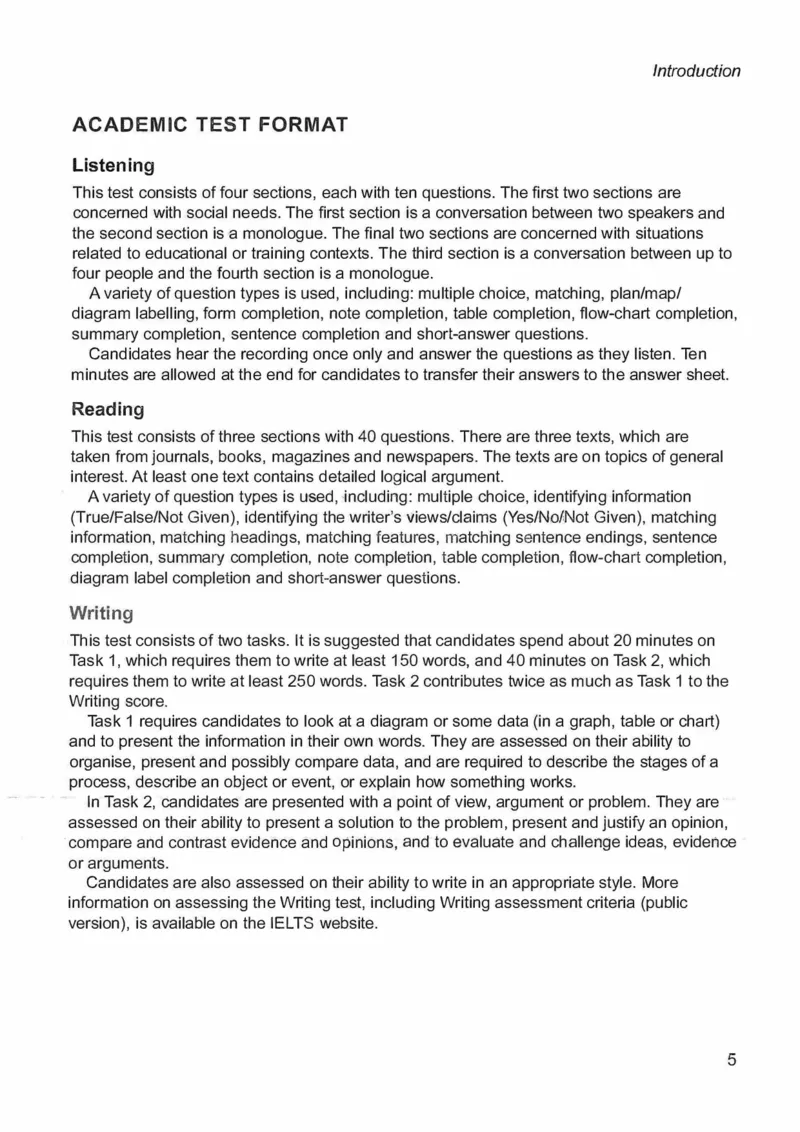
ACADEMIC TEST FORMAT
Listening
This test consists of four sections, each with ten questions. The first two sections are
concerned with social needs. The first section is a conversation between two speakers and
the second section is a monologue. The final two sections are concerned with situations
related to educational or training contexts. The third section is a conversation between up to
four people and the fourth section is a monologue.
A variety of question types is used, including: multiple choice, matching, plan/map/
diagram labelling, form completion, note completion, table completion, flow-chart completion,
summary completion, sentence completion and short-answer questions.
Candidates hear the recording once only and answer the questions as they listen. Ten
minutes are allowed at the end for candidates to transfer their answers to the answer sheet.
Reading
This test consists of three sections with 40 questions. There are three texts, which are
taken from journals, books, magazines and newspapers. The texts are on topics of general
interest. At least one text contains detailed logical argument.
A variety of question types is used, ·including: multiple choice, identifying information
(True/False/Not Given), identifying the writer's views/claims (Yes/No/Not Given), matching
information, matching headings, matching features, matching sentence endings, sentence
completion, summary completion, note completion, table completion, flow-chart completion,
diagram label completion and short-answer questions.
Writing
This test consists of two tasks. It is suggested that candidates spend about 20 minutes on
Task 1, which requires them to write at least 150 words, and 40 minutes on Task 2, which
requires them to write at least 250 words. Task 2 contributes twice as much as Task 1 to the
Writing score.
Task 1 requires candidates to look at a diagram or some data (in a graph, table or chart)
and to present the information in their own words. They are assessed on their ability to
organise, present and possibly compare data, and are required to describe the stages of a
process, describe an object or event, or explain how something works.
In Task 2, · candidates are presented with a point of view, argument or problem. They are
assessed on their ability to present a solution to the problem, present and justify an opinion,
·compare and contrast evidence and opinions, and to evaluate and challenge ideas, evidence
or arguments.
Candidates are also assessed on their ability to write in an appropriate style. More
information on assessing the Writing test, including Writing assessment criteria (public
version), is available on the IELTS website.
5Introduction
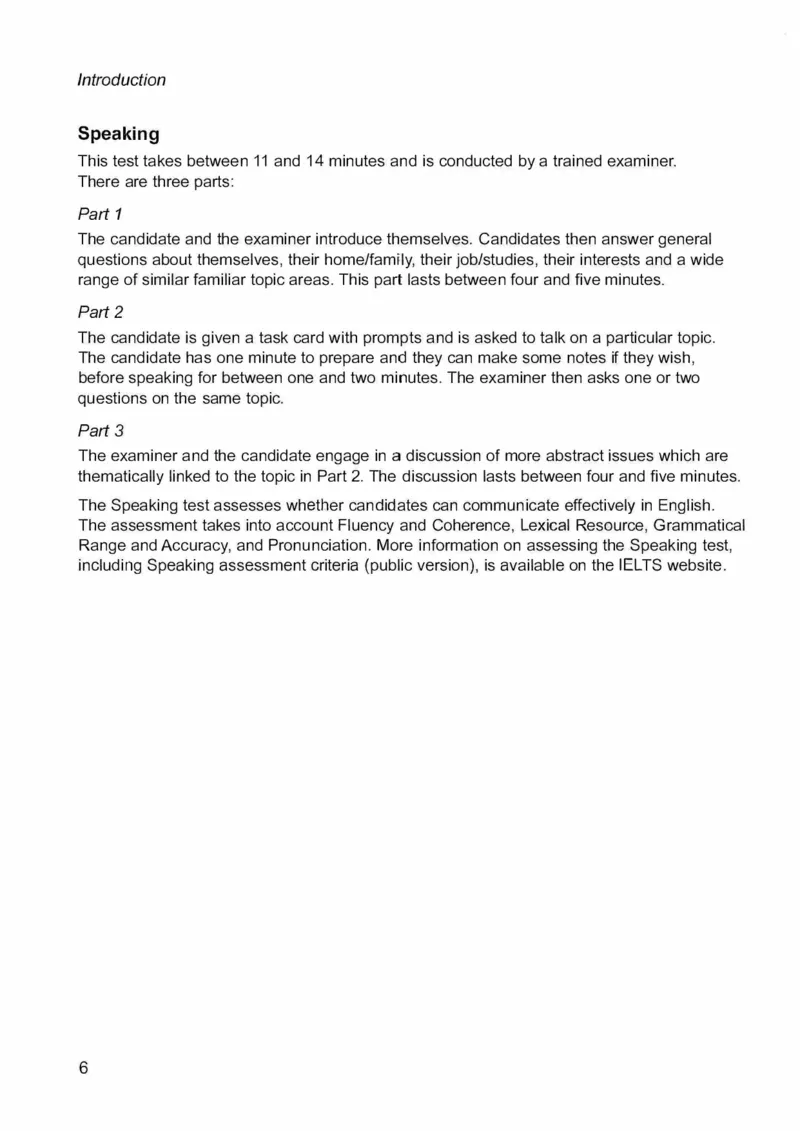
Speaking
This test takes between 11 and 14 minutes and is conducted by a trained examiner.
There are three parts:
Part 1
The candidate and the examiner introduce themselves. Candidates then answer general
questions about themselves, their home/family, their job/studies, their interests and a wide
range of similar familiar topic areas. This part lasts between four and five minutes.
Part 2
The candidate is given a task card with prompts and is asked to talk on a particular topic.
The candidate has one minute to prepare and they can make some notes if they wish,
before speaking for between one and two minutes. The examiner then asks one or two
questions on the same topic.
Part 3
The examiner and the candidate engage in a discussion of more abstract issues which are
thematically linked to the topic in Part 2. The discussion lasts between four and five minutes.
The Speaking test assesses whether candidates can communicate effectively in English.
The assessment takes into account Fluency and Coherence, Lexical Resource, Grammatical
Range and Accuracy, and Pronunciation. More information on assessing the Speaking test,
including Speaking assessment criteria (public version), is available on the IELTS website.
6Introduction
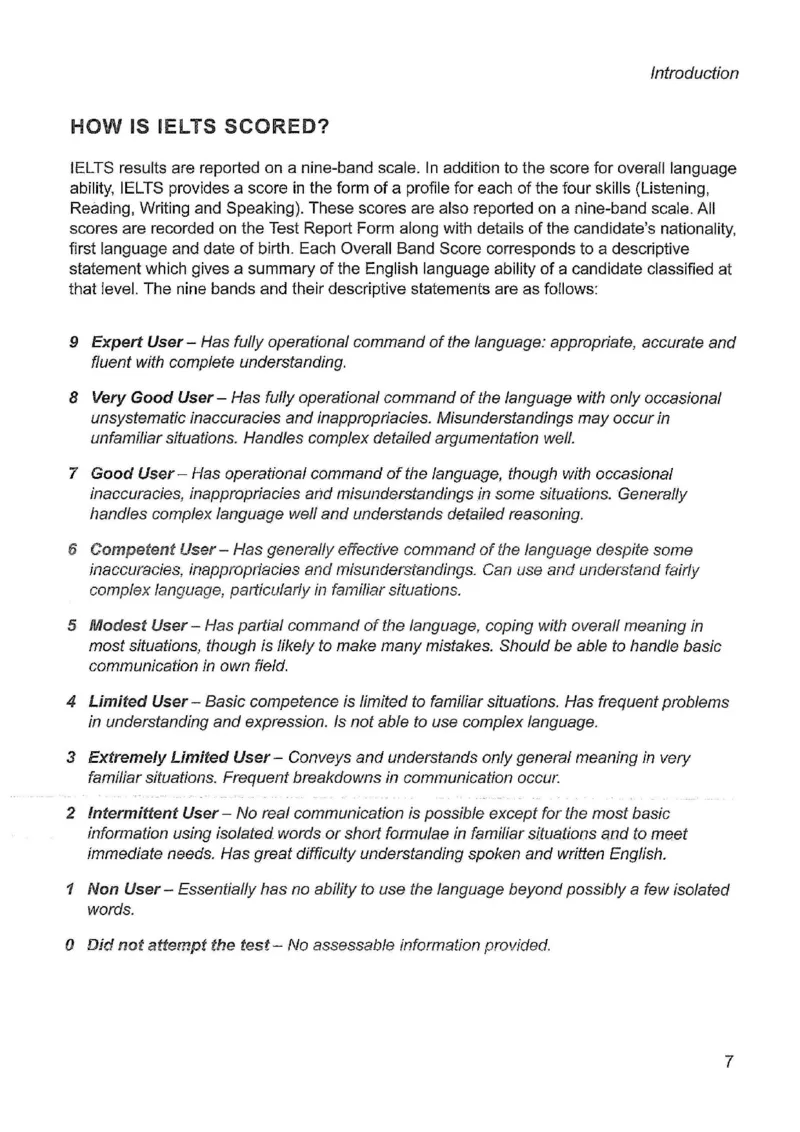
HOW IS IELTS SCORED?
IELTS results are reported on a nine-band scale. In addition to the score for overall language
ability, IELTS provides a score in the form of a profile for each of the four skills (Listening,
Reading, Writing and Speaking). These scores are also reported on a nine-band scale. All
scores are recorded on the Test Report Form along with details of the candidate's nationality,
first language and date of birth. Each Overall Band Score corresponds to a descriptive
statement which gives a summary of the English language ability of a candidate classified at
that level. The nine bands and their descriptive statements are as follows:
9 Expert User - Has fully operational command of the language: appropriate, accurate and
fluent with complete understanding.
8 Very Good User - Has fully operational command of the language with only occasional
unsystematic inaccuracies and inappropriacies. Misunderstandings may occur in
unfamiliar situations. Handles complex detailed argumentation well.
7 Good User - Has operational command of the language, though with occasional
inaccuracies, inappropriacies and misunderstandings in some situations. Generally
handles complex language weJIa nd understands detailed reasoning.
6 Competent User - Has generally effective command of the language despite some
inaccuracies, inappropriacies and misunderstandings. Can use and understand fairly
complex language, particularly in familiar situations.
5 Modest User - Has partial command of the language, coping with overall meaning in
most situations, though is likely to make many mistakes. Should be able to handle basic
communication in own field.
4 Limited User - Basic competence is limited to familiar situations. Has frequent problems
in understanding and expression. Is not able to use complex language.
3 Extremely Limited User - Conveys and understands only general meaning in very
familiar situations. Frequent breakdowns in communication occur.
2 Intermittent User - No real communication is possible except for the most basic
information using isolated words.or short formulae in familiar situations and to meJ~t
immediate needs. Has great difficulty understanding spoken and written English.
1 Non User - Essentially has no ability to use the language beyond possibly a few isolated
words.
0 Did not attempt the test- No assessable information provided.
7Introduction
MARKING THE PRACTICE TESTS
Listening and Reading
The Answer Keys are on pages 116-123 .
Each question in the Listening and Reading tests is worth one mark.
Questions which require letter I Roman numeral answers
• For questions where the answers are letters or Roman numerals, you should write only
the number of answers required. For example, if the answer is a single letter or numeral
you should write only one answer. If you have written more letters or numerals than are
required, the answer must be marked wrong.
Questions which require answers in the form of words or numbers
• Answers may be written in upper or lower case.
• Words in brackets are optional - they are correct, but not necessary.
• Alternative answers are separated by a slash (/).
• If you are asked to write an answer using a certain number of words and/or (a)
number(s), you will be penalised if you exceed this. For example, if a question specifies
an answer using NO MORE THAN THREE WORDS and the correct answer is 'black
leather coat', the answer 'coat of black leather' is incorrect.
• In questions where you are expected to complete a gap, you should only transfer the
necessary missing word(s) onto the answer sheet. For example, to complete 'in the ... ',
where the correct answer is 'morning', the answer 'in the morning' would be incorrect.
• All answers require correct spelling (including words in brackets).
• Both US and UK spelling are acceptable and are included in the Answer Key.
• All standard alternatives for numbers, dates and currencies are acceptable.
• All standard abbreviations are acceptable.
• You will find additional notes about individual answers in the Answer Key.
Writing
The sample answers are on pages 124-131. It is not possible for you to give yourself a mark
for the Writing tasks. We have provided sample answers (written by candidates), showing
their score and the examiner's comments. These sample answers will give you an insight
into what is required for the Writing test.
8Introduction
HOW SHOULD YOU INTERPRET YOUR SCORES?
At the end of each Listening and Reading Answer Key you will find a chart which will help
you assess whether, on the basis of your Practice Test results, you are ready to take the
IELTS test.
In interpreting your score, there are a number of points you should bear in mind. Your
performance in the real IELTS test will be reported in two ways: there will be a Band Score
from 1 to 9 for each of the components and an Overall Band Score from 1 to 9, which
is the average of your scores in the four components . However, institutions considering
your application are advised to look at both the Overall Band Score and the Bands for
each component in order to determine whether you have the language skills needed for a
particular course of study. For example, if your course involves a lot of reading and writing,
but no lectures, listening skills might be less important and a score of 5 in Listening might be
acceptable if the Overall Band Score was 7. However, for a course which has lots of lectures
and spoken instructions, a score of 5 in Listening might be unacceptable even though the
Overall Band Score was 7.
Once you have marked your tests, you should have some idea of whether your listening
and reading skills are good enough for you to try the IELTS test. If you did well enough in
. one component, but not in others, you will have to decide for yourself whether you are ready
to take the test.
The Practice Tests have been checked to ensure that they are of approximately the same
level of difficulty as the real IELTS test. However, we cannot guarantee that your score in the
Practice Tests will be reflected in the real IELTS test. The Practice Tests can only give you
an idea of your possible future performance and it is ultimately up to you to make decisions
based on your score.
Different institutions accept different IELTS scores for different types of courses. We have
based our recommendations on the average scores which the majority of institutions accept.
The institution to which you are applying may, of course, require a higher or lower score than
most other institutions.
Further information
For more information about IELTS or any other Cambridge English Language Assessment
examination , write to:
Cambridge English Language Assessment
1 Hills Road
Cambridge
CB1 2EU
United Kingdom
https://support. cambridgeenglish .org
http://www.ielts.org
9Test 5
LISTENING
SECTION 1 Questions 1-10
Complete the notes below.
Write ONE WORD AND/OR A NUMBER for each answer.
FAMILY EXCURSIONS
Cruise on a lake
Example
• Travel on an old ........?.. t.?.0.r.D.~.h..]..P... . .
• Can take photos of the 1 ..........................................t.h at surround the lake
Farm visit
• Children can help feed the sheep
• Visit can include a 40-minute ride on a 2 ...........................................
• Visitors can walk in the farm's 3 ........................................... by the lake
• 4 ........................................... is available at extra cost
Cycling trips
• Cyclists explore the Back Road
• A 5 ........................................... is provided
• Only suitable for cyclistsw ho have some 6 .................................. .........
Bikes can be hired from 7 ...........................................( near the Cruise Ship
Terminal)
10Listening
• Cyclists need:
a repair kit
food and drink
a 8 ...........................................( can be hired)
• There are no 9 ........................................... or accommodation in the area
Cost
• Total cost for whole family of cruise and farm visit: 10 $ ...........................................
11Test 5
SECTION 2 Questions 11-20
Questions 11-14
Choose the correct letter, A, B or C.
Talk to new kitchen assistants
11 According to the manager, what do most people like about the job of kitchen
assistant?
A the variety of work
B the friendly atmosphere
C the opportunities for promotion
12 The manager is concerned about some of the new staff's
A jewellery.
B hair styles.
C shoes.
13 The manager says that the day is likely to be busy for kitchen st.aff because
A it is a public holiday.
B the head chef is absent.
C the restaurant is almost fully booked.
14 Only kitchen staff who are 18 or older are allowed to use
A the waste disposal unit.
B the electric mixer.
C the meat slicer.
Questions 15 and 16
Choose TWO letters, A-E.
According to the manager, which TWO things can make the job of kitchen assistant
stressful?
A They have to follow orders immediately.
B The kitchen gets very hot.
C They may not be able to take a break.
D They have to do overtime.
E The work is physically demanding.
12Listening
Questions 17-20
What is the responsibility of each of the following restaurant staff?
Choose FOUR answers from the box and write the correct letter, A-F, next to
Questions 17-20.
Responsibilities
A training courses
B food stocks
C first aid
D breakages
E staff discounts
F timetables
Restaurant staff
17 Joy Parkins ......................
18 David Field
······················
19 Dexter Wills ......................
20 Mike Smith ......................
13Test 5
SECTION 3 Questions 21-30
Questions 21-23
Choose the correct letter, A, B or C.
Paper on Public Libraries
21 What will be the main topic of Trudie and Stewart's paper?
A how public library services are organised in different countries
B how changes in society are reflected in public libraries
C how the funding of public libraries has changed
22 They agree that one disadvantage of free digitalised books is that
A they may take a long time to read.
B they can be difficult to read.
C they are generally old.
23 Stewart expects that in the future libraries will
A maintain their traditional function.
B become centres for local communities.
C no longer contain any books.
Questions 24-30
Complete the notes below.
Write ONE WORD ONLY for each answer.
Study of local library: possible questions
• whether it has a 24 ..... .......... ...... of its own
• its policy regarding noise of various kinds
• how it's affected by laws regarding all aspects of 25 ....... ... ..... ... .. .
• how the design needs to take the 26 .......... ........... of customers into account
• what 27 ...... ........... .... is required in case of accidents
• why a famous person's 28 .......... ........... is located in the library
• whether it has a 29 ..................... of local organisations
• how it's different from a library in a 30 .... .... ............ .
14Listening
SECTION 4 Questions 31-40
Complete the notes below.
Write NO MORE THAN TWO WORDS for each answer.
Four business values
Many business values can result in 31 ........................................... .
Senior managers need to understand and deal with the potential
32 ......................................t .h..a..t may result.
Collaboration
During a training course, the speaker was in a team that had to build a
33 .......................................... ..
Other teams experienced 34 ......................., . ..............f.r.o..m trying to collaborate.
The speaker's team won because they reduced collaboration.
Sales of a 35 ...........................................w ere poor because of collaboration.
Industriousness
Hard work may be a bad use of various company 36 .......................................... ..
The word 'lazy' in this context refers to people who avoid doing tasks that
are 37 .................................. ..........
Creativity
An advertising campaign for a 38 ...........................................w as memorable but failed to
boost sales.
Creativity should be used as a response to a particular 39 ........................................... .
Excellence
According to one study, on average, pioneers had a 40 ...............................t.h..a..t. ......
was far higher than that of followers.
Companies that always aim at excellence may miss opportunities.
15Test5
READING PASSAGE 1
You should spend about 20 minutes on Questions 1-13 , which are based on Reading
Passage 1 below.
Cork
Cork - the thick bark of the cork oak Portugal, Spain, Italy, Greece and
tree (Quercus suber) - is a remarkable Morocco. They flourish in warm, sunny
material. It is tough, elastic, buoyant , climates where there is a minimum of
and fire-resistant, and suitable for a 400 millimetres of rain per year, and
wide range of purposes. It has also not more than 800 millimetres. Like
been used for millennia: the ancient grape vines, the trees thrive in poor
Egyptians sealed their sarcopha gi soil, putting down deep roots in search
(stone coffins) with cork, while the of moisture and nutrients. Southern
ancient Greeks and Romans used it Portugal's Alentejo region meets all of
for anything from beehives to sandals. these requirements, which explains
why, by the early 20th century, this
And the cork oak itself is an region had become the world's largest
extraordinary tree. Its bark grows producer of cork, and why today it
up to 20 cm in thickness, insulating accounts for roughly half of all cork
the tree like a coat wrapped around production around the world.
the trunk and branches and keeping
the inside at a constant 20°C all year Most cork forests are family-owned.
round. Developed most probably as Many of these family businesses , and
a defence against forest fires, the indeed many of the trees the1nselves,
bark of the cork oak has a particular are around 200 years old. Cork
cellular structure - with about production is, above all, an exercise in
40 million cells per cubic centimetre - patience. From the planting of a cork
that technology has never succeeded sapling to the first harvest takes 25
in replicating. The cells are filled with years, and a gap of approximately a
air, which is why cork is so buoyant. decade must separate harvests from
It also has an elasticity that means an individual tree . And for top-quality
you can squash it and watch it spring cork, it's necessary to wait a further
back to its original size and shape 15 or 20 years . You even have to wait
when you release the pressure. for the right kind of summer's day to
harvest cork. If the bark is stripped on
Cork oaks grow in a number of a day when it's too cold - or when the
Mediterranean countries, including air is damp - the tree will be damaged .
16Reading
Cork harvesting is a very specialised is caused by a chemical compound
profession. No mechanical means called 2,4,6-trichloroanisole (TCA),
of stripping cork bark has been which forms through the interaction
invented, so the job is done by teams of plant phenols, chlorine and mould.
of highly skilled workers . First, they The tiniest concentrations - as little
make vertical cuts down the bark as three or four parts to a trillion -
using small sharp axes, then lever · can spoil the taste of the product
it away in pieces as large as they contained in the bottle. The result
can manage. The most skilful cork has been a gradual yet steady move
strippers prise away a semi-circular first towards plastic stoppers and,
husk that runs the length of the trunk more recently, to aluminium screw
from just above ground level to the caps. These substitutes are cheaper to
first branches . It is then dried on the manufacture and, in the case of screw
ground for about four months, before caps, more convenient for the user.
being taken to factories, where it is
boiled to kill any insects that might The classic cork stopper does
remain in the cork. Over 60% of have several advantages, however.
cork then goes on to be made into Firstly, its traditional image is more
traditional bottle stoppers, with most in keeping with that of the type of
of the remainder being used in the high quality goods with which it has
construction trade . Corkboard and long been associated. Secondly -
cork tiles are ideal for thermal and and very importantly - cork is a
acoustic insulation, while granules of sustainable product that can be
cork are used in the manufacture of recycled without difficulty. Moreover,
concrete . cork forests are a resource which
support local biodiversity, and prevent
Recent years have seen the end of desertification in the regions where
the virtual monopoly of cork as the they are planted. So, given the current
material for bottle stoppers, due to concerns about environmental issues,
concerns about the effect it may have the future of this ancient material
on the contents of the bottle. This once again looks promising.
17Test 5
Questions 1-5
Do the following statements agree with the information given in Reading Passage 1?
In boxes 1-5 on your answer sheet, write
TRUE if the statement agrees with the information
FALSE if the statement contradicts the information
NOT GIVEN if there is no information on this
1 The cork oak has the thickest bark of any living tree.
2 Scientists have developed a synthetic cork with the same cellular structure as
natural cork.
3 Individual cork oak trees must be left for 25 years between the first and second
harvest.
4 Cork bark should be stripped in dry atmospheric conditions.
5 The only way to remove the bark from cork oak trees is by hand.
18Reading
Questions 6-13
Complete the notes below.
Choose ONE WORD ONLY from the passage for each answer.
Write your answers in boxes 6-13 on your answer sheet.
Comparison of aluminium screw caps and
cork bottle stoppers
Advantages of aluminium screw caps
• do not affect the 6 ...... ....... ........ of the bottle contents
• are 7 ............. ...... .. to produce
• are 8 ....... .............. to use
Advantag es of cork bottle stoppe·rs
• suit the 9 ..................... of quality products
• made from a 10 ........... .......... material
• easily 11 .......... .......... .
• cork forests aid 12 ....... ....... ...... .
• cork forests stop 13 ..... .... ..... ....... happening
19Test5
READING PASSAGE 2
You should spend about 20 minutes on Questions 14-26 , which are based on Reading
Passage 2 below.
COLLECTING AS A HOBBY
Collecting must be one of the most varied Some may spend their whole lives in a
of human activities, and it's one that many hunt for this. Psychologicall y, this can give
of us psycho log ists find fascinating. Many a pur pose to a life that otherwise fee ls
forms of collect ing have bee n dig nified aimless. The re is a danger , though, that
with a technical name: an archtophilist if the individual is ever lucky enough to
collects teddy bears , a philate list collects find what they're look ing for, rather than
postage stamps, and a deltio logist celebrating their success, they may fee l
collects postcards. Amassing hundreds or emp ty, now that the goa l that drove them
even thousands of postcards, choco late on has gone.
wrapp ers or whatev er, takes time, energy
and money that could surely b.e put to If you think about collect ing postage
much more prod uctive use. And yet there stamps , another potential reason for
are millions of collectors around the world. it - or, perhaps, a result of collecting - is
Why do they do it? its educational value. Stamp collecting
opens a window to other count ries, and
There are the peop le who collect beca use to the plants, animals, or famous people
they want to make money - this could be shown on the ir stamps. Similarly, in the
th
called an instrumen tal reason for collect ing; 19 century, many collectors amassed
that is, collecting as a means to an end . fossils, animals and plants from around
They'll look for, say, antiques that they the globe, and their collections provided
can buy cheap ly and expect to be able a vast amount of information abo ut the
to sell at a profit. But there may wel l be a natura l wor ld. Without those collections,
psycholog ical eleme nt, too - buying cheap our understanding wou ld be greatly infer ior
and selling dear can give the collecto r a to what it is.
sense of triumph . And as selling online is so
easy, more and more peopl e are join ing in. In the past - and now adays, too, though
to a lesser extent - a popular form of
Many collectors collect to dev elop the ir collect ing, part icularly among boys
social life, attend ing meetings of a group and men, was trainspott ing. This might
of collectors and exchang ing information involve trying to see every locomotive of a
on items. This is a variant on join ing a part icular type , using published data that
bridg e club or a gym , and similar ly brings identif ies each one, and ticking off each
them into contact with like-minded people. engine as it is seen. Trainspotters exchange
informat ion, these days often by mobi le
Another mot ive for collecting is the desire phon e, so they can work out where to go
to find something spec ial, or a particular to, to see a parti cular engine. As a by
examp le of the collected item, such as a product, many pract itioners of the hob by
rare early record ing by a part icular singer . become very knowl edgeab le about railway
20Reading
operations, or the technical specifications perhaps by country in alphabet ical order,
of different engine types. or grouping stamps by what they depict
people, birds, maps, and so on.
Similarly, people who collect dolls may go
beyond simply enlarging their collection, One reason, conscious or not, for what
and deve lop an interest in the way that someone chooses to collect is to show
dolls are made, or the materials that the collector's individualism. Someone
are used. These have changed over the who decides to collect something as
centuries from the wood that was standard unexpected as dog collars, for instance,
in 16th century Europe, through the wax may be conveying their belief that they
and porcelain of later centur ies, to the must be interesting themselves. And
plastics of today's dolls. Or collectors believe it or not, there is at least one dog
might be inspired to study how dolls collar museum in existence, and it grew out
reflect notions of what children like, or of a personal collection.
ought to like.
Of course, all hobbies give pleasu re, but
Not all collectors are interested in learning the common factor in collect ing is usually
from their hobby, though, so what we passion: pleasure is putting it far too
might call a psychologica l reason for mildly. More than most other hobb ies,
collecting is the need for a sense of collecting can be totally engrossing,
control, perhaps as a way of dealing with and can give a strong sense of personal
insecurity. Stamp collectors, for instance, fulfilment. To non-collec tors it may appear
arrange their stamps in albums, usually very an eccentric, if harmless, way of spending
neatly, orga nising their collection accord ing time, but potentially, collecting has a lot
to certain commonp lace principles - going for it.
21Test 5
Questions 14-21
Complete the sentences below.
Choose ONE WORD ONLY from the passage for each answer.
Write your answers in boxes 14-21 on your answer sheet.
14 The writer mentions collecting ............ as an example of collecting in order to
make money.
15 Collectors may get a feeling of ............ from buying and selling items.
16 Collectors' clubs provide opportunities to share .... ...... .. .
17 Collectors' clubs offer ........ .... with people who have similar interests.
18 Collecting sometimes involves a life-long .... ........ for a special item.
19 Searching for something particular may prevent people from feeling their life is
completely ..... .... ... .
20 Stamp collecting may be ............ because it provides facts about different
countries.
21 .... ........ tends to be mostly a male hobby.
Questions 22-26
Do the following statements agree with the information given in the passage on
pages 20 and 21?
In boxes 22-26 on your answer sheet, write
TRUE if the statement agrees with the information
FALSE if the statement contradicts the information
NOT GIVEN if there is no information on this
22 The number of people buying dolls has grown over the centuries .
23 Sixteenth century European dolls were normally made of wax and porcelain.
24 Arranging a stamp collection by the size of the stamps is less common than other
methods .
25 Someone who collects unusual objects may want others to think he or she is also
unusual.
26 Collecting gives a feeling that other hobbies are unlikely to inspire.
22Reading
READING PASSAGE 3
You should spend about 20 minutes on Questions 27-40 , which are based on Reading
Passage 3 on pages 24 and 25.
Questions 27-32
Reading Passage 3 has six sections, A-F.
Choose the correct heading for each section from the list of headings below.
Write the correct number, i-viii, in boxes 27-32 on your answer sheet.
List of Headings
Courses that require a high level of commitment
ii A course title with two meanings
iii The equal irr,1portanceo f two key issues
iv Applying a theory in an unexpected context
v The financial benefits of studying
vi A surprising course title
vii Different names for different outcomes
viii The possibility of attracting the wrong kind of student
27 Section A
28 Section B
29 Section C
30 Section D
31 Section E
32 Section F
23Test5
What's the purpose of gaining knowledge?
A 'I would found an institution where any person can find instruction in any
subject.' That was the found er's motto for Cornell University, and it seems an apt
characterization of the different university, also in rhe USA, where I currently teach
philosophy. A student can prepare for a career in resort management, engineerin g,
interior design, accounting, music, law enforcement, you name it. But what would
the founders of these two institution s have thought of a course called 'Arson for Profit'?
I kid you not: we have it on the books. Any undergr aduates who have met the academic
requirements can sign up for the course in our program in 'fire science'.
B Naturally, the course is intended for prospective arson investigators, who can learn all
the tricks of the trade for detecting whether a fire was deliberately set, discovering who
did it, and establishing a chain of evidence for effective prosecution in a court of law.
But wouldn't this also be the perfect course for prospective arsonists to sign up for? My
point is not to criticize academic program s in fire science: they are highly welcome as
part of the increasii1g professionalizqtion of this and many other occupations. However,
it's not unknown for a firefighter to torch a building. 1his example suggests how
dishone st and illegal behavior, with the help of. higher education, can creep into every
aspect of public and business life.
C I realized this anew when I was invited to speak before a class in marketing, which is
anoth er of our degree programs. The regular instructor is a colleague who appreciates
the kind of ethical perspective I can bring as a philosopher. There are endless ways
I could have approac hed this assignment, but I took my cue from the title of the
course: 'Principles of Marketing '. It made me chink co ask the student s, 'ls marketing
princip led?' After all, a subject matter can have principles in the sense of being codified,
having rules, as with football or chess, without being principl ed in the sense of being
ethical. Many of the students immediately assumed chat the answer co my question
about marketin g princip les was obvious : no. Just look at the ways in which everything
under the sun has been marketed; obviously it need not be done in a principled
( =ethical) fashion .
D Is chat obvious? I made the suggestion, which may sound downright crazy in light of
the evidence, that perhaps marketing is by definition principled . My inspiration for this
judgement is the philosopher Immanuel Kant, who argued that any body of knowledge
consists of an end (or purpos e) and a means.
24Reading
E Let us apply both the terms 'means' and 'end' to marketing. The students have signed
up for a course in order to learn how to market effectively. But to what encP. There seem
to be two main attitudes toward that question. One is that the answer is obvious: the
purpose of marketing is to sell things and to make money. The other attitude is that the
purpose of marketing is irrelevant: Each person comes to the program and course with
his or her own plans, and these need not even concern the acquisition of marketing
expertise as such. My proposal, which I believe would also be Kane's, is that neither of
these attitudes captures the significance of the end to the means for marketing. A field
of knowledge or a professional endeavor is defined by both the means and the end;
hence both deserve scrutiny. Students need to study both how to achieve X, and also
what X is.
F It is at this point that 'Arson for Profit' becomes supremely relevant. That course is
presumably all about means: how to detect and prosecute criminal activity. It is therefore
assumed that the end is good in an ethical sense. When I ask fire science students to
articulate the end, or purpose, of their field, they eventually generalize to something like,
'The safety and welfare of society,' which seems right. As we have seen, someone could
use the very same knowledge of means to achieve a much less noble end, such as personal
profit via destructive, dangerouS', reckless activity. But we would not call that fire.fighting.
We have a separate word for it: arson. Similarly, if you. employed the 'principles of
marketing' in an unprincipled way, you would not be doing marketing. We have another
term for it: fraud. Kant gives the example of a doctor and a poisoner, who use the
identical knowledge to achieve their divergent ends. We would say that one is practicing
medicine, the other, murder.
25Test 5
Questions 33-36
Complete the summary below.
Choose NO MORE THAN TWO WORDS from the passage for each answer.
Write your answers in boxes 33-36 on your answer sheet.
The 'Arson for Profit' course
This is a university course intended for students who are undergraduates and who
are studying 33 ............ . The expectation is that they will become 34 ........... .
specialising in arson. The course will help them to detect cases of arson and find
35 ............ of criminal intent, leading to successful 36 ............ in the courts.
Questions 37-40
Do the following statements agree with the views of the writer in Reading Passage 3?
In boxes 37-40 on your answer sheet, write
YES if the statement agrees with the views of the writer
NO if the statement contradicts the views of the writer
NOT GIVEN if it is impossible to say what the writer thinks about this
37 It is difficult to attract students onto courses that do not focus on a career.
38 The 'Arson for Profit' course would be useful for people intending to set fire to
buildings.
39 Fire science courses are too academic to help people to be good at the job of
firefighting.
40 The writer's fire science students provided a detailed definition of the purpose of
their studies.
26Writing
f" o,..� c-,, tc -CH CH
WRITING
" y
WRITING TASK 1
You should spend about 20 minutes on this task.
The bar chart below shows the percentage of Australian men and women in
different age groups who did regular physical activity in 2010.
Summarise the information by selecting and reporting the main features, and
make comparisons where relevant.
Write at least 150 words.
Percentage of Australian men and women doing
regular physical activity: 2010
60
Q)
C)ea
Q)
15 to 24 25 to 34 35 to 44 45 to 54 55 to 64 65 and over
Age group
■
Ii]
Male Female
27Test5
WRITING TASK 2
You should spend about 40 minutes on this task.
Write about the following topic:
Some people believe that it is good to share as much information as possible
in scientific research, business and the academic world. Others believe that
some information is too important or too valuable to be shared freely.
Discuss both these views and give your own opinion.
Give reasons for your answer and include any relevant examples from your own
knowledge or experience.
Write at least 250 words.
28Speaking
' s
: SPEAKJNG
PART 1
The examiner asks the candidate about him/herself, his/her home, work or studies and
other familiar topics.
EXAMPLE
Health
• Is it important to you to eat healthy food? [Why?/Why not?]
• If you catch a cold, what do you do to help you feel better? [Why?]
• Do you pay attention to public information about health? [Why?/Why not?]
• What could you do to have a healthier lifestyle?
PART 2
Describe an occasion when you had to wait You will have to talk about the
a long time for someone or something· .to topic for one to two minutes.
arrive. You have one minute to think
about what you are going to say.
You should say: You can make some notes to
who or what you were waiting for help you if you wish.
how long you had to wait
why you had to wait a long time
and explain how you felt about waiting a
long time.
PART 3
Discussion topics:
Arriving early
Example questions:
In what kinds of situations should people always arrive early?
How important it is to arrive early in your country?
How can modern technology help people to arrive early?
Being patient
Example questions:
What kinds of jobs require the most patience?
Is it always better to be patient in work (or studies)?
Do you agree or disagree that the older people are, the more patient they are?
29Test 6
LISTENING
Questions 1-10
SECTION 1
Complete the notes below.
Write ONE WORD AND/OR A NUMBER for each answer.
Events during Kenton Festival
Example
Start date: ............... J.�.t.-h .............. M<;1y
Opening ceremony (first day)
• In town centre, starting at 1 .......................................... .
The mayor will make a speech
A 2 ........................................... will perform
Performance of a 3 .................................... about Helen Tungate (a 4 .................................... )
Evening fireworks display situated across the 5 .......................................... .
Other events
• Videos about relationships that children have with their 6 .......................................... .
Venue: 7 ........................................... House
• Performance of 8 ........................................... dances
Venue: the 9 ........................................... market in the town centre
Time: 2 and 5 pm every day except 1 st day of festival
• Several professional concerts and one by children
Venue: library
Time: 6.30 pm on the 18th
Tickets available online from festival box office and from shops which have
the festival 10 ........................................... in their windows
30Listening
SECTION 2 Questions 11-20
Questions 11-15
Choose the correct letter, A, B or C.
Theatre trip to Munich
11 When the group meet at the airport they will have
A breakfast.
B coffee.
C lunch.
12 The group will be met at Munich Airport by
A an employee at the National Theatre.
B a theatre manager.
C a tour operator.
13 How much will they pay per night for a double room at the hotel?
A 110 euros
B 120 euros
C 150 euros
14 What type of restaurant will they go to on Tuesday evening?
A an Italian restaurant
B a Lebanese restaurant
C a typical restaurant of the region
15 Who will they meet on Wednesday afternoon?
A an actor
B a playwright
C a theatre director
31Test 6
Questions 16-20
What does the man say about the play on each of the following days?
Choose FIVE answers from the box and write the correct letter, A-G, next to
Questions 16-20.
Comments
A The playwright will be present.
B The play was written to celebrate an anniversary.
C The play will be performed inside a historic building.
D The play will be accompanied by live music.
E The play will be performed outdoors.
F The play will be performed for the first time.
G The performance will be attended by officials from the town.
Days
16 Wednesday ......................
17 Thursday ......................
18 Friday ......................
19 Saturday ······················
20 Monday ····•·················
32Listening
SECTION 3 Questions 21-30
Questions 21-25
Choose the correct letter, A, B or C.
Scandinavian Studies
21 James chose to take Scandinavian Studies because when he was a child
A he was often taken to Denmark.
B his mother spoke to him in Danish.
C a number of Danish people visited his family.
22 When he graduates, James would like to
A take a postgraduate course.
B work in the media.
C become a translator.
23 Which course will end this term?
A Swedish cinema
B Danish television programmes
C Scandinavian literature
24 They agree that James's literature paper this term will be on
A 19th century playwrights.
B the Icelandic sagas.
C modern Scandinavian novels.
25 Beth recommends that James's paper should be
A a historical overview of the genre.
B an in-depth analysis of a single writer.
C a study of the social background to the literature.
33Test 6
Questions 26-30
Complete the flow-chart below.
Choose FIVE answers from the box and write the correct letter, A-G, next to
Questions 26-30.
A bullet points
B film
C notes
D structure
E student paper
F textbook
G documentary
How James will write his paper on the Vikings
He'll read a 26 ...................... and choose his topic.
He'll borrow a 27 ...................... from Beth.
+
He'll plan the 28 ...................... of the paper.
He'll read some source material and write 29 ...................... .
He'll write the paper using 30 ...................... .
He'll write the complete paper.
34Listening
SECTION 4 Questions 31-40
Complete the notes below.
Write ONE WORD ONLY for each answer.
Conflict at work
Conflict mostly consists of behaviour in the general category of 31 ...........................................
Often a result of people wanting to prove their 32 .......................................... .
Also caused by differences in 33 ........................................... between people
34 ' .......................................... .' conflicts: people more concerned about own team than about
company
Conflict-related stress can cause 35 ........................................... that may last for months
Chief Executives (CEOs)
Many have both 36 ........................................... and anxiety
May not like to have their decisions questioned
There may be conflict between people who have different 37 .......................................... .
Other managers
A structure that is more 38 ........................................... may create a feeling of uncertainty
about who staff should report to.
Minimising conflict
Bosses need to try hard to gain 39 ......................................... ..
Someone from outside the company may be given the role of 40 ........................................... in
_ order to resolve conflicts.
35Test 6
READING
READING PASSAGE 1
You should spend about 20 minutes on Questions 1-13, which are based on Reading
Passage 1 below.
The risks agriculture faces in developing countries
Synthesis of an online debate*
A Two things distinguish food production from all other productive activities: first,
every single person needs food each day and has a right to it; and second, it is
hugely dependent on nature. These two unique aspects, one political, the other
natural, make food production highly vulnerable and different from any other
business. At the same time, cultural values are highly entrenched in food and
agricultural systems worldwide.
B Farmers everywhere face major risks, including extreme weather, long-term
climate change, and price volatility in input and product markets. However,
smallholder farmers in developing countries must in addition deal with adverse
environments, both natural, in terms of soil quality, rainfall, etc., and human, in
terms of infrastructure, financial systems, markets, knowledge and technology.
Counter-intuitively, hunger is prevalent among many smallholder farmers in the
developing world.
C Participants in the online debate argued that our biggest challenge is to address the
underlying causes of the agricultural system's inability to ensure sufficient food for
all, and they identified as drivers of this problem our dependency on fossil fuels and
unsupportive government policies.
D On the question of mitigating the risks farmers face, most essayists called for
greater state intervention. In his essay, Kanayo F. Nwanze, President of the
International Fund for Agricultural Development, argued that governments can
significantly reduce risks for farmers by providing basic services like roads to get
produce more efficiently to markets, or water and food storage facilities to reduce
losses. Sophia Murphy, senior advisor to the Institute for Agriculture and Trade
Policy, suggested that the procurement and holding of stocks by governments
can also help mitigate wild swings in food prices by alleviating uncertainties about
market supply.
*The personal names in the text refer to the authors of written contributions to the online debate.
36Reading
E Shenggen Fan, Director General of the International Food Policy Research
Institute, held up social safety nets and public welfare programmes in Ethiopia,
Brazil and Mexico as valuable ways to address poverty among farming families
and reduce their vulnerability to agriculture shocks. However, some commentators
responded that cash transfers to poor families do not necessarily translate into
increased food security, as these programmes do not always strengthen food
production or raise incomes. Regarding state subsidies for agriculture, Rokeya
Kabir, Executive Director of Bangladesh Nari Progati Sangha, commented in her
essay that these 'have not compensated for the stranglehold exercised by private
traders. In fact, studies show that sixty percent of beneficiaries of subsidies are not
poor, but rich landowners and non-farmer traders.'
F Nwanze, Murphy and Fan argued that private risk management tools, like private
insurance, commodity futures markets, and rural finance can help small-scale
producers mitigate risk and allow for investment in improvements. Kabir warned
that financial support schemes often encourage the adoption of high-input
agricultural practices, which in the medium term may raise production costs
beyond the value of their harvests. Murphy noted that when futures markets
become excessively financialised they can contribute to short-term price volatility,
which increases farmers' food insecurity. Many participants and commentators
emphasised that greater transparency in markets is needed to mitigate the impact
of volatility, and make evident whether adequate stocks and supplies are available.
Others contended that agribusiness companies should be held responsible for
paying for negative side effects.
G Many essayists mentioned climate change and its consequences for small-scale
agriculture. Fan explained that 'in addition to reducing crop yields, climate change
increases the magnitude and the frequency of extreme weather events, which
increase smallholder vulnerability.' The growing unpredictability of weather patterns
increases farmers' difficulty in managing weather-related risks. According to this
author, one solution would be to develop crop varieties that are more resilient
to new climate trends and extreme weather patterns. Accordingly, Pat Mooney,
co-founder and executive director of the ETC Group, suggested that 'if we are to
survive climate change, we must adopt policies that let peasants diversify the plant
and animal species and varieties/breeds that make up our menus.'
37Test 6
H Some participating authors and commentators argued in favour of community
based and autonomous risk management strategies through collective action
groups, co-operatives or producers' groups. Such groups enhance market
opportunities for small-scale producers, reduce marketing costs and synchronise
buying and selling with seasonal price conditions. According to Murphy, 'collective
action offers an important way for farmers to strengthen their political and economic
bargaining power, and to reduce their business risks.' One commentator, Giel Ton,
warned that collective action does not come as a free good. It takes time, effort
and money to organise, build trust and to experiment. Others, like Marcel Vernooij
and Marcel Beukeboom, suggested that in order to 'apply what we already know',
all stakeholders, including business, government, scientists and civil society, must
work together, starting at the beginning of the value chain.
Some participants explained that market price volatility is often worsened by the
presence of intermediary purchasers who, taking advantage of farmers' vulnerability,
dictate prices. One commentator suggested farmers can gain greater control over
prices and minimise price volatility by selling directly to consumers. Similarly, Sonali
Bisht, founder and advisor to the Institute of Himalayan Environmental Research
and Education (INHERE), India, wrote that community-supported agriculture, where
consumers invest i'n local farmers by subscription and guarantee producers a fair
price, is a risk-sharing model worth more attention. Direct food distribution systems
not only encourage small-scale agriculture but also give consumers more control
over the food they consume, she wrote.
38Reading
Questions 1-3
Reading Passage 1 has nine paragraphs, A-1.
Which paragraph contains the following information?
Write the correct letter, A-I, in boxes 1-3 on your answer sheet.
1 a reference to characteristics that only apply to food production
2 a reference to challenges faced only by farmers in certain parts of the world
3 a reference to difficulties in bringing about co-operation between farmers
39Test 6
Questions 4-9
Look at the following statements (Questions 4-9) and the list of people below.
Match each statement with the correct person, A-G.
Write the correct letter, A-G, in boxes 4-9 on your answer sheet.
NB You may use any letter more than once.
4 Financial assistance from the government does not always go to the farmers who
most need it.
5 Farmers can benefit from collaborating as a group.
6 Financial assistance from the government can improve the standard of living of
farmers.
7 Farmers may be helped if there is financial input by the same individuals who buy
from them.
8 Governments can help to reduce variation in prices.
9 Improvements to infrastructure can have a major impact on risk for farmers.
List of People
A Kanayo F. Nwanze
B Sophia Murphy
C Shenggen Fan
D Rokeya Kabir
E Pat Mooney
F Giel Ton
G Sonali Bisht
40Reading
Questions 10 and 11
Choose TWO letters, A-E.
Write the correct letters in boxes 10 and 11 on your answer sheet.
Which TWO problems are mentioned which affect farmers with small farms in
developing countries?
A lack of demand for locally produced food
B lack of irrigation programmes
C being unable to get insurance
D the effects of changing weather patterns
E having to sell their goods to intermediary buyers
Questions 12 and 13
Choose TWO letters, A-E.
Write the correct letters in boxes 12 and 13 on your answer sheet.
Which TWO actions are recommended for improving conditions for farmers?
A reducing the size of food stocks
B attempting to ensure that prices rise at certain times of the year
C organising co-operation between a wide range of interested parties
D encouraging consumers to take a financial stake in farming
E making customers aware of the reasons for changing food prices
41Test 6
READING PASSAGE 2
You should spend about 20 minutes on Questions 14-26, which are based on Reading
Passage 2 below.
Questions 14-20
Reading Passage 2 has seven paragraphs, A-G.
Choose the correct heading for each paragraph from the list of headings below.
Write the correct number, i-viii, in boxes 14-20 on your answer sheet.
List of Headings
Different accounts of the same journey
Bingham gains support
ii
A common belief
iii
The aim of the trip
iv
v A dramatic description
A new route
vi
Bingham publishes his theory
vii
Bingham's lack of enthusiasm
viii
14 Paragraph A
15 Paragraph
B
16 Paragraph
C
17 Paragraph
D
18 Paragraph
E
19 Paragraph F
20 Paragraph
G
42Reading
The Lost City
An explorer's encounter with the ruined city of Machu Picchu, the most famous
icon of the Inca civilisation
A When the US explorer and academic Hiram Bingham arrived in South America in
1911, he was ready for what was to be the greatest achievement of his life: the
exploration of the remote hinterland to the west of Cusco, the old capital of the Inca
empire in the Andes mountains of Peru. His goal was to locate the remains of a city
called Vitcos, the last capital of the Inca civilisation. Cusco lies on a high plateau
at an elevation of more than 3,000 metres, and Bingham's plan was to descend
from this plateau along the valley of the Urubamba river, which takes a circuitous
route down to the Amazon and passes through an area of dramatic canyons and
mountain ranges.
B When Bingham and his team set off down the Urubamba in late July, they had
an advantage over travellers who had preceded them: a track had recently been
blasted down the valley canyon to enable rubber to be brought up by mules from
the jungle. Almost all previous traveUers had left the river atOllantaytambo and
taken a high pass across the mountains 'to rejoin the river lower down, thereby
cutting a substantial corner, but also therefore never passing through the area
around Machu Picchu.
C On 24 July they were a few days into their descent of the valley. The day began
slowly, with Bingham trying to arrange sufficient mules for the next stage of the
trek. His companions showed no interest in accompanying him up the nearby hill
to see some ruins that a local farmer, Melchor Arteaga, had told them about the
night before. The morning was dull and damp, and Bingham also seems to have
been less than keen on the prospect of climbing the hill. In his book Lost City of the
Incas, he relates that he made the ascent without having the least expectation that
he would find anything at the top.
D Bingham writes about the approach in vivid style in his book. First, as he climbs
up the hill, he describes the evet�present possibility of deadly snakes, 'capable of
making considerable springs when in pursuit of their prey'; not that he sees any.
Then there's a sense of mounting discovery as he comes -across great sweeps
of terraces, then a mausoleum, followed by monumental staircases and, finally,
the grand ceremonial buildings of Machu Picchu. 'It seemed like an unbelievable
dream ... the sight held me spellbound ...' he wrote.
43Test 6
E We should remember, however, that Lost City of the Incas is a work of hindsight,
not written until 1948, many years after his journey. His journal entries of the
time reveal a much more gradual appreciation of his achievement. He spent
the afternoon at the ruins noting down the dimensions of some of the buildings,
then descended and rejoined his companions, to whom he seems to have said
little about his discovery. At this stage, Bingham didn't realise the extent or the
importance of the site, nor did he realise what use he could make of the discovery.
F However, soon after returning it occurred to him that he could make a name for
himself from this discovery. When he came to write the National Geographic
magazine article that broke the story to the world in April 1913, he knew he had
to produce a big idea. He wondered whether it could have been the birthplace of
the very first Inca, Manco the Great, and whether it could also have been what
chroniclers described as 'the last city of the Incas'. This term refers to Vilcabamba,
the settlement where the Incas had fled from Spanish invaders in the 1530s.
Bingham made desperate attempts to prove this belief for nearly 40 years. Sadly,
his vision of the site as both the beginning and end of the Inca civilisation, while
a magnificent one. , is inaccurate. We now know that Vilcabamba actually lies 65
kilometres away in the depths of the jungle.
G One question that has perplexed visitors, historians and archaeologists alike ever
since Bingham, is why the site seems to have been abandoned before the Spanish
Conquest. There are no references to it by any of the Spanish chroniclers - and if
they had known of its existence so close to Cusco they would certainly have come
in search of gold. An idea which has gained wide acceptance over the past few
years is that Machu Picchu was a moya, a country estate built by an Inca emperor
to escape the cold winters of Cusco, where the elite could enjoy monumental
architecture and spectacular views. Furthermore, the particular architecture of
Machu Picchu suggests that it was constructed at the time of the greatest of all the
Incas, the emperor Pachacuti (c. 1438-71 ). By custom, Pachacuti's descendants
built other similar estates for their own use, and so Machu Picchu would have been
abandoned after his death, some 50 years before the Spanish Conquest.
44Reading
Questions 21-24
Do the following statements agree with the information given in Reading Passage 2?
In boxes 21-24 on your answer sheet, write
TRUE if the statement agrees with the information
FALSE if the statement contradicts the information
NOT GIVEN if there is no information on this
21 Bingham went to South America in search of an Inca city.
22 Bingham chose a particular route down the Urubamba valley because it was the
most common route used by travellers.
23 Bingham understood the significance of Machu Picchu as soon as he saw it.
24 Bingham returned to Machu Picchu in order to find evidence to support his theory.
Questions 25-26
Complete the sentences below.
Choose ONE WORD ONLY from the passage for each answer.
Write your answers in boxes 25-26 on your answer sheet.
25 The track that took Bingham down the Urubamba valley had been created for the
transportation of ........................................... .
26 Bingham found out about the ruins of Machu Picchu from a ........................................... in the
Urubamba valley.
45Test 6
READING PASSAGE 3
You should spend about 20 minutes on Questions 27-40, which are based on Reading
Passage 3 below.
The Benefits of Being Bilingual
A According to the latest figures, the majority of the world's population is now bilingual
or multilingual, having grown up speaking two or more languages. In the past, such
children were considered to be at a disadvantage compared with their monolingual
peers. Over the past few decades, however, technological advances have allowed
researchers to look more deeply at how bilingualism interacts with and changes
the cognitive and neurological systems, thereby identifying several clear benefits of
being bilingual.
B Research shows that when a bilingual person uses one language, the other is
active at the same time. When we hear a word, we don't hear the entire word all at
once: the sounds arrive in sequential order. Long before the word is finished, the
brain's language system begins to guess what that word might be. If you hear 'can',
you will likely activate words like 'candy' and 'candle' as werl, at least during the
earlier stages of word recognition. For bilingual people, this activation is not limited
to a single language; auditory input activates corresponding words regardless
of the language to which they belong. Some of the most compelling evidence
for this phenomenon, called 'language co-activation', comes from studying eye
movements. A Russian-English bilingual asked to 'pick up a marker' from a set of
objects would look more at a stamp than someone who doesn't know Russian,
because the Russian word for 'stamp', marka, sounds like the English word he or
she heard, 'marker'. In cases like this, language co-activation occurs because what
the listener hears could map onto words in either language.
C Having to deal with this persistent linguistic competition can result in difficulties,
however. For instance, knowing more than one language can cause speakers to
name pictures more slowly, and can increase 'tip-of-the-tongue states', when you
can almost, but not quite, bring a word to mind. As a result, the constant juggling of
two languages creates a need to control how much a person accesses a language
at any given time. For this reason, bilingual people often perform better on tasks
that require conflict management. In the classic Stroop Task, people see a word
and are asked to name the colour of the word's font. When the colour and the
word match (i.e., the word 'red' printed in red), people correctly name the colour
more quickly than when the colour and the word don't match (i.e., the word 'red'
printed in blue). This occurs because the word itself ('red') and its font colour (blue)
conflict. Bilingual people often excel at tasks such as this, which tap into the ability
to ignore competing perceptual information and focus on the relevant aspects of
the input. Bilinguals are also better at switching between two tasks; for example,
when bilinguals have to switch from categorizing objects by colour (red or green)
46Reading
to ·categorizing them by shape (circle or triangle), they do so more quickly than
monolingual people, reflecting better cognitive control when having to make rapid
cl1anges of strategy.
D It also seems that the neurological roots of the bilingual advantage extend to brain
ar-eas more traditionally associated with sensory processing. When monolingual
and bilingual adolescents listen to simple speech sounds without any intervening
background noise, they show highly similar brain stem responses. When
researchers play the same sound to both groups in the presence of background
noise, however, the bilingual listeners' neural response is considerably larger,
reflecting better encoding of the sound's fundamental frequency, a feature of sound
closely related to pitch perception.
E Such improvements in cognitive and sensory processing may help a bilingual
person to process information in the environment, and help explain why bilingual
adults acquire a third language better than monolingual adults master a second
language. This advantage may be rooted in the skill of focussing on information
about the new language while reducing interference from the languages they
al ready know.
F Research also indicates that bilingual experience may help to keep the cognitive
mechanisms sharp by recruiting alternate brain networks to compensate for those
that become damaged during aging. Older bilinguals enjoy improved memory
relative to monolingual people, which can lead to real-world health benefits. In a
study of over 200 patients with Alzheimer's disease, a degenerative brain disease,
bilingual patients reported showing initial symptoms of the disease an average
of five years later than monolingual patients. In a follow-up study, researchers
compared the brains of bilingual and monolingual patients matched on the severity
of Alzheimer's symptoms. Surprisingly, the bilinguals' brains had more physical
signs of disease than their monolingual counterparts, even though their outward
behaviour and abilities were the same. If the brain is an engine, bilingualism may
help it to go farther on the same amount of fuel.
G Furthermore, the benefits associated with bilingual experience seem to start
very early. In one study, researchers taught seven-month-old babies growing
up·in monolingual or bilingual homes that when they heard a tinkling sound, a
puppet appeared on one side of a screen. Halfway through the study, the puppet
began appearing on the opposite side of the screen. In order to get a reward, the
infants had to adjust the rule they'd learned; only the bilingual babies were able to
successfully learn the new rule. This suggests that for very young children, as well
as for older people, navigating a multilingual environment imparts advantages that
transfer far beyond language.
47Test 6
Questions 27-31
Complete the table below.
Choose NO MORE THAN TWO WORDS from the passage for each answer.
Write your answers in boxes 27-31 on your answer sheet.
Test Findings
Bilingual people engage both languages
Observing the 27 ...................... of Russian-
simultaneously: a mechanism known as
English bilingual people when asked to
28 ......................
select certain objects
Bilingual people are more able to handle
A test called the 29 ...................... , focusing
tasks involving a skill called 30 ......................
on naming colours
A test involving switching between tasks When changing strategies, bilingual
people have superior 31 ......................
Questions 32-36
Do the following statements agree with the claims of the writer in Reading Passage 3?
In boxes 32-36 on your answer sheet, write
YES if the statement agrees with the claims of the writer
NO if the statement contradicts the claims of the writer
NOT GIVEN if it is impossible to say what the writer thinks about this
32 Attitudes towards bilingualism have changed in recent years.
33 Bilingual people are better than monolingual people at guessing correctly what
words are before they are finished.
34 Bilingual people consistently name images faster than monolingual people.
35 Bilingual people's brains process single sounds more efficiently than monolingual
people in all situations.
36 Fewer bilingual people than monolingual people suffer from brain disease in
old age.
48Reading
Questions
37-40
Reading Passage 3 has seven paragraphs, A-G.
Which paragraph contains the following information?
Write the correct letter, A-G, in boxes 37-40 on your answer sheet.
37 an example of how bilingual and monolingual people's brains respond differently
to a certain type of non-verbal auditory input
38 a demonstration of how a bilingual upbringing has benefits even before we learn
to speak
39 a description of the process by which people identify words that they hear
40 reference to some negative consequences of being bilingual
49Test6
WRITING
WRITING TASK 1
You should spend about 20 minutes on this task.
The maps below show the centre of a small town called /slip as it is now, and
plans for its development.
Summarise the information by selecting and reporting the main features, and
make comparisons where relevant.
Write at least 150 words.
lslip town centre now
Countryside
Shops
Main road
Housing
Park
Housing
lslip town centre: planned development
/
/
1 Bus Shopping Car
1
station centre park
/ ,..__�---��
1 Pedestrians only
Shops
Dual� Housing New Park
housing
carriageway
/
\ '- -------------- -
' /
Housing
50Writing
WRITING TASK 2
You should spend about 40 minutes on this task.
Write about the following topic:
At the present time, the population of some countries includes a relatively large
number of young adults, compared with the number of older people.
Do the advantages of this situation outweigh the disadvantages?
Give reasons for your answer and include any relevant examples from your own
knowledge or experience.
Write at least 250 words.
51Test 6
SPEAKING
PART 1
The examiner asks the candidate about him/herself, his/her home, work or studies and
other familiar topics.
EXAMPLE
Songs and singing
• Did you enjoy singing when you were younger? [Why?/Why not?]
•
How often do you sing now? [Why?]
• Do you have a favourite song you like listening to? [Why?/Why not?]
• How important is singing in your culture? [Why?]
PART 2
Describe a film/movie actor from your country You will have to talk about the
who is very popular. topic for one to two minutes.
You have one minute to think
You should say: about what you are going to say.
who this actor is You can make some notes to
what kinds of films/movies he/she acts in help you if you wish.
what you know about this actor's life
and explain why this actor is so popular.
PART 3
Discussion topics:
Watching films/movies
Example questions:
What are the most popular types of films in your country?
What is the difference between watching a film in the cinema and watching a film at
home?
Do you think cinemas will close in the future?
Theatre
Example questions:
How important is the theatre in your country's history?
How strong a tradition is it today in your country to go to the theatre?
Do you think the theatre should be run as a business or as a public service?
52Test 7
- -
. 1..asmENING
SECTION 1 Questions 1-10
Complete the notes below.
Write ONE WORD ONLY for each answer.
PUBLIC LIBRARY
Example
Th e l.
I
br ary re- opene d. 1·a s· t ...............m... o... n...t...h... ............ .
The library now has
•
a seating area with magazines
• an expanded section for books on 1 ................................... ..
•
a new section on local 2 .................................... .
•
a community room for meetings (also possible to 3 ..................................... there)
• a new section of books for 4 .....................................
For younger children
• the next Science Club meeting: experiments using things from your
5 .................................... .
.
-
Reading Challenge: read six books during the holidays
For adults
•
this Friday: a local author talks about a novel based on a real 6 ................................... ..
• IT support is available on Tuesdays - no 7 ..................................... is necessary
•
free check of blood 8 ..................................... and cholesterol levels (over 60s only)
Other information
• the library shop sells wall-charts, cards and 9 .................................... .
• evenings and weekends: free 10 ..................................... is available
53Test
7
SECTION 2 Questions 11-20
Questions 11 and 12
Choose TWO letters, A-E.
Which TWO age groups are taking increasing numbers of holidays with BC Travel?
A 16-30 years
B 31-42 years
C 43-54 years
D 55-64 years
E over 65 years
Questions 13 and 14
Choose TWO letters, A-E.
Which TWO are the main reasons given for the popularity of activity holidays?
A Clients make new friends.
B Clients learn a useful skill.
C Clients learn about a different culture.
D Clients are excited by the risk involved.
E Clients find them good value for money.
Questions 15-17
Choose the correct letter, A, B or C.
15 How does BC Travel plan to expand the painting holidays?
A by adding to the number of locations
B by increasing the range of levels
C by employing more teachers
16 Why are BC Travel's cooking holidays unusual?
A They only use organic foods.
B They have an international focus.
C They mainly involve vegetarian dishes.
17 What does the speaker say about the photography holidays?
A Clients receive individual tuition.
B The tutors are also trained guides.
C Advice is given on selling photographs.
54Listening
Questions 18-20
Complete the table below.
Write ONE WORD ONLY for each answer.
Fitness Holidays
Location Main focus Other comments
•
Ireland and Italy general fitness personally designed
programme
•
also reduces
18 .....................................
•
Greece includes exercise on
19 ..................................... control
the beach
•
Morocco mountain biking wide variety of levels
•
one holiday that is
specially designed for
20 .....................................
55Test 7
SECTION 3 Questions 21-30
Questions 21-26
Complete the flow-chart below.
Choose SIX answers from the box and write the correct letter, A-H, next to
Questions 21-26.
A patterns 8 names C sources D questions
E employees F solutions G headings H officials
STAGES IN DOING A TOURISM CASE STUDY
RESEARCH
Locate and read relevant articles, noting key information and also 21 ..................................... .
Identify a problem or need
Select interviewees - these may be site 22 ...................................... , visitors or
city 23 ..................................... .
Prepare and carry out interviews. If possible, collect statistics.
•
Check whether 24 ...................................... of interviewees can be used
ANALYSIS
Select relevant information and try to identify 25 ..................................... .
•
Decide on the best form of visuals
WRITING THE CASE STUDY
Give some background before writing the main sections
Do NOT end with 26 .................................... ..
56Listening
Questions 27-30
Choose the correct letter, A, B or C.
The Horton Castle site
27 Natalie and Dave agree one reason why so few people visit Horton Castle is that
A the publicity is poor.
B it is difficult to get to.
C there is little there of interest.
28 Natalie and Dave agree that the greatest problem with a visitor centre could be
A covering the investment costs.
B finding a big enough space for it.
C dealing with planning restrictions.
29 What does Dave say about conditions in the town of Horton?
A There is a lot of unemployment.
B There are few people of working age.
C There are opportunities for skilled workers.
30 According to Natalie, one way to prevent damage to the castle site would be to
A insist visitors have a guide.
B make visitors keep to the paths.
C limit visitor numbers.
57Test 7
SECTION 4
Questions 31-40
Complete the notes below.
Write ONE WORD ONLY for each answer.
The effects of environmental change on birds
Mercury (Hg)
• Highly toxic
• Released into the atmosphere from coal
• In water it may be consumed by fish
• It has also recently been found to affect birds which feed on 31 .......................... ..
Research on effects of mercu_ry on brrds
• Claire Varian-Ramos is investigating:
the effects on birds' 32 ............................ or mental processes, e.g. memory
the effects on bird song (usually learned from a bird's 33 ............................ )
• Findings:
songs learned by birds exposed to mercury are less 34 .......................... ..
this may have a negative effect on birds' 35 ............................
• Lab-based studies:
allow more 36 ............................ for the experimenter
Implications for humans
• Migrating birds such as 37 ............................ containing mercury may be eaten by
humans
• Mercury also causes problems in learning 38 .......................... ..
• Mercury in a mother's body from 39 ............................ may affect the unborn child
• New regulations for mercury emissions will affect everyone's energy
40 .......................... ..
58Reading
READING_
READING PASSAGE 1
You should spend about 20 minutes on Questions 1-13, which are based on Reading
Passage 1.
Questions 1-7
Reading Passage 1 has seven paragraphs, A-G.
Choose the correct heading for each paragraph from the list of headings below.
Write the correct number, i-viii, in boxes 1-7 on your answer sheet.
List of Headings
The importance of getting: the timing right
ii Young meets old
iii Developments to the disadvantage of tortoise
populations
iv Planning a bigger idea
v Tortoises populate the islands
vi Carrying out a carefully prepared operation
vii Looking for a home for the islands' tortoises
viii The start of the conservation project
1 Paragraph A
-2 Paragraph B
3 Paragraph C
4 Paragraph D
5 Paragraph E
6 Paragraph F
7 Paragraph G
59Test 7
Flying tortoises
An airborne reintroduction programme has helped conservationists take
significant steps to protect the endangered Galapagos tortoise.
A Forests of spiny cacti cover much of the uneven lava plains that separate the
interior of the Galapagos island of lsabela from the Pacific Ocean. With its
five distinct volcanoes, the island resembles a lunar landscape. Only the thick
vegetation at the skirt of the often cloud-covered peak of Sierra Negra offers respite
from the barren terrain below. This inhospitable environment is home to the giant
Galapagos tortoise. Some time after the Galapagos's birth, around five million
years ago, the islands were colonised by one or more tortoises from mainland
South America. As these ancestral tortoises settled on the individual islands, the
different populations adapted to their unique environments, giving rise to at least
14 different subspecies. Island life agreed with them. In the absence of significant
predators, they grew to become the largest and longest-living tortoises on the
planet, weighing more than 400 kilograms, occasionally exceeding 1.8 metres in
length and living for more than a century.
8 Before human arrival, the archipelago's tortoises numbered in the hundreds
of thousands. From the 17th century onwards, pirates took a few on board for
food, but the arrival of whaling ships in the 1790s saw this exploitation grow
exponentially. Relatively immobile and capable of surviving for months without food
or water, the tortoises were taken on board these ships to act as food supplies
during long ocean passages. Sometimes, their bodies were processed into high
grade oil. In total, an estimated 200,000 animals were taken from the archipelago
before the 20th century. This historical exploitation was then exacerbated when
settlers came to the islands. They hunted the tortoises and destroyed their habitat
to clear land for agriculture. They also introduced alien species - ranging from
cattle, pigs, goats, rats and dogs to plants and ants - that either prey on the eggs
and young tortoises or damage or destroy their habitat.
C Today, only 11 of the original subspecies survive and of these, several are highly
endangered. In 1989, work began on a tortoise-breeding centre just outside the
town of Puerto Villamil on lsabela, dedicated to protecting the island's tortoise
populations. The centre's captive-breeding programme proved to be extremely
successful, and it eventually had to deal with an overpopulation problem.
D The problem was also a pressing one. Captive-bred tortoises can't be reintroduced
into the wild until they're at least five years old and weigh at least 4.5 kilograms,
at which point their size and weight - and their hardened shells - are sufficient
to protect them from predators. But if people wait too long after that point, the
tortoises eventually become too large to transport.
60Reading
E For years, repatriation efforts were carried out in small numbers, with the tortoises
carried on the backs of men over weeks of long, treacherous hikes along narrow
trails. But in November 2010, the environmentalist and Galapagos National Park
liaison officer Godfrey Merlin, a visiting private motor yacht captain and a helicopter
pilot gathered around a table in a small cafe in Puerto Ayora on the island of Santa
Cruz to work out more ambitious reintroduction. The aim was to use a helicopter
to move 300 of the breeding centre's tortoises to various locations close to Sierra
Negra.
F This unprecedented effort was made possible by the owners of the 67-metre
yacht White Cloud, who provided the Galapagos National Park with free use of
their helicopter and its experienced pilot, as well as the logistical support of the
yacht, its captain and crew. Originally an air ambulance, the yacht's helicopter
has a rear double door and a large internal space that's well suited for cargo,
so a custom crate was designed to hold up to 33 tortoises with a total weight of
about 150 kilograms. This weight, together with that of the fuel, pilot and four crew,
approached the helicopter's maximum payload, and there were times when it was
clearly right on the edge of the helicopter's capabilities. During a period of three
days, a group of volunteers from the breeding centre worked around the clock to
prepare the young tortoises for transport. Meanwhile, park wardens, dropped off
ahead of time in remote locations, cleared landing sites within the thick brush, cacti
and lava rocks.
G Upon their release, the juvenile tortoises quickly spread out over their ancestral
territory, investigating their new surroundings and feeding on the vegetation.
Eventually, one tiny tortoise came across a fully grown giant who had been
lumbering around the island for around a hundred years. The two stood side by
side, a powerful symbol of the regeneration of an ancient species.
61Test
7
Questions 8-13
Complete the notes below.
Choose ONE WORD ONLY from the passage for each answer.
Write your answers in boxes 8-13 on your answer sheet.
The decline of the Galapagos tortoise
• Originally from mainland South America
• Numbers on Galapagos islands increased, due to lack of predators
• 17th century: small numbers taken onto ships used by 8 .......................................... .
• 1790s: very large numbers taken onto whaling ships, kept for 9 ........................................... ,
and also used to produce 10 .......................................... .
• Hunted by 11 ............................................ on the i·slands.
• Habitat destruction: for the -establishment of agriculture and by various
12 ........................................... not native to the islands, which also fed on baby tortoises and
tortoises' 13 .......................................... .
62Reading
READING PASSAGE 2
You should spend about 20 minutes on Questions 14-26, which are based on Reading
Passage 2.
The Intersection of Health Sciences and Geography
A While many diseases that affect humans have been eradicated due to
improvements in vaccinations and the availability of healthcare, there are still areas
around the world where certain health issues are more prevalent. In a world that is
far more globalised than ever before, people come into contact with one another
through travel and living closer and closer to each other. As a result, super-viruses
and other infections resistant to antibiotics are becoming more and more common.
B Geography can often play a very large role in the health concerns of certain
populations. For instance, depending on where you live, you will not have the same
health concerns as someone who lives in a different geographical region. Perhaps
one of the most obvious examples of this idea is malaria-prone areas, which are
usually tropical regions that foster a warm and damp environment in which the
mosquitos that can give people this disease can grow. Malarip is much less of a
problem in high-altitude deserts, for instance.
C In some countries, geographical factors influence the health and well-being of
the population in very obvious ways. In many large cities, the wind is not strong
enough to clear the air of the massive amounts of smog and pollution that cause
asthma, lung problems, eyesight issues and more in the people who live there. Part
of the problem is, of course, the massive number of cars being driven, in addition
to factories that run on coal power. The rapid industrialisation of some countries in
recent years has also led to the cutting down of forests to allow for the expansion of
big cities, which makes it even harder to fight the pollution with the fresh air that is
produced by plants.
D It is in situations like these that the field of health geography comes into its own. It
is an increasingly important area of study in a world where diseases like polio are
re-emerging,- respiratory diseases continue to spread, and malaria-prone areas
are still fighting to find a better cure. Health geography is the combination of, on
the one hand, knowledge regarding geography and methods used to analyse and -
interpret geographical information, and on the other, the study of health, diseases
and healthcare practices around the world. The aim of this hybrid science is to
create solutions for common geography-based health problems. While people will
always be prone to illness, the study of how geography affects our health could
lead to the eradication of certain illnesses, and the prevention of others in the
future. By understanding why and how we get sick, we can change the way we
treat illness and disease specific to certain geographical locations.
63Test 7
E The geography of disease and ill health analyses the frequency with which certain
diseases appear in different parts of the world, and overlays the data with the
geography of the region, to see if there could be a correlation between the two.
Health geographers also study factors that could make certain individuals or a
population more likely to be taken ill with a specific health concern or disease, as
compared with the population of another area. Health geographers in this field
are usually trained as healthcare workers, and have an understanding of basic
epidemiology as it relates to the spread of diseases among the population.
F Researchers study the interactions between humans and their environment that
could lead to illness (such as asthma in places with high levels of pollution) and
work to create a clear way of categorising illnesses, diseases and epidemics into
local and global scales. Health geographers can map the spread of illnesses and
attempt to identify the reasons behind an increase or decrease in illnesses, as
they work to find a way to halt the further spread or re-emergence of diseases in
vulnerable populations.
G The second subcategory of health geography is the geography of healthcare
provision. This group studies the availability (or lack thereof) of healthcare
resources to individuals and populafrons around the world. In both developed and
developing nations there is often a very large discrepancy between the options
available to people in different social classes, income brackets, and levels of
education. Individuals working in the area of the geography of healthcare provision
attempt to assess the levels of healthcare in the area (for instance, it may be very
difficult for people to get medical attention because there is a mountain between
their village and the nearest hospital). These researchers are on the frontline of
making recommendations regarding policy to international organisations, local
government bodies and others.
H The field of health geography is often overlooked, but it constitutes a huge area
of need in the fields of geography and healthcare. If we can understand how
geography affects our health no matter where in the world we are located, we can
better treat disease, prevent illness, and keep people safe and well.
64Reading
Questions 14-19
Reading Passage 2 has eight sections, A-H.
Which paragraph contains the following information?
Write the correct letter, A-H, in boxes 14-19 on your answer sheet.
NB You may use any letter more than once.
14 an acceptance that not all diseases can be totally eliminated
15 examples of physical conditions caused by human behaviour
16 a reference to classifying diseases on the basis of how far they extend
geographically
17 reasons why the level of access to healthcare can vary within a country
18 a description of health geography as a mixture of different academic fields
19 a description of the type of area where- a particular illness is rare
Questions 2CJ..---26
Complete the sentences below.
Choose ONE WORD ONLY from the passage for each answer.
20 Certain diseases have disappeared, thanks to better ........................................... and
healthcare.
21 Because there is more contact between people, ........................................... are losing their
usefulness.
22 Disease-causing ........................................... are most likely to be found in hot, damp regions.
23 One cause of pollution is ........................................... that burn a particular fuel.
24 The growth of cities often has an impact on nearby ........................................... .
25 ........................................... is one disease that is growing after having been eradicated.
26 A physical barrier such as a ........................................... can prevent people from reaching
a hospital.
65Test 7
READING PASSAGE 3
You should spend about 20 minutes on Questions 27-40, which are based on Reading
Passage 3.
Music and the emotions
Neuroscientist Jonah Lehrer considers the emotional power of music
Why does music make us feel? On the one hand, music is a purely abstract art form,
devoid of language or explicit ideas. And yet, even though music says little, it still
manages to touch us deeply. When listening to our favourite songs, our body betrays all
the symptoms of emotional arousal. The pupils in our eyes dilate, our pulse and blood
pressure rise, the electrical conductance of our skin is lowered, and the cerebellum, a
brain region associated with bodily movement, becomes strangely active. Blood is even
re-directed to the muscles in our legs. In other words, sound stirs us at our biological
roots.
A recent paper in Nature Neuroscience by a research team in Montreal, Canada, marks
an important step in revealing the precise 1.mderpinnings of 'the potent pleasurable
stimulus' that is music. Although the study involves plenty of fancy technology, including
functional magnetic resonance imaging (fMRI) and ligand-based positron emission
tomography (PET) scanning, the experiment itself was rather straightforward. After
screening 217 individuals who responded to advertisements requesting people who
experience 'chills' to instrumental music, the scientists narrowed down the subject pool
to ten. They then asked the subjects to bring in their playlist of favourite songs - virtually
every genre was represented, from techno to tango - and played them the music while
their brain activity was monitored. Because the scientists were combining methodologies
(PET and fMRI), they were able to obtain an impressively exact and detailed portrait of
music in the brain. The first thing they discovered is that music triggers the production
of dopamine - a chemical with a key role in setting people's moods - by the neurons
(nerve cells) in both the dorsal and ventral regions of the brain. As these two regions
have long been linked with the experience of pleasure, this finding isn't particularly
surprising.
What is rather more significant is the finding that the dopamine neurons in the
caudate - a region of the brain involved in learning stimulus-response associations,
and in anticipating food and other 'reward' stimuli - were at their most active around
15 seconds before the participants' favourite moments in the music. The researchers
call this the 'anticipatory phase' and argue that the purpose of this activity is to help
us predict the arrival of our favourite part. The question, of course, is what all these
dopamine neurons are up to. Why are they so active in the period preceding the
acoustic climax? After all, we typically associate surges of dopamine with pleasure, with
the processing of actual rewards. And yet, this cluster of cells is most active when the
'chills' have yet to arrive, when the melodic pattern is still unresolved.
66Reading
One way to answer the question is to look at the music and not the neurons. While
music can often seem (at least to the outsider) like a labyrinth of intricate patterns, it
turns out that the most important part of every song or symphony is when the patterns
break down, when the sound becomes unpredictable. If the music is too obvious, it is
annoyingly boring, like an alarm clock. Numerous studies, after all, have demonstrated
that dopamine neurons quickly adapt to predictable rewards. If we know what's going
to happen next, then we don't get excited. This is why composers often introduce a
key note in the beginning of a song, spend most of the rest of the piece in the studious
avoidance of the pattern, and then finally repeat it only at the end. The longer we are
denied the pattern we expect, the greater the emotional release when the pattern
returns, safe and sound.
To demonstrate this psychological principle, the musicologist Leonard Meyer, in his
classic book Emotion and Meaning in Music (1956), analysed the 5th movement of
Beethoven's String Quartet in C-sharp minor, Op. 131. Meyer wanted to show how
music is defined by its flirtation with - but not submission to -our expectations of order.
Meyer dissected 50 measures (bars) of the masterpiece, showing how Beethoven
begins with the clear statement of a rhythmic and harmonic pattern and then, in an
ingenious tonal dance, carefully holds off repeating it. What Beethoven does instead is
suggest variations of th� pattern. He wants to preserve an element of uncertainty in his
music, making our brains beg for the one chord he refuses to give us. Beethoven saves
that chord for the end.
According to Meyer, it is the suspenseful tension of music, arising out of our unfulfilled
expectations, that is the source of the music's feeling. While earlier theories of music
focused on the way a sound can refer to the real world of images and experiences - its
'connotative' meaning - Meyer argued that the emotions we find in music come from the
unfolding events of the music itself. This 'embodied meaning' arises from the patterns
the symphony invokes and then ignores. It is this uncertainty that triggers the surge
of dopamine in the caudate, as we struggle to figure out what will happen next. We
can predict some of the notes, but we can't predict them all, and that is what keeps us
listening, waiting expectantly for our reward, for the pattern to be completed.
67Test
7
Questions 27-31
Complete the summary below.
Choose NO MORE THAN TWO WORDS from the passage for each answer.
Write your answers in boxes 27-31 on your answer sheet.
The Montreal Study
Participants, who were recruited for the study through advertisements, had their brain
activity monitored while listening to their favourite music. It was noted that the music
stimulated the brain's neurons to release a substance called 27 ...................................... in two
of the parts of the brain which are associated with feeling 28 ...................................... .
Researchers also observed that the neurons in the area of the brain called the
29 ...................................... were particularly active just before the participants' favourite
moments in the music-'- the period known as the 30 ...................................... . Activity in
this part of the brain is associated with the expectation of 'reward' stimuli such as
31 ...................................... .
68Reading
Questions 32-36
Choose the correct letter, A, B, C or D.
Write the correct letter in boxes 32-36 on your answer sheet.
32 What point does the writer emphasise in the first paragraph?
A how dramatically our reactions to music can vary
B how intense our physical responses to music can be
C how little we know about the way that music affects us
D how much music can tell us about how our brains operate
33 What view of the Montreal study does the writer express in the second paragraph?
A Its aims were innovative.
B The approach was too simplistic.
C It produced some remarkably precise data.
D The technology used was unnecessarily complex.
34 What does the writer find interesting about the results of the Montreal study?
A the timing of participants' neural responses to the music
B the impact of the music on participants' emotional state
C the section of participants' brains which was activated by the music
D the type of music which had the strongest effect on participants' brains
35 Why does the writer refer to Meyer's work on music and emotion?
A to propose an original theory about the subject
B to offer support for the findings of the Montreal study
C to recommend the need for further research into the subject
D to present a view which opposes that of the Montreal researchers
36 According to Leonard Meyer, what causes the listener's emotional response to
music?
A the WaY-thafthe music evokes poignant rnemories in the listener
B the association of certain musical chords with certain feelings
C the· nstener's sympathy with the composer's intentions
D the internal structure of the musical composition
69Test 7
Questions 37-40
Complete each sentence with the correct ending, A-F, below.
Write the correct letter, A-F, in boxes 37-40 on your answer sheet.
37 The Montreal researchers discovered that
38 Many studies have demonstrated that
39 Meyer's analysis of Beethoven's music shows that
40 Earlier theories of music suggested that
A our response to music depends on our initial emotional state.
B neuron activity decreases if outcomes become predictable.
C emotive music can bring to mind actual pictures and events.
D experiences in our past can influence our emotional reaction to music.
E emotive music delays giving listeners what they expect to hear.
F neuron activity increases prior to key points in a musical piece.
70Writing
V <� ~ V �� =� -SST':;/�� �N � � .-> x �
WRllJING-
'�.,� ' ��� •,�_
WRITING TASK 1
You should spend about 20 minutes on this task.
The chart below shows how frequently people in the USA ate in fast food
restaurants between 2003 and 2013.
Summarise the information by selecting and reporting the main features, and
make comparisons where relevant.
Write at least 150 words.
Frequency of eating at fast food restaurants among
people in the USA (2003-2013)
40% ·=· <•--·•-" •·----·-·--•·--•-�
35%
30%
25%
20%
0 15%
10%
5%
0%
Every Several Once a Once or A few Never
day times week twice times a
a week a month year
■
til
2003 2006 [23 2013
71Test 7
WRITING TASK 2
You should spend about 40 minutes on this task.
Write about the following topic:
In a number of countries, some people think it is necessary to spend large
sums of money on constructing new railway lines for very fast trains between
cities. Others believe the money should be spent on improving existing public
transport.
Discuss both these views and give your own opinion.
Give reasons for your answer and include any relevant examples from your own
knowledge or experience.
Write at least 250 words.
72Speaking
SPEAKING
PART 1
The examiner asks the candidate about him/herself, his/her home, work or studies and
other familiar topics.
EXAMPLE
Clothes
• Where do you buy most of your clothes? [Why?]
• How often do you buy new clothes for yourself? [Why?]
• How do you decide which clothes to buy? [Why?]
• Have the kinds of clothes you like changed in recent years? [Why?/Why not?]
PART 2
Describe an interesting discussi,on you Yow will have to talk about the
had about how you spend your money. topic for one lo two minutes.
You have one minute to think
You should say: about what you are going to say.
who you had the discussion with You can make some notes to
why you discussed this topic help you if you wish.
what the result of the discussion was
and explain why this discussion was
interesting for you.
PART 3
Discussion topics:
Money and young people
Example questions:
Why do some parents give-their children money to spend each week?
Do you agree that schools should teach children how to manage money?
Do you think it is a good idea for students to earn money while studying?
Money and society
Example questions:
Do you think it is true that in today's society money cannot buy happiness?
What disadvantages are there in a society where the gap between rich and poor
is very large?
Do you think richer countries have a responsibility to help poorer countries?
73Test 8
LISTENING
SECTION 1 Questions 1-10
Complete the notes below.
Write ONE WORD AND/OR A NUMBER for each answer.
Cycle tour leader: Applicant enquiry
Example
Name: Margaret .............. f�ft:b. ............. .
About the applicant:
• wants a 1 ...................................... job
• will soon start work as a 2 ......................................
• has led cycle trips in 3 .................................... ..
• interested in being a leader of a cycling trip for families
• is currently doing voluntary work with members of a 4 ...................................... club
• available for five months from the 1 st of 5 ..................................... .
• can't eat 6 ..................................... .
Contact details:
• address: 27 7 ...................................... Place, Dumfries
• postcode: 8 ......................................
Interview:
• interview at 2.30 pm on 9 ..................................... .
• will plan a short 10 ...................................... about being a tour guide
74Listening
SECTION 2 Questions 11-20
Questions 11-14
Choose the correct letter, A, B or C.
Visiting the Sheepmarket area
11 Which is the most rapidly-growing group of residents in the Sheepmarket area?
A young professional people
B students from the university
C employees in the local market
12 The speaker recommends the side streets in the Sheepmarket for their
A international restaurants.
B historical buildings.
C arts and crafts.
13 Clothes designed by entrants for the Young Fashion competition must
A be modelled by the designers themselves.
B be inspired by aspects of contemporary culture.
C be made from locally produced materials.
14 Car parking is free in some car parks if you
A stay for less than an hour.
B buy something in the shops.
C park in the evenings or at weekends.
75Test 8
Questions 15-20
Label the map below.
Write the correct letter, A-I, next to Questions 15-20.
Art and History in the Sheepmarket
Hill Road
s "E'."i
--=-i '"O
Cl:l
0
,------a:
o
Public
Garderis
Station
. '
: I!
Square c_J
___
._HJ
.__ __,
Crawley Road
15 The Reynolds House ················""'"
16 The Thumb ......................
17 The Museum
·······""''"'"'''"
18 The Contemporary Art Gallery ......................
19 The Warner Gallery ......................
20 Nucleus ......................
76Listening
SECTION 3 Questions 21-30
Questions 21-24
Complete the table below.
Write ONE WORD ONLY for each answer.
Presentation on film adaptations of Shakespeare's plays
Stages of presentation Work still to be done
Introduce Giannetti's book containing a Organise notes
21 ............................... of adaptations
Ask class to suggest the 22 ............................... No further work needed
adaptations
Present Rachel Malchow's ideas
Prepare some 23 ...............................
Discuss relationship between No further work needed
adaptations and 24 ............................... at the
time of making the film
77Testa
Questions 25-30
What do the speakers say about each of the following films?
Choose SIX answers from the box and write the correct letter, A-G, next to
questions 25-30.
Comments
A clearly shows the historical period
B contains only parts of the play
C is too similar to another kind of film
D turned out to be unpopular with audiences
E presents the play in a different period from the original
F sets the original in a different country
G incorporates a variety of art forms
Films
25 Ran
26 Much Ado About Nothing
27 Romeo & Juliet
28 Hamlet
29 Prospero's Books
30 Looking for Richard
78Listening
SECTION 4 Questions 31-40
Complete the notes below.
Write ONE WORD ONLY for each answer.
Noise in Cities
Past research focused on noise level (measured in decibels) and people's responses.
Noise 'maps'
• show that the highest noise levels are usually found on roads
• do not show other sources of noise, e.g. when windows are open or people's
neighbours are in their 31 ......................................... ..
• ignore variations in people's perceptions of noise
• have made people realize that the noise is a 32 ........................................... issue that
must be dealt with
Problems caused by noise
• sleep disturbance
• increase in amount of stress
• effect on the 33 ........................................... of schoolchildren
Different types of noise
Some noises can be considered pleasant e.g. the sound of a 34 ...........................................
in a town
To investigate this, researchers may use methods from 35 ...........................................
sciences e.g. questionnaires
What people want
Plenty of activity in urban environments which are 36 ........................................... , but also
allow people to relax
But'architects and town planners
• do not get much 37 ........................................... in acoustics
• regard sound as the responsibility of engineers
Understanding sound as an art form
We need to know
•
how sound relates to 38 ......................................... ..
• what can be learnt from psychology about the effects of sound
• whether physics can help us understand the 39 ........................................... of sound
Virtual reality programs
• advantage: predict the effect of buildings
0 current disadvantage: they are 40 ......................................... ..
79Test 8
READING
READING PASSAGE 1
You should spend about 20 minutes on Questions 1-13, which are based on Reading
Passage 1 below.
The History of Glass
From our earliest origins, man has been ability in the making of glass bottles, and
making use of glass. Historians have many of the city's craftsmen left Italy to
discovered that a type of natural glass set up glassworks throughout Europe.
- obsidian - formed in places such as
the mouth of a volcano as a result of A major milestone in the history of glass
the intense heat of an eruption melting occurred with the invention of lead crystal
sand -was first used as tips for spears. glass by the English glass manufacturer
Archaeologists have even found evidence George Ravenscroft (1632-1683). He
of man-made glass which dates back to attempted to counter the effect of
4000 BC; this took the form of glazes used clouding that sometimes occurred in
for coating stone beads. It was not until blown glass by introducing lead to the raw
1500 BC, however, that the first hollow materials used in the process. The new
glass container was made by covering a glass he created was softer and easier
sand core with a layer of molten glass. to decorate, and had a higher refractive
index, adding to its brilliance and beauty,
Glass blowing became the most common and it proved invaluable to the optical
way to make glass containers from the industry. It is thanks to Ravenscroft's
first century BC. The glass made during invention that optical lenses, astronomical
this time was highly coloured due to the telescopes, microscopes and the like
impurities of the raw material. In the became possible.
first century AD, methods of creating
colourless glass were developed, which In Britain, the modern glass industry only
was then tinted by the addition of really started to develop after the repeal
colouring materials. The secret of glass of the Excise Act in 1845. Before that
making was taken across Europe by the time, heavy taxes had been placed on the
Romans during this century. However, amount of glass melted in a glasshouse,
they guarded the skills and technology and were levied continuously from
required to make glass very closely, and 1745 to 1845. Joseph Paxton's Crystal
it was not until their empire collapsed Palace at London's Great Exhibition of
in 47 6 AD that glass-making knowledge 1851 marked the beginning of glass as a
became widespread throughout Europe material used in the building industry. This
and the Middle East. From the 10th revolutionary new building encouraged
century onwards, the Venetians gained a the use of glass in public, domestic
reputation for technical skill and artistic and horticultural architecture. Glass
80Reading
manufacturing techniques also improved operating in a fiercely competitive global
with the advancement of science and the market where quality, design and service
development of better technology. levels are critical to maintaining market
share. Modem glass plants are capable
From 1887 onwards, glass making of malting millions of glass containers.a
developed from traditional mouth-blowing day in many different colours, with green,
to a semi-automatic process, after factory brown and clear remaining the most
owner HM Ashley introduced a machine popular. Few of us can imagine modem
capable of producing 200 bottles per hour life without glass. It features in almost
in Castleford, Yorkshire, England -more every aspect of our lives -in our homes,
than three times quicker than any previous our cars and whenever we sit down to eat
production method. Then in 1907, the first or drink. Glass packaging is used for many
fully automated machine was developed products, many beverages are sold in
in the USA by Michael Owens -founder glass, as are numerous foodstuffs, as well ·
of the Owens Bottle Machine Company as medicines and cosmetics.
(later the major manufacturers Owens
Illinois) - and installed in its factory. Glass is an ideal material for recycling,
Owens' invention could produce an and with growing consumer concern
impressive 2,500 bottles per hour. Other for green issues, .glass bottles and
developments followed rapidly, but: it Jars are becoming ever more popular.
was not until the First World War, when Glass recycling is good news for
Britain became cut off from essential glass the environment. It saves used glass
suppliers, that glass became part of the containers being sent to landfill. As less
scientific sector. Previous to this, glass energy is needed to melt recycled glass
had been seen as a craft rather than a than to melt down raw materials, this also
precise science. saves fuel and production costs. Recycling
also reduces the need for raw materials
Today, glass making is big business. It to be quarried, thus saving precious
has become a modem, hi-tech industry resources.
81Test 8
Questions 1-8
Complete the notes below.
Choose ONE WORD ONLY from the passage for each answer.
Write your answers in boxes 1-8 on your answer sheet.
The History of Glass
• Early humans used a material called 1 ........................................... to make the sharp points
of their 2 ........................................... .
• 4000 BC: 3 ........................................... made of stone were covered in a coating of
man-made glass.
• First century BC: glass was coloured because of the 4 .......................................... in the
material.
• Until 476 AD: Only the 5 .......................................... knew how to make glass.
• From 10th century: Venetians became famous for making bottles out of glass.
• 17th century: George Ravenscroft developed a process using 6 .......................................... .
to avoid the occurrence of 7 ........................................... in blown glass.
• Mid-19th century: British glass production developed after changes to laws
concerning 8 ........................................... .
Questions 9-13
In boxes 9-13 on your answer sheet, write
TRUE if the statement agrees with the information
FALSE if the statement contradicts the information
NOT GIVEN if there is no information on this
9 In 1887, HM Ashley had the fastest bottle-producing machine that existed at the
time.
10 Michael Owens was hired by a large US company to design a fully-automated
bottle manufacturing machine for them.
11 Nowadays, most glass is produced by large international manufacturers.
12 Concern for the environment is leading to an increased demand for glass
containers.
13 It is more expensive to produce recycled glass than to manufacture new glass.
82Reading
READING PASSAGE 2
You should spend about 20 minutes on Questions 14-26, which are based on Reading
Passage 2 below.
Bring back the big cats
It's time to start returning vanished native animals to Britain, says John Vesty
There is a poem, written around 598 AD, trees return to places that have been
which describes hunting a mystery animal denuded, allowing parts of the seabed
1/ewyn.
called a But what was it? Nothing to recover from trawling and dredging,
seemed to fit, until 2006, when an animal permitting rivers to flow freely again.
bone, dating from around the same Above all, it means bringing back missing
period, was found in the Kinsey Cave in species. One of the most striking findings
northern England. Until this discovery, the of modern ecology is that ecosystems
lynx - a large spotted cat with tasselled without large predators behave in
ears - was presumed to have died out in e:ompletely different ways from those that
Britain at least 6,000 years ago, before retain them. Some of them drive dynamic
the inhabitants of these islands took up processes that resonate through the whole
farming. But the 2006 find, together with food chain, creating niches for hundreds
three others in Yorkshire and Scotland, is of species that might otherwise struggle to
compelling evidence that the lynx and the survive. The killers turn out to be bringers
llewyn
mysterious were in fact one and the of life.
same animal. If this is so, it would bring
Such findings present a big challenge
forward the tassel-eared cat's estimated
to British conservation, which has often
extinction date by roughly 5,000 years.
selected arbitrary assemblages of plants
However, this is not quite the last glimpse and animals and sought, at great effort and
of the animal in British culture. A 9th expense, to prevent them from changing.
century stone cross from the Isle of Eigg It has tried to preserve the living world as
shows, alongside the deer, boar and if it were a jar of pickles, letting nothing
___ aurochs pursued by a mounted hunter, a in and nothing out, keeping nature in
speckled cat with tasselled ears. Were it not a state of arrested development. But
fQrthe animal's backside having worn away ec..osystems are not merely. collections-of
with time, we could have been certain, as species; they are also the dynamic and
the lynx's stubby tail is unmistakable. But ever-shifting relationships between them.
even without this key feature, it's hard to And this dynamism often depends on large
see what else the creature could have been. predators.
The lynx is now becoming the totemic
At sea the potential is even greater: by
animal of a movement that is transforming
protecting large areas from commercial
British environmentalism: rewilding.
fishing, we could once more see what
Rewilding means the mass restoration of 18th-century literature describes: vast
damaged ecosystems. It involves letting shoals of fish being chased by fin and
83Test 8
sperm whales, within sight of the English On a recent trip to the Cairngorm
shore. This policy would also greatly boost Mountains, I heard several conservationists
catches in the surrounding seas; the fishing suggest that the lynx could be reintroduced
industry's insistence on scouring every inch there within 20 years. If trees return to
of seabed, leaving no breeding reserves, the bare hills elsewhere in Britain, the big
could not be more damaging to its own cats could soon follow. There is nothing
interests. extraordinary about these proposals,
seen from the perspective of anywhere
Rewilding is a rare example of an
else in Europe. The lynx has now been
environmental movement in which
reintroduced to the Jura Mountains, the
campaigners articulate what they are for
Alps, the Vosges in eastern France and
rather than only what they are against.
the Harz mountains in Germany, and has
One of the reasons why the enthusiasm for
re-established itself in many more places.
rewilding is spreading so quickly in Britain
The European population has tripled since
is that it helps to create a more inspiring
1970 to roughly 10,000. As with wolves,
vision than the green movement's usual
bears, beavers, boar, bison, moose and
promise of 'Follow us and the world will be
many other species, the lynx has been able
slightly less awful than it would otherwise
to spread as farming has left the hills and
have been.'
people discover that it is more lucrative to
The lynx presents no threat to human protect charismatic wildlife than to hunt it,
beings: there is no known instance of one as tourists will pay for the chance to see it.
preying on people. It is a specialist predator Large-scale rewilding is happening almost
of roe deer, a species that has exploded in everywhere -except Britain.
Britain in recent decades, holding back, by
Here, attitudes are just beginning to
intensive browsing, attempts to re-establish
change. Conservationists are starting to
forests. It will also winkle out sika deer:
accept that the old preservation-jar model
an exotic species that is almost impossible
is failing, even on its own terms. Already,
for human beings to control, as it hides in
projects such as Trees for Life in the
impenetrable plantations of young trees.
Highlands provide a hint of what might be
The attempt to reintroduce this predator
coming. An organisation is being set up
marries well with the aim of bringing
that will seek to catalyse the rewilding of
forests back to parts of our bare and barren
land and sea across Britain, its aim being to
uplands. The lynx requires deep cover, and
reintroduce that rarest of species to British
as such presents little risk to sheep and
ecosystems: hope.
other livestock, which are supposed, as a
condition of farm subsidies, to be kept out
of the woods.
84Reading
Questions 14-18
Write the correct letter, A, B, C or D, in boxes 14-18 on your answer sheet.
14 What did the 2006 discovery of the animal bone reveal about the lynx?
A Its physical appearance was very distinctive.
B Its extinction was linked to the spread of farming.
C It vanished from Britain several thousand years ago.
D It survived in Britain longer than was previously thought.
15 What point does the writer make about large predators in the third paragraph?
A Their presence can increase biodiversity.
B They may cause damage to local ecosystems.
C Their behaviour can alter according to the environment.
D They should be reintroduced only to areas where they were native.
16 What does the writer suggest about British conservation in the fourth paragraph?
A It has failed to achieve its aims.
B It is beginning to change direction.
C It has taken a misguided approach.
D It has focused on the most widespread species.
17 Protecting large areas of the sea from commercial fishing would result in
A practical benefits for the fishing industry.
B some short-term losses to the fishing industry.
C widespread opposition from the fishing industry.
D certain changes to techniques within the fishing industry.
18 According to the author, what distinguishes rewilding from other environmental
campaigns?
A Its objective is more achievable.
B Its supporters are more articulate.
C ltspositive message is more appealing.
D It is based on sounder scientific principles.
85Test 8
Questions 19-22
Complete the summary using the list of words and phrases A-F below.
Write the correct letter, A-F, in boxes 19-22 on your answer sheet.
Reintroducing the lynx to Britain
There would be many advantages to reintroducing the lynx to Britain. While there is no
evidence that the lynx has ever put 19 ...................................... in danger, it would reduce the
numbers of certain 20 ...................................... whose populations have increased enormously in
recent decades. It would present only a minimal threat to 21 ...................................... , provided
these were kept away from lynx habitats. Furthermore, the reintroduction programme
would also link efficiently with initiatives to return native 22 ...................................... to certain
areas of the country.
A trees B endangered species C hillsides
D wild animals E humans F farm animals
86Reading
Questions 23-26
Do the following statements agree with the claims of the writer in Reading Passage 2?
In boxes 23-26 on your answer sheet, write
YES if the statement agrees with the claims of the writer
NO if the statement contradicts the claims of the writer
NOT GIVEN if it is impossible to say what the writer thinks about this
23 Britain could become the first European country to reintroduce the lynx.
24 The large growth in the European lynx population since 1970 has exceeded
conservationists' expectations.
25 Changes in agricultural practices have extended the habitat of the lynx in Europe.
26 It has become apparent that species reintroduction has commercial advantages.
87Test 8
READING PASSAGE 3
You should spend about 20 minutes on Questions 27-40, which are based on Reading
Passage 3 on pages 89 and 90.
Questions 27-33
Reading Passage 3 has seven paragraphs, A-G.
Choose the correct heading for each paragraph from the list of headings below.
Write the correct number, i-viii, in boxes 27-33 on your answer sheet.
List of Headings
Disputes over financial arrangements regarding senior managers
The impact on companies of being subjected to close examination
ii
The possible need for fundamental change in every area of business
iii
Many external bodies being held responsible for problems
iv
v The falling number of board members with broad enough experience
A risk that not all directors take part in solving major problems
vi
Boards not looking far enough ahead
vii
A proposal to change the way the board operates
viii
27 Paragraph A
28 Paragraph B
29 Paragraph
C
30 Paragraph D
31 Paragraph
E
32 Paragraph F
33 Paragraph
G
88Reading
UK companies need more effective boards of directors
A After a number of serious failures of governance (that is, how they are managed
at the highest level), companies in Britain, as well as elsewhere, should consider
radical changes to their directors' roles. It is clear that the role of a board director
today is not an easy one. Following the 2008 financial meltdown, which resulted in
a deeper and more prolonged period of economic downturn than anyone expected,
the search for explanations in the many post-mortems of the crisis has meant
blame has been spread far and wide. Governments, regulators, central banks and
auditors have all been in the frame. The role of bank directors and management
and their widely publicised failures have been extensively picked over and
examined in reports, inquiries and commentaries.
B The knock-on effect of this scrutiny has been to make the governance of
companies in general an issue of intense public debate and has significantly
increased the pressures on, and the responsibilities of, directors. At the simplest
and most practical level, the time involved in fulfilling the demands of a board
directorship has increased significantly, calling into question the effectiveness of
the classic model of corporate governance by part-time, independent non-executive
directors. Where once a board schedule may have consisted of between eight and
ten meetings a year, in many companies the number of events requiring board
input and decisions has dramatically risen. Furthermore, the amount of reading
and preparation required for each meeting is increasing. Agendas can become
overloaded and this can mean the time for constructive debate must necessarily be
restricted in favour of getting through the business.
C Often, board business is devolved to committees in order to cope with the
workload, which may be more efficient but can mean that the board as a whole
is less involved in fully addressing some of the most important issues. It is not
uncommon for the audit committee meeting to last longer than the main board
meeting itself. Process may take the place of discussion and be at the expense of
real collaboration, so that boxes are ticked rather than issues tackled.
D A radical solution, which may work for some very large companies whose
businesses are extensive and complex, is the professional board, whose members
would work up to three or four days a week, supported by their own dedicated staff
and advisers. There are obvious. . risks to this-and it would be important to establish
clear guidelines for such a board to ensure that it did not step on the toes of
management by becoming too engaged in the day-to-day running of the company.
Problems of recruitment, remuneration and independence could also arise and this
structure would not be appropriate for all companies. However, more professional
and better-informed boards would have been particularly appropriate for banks
where the executives had access to information that part-time non-executive
directors lacked, leaving the latter unable to comprehend or anticipate the 2008
crash.
89Test 8
E One of the main criticisms of boards and their directors is that they do not focus
sufficiently on longer-term matters of strategy, sustainability and governance,
but instead concentrate too much on short-term financial metrics. Regulatory
requirements and the structure of the market encourage this behaviour. The tyranny
of quarterly reporting can distort board decision-making, as directors have to 'make
the numbers' every four months to meet the insatiable appetite of the market for
more data. This serves to encourage the trading methodology of a certain kind of
investor who moves in and out of a stock without engaging in constructive dialogue
with the company about strategy or performance, and is simply seeking a short
term financial gain. This effect has been made worse by the changing profile of
investors due to the globalisation of capital and the increasing use of automated
trading systems. Corporate culture adapts and management teams are largely
incentivised to meet financial goals.
F Compensation for chief executives has become a combat zone where pitched
battles between investors, management and board members are fought, often
behind closed doors but increasingly frequently in the full glare of press attention.
Many would argue that this is in the interest of transparency and good governance
as shareholders use their muscle in, the area of pay to pressure boards to
remove underperforming chief executives. Their powers to vote down executive
remuneration policies increased when binding votes came into force. The chair
of the remuneration committee can be an exposed and lonely role, as Alison
Carnwath, chair of Barclays Bank's remuneration committee, found when she had
to resign, having been roundly criticised for trying to defend the enormous bonus
to be paid to the chief executive; the irony being that she was widely understood to
have spoken out against it in the privacy of the committee.
G The financial crisis stimulated a debate about the role and purpose of the company
and a heightened awareness of corporate ethics. Trust in the corporation has been
eroded and academics such as Michael Sandel, in his thoughtful and bestselling
book What Money Can't Buy, are questioning the morality of capitalism and the
market economy. Boards of companies in all sectors will need to widen their
perspective to encompass these issues and this may involve a realignment of
corporate goals. We live in challenging times.
90Reading
Questions 34-37
Do the following statements agree with the claims of the writer in Reading Passage 3?
In boxes 34-37 on your answer sheet, write
YES if the statement agrees with the claims of the writer
NO if the statement contradicts the claims of the writer
NOT GIVEN if it is impossible to say what the writer thinks about this
34 Close scrutiny of the behaviour of boards has increased since the economic
downturn.
35 Banks have been mismanaged to a greater extent than other businesses.
36 Board meetings normally continue for as long as necessary to debate matters
in full.
37 Using a committee structure would ensure that board members are fully informed
about significant issues.
Questions 38-40
Complete the sentences below.
Choose ONE WORD ONLY from the passage for each answer.
Write your answers in boxes 38-40 on your answer sheet.
38 Before 2008, non-executive directors were at a disadvantage because of their lack
of ........................................... .
39 Boards tend to place too much emphasis on ........................................... considerations that
are only of short-term relevance.
40 On certain matters, such as pay, the board may have to accept the views
of ..
m. ............. ,. ............ nm .... ro • . .
91Test 8
WRITING
WRITING TASK 1
You should spend about 20 minutes on this task.
The diagram below shows how geothermal energy is used to produce
electricity.
Summarise the information by selecting and reporting the main features, and
make comparisons where relevant.
Write at least 150 words.
Geothermal power plant
0
�Steam.···
t_ •.....
Condenser
Cold
(powered by (powered by
water turbine and steam)
produces
electricity)
92Writing
WRITING TASK 2
You should spend about 40 minutes on this task.
Write about the following topic:
Some people believe that allowing children to make their own choices on
everyday matters (such as food, clothes and entertainment) is likely to result
in a society of individuals who only think about their own wishes. Other people
believe that it is important for children to make decisions about matters that
affect them.
Discuss both these views and give your own opinion.
Give reasons for your answer and include any relevant examples from your own
knowledge or experience.
Write at least 250 words.
93Testa
SPEAKING
PART 1
The examiner asks the candidate about him/herself, his/her home, work or studies and
other familiar topics.
EXAMPLE
Art
• Did you enjoy doing art lessons when you were a child? [Why?/Why not?]
• Do you ever draw or paint pictures now? [Why?/Why not?]
• When was the last time you went to an art gallery or exhibition? [Why?]
• What kind of pictures do you like having in your home? [Why?]
PART 2
Describe a time when you visited a friend You will have to talk about the
or family member at their workplace. topic for one to two minutes.
You have one minute to think
You should say: about what you are going to say.
who you visited You can make some notes to
where this person worked help you if you wish.
why you visited this person's
workplace
and explain how you felt about visiting this
person's workplace.
PART 3
Discussion topics:
Different kinds of workplaces
Example questions:
What things make an office comfortable to work in?
Why do some people prefer to work outdoors?
Do you agree that the building people work in is more important than the colleagues
they work with?
The importance of work
Example questions:
What would life be like if people didn't have to work?
Are all jobs of equal importance?
Why do some people become workaholics?
94Audioscripts
SECTION 1
TC EMPLOYEE: Hi. Can I help you?
vIsITOR: I'd like to find out if you have any excursions suitable for families.
TC EMPLOYEE: Sure. How about taking your family for a cruise? We have a steamship that Example
takes passengers out several times a day -it's over 100 years old.
VISITOR: That sounds interesting. How long is the trip?
TC EMPLOYEE: About an hour and a half. And don't forget to take pictures of the mountains. 01
They're all around you when you're on the boat and they look fantastic.
vIsIToR: OK. And I assume there's a cafe or something on board?
TC EMPLOYEE: Sure. How old are your children?
vIs1TOR: Er, my daughter's fifteen and my son's seven.
TC EMPLOYEE: Right. Well there are various things you can do once you've crossed the lake,
to make a day of it. One thing that's very popular is a visit to the Country Farm.
You're met off the boat by the farmer and he'll take you to the holding pens,
where the sheep are kept. Children love feeding them!
vIsITOR: My son would love that. He really likes animals.
Tc EMPLOYEE: Well, there's also a 40-minute trek round the farm on a horse, if he wants. 02
vIsIToR: Do you think he'd manage it? He hasn't done that before.
TC EMPLOYEE: Sure. It's suitable for complete beginners.
vIsITOR: Ah, good.
TC EMPLOYEE: And again, visitors are welcome to explore the farm on their own, as long
as th�y take care to close gates and so on. There are some very beautiful 03
gardens along the side of the lake which also belong to the farm -they'll be
just at their best now. You could easily spend an hour or two there.
vIsITOR: OK. Well that all sounds good. And can we get lunch there? 04
TC EMPLOYEE: You can, and it's very good, though it's not included in the basic cost. You pay
when you get there.
VISITOR: Right.
vIsITOR: So is there anything else to do over on that side of the lake?
TC EMPLOYEE: Well, what you can do is take a bike over on the ship and then go on a cycling
tril? There's a _trail there. called the Back �oad -: you could ea?ily spen_9 three
'.
or four hours exploring it, and the scenery's wonderful. They'll give you a map 05
when you get your ticket for the cruise -there's no extra charge.
vIsITOR: What's the trail like in terms of difficulty?
TC EMPLOYEE: Quite challenging in places. It wouldn't be suitable for your seven-year-old. lL 06
needs someone who's got a bit more experience.
v1sITOR: Hmm. Well, my daughter loves cycling and so do I, so maybe the two of us
could go, and my wife and son could stay on the farm. That might work out
quite well. But we don't have bikes here. .. is there somewhere we could
rent them?
TC EMPLOYEE: Yes, there's a place here in the city. It's called Ratchesons. 07
vIsITOR: I'll just make a note of that -er, how do you spell it?
95Audioscripts
TC EMPLOYEE: R-A-T-C-H-E-S-O-N-S. It's just by the cruise ship terminal.
VISITOR: OK.
TC EMPLOYEE: You'd also need to pick up a repair kit for the bike from there to take along with
you, and you'd need to take along a snack and some water -it'd be best to get
those in the city.
vIsIToR: Fine. That shouldn't be a problem. And I assume I can rent a helmet from the QB
bike place?
TC EMPLOYEE: Sure, you should definitely get that. It's a great ride, but you want to be well
prepared because it's very remote -you won't see any shops round there, or Q9
anywhere to stay. so you need to get back in time for the last boat.
vIsITOR: Yeah. So what sort of prices are we looking at here?
TC EMPLOYEE: Let's see, that'd be one adult and one child for the cruise with farm tour,
that's $117, and an adult and a child for the cruise only so that's $214 dollars
altogether. Oh, wait a minute, how old did you say your daughter was?
VISITOR: Fifteen.
TC EMPLOYEE: Then I'm afraid it's $267 because she has to pay the adult fare, which is $75 Q10
instead of the child fare which is $22 -sorry about that.
vIsITOR: That's OK. Er, so how do ...
SECTION 2
Good morning everyone. My name's Joy Parkins and I'm the restaurant manager. And I
understand that none of you've had any previous experience as kitchen assistants? Well,
you might be feeling a bit nervous now, but most of our kitchen assistants say they enjoy the
work. OK, they might get shouted at sometimes, but it's nothing personal, and they're pleased Q11
that they have so many different things to do, which means they never get bored. And I'll
tell you straightaway that if you do well, we might think about moving you up and giving you
some more responsibility.
Right, well, you've all shown up on time, which is an excellent start. Now I'm glad to see none
of you have unsuitable footwear, so that's good -you need to be careful as the floors can get
very wet and slippery. Those of you with long hair have got it well out of the way, but some of Q12
you'll need to remove your rings and bracelets -just put them somewhere safe for today, and
remember to leave them at home tomorrow, as they can be a safety hazard.
Now it's going to be a busy day for you all today -we don't have any tables free for this Q13
evening, and only a few for lunch. Fortunately we've got our Head Chef back -he was away
on holiday all last week which meant the other chefs had extra work. Now, I'll tell you a bit
more about the job in a minute but first, some general regulations. For all of you, whatever
your age, there's some equipment you mustn't use until you've been properly trained, like
the waste disposal system for example, for health and safety reasons. Then I think there are Q14
two of you here who are under 18 -that's Emma and Jake, isn't it? Right. so for you two, the
meat slicer is out of bounds. And of course none of you are allowed to use the electric mixer
until you've been shown how it works.
Now you may have heard that this can be a stressful job, and I have to say that can be true.
You'll be working an eight-hour day for the first week, though you'll have the chance to do
overtime after that as well if you want to. But however long the hours are, you'll get a break
in the middle. What you will find is that you're on your feet all day long, lifting and carrying, so Q15 &
if you're not fit now you soon will be! You'll find you don't have much chance to take it easy - Q16
when someone tells you to do something you need to do it straightaway -but at least we do
have a very efficient air conditioning system compared with some kitchens.
96Tests
Now let me tell you about some of the people you need to know. So as I said, I'm Joy Parkins Q17
and I decide who does what during the day and how long they work for. I'll be trying to get
you to work with as many different people in the kitchen as possible, so that you learn while
you're on the job. One person whose name you must remember is David Field. If you injure Q18
yourself at all, even if it's really minor, you must report to him and he'll make sure the incident
is recorded and you get the appropriate treatment. He's trained to give basic treatment to
staff himself, or he'll send you off somewhere else if necessary. Then there's Dexter Wills - Q19
he's the person you need to see if you smash a plate or something like that. Don't just leave
it and hope no one will notice -it's really important to get things noted and replaced or there
could be problems later. And finally, there's Mike Smith. He's the member of staff who takes Q20
care of all the stores of perishables. so if you notice we're getting low in flour or sugar or
something. make sure you let him know so he can put in an order.
OK, now the next thing ...
SECTION 3
TRUDIE: OK, Stewart. We need to start planning our paper on public libraries. Have you
thought of an angle yet?
STEWART: Well, there's so much we could look into. How libraries have changed over the
centuries, for instance, or how different countries organise them. What do you
think, Trudie?
TRUDIE: Maybe we should concentrate on.this country, and try and relate the changes in Q21
libraries to external developments. like the fact that far more people can read than
a century ago, and that the local population may speak lots of different languages.
STEWART: We could include something about changes in the source of funding, too.
TRUDIE: Yes, but remember we're only supposed to write a short paper, so it's probably
best if we don't go into funding in any detail.
STEWART: Right. Well, shall we just brainstorm a few ideas, to get started?
TRUDIE: OK. We obviously need to look at the impact of new technology, particularly the
internet. Now that lots of books have been digitalised, people can access them
from their own computers at home.
STEWART: And if everyone did that, libraries would be obsolete.
TRUDIE: Yes.
STEWART: But the digitalised books that are available onl ine for free are mostly out of Q22
copyright. aren't they? And copyright in this country lasts for 70 years after the
author dies. So you won't find the latest best-seller or up-to-date information.
TRUDIE: That's an important point.Aoyway, I findit_hard_to• .concentrate when I'm.reading a
long text on a screen. I'd much rather read a physical book. And it takes longer to
read on a screen.
STEWART: Oh, I prefer it. I suppose it's just a personal preference.
TRUDIE: Mm. I expect that libraries will go on evolving in the next few years. Some have
already become centres where community activities take place, like local clubs
meeting there. I think that'll become even more common.
STEWART: I'd like to think so, and that they'll still be serving their traditional function, but I'm
not so sure. There are financial implications, after all. What I'm afraid will happen is Q23
that books and magazines will all disappear. and there'll just be rows and rows of
computers. They won't look anything like the libraries we're used to.
TRUDIE: Well, we'll see.
97Audioscripts
TRUDIE: I've just had an idea. Why don't we make an in-depth study of our local public
library as background to our paper?
STEWART: Yes, that'd be interesting, and raise all sorts of issues. Let's make a list of possible
things we could ask about, then work out some sort of structure. For instance, um. Q24
we could interview some of the staff, and find out whether the library has its own
budget, or if that's controlled by the local council.
TRUDIE: And what their policies are. I know they don't allow food, but I'd love to find out
what types of noise they ban -there always seems to be a lot of talking, but never
music. I don't know if that's a policy or it just happens.
STEWART: Ah, I've often wondered. Then there are things like how the library is affected by Q25
employment laws. I suppose there are rules about working hours, facilities for staff,
and so on.
TRUDIE: Right. Then there are other issues relating to the design of the building and how Q26
customers use it. Like what measures does the library take to ensure their safety?
They'd need floor coverings that aren't slippery, and emergency exits, for instance.
Oh, and another thing -there's the question of the kind of insurance the library Q27
needs to have, in case anyone gets injured.
STEWART: Yes, that's something else to find out. You know something I've often wondered?
TRUDIE What's that?
STEWART: Well, you know they've got an archive of local newspapers going back years? Well,
next to it they've got the diary of a well-known politician from the late 19th century. Q28
I wonder why it's there. Do you know what his con_nection was with this area?
TRUDIE: No idea. Let's add it to our list of things to find out. Oh., I've just thought -you know Q29
people might ask in the iibrary about local organisations, lik� sports clubs? Well. I
wonder if they keep a database, or whether they just look online.
STEWART: Right. I quite fancy finding out what the differences are between a library that's Q30
open to the public and one that's part of a museum, for example -they must be
very different.
TRUDIE: Mmm. Then something else I'd like to know is ...
SECTION 4
In public discussion of business, we take certain values for granted. Today I'm going to talk
about four of them: collaboration, hard work, creativity and excellence. Most people would
say they're all 'good things'. I'm going to suggest that's an over-simple view.
The trouble with these values is that they're theoretical concepts, removed from the reality of
day-to-day business. Pursue values by all means. but be prepared for what may happen as a Q31
result. They can actually cause damage, which is not at all the intention.
Business leaders generally try to do the right thing. But all too often the right thing backfires, Q32
if those leaders adopt values without understanding and managing the side effects that arise.
The values can easily get in the way of what's actually intended.
OK. So the first value I'm going to discuss is collaboration. Er, let me give you an example.
On a management training course I once attended, we were put into groups and had to Q33
construct a bridge across a stream, using building blocks that we were given. The rule was
that everyone in the team had to move at least one building block during the construction.
This was intended to encourage teamwork.
98Test5
But it was really a job best done by one person. The other teams tried to collaborate on Q34
building the structure, and descended into confusion, with everyone getting in each other's
way. Our team leader solved the challenge brilliantly. She simply asked everyone in the team
to move a piece a few centimetres, to comply with the rule, and then let the person in the
team with an aptitude for puzzles like this build it alone. We finished before any other team.
My point is that the task wasn't really suited to teamworking, so why make it one?
Teamwork can also lead to inconsistency -a common cause of poor sales. In the case of Q35
a smartphone that a certain company launched, one director wanted to target the business
market. and another demanded it was aimed at consumers. The company wanted both
directors to be involved, so gave the product a consumer-friendly name. but marketed it to
companies. The result was that it met the needs of neither group. It would have been better
to let one director or the other have his way, not both.
Now industriousness, or hard work. It's easy to mock people who say they work hard: after
all, a hamster running around in a wheel is working hard -and getting nowhere. Of course
hard work is valuable, but only when properly targeted. Otherwise it wastes the resources Q36
that companies value most -time and energy. And that's bad for the organisation.
There's a management model that groups people according to four criteria: clever, hard-
working, stupid and lazy. Here 'lazy' means having a rational determination not to carry out Q37
unnecessary tasks. It doesn't mean trying to avoid work altogether. Most people display two
of these characteristics, and the most valuable people are those who are both clever and
lazy: they possess intellectual clarity, anq they don't rush into making decisions. They come
up with solutions to save the time and energy spentby the stupid and hard-working group.
Instead of throwing more man-hours at a problem, the clever and lazy group looks for a more
effective solution.
Next we come to creativity. This often works well -creating an attention-grabbing TV
commercial, for example, might lead to increased sales. But it isn't always a good thing.
Some advertising campaigns are remembered for their creativity, without having any effect
on sales. This happened a few years ago with the launch of a chocolate bar: subsequent Q38
research showed that plenty of consumers remembered the adverts. but had no idea what
was being advertised. The trouble is that the creator derives pleasure from coming up with
the idea, and wrongly assumes the audience for the campaign will share that feeling.
A company that brings out thousands of new products may seem more creative than a
company that only has a few, but it may be creative, and make smaller profits. Creativity Q39
too
needs to be targeted. to solve a problem that the company has identified. Just coming up with
more and more novel products isn't necessarily a good thing.
_ ... .6 D.9. fin_ alJy, exc�lt�11g�,, We an kn,_9w_gq,npanies that claim they 'striveJor excellence', but __
it takes a long time to achieve excellence. In business, being first with a product is more
profitable than having the best product. A major study of company performance compared
pioneers -that is, companies bringing out the first versioff of a·partfcufar producr:...:·with
followers, the companies that copied and improved on that product. The study found that the Q40
pioneers commanded an average market share of 29 percent. while the followers achieved
less than half that. only 13 percent - even though their product might have been better.
Insisting on excellence in everything we do is time-consuming, wastes energy and leads
to losing out on opportunities. Sometimes, second-rate work is more worthwhile than
excellence. 'Make sure it's excellent' sounds like a good approach to business, but the 'just
get-started' approach is likely to be more successful.
99Audioscripts
TEST 6·
SECTION 1
MAN: Good morning, Kenton Festival box office. How can I help you?
WOMAN: Oh, good morning. I'm coming to Kenton for a few days' holiday next month, and a
friend told me there's a festival. She gave me this number to find out about it.
MAN: That's right, the festival begins on the 16th of May and goes on till the 19th . Example
WOMAN: Oh, that's great. I'll be there from the 15th till the 19th . So could you tell me the
programme, please?
MAN: Well, on the first day, there's the opening ceremony, in the town centre. People start
gathering around 2 o'clock, to get a good place to see from, and the events will start 01
at 2.45, and finish about 5.30.
WOMAN: OK, thanks. I'll make sure I get there early to get a good spot.
MAN: The festival will be officially opened by the mayor. He'll just speak for a few minutes,
welcoming everyone to the festival. All the town councillors will be there, and of
course lots of other people.
WOMAN: Right.
MAN: Then there'll be a performance by a band. Most years we have a children's choir, 02
but this year the local army cadets offered to perform, and they're very good.
WOMAN: Uhuh.
MAN: After that, a community group from the town will perform a play they've written Q3
themselves, just a short one. It's about Helen Tungate. ! don't know if you've heard
of her?
WOMAN: I certainly have. She was a scientist years ago. 04
MAN: That's right. She was born in Kenton exactly 100 years ago, so we're celebrating
her centenary.
WOMAN: I'm a biologist, so I've always been interested in her. I didn't realise she came from
Kenton.
MAN: Yes. Well, all that will take place in the afternoon, and later. as the sun sets. there'll Q5
be a firework display. You should go to the park to watch. as you'll get the best view
from there. and the display takes place on the opposite side of the river. It's always
one of the most popular events in the festival.
WOMAN: Sounds great.
WOMAN: And what's happening on the other days?
MAN: There are several events that go on the whole time. For example, the students of 06
the art college have produced a number of videos. all connected with relationships
between children and their grandparents.
WOMAN: That sounds interesting. It makes a change from children and parents, doesn't it!
MAN: Exactly. Because the art college is in use for classes, throughout the festival, the 07
videos are being shown in Handsworth House.
WOMAN: How do you spell the name?
MAN: H-A-N-D-S-W-O-R-T-H. Handsworth House. It's close to the Town Hall.
WOMAN: Right.
MAN: Now let me see, what else can I tell you about?
WOMAN: Are there any displays of ballet dancing? I'm particularly interested in that as I do it
as a hobby.
MAN: There isn't any ballet, I'm afraid, but there'll be a demonstration of traditional
QB
dances from all round the country.
100Test 6
WOMAN: Oh, that'd be nice. Where's that being held?
MAN: It's in the market in the town centre -the outdoor one. not the covered market. And Q9
it's on at 2 and 5 every afternoon of the festival, apart from the first day.
WOMAN: Lovely. I'm interested in all kinds of dancing, so I'm sure I'll enjoy that!
MAN: Mmm. I'm sure you will.
WOMAN: And I'd really like to go to some concerts, if there are any.
MAN: Yes, there are several. Three performed by professionals, and one by local children.
WOMAN: And where is it being held?
MAN: It's in the library, which is in Park Street. On the 18th , at 6.30 in the evening.
WOMAN: I presume I'll need tickets for that.
MAN: Yes. you can book online. or you can buy them when you arrive in Kenton. either at Q10
the festival box office. or from any shops displaying our logo in the windows.
WOMAN: Well. I think that'll keep me busy for the whole of my stay in Kenton. Thank you so
much for all your help.
MAN: You're welcome. I hope you enjoy your stay.
WOMAN: Thank you. Goodbye.
SECTION 2
Right. I've now almost succeeded in finalising plans for our tour, so I'll bring you up to date
with what I know.
As you know, we're flying firstto. Munich, on Monday the
4th.
The flight is at 11.30, so it's too early to have lunch at the airport. I suggest we meet there for 011
coffee at 10, which should give us plenty of time for breakfast before we leave home.
When we arrive in Munich, we'll be met at the airport by Claus Bauer. Claus works for a tour Q12
operator, and he'll look after us for the time we'll be in Germany. He's already liaised with
the managers of the theatres we're going to visit, and he's also arranged for an officer of the
National Theatre in Munich to show us round the theatre one afternoon during our stay.
Now last time we discussed this trip, I didn't have the precise cost for hotel rooms, but now
I have. The normal rate at the hotel where we're staying is 150 euros a night for a double 013
room. I'd hoped to get that down to 120 euros. but in fact I've been able to negotiate a rate
of 110. That'll be reflected in the final payment which you'll need to make by the end of this
week.
On Tuesday, the day after our arrival, I had hoped we could sit in on a rehearsal at one of
the theatres, but unfortunately that's proved very difficult to arrange, so instead we'll have a
-
· coach trip to one of the amazing·castles in the mountains south of Munich.
On Tuesday evening, we'll all have dinner together in a restaurant near our hotel. From
talking to you all about your preferences, it was clear that a typical local restaurant would be
too meat-oriented for some of you. Some of you suggested an Italian restaurant, but I must 014
confess that I decided to book a Lebanese one, as we have plenty of opportunities to go to
an Italian restaurant at home.
On Wednesday afternoon. the director of the play we're going to see that evening will talk to Q15
us at the theatre. She'll describe the whole process of producing a play, including how she
chose the actors, and, as the play we're going to see is a modern one. how she worked with
the playwright.
101Audioscripts
Right. Now I'd just like to make a few points about the plays we're going to see, partly
because it might influence your choice of clothes to take with you!
The play we're seeing on Wednesday evening is a modern one, and we're going to the Q16
premiere, so it'll be quite a dressy occasion, though of course you don't have to dress
formally. I gather it's rather a multimedia production, with amazing lighting effects and a
soundtrack of electronic music, though unfortunately the playwright is ill and is unlikely to be
able to attend.
On Thursday we're seeing a play that was first performed last year, when it was Q17
commissioned to mark a hundred years since the birth in the town of a well-known scientist.
We're going to see a revival of that production, which aroused a lot of interest.
Friday's play will really make you think hard about what clothes to pack, as it'll be in the Q 18
garden of a palace. It's a beautiful setting, but I'd better warn you, there won't be much
protection from the wind.
On Saturday. we're going by coach to a theatre in another town. not far from Munich. This will Q19
be the opening of a drama festiva,l and the mayor and all the other dignitaries of the town will
be attending. After the performance, the mayor is hosting a reception for all the audience, and
there'll be a band playing traditional music of the region.
And after having a day off on Sunday, our final play is on Monday. and it's in the stunning Q20
setting of the old Town Hall, which dates back to the 14th century: The performance marks the
fifty years that the lead actor has been on stage, and the play is the one where he made his
first professional appearance, all those years ago.
And the day after that, we'll be flying back home. Now have you got any questions before I ...
SECTION 3
BETH: Oh good morning. You must be James. I'm Beth Cartwright -please call me Beth.
JAMES: Thank you.
BETH: Now as this is your first tutorial since you started on the Scandinavian Studies
course, I'd like to find out something about you. Why did you decide to take this
course?
JAMES: Well. my mother is Danish. and although we always lived in England, she used to Q21
talk about her home a lot, and that made me want to visit Denmark. We hardly ever
did. though -my mother usually went on her own. But whenever her relations or
friends were in England they always came to see us.
BETH: I see. So I assume you already speak Danish, one of the languages you'll be
studying.
JAMES: I can get by when I talk to people, though I'm not terribly accurate.
BETH: Now you probably know that you'll spend the third year of the course abroad. Have
you had any thoughts about that?
JAMES: I'm really looking forward to it. And although Denmark seems the obvious place to
go, because of my family connections, I'd love to spend the time in Iceland.
BETH: Oh, I'm sure it can be arranged. Do you have any plans for when you graduate? A lot
of students go on to take a master's degree.
JAMES: I think the four years of the undergraduate course will be enough for me. I'm Q22
interested in journalism. and I quite like the idea of moving to Scandinavia and writing
for magazines. I'd find that more creative than translating, which I suppose most
graduates do.
102Test 6
BETH: OK. Now how are you finding the courses you're taking this term, James?
JAMES: Well, I'm really enjoying the one on Swedish cinema.
BETH: That'll continue next term, but the one on Scandinavian literature that's running at the 023
moment will be replaced by more specialised courses. Oh, and by the way, if you're
interested in watching Danish television programmes -there's going to be a course
on that the term after next.
JAMES: That sounds good.
BETH: Have you started thinking about the literature paper that you have to write in the next
few weeks?
JAMES: Yes, my first choice would be to do something on the Icelandic sagas.
BETH: Hmm. The trouble with that is that a lot of people choose that topic, and it can be
difficult to get hold of the books you'll need. Why not leave that for another time?
JAMES: Right.
BETH: You might find modern novels or 19th century playwrights interesting. 024
JAMES: I've read or seen several plays in translation, so that would be a good idea.
BETH: Fine. I'll put you down for that topic.
JAMES: Right. So what would you advise me to aim at in the paper?
BETH: First I suggest you avoid taking one writer and going into a great deal of detail. That
approach certainly has its place, but I think you first need to get an understanding 025
of the literature in the context of the society in which it was produced -who it was
written for, how it was published, and so on. I also think that's more fruitful than
placing it within the history of the genre.
JAMES: OK, that sounds reasonable.
JAMES: Could I ask for some advice about writing the paper I'm working on about the
Vikings? I have to do that this week, and I'm a bit stuck.
BETH: Of course. Have you decided yet what to write about?
JAMES: No, I haven't. There's so much that seems interesting -Viking settlement in other
countries, trade, mythology ...
BETH: Well, what I suggest is that you read an assignment a student wrote last year, which 026
is kept in the library. It's short and well focused, and I'm sure you'll find it helpful. I'll
give you the details in a moment. Textbooks usually cover so many topics, it can be
very difficult to choose just one.
JAMES: OK. I've got a DVD of the film about the Vikings that came out earlier this year.
Should I watch that again?
BETH: If it's the one I am thinking of, hmm, I'd ignore it -it's more fantasy than reality.
But I've got a recording of a documentary that you should watch. It makes some 027
interesting and provocative points, which I think will help you to focus your topic.
'JAMES: Right·· --
JAMES: So then should I work out an outline? 028
BETH: Yes. Just headings for different sections, at this stage. And then you should start 029
looking for suitable articles and books to draw on, and take notes which you organise
according to those headings.
I see.
JAMES:
BETH: Then put short phrases and sentences as bullet points under each heading. Make 030
sure that this skeleton makes sense and flows properly, before writing up the paper
in full.
OK. Thanks, that's very helpful.
JAMES:
103Audioscripts
SECTION 4
Over the years, attitudes towards workers have changed considerably. After all, there was a
time when workers had no rights at all, and laboured in appalling conditions. Conditions have
improved a lot, but conflict in the workplace is still common. And human resources managers
nowadays need to be able to deal with it when necessary.
What is conflict in the workplace? Definitions vary, but I'm taking it to refer to a whole range Q31
of behaviours that the victim finds unacceptable, from minor, harmless arguments to -at the
opposite extreme -physical violence. Much of this is covered by the term bullying, by which
I mean one or more people behaving abusively or aggressively against another who is in a
weaker position. Although all behaviour like this is a form of conflict, not all conflict can be
described in these terms.
As with all human behaviour, there are numerous reasons for it. But often it's caused by Q32
someone who feels the need to show their superiority over someone else, in order to feel that
they aren't at the lowest level in a hierarchy or a group of people.
In some cases one person simply dislikes the other, on the basis that the personality of one Q33
is in some way incompatible with that of the other person. A general habit of optimism in one
person could make them intolerant of a colleague who's constantly pessimistic -not that that
justifies treating them badly, of course.
Some conflicts arise when people are more interested in promoting themselves and their Q34
team than in the company as a whole. These conflicts are called 'structural', and could come
about, for example, when a sales team believe they are the only people in the business who
do any useful work, and look down on behind-the-scenes administrators.
Conflict obviously affects the individuals concerned -the situation is likely to be very stressful Q35
for victims, resulting in their absence from work, possibly for months. For the company, if no
effort is made to deal with conflict, it can spiral out of control, and even lead to the breakdown
of the business.
Some interesting work with chief executives -CEOs -has uncovered some of the reasons
why they may treat colleagues badly. Many CEOs combine two opposing characteristics: Q36
confidence -that is, the belief that they're capable of great achievements -with a high level
of anxiety, a fear of missing targets, whether set by themselves or by the directors of the
company. This combination can make them respond badly to anyone who questions their
decisions.
In a high pressure work environment, such characteristics become problematic. And it's Q37
particularly difficult to tackle the situation where colleagues, managers and board members
are all trying to achieve their own visions. When they can't agree on strategic issues and on
where they see the business going. there are real problems.
For managers at lower levels within the organisation, it might seem that an autocratic form
of management -where the chief executive gives orders and everyone else has to obey -
would see more conflict than others. Interestingly, though, a company with a more democratic Q38
business mode.l can suffer when uncertainty about who to report to leads to conflicting
more.
demands.
Now I'll say a little about dealing with the type of conflict that has harmful effects. Of course
the ideal is to prevent it arising in the first place. A good manager, at any level. will make Q39
efforts to earn the respect of the people they work with, particularly those who report to them.
That will involve politeness in all communications, and treating them as equals who happen
to have a different role within the organisation.
104Test 7
Sometimes, of course, conflict does occur, and can get out of hand. In such cases the human
resources department often gets involved. However, if one of the parties in a conflict sees 040
human resources as simply a mouthpiece for the chief executive, then an external mediator
might be able to help. By talking to both sides, and trying to find the truth of what's been
happening, they can build a clear picture of the situation, and give feedback that both sides
will accept, precisely because they're independent.
TEST 7
SECTION 1
susIE: Hello?
PAUL: Hi, Susie, it's Paul here. How are you? Enjoying your new job? You're working at
the library, aren't you?
sus1E: Yes. I started when the library re-opened a month ago. It's great. Example
PAUL: Actually Carol and I have been meaning to join for a while.
sus1E: Oh, you should. It doesn't cost anything, and the new library has all sorts of
facilities. It's not Just a place where you borrow books. For instance, there's an
area with comfortable seats where you can sit and read the magazines they have
there. Some people spend the whole morning there.
PAUL: Mmm. Wish I had that amount of time to spend!
susIE: Yes, you must be pretty busy at present, with the children and everything?
PAUL: We are, yes. But we're hoping to get away this summer. We're thinking of going to
Greece.
susIE: Well, we've got a much larger section of the library devoted to travel books now, so 01
you should come and have a look. I can't remember if there's anything specifically
on Greece, but I should think so.
PAUL: OK. Now Carol's organising a project for the history class she teaches at school -
it's about life in the town a hundred years ago. Do you have anything that might be
useful?
SUSIE: Yes, actually we've now got a new section with materials on the history of the town 02
and surrounding region.
PAUL: Right. I'll tell her. You can't always find that sort of thing on the internet. Now in the
old library there used to be a separate room with reference books. It was a really
nice quiet room.
---·· - · · · SUSIE: Yes:·W e've ·put those books-in the main part of the library now, but we do have 03 · ··· -· - ·
a room called the community room. It can be hired out for meetings, but at other
times people can use it to study.
PAUL: I might use that. It's hard to find anywhere quiet at home sometimes.
SUSIE: I can't remember how old your son and daughter are ... we've introduced a special 04
section of fiction written specially for teenagers, but they might be a bit young for
that?
PAUL: Yes, they would be.
susIE: Well, we do have lots of activities for younger children.
PAUL: Yes?
sus1E: For example we have a Science Club. At the next meeting, they're going to be 05
doing experiments with stuff that everyone has in the kitchen - sugar and flour and
so on.
105Audioscripts
PAUL: They might be interested, yes.
susIE: And we have a competition for children called Reading Challenge. That doesn't
begin until after the end of term. They have to read six books, and they get a
certificate if they manage it.
PAUL: So that gives them something to do while they're on holiday, instead of getting
bored.
SUSIE: That's the idea. And there's special activities for adults too. On Friday we have a Q6
local author called Tanya Streep who's going to be talking about her new novel.
It's called 'Catch the Mouse' and she based the story on a crime that actually took
place here years ago.
PAUL: Right. We're not free on Friday, but I'll look out for the book.
SUSIE: Now this probably isn't for you, but we do have IT support available for members. Q7
We get quite a few older people coming along who are wanting to get up to speed
with computer technology. It's on Tuesday mornings - they don't need to make an
appointment or anything, they just turn up.
PAUL: Well, my mother might be interested, I'll let her know.
SUSIE: OK. And there's another service which you wouldn't expect from a library, which is QB
a free medical check-up. The hospital arranges for someone to come along and
measure the level of sugar in your blood, and they check cholesterol levels at the
same time.
PAUL: Really?
SUSIE: Yes, but that's only for the over-60s, so you wouldn't qualify.
PAUL: OK. Well, I'll tell my mother, she might be interested.
SUSIE: What other information ... well, we do have a little shop with things like wallcharts Q9
and greetings cards, and also stamps so you can post the cards straightaway,
which is really useful.
PAUL: Yeah. Well, I'll bring the children round at the weekend and we'll join. Oh, one more
thing - I'll be bringing the car, is there parking available? Q10
SUSIE: Yes. and it's free in the evening and at weekends.
PAUL: Perfect. Well, thanks, Susie see you ...
SECTION 2
In this session in your training day we're going to look at some of the more specialised holidays
we offer at BC Travel. Now, the travel business is very competitive and it's important to be
aware of how the market's changing and developing. In terms of age groups, the over-65s are Q11 &
an important market, and one that's increasing steadily year on year. The fewest holidays are Q12
taken by the 31 to 42-year-olds, and that figure shows no sign of rising. The biggest market at
present is still the youngest group, the 16 to 30s, but this group's also seen the biggest drop
over the last few years, whereas there's a noticeable growth in the number of holidays taken Q11 &
by the 55 to 64-year-olds. As far as the 43 to 54-year-olds are concerned, bookings there are Q12
steady, but I have to say we haven't seen the increase we expected.
One trend we're noticing with nearly all age groups is the growing popularity of holidays
in which clients do some kind of specialised activity. I'm not talking here about adventure
holidays, where clients take part in high-risk activities like white water rafting just for the thrill
of it. Activity holidays usually involve rather less high-risk sports, or things like art and music.
They're not necessarily cheaper than ordinary holidays, often the opposite, in fact. But they Q13 &
do often take place outside the main tourist centres. which gives an opportunity for clients Q14
to find out more about the local people and customs, and many say this is one of the most
positive features of these holidays. Of course, they offer the chance to develop a new skill or
106Test 7
talent, but clients often say that more than this. it's the chance to create lasting relationships 013 &
with other like-minded people that's the main draw. 014
Let me give you some examples of BC Travel activity holidays. Our painting holidays take
place in four different centres in France and Italy and they're very popular with clients of all
abilities from beginners onwards. We've got an excellent team of artists to lead the classes - 015
some of them have been with us from the start. and five additional ones will be joining us this
year so that we can offer a greater number of classes in each centre.
As far as cooking holidays are concerned, I know a lot of agents offer holidays where clients 016
cook recipes related to one particular country, usually the one they're staying in. but we focus
on dishes from a great many different ones. Apart from that you'll find the usual emphasis
on good quality, organic ingredients - that's more or less a given nowadays - and there are
generally some meat-free recipes included.
Our photography holidays take place in a wide range of countries from Iceland to Vietnam,
and clients have the opportunity to see some stunning scenery. Groups are small, no more
than eight, so clients can have one-on-one tuition during the holiday. and excursions are 017
arranged with fully-trained guides. At the end of each holiday an exhibition is held of the
photographs taken so that clients can see one another's work and receive valuable feedback
from the tutor.
Finally, let me tell you about our fitness holidays. In rrel'and and Italy we run ohe-week
general fitness classes for all ages and levels of fitness .. Clients start the course with a
consultation with a trainer, and together they draw up an individual programme. As well as
improving general fitness, clients find that they end up losing much of the stress they've built O 18
up in their daily lives.
In Greece. we have a two-week holiday for clients who want to do something about their 019
weight. This has all the features you'd expect, like a personalised diet programme, but one
of its most popular features is that the exercise classes are all held on the beach. People say
it's far preferable to being in a gym.
Finally, we offer several holidays in Morocco. One very popular one is the mountain biking
holiday. Bikes are provided and there are different routes according to people's ability. We 020
offer one which is tailored to the needs of families, which is particularly popular.
OK, so that's about all the time I have today, so thank you very much ...
_ NATALIE: Dave, I'm worried about our case study, rve done a bit of reading, but I'm not sure
what's involved in actually writing a case study - I missed the lecture where Dr
Baker talked us through it.
DAVE: OK, well it's quite straightforward. We've got our focus - that's tourism at the Horton
Castle site. And you said you'd done some reading about it.
NATALIE: Yes, I found some articles and made notes of the main points.
DAVE: Did you remember to keep a record of where you got the information from? 021
NATALIE: Sure. I know what a pain it is when you forget that.
DAVE: OK, so we can compare what we've read. Then we have to decide on a particular
problem or need at our site. And then think about who we're going to interview to get
more information.
107Audioscripts
NATALIE: OK. So who'd that be? The people who work there? And presumably some of the 022
tourists too?
DAVE: Yes, both those groups. So we'll have to go to the site to do that, I suppose. But we
might also do some of our interviewing away from the site - we could even contact 023
some people here in the city. like administrators involved in overseeing tourism.
NATALIE: OK. So we'll need to think about our interview questions and fix times and places for
the meetings. It's all going to take a lot of time.
DAVE: Mmm. And if we can, we should ask our interviewees if they can bring along some
numerical data that we can add to support our findings.
NATALIE: And photographs?
DAVE: I think we have plenty of those already. But Dr Baker also said we have to establish 024
with our interviewees whether we can identify them in our case study. or whether
they want to be anonymous.
NATALIE: Oh, I wouldn't have thought of that. OK, once we've got all this information,
I suppose we have to analyse it.
DAVE: Yes, put it all together and choose what's relevant to the problem we're focusing
on, and analyse that carefully to find out if we can identify any trends or regularities 025
there. That's the main thing at this stage, rather than concentrating on details or lots
of facts.
NATALIE: OK. And then once we've analysed that, what next?
DAVE: Well, then we need to think about what we do with the data we've selected to make
it as clear as possible to our readers. Things like grc;1phso, r tables, or charts ...
NATALIE: Right.
DAVE: Then the case study itself is mostly quite standard; we begin by presenting the
problem, and giving some background, then go through the main sections, but the
thing that surprised me is that in a normal report we'd end with some suggestions 026
to deal with the problem or need we identified. but in a case study we end up with a
question or a series of questions to our readers. and they decide what ought to be
done.
NATALIE: Oh, I hadn't realised that.
NATALIE: So basically, the problem we're addressing in our case study of the Horton Castle
site is why so few tourists are visiting it. And we'll find out more from our interviews,
but I did find one report on the internet that suggested that one reason might be
because as far as transport goes, access is difficult.
DAVE: I read that too, but that report was actually written ten years ago, when the road
there was really bad, but that's been improved now. And I think there's plenty of 027
fascinating stuff there for a really good day out. but you'd never realise it from the
castle website - maybe that's the problem.
NATALIE: Yes, it's really dry and boring.
DAVE: I read somewhere a suggestion that what the castle needs is a visitor centre. So we
could have a look for some information about that on the internet. What would we
need to know?
NATALIE: Well, who'd use it for a start. It'd be good to know what categories the visitors fell
into too, like school parties or retired people, but I think we'd have to talk to staff to
get that information.
DAVE: OK. And as we're thinking of suggesting a visitor centre we'd also have to look at
potential problems. I mean, obviously it wouldn't be cheap to set up.
NATALIE: No, but it could be a really good investment. And as it's on a historical site it'd need 028
to get special planning permission. I expect. That might be hard.
108Test 7
DAVE: Right, especially as the only possible place for it would be at the entrance, and that's
right in front of the castle.
NATALIE: Mmm.
DAVE: But it could be a good thing for the town of Horton. At present it's a bit of a ghost
town. Once they've left school and got any skills or qualifications, the young people 029
all get out as fast as they can to get jobs in the city, and the only people left are
children and those who've retired.
NATALIE: Right. Something else we could investigate would be the potential damage that
tourists might cause to the castle site, I mean their environmental impact. At present
the tourists can just wander round wherever they want, but if numbers increase, 030
there might have to be some restrictions, like sticking to marked ways. And there'd
need to be guides and wardens around to make sure these were enforced.
DAVE: Yes, we could look at that too. OK, well ...
SECTION 4
OK, so we've been looking at how man-made changes in our environment can affect wildlife.
Now I'll discuss a particular example. Let's take a look at mercury. Mercury's one of the 120 or
so elements that make up all matter, and it has the symbol Hg. It's a shiny, silvery substance.
You may have seen it in old-fashioned thermometers, but it's not used much for domestic
purposes now because it's highly toxic.
But the problem is that the arnount of mercury in the environment's increasing. The main
reason for this is the power plants used to produce electricity. The main source of energy that
most of them use is still coal, and when it's burned it releases mercury into the atmosphere.
Some of this gets deposited into lakes and rivers, and if it's ingested by a fish it's not
excreted, it stays in the fish's body and it enters the food chain. So it's been known for some
time that birds which eat fish may be affected, but what wasn't known until quite recently is 031
that those that eat insects can also be affected.
So a woman called Claire Varian-Ramos is doing some research on how this is affecting
birds.
And rather than looking at how many birds are actually killed by mercury poisoning, she's
looking for more subtle sub-effects. And these may be to do with the behaviour of the birds, 032
or with the effect of mercury on the way their brain works, so whether it leads to problems
with memory, for example. And she's particularly focusing on the effects of mercury on
bird song. Now. the process of song learning happens at a particular stage in the birds' 033
development, and what you may not know is that a young bird seems to acquire this skill by
·listening to the songs produced by'its·father,-rather than by,any other bird. ··· ·
And Varian-Ramos has already found in her research that if young male birds are exposed to 034
. mercury, if they"eat food contaminate·d with inercuiy, ·then.t he songs fh-ey-produce-aren'fEis· -·
complex as those produced by other birds. So quite low-level exposure to mercury is likely
to have an impact on male birds in a natural situation, because it can mean that they're less
attractive to female birds, and so it can affect their chances of reproduction. 035
Now the way she's carrying out this research is worth thinking about. She's using a mixture
of studies using birds kept in laboratories, and studies carried out outdoors in the wild. The 036
lab-based studies have the advantage that you don't get all the variables you would in a
natural setting, so the experimenter has a much higher level of control, and that means they
can be more confident about their results in some ways. And of course they don't have to
worry about going out and finding the birds in order to observe them.
109Audioscripts
So what are the implications here for humans? Well, because many birds are migratory, they Q37
may be transporting mercury far from contaminated sites. For example, it's been found that
ducks who'd been feeding at a contaminated site were later shot by hunters over a thousand
kilometres away, and presumably eaten. But these birds likely had mercury levels high
enough to warrant concern for human consumption.
In addition, going back to song learning by birds, we saw that this may be affected by
mercury contamination. Well, we also know that in humans, mercury causes developmental Q38
delays in the acquisition of language, and in fact this process is very similar in the brain
regions it involves and even the genes that are involved. But mercury contamination has
other important implications for humans as well. It's now known that an unborn child can be Q39
affected if the food eaten by its mother contains high levels of mercury, and these effects can
be quite substantial.
In the end, it comes down to whether more value is placed on human economic wellbeing
or environmental wellbeing. It's true there are new regulations for mercury emissions from Q40
power plants, but these will need billions of dollars to implement, and increase costs for
everyone. Some argue that's too much to pay to protect wildlife. But as we've seen, the
issues go beyond that, and I think it's an issue we need to consider very carefully.
TE~T 8
SECTION 1
BOB: Hello, Pembroke Cycling Holidays, Bob speaking.
MARGARET: Oh hello. I've seen your advert for people to lead cycle trips. Are you the right
person to speak to?
BOB: Yes, I am. Could I have your name, please?
MARGARET: It's Margaret Smith. Example
BOB: Are you looking for a permanent job, Margaret? Q1
MARGARET: No, temporary. I've got a permanent job starting in a few months' time, and I
want to do something else until then.
BOB: What work do you do?
MARGARET: This will probably sound crazy - I used to be a lawyer, and then I made a
complete career change and I'm going to be a doctor. I've just finished my Q2
training.
BOB: Right. And have you had any experience of leading cycle trips?
MARGARET: Yes, I've led several bike tours in Africa. The trip to India that I had arranged to Q3
lead next month has now been cancelled, so when I saw you were advertising
for tour leaders, I decided to apply.
BOB: OK. Now we normally have two or three leaders on a trip, depending on the size
of the group. Some tours are for very experienced cyclists, but we've got a tour
coming up soon in Spain, which is proving so popular we need an additional
leader. It's a cycling holiday for families. Would that suit you?
MARGARET: It certainly would. I enjoy working with children, and I probably need some more
experience before I go on a really challenging trip.
BOB: That tour includes several teenagers: have you worked with that age group
before?
MARGARET: Yes, I'm a volunteer worker in a youth club, where I help people to improve their Q4
cycling skills. Before that I helped out in a cycling club where I taught beginners.
110Test 8
BOB: Well that's great. Now the trip I mentioned is just for a fortnight, but there might
be the possibility of leading other tours after that. Would that fit in with your
plans?
MARGARET: That'd be fine. I'll be free for five months. My job is due to start on October the 05
2nd, and I'm available from May the 1s t until late September.
BOB: Good. Now is there anything I need to know about the food you eat? We usually
have one or two people in the group who don't eat meat, or have some sort of
food allergy, so we're always very careful about that.
MARGARET: Yes, I'm allergic to cheese. Would that be a problem? 06
BOB: No, as long as we have enough notice, we can deal with that.
MARGARET: That's great.
MARGARET: It sounds really interesting - would you like me to fill in an application form?
BOB: Yes, please. Where should I post it to?
MARGARET:' Could you send it to 27 Arbuthnot Place-A-R-B-U-T-H-N-0-T - Place, Dumfries. 07
BOB: And what's the postcode, please? 08
MARGARET: DG7 4PH.
BOB: Was that P Papa or B Bravo?
MARGARET: p Papa.
BOB: Got that. If you could return the application form by Friday this week, we can 09
interview you on Tuesday next week. Say half past two. Would that be possible
for you?
MARGARET: Yes, it's fine. You're quite a long way from where I live, so I'll drive,o ver on
Monday. Should I bring anything to the interview?'
BOB: We'll have your application form, of course, but we'll need to see any certificates
you've got that are relevant, in cycling, first aid, or whatever.
MARGARET: OK.
BOB: And at the interview we'd like to find out about your experience of being a tour 010
guide. so could you prepare a ten-minute talk about that. please? You don't need
slides or any complicated equipment - just some notes.
MARGARET: Right. I'll start thinking about that straightaway!
BOB: Good. Well, we'll look forward to receiving your application form, and we'll
contact you to confirm the interview.
MARGARET: Thanks very much.
BOB: Thank you, Margaret. Goodbye.
MARGARET: Bye.
s·ECTION 2
W~Jc_ometa . this podcast about the Sheepmarket, which is one of the oldest parts of the city,
As its name suggests, there was originally a market here where farmers brought their sheep,
but now it's been redeveloped into a buzzing, vibrant area of the city, which is also home to
one of the city's fastest-growing communities. The nearby university has always meant the
area's popular with students, who come in to enjoy the lively nightlife, but now graduates 011
embarking on careers in the worlds of fashion and design are buying up the new apartments
recently built here to replace the small houses where the market workers used to live.
The narrow old side streets are great places for finding original pictures. jewellery and 012
ceramics which won't break the bank, as well as local produce like fruit and vegetables.
There's also lots of pavement cafes where you can have a coffee and watch tourists from all
111Audioscripts
over the world go by. The oldest buildings in the area are on the main streets, including the
city's first department store, built in the 1880s, which is still open today.
The Sheepmarket is a centre for fashion, and there's a policy of encouraging new young
designers. The Young Fashion competition is open to local young people who are passionate
about fashion. This year they've been asked to design an outfit based on ideas from the Q13
music and technology that's part of their everyday life, using both natural and man-made
fibres. The garments will be judged by a panel of experts and fashion designers, and the
winning entries will be modelled at a special gala evening.
Parking at the Sheepmarket is easy. There are plenty of pay and display car parking spaces
on the roadsides which are fine if you just want to stay for an hour or two, but if you want
to spend the day there it's better to park in one of the four underground car parks. It's not
expensive and if you can present a receipt from one of the local stores. you'll not be charged Q14
at all. After six pm many of the car parks have a flat rate which varies but it is usually very
reasonable.
The Sheepmarket is one of the main centres for art and history in the whole of the country.
If you look at our map, you'll see some of the main attractions there. Most visitors start from
Crawley Road, at the bottom of the map. The Reynolds House is one of the oldest houses in Q15
the city. and is open to the public. It's on the north side of Crawley Road. next to the footpath
that leads to the public gardens.
The area's particularly interesting for its unusual sculptures . The Thumb' is1ust what ~ts name Q16
suggests. but it's about 10 metres high. You'll see it on Hill Road. across the road froni the
Bank.
The Museum 's got a particularly fine collection of New Zealand landscapes. It's on the east Q17
side of the Sheepmarket. on City Road. It's on the other side of the road from the public
gardens. immediately facing the junction with Hill Road.
The Contemporary Art Gallery is on a little road that leads off Station Square. not far from the Q18
public gardens. The road ends at the gallery - it doesn't go anywhere else. That's open every
day except Mondays .
The Warner Gallery specialises in 19th-century art. It's on City Road. near the junction with Q19
Crawley Road. on the same side of the road as the public gardens. It's open on weekdays
from 9 to 5, and entry is free.
Finally. if you're interested in purchasing high quality artwork. the place to go is Nucleus . You Q2O
need to go from Crawley Road up through Station Square and east along Hill Road until you
get to a small winding road turning off. Go up there and it's on your right - if you get to City
Road you've gone too far.
SECTION 3
KATIE: Joe, you know I'm giving a presentation in our film studies class next week?
JOE: Yes.
KATIE: Well, could we discuss it? I could do with getting someone else's opinion.
JOE: Of course. Katie. What are you going to talk about?
KATIE: It's about film adaptations of Shakespeare's plays. I've got very interested in all the
different approac hes that film directors take.
JOE: Uhuh.
112Test8
KATIE: So I thought I'd start with Giannetti, who's a professor of film and literature, and in one 021
of his books he came up with a straightforward classification of film adaptations based
on how faithful they are to the original plays and novels.
JOE: Right.
KATIE: I've already made some notes on that, so I just need to sort those out before the
presentation. I thought that next I'd ask the class to come up with the worst examples 022
of Shakespeare adaptations that they've seen, and to say why. That should be more
fun than having their favourite versions.
JOE: Yes, I can certainly think of a couple!
KATIE: Right. Next I want to talk about Rachel Malchow. I came across something on the
internet about her work on film adaptations, and I was thinking of showing some film
clips to illustrate her ideas.
JOE: Will you have enough time, though? Both to prepare and during the presentation?
After all, I doubt if you'll be able to find all the clips you want.
KATIE: Hmm. Perhaps you're right. OK, well, I'd better do some slides instead, saying how 023
various films relate to what she says. That should encourage discussion.
JOE: Mmm.
KATIE: Next I want to say something about how plays may be chosen for adaptation because 024
they're concerned with issues of the time when the film is made.
JOE: You mean things like patriotism, or the role of governments?
KATIE: Exactly. It's quite tricky, but I've got a few ideas I'd like to discuss.
---------------------------------------------·---·---·---------. ---~--------
-
--------------------------------------------------, -------------------------
.
KATIE: And finally I want to talk about a few adaptations that I think illustrate a range of
approaches, and make some comments on them. Do you know the Japanese filni
Ran?
JOE: I haven't seen it. It was based on Shakespeare's King Lear, wasn't it?
KATIE: That's right. It was a very loose adaptation. using the same situation and story, but 025
moving it to 16th century Japan instead of 16th century Britain. So for example the
king's daughters become sons, because in Japanese culture at that time, women
couldn't succeed to the throne.
JOE: OK. I hope you're going to talk about the1993 film of Much Ado About Nothing. I think
that's one of the best Shakespeare films. It really brings the play to life, doesn't it?
KATIE: Yes, I agree. And I think filming it in Italy, where the play is set, makes you see what 026
life was like at the time of the play.
JOE: Absolutely. Right, what's next?
KATIE: Er, next, I thought Romeo & Juliet, the 1996 film, which moves the action into the 027
present day.
JOE: Yes, it worked really well, I thought - changing the two feuding families in the original
to two competing business empires, even though they're speaking in the English of the
original play.
KATIE: YoLJ'd~ xp~ct it would sound really b_izarre, but I found I soon got used to it. .
JOE: Me too.
KATIE: Then I thought I'd include a real Hollywood film, one that's intended to appeal to a
mass commercial audience.
JOE: There must be quite a number of those.
KATIE: Yes, but I've picked the 1996 film of Hamlet. It included every line of the text, but 028
it's more like a typical action hero movie - there are loads of special effects, but no
unifying interpretation of the play.
JOE: All show and no substance.
KATIE: Exactly. Then there's Prospero's Books, based on The Tempest. That was really 029
innovative, from a stylistic point of view.
113Audioscripts
JOE: Didn't it include dance and singing and animation, as well as live actors?
KATIE: Yes. it did. I also want to mention Looking for Richard. Did you ever see it? 030
JOE: No. but I've read about it. It was a blend of a documentary with a few scenes from
Richard Ill, wasn't it?
KATIE: That's right. It's more a way of looking into how people nowadays connect with the
playwright - the play is really just the starting point. And that'll be where I finish.
JOE: Well, it sounds as though it'll be very interesting.
SECTION 4
This lecture will be about the science of acoustics, the study of sound, in relation to urban
environments such as cities. As an acoustic engineer myself, I think this is an area where
we're likely to see great changes. In the past, researching urban soundscapes was simple.
We measured levels of sound in decibels, so I used to take my sound meter and I measured
the noise somewhere, and then I might ask a sample of people to say at what level the sound
became annoying.
With data like this, acoustic engineers have been able to build up what we call noise maps,
maps of the sound environment. But actually these aren't a lot of use. What they do show is
that the highest noise levels are generally on roads - well, that's not really very surprising.
But there's quite a lot going on that these maps don't show, because they can't capture
the complex way that sound varies over time. So they ignore important issues such as the 031
noise someone might hear from the open windows or gardens of their neighbours, and this
sort of noise can be quite significant in summer. We don't have any databases on this sort
of information. As well as that, these records of sound levels take no account of the fact
that people vary in their perceptions of noise - so someone like me with years of working in
acoustics might be very different from you in that regard.
But anyway, even though these noise maps are fairly crude, they've been useful in providing 032
information and raising awareness that noise matters, we need to deal with it and so it's a
political matter. And that's important - we need rules and regulations because noise can
cause all sorts of problems.
Those of you who are city-dwellers know that things go on 24 hours a day, so city-dwellers
often suffer from interrupted sleep. It's also known that noise can lead to a rise in levels of
stress, due to physical changes in the body affecting the composition of the blood. And there
are other problems as well, for instance if schoolchildren don't have a quiet place to study. 033
their work will suffer.
Now, one problem with decibel measurement is that it doesn't differentiate between different
types of noise. Some types of sounds that most people would probably think of as nice and 034
relaxing might well score quite highly in decibel levels - think of the sound made by a fountain
in a town square, for example. That's not necessarily something that we'd want to control or
reduce. So maybe researchers should consider these sorts of sounds in urban design. This is
going to be tricky because just measuring decibel levels isn't going to help us here. Instead, 035
many researchers are using social science techniques, studying people's emotional response
to sound by using questionnaires and so on.
So what exactly do people want to hear in an urban environment? Some recent
interdisciplinary research has come out with results that at first sight seem contradictory - Q._ 036
city needs to have a sense of activity, so it needs to be lively, with sounds like the clack of
high heels on a pavement or the hiss of a coffee machine, but these mustn't be too intrusive.
because at the same time we need to be able to relax.
114TestB
One of the major problems in achieving this will be getting architects and town planners to 037
use the research. Apart from studying the basics of acoustics, these people receive very
little training in this area. But in fact they should be regarding sound as an opportunity to add
to the experience of urban living, whereas at present they tend to see it as something to be
avoided or reduced as far as possible, or something that's just a job for engineers like the
street drainage system.
What's needed is for noise in cities to be regarded as an aesthetic quality, as something
that has the qualities of an art form. If we acknowledge this, then we urgently need to
know what governs it and how designers can work with it. We need to develop a complex 038
understanding of many factors. What is the relationship between sound and culture? What
can we learn from disciplines such as psychology about the way that sound interacts with
human development and social relationships, and the way that sound affects our thought and
feelings? Can we learn anything from physics about the nature of sound itself? 039
Today's powerful technologies can also help us. To show us their ideas and help us to
imagine the effect their buildings will have, architects and town planners already use virtual 040
reality- but these programs are silent. In the future such programs could use realistic
sounds, meaning that soundscapes could be explored before being built. So hopefully, using
the best technology we can lay our hands on, the city of the future will be a pleasure to the
ears as well as the eyes.
115Listeninga nd Reading Answer Keys
TEST 5
LISTENING
Section 1, Questions 1-10 Section 3, Questions 21-30
1 mountains 21 B
2 horse 22 C
3 garden(s) 23 C
4 lunch 24 budget
5 map 25 employment
6 experience 26 safety
7 Ratchesons 27 insurance
8 helmet 28 diary
9 shops 29 database
10 267 30 museum
Section 2, Questions 11-20 Section 4, Questions 3·1-40
11 A 31 damage
12 A 32 side effects
13 C 33 bridge
14 C 34 confusion
15&16 IN EITHER ORDER 35 smartphone
A 36 resources
E 37 unnecessary/not necessary
17 F 38 chocolate bar
18 C 39 problem
19 D 40 market share
20 B
If you score ...
0-15 16-24 25-40
you are unlikely to get an you may get an acceptable you are likely to get an
acceptable score under score under examination acceptable score under
examination conditions and conditions but we recommend examination conditions but
we recommend that you spend that you think about having remember that different
a lot of time improving your more practice or lessons institutions will find different
English before you take IELTS. before you take IELTS. scores acceptable.
116Listening and Reading Answer Keys
READING
Reading Passage 1,
Questions 1-13 20 educational
21 Trainspotting
1 NOT GIVEN 22 NOT GIVEN
2 FALSE 23 FALSE
3 FALSE 24 NOT GIVEN
4 TRUE 25 TRUE
5 TRUE 26 TRUE
6 taste
7 cheaper
Reading Passage 3,
8 convenient
Questions 27-40
9 image
10 sustainable 27 vi
11 recycled 28 viii
12 biodiversity 29 ii
13 desertification 30 iv
31 iii
Reading Passage 2, 32 vii
Questions 14-26 33 fire science
34 investigators
14 antiques 35 evidence
15 triumph 36 prosecution
16 information 37 NOT GIVEN
17 contact/meetings 38 YES
18 hunt/desire 39 NO
19 aimless/empty 40 NO
If you score ...
0-15 16-25 26-40
you are unlikely to get an you may get an acceptable you are likely to get an
acceptable score under score under examination acceptable score under
examination conditions and conditions but we recommend examination conditions but
we recommend that you spend that you think about having remember that different
a lot of time improving your more practice or lessons institutions will find different
English before you take IELTS. before you take IELTS. scores acceptable.
117Listening and Reading Answer Keys
TEST 6
LISTENING
Section 1, Questions 1-10 Section 3, Questions 21-30
1 2.45 21 C
2 band 22 B
3 play 23 C
4 scientist 24 A
5 river 25 C
6 grandparents 26 E
7 Handsworth 27 G
8 traditional 28 D
9 outdoor 29 C
10 logo 30 A
Section 2, Questions 11-20 Section 4, Questions 31-40
11 B 31 bullying
12 C 32 superiority
13 A 33 personality
14 B 34 structural
15 C 35 absence
16 F 36 confidence
17 B 37 visions
18 E 38 democratic
19 G 39 respect
20 C 40 mediator
If you score ...
0-16 17-25 26-40
you are unlikely to get an you may get an acceptable you are likely to get an
acceptable score under score under examination acceptable score under
examination conditions and conditions but we recommend examination conditions but
we recommend that you spend that you think about having remember that different
a lot of time improving your more practice or lessons institutions will find different
English before you take IELTS. before you take IELTS. scores acceptable .
118Listening and Reading Answer Keys
READING
Reading Passage 1,
Questions 1-13
1 A 20 iii
2 B 21 TRUE
3 H 22 FALSE
4 D 23 FALSE
5 B 24 NOT GIVEN
6 C 25 rubber
7 G 26 farmer
8 B
9 A Reading Passage 3,
10& 11 IN EITHER ORDER
Questions 27-40
D
E 27 eye movements
12& 13 IN EITHER ORDER 28 language co-activation
C 29 Stroop Task
D 30 conflict management
31 cognitive control
Reading Passage 2, 32 YES
33 NOTGIVEN
Questions 14-26
34 NO
14 iv 35 NO
15 vi 36 NOTGIVEN
16 viii 37 D
17 V 38 G
18 39 B
19 vii 40 C
If you score ...
0-15 16-25 26-40
you are unlikely to get an you may get an acceptable you are likely to get an
acceptable score under score under examination acceptable score under
examination conditions and conditions but we recommend examination conditions but
we recommend that you spend that you think about having remember that different
_Jl lot gf tir:n_ei_n :ipr9ying yoy_r _mp_rep racticeor l~ssons institutions wjll_find different
- .
English before you take IELTS. before you take IELTS. scores acceptable.
119Listening and Reading Answer Keys
TEST 7
LISTENING
Section 1, Questions 1-10 Section 3, Questions 21-30
1 travel/travel(! )ing 21 C
2 history 22 E
3 study 23 H
4 teenagers 24 B
5 kitchen 25 A
6 crime 26 F
7 appointment/booking 27 A
8 sugar 28 C
9 stamps 29 B
10 parking 30 B
Section 2, Questions 11-20 Section 4, Questions 31-40
11&12 IN EITHER ORDER 31 insects
D 32 behaviour/behavior
E 33 father
13&14 IN EITHER ORDER 34 complex/complicated
A 35 reproduction/breeding
C 36 control
15 C 37 duck(s)
16 B 38 language
17 A 39 food
18 stress 40 cost( s )/price( s )/bill( s)
19 weight
20 families
If you score ...
0-15 16-25 26-40
you are unlikely to get an you may get an acceptable you are likely to get an
acceptable score under score under examination acceptable score under
examination conditions and conditions but we recommend examination conditions but
we recommend that you spend that you think about having remember that different
a lot of time improving your more practice or lessons institutions will find different
English before you take IELTS. before you take IELTS. scores acceptable .
120Listening and Reading Answer Keys
READING
Reading Passage 1,
Questions 1-13 20 vaccinations
21 antibiotics
1 V 22 mosquito(e)s
2 iii 23 factories
3 viii 24 forests
4 i 25 Polio
5 iv 26 mountain
6 vi
7 ii
Reading Passage 3,
8 pirates
9 food Questions 27-40
10 oil 27 dopamine
11 settlers 28 pleasure
12 species 29 caudate
13 eggs 30 anticipatory phase
31 food
Reading Passage 2, 32 B
33
Questions 14- 26 C
34 A
14 D 35 B
15 C 36 D
16 F 37 F
17 G 38 B
18 D 39 E
19 B 40
C
If you score ...
0-14 15-24 25-40
you are unlikely to get an you may get an acceptable you are likely to get an
acceptable score under score under examination acceptable score under
examination conditions and conditions but we recommend examination conditions but
we recommend that you spend that you think about having remember that different
a lot of time improving your more practice or lessons institutions will find different
English before you take IELTS. before you take IELTS. scores acceptable.
. .
121Listening and Reading Answer Keys
TEST 8
LISTENING
Section 1, Questions 1-10 Section 3, Questions 21-30
1 temporary 21 classification
2 doctor 22 worst
3 Africa 23 slides
4 youth 24 issues
5 May 25 F
6 cheese 26 A
7 Arbuthnot 27 E
8 DG74PH 28 C
9 Tuesday 29 G
10 talk/presentation 30 B
Section 2, Questions 11-20 Section 4, Questions 31-40
11 A 31 garden(s)
12 C 32 political
13 B 33 work/study
14 B 34 fountain
15 H 35 social
16 C 36 lively
17 F 37 training
18 G 38 culture
19 I 39 nature
20 B 40 silent
If you score ...
0-15 16-24 25-40
you are unlikely to get an you may get an acceptable you are likely to get an
acceptable score under score under examination acceptable score under
examination conditions and conditions but we recommend examination conditions but
we recommend that you spend that you think about having remember that different
a lot of time improving your more practice or lessons institutions will find different
English before you take IELTS. before you take IELTS. scores acceptable.
122Listening and Reading Answer Keys
READING
Reading Passage 1,
20 D
Questions 1-13
21 F
1 obsidian 22 A
2 spears 23 NO
3 beads 24 NOT GIVEN
4 impurities 25 YES
5 Romans 26 YES
6 lead
7 clouding Reading Passage 3,
8 taxes
Questions 27-40
9 TRUE
10 FALSE 27 iv
11 NOT GIVEN 28 ii
12 TRUE 29 vi
13 FALSE 30 viii
31 vii
32
Reading Passage 2,
33 iii
Questions 14-26
34 YES
14 D 35 NOT GIVEN
15 A 36 NO
16 C 37 NO
17 A 38 information
18 C 39 financial
19 E 40 shareholders/investors
If you score ...
0-14 15-24 25-40
you are unlikely to get an you may get an acceptable you are likely to get an
acceptable score under score under examination acceptable score under
examination conditions and conditions but we recommend examination conditions but
we recommend that you spend that you think about having remember that different
a lot of time improving your more practice or lessons institutions will find different
English before you take IELTS. before you take IELTS. scores acceptable.
123Sample answers for Writing tasks
TEST 5, WRITING TASK 1
SAMPLE ANSWER
This is an answer written by a candidate who achieved a Band 5.0 score. Here is the
examiner's comment:
The candidate covers the key features and rounds off the description with an
overview. Organisation is evident, however not wholly logical, and it is sometimes
difficult to relate data to specific age groups. Vocabulary is just about adequate,
I
but is rather dependent on input material [regular physical activity percentage]:
I
original material is limited to e.g. [teenager mid-twenties] with a lot of inaccuracy
in word formation. Most sentence forms consist of simple structures and these
I
are often inaccurate [bars's changed and interesting men's percentage are
increasing I the percentage more decrease unti�, though there is some accuracy in
comparative forms [is higher than].
The bo.r cho.d:.. belOl..v sh01..vs l::..he percenlo.3e of Ausl::..ro.li..o. men o.nd L.00men i..n di..fferenl::.. o.5e
e,
roup L.0hO di..d re
3
ulo.r ph.:)si..co.l o.d:.. i..vi..l
.:)
i..n Z.010. 11:..'s i..nl:..eresl::..i..n3 l::..o l::..he bo.r chor. l::...
In 15 l::..o Z.4-, ' Ausl::..ro.li..o.n men's percenl::..o.5e of doi..n
s
re3ulo.r phjsi..co.l o.cl::..i..vi..l::...:) i..S 52..5
o.nd L.00men 's percenl::..o.5e i..S 4-7. 7. Compo.re L.0i..l::..h men o.nd L.00men, men's percenl::..o.5e i..S
hi..3her l::..ho.n L.00men's percenl::..o.5e. H01..vever, bo.rs's cho.n3ed o.nd i..nl::..eresl::..i..n5. Afl::..er 2.5
l::..o <o4-, men's percenl::..o.5e o.re i..ncreo.si..n5. In 2.5 l::..o 34-, men's percenl::..o.5e i..S 4-2.,Z..
Besi..des, In 35 l::..o 4-4-, l::..he percenlo.5e more decreo.se unl::..i..1 39.5.
Afl::..er ave( 4-5 °'cf• o. feL.0 i..ncreo.se k.k.e 4-3.7, 4-5.1 o.nd 4-l'o.7.
H()L-.)ever, l::..he percenl::..o.5e couldn 'l::.. over 50 % .
Then, L.00men's percenl::..o.3es a.re i..ncreo.se unli..1 54- o.5e li..k.e 52..5, 53.3. All::..hou3h
L.00men' s percenl::..o.3es o.re decreo.se o.fl::..er 55 o.3e, l::..he percenl::..o.3es o.re hi..5her l::..ho.n men's
percenl::..o.5es.
In conc\usi..on, men di..d re5ulo.r ph Si..co.l o.cl::..i..vi..l::.. more lho.n L.00men L.0hen l::..he.:) L.0e(e
.:) .:)
l::..eeno.5er o.nd mi..d l::..L.0enl::..i..es.
Afl::..er mi..d-l::..L.0enl::..i..es, h0L.0ever, men's percenl::..o.3e L.00.S decreo.sed o.nd L.00men's percenl::..o.3e
L.00.S i..ncreo.se.
124Sample answers for Writing tasks
TEST 5, WRITING TASK 2
SAMPLE ANSWER
This is an answer written by a candidate who achieved a Band 6.0 score. Here is the
examiner's comment:
The candidate addresses all parts of the prompt, although there is some
misunderstanding of the term shared freely. Ideas relating to each sector
mentioned in the prompt are presented, yet there is not much development of
these, especially of sharing ideas in the business world. There is a clear overall
progression, with the candidate's own opinion presented at the end, but there
are some errors in the use of cohesive devices [working there on out of this I
which scientist]. Lexis is mainly appropriate for the task, though there are some
errors in word choice [actual I releases] and spelling [govenment I limite I
theme I loose]. There is a mix of simple and complex sentence forms, with a fair
degree of accuracy: errors in grammatical control seldom prevent meaning from
coming through.
Sho.ri..ns i..nfO(IYIO.li..on i..S o.cluo.l i..ssue i..n OU( world where .,!:..i ho.s sl:..t,ons i..ntluence 01'\ people.
There o.re vo.ri..ous spheres of our Ii..f e where i..nf6r1Y10.li..on i..s IYI0re or less i..rnporlo.nl for
people wofki..n3 !:..here oo cul of lhi..s. For lhi..s reo.son some people consi..der lho.l d:.. i..s
300d lo sho.re i..nforrno.li..on whi..le olhers lhi..l'\k. i..n opposi..le WO.:).
For e.:,<._o_rnple. pro.cli..co.11 o.11 sc.i..enli..sls o.re 310.d lo sho.re i..nforrno.li..on wi..lh ordi..no.r:} people
:}
or olher sci..enli..sl. There i..S no cornpeli..li..oo i..n lhi..s sphere. Sorne:li..rnes i..!:.. i..s bo.d for
3ovenrnenl whi..ch sci..enli..sl sho.re lhe secrel i..nforrno.li..on wi..lh i..nlerno.li..ono.l sp:} bul d:..
wi..11 nol hurl i..nforrno.li..on.
There o.re. some si..rnple. rules i..n o.co.derni..c world whi..ch li..rni..le. i..nforrno.li..ono.1 sources be.lwee.n
people.. If person i..S i..nle.re.sle.d LI'\ lhe.rne di..ScuSSi..ns wi..lh :)OU o.nd :)OU or. e. re.o.d:} lo keep
lo.lki..ns lhe.n lhe. person 3i..veS ' ou o.11 i..nforrno.li..OI'\ who.I:.. he knows for free. On lhe olhe.r
:}
ho.nd• i..f lhe person knows rnuch o.nd he knows lho.l :}ou co.n no!:.. Si..ve hi..rn o.cluo.l or
new i..nfor1Y10.li..on lhen he wi..11 sho.re i..nfor1Y10.li..on wi..lh :)OU jusl for rnooe:i. For e)(..O.IYlple..
slude.nl PC\.:) for hi..s leo.rni..ns whi..le. lwo sludenls CO.I'\ coopero.le. O.l'\d sho.re �nforrno._li..or:--
__ _
-�i..lh eo.ch olher. Il i..s ob_;Lous1; lho.l sho.ri..ns i..nfor1Y10.li..on i.n busi..ness world co.n followes
b releo.ses. There i..S lo.rse cornpeli..li..oo o.nd i..l IY\°':} lo.kes IY\uch cosls for COl'Y'lf?O.l'\i..es.
:}
. Cornpo.ni..es loose -lhei..r profd:.. ever dCI.:) beC:o.use some one· co.n nol ke�p si..lence �speci..o.l�
:}
IT cornpo.ni..es.
To surn up o.11 o.bove. i..l i..S neccesser:} lo SCI.:) lho.l lhere o.re SO!Y\e spheres i..n whi..ch
sho.ri..ns i..nforMo.li..oo i..S 0. cri..lYle. In M :) opi..ni..on. i..n IYIO.l"I:) co.ses i..nforlYlo.t.i..01'\ CO.I'\ be loo
i..1Y1porlo.nl or sho.ri..n3 o.l o.11.
125Sample answers for Writing tasks
TEST 6, WRITING TASK 1
SAMPLE ANSWER
This is an answer written by a candidate who achieved a Band 7.0 score. Here is the
examiner's comment:
The candidate covers all the key features and presents a clear overview of the
developments planned. Information and ideas are logically organised and there is
a clear progression throughout the response. A range of cohesive devices is used
flexibly [currently I Overall I First of all I therefore I Moreover I The next point I To
sum up]. Lexical choice shows flexibility and precision, and includes less common
items [modifications I predicting I grouped in a shopping main, though there is some
inappropriate word choice [desetves]. A range of grammatical structures is used
flexibly and accurately and error-free sentences are frequent.
The lwo Mo.f)S of lhe cenl(e of lhe lQv..)f\S of Isli..p ff ve i..nforMo.t.i ... Of\ o.boul lhe c.i .l
:i
cuffenll O.f\d i..n lhe fulure. Overo.11, o. lol of modi.. f°l...co.b..Of\S CO.f\ be observed dufi..f\ 3 lhe
:i
fo(eco.sl developmef\f::...
Fi..(sl of o.11, o.ccordi..n 3 lo lhe cuffef\l Mo.f) lhe cenlre i..s close lo o. cOuf\lr:is.i .de. A MO.i..n
mo.d deserves houses, o. school, Severo.I shops O.f\d o. po.rk.
Looki..n3 more closel o.l lhe Mo.f) predi..cli..f\3 lhe fulure developmef\l of lhe c.i .l , o. \of::..
:i :i
of mod.i . f°l...co.f::...i .Of\S CO.I\ be observed. The Si.. :z.e of lhe cel\f::..re w.i.11 i..f\creo.se i..f\ O.I\ ovo.l sho,pe.;
lherefo(e lhe counlr si...de wi...11 di...So.ppeo.r. Moreover, lhe Si..f\3\e roo.d wi...11 be replo.ced b� o.
:i
bi...33er duo.I co.ffi...o.3ewo.�- A pedesl::..ri...o.l\ W°':) wi...11 deserve f::..he cel\lro.l o.reo.. New houses wi...11
be bui...\l w..i .lh l\ew fo.ci...li...li..es such o.s o. bus slo.li...ol\ O.l\d o. po.rk.i .1\3. The shops wi...11 be
3rouped i..l\ o. shoppi...1\3 mo.11. The l\e><-.l pOi...l\l i..S lhe 30.rdel\ o.reo. wh.i c.. h wi...11 be smo.ller. As
lhe ci...l� wi.1..1 ho.ve more people lhe school wi..11 be bi..33er.
To sum up, belweel\ lhe o.cluo.l mo,p of Isli..p lQv..)I\ cel\lre O.l\d lhe fulure pl0.1\1\ed
developmel\l, o. lol of modi...f°l...co.f::..i..ol\S o.re predi...cled. 01\ lhe Of\e ho.f\d f::..he ci...l wi..11
:i
be bi...33er wi...lh more fo.ci...li...li...es. 01\ f::..he olher ho.l\d lhe po.rk wi...11 be reduced O.l\d lhe
cOuf\f::..r�si...de wi...11 di...so,ppeo.r. The ci...l� w.i ..11 ho.ve cho.f\3ed o. 3reo.l deo.l.
126Sample answers for Writing tasks
TEST 6, WRITING TASK 2
SAMPLE ANSWER
This is an answer written by a candidate who achieved a Band 5.0 score. Here is the
examiner's comment:
The response looks at some advantages and disadvantages of the topic, but
does not reach any conclusion. As a result, there is a lack of overall progression,
although organisation is evident and cohesive devices are used (though rather
mechanically) [One of advantages I For example I A/so I Another disadvantage I
For instance]. The range of lexis is adequate for the task, however there are often
spelling mistakes [contries I yonge I quilifiedj and errors in word choice or formation
[chancing to improve I unemployee problem]. There are attempts to produce
complex sentence forms, but there is a lack of grammatical control which can
cause some difficulty for the reader [ ... due to some countries limit the population, if
that have more young children it will over limit].
N�d°'.:)S, !:..he. people of some coun!:..rLes !:..ho.!:.. ho.ve !:..he. .:,oun5 people rnore !:..ho.n !:..he old
people. Some people !:..hLnks when !:..heLr con!:..rLes ho.ve !:..he .:,on5e people rnore !:..hon. !:..he old
,
people wdl be 5ood becC\use f !:..ho.!:.. could Lncreo.ses !:..he populo.!:..Lon Lt"\ !:..he fu!:..ure. A.no!:..her
people !:..hLnks L!:.. no!:.. 5ood due !:..o some cout"\!:..rLes ILrnL!:.. lhe populo.!:..Lon, Lf !:..ho.!:.. hov. e
more .:,oun5 chUdret"\, Ll wUI over ILrnLl. ThLs esso..:1 wLII dLscuss !:..he o.dvo.n!:..o.5es o.t"\d
dLso.dvo.nlo.5es C\bou!:.. Ln some coun!:..rLes ho.ve !:..he .:,oun5 people rnore !:..ho.n lhe old people.
One of o.dvo.nl:_o.5es Ls Lncreo.sLn5 !:..he populo.!:..Lon. In some counlrLes suppor!:.. !:..he fo.mU
.:1
!:..o ho.ve rnore chUdren beco.use !::_ho,!:.. co.n Lncreo.ses !:..he populo.l::..Lon Ln l::..he fu!:..ure. For
e.:><..o.rnple, Ln 5Ln5o.pore, PhULphLne o.nd so on. Who.!:.. Ls rnore cho.ncLn5 !:..o Lrnprove l::..he
educo.!:..Lons o.s when t..he..:1 ho.ve o. lo!:.. of .:1oun5 5enero.!:..Lon, !:..he. 5ove.rnmen!:.. could Lrnprove.
o. 5ood e.duco.!:..Lon. Also, l:_he.:1 co.n de. velop !:..he s s!:..ems Lndude !:..he q_uUL ft.e.d !:..e.o.chers, !:..he.
.:1
5ood o.!:..rnosphe.re.
One. of dLSO.dvo.n!::..o.5e.s Ls !:..he plo.ce for s!:..ud:-}. If !:..he .:1oun5 5enero.!:..Lon s!:..UI o. lol, !:..he
school wUI no!:.. e.nou5h for !:..he. s!:..ud , !:..he 5ove.rnrne.n!:.. should cons!:..ruc!:.. rnore. school.
.:1
_ A.Isa, whe.n !:..he. ho.ve. !:..he. new schools, !:..he l::..eo.che.r wUI no!:.. enou5h l::..o !:..eo.ch-!:..hem. The.
:,
unLversL!:.. should 5e.!:.. rnore s!:..ude.n!:.. !:..o s!:..ud o.bou!:.. !:..eo.chLn5 e.duco.!:..Lon.
.:, :,
-A.nol::.her di..SO.dvo.n!:..o.5es Ls !:..he q_uo.lL!:..
:,
of e.duco.!:..Lon. If !:..he rno.n:, s!:..uden!:..s leo.rn Ln !:..he
do.ssroom, !:..he. !:..e.o.chers co.n no!:.. !:..o.ke. cor. e o.11. For Lns!:..o.nce., when !:..he ho.ve. o. proble.m !:..he.:,
:,
wUI t"\e.ed some. help from !:..he !:..eo.chers. Fur!:..hermore, when !:..he
:,
5row up, !:..he. une.rnpl�e.e.
proble.m wLII ho.ppm beco.use !:..he compo.n:, co.n t"\O!:.. re.ce.Lve ever
:,
� !:..o 5e!:.. o. job.
In condusLon, Ln some coun!:..rLe.s !:..ho.l::.. ho.ve !:..he .:}� pop-ilo.!:..Lon l'<\Ofe. !:..ho.n !:..he old
pop-ilo.!:..Lon, !:..he 50ve.rnrnen!:.. should rno.noc.f !:..he educo.!:..Lon 5:is!:..em. More.Over, !:..he
:,
should
prepo.re. !:..he plo.ns for slovLn5 une.rnplo.:,e.e. problems whLch co.n ho.ppm Ln !:..he fu!:..ure..
127Sample answers for Writing tasks
TEST 7, WRITING TASK 1
SAMPLE ANSWER
This is an answer written by a candidate who achieved a Band 6.5 score. Here is the
examiner's comment:
The candidate organises the information well and describes the trends in the
various groups, but the lack of data to support the descriptions is a significant
omission. There is a clear progression throughout the response, with good
I
management of cohesive devices [percentage of people who during the same
I I I
period in these segments of the chart the groups in which such facilities]. Lexis
shows some flexibility and precision [on a weekly basis] and there is evidence of
I I I
less common items [segments major changes most of the population most/
I I
least popular with the exception with few errors in word choice [visualises be
on,
I clients]. There is a variety of complex structures used with flexibility and accuracy,
but there are also a few errors in grammatical control and in punctuation.
The cho.d..: vi...Suo.k.ses hO\,..) ofl.. er, l:..he US ci...li...-z..er,s be :o.l fo.sl-food (eSlo.uro.r,ls i..r, lhe
:i eo.rs Z..003, Z..OOCo o,r,d Z..013.
From Z..003 lo Z..OOCo lhe percer,lo. �f of people \;,..)ho ho.ve r,ever eo.ler, o.l o. fo.sl food
reslo.uro.r,l ho.s fo.ller, b 1%, bul or, lhe olher ho,r,d duri..r,3 lhe so.me peri..od t..he r,urnber
.:)
of cli...er,ls \;,..)ho eo.l fo.sl food ever .:)d°'.':) ho.s o.lso fo.ller, lo o.boul 3% of lhe populo.li..or,.
Si...r,ce Z..OOCo, r,o olher cho.r,3es ho.ve occurred i..r, lhese se f"'er,ls of lhe cho.rl.
f
The rn�or cho.r,3es be seer, i._r, lhe roups, \;,..)ho eo.l i._r, o. fo.sl-food reslo.uro.r,l o.
CO.f'I s Of'I
l;,..)eekl bo.si...s (or,ce or Severo.I li...rnes o. l;,..)eek) o,r,d i...r, lhe 3roups i..r, whi...ch people vi..Si...l lhe
:i
fo.sl-food reslo.uro.r,l:..s or,ce or l:..l;,..)i...ce o. rnor,lh or or,ce o. fel;,..) rnor,lhs. Whi...le i...r, Z..OOCo
rnosl of lhe US ci..li.-z.... er,s o.le o.l such fo.ci...li...li...es o.l leo.sl or,ce o. l;,..)eek, i...r, Z..013 rnosl
of lhe populo.li...or, di...d so or,I or,ce or t..l;,..)i..ce o. rnor,lh. Il's cleo.r l:..ho.l lhe fo.sl-food
.:)
reslo.uro.r,ls \;,..)ere rnosl populo.r i...r, Z..OOCo o,r,d leo.sl populo.r i_r, Z..013. HQl;,..)eve( lhe r,urnber
of people \;,..)ho eo.l:.. i...r, such reslo.uro.r,ls or,\ o. fel;,..) li..rnes ever:) .:)eo.r di...dr, 'l cho.r,3e.
:)
A.s o. \;,..)hole, l;,..)i...l:..h lhe e><-.cepli...or, of people \;,..)ho ro.re\ or r,ever eo.l fo.sl foOd o,r,d i...r,
.:)
o,ddi...li...or,, !:..he srno.11 po.rl of !:..he populo.li...or, who eo.l ever:) d°'.':), !:..he peo.k of 3oi...l'"l3 lo
fo.sl-foOd reslo.uro.r,l:..s l;,..)o.s reo.ched i...r, Z..OOCo i...r, cor,lro.sl l;,..)i...l:..h Z..013 \;,..)her, rnosl:.. of lhe
populo.li...or, sper,I:.. li...rne i...r, lhern or,\ or,ce or ll;,..)i...ce o. rnor,lh.
.:)
128Sample answers for Writing tasks
TEST 7, WRITING TASK 2
SAMPLE ANSWER
This is an answer written by a candidate who achieved a Band 7.5 score. Here is the
examiner's comment:
This is a good response which would achieve an even higher score if there was
more focus on large sums of money and on between cities. The writing is well
organised and there is a clear progression throughout, although the use of some
cohesive devices could be more flexible. There is a wide range of vocabulary,
used appropriately and naturally, [preferred method of transporlation I leave the
driving to the professional I more affordable I ever-expanding urban populations I
embrace the idea of], but some spelling errors are noted [Communters I whi// I cheif
I ammount I busses]. There is a wide range of structures and again, these are used
flexibly, however there are occasional errors in punctuation.
For mo.� people O.fOUf\d l:. . he world, lhe prefeffed melhod of t.ro.f\sporlo.t.i..Of\ i..S hi..sh-speed
...
ro.i..\. Commuf\t..e(S lro.vel\Lf\s lo O.f\d from wart... (el Of\ lhe so.fel O.f\d effLci..enc.:1, whLII
.:1 .:)
louri..sls o.ppreci..o.le lhe c0f\vef\i..ef\ce O.f\d f\Ov'l,lt. lho.l lro.i..f\S prov.i .di?.. O1::..hers beli..eve lho.l
.:)
hi..8hw°':\s• buSSe.S O.f\d re5ulo.r lro.i..f\S should be Lmproved before l"\ew, hL5h-speed li..f\eS o.re
o.dded.
So.fel i..S chei..f o.mof\s C0f\cerf\S for lhose who lro.vel lo work Q( school Of\ 0. re5ulo.r
.:1
bo.sLs. If Of\e dri..ves o. co.r, lhe.:1 ho.ve lo cof\c,mlro.le Of\ lhe roo.d f\Ot.. 0f\1 lo o.voi..d
23
o.cci..def\t..S but.. o.lso lo prevef\t.. at.her dri...vers frorn co.usi..."8 o. problem Of\ lhe roo.d. HLsh
speed ro.LI o.llews lhe commuf\t..er lo leo.ve lhe drLvLf\5 lo t.he professi...Of\O.I cof\t..mlli..f\8 t.he
lro.Lf\, 0,1\0wi..f\5 lhem Lo 5el some work dOf\e whLle 5elt..i..f\5 Lo work so.fel .
23
If\ o.ddi...li..of\, people t..ef\d lo move furlher Of\. d furl.her o.� frorn ci..t.. cef\t..res, where lo,f\d
23
O.f\d houses o.re more of. fordo.ble. Hi..8h-speed ro.LI o,llews lhese cornmu!:..ers lo lro.vel 5reo,ler
di...St.o,f\ces i..f\ o. shorler o.mmOuf\t.. of li...me. There i..S o, f\ow-of\ effect.. here, beco.use i..f we
co,f\ reduce lhe f\urnber of co.rs Of\ lhe roo,d, we co,f\ o.lso cul dOWf\ Of\ lro,ffi..c jO.l"rlS O,f\d
roo.d del°':ls.
.
Of\ !:..he olher ho.l'\d, hL h..:.speed t..ro,Lf\S o.re e><..pensLve, O.f\d some beli..eve t..hLs mof\e.:} could
t3
be spef\d Of\ repo.LrLn5 molor�s whLch o,re used b co.rs, busses o.nd rnolorc des.
.:1 23
Anolhef possi..bLILt..
23
would be--Lo··use l:::.hi..s mone
_:1
lo bui..ld more re
e
ulo.r cornrnunler-lro,Lns
o.nd busses lo se(vi...ce lhe ever-e><..po.ndLn5 urbo.n populo.t..Lons. Moreover, boo.ls o.nd feffi...es
could benefLl fr°"" o, bud5el whi..ch focuses more on e><..LSt..Ln5 forms of !:..ro.nsporl.
In !:..he ef\d, pub\Lc lro,nspor!:.. i..S o,n Lssue whi...ch o,ffed:.s us o,11. The t..o.><..es whi...ch we
P°':\ should be 5pef\t.. on t.he. l
.:lpe
of lro.nsporl whi...ch wi...11 ho.ve t.he mosl bef\e.h..t.. lo
o.11 ci..t..Lz.ens. In o.ddi...t..Lon, we f\e.e.d Lo t..Cl.ke. i..n!:..o o.ccouf\l how much lhe envi..fOf\me.f\t.. Ls
do,mo.5e.d b fossU fuels o.nd polluli..on. !:..here.fore, I beli..eve Lf\ order lo move forwo.rd, we
_:1
f\eed lo embro,ce lhe. i..de.o. of hL5h-speed ro.i..l so lho,l fu!:..ure. 5ene.ro.!:..Loos co.n cof\l.i.nue lo
Ii..v e. so, fe.1 o,nd e f fi..ci..enll .
.:l _:1
129Sample answers for Writing tasks
TEST 8, WRITING TASK 1
SAMPLE ANSWER
This is an answer written by a candidate who achieved a Band 6.0 score. Here is the
examiner's comment:
The candidate has provided a clear introduction and an overview of the key
stages of the process. Each stage is identified and described, although there are
some minor errors in the reporting of stage 5. There is room for expansion of the
description of each stage, which could help to achieve a higher score. There is a
clear overall progression, with each stage being signalled by appropriate markers
[First I in order to I After that I At this point I Then, the final step I Finally]. These
markers are adequate, but a higher score might be achieved by varying their
position in each sentence, rather than always placing them at the beginning. The
range of vocabulary is adequate for the task and there are attempts to use more
variety here [five general steps I connected I accumulated], though there are
some examples of error in word choice .[box I tank I a circle movements I a circular
movement], in spelling [undergrownd I trough I conteiner I sumary] and in word
formation [condensered I condensed I gas I gaseous I :trasladated I transferred? I
condensering I condensing]. There is a mix of simple and complex sentence forms,
including accurate use of passive forms. There are some errors [a/ an I who I
what], but otherwise the level of accuracy is good. The same level of accuracy, over
a wider range of sentence forms, would increase the score on Grammatical Range
and Accuracy.
The dLo,c)ro,m shows how e\ed::.Acd..: .:l LS produced b eolhermo,I el"\erc).:l· There o,re fLve
.:J c)
el"\ero,I sleps LI"\ lhLS process. FLrSl, LI"\ o, bLc) bo><.. cOl"\l"\ecled ul"\derc)rowl"\d, cold wo,ler LS
c)
o,ccumulo,led LI"\ order lo be pumped dOWI"\ o,boul 4-.S K.m.
Afler lho,l, wo,ler LS heo,led po,SSLl"\ lrnu h hol rocks co,\led Geolhermo,1 -z..Ol"\e e>,l"\d Ll
c) c)
LS pumped up LI"\ order lo be COl"\del"\Sered LI"\ o, bL COl"\leLl"\er. Al lhLS pDLl"\l, wo,ler LS LI"\
c)
o, c)°'s slo,le e>,l"\d Ll LS pul LI"\ o, lurbLl"\e u0hLch moves Ll LI"\ o, cLrcle movemel"\t..S. Tuel"\,
lhe "h_l"\O,\ slep LS lo use °' c)el"\ero,lor LI"\ order lo wo,ler be powered 0,1"\d el"\erw CO,I"\ be
produced. FLl"\O,l\ el"\erw LS lro,slo.do,led lo 0. er,erw lower.
.:l
II"\ Surno.r.:i, lhe eolhermo,\ power plo.r,l i....S used lo creo,le er,erw LI"\ some sleps·.
c)
heo.lLl"\c) cold wo,ler b o, eolhermo,I -z..or,e O.l"\d cor,del"\SerLl"\ Ll LI"\ order lo pul Lt.. LI"\ o,
.:) c) c)
c)el"\ero,lor lurbLl"\e whLch LS who produces lhe el"\erc).:l lo be used.
130Sample answers for Writing tasks
TEST 8, W' RITING TASK 2
SAMPLE ANSWER
This is an answer written by a candidate who achieved a Band 5.0 score. Here is the
examiner's comment:
This is an attempt to address the prompt and some main ideas are put forward,
but there is no discussion of is likely to result in a society of individuals who
only think about their own wishes. This omission, and the fact that the response
is underlength, limit the Band score rating. Organisation is evident, however the
answer lacks contextualisation, and cohesion within sentences is sometimes
faulty [that is cause many African children to ... I they will show respect to their
ad community in is genera�. Vocabulary is the strongest aspect of the response
[confident I make mistakes I dictate I the right path I do something wrong I manage
their affairs I vandals and aggressors I determine their own choices I show respect
I oppressed I respect children I justify] and although spelling errors occur, they do
not generally prevent meaning from coming through [becouse I fought I smagging].
Grammatical control is variable. : some complex structures are produced accurately
while other, simpler, forms contain errors. Punctuation and capitalisation are also
sometimes faulty.
i..l i..S e,ood lo show chi..ldfel"\ li..vi..l"\s 0. freedom evi..(01"\!Y\el"\l, becouse i..l could help chi..ldfel"\ lo
srow S�fOl"\e)ef O.f\d COl"\h..def\l. Bul d:.. depef\dS Of\ lhe o.e,e of lhe chi..ld, fore:,<.,..o.mple 0. li..t.lle
chi..ldfel'\ co,f\ l"\Ot. choose dolhes o,f\d lhe::.1 o.lso li..ke !::.o ec,.!::. s....,ee!::.s o·(. 11 lhe li..me.
Whel"\ !:_he chi..ldfel"\ i..5 free lo lhei..r choi..ces l:..he::.1 could mo.ke mi..slo.kes so po.ref\l:..S should
l"\Ol:.. di..d:..o.le chi...ldfel"\ \..)ho.I::. �l"\l:.., bul:.. e,ui..de lo !:..he ri..e,hl po.l:..h. fore:,<.,..o,rnple mosl po.rel"\l:..S
(.I"\ weS�e(I"\ world l:..eo.ch l:..hei..f chi..ldfel"\ o.re,ui..l"\e) ro.l:..her l:..ho.l"\ Smo.ooi.."S whef\ l:..he� do
somel:..hLns wfOl"\e). Whef\ chi..ldfef\ o.re loue,hl l:..o do lhei..r OWi"\ choi..ce could eo.si..l
:i
!Y\0.1"\0.Se
lhei..r D\Ho.i..rs, whel"\ e,row up.
chi...ldfel'\ M°".:} somel:..i..mes e,i..ve o. e,ood opi..l"\i..OI"\, so !:..ho.I::. i..l:.. i..s e,ood l:..o ul"\def5t:.O.l"\d ro.lher
!:..ho.I"\ upsell:..i.."e) !:..hem. MO.":) po.rel"\t..5 fo Afri..co. do l"\Ot.. beli..eve of ILsl:..el"\ chi..ldfel"\, lho.l:.. LS
co.use �".:) A frLCOf\. chi..ldfel"\ become vo.f\do.ls O.f\d o.ooreS50f5 t:.Qt.....)o,(d lhe cornrnul"\Ll:.. ,
:,
Lf we t..eo.ch our .:)OUl"\se(5 l:..o delerrnLl"\e lhei..r OWi"\ choi..ces, lhe� wi..11 show fe.Specl lo
· lheLr D\d cornmuf\Ll LI"\ Ls e,el"\ero.l beco.uSe lhe� f\evef fell oppressed O.l"\d l:..he:i would l"\Ol
.:)
bol:..her (:.o O.I"\.:) whel"\ lhe.:} e,el older.
over o.11 • whel"\ we ILst:.el"\ our chi..ldfel"\ l:..ho.l:.. we rno.ke lhe.Lr ful:..ure pefSOl"\O.ILl:.. bell:..er.
.:)
po.rel"\t..$ should re5pecl:.. chi...ldfel"\. So.me ILke o.dull:..s. Whel"\ lhe po.rel"\l:..5 l:..r l:..o refuse chi..ldfel"\
.:}
somelhcn
3
lhe.:} should jusli..f
.:}
lo lhern wh
.:)
lhe
.:)
refused e:,<.,..p\o.L" lo l:..hem lhe feo,SOl"\S.
131