(cid:13581)(cid:4598)(cid:446)(cid:2655)(cid:11096)(cid:2173)
(cid:21)(cid:19)17 (cid:5284)(cid:1944)(cid:3373)(cid:11909)(cid:3867)(cid:11844)(cid:12454)(cid:11087)(cid:6411)(cid:11087)(cid:13875)(cid:16901)
(cid:14533)(cid:16833)
(cid:708)(cid:12289)(cid:11550)(cid:1299)(cid:11825)(cid:726)(cid:21)(cid:19)(cid:20)(cid:709)
(cid:447)(cid:13783)(cid:10995)(cid:8892)(cid:5859)(cid:1119)(cid:20045)(cid:447)
(cid:20)(cid:17) (cid:12676)(cid:20168)(cid:2173)(cid:712)(cid:13875)(cid:11087)(cid:20139)(cid:3416)(cid:16901)(cid:20168)(cid:1980)(cid:6455)(cid:4554)(cid:1405)(cid:13726)(cid:1082)(cid:3739)(cid:1993)(cid:13875)(cid:11087)(cid:13638)(cid:2599)(cid:2748)(cid:13875)(cid:11087)(cid:4099)(cid:2621)(cid:727)(cid:3416)(cid:12676)(cid:20168)(cid:2449)
(cid:6455)(cid:4554)(cid:1405)(cid:13726)(cid:1082)(cid:3739)(cid:1993)(cid:6357)(cid:13875)(cid:2437)(cid:1405)(cid:451)(cid:13875)(cid:11087)(cid:4099)(cid:2621)(cid:2748)(cid:13875)(cid:11087)(cid:13638)(cid:2599)(cid:15)(cid:5286)(cid:9138)(cid:1993)(cid:13875)(cid:11087)(cid:13638)(cid:2599)(cid:1553)(cid:5791)(cid:9961)(cid:452)
(cid:21)(cid:17) (cid:13875)(cid:11087)(cid:20139)(cid:6330)(cid:16901)(cid:20168)(cid:1980)(cid:1082)(cid:11444)(cid:256)(cid:16901)(cid:2471)(cid:7569)(cid:5522)(cid:11825)(cid:257)(cid:13000)(cid:17252)(cid:7569)(cid:2566)(cid:1083)(cid:712)(cid:13000)(cid:17252)(cid:3416)(cid:12676)(cid:20168)(cid:2449)(cid:11444)(cid:256)(cid:16901)(cid:2471)
(cid:7569)(cid:5522)(cid:11825)(cid:13000)(cid:17252)(cid:1405)(cid:13726)(cid:257)(cid:7798)(cid:1117)(cid:452)(cid:1085)(cid:6457)(cid:16372)(cid:4554)(cid:13000)(cid:17252)(cid:7569)(cid:5522)(cid:11825)(cid:13884)(cid:5537)(cid:2813)(cid:16884)(cid:2471)(cid:13571)(cid:7628)(cid:11444)(cid:712)(cid:17235)(cid:1323)(cid:11105)
(cid:13875)(cid:11087)(cid:14362)(cid:17231)(cid:452)
(cid:22)(cid:17) (cid:17977)(cid:6425)(cid:20168)(cid:11444)(cid:12676)(cid:7800)(cid:5621)(cid:20139)(cid:9138)(cid:1993)(cid:3416)(cid:12676)(cid:20168)(cid:2449)(cid:11560)(cid:5316)(cid:20168)(cid:2599)(cid:11444)(cid:17977)(cid:20137)(cid:1082)(cid:712)(cid:19854)(cid:17977)(cid:6425)(cid:20168)(cid:11444)(cid:12676)(cid:7800)(cid:5621)(cid:20139)
(cid:1174)(cid:1993)(cid:3416)(cid:12676)(cid:20168)(cid:2449)(cid:6455)(cid:4554)(cid:1405)(cid:13726)(cid:11444)(cid:17897)(cid:7798)(cid:2410)(cid:3599)(cid:1973)(cid:452)(cid:17333)(cid:2090)(cid:12676)(cid:20168)(cid:2410)(cid:3599)(cid:1174)(cid:1993)(cid:11444)(cid:12676)(cid:7800)(cid:7184)(cid:7032)(cid:727)(cid:3416)
(cid:14713)(cid:12399)(cid:13544)(cid:451)(cid:16901)(cid:20168)(cid:1980)(cid:1082)(cid:12676)(cid:20168)(cid:7184)(cid:7032)(cid:452)
(cid:23)(cid:17) (cid:3739)(cid:708)(cid:1174)(cid:709)(cid:1993)(cid:18200)(cid:2102)(cid:5621)(cid:20139)(cid:1455)(cid:11096)(cid:21761)(cid:14498)(cid:4487)(cid:17961)(cid:12718)(cid:4487)(cid:12612)(cid:1174)(cid:1993)(cid:712)(cid:4487)(cid:17961)(cid:5141)(cid:7076)(cid:451)(cid:12612)(cid:17961)(cid:9269)(cid:8074)(cid:727)(cid:9138)
(cid:1993)(cid:18200)(cid:2102)(cid:5621)(cid:20139)(cid:1455)(cid:11096) (cid:21)(cid:37) (cid:19189)(cid:12612)(cid:3739)(cid:9138)(cid:452)
(cid:24)(cid:17) (cid:13875)(cid:16901)(cid:13571)(cid:7567)(cid:712)(cid:4662)(cid:12676)(cid:20168)(cid:2449)(cid:2748)(cid:16901)(cid:20168)(cid:1980)(cid:6457)(cid:16372)(cid:4554)(cid:1236)(cid:3342)(cid:452)
(cid:708)(cid:1301)(cid:1083)(cid:1553)(cid:5791)(cid:13875)(cid:11087)(cid:5621)(cid:20139)(cid:16852)(cid:11599)(cid:3739)(cid:1993)(cid:709)
(cid:13875)(cid:11087)(cid:13638)(cid:2599)
(cid:13875)(cid:11087)(cid:4099)(cid:2621)Section I Use of English
Directions:
Read the following text. Choose the best word(s) for each numbered blank and
mark A, B, C or D on the ANSWER SHEET. (10 points)
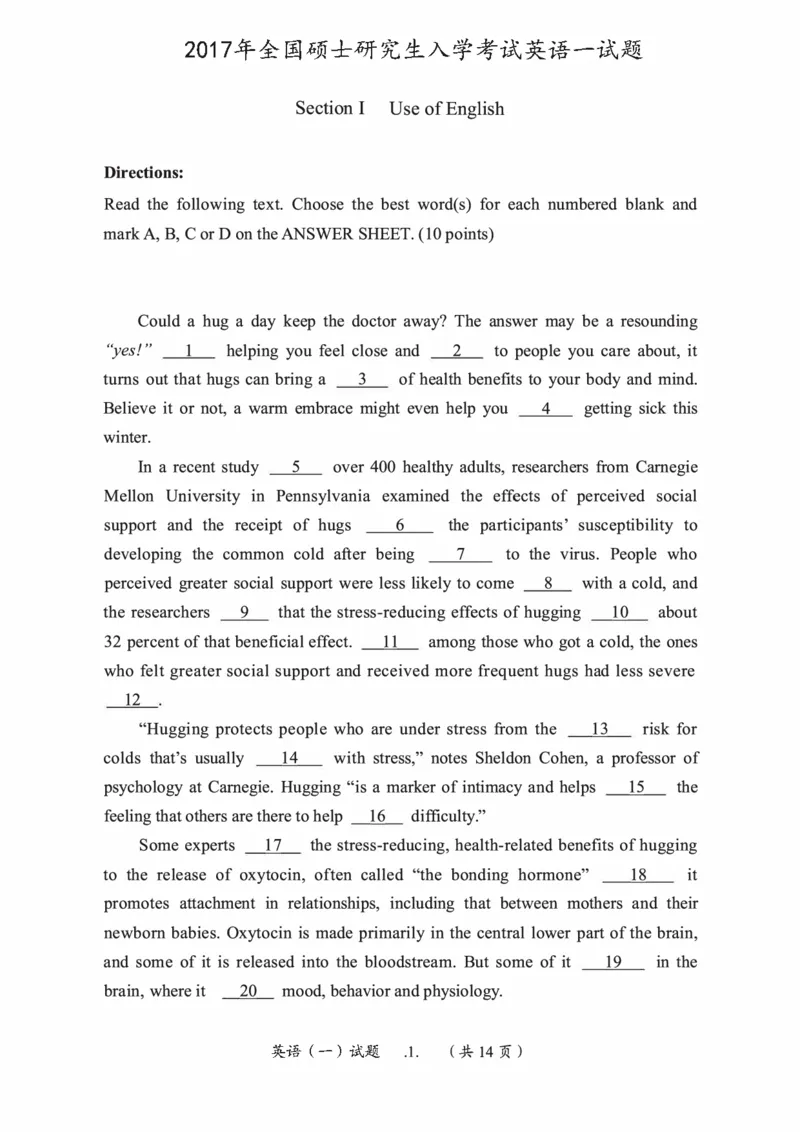
Could a hug a day keep the doctor away? The answer may be a resounding
'yes! " 1 helping you feel close and 2 to people you care about, it
turns out that hugs can bring a 3 of health benefits to your body and mind.
Believe it or not, a warm embrace might even help you 4 getting sick this
winter.
In a recent study 5 over 400 healthy adults, researchers from Carnegie
Mellon University in Pennsylvania examined the effects of perceived social
support and the receipt of hugs 6 the participants' susceptibility to
developing the common cold after being 7 to the virus. People who
perceived greater social support were less likely to come 8 with a cold, and
the researchers 9 that the stress-reducing effects of hugging 10 about
32 percent of that beneficial effect. 11 among those who got a cold, the ones
who felt greater social support and received more frequent hugs had less severe
12
"Hugging protects people who are under stress from the 13 risk for
colds that's usually 14 with stress," notes Sheldon Cohen, a professor of
psychology at Carnegie. Hugging "is a marker of intimacy and helps 15 the
feeling that others are there to help 16 difficulty."
Some experts 17 the stress-reducing, health-related benefits of hugging
to the release of oxytocin, often called "the bonding hormone" 18 it
promotes attachment in relationships, including that between mothers and their
newborn babies. Oxytocin is made primarily in the central lower part of the brain,
and some of it is released into the bloodstream. But some of it 19 in the
brain, where it 20 mood, behavior and physiology.
(-3¾-14 yf)
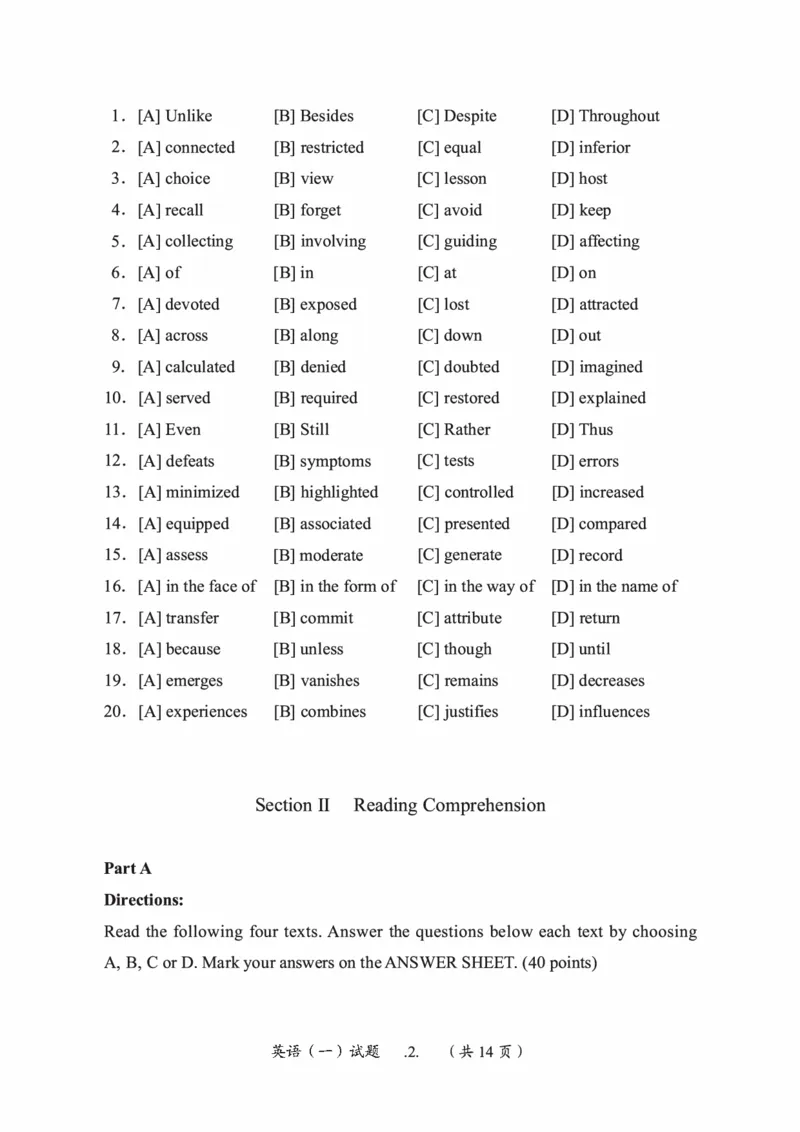
.1.1. [A] Unlike [B] Besides [C] Despite [D] Throughout
2. [A] connected [B] restricted [C] equal [D] inferior
[A] choice [B] view [C] lesson [D] host
3.
4. [A] recall [B] forget [C] avoid [D] keep
5. [A] collecting [B] involving [C] guiding [D] affecting
6. [A] of [BJ in [CJ at [DJ on
7. [A] devoted [B] exposed [C] lost [D] attracted
8. [A] across [B] along [C] down [D] out
9. [A] calculated [BJ denied [CJ doubted [DJ imagined
[A] served [B] required [C] restored [D] explained
10.
11. [A] Even [B] Still [C] Rather [D] Thus
12. [AJ defeats [B] symptoms [C] tests [D] errors
13. [ A J minimized [BJ highlighted [CJ controlled [DJ increased
14. [ A J equipped [B] associated [CJ presented [D] compared
15. [AJ assess [BJ moderate [CJ generate [D] record
16. [A] in the face of [B] in the form of [C] in the way of [D] in the name of
17. [ A J transfer [B] commit [C] attribute [D] return
18. [AJ because [B] unless [C] though [DJ until
19. [AJ emerges [BJ vanishes [CJ remains [DJ decreases
20. [ A J experiences [BJ combines [CJ justifies [DJ influences
Section II Reading Comprehension
Part A
Directions:
Read the following four texts. Answer the questions below each text by choosing
A, B, C or D. Mark your answers on the ANSWER SHEET. (40 points)
(-3¾-14 yf)
.2.Textl
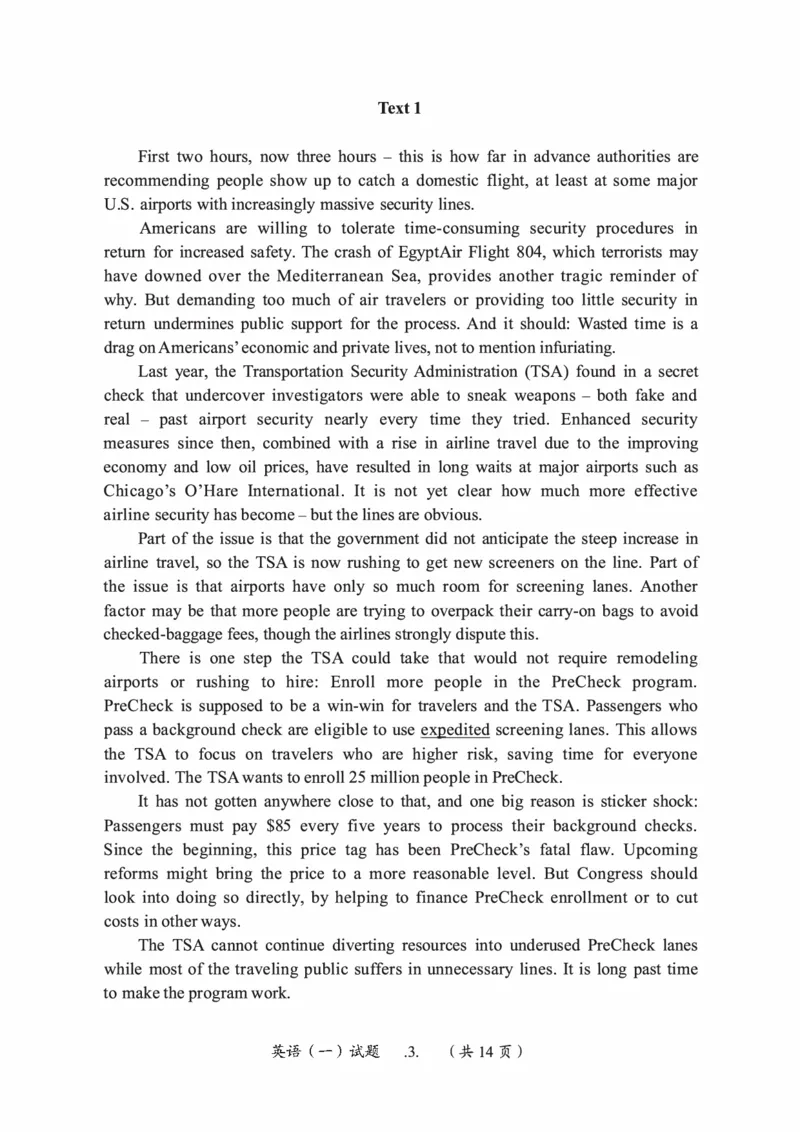
First two hours, now three hours - this is how far in advance authorities are
recommending people show up to catch a domestic flight, at least at some major
U.S. airports with increasingly massive security lines.
Americans are willing to tolerate time-consuming security procedures in
return for increased safety. The crash of EgyptAir Flight 804, which terrorists may
have downed over the Mediterranean Sea, provides another tragic reminder of
why. But demanding too much of air travelers or providing too little security in
return undermines public support for the process. And it should: Wasted time is a
drag on Americans' economic and private lives, not to mention infuriating.
Last year, the Transportation Security Administration (TSA) found in a secret
check that undercover investigators were able to sneak weapons - both fake and
real - past airport security nearly every time they tried. Enhanced security
measures since then, combined with a rise in airline travel due to the improving
economy and low oil prices, have resulted in long waits at major airports such as
Chicago's O'Hare International. It is not yet clear how much more effective
airline security has become -but the lines are obvious.
Part of the issue is that the govermn ent did not anticipate the steep increase in
airline travel, so the TSA is now rushing to get new screeners on the line. Part of
the issue is that airports have only so much room for screening lanes. Another
factor may be that more people are trying to overpack their carry-on bags to avoid
checked-baggage fees, though the airlines strongly dispute this.
There is one step the TSA could take that would not require remodeling
airports or rushing to hire: Enroll more people in the PreCheck program.
PreCheck is supposed to be a win-win for travelers and the TSA. Passengers who
pass a background check are eligible to use expedited screening lanes. This allows
the TSA to focus on travelers who are higher risk, saving time for everyone
involved. The TSA wants to emoll 25 million people in PreCheck.
It has not gotten anywhere close to that, and one big reason is sticker shock:
Passengers must pay $85 every five years to process their background checks.
Since the beginning, this price tag has been PreCheck's fatal flaw. Upcoming
reforms might bring the price to a more reasonable level. But Congress should
look into doing so directly, by helping to finance PreCheck enrollment or to cut
costs in other ways.
The TSA cannot continue diverting resources into underused PreCheck lanes
while most of the traveling public suffers in unnecessary lines. It is long past time
to make the program work.
(-3¾-14 yf)
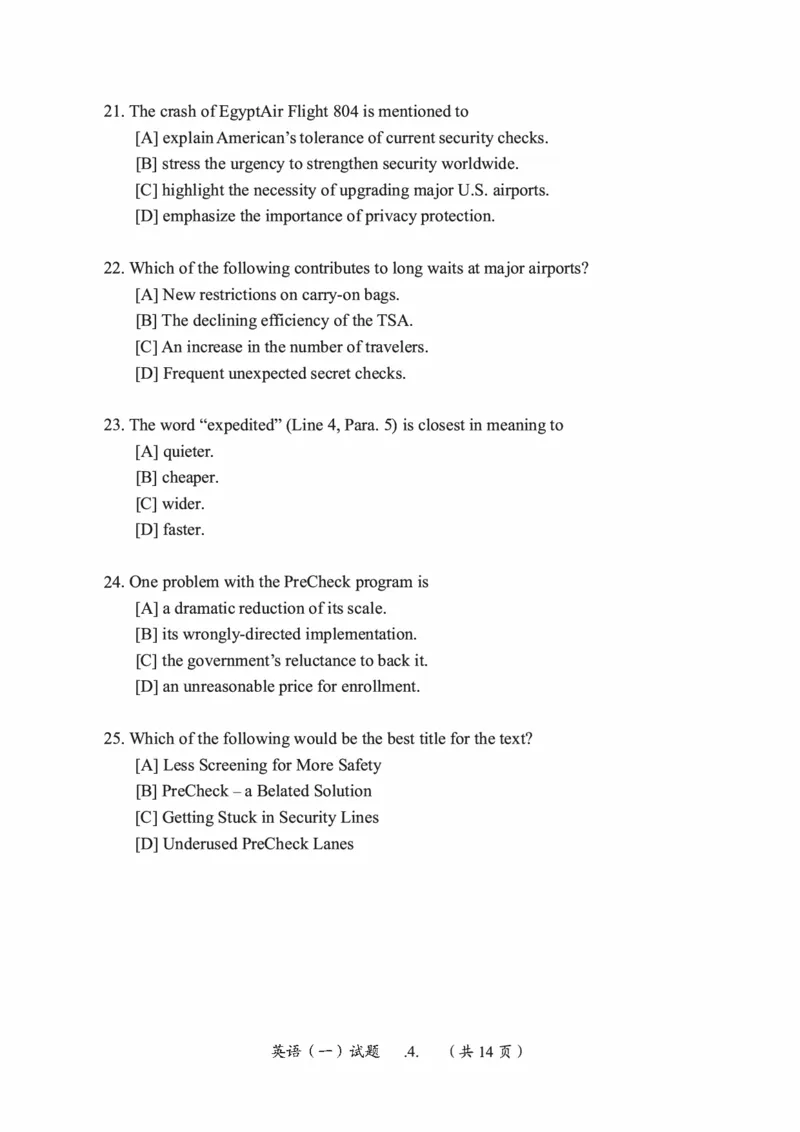
.3.21. The crash ofEgyptAir Flight 804 is mentioned to
[A] explain American's tolerance of current security checks.
[B] stress the urgency to strengthen security worldwide.
[C] highlight the necessity of upgrading major U.S. airports.
[D] emphasize the importance of privacy protection.
22. Which of the following contributes to long waits at major airports?
[A] New restrictions on carry-on bags.
[B] The declining efficiency of the TSA.
[C] An increase in the number of travelers.
[D] Frequent unexpected secret checks.
23. The word "expedited" (Line 4, Para. 5) is closest in meaning to
[A] quieter.
[B] cheaper.
[C] wider.
[D] faster.
24. One problem with the PreCheck program is
[A] a dramatic reduction of its scale.
[B] its wrongly-directed implementation.
[C] the government's reluctance to back it.
[D] an unreasonable price for enrollment.
25. Which of the following would be the best title for the text?
[A] Less Screening for More Safety
[B] PreCheck-a Belated Solution
[C] Getitng Stuck in Security Lines
[D] Underused PreCheck Lanes
(-3¾-14 yf)
.4.Text2
"The ancient Hawaiians were astronomers," wrote Queen Liliuokalani,
Hawaii's last reigning monarch, in 1897. Star watchers were among the most
esteemed members of Hawaiian society. Sadly, all is not well with astronomy in
Hawaii today. Protests have erupted over construction of the Thirty Meter
Telescope (TMT), a giant observatory that promises to revolutionize humanity's
view of the cosmos.
At issue is the TMT's planned location on Mauna Kea, a dormant volcano
worshiped by some Hawaiians as the piko, that connects the Hawaiian Islands to
the heavens. But Mauna Kea is also home to some of the world's most powerful
telescopes. Rested in the Pacific Ocean, Mauna Kea's peak rises above the bulk of
our planet's dense atmosphere, where conditions allow telescopes to obtain
images of unsurpassed clarity.
Opposition to telescopes on Mauna Kea is nothing new. A small but vocal
group of Hawaiians and environmentalists have long viewed their presence as
disrespect for sacred land and a painful reminder of the occupation of what was
once a sovereign nation.
Some blame for the current controversy belongs to astronomers. In their
eagerness to build bigger telescopes, they forgot that science is not the only way
of understanding the world. They did not always prioritize the protection of
Mauna Kea's fragile ecosystems or its holiness to the island's inhabitants. Hawaiian
culture is not a relic of the past; it is a living culture undergoing a renaissance today.
Yet science has a cultural history, too, with roots going back to the dawn of
civilization. The same curiosity to find what lies beyond the horizon that first
brought early Polynesians to Hawaii's shores inspires astronomers today to
explore the heavens. Calls to disassemble all telescopes on Mauna Kea or to ban
future development there ignore the reality that astronomy and Hawaiian culture
both seek to answer big questions about who we are, where we come from and
where we are going. Perhaps that is why we explore the starry skies, as if
answering a primal calling to know ourselves and our true ancestral homes.
The astronomy community is making compromises to change its use of
Mauna Kea. The TMT site was chosen to minimize the telescope's visibility
around the island and to avoid archaeological and environmental impact. To limit
the number of telescopes on Mauna Kea, old ones will be removed at the end of
their lifetimes and their sites returned to a natural state. There is no reason why
everyone cannot be welcomed on Mauna Kea to embrace their cultural heritage
and to study the stars.
(-3¾-14 yf)
.5.26. Queen Liliuokalani's remark in Paragraph 1 indicates
[A] her conservative view on the historical role of astronomy.
[B] the importance of astronomy in ancient Hawaiian society.
[C] the regrettable decline of astronomy in ancient times.
[D] her appreciation of star watchers' feats in her time.
27. Mauna Kea is deemed as an ideal astronomical site due to
[A] its geographical features.
[B] its protective surroundings.
[C] its religious implications.
[D] its existing infrastructure.
28. The construction of the TMT is opposed by some locals partly because
[A] it may risk ruining their intellectual life.
[B] it reminds them of a humiliating history.
[C] their culture will lose a chance of revival.
[D] they fear losing control ofMauna Kea.
29. It can be inferred from Paragraph 5 that progress in today's astronomy
[A] is fulfilling the dreams of ancient Hawaiians.
[B] helps spread Hawaiian culture across the world.
[C] may uncover the origin of Hawaiian culture.
[D] will eventually soften Hawaiians' hostility.
30. The author's attitude toward choosing Mauna Kea as the TMT site is one of
[A] severe criticism.
[B] passive acceptance.
[C] slight hesitancy.
[D] full approval.
.6. (-3¾-14 yf)Text3
Robert F. Kennedy once said that a country's GDP measures "everything
except that which makes life worthwhile." With Britain voting to leave the
European Union, and GDP already predicted to slow as a result, it is now a timely
moment to assess what he was referring to.
The question of GDP and its usefulness has annoyed policymakers for over
half a century. Many argue that it is a flawed concept. It measures things that do
not matter and misses things that do. By most recent measures, the UK's GDP has
been the envy of the Western world, with record low unemployment and high
growth figures. If everything was going so well, then why did over 17 million
people vote for Brexit, despite the warnings about what it could do to their
country's economic prospects?
A recent annual study of countries and their ability to convert growth into
well-being sheds some light on that question. Across the 163 countries measured,
the UK is one of the poorest performers in ensuring that economic growth is
translated into meaningful improvements for its citizens. Rather than just focusing
on GDP, over 40 different sets of criteria from health, education and civil society
engagement have been measured to get a more rounded assessment of how
countries are performing.
While all of these countries face their own challenges, there are a number of
consistent themes. Yes, there has been a budding economic recovery since the
2008 global crash, but in key indicators in areas such as health and education,
major economies have continued to decline. Yet this isn't the case with all
countries. Some relatively poor European countries have seen huge improvements
across measures including civil society, income equality and the environment.
This is a lesson that rich countries can learn: When GDP is no longer
regarded as the sole measure of a country's success, the world looks very
different.
So, what Kennedy was referring to was that while GDP has been the most
common method for measuring the economic activity of nations, as a measure, it
is no longer enough. It does not include important factors such as environmental
quality or education outcomes - all things that contribute to a person's sense of
well-being.
The sharp hit to growth predicted around the world and in the UK could lead
to a decline in the everyday services we depend on for our well-being and for
growth. But policymakers who refocus efforts on improving well-being rather
than simply worrying about GDP figures could avoid the forecasted doom and
may even see progress.
(-3¾-14 yf)
.7.31. Robert F. Kennedy is cited because he
[A] praised the UK for its GDP.
[B] identified GDP with happiness.
[C] misinterpreted the role of GDP.
[D] had a low opinion of GDP.
32. It can be inferred from Paragraph 2 that
[A] the UK is reluctant to remold its economic pattern.
[B] GDP as the measure of success is widely defied in the UK.
[C] the UK will contribute less to the world economy.
[D] policymakers in the UK are paying less attention to GDP.
33. Which of the following is true about the recent annual study?
[A] It is sponsored by 163 countries.
[B] It excludes GDP as an indicator.
[C] Its criteria are questionable.
[D] Its results are enlightening.
34. In the last two paragraphs, the author suggests that
[A] the UK is preparing for an economic boom.
[B] high GDP foreshadows an economic decline.
[C] it is essential to consider factors beyond GDP.
[D] it requires caution to handle economic issues.
35. Which of the following is the best title for the text?
[A] High GDP But Inadequate Well-being, a UK Lesson
[B] GDP Figures, a Window on Global Economic Health
[C] Robert F. Kennedy, a Terminator of GDP
[D] Brexit, the UK's Gateway to Well-being
(-3¾-14 yf)
.8.Text4
In a rare unammous ruling, the US Supreme Court has overturned the
corruption conviction of a former Virginia governor, Robert McDonnell. But it did
so while holding its nose at the ethics of his conduct, which included accepting
gifts such as a Rolex watch and a Ferrari automobile from a company seeking
access to government.
The high court's decision said the judge in Mr. McDonnell's trial failed to tell
a jury that it must look only at his "official acts," or the former governor's
decisions on "specific" and "unsettled" issues related to his duties.
Merely helping a gift-giver gain access to other officials, unless done with
clear intent to pressure those officials, is not corruption, the justices found.
The court did suggest that accepting favors in return for opening doors is
"distasteful" and "nasty." But under anti-bribery laws, proof must be made of
concrete benefits, such as approval of a contract or regulation. Simply arranging a
meeting, making a phone call, or hosting an event is not an "official act".
The court's ruling is legally sound in defining a kind of favoritism that is not
criminal. Elected leaders must be allowed to help supporters deal with
bureaucratic problems without fear of prosecution for bribery. "The basic compact
underlying representative government," wrote Chief Justice John Roberts for the
court, "assumes that public officials will hear from their constituents and act on
their concerns."
But the ruling reinforces the need for citizens and their elected representatives,
not the courts, to ensure equality of access to government. Officials must not be
allowed to play favorites in providing information or in arranging meetings
simply because an individual or group provides a campaign donation or a personal
gift. This type of integrity requires well-enforced laws in government transparency,
such as records of official meetings, rules on lobbying, and information about
each elected leader's source of wealth.
Favoritism in official access can fan public perceptions of corruption. But it is
not always corruption. Rather officials must avoid double standards, or different
types of access for average people and the wealthy. If connections can be bought,
a basic premise of democratic society - that all are equal in treatment by
government - is undermined. Good governance rests on an understanding of the
inherent worth of each individual.
The court's ruling is a step forward in the struggle against both corruption and
official favoritism.
.9. (-3¾-14 yf)36. The underlined sentence (Para.1) most probably shows that the court
[A] avoided defining the extent of McDonnell's duties.
[B] made no compromise in convicting McDonnell.
[C] was contemptuous of McDonnell's conduct.
[D] refused to comment on McDonnell's ethics.
37.According to Paragraph 4, an official act is deemed corruptive only if it involves
[A] leaking secrets intentionally.
[B] sizable gains in the form of gifts.
[C] concrete returns for gift-givers.
[D] breaking contracts officially.
38. The court's ruling is based on the assumption that public officials are
[A]justified in addressing the needs of their constituents.
[B] qualified to deal independently with bureaucratic issues.
[C] allowed to focus on the concerns of their supporters.
[D] exempt from conviction on the charge offavoritism.
39. Well-enforced laws in government transparency are needed to
[A] awaken the conscience of officials.
[B] guarantee fair play in official access.
[C] allow for certain kinds of lobbying.
[D] inspire hopes in average people.
40. The author's attitude toward the court's ruling is
[A] sarcastic.
[BJ tolerant.
[CJ skeptical.
[DJ supportive.
�* ( -) iA.� .10. (-3l 14 yf)PartB
Directions:
The following paragraphs are given in a wrong order. For questions 41-45, you
are required to reorganize these paragraphs into a coherent text by choosing
from the list A-G and filling them into the numbered boxes. ParagraphsB and D have
been correctly placed. Mark your answers on the ANSWER SHEET. ( 10 points)
[AJ The first published sketch, "A Dinner at Poplar Walk" brought tears to
Dickens's eyes when he discovered it in the pages of The Monthly Magazine.
From then on his sketches, which appeared under the pen name "Boz" in The
Evening Chronicle, earned him a modest reputation.
[BJ The runaway success of The Pickwick Papers, as it is generally known today,
secured Dickens's fame. There were Pickwick coats and Pickwick cigars, and
the plump, spectacled hero, Samuel Pickwick, became a national figure.
[CJ Soon after Sketches by Boz appeared, a publishing firm approached Dickens to
write a story in monthly installments, as a backdrop for a series of woodcuts
by the then-famous artist Robert Seymour, who had originated the idea for the
story. With characteristic confidence, Dickens successfully insisted that
Seymour's pictures illustrate his own story instead. After the first installment,
Dickens wrote to the artist and asked him to correct a drawing Dickens felt
was not faithful enough to his prose. Seymour made the change, went into his
backyard, and expressed his displeasure by committing suicide. Dickens and
his publishers simply pressed on with a new artist. The comic novel, The
Posthumous Papers of the Pickwick Club, appeared serially in 1836 and 1837
and was first published in book form in 183 7.
[DJ Charles Dickens is probably the best-known and, to many people, the greatest
English novelist of the 19th century. A moralist, satirist, and social reformer,
Dickens crafted complex plots and striking characters that capture the
panorama of English society.
[EJ Soon after his father's release from prison, Dickens got a better job as errand
boy in law offices. He taught himself shorthand to get an even better job later
as a court stenographer and as a reporter in Parliament. At the same time,
Dickens, who had a reporter's eye for transcribing the life around him,
especially anything comic or odd, submitted short sketches to obscure
magazmes.
(4l-14 yf)
�i¼ ( - ) i:i\.M .11.[F] Dickens was born in Portsmouth, on England's southern coast. His father was
a clerk in the British Navy pay office - a respectable position, but with little
social status. His paternal grandparents, a steward and a housekeeper,
possessed even less status, having been servants, and Dickens later concealed
their background. Dickens's mother supposedly came from a more
respectable family. Yet two years before Dickens's birth, his mother's fta her
was caught stealing and fled to Europe, never to return. The family's
increasing poverty forced Dickens out of school at age 12 to work in Warren's
Blacking Warehouse, a shoe-polish factory, where the other working boys
mocked him as "the young gentleman." His father was then imprisoned for
debt. The humiliations of his father's imprisonment and his labor in the
blacking factory formed Dickens's greatest wound and became his deepest
secret. He could not confide them even to his wife, although they provide the
unacknowledged foundation of his fiction.
[G] After Pickwick, Dickens plunged into a bleaker world. In Oliver Twist, he
traces an orphan's progress from the workhouse to the criminal slums of
London. Nicholas Nickle by, his next novel, combines the darkness of Oliver
Twist with the sunlight of Pickwick. The popularity of these novels
consolidated Dickens' as a nationally and internationally celebrated man of
letters.
1� 1� I 1� I I 1� I
41. 42. 43. 44. � B 45.
�* ( -) iA.� .12. (-3l 14 yf)PartC
Directions:
Read the following text carefully and then translate the underlined segments into
Chinese. Your translaiton should be written neatly on the ANSWER SHEET. (10
points)
The growth of the use of English as the world's primary language for
international communication has obviously been continuing for several decades.
( 46) But even as the number of English speakers expands further there are signs
that the global predominance of the language may fade within the foreseeable future.
Complex international, economic, technological and cultural changes could
start to diminish the leading position of English as the language of the world
market, and UK interests which enjoy advantage from the breadth of English
usage would consequently face new pressures. Those realistic possibilities are
highlighted in the study presented by David Graddol. ( 47 ) His analysis should
therefore end any self-contentedness among those who may believe that the global
position of English is so stable that the young generations of the United Kingdom
do not need additional language capabilities.
David Graddol concludes that monoglot English graduates face a bleak
economic future as qualified multilingual youngsters from other countries are
proving to have a competitive advantage over their British counterparts in global
companies and organisations. Alongside that, ( 48) many countries are introducing
English into the primary-school curriculum but British schoolchildren and
students do not appear to be gaining greater encouragement to achieve fluency in
other languages.
If left to themselves, such trends will diminish the relative strength of the
English language in international education markets as the demand for educational
resources in languages, such as Spanish, Arabic or Mandarin grows and
international business process outsourcing in other languages such as Japanese,
French and German, spreads.
( 49) The changes identified by David Graddol all present clear and major
challenges to the UK's providers of English language teaching to people of other
countries and to broader education business sectors. The English language
teaching sector directly earns nearly £ 1.3 billion for the UK in invisible exports
and our other education related exports earn up to £ 10 billion a year more. As the
international education market expands, the recent slowdown in the numbers of
international students studying in the main English-speaking countries is likely to
continue, especially if there are no effective strategic policies to prevent such slippage.
The anticipation of possible shifts in demand provided by this study is significant:
(50) It gives a basis to all organisations which seek to promote the learning and
use of English, a basis for planning to meet the possibilities of what could be a
very different operating environment. That is a necessary and practical approach.
In this as in much else, those who wish to influence the future must prepare for it.
�* ( -) iA.� .13. (-3l 14 yf)Section III Writing
PartA
51. Directions:
You are to write an email to James Cook, a newly-arrived Australian
professor, recommending some tourist attractions in your city. Please give reasons
for your recommendation.
You should write neatly on the ANSWER SHEET.
Do not sign your own name at the end of the email. Use "Li Ming" instead.
Do not write the address. (10 points)
PartB
52. Directions:
Write an essay of 160-200 words based on the following pictures. In your
essay, you should
1) describe the pictures briefly,
2) interpret the meaning, and
3) give your comments.
You should write neatly on the ANSWER SHEET. (20 points)
�* ( - ) iA.� .14. (-3l 14 yf)