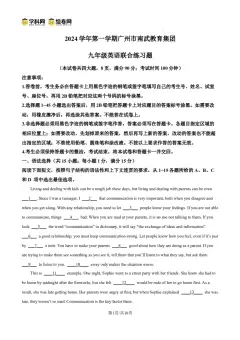
2024 学年初三上学期期中考联考试卷
英语
本卷共8页,满分90分,用时100分钟。
一、语法选择(共15小题;每小题1分,满分15分)
阅读下面短文,按照句子结构的语法性和上下文连贯的要求,从 1~15各题所给的A、B、C和D项
中,选出最佳选项。
Diana was born in New York City. She showed great talent and love for 1 from an early age. Later
she 2 by her coach, an Olympic swimmer, and set new records in many long-distance swimming
competitions. At 28, Diana set 3 unusual goal. She tried to swim from Cuba to Florida for the first time.
The high winds were 4 she had to give up the journey. After experiencing serious 5 problems,
Diana felt the need for new challenges beyond the pool. At 30, she found a new job, but deep in her heart, there still
lived her goal.
After 30 years of no swimming, Diana began training. This time, she wished 6 what she started. In
2011, she tried to swim from Cuba to Florida again. But 7 , the swim was full of danger. There 8
terrible storms and deadly sea animals during the long and tiring journey. 9 she failed many times, she was
ready to fight back. In 2012, after 60 hours in the water, a lightning storm and some 1 0 problems stopped
her for the fourth time.
In 2013, 35 years after 1 1 first try, Diana planned to swim from Cuba to Florida for a fifth time. After
almost 53 hours, the 1 2 Diana completed the historic swim with the help of a team of doctors, scientists
and navigators 1 3 September 2nd. She finally became the first person 1 4 the goal which seems almost
impossible. She was indeed one of the greatest athletes in history.
“We should stick with our dreams. Going after your dreams 1 5 never too late.” Diana said in her
book.
1. A. swimming B. swam C. to swim D. swum
2. А. trained B. was trained C. has trained D. has been trained
3. A. / B. the C. an D. a
4. A. too strong to B. as strong as C. such strong that D. so strong that
5. A. health B. healthy C. healthily D. healthier
6. A. to finish B. finish C. finished D. finishes
7. A. lucky B. luckily C. unlucky D. unluckily
8. A. are B. had C. were D. have
9. A. Because B. Although C. Unless D. But
10. A. another B. other C. the other D. others
11. A. she B. she’s C. her D. /
12. A. 64-year old B. 64-years-old C. 64 years old D. 64-year-old
学科网(北京)股份有限公司13. A. on B. in C. at D. to
14. A. achieve B. achieves C. to achieve D. achieved
15. A. are B. is C. was D. were
二、完型填空(共10小题;每小题1分,满分10分)
阅读下面短文,掌握其大意,然后从1-10各题所给的A、B、C和D项中,选出最佳选项。
Long long ago, in a small village, there lived a young man who was named James. He always felt
pain because he led a hard life. One day, he visited a wise old man, who always helped a lot of
people in need and told 1 about his troubles.
The old man listened to James 2 and then gave him a handful of salt. James was confused (困惑的).
He wanted to know whether the salt was magical and could wash away all the 3 in his life.
Then the man 4 James to put some salt in a glass of water and drink it. James followed the man’s
instructions.
“How does it 5 ?” asked the man.
“That is awful,” said James as he spat (吐) out the salty water.
The old man laughed and then led James to the nearby 6 . “Put the same amount of salt in it and drink
the water from it,” said the man.
“It is perfect. I can 7 taste any salt,” James said. “I am so 8 . I can drink a lot!” This time,
James enjoyed the cool water of the lake very much.
The old man then sat next to James, took his hands and said, “The pain in life is just like salt. How it tastes
depends on the container (容器) we put it into. So, when you are in pain, you can make your heart 9 . Stop
being like a glass and 1 0 being like a lake. Then the troubles in your life will cause you less pain and you
can enjoy your life better.”
1. A. us B. him C. you D. them
2. A. suddenly B. worriedly C. hurriedly D. patiently
3. A. waste B. sights C. pain D. mistakes
4. A. asked B. expected C. allowed D. promised
5. A. work B. taste C. happen D. sound
6. A. lake B. hospital C. store D. restaurant
7. A. only B. possibly C. hardly D. excitedly
8. A. nervous B. rude C. sorry D. thirsty
9. A. warmer B. bigger C. calmer D. sadder
10. A. try B. avoid C. suggest D. forget
三、阅读(共两节,满分35分)
第一节 阅读理解(共15小题;每题2分,满分30分)
学科网(北京)股份有限公司阅读下列短文,从每题所给的A、B、C和D项中,选出最佳选项。
(A)
Brian looked at the ugly gray walls of his bedroom. Soon the hated walls would be covered, but not with
paint as he had first planned. Brian had been disappointed to learn that the house owner would not allow painting.
For weeks he was unable to understand: without using paint, how could he cover the walls? But, a Grandmother
always said, “Necessity is the mother of invention.” So Brian did some thinking, and with a little help from his
mother, he came up with a great plan.
This morning, Mom had needed to stop at the mall to buy a book and Brian went along. There, Brian noticed
a large poster of Harry Potter and the Hogwarts School on the wall. Next to it was a poster showing the cover of
No Arm in Left Field, a baseball novel that Brian had read several times. “This is it,” Brian thought excitedly. “I’ll cover
the walls with posters!”
When he left the mall, Brian had an armful of posters and a box of tacks (大头钉). At home, he headed
straight to his room. First, he took out the posters and spread them out on his bed, his desk, and most of the floor. Next,
he found out the size of each poster, and then the walls. He wanted to cover as much of those ugly walls as
possible! It took all afternoon to work out the best preparation. He drew it on paper, making changes until it was
just right. When Dad came home at dinnertime, Brian was ready to tack up the posters.
“Come see my room, Dad,” called Brian. “It’s going to be great!” But when Dad came into the bedroom, he
looked worried. “The house owner said we could not put any holes in the walls. You can’t use tacks, Brian. I am
sorry.”
Brian’s joy slowly disappeared. He would stay with the boring gray walls forever. Maybe there was no way
to solve this problem after all. How could you hang posters without using tacks? After all, posters would not stick
to the walls by themselves!
“What would stick to the walls?” Brian wondered. Then he smiled. Tape, that’s what! Brian took a piece of
tape and made it into a circle. He made sure the sticky part of the tape was on the outside. This would work, for
sure!
1. In this story, what is Brian’s main problem?
A. Being told not to use tacks.
B. Getting permission to paint the room.
C. Working out a good preparation for his posters.
D. Finding a proper way to cover his bedroom walls.
2. Which word can best describe Brian?
A. Hard-working. B. Kind. C. Smart. D. Brave.
3. In what order did the following happen in the story?
a. Dad came back and warned Brain not to use tacks.
b. Brian spent a whole afternoon getting ready.
c. The room took a completely new look.
d. Brian bought lots of posters and tacks.
e. Brian was not allowed to paint the walls.
学科网(北京)股份有限公司A. e-d-b-a-c B. a-e-d-b-c
C. e-a-c-b-d D. a-b-d-c-e
4. What can we learn from the story?
A. We should never put holes in our walls.
B. We can solve problems in a creative way.
C. Kids should be allowed to paint their rooms.
D. It’s fun to have a lot of posters in our bedroom
(B)
Joel Sartore is a writer, teacher, and photographer. His words and beautiful images
show his love of photography and of the natural world.
Question 1: How did you become a National Geographic photographer?
My first job was for a newspaper. After a few years there, I met a National Geographic
photographer. He liked my photos and said I should send some to the magazine. So I did.
That led to a one-day job. And that led to a nine-day job, and so on.
Question 2: __________
To get into National Geographic, you have to give them something they don’t have. It’s not enough just to be
a great photographer. You also have to be a scientist, for example, or be able to dive under sea ice, or spend maybe
several days in a tree.
Question 3: Is it hard to get a job as a photographer today?
It’s now harder to work for magazines. Technology makes it easy to take good pictures, which mean there are
more photos and photographers. Also, the Web is filled with photos from all around the world that are free, or cost
very little. These photos are often good enough to be put in books and magazines. What the magazines need to do
these days is to pay for these photos.
Question 4: I want to be a photographer. Do you have any advice for me?
Advice? Well, work hard. Be passionate (热情的) about every project you work on. Take lots of pictures in
different situations. Look at others’ photos thoughtfully and learn from them. And be curious about everything.
There’s something to photograph everywhere .
5. Which of the following can be Question 2?
A. Why do you want to work for National Geographic?
B. What do National Geographic photographers like to do?
C. What kind of photos do you give to National Geographic?
D. What kind of photographer is National Geographic looking for?
6. How many reasons did Joel Sartore mention in his answer to Question 3?
A. 1 B. 2. C. 3. D. 4.
7. The underlined sentence in the last paragraph is closest in meaning to “__________”.
A. Take as many photos as possible. B. There is beauty everywhere.
C. It’s easy to be a good photographer. D. Photographers should travel everywhere.
学科网(北京)股份有限公司8. Who is most likely to be employed by National Geographic?
A. Hanson, a photographer who has worked for many magazines.
B. Bowie, a photographer who learn to take photos at an early age.
C. Marina, photographer who is good at science and diving.
D. Jason, a photographer who keeps developing skills and ideas.
(C)
How do people think differently? This has always been unusual. To search an answer, a scientist named J.P
Guilford started a famous study of creativity in the1970s, known as the nine-dot puzzle. He asked the participants
(参与者) to connect all nine dots using only four straight lines, without lifting their pencils from the page. All the
participants looked for solutions within the square they imagined. Only 20 percent managed to break out of the
square and continue their lines in the white space around the dots, while the rest of them were blinded by the
boundaries (边界) of the square.
The results of Guilford’s study led him to a conclusion: creativity needs you to go outside the box. The idea
was widely spread soon. Overnight, it seemed that creativity experts everywhere were teaching managers how to
think outside the box. The idea was so popular that no one thought of checking the facts. No one, that is, before
two different research teams: Clarke Burham with Kenneth Davis, and Joseph Aíba with Robert Weisberg, did
another experiment.
To make sure that Guilford’s study is correct, both teams divided participants into two groups. The first group
was given the same instructions as the participants in Guilford’s experiment. The second group was told to draw
the lines outside the imagined box. Guess what? Only a little more than 20 percent solved the puzzle, which is no
big difference from the result of Guilford’s experiment.
Let’s look a little more closely at the surprising result. Solving this problem requires people to think outside
the box. However, direct and clear instructions to “think outside the box” do not help participants improve their
performance. The widely spread idea that out-of-the-box thinking makes people more creative can, in some way,
be dangerous. After all, with one simple but brilliant experiment, researchers had proved that the connection
between thinking outside the box and creativity was a misunderstanding.
9. Which of the following patterns can solve the nine-dot puzzle?
A. B. C. D.
10. The nine-dot puzzle study is mainly focused on __________?
A. how people do things in real life.
B. some students don’t enjoy being outside.
C. what knowledge people have learned.
D. how people think in different ways.
11. Which is the best title for the passage?
A. Puzzle Solving: A Key to Creativity
学科网(北京)股份有限公司B. Nine-Dot Puzzle: A Magic Test
C. Thinking Outside the Box: A Misleading Idea
D. Creative Thinking: An Unusual Topic
(D)
A lot of people play sports, but very few people become sports professionals (专家). If sports aren’t going to
be your future, then why should you play them? Why should you train every day? Why should you work hard and
feel sore (酸痛的) the next day? Wouldn’t it be better to forget sports and only pay attention to your lessons? In
fact, there are a lot of reasons to play sports.
First of all, sports are a great way to exercise. Exercising keeps you healthy and strong. It also helps you stay
in a good condition. When you exercise, your body makes endorphins (安多芬) which give you more energy and
make you feel happier.
Also, sports teach young people how to communicate and work as a team. They teach young people to
respect their coaches, teammates and players from the other team. Many reports say that sports help young people
stay out of trouble. If a young person plays sports, he or she may have fewer problems. This is because sports teach
people about rules. They also teach people that if they work hard, they might succeed.
Another good way of sports is that they make people leave their houses. These days, a lot of people spend too
much time staying at home and seldom go out. They watch television and play video games all day long.
When you play sports, you go outside and exercise in the sun. You take in fresh air. All of these things are important.
Sports means so much to people. They bring people a lot of advantages. So, why not take up with
a sport and make it become your hobby? Maybe you’re not going to become a sports professional, but that
doesn’t matter, sports will help you become a better and happier person.
12. In Paragraph 1, the writer leads into the topic (导入话题) by __________.
A. telling stories B. listing numbers
C. giving examples D. asking questions
13. What does the underlined word “They” in Paragraph 3 refer to?
A. Reports. B. Sports. C. Problems. D. Rules.
14. According to Paragraph 4, what things are important?
A. Watching television B. Taking in fresh air
C. Playing video games. D. Respecting their teammates
15. Which of the following is the structure (结构) of the passage? (P = Paragraph)
A. B. C. D.
第二节 阅读填空(共5小题;每题1分,满分5分)
学科网(北京)股份有限公司阅读短文及文后A-E选项,选出可以填入后面各题空白处的最佳选项。
Every culture produces men and women with sharp minds who spend their days thinking about the
world and how to live a good and happy life. 1
Born in 551 BC, Confucius, King zi, has made the greatest contribution to Chinese culture in history and his
philosophical ideas are widely known. Although he was raised in a poor family, he visited famous scholars and
learned a lot. He developed his thoughts into a system of philosophy known as Confucianism.
2 First, he said we should respect the king. Next, we should do everything possible to respect each
other. Finally, he believed that we can have a really good and happy life if we learn to live in harmony (和谐). This
means that we should try to find a way to live peacefully both with each other and with the natural world.
3 His friends and followers collected them after his death. Slowly, people everywhere accepted his
wisdom. 4 For example, one of his famous sayings: “What you know, you know; what you don’t
know, you don’t know.”
Confucius was a great teacher as well and developed education for ordinary (普通的) people. He traveled
around to promote his political thinking but failed. But he never gave up.
He is a great Chinese spiritual leader. Over the last 2, 000 years, his philosophy has continued to influence
China and the rest of the world. 5
A. Now his wise sayings have influenced many people in different
countries.
B. It is regarded as the symbol of Chinese culture.
C. However, none of his wise sayings were written down while he was
alive.
D. They are the philosophers.
E. Confucius found three main truths about how to live a good life.
四、写作(共三节,满分30分)
第一节 语篇填词(共5小题;每小题1分,满分5分)
Do you have a good relationship with your classmates? Not getting on well with your classmates may sometimes
drive you 1. m__________. How can you form a good relationship between you and your classmates? Here are
two suggestions.
Communicate with your classmates. Communication is the most important. If you don’t communicate, you
will 2. f__________ to know their habits and problems. Knowing nothing about each other will lead to embarrassing
situations.
Give your classmates their own space. They should have as much 3. p__________ space as possible. You
may 4. h__________ to be asked about your secrets, and that’s the same for your classmates. Don’t take things
from your classmates’ schoolbags or use their things without telling them. That will make you an 5. a__________
classmate.
学科网(北京)股份有限公司All in all, when living with others, we should respect others and often talk with them.
第二节 完成句子(共5小题;每小题2分,满分10分)
根据所给的汉语内容,用英语完成下列句子。(每空限填一词)
1. 经过一系列的考试,Emily最终赢了比赛。Emily感到非常兴奋!
After a __________ __________ exams, Emily finally won the competition. __________ __________
she feels!
2. 他们对拳击不感兴趣。
They __________ __________ __________ __________ boxing.
3. 你最近在节食吗?
Have you __________ __________ __________ __________ recently?
4. Emily的父母总是在出差,所以她经常帮着做家务。
Emily’s parents are always __________ __________ so she often __________ __________ the
housework.
5. Jerry昨天直到晚上8点才收到妈妈的电话。
Jerry __________ __________ __________ his mother __________ 8 p.m. yesterday.
第三节 书面表达(满分15分)
假设你叫李华,你们家有三条家规,你不同意其中一条。请以书信方式,根据以下提示写一封信给爸爸
妈妈。
1. Introduce three of your family rules.
2. Which rule do you disagree about? Why?
3. What’s your suggestion about that rule?
要求:1.短文应包括提示中所有要点,可适当发挥;
2.短文中不能出现真实的人名和地名;
3.词数不少于80。
___________________________________________________________________________________________
___________________________________________________________________________________________
___________________________________________________________________________________________
学科网(北京)股份有限公司