大学英语四级考试2015年 12月真题第3 套
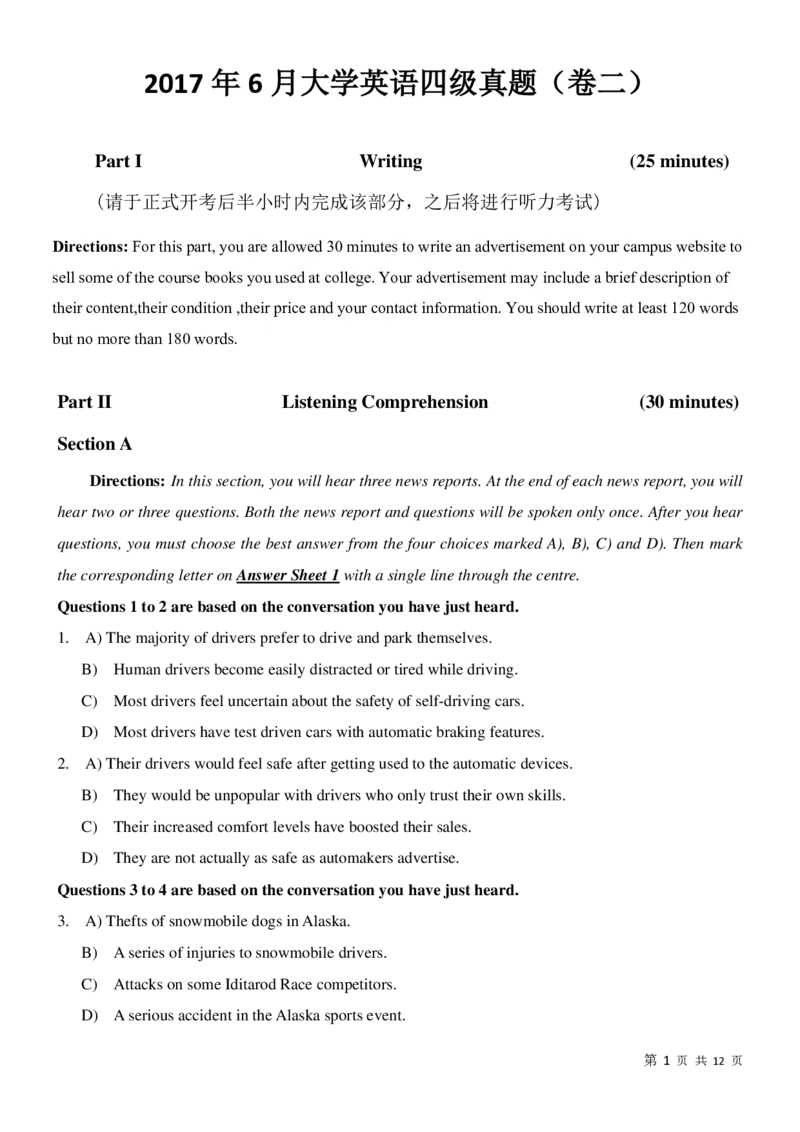
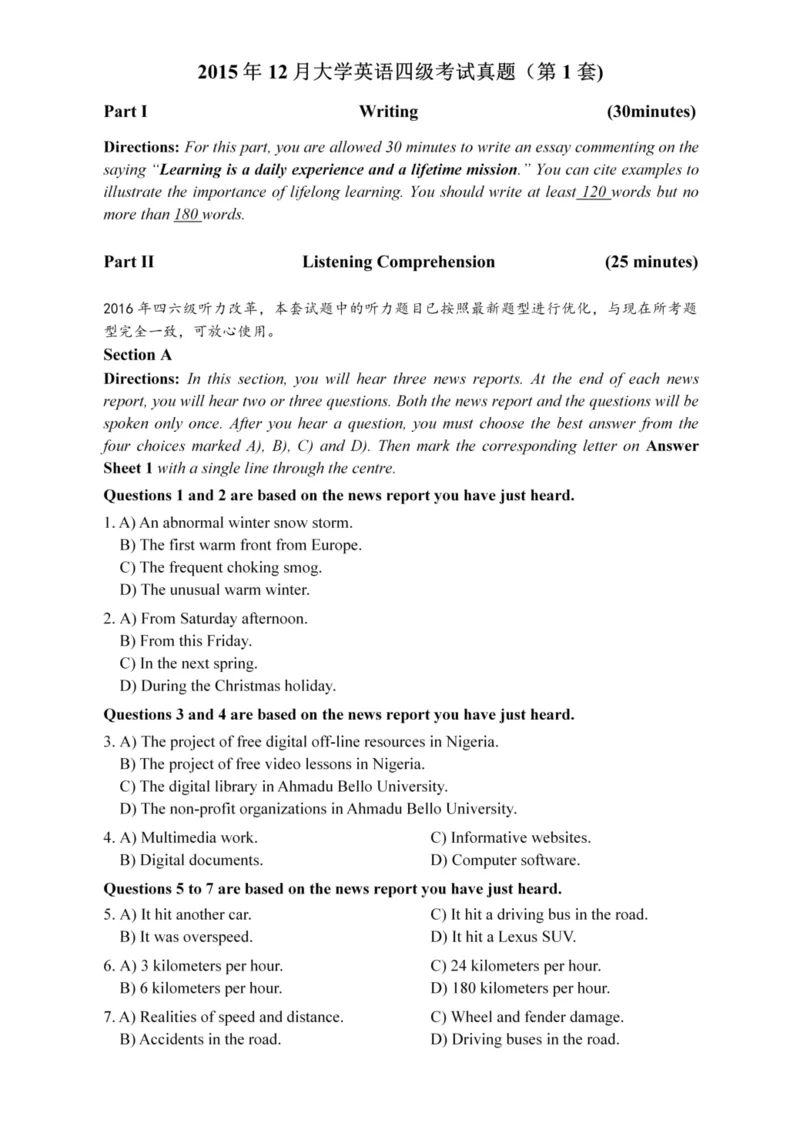
Part I Writing (30 minutes)
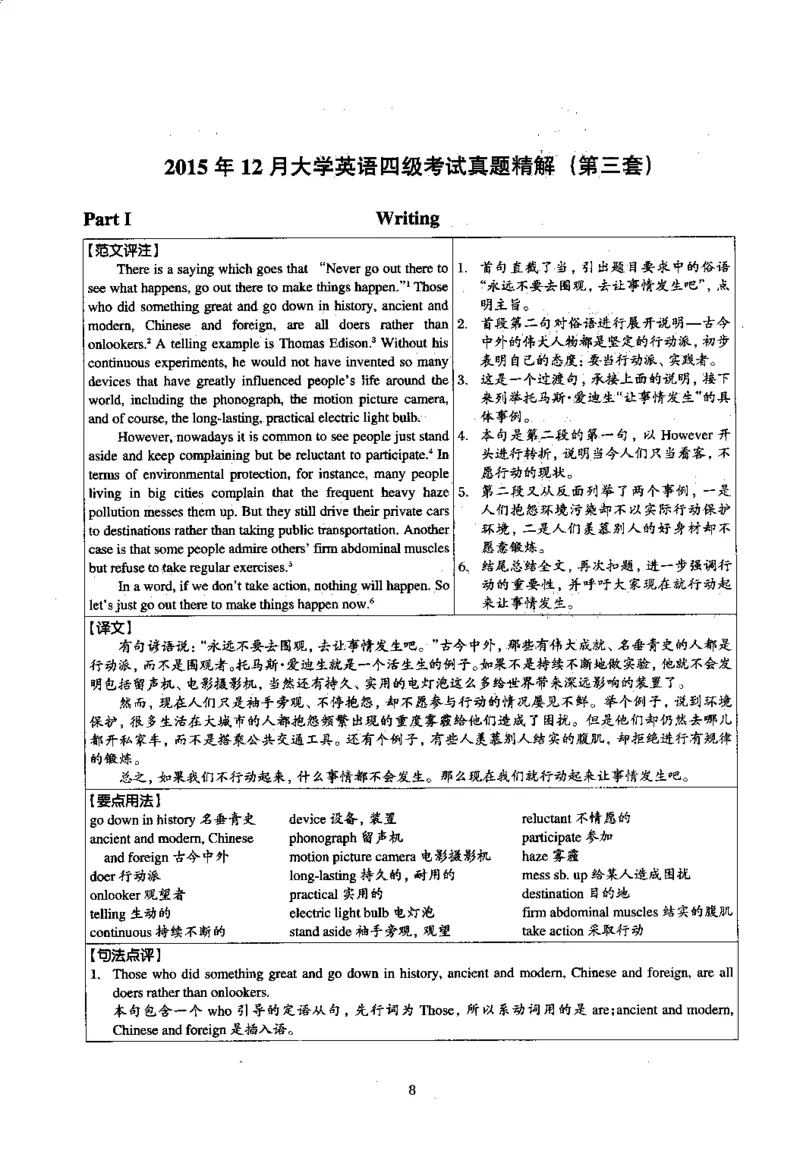
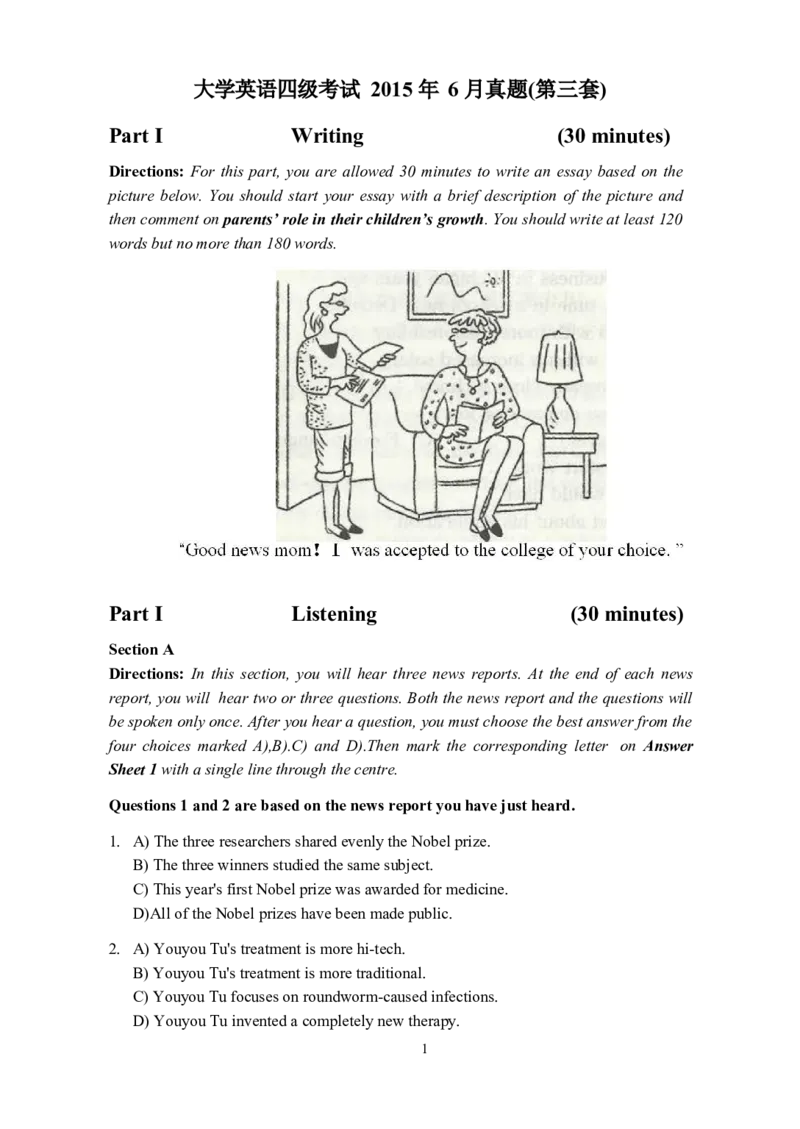
Directions: For this part, you are allowed 30 minutes to write an essay commenting on the
saying ((Never go out there to see what happens, go out there to make things happen.
You can cite examples to illustrate the importance of being participants rather than mere
onlookers in life. You should write at least 120 words but no more than 180 words.
Part II Listening Comprehension (25 minutes)
温馨提示:2016年四六级听力改革,为使考试可接触到更多
新题型听力题目,特添加本套听力模拟题,与现在所考题型完全一致,可放心使用。
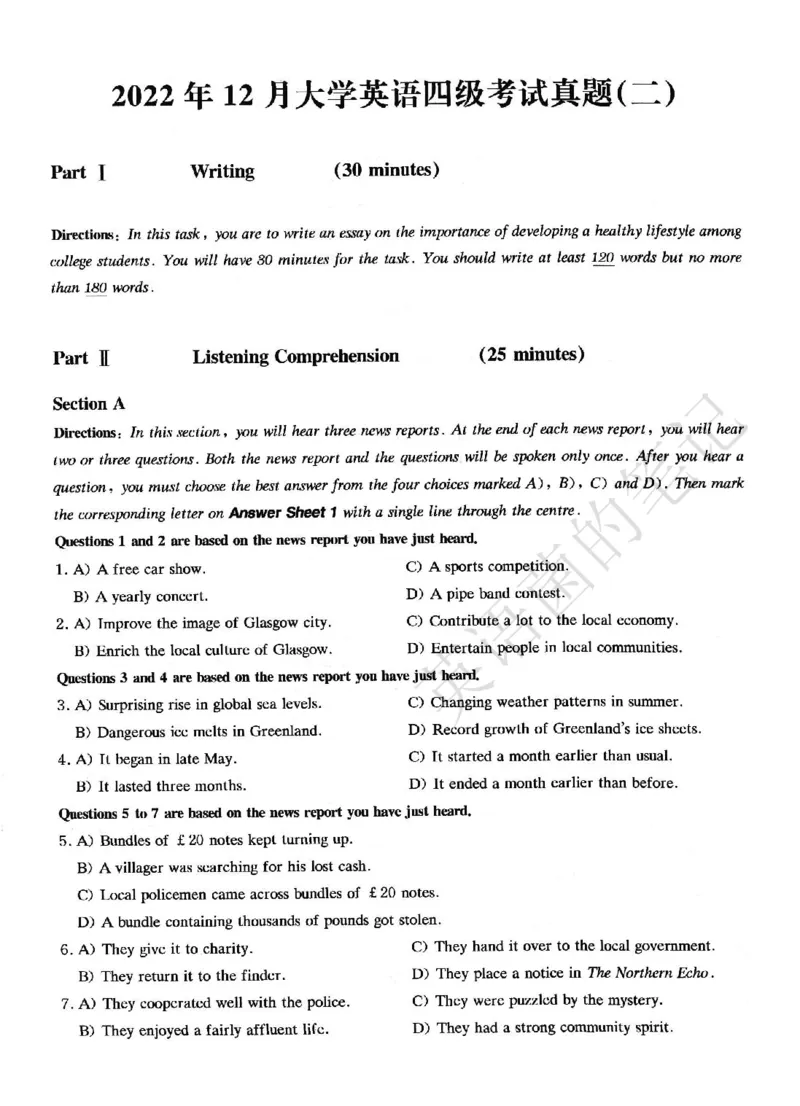
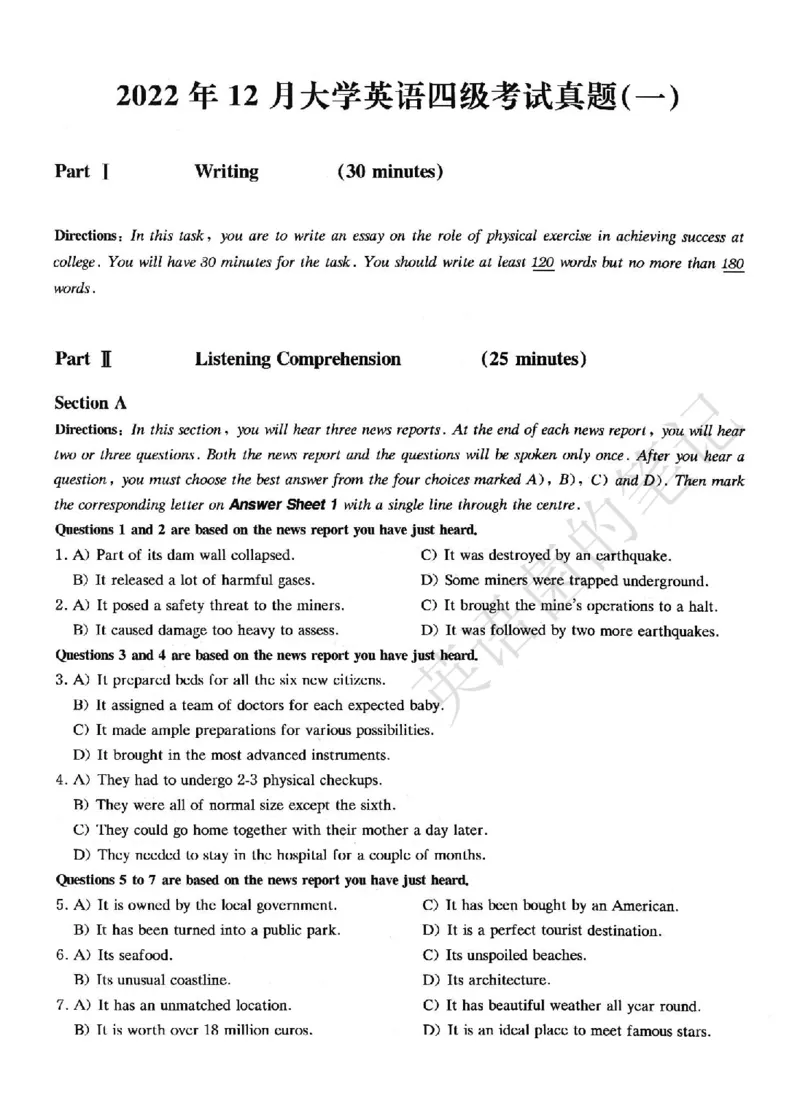
Section A
Directions: In this section, you will hear three news reports. At the end of each news
report, you will hear two or three questions. Both the news report and the questions will be
spoken only once. After you hear a question, you must choose the best answer from the
four choices marked A), B), C) and D). Then mark the corresponding letter on Answer
Sheet 1 with a single line through the centre.
Questions 1 and 2 are based on the news report you have just heard.
1. A) A lawsuit has been filed against Malaysia Airlines.
B) The missing passengers5 bodies have been found.
C) The cause of the disappearance has been unveiled.
D) Flight MH370 got lost during its trip to Hong Kong.
2. A) On a beach in Mozambique. C) In Reunion Island.
B) In Malaysia. D) In Beijing.
Questions 3 and 4 are based on the news report you have just heard.
3. A) Because they are used to living here.
B) Because it is cheaper for them to live here.
C) Because it is easier fbr them to get a job.
D) Because the government forced them to live here.
4. A) The snowstorm. C) The war.
B) The bombing. D) The starvation.
Questions 5 to 7 are based on the news report you have just heard.
5. A) Enriching the menu. C) Opening new branches.
B) Meeting customer needs. D) Improving customer sales.
6. A) U.S.-based McDonald's president. C) McDonald's Japan's president.
B) McDonald's Japan's customer. D) U.S.-based McDonald's customer.
7. A) In 1971. C) In 1997.
B) In 1991. D) In 2015.
Section B
Directions: In this section, you will hear two long conversations. At the end of each
conversation, you will hear four questions. Both the conversation and the questions will be
spoken only once. After you hear a question, you must choose the best answer from the
four choices marked A), B), C) and D). Then mark the corresponding letter on Answer
Sheet 1 with a single line through the centre.Questions 8 to 11 are based on the conversation you have just heard.
8. A) Hosting an evening TV program. C) Lecturing on business management.
B) Having her bicycle repaired. D) Conducting a market survey.
9. A) He repaired bicycles. C) He worked as a salesman.
B) He served as a consultant. D) He coached in a racing club.
10. A) He wanted to be his own boss. C) He didn't want to start from scratch.
B) He found it more profitable. D) He didn't want to be in too much debt.
11. A) They work five days a week. C) They are paid by the hour.
B) They are all the man's friends. D) They all enjoy gambling.
Questions 12 to 15 are based on the conversation you have just heard.
12. A) It has gradually given way to service industry.
B) It remains a major part of industrial activity.
C) It has a history as long as paper processing.
D) It accounts for 80 percent of the region's GDP.
13. A) Transport problems. C) Lack of resources.
B) Shortage of funding. D) Poor management.
14. A) Competition from rival companies. C) Possible locations fbr a new factory.
B) Product promotion campaigns. D) Measures to create job opportunities.
15. A) Ifs just so-so. C) It's very good and improving.
B) Its perfect. D) It's disappointing.
Section C
Directions: In this section, you will hear three passages. At the end of each passage, you
will hear three or four questions. Both the passage and the questions will be spoken only
once. After you hear a question,you must choose the best answer from the four choices
marked A), B), C) and D). Then mark the corresponding letter on Answer Sheet 1 with a
single line through the centre.
Questions 16 to 18 are based on the passage you have just heard.
16. A) They shared mutual friends in school.
B) They had known each other since childhood.
C) They shared many extracurricular activities.
D) They had many interests in common.
17. A) At a local club. C) At the sports center.
B) At Joe's house. D) At the boarding school.
18. A) Durable friendships can be very difficult to maintain.
B) One has to be respectful of other people in order to win respect.
C) It is hard for people from different backgrounds to become friends.
D) Social divisions will break down if people get to know each other.
Questions 19 to 21 are based on the passage you have just heard.
19. A) Near the entrance of a park. C) At a parking meter.
B) In his building's parking lot. D) At a street comer.
20. A) It had been taken by the police. C) It had been stolen by someone.
B) It had been moved to the next block. D) It had been parked at a wrong place.
21. A) At the Greenville center. C) In a neighboring town.B) At a public parking lot. D) In the city garage.
Questions 22 to 25 are based on the passage you have just heard.
22. A) Famous creative individuals.
B) The mysteriousness of creativity.
C) A major scientific discovery.
D) Creativity as shown in arts.
23. A) It is something people all engage in.
B) It helps people acquire knowledge.
C) It starts soon after we are bom.
D) It is the source of all artistic work.
24. A) Creative imagination.
B) Logical reasoning.
C) Natural curiosity.
D) Critical thinking.
25. A) It is beyond ordinary people.
B) It is yet to be fully understood.
C) It is part of everyday life.
D) It is a unique human trait.
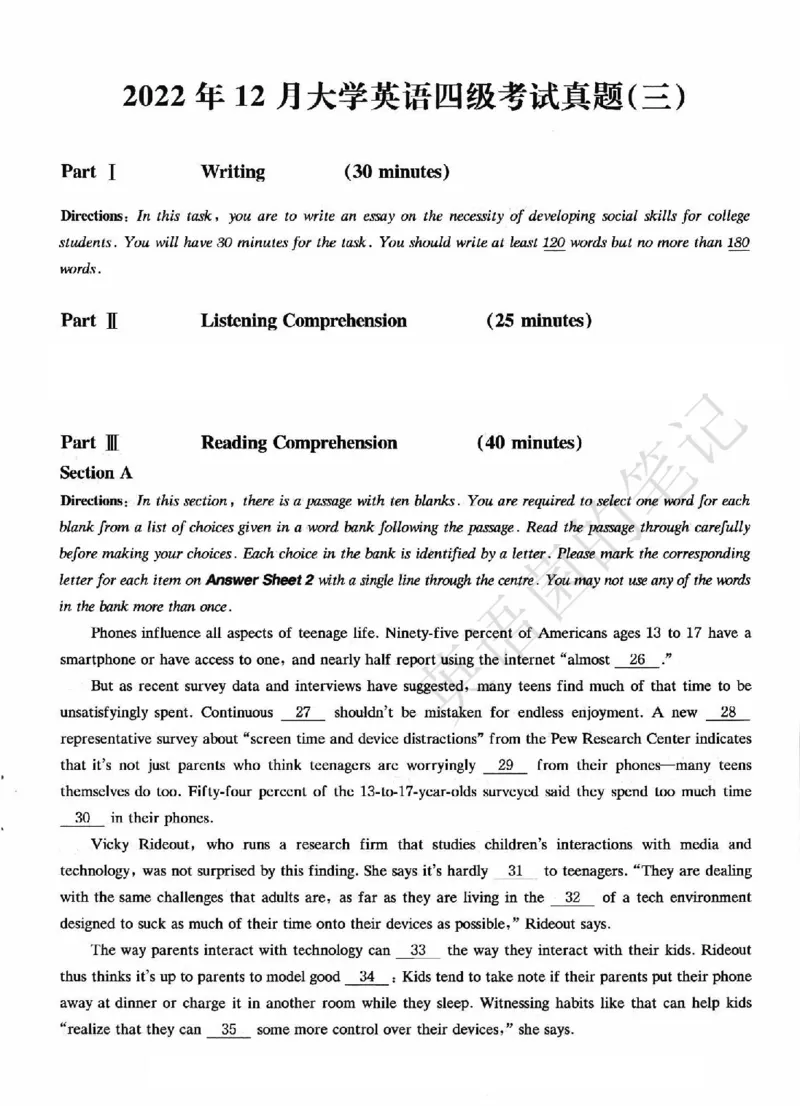
Part III Reading Comprehension (40 minutes)
Section A
Directions; In this section, there is a passage with ten blanks. You are required to select
one word for each blank from a list of choices given in a word bank following the passage.
Read the passage through carefully before making your choices, Each choice in the bank
is identified by a letter. Please mark the corresponding letter for each item on Answer
Sheet 2 with a single line through the centre. You may not use any of the words in the bank
more than once.
Questions 26 to 35 are based on the following passage.
For many Americans, 2013 ended with an unusually bitter cold spell. Late November
and December 26 early snow and bone-chilling temperatures in much of the country,
part of a year when, for the first time in two 27 , record-cold days will likely turn out to
have outnumbered record-warm ones. But the U. S. was the exception: November was the
warmest ever 28 , and current data indicates that 2013 is likely to have been the fourth
hottest year on record.
Enjoy the snow now, because 29 are good that 2014 will be even hotter, perhaps
the hottest year since records have been kept. That's because, scientists are predicting,
2014 will be an El Nino year.
El Nino, Spanish for “the child”, 30 when surface ocean waters in the southern
Pacific become abnormally warm. So large is the Pacific, covering 30% of the planet's
surface, that the 31 energy generated by its warming is enough to touch off a series of
weather changes around the world. El Ni nos are 32 with abnormally dry conditions in
Southeast Asia and Australia. They can lead to extreme rain in parts of North and South
America, even as southern Africa 33 dry weather. Marine life may be affected too: El
Nino can 34 the rising of the cold, nutrient-rich (营养丰富的)water that supports large
fish 35 , and the unusually warm ocean temperatures can destroy coral (珊孑胡).A) additional I) logically
B) associated J) occurs
C) bore K) populations
D) chances L) realize
E) communicated M) reduce
F) decades N) saw
G) experiences 0) Specific
H) globally
Section B
Directions: In this section, you are going to read a passage with ten statements attached to
it. Each statement contains information given in one of the paragraphs. Identify the
paragraph from which the information is derived. You may choose a paragraph more than
once. Each paragraph is marked with a letter. Answer the questions by marking the
corresponding letter on Answer Sheet 2.
How to Eat Well
A) Why do so many Americans eat tons of processed food, the stuff that is correctly
called junk (垃圾)and should really carry warning labels?
B) Ifs not because fresh ingredients are hard to come by. Supermarkets offer more
variety than ever, and there are over four times as many farmers9 markets in the U.S. as
there were 20 years ago. Nor is it for lack of available information. There are plenty of
recipes (食 谱 ),how-to videos and cooking classes available to anyone who has a
computer, smartphone or television. If anything the information is overwhelming.
C) And yet we aren't cooking. If you eat three meals a day and behave like most
Americans, you probably get at least a third of your daily calories (卡路里)outsides
the home. Nearly two-thirds of us grab fast food once a week, and we get almost 25%
of our daily calories from snacks. So we9re eating out or taking in, and we don't sit
down- or we do, but we hurry.
D) Shouldn't preparing- and consuming- food be a source of comfort, pride, health,
well-being, relaxation, sociability? Something that connects us to other humans? Why
should we want to outsource (夕卜包)this basic task, especially when outsourcing it is so
harmful?
E) When I talk about cooking, I'm not talking about creating elaborate dinner parties or
three-day science projects. I'm talking about simple, easy, everyday meals. My mission
is to encourage green hands and those lacking time or money to feed themselves. That
means we need modest, realistic expectations, and we need to teach people to cook
food thafs good enough to share with family and friends.
F) Perhaps a return to real cooking needn't be far off. A recent Harris poll revealed that
79% of Americans say they enjoy cooking and 30% "love it”; 14% admit to not
enjoying kitchen work and just 7% won't go near the stove at all. But this doesn't
necessarily translate to real cooking, and the result of this survey shouldn't surprise
anyone: 52% of those 65 or older cook at home five or more times per week; only a
third of young people do.G) Back in the 1950s most of us grew up in households where Mom cooked virtually
every night. The intention to put a home-cooked meal on the table was pretty much
universal. Most people couldn,t afford to do otherwise.
H) Although frozen dinners were invented in the '40s, their popularity didn't boom until
televisions became popular a decade or so later. Since then packaged, pre
prepared meals have been whafs fbr dinner. The microwave and fast-food chains were
the biggest catalysts (催 化 剂 ),but the big food companies- which want to sell
anything except the raw ingredients that go into cooking- made the home cook an
endangered species.
I) Still, I find it strange that only a third of young people report preparing meals at home
regularly. Isn't this the same crowd that rails against processed junk and champions
craft cooking? And isn't this the generation who say they've concerned about their
health and the well-being of the planet? If these are truly the values of many young
people, then their behavior doesn't match their beliefs.
J) There have been half-hearted but well-publicized efforts by some food companies to
reduce calories in their processed foods, but the Standard American Diet is still the
polar opposite of the healthy, mostly plant-based diet that just about every expert says
we should be eating. Considering that the government5s standards are not nearly
ambitious enough, the picture is clear: by not cooking at home, we're not eating the
right things, and the consequences are hard to overstate.
K) To help quantify (量化)the costs of a poor diet, I recently tried to estimate this impact
in terms of a most famous food, the burger (汉堡 包).I concluded that the profit from
burgers is more than offset (吉氐消)by the damage they cause in health problems and
environmental harm.
L) Cooking real food is the best defense- not to mention that any meal you've likely to
eat at home contains about 200 fewer calories than one you would eat in a restaurant.
M) To those Americans for whom money is a concern, my advice is simple: Buy what you
can afford, and cook it yourself The common prescription is to primarily shop the
grocery store, since thafs where fresh produce, meat and seafood, and dairy are. And to
save money and still eat well you don't need local, organic ingredients; all you need is
real food. I'm not saying local food isn't better; it is. But there is plenty of decent food
in the grocery stores.
N) The other sections you should get to know are the frozen foods and the canned goods.
Frozen produce is still produce; canned tomatoes are still tomatoes. Just make sure
you're getting real food without tons of added salt or sugar. Ask yourself, would
Grandma consider this food? Does it look like something that might occur in nature?
Ifs pretty much common sense: you want to buy food, not unidentifiable fbodlike
objects.
O) You don't have to hit the grocery store daily, nor do you need an abundance of skill.
Since fewer than half of Americans say they cook at an intermediate level and only
20% describe their cooking skills as advanced, the crisis is one of confidence. And the
only remedy fbr that is practice. There 9s nothing mysterious about cooking the evening
meal. You just have to do a little thinking ahead and redefine what qualifies as dinner.Like any skill, cooking gets easier as you do it more; every time you cook, you advance
your level of skills. Someday you won't even need recipes. My advice is that you not
pay attention to the number of steps and ingredients, because they can be deceiving.
P) Time, I realize, is the biggest obstacle to cooking fbr most people. You must adjust
your priorities to find time to cook. For instance, you can move a TV to the kitchen and
watch your favorite shows while you're standing at the sink. No one is asking you to
give up activities you like, but if you're watching food shows on TV, try cooking
instead.
36. Cooking benefits people in many ways and enables them to connect with one another.
37. Abundant information about cooking is available either online or on TV.
38. Young people do less cooking at home than the elderly these days.
39. Cooking skills can be improved with practice.
40. In the mid-20th century, most families ate dinner at home instead of eating out.
41. Even those short of time or money should be encouraged to cook fbr themselves and
their family.
42. Eating food not cooked by ourselves can cause serious consequences.
43. To eat well and still save money, people should buy fresh food and cook it themselves.
44. We get a fairly large portion of calories from fast food and snacks.
45. The popularity of TV led to the popularity of frozen food.
Section C
Directions: There are 2 passages in this section. Each passage is followed by some
questions or unfinished statements. For each of them there are four choices marked A), B),
C) and D). You should decide on the best choice and mark the corresponding letter on
Answer Sheet 2 with a single line through the centre.
Passage One
Questions 46 to 50 are based on the following passage.
The wallet is heading for extinction. As a day-to-day essential, it will die off with the
generation who read print newspapers. The kind of shopping- where you hand over notes
and count out change in return- now happens only in the most minor of our retail
encounters, like buying a bar of chocolate or a pint of milk from a comer shop. At the
shops where you spend any real money, that money is increasingly abstracted. And this is
more and more true, the higher up the scale you go. At the most cutting-edge retail stores一
Victoria Beckham on Dover Street, fbr instance- you don't go and stand at any kind of
cash register when you decide to pay. The staff are equipped with iPads to take your
payment while you relax on a sofa.
Which is nothing more or less than excellent service, if you have the money. But
across society, the abstraction of the idea of cash makes me uneasy. Maybe Fm just
old-fashioned. But earning money isn't quick or easy for most of us. Isn't it a bit weird that
spending it should happen in half a blink (眨目艮)of an eye? Doesn't a wallet- that time-
honoured Friday-night feeling of pleasing, promising fatness- represent something that
matters?But ril leave the economics to the experts. What bothers me about the death of
the wallet is the change it represents in our physical environment. Everything about the
look and feel of a wallet- the way the fastenings and materials wear and tear and loosen
with age, the plastic and paper and gold and silver, and handwritten phone numbers and
printed cinema tickets一is the very opposite of what our world is becoming. The opposite
of a wallet is a smartphone or an iPad. The rounded edges, cool glass, smooth and
unknowable as a pebble (鹅卵石).Instead of digging through pieces of paper and peering
into comers, we move our fingers left and right. No more counting out coins. Show your
wallet, if you still have one. It may not be here much longer.
46. What is happening to the wallet?
A) It is disappearing.
B) It is being fattened.
C) It is becoming costly.
D) It is changing in style.
47. How are business transactions done in big modem stores?
A) Individually.
B) Electronically.
C) In the abstract.
D) Via a cash register.
48. What makes the author feel uncomfortable nowadays?
A) Saving money is becoming a thing of the past.
B) The pleasing Friday-night feeling is fading.
C) Earning money is getting more difficult.
D) Spending money is so fast and easy.
49. Why does the author choose to write about whafs happening to the wallet?
A) It represents a change in the modem world.
B) It has something to do with everybody 9s life.
C) It marks the end of a time-honoured tradition.
D) It is the concern of contemporary economists.
50. What can we infer from the passage about the author?
A) He is resistant to social changes.
B) He is against technological progress.
C) He feels reluctant to part with the traditional wallet.
D) He feels insecure in the ever-changing modem world.
Passage Two
Questions 51 to 55 are based on the following passage.
Everybody sleeps, but what people stay up late to catch- or wake up early in order
not to miss—— varies by culture.
From data collected, it seems the things that cause us to lose the most sleep, on
average, are sporting events, time changes, and holidays.
Around the world, people changed sleep patterns thanks to the start or end of daylightsavings time, Russians, fbr example, began to wake up about a half-hour later each day
after President Vladimir Putin shifted the country permanently to “winter time“ starting on
October 26.
Russia's other late nights and early mornings generally correspond to public holidays.
On New Year's Eve, Russians have the world's latest bedtime, hitting the hay at around
3:30 a.m.
Russians also get up an hour later on International Women's Day, the day for treating
and celebrating female relatives.
Similarly, Americans, late nights, late mornings, and longest sleeps fall on three-day
weekends.
Canada got the least sleep of the year the night it beat Sweden in the Olympic
hockey (冰球)final.
The World Cup is also chiefly responsible fbr sleep deprivation (录I 夺).The worst
night for sleep in the U.K. was the night of the England-Italy match on June 14. Brits
stayed up a half-hour later to watch it, and then they woke up earlier than usual the next
morning thanks to summer nights, the phenomenon in which the sun barely sets in northern
countries in the summertime. That was nothing, though, compared to Germans, Italians,
and the French, who stayed up around an hour and a half later on various days throughout
the summer to watch the Cup.
It should be made clear that not everyone has a device to record their sleep patterns; in
some of these nations, it's likely that only the richest people do. And people who elect to
track their sleep may try to get more sleep than the average person. Even if thafs the case,
though, the above findings are still striking. If the most health-conscious among us have
such deep swings in our shut-eye levels throughout the year, how much sleep are the rest of
us losing?
51. What does the author say about people's sleeping habits?
A) They are culture-related.
B) They change with the seasons.
C) They affect people's health.
D) They vary from person to person.
52. What do we learn about the Russians regarding sleep?
A) They don't fell asleep until very late.
B) They don't sleep much on weekends.
C) They get less sleep on public holidays.
D) They sleep longer than people elsewhere.
53. What is the major cause for Europeans9 loss of sleep?
A) The daylight savings time.
B) The colorful night life.
C) The World Cup.
D) The summertime.54. What is the most probable reason for some rich people to use a device to record their
sleep patterns?
A) They have trouble falling asleep.
B) They want to get sufficient sleep.
C) They are involved in a sleep research.
D) They want to go to bed on regular hours.
55. What does the author imply in the last paragraph?
A) Sleeplessness does harm to people's health.
B) Few people really know the importance of sleep.
C) It is important to study our sleep patterns.
D) Average people probably sleep less than the rich.
Part IV Translation (30 minutes)
Directions: For this part, you are allowed 30 minutes to translate a passage from Chinese
into English. You should write your answer on Answer Sheet 2.
今年在长沙举行了一年一度的外国人汉语演讲比赛。这项比赛证明是促进中国和世界
其他地区文化交流的好方法。它为世界各地的年轻人提供了更好地了解中国的机会。
来自87个国家共计126位选手聚集在湖南省省会参加了从7月6日到8月5日进行的半决赛
和决赛。
比赛并不是唯一的活动。选手们还有机会参观了中国其他地区的著名景点和历 史名
胜。