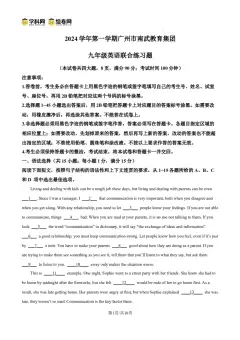
2024 学年上学期九年级期中诊断性调研
英语问卷
(时间: 100分钟, 分值: 90分)
一、语法选择(共15小题;每小题1分,满分15分)
阅读下面短文,按照句子结构的语法性和上下文连贯的要求, 从各题所给的A、B、C和D项中选出
最佳选项,并在答题卡上将该项涂黑。
A wise man was on his long journey with a young man. Night was falling, so they decided to find a place 1
. They searched for a long time and at last found a tiny old house. A poor family lived in it. They gave the two
visitors a warm welcome and prepared a simple meal 2 them including fresh milk and cheese.
After the meal, the wise man asked how they made a living in such a poor place. In a low voice the husband
replied, “We have 3 cow. We sell her milk to our neighbors and keep some for 4 own needs — make some
cheese and cream.”
The next morning, the two visitors continued their journey. 5 they walked a few miles, the wise man
said to the young man, “Go back and push the cow off the cliff (悬崖) .” “Why? Without the cow, they 6
nothing.” The wise man repeated his order, “Go back and 7 the cow.”
The young man was 8 about the future of the family. 9 finally he returned to the old house and did as
the wise man told him.
A few years later, the young man 10 on the same road. He decided to visit the family again. To his 11 ,
he saw a large house with a beautiful garden there. He knocked on the door and a well-dressed man answered it. He
was the son of the family. The man invited him to enter the house and told him 12 their life changed. “You know,
we had 13 but a cow to keep us alive years ago. But one day she fell off the cliff and died. We had to come up
with new ways of 14 a living. You see, we are much 15 than before.” At his words, the young man smiled.
1. A. to stay B. stay C. staying D. stays
2. A. with B. for C. to D. by
3. A. a B. an C. the D. /
4. A. we B.us C. our D. ours
5. A. While B. When C. If D. After
6. A. will have B. have C. having D. has
7. A. killed B. kill C. to kill D. killing
8. A. worry B. worries C. worried D. worriedly
9. A. So B. And C. Although D. But
10. A. travelled B. travels C. travelling D. has travelled
11. A. surprised B. surprise C. surprisedly D. surprising
12. A. what B. when C. how D. where
13. A. anything B. something C. everything D. nothing
学科网(北京)股份有限公司14. A making B. make C. made D. to making
15. A. good B. better C. best D. well
二、完形填空(共10小题;每小题1分,满分10分)
阅读下面短文,掌握其大意,然后从1~10各题所给的A、B、C和D项中选出最佳选项,并在答题
卡上将该项涂黑。
A group of university graduates visited their old professor. During their visit, the conversation turned to work.
The graduates were 1 about their problems and stress in work and in life . After putting a pot of coffee on the
table, the professor went to the kitchen and came back with a tray, crowded with many 2 cups: porcelain, glass,
plastic and crystal. Some cups were simple, other ones expensive. The professor asked them to pick out their cups
first. When the graduates picked out their favorite cups, the professor 3 , “Notice how all the beautiful cups were
picked out and the simple and cheap ones were left.”
“Wanting only the best things for yourself 4 your problems and stress. You need to understand that the cup
doesn't make the coffee better 5 , all that you wanted was the coffee, not the cup.” But you consciously 6 the ebst
cups, and then looked to see what cups others picked.
“Your 7 is the coffee. Your job, money, position in society, they are the cups. The type of cup doesn’t decide
the quality of life. Sometimes, by focusing only on the cups, we forget to 8 the coffee. The 9 people are not
those who have the best things, but those who enjoy life and make the most of what they have.”
Hearing this, the graduates were speechless. They had learned another important life lesson from their old
professor - that true happiness means enjoying life and not worrying about 10 things.
1. A. thinking B. complaining C. learning D. worrying
2. A . different B. expensive C. cheap D. simple
3. A. shouted B. reported C. answered D. explained
4. A. cares for B. gets to C. leads to D. asks for
5. A. Luckily B. Finally C. Honestly D. Actually
6. A. bought B. chose C. brought D. decided
7. A. purpose B life C. work D. study
8. A . buy B. understand C. drink D. taste
9. A . simplest B. happiest C. richest D. luckiest
10. A. unknown B. unusual C. unimportant D. unlucky
三、阅读理解(共两节,满分35分)
阅读下列短文,从1~15各题所给的A、B、C和D项中选出最佳选项,并在答题卡上将该项涂黑。
(A)
Clyde, a small-clawed otter (水猴), was moved from Auckland Zoo to Wellington Zoo two months ago.
The zookeepers hoped he and the other otter Bonnie might start a family together.
But only two days after he arrived, Clyde went missing. He had dug his way under one of the walls and was
nowhere to be seen.
The zookeepers set up cages inside the zoo, with plate of Clyde’s favorite fish in them, hoping to catch him.
Two days went by and still there was no sign of Clyde’s.
学科网(北京)股份有限公司At last a couple saw Clyde at their house — a whole kilometer away in Newtown. Clyde was hiding in an out-
of-reach hole outside their laundry.
The zookeeper arrived and set up some more traps to try to catch him But Clyde is a pretty smart otter. Twice
he managed to get the fish out of a trap without being caught.
Five days after he's escaped Clyde' studys on the run came to an end when he was finally caught in one of the
traps.
It was no good putting Clyde back in his old home — he’d only dig his way out again. So he and Bonnie were
put into the zoo hospital. There was no chance of their escaping from there.
Meanwhile, the zookeepers were working hard to make Clyde's old home safer. They put an iron barrier
underground to stop him digging their way out. Then Bonnie and Clyde went home again.
But a month after his first escape, Clyde was out again. Once more the zookeepers came hurrying to catch
Clyde. They found him by following the bubbles he made in the river nearby.
Nobody knew how Clyde had escaped. But this time he was only out for an hour. So, he went back to the
hospital again.
Poor Clyde. It seemed that he wasn't happy at Wellington Zoo, even though he and Bonnie were getting on
well together. The keepers didn't like seeing him unhappy, so they planned to look for a home for him somewhere
else.
1. What order is the article written in?
A. Space B. Logic C. Comparison D. Time
2. How long did his first run-away from the zoo last?
A. 2 days B.1 hour C. 5 days D. 1 month
3. What do we know about Clyde?
A. He didn’t get on well with Bonnie. B. He was good at digging.
C. He was happy in Wellington Zoo. D. He escaped to meet Bonnie.
4. Where is the passage most likely to have been taken from?
A. A news report. B. An advertisement.
C. A book review. D. A research paper.
(B)
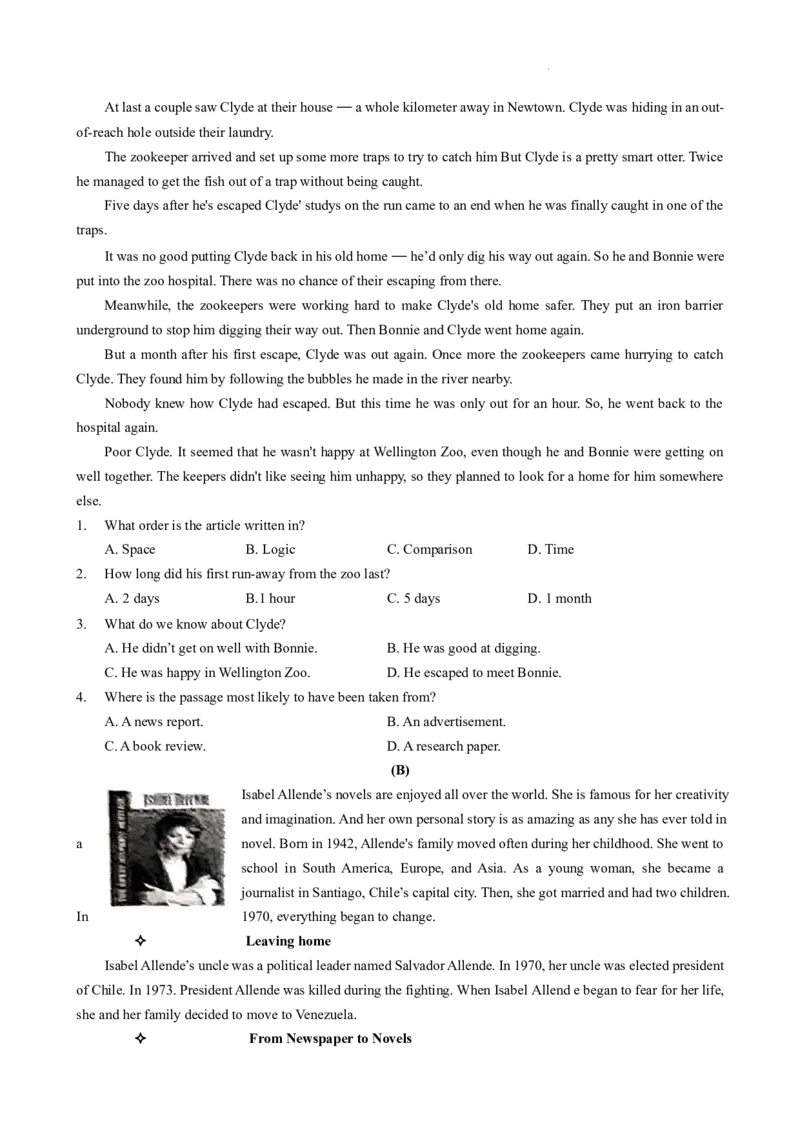
Isabel Allende’s novels are enjoyed all over the world. She is famous for her creativity
and imagination. And her own personal story is as amazing as any she has ever told in
a novel. Born in 1942, Allende's family moved often during her childhood. She went to
school in South America, Europe, and Asia. As a young woman, she became a
journalist in Santiago, Chile’s capital city. Then, she got married and had two children.
In 1970, everything began to change.
Leaving home
Isabel Allende’s uncle was a political leader named Salvador Allende. In 1970, her uncle was elected president
of Chile. In 1973. President Allende was killed during the fighting. When Isabel Allend e began to fear for her life,
she and her family decided to move to Venezuela.
From Newspaper to Novels
学科网(北京)股份有限公司It was really a painful experience for Isabel Allende to leave her country. Without this experience, however,
Allende said she never would have begun writing novels. Then she got a phone call from Chile. Her grandfather
was dying. She knew she could not return home to be with him, but she wanted to respect him in some way. “I
decided to write a letter about all the things he told us when we were young.” Allende explained. Later, she wrote a
long letter which became Allende’s first novel. The House of the Sprits.
The Writing Life
“I spent ten, twelve hours a day in a room. writing.” Allende says, “I don’t talk to anybody; I don’t answer the
phone.” When she finished the first draft of a new novel, Allende mailed a-copy to her strictest critic (评论家). “I
send it to my mother. She read it and came here with a red pen. We fight for a month at least.” Allende then went
back to work until she felt the book was finished. “The storytelling is the fun part,” she said. “The writing can be a
lot of work!”
5. What does the writer think of Isabel Allende’s story?
A. Interested B. moving C. painful D. amazing
6. What was Isabel Allende before she got married?
A. She was a journalist. B. She was a teacher.
C. She was a political leader. D. She was a president.
7. Why did Isabel Allende start writing her first novel?
A. Because she wanted to make money.
B. Because she liked writing novel.
C. Because she wanted to respect her grandfather.
D. Because she wanted to write against the government.
8. In Paragraph 4. when Allende said “We fight for a month at least”, she meant that “__________”.
A. Isabel Allende and her mother discussed and argued a lot about the draft.
B. Isabel Allende and her mother often fought because of the draft.
C. Isabel Allende and her mother didn't have a good relationship.
D. Isabel Allende’s mother didn’t like Isabel Allende’s draft at all.
(C)
There is a saying that cats have nine lives. A recent study examined why. Scientists carried out a study of cats
which had fallen out of windows of buildings. Nine out of ten remained alive after a fall of two storeys or more.
One cat which fell from the thirty-second floor of a building only broke a tooth. Interestingly, the cats were in
greatest danger of being killed if they fell from the seventh floor. Falling from either a less or greater height gave
them a better chance of survival (幸存).
Damage to a body depends on how fast it hits the ground, which in turn depends on how far it has fallen. But
it's not quite that simple, because, as an object falls through the air, the air holds it back and slows the object down.
After a while the object stops accelerating and continues at a fixed (稳定的) speed. This is the terminal (极限的)
speed. Bulky (肥胖的) things have a lower terminal speed because there is a larger area for the air to push up on.
Heavy things have a higher terminal speed because they push down harder against the air. Cats have a lower
terminal speed than falling people, for example, because they are quite bulky and not very heavy so that they hit the
学科网(北京)股份有限公司ground more slowly and are less likely to be hurt.
Then why does the seventh-floor matter? This is the distance cats take to reach their terminal speed. After the
seventh floor, they may relax and spread out their legs and change their falling position so that they may land on
their feet. This would slow them down and allow their muscles to reduce the force of impact, and thus reduce the
damage.
9. The scientists came to a conclusion (结论) that a fall from __________ floor was most likely to kill a cat.
A. the second B. the thirty-second
C. the seventh D. the higher
10. The underlined word “accelerating” in the second paragraph probably means .
A. moving faster B. moving slower
C. moving at a fixed speed D. moving at a normal speed
11. Falling cat has a lower terminal speed than a falling man because it is .
A. bigger but heavier B. bigger and relatively (相对地) lighter
C. lighter but relatively bigger D. smaller and lighter
12. A fall from higher than a seventh floor allows the falling cat __________.
A. to have time to reduce its falling speed
B. to relax and spread out its legs and to land on a safer position
C. to fall slower than from the sixth floor
D. to be able to reach the ground softly on its back
(D)
There are so many things around us that make life more convenient. What might life be like without them? We
asked our readers what they thought were the most useful inventions from the past. Here
are their top four.
It all starts here. If you haven't got wheels, you can’t go anywhere or get anything! We
need them for every type of vehicle. They take us to places we have never been to and bring
things fast. They’re used for operating many kinds of machines. Wheels were used as far back
as 3000 BC.
Imagine it’s extremely cold or extremely hot. If you want some water, you’ve got
to go to the well or a pump. Or even worse, your toilet is outside the house. Before
indoor plumbing (室内管道), people had to do this. Try to think about all the times
you turn on the water in your home every day. The ancient Greeks created it nearly 4,000
years ago. Unfortunately, there are still some countries where they haven’t got it.
Until 1879, candles or oil lamps were used for lighting. But then Thomas Edison
developed the bulb. Walk around your home and count how many lightbulbs you see. They' re everywhere--even
inside your fridge!
You might use one of these to do your homework, organize your schedule or read a magazine. But computers are
also used for running things that you use every day. There are tiny computers inside cars, microwave ovens, TV sets
and DVD players. Charles Babbage invented the first computing machine in 1822 but it has changed a lot since
学科网(北京)股份有限公司then.
13. When were wheels first used according to this article? __________
A. About 3000 AD. B. Nearly 4000 years ago.
C. 3 century ago. D. About 3000 BC.
14. Which of the following is NOT TRUE according to the article? __________
A. Wheels are used for operating many kinds of machines.
B. Before indoor plumbing, people had to go outside to get water.
C. There aren’t any tiny computers inside cars, microwave ovens. TV sets or DVD players
D. After Thomas Edison developed the bulb, we could see lightbulbs almost everywhere.
15. Which of the following is the best title for this article? __________
A. Things that make life more convenient
B. The most useful inventions in the world
C. The top four useful inventions in readers’ eyes
D. What might life be like without the four inventions?
第二节 阅读填空(共5小题:每小题1分,满分5分)
阅读短文及文后A—E选项,选出可以填入41—45 各题空白处的最佳选项,并在答题卡上将该项涂
黑。
We all believe we listen well and yet many times we feel others are not listening to us. However, listening
goes in both directions — you may believe you are listening well, but how often have you completely forgotten
what was said to you? 1
Make eye contact.
2 When people talk, they put out visual clues that add to the conversation and meaning of their word.
Stop talking.
You can’t listen, talk and at the same time completely receive the meaning of the other person’s words. 3
React without words.
Let the other person know you are listening through physical reactions, such as head nods, smiles, frowns
and eye contact 4
5 Behave as an effective listener. The more you continue to behave as a listener, the more you will be an
effective listener.
A. Act as a listener.
B. Make eye contact with the person who is talking to you.
C. There are a few ways to become a more effective listener.
D. Wait your turn and take in what has been said to you before you make a reply.
E. These may also help to let the speaker know whether you are fully understanding his words.
四、写作(共三节;满分30分)
第一节 语篇填词(共5小题;每小题1分,满分5分)
阅读短文,根据上下文和所给的首字母写出所缺单词。注意使用正确形式,每空限填一词。答卷时,
要求写出完整单词。
学科网(北京)股份有限公司School counsellors (咨询师) are the people you can turn to when you need help. They know how to listen
and can help kids with life’s challenges. Counsellors have special training in how to help kids 1. s__________
problems, make 2. d__________ and stand up for themselves.
If someone was bullying (欺凌) you, for example, the counsellor would talk to you about it and could give
you some advice. The counsellor may also talk to the bully and maybe even to the kids who saw what
happened. The counsellor might talk with your teacher and your parents about the problems as well. 3.
T__________ this may make you feel a little uncomfortable, facing the problem and trying to change it is better
than living in a bad 4. s__________ With the counsellor’s help, you don’t face difficult school problems alone.
And you may feel 5. r__________ after the problem is gone.
第二节 完成句子(共5小题;每空0.5分,满分10分)
根据所给的汉语内容,用英语完成下列句子。(每空限填一词)
1. 在朗朗小的时候,父母期望他成为一个钢琴家。
When Lang Lang was a little boy, he __________ __________ __________ __________ a pianist.
2. 能收到你的来信真是令人兴奋!
__________ __________ it is to __________ __________ you!
3. 昨晚她妹妹不停的哭,几乎把她逼疯了。
Last night, her younger sister kept __________ and almost __________ __________ __________.
4. 他几乎没有朋友,他似乎很难相处。
He has few friends, he __________ __________ to get along with.
5. 当苏炳添领她上台的时候,她兴奋得几乎要昏过去了。
When she was led onto the stage by Su Bingtian, she was __________ excited __________ she nearly
__________ __________.
第三节 书面表达(共1题,满分15分)
假如你是南华中学英语校报的编辑李华老师.该校九年级学生王小明向校报的 Problems & Advice
栏目写的一封求助信.信中提及进入九年级以来.如作业太多、感到焦虑、无法平衡娱乐与学习的关系等问
题。请你根据以下提示写一封回信,提出你的建议和解决方法。
内容要点:
1.表示理解、给予安慰;
2.提出合理的建议和解决方法:
3.做好时间安排、不要过于焦虑;
4.不要熬夜.做到劳逸结合;
5.请你补充一点相关内容……
6.希望以上建议能够对该生有帮助。
写作要求:
1.80 词左右,开头和结尾已给出,不计入总词数内;
学科网(北京)股份有限公司2.文中不得出现真实姓名和校名;
___________________________________________________________________________________________
___________________________________________________________________________________________
___________________________________________________________________________________________
___________________________________________________________________________________________
___________________________________________________________________________________________
___________________________________________________________________________________________
___________________________________________________________________________________________
___________________________________________________________________________________________
___________________________________________________________________________________________
学科网(北京)股份有限公司