







































































































































文档内容
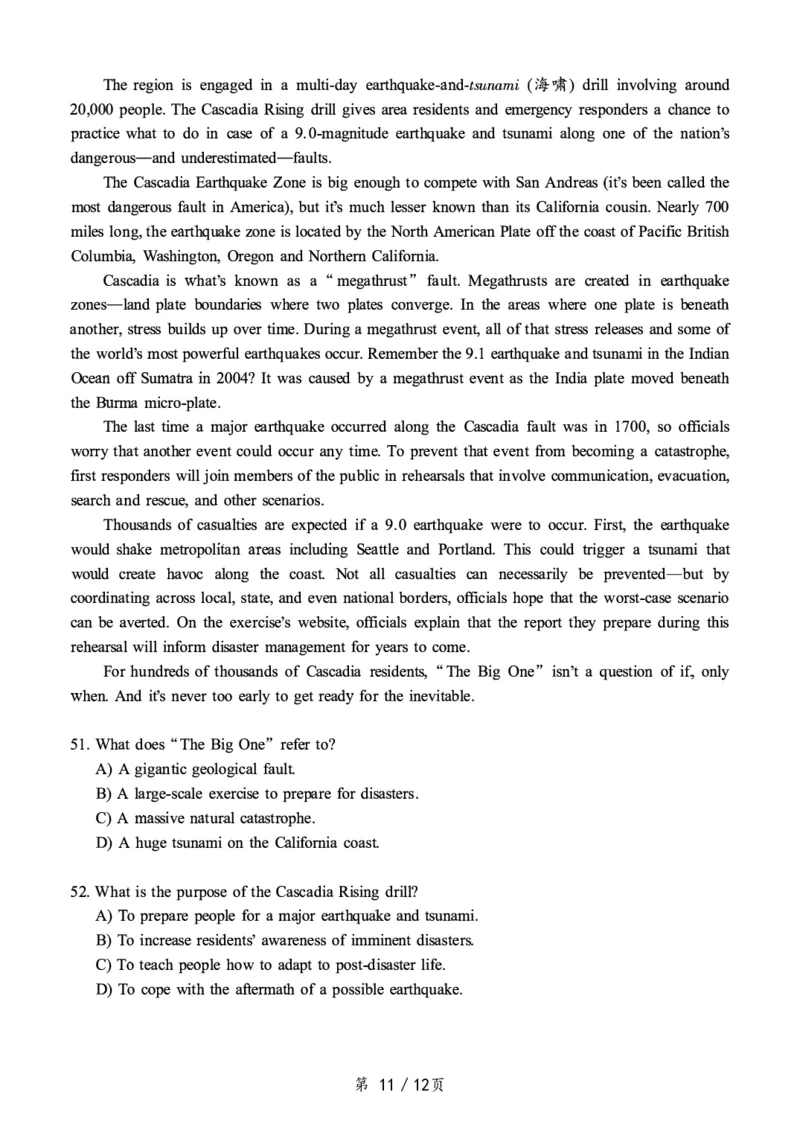
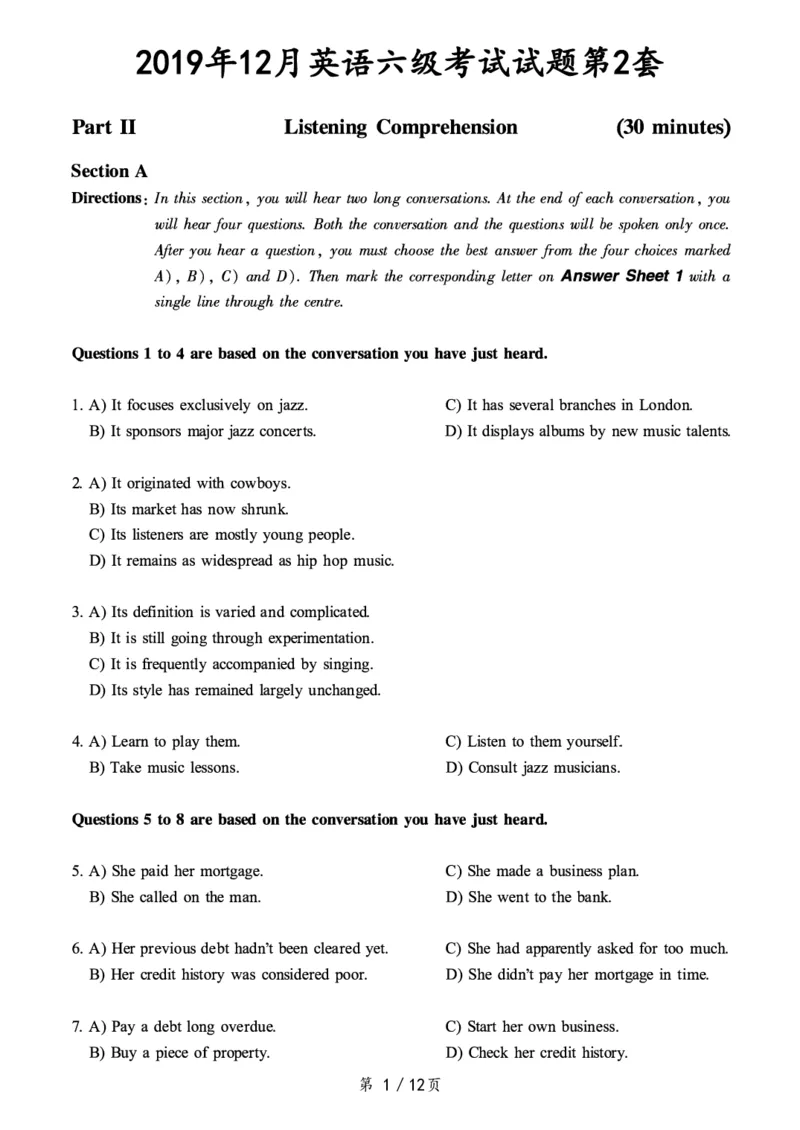
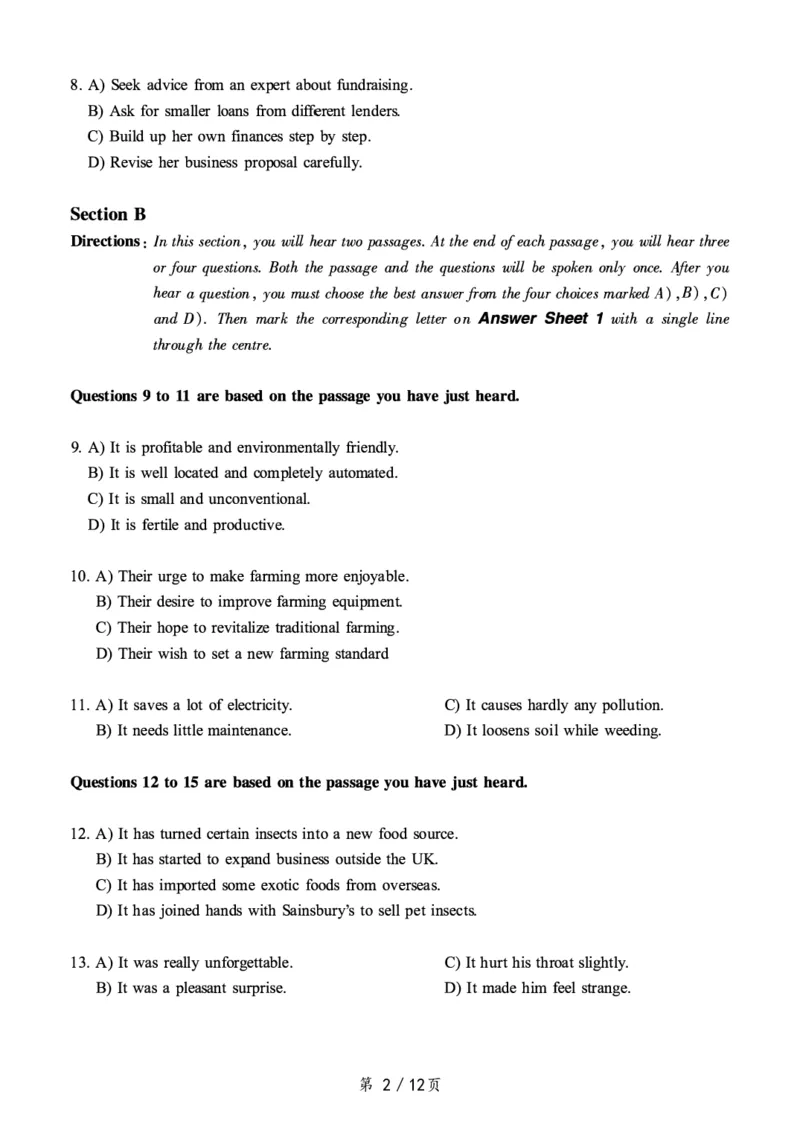
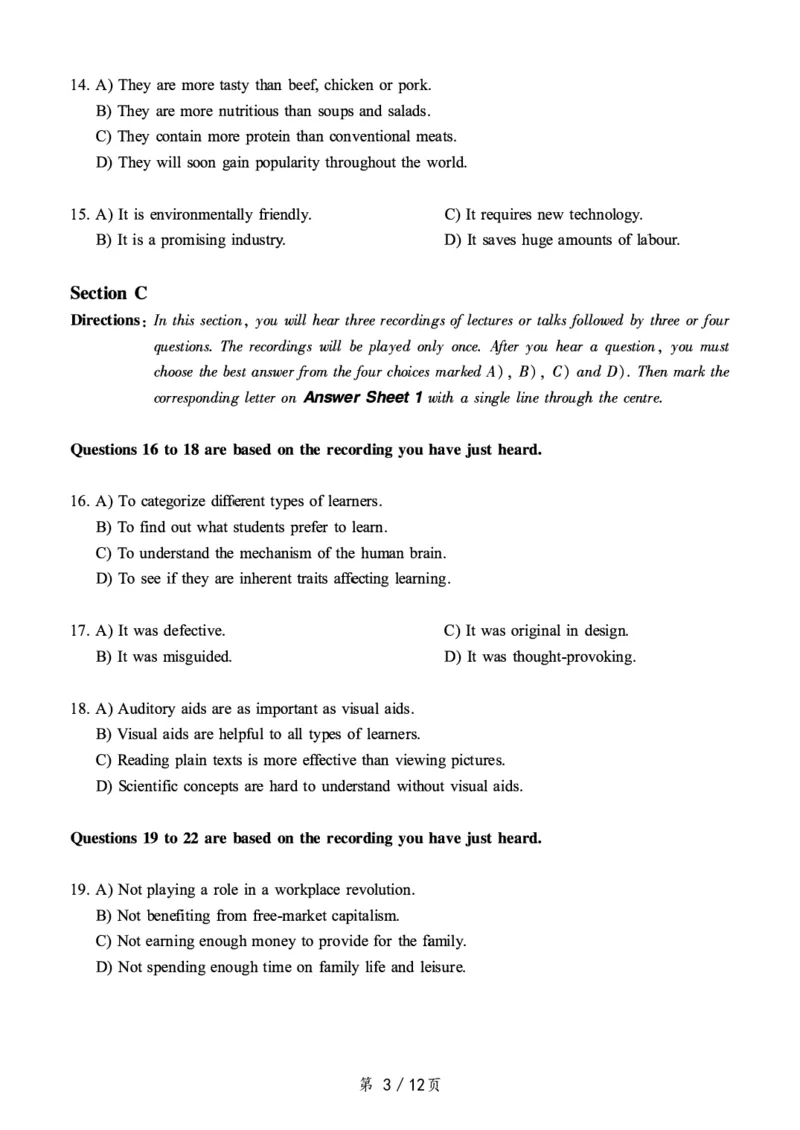
2
2
0
0
1
1
9
9
年年66月月大大学学英英语语六六级级考考试试试试题题第第11套套
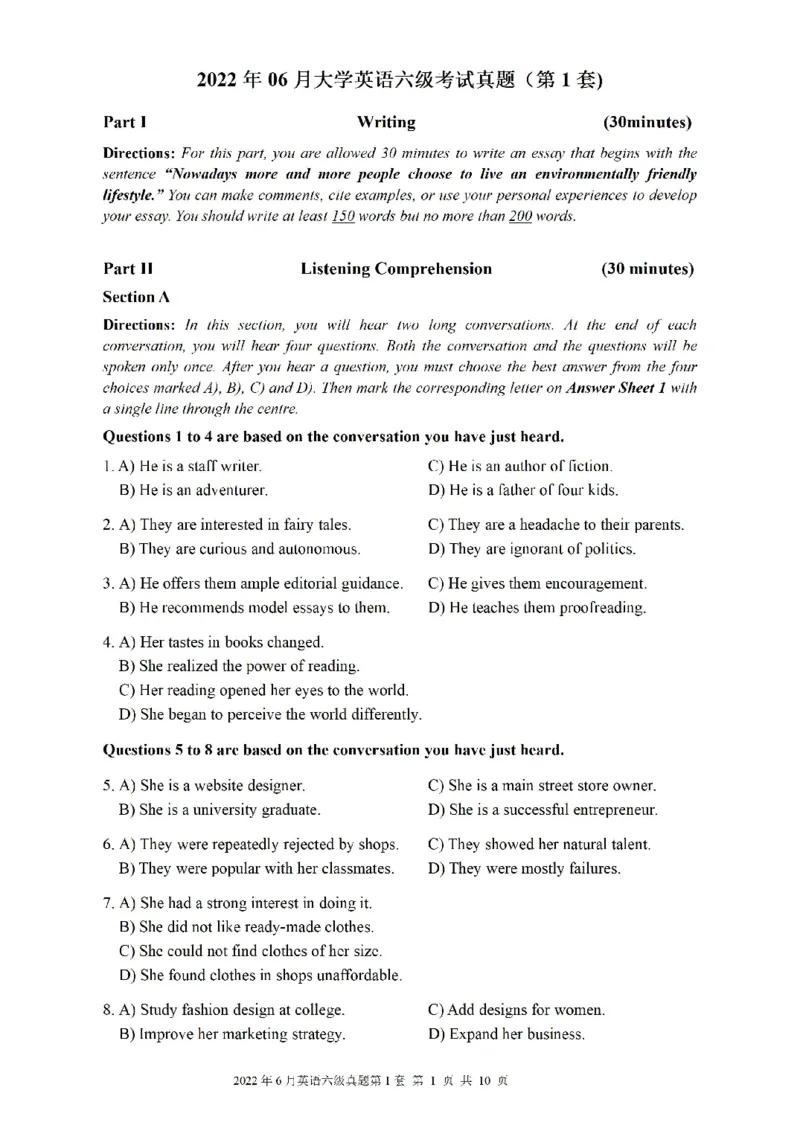
Part II
Listening Comprehension (30 minutes)
Part II Listening Comprehension (30 minutes)
Section A
Section A
Directions:In this section,you will hear two long conversations.At the end of each conversation,you
Directions: In this section, you will hear two long conversations. At the end of each conversation, you
will hear four questions. Both the conversation and the questions will be spoken only once.
will hear four questions. Both the conversation and the questions will be spoken only once.
After you hear a question,you must choose the best answer from the four choices marked
After you hear a question , you must choose the best answer from the four choices marked
AA),)B , )B,C)) ,a nCd) Da)n.dT Dhe)n. mTharenk mthaerk ctohre rceosrrpeospnodnidnign gl eletttteer ro no nA Annsswweerr ShSheeeett 11 wwiitthh aa
single line through the centre.
single line through the centre.
Questions 1 to 4 are based on the conversation you have just heard.
Questions 1 to 4 are based on the conversation you have just heard.
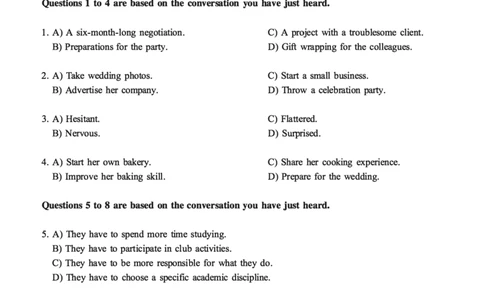
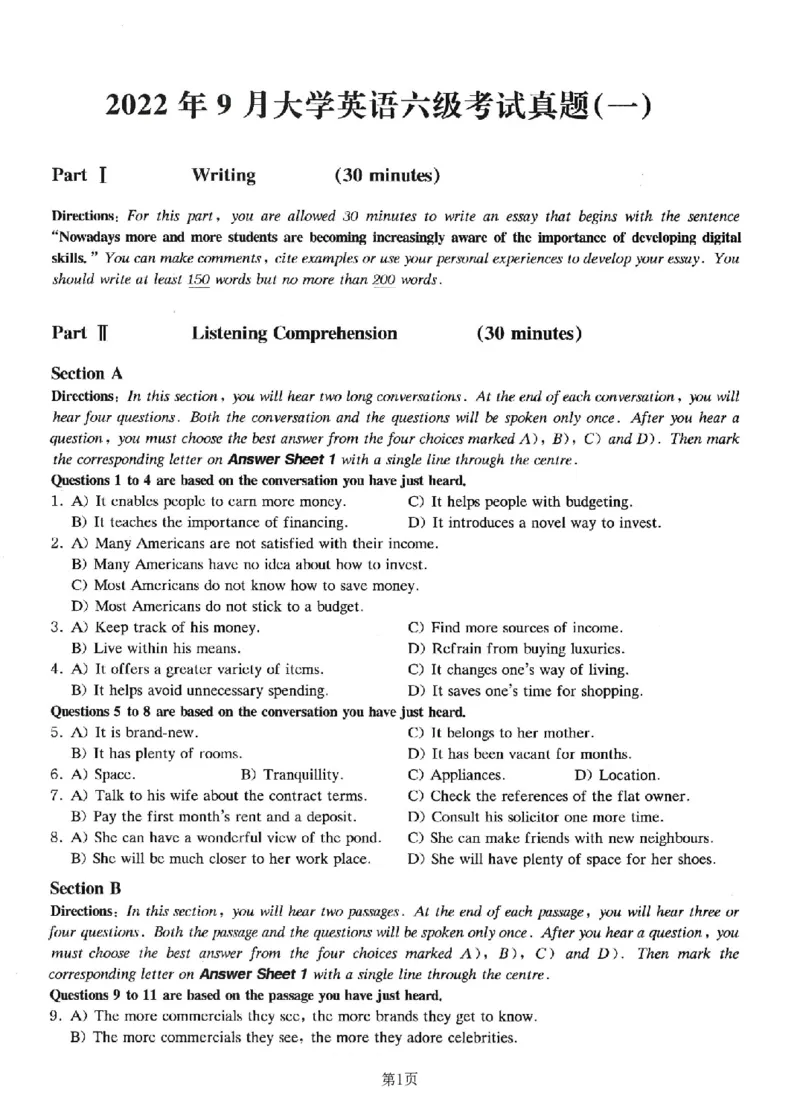
1.1 .AA) )A A s isxix--mmonotnhth-l-olonng gn engeogtoitiaattiioonn.. C)C )A Apr pojroejcetc tw iwtihth a at trroouubblleessoomme ec lcilieenntt..
B)B )PrPerpeaprarataitoinosn sf ofor r tthhee ppaartyrty.. D)D )GiGftift wwrarpappipnign gf ofor rt hthee ccoolllleeaagguueess..
22. .AA)) TTaakkee wweeddddiningg pphhoottooss.. C)C )StSatrartt aa ssmmalalll bbuussiinneessss..
B)B )AdAvdevretritissee hheerr ccoommppaannyy.. D)D )ThTrhorwo wa cae lceelberbartaitioonn ppaartyrty..
3.A) Hesitant. C) Fltere.
3. A) Hesitant. C) Flattered.
B) Nervous. D) Surprised.
B) Nervous. D) Surprised.
4.4A.)A S) tSatrartt hheerr oowwnn bbaakkeerryy.. C)C )ShSahrare eh ehre r ccooookkiinngg eexxppeerriieennccee..
B)B )ImIpmrporvoev eh ehre rb abkakinign gs ksiklilll.. D)D )PrPerpeaprare e ffoorr tthhee wweeddddiinngg..
Questions 5 to8 are based on the conversation you have just heard.
Questions 5 to 8 are based on the conversation you have just heard.
55. .AA) ) TThheye yh ahvaev et oto ssppeenndd mmoroer et tiimmee ssttuuddyyiinngg..
B)BT)heTyh heayv eh atvoe ptaor tpiartciipcaitpea tien inc lculbu ba catcitviivtitiieess..
C)CT)heTyh ehya vhea vteo tobe b me omreo rree srepsopnosnibsilbel ef foorr wwhhata t tthheeyy ddoo..
D)DT)heTyh ehya vhea vtoe toch ocohsoeo sae sap escpiefciicfi ca caacdaedmeimc icd idsicsicpiplliinnee..
6.6A.)A G) eGt ert eraedayd yf ofor ra a ccaarreeeerr.. C)C )SeSte t aa lloonngg--tterrmm ggooaall..
B)B )MaMkeak ae lao tlo to fo ff frriieennddss.. D) D ) Be B h e a h v a e v e l i l k ik e e a a d d u u l l t t s s . .
77.A.)AT)h oTsheo wseh ow shhoa rshe arhee rh earc aadceamdiecm iicn tinetreersetstss..
BB)T)hTosheo sweh wo hroe srpeespctec th ehre rs sttuuddeenntt ccoommmmititmmeennttss..
C)C )ThTohsoes ew hwoh oca cnan h ehlepl ph ehre rw whehne ns hseh ei si s iinn nneeeedd..
DD)T)hoTsheo sweh ow hgoo gtoo ttoh eth es asmame ec lculbusb sa sas sshhee ddooeess..
8.8A.)ATh)o sTeh ohseel phfeulpl fufolr fo tra ptpaipnpgi ntgh ethire irp optoetnetnitiaall..
B)BT)hoTsheo sceo ncdouncidvuec ivtoe tiom pirmovpirongv intghe ithre isro csoiaclia ls ksiklilllss..
淘宝店铺∶光速考研工作室
第 1/ 12页
第 1/12页C)C )ThTohseo shee lhpefluplfu flo rfo cr uclutiltviavtaitning gi nindidviivdiduaula li nintteerreessttss..
D)D )ThTohseo sceo cnoduncdiuvcei vteo tot htheierir aaccaaddeemmici cs sttuuddiieess..
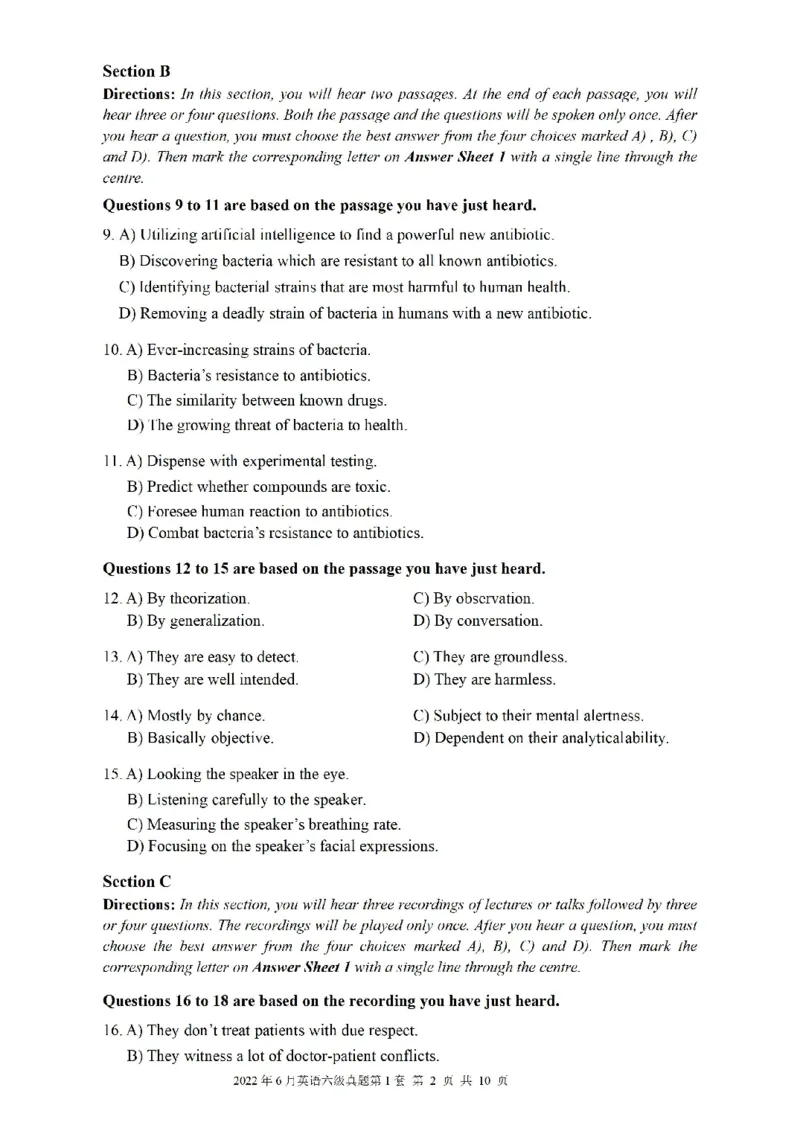
Section B
Section B
Directions:In this section,you will hear two passages.At the end of each passage,you will hear thee
Directions: In this section, you will hear two passages. At the end of each passage, you will hear three
or four questions. Both the passage and the questions will be spoken only once.After yu
or four questions. Both the passage and the questions will be spoken only once. After you
hehaeraar qau qeustesitoionn,y , oyuo umu mstus ct hcohoosoes et hthee bbeesstt aansnswweerr frfroomm tthhee f ofuoru rc hcohicoeisc emsa rmkaerdk eAd ) A,) B,B) ),, CC))
an
a
d
n d
D )
D
.
)
T. h e
Th
n
e
m
n
a r
m
k
a
t
r
h
k
e
th
c
e
o r
c
r
o
e
rr
s
e
p
s
o
p
n
o
d
n
i
d
n
in
g
g
l e
letter
tter
o
o
n
n AAnnsswwerer S hSheeeet 1t w1 it
w
h
it h
a
a
s i
s
n
in
g
g
le
le
l
l
i
in
n
e
e
through the centre.
through the centre.
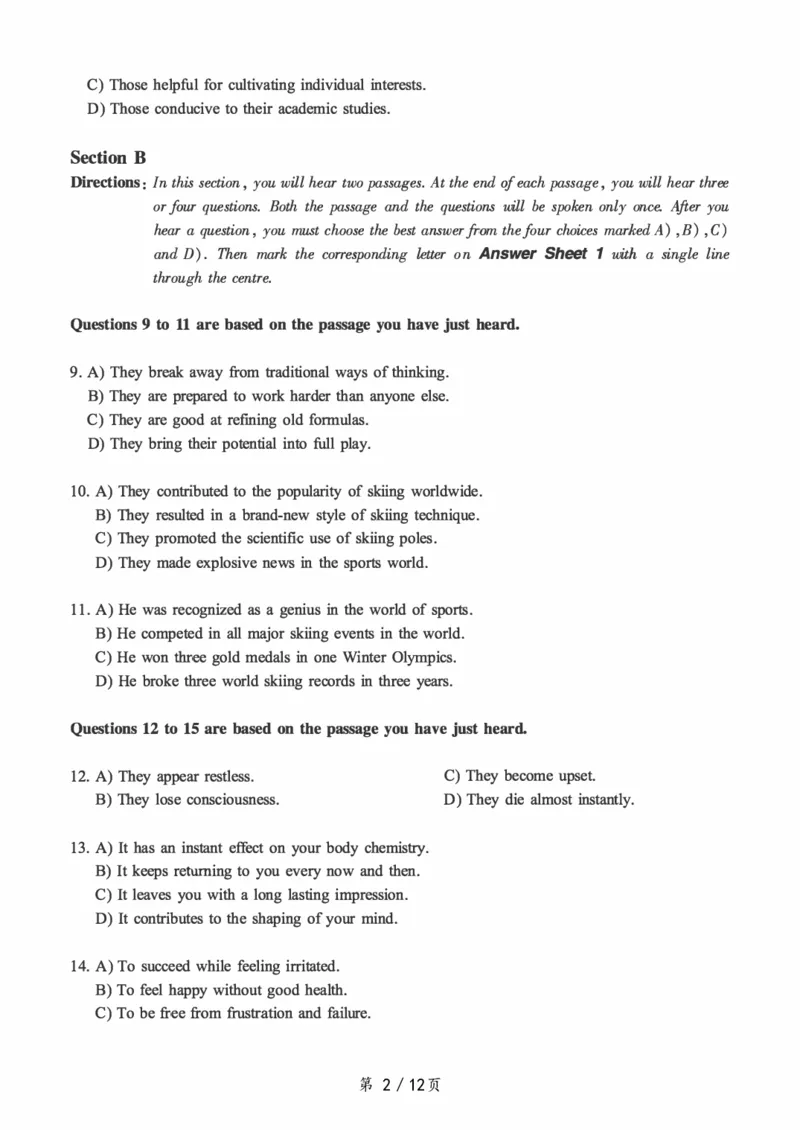
QuQeusetsitoionsn s9 9 ttoo 1111 aarree bbaasseedd oonn tthehe ppaassssaaggee yyoouu hhaavvee jjuusstt hheeaarrdd..
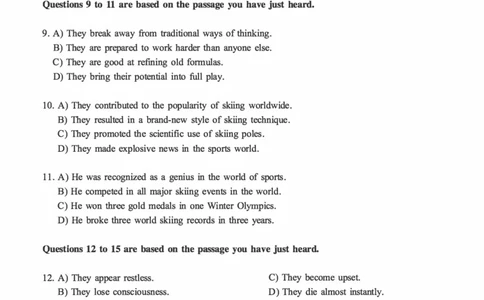
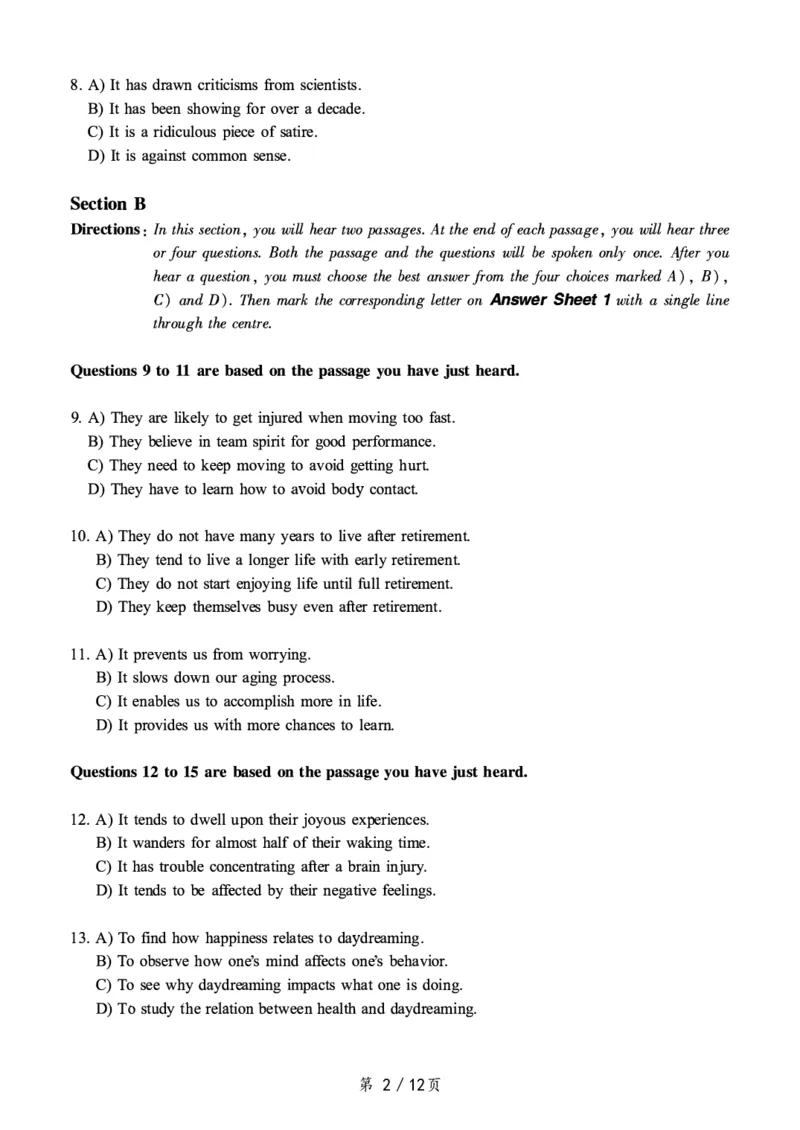
9.9 .AA) )T Thehye yb rberaekak a waway afyr ofrmo mtr atrdaidtiitoionnala l wwayasy so of ft thhiinnkkiinngg..
BB) )T hTehye ya rare ep rperpeaprareedd ttoo wworokr kh hararddere r tthhaann aannyyoonnee eellssee..
C)C )ThTehye ya rare eg ogoodo dat at r erfeifinniinngg oolldd ffoormrmuullaass..
D)D )T hTeyh ebyr ibnrgi ntgh ethire ipro pteontetinatila li nintoto ffulu lll ppllaayy..
101.0A.)ATh) eTy hceoyn tcroinbtriutbeudt etdo toth the ep oppoupluarlariittyy ooff sskkiiiinngg wwoorrllddwwiiddee..
B)B )T hTehy erye sreuslutletde di nin a a bbrraanndd--nneeww s tsytlyele ooff s skkiiiinngg tteecchhnniiqquuee..
C)C )ThTehye ypr pomroomteodt etdh eth sec isceinetnitfificic uussee ooff sskkiiinngg ppoolleess..
DD) )ThTehye ym amdea deex pelxopsliovsiev en enwesw isn i nt hthe es sppoortrtss wwoorrlldd..
111.1A.)A H)e H wea sw raes croegcnoigzneidz eads aas gae ngieunsi uisn i nt hthe ew owrolrdl do fo fs psporotrtss..
B)B )HeH ceo cmopemtpede teidn ianl la llm amjoarjo rs ksikiiningg e evevnetnsts iinn tthhee wwoorrlldd..
CC) )HHe ew owno nth thrreee eg golodld mmedeadlasls iinn oonnee WWiinntteerr OOllymymppiiccss..
D)D )H eH ber bokroe kteh rtheree ew owrlodr ldsk sikiniign gr erceocrodrsd si nin tthhrreeee yyeeaarrss..
QuQeusetsitoionsn s1 122 t too 1155 aarree bbaasseedd oonn tthhee ppaassssaaggee yyoouu hhaavvee jjuusstt hheeaarrdd..
121.2 .AA) )T hTehye ya pappepaerar r ersetsltleessss.. C) C ) T T he h y e y b b e e c c o o m m e e u u p p s s e e t t. .
B)B )ThTehye yl olsoes e ccoonnsscciioouussnneessss.. D)D T)hTeyh edyi ed iea lamlomsto sit nisntsatannttllyy..
131.3 .AA)I)t Ith ahsa sa nan i nisntsatanntt eeffffeecctt oonn yyoouurr bbooddyy cchheemmisisttryry..
BB)I)t Itk ekeepesp sr eretturnurniinngg ttoo yyoouu eevveerryy nnooww aanndd tthheenn..
C)C )ItI t lleeaavveess yyoouu w witihth a a l loonngg l laassttiinngg iimmpprreessssiioonn..
D)D )I tI t ccoonntrtriibbuutteess ttoo ththee sshhaappiinngg ooff yyoouurr mmiinndd..
141.4A.)A T)o Tsou cscuececde ewdh iwleh iflee efelienlgin gir irrrititaatteedd..
B)B )ToT of efeele l hhaappppy yw witihthooutu t ggoooodd h heaealltthh..
C)C )ToT obe b fer efree ef rfromo mfr ufrustsrtrataitoionn a annd df afaililuurree..
淘宝店铺∶光速考研工作室
第 2/ 12页
第 2/12页DD) )TTo oe nejnojoyy g gooodo dh ehaelatlthh wwhhililee iinn ddararkk mmooooddss..
151.5 .AA) ) TThehye ya raree cclloosseellyy ccoonnnneecctteedd.. CC) )TThehye ya raer et toooo ccoommplpelxex t too uunnddeerrssttanandd..
BB) )TThehye yf ufuncntcitoionn i inn aa ssiimmiillarar wwayay.. D)D )ThTehy erye irenifnoforcrec ee aecahc ho tohthere rc ocnosntsatannttllyy..
Section C
Section C
Directions:In this section,you will hear three recordings of lectures or talks followed by three or four
Directions: In this section, you will hear three recordi of lectures or talks followed by three or four
ngs
questions.The recordings will be played only once After you hear a question,you must
questions. The recordings will be played only once. After you hear a question, you must
ch c o h o o s o e se t t h h e e b b e e s s t t a ns an w s e w r e fr r o f m ro t m h e t f h o e u r f o c u h r o ic c e h s o i m c a e r s k e m d a r A k)e d, BA)), ,B )C,) C a ) n a d nd D D)).. T Th he e n n m m a a r r k k t th he e
corresponding letter on Answer Sheet 1 with a single line through the centre
corresponding letter on Answer Sheet 1 with a single line through the centre.
Questions 16 to 18 are based on the recording you have just heard.
Questions 16 to 18 are based on the recording you have just heard.
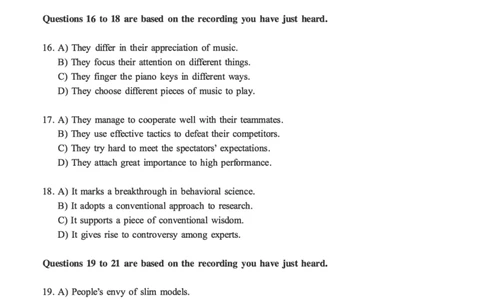
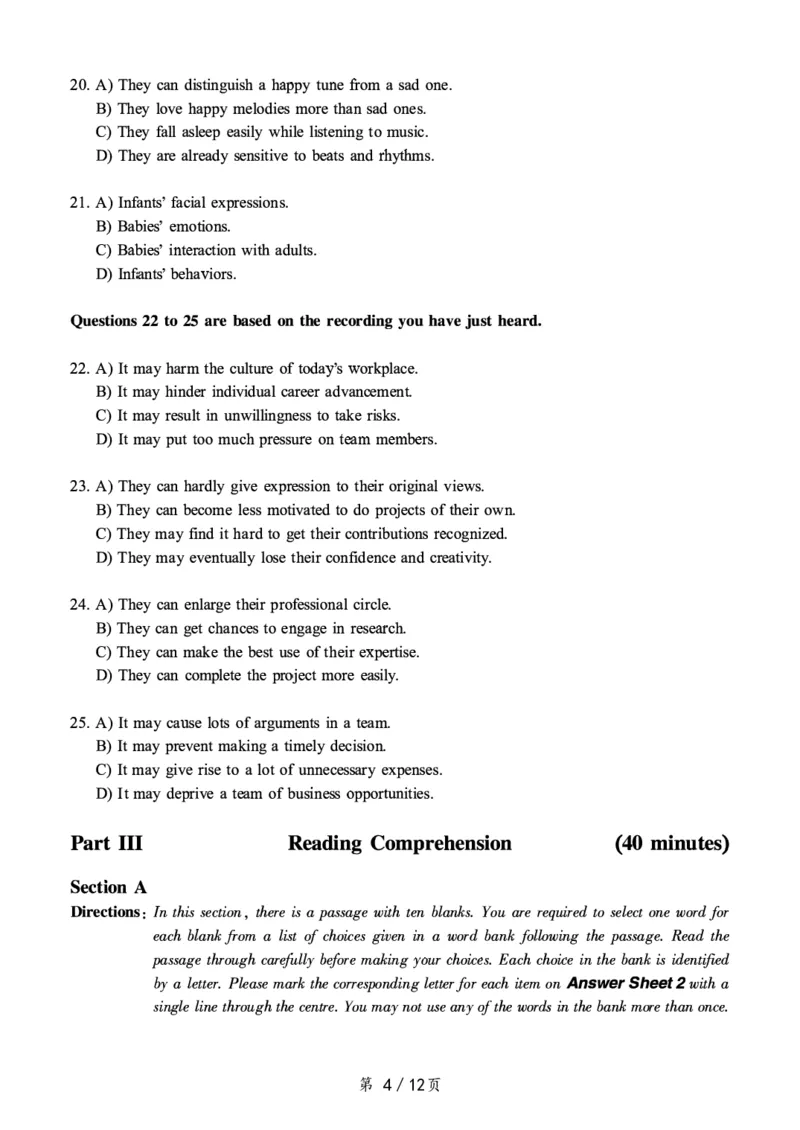
161.6 .AA) )T hTehye ydi fdfiffere ri nin tthheeiirr aapppprreecciiaattiioonn ooff mmuussiicc..
B)B )ThTehy efyo cfousc utsh ethire ira tattetentnitioonn oon nd idfifffeerreenntt tthhiinnggss..
C)C )ThTehy efyi nfignegre rt hthe ep ipaiannoo k ekyesy si nin ddiiffffeerreenntt wwaayyss..
D)D )ThTehye cyh ocohsoeo sdei fdfieffreernetn tp ipeiecceess ooff mmusuiscic ttoo ppllaayy..
171.7 .AA) ) TThehye ym amnaangea gteo toc ocoopoepraetraet ew ewlell lw witihth tthheeiirr tteeamammmaatteess..
B)B )ThTehy euys eu seef feeffcteicvtiev et atcatcitcicss ttoo ddeeffeeaatt tthheeiirr ccoommppeteitittoorrss..
C)C )ThTehy etyr ytry h ahrard dt ot om emete etth the es psepcetcattaotrosr's ' eexxppeectcatattiioonnss..
D)D )ThTehye ya tatttaacchh g grereaatt iimpmpoorrttananccee ttoo hhiigghh ppeerfrfoormrmananccee..
181.8 .AA) )I tIt mmararkks s aa bbrreeaakktthhrroouughg hi nin bbeheahvaivoiroarla l sscciieennccee..
B)B )ItI t aaddoopptsts aa ccoonnvvenetnitioonnaall aapppprrooaacchh ttoo rreesseeaarccr hh..
C)C )ItIt ssuuppppoortrtss aa ppiieeccee ooff ccoonnvveennttiioonnaall wwiissddoomm..
DD) )ItI t ggiivveess rriissee toto ccoonntrtroovveerrssyy amamoonngg eexxppeerrttss..
Questions 19 to 21 are based on the recording you have just heard.
Questions 19 to 21 are based on the recording you have just heard.
191.9A.)A P) ePoepolpel'es's eennvvyy ooff sslliimm mmooddeellss..
B)B )PePoepolpel'es's ccrrazazee ffoorr ggoooodd hheeaalltthh..
C)
C )
ThTeh ei nicnrceraesaisningg r rananggee ooff ffaannccyy pprroodduuccttss..
D)D )ThTeh eg rgeraeta tv avrarieiettyy ooff sslimminlimmingg pprroodduuccttss..
202.0A.)A )T hTehye ya pappepaerar v viiggoorroouuss.. C)
C )
ThTehye yl oloookk cchhaarmirminngg..
B)B )ThTehye ya pappepaerar s tstranranggee.. D) D ) Th T e h y e y l o lo ok o k u un nh h e e a a l l t th hy y . .
212.1A.)A C) uCltuultruer ea anndd u uppbbririnnggiinngg.. C)
C )
PPeerer pprressusurree..
B)B )WeWaletahl tha nand ds oscoicaila l ssttaattuuss.. D) D ) M M ed ed i i a a i i nfl f u u e e n c c e e. .
第 3/ 12页
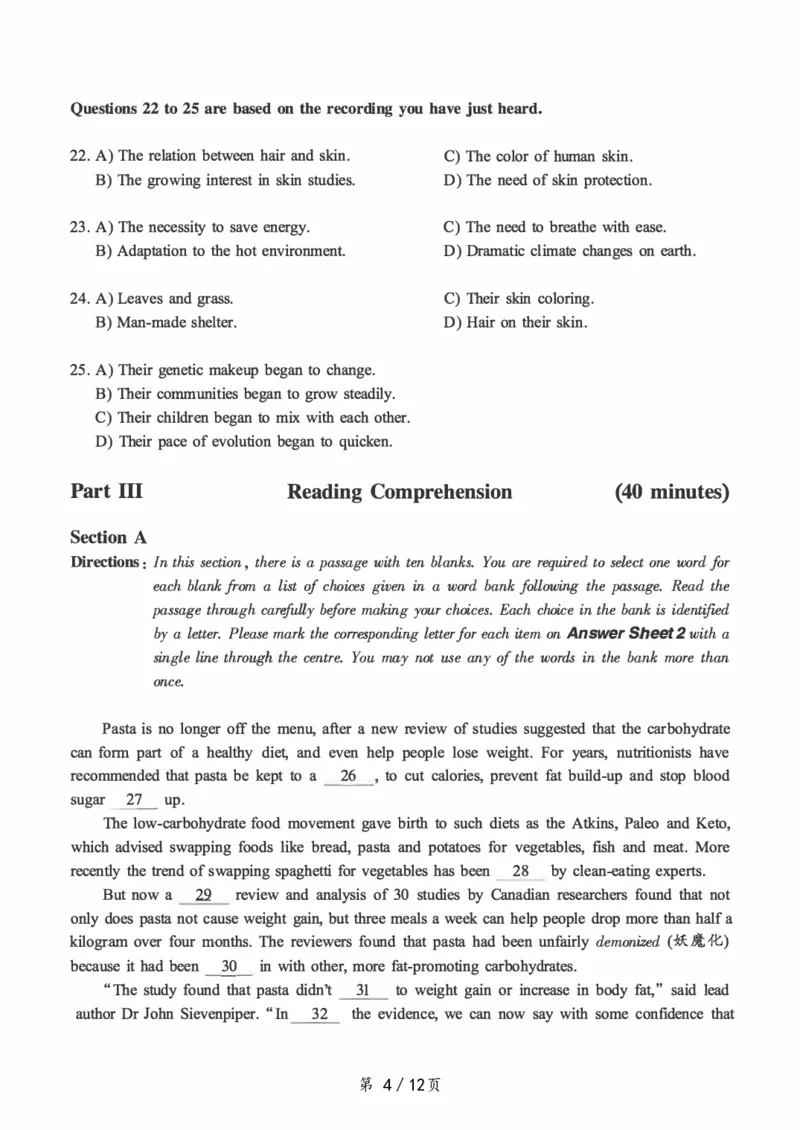
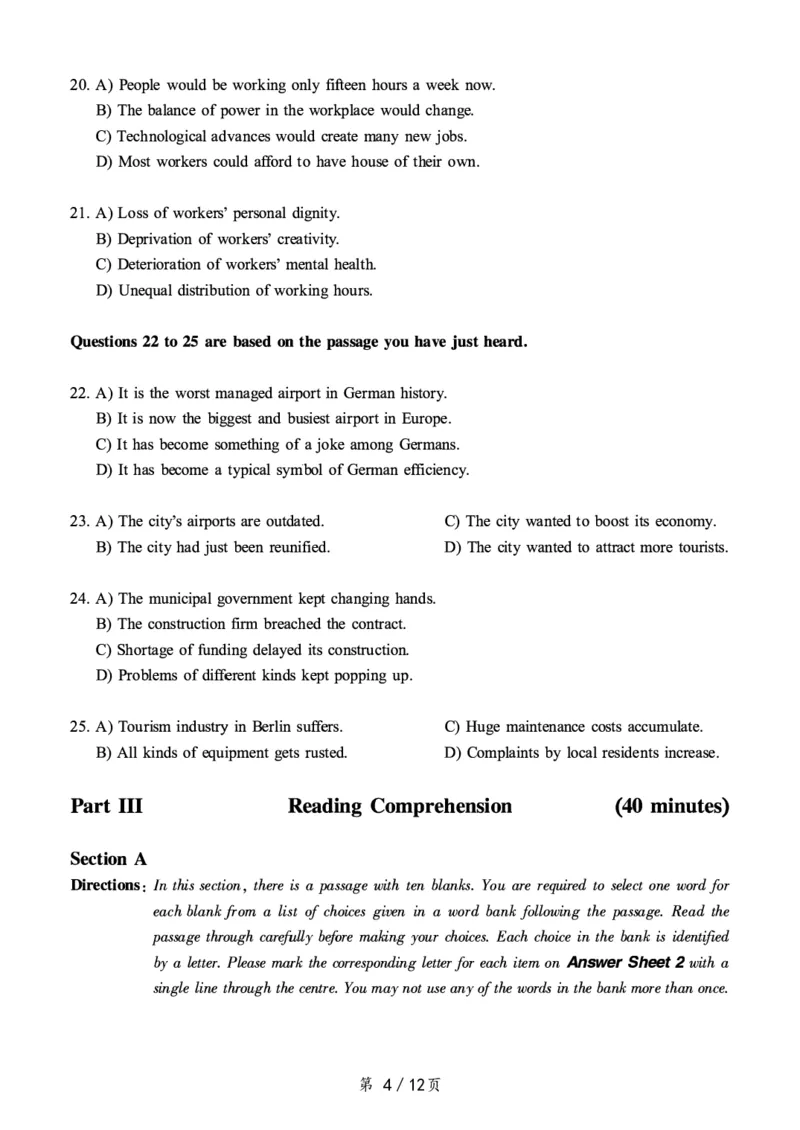
第 3/12页Questions 22 to 25 are based on the recording you have just heard.
Questions 22 to 25 are based on the recording you have just heard.
222.2A.)A T)h Te hree lrealtaitoionn bbeettwweeene nh haiarir aanndd sskkiinn.. CC) )T Theh ec ocloolorr ooff hhuummaann sskkiinn..
BB) )ThTeh eg rgrowoinwgi nign tienrteesrets ti nin s skkinin ssttududiieess.. DD) )ThTeh en eneede do fo fs ksiknin p proroteteccttiioonn..
223.3A.)A T) hTe hnee cneescseisstiyty t too ssaavvee eenneerrggyy.. C)C )ThTeh en eneede dt ot ob rbereaatthhee wwitithh eeaassee..
BB) )AdAadpatpattaitoionn t too tthhee hhoott eennvviirroonnmmeenntt.. DD) )DrDarmamatiacti cc lcilimmataete cchhaannggeess oonn eeaarthrth..
242.4 .AA) )L Leaevaevse s aanndd ggrarassss.. C)C )T hTehieri rs kskinin ccoolloorriinngg..
B)B )MaMnan-m-amdea dse hsehletlteerr.. D)D H)aHira iro no nt htheierir sskkiinn..
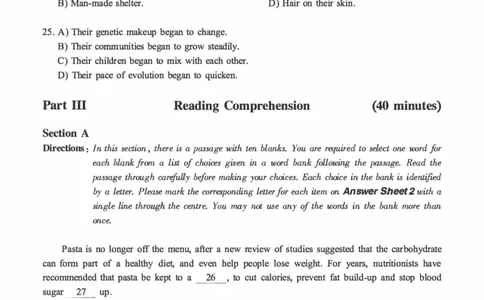
225.5 .AA) ) TThehierir ggeenneettiicc mmaakkeeuupp bbeeggaann ttoo cchhaannggee..
BB)T)heTihre icr ocmommmunituineitsi ebs ebgeagna nt ot og rgorwo ws tsetaeaddililyy..
C)C )ThTehieri rc hcihlilddrreenn bbeeggaann ttoo mmiixx wwitithh eeaacchh ootthheerr..
D)D )T hTheieri rp apcaec eo fo fe evvooluluttiioonn bbeeggaann ttoo ququiicckkeenn..
Part II
Reading Comprehension (40 minutes)
Part III Reading Comprehension ( 40 minutes)
Section A
Section A
Directions:In this section, there isa passage with ten blanks. You are required to select one word for
Directions: In this section, there is a passage with ten blanks. You are required to select one word for
each blank from a list of choices given in a word bank following the passage.Read the
each blank from a list of choices given in a word bank followi the passage. Read the
ng
passage through carefuly before making your choices. Each choice in the bank is identified
passage through carefully before making your choices. Each choice in the bank is identified
by aletter. Please mark the corresponding letterfor each item on Answer Sheet 2 with a
by a letter. Please mark the corresponding letter for each item on Answer Sheet 2 with a
single line through the centre.You may not use any of the words in the bank more than
onsicnegl.e line through the centre. You may not use any of the words in the bank more than
once.
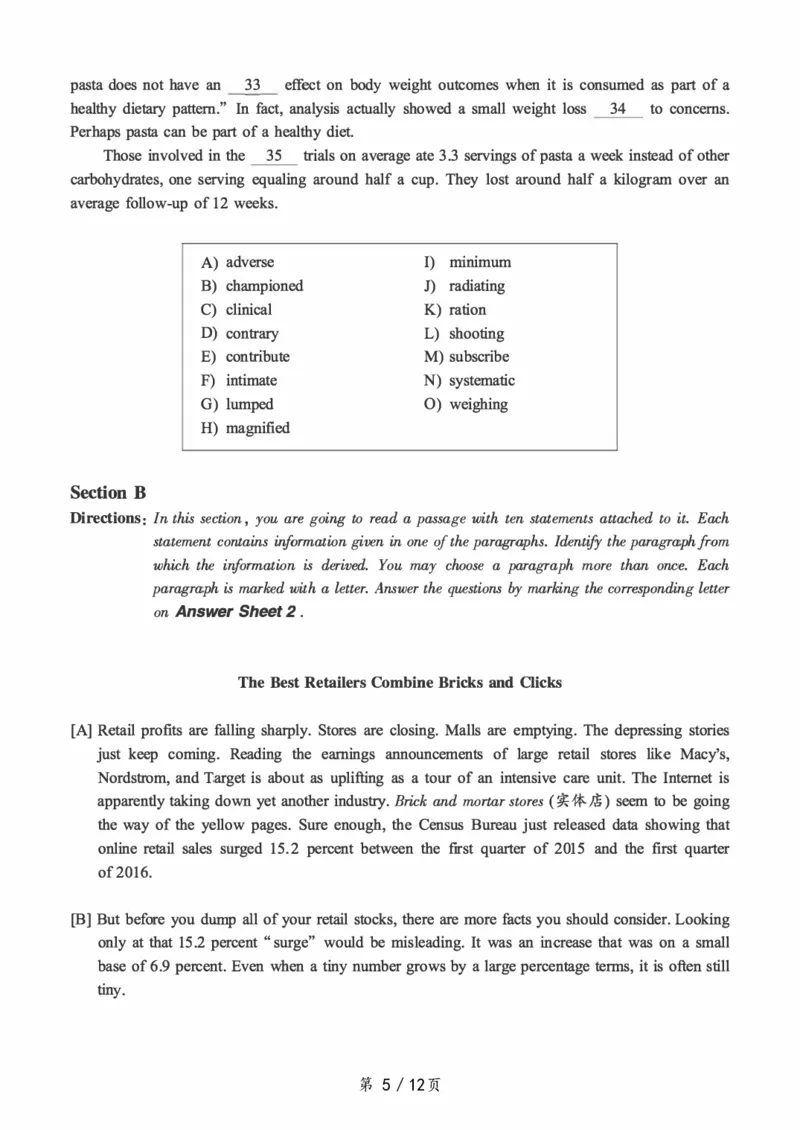
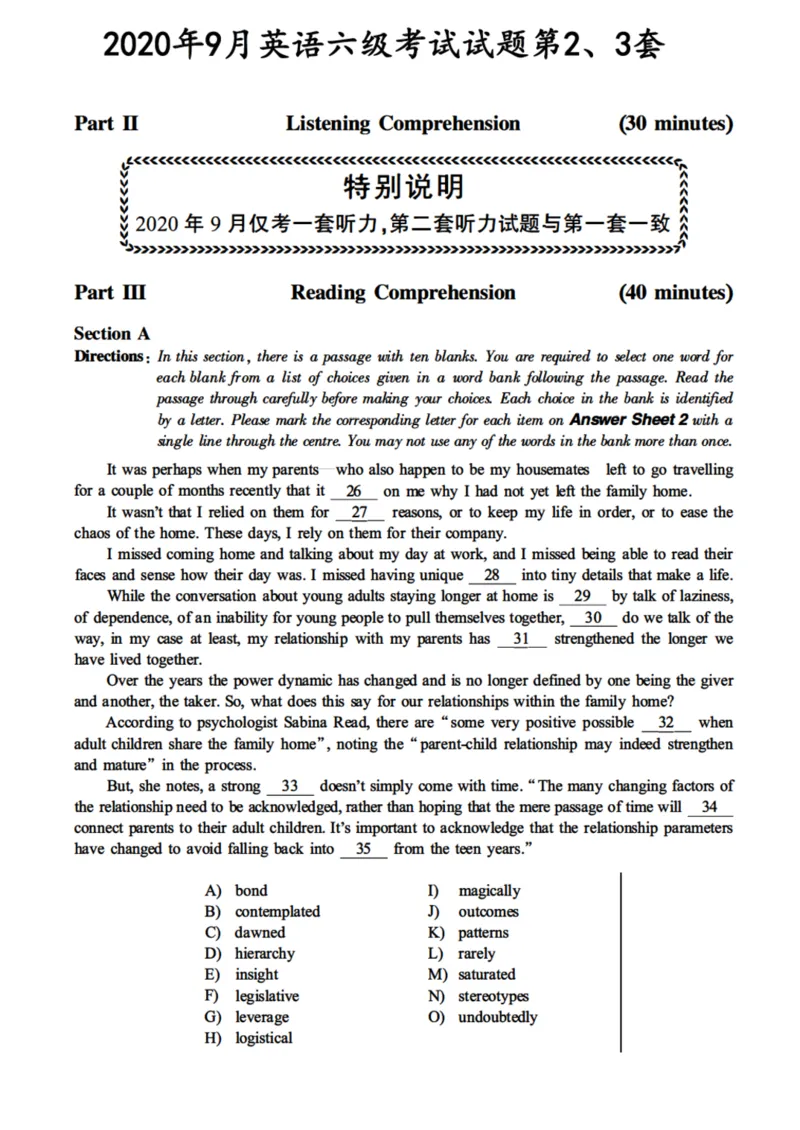
Pasta is no longer off the menu, after a new review of studies suggested that the carbohydrate
Pasta is no longer off the menu, after a new review of studies suggested that the carbohydrate
can form part of a healthy diet, and even help people lose weight. For years, nutritionists have
can form part of a healthy diet, and even help people lose weight. For years, nutritionists have
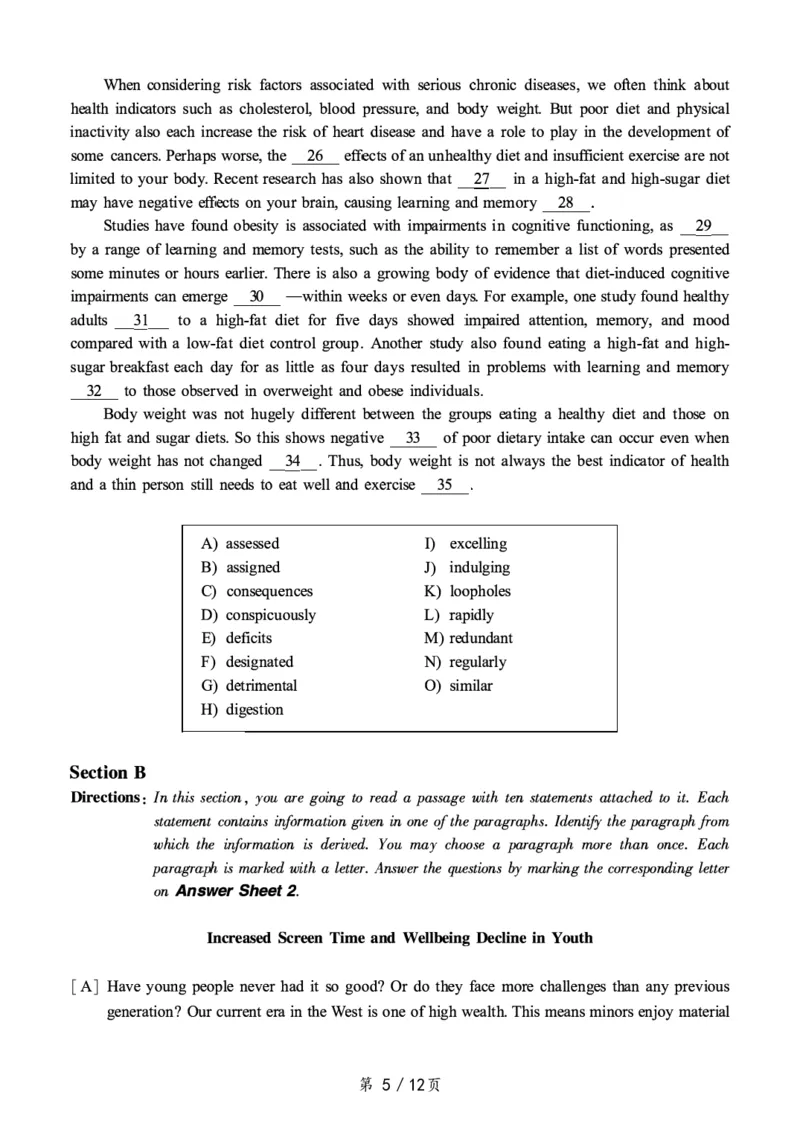
recommended that pasta be kept to a 26 , to cut calories, prevent fat build-up and stop blood
recommended that pasta be kept to a 26 , to cut calories, prevent fat build-up and stop blood
sugar 27_up.
sugar � up.
The low-carbohydrate food movement gave birth to such diets as the Atkins, Paleo and Keto,
The low-carbohydrate food movement gave birth to such diets as the Atkins, Paleo and Keto,
which advised swapping foods like bread, pasta and potatoes for vegetables, fish and meat. More
which advised swapping foods like bread, pasta and potatoes for vegetables, fish and meat. More
recently the trend of swapping spaghetti for vegetables has been 28 by clean-eating experts.
recently the trend of swapping spaghetti for vegetables has been 28 by clean-eating experts.
But now a 29 review and analysis of 30 studies by Canadian researchers found that not
But now a 29 review and analysis of 30 studies by Canadian researchers found that not
only does pasta not cause weight gain, but three meals a week can help people drop more than half a
only does pasta not cause weight gain, but three meals a week can help people drop more than half a
kiklilooggrraamm o voevre rf ofuoru r mmonotnhths.s . TTheh er erveiveiewweresr sf ofouundn dt hthatat ppaassttaa hhaadd bbeeeenn uunnffaaiirrllyy d d e e m mo o n n i iz z e e d d ((*妖魔ht化1t.))
because it had been 30 in with other, more fat-promoting carbohydrates.
because it had been 30 in with other, more fat-promoting carbohydrates.
"The study found that pasta didnt 31 to weight gain or increase in body fat,"said lead
"T he study found that pasta didn't 31 to weight gain or increase in body fat," said lead
author Dr John Sievenpiper."In 32 the evidence, we can now say with some confidence that
author Dr John Sievenpiper. "In 32 the evidence, we can now say with some confidence that
淘宝店铺∶ 光速考研工作室
第 4/ 12页
第 4/12页pasta does not have an 33 effect on body weight outcomes when it is consumed as part of a
pasta does not have an 33 effect on body weight outcomes when it is consumed as part of a
healthy dietary pattern."In fact, analysis actually showed a small weight loss 34 to concerns.
healthy dietary pattern." In fact, analysis actually showed a small weight loss 34 to concerns.
Perhaps pasta can be part of a healthy diet.
Perhaps pasta can be part of a healthy diet.
Those involved in the 35 trials on average ate 3.3 servings of pasta a week instead of other
Those involved in the 35 trials on average ate 3.3 servings of pasta a week instead of other
carbohydrates,one serving equaling around half a cup.They lost around half a kilogram over an
carbohydrates, one serving equaling around half a cup. They lost around half a kilogram over an
average follow-up of 12 weeks.
average follow-up of 12 weeks.
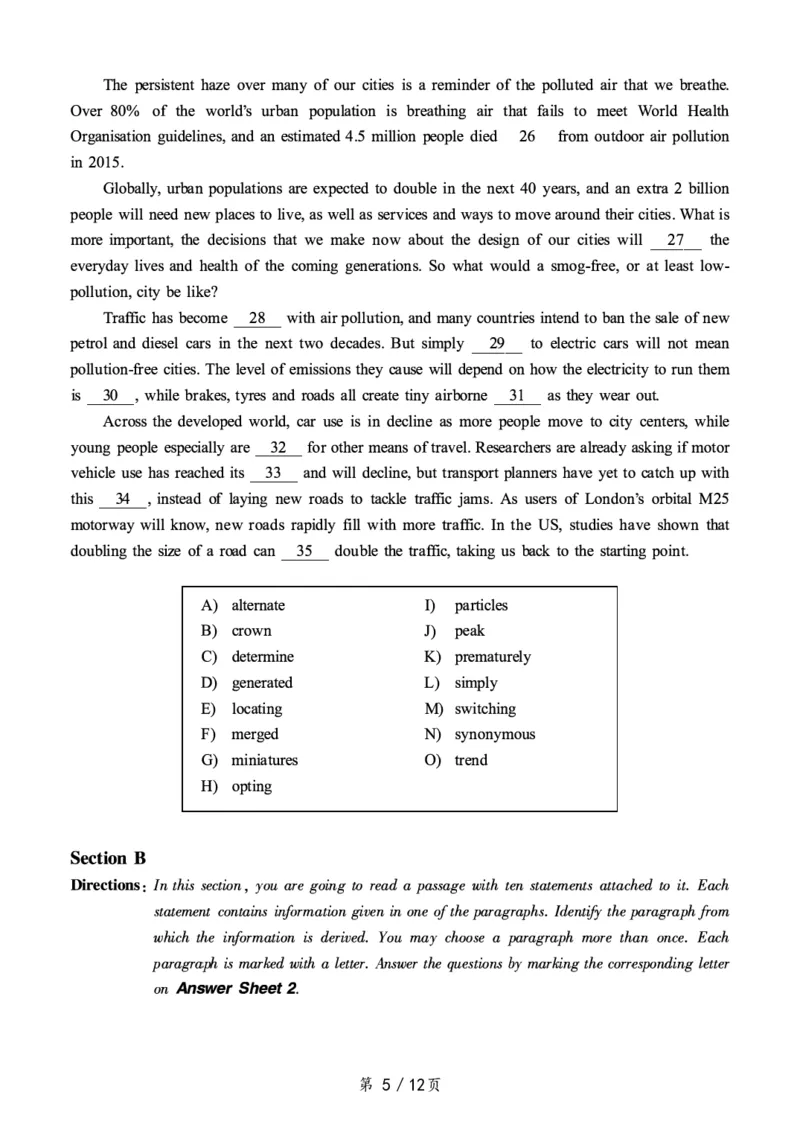
A) A ) a a d d v v e e r rs s e e I)I) mmiinniimmumum
B) championed J) radiating
B) championed J) radiating
Celinical
K) ration
C) clinical K) ration
D) contrary L) shooting
D) contrary L) shooting
E) contibute M) subscribe
E) contribute M) subscribe
F)intimate N) systematic
GFl)u i m nt p im e at d e O N w ) e s i y g st h em i a n ti g c
G) lumped 0) weighing
H) magified
H) magnified
Section B
Section B
Directions:In this section,you are going to read a passage with ten statements attached to it. Each
Directions : In this section , you are going to read a passage with ten statements auached to it. Each
statement contains information given in one of the paragraphs. Identify the paragraph from
statement contains information given in one of the paragraphs. Identify the paragraph from
which the information is derived. You may choose a paragraph more than once Each
whu:h the information is derived. You may choose a paragraph more than once. Each
paragraph is marked with a letter.Answer the questions by marking the corresponding letter
paragraph is marked with a letter. Answer the questions by marking the corresponding letter
on, Answer Sheet 2.
on Answer Sheet 2 .
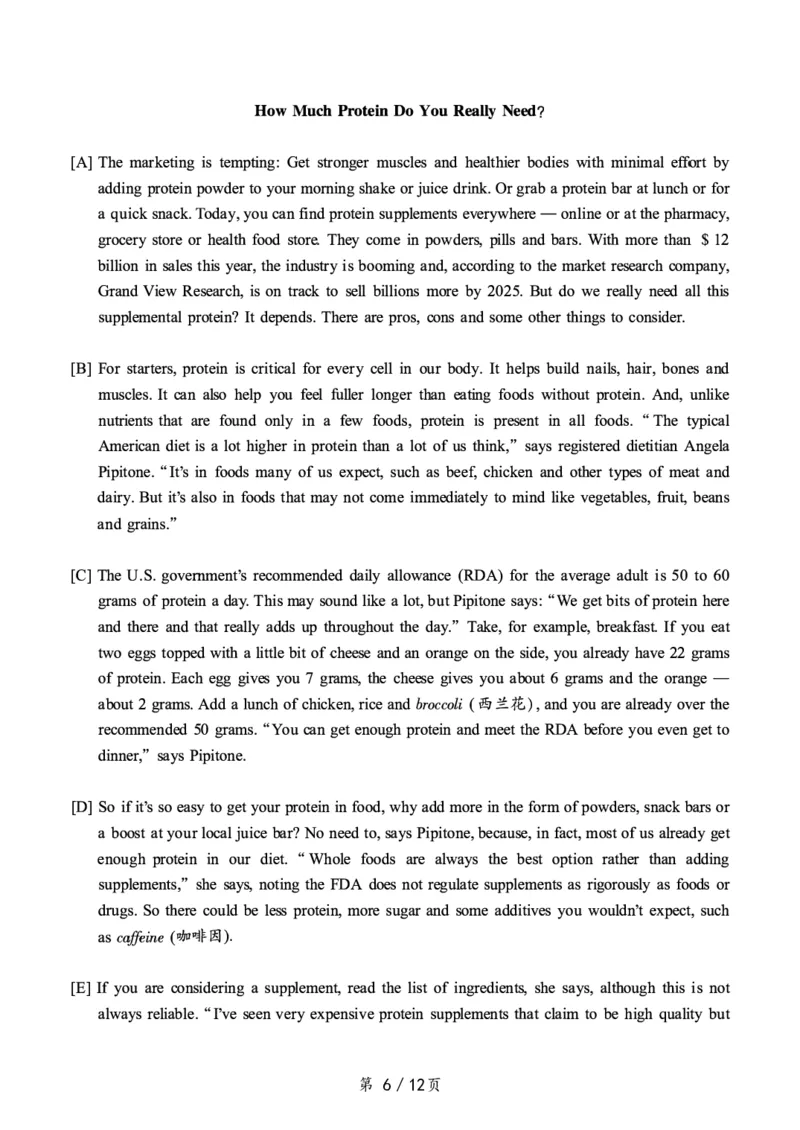
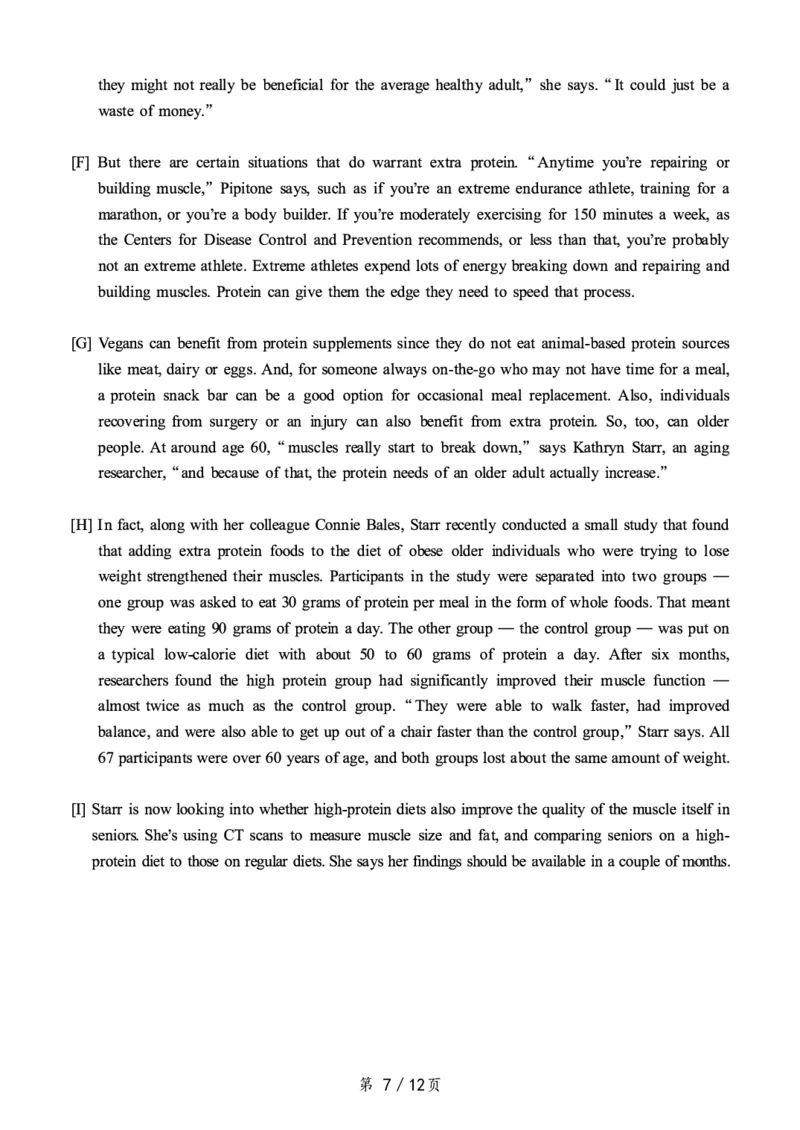
The Best Retailers Combine Bricks and Clicks
The Best Retailers Combine Bricks and Clicks
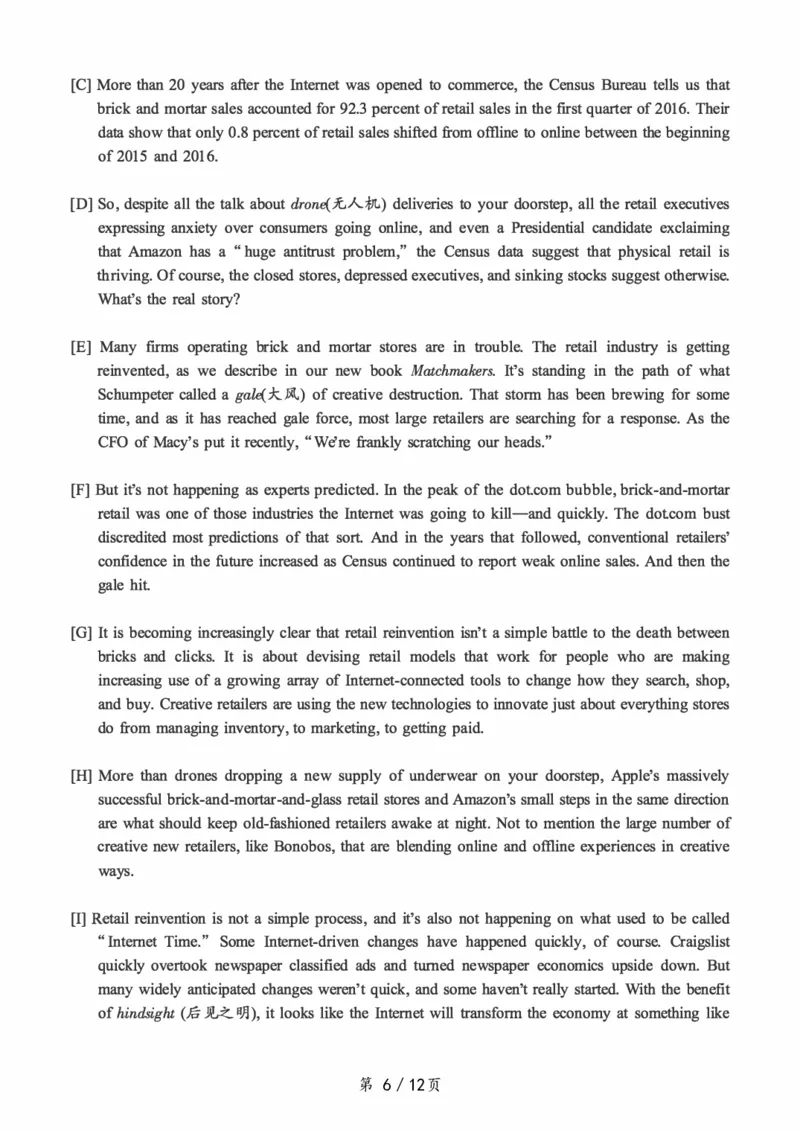
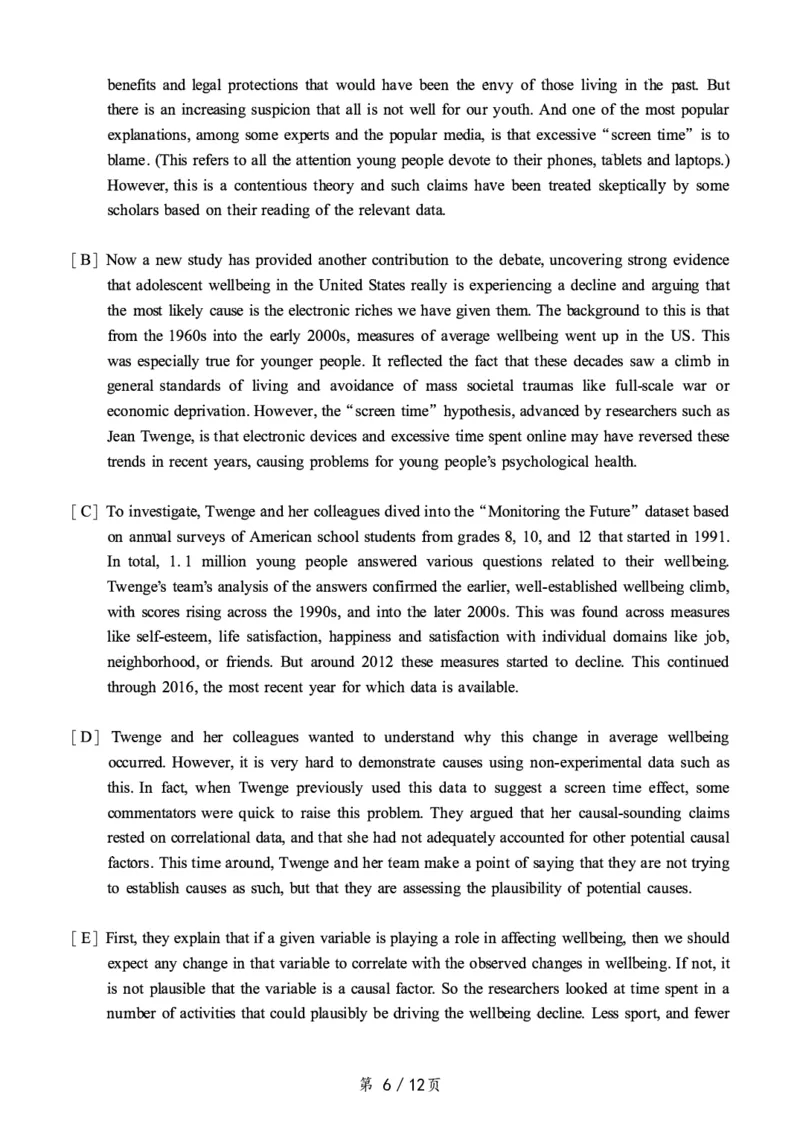
[A[]A ]ReRtaeitali lp prorofifittss aarree ffaallllinigng sshharparplyly. .SSttoorreess araree cclloossiningg. .M Maallllss araree eemmppttyyiinngg.. TThhee ddeeppreressssiinngg ssttoorriieess
jujusstt kkeeeepp ccoomminign.g . ReRaedaidnign gt hthe ee aemarninginsg sa nnanounnocuenmceenmtsen otsf olfa rlgare gree traeitali l stsotorreess lliikkee MMaaccyy''ss,,
Nordstrom, and Target is about as uplifting as a tour of an intensive care unit. The Internet is
Nordstrom, and Target is about as uplifting as a tour of an intensive care unit. The Internet is
apappaprarenetnltyly ttaakkiinngg ddoowwn ny eyte t aannooththeerr iinndduussttryry.. B B r r i u: c k k a a n nd d m m o o r rt ta a r r s s t t o o re re s s((�实#-.体/.t店)) sseeeemm ttoo bbee ggooiinngg
ththee wwaya yo fo ft hthee yyeellllooww p apgaegse.s . SSuurere eennoouguhg,h ,t hthee CCenesnussu sB uBrueraeua uj ujsuts t rreelleeaasseedd ddaattaa sshhoowwiinngg tthhaatt
online retail sales surged 15.2 percent between the frst quarter of 2015 and the first quarter
online retail sales surged 15.2 percent between the first quarter of 2015 and the first quarter
of 2016.
of 2016.
[B[B] ]BButu tb ebfeoforere yyoou ud udmump apl la llo fo fy oyuoru rr erteataiill ssttoocckkss,, ththeerree araree m moorree ffaacctst sy oyuou s hsohouuldld c oconnssidiedre.r L.Looookkiinngg
only at that 15.2 percent"surge"would be misleading. It was an increase that was on a small
only at that 15.2 percent "surge" would be misleading. It was an increase that was on a small
base of 6.9 percent. Even when a tiny number grows by a large percentage terms, it is often still
base of 6.9 percent. Even when a tiny number grows by a large percentage terms, it is often still
tiny
tiny.
淘宝店铺∶光速考研工作室
第5/12页
第 5/12页[C[C] ]MMoroe ret hthanan 2 02 0y eyaerars sa fatfteerr tthhee IInntteernrneet tw waass ooppeenneedd ttoo ccoommmmerercec,e , tthhee CCenesnussu sB uBrueraeua ut etlelllss uuss tthhaatt
brick and mortar sales accounted for 92.3 percent of retail sales in the first quarter of 2016. Their
brick and mortar sales accounted for 92.3 percent ofretail sales in the first quarter of 2016. Their
data show that only 0.8 percent of retail sales shifted from offline to online between the beginning
data show that only 0.8 percent of retail sales shifted from oflline to online between the beginning
of 2015 and 2016.
of 2015 and 2016.
【[DD】] SSoo,, ddeessppiitte a allll tthhee ttaallkk aabboouutt d
dro
ron
n
d(
e(
无
Jt,
人
A.
机
:f}t.
)
)
ddeleilivveerriieess ttoo yyoourur d odoorostrsetpe,p, aallll ththee rreetataiill eexxeeccuuttiivveess
expressing anxiety over consumers going online, and even a Presidential candidate exclaiming
expressing anxiety over consumers going online, and even a Presidential candidate exclaiming
that Amazon has a"huge antitrust problem,"the Census data suggest that physical retail is
that Amazon has a "huge antitrust problem," the Census data suggest that physical retail is
thriving. Of course, the closed stores, depressed executives,and sinking stocks suggest otherwise.
thriving. Of course, the closed stores, depressed executives, and sinking stocks suggest otherwise.
What's the real story?
What's the real story?
[E[E] ]MaMnyan fyi rfimsrm osp eorpaetriantgin bgr ibcrkic kan da nmdo rmtaorr tarst orsteosr easr ear ien itnr otruoblueb.l eT. hTe hree traeitali li nindudsutsrtryy iiss ggeettttiinngg
reinvented, as we describe in our new book Matchmakers.It's standing in the path of what
reinvented, as we describe in our new book Matchmakers. It's standing in the path of what
ScShcuhmupmetpeert ecra clallelde da ag aglaek((:k.大风JJJ...)) ooff ccrreeaattiivvee ddeesstrutrucctitoino.n .T hTahta ts tosrmtor mh ahsa sb ebeene nb rberwewiinngg foforr sosommee
ti
ti
m
m
e,
e ,
a
an
nd
d
a s
a s
i t
it
h
h
a
a
s
s
r
r
e
e
a
a
c
c
h
h
e
e
d
d
g a
g
l
a
e
l e
f o
f
rcorc e,
e ,
m
m
os
o
t
s t
l a
lar
rg
g
e
e
r
r
e
e
t
t
a
a
i
i
l
le
e
r
r
s
s
ar
ar
e
e
s
s
e
e
ar
ar
c
c
h
h
i
i
n
n
g
g
fo
fo
r
r
a
a
r
r
e
e
s
s
p
p
o
o
n
n
s
s
e
e
.
.
A
A
s
s
th
th
e
e
CFO of Macy's put it recently,"We're frankly scratching our heads."
CFO of Macy's put it recently, "We're frankly scratching our heads."
[F[]F ]BButu ti 'its's nnoott hhaappppeenniningg aass eexxpperetrtss pprreeddiicctteedd.. IInn tthhee ppeeakak ooff ththee ddoott..ccoornm bbuubbbbllee,, bbrriicckk--anandd--mmoorrttarar
retail was one of those industries the Internet was going to kill—and quickly. The dotcom bust
retail was one of those industries the Internet was going to kill-and quickly. The dot.corn bust
didsisccrreeddiitteedd mmosots t pprereddicicttiioonnss ooff tthhaatt ssoorrtt. AAndn di ni nt hthe ey eyaerars st hthata tf ofolllolowwede,d ,c ocnovnenvteinotnioaln arl etreatiailelerrss''
confidence in the future increased as Census continued to report weak online sales. And then the
confidence in the future increased as Census continued to report weak online sales. And then the
gale hit
gale hit.
[G[G] ]ItI t iiss bbeeccoomminign gi nicrnceraesaisnignlgyl yc lcelaerar t hthata t rreettaaiill rreeiinnvveennttiioonn iissnn''t ta as ismimppllee b baatttltel et ot oth teh ed edaethat hb ebtewtweeeenn
br
b
i
r
c
ic
k
k
s
s
a
an
nd
d
c
c
l
l
i
i
c
c
k
k
s
s
.
. I
I
t
t
is
i s
a
a
b
b
o
o
u
u
t
t
d
d
e
e
v
v
is
i
i
s
n
i
g
n g
r e
r
ta
et
il
a i
m
l
o
m
d
o
e
d
ls
e ls
th a
t
t
h a
w
t
o
w
rk
or k
f
for or
p e
p
o
e
p
o
le
p le
w h
w
o
ho
ar
a
e
r e
m
m
ak
ak
i
i
n
n
g
g
increasing use of a growing array of Internet-connected tools to change how they search,shop,
increasing use of a growing array of Internet-connected tools to change how they search, shop,
and buy. Creative retailers are using the new technologies to innovate just about everything stores
and buy. Creative retailers are using the new technologies to innovate just about everything stores
dod of rfroom mm amnaangianggi nign viennvteonrtyo,r yt,o t om amrkaretkientgin,g t, ot og egtetttiinngg ppaaiidd..
[H[H] ]MMoroer et hthanan d rdronoense sd rdropoppipning ga an enwe ws uspupplpyl yo fo fu nundedrewrewaerar o no ny oyuorur d odoorsotrsetpe,p , AAppplpel'es's mmasasssiivveellyy
successful brick-and-mortar-and-glass retail stores and Amazon's small steps in the same direction
successful brick-and-mortar-and-glass retail stores and Amazon's small steps in the same direction
are what should keep old-fashioned retailers awake at night. Not to mention the large number of
aer what should keep old-fashioned retailers awake at night. Not to mention the large number of
creative new retailers, like Bonobos, that are blending online and offline experiences in creative
creative new retailers, like Bonobos, that are blending online and oflline experiences in creative
ways.
ways.
[][I ]ReRteatiail l rreeiinnvveennttiioonn iiss nnoott aa ssiimmppllee pprroocceessss,, anandd iitt's' sa laslos on onto th ahpappepneninigng oonn wwhhaatt uusseedd ttoo bbee ccaalllleedd
"I"nItneterrnneett TTiime.em "."S omSeo mIen teInrnteert-endt-rdirvievne nc hcahnangegse sh ahvaev hea phpaepnpeedn eqdu iqcuklicyk,l yo,f ocfo ucrosuer.se .C rCairagisglsilisstt
quqiucickkllyy oovveerrttooookk nneewwssppaappeerr ccllaassssiififeide da dasd sa nadn dt urntureedd nneewwssppaappeerr eeccoonnoommiiccss uuppssiiddee ddoowwnn.. BBuutt
many widely anticipated changes weren't quick,and some haven't really started. With the benefit
many widely anticipated changes weren't quick, and some haven't really started. With the benefit
ofo fh ihnidnsdsigighth t ((Jg后 见Jt之.t明 aJJ) ),, iitt loloookkss lilkiek eth teh eI nItnernterent ewt iwlli ltrl antrsafonsrmfo rthm et heec oecnoonmomyy aatt ssoommeetthhiinngg lliikkee
淘宝店铺∶ 光速考研工作室
第6/12页
第 6/12页the pace of other great inventions like electricity. B2B commerce, for example, didn't move
the pace of other great inventions like electricity. B2B commerce, for example, didn't move
mainly online by 2005 as many had predicted in 2000,nor even by 2016, but that doesn't mean it
mainly online by 2005 as many had predicted in 2000, nor even by 2016, but that doesn't mean it
wowno'nt' td do os oso o ovvere r tthhee nneexxtt fefeww ddeeccaaddeess..
[J[J]] BButu t tthhee ggalaele iiss ssttiillll b blolowwiinngg.. TThhee ssuuddddeenn d edcelcilninee inin ffoooot t ttrraaffifficc iinn rreecceenntt yyeeararss,, eevveenn ththoouughgh iitt
hasn't been accompanied by a massive decline in physical sales, is a critical warning. People can
hasn't been accompanied by a massive decline in physical sales, is a critical warning. People can
shop more efficiently online and therefore don't need to go to as many stores to find what they
shop more efficiently online and therefore don't need to go to as many stores to find what they
want. There's a surplus of physical shopping space for the crowds, which is one reason why
want. There's a surplus of physical shopping space for the crowds, which is one reason why
stsotorreess aarree ddoowwnnsisizziinngg aanndd cclloossiinngg..
[K[K] ]ThTeh eri rsies eo fo ft thhee mmoboibliel ep hpohnoen eh ahsa sr erceecnetnltyl ya daddedde da an enwe wle vleelv eol fo fc ocmopmplexlietxyi tyto tot hthe ep rporcoecsess so fo fr erettaaiill
reinvention. Even five years ago most people faced a choice. Sit at your computer, probably at
reinvention. Even five years ago most people faced a choice. Sit at your computer, probably at
home or at the office,search and browse,and buy.Or head out to the mall, or Main Stet,look
home or at the office, search and browse, and buy. Or head out to the mall, or Main Street, look
aannd ds hsohpo,p ,a annd db buyu.y . NNowo,wju, sjtu sat baobuoutt e veevreyroynoen hea hs aas as msamrtartpphohnoe,n ec, ocnonnecnteecdte dt ot ot hthe eI Internnterneett aallmmoosstt
everywhere almost all the time. Even when a retailer gets a customer to walk in the store, she can
everywhere almost all the time. Even when a retailer gets a customer to walk in the store, she can
eaesaisliyly sseeee i fif tthheerree''ss aa bbeetttteerr ddeeaall oonnlliinnee oorr aatt ananootthheerr ssttoorree nneeararbbyy..
[L] So far, the main thing many large retailers have done in response to all this is to open online
[L] So far, the main thing many large retailers have done in response to all this is to open online
stores, so people will come to them directly rather than to Amazon and its smaller online rivals.
stores, so people will come to them directly rather than to Amazon and its smaller online rivals.
Many are having the same problem that newspapers have had.Even if they get online traffic, they
Many are having the same problem that newspapers have had. Even if they get online traffic, they
stsrtruuggggllee ttoo mmaakeke eennoouguhg hm omneoyn eoyn loinnlei nteo toc ocmopmpenseantesa tfeo rfo wrh wath atth ethye yar are el olsoisningg o offfllliinnee..
[M]A few seem to be making this work. Among large traditional retailers,Walmart recently reported
[M] A few seem to be making this work. Among large traditional retailers,Walmart recently reported
the best results,leading its stock price to surge,while Macy's, Target,and Nordstrom's dropped.
the best results, leading its stock price to surge, while Macy's, Target, and Nordstrom's dropped.
YeYte tW aWlmalarmt'arts 'yse yare-arov-oerv-eyre-ayre aron loinnlein sea lsaesle so nolnyl yg rgerwe w7 p7e rpceerncte,nt ,l leeaaddiinngg iittss CCEEOO t ot ol alamementn(t哀(�叹�),),
"Growth here is too slow."Part of the problem is that almost two decades after Amazon filed the
"Growth here is too slow." Part of the problem is that almost two decades afler Amazon filed the
one-click patent, the online retail shopping and buying experience is filled with frictions.A recent
one-click patent, the online retail shopping and buying experience is filled with frictions. A recent
st
s
u
tu
d
d
y
y
g r
g
a
r
d
a
e
d
d
e d
m o
m
r
o
e
re
t h
th
an
an
6 0
6
0
0 0
I n
I
t
n
e
t
r
e
n
rn
et
e t
r
r
e
e
t
t
a
a
i
il
l
e
e
r
r
s
s
o n
on
h o
ho
w
w
e
e
a
a
s
s
y
y
i
i
t
t
w
w
a
a
s
s
f
for o r
c o
c
n
o
s
n
um
sum
e
e
r
r
s
s
to
t o
s h
s
o
h
p
op
,
,
b
b
u
u
y
y
,
,
an
an
d
d
pay.Almost half of the sites didn't get a passing grade and only 18 percent got an A or B.
pay. Almost half of the sites didn't get a passing grade and only 18 percent got an A or B.
[N[N] ]ThTeh teu trurmmoilo ioln o tnh eth eg rgoruondu nidn ipnh ypshiycsailc arle rteatiali l iiss hhaarrdd ttoo ssqquuaarree wwiitthh ththee CCeennssuuss ddaattaa.. UnUnffoorrttununaatteellyy,,
part of the explanation is that the Census retail data are unreliable. Our deep look into those data
part of the explanation is that the Census retail data are unreliable. Our deep look into those data
and their preparation revealed serious problems.It seems likely that Census simply misclassifies a
and their preparation revealed serious problems. It seems likely that Census simply misclassifies a
large chunk of online sales. It is certain that the Census procedures, which lump the online sales
large chunk of online sales. It is certain that the Census procedures, which lump the online sales
ofo fm amjaojro rt rtraaddititiioonnaall rreettaaiilelresr sl ilkiek We Waalmlmartart i ni nw withit h""nnoonn--ssttoorree rreettaaiilelresr"s "lliikkee fofooodd trutrucckkss, ,c ancan m maasskk
mamjoarjo rc hcahnangesg eisn inin idnidviivdiudaula lr erteataiill ccaatteeggoorriieess.. TThhee bburureeaauu ccoouulldd eeaassiillyy pprreesseenntt ththeeiirr ddaatat ai ni nm moorree
usuesfeuful l wwayasy,s , bbuutt tthheeyy hhaavvee cchhoosseenn nnoott ttoo..
[O[O] ]DeDsepsiptiete tthhee ttuurmrmooilil,, bbrriicckk anandd mmoorrttarar wwoonn''tt ddiissapapppeearar ananyy ttiimmee ssoooonn.. TThhee bbiigg qquueessttiioonnss aarree
which, if any, of the large traditional retailers will till be on the scene in a decade or two because
which, if any, of the large traditional retailers will still be on the scene in a decade or two because
淘宝店铺∶光速考研工作室
第7/12页
第 7/12页they have successfully reinvented themselves, which new players will operate busy stores on
they have successfully reinvented themselves, which new players will operate busy stores on
Main Streets and maybe even in shopping malls, and how the shopping and buying experience
Main Streets and maybe even in shopping malls, and how the shopping and buying experience
will have changed in each retail category. Investors shouldn't write off brick and mortar. Whether
will have changed in each retail category. Investors shouldn't write off brick and mortar. Whether
they should bet on the traditional players who run those stores now is another matter.
they should bet on the traditional players who run those stores now is another matter.
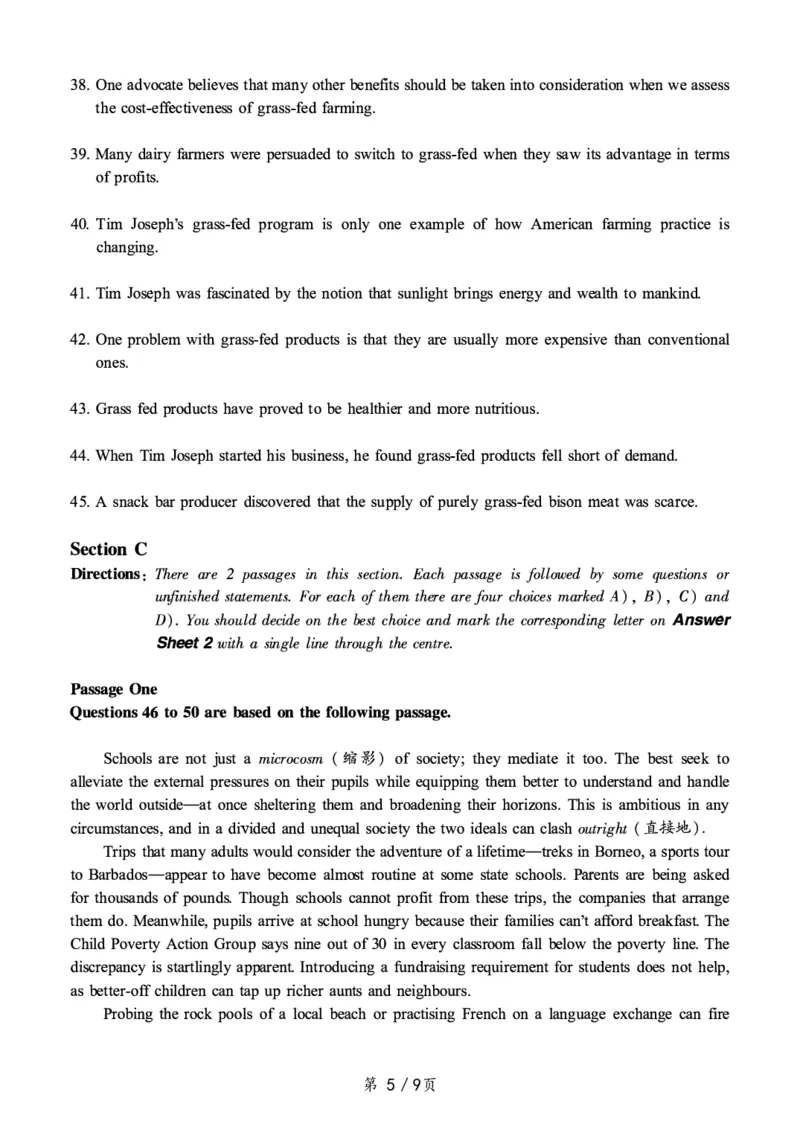
36.Although online retailing has existed for some twenty years, nearly half of the Intemet retailers
36. Although online retailing has existed for some twenty years, nearly half of the Internet retailers
ststiillll fafaiil lt ot or erceecieviev es astaistfaiscftaocryto rfey efdebeadbcakc kfr ofrmo mc oconnssumumeerrss,, aaccccoorrddiinngg ttoo aa rreecceenntt ssurvurveeyy..
37. Innovative retailers integrate Internet technologies with conventional retailing to create new retail
37. Innovative retailers integrate Internet technologies with conventional retailing to create new retail
models.
models.
38. Despite what the Census data suggest, the value of physical retail's stocks has been dropping.
38. Despite what the Census data suggest, the value of physical retail's stocks has been dropping.
39.Internet-driven changes in the retail industry didn't take place as quickly as widely anticipated.
39. Internet-driven changes in the retail industry didn't take place as quickly as widely anticipated.
40.Statistics indicate that brick and mortar sales still made up the lion's share of the retail business.
40. Statistics indicate that brick and mortar sales still made up the lion's share of the retail business.
41.Companies that successfully combine online and offline business models may prove to be a big
41. Companies that successfully combine online and oflline business models may prove to be a big
concern for traditional retailers.
concern for traditional retailers.
442.2 .BBrircick ka nand dm omrtoarrtar r erteatialileerrss''f faaiitthh iinn ththeeiri rb ubsuisniensess sw waass s trsternegnthgtehneended w whheenn ththee ddoott..ccoornm bbuubbbblele bbuurrsstt..
43. Despite the tremendous challenges from online retailing, traditional retailing will be here to stay
43. Despite the tremendous challenges from online retailing, traditional retailing will be here to stay
for quite some time.
for quite some time.
44. With the rise of online commerce, physical retail stores are likely to suffer the same fate as the
44. With the rise of online commerce, physical retail stores are likely to suffer the same fate as the
yellow pages.
yellow pages.
45. The wide use of smartphones has made it more complex for traditional retailers to reinvent their
45. The wide use of smartphones has made it more complex for traditional retailers to reinvent their
business
business.
Section C
Section C
Directions:There are 2 passages in this section.Each passage is followed by some questions ar
Directions: There are 2 passages in this section. Each passage is followed by some questions or
un
u
f
nfi
in
n
i
is
s
h
h
e
e
d
d
s
s
ta
t
t
a
e
t
m
em
en
e
t
n
s
t
.
s
Fo
. F
r
o
e
r
a c
e
h
a c
of
h
t
o
h
f
e m
t h
t
e
h
m
e re
t h
a
e
r
r
e
e
f o
a
u
r
r
e f
c
o
h
u
o
r
ic e
c
s
h o
m
i
a
c
rk
es
e d
m a
A
r )k e, d
B
A )) ,, BC),)C )
a
a
n
n
d
d
D
D
).
)
y
.
o u
yo
s
u
h o
s
u
h
l
ou
d
ld
d e
d
ad
ec
e
i d
o
e
n
o
t
n
h e
th e
b e
b
s
e
t
s t
c
c
h
h
o
o
i
i
c
c
e
e
a
a
n
n
d
d
m
m
a
a
r
r
h
k
t
t
h
h
e
e
c
c
o
orr
rr
e
e
sp
sp
o
o
n
n
d
d
in
i
g
ng
l e
l
t
e
te
t
r
t e
o
r
n
oAnn Asnwerswer
Sheet 2 with a single line through the centre.
Sheet 2 with a single line through the centre.
淘宝店铺∶光速考研工作室
第8/12页
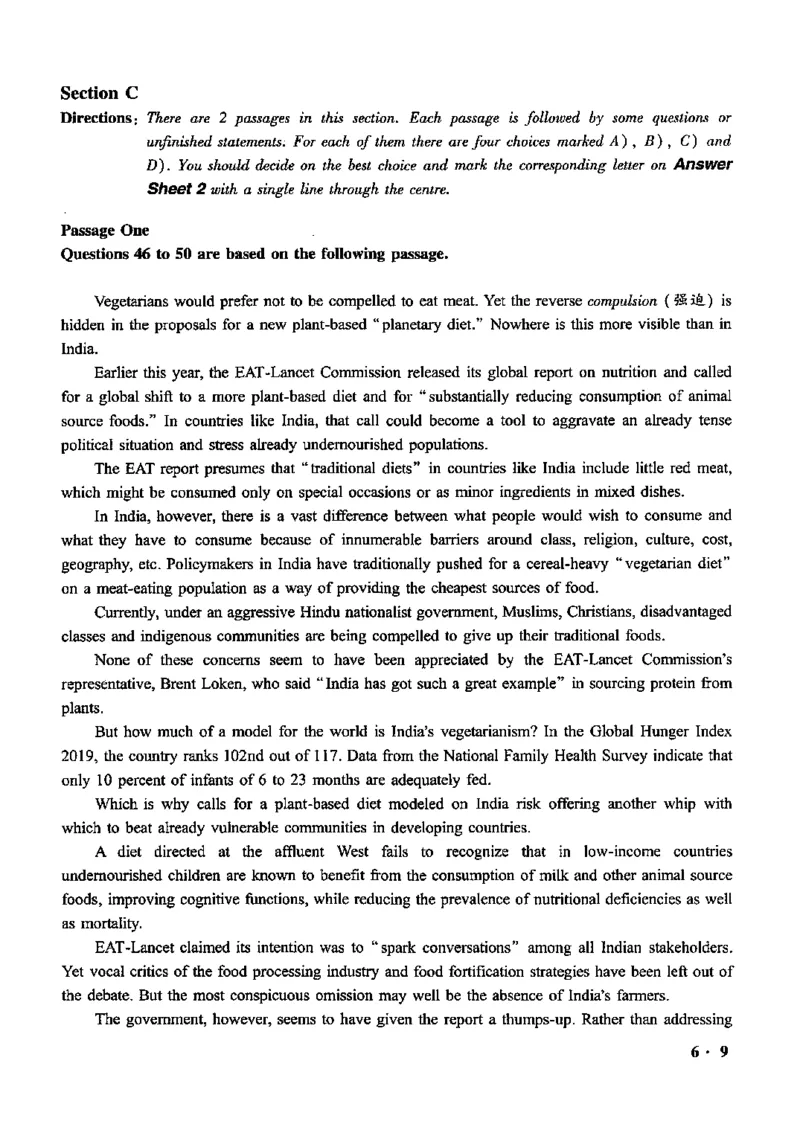
第 8/12页Passage One
Passage One
Questions 46 to 50 are based on the following passage.
Questions 46 to 50 are based on the following passage.
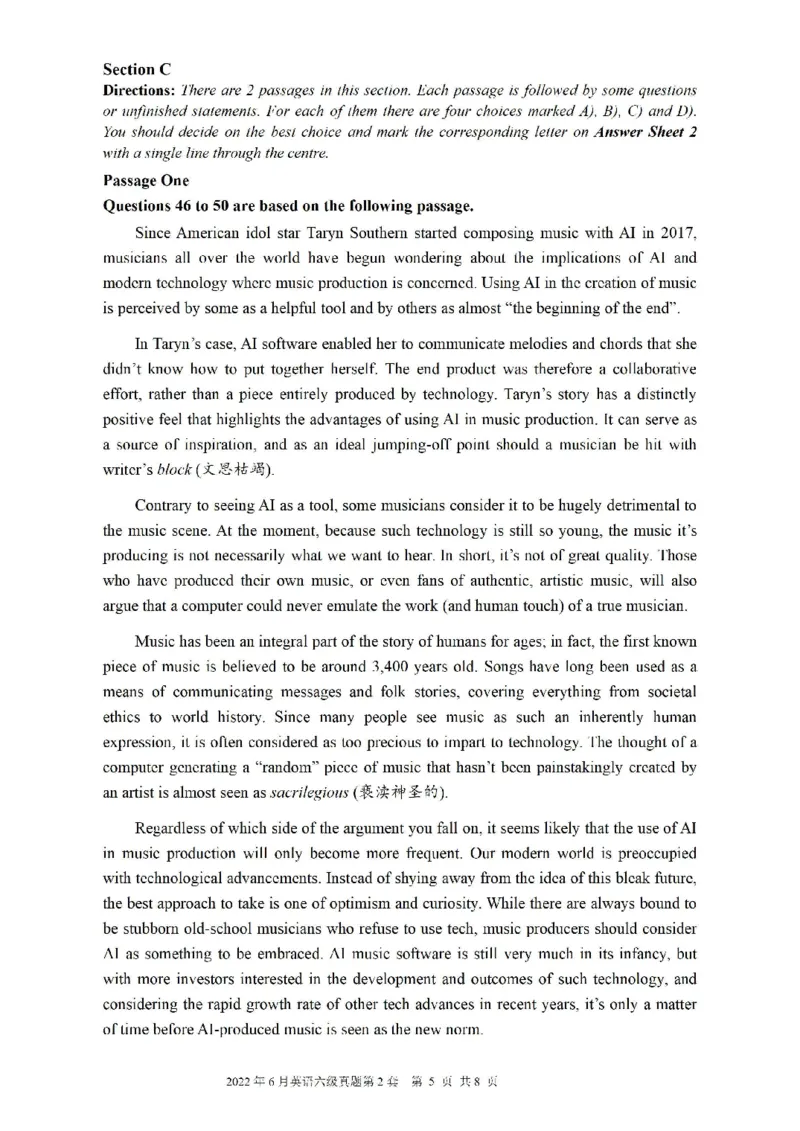
PrPorfoefesssosro r SStetepphhene nH aHwakwinkgi nhga sh awsa mwedarn theadt ththaet thcree actrieoanti oonf opofw peorfwuelr fuarlt iartfiicfiicaila l iinntteelllliiggeennccee (( AAlI))
will be"either the best, or the worst thing, ever to happen to humanity",and praised the creation of
will be "e ither the best, or the worst thing, ever to happen to humanity" , and praised the creation of
an academic institute dedicated to researching the future of intelligence as"crucial to the future of our
an academic institute dedicated to researching the future of intelligence as " crucial to the future of our
civilisation and our species".
civilisation and our species".
Hawking was speaking at the opening of the Leverhulme Centre for the Future of Intelligence
Hawking was speaking at the opening of the Leverhulme Center for the Future of Intelligence
(L(LCFCIF)aI)t aCta mCbamridbgrei dUgnei vUernsiivteyr,s itya ,m ual tmiu-dltii-sdciispcliipnlainryary in sintsittiututtee tthhaatt wwiillll attempattemptt ttoo ttaacckkllee sosommee ooff tthhee
open-ended questions raised by the rapid pace of development in AI research."We spend a great deal
open-ended questions raised by the rapid pace of development in AI research. "We spend a great deal
of time studying history,"Hawking said,"which,let's face it, is mostly the history of stupidity.So its
of time studying history," Hawking said, "which, let's face it, is mostly the history of stupidity. So it's
a welcome change that people are studying instead the future of intelligence."
a welcome change that people are studying instead the future of intelligence."
While the world-renowned physicist has often been cautious about AI, raising concerns that
While the world-renowned physicist has often been cautious about AI, raising concerns that
humanity could be the architect of its own destruction if it creates a super-intelligence with a will of
humanity could be the architect of its own destruction if it creates a super-intelligence with a will of
its own, he was also quick to highlight the positives that AI research can bring."The potential
its own, he was also quick to highlight the positives that AI research can bring. " The potential
benefits of creating intelligence are huge,"he said."We cannot predict what we might achieve when
benefits of creating intelligence are huge," he said. "We cannot predict what we might achieve when
our own minds are amplified by AI. Perhaps with the tools of this new technological revolution, we
our own minds are amplified by Al. Perhaps with the tools of this new technological revolution, we
will be able to undo some of the damage done to the natural world by the last one—industialisation.
will be able to undo some of the damage done to the natural world by the last one-industrialisation.
AnAdn sdu rsurelye lyw ew wei lwl ilal iami mto tof ifinanlallyly eerraaddiiccaattee ddiisseeaassee anandd ppoovveerrttyy.. AAndn de veevreyr ya sapsepcetc to fo fo ourur l liivveess wwiillll bbee
transformed.In short, success in creating AI could be the biggest event in the history of our
tanr sformed. In short, success in creating AI could be the biggest event in the history of our
civilisation."
civilisation."
HuHwu Pwr iPcrei,c et, hthe ec ecnetnrtre'es's aaccaaddeemmici c didrireeccttoorr aanndd tthhee BBeerrttrraanndd RRuusssseellll pprrooffeessssoorr ooff pphhiilloossoopphhyy aatt
CaCmambribdrgide gUen iUvneirvseirtsyi,ty ,w hwehree reH aHwkaiwngk inisg aisl saol soan anac aadceamdiecm, ics,a isda idt hthata tt hthee cceenntrtree ccaamme ea baobuotu tp aprarttiiaallllyy
as a result of the university's Centre for Existential Risk. That institute examined a wider range of
as a result of the university's Centre for Existential Risk. That institute examined a wider range of
potential problems for humanity, while the LCFI has a narrow focus.
potential problems for humanity, while the LCFI has a narrow focus.
AI pioneer Margaret Boden, professor of cognitive science at the University of Sussex, praised
AI pioneer Margaret Boden, professor of cognitive science at the University of Sussex, praised
the progress of such discussions.As recently as 2009, she said, the topic wasn't taken seriously,even
the progress of such discussions. As recently as 2009, she said, the topic wasn't taken seriously, even
among AI researchers."AI is hugely exciting,"she said,"but it has limitations, which present grave
among AI researchers. "AI is hugely exciting," she said,"b ut it has limitations, which present grave
dangers given uncritical use."
dangers given uncritical use."
The academic community is not alone in warmning about the potential dangers of AI as well as
The academic community is not alone in warning about the potential dangers of AI as well as
the potential benefits. A number of pioneers from the technology industry, most famously the
the potential benefits. A number of pioneers from the technology industry, most famously the
entrepreneur Elon Musk, have also expressed their concerms about the damage that a super-intelligent
entrepreneur Elon Musk, have also expressed their concerns about the damage that a super-intelligent
AI could do to humanity.
AI could do to humanity.
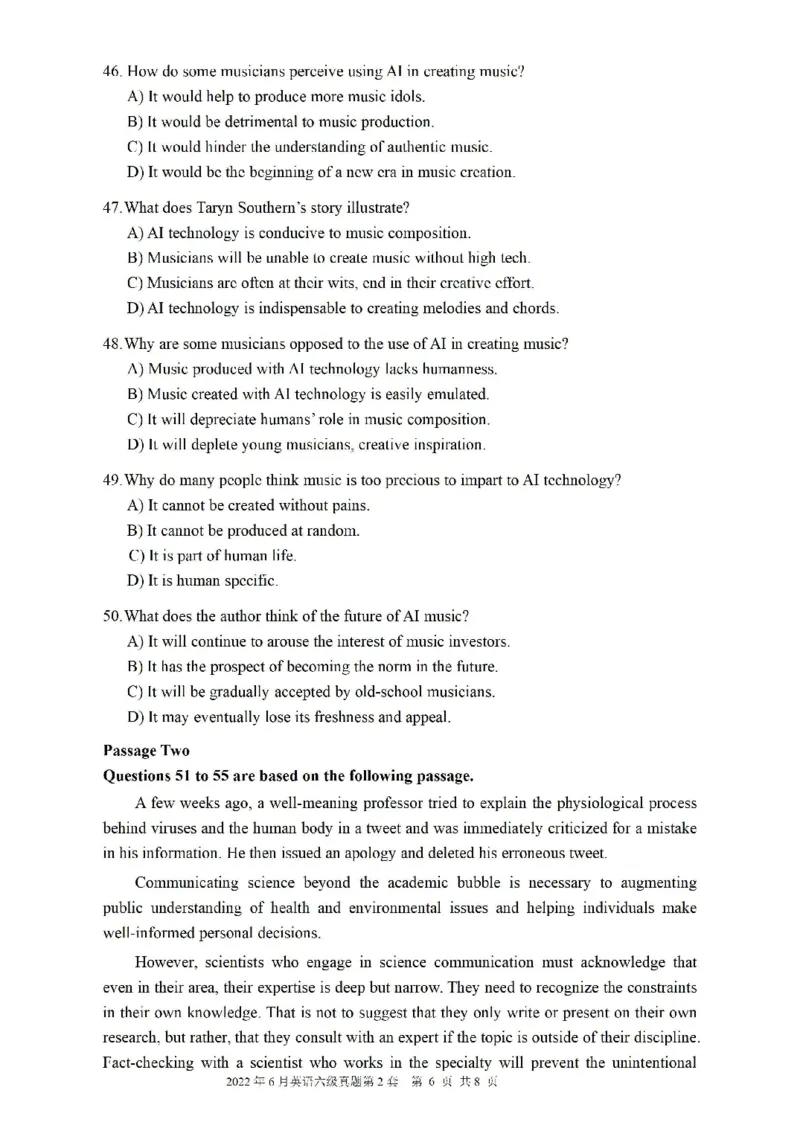
46. What did Stephen Hawking think of artificial intelligence?
46. What did Stephen Hawking think of artificial intelligence?
AA) )ItI t wwouoludl db eb ev ivtiatla l ttoo tthhee pprrooggreerssss ooff hhuummanan c icviivliilissaattiioonn..
B)B )ItI t mmigihgth tb be ea ab lbelessssiinngg oorr aa ddiissaasstteerr iinn ththee mmakakiinngg..
C)C )ItI t mmigihgth tp rperseesnetn t cchhalallleennggese s aass wwelell l aass oopppporotrutunnititiieess..
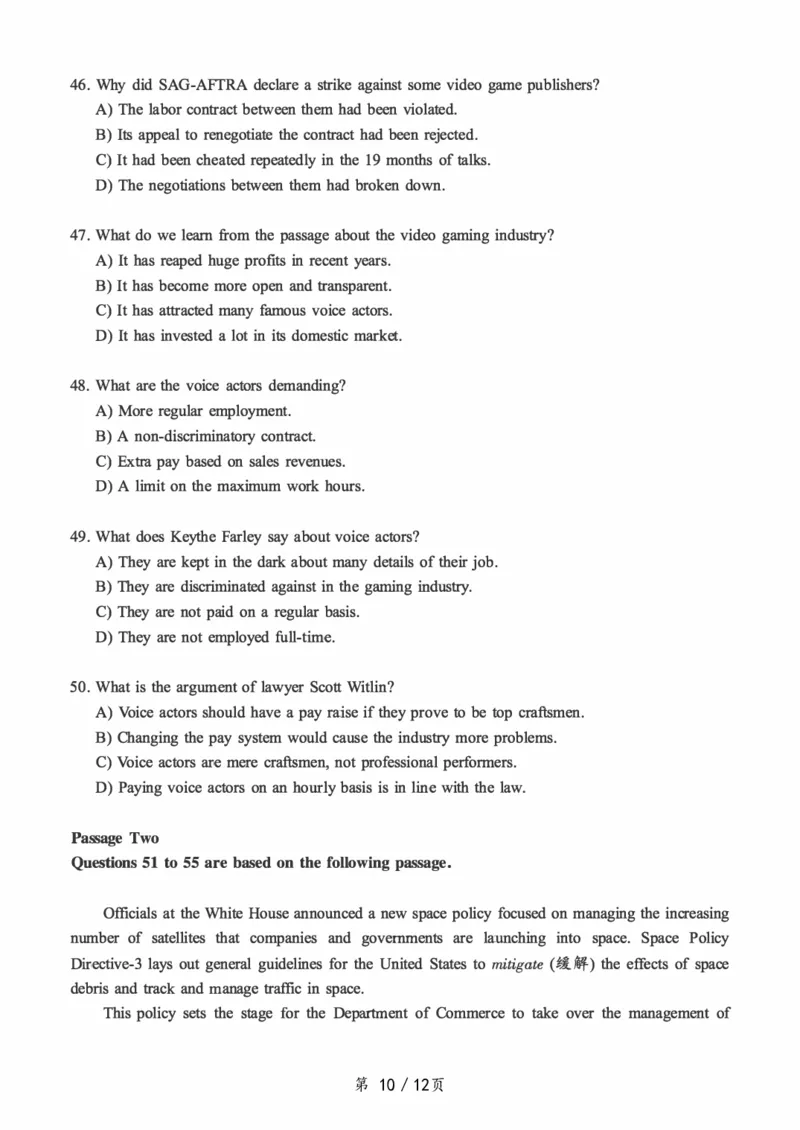
D)DI)t Iwt owulodu lbde bae sai gsnignifiificcaanntt eexxppaannsisioonn ooff hhuummanan i nitnetlellliiggeennccee..
淘宝店铺∶光速考研工作室
第9/.12页
第 9/12页47. What did Hawking say about the creation of the LCFI?
4 7. What did Hawking say about the creation of the LCFI?
AA) )ItI t wwouoludl da caccecleelrearattee tthhee pprrooggrreessss ooff AAII rreesseeaarrcchh..
B)B )ItIt wwouoludl dm marakr ka as tsetepp f foorrwwarard di nin tthhee AAI I iinndduussttryry..
C)CI)t Iwt aws aes xetxrtemeremlyel yi mipmoprotartannt tt oto tthhee ddeessttiinnyy ooff hhuummanankkiinndd..
D)DI)t Iwt aws aasn anac haicehvieemveenmt eonft omfu lmuti-ltdii-sdciiscpilpilninararyy c coollllaabboorraattiioonn..
48. What did Hawking say was a welcome change in AI research?
48. What did Hawking say was a welcome change in AI research?
AA) )ThTeh esh sihftift o fo fr reesseeaarrcchh ffooccuus s ffrroomm t hthe ep apsats tt too tthhee ffuuttuurree..
B)B )ThTeh es hsihfitft ooff rreesseeaarrcchh ffrroomm tthheeoorryy ttoo iimmpplleemmeennttaattiioonn..
C)C )ThTeh eg rgeraetaetre r eemmpphahsaissi so on nt hthee nneeggaattiivvee iimpmpaacctt ooff AAlL.
D)D )ThTeh ein icnrceraesaisning ga waawrareneensess so fo fm amnkankindi'nsd 'sp apsats ts tstuuppiiddiittyy..
49. What concerns did Hawking raise about AI?
49. What concerns did Hawking raise about AI?
AA) )ItIt mmaya ye xecxeceede dh uhmuman anin tienltleillgiegnecnec es osoonoenre ro ro rl alatteerr..
BB)I)tI tm amya yu lutlitimmataetellyy oovveerr--amampplliifyfy ththee h umhumaann mmiinndd..
C)C )SuSpuepr-eir-nitnetlellliiggeennccee mmayay c acuasues ei titss oowwnn d edsetsrtruuccttiioonn..
D)D )SuSpuepre-ri-nitnetelllliiggeennccee mmaayy eevveennttuuaallllyy rruuiinn mmaankinnkindd..
50.What do we leam about some entrepreneurs from the technology industry?
50. What do we learn about some entrepreneurs from the technology industry?
AA) )TThehye ya raree mmucuhc hi ninfflluueenncceedd bbyy tthhee aaccaaddeemmiicc ccoommmmuunnitityy..
BB)T)heTyh eayr ear meo msto slti kliekleyly ttoo bbeenneeffiitt frformom AAII ddeevveellooppmmeenntt..
C)C )ThTehye ys hsahrare et thhee ssaammee ccoonncceerrnnss aabboouutt AAII aass aaccaaddeemmiiccss..
DD)T)hTeyh ebye lbieeliveev et htheeyy ccaann kkeeeepp AAII uunnddeerr hhuummanan c coonntrtrooll..
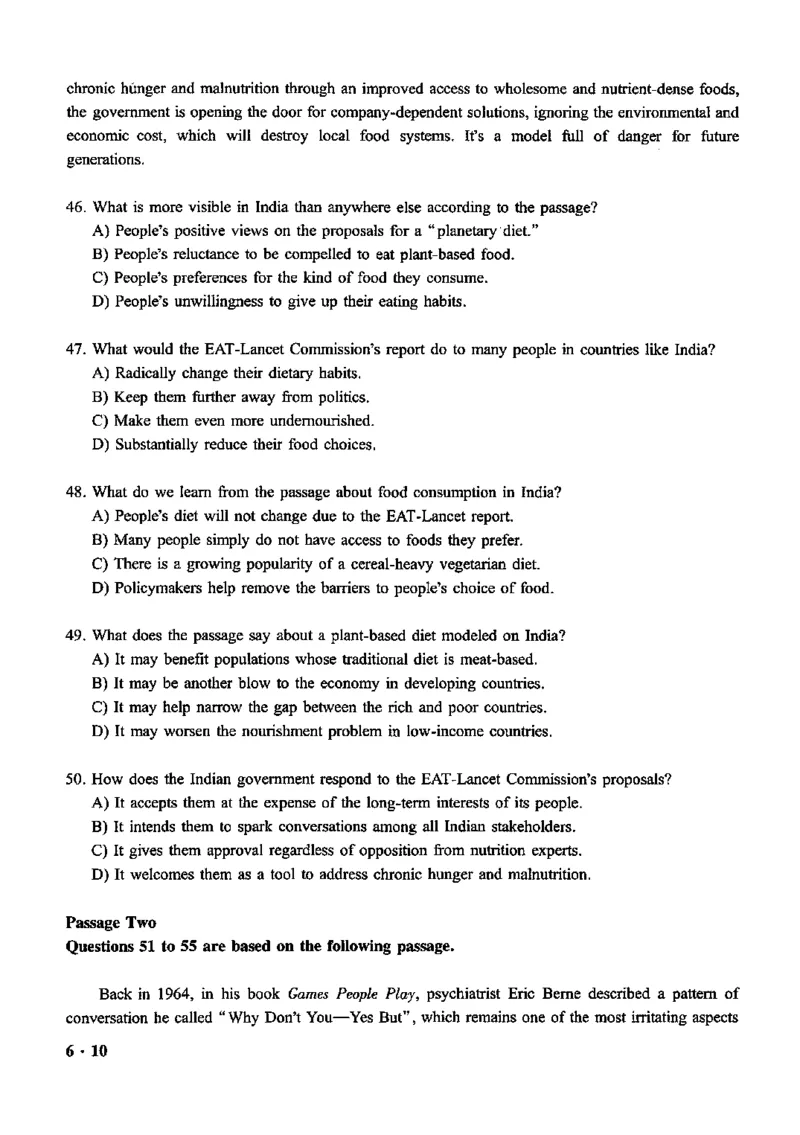
Passage Tw0
Passage Two
QuQeusetsitioonsn s5 51 1t too 5555 aarree bbaasseedd oonn tthhee ffoolllloowwiinngg ppaassssaaggee..
ThTeh em amrkaretk efto for rp rpordoudctusc tsd edseisgingende dsp sepceifciificaclalllyy ffoorr oollddeerr aadduullttss ccoouulldd rreeaacchh $$ 3300 bbiilllliioonn bbyy nneexxtt
yeyaerar,, aanndd ssatartrtuuppss ((�初l1i创 1]-¾'-公司�J)) wwanant t iinn oonn tthhee aaccttiioonn.. WWhhaatt tthheeyy ssoommeettiimmeess llaacckk iiss fefeeeddbbaacckk frfroomm tthhee
people who they hope will use their products. So Brookdale,the country's largest owner of retirement
people who they hope will use their products. So Brookdale, the country's largest owner of retirement
cocmommunmiutniietsie,sh,a sh abse bene einn vinivtiitning ga af efwew s esleelecctt eennttrreepprreenneeuurrss jjuusstt tot om moovvee iinn foforr aa fefwew ddaayyss,, sshhooww ooffff
their products and hear what the residents have to say.
their products and hear what the residents have to say.
That's what brought Dayle Rodriguez, 28, all the way from England to the dining room of
That's what brought Dayle Rodriguez, 28, all the way from England to the dining room of
BBrorookodkadlael eS oSuotuhth B aByay i ni nT oTrorrranancec,e , CCaalliiffoorrnniiaa.. RRooddrriigguueezz iiss thteh ec ocmommmuunniittyy anandd mmaarrkkeettiinngg mmaannaaggeerr ffoorr
a company called Sentab. The startup's product, SentabTV, enables older adults who may not be
a company called Sentab. The startup's product, SentabTV, enables older adults who may not be
comfortable with computers to access email, video chat and social media using just their televisions
comfortable with computers to access email, video chat and social media using just their televisions
and a remote control.
and a remote control.
"It's nothing new, it's nothing too complicated and it's natural because lots of people have TV
"It's nothing new, it's nothing too complicated and it's natural because lots of people have TV
remotes,"says Rodriguez.
remotes," says Rodriguez.
BuBtu tn onnoen eo fo ft hthata t iiss tthhee ttooppiicc ooff ccoonnvveerrssaattiioonn inin thteh eB Brrooookkddaallee ddiinniinngg rroooomm.. IInnsstteeaadd,, RRooddrriigguueezz
淘宝店铺∶ 光速考研工作室
第第 1100// 1122页页solicits residents' advice on what he should get on his cheeseburger and how he should spend the
solicits residents' advice on what he should get on his cheeseburger and how he should spend the
afatfteerrnonoono.nP. laPylayingin gc arcdarsd sw aws aosn otnh eth aeg eangdean,daa,s awse lwle lals als elaerarnmining gt ot op lpalayy m
ma
ahj
hj
on
o
g
ng
( (麻.$将*) )..
Rodriguez says it's important that residents here don't feel like he's selling them something."rve
Rodriguez says it's important that residents here don't feel like he's selling them something. "I've
had more feedback in a passive approach,"he says."Playing pool, playing cards, having dinner,
had more feedback in a passive approach," he says. "Playing pool, playing cards, having dinner,
having lunch,"all work better"than going through a survey of questions. When they get to know me
having lunch," all work better "than going through a survey of questions. When they get to know me
and to tust me,knowing for sure I'm not selling them something—there'll be more honest feedback
and to trust me, knowing for suer I'm not selling them something-there'll be more honest feedback
from them."
from them."
RoRdordrigiugeuze zi si sj juusstt tthhee sseevveenntthh eennttrreepprreenneeuurr ttoo mmoovvee iinnttoo oonnee ooff BBroroookdkadlael'es's 11,,110000 sseenniioorr lliivviinngg
communities. Other new products in the program have included a kind of full-body blow dryer and
communities. Other new products in the program have included a kind of full-body blow dryer and
specially designed clothing that allows people with disabilities to dress and undress themselves.
specially designed clothing that allows people with disabilities to dress and undress themselves.
Mary Lou Busch,93,agreed to try the Sentab system.She tells Rodriguez that it might be good
Mary Lou Busch, 93, agreed to try the Sentab system. She tells Rodriguez that it might be good
for someone, but not for her.
for someone, but not for her.
"I have the computer and FaceTime, which I talk with my family on,"she explains. She also
"I have the computer and FaceTime, which I talk with my family on," she explains. She also
has an iPad and a smartphone."So I do pretty much everything I need to do."
has an iPad and a smartphone. "So I do pretty much everything I need to do."
TTo ob be ef afaiirr,, iiff R Rooddrrigiugueze zh hadad wwanantetedd fefeededbbaacckk fforrmom ssoommee mmoorree tteecchhnnoopphhoobbiicc (( 1i害 ·t怕� Ji.技术�的�))
seniors, he might have ended up in the wrong Brookdale community.This one is located in the heart
seniors, he might have ended up in the wrong Brookdale community. This one is located in the heart
oof fS oSuotuhtherernn C aClialfiofrornniiaa''ss aaeerroossppaaccee ccoorrrriiddoorr. .M Mananyy rreessiiddeennttss hhaavvee bbaacckkggrroouunnddss iinn enegnignineeeerriinngg,,
business and academic circles.
business and academic circles.
But Rodriguez says he's still learmning something important by moving into this Brookdale
But Rodriguez says he's still learning something important by moving into this Brookdale
community: " People are more tech-proficient than we thought."
community: "People are more tech-proficient than we thought."
AnAdn bde bseisdiedse,s , wwhehreer ee ellssee wwoouuldld hhee lleearnarn toto pplalyay m mahahjjoonngg??
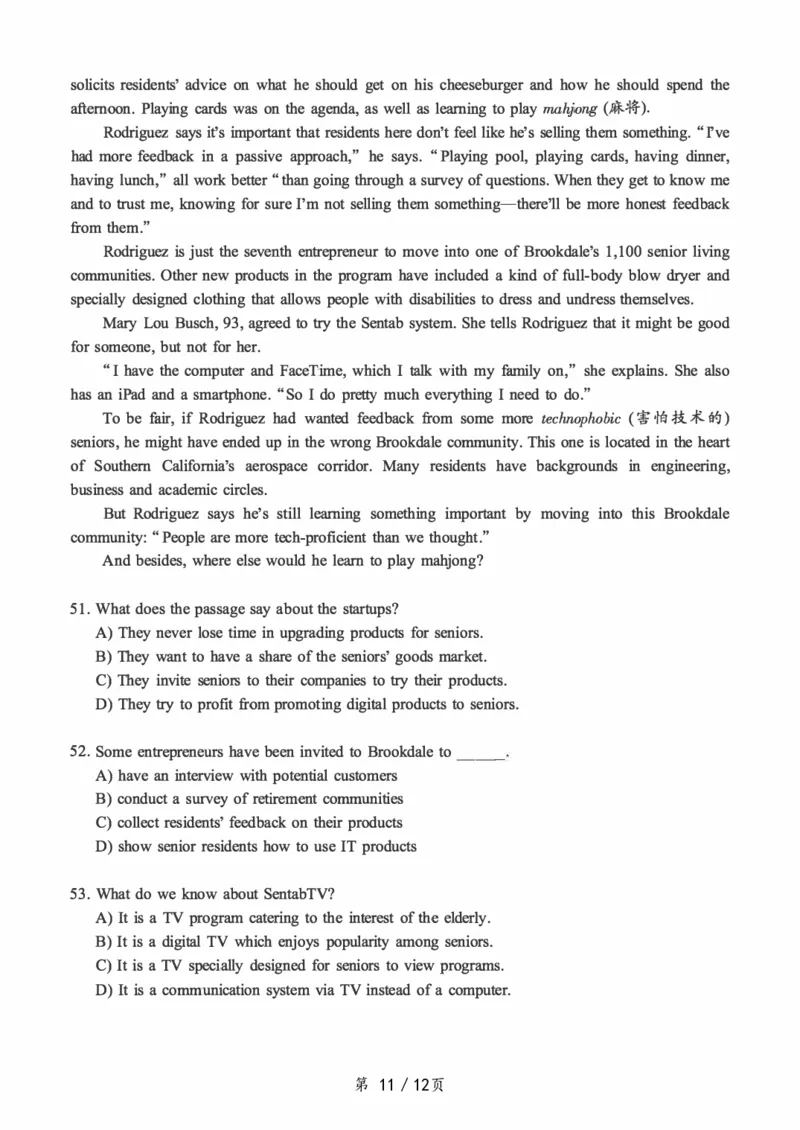
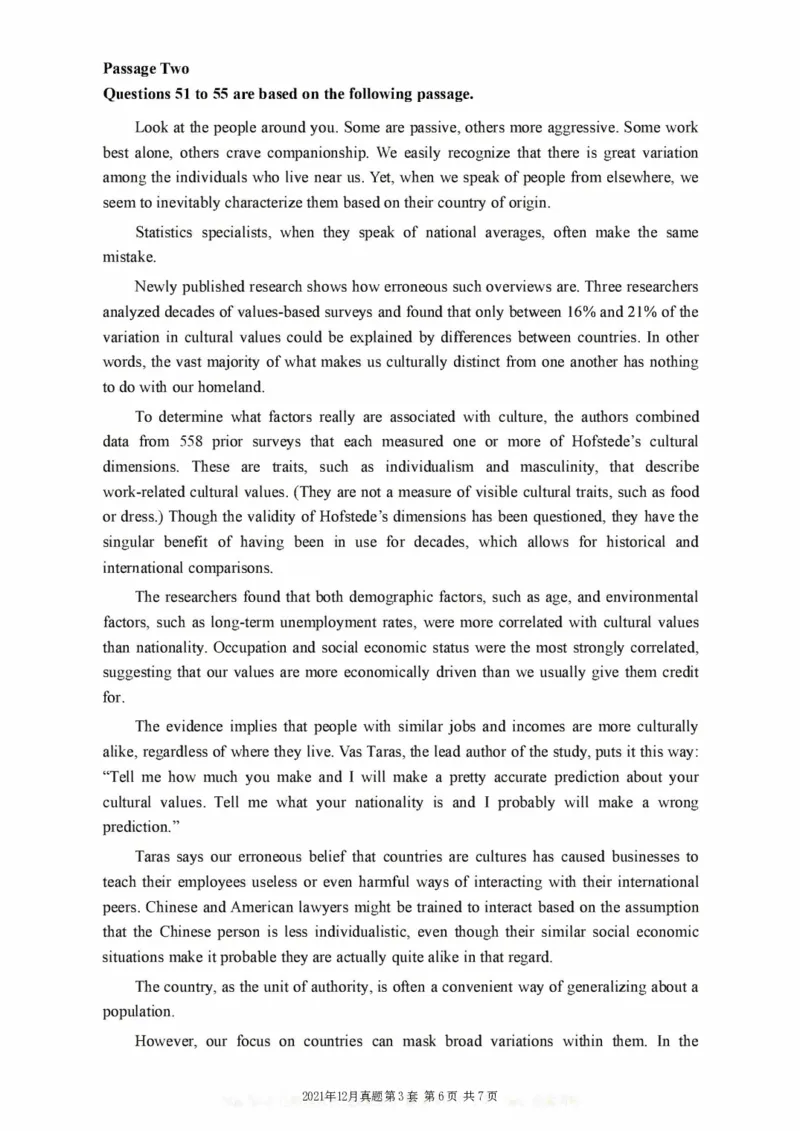
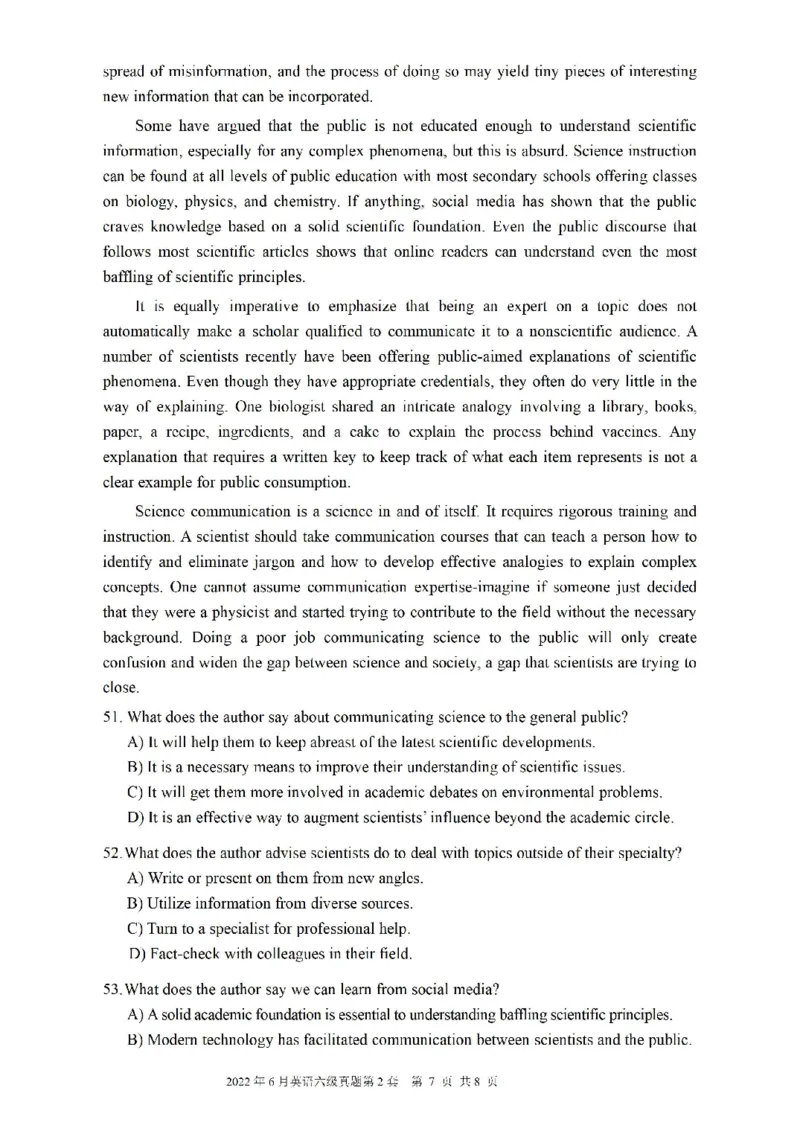
51. What does the passage say about the startups?
51. What does the passage say about the startups?
AA)T)heTyh enye vneerv leor sleo stei mtiem ien i nu pugprgardaidnign gp rpordoudcutcst sf ofor r sseenniioorrss..
BB)T)hTeyh ewya nwtan tto toha vhea vae as hsahrare eo fo ft thhee sseenniioorrss'' ggooooddss mmaarrkkeett..
C) C T ) heTyh ienyv iitnev itsee nsieonriso rts ot ot htheieri r ccoompmpanianesie st ot ot rtryy tthheeiirr pprroodduuccttss..
D)DT)heTyh teryy tryto tpor opfriotfi tf rfroom mp rpormoomtiontgi ndgi gdiitgaitla lp rpordouductcst st oto sseenniioorrss..
52.Some entrepreneurs have been invited to Brookdale to____
52. Some entrepreneurs have been invited to Brookdale to ___
AA) )hahvaev ea nan i ninteterrvviieeww wwitihth ppootteennttiiaall ccuussttoommeerrss
B)B )cocnodnudcutc ta a ssuurvrveeyy ooff rreetiretirmemeenntt ccoommmmuunnititiieess
C)C )coclollelecct t rreessiiddeennttss'' ffeeeeddbbaacckk oonn tthheeiirr pprroodduuccttss
DD)s)hoshw oswe nsieonri orr erseisdidenetnsts hhooww t too uussee IITT pprroodduuccttss
53. What do we know about SentabTV?
53. What do we know about SentabTV?
AA) )ItI t iiss aa TTVV p rporgorgarmam ca tceartienrgin tgo toth eth ein itnetreersets t oof ft thehe eellddeerrllyy..
B)BI)t Iti si s aa ddiiggiittaall TTVV wwhhiicchh eennjjooyyss ppooppuulalarriityty amamoonngg sseenniioorrss..
C)C )ItI t iiss aa TTVV ssppeecciiaallllyy ddeessiiggnneedd ffoorr sseenniioorrss toto v vieiwew pprrooggrramamss..
DD)I)t Iti sis aa ccoommmmununicaictaitoionn ssyysstteemm vviiaa TTVVi nisntseteaadd ooff aa ccoommppuutteerr..
淘宝店铺∶ 光速考研工作室
第 11/12页
第 11/12页54. What does Rodriguez say is important in promoting products?
54. What does Rodriguez say is important in promoting products?
AA) )WWinnininngin gt rtruusts t ffrroomm p prroossppeeccttiivvee ccuussttoommeerrss..
B)B )KnKonwoinwgi ntgh eth lei kliekse sa nand dd idsilsliikkeess ooff ccuussttoommeerrss..
C)C )DeDmoenmsotrnasttraintgi ntgh ethire irs uspuepreiroiroirtityy oonn tthhee ssppoott..
DD) )ReRsepsopnodnidnign gp rpormopmtpltly yt oto ccuussttoommeerr ffeeeeddbbaacckk..
55. What do we learn about the seniors in the Brookdale community?
55. What do we learn about the seniors in the Brookdale community?
AA) )MoMsto sotf o tfh tehme mar ea rien itnetreersetsteedd iinn uussiinngg tthhee SSeennttaabb..
B)B )ThTehye yar are eq uqiuteit ea ta t eeaassee wwitithh hhiigghh--tteecchh pprroodduuccttss..
C)C )TThehye yh ahvaev em mucuhc hi ni nc ocommmomn owni twhi thse sneinoirosr s eellsseewwhheerree..
D) Most of them enjoy a longer life than average people.
D) Most of them enjoy a longer life than average people.
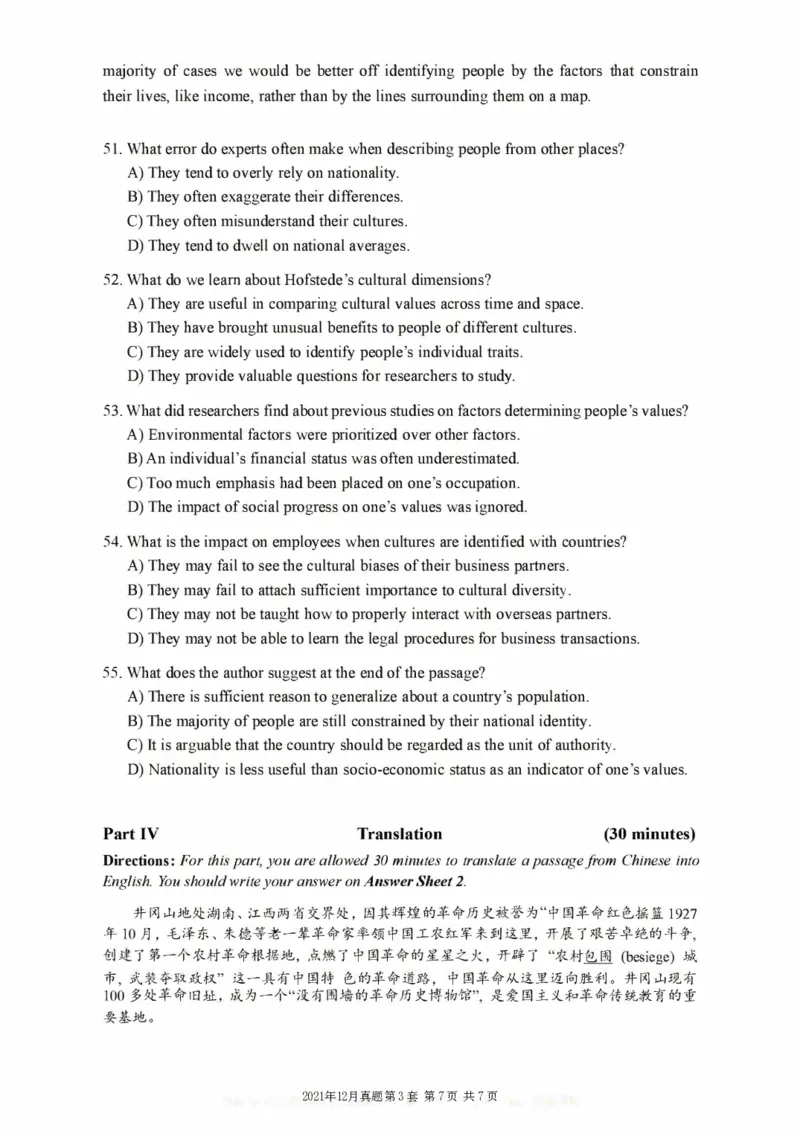
Part IV Translation (30 minutes)
Part IV Translation (30 minutes)
Directions: For this part,you are allowed 30 minutes to translateapassagefrom Chinese into English.
Directions: For this part, you are allowed 30 minutes to translate a passage from Chinese into English.
You should write your answer on Answer Sheet 2.
You should write your answer on Answer Sheet 2.
成
n\t
语
iit
(
(
C
C
h
h
i
in
n
e
e
s
s
e
e
id
i
i
d
o
i
m
o
s
m)s
;;l
)
ld
是
Jl.i-a-
汉语
9"
中
IW
的
-
一
#
种
�!lt
独
�
特
!W
的
lt
表
it
达
:n
方
:i:.t
式
,
,
::k
大
$
多
Ea
由
lm
四
-1-
个
&
汉
�
字
ffl
组
�
成
o
。
�
它
f
们
f]i'ilfi
高 J.t度
r9"
简ffo练�且_§JB形式iC固II定J£, ,f但El.im通1lU常能�形%象�地:tm表�达�深�刻�tl的!W含* Jl..义o。 n\t成i语!f::k大多$�数来*源�于 中国!E古ii代f-t的!W文x学�作ft品�,,
通常与某些神话、传说或者历史事件有关。如果不知道某个成语的出处,就很难理解其确切含
im 1lt � �@Mr ffl,ft iJtwc:ifJJJ � $ftf:1f :ko �r1J1t;;y� � :ii�-1-nlti! 1W ill 5ll:, !i!UI!�JJ.fuOt�-m *
义
Jl..
。
o
因
�
此
.lit
,
,�
学
>3
习
�
成
i!
语
1f
有
I!:/J
助
r
于
A
人
f
们
fJJ!
更
:tff-
好
:tm
地
JJ.
理
�
解
q:r
中
OO
国
�
传
�
统
X
文
1t
化
o
。
nlt
成
i!
语
tE
在 日
8
#常
�
会
ffl
话
*1
和
X
文
�
学
-€
创
� ft
作 中
q:r 1
广
rz
泛
使用。恰当使用成语可以使一个人的语言更具表现力,交流更有效。
{tJtL ·lt�{tffln\ti!J:iJ�{t-1-A!Wi-a-�J!Jl.�m'.JJ ,xtitJ!1f3'&o
Part I Writing
(30 minutes)
Part I Writing (30 minutes)
(请于正式开考后半小时内完成该部分,之后将进行听力考试)
(iiT iE�7f�E *l]\lfit l*J �At�S!Ht ZE�ill:fiPJrjJ �lit)
I
Directions: For this part,you are allowed 30 minutes to write anessay on the importance ofteam
Directions: For this part, you are allowed 30 minutes to write an essay on the importance of team
spirit and communication in the workplace.You can ate examples to illustrate your
spirit and communication in the workplace. You can cite exampks to illustrate your
views.You shoud write at least 150 words but no more than 200 words.
views. You should write at kast 150 words but no more than 200 words.
淘宝店铺∶光速考研工作室
第 12/12页
第 12/12页22001199年年66月月英英语语六六级级考考试试试试题题第第22套套
Part II
Listening Comprehension (30 minutes)
Part II Listening Comprehension (30 minutes)
Section A
Section A
Directions:In this section,you will hear two long conversations. At the end of each conversation,you
Directions: In this section, you will hear two lo conversations. At the end of each conversation, you
ng
will hear four questions. Both the conversation and the questions will be spoken only once
will hear four questions. Both the conversation and the questions will be spoken only once.
After you hearaquestion,you must choose the best answer from the four choices marked
After you hear a question , you must choose the best answer from the four choices marked
A
A
)
)
B ),
B
C
)
) ,a nCd) D
a
)
n
.
d
T h
D
en
).
m
T
a
h
r
e
k
n
t
m
h
a
e
r k
c o
th
r
e
r e
co
s
"esp
pond
o
i
n
n
d
g
in g
le
l
t
e
t
tt
e
e
r
r o
o
n
n
A
A
n
ns
s
w
w
e
e
r
r
S
Sh
hee
e
t
e t
1
1
w
w
i
i
t
t
h
h a
a
single line through the centre.
si le line through the centre.
ng
Questions 1 to 4 are based on the conversation you have just heard.
Questions 1 to 4 are based on the conversation you have just heard.
1.1.A)AW)h yW Rhoym a
R
n
o m
H
a
ol
n
i
Ho
day
li d
w
a
a
y
s wmaosr em foarem ofuams otuhsa nth Banre
B
ak
r
f
ea
a
k
s
f
t
a s
a
t
t
a t
T f
T
f
iff
a
a
ny
n
'
y
s
's
.
.
B)B )WhWyh Ayu Adruedy reHye pHbeuprbnurn ha dh amdo rmeo rfee mfeamlea lfea fnans st hthaann mmalaele oonneess..
CC) )WWhyh yt hthe ew womoamn anwa wntanedt edt ot ob eb el liikkee AAuuddrreeyy HHeeppbbuurnrn..
D)D )WhWy hsyo s om amnyan gyi rglirsls aaddoorreedd AAuuddrreeyy HHeeppbbuurnrn..
22. .AA) ) HHere ru nuniqiuqeu ep epresosrnoanlailtityy.. C)C )H eHr esrh ishftift o fo fi ninteterreesstt ttoo ppeerrffoorrmmiinngg aarrttss..
B)B )HeHre rp hpyhsyisciacla l ccoonndidtitiioonn.. D)D )HeHr efr afamimlyi'lys' ss ussupsepnesnisoino no fo ff ifinnaanncicaiall aaiidd..
33. .AA) ) SShhee wwasa sn onto t aann oouuttggooiinngg ppeerrssoonn.. CC) )SSheh ew wasa se aesaysy--ggooiningg oonn tthehe wwhhoollee..
BB) )SSheh ew wasa sm modoedsets t aanndd hhaarrddwwoorrkkiinngg.. D)D )ShSeh ew aws auss uuaslulayll yn onto tv evreyr yo potpitmimisitsiticc..
4.A)She was influenced by the roles she played in the films.
4. A) She was influenced by the roles she played in the films.
BB) )HeHre rp aprarenetnst st taauugghht t hheerr ttoo ssymymppaatthhiizzee wwiitthh tthhee nneeeeddyy..
C)C )ShSeh el eleaarnrneedd ttoo vvoollununtteeeerr wwhheenn sshhee wwaass aa cchhiildd..
DD)H)erH efra mfiamly ilbye nbeefnietfietde df rfroom mo tohthere rp epoepolpel'es's hheellpp..
QuQeusetsitoionsn s5 5 ttoo 88 aarree bbaasseedd oonn tthhee ccoonnvveerrssaattiioonn yyoouu hhaavvee jjuusstt hheearardd..
5.5 .AA) )G Giviev ea ap preresseennttaattiioonn.. C)C )StSatarrtt aa nneeww ccoommppaannyy..
B)B )RaRiasiese ssoomme eq queusetstiioonnss.. D)D )AtAttetenndd a a bbooaarrdd mmeeeettiinngg..
6.6 .A)A )I tI t wwililll ccuutt pprroodduuccttiioonn ccoossttss.. C)C )NoN sot astfafff w wililll bbee ddiissmmiisssseedd..
B)B )ItI tw wilill l rraaiissee pprroodduuccttiivviittyy.. D) D ) No N n o e w n e s w t a s f t f a ff w i w l i l l l b b e e h h i i r r e e d d . .
77. .AA) )T hTeh et itmimeleilnien eo fo fr eressttruruccttuuririnngg.. CC) )TTheh ec coommmumniucnaictaitoino nc chhaannnneellss..
B)B )ThThe er eraesaosnosn sf ofor rr eressttruruccttuurriinngg.. D D ) ) T T he h e c c o o m m pa p n an y' y s 's n n e e w w m m is is s s i i o o n n s s. .
淘宝店铺∶光速考研工作室 1 12
第 1/12页88. .AA) ) BBy yc ocnosnuslutltiinngg tthheeiirr oowwnn ddeeppaartmrtmeenntt mmaannaaggeerrss..
BB) )ByB ye meamilaiilningg q quuesetstiioonnss toto ththee mmanan oorr thteh ew woommaann..
CC) )BBy ye xepxlpolroirinngg vvaarriioouuss cchhaannnneellss ooff ccoommmmuunnicicaattiioonn..
DD) )ByB yv ivsiistitiinngg ththee ccoompmpaannyy''ss oowwnn ccoommppuutteerr nneettwwoorrkk..
Section B
Section B
Directions:In this section,you will hear two passages.At the end of each passage,youwill hear three
Directions: In this section, you will hear two passages. At the end of each passage, you will hear three
or four questions. Both the passage and the questions will be spoken only once After you
or four questions. Both the passage and the questions will be spoken only once. After you
he h a e r a r a a q u q e u s e t st i i o on n, ,y o y u o u m u m s us t t c h ch oo o s o e se t t h h e e b b e e s s t t a a n n sw sw e e r r fr f o r m o m t h t e h f e o f u o r u r c h c o h ic o e i s c e m s a r m k a e r d h e A d ) A,) B,B)) ,, CC))
an
a
d
n d
D )D.)T .h e
Th
n
e
m
n
a r
m
h
a rk
th e
t h
c
e
or
co
r
rr
es
es
p
p
o
o
n
n
d
d
i
i
n
n
g
g
l
le
t
t
t
te
e
r
r
o
o
n
n AAnnsswwerer SShheeeet t1 w1i t
w
h
i th
a
a
s in
si
g
n
l
g
e
k
l
l
i
ine
ne
through the centre.
through the centre.
QuQeusetsitioonsn s9 9 ttoo 11l1 aarree bbaasseedd oonn tthehe ppaassssaaggee yyoouu hhaavvee jjuusstt hheeaarrdd..
9.9A.)A I)t Iht ehleplsp sp apsassesnegnegrse rst ot ot atkake ec acrare eo fo ft thheeiirr ppeett aanniimmalalss..
B)B )ItI t hhasa s aannimimalasl st oto hheellpp ppaasssseennggeresrs ccaarryrry tthheeiirr lluuggggaaggee..
C)C )ItI t uusseess tthheerraappyy aanniimmaallss ttoo ssooootthhee nneerrvvoouuss ppaasssseennggeerrss..
D)D )ItI t aalllloowwss ppaasssseennggeersrs ttoo hhaavvee aanniimmalasls ttrravaveell wwiitthh ththeemm..
10 1 . 0 . A A ) ) A A vo v i o d i i d n in g g p o p s o s s i si b b l l e e d d a an ng g e e r r s s . . C)C )IdIednetnitfifyyiinngg ddrurugg ssmumugggglelerrss..
B)B )FiFnindidningg tthheeiirr wwaayy aarroounundd.. DD) )LoLookoinkgin gaf atftere rs siicckk ppaasssseennggeerrss..
111.1 .AA) )S cShcehdeuldeu lteh ethier irf lfliigghhttss aarroouunndd t thhee aannimimala lv ivsiisittss..
B)B )PhPohtootgorgarpaph hth the et htherearapyp ya nanimiamlsa lsa ta tt hthee aaiirprpoorrtt..
C)C )KeKeepe pso smoem aen ianmailmsa lfso rfo rt htherearpaepuetuiticc ppuurprpoosseess..
D)DB)riBnrgi ntgh ethire irp epte ta annimimalasl so on nb boaorard dt htheeiirr ppllananee..
QQueusetsitioonns s 1122 ttoo 1155 aarree bbaasseedd oonn tthhee ppaassssaaggee yyoouu hhaavvee jjuusstt hheeaarrdd..
121.2A.)A B)e Bsiedsei dae bae bauetaiuftuifulllyly ppaianintteedd wwalalll iinn AArrlieess..
B)B )BeBseisdied et hthee ggaattee ooff aann aanncciieenntt RRoommaann c ciittyy..
C)C )AtA tt hthee ssiittee ooff anan aannccieinetn tR oRmomanan mmaannssiioonn..
DD) )AtA tt hthe ee enntrtraannccee ttoo aa rreecceeppttiioonn hhaalll li ni nR oRommee..
1313.A.)A )A Anu nmubemrb eorf odfi dfifffeerreenntt iimmaaggeess.. C)C )VaVrariiouosu sm musuisciacla l iinnssttrurummeennttss..
BB) )AA n unmubmerb eor fo fm ymthyothloolgoigciacla l hheerrooeess.. D)D )PaPianitnitninggs sb byy f faammouosu sF rFernecnhc ha rarttisisttss..
141.4 .AA)T) hTe hoer iogriignianlailtityy aanndd eexxppeerrttiissee sshhoowwnn.. C)C )ThTeh es tsutnunninnign gi mimagaegse sv ivviivdidllyy ddeeppiicctteedd..
B)B )ThTeh ew owrlodrllyd lys ospohpishtisitciactaitioonn ddiissppllaayyeedd.. D)D )ThTeh iem pimpresrseisvseiv es ksiklillsls aanndd ccoossttllyy dydyeess..
淘宝店铺∶光速考研工作室 2 12
第 2/12页151.5A.)A H)i sH aisr tartiistsitcic ttaassttee iiss ssuuppeerrbb.. C)C )HeH wea ws aas cao lcloellcetcotro ro of fa annttiiqueess..
qu
B)B )HiHs isi diednetnitittyy rreemmaaiinnss uunncclleeaarr.. DD) )HeH ew aws aas rai rcihc hI tIatalliianan mmeerrcchhaanntt..
Section C
Section C
Directions:In this section,you will hear three recordings of lectures or talks followed by three orfour
Directions: In this section, you will hear three recordings of lectures or talks followed by three or four
questions. The recordings will be played only once.After you heara question,you must
questions. The recordi will be played only once. After you hear a question, you must
ngs
choose the best answer from the four choicesmarked A),B),C)and D).Then mark the
choose the best answer from the four choices marked A) , B) , C) and D) . Then mark the
corresponding letter on Answer Sheet 1 with a single line through centre
corresponding letter on Answer Sheet 1 with a single line through centre.
Questions 16 to 18 are based on the recording you have just heard.
Questions 16 to 18 are based on the recording you have just heard.
.
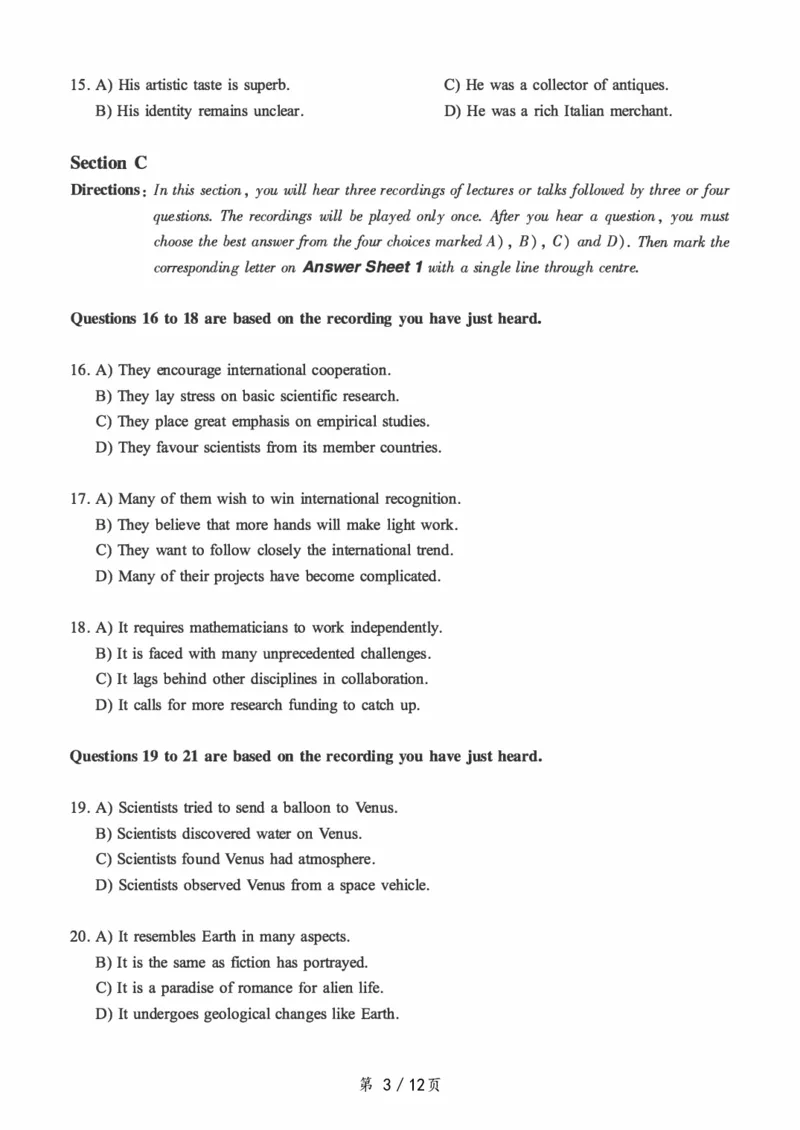
161.6 .AA) )T Thehye ye necnocuoruragaeg ien intetrernnataitioonnaall ccooooppeerraattiioonn..
B)B )ThTehy elya yl asyt rsetserss so no nb absiacs ics csiceinetnitfifiicc rreesseeaarrcchh..
C)C )ThTehye yp lpalcaec eg rgeraeta te emmphpahsiassi so no ne mepmirpiiricacla ls sttuuddiieess..
D)D )ThTehye yfa favovuor ursc siceinetnitsisttss ffrroomm iittss mmeemmbbere r ccoouuntnrtriieess..
171.7 .AA) )M Manany oyf otfh theme mwi swhi stho twoi wn iinn tinertenrnatatioionanla l rreeccooggnniittiioonn..
BB)T)heTyh ebye lbieelvieev et hthata t mmoroer eh ahnandsd sw iwlilll mmaakke e lliigghhtt wwoorrkk..
C)C )ThTehy ewya nwt antot tfoo lfolollwo wcl ocsleolsye lyth the ei nitnetrenrnataitioonnaall ttrreenndd..
D)D )MaMnyan oyf otfh ethieri rp prorojjeeccttss hhaavvee bbeeccoommee ccoommplpiliccaatteedd..
181.8A.)A I)t I tr ereqquiurireess mmatahtheemmataitciciiaannss ttoo wwoorrkk iinnddeeppeennddeennttllyy..
B)B )ItIt iiss fafacceedd wwiithth mmaannyy uunnpprreecceeddeenntteedd cchhaalllleennggeess..
C)C )ItI tl alaggs s bbeheihnidn do tohthere rd idsicsicpiplilinneess iinn ccoollllaabboorraattiioonn..
DD)I)t Itc aclallsls ffoorr mmoorere rreesseeaarrcchh ffuunnddiinngg ttoo ccaattcchh uupp..
Questions 19 to 21 are based on the recording you havejust heard.
Questions 19 to 21 are based on the recording you have just heard.
191.9A.)A S)c iSecniteinstitsst st trriieedd ttoo sseenndd aa bbaalllloooonn ttoo VVeennuuss..
B)B )ScSiceinetnitissttss ddiissccoovveerreedd wwaatteerr oonn VeVennuuss..
C)C )ScSiceienntitissttss fofouunndd VVeennuuss hhaadd aatmtmoosspphheerree..
D)D )ScSiceinetnitsisttss oobbsseerrvveedd VVeennuuss ffrroomm a a ssppaaccee vveehhicicllee..
202.0A.)A I)t I tr eresseemmblbelse s EEararthth iinn mmaannyy aassppeeccttss..
B)B )ItI t iiss tthhee ssamamee aass ffiiccttiioonn hhaass ppoorrttrraayyeedd..
C)C )ItI ti sis aa ppaarraaddiissee ooff rroommanancec ef ofor ra laileienn lliiffee..
D)D )ItI t uunndedregrogeose sg egoeloolgoigciacla l cchhaannggese sl liikkee EEaarthrth..
淘宝店铺∶ 光速考研工作室
3 12
第 3/12页221.1A.)A I)t Itm imghigt hht ahvave bee ebne ehno thtoetrt etr hthanan i ti t iiss ttooddaayy..
B)B )ItI t mmigihgth th ahvaev eb ebeene na ac oczoyzy ha bhiatbaitta tf ofor rl iliffee..
C)
C )
ItIt uusseedd ttoo hhaavvee mmoorere wwatateerr tthhaann EEaarthrth..
D)D )ItI t uusesedd t oto bbee ccoovevreerde dw iwthith r arianinfoforreessttss..
QuQeusetsitioonsn s2 222 t too 2255 aarree bbaasseedd oonn tthhee rreeccoorrddiinngg yyoouu hhaavvee jjuusstt hheeaarrdd..
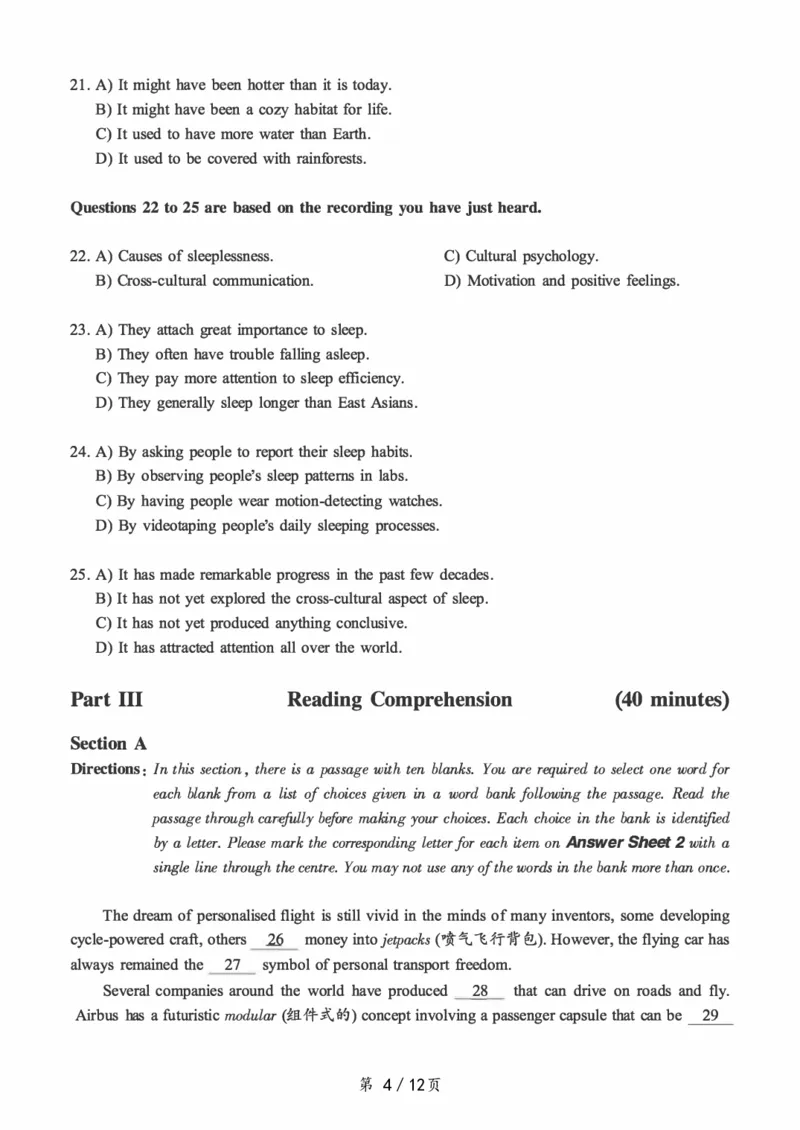
222.2 .AA) )C aCuasuesse so fo fs lseleeepplleessssnneessss.. C)
C )
CuClutltuurraall ppssyycchhoollooggyy..
BB) )CrCorsoss-s-ccuullttuurraall ccoommmmuunnicicaattiioonn.. DD)M)otMivoattiviaotino nan da npdo spiotsiitivev ef efeeelliinnggss..
223.3A.)A T)h Teyh eayt taattcahc hg rgeraeta ti immpoprotratanncec et oto sslleeeepp..
B)B )ThTehye yof toeftne nh ahvave ter trouobulbel ef afalllliinngg aasslleeeepp..
C)
C )
ThTehy epya yp aymo rme oartet aettnteinotino nt ot os lseleeepp e efffificciieennccyy..
D)D )ThTehye yge gneernaelrlayll ys lseleeepp lloonnggeerr tthhaann EEaasstt AAssiiaannss..
224.4A.)A B)y Bays kaisnkgi npge oppeloe ptleo troe proerpto rtth theieri rs lsleeeepp hhaabbititss..
B)B )ByB yob osebrsveirvngin pge oppeloep'lse 'ss lseleepe pp aptattetrenrns s iinn llaabbss..
C)C )ByB yh ahvaivnign gp epoepolpel ew ewaerar m omtoiotino-nd-edteetcetctiinngg wwaattchhceess..
D)D )ByB vyi dveidoetoaptaipnign gp epoepolpel'es' s ddaaiillyy sslleeeppiinngg pprroocceesssseess..
225.5A.)AIt) Ihta hs ams amdea dree mraermkarabklaeb lper opgrroegsrse ssi ni nt hthee ppaasstt ffeeww ddeeccaaddeess..
BB)I)t Ith ahsa sn onto yt eyte te xepxlpolroerde dt hthe ec rcorsoss-sc-uclutluturarla l aassppeecctt ooff sslleeeepp..
C)
C )
ItIt hhaass nnoott yyeett pprroodduucceedd aannyyththiinngg ccoonncclluussiivvee..
D)D )ItI th ahsa sa tatttrraacctteedd aatttteennttiioonn aallll oovveerr ththee wwoorrlldd..
Part I[ Reading Comprehension (40 minutes)
Part III Reading Comprehension (40 minutes)
Section A
Section A
Directions:In ths section, there isa passage with ten blanks. You are required to select one wordfor
Directions: In this section, there is a passage with ten blanks. You are required to select one word for
each bank from a list of choices given in a word bank following the passage.Read the
each blank from a list of choices given in a word bank following the passage. Read the
passage through carejully before making your choices. Each choice in the bank is identified
passage through carefully before making your choices. Each choice in the bank is identified
by a leter.Please mark the corresponding letter for each item on Answer Sheet 2 with a
by a letter. Please mark the corresponding letter for each item on Answer Sheet 2 with a
single line throughthe centre.You may not use any of the words in the bank more than once.
si le line through the centre. You may not use any of the words in the bank more than onoe.
ng
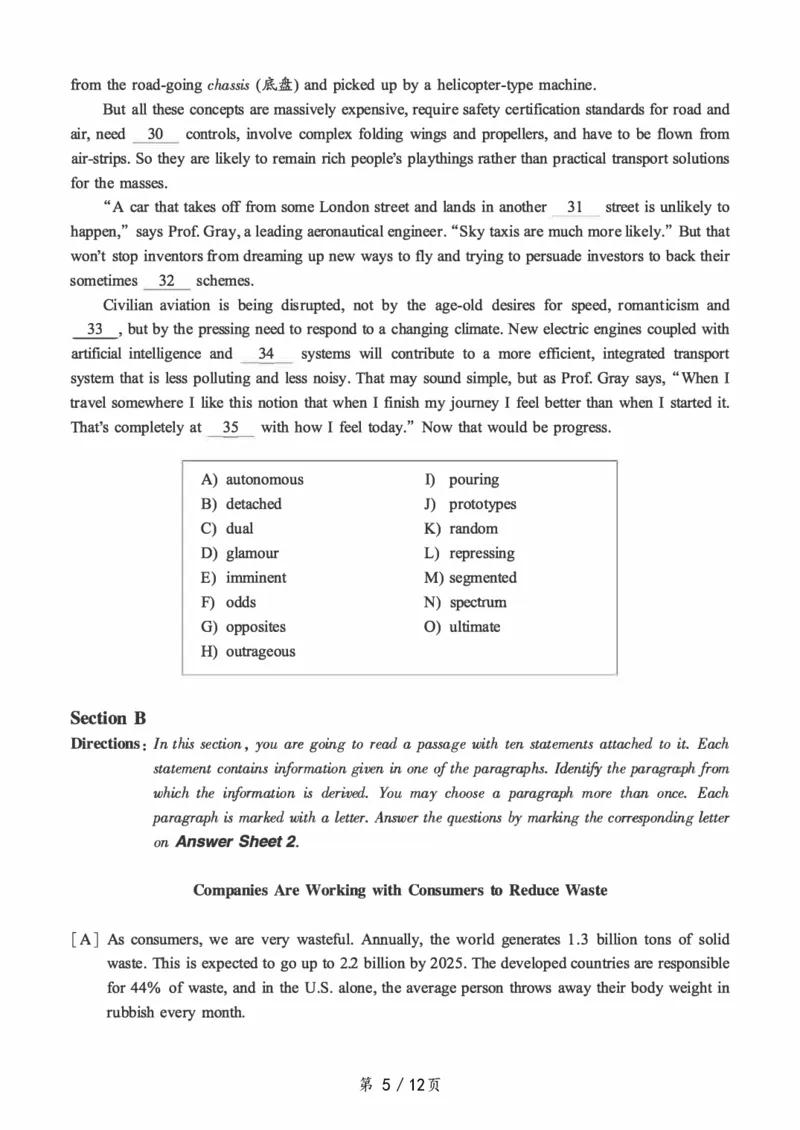
The dream of personalised flight is still vivid in the minds of many inventors, some developing
The dream of personalised flight is still vivid in the minds of many inventors, some developing
cyccylcele--ppoowwereerde dc crraafftt,, o thotehrse rs 2266 momneoyn eiyn tinojtoep j a e c tp k a s c ( ks 喷 (�气 飞�行 ""t背 1t包 11') @..H ).o wHeovwere,vetrh, eth fe lflyiyningg ccaarr hhaass
always remained the 27 symbol of personal transport freedom.
always remained the 27 symbol of personal transport freedom.
Several companies around the world have produced 28 that can drive on roads and fly.
Several companies around the world have produced 28 that can drive on roads and fly.
AiAribrubsu sh ahsa sa af fuuttuurriissttiicc
m
m
o
o
d
d
u
ul
la
a
r
r {(ffl组 #-件A.式 V-J的)) ccoonncceepptt inivnvoolvlvinign ga ap apsassesnegnegre rc acpaspusluel the atth actan c bane b�e 29
淘宝店铺∶光速考研工作室
4 12
第 4/12页frfroomm t hthe er rooaadd-g-goioning gc hchasassisiss( (ffi.底盘Jt)) aanndd ppiicckkeedd uupp bbyy aa hheelliiccoopptteerr--ttyyppee mmaacchhiinnee..
But all these concepts are massively expensive,require safety certification standards for road and
But all these concepts are massively expensive, require safety certification standards for road and
air, need 30 controls, involve complex folding wings and propellers, and have to be flown from
air, need 30 controls, involve complex folding wings and propellers, and have to be flown from
air-strips.So they are likely to remain rich people's playthings rather than practical transport solutions
air-strips. So they are likely to remain rich people's playthings rather than practical transport solutions
for the masses.
for the masses.
"A car that takes off from some London street and lands in another 31 street is unlikely to
"A car that takes off from some London street and lands in another 31 street is unlikely to
happen,"says Prof. Gray,a leading aeronautical engineer."Sky taxis are much more likely."But that
happen," says Prof. Gray, a leading aeronautical engineer. "Sky taxis are much more likely." But that
won't stop inventors from dreaming up new ways to fly and trying to persuade investors to back their
won't stop inventors from dreaming up new ways to fly and trying to persuade investors to back their
sometimes _32__schemes.
sometimes 32 schemes.
Civilian aviation is being disrupted,not by the age-old desires for speed, romanticism and
Civilian aviation is being disrupted, not by the age-old desires for speed, romanticism and
33 ,but by the pressing need to respond to a changing climate.New electric engines coupled with
___lL_, but by the pressing need to respond to a changing climate. New electric engines coupled with
artificial intelligence and 34 systems will contribute to a more efficient, integrated transport
artificial intelligence and 34 systems will contribute to a more efficient, integrated transport
system that is less polluting and less noisy.That may sound simple, but as Prof. Gray says,"When I
system that is less polluting and less noisy. That may sound simple, but as Prof. Gray says, "When I
travel somewhere I like this notion that when I finish myjourney I feel better than when I started it.
travel somewhere I like this notion that when I finish my journey I feel better than when I started it.
That's completely at 35 with how I feel today."Now that would be progress.
That's completely at 35 with how I feel today." Now that would be progress.
A) autonomous I) pouring
A) autonomous I) pouring
B) detached J prototypes
B) detached J) prototypes
C) dual K)random
C) dual K) random
D glamour
L) reressing
D) glamour L) repressing
M sgmented
E) imminent
FoEd) eimdmiisnent M) segmented
N) spectum
F) odds N) spectrum
Oultimate
G)opposites
G) opposites 0) ultimate
H) outragous
H) outrageous
Section B
Section B
Directions:In this section,you are going to read a passage with ten statemens atched to it. Each
Directions: In this section, you are going to read a passage with ten statements attached to it. Each
statement contains information given in one of the paragraphs.Identify the paragraph from
statement contains information given in one of the paragraphs. Identify the paragraph from
which the information is derived. You may choose a paragraph more than once Each
which the information is derived. You may choose a paragraph more than once. Each
paragraph is marked withaleter.Answer the questions by marking the corresponding letter
paragraph is marked with a letter. Answer the questions by marking the corresponding "letter
on Answer Sheet 2.
on Answer Sheet 2.
Companies Are Working with Consumers to Reduce Waste
Companies Are Working with Consumers to Reduce Waste
[A] As consumers, we are very wasteful. Annually, the world generates 1.3 billion tons of solid
[ A] As consumers, we are very wasteful. Annually, the world generates 1.3 billion tons of solid
waste. This is expected to go up to 2.2 billion by 2025.The developed countries are responsible
waste. This is expected to go up to 22 billion by 2025. The developed countries are responsible
for 44of waste,and in the US.alone,the average person throws away their body weight in
for 44% of waste, and in the U.S. alone, the average person throws away their body weight in
rubbish every month.
rubbish every month.
淘宝店铺∶ 光速考研工作室
5 12
第 5/12页[B[ ]B ]CoCnvoenvnteinotnioaln awl iwsdisodmo mwo uwldo usldee sme etmo stoug sguegsgt etsth atht act ocmopmanpianesi ehs ahvave neo n ion cinecnetnitviev et oto lleennggtthheenn tthhee
life cycle of their products and reduce the revenue they would get from selling new goods. Yet,
life cycle of their products and reduce the revenue they would get for m selling new goods. Yet,
more and more businesses are thinking about how to reduce consumer waste. This is partly
more and more businesses are thinking about how to reduce consumer waste. This is partly
driven by the rising price of raw materials and metals. It is also partly due to both consumers
driven by the rising price of raw materials and metals. It is also partly due to both consumers
and companies becoming more aware of the need to protect our environment.
and companies becoming more aware of the need to protect our environment.
[[C ]C ]WhWenh ecnh ocohsoionsgi nwgh wath aptr pordoudcutcst st oto bbuuyy aanndd wwhhiicchh bbrraannddss ttoo bbuuyy frformom, ,mmoorree anandd mmoorree ccoonnssumumeerrss
are looking into sustainability.This is opposed to just price and performance they were
are looking into sustainability. This is opposed to just price and performance they were
concerned about in the past.In a survey of 54 of the world's leading brands, almost all of them
concerned about in the past. In a survey of 54 of the world's leading brands, almost all of them
reported that consumers are showing increasing care about sustainable lifestyles. At the same
reported that consumers are showing increasing care about sustainable lifestyles. At the same
time,surveys on consumers in the U.S.and the UK.show that they also care about minimizing
time, surveys on consumers in the U.S. and the U.K. show that they also car,e about minimizing
energy use and reducing waste.
energy use and reducing waste.
[D[ ]DFo]r Ftohre thmeo smt opsat rtp,art c, ocnosnusmumerser sc ocnotnrtrolo l wwhahtat hhaappppenenss ttoo aa pprroodduucctt.. BBuutt ssoommee ccoommppaanniieess aarere
realizing that placing the burden of recycling entirely on the consumer is not an effetive strategy,
realizing that placing the burden of recycling entirely on the consumer is not an effective strategy,
especially when tossing something away seems like the easiest and most convenient option.
especially when tossing something away seems like the easiest and most convenient option.
[E[ ]E S]o mSeo mreet arieltearilse ras ndan mda nmufanacutfuracetursre risn itnh eth cel octlhoithnign,g ,f ofootowtewaerar, ,a nand de leelcetcrtroonniiccss iinndduussttrriieess hhaavvee
launched environmental programs. They want to make their customers interested in preserving
launched environmental programs. They want to make their customers interested in preserving
ththeeirir pprroodduuccttss aanndd pprreevveennttiinngg tthhiinnggss ththaatt sstitlli lhlav hea vvea vluael ufre ofmro mg ogionign gt ot oth teh eg argabrabgaeg ed udmumpp.. BByy
offering services to help expand the longevity of their products, they're promising quality and
offering services to help expand the longevity of their products, they're promising quality and
durability to consumers, and receiving the reputational gains for being environmentally friendly.
durability to consumers, and receiving the reputational gains for being environmentally friendly.
[F] For example,the Swedish jeans company Nudie Jeans offers free repair at twenty of their shops.
[ F] For example, the Swedish jeans company Nudie Jeans offers free repair at twenty of their shops.
Instead of discarding their old worn-out jeans, customers bring them in to be renewed. The
Instead of discarding their old worn-out jeans, customers bring them in to be renewed. The
company even provides mail-order repair kits and online videos,so that customers can leamn
company even provides mail-order repair kits and online videos, so that customers can learn
hhowo wto tof ifix xa ap apiari ro ofjfe jaenans sa ta th ohmoem. eT. heTihre iprh iplhoisloopsohyp hiys itsh atht aet xetxetnednidngin gth the el ilfiefe ooff a a ppaaiirr ooff jjeeananss
iiss nnoott oonnllyy ggrreeaatt foforr ththee eennvviiroronnmmeenntt,, bbuutt aalllolwowss ththee ccoonnssuummeerr ttoo ggeett mmoorree vvaalluuee oouut t ooff tthheeiirr
product. When customers do want to toss their pair, they can give them back to the store, which
product. When customers do want to toss their pair, they can give them back to the store, which
wwililll rreeppuurrppoossee aanndd rreesseellll ththeemm.. AAnnootthheerr ccllooththiinngg ccoommppaannyy,, PPaattaaggoonniiaa,, aa hhiigghh--eenndd oouuttddoooorr
clothing store,follows the same principle. It has partnered with DIY website iFixit to teach
clothing store, follows the same principle. It has partnered with DIY website iFixit to teach
consumers how to repair their clothing, such as waterproof outerwear, at home. The company
consumers how to repair their clothing, such as waterproof outerwear, at home. The company
also offers a repair program for their customers for a modest fee. Currently, Patagonia repairs
also offers a repair program for their customers for a modest fee. Currently, Patagonia repairs
about 40,000 garments a year in their Reno,Nevada, service center.According to the company's
about 40,000 garments a year in their Reno, Nevada, service center. According to the company's
CEO, Rose Marcario, this is about building a company that cares about the environment. At the
CEO, Rose Marcario, this is about building a company that cares about the environment. At the
same time, offering repair supports the perceived quality of its products.
same time, offering repair supports the perceived quality of its products.
[G[ ]GIn] BIrna zBirla,z itl,h eth em umltuilntiantaitioonnalal ccoorrppoorraattiioonn AAddiiddaass hhaass bbeeeenn rrunninunningg aa sshhooee--rreeccyycclliningg pprrooggrramam
called"Sustainable Footprint"since 2012. Customers can bring shoes of any brand into an
called "Sustainable Footprint" since 2012. Customers can bring shoes of any brand into an
淘宝店铺∶光速考研工作室
6 12
第 6/12页Adidas store to be shredded and turned into alternative fuels for energy creation instead of being
Adidas store to be shr,edded and turned into alternative fuels for energy creation instead of being
burned as trash.They are used to fuel cement ovens.To motivate visitors to bring in more old
burned as trash. They are used to fuel cement ovens. To motivate visitors to bring in more old
shoes,Adidas Brazil promotes the program in stores by showing videos to educate customers,
shoes, Adidas Brazil promotes the program in stores by showing videos to educate customers,
and it even offers a discount each time a customer brings in an old pair of shoes. This boosts
and it even offers a discount each time a customer brings in an old pair of shoes. This boosts
the reputation and image of Adidas by making people more aware of the company's values.
the reputation and image of Adidas by making people more aware of the company's values.
[H[ ]H EJn oErnmoorums ooupsp oorptpuonirttunieist ieasl saol sloi eli ew iwthith e -ew-awsatset.e . IItt iiss eessttimimaatteedd ththata ti ni n2 021041 4 thteh ew woorrldld pprroodduucceedd
some 42 million metric tons of e-waste(discarded electrical and electronic equipment and its
some 42 million metric tons of e-waste ( discarded electrical and electronic equipment and its
paprartts)s ) wwitihth NNorotrhth A Amemriecraic aa nand dEu Erourpeo paec caocucnotuinntgi nfgo rfo 8r 8an and 1d2 1m2i lmliilolino nm emtreitrci ct otonsn sr reessppeeccttiivveellyy..
The materials from e-waste include iron, copper, gold, silver, and aluminum—materials that
The materials from e-waste include iron, copper, gold, silver, and aluminum-materials that
could be rused,resold, salvaged, or recycled.Together,the value of these metals is estimated to
could be reused, resold, salvaged, or recycled. Together, the value of these metals is estimated to
beb ea abbouotu t $5$2 5 b2i lblililoionn..E lEelcetcrtroonniiccss ggiiananttss lilkiek eB eBsets tB uByu y anandd SSamamssunungg hhaavvee pprroovviiddeedd ee--wwaassttee
tatakkee--bbaacckk pprrooggrraammss oovevre r ththee ppasatst ffeeww yeyaerarss,, wwhihcichh aiamim t ot or e r f efu ur r b b i is s h h (( 翻jJ:J新 -®i'))o lodld eleeleccttrroonniicc
cocmopmopneonntesn tsa nad ndp aprartts s iinnttoo nneeww pprroodduuccttss..
[I[ ]IF]orF oort hoethr ecro mcpoamnpieans ieisn tienrteesretsetde di nin r eredducuicningg wwasatset,e , hheellppiinngg tthhee eennvviirroonnmmeenntt,, aanndd pprroovviiddiinngg tthhee
sustainable lifestyles that consumers seek, here are some first steps for building a relationship
sustainable lifestyles that consumers seek, here aer some first steps for building a relationship
with customers that focuses on recycling and restoring value to products:
with customers that focuses on recycling and restoring value to products:
[J[ ]J ]FiFndin pda rptartnnerse.rsI.f Iyfo yu oaur ear ae maa nmufanacutfuracetru rwehro w rheoli reesl ioens oount soiudtes iddies tdrisitrbuitbourtso,r st, hthene nr erteatialileerrss aarree tthhee
ideal partner for collecting old products. Power tool maker DeWalt partners with companies,
ideal partner for collecting old products. Power tool maker DeWalt partners with companies,
such as Lowes and Napa Auto Parts, to collect old tools at their stores for recycling. The
such as Lowes and Napa Auto Parts, to collect old tools at their stores for recycling. The
paprartntneerrsshhiipp bbeenneeffiitst s bboothth ssiiddees s bbyy aalllloowwiinngg uunnccoonnvveennttiioonnaall ppartnartneersr s ( (fofor r eexxaammppllee,, twtwoo
cocmopmanpianesie sf rfroom mt wtow odi fdfirffeenrte nit ndiundsutrstrieiess)) ttoo wworokrk t otogegtehtheerr oonn a as psepceicfifiicc aassppeecctt ooff ththee vvaalluuee
chain, like, in this example, an engine firm with an accessory one.
chain, like, in this example, an engine firm with an accessory one.
[K[ ]K C]reCarteea tie ncinecnetnitvievse.s. EEnvnivriroonnmmenetnatlal ccoonnsscciieennttiioouussnneessss iisns'nt 'ta lwalaywasy se neonuoguhg h tot o mmakakee ccuussttoommeerrss
recycle old goods.For instance, DeWalt discovered that many contractors were holding on to
recycle old goods. For instance, DeWalt discovered that many contractors were holding on to
their old tools, even if they no longer worked, because they were expensive purchases and it
their old tools, even if they no longer worked, because they were expensive purchases and it
wawsa sh ahrard dt ot oj ujsutsitiffyy bbrriinnggiinngg tthheemm i inn ttoo rreeccyyccllee.. BByy ooffffeerriinngg iinnsstantant td idsicsocuonuntst sw woorrtht ha sa sm muucchh aass
$ 100,DeWalt launched a trade-in program to encourage people to bring back tools. As a
$ 100, DeWalt launched a trade-in program to encourage people to bring back tools. As a
result, DeWalt now reuses those materials to create new products.
result, DeWalt now reuses those materials to create new products.
[L[ ]L S]taSrtartt w witihth a a ttrriiaall pprrooggrramam,, aanndd eexxppeecctt tot oc hchananggee ttheh e d deetatialsi lass ayso uy oguo g. oA.Annyy taktakee-b-baacckk pprrooggrramam
will likely change over time, depending on what works for your customers and company goals.
will likely change over time, depending on what works for your customers and company goals.
Maybe you see low customer participation at first, or conversely,so much success that the cost
Maybe you see low customer participation at first, or conversely, so much success that the cost
of recycling becomes too high. Best Buy, for instance, has been bearing the lion's share of e-
of recycling becomes too high. Best Buy, for instance, has been bearing the lion's share of e
waste volume since two of its largest competitors,Amazon and Wal-mart, do not have their own
waste volume since two of its largest competitors, Amazon and Wal-mart, do not have their own
淘宝店铺∶ 光速考研工作室
7 12
第 7/12页recycling programs.Since the launch of its program, Best Buy changed its policy to add a $25
recycling programs. Since the launch of its program, Best Buy changed its policy to add a $ 25
fee for recycling old televisions in order to keep the program going.
fee for recycling old televisions in order to keep teh program going.
[M] Build a culture of collective values with customers. A strongerrelationship between the retailer/
[ M] Build a culture of collective values with customers. A stronger relationship between the retailer/
producer and the consumer isn't just about financial incentives. By creating more awareness
producer and the consumer isn't just about finacn ial incentives. By creating more awareness
around your efforts to reduce waste,and by developing a culture of responsibility, repair,and
around your efforts to reduce waste, and by developing a culture of responsibility, repair, and
reuse, you can build customer loyalty based on shared values and responsibilities.
reuse, you can build customer loyalty based on shared values and responsibilities.
[N] These examples are just the tip of the iceberg, but they demonstrate how helping customers get
[ N] These examples are just the tip of the iceberg, but they demonstrate how helping customers get
more use of their materials can transform value chains and operations. Reducing waste by
more use of their materials can transform value chains and operations. Reducing waste by
incorporating used materials into production can cut costs and decrease the price of procurement
incorporating used materials into production can cut costs and decrease the price of procurement
i
(采购))∶less to be procured from the outside and more to be re-utilized from the inside.
("*-Jill:J): less to be procured from the outside and more to be re-utlized from the inside.
[O] Companies play a big role in creating a circular economy, in which value is generating less from
[ 0] Companies play a big role in creating a circular economy, in which value is generating less from
extracting new resources and more from getting better use out of the resources we already
extracting new resources and more from getting better use out of the resources we already
have—but they must also get customers engaged in the process.
have-but they must also get customers engaged in the process.
36. Some companies believe that products'prolonged lifespan benefits both the environment and
36. Some companies believe that products' prolonged lifespan benefits both the environment and
custormers.
customers.
37.A survey shows shoppers today are getting more concerned about energy conservation and
37 . A survey shows shoppers today are getting more concerned about energy conservation and
environmental protection when deciding what to buy.
environmental protection when deciding what to buy.
38. Companies can build customer loyalty by creating a positive culture of environmental awareness.
38. Companies can build customer loyalty by creating a positive culture of environmental awareness.
39.When companies launch environmental programs, they will have their brand reputation enhanced.
39. When companies launch environmental programs, they will have their brand reputation enhanced.
40. One multinational company offers discounts to customers who bring in old footwear to be used as fuel.
40. One nrultinational company offers discounts to customers who bring in old footwear to be used as fuel.
41.Recycling used products can help manufacturers reduce production costs.
41. Recycling used products can help manufacturers reduce production costs.
42. Electronic products contain valuable metals that could be recovered.
42. Electronic products contain valuable metals that could be recovered.
43.It seems commonly believed that companies are not motivated to prolong their products'lifespan.
43. It seems commonly believed that companies are not motivated to prolong their products' lifespan.
44. It is advisable for companies to partner with each other in product recycling.
44. It is advisable for companies to partner with each other in product recycling.
45.Some businesses have begun to realize it may not be effctive to let consumers take full
45. Some businesses have begun to realize it may not be effective to let consumers take full
responsibility for recycling.
responsibility for recycling.
淘宝店铺∶ 光速考研工作室
8 12
第 8/12页Section C
Section C
Dir•e ctions: There are 2 passages in this section.Each passage is followed by some questions or
Directions : There are 2 passages in thui section. Each passage ui followed by some questions or
un
u
f
nfi
in
n
i
ui
s
h
h
e
e
d
d
s
s
t
t
a
a
te
t
m
em
e
e
n
n
ts
t
.
s.
Fo
F
r
o
e
r
a c
e
h
a c
o
h
f
o
th
f
em
th e
t
m
h e
t
re
h e
a
r
r
e
e f
a
o
r
u
e
r
f
c
o
h
u
o
r
i ce
c
s
h o
m
ic
a
e
rk
s
e d
m a
A
rk )e ,d
B
A )), ,B )C,C))
a
a
n
n
d
d
DD).) .Y o
Yo
u
u
s h
s
o
h
u
o
l
u
d
l d
d e
d
c
e
i
c
d
ide
e o
o
n
n
t
t
h
h
e
e
b
b
e
e
s
s
t
t c
c
h
h
o
o
i
i
c
c
e
e
a
a
n
n
d
d
m
m
a
ar
rk
k
t
t
h
h
e
e
c
c
o
o
rr
r
e
r
s
e
p
s
o
p
n
o
d
n
i
d
n
i
g
n g
l e
l
tt
e
e
t
r
t
o
e
n
r oAnn Asnwsweerr
Sheet 2 with a single line through the centre.
Sheet 2 with a sinlge line through the centre.
Passage One
Passage One
Questions 46 to 50 are based on the following passage.
Questions 46 to 50 are based on the following passage.
Effective Friday, Screen Actors Guild-American Federation of Television and Radio Artists
Effective Friday, Screen Actors Guild-American Federation of Television and Radio Artists
(S(SAAG-GAF-ATRFAT)RhaAs) dheacsl adreecdl arae ds tar isktrike aeg aaignasitn st1 11 1v ivdiedoe og agmaem peu bpluibslihsehresr s oovvere r ggaammese st hthaatt wweenntt iinnttoo
production after Feb.17,2015.The companies include some of the heavyweights of the industry, like
production after Feb. 17, 2015. The companies include some of the heavyweights of the industry, like
Electronic Arts Productions, Insomniac Games, Activision and Disney.
Electronic Arts Productions, Insomniac Games, Activision and Disney.
The strike comes in light of an unsuccessful 19 months of negotiations after the existing labor
The strike comes in light of an unsuccessful 19 months of negotiations after the existing labor
ccoontnrtraacctt kknnoowwn na sa st hthee I nIntteerraaccttiivvee MMeeddiiaa AAgrgereemeemnetn et xepxipreirde di ni nl altaete 2200141.4O. vOervaelrla,l l,t hthe es tsrtriikkee iiss anan
effort to provide more secondary compensation along with other concerns, such as transparency upon
effort to provide more secondary compensation along with other concerns, such as transparency upon
hihriirningg t atalleenntt aanndd oonn-s-seett (( ilit制J 1t作 中tf')) ssaaffeettyy pprreeccaauuttiioonnss..
TTheh ev ivdiedoe og agmamingi nign diunsdtursytry ha sh absa bllaolloonoend eidn inre rceecnetn yt eyaerars.s . TTheh eL oLslJS A A ng n e g l e e l s e s T i T m i e m s e s r erpeoprotrsts tthhaatt tthhee
ininddusutsrtryy iiss iinn ththee mmiiddsstt ooff aann inintentesnes ei nicnrceraesaes ein icna shca sflh ofwl.o wI.nI n2 021051,5 ,g amingamigng pprorodduucceedd $$2 23.355 bbilillliioonn
in domestic revenue.
in domestic revenue.
BButu tS SAAG-GAF-AFIRATRA say ss avyosi cveo iaccet oarcstors do nd'ont 'rt erececieviev er eressiidualsduals ((i!.追m加酬 �金 ½)) foforr tthheeiirr ggamiaminngg wwoorrkk..
IInnsstteeaadd,,t htheye yr erecceievivee a a ffiixxeedd rraattee,, wwhhiicchh iiss typtypiiccalallyl ya baoboutut $$ 882255 ffoorr aa sstantandarddard fofouurr--hhoouurr vvooccaall sseessssiioonn.. SSoo
the voice actors are pushing for the idea of secondary compensation—a perfonnance boms every time a
the voice actors are pushing for the idea of secondary compensation-a performance bonus every time a
game sells 2 million copies or downloads, or reaches 2 million subscribers,with a cap at 8 million.
game sells 2 million copies or downloads, or reaches 2 million subscribers, with a cap at 8 million.
"Its a very small number of games that would trigger this secondary compensation issue,"said
"It's a very small number of games that would trigger this secondary compensation issue," said
voice actor Crispin Freeman, who's a member of the union's negotiating committee."This is an
voice actor Crispin Freeman, who's a member of the union's negotiating committee. " This is an
m
imimpoprtoarntant ta sapsepcetc to fo fw whahta ti tit mmeaenans st oto b bee a a fr fr ee ee l l a a n n c c e e ((A从':f=事自 由u=J职JIR.业.ik.的)a!Jp)e rpfeorfromrmer,er , wwhoh oi sins'nt't rreegguullaarrllyy
employed every single day working on projects."
employed every single day working on projects."
AnAotnhoethr emra jmora jocor mcpolmaipnlta ifnrto mfr otmhe thacet oarcsto irss itsh eth es escercerceyc yo fo fth the ei ninddusutsrtryy.." I" Ic acnan't' t iimmagaignien ei fif tthheerree''ss
aanny yo tohtheerr aaccttiinngg jjoobb iinn thteh ew woorrlldd wwhheerree yyoouu ddoonn''tt knknooww wwhhata t sshhooww y oyuo'ur'ere iinn,, wwhheenn y oyuo'ur'ree hhiirreedd,,""
ssaayyss vvooiiccee aaccttoorr KKeeyytthhee FFararlleeyy, ,w whhoo cchhaairisr sth teh Se ASGAG--AAFFTTRRAA n engeogtoitaiattiinngg ccoommmmitittteeee..
"And yet that happens every day in the video game world,"Farley told reporters during a press
"And yet that happens every day in the video game world," Farley told reporters during a press
conference Friday."I was a main character in Fallout4,a character by the name of Kellogg, and I
conference Friday. "I was a main character in Fallout 4, a character by the name of Kellogg, and I
never knew that I was doing vocal recording for that game throughout the year and a half."
never knew that I was doing vocal recording for that game throughout the year and a half."
Scott Witlin, the lawyer representing the video game companies, says voice actors"represent
Scott Witlin, the lawyer representing the video game companies, says voice actors " represent
less than one tenth of 1 percent of the work that goes into making a video game."So"even though
less than one tenth of 1 percent of the work that goes into making a video game." So "even though
ththeye'yr'ree tthhee ttoopp ccrraaffttssmmeenn iinn tthheeiirr fifeiledl,d", "WWiittlliinn ssaayyss, ,""iiff wwee ppaayy tthheemm u undendre ra av vasatsltlyy ddiiffffeerreenntt ssyyssttemem
than the people who do the 999 percent of the work,that's going to create far more problems for the
than the people who do the 99.9 percent of the work, that's going to create far more problems for the
video game companies."
video game companies."
9 12
第 9/12页46. Why did SAG-AFTRA declare a strike against some video game publishers?
46. Why did SAG-AFTRA declare a strike against some video game publishers?
AA) )ThTeh el albaboro rc coonntrtaracctt bbeetwtweeeenn tthheemm hhaadd bbeeeenn vviioollaatteedd..
B)BI)tsI tsa pappepale atl ot or erneengeogtoitaitaete tthhee ccoonnttrraacctt hhaadd bbeeeenn rrejejeecctteedd..
C) C ) ItI t hhaad db beeene nc hcehaetaetde dr erpeepaetaeteddlyly iinn tthhee 1199 mmonotnhths so fo ft taallkkss..
DD) )ThTeh en engeogtoitaiattiioonnss bbeettwweeeenn ththeemm hhaadd bbrrookkeenn ddoowwnn..
47.What do we learn from the passage about the video gaming industry?
4 7. What do we learn from the passage about the video gaming industry?
AA) )ItI t hhaass rreeaappeedd h hugueg ep rporfoifitsts iinn rreecceenntt yyeeaarrss..
B)B )ItIt hhaass bbeeccoomme em moroer eo poepne na nand dt rtraannssppaarreenntt..
C) C ) ItI t hhaass aatttrtraacctteedd mmaannyy ffamamoouus s vvooicicee aaccttoorrss..
DD) )ItI t hhaass iinnvveeststeedd aa lloott iinn iittss d doommeessttiicc mmaarrkkeett..
48. What are the voice actors demanding?
48. What ar,e the voice actors demanding?
AA) )MMoroer er eregguullaarr eemmppllooyymmeenntt..
B)B )A An onno-ndi-dscisrcirmiminiantaotroyry c coontnrtraacctt..
C)C )ExEtxrtra a ppaayy b basaesedd o on ns saalleess rreevveennuueess..
DD) )AA l ilimmitit oonn ththee mmaxaxiimmuumm wwoorkrk hhoouurrss..
49. What does Keythe Farley say about voice actors?
49. What does Keythe Farley say about voice actors?
A)A )ThTehy eayr ear ek ekpte pit ni nt hthe ed adrarkk a baobuotu tm amnyan dye tdaeitlasil so fo ft htheeiirr jjoobb..
B)BT)heTyh eayr ear dei sdcirsicriminminateadte da gaagianisnts ti inn tthhee ggaamiminngg i nindduuststryry..
C)C )ThTehye yar ear en onto tp apiadi do no na ar ergeuglualrar bbaassiiss..
D)D )ThTehye ya rare en onto te emmpplolyoeyde df ufullll--ttiimmee..
50. What is the argument of lawyer Scott Witlin?
50. What is the argument of lawyer Scott Witlin?
AA) )VoViociec ea catcotrosr ss shhoouludl dh havaev ea ap apya yr ariasiese i iff tthheeyy pprroovvee ttoo bbee ttoopp ccrraaftftssmmeenn..
BB) )ChCahnangignign gt hthe ep paya ys ysyststeemm w wouoludl dc acuasues et hthee iinndduussttryry mmoorree pprroobblleemmss..
C)C )VoViociec ea catcotrosr sa arree mmereer ec rcaraftftssmmene,n , nnoot t pprrooffeessssiioonnaall ppeerrffoormrmeerrss..
D)D )PaPyaiyngin gvo vicoei caec atocrtosr so no na nan h ohuorlury lbya bsiass isi si si inn lliinene wwiitthh tthhee llaaww..
Passage Two
Passage Two
Questions 51 to 55 are based on the following passage.
Questions 51 to 55 are based on the following passage.
Officials at the White House announced a new space policy focused on managing the increasing
Officials at the White House announced a new space policy focused on managing the increasing
number of satellites that companies and governments are launching into space. Space Policy
number of satellites that companies and governments are launching into space. Space Policy
DiDrirecetcitvivee--33 llaayyss oouutt ggeenneerarall gguuiiddeelliinneess ffoorr tthhee UUnniitteedd SSttaatteess ttoo
m
mi
i
t
ti
i
g
g
a
at
te
e ((i1.缓解M)) tthhee eeffffeeccttss ooff ssppaaccee
debris and track and manage traffic in space.
debris and track and manage traffic in space.
This policy sets the stage for the Department of Commerce to take over the management of
This policy sets the stage for the Department of Commerce to take over the management of
淘宝店铺∶光速考研工作室
10 12
第 10/12页traffic in space. The department will make sure that newly launched satellites don't use radio
traffic in space. The department will make sure that newly launched satellites don't use radio
frequencies that would interfere with existing satellites, and schedule when such new satelltes can be
frequencies that would interfere with existing satellites, and schedule when such new satellites can be
launched. This only applies to American space activities, but the hope is that it will help standardize a
launched. This only applies to American space activities, but the hope is that it will help standardize a
set of norms in the dawning commercial spaceflight industry throughout the world.
set of norms in the dawning commercial spaceflight industry throughout the world.
Space, especially the space directly around our planet, is getting more crowded as more
Space, especially the space directly around our planet, is getting more crowded as more
governments and companies launch satellites. One impetus for the policy is that companies are
governments and companies launch satellites. One impetus for the policy is that companies are
alarlereaaddy ys tsatartinrtingg ttoo bbuuiilldd mmasassisvive ec oconsnstetellllaattiwonsns ((£星座.&)),, ccoommpprriissiinngg hhuunnddrreedds s oor r tthhoousuasnandsd so fo fs astaetlellliitteess
with many moving parts among them. With so much stuff in space,and a limited area around our
with many moving parts among them. With so much stuff in space, and a limited area around our
planet, the government wants to reduce the chances of a collision. Two or more satelites slamming
planet, the government wants to reduce the chances of a collision. Two or more satellites slamming
into each other could create many more out-of-control bits that would pose even more hazards to the
into each other could create many more out-of-control bits that would pose even more hazards to the
growing collection of satellites in space.
growing collection of satellites in space.
And it's not like this hasn't happened before.In 2009 an old Russian craft slammed into a
And it's not like this hasn't happened before. In 2009 an old Russian craft slammed into a
communications satellite,creating a cloud of hundreds of pieces of debris and putting other hardware
communications satellite, creating a cloud of hundreds of pieces of debris and putting other hardware
at risk.Journalist Sarah Scoles reports that NASA currently tracks about 24,000 objects in space, and
at risk. Journalist Sarah Scoles reports that NASA currently tracks about 24,000 objects in space, and
in 2016 the Air Force had to issue 3,995,874 warnings to satellite owners alerting them to a potential
in 2016 the Air Force had to issue 3,995,874 warnings to satellite owners alerting them to a potential
nearby threat from another satellite or bit of debris.
nearby thr,eat from another satellite or bit of debris.
That's why this new policy also includes directions to update the current U.S. Government
That's why this new policy also includes directions to update the current U.S. Government
Orbital Debris Mitigation Standard Practices, which already require any entity that launches a satellite
Orbital Debris Mitigation Standard Practices, which already require any entity that launches a satellite
or
o r
s p
s
a
p
c
a
e
c
c
e
r
c
a
r
f
a
t
ft
t
t
o
o
v
v
i
i
g
g
o
o
r
r
o
o
u
u
s
s
l
l
y
y
a
an
na
a
l
l
y
y
z
z
e
e
t
th
he
e
l
li
i
k
k
e
e
l
l
i
i
h
h
o
o
o
o
d
d
th
th
a
a
t
t
an
an
y
y
o
o
f
f
th
th
e
e
ir
i r
a
act c
io
t
n
io
s
n
,
s
fr
,f
o
r
m
om
an
an
u
u
n
n
e
e
x
x
p
p
e
e
c
ct
te
e
d
d
f
f
a
i
i
l
lur
ur
e
e
or normal operations, will create more space debris. It includes accounting for any piece of debris
or normal operations, will create more space debris. It includes accounting for any piece of debris
they plan to release over 5mm that might stay in orbit for 25 years or more.It might seem surprising
they plan to release over 5mm that might stay in orbit for 25 years or more. It might seem surprising
to think about an item staying in space for that long, but the oldest satellite still in orbit—Vanguard
to think about an item staying in space for that long, but the oldest satellite still in orbit-Vanguard
1—turned 60 in 2018.
I-turned 60 in 2018.
Agencies and companies throughout the world are working on developing technology that would
Agencies and companies throughout the world aer working on developing technology that would
dispose of or capture space debris before it causes serious damage.But for now,the U.S.government
dispose of or capture space debris before it causes serious damage. But for now, the U.S. government
isis mmoroer ef ofocucsuesde do no np rperveevnetnitnign gn enwe wde bdreibsr isf rfromo mfo rfomirmngi ntgh athn anta ktakingin tgh eth et rtrasahs ho uotu to fo fo orrbbitit..
51. What is the purpose of the new U.S. space policy?
51. What is the purpose of the new U.S. space poli ?
cy
A)A )ToT ol alya yo uotu tg egneenrearla lg ugiudiedleilnineess fforor ssppaaccee eexxpplloorraattiioonn..
B)B )ToT oe necnocuoruargaeg ec ocmopmanpianesi ets ot oj ojoinin iinn ssppaaccee pprrooggrramamss..
C)C )ToT om amkeak teh eth bee sbte suts eu soef osfa tseatlelliltiteess iinn ssppaaccee..
DD) )ToT oi mipmropvreo vter atrfafffiicc ccoonndidtitiioonnss iinn ssppaaccee..
52. What is the Department of Commerce expected to do under the new policy?
52. What is the Department of Commerce expected to do under the new policy?
AA) )ReRdeudcuec ed edberbirsis iinn ssppaaccee..
B)B )MoMniotnorit osra tsealtelliltitee ooppeerraattiioonnss..
C)C R)eRguelgautlea teth the el aluanucnhcihnign go fo fn enwe wsa tsealtelliltiteess..
D)D )UpUdaptdeat sea statelellliittee ccoommmmuunincicaattiioonnss tteecchhnnoollooggyy..
淘宝店铺∶ 光速考研工作室 11 12
第 11/12页53. What does the U.S. government hope to do with the new space policy?
53. What does the U.S. government hope to do with the new space policy?
AA) )SeSte ti nitneternrnataitioonnala l ssttaannddaarrdds s ffoorr tthhee ssppaaccee fflliigghhtt iinndduussttryry..
B)B )MoMnoopnoolpiozlei zsep sapcaec ei nidnudsutsrtryy bbyy d deveevleoloppiningg a a sseett ooff nnoormrmss..
C)C )FaFcaicliiltitaattee ccoommmmerecricaila ls sppaaccee fflliigghhttss ththrroouugghhoouutt ththee wwoorrlldd..
D)D )PrPormoomteo tien tienrtenrnataitoinoanla lc oclollalabboorarattiioonn iinn ssppaaccee eexxpplloorraattiioonn..
54.What is a space vehicle launching entity required to do according to the current U.S.Government
54. What is a space vehicle launching entity required to do according to the current U.S. Government
Orbital Debris Mitigation Standard Practices?
Orbital Debris Mitigation Standard Practices?
AA) )GiGviev ea na ne setsitmiamtaet eo fo fh ohwo wlo nlog nigt si tsd edberbirsi sw iwlill l ssttaayy iinn ssppaaccee..
B)B )AcAcocucnotun fto rfo trh eth ed edberibsri si ti t hhaass rreelleeaasseedd iinnttoo ssppaaccee aatt ananyy ttiimmee..
C)C )PrPorvoivdeid ea ad edtaeitalielde dp lpalan nf ofor r mmanaagnaigngin gth eth es psapcaec ede dbreibsr isi ti t ccrreeaatteess..
D)DM)akMe aka et hao rthouogrho uagnha lanysailsy soisf oafn ya npyo spsoisbslieb lae dadditdiitoino nt oto s sppaaccee ddeebbririss..
555.5 .WWhahta ta rare ,es sppaaccee aaggeenncciieess aanndd ccoommpapnanieise sa aiimminingg t too ddoo aatt pprreesseenntt??
AA) )ReRceyccylce leu suesde ds psapcaec ev evhiechlicelse sb ebfeoforer et htheye yt uturnrn i innttoo ddeebbrriiss..
BB) )DDeveevleolpo pt etcehcnhonloolgoyg yt ot oa daddrdreesss s tthhee ssppaaccee ddeebbrriiss pprroobblleemm..
C)C )LiLmiimt itt hthee aammouonutn to fo fd edberbirsis eenntteerriinngg ssppaaccee..
D)D )CoCopoeorpaetrea tcel ocsloesleyl yt ot or ertertriieevvee ssppaaccee ddeebbrriiss..
Part IV
Translation (30 minutes)
Part IV Translation (30 minutes)
Directions: For this part,you are allowed 30minutes to translate a passagefrom Chinese into English.
Directions : For this part, you are allowed 30 minutes to translate a passage from Chinese into English.
You should write your answer on Answer Sheet 2.
You should write your answer on Answer Sheet 2.
中9'l国 l�Hl幅员fft辽:ii阔rml, ,A人口t1众 �多$, ,q 很 �$ 多 :ttf! 地 jf 方 A 人 1 们 niHJt 都说 自 § B 己 � 的 jf 方 g 言。 方 ::n 言 a 在 t£ 发 '.&. 音 if 上 L 差 tHJ 别 tl 最 :.ll 大 ::k , ' ffe.l 词 r 汇 [f!l 和
O
语i-!法�差tHJ别tl较tsuJ小\。
o
有�些@方::n言a, ,特!fif别J.ltJ是:id北�方::n和fll南m方::n的�方::n言a, ,.£差�异q很�大::k,. i;A以�至r于iJt说�不lfiJ同::n方a言�的A人 11t常常11t很q�
难xt听JJJr懂·r.彼tit此llt的�讲iJ:1:话�。 方
::n
言
a
被
�
认
iA
为
�
是
¾
当
§
地
:tt!!
文
X
化
{t
的
�
一
-
个
1-
组
ili
成
,$;
部 W分?t,, @但n近1¥年*来
fl
能
�i
说
Jtjf
方
g
言
�
的
A
人
�
数
�
不
$fr
断
�
减
O
少1"。 为�了T鼓tt励ullJ人A们ff更JJ!多$说iJt本:2fs:地:tm方::n言a,,一 -些@地:tm方::n政�府JAf已 B经f£采*取JOC措m'施Mli,, 如:tlll在t£.学�校t1t开Jf设li方:1f言a课i:J,,t£.在J广ffi播
o
和flJ电 Et!视 t!,1!上_t播ffi放$:方jf言g 节71目 §, ' 以i;A期 ;lf)l�保存 #本:2fs:地:ttf!的 �文 )(化 -it遗:li产r:。
0
Part I Writing
(30 minutes)
Part I Writing (30 minutes)
((iW请T于 iE正�式开7f考7f后 s半*小1J,时ffit内 l*J完 1c成lil该�部$分�,, 之z.后s将�进i!行fi听PJr力
jJ
考 7f试it))
Directions: For this part,you are allowed 30 minutes to write an essay on the importance of
Directions: For this part, you are allowed 30 minutes to write an essay on the importance of
mutual understanding and respect in interpersonal relationships. You can cite
mutual understanding and respect in interpersonal relationships. You can cite
examples to illustrate your views. You should urite at leas 150 words but no more than
exampks to illustrate your views. You should write at "least 150 words but no more than
20 word.
200 words.
淘宝店铺∶ 光速考研工作室
12 12
第 12/12页2019年6月英语六级考试试题第3套
2019年6月英语六级考试试题第3套
Part II Listening Comprehension (30 minutes)
Part II Listening Comprehension (30 minutes)
isss>>>>>>>>>>>>>>>>>>>>>>>>>>>>>>>>>>>>>>>>>>>>>>>>>>> �
"'.)>>>>>>>>>>>>>>>>>>>>>>>>>>>>>>>>>>>>>>>>>>>>>>>>>>>>>>>>,�
Part III
Reading Comprehension (40 minutes)
Part III Reading Comprehension (4 0 minutes)
Section A
Section A
Directions:In ths section,there is apassagewih ten blanks.You are required to select one wordfor
Directions : In this section, there is a passage with ten blanks. You are required to select one word for
each bank from a list of choices given in a word bank following the passage.Red the
each blank from a list of choices given in a word bank following the passage. Read the
passage through carefully before making your choices Each choice in the bank isidentified
passage through carefully before making your choices. Each choice in the bank is identified
by a letter. Please mark the corresponding letterfor each item on Answer Sheet 2with a
by a letter. Please mark the corresponding letter for each item on Answer Sheet 2 with a
single line through the centre.You may not use any of the words in the bank more than
onsicnegl.e line through the centre. You may not use any of the words in the bank more than
once.
Steel is valued for its reliability, but not when it gets cold. Most forms of steel 26_ become
Steel is valued for its reliability, but not when it gets cold. Most forms of steel 26 become
brbirittttllee ((Jlli脆av的)) aatt tetmemppeerraaturtuerse sb ebleolwo wa baboouutt --2255℃°C unulnelsesss tthheeyy aarree mmixixeded w iwtihth o tohthere r mmeteatlasls.. NNooww,,
though, a novel type of steel has been developed that resists 27 at much lower temperatures,
though, a novel type of steel has been developed that resists 27 at much lower temperatures,
while remaining its strength and toughness—without the need for expensive 28
while remaining its strength and toughness-without the need for expensive 28
Steel's fragility at low temperatures first became a major concern during the Second World War.
Steel's fragility at low temperatures first became a major concern during the Second World War.
AAftfterer GGeremramnan U- Ubo-abtosat tso r
to
p
r
e
p
d
e
o
d
e
o
d
e
(
d
用(Jfl鱼 it雷 攻1'击:i:k) ¾nu) mneuromuesr oBursi tBisriht isshh isphsi,psa, a2 720700-0st-srtornogn gf lfleeeett ooff cchheeaapp-
and-cheerful"Liberty ships"was introduced to replace the lost vessels, providing a lifeline for the
and-cheerful "Liberty ships" was introduced to replace the lost vessels, providing a lifeline for the
29_ British.But the steel shells of hundreds of the ships 30 in the icy north Atlantic,and 12
29 British. But the steel shells of hundreds of the ships 30 in the icy north Atlantic, and 12
broke in half and sank.
broke in half and sank.
Brittleness remains a problem when building steel structures in cold conditions, such as oil rigs
Brittleness remains a problem when building steel structures in cold conditions, such as oil rigs
in the Arctic. So scientists have 31 to find a solution by mixing it with expensivemetals such as
in the Arctic. So scientists have 31 to find a solution by mixing it with expensive metals such as
nickel.
nickel.
Yuji Kimura and colleagues in Japan tried a more physical 32. Rather than adding other
Yuuji Kimura and colleagues in Japan tried a more physical 32 . Rather than adding other
metals, they developed a complex mechanical process involving repeated heating and very severe
metals, they developed a complex mechanical process involving repeated heating and very severe
mechanical deformation, known as tempforming.
mechanical deformation, known as tempforrning.
The resulting steel appears to achieve a combination of strength and toughness that is _33 to
The resulting steel appears to achieve a combination of strength and toughness that is 33 to
that of modern steels that are very rich in alloy content and,therefore, very expensive
that of modem steels that are very rich in alloy content and, therefore, very expensive.
Kimura's team intends to use its tempformed steel to make ultra-high strength parts, such as
Kimura's team intends to use its tempformed steel to make ultra-high strength parts, such as
bolts.They hope to reduce both the number of 34_ needed in a construction job and their
bolts. They hope to reduce both the number of 34 needed in a construction job and their
weight—by replacing solid supports with 35 tubes, for example. This could reduce the amount
weight-by replacing solid supports with 35 tubes, for example. This could reduce the amount
of steel needed to make everything from automobiles to buildings and bridges.
of steel needed to make everything from automobiles to buildings and bridges.
第 1/8页
第 1/8页 淘宝店铺∶光速考研工作室A) abruply ) cracked
A) abruptly I) cracked
B) addives J) fractures
B) additives J) fractures
C) approach K) hollow
C) approach hollow
K)
D) ardently L) eleant
D) ardently L) relevant
E) eieged M) reshuftled
E) besieged M) reshuffied
F) chanel N) strived
F) channel N) strived
G) comparable O) violent
G) comparable 0) violent
H) components
H) components
Section B
Section B
Directions:In this section,you are going to read a passage with ten statemens aached to it.Each
Directions: In this section, you are going to read a passage with ten statements attached to it. Each
statement contains information gien in one of the paragraphs.Identify the paragraph from
statement contains information given in one of the paragraphs. Identify the paragraph from
which the information is derived. You may choose a paragraph more than once. Each
which the information is derived. You may choose a paragraph more than once. Each
paragraph is marked withaleter.Answer the quetions by marking the corresponding letter
paragraph is marked with a letter. Answer the questions by marking the corresponding letter
on Answer Sheet 2.
on Answer Sheet 2.
The future of personal satellite technology is here—are we ready for it?
The future of personal satellite technology is here-are we ready for it?
[A] Satelites used to be the exclusive playthings of rich goverments and wealthy corporations.But
[A] Satellites used to be the exclusive playthings of rich governments and wealthy corporations. But
increasingly, as space becomes more democratized,they are coming within reach of ordinary
increasingly, as space becomes more democratized, they are coming within reach of ordinary
pepoepolpel.eJ.u Jsut stl ilkikee d d r r o o n n e e s s ( ( 无Jt人A.机:f]L))b ebfeorfoer et htehme,mm, imniiantiuartuer es astatelellliitteess aarree bbeeggiinnnniinngg ttoo fufunnddamameennttaallllyy
transform our conceptions of who gets to do what up above our heads.
transform our conceptions of who gets to do what up above our heads.
[B] As a recent report from the National Academy of Sciences highlights, these satellites hold
[B] As a recent report from the National Academy of Sciences highlights, these satellites hold
tremendous potential for making satellite-based science more accessible than ever before. However,
tremendous potential for making satellite-based science more accessible than ever before. However,
as the cost of getting your own stellte in orbit drops sharply, the risks of irresponsible use grow.
as the cost of getting your own satellite in orbit drops sharply, the risks of irresponsible use grow.
The question here is no longer"Can we?"but"Should we?"What are the potential downsides
The question here is no longer "Can we?" but "Should we?" What are the potential downsides
of having a slice of space densely populated by equipment built by people not traditionally
of having a slice of space densely populated by equipment built by people not traditionally
labeled as"professionals"? And what would the responsible and beneficial development and use
labeled as "professionals"? And what would the responsible and beneficial development and use
of this technology actually look like? Some of the answers may come from a nonprofit
of this technology actually look like? Some of the answers may come from a nonprofit
organization that has been building and launching amateur satellites for nearly 50 years.
organization that has been building and launching amateur satellites for nearly 50 years.
[C] Having your personal satellite launched into orbit might sound like an idea straight out of science
[C] Having your personal satellite launched into orbit might sound like an idea straight out of science
fiction. But over the past few decades a unique class of satellites has been created that fits the bill:
fiction. But over the past few decades a unique class of satellites has been created that fits the bill:
CubeSats.The"Cube"here simply refers to the satellite's shape. The most common CubeSat is a
CubeSats. The "Cube" here simply refers to the satellite's shape. The most common CubeSat is a
10 cm cube, so small that a single CubeSat could easily be mistaken for a paperweight on your
10 cm cube, so small that a single CubeSat could easily be mistaken for a paperweight on your
desk. These mini-satellites can fit in a launch vehicle's formerly"wasted space."Multiples can be
desk. These mini-satellites can fit in a launch vehicle's formerly "wasted space." Multiples can be
deployed in combination for more complex missions than could be achieved by one CubeSat alone.
deployed in combination for more complex missions than could be achieved by one CubeSat alone.
第 2 /8页
第 2/8页 淘宝店铺∶ 光速考研工作室[D] Within their compact bodies these minute satelites are able to house sensors and communications
[D] Within their compact bodies these minute satellites are able to house sensors and communications
receivers/transmitters that enable operators to study Earth from space, as well as space around
receivers/transmitters that enable operators to study Earth from space, as well as space around
EEaratrthh.. TThheeyy''rree pprriimmaarriillyy ddeessigignneedd foforr LLooww EEaarthrth OOrrbbiitt ((LLEEOO)—)-anan e aesaisliyly a caccecsesssiibbllee rreeggiioonn ooff
space from around 200 to 800 miles above Earth, where human-tended missions like the Hubble
space from around 200 to 800 miles above Earth, where human-tended missions like the Hubble
SpSapcaec eT eTleelsecsocoppe ea nadn dt hthe e IInntteerrnnaattiioonnaall SSppaaccee SSttaattioinon ((ISISSS)) hhaanngg oouutt.. BBuutt tthheeyy ccaann aattttaaiinn mmoorree
distant orbits; NASA plans for most of its future Earth-escaping payloads(to the moon and Mars
distant orbits; NASA plans for most of its future Earth-escaping payloads (to the moon and Mars
especially) to carry CubeSats.
especially) to carry CubeSats.
[E] Because they're so small and light, it costs much less to get a CubeSat into Earth's orbit than a
[E] Because they're so small and light, it costs much less to get a CubeSat into Earth's orbit than a
traditional communications or GPS satellite. For instance, a research group here at Arizona State
traditional communications or GPS satellite. For instance, a research group here at Arizona State
UnUinveivrseirstiyty r reecceenntltlyy ccllaaiimmeedd tthheeiirr ddeevveellooppmmenetnatla l ssmmalall l CCubuebSeaStast sc ocuoludl dc ocsots ta sa sl liittttllee aass $$33,,000000 ttoo
put in orbit. This decrease in cost allows researchers, hobbyists and even elementary school
put in orbit. This decrease in cost allows researchers, hobbyists and even elementary school
groups to put simple instruments into LEO or even having them deployed from the ISS.
groups to put simple instruments into LEO or even having them deployed from the ISS.
[F] The first CubeSat was created in the early 2000s,as a way of enabling Stanford graduate students
[F] The first CubeSat was created in the early 2000s, as a way of enabling Stanford graduate students
tot od edseisging,n , bbuuiilldd,, t etsets ta nadn do popeerraattee a a spspaacceeccrraaftf tw wiithth ssimiimillaarr c acappaabbiillitiiteise tso ttoh et hUe SUSSRSR's' sS pSpuutntnikik(( lit前 11'苏
联JfJt的�人A.造it.卫星.:E.)£.)Si. nScien cteh tehne,n,N ANSAA,SA ,t hthe e NNataitoionnaall RReeccoonnnnaaiissssaannccee OOfffificcee aanndd eevveenn BBooeeiinngg hhaavvee
all launched and operated CubeSats. There are more than 130 currently in operation. The NASA
all launched and operated CubeSats. There are more than 130 currently in operation. The NASA
Educational Launch of Nano Satellite program, which offers free launches for educational groups
Educational Launch of Nano Satellite program, which offers free launches for educational groups
and science missions, is now open to U.S.nonprofit corporations as well. Clearly, satellites are
and science missions, is now open to U.S. nonprofit corporations as well. Clearly, satellites are
nonto tj juustst ffoorr rroocckkeett sscciieennttiisstst sa naymnymoorree..
[G] The National Academy of Sciences report emphasizes CubeSats'importance in scientific
[G] The National Academy of Sciences report emphasizes CubeSats' importance in scientific
discovery and the training of future space scientists and engineers. Yet it also acknowledges that
discovery and the training of future space scientists and engineers. Yet it also acknowledges that
widespread deployment of LEO CubeSats isn't risk-free. The greatest concern the authors raise is
widespread deployment of LEO CubeSats isn't risk-free. The greatest concern the authors raise is
space debris—pieces of"junk"that orbit the earth, with the potential to cause serious damage if
space debris-pieces of "junk" that orbit the earth, with the potential to cause serious damage if
they collide with operational units, including the ISS.
they collide with operational units, including the ISS.
[H[H] ]CuCrurrrenetnltyly,, tthheerree aarreenn''t tm mananyy CCuubbeeSSaattss aanndd tthheeyy''rree trtraacckkeedd cclolosesleyl.y Ye. Yte at sa Ls ELOEO ooppeennss uupp ttoo mmoorree
amateur satellites, they may pose an increasing threat. As the report authors point out, even near-
amateur satellites, they may pose an increasing threat. As the report authors point out, even near
misses might lead to the"creation of a burdensome regulatory framework and affect the future
misses might lead to the " creation of a burdensome regulatory framework and affect the future
disposition of science CubeSats."
disposition of science CubeSats."
[I] CubeSat researchers suggest that now's the time to ponder unexpected and unintended possible
[I] CubeSat researchers suggest that now's the time to ponder unexpected and unintended possible
consequences of more people than ever having access to their own small slice of space. In an era
consequences of more people than ever having access to their own small slice of space. In an era
when you can simply buy a CubeSat kit off the shelf, how can we trust the satelites over our
when you can simply buy a CubeSat kit off the shelf, how can we trust the satellites over our
heads were developed with good intentions by people who knew what they were doing? Some
heads were developed with good intentions by people who knew what they were doing? Some
"expert amateurs" in the satellite game could provide some inspiration for how to proceed
"expert amateurs" in the satellite game could provide some inspiration for how to proceed
responsibly.
responsibly.
第 3/8页
第 3/8页 淘 宝店铺∶ 光速考研工作室[J] In 1969, the Radio Amateur Satellite Corporation(AMSAT) was created in order to foster ham
[J] In 1969, the Radio Amateur Satellite Corporation (AMSAT) was created in order to foster ham
rraaddioio eenntthhuussiiaassttss' (' (3K.业 ¼余JG无�线电�爱1[ 好 *r-者;ft)p)a prtairtciicpipaattiioonn iinn ssppaaccee rreesseeararcchh anandd ccoommmmunuinciactaitoionn. . IItt
continued the efforts,begun in 1961, by Project OSCAR—a U.S.-based group that built and
continued the efforts, begun in 1961, by Project OSCAR-a U. S.-based group that built and
launched the very first nongovernmental satellite just four years after Sputnik. As an organization
launched the very first nongovernmental satellite just four years after Sputnik. As an organization
of volunteers, AMSAT was putting"amateur" satellites in orbit decades before the current
of volunteers, AMSAT was putting " amateur" satellites in orbit decades before the current
CubeSat craze. And over time, its members have leamned a thing or two about responsibility. Here,
CubeSat craze. And over time, its members have learned a thing or two about responsibility. Here,
open-source development has been a central principle. Within the organization, AMSAT has a
open-source development has been a central principle. Within the organization, AMSAT has a
philosophy of open sourcing everything—making technical data on all aspects of their satellites
philosophy of open sourcing everything-making technical data on all aspects of their satellites
fully available to everyone in the organization, and when possible, the public. According to a
fully available to everyone in the organization, and when possible, the public. According to a
member of the team responsible for FOX 1-A, AMSAT's first CubeSat, this means that theres no
member of the team responsible for FOX 1-A, AMSAT's first CubeSat, this means that there's no
way to sneak something like explosives or an energy emitter into an amateur stellite when
way to sneak something like explosives or an energy emitter into an amateur satellite when
everyone has access to the designs and implementation.
everyone has access to the designs and implementation.
[K] However, they're more cautious about sharing information with nonmembers, as the organization
[K] However, they're more cautious about sharing information with nonmembers, as the organization
guards against others developing the ability to hijack and take control of their satellites. This form
guards against others developing the ability to hijack and take control of their satellites. This form
of"self-governance"is possible within long-standing amateur organizations that, over time, are
of " self-governance" is possible within long-standing amateur organizations that, over time, are
able to build a sense of responsibility to community members, as well as society in general. But
able to build a sense of responsibility to community members, as well as society in general. But
what happens when new players emerge, who don't have deep roots within the existing culture?
what happens when new players emerge, who don't have deep roots within the existing culture?
[L] Hobbyists and students are gaining access to technologies without being part of a long-standing
[L] Hobbyists and students are gaining access to technologies without being part of a long-standing
amateur establishment. They're still constrained by funders launch providers and a series of
amateur establishment. They're still constrained by funders, launch providers and a series of
regulations—all of which rein in what CubeSat developers can and cannot do. But there's a
regulations-all of which rein in what CubeSat developers can and cannot do. But there's a
danger they're ill-equipped to think through potential unintended consequences. What these
danger they're ill-equipped to think through potential unintended consequences. What these
unintended consequences might be is admittedly far from clear. Yet we know innovators can be
unintended consequences might be is admittedly far from clear. Yet we know innovators can be
remarkably creative with taking technologies in unexpected directions. Think of something as
remarkably creative with taking technologies in unexpected directions. Think of something as
seemingly benign as the cellphone—we have microfinance and text-based social networking at
seemingly benign as the cellphone-we have microfinance and text-based social networking at
onoen ee nedn do fo fth teh es psepcetcrtruumm,, aanndd iimmpprroovviisseedd(( 1)临{£ 时at制ti作Ht的ft!J))e xepxlposloisviev ed edveivciecse sa ta t tthhee ootthheerr..
[M] This is where a culture of social responsibility around CubeSats becomes important—not simply
[M] This is where a culture of social responsibility around CubeSats becomes important-not simply
to ensure that physical risks are minimized, but to engage with a much larger community in
to ensure that physical risks are minimized, but to engage with a much larger community in
anticipating and managing less obvious consequences of the technology. This is not an easy task.
anticipating and managing less obvious consequences of the technology. This is not an easy task.
Yet the evidence from AMSAT and other areas of technology development suggests that
Yet the evidence from AMSAT and other areas of technology development suggests that
responsible amateur communities can and do emerge around novel technologies. The challenge
responsible amateur communities can and do emerge around novel technologies. The challenge
hehreer,eo, fo fco cuorusers,e ,i sis eennssuurriinngg tthhaatt wwhhaatt aann aammataeteuurr ccoommmmuniutnyi tyco ncsoindseirdse rts ot ob eb er ersepsopnosnibsilbel,e , aaccttuuaallllyy
is. Here's where there needs to be a much wider public conversation that extends beyond
is. Here's where there needs to be a much wider public conversation that extends beyond
govermnment agencies and scientific communities to include students, hobbyists, and anyone who
government agencies and scientific communities to include students, hobbyists, and anyone who
may potentially stand to be affected by the use of CubeSat technology.
may potentially stand to be affected by the use of CubeSat technology.
36. Given the easier accessibility to space, it is time to think about how to prevent misuse of satellites.
36. Given the easier accessibility to space, it is time to think about how to prevent misuse of satellites.
第4/8页
第 4/8页 淘宝店铺∶光速考研工作室37.A group of mini-satellites can work together to accomplish more complex tasks.
37. A group of mini-satellites can work together to accomplish more complex tasks.
38.The greater accessibility of mini-satellites increases the risks of their irresponsible use.
38. The greater accessibility of mini-satellites increases the risks of their irresponsible use.
39.Even school pupils can have their CubeSats put in orbit owing to the lowered launching cost.
39. Even school pupils can have their CubeSats put in orbit owing to the lowered launching cost.
40.AMSAT is careful about sharing information with outsiders to prevent hijacking of their satellites.
40. AMSAT is careful about sharing information with outsiders to prevent hijacking of their satellites.
41.NASA offers to launch CubeSats free of charge for educational and research purposes.
41. NASA offers to launch CubeSats free of charge for educational and research purposes.
42.Even with constraints, it is possible for some creative developers to take the CubeSat technology
42. Even with constraints, it is possible for some creative developers to take the CubeSat technology
in directions that result in harmful outcomes.
in directions that result in harmful outcomes.
43.While making significant contributions to space science, CubeSats may pose hazards to other
43. While making significant contributions to space science, CubeSats may pose hazards to other
space vehicles.
space vehicles.
44. Mini-satellites enable operators to study Earth from LEO and space around it.
44. Mini-satellites enable operators to study Earth from LEO and space around it.
45. AMSAT operates on the principle of having all its technical data accessible to its members,
45. AMSAT operates on the principle of having all its technical data accessible to its members,
preventing the abuse of amateur satellites.
preventing the abuse of amateur satellites.
Section C
Section C
Directions: There are 2 passages in this section.Each passage is followed by some questions or
Directions: There are 2 passages in this section. Each passage is followed by some questions or
unufnfiinniisshheedd ssttaatetmemeenntst. s.Fo Fro era ceha cohf othf emth etmh erteh earree foaruer fcohuori cecsh omicaerkse dm aArh )e ,d BA )), ,B )C,C)) aanndd
D
D
).
)
Y .o u
Y o
s
u
h o
s
u
h
l
o
d
u l
d
d
e c
d
i
e
d
ci
e
d e
o n
o n
t h
th
e
e
b
b
e
e
s
s
t
t c
c
h
h
o
o
i
i
c
c
e
e
a
a
n
n
d
d
m
m
a
ar
rk
k
t
t
h
h
e
e
c
c
o
o
rr
r
e
r
sp
es
o
p
n
o
d
n
in
di
g
n g
le t
l
te
e
r
t e
o
r
n
o
A
n
n
A
s
n
we
swe
r
r
Sheet 2 with a single line through the centre.
Sheet 2 with a single line through the centre.
Passage One
Passage One
Questions 46 to 50 are based on the following passage.
Questions 46 to 50 are based on the following passage.
When I re-entered the full-time workforce a few years ago after a decade of solitary self-
When I re-entered the full-time workforce a few years ago after a decade of solitary self
employment, there was one thing I was looking forward to the most: the opportunity to have work
employment, there was one thing I was looking forward to the most: the opportunity to have work
friends once again.It wasn't until I entered the corporate world that I realized, for me at least, being
friends once again. It wasn't until I entered the corporate world that I realized, for me at least, being
friends with colleagues didnt emerge as a priority at all.This is surprising when you consider the
friends with colleagues didn't emerge as a priority at all. This is surprising when you consider the
prevailing emphasis by scholars and trainers and managers on the importance of cultivating close
prevailing emphasis by scholars and trainers and managers on the importance of cultivating close
inintteerrppeerrssoonnaall rreellaattioionnsshhipips sa ta tw woorrkk. .S Soo mmuucchh rreesseeaarrcchh hhaass eexxpplloorreedd ththee wwaayy iinn wwhhicichh ccoolllleeggiiaall (( �同 :f事
的fr-J))t itieess ccaann hheellpp oovveerrccoomme ea ar arnangeg eo fo fw owrokprklapclea cies issuseuse sa fafffeeccttiinngg pprroodduuccttiivviittyy anandd tthhee qquuaalliittyy ooff w woorrkk
output such as team-based conflict, jealousy, undermining, anger,and more.
output such as team-based conflict, jealousy, undermining, anger, and more.
Perhaps my expectations of lunches, water-cooler gossip and caring, deep-and-meaningful
Perhaps my expectations of lunches, water-cooler gossip and caring, deep-and-meaningful
第 5/8页
第 5/8页 淘宝店铺∶光速考研工作室conversations were a legacy of the last time I was in that kind of office environment. Whereas now,
conversations were a legacy of the last time I was in that kind of office environment. Whereas now,
as I near the end of my fourth decade, I realize work can be fully functional and entirely fulfilling
as I near the end of my fourth decade, I realize work can be fully functional and entirely fulfilling
without needing to be best mates with the people stting next to you.
without needing to be best mates with the people sitting next to you.
In an academic analysis just published in the profoundly-respected Journal of Management,
In an academic analysis just published in the profoundly-respected Journal of Management,
researchers have looked at the concept of" indifferent relationships".It's a simple term that
researchers have looked at the concept of " indifferent relationships " . It's a simple term that
en e c nc ap a s p ul su at la es te s ( (概t�括A�)) tthhee ffaacctt ththaatt rreelalatitoinosnhshipips sat a tw woorrkk ccanan rreeaassoonnaabbllyy bbe en onno-nin-itnitmiamtea,te , iinnccoonnsesequqeunetniatila,l,
unimportant and even, dare I say it, disposable or substitutable.
unimportant and even, dare I say it, disposable or substitutable.
Indifferent relationships are neither positive nor negative. The limited research conducted thus far
Indifferent relationships are neither positive nor negative. The limited research conducted thus far
indicates they're especially dominant among those who value independence over cooperation. and
indicates they're especially dominant among those who value independence over cooperation, and
harmony over confrontation.Indifference is also the preferred option among those who are socially
harmony over confrontation. Indifference is also the preferred option among those who are socially
lazy. Maintaining relationships over the long term takes effort. For some of us, too much effort
lazy. Maintaining relationships over the long term takes effort. For some of us, too much effort.
As noted above, indifferent relationships may not always be the most helpful approach in
As noted above, indifferent relationships may not always be the most helpful approach in
resolving some of the issues that pop up at work. But there are nonetheless several empirically proven
resolving some of the issues that pop up at work. But there are nonetheless several empirically proven
benefits. One of those is efficiency. Less time chatting and socializing means more time working and
benefits. One of those is efficiency. Less time chatting and socializing means more time working and
chuning (产出).
churning (/L tll ).
The other is self-esteem. As human beings, we're primed to compare ourselves to each other in
The other is self-esteem. As human beings, we're primed to compare ourselves to each other in
what is an anxiety-inducing phenomenon. Apparently, we look down on acquaintances more so than
what is an anxiety-inducing phenomenon. Apparently, we look down on acquaintances more so than
friends. Since the former is most common among those inclined towards indifferent relationships, their
friends. Since the former is most common among those inclined towards indifferent relationships, their
predominance can bolster individuals''sense of self-worth.
predominance can bolster individuals' sense of self-worth.
Ego aside, a third advantage is that the emotional neutrality of indifferent relationships has been
Ego aside, a third advantage is that the emotional neutrality of indifferent relationships has been
found to enhance critical evaluation, to strengthen one's focus on task resolution, and to gain greater
found to enhance critical evaluation, to strengthen one's focus on task resolution, and to gain greater
access to valuable information. None of that might be as fun as after-work socializing but, hey, I'll
access to valuable information. None of that might be as fun as after-work socializing but, hey, I'll
take it anyway.
take it anyway.
46. What did the author realize when he re-entered the corporate world?
46. What did the author realize when he re-entered the corporate world?
AA) )MaMkiakngin nge nw efwr ifreniednsd ws iwthit hh ihsi sw owrokrmkamteast ews aws anso tn oats a se aesays ya sa sh eh eh ahda da natnitciciippaatteedd..
B)BC)ulCtiuvltaitviantgin pgo spiotsiivtiev ei nitnetreprperesrosnoanla lr erlealattiioonnsshhiippss hheellppeedd h himim e xepxepl esl osloiltiataryry ffeeeelliinnggss..
C)C W)oWrkoirnkgin ign itnh eth ce ocroprporoartaet ew owrlodrl dr erqeuqiurierse s mmoroer ei ninteterrppeerrssoonnaall sskkiilllls st htahna ns eslefl-efmp-emlpolyomymeenntt.
DD)B)uiBludiilndgin cgl ocsloe ser erlealtaitoionnshshipipss wwitithh hhiiss ccoolllleeaagguueess wwaass nnoott aass iimmppoorrttaanntt aass hhee hhaadd eexxppeecctteedd..
47.What do we learn from many studies about collegial relationships?
47. What do we learn from many studies about collegial relationships?
AA) )InInhahramromnioonuiso urse lraetlaitionosnhsihpisp sh havaev ea nan a davdevresres ee fefffecetc t oonn p prorodducutcitviviittyy..
B)BH)arHmaronmioounsi oruesl raetliaotinosnhsihpisp sa raree wwhahta tm manany yc ocmopmanpiaensi easi ma imto toc uclutlitivvaattee..
C)C C)lCosleo sceo lcloelglieagli arl erlealtatioionsnhsihpisp sc ocnotnrtribiubtuet ev evreyr yl iltitttllee ttoo pprroodduucct t qquualailittyy..
D)D )CoCnfolniflcitcitinngg rreellaattiioonnsshhiippss iinn tthhee wwoorrkkppllaaccee eexxiisstt aalmlmoosstt eevveeryrywwhheerree..
48. What can be inferred about relationships at work from an academic analysis?
48. What can be inferred about relationships at work from an academic analysis?
AA) )ThTehye ys hsohuoludl db eb ec uclutlitivvaatteedd.. C)C )ThTehy eayr ear vei vtaitla lt too c coorrpporoarattee ccuullttuurree..
B)B )ThTehy eayr ear ev ivritrutualalllyy rirrreelleevvaanntt.. D)D )ThTehy eysh sohuolud ldb eb er eraesaosnoanbalbyl yi ninttiimmaattee..
第 6/8页
第 6/8页 淘宝店铺∶光速考研工作室49. What does the author say about people who are socially lazy?
49. What does the author say about people who are socially lazy?
AA) )ThTehye yf efeele lu uncnocmofmorfotarbtalbe lew hwenh eenn geanggianggi nign isno csioaclia li nitneterraaccttiioonnss..
B)B )ThTehy eyof toeftne nf ifindn dt htehmesmelsveelvse is ni nc ocnofnrfronotnattaitioonn w witihth t htheeiirr ccoolllleeaagguueess..
C)C )ThTehy eayr ear uen uwinlwliilnlign gt ot om amkeak eef feoffrotsrt st oto m maianitnatianin wworokrpklpalcaec er erlealattiioonnsshhiippss..
D)D T)hTeyh elya clka cbka sbiacs icc ocmommmunicuantiicoant isokni lslksi llisn ind edaelailnign gw iwthit hi nitnetreprperesrsoonnala l iissssuueess..
50. What is one of the benefits of indifferent relationships?
50. What is one of the benefits of indifferent relationships?
A) They provide fun at work. C) They help resolve differences.
A) They provide fun at work. C) They help resolve differences.
B) They help control emotions. D) They improve work efficiency.
B) They help control emotions. D) They improve work efficiency.
Passage Two
Passage Two
Questions 51 to 55 are based on the following passage.
Questions 51 to 55 are based on the following passage.
InIn a a f efeww d edceacdaesd,e sa, rartitfifiicciiaall iinntteelllilgiegnecnec e((AAII)) wwiillll ssuurprpaassss mmaannyy o fo ft hthe ea baibliilittiieess ththaatt wwee bbeelliieevvee
make us special. This is a grand challenge for our age and it may require an"irrational"response.
make us special. This is a grand challenge for our age and it may require an "irrational" response.
One of the most significant pieces of news from the US in early 2017 was the efforts of Google
One of the most significant pieces of news from the US in early 2017 was the efforts of Google
to make autonomous driving a reality.According to a report, Google's self-driving cars clocked 1,023,
to make autonomous driving a reality. According to a report, Google's self-driving cars clocked 1,023,
330 km, and required human intervention 124 times. That is one intervention about every 8,047 km of
330 km, and required human intervention 124 times. That is one intervention about every 8,047 km of
aauuttoonnoommouosu sd rdirviviinngg.. BBuutt eevveenn momroer ei mipmpresressisvivee isis tthhee pproroggrreessss iinn jjuusstt aa ssiinnggllee yyeeaarr: : hhuummaann
interventions fell from 0.8 times per thousand miles to 0.2, a400?provement. With such progress,
interventions fell from 0.8 times per thousand miles to 0.2, a 400% improvement. With such progress,
Google's cars will easily surpass my own driving ability later this year.
Google's cars will easily surpass my own driving ability later this year.
Driving once seemed to be a very human skill. But we said that about chess, too. Then a
Driving once seemed to be a very human skill. But we said that about chess, too. Then a
ccoommpuptuetre rb beaeatt tthhee hhuummaann wworolrdld cchhaammpipoino,n, rreeppeeatateeddlyl.y .T hTeh eb obaoradr dg amgamee GoGo (( I}]围 棋tt)) ttooookk oovveerr frfroomm
chess as a new test for human thinking in 2016, when a computer beat one of the world's leading
chess as a new test for human thinking in 2016, when a computer beat one of the world's leading
professional Go players. With computers conquering what used to be deeply human tasks, what will it
professional Go players. With computers conquering what used to be deeply human tasks, what will it
mean in the future to be human? I worry about my six-year-old son. What will his place be in a
mean in the future to be human? I worry about my six-year-old son. What will his place be in a
world where machines beat us in one area after another? He'll never calculate faster never drive
world where machines beat us in one area after another? He'll never calculate faster, never drive
better, or even fly more safely. Actually, it all comes down to a fairly simple question: What's so
better, or even fly more safely. Actually, it all comes down to a fairly simple question: What's so
special about us? It can't be skills like arithmetic, which machines already excel in. So far, machines
special about us? It can't be skills like arithmetic, which machines already excel in. So far, machines
have a pretty hard time emulating creativity, arbitrary enough not to be predicted by a computer, and
have a pretty hard time emulating creativity, arbitrary enough not to be predicted by a computer, and
yet more than simple randomness.
yet more than simple randomness.
Perhaps, if we continue to improve information-processing machines, well soon have helpful
Perhaps, if we continue to improve information-processing machines, we'll soon have helpful
rational assistants.So we must aim to complement the rationality of the machine, rather than to compete
rational assistants. So we must aim to complement the rationality of the machine, rather than to compete
with it. If I'm right, we should foster a creative spirit because a dose of illogical creativity will
with it. If I'm right, we should foster a creative spirit because a dose of illogical creativity will
complement the rationality of the machine. Unfortunately, however, our education system has not
complement the rationality of the machine. Unfortunately, however, our education system has not
caught up to the approaching reality.Indeed, our schools and universities are structured to mould pupils
caught up to the approaching reality. Indeed, our schools and universities are structured to mould pupils
to be mostly obedient servants of rationality,and to develop outdated skills in interacting with outdated
to be mostly obedient servants of rationality, and to develop outdated skills in interacting with outdated
machines. We need to help our children learn how to best work with smart computers to improve
machines. We need to help our children learn how to best work with smart computers to improve
human decision-making. But most of all we need to keep the long-term perspective in mind: that even if
human decision-making. But most of all we need to keep the long-term perspective in mind: that even if
第7/8页
第 7/8页 淘宝店铺∶光速考研工作室computers will outsmart us, we can still be the most creative.Because if we arent, we won't be providing
computers will outsmart us, we can still be the most creative. Because if we aren't, we won't be providing
much value in future ecosystems,and that may put in question the foundation for our existence.
much value in future ecosystems, and that may put in question the foundation for our existence.
51. What is the author's greatest concern about the use of AI?
51. What is the author's greatest concern about the use of AI?
AA) )CoCmopmutpeurste rasr ea rpee rpfeorrfomrimngi nlgo tlso tos fo fcr ceraetaitvivee ttaasskkss..
B)B )MaMnyan ayb ialbiitliiteise s wwililll cceeaassee ttoo bbee uunniiqquuee ttoo hhuummaann bbeeiinnggss..
C) Computers may become more rational than humans.
C) Computers may become more rational than humans.
D)D )MaMnya nhyu mhaunm sakni lslksil las rare ef afasstt bbeeccoomminingg oouuttddaatteedd..
52. What impresses the author most in the field of AI?
52. What impresses the author most in the field of AI?
A)A )GoGogoloeg'lse 'esx epxerpiemreimnteanl tadlr idvreirvleersless sc acrars sr erqeuqiuriere lliittttllee h huummaann iinntteerrvveennttiioonn..
B)B )GoGogoloeg'lse 'csa rcsa rhs ahvea vseu rspuarpssaesds ehdi sh idsr idvriinvgin agb ialbiitliyt yi nin j juusstt aa ssiinnggllee yyeeaarr..
C)C )GoGoogoleg leh ahsa sm amdea dheu gheu gper opgrroegsrse sis ni na uatuotnoonmoomuso udsr idvriivnign gi nin a as shhoorrtt ttiimmee..
D) Google has become a world leader in the field of autonomous driving.
D) Google has become a world leader in the field of autonomous driving.
53. What do we learn from the passage about creativity?
53. What do we learn from the passage about creativity?
A)A I)tI ti sis rraattiioonnaall.. C)C )ItI t iiss hhuummaann s pspeceiciffiicc..
B) B ) I It i s is p r p e r d e i d c ic t t a a b b l le e . . D)D )ItI t iiss yyeett ttoo bbee eemmuullaatteedd bbyy AAIl..
54. What should schoos help children do in the era of AI?
54. What should schools help children do in the era of AI?
A) A ) Cu C lt u i lti va v t a e t e o o ri ri g g i i n n a a l l t th h i i n n k k i i n n g g. . C)C )CoCmopmetpee tew iwtiht hs msmarart t mmacachhiinneess..
B) B ) Le L a e r a n rn t t o o w w or o k rk i i n n d d e e p p e e n n d d e e n n t t l l y y . . D)D )UUndnedresrtstaanndd hhooww AAII wwoorrkkss..
55. How can we humans justify our future existence?
55. How can we humans justify our future existence?
C) By rationally compromising with AI.
AA) )ByB yc ocnosntsatnantltyly oouuttssmmaarrttiinngg ccoommppuuteterrss.. C) By rationally compromising with Al.
B) By adopting a long-term perspective. D) By providing value with our creativity.
B) By adopting a long-term perspective. D) By providing value with our creativity.
Part IV
Translation
(30 minutes)
Part IV Translation (30 minutes)
Directions: For ths part,you are allowed 30 minutes to translatea passage from Chinese into English.
Directions: For this part, you are allowed 30 minutes to translate a passage from Chinese into English.
You should write your answer on Answer Sheet 2,
You should write your answer on Answer Sheet 2.
w r
汉iX语 m现JJtI.在tE是�世ttt界 上1:用m作1t本:z1s:族�语m人 ,AJ数&最!i多� 的!'mm语言s。 i汉X m语与-'=西® :1f方 m语言s的 !'m-一1个-重m要� 区IBJ别JU 在tE 于r它't:
O
是
�
以
�
方
Jr
块
:l;J *
字
f¥
(( cchhaarraaccttere)r
rm
)
�
而不�是�以-¥字-BJ:母fAJ构nlU成r� 的
o
。
§
目
frJ
前
1J3
仍
t£
在
{5'!
使
ffl
用 的a�书�写�系*统�中�,, 汉
&
语
i!
是
�
最
!i
古
-tf
老
�
的
i'm
。
o
在 tE 中 � 国 00 , , 来自 § � 不 同 [Pjf!g 地区 1K 的 I'm 人 A 可 PT 能 ,� 听 l1fr 不 � 懂tl 对 x& 方 Jr 的 Em 方 Jf 言 s ,, 1 但 !'1. 由 ES T 于 'I 汉 X 字 '¥ 有 � 统 � 一 - 的 I'm 书 � 写 � 形 % 式:rt , , 1 他 1!! 1 们 fJ 3't 交 i 流 frE� 起
来几乎没有任何困难。汉语历史上对团结中华民族发挥了重要作用。今天,随着中国经济的快
*����«Mm•o &mffi�_t����$����Tm�fffflo ��,�-�OO�ml'm�
速
�
增
:1:�
长
-K
和
fll
全
�
球
:1!:J
影
t�
响
n[rij
力
JJ
的
!'m
增
:f:U
强
!n
,
,
越�来*越�多�其Jt他1-m国
oo
家
�
的
a�
人
A
也
m
开
3f
始
� fl
学
�
习
�
汉
&
语
m
。
0
Writing
Part I
(30 minutes)
Part I Writing (30 minutes)
Directions:For this part,you are allowed 30 minutes to write an essay on the importance of
Directions : For this part , you are allowed 30 minutes to write an essay on the imporlance of
motivation and methods in learning. You can cite examples to ilustrate your views.
motivation and methods in learning. You can cite examples to illustrate your views.
You should write at least 150 words but no more than 200 words.
You should write at least 150 words but no more than 200 words.
第 8/8页
第 8/8页 淘宝店铺∶光速考研工作室2019年12月英语六级考试试题第1套
Part II Listening Comprehension (30 minutes)
Section A
Directions: In this section,you will hear two long conversations. At the end of each conversation, you
will hear four questions. Both the conversation and the question will be spoken only once.
After you hear a question , you must choose the best answer from the four choices marked
A) , B) , C) and D) . Then mark the corresponding letter on Answer Sheet 1 with a
single line through the centre.
Questions 1 to 4 are based on the conversation you have just heard.
1. A) Magazine reporter. C) Website designer.
B) Fashion designer. D) Features editor.
2. A) Designing sports clothing. C) Answering daily emails.
B) Consulting fashion experts. D) Interviewing job-seekers.
3. A) It is challenging. C) It is tiresome.
B) It is fascinating. D) It is fashionable.
4. A) Her persistence. C) Her competence.
B) Her experience. D) Her confidence.
Questions 5 to 8 are based on the conversation you have just heard.
5. A) It is enjoyable.
B) It is educational.
C) It is divorced from real life.
D) It is adapted from a drama.
6. A) All the roles are played by famous actors and actresses.
B) It is based on the real-life experiences of some celebrities.
C) Its plots and events reveal a lot about Frankie's actual life.
D) It is written, directed, edited and produced by Frankie himself.
7. A) Go to the theater and enjoy it.
B) Recommend it to her friends.
C) Watch it with the man.
D) Download and watch it.
第 1/12页8. A) It has drawn criticisms from scientists.
B) It has been showing for over a decade.
C) It is a ridiculous piece of satire.
D) It is against common sense.
Section B
Directions: In this section, you will hear two passages. At the end of each passage, you will hear three
or four questions. Both the passage and the questions will be spoken only once. After you
hear a question , you must choose the best answer from the four choices marked A ) , B ) ,
C) and D) . Then mark the corresponding letter on Answer Sheet 1 with a single line
through the centre.
Questions 9 to 11 are based on the passage you have just heard.
9. A) They are likely to get injured when moving too fast.
B) They believe in team spirit for good performance.
C) They need to keep moving to avoid getting hurt.
D) They have to learn how to avoid body contact.
10. A) They do not have many years to live after retirement.
B) They tend to live a longer life with early retirement.
C) They do not start enjoying life until full retirement.
D) They keep themselves busy even after retirement.
11. A) It prevents us from worrying.
B) It slows down our aging process.
C) It enables us to accomplish more in life.
D) It provides us with more chances to learn.
Questions 12 to 15 are based on the passage you have just heard.
12. A) It tends to dwell upon their joyous experiences.
B) It wanders for almost half of their waking time.
C) It has trouble concentrating after a brain injury.
D) It tends to be affected by their negative feelings.
13. A) To find how happiness relates to daydreaming.
B) To observe how one's mind affects one's behavior.
C) To see why daydreaming impacts what one is doing.
D) To study the relation between health and daydreaming.
第 2/12页14. A) It helps them make good decisions.
B) It helps them tap their potentials.
C) It contributes to their creativity.
D) It contributes to clear thinking.
15. A) Subjects with clear goals in mind outperformed those without clear goals.
B) The difference in performance between the two groups was insignificant.
C) Non-daydreamers were more focused on their tasks than daydreamers.
D) Daydreamers did better than non-daydreamers in task performance.
Section C
Directions : In this section , you will hear three recordings of lectures or talks followed by three or four
questions. The recordings will be played only once. After you hear a question, you must
choose the best answer from the four choices marked A ) , B) , C) and D ) . Then mark the
corresponding letter on Answer Sheet 1 with a single line through the centre.
Questions 16 to 18 are based on the recording you have just heard.
16. A) They are the oldest buildings in Europe.
B) They are part of the Christian tradition.
C) They are renovated to attract tourists.
D) They are in worsening condition.
17. A) They have a history of 14 centuries.
B) They are 40 metres tall on average.
C) They are without foundations.
D) They consist of several storeys.
18. A) Wood was harmonious with nature.
B) Wooden buildings kept the cold out.
C) Timber was abundant in Scandinavia.
D) The Vikings liked wooden structures.
Questions 19 to 21 are based on the recording you have just heard.
19. A) Similarities between human babies and baby animals.
B) Cognitive features of different newly born mammals.
C) Adults' influence on children.
D) Abilities of human babies.
第 3/12页20. A) They can distinguish a happy tune from a sad one.
B) They love happy melodies more than sad ones.
C) They fall asleep easily while listening to music.
D) They are already sensitive to beats and rhythms.
21. A) Infants' facial expressions.
B) Babies' emotions.
C) Babies' interaction with adults.
D) Infants' behaviors.
Questions 22 to 25 are based on the recording you have just heard.
22. A) It may harm the culture of today's workplace.
B) It may hinder individual career advancement.
C) It may result in unwillingness to take risks.
D) It may put too much pressure on team members.
23. A) They can hardly give expression to their original views.
B) They can become less motivated to do projects of their own.
C) They may find it hard to get their contributions recognized.
D) They may eventually lose their confidence and creativity.
24. A) They can enlarge their professional circle.
B) They can get chances to engage in research.
C) They can make the best use of their expertise.
D) They can complete the project more easily.
25. A) It may cause lots of arguments in a team.
B) It may prevent making a timely decision.
C) It may give rise to a lot of unnecessary expenses.
D) It may deprive a team of business opportunities.
Part III Reading Comprehension (4 0 minutes)
Section A
Directions: In this section, there is a passage with ten blanks. You are required to select one word for
each blank from a list of choices given in a word bank following the passage. Read the
passage through carefully before making your choices. Each choice in the bank is identified
by a letter. Please mark the corresponding letter for each item on Answer Sheet 2 with a
single line through the centre. You may not use any of the words in the bank more than once.
第 4/12页When considering risk factors associated with senous chronic diseases, we often think about
health indicators such as cholesterol, blood pressure, and body weight. But poor diet and physical
inactivity also each increase the risk of heart disease and have a role to play in the development of
some cancers. Perhaps worse, the 26 effects of an unhealthy diet and insufficient exercise are not
limited to your body. Recent research has also shown that 27 in a high-fat and high-sugar diet
may have negative effects on your brain, causing learning and memory 28
Studies have found obesity is associated with impainnents in cognitive functioning, as 29
by a range of learning and memory tests, such as the ability to remember a list of words presented
some minutes or hours earlier. There is also a growing body of evidence that diet-induced cognitive
impainnents can emerge 30 -within weeks or even days. For example, one study found healthy
adults 31 to a high-fat diet for five days showed impaired attention, memory, and mood
compared with a low-fat diet control group. Another study also found eating a high-fat and high
sugar breakfast each day for as little as four days resulted in problems with learning and memory
32 to those observed in overweight and obese individuals.
Body weight was not hugely different between the groups eating a healthy diet and those on
high fat and sugar diets. So this shows negative 33 of poor dietary intake can occur even when
body weight has not changed 34 . Thus, body weight is not always the best indicator of health
and a thin person still needs to eat well and exercise 35
A) assessed I) excelling
B) assigned J) indulging
C) consequences loopholes
K)
D) conspicuously L) rapidly
E) deficits M) redundant
F) designated N) regularly
G) detrimental 0) similar
H) digestion
Section B
Directions: In this section, you are going to read a passage with ten statements attached to it. Each
statement contains information given in one of the paragraphs. Identify the paragraph from
which the information is derived. You may choose a paragraph more than once. Each
paragraph is marked with a letter. Answer the questions by marking the corresponding letter
on Answer Sheet 2.
Increased Screen Time and Wellbeing Decline in Youth
[ A] Have young people never had it so good? Or do they face more challenges than any previous
generation? Our current era in the West is one of high wealth. This means minors enjoy material
第 5/12页benefits and legal protections that would have been the envy of those living in the past. But
there is an increasing suspicion that all is not well for our youth. And one of the most popular
explanations, among some experts and the popular media, is that excessive "screen time" is to
blame. (This refers to all the attention young people devote to their phones, tablets and laptops.)
However, this is a contentious theory and such claims have been treated skeptically by some
scholars based on their reading of the relevant data.
[ B] Now a new study has provided another contribution to the debate, uncovering strong evidence
that adolescent wellbeing in the United States really is experiencing a decline and arguing that
the most likely cause is the electronic riches we have given them. The background to this is that
from the 1960s into the early 2000s, measures of average wellbeing went up in the US. This
was especially true for younger people. It reflected the fact that these decades saw a climb in
general standards of living and avoidance of mass societal traumas like full-scale war or
economic deprivation. However, the "screen time" hypothesis, advanced by researchers such as
Jean Twenge, is that electronic devices and excessive time spent online may have reversed these
trends in recent years, causing problems for young people's psychological health.
[ C] To investigate, Twenge and her colleagues dived into the "Monitoring the Future" dataset based
on annual surveys of American school students from grades 8, 10, and 12 that started in 1991.
In total, 1. 1 million young people answered various questions related to their wellbeing.
Twenge's team's analysis of the answers confinned the earlier, well-established wellbeing climb,
with scores rising across the 1990s, and into the later 2000s. This was found across measures
like self-esteem, life satisfaction, happiness and satisfaction with individual domains like job,
neighborhood, or friends. But around 2012 these measures started to decline. This continued
through 2016, the most recent year for which data is available.
[ D] Twenge and her colleagues wanted to understand why this change in average wellbeing
occurred. However, it is very hard to demonstrate causes using non-experimental data such as
this. In fact, when Twenge previously used this data to suggest a screen time effect, some
commentators were quick to raise this problem. They argued that her causal-sounding claims
rested on correlational data, and that she had not adequately accounted for other potential causal
factors. This time around, Twenge and her team make a point of saying that they are not trying
to establish causes as such, but that they are assessing the plausibility of potential causes.
[ E] First, they explain that if a given variable is playing a role in affecting wellbeing, then we should
expect any change in that variable to correlate with the observed changes in wellbeing. If not, it
is not plausible that the variable is a causal factor. So the researchers looked at time spent in a
number of activities that could plausibly be driving the wellbeing decline. Less sport, and fewer
第 6/12页meetings with peers correlated with lower wellbeing, as did less time reading print media
(newspapers) and, surprisingly, less time doing homework. (This last finding would appear to
contradict another popular hypothesis that it is our burdening of students with assignments that
is causing all the problems.) In addition, more TV watching and more electronic communication
both correlated with lower wellbeing. All these effects held true for measures of happiness, life
satisfaction and self-esteem, with the effects stronger in the 8th and lOth-graders.
[ F] Next, Twenge's team dug a little deeper into the data on screen time. They found that
adolescents who spent a very small amount of time on digital devices-a couple of hours a
week-had the highest wellbeing. Their wellbeing was even higher than those who never used
such devices. However, higher doses of screen time were clearly associated with lower
happiness. Those spending 10-19 hours per week on their devices were 41 percent more likely
to be unhappy than lower-frequency users. Those who used such devices 40 hours a week or
more ( one in ten teenagers) were twice as likely to be unhappy. The data was slightly
complicated by the fact that there was a tendency for kids who were social in the real world to
also use more online communication, but by bracketing out different cases it became clear that
the real-world sociality component correlated with greater wellbeing, whereas greater time on
screens or online only correlated with poorer wellbeing.
[ G] So far, so plausible. But the next question is, are the drops in average wellbeing happening at
the same time as trends toward increased electronic device usage? It looks like it-after all,
2012 was the tipping point when more than half of Americans began owning smartphones.
Twenge and her colleagues also found that across the key years of 2013-16, wellbeing was
indeed lowest in years where adolescents spent more time online, on social media, and reading
news online, and when more youth in the United States had smartphones. And in a second
analysis, they found that where technology went, dips in wellbeing followed. For instance, years
with a larger increase in online usage were followed by years with lower wellbeing, rather than
the other way around. This does not prove causality, but is consistent with it. Meanwhile, TV
use did not show this tracking. TV might make you less happy, but this is not what seems to be
driving the recent declines in young people's average happiness.
[ HJ A similar but reversed pattern was found for the activities associated with greater wellbeing. For
example, years when people spent more time with friends were better years for wellbeing ( and
followed by better years). Sadly, the data also showed face-to-face socializing and sports activity
had declined over the period covered by the survey.
[ I] There is another explanation that Twenge and her colleagues wanted to address: the impact of the
great recession of 2007-2009, which hit a great number of American families and might be
第 7/12页affecting adolescents. The dataset they used did not include economic data, so instead the
researchers looked at whether the 2013-16 wellb eing decline was tracking economic indicators.
They found some evidence that some crude measures, like income inequality, correlated with
changes in wellbeing, but economic measures with a more direct impact, like family income and
unemployment rates (which put families into difficulties), had no relationship with wellbeing.
The researchers also note that the recession hit some years before we see the beginning of the
wellbeing drop, and before the steepest wellbeing decline, which occurred in 2013.
[ J] The researchers conclude that electronic communication was the only adolescent activity that
increased at the same time psychological wellbeing declined. I suspect that some experts in the
field will be keen to address alternative explanations, such as unassessed variables playing a role
in the wellbeing decline. But the new work does go further than previous research and suggests
that screen time should still be considered a potential barrier to young people's flourishing.
36. The year when most Americans began using smartphones was identified as a turning point in
young Americans' level of happiness.
3 7. Scores in various wellbeing measures began to go downward among young Americans in recent
years.
38. Unfortunately, activities involving direct contact with people, which contributed to better
wellbeing, were found to be on the decline.
39. In response to past critics, Twenge and her co-researchers stress they are not trying to prove that
the use of digital devices reduces young people's wellbeing.
40. In the last few decades of the 20th century, living standards went up and economic depressions
were largely averted in the US.
41. Contrary to popular belief, doing homework might add to students' wellbeing.
42. The author believes the researchers' new study has gone a step further regarding the impact of
screen time on wellbeing.
43. The researchers found that extended screen time makes young people less happy.
44. Data reveals that economic inequality rather than family income might affect people's wellbeing.
45. Too much screen time is widely believed to be the cause of unhappiness among today's young
people.
第 8/12页Section C
Directions : There are 2 passages in this section. Each passage is followed by some questions or
unfinished statements. For each of them there are four choices marked A) , B) , C) and
D) . You should decide on the best choice and mark the corresponding letter on Answer
Sheet 2 with a single line through the centre.
Passage One
Questions 46 to 50 are based on the following passage.
"The dangerous thing about lying is people don't understand how the act changes us," says Dan
Ariely, behavioural psychologist at Duke University. Psychologists have documented children lying as
early as the age of two. Some experts even consider lying a developmental milestone, like crawling
and walking, because it requires sophisticated planning, attention and the ability to see a situation
from someone else's perspective to manipulate them. But, for most people, lying gets limited as we
develop a sense of morality and the ability to self-regulate.
Harvard cognitive neuroscientist Joshua Greene says, for most of us, lying takes work. In studies,
he gave study subjects a chance to deceive for monetary gain while examining their brains in a
functional MRI machine, which maps blood flow to active parts of the brain. Some people told the
truth instantly and instinctively. But others opted to lie, and they showed increased activity in their
frontal parietal (�M:,flal.J) control network, which is involved in difficult or complex thinking. This
suggests that they were deciding between truth and dishonesty-and ultimately opting for the latter.
For a follow-up analysis, he found that people whose neural (if�al.J ) reward centres were more
active when they won money were also more likely to be among the group of liars-suggesting that
lying may have to do with the inability to resist temptation.
External conditions also matter in terms of when and how often we lie.We are more likely to lie,
research shows, when we are able to rationalise it, when we are stressed and fatigued or see others
being dishonest. And we are less likely to lie when we have moral reminders or when we think others
are watching. "We as a society need to understand that, when we don't punish lying, we increase the
probability it will happen again," Ariely says.
In a 2016 study published in the journal Nature Neuroscience, Ariely and colleagues showed how
dishonesty alters people's brains, making it easier to tell lies in the future. When people uttered a
falsehood, the scientists noticed a burst of activity in their arnygdala. The arnygdala is a crucial part of
the brain that produces fear, anxiety and emotional responses including that sinking, guilty feeling you
get when you lie. But when scientists had their subjects play a game-in which they won money by
deceiving their partner, they noticed the negative signals from the amygdala began to decrease. Not
only that, but when people faced no consequences for dishonesty, their falsehoods tended to get even
more sensational. This means that if you give people multiple opportunities to lie for their own
benefit, they start with little lies which get bigger over time.
第 9/12页46. Why do some experts consider lying a milestone in a child's development?
A) It shows they have the ability to view complex situations from different angles.
B) It indicates they have an ability more remarkable than crawling and walking.
C) It represents their ability to actively interact with people around them.
D) It involves the coordination of both their mental and physical abilities.
4 7. Why does the Harvard neuroscientist say that lying takes work?
A) It is hard to choose from several options.
B) It is difficult to sound natural or plausible.
C) It requires speedy blood flow into one's brain.
D) It involves lots of sophisticated mental activity.
48. Under what circumstances do people tend to lie?
A) When they become too emotional.
B) When they face too much peer pressure.
C) When the temptation is too strong.
D) When the consequences are not imminent.
49. When are people less likely to lie?
A) When they are worn out and stressed.
B) When they are under watchful eyes.
C) When they think in a rational way.
D) When they have a clear conscience.
50. What does the author say will happen when a liar does not get punished?
A) They may feel justified.
B) They will tell bigger lies.
C) They will become complacent.
D) They may mix lies and truths.
Passage Two
Questions 51 to 55 are based on the following passage.
Here's how the Pacific Northwest is preparing for "The Big One" . It's the mother of all disaster
drills for what could be the worst disaster in American history. California has spent years preparing
for "The Big One" -the inevitable earthquake that will undoubtedly unleash all kinds of havoc along
the famous San Andreas fault ( �;;,, ). But what if the fault that runs along the Pacific Northwest
delivers a gigantic earthquake of its own? If the people of the Cascadia region have anything to do
with it, they won't be caught unawares.
第 10/12页The region is engaged in a multi-day earthquake-and-tsunami Ut 1*) drill involving around
20,000 people. The Cascadia Rising drill gives area residents and emergency responders a chance to
practice what to do in case of a 9. 0-magnitude earthquake and tsunami along one of the nation's
dangerous-and underestimated-faults.
The Cascadia Earthquake Zone is big enough to compete with San Andreas (it's been called the
most dangerous fault in America), but it's much lesser known than its California cousin. Nearly 700
miles long, the earthquake zone is located by the North American Plate off the coast of Pacific British
Columbia, Washington, Oregon and Northern California.
Cascadia is what's known as a " megathrust" fault. Megathrusts are created in earthquake
zones-land plate boundaries where two plates converge. In the areas where one plate is beneath
another, stress builds up over time. During a megathrust event, all of that stress releases and some of
the world's most powerful earthquakes occur. Remember the 9.1 earthquake and tsunami in the Indian
Ocean off Sumatra in 2004? It was caused by a megathrust event as the India plate moved beneath
the Burma micro-plate.
The last time a major earthquake occurred along the Cascadia fault was in 1700, so officials
worry that another event could occur any time. To prevent that event from becoming a catastrophe,
first responders will join members of the public in rehearsals that involve communication, evacuation,
search and rescue, and other scenarios.
Thousands of casualties are expected if a 9. 0 earthquake were to occur. First, the earthquake
would shake metropolitan areas including Seattle and Portland. This could trigger a tsunami that
would create havoc along the coast. Not all casualties can necessarily be prevented-but by
coordinating across local, state, and even national borders, officials hope that the worst-case scenario
can be averted. On the exercise's website, officials explain that the report they prepare during this
rehearsal will inform disaster management for years to come.
For hundreds of thousands of Cascadia residents, "The Big One" isn't a question of if, only
when. And it's never too early to get ready for the inevitable.
51. What does "The Big One" refer to?
A) A gigantic geological fault.
B) A large-scale exercise to prepare for disasters.
C) A massive natural catastrophe.
D) A huge tsunami on the California coast.
52. What is the purpose of the Cascadia Rising drill?
A) To prepare people for a major earthquake and tsunami.
B) To increase residents' awareness of imminent disasters.
C) To teach people how to adapt to post-disaster life.
D) To cope with the aftermath of a possible earthquake.
第 11/12页53. What happens in case of a megathrust earthquake according to the passage?
A) Two plates merge into one.
B) A variety of forces converge.
C) Boundaries blur between plates.
D) Enormous stress is released.
54. What do the officials hope to achieve through the drills?
A) Coordinating various disaster-relief efforts.
B) Reducing casualties in the event of a disaster.
C) Minimizing property loss caused by disasters.
D) Establishing disaster and emergency management.
55. What does the author say about "The Big One"?
A) Whether it will occur remains to be seen.
B) How it will arrive is too early to predict.
C) Its occurrence is just a matter of time.
D) It keeps haunting Cascadia residents.
Part IV Translation (30 minutes)
Directions: For this part, you are allowed 30 minutes to translate a passage from Chinese into English.
You should write your answer on Answer Sheet 2.
Uft( peony) :.7:t'@.ffiml, ��r%'i:ft, �fiE�:fUf--"5�5R, IEiffiliE 9'100���" :.7:t9'1Z E" 9'1
o
s
OOW�!t!i1:ff�tg:ff ;ffififi;f:JH±ft "f 1¥*, itlfF T W�ic¥�:fU�ilID��H±ft Jl!HtatAA, �±ft
o o
ii:�% lzfil ftlff :i!![ fifi ttJt�1t � 00 :.it , iEl ffiJ *rilU Jxtfi- -tttt£2 at , rt �13 �:½xnx:� �±ft!IG :I:� 9'1,t. , , ffiJ
o
_§3� -:l:-!1!1iI-11:1�t!t¥U4-5co :E,m;(:E, J:&"fJ: Jf l'f9 00 P3>'�vh��fffl¥Ur! �13�.bo-1¥-Bt l'f9�±:ft
z� , m �
� , Mm-rt �13 U:Ptl'f9a!k *r Fitl at�� J-L.®li!t� l'f9
0
Part I Writing (30 minutes)
cit-=.F iE�,t�J§ =!f.,J,a.tl*J �Jix3�$�, z.J§�il!fru1r:n�i.it)
Directions: For this part, you are allowed 30 minutes to write an essay on the importance of
having a sense of social responsibility. You should write at least 150 words but no
more than 200 words.
第 12/12页2019年12月英语六级考试试题第2套
Part II Listening Comprehension (30 minutes)
Section A
Directions: In this section, you will hear two long conversations. At the end of each conversation , you
will hear four questions. Both the conversation and the questions will be spoken only once.
After you hear a question , you must choose the best answer from the four choices marked
A) , B) , C) and D) . Then mark the corresponding letter on Answer Sheet 1 with a
single line through the centre.
Questions 1 to 4 are based on the conversation you have just heard.
1. A) It focuses exclusively on jazz. C) It has several branches in London.
B) It sponsors major jazz concerts. D) It displays albums by new music talents.
2. A) It originated with cowboys.
B) Its market has now shrunk.
C) Its listeners are mostly young people.
D) It remains as widespread as hip hop music.
3. A) Its definition is varied and complicated.
B) It is still going through experimentation.
C) It is frequently accompanied by singing.
D) Its style has remained largely unchanged.
4. A) Learn to play them. C) Listen to them yourself.
B) Take music lessons. D) Consult jazz musicians.
Questions 5 to 8 are based on the conversation you have just heard.
5. A) She paid her mortgage. C) She made a business plan.
B) She called on the man. D) She went to the bank.
6. A) Her previous debt hadn't been cleared yet. C) She had apparently asked for too much.
B) Her credit history was considered poor. D) She didn't pay her mortgage in time.
7. A) Pay a debt long overdue. C) Start her own business.
B) B-u--y- a piece of property. D) Check her credit history.
第 1/12页8. A) Seek advice from an expert about fundraising.
B) Ask for smaller loans from different lenders.
C) Build up her own finances step by step.
D) Revise her business proposal carefully.
Section B
Directions: In this section, you will hear two passages. At the end of each passage, you will hear three
or four questions. Both the passage and the questions will be spoken only once. After you
hear a question , you must choose the best answer from the four choices marked A ) , B) , C)
and D) . Then mark the corresponding letter on Answer Sheet 1 with a single line
through the centre.
Questions 9 to 11 are based on the passage you have just heard.
9. A) It is profitable and environmentally friendly.
B) It is well located and completely automated.
C) It is small and unconventional.
D) It is fertile and productive.
10. A) Their urge to make farming more enjoyable.
B) Their desire to improve farming equipment.
C) Their hope to revitalize traditional farming.
D) Their wish to set a new farming standard
11. A) It saves a lot of electricity. C) It causes hardly any pollution.
B) It needs little maintenance. D) It loosens soil while weeding.
Questions 12 to 15 are based on the passage you have just heard.
12. A) It has turned certain insects into a new food source.
B) It has started to expand business outside the UK.
C) It has imported some exotic foods from overseas.
D) It has joined hands with Sainsbury's to sell pet insects.
13. A) It was really unforgettable. C) It hurt his throat slightly.
B) It was a pleasant surprise. D) It made him feel strange.
第 2/12页14. A) They are more tasty than beef, chicken or pork.
B) They are more nutritious than soups and salads.
C) They contain more protein than conventional meats.
D) They will soon gain popularity throughout the world.
15. A) It is environmentally friendly. C) It requires new technology.
B) It is a promising industry. D) It saves huge amounts of labour.
Section C
Directions: In this section, you will hear three recordings of lectures or talks followed by three or four
questions. The recordings will be played only once. After you hear a question, you must
choose the best answer from the four choices marked A ) , B) , C) and D) . Then mark the
corresponding letter on Answer Sheet 1 with a single line through the centre.
Questions 16 to 18 are based on the recording you have just heard.
16. A) To categorize different types of learners.
B) To find out what students prefer to learn.
C) To understand the mechanism of the human brain.
D) To see if they are inherent traits affecting learning.
17. A) It was defective. C) It was original in design.
B) It was misguided. D) It was thought-provoking.
18. A) Auditory aids are as important as visual aids.
B) Visual aids are helpful to all types of learners.
C) Reading plain texts is more effective than viewing pictures.
D) Scientific concepts are hard to understand without visual aids.
Questions 19 to 22 are based on the recording you have just heard.
19. A) Not playing a role in a workplace revolution.
B) Not benefiting from free-market capitalism.
C) Not earning enough money to provide for the family.
D) Not spending enough time on family life and leisure.
第 3/12页20. A) People would be working only fifteen hours a week now.
B) The balance of power in the workplace would change.
C) Technological advances would create many new jobs.
D) Most workers could afford to have house of their own.
21. A) Loss of workers' personal dignity.
B) Deprivation of workers' creativity.
C) Deterioration of workers' mental health.
D) Unequal distribution of working hours.
Questions 22 to 25 are based on the passage you have just heard.
22. A) It is the worst managed airport in German history.
B) It is now the biggest and busiest airport in Europe.
C) It has become something of a joke among Germans.
D) It has become a typical symbol of German efficiency.
23. A) The city's airports are outdated. C) The city wanted to boost its economy.
B) The city had just been reunified. D) The city wanted to attract more tourists.
24. A) The municipal government kept changing hands.
B) The construction finn breached the contract.
C) Shortage of funding delayed its construction.
D) Problems of different kinds kept popping up.
25. A) Tourism industry in Berlin suffers. C) Huge maintenance costs accumulate.
B) All kinds of equipment gets rusted. D) Complaints by local residents increase.
Part III Reading Comprehension (4 0 minutes)
Section A
Directions: In this section, there is a passage with ten blanks. You are required to select one word for
each blank from a list of choices given in a word bank following the passage. Read the
passage through carefully before making your choices. Each choice in the bank is identified
by a letter. Please mark the corresponding letter for each item on Answer Sheet 2 with a
single line through the centre. You may not use any of the words in the bank more than once.
第 4/12页The persistent haze over many of our cities is a reminder of the polluted air that we breathe.
Over 80% of the world's urban population is breathing air that fails to meet World Health
Organisation guidelines, and an estimated 4.5 million people died 26 from outdoor air pollution
in 2015.
Globally, urban populations are expected to double in the next 40 years, and an extra 2 billion
people will need new places to live, as well as services and ways to move around their cities. What is
more important, the decisions that we make now about the design of our cities will 27 the
everyday lives and health of the corning generations. So what would a smog-free, or at least low
pollution, city be like?
Traffic has become 28 with air pollution, and many countries intend to ban the sale of new
petrol and diesel cars in the next two decades. But simply 29 to electric cars will not mean
pollution-free cities. The level of emissions they cause will depend on how the electricity to run them
is 30 , while brakes, tyres and roads all create tiny airborne 31 as they wear out.
Across the developed world, car use is in decline as more people move to city centers, while
young people especially are 32 for other means of travel. Researchers are already asking if motor
vehicle use has reached its 33 and will decline, but transport planners have yet to catch up with
this 34 , instead of laying new roads to tackle traffic jams. As users of London's orbital M25
motorway will know, new roads rapidly fill with more traffic. In the US, studies have shown that
doubling the size of a road can 35 double the traffic, taking us back to the starting point.
A) alternate I) particles
B) crown J) peak
C) determine K) prematurely
D) generated L) simply
E) locating M) switching
F) merged N) synonymous
G) miniatures 0) trend
H) opting
Section B
Directions : In this section , you are going to read a passage with ten statements attached to it. Each
statement contains information given in one of the paragraphs. Identify the paragraph from
which the information is derived. You may choose a paragraph more than once. Each
paragraph is marked with a letter. Answer the questions by marking the corresponding letter
on Answer Sheet 2.
第 5/12页How Much Protein Do You Really Need?
[A] The marketing is tempting: Get stronger muscles and healthier bodies with minimal effort by
adding protein powder to your morning shake or juice drink. Or grab a protein bar at lunch or for
a quick snack. Today, you can find protein supplements everywhere -online or at the pharmacy,
grocery store or health food store. They come in powders, pills and bars. With more than $ 12
billion in sales this year, the industry is booming and, according to the market research company,
Grand View Research, is on track to sell billions more by 2025. But do we really need all this
supplemental protein? It depends. There are pros, cons and some other things to consider.
[B] For starters, protein is critical for every cell in our body. It helps build nails, hair, bones and
muscles. It can also help you feel fuller longer than eating foods without protein. And, unlike
nutrients that are found only in a few foods, protein is present in all foods. " The typical
American diet is a lot higher in protein than a lot of us think," says registered dietitian Angela
Pipitone. "It's in foods many of us expect, such as beef, chicken and other types of meat and
dairy. But it's also in foods that may not come immediately to mind like vegetables, fruit, beans
and grains."
[C] The U.S. government's recommended daily allowance (RDA) for the average adult is 50 to 60
grams of protein a day. This may sound like a lot, but Pipitone says: "We get bits of protein here
and there and that really adds up throughout the day." Take, for example, breakfast. If you eat
two eggs topped with a little bit of cheese and an orange on the side, you already have 22 grams
of protein. Each egg gives you 7 grams, the cheese gives you about 6 grams and the orange -
±
about 2 grams. Add a lunch of chicken, rice and broccoli ( iEJ 1t.) , and you are already over the
recommended 50 grams. "You can get enough protein and meet the RDA before you even get to
dinner," says Pipitone.
[D] So if it's so easy to get your protein in food, why add more in the form of powders, snack bars or
a boost at your local juice bar? No need to, says Pipitone, because, in fact, most of us already get
enough protein in our diet. " Whole foods are always the best option rather than adding
supplements," she says, noting the FDA does not regulate supplements as rigorously as foods or
drugs. So there could be less protein, more sugar and some additives you wouldn't expect, such
as caffeine (w�lolzsl).
[E] If you are considering a supplement, read the list of ingredients, she says, although this is not
always reliable. "I've seen very expensive protein supplements that claim to be high quality but
第 6/12页they might not really be beneficial for the average healthy adult," she says. "It could just be a
waste of money."
[F] But there are certain situations that do warrant extra protein. " Anytime you're repairing or
building muscle," Pipitone says, such as if you're an extreme endurance athlete, training for a
marathon, or you're a body builder. If you're moderately exercising for 150 minutes a week, as
the Centers for Disease Control and Prevention recommends, or less than that, you're probably
not an extreme athlete. Extreme athletes expend lots of energy breaking down and repairing and
building muscles. Protein can give them the edge they need to speed that process.
[G] Vegans can benefit from protein supplements since they do not eat animal-based protein sources
like meat, dairy or eggs. And, for someone always on-the-go who may not have time for a meal,
a protein snack bar can be a good option for occasional meal replacement. Also, individuals
recovering from surgery or an injury can also benefit from extra protein. So, too, can older
people. At around age 60, "muscles really start to break down," says Kathryn Starr, an aging
researcher, "and because of that, the protein needs of an older adult actually increase."
[H] In fact, along with her colleague Connie Bales, Starr recently conducted a small study that found
that adding extra protein foods to the diet of obese older individuals who were trying to lose
weight strengthened their muscles. Participants in the study were separated into two groups -
one group was asked to eat 30 grams of protein per meal in the form of whole foods. That meant
they were eating 90 grams of protein a day. The other group - the control group - was put on
a typical low-calorie diet with about 50 to 60 grams of protein a day. After six months,
researchers found the high protein group had significantly improved their muscle function -
almost twice as much as the control group. " They were able to walk faster, had improved
balance, and were also able to get up out of a chair faster than the control group," Starr says. All
67 participants were over 60 years of age, and both groups lost about the same amount of weight.
[I] Starr is now looking into whether high-protein diets also improve the quality of the muscle itself in
seniors. She's using CT scans to measure muscle size and fat, and comparing seniors on a high
protein diet to those on regular diets. She says her findings should be available in a couple of months.
第 7/12页[J] In the meantime, 70-year-old Corliss Keith, who was in the high protein group in Starr's latest
study, says she feels a big difference. "I feel excellent," she says. "I feel like I have a different
body, I have more energy, I'm stronger." She says she is able to take Zumba exercise classes three
times a week, work out on the treadmill (lle,�iJt.), and take long, brisk walks. Keith also lost more
than 15 pounds. "I'm a fashionable person, so now I'm back in my 3-inch heels," she says.
[K] As people age, Starr says muscle strength is key to helping them stay strong and continue living
on their own in their own home. "I feel very much alive now," says Keith. "I feel like I could
stay by myself until I'm 100."
[L] But can people overdo protein? Pipitone says you do have to be careful. Other researchers say
too much protein can cause cramps ( J&.:.f-), headaches, and fatigue. Dehydration( Jli1]<..) is also a
risk when you eat too much protein. Pipitone says if you increase protein, you also have to
increase your fluid intake. "I always tell people to make sure they're drinking enough fluids,"
which for the average person is 60 to 70 ounces a day, which translates into eight 8-ounce glasses
of water or liquid per day.
[M] There have been some indications that extra protein makes the kidneys work harder, which could
be problematic for individuals with a history of kidney disease and for them, the supplements may
increase the risk of kidney stones, she says.
[N] Bottom line, if you think you need more protein in your diet, consider these questions: Are you
an extreme athlete; are you recovering from injury or surgery; or are you 60 years or older? If so,
adding high protein foods like eggs and meat products to your diet can be beneficial. And, if
you're not sure, it is always a good idea to check with your primary care provider.
36. It is quite easy for one to take in the recommended amount of protein.
37. Pipitone claims that healthy adults need not spend money on protein supplements.
38. The protein supplement business is found to be thriving.
39. Protein can speed the repairing of damaged muscles.
40. Protein supplements may overburden some internal organ, thus leading to its malfunctioning.
41 . Older adults need to take in more protein to keep their muscles strong.
第 8/12页42. Protein is found in more foods than people might realize.
43. Additional protein was found to help strengthen the muscles of overweight seniors seeking weight loss.
44. Pipitone believes that whole foods provide the best source of protein.
45. People are advised to drink more liquid when they take in more protein.
Section C
Directions : There are 2 passages in this section. Each passage is followed by some questions or
unfinished statements. For each of them there are four choices marked A ) , B ) , C) and
D) . You should decide on the best choice and mark the corresponding letter on Answer
Sheet 2 with a single line through the centre.
Passage One
Questions 46 to 50 are based on the following passage.
Last year, a child was born at a hospital in the UK with her heart outside her body. Few babies
survive this rare condition, and those who do must endure numerous operations and are likely to have
complex needs. When her mother was interviewed, three weeks after her daughter's birth, she was
asked if she was prepared for what might be a daunting ( 4--A. !1. � � ) task caring for her. She
answered without hesitation that, as far as she was concerned, this would be a "privilege".
Rarely has there been a better example of the power of attitude, one of our most powerful
psychological tools. Our attitudes allow us to turn mistakes into opportunities, and loss into the
chance for new beginnings. An attitude is a settled way of thinking, feeling and/or behaving towards
particular objects, people, events or ideologies. We use our attitudes to filter, interpret and react to the
world around us. You weren't born with attitudes; rather they are all learned, and this happens in a
number of ways.
The most powerful influences occur during early childhood and include both what happened to
you directly, and what those around you did and said in your presence. As you acquire a distinctive
identity, your attitudes are further refined by the behavior of those with whom you identify-your
family, those of your gender and culture, and the people you admire, even though you may not know
them personally. Friendships and other important relationships become increasingly important,
particularly during adolescence. About that same time and throughout adulthood, the information you
receive, especially when ideas are repeated in association with goals and achievements you find
attractive, also refines your attitudes.
Many people assume that our attitudes are internally consistent, that is, the way you think and
第 9/12页feel about someone or something predicts your behavior towards them. However, many studies have
found that feelings and thoughts don't necessarily predict behavior. In general, your attitudes will be
internally consistent only when the behavior is easy, and when those around you hold similar beliefs.
That's why, for example, many say they believe in the benefits of recycling or exercise, but don't
behave in line with their views, because it takes awareness, effort and courage to go beyond merely
stating that you believe something is a good idea.
One of the most effective ways to change an attitude is to start behaving as if you already feel
and think the way you'd prefer to. Take some time to reflect on your attitudes, to think about what
you believe and why. Is there anything you consider a burden rather than a privilege? If so, start
behaving-right now-as if the latter is the case.
46. What do we learn from the passage about attitude?
A) It shapes our beliefs and ideologies.
B) It improves our psychological wellbeing.
C) It determines how we respond to our immediate environment.
D) It changes the way we think, feel and interact with one another.
47. What can contribute to the refinement of one's attitude, according to the passage?
A) Their idols' behaviors. C) Their contact with the opposite gender.
B) Their educational level. D) Their interaction with different cultures.
48. What do many studies find about people's feelings and thoughts?
A) They may not suggest how a person is going to behave.
B) They are in a way consistent with a person's mentality.
C) They may not find expression in interpersonal relations.
D) They are in line with a person's behavior no matter what.
49. How come many people don't do what they believe is good?
A) They can't afford the time. C) They are hypocritical.
B) They have no idea how to. D) They lack willpower.
50. What is proposed as a strategy to change attitude?
A) Changing things that require one's immediate attention.
B) Starting to act in a way that embodies one's aspirations.
C) Adjusting one's behavior gradually over a period of time.
D) Considering ways of reducing one's psychological burdens.
第 10/12页Passage Two
Questions 51 to 55 are based on the following passage.
*
Industrial fishing for krill ( *F) in the unspoilt waters around Antarctica is threatening the
future of one of the world's last great wildernesses, according to a new report.
The study by Greenpeace analysed the movements of krill fishing vessels in the region and
found they were increasingly operating " in the immediate vicinity of penguin colonies and whale
feeding grounds". It also highlights incidents of fishing boats being involved in groundings, oil spills
and accidents, which posed a serious threat to the Antarctic ecosystem.
The report, published on Tuesday, comes amid growing concern about the impact of fishing and
climate change on the Antarctic. A global campaign has been launched to create a network of ocean
sanctuaries to protect the seas in the region and Greenpeace is calling for an immediate halt to fishing
in areas being considered for sanctuary status.
Frida Bengtsson from Greenpeace's Protect the Antarctic campaign said: "If the krill industry
wants to show it's a responsible player, then it should be voluntarily getting out of any area which is
being proposed as an ocean sanctuary, and should instead be backing the protection of these huge
tracts of the Antarctic."
A global campaign has been launched to tum a huge tract of Antarctic seas into ocean
sanctuaries, protecting wildlife and banning not just krill fishing, but all fishing. One was created in
the Ross Sea in 2016, another reserve is being proposed in a vast area of the Weddell Sea, and a third
sanctuary is under consideration in the area west of the Antarctic Peninsula-a key krill fishing area.
The Commission for the Conservation of Antarctic Marine Living Resources ( CCAMLR)
manages the seas around Antarctica. It will decide on the Weddell Sea sanctuary proposal at a
conference in Australia in October, although a decision on the peninsula sanctuary is not expected
until later.
Keith Reid, a science manager at CCAMLR, said that the organisation sought " a balance
between protection, conservation and sustainable fishing in the Southern Ocean." He said although
more fishing was taking place nearer penguin colonies it was often happening later in the season
when these colonies were empty.
"The creation of a system of marine protected areas is a key part of ongoing scientific and
policy discussions in CCAMLR," he added. "Our long-term operation in the region depends on a
healthy and thriving Antarctic marine ecosystem, which is why we have always had an open dialogue
with the environmental non-governmental organisations. We strongly intend to continue this dialogue,
including talks with Greenpeace, to discuss improvements based on the latest scientific data. We are
not the ones to decide on the establishment of marine protected areas, but we hope to contribute
positively with our knowledge and experience."
第 11/12页51. What does Greenpeace's study find about krill fishing?
A) It caused a great many penguins and whales to migrate.
B) It was depriving penguins and whales of their habitats.
C) It was carried out too close to the habitats of penguins and whales.
D) It posed an unprecedented threat to the wildlife around Antarctica.
52. For what purpose has a global campaign been launched?
A) To reduce the impact of climate change on Antarctica.
B) To establish conservation areas in the Antarctic region.
C) To regulate krill fishing operations in the Antarctic seas.
D) To publicise the concern about the impact of krill fishing.
53. What is Greenpeace's recommendation to the krill industry?
A) Opting to operate away from the suggested conservation areas.
B) Volunteering to protect the endangered species in the Antarctic.
C) Refraining from krill fishing throughout the breeding season.
D) Showing its sense of responsibility by leading the global campaign.
54. What did CCAMLR aim to do according to its science manager?
A) Raise public awareness of the vulnerability of Antarctic species.
B) Ban all commercial fishing operations in the Southern Ocean.
C) Keep the penguin colonies from all fishing interference.
D) Sustain fishing without damaging the Antarctic ecosystem.
55. How does CCAMLR define its role in the conservation of the Antarctic environment?
A) A coordinator in policy discussions. C) A provider of the needed expertise.
B) An authority on big data analysis. D) An initiator of marine sanctuaries.
Part IV Translation (30 minutes)
Directions: For this part, you are allowed 30 minutes to translate a passage from Chinese into English.
You should write your answer on Answer Sheet 2.
ffi:tt( plum blossom) 1irns-9'1 IE--t:k�:ttz:.e , ml r 9'1 !Em::ir, B:lf =:: ct�1:ps��:l:'1'i-;¥o#ffi
*
ill!w
JJi� st11 nWU, � �ffi:tt�ll!F� Jxl {1Jt��pj: 1:1: 9'100� �Jt 1.-t 9'1 ffi:tt�fil
0 �� ' ' 0 '
w . ra, w �
B.1 , � rWift , �JJw .A. fn �ll!xl.t�tL!il\Ji.mfrrfi §it W3lt , ff .A.-fil llID �� m:tt 9'1 � J&�
111 O
mffim
� iUfF T :3c��*1B�1tlfb tfim:kikmt�JB!ffi:tt *11AA i's] 1lt ffl r�JJ!Yittffl B)[4}
' O ' O
ffi:tt5E"7 m :tt , �1:p�,JJ,ffi:tt 11 , nx: et ...t:n s� .A.� w F � ¥LI ffi:tt w ff'Jt§'5t#lt
o
第 12/12页Part I Writing (30 minutes)
Directions: For this part, you are allowed 30 minutes to write an essay on the importance of
having a sense of family responsibility. You should write at least 150 words but no more than
200 words.2019年12月英语六级考试试题第3套
Part II Listening Comprehension (30 minutes)
�L<<<<<<<<<<<<<<<<<<<<<<<<<<<<<<<<<<<<<<<<<<<<<<<<<<<<<<<<�
� %= �IJ i� a� � �
A�*����*���n
� �
� m=��n���m-��m=���-� �
"'..)>>>>>>>>>>>>>>>>>>>>>>>>>>>>>>>>>>>>>>>>>>>>>>>>>>>>>>>>,�
Part III Reading Comprehension (4 0 minutes)
Section A
Directions: In this section, there is a passage with ten blanks. You are required to select one word for
each blank from a list of choices given in a word bank following the passage. Read the
passage through carefully before making your choices. Each choice in the bank is identified
by a letter. Please mark the corresponding letter for each item on Answer Sheet 2 with a
single line through the centre. You may not use any of the words in the bank more than
once.
The number of devices you can talk to is multiplying-first it was your phone, then your car,
and now you can tell your kitchen appliances what to do. But even without gadgets that understand
our spoken commands, research suggests that, as bizarre as it sounds, under certain 26 , people
regularly ascribe human traits to everyday objects.
Sometimes we see things as human because we are 27 . In one experiment, people who
reported feeling isolated were more likely than others to attribute 28 to various gadgets. In tum,
feeling close to objects can 29 loneliness. When college students were reminded of a time they
had been 30 in a social setting, they compensated by exaggerating their number of friends-unless
they were first given tasks that caused them to interact with their phone as if it had human qualities.
According to the researchers, the participants' phones 31 substituted for real friends.
At other times, we personify products in an effort to understand them. One study found that
three in four respondents yelled at their computer. Further, the more their computer gave them
problems, the more likely the respondents were to report that it had its own "beliefs and 32
So how do people assign traits to an object? In part, we rely on looks. On humans, wide faces
are 33 with dominance. Similarly, people rated cars, clocks, and watches with wide faces as more
dominant-looking than narrow-faced ones, and preferred them-especially in 34 situations. An
analysis of car sales in Germany found that cars with grilles ( ctt ,#JJt) that were upturned like smiles
sold best. The purchasers saw this 35 as increasing a car's friendliness.
第 1/9页A) alleviate I) desires
B) apparently J) excluded
C) arrogant K) feature
D) associated L) lonely
E) circumstances M) separate
F) competitive N) spectacularly
G) conceded 0) warrant
H) consc10usness
Section B
Directions: In this section, you are going to read a passage with ten statements attached to it. Each
statement contains information given in one of the paragraphs. Identify the paragraph from
which the information is derived. You may choose a paragraph more than once. Each
paragraph is marked with a letter. Answer the questions by marking the corresponding letter
on Answer Sheet 2.
Why More Farmers Are Making The Switch to Grass-Fed Meat and Dairy
[ A] Though he didn't come from a farming family, from a young age Tim Joseph was fascinated by
the idea of living off the land. Reading magazines like The Stockman Grass Farmer and Graze, he
got hooked on the idea of grass-fed agriculture. The idea that all energy and wealth comes from
the sun really intrigued him. He thought the shorter the distance between the sun and the end
product, the higher the profit to the farmer.
[ B] Joseph wanted to put this theory to the test. In 2009, he and his wife Laura launched Maple Hill
Creamery, an organic, all grass-fed yogurt company in northern New York. He quickly learned
what the market has demonstrated: Demand for grass-fed products currently exceeds supply.
Grass-fed beef is enjoying a 25-30% annual growth rate. Sales of grass-fed yogurt and kefir (�
�JUkJ'� ), on the other hand, have in the last year increased by over 38%. This is in
comparison with a drop of just under 1 % in the total yogurt and kefir market, according to
natural and organic market research company SPINS. Joseph's top priority became getting his
hands on enough grass-fed milk to keep customers satisfied, since his own 64-cow herd wasn't
going to suffice.
[ C] His first partnership was with Paul and Phyllis Amburgh, owners of the Dharma Lea farm in
New York. The Amburghs, too, were true believers in grass-fed. In addition to supplying milk
from their own 85-head herd, they began to help other farmers in the area convert from
conventional to certified organic and grass-fed in order to enter the Maple Hill supply chain.
第 2/9页Since 2010, the couple has helped 125 small dairy farms convert to grass-fed, with more than
80% of those farms corning on board during the last two years.
[ D] All this conversion has helped Maple Hill grow 40-50% every year since it began, with no end
in sight. Joseph has learned that a farmer has to have a certain mindset to successfully convert.
But convincing open-minded dairy people is actually not that hard, when you look at the
economics. Grass-fed milk can fetch up 2.5 times the price of conventional milk. Another factor
is the squeeze that conventional dairy farmers have felt as the price of grain they feed their cows
has gone up, tightening their profit margins. By replacing expensive grain feed with regenerative
management practices, grass-fed farmers are insulated from jumps in the price of feed. These
practices include grazing animals on grasses grown from the pastureland's natural seed bank,
and fertilized by the cows' own fertilizer.
[ E] Champions of this type of regenerative grazing also point to its animal welfare, climate and
health benefits: Grass-fed animals live longer out of confinement. Grazing herds stimulate
microbial (,{;ft± 4h al.]) activity in the soil, helping to capture water and separate carbon. And
grass-fed dairy and meat have been shown to be higher in certain nutrients and healthy fats.
[ F] In the grass fed system, farmers are also not subject to the wildly fluctuating milk prices of the
international commodity market. The unpredictability of global demand and the lag-time it takes
to add more cows to a herd to meet demand can result in events like the recent cheese surplus.
Going grass-fed is a safe refuge, a way for family-scale farms to stay viable. Usually a farmer
will get to the point where financially, what they're doing is not working. That's when they call
Maple Hill. If the farm is well managed and has enough land, and the desire to convert is
sincere, a relationship can begin. Through regular regional educational meetings, a large annual
meeting, individual farm visits and thousands of phone calls, the Amburghs pass on the
principles of pasture management. Maple Hill signs a contract pledging to buy the farmer's milk
at a guaranteed base price, plus quality premiums and incentives for higher protein, butter-fat
and other solids.
[ G] While Maple Hill's conversion program is unusually hands-on and comprehensive, it's just one
of a growing number of businesses committed to slowly changing the way America farms.
Joseph calls sharing his knowledge network through peer-to-peer learning a core piece of the
company's culture. Last summer, Massachusetts grass-fed beef advocate John Smith launched
Big Picture Beef, a network of small grass-fed beef farms in New England and New York that is
projected to bring to market 2,500 head of cattle from 125 producers this year. Early indications
are that Smith will have no shortage of farm members. Since he began to informally announce
the network at farming conferences and on social media, he's received a steady stream of
inquiries from interested farmers.
第 3/9页[ HJ Smith says he'll provide services ranging from formal seminars to on-farm workshops on holistic
(�,ff.. a!]) management, to one-on-one hand-holding and an almost 24/7 phone hotline for
farmers who are converting. In exchange, he guarantees an above-market price for each animal
and a calf-to-customer electronic ear tag ID system like that used in the European Union.
[ I] Though advocates portray grass fed products as a win-win situation for all, they do have
downsides. Price, for one, is an issue. Joseph says his products are priced 10-20% above organic
versions, but depending on the product chosen, compared to non-organic conventional yogurt,
consumers could pay a premium of 30-50% or more for grass-fed. As for the meat, Smith says
his grass-fed hamburger will be priced 20-25% over the conventional alternative. But a look at
the prices on online grocer Fresh Direct suggests a grass-fed premium of anywhere from
35-60%.
[ J] And not every farmer has the option of going grass-fed. For both beef and dairy production it
requires, at least in the beginning, more pastureland. Grass-fed beef production tends to be more
labor-intensive as well. But Smith counters that if you factor in the hidden cost of government
corn subsidies, environment degradation, and decreased human heath and animal welfare, grass
fed is the more cost-effective model. " The sun provides the lowest cost of production and the
cheapest meat," he says.
[ K] Another grass-fed booster spurring farmers to convert is EPIC, which makes meat-based protein
bars. Founders Taylor Collins and his wife, Katie Forrest, used to be endurance athletes; now
they're advocates of grass-fed meat. Soon after launching EPIC's most successful product-the
Bison Bacon Cranberry Bar-Collins and Forrest found they'd exhausted their sources for bison
( �t -k Jf 4) raised exclusively on pasture. When they started researching the supply chain, they
learned that only 2-3% of all bison is actually grass-fed. The rest is feed-lot confined and fed
grain and corn.
[ L] But after General Mills bought EPIC in 2016, Collins and Forrest suddenly had the resources
they needed to expand their supply chain. So the company teamed up with Wisconsin-based
rancher Northstar Bison. EPIC fronted the money for the purchase of $ 2.5 million worth of
young bison that will be raised according to its grass-fed protocols, with a guaranteed purchase
price. The message to young people who might not otherwise be able to afford to break into the
business is," ' You can purchase this $ 3 million piece of land here, because I'm guaranteeing
you today you'll have 1,000 bison on it.' We're bringing new blood into the old, conventional
farming ecosystem, which is really cool to see," Collins explains.
36. Farmers going grass-fed are not affected by the ever-changing milk prices of the global market.
37. Over the years, Tim Joseph's partners have helped many dairy farmers to switch to grass-fed.
第 4/9页38. One advocate believes that many other benefits should be taken into consideration when we assess
the cost-effectiveness of grass-fed farming.
39. Many dairy farmers were persuaded to switch to grass-fed when they saw its advantage in terms
of profits.
40. Tim Joseph's grass-fed program is only one example of how American farming practice is
changing.
41. Tim Joseph was fascinated by the notion that sunlight brings energy and wealth to mankind.
42. One problem with grass-fed products is that they are usually more expensive than conventional
ones.
43. Grass fed products have proved to be healthier and more nutritious.
44. When Tim Joseph started his business, he found grass-fed products fell short of demand.
45. A snack bar producer discovered that the supply of purely grass-fed bison meat was scarce.
Section C
Directions : There are 2 passages in this section. Each passage is followed by some questions or
unfinished statements. For each of them there are four choices marked A ) , B ) , C) and
D) . You should decide on the best choice and mark the corresponding letter on Answer
Sheet 2 with a single line through the centre.
Passage One
Questions 46 to 50 are based on the following passage.
Schools are not just a microcosm ( � JJ ) of society; they mediate it too. The best seek to
alleviate the external pressures on their pupils while equipping them better to understand and handle
the world outside-at once sheltering them and broadening their horizons. This is ambitious in any
circumstances, and in a divided and unequal society the two ideals can clash outright ( ..t AiJ-tk.).
Trips that many adults would consider the adventure of a lifetime-treks in Borneo, a sports tour
to Barbados-appear to have become almost routine at some state schools. Parents are being asked
for thousands of pounds. Though schools cannot profit from these trips, the companies that arrange
them do. Meanwhile, pupils arrive at school hungry because their families can't afford breakfast. The
Child Poverty Action Group says nine out of 30 in every classroom fall below the poverty line. The
discrepancy is startlingly apparent. Introducing a fundraising requirement for students does not help,
as better-off children can tap up richer aunts and neighbours.
Probing the rock pools of a local beach or practising French on a language exchange can fire
第 5/9页children's passions, boost their skills and open their eyes to life's possibilities. Educational outings
help bright but disadvantaged students to get better scores in A-level tests. In this globalised age,
there is a good case for international travel, and some parents say they can manage the cost of a
school trip abroad more easily than a family holiday. Even in the face of immense and mounting
financial pressures, some schools have shown remarkable determination and ingenuity in ensuring that
all their pupils are able to take up opportunities that may be truly life-changing. They should be
applauded. Methods such as whole-school fundraising, with the proceeds ( ��A) pooled, can help to
extend opportunities and fuel community spirit.
But £ 3,000 trips cannot be justified when the average income for families with children is just
over £ 30,000. Such initiatives close doors for many pupils. Some parents pull their children out of
school because of expensive field trips. Even parents who can see that a trip is little more than a party
or celebration may well feel guilt that their child is left behind.
The Department for Education's guidance says schools can charge only for board and lodging if
the trip is part of the syllabus, and that students receiving government aid are exempt from these
costs. However, many schools seem to ignore the advice; and it does not cover the kind of glamorous,
exotic trips, which are becoming increasingly common. Schools cannot be expected to bring together
communities single-handed. But the least we should expect is that they do not foster divisions and
exclude those who are already disadvantaged.
46. What does the author say best schools should do?
A) Prepare students to both challenge and change the divided unequal society.
B) Protect students from social pressures and enable them to face the world.
C) Motivate students to develop their physical as well as intellectual abilities.
D) Encourage students to be ambitious and help them to achieve their goals.
47. What does the author think about school field trips?
A) They enable students from different backgrounds to mix with each other.
B) They widen the gap between privileged and disadvantaged students.
C) They give the disadvantaged students a chance to see the world.
D) They only benefit students with rich relatives and neighbours.
48. What does the author suggest can help build community spirit?
A) Events aiming to improve community services.
B) Activities that help to fuel students' ingenuity.
C) Events that require mutual understanding.
D) Activities involving all students on campus.
49. What do we learn about low-income parents regarding school field trips?
A) They want their children to participate even though they don't see much benefit.
B) They don't want their kids to participate but find it hard to keep them from going.
C) They don't want their kids to miss any chance to broaden their horizons despite the cost.
第 6/9页D) They want their children to experience adventures but they don't want them to run risks.
50. What is the author's expectation of schools?
A) Bringing a community together with ingenuity.
B) Resolving the existing discrepancies in society.
C) Avoiding creating new gaps among students.
D) Giving poor students preferential treatment.
Passage Two
Questions 51 to 55 are based on the following passage.
Rising temperatures and overfishing in the pristine ( 3f... � it � � ) waters around the Antarctic
could see king penguin populations pushed to the brink of extinction by the end of the century,
according to a new study. The study's report states that as global warming transforms the environment
in the world's last great wilderness, 70 percent of king penguins could either disappear or be forced to
find new breeding grounds.
Co-author Celine Le Bohec, from the University of Strasbourg in France, warned: "If there're no
actions aimed at halting or controlling global warming, and the pace of the current human-induced
changes such as climate change and overfishing stays the same, the species may soon disappear." The
findings come amid growing concern over the future of the Antarctic. Earlier this month a separate
study found that a combination of climate change and industrial fishing is threatening the krill (��)
population in Antarctic waters, with a potentially disastrous impact on whales, seals and penguins. But
today's report is the starkest warning yet of the potentially devastating impact of climate change and
human exploitation on the Antarctic's delicate ecosystems.
Le Bohec said: "Unless current greenhouse gas emissions drop, 70 percent of king penguins-1.1
million breeding pairs-will be forced to relocate their breeding grounds, or face extinction by 2100."
King penguins are the second-largest type of penguin and only breed on specific isolated islands in
the Southern Ocean where there is no ice cover and easy access to the sea. As the ocean warms, a
body of water called the Antarctic Polar Front-an upward movement of nutrient-rich sea that
supports a huge abundance of marine life-is being pushed further south. This means that king
penguins, which feed on fish and krill in this body of water, have to travel further to their feeding
grounds, leaving their hungry chicks for longer. And as the distance between their breeding grounds
and their food grows, entire colonies could be wiped out.
Le Bohec said: "The plight of the king penguin should serve as a warning about the future of
the entire marine environment in the Antarctic. Penguins, like other seabirds and marine mammals,
occupy higher levels in the food chain and they are what we call bio-indicators of their ecosystems."
Penguins are sensitive indicators of changes in marine ecosystems. As such, they are key species for
understanding and predicting impacts of global change on Antarctic and sub-Antarctic marine
ecosystems. The report found that although some king penguins may be able to relocate to new
breeding grounds closer to their retreating food source, suitable new habitats would be scarce. Only a
handful of islands in the Southern Ocean are suitable for sustaining large breeding colonies.
第 7/9页51. What will happen by 2100, according to a new study?
A) King penguins in the Antarctic will be on the verge of dying out.
B) Sea water will rise to a much higher level around the Antarctic.
C) The melting ice cover will destroy the great Antarctic wilderness.
D) The pristine waters around the Antarctic will disappear forever.
52. What do we learn from the findings of a separate study?
A) Shrinking krill population and rising temperatures could force Antarctic whales to migrate.
B) Human activities have accelerated climate change in the Antarctic region in recent years.
C) Industrial fishing and climate change could be fatal to certain Antarctic species.
D) Krill fishing in the Antarctic has worsened the pollution of the pristine waters.
53. What does the passage say about king penguins?
A) They will tum out to be the second-largest species of birds to become extinct.
B) Many of them will have to migrate to isolated islands in the Southern Ocean.
C) They feed primarily on only a few kinds of krill in the Antarctic Polar Front.
D) The majority of them may have to find new breeding grounds in the future.
54. What happens when sea levels rise in the Antarctic?
A) Many baby king penguins can't have food in time.
B) Many king penguins could no longer live on krill.
C) Whales will invade king penguins' breeding grounds.
D) Whales will have to travel long distances to find food.
55. What do we learn about the Southern Ocean?
A) The king penguins there are reluctant to leave for new breeding grounds.
B) Its conservation is key to the sustainable propagation of Antarctic species.
C) It is most likely to become the ultimate retreat for species like the king penguin.
D) Only a few of its islands can serve as huge breeding grounds for king penguins.
Part IV Translation (30 minutes)
Directions: For this part, you are allowed 30 minutes to translate a passage from Chinese into
English. You should write your answer on Answer Sheet 2.
{i1f;tt( lotus flower) ¾q:r 00 Ef9�:;ftz�, 1*5¥:Jdi'J%�o q:r OOi"F$±-t!r:1rEt9ltA
*
tS f01t!!:lftl53�1r
{i1f ;tt1:.-K a {i1f ;ft�% Mffi , ]( B m' ��JJ!x: , 1�J!t f;fJ if , ;ft m-Kits 1W --t-A , IN '31 § 4H-t!! Ef9 wt�
1ruttx_m1;t {i1f ;{tJ'l.;;g $ fift � ff� , re£ fi��1t7]( Im , X fiMHt� lzfil , � r:iJ �1tJk 1m:, ?mxY t� �, i:!Jc� lf
a
m m
O
{rif ;ft:ifl!Mf �Erm�-�' ili 5� mj�� '�AiE�iR' � ft '##ffl * ttritu A Ef9 � fi6 &b 1!' *¾w:
,,A.1ffi1 %i tl1 1: Ef9I� :®ItJ {i1f ;tt�* Ef9 :tt!r1r -m¾i"F $ffi�� :!ff� f:2 # :3'cJliJz:ttg
a a
第 8/9页Part I Writing (30 minutes)
cit-=.F iE �,t�J§ =!f.,J,a.tl*J �Jix3�$�, z.J§�il!fru1r:n�i.it)
Directions: For this part, you are allowed 30 minutes to write an essay on the importance of
having a sense of community responsibility. You should write at least 150 words but
no more than 200 words.
第 9/9页2020年7月大学英语六级考试真题全1套
Part II Listening Comprehension (30 minutes)
Section A
Directions In this section you will hear two long conversations. At the end of each conversation you
: , ,
will hear four questions. Both the conversation and the questions will be spoken only once.
After you hear a question you must choose the best answer from the four choices marked
,
A B C and D . Then mark the corresponding letter on Answer Sheet 1 with a
), ), ) )
single line through the centre.
Questions 1 to 4 are based on the conversation you have just heard.
1. A) She is a great athlete. C) She is a famous scientist.
B) She is a famed speaker. D) She is a noted inventor.
2. A) How knowledge of human biochemistry has been evolving.
B) How nutrition helps athletes performance in competitions.
C) How scientific training enables athletes to set new records.
D) How technology has helped athletes to scale new heights.
3. A) Our physical structures. C) Our biochemical process.
B) Our scientific knowledge. D) Our concept of nutrition.
4. A) It may increase the expenses of sports competitions.
B) It may lead to athletes over reliance on equipment.
C) It may give an unfair advantage to some athletes.
D) It may change the nature of sports competitions.
Questions 5 to 8 are based on the conversation you have just heard.
5. A) Experience. C) Family background.
B) Flexibility. D) Business connections.
6. A) Buying directly from factories.
B) Shipping goods in bulk by sea.
C) Having partners in many parts of the world.
D) Using the same container back and forth.
7. A) Warehouses. C) Investors.
B) Factories. D) Retailers.
6 1
·8. A) Trendy style. C) Lower import duties.
B) Unique design. D) Lower shipping costs.
Section B
Directions In this section you will hear two passages. At the end of each passage you will hear three
: , ,
or four questions. Both the passage and the questions will be spoken only once. After you
hear a question you must choose the best answer from the four choices marked A B
, ), ),
C and D . Then mark the corresponding letter on Answer Sheet 1 with a single line
) )
through the centre.
Questions 9 to 11 are based on the passage you have just heard.
9. A) It helps employees to reduce their stress.
B) It prevents employees from feeling bored.
C) It strengthens harmony among employees.
D) It helps employees to view things positively.
10. A) Weekends are conducive to reducing stress.
B) Humor is vital to interpersonal relationships.
C) All workers experience some emotional stress.
D) Humor can help workers excel at routine tasks.
11. A) Smash the toys to release their bottled up resentments.
-
B) Take the boss doll apart as long as they reassemble it.
C) Design and install stress reducing gadgets.
-
D) Strike at the boss doll as hard as they like.
Questions 12 to 15 are based on the passage you have just heard.
12. A) The recent finding of a changed gene in obese mice.
B) A breakthrough in understanding gene modification.
C) A newly discovered way for people to lose weight.
D) The self repairing ability of a gene in obese mice.
-
13. A) It renders an organism unable to fight diseases.
B) It prevents the mices fatty tissues from growing.
C) It helps organisms adapt to environmental changes.
D) It renders mice unable to sense when to stop eating.
6 2
·14. A) Human beings have more obesity genes than most mice do.
B) Half of a persons total weight variation can be controlled.
C) People are born with a tendency to have a certain weight.
D) The function of the obesity genes is yet to be explored.
15. A) The worsening of natural environment.
B) The abundant provision of rich foods.
C) The accelerated pace of present day life.
-
D) The adverse impact of the food industry.
Section C
Directions In this section you will hear three recordings of lectures or talks followed by three or four
: ,
questions. The recordings will be played only once. After you hear a question you must
,
choose the best answer from the four choices marked A B C and D . Then mark the
), ), ) )
corresponding letter on Answer Sheet 1 with a single line through the centre.
Questions 16 to 18 are based on the recording you have just heard.
16. A) Similarity in interests. C) Openness.
B) Mental stimulation. D) Compassion.
17. A) The willingness to offer timely help. C) Personal bonds.
B) The joy found in each others company. D) Emotional factors.
18. A) Failure to keep a promise. C) Feelings of betrayal.
B) Lack of frankness. D) Loss of contact.
Questions 19 to 21 are based on the recording you have just heard.
19. A) Along the low lying Colorado River.
-
B) At the Dinosaur National Monument.
C) Along the border of the U.S. and Canada.
D) At museums of natural history in large cities.
20. A) Volcanic explosions could bring whole animal species to extinction.
B) Some natural disaster killed a whole herd of dinosaurs in the area.
C) The pit should be carefully preserved for the study of dinosaurs.
D) The whole region must have been struck by a devastating flood.
6 3
·21. A) They floated down an eastward flowing river.
B) They lay buried deep in the sand for millions of years.
C) They were skeletons of dinosaurs inhabiting the locality.
D) They were remains of dinosaurs killed in a volcanic explosion.
Questions 22 to 25 are based on the recording you have just heard.
22. A) Indulging in seeking leisure and material comfort.
B) Attaching too much importance to independence.
C) Failing to care for parents in the traditional way.
D) Leaving their parents on the verge of starvation.
23. A) They have great difficulty living by themselves.
B) They have little hope of getting any family care.
C) They have fond memories of their good old days.
D) They have a sense of independence and autonomy.
24. A) People in many parts of the world preferred small sized families.
-
B) There have been extended families in most parts of the world.
C) Many elderly people were unwilling to take care of their grandchildren.
D) So many young Americans refused to live together with their parents.
25. A) Leave their younger generations alone.
B) Avoid being a burden to their children.
C) Stay healthy by engaging in joyful activities.
D) View things from their children s perspective.
’
Part III Reading Comprehension (40 minutes)
Section A
Directions In this section there is a passage with ten blanks. You are required to select one word for
: ,
each blank from a list of choices given in a word bank following the passage. Read the
passage through carefully before making your choices. Each choice in the bank is identified
by a letter. Please mark the corresponding letter for each item on Answer Sheet 2 with a
single line through the centre. You may not use any of the words in the bank more than
once.
The United Nations issued a report last week warning that humans are destroying nature at such
a rate that life on Earth is at risk. When the report came out, it naturally 26 headlines. But
obviously it didnt hijack the news agenda in the manner of a major terrorist attack or 27 of war.
6 4
·The report from the Intergovernmental Science Policy Platform on Biodiversity and Ecosystem
-
Services (IPBES) is clear on whats at 28 and what needs to change. IPBES chair Robert Watson
says the 29 evidence presents an ominous (凶兆的) picture . The health of ecosystems on
“ ” “ ” “
which we and all other species depend is 30 more rapidly than ever, Robert Watson said. We
” “
are 31 the very foundations of our economies, livelihoods, food security, health and quality of
life worldwide. The report says its not too late if we make transformative change fundamental,
” “ ”—
system wide reorganization at every level from local to global and we need to focus on how to
- — ,
make that happen.
First, dont indulge in despair, because despair leads to inertia and doing nothing means certain
32 . Every action to save nature will improve our collective and personal futures and the only
way to respond to a threat of this scale is with 33 action rooted in headstrong optimism. Second,
we need relentless focus, just like when paramedics (救护人员) arrive on a scene and use the concept
of triage (伤员鉴别分类) to ensure the most 34 cases get treated first. Saving the natural
“ ”
world needs that kind of thinking. We dont have the 35 to do everything at once. We need to
make hard choices.
A) capacity I) junction
B) declaration J) monotonous
C) deteriorating K) overwhelming
D) determined L) stagnation
E) disaster M) stake
F) eroding N) stifled
G) grabbed O) urgent
H) inventory
Section B
Directions In this section you are going to read a passage with ten statements attached to it. Each
: ,
statement contains information given in one of the paragraphs. Identify the paragraph from
which the information is derived. You may choose a paragraph more than once. Each
paragraph is marked with a letter. Answer the questions by marking the corresponding letter
on Answer Sheet 2.
Children Understand Far More About Other Minds Than Long Believed
A) Until a few decades ago, scholars believed that young children know very little, if anything, about
what others are thinking. Swiss psychologist Jean Piaget, who is credited with founding the
scientific study of childrens thinking, was convinced that preschool children cannot consider what
goes on in the minds of others. The interviews and experiments he conducted with kids in the
middle of the 20th century suggested that they were trapped in their subjective viewpoints,
6 5
·incapable of imagining what others think, feel or believe.
B) Much of the subsequent research on early childhood thinking was highly influenced by Piagets
ideas. Scholars sought to refine his theory and empirically confirm his views. But it became
increasingly clear that Piaget seemed to have gravely underestimated the intellectual powers of
very young kids before they can make themselves understood by speech. Researchers began to
devise ever more ingenious ways of figuring out what goes on in the minds of babies, and the
resulting picture of their abilities shows subtle variations. Consequently, the old view of childrens
egocentric (自我中心的) nature and intellectual weaknesses has increasingly fallen out of favor
and become replaced by a more generous position that sees a budding sense not only of the
physical world but also of other minds, even in the youngest young.
“ ”
C) Historically, children didnt receive much respect for their mental powers. Piaget not only believed
that children were egocentric in the sense that they were unable to differentiate between their
“ ”
own viewpoint and that of others; he was also convinced that their thinking was characterized by
systematic errors and confusions. When playing with others, they dont cooperate because they do
not realize there are different roles and perspectives. He was convinced that children literally
cannot get their act together : instead of playing cooperatively and truly together, they play side
“ ”
by side, with little regard for others. And when speaking with others, a young child supposedly
cannot consider the listeners viewpoint but talks to himself without listening to others.
“ ”
D) Piaget and his followers maintained that children go through something like a dark age of
intellectual development before slowly and gradually becoming enlightened by reason and
rationality as they reach school age. Alongside this enlightenment develops an ever growing
understanding of other persons, including their attitudes and views of the world.
E) Today, a very different picture of childrens mental development emerges. Psychologists
continually reveal new insights into the depth of young childrens knowledge of the world,
including their understanding of other minds. Recent studies suggest that even infants are
sensitive to others perspectives and beliefs.
F) Part of the motivation to revise some of Piagets conclusions stemmed from an ideological shift
about the origin of human knowledge that occurred in the second half of the 20th century. It
became increasingly unpopular to assume that a basic understanding of the world can be built
entirely from experience. This was in part prompted by theorist Noam Chomsky, who argued that
something as complex as the rules of grammar cannot be picked up from exposure to speech, but
is supplied by an inborn language faculty. Others followed suit and defined further core areas
“ ” “ ”
in which knowledge allegedly cannot be pieced together from experience but must be possessed at
birth. One such area is our knowledge of others minds. Some even argue that a basic knowledge
of others minds is not only possessed by human infants, but must be evolutionarily old and hence
6 6
·shared by our nearest living relatives, the great apes.
G) To prove that infants know more in this realm than had been acknowledged, researchers needed to
come up with innovative ways of showing it. A big part of why we now recognize so much more
of kids intellectual capacities is the development of much more sensitive research tools than
Piaget had at his disposal.
H) Instead of engaging babies in dialog or having them execute complex motor tasks, the newer
methods capitalize on behaviors that have a firm place in infants natural behavior repertoire:
looking, listening, sucking, making facial expressions, gestures and simple manual actions. The
idea of focusing on these small behaviors is that they give kids the chance to demonstrate their
“ ”
knowledge implicitly and spontaneously without having to respond to questions or instructions.
For example, children might look longer at an event that they did not expect to happen, or they
might show facial expressions indicating that they have sympathetic concern for others. When
researchers measure these less demanding, and often involuntary, behaviors, they can detect a
sensitivity to others mental states at a much younger age than with the more taxing methods that
Piaget and his followers deployed.
I) In the 1980s, these kinds of implicit measures became customary in developmental psychology. But
it took a while longer before these tools were employed to measure childrens grasp of the mental
lives of others.
J) In a set of experiments, my colleagues at the University of Southern California and I found
evidence that babies can even anticipate how others will feel when their expectations are
disappointed. We acted out several puppet (木偶) shows in front of two year old children. In these
- -
puppet shows, a protagonist (Cookie Monster) left his precious belongings (cookies) on stage and
later returned to fetch them. What the protagonist did not know was that an antagonist had come
and messed with his possessions. The children had witnessed these acts and attentively watched the
protagonist return. We recorded childrens facial and bodily expressions. Children bit their lips,
wrinkled their nose or wiggled (扭动) in their chair when the protagonist came back, as if they
anticipated the bewilderment and disappointment he was about to experience. Importantly, children
showed no such reactions and remained calm when the protagonist had seen the events himself and
thus knew what to expect. Our study reveals that by the tender age of two, kids not only track
what others believe or expect; they can even foresee how others will feel when they discover
reality.
K) Studies like this reveal that there is much more going on in small kids and even infants minds
than was previously believed. With the explicit measures used by Piaget and successors, these
deeper layers of kids understanding cannot be accessed. The new investigative tools demonstrate
that kids know more than they can say: when we scratch beneath the surface, we find an emerging
6 7
·understanding of relations and perspectives that Piaget probably did not dream of.
L) Despite these obvious advances in the study of young childrens thinking, it would be a grave
mistake to dismiss the careful and systematic analyses compiled by Piaget and others before the
new tests dominated the scene because the original methods revealed essential facts about how
children think that the new methods cannot uncover.
M) Theres no consensus in todays science community about how much we can infer from a look, a
facial expression or a hand gesture. These behaviors clearly indicate a curiosity about what goes
on in the mind of others, and probably a set of early intuitions coupled with a willingness to learn
more. They pave the way to richer and more explicit forms of understanding of the minds of
others. But they can in no way replace the childs growing ability to articulate and refine her
understanding of how people behave and why.
36. Piaget believed that small children could not collaborate with others while playing.
37. The author and his colleagues study shows two year olds may be able to predict other peoples
- -
feelings.
38. In the latter half of the last century, fewer and fewer people believed the basis for our
understanding of the world is wholly empirical.
39. Research conducted by Jean Piaget in the last century suggested babies were insensitive to others
thinking.
40. Our improved understanding of babies intellectual power is attributable to better research tools.
41. It has been found in recent research that even small babies are sensitive to other peoples points of view.
42. Scientists are still debating what inference can be drawn from certain physical expressions of a
child.
43. The newer research methods focus on infants simple behaviors instead of requiring them to
answer questions.
44. With the progress in psychology, the traditional view of childrens self centered nature and limited
-
thinking abilities has become less and less influential.
45. Even though marked advances have been made, it is wrong to dismiss Piagets fundamental
contributions to the study of kids cognitive abilities.
6 8
·Section C
Directions There are 2 passages in this section. Each passage is followed by some questions or
:
unfinished statements. For each of them there are four choices marked A B C and
), ), )
D . You should decide on the best choice and mark the corresponding letter on Answer
)
Sheet 2 with a single line through the centre.
Passage One
Questions 46 to 50 are based on the following passage.
People often discuss the dangers of too much stress, but lately a very different view of stress is
gaining popularity: this view of stress, held by members of the positive stress movement, argues that
stress might actually be beneficial. The positive stress movement is made up of people such as
Zachary Rapp who are looking for an edge in a competitive world, and Rapps routine is a good
example of followers of the movement. He wakes up most mornings at dawn, goes for a run, sips
black coffee while ripping through emails, and then steps into a freezing cold shower. This is a
routine designed to reduce the stress of running simultaneously three different health and
biotechnology companies for 18 hours a day.
Although Rapps practices may sound extreme, he is part of a growing movement, consisting
largely of tech industry workers who claim that such radical tactics will help them live better and
longer. Inspired by influential figures in different fields, including entertainers, athletes, entrepreneurs
and scientists, positive stress practitioners seek out some combination of extreme temperatures,
restrictive diets, punishing exercise routines and general discomfort.
Rapp argues that positive stress keeps him balanced. In addition to running and freezing
showers, Rapp uses ice baths, hot yoga, and unconventional eating practices such as eliminating dairy,
sugar, alcohol and various other foods high in carbohydrates. He believes that these practices, which
put stress on his body, actually make him feel less stress from work. However, Rapp does not credit
anyone in particular for his choices: he said he started using these methods in college, where he got
into the habit of taking ice baths to recover from sports. He got back into it while trying to get his
three companies off the ground.
Rapp works long hours and sleeps only five to seven hours a night but he said he only gets sick
once a year. For him, the difference between day to day stress, like the kind we feel when moving
- -
apartments, and positive stress is that the latter involves pushing the body to extremes and forcing it
to build up a tolerance.
One thought leader in the positive stress world is Dutch extreme athlete Wim Hof, who earned
the name ice man for his ability to withstand severe cold using deep breathing exercises. Hofs
“ ”
ideas have become popular among tech industry elites and, thanks to Hof, cold showers are now a
trend; indeed, some even call it a form of therapy.
But it is important to note that not everyone agrees with these practitioners; indeed, some
6 9
·medical professionals argue that positive stress is not for everyone, and that it might even be
dangerous for people who are unhealthy or older.
46. What do we learn about followers of the positive stress movement?
A) They are usually quite sensitive to different types of stress.
B) They hold a different view on stress from the popular one.
C) They derive much pleasure from living a very hectic life.
D) They gain a competitive edge by enjoying good health.
47. What do followers of the positive stress movement usually do to put their ideas into practice?
A) They keep changing their living habits.
B) They network with influential figures.
C) They seek jobs in tech industries.
D) They apply extreme tactics.
48. What does Zachary Rapp say about his unconventional practices?
A) They help him combat stress from work.
B) They enable him to cut down living expenses.
C) They enable him to recover from injuries and illnesses.
D) They help him get three companies enlisted all at once.
49. What can be inferred from the passage about day to day stress?
- -
A) It is harmful to ones physical and mental health.
B) It does not differ in essence from positive stress.
C) It is something everybody has to live with.
D) It does not help build up ones tolerance.
50. What do some medical professionals think of positive stress?
A) Its true effect remains to be verified.
B) Its side effect should not be ignored.
C) Its effect varies considerably from person to person.
D) Its practitioners should not take it as a form of therapy.
Passage Two
Questions 51 to 55 are based on the following passage.
Is hunting good or bad for the environment? Like so many hot button issues, the answer to this
question depends upon who you ask. On the one hand, some say, nothing could be more natural than
6 10
·hunting, and indeed just about every animal species including humans has been either predator or
— —
prey at some point in its evolution. And, ironic as it sounds, since humans have wiped out many
animal predators, some see hunting as a natural way to reduce the herds of prey animals that now
reproduce beyond the environments carrying capacity.
On the other hand, many environmental and animal advocates see hunting as savage, arguing
that it is morally wrong to kill animals, regardless of practical considerations. According to Glenn
Kirk of the California based The Animals Voice, hunting causes immense suffering to individual wild
- “
animals... and is irrationally cruel because unlike natural predation (捕食) hunters kill for
” “ ,
pleasure... He adds that, despite hunters claims that hunting keeps wildlife populations in balance,
”
hunters license fees are used to manipulate a few game species into overpopulation at the expense
“
of a much larger number of non game species, resulting in the loss of biological diversity, genetic
-
integrity and ecological balance.
”
Beyond moral issues, others contend that hunting is not practical. According to the Humane
Society of the United States, the vast majority of hunted species such as waterfowl, rabbits, upland
—
birds and mourning doves provide minimal nutrition and do not require population control.
—“ ”
Author Gary E. Varner suggests in his book, In Natures Interests, that some types of hunting may
be morally justifiable while others may not be. Hunting designed to secure the aggregate welfare of
“
the target species, the integrity of its ecosystem, or both what Varner terms therapeutic
”— “
hunting is defensible, while subsistence and sport hunting both of which only benefit human
”— —
beings is not.
—
Regardless of ones individual stance, fewer Americans hunt today than in recent history. Data
gathered by the U.S. Fish & Wildlife Service in 2006 show that only five percent of Americans
—
some 12.5 million individuals consider themselves hunters today, down from nine percent in 2001
—
and 15 percent in 1996.
Public support for hunting, however, is on the rise. A 2007 survey by Responsive Management
Inc. found that eighty percent of respondents agreed that hunting has a legitimate place in modern
“
society, and the percentage of Americans indicating disapproval of hunting declined from 22 percent
”
in 1995 to 16 percent in 2007.
Perhaps matching the trend among the public, green leaders are increasingly advocating
cooperation between hunters and environmental groups: After all, both deplore urban sprawl and
habitat destruction.
51. What does the author say sounds ironic?
A) Some predators may often turn out to be prey of other predators.
B) Hunting may also be a solution to the problem caused by hunting.
C) The species of prey animals continue to vary despite humans hunting.
D) The number of prey animals keeps rising despite environmental change.
6 11
·52. What does Glenn Kirk think of charging hunters license fees?
A) It keeps game population under control.
B) It turns hunting into a sport of the rich.
C) It leads to ecological imbalance.
D) It helps stop killing for pleasure.
53. What is the argument of the Humane Society of the United States against hunting?
A) Overpopulation is not an issue for most hunted animals.
B) Hunting deprives animal populations of their food sources.
C) Many birds and small animals are being irrationally killed.
D) Hunting is universally acknowledged as a savage behavior.
54. When is hunting morally justifiable according to Gary E. Varner?
A) When it benefits animals and their ecosystem.
B) When it serves both human and animal interests.
C) When it is indispensable to humans subsistence.
D) When it stabilizes the population of animal species.
55. What concept are green leaders trying to promote?
A) Effective protection of animal habitats.
B) Strict control over urban development.
C) Coordinated efforts of hunters and environmentalists.
D) A compromise between development and animal protection.
Part IV Translation (30 minutes)
Directions For this part you are allowed minutes to translate a passage from Chinese into
: , 30
English. You should write your answer on Answer Sheet 2.
三国演义 The Romance of the Three Kingdoms 是中国一部著名的历史小说 写于十四
《 》( ) ,
世纪 这部文学作品以三国时期的历史为背景 描写了从公元二世纪下半叶到公元三世纪下半
。 ,
叶的魏 蜀 吴三国之间的战争 小说中刻画了近千个人物和无数的历史事件 这些人物和事
、 、 。 。
件虽然大都基于真实的历史 但都不同程度地被浪漫化和戏剧化了 三国演义 是一部公认
, 。 《 》
的文学杰作 自面世以来 这部小说不断吸引着一代又一代的读者 并且对中国文化产生了广
。 , ,
泛而持久的影响
。
6 12
·未得到监考教师指令前,不得翻阅该试题册!
Part I Writing (30 minutes)
(请于正式开考后半小时内完成该部分,之后将进行听力考试)
Directions For this part you are allowed 30 minutes to write an essay on the saying The best
: , “
preparation for tomorrow is doing your best today. You should write at least 150 words
”
but no more than 200 words.
请用黑色签字笔在答题卡1 指定区域内作答作文题,在试题册上的作答无效!
请认真填写以下信息:
准考证号
I I I I I I I I I I I I I I I I
:
姓 名
:
错填、未填以上信息,按违规处理!2020年9月英语六级考试试题第1套
Part II Listening Comprehension (30 minutes)
Section A
Directions: In this section, you will hear two long conversations. At the end of each conversation,
you will hear four questions. Both the conversation and the questions will be spoken
only once. After you hear a question, you must choose the best answer from the four
C)
choices marked A) , B) , and D) . Then mark the corresponding letter on Answer
Sheet 1 with a single line through the centre.
Questions 1 to 4 are based on the conversation you have just heard.
1. A) She can devote all her life to pursuing her passion.
B) Her accumulated expertise helps her to achieve her goals.
C) She can spread her academic ideas on a weekly TV show.
D) Her research findings are widely acclaimed in the world.
2. A) Provision of guidance for nuclear labs in Europe.
B) Touring the globe to attend science TV shows.
C) Overseeing two research groups at Oxford.
D) Science education and scientific research.
3. A) A better understanding of a subject. C) A broader knowledge of related fields.
B) A stronger will to meet challenges. D) A closer relationship with young people.
4. A) By applying the latest research methods. C) By building upon previous discoveries.
B) By making full use of the existing data. D) By utilizing more powerful computers.
Questions 5 to 8 are based on the conversation you have just heard.
5. A) They can predict future events. C) They have cultural connotations.
B) They have no special meanings. D) They cannot be easily explained.
6. A) It was canceled due to bad weather. C) She dreamed of a plane crash.
B) She overslept and missed the flight. D) It was postponed to the following day.
7. A) They can be affected by people's childhood experiences.
B) They may sometimes seem ridiculous to a rational mind.
C) They usually result from people's unpleasant memories.
D) They can have an impact as great as rational thinking.
第 1/12页8. A) They call for scientific methods to interpret.
B) They mirror their long-cherished wishes.
C) They reflect their complicated emotions.
D) They are often related to irrational feelings.
Section B
Directions : In this section , you will hear two passages. At the end of each passage , you will hear three
or four questions. Both the passage and the questions will be spoken only once. After you
hear a question , you must choose the best answer from the four choices marked A ) , B ) ,
C) and D). Then mark the corresponding letter on Answer Sheet 1 with a single line
through the centre.
Questions 9 to 11 are based on the passage you have just heard.
9. A) Radio waves. C) Robots.
B) Sound waves. D) Satellites.
10. A) It may be freezing fast beneath the glacier.
B) It may have micro-organisms living in it.
C) It may have certain rare minerals in it.
D) It may be as deep as four kilometers.
11. A) Help understand life in freezing conditions.
B) Help fmd new sources of fresh water.
C) Provide information about other planets.
D) Shed light on possible life in outer space.
Questions 12 to 15 are based on the passage you have just heard.
12. A) He found there had been little research on their language.
B) He was trying to preserve the languages of the Indian tribes.
C) His contact with a social worker had greatly aroused his interest in the tribe.
D) His meeting with Gonzalez had made him eager to learn more about the tribe.
13. A) He taught Copeland to speak the Tarahumaras language.
B) He persuaded the Tarahumaras to accept Copeland's gifts.
C) He recommended one of his best friends as an interpreter.
D) He acted as an intermediary between Copeland and the villagers.
14. A) Unpredictable. C) Laborious.
B) Unjustifiable. D) Tedious.
第 2/12页15. A) Their appreciation of help from the outsiders.
B) Their sense of sharing and caring.
C) Their readiness to adapt to technology.
D) Their belief in creating wealth for themselves.
Section C
Directions : In this section , you will hear three recordings of lectures or talks followed by three or
four questions. The recordi will be played only once. After you hear a question, you
ngs
must choose the best answer from the four choices marked A) , B) , C) and D) . Then
mark the corresponding letter on Answer Sheet 1 with a single line through the
centre.
Questions 16 to 18 are based on the recording you have just heard.
16. A) They tend to be silenced into submission.
B) They find it hard to defend themselves.
C) They will feel proud of being pioneers.
D) They will feel somewhat encouraged.
17. A) One who advocates violence in effecting change.
B) One who craves for relentless transformations.
C) One who acts in the interests of the oppressed.
D) One who rebels against the existing social order.
18. A) They tried to effect social change by force.
B) They disrupted the nation's social stability.
C) They served as a driving force for progress.
D) They did more harm than good to humanity.
Questions 19 to 21 are based on the recording you have just heard.
19. A) Few of us can ignore changes in our immediate environment.
B) It is impossible for us to be immune from outside influence.
C) Few of us can remain unaware of what happens around us.
D) It is important for us to keep in touch with our own world.
20. A) Make up his mind to start all over again.
B) Stop making unfair judgments of others.
C) Try to find a more exciting job somewhere else.
D) Recognise the negative impact of his coworkers.
第 3/12页21. A) They are quite susceptible to suicide.
B) They improve people's quality of life.
C) They suffer a great deal from ill health.
D) They help people solve mental problems.
Questions 22 to 25 are based on the recording you have just heard.
22. A) Few people can identify its texture. C) Its real value is open to interpretation.
B) Few people can describe it precisely. D) Its importance is often over-estimated.
23. A) It has never seen any change. C) It is a well-protected government secret.
B) It has much to do with color. D) It is a subject of study by many forgers.
24. A) People had little faith in paper money. C) It predicted their value would increase.
B) They could last longer in circulation. D) They were more difficult to counterfeit.
25. A) The stabilization of the dollar value. C) A gold standard for American currency.
B) The issuing of government securities. D) A steady appreciation of the U.S. dollar.
Part III Reading Comprehension (4 0 minutes)
Section A
Directions : In this section, there is a passage with ten blanks. You are required to select one word for
each blank from a list of choices given in a word bank following the passage. Read the
passage through carefully before making your choices. Each choice in the bank is identified
by a letter. Please mark the corresponding letter for each item on Answer Sheet 2 with a
single line through the centre. You may not use any of the words in the bank more than once.
Overall, men are more likely than women to make excuses. Several studies suggest that men feel
the need to appear competent in all 26 , while women worry only about the skills in which
they've invested 27 . Ask a man and a woman to go diving for the first time, and the woman is
likely to jump in, while the man is likely to say he's not feeling too well.
Ironically, it is often success that leads people to flirt with failure. Praise won for 28 a skill
suddenly puts one in the position of having everything to lose. Rather than putting their reputation on
the line again, many successful people develop a handicap drinking, 29 , depression that
allows them to keep their status no matter what the future brings. An advertising executive 30
for depression shortly after winning an award put it this way: "Without my depression, I'd be a
failure now; with it, I'm a success ' on hold. ' "
In fact, the people most likely to become chronic excuse makers are those 31 with success.
Such people are so afraid of being 32 a failure at anything that they constantly develop one
第 4/12页handicap or another in order to explain away failure.
Though self-handicapping can be an effective way of coping with performance anxiety now and
then, in the end, researchers say, it will lead to 33 . In the long run, excuse makers fail to live up
to their true 34 and lose the status they care so much about. And despite their protests to the
35 , they have only themselves to blame.
A) contrary I) momentum
B) fatigue J) obsessed
C) heavily K) potential
D) heaving L) reahns
E) hospitalized M) reciprocal
F) labeled N) rum
G) legacies 0) viciously
H) mastering
Section B
Directions : In this section, you are going to read a passage with ten statements attached to it.
Each statement contains information given in one of the paragraphs. Identify the
paragraph from which the information is derived. You may choose a paragraph more
than once. Each paragraph is marked with a letter. Answer the questions by marking
the corresponding letter on Answer Sheet 2.
Six Potential Brain Benefits of Bilingual Education
A) Brains, brains, brains. People are fascinated by brain research. And yet it can be hard to point to
places where our education system is really making use of the latest neuroscience ( # � :ff -!fr )
findings. But there is one happy link where research is meeting practice: bilingual ( � i½ �)
education. " In the last 20 years or so, there's been a virtual explosion of research on
bilingualism," says Judith Kroll, a professor at the University of California, Riverside.
B) Again and again, researchers have found, "bilingualism is an experience that shapes our brain for
life," in the words of Gigi Luk, an associate professor at Harvard's Graduate School of Education.
At the same time, one of the hottest trends in public schooling is what's often called dual-language
or two-way immersion programs.
C) Traditional programs for English-language learners, or ELLs, focus on assimilating students into
English as quickly as possible. Dual-language classrooms, by contrast, provide instruction across
subjects to both English natives and English learners, in both English and a target language. The
goal is functional bilingualism and biliteracy for all students by middle school. New York City,
第 5/12页North Carolina, Delaware, Utah, Oregon and Washington state are among the places expanding
dual-language classrooms.
D) The trend flies in the face of some of the culture wars of two decades ago, when advocates
insisted on "English first" education. Most famously, California passed Proposition 227 in 1998.
It was intended to sharply reduce the amount of time that English-language learners spent in
bilingual settings. Proposition 58, passed by California voters on November 8, largely reversed
that decision, paving the way for a huge expansion of bilingual education in the state that has the
largest population of English-language learners.
E) Some of the insistence on English-first was founded on research produced decades ago, in which
bilingual students underperformed monolingual ( if i¼ � ) English speakers and had lower IQ
scores. Today's scholars, like Ellen Bialystok at York University in Toronto, say that research was
"deeply flawed." "Earlier research looked at socially disadvantaged groups," agrees Antonella
Sorace at the University of Edinburgh in Scotland. " This has been completely contradicted by
recent research" that compares groups more similar to each other.
F) So what does recent research say about the potential benefits of bilingual education? It turns out
that, in many ways, the real trick to speaking two languages consists in managing not to speak one
of those languages at a given moment which is fundamentally a feat of paying attention.
Saying "Goodbye" to morn and then " Guten tag" to your teacher, or managing to ask for a
crayola roja instead of a red crayon ( � � ) , requires skills called " inhibition" and " task
switching." These skills are subsets of an ability called executive function.
G) People who speak two languages often outperform monolinguals on general measures of executive
function. "Bilinguals can pay focused attention without being distracted and also improve in the
ability to switch from one task to another," says Sorace.
H) Do these same advantages benefit a child who begins learning a second language in kindergarten
instead of as a baby? We don't yet know. Patterns of language learning and language use are
complex. But Gigi Luk at Harvard cites at least one brain-imaging study on adolescents that
shows similar changes in brain structure when compared with those who are bilingual from birth,
even when they didn't begin practicing a second language in earnest before late childhood.
I) Young children being raised bilingual have to follow social cues to fi re out which language to
gu
use with which person and in what setting. As a result, says Sorace, bilingual children as young as
age 3 have demonstrated a head start on tests of perspective-taking and theory of mind both of
which are fundamental social and emotional skills.
J) About 10 percent of students in the Portland, Oregon public schools are assigned by lottery to dual-
6 · 6
第 6/12页language classrooms that offer instruction in Spanish, Japanese or Mandarin, alongside English.
Jennifer Steele at American University conducted a four-year, randomized trial and found that
these dual-language students outperformed their peers in English-reading skills by a full school
year's worth of learning by the end of middle school. Because the effects are found in reading, not
in math or science where there were few differences, Steele suggests that learning two languages
makes students more aware of how language works in general.
K) The research of Gigi Luk at Harvard offers a slightly different explanation. She has recently done
a small study looking at a group of 100 fourth-graders in Massachusetts who had similar reading
scores on a standard test, but very different language experiences. Some were foreign-language
dominant and others were English natives. Here's what's interesting. The students who were
dominant in a foreign language weren't yet comfortably bilingual; they were just starting to learn
English. Therefore, by definition, they had a much weaker English vocabulary than the native
speakers. Yet they were just as good at interpreting a text. "This is very surprising," Luk says.
"You would expect the reading comprehension performance to mirror the vocabulary it's a
cornerstone of comprehension."
L) How did the foreign-language dominant speakers manage this feat? Well, Luk found, they also
scored higher on tests of executive functioning. So, even though they didn't have huge mental
dictionaries to draw on, they may have been great puzzle-solvers, taking into account higher-level
concepts such as whether a single sentence made sense within an overall story line. They got to
the same results as the monolinguals, by a different path.
M) American public school classrooms as a whole are becoming more segregated by race and class.
Dual-language programs can be an exception. Because they are composed of native English
speakers deliberately placed together with recent immigrants, they tend to be more ethnically and
economically balanced. And there is some evidence that this helps kids of all backgrounds gain
comfort with diversity and different cultures.
N) Several of the researchers also pointed out that, in bilingual education, non-English-dominant
students and their families tend to feel that their home language is heard and valued, compared
with a classroom where the home language is left at the door in favor of English. This can
improve students' sense of belonging and increase parents' involvement in their children's
education, including behaviors like reading to children. " Many parents fear their language is an
obstacle, a problem, and if they abandon it their child will integrate better," says Antonella Sorace
of the University of Edinburgh. "We tell them they're not doing their child a favor by giving up
their language."
0) One theme that was striking in speaking to all these researchers was just how strongly they
advocated for dual-language classrooms. Thomas and Collier have advised many school systems
第 7/12页on how to expand their dual-language programs, and Sorace runs "Bilingualism Matters," an
international network of researchers who promote bilingual education projects. This type of
advocacy among scientists is unusual; even more so because the "bilingual advantage hypothesis"
is being challenged once again.
P) A review of studies published last year found that cognitive advantages failed to appear in 83
percent of published studies, though in a separate analysis, the sum of effects was still significantly
positive. One potential explanation offered by the researchers is that advantages that are
measurable in the very young and very old tend to fade when testing young adults at the peak of
their cognitive powers. And, they countered that no negative effects of bilingual education have
been found. So, even if the advantages are small, they are still worth it. Not to mention one
obvious, outstanding fact: "Bilingual children can speak two languages!"
36. A study found that there are similar changes in brain structure between those who are bilingual
from birth and those who start learning a second language later.
37. Unlike traditional monolingual programs, bilingual classrooms aim at developing students' ability
to use two languages by middle school.
38. A study showed that dual-language students did significantly better than their peers in reading
English texts.
39. About twenty years ago, bilingual practice was strongly discouraged, especially in California.
40. Ethnically and economically balanced bilingual classrooms are found to be helpful for kids to get
used to social and cultural diversity.
41. Researchers now claim that earlier research on bilingual education was seriously flawed.
42. According to a researcher, dual-language experiences exert a lifelong influence on one's brain.
43. Advocates of bilingual education argued that it produces positive effects though they may be
limited.
44. Bilingual speakers often do better than monolinguals in completing certain tasks because they can
concentrate better on what they are doing.
45. When their native language is used, parents can become more involved m their children's
education.
第 8/12页Section C
Directions : There are 2 passages in this section. Each passage is followed by some questions or
unfinished statements. For each of them there are four choices marked A) , B) , C) and
D). You should decide on the best choice and mark the corresponding letter on Answer
Sheet 2 with a single line through the centre.
Passage One
Questions 46 to 50 are based on the following passage.
It is not controversial to say that an unhealthy diet causes bad health. Nor are the basic elements
of healthy eating disputed. Obesity raises susceptibility to cancer, and Britain is the sixth most obese
country on Earth. That is a public health emergency. But naming the problem is the easy part. No one
disputes the costs in quality of life and depleted health budgets of an obese population, but the quest for
solutions gets diverted by ideological arguments around responsibility and choice. And the water is
muddied by lobbying from the industries that profit from consumption of obesity-inducing products.
Historical precedent suggests that science and politics can overcome resistance from businesses
that pollute and poison but it takes time, and success often starts small. So it is heartening to note that
a programme in Leeds has achieved a reduction in childhood obesity, becoming the first UK city to
reverse a fattening trend. The best results were among younger children and in more deprived areas.
When 28% of English children aged two to 15 are obese, a national shift on the scale achieved by
Leeds would lengthen hundreds of thousands of lives. A significant factor in the Leeds experience appears
to be a scheme called HENRY, which helps parents reward behaviours that prevent obesity in children.
Many members of parliament are uncomfortable even with their own government's anti-obesity
strategy, since it involves a "sugar tax" and a ban on the sale of energy drinks to under-16s. Bans
and taxes can be blunt instruments, but their harshest critics can rarely suggest better methods. These
critics just oppose regulation itself.
The relationship between poor health and inequality is too pronounced for governments to be
passive about large-scale intervention. People living in the most deprived areas are four times more
prone to die from avoidable causes than counterparts in more affluent places. As the structural nature
of public health problems becomes harder to ignore, the complaint about overprotective government
loses potency.
In fact, the polarised debate over public health interventions should have been abandoned long
ago. Government action works when individuals are motivated to respond. Individuals need
governments that expand access to good choices. The HENRY programme was delivered in part
through children's centres. Closing such centres and cutting council budgets doesn't magically increase
reserves of individual self-reliance. The function of a well-designed state intervention is not to deprive
people of liberty but to build social capacity and infrastructure that helps people take responsibility for
their wellbeing. The obesity crisis will not have a solution devised by left or right ideology but
experience indicates that the private sector needs the incentive of regulation before it starts taking
public health emergencies seriously.
第 9/12页But the scheme is attracting criticism from scientists and conservation groups, who argue that the
government hasn't gone far enough in protecting the Coral Sea, or in other marine reserves in the
coastal network.
Hugh Possingham, director of the Centre of Excellence for Environmental Decisions at the
University of Queensland, points out that little more than half of the Coral Sea reserve is proposed as
a ' no take' area, in which all fishing would be banned. The world's largest existing marine reserve,
established last year by the British government in the Indian Ocean, spans 544,000 km2 and is a no
take zone throughout. An alliance of campaigning conservation groups argues that more of the Coral
Sea should receive this level of protection.
"I would like to have seen more protection for coral reefs," says Terry Hughes, director of the
Centre of Excellence for Coral Reef Studies at James Cook University in Queensland. "More than 20
of them would be outside the no-take area and vulnerable to catch-and-release fishing".
As Nature went to press, the Australian government had not responded to specific criticisms of
the plan. But Robin Beaman, a marine geologist at James Cook University, says that the reserve does
"broadly protect the range of habitats" in the sea. " I can testify to the huge effort that government
agencies and other organisations have put into trying to understand the ecological values of this vast
area," he says.
Reserves proposed earlier this year for Australia's southwestem and northwestem coastal regions
have also been criticised for failing to give habitats adequate protection. In August, 173 marine
scientists signed an open letter to the government saying they were " greatly concerned" that the
proposals for the southwestem region had not been based on the " core science principles " of
reserves the protected regions were not, for instance, representative of all the habitats in the region,
they said.
Critics say that the southwestem reserve offers the greatest protection to the offshore areas where
commercial opportunities are fewest and where there is little threat to the environment, a contention
also levelled at the Coral Sea plan.
51. What do we learn from the passage about the Coral Sea?
A) It is exceptionally rich in marine life.
B) It is the biggest marine protected area.
C) It remains largely undisturbed by humans.
D) It is a unique haven of endangered species.
52. What does the Australian government plan to do according to Tony Burke?
A) Make a new proposal to protect the Coral Sea.
B) Revise its conservation plan owing to criticisms.
C) Upgrade the established reserves to protect marine life.
D) Complete the series of marine reserves around its coast.
第 11/12页53. What is scientists' argument about the Coral Sea proposal?
A) The government has not done enough for marine protection.
B) It will not improve the marine reserves along Australia's coast.
C) The government has not consulted them in drawing up the proposal.
D) It is not based on sufficient investigations into the ecological system.
54. What does marine geologist Robin Beaman say about the Coral Sea plan?
A) It can compare with the British government's effort in the Indian Ocean.
B) It will result in the establishment of the world's largest marine reserve.
C) It will ensure the sustainability of the fishing industry around the coast.
D) It is a tremendous joint effort to protect the range of marine habitats.
55. What do critics think of the Coral Sea plan?
A) It will do more harm than good to the environment.
B) It will adversely affect Australia's fishing industry.
C) It will protect regions that actually require little protection.
D) It will win little support from environmental organisations.
Part IV Translation (30 minutes)
Directions: For this part, you are allowed 30 minutes to translate a passage from Chinese into
English. You should write your answer on Answer Sheet 2.
f
-
iffi
-
�
-
i
-
c} ( Journey to the West) fil i"f¾ 9" 00 )(� Im 7Ctf�;J\iJt i=f::rJIJ'l.� ��jJ 1¥)-$, :'M�
-tl:!¾�oo*•r�A�1¥J-$��0 �-��-�T*�-ffl�OO����Ml¥J����-
9" OOW$f-tl!!RfiJ1.±fPOC.lt'Z� ( Buddhist scripture) 1¥Jxl!x!El33Wa 1il�ii'Jlif 1¥J .:tm!l�r1,l}W:, {E:J.�
m
ifj)lj\ iJl.*ffl T :k-S: 9" 001%f a] t& if fnilf!i! 1¥J�ifJ ',g,J T �fij:t *5JN f] :tutl:f::.1¥1 A !fwln $J 4w �� 0 jt 9"
·*� s{J¾:PM!� '1t!?.!5�fi!:t�fF:!1K!t:1t4$1¥Jii'JcifJ V¥�4ij�i=p OO�rFJrlm� 0
Part I Writing (30 minutes)
c-iiT.iE it7f:;ljs -$1J,a1 l*1 �.61�$,t, zs�ntfr�Jr:n:;lj"iit)
Directions: For this part, you are allowed 30 minutes to write an essay on the saying "Beauty of
the soul is the essential beauty. " You should write at least 150 words but no more
than 200 words.
第 12/12页Section B
Directions : In this section , you are going to read a passage with ten statements attached to it. Each
statement contains information given in one of the paragraphs. Identify the paragraph from
which the information is derived. You may choose a paragraph more than once. Each
paragraph is marked with a letter. Answer the questions by marking the corresponding letter
on Answer Sheet 2.
How Telemedicine Is Transforming Healthcare
A) After years of big promises, telemedicine is finally living up to its potential. Driven by faster
internet connections, ubiquitous ( J"G 51-1:. � ;(£ aJ.i) smartphones and changing insurance standards,
more health providers are turning to electronic communications to do their jobs and it's
dramatically changing the delivery of healthcare.
B) Doctors are linking up with patients by phone, email and webcam ( Wl M}. .fl.1� �). They're also
consulting with each other electronically sometimes to make split-second decisions on heart attacks
and strokes. Patients, meanwhile, are using new devices to relay their blood pressure, heart rate and
other vital signs to their doctors so they can manage chronic conditions at home. Telemedicine also
allows for better care in places where medical expertise is hard to come by. Five to 10 times a day,
Doctors Without Borders relays questions about tough cases from its physicians in Niger, South Sudan
and elsewhere to its network of 280 experts around the world, and back again via internet.
C) As a measure of how rapidly telemedicine is spreading, consider: More than 15 million Americans
received some kind of medical care remotely last year, according to the American Telemedicine
Association, a trade group, which expects those numbers to grow by 30% this year.
D) None of this is to say that telemedicine has found its way into all comers of medicine. A recent
survey of 500 tech-savvy( tk:iiAi� aJ.i) consumers found that 39% hadn't heard of telemedicine,
and of those who haven't used it, 42% said they preferred in-person doctor visits. In a poll of
1,500 family physicians, only 15% had used it in their practices but 90% said they would if it
were appropriately reimbursed ( ;f, H4£ ) .
E) What's more, for all the rapid growth, significant questions and challenges remain. Rules defining
and regulating telemedicine differ widely from state to state. Physicians groups are issuing
different guidelines about what care they consider appropriate to deliver and in what form.
F) Some critics also question whether the quality of care is keeping up with the rapid expansion of
telemedicine. And there's the question of what services physicians should be paid for: Insurance
coverage varies from health plan to health plan, and a big federal plan covers only a narrow range
of services. Telemedicine's future will depend on how and whether regulators, providers, payers
and patients can address these challenges. Here's a closer look at some of these issues:
G) Do patients trade quality for convenience? The fastest-growing services in telemedicine connect
consumers with clinicians they've never met for a phone, video or email visit on-demand, 24/7.
Typically, these are for nonemergency issues such as colds, flu, ear-aches and skin rashes, and
they cost around $45, compared with approximately $100 at a doctor's office, $160 at an
urgent-care clinic or $ 750 and up at an emergency room.H) Many health plans and employers have rushed to offer the services and promote them as a
convenient way for plan members to get medical care without leaving home or work. Nearly
three-quarters of large employers will offer virtual doctor visits as a benefit to employees this year,
up from 48% last year. Web companies such as Teladoc and American Well are expected to host
some 1.2 million such virtual doctor visits this year, up 20% from last year, according to the
American Telemedicine Association.
I) But critics worry that such services may be sacrificing quality for convenience. Consulting a
random doctor patients will never meet, they say, further fragments the health-care system, and
even minor issues such as upper respiratory (J:.'1'-?&..il�) infections can't be thoroughly evaluated
by a doctor who can't listen to your heart or feel your swollen glands. In a recent study, researchers
posing as patients with skin problems sought help from 16 telemedicine sites with unsettling
results. In 62 encounters, fewer than one-third disclosed clinicians' credential or let patients choose;
only 32% discussed potential side effects of prescribed medications. Several sites misdiagnosed
serious conditions, largely because they failed to ask basic follow-up questions, the researchers
said. "Telemedicine holds enormous promise, but these sites are just not ready for prime time,"
says Jack Resneck, the study's lead author.
J) The American Telemedicine Association and other organizations have started accreditation (�ft:)
programs to identify top-quality telemedicine sites. The American Medical Association this month
approved new ethical guidelines for telemedicine, calling for participating doctors to recognize the
limitations of such services and ensure that they have sufficient information to make clinical
recommendations.
K) Who pays for the services? While employers and health plans have been eager to cover virtual urgent
care visits, insurers have been far less willing to pay for telemedicine when doctors use phone, email or
video to consult with existing patients about continuing issues. "It's very hard to get paid unless
you physically see the patient," says Peter Rasmussen, medical director of distance health at the
Cleveland Clinic. Some 32 states have passed "parity" (� � �) laws requiring private insurers to
reimburse doctors for services delivered remotely if the same service would be covered in person,
though not necessarily at the same rate or frequency. Medicare lags further behind. The federal
health plan for the elderly covers a small number of telemedicine services only for beneficiaries
in rural areas and only when the services are received in a hospital, doctor's office or clinic.
L) Bills to expand Medicare coverage of telemedicine have bipartisan( i1fJ ,Jt �) support in Congress.
Opponents worry that such expansion would be costly for taxpayers, but advocates say it would
save money in the long run.
M) Experts say more hospitals are likely to invest in telemedicine systems as they move away from
fee-for-service payments and into managed-care-type contracts that give them a set fee to provide
care for patients and allow them to keep any savings they achieve.
N) Is the state-by-state regulatory system outdated? Historically, regulation of medicine has been left
to individual states. But some industry members contend that having 50 different sets of rules,
licensing fees and even definitions of " medical practice " makes less sense in the era of
telemedicine and is hampering its growth. Currently, doctors must have a valid license in the statewhere the patient is located to provide medical care, which means virtual-visit companies can
match users only with locally licensed clinicians. It also causes administrative hassles (fef..;l:�i) for
world-class medical centers that attract patients from across the country. At the Mayo Clinic,
doctors who treat out-of-state patients can follow up with them via phone, email or web chats
when they return home, but they can only discuss the conditions they treated in person. " If the
patient wants to talk about a new problem, the doctor has to be licensed in that state to discuss it.
If not, the patient should talk to his primary-care physician about it," says Steve Ommen, who
runs Mayo's Connected Care program.
0) To date, 17 states have joined a compact that will allow a doctor licensed in one member state to
quickly obtain a license in another. While welcoming the move, some telemedicine advocates
would prefer states to automatically honor one another's licenses, as they do with drivers' licenses.
But states aren't likely to surrender control of medical practice, and most are considering new
regulations. This year, more than 200 telemedicine-related bills have been introduced in 42 states,
many regarding what services Medicaid will cover and whether payers should reimburse for
remote patient monitoring. "A lot of states are still trying to define telemedicine," says Lisa
Robbin, chief advocacy officer for the Federation of State Medical Boards.
36. An overwhehning majority of family physicians are willing to use telemedicine if they are duly paid.
3 7. Many employers are eager to provide telemedicine service as a benefit to their employees because
of its convenience.
38. Different states have markedly different regulations for telemedicine.
39. With telemedicine, patients in regions short of professional medical service are able to receive
better medical care.
40. Unlike employers and health plans, insurers have been rather reluctant to pay for some
telemedicine services.
41. Some supporters of telemedicine hope states will accept each other's medical practice licenses as valid.
42. The fastest growing area for telemedicine services is for lesser health problems.
43. As telemedicine spreads quickly, some of its opponents doubt whether its service quality can be
guaranteed.
44. The results obtained by researchers who pretended to be patients seeking help from telemedicine
providers are disturbing.
45. Some people argue that the fact that different states have different regulations concerning medical
services hinders the development of telemedicine.
Section C
Directions : There are 2 passages in this section. Each passage is followed by some questions or
unfinished statements. For each of them there are four choices marked A ) , B ) , C) and
D) . You should decide on the best choice and mark the corresponding letter on Answer
Sheet 2 with a single line through the centre.Passage One
Questions 46 to 50 are based on the following passage.
Danielle Steel, the 71-year-old romance novelist is notoriously productive, having published 179
books at a rate of up to seven a year. But a passing reference in a recent profile by Glamour magazine
to her 20-hour workdays prompted an outpouring of admiration.
Steel has given that 20-hour figure when describing her "exhausting" process in the past: "I start
the book and don't leave my desk until the first draft is finished." She goes from bed, to desk, to bath, to
bed, avoiding all contact aside from phone calls with her nine children. "I don't comb my hair for weeks,"
she says. Meals are brought to her desk, where she types until her fingers swell and her nails bleed.
The business news website Quartz held Steel up as an inspiration, writing that if only we all
followed her "actually extremely liberating" example of industrious sleeplessness, we would be quick
to see results.
Well, indeed. With research results showing the cumulative effects of sleep loss and its impact on
productivity, doubt has been voiced about the accuracy of Steel's self-assessment. Her output may be
undeniable, but sceptics have suggested that she is guilty of erasing the role of ghostwriters ( 1-\.flA.)
at worst, gross exaggeration at best.
Steel says working 20 hours a day is "pretty brutal physically." But is it even possible? "No,"
says Maryanne Taylor of the Sleep Works. While you could work that long, the impact on
productivity would make it hardly worthwhile. If Steel was routinely sleeping for four hours a night,
she would be drastically underestimating the negative impact, says Alison Gardiner, founder of the
sleep improvement programme Sleepstation. "It's akin to being drunk."
It's possible that Steel is exaggerating the demands of her schedule. Self-imposed sleeplessness
has "become a bit of a status symbol", says Taylor, a misguided measure to prove how powerful and
productive you are. Margaret Thatcher was also said to get by on four hours a night, while the 130-
hour work weeks endured by tech heads has been held up as key to their success.
That is starting to change with increased awareness of the importance of sleep for mental health.
"People are starting to realise that sleep should not be something that you fit in between everything
else," says Taylor.
But it is possible if statistically extremely unlikely that Steel could be born a "short sleeper"
with an unusual body clock, says sleep expert Dr. Sophie Bostock. " It's probably present in fewer
than 1 % of the population."
Even if Steel does happen to be among that tiny minority, says Bostock, it's " pretty
irresponsible" to suggest that 20-hour days are simply a question of discipline for the rest of us.
46. What do we learn from the passage about Glamour magazine readers?
A) They are intrigued by the exotic romance in Danielle Steel's novels.
B) They are amazed by the number of books written by Danielle Steel.
C) They are deeply impressed by Danielle Steel's daily work schedule.
D) They are highly motivated by Danielle Steel's unusual productivity.
47. What did the business news website Quartz say about Danielle Steel?
A) She could serve as an example of industriousness.
B) She proved we could liberate ourselves from sleep.
C) She could be an inspiration to novelists all over the world.
D) She showed we could get all our work done without sleep.48. What do sceptics think of Danielle Steel's work schedule claims?
A) They are questionable. C) They are irresistible.
B) They are alterable. D) They are verifiable.
49. What does Maryanne Taylor think of self-imposed sleeplessness?
A) It may turn out to be key to a successful career.
B) It may be practiced only by certain tech heads.
C) It may symbolise one's importance and success.
D) It may well serve as a measure of self-discipline.
50. How does Dr. Sophie Bostock look at the 20-hour daily work schedule?
A) One should not adopt it without consulting a sleep expert.
B) The general public should not be encouraged to follow it.
C) One must be duly self-disciplined to adhere to it.
D) The majority must adjust their body clock for it.
Passage Two
Questions 51 to 55 are based on the following passage.
Organic agriculture is a relatively untapped resource for feeding the Earth's population, especially
in the face of climate change and other global challenges. That's the conclusion I reached in reviewing
40 years of science comparing the long-term prospects of organic and conventional farming.
The review study, "Organic Agriculture in the 21 st Century," is featured as the cover story for
the February issue of the journal Nature Plants. It is the first to compare organic and conventional
agriculture across the main goals of sustainability identified by the National Academy of Sciences:
productivity, economics and environment.
Critics have long argued that organic agriculture is inefficient, requiring more land to yield the
same amount of food. It's true that organic farming produces lower yields, averaging 10 to 20 percent
less than conventional. Advocates contend that the environmental advantages of organic agriculture
far outweigh the lower yields, and that increasing research and breeding resources for organic systems
would reduce the yield gap. Sometimes excluded from these arguments is the fact that we already
produce enough food to more than feed the world's 7.4 billion people but do not provide adequate
access to all individuals.
In some cases, organic yields can be higher than conventional. For example, in severe drought
conditions, which are expected to increase with climate change in many areas, organic farms can produce
as good, if not better, yields because of the higher water-holding capacity of organically farmed soils.
What science does tell us is that mainstream conventional farming systems have provided
growing supplies of food and other products but often at the expense of other sustainability goals.
Conventional agriculture may produce more food, but it often comes at a cost to the environment.
Biodiversity loss, environmental degradation, and severe impacts on ecosystem services have not only
accompanied conventional farming systems but have often extended well beyond their field boundaries.
With organic agriculture, environmental costs tend to be lower and the benefits greater.
Overall, organic farms tend to store more soil carbon, have better soil quality and reduce soil
erosion compared to their conventional counterparts. Organic agriculture also creates less soil and
water pollution and lower greenhouse gas emissions. And it's more energy-efficient because it doesn'trely on synthetic fertilizers or pesticides.
Organic agriculture is also associated with greater biodiversity of plants, animals, insects and
microorganisms as well as genetic diversity. Biodiversity increases the services that nature provides
and improves the ability of farming systems to adapt to changing conditions.
Despite lower yields, organic agriculture is more profitable for farmers because consumers are
willing to pay more. Higher prices, called price premiums, can be justified as a way to compensate
farmers for providing ecosystem services and avoiding environmental damage or external costs.
51. What do we learn from the conclusion of the author's review study?
A) More resources should be tapped for feeding the world's population.
B) Organic farming may be exploited to solve the global food problem.
C) The long-term prospects of organic farming are yet to be explored.
D) Organic farming is at least as promising as conventional farming.
52. What is the critics' argument against organic farming?
A) It cannot meet the need for food. C) It is not really practical.
B) It cannot increase farm yields. D) It is not that productive.
53. What does the author think should be taken into account in arguing about organic farming?
A) Growth in world population. C) Inequality in food distribution.
B) Deterioration in soil fertility. D) Advance in farming technology.
54. What does science tell us about conventional farming?
A) It will not be able to meet global food demand.
B) It is not conducive to sustainable development.
C) It will eventually give way to organic farming.
D) It is going mainstream throughout the world.
55. Why does the author think higher prices of organic farm produce are justifiable?
A) They give farmers going organic a big competitive edge.
B) They motivate farmers to upgrade farming technology.
C) Organic farming costs more than conventional farming.
D) Organic farming does long-term good to the ecosystem.
Part IV Translation (30 minutes)
Directions: For this part, you are allowed 30 minutes to translate a passage from Chinese into English.
You should write your answer on Answer Sheet 2.
(£I-�) (Dream of the Red Chamber)¾ 18 tlt£21f�Jr�Llfl=:s{J��;Jvl,Jto lf�JHir §
am���A�m.��Tm��ffl#2�z����tt�ffl$$0 ���*� 3o ���A
!lmffl 400 ��*-�A!lm, 4lt�A !lmf��tl[lllJ1�tltl�O�, A�Wf aJJ ��-tio 1J,-i,Jti,$,&.f-!!!tti�T gg
���tttiO\Hfs{JfilW,&�Tif@:t±��-���ftttJLfflffi���s{J:t±�1*�o
(il-�)M½T����fflffi���.A�ffl��£*��ho �--���¾�OOM
1t :1c � 1J, iJt , -!E.¾ tit J'l!. _tM1t :1c � ::t $ �Ll fF z � oPart I Writing (30 minutes)
(请千正式开考后半小时内完成该部分,之后将进行听力考试)
Directions:几r this part, you are al如ved30 minutes to write an essay on the saying "W加is
叩rth doing is worth doing well." You sho认d write at least 150 words b山叩叩re
t压200words.
温馨提示
第3套除写作和翻译题目外,其余题目和第2套完全相同,故而未再重复
附:第3套作文及翻译
Part I Writing (30 minutes)
(请千正式开考后半小时内完成该部分,之后将进行听力考试)
Dlrecdons: For this part, you OTe allowed 30 minutes to write an essay on the sayi "Wealth
ng
oft比mindis t比only tnu wealth." You should write at least 150 words but no
more than 2fJO wor心.
Part IV Translation (30 minutes)
Dlrecdons : For this part, you OTe allowed 30 minutes t,o tra心late a passage from Chinese into
E /i,sh. You should write your answer on Answer Sheet 2.
ng
《水浒传》(Water Margin)是中国文学四大经典小说之 一。 这部小说基千历史人物宋江及
其伙伴反抗封建帝王的故事,数百年来一直深受中国读者的喜爱。
亳不夸张地说,几乎每个中国人都熟悉小说中的一些主要人物。 这部小说中的精彩故事在
茶馆、戏剧舞台、广播电视、电影屏幕和无数家庭中反复讲述。 事实上,这部小说的影响已经远
远超出了国界。 越来越多的外国读者也感到这部小说里的故事生动感人、趣味盎然。2020年12月大学英语六级试题第1套
Part II Listening Comprehension (30 minutes)
Section A
Directions : In thi-s section , you will hear two long conversations. At the end of each conversation, you
will hear four questions. Both the conversation and the questions will be spoken only once.
After you hear a question, you must choose the best answer from the four choices marked
A) , B) , C) and D) . Then mark the corresponding letter on Answer Sheet 1 with a
single line through the centre.
Questions 1 to 4 are based on the conversation you have just heard.
1. A) Her house has not been repaired in time.
B) She has failed to reach the manager again.
C) Her claim has been completely disregarded.
D) She has not received any letter from the man.
2. A) The ground floor of their cottage was flooded.
B) Their caravan was washed away by the flood.
C) Their entire house was destroyed by the flood.
D) The roof of their cottage collapsed in the flood.
3. A) The woman's misreading of the insurance company's letter.
B) The woman's ignorance of the insurance company's policy.
C) The woman's inaccurate description of the whole incident.
D) The woman's failure to pay her house insurance in time.
4. A) File a lawsuit against the insurance company.
B) Talk to the manager of Safe House Insurance.
C) Consult her lawyer about the insurance policy.
D) Revise the terms and conditions of the contract.
Questions 5 to 8 are based on the conversation you have just heard.
5. A) They work in different fields of AI technology.
B) They disagree about the future of AI technology.
C) They differ greatly in their knowledge of modem technology.
D) They are both worried about the negative impact of technology.
6 · 16. A) Simply writing AI software.
B) Stimulating and motivating.
C) Less time-consuming and focusing on creation.
D) More demanding and requiring special training.
7. A) There could be jobs nobody wants to do.
B) Digital life could replace human civilization.
C) Humans would be tired of communicating with one another.
D) Old people would be taken care of solely by unfeeling robots.
8. A) Life will become like a science fiction film.
B) It will take away humans' jobs altogether.
C) Chips will be inserted in human brains.
D) It will be smarter than human beings.
Section B
Directions : In this section, you will hear two passages. At the end of each passage, you will hear three
or four questions. Both the passage and the questions will be spoken only once. After you
hear a question, you must choose the best answer from the four choices marked A ) , B} ,
C) and D) . Then mark the corresponding letter on Answer Sheet 1 with a single line
through the centre.
Questions 9 to 11 are based on the passage you have just heard.
9. A) Restrain themselves from high-risk investments.
B) Save one-fifth of their net monthly income.
C) Invest shrewdly in lucrative businesses.
D) Try to earn as much money as possible.
10. A) Start by doing something small. C) Try to stick to their initial plan.
B) Ask a close friend for advice. D) Cut 20% of their daily spending.
11. A) An optimistic attitude. C) A proper mindset.
B) An ambitious plan. D) A keen interest.
Questions 12 to 15 are based on the passage you have just heard.
12. A) She was uninterested in advertising. C) She was unhappy with fashion trends.
B) She found her outfit inappropriate. D) She often checked herself in a mirror.
6 · 213. A) To save the trouble of choosing a unique outfit every day.
B) To meet the expectations of fashion-conscious clients.
C) To keep up with the current trends.
D) To save the expenses on clothing.
14. A) It enhances people's ability to work independently.
B) It helps people succeed in whatever they are doing.
C) It matters a lot in jobs involving interaction with others.
D) It boosts one's confidence when looking for employment.
15. A} Design their own uniform to appear unique.
B) Wear classic pieces to impress their clients.
C) Fight the ever-changing trends in fashion.
D) Do whatever is possible to look smart.
Section C
Directions : In this section, you will hear three recordings of lectures or talks followed by three or four
questions. The recordings will be played only once. After you hear a question, you must
choose the best answer from the four choices marked A ) , B) , C) and D) . Then mark the
corresponding letter on Answer Sheet 1 with a single line through the centre.
Questions 16 to 18 are based on the recording you have just heard.
16. A) Their obsession with consumption. C) The ever-increasing costs of housing.
B) Their failure to accumulate wealth. D) The deterioration of the environment.
17. A) Things that are rare to find. C) Things that boost efficiency.
B) Things that cost less money. D) Things that we cherish most.
18. A} They serve multiple purposes. C) They are mostly durable.
B) They benefit the environment. D) They are easily disposable.
Questions 19 to 21 are based on the recording you have just heard.
19. A) All respondents were afraid of making a high expense claim.
B) A number of respondents gave an average answer of 400 miles.
C) Over 10% of the respondents lied about the distance they drove.
D) Most of the respondents got compensated for driving 384 miles.
6 • 320. A) They responded to colleagues' suspicion. C) They wanted to protect their reputation.
B) They cared about other people's claims. D) They endeavored to actually be honest.
21. A) They seem positive. C) They are illustrative.
B) They seem intuitive. D) They are conclusive.
Questions 22 to 25 are based on the recording you have just heard.
22. A) Deterioration in the quality of new music. C) Older people's changing musical tastes.
B) Insights into the features of good music. D) Older people's aversion to new music.
23. A) They no longer listen to new music.
B) They find all music sounds the same.
C) They can make subtle distinctions about music.
D) They seldom listen to songs released in their teens.
24. A) The more you are exposed to something, the more familiar it'll be to you.
B) The more you are exposed to something, the deeper you'll understand it.
C) The more you experience something, the longer you'll remember it.
D) The more you experience something, the better you'll appreciate it.
25. A} Teenagers' memories are more lasting. C) Teenagers are much more sensitive.
B) Teenagers' emotions are more intense. D) Teenagers are much more sentimental.
Part III Reading Comprehension (40 minutes)
Section A
Directions: In this section, there is a passage with ten blanks. You are required to select one word for
each blank from a list of choices given in a word bank following the passage. Read the
passage through carefully before making your choices. Each choice in the bank is identified
by a letter. Please mark the corresponding letter for each item on Answer Sheet 2 with a
single line through the centre. You may not use any of the words in the bank more than once.
The idea of taxing things that are bad for society has a powerful allure. It offers the possibility of
a double benefit- 26 harmful activities, while also providing the government with revenue.
Take sin taxes. Taxes on alcohol make it more expensive to get drunk, which reduces excessive
drinking and 27 driving. At the same time, they provide state and local governments with
billions of dollars of revenue. Tobacco taxes, which generate more than twice as much, have proven
28 in the decline of smoking, which has saved millions of lives.
6 • 4Truces can also be an important tool for environmental protection, and many economists say
taxing carbon would be the best way to reduce greenhouse gas emissions. Economic theory says that
unlike income or sales taxes, carbon taxes can actually increase economic efficiency; because
companies that 29 carbon dioxide into the sky don't pay the costs of the climate change they
cause, carbon taxes would restore the proper 30 to the market.
In reality, carbon taxes alone won't be enough to halt global warming, but they would be a
useful part of any climate plan. What's more, the revenue from this tax, which would 31 be
hundreds of billions of dollars per year, could be handed out to citizens as a 32 or used to fund
green infrastructure projects.
Similarly, a wealth tax has been put forward as a way to reduce inequality while raising revenue.
The revenue from this tax, which some experts 33 will be over $4 trillion per decade, would be
designated for housing, child care, health care and other government benefits. If you believe, as many
do, that wealth inequality is 34 bad, then these taxes improve society while also 35
government coffers ( ½ Jlf-) .
A) discouraging I) initially
B) dividend J) instrumental
C) emotional K) merging
D) fragments L) predict
E) impaired M) probably
F) imprisoned N) pump
G) incentives 0) swelling
H) inherently
Section B
Directions: In this section, you are going to read a passage with ten statements attached to it. Each
statement contains information given in one of the paragraphs. Identify the paragraph from
which the information is derived. You may choose a paragraph more than once. Each
paragraph is marked with a letter. Answer the questions by marking the corresponding letter
on Answer Sheet 2.
The Challenges for Artificial Intelligence in Agriculture
A) A group of corn fanners stands huddled around an agronomist ( J{t flJ! ~) and his computer on the
side of an irrigation machine in central South Africa. The agronomist has just flown over the field
with a hybrid unmanned aerial vehicle (UAV) that takes off and lands using propellers yet
maintains distance and speed for scanning vast hectares of land through the use of its fixed wings.
6 · 5B) The UAV is fitted with a four spectral band precision sensor that conducts onboard processing
immediately after the flight, allowing farmers and field staff to address, almost immediately, any
crop abnormalities that the sensor may have recorded, making the data collection truly real-time.
C) In this instance, the farmers and agronomist are looking to specialized software to give them an
accurate plant population count. It's been 10 days since the corn emerged and the farmer wants to
determine if there are any parts of the field that require replanting due to a lack of emergence or
wind damage, which can be severe in the early stages of the summer rainy season.
D) At this growth stage of the plant's development, the farmer has another 10 days to conduct any
replanting before the majority of his fertilizer and chemical applications need to occur. Once these
have been applied, it becomes economically unviable to take corrective action, making any further
collected data historical and useful only to inform future practices for the season to come.
E) The software completes its processing in under 15 minutes producing a plant population count
map. It's difficult to grasp just how impressive this is, without understanding that just over a year
ago it would have taken three to five days to process the exact same data set, illustrating the
advancements that have been achieved in precision agriculture and remote sensing in recent years.
With the software having been developed in the United States on the same variety of crops in
seemingly similar conditions, the agronomist feels confident that the software will produce a near
accurate result.
F) As the map appears on the screen, the agronomist's face begins to drop. Having walked through
the planted rows before the flight to gain a physical understanding of the situation on the ground,
he knows the instant he sees the data on his screen that the plant count is not correct, and so do
the farmers, even with their limited understanding of how to read remote sensing maps.
G) Hypothetically, it is possible for machines to learn to solve any problem on earth relating to the
physical interaction of all things within a defined or contained environment by using artificial
intelligence and machine learning.
,n.
H) Remote sensors enable algorithms ( *) to interpret a field's environment as statistical data that
can be understood and useful to farmers for decision-making. Algorithms process the data,
adapting and learning based on the data received. The more inputs and statistical information
collected, the better the algorithm will be at predicting a range of outcomes. And the aim is that
farmers can use this artificial intelligence to achieve their goal of a better harvest through making
better decisions in the field.
I) In 2011, IBM, through its R&D Headquarters in Haifa, Israel, launched an agricultural cloud
computing project. The project, in collaboration with a number of specialized IT and agricultural
6 · 6partners, had one goal in mind-to take a variety of academic and physical data sources from an
agricultural environment and turn these into automatic predictive solutions for farmers that would
assist them in making real-time decisions in the field.
J) Interviews with some of the IBM project team members at the time revealed that the team believed it
was entirely possible to "algorithm" agriculture, meaning that algorithms could solve any problem in
the world. Earlier that year, IBM's cognitive learning system, Watson, competed in the game
Jeopardy against former winners Brad Rutter and Ken Jennings with astonishing results. Several
years later, Watson went on to produce ground-breaking achievements in the field of medicine.
K) So why did the project have such success in medicine but not agriculture? Because it is one of the
most difficult fields to contain for the purpose of statistical quantification. Even within a single
field, conditions are always changing from one section to the next. There's unpredictable weather,
changes in soil quality, and the ever-present possibility that pests and diseases may pay a visit.
Growers may feel their prospects are good for an upcoming harvest, but until that day arrives, the
outcome will always be uncertain.
L) By comparison, our bodies are a contained environment. Agriculture takes place in nature, among
ecosystems of interacting organisms and activity, and crop production takes place within that
ecosystem environment. But these ecosystems are not contained. They are subject to climatic
occurrences such as weather systems, which impact upon hemispheres as a whole, and from
continent to continent. Therefore, understanding how to manage an agricultural environment means
taking literally many hundreds if not thousands of factors into account.
M) What may occur with the same seed and fertilizer program in the United States' Midwest region is
almost certainly unrelated to what may occur with the same seed and fertilizer program in
Australia or South Africa. A few factors that could impact on variation would typically include
the measurement of rain per unit of a crop planted, soil type, patterns of soil degradation, daylight
hours, temperature and so forth.
N) So the problem with deploying machine learning and artificial intelligence in agriculture is not that
scientists lack the capacity to develop programs and protocols to begin to address the biggest of
growers' concerns; the problem is that in most cases, no two environments will be exactly alike,
which makes the testing, validation and successful rollout of such technologies much more
laborious than in most other industries.
0) Practically, to say that AI and Machine Leaming can be developed to solve all problems related to
our physical environment is to basically say that we have a complete understanding of all aspects
of the interaction of physical or material activity on the planet. After all, it is only through our
understanding of ' the nature of things' that protocols and processes are designed for the rational
6 • 7capabilities of cognitive systems to take place. And, although AI and Machine Leaming are teaching
us many things about how to understand our environment, we are still far from being able to predict
critical outcomes in fields like agriculture purely through the cognitive ability of machines.
P) Backed by the venture capital community, which is now investing billions of dollars in the sector,
most agricultural technology startups today are pushed to complete development as quickly as
possible and then encouraged to flood the market as quickly as possible with their products.
Q) This usually results in a failure of a product, which leads to skepticism from the market and
delivers a blow to the integrity of Machine Leaming technology. In most cases, the problem is not
that the technology does not work, the problem is that industry has not taken the time to respect
that agriculture is one of the most uncontained environments to manage. For technology to truly
make an impact on agriculture, more effort, skills, and :funding is needed to test these technologies
in farmers' fields.
R) There is huge potential for artificial intelligence and machine learning to revolutionize agriculture
by integrating these technologies into critical markets on a global scale. Only then can it make a
difference to the grower, where it really counts.
36. Farmers will not profit from replanting once they have applied most of the fertilizer and other
chemicals to their fields.
37. Agriculture differs from the medical science of the human body in that its environment is not a
contained one.
38. The agronomist is sure that he will obtain a near accurate count of plant population with his
software.
39. The application of artificial intelligence to agriculture is much more challenging than to most other
industries.
40. Even the farmers know the data provided by the UAV is not correct.
41. The pressure for quick results leads to product failure, which, in tum, arouses doubts about the
applicability of AI technology to agriculture.
42. Remote sensors are aimed to help farmers improve decision-making to increase yields.
43. The farmer expects the software to tell him whether he will have to replant any parts of his farm
fields.
6• 844. Agriculture proves very difficult to quantify because of the constantly changing conditions involved.
45. The same seed and fertilizer program may yield completely different outcomes in different places.
Section C
Directions: There are 2 passages in this section. Each passage is followed by some questions or
unfinished statements. For each of them there are four choices marked A) , B) , C) and
D). You should decide on the best choice and mark the corresponding letter on Answer
Sheet 2 with a single line through the centre.
Passage One
Questions 46 to 50 are based on the following passage.
What is the place of art in a culture of inattention? Recent visitors to the Louvre report that
tourists can now spend only a minute in front of the Mona Lisa before being asked to move on. Much
of that time, for some of them, is spent taking photographs not even of the painting but of themselves
with the painting in the background.
One view is that we have democratised tourism and gallery-going so much that we have made it
effectively impossible to appreciate what we've travelled to see. In this oversubscribed society,
experience becomes a commodity like any other. There are queues to climb Mt. Jolmo Lungma as
well as to see famous paintings. Leisure, thus conceived, is hard labour, and returning to work
becomes a well-earned break from the ordeal.
What gets lost in this industrialised haste is the quality of looking. Consider an extreme example,
the late philosopher Richard Wollheim. When he visited the Louvre he could spent as much as four
hours sitting before a painting. The first hour, he claimed, was necessary for misperceptions to be
eliminated. It was only then that the picture would begin to disclose itself. This seems unthinkable
today, but it is still possible to organise. Even in the busiest museums there are many rooms and many
pictures worth hours of contemplation which the crowds largely ignore. Sometimes the largest crowds
are partly the products of bad management; the Mona Lisa is such a hurried experience today partly
because the museum is being reorganised. The Uffizi in Florence, another site of cultural pilgrimage,
has cut its entry queues down to seven minutes by clever management. And there are some forms of
art, those designed to be spectacles as well as objects of contemplation, which can work perfectly well
in the face of huge crowds.
Olafur Eliasson's current Tate Modern show, for instance, might seem nothing more than an
entertainment, overrun as it is with kids romping ( ~ lifil ~ ~ -i-) in fog rooms and spray mist
installations. But it's more than that: where Eliasson is at his most entertaining, he is at his most serious
too, and his disorienting installations bring home the reality of the destructive effects we are having
on the planet-not least what we are doing to the glaciers of Eliasson's beloved Iceland.
6 • 9Marcel Proust, another lover of the Louvre, wrote: " It is only through art that we can escape
from ourselves and know how another person sees the universe, whose landscapes would otherwise
have remained as unknown as any on the moon." If any art remains-worth seeing, it must lead us to
such escapes. But a minute in front of a painting in a hurried crowd won't do that.
46. What does the scene at the Louvre demonstrate according to the author?
A) The enormous appeal of a great piece of artistic work to tourists.
B) The near impossibility of appreciating art in an age of mass tourism.
C) The ever-growing commercial value of long-cherished artistic works.
D) The real difficulty in getting a glimpse at a masterpiece amid a crowd.
4 7. Why did the late philosopher Richard Wollheim spend four hours before a picture?
A) It takes time to appreciate a piece of art fully.
B) It is quite common to misinterpret artistic works.
C) The longer people contemplate a picture, the more likely they will enjoy it.
D) The more time one spends before a painting, the more valuable one finds it.
48. What does the case of the Uffizi in Florence show?
A) Art works in museums should be better taken care of.
B) Sites of cultural pilgrimage are always flooded with visitors.
C) Good management is key to handling large crowds of visitors.
D) Large crowds of visitors cause management problems for museums.
49. What do we learn from Olafur Eliasson's current Tate Modern show?
A) Children learn to appreciate art works most effectively while they are playing.
B) It is possible to combine entertainment with appreciation of serious art.
C) Art works about the environment appeal most to young children.
D) Some forms of art can accommodate huge crowds of visitors.
50. What can art do according to Marcel Proust?
A) Enable us to live a much fuller life.
B) Allow us to escape the harsh reality.
C) Help us to see the world from a different perspective.
D) Urge us to explore the unknown domain of the universe.
Passage Two
Questions 51 to 55 are based on the following passage.
Every five years, the government tries to tell Americans what to put in their bellies. Eat more
vegetables. Dial back the fats. It's all based on the best available science for leading a healthy life. But
6 · 10the best available science also has a lot to say about what those food choices do to the environment,
and some researchers are annoyed that new dietary recommendations of the USDA (United States
Department of Agriculture) released yesterday seem to utterly ignore that fact.
Broadly, the 2016 -2020 dietary recommendations aim for balance: More vegetables, leaner
meats and far less sugar.
But Americans consume more calories per capita than almost any other country in the world. So
the things Americans eat have a huge impact on climate change. Soil tilling releases carbon dioxide,
and delivery vehicles emit exhaust. The government's dietary guidelines could have done a lot to
lower that climate cost. Not just because of their position of authority: The guidelines drive billions of
dollars of food production through federal programs like school lunches and nutrition assistance for
the needy.
On its own, plant and animal agriculture contributes 9 percent of all the country's greenhouse gas
emissions. That's not counting the fuel burned in transportation, processing, refrigeration, and other
waypoints between farm and belly. Red meats are among the biggest and most notorious emitters, but
trucking a salad from California to Minnesota in January also carries a significant burden. And
greenhouse gas emissions aren't the whole story. Food production is the largest user of fresh water,
largest contributor to the loss of biodiversity, and a major contributor to using up natural resources.
All of these points and more showed up in the Dietary Guidelines Advisory Committee's
scientific report, released last February. Miriam Nelson chaired the subcommittee in charge of
sustainability for the report, and is disappointed that eating less meat and buying local food aren't in
the final product. "Especially if you consider that eating less meat, especially red and processed, has
health benefits," she says.
So what happened? The official response is that sustainability falls too far outside the guidelines'
official scope, which is to provide "nutritional and dietary information."
Possibly the agencies in charge of drafting the decisions are too close to the industries they are
supposed to regulate. On one hand, the USDA is compiling dietary advice. On the other, their clients
are US agriculture companies.
The line about keeping the guidelines' scope to nutrition and diet doesn't ring quite right with
researchers. David Wallinga, for example, says, " In previous guidelines, they've always been
concerned with things like food security-which is presumably the mission of the USDA. You
absolutely need to be worried about climate impacts and future sustainability if you want secure food
in the future."
51. Why are some researchers irritated at the USDA's 2016-2020 Dietary Guidelines?
A) It ignores the harmful effect of red meat and processed food on health.
B) Too much emphasis is given to eating less meat and buying local food.
C) The dietary recommendations are not based on medical science.
D) It takes no notice of the potential impact on the environment.
6 • 1152. Why does the author say the USDA could have contributed a lot to lowering the climate cost
through its dietary guidelines?
A) It has the capacity and the financial resources to do so.
B) Its researchers have already submitted relevant proposals.
C) Its agencies in charge of drafting the guidelines have the expertise.
D) It can raise students' environmental awareness through its programs.
53. What do we learn from the Dietary Guidelines Advisory Committee's scientific report?
A) Food is easily contaminated from farm to belly.
B) Greenhouse effect is an issue still under debate.
C) Modem agriculture has increased food diversity.
D) Farming consumes most of our natural resources.
54. What may account for the neglect of sustainability in the USDA's Dietary Guidelines according to
the author?
A) Its exclusive concern with Americans' food safety.
B) Its sole responsibility for providing dietary advice.
C) Its close ties with the agriculture companies.
D) Its alleged failure to regulate the industries.
55. What should the USDA do to achieve food security according to David Wallinga?
A) Give top priority to things like nutrition and food security.
B) Endeavor to ensure the sustainable development of agriculture.
C) Fulfill its mission by closely cooperating with the industries.
D) Study the long-term impact of climate change on food production.
Part IV Translation (30 minutes)
Directions: For thi,s part, you are allowed 30 minutes to translate a passage from Chinese into Engli.sh.
You should write your answer on Answer Sheet 2.
1 956 960 4 ooo $
WiH!kBU�tttW..t!l�it*B9�}JJ{-Jffl-, �* 0!!! ,Jt9=1� 0!1!;(£rfi1!
*Z..t,��MDMffl9=1�Jt�•�09ffi-�--o ��-•��tttW..tAAWB9��--,
;(£-�M�ffl-�Eff**T��R�ffl•,�-R���-�"8@.lffl-"a WM••**
nmT9=1��-�DMZ�B9•fi��o�-�89�,�•*•��TD*B9�m�M,�•
T�•m�89�fflo••*�E,�*�$89A��***oottWM,����m���fil�
89�:iJ:o
Part I Writing (30 minutes)
* � *
c -iw ,=-IE j\ E ¥,J \Jt-t r,1g 3t � $ :$t , z ,rg �4 itt fr n1r :n �m)
Directions: For th�s part, you are allowed 30 minutes to write an essay on why students should be
encouraged to develop creativity. You should write al least 150 words but no more
than 200 words.
6 • 122020年12月大学英语六级试题第2套
Part II Listening Comprehension (30 minutes)
Section A
Directions : In thi,s section, you will hear two long conversations. At the end of each conversation, you
will hear four questions. Both the conversation and the questions will be spoken only once.
After you hear a question, you must choose the best answer from the four choices marked
A) , B) , C) and D) . Then mark the corresponding letter on Answer Sheet 1 with a
single line through the centre.
Questions 1 to 4 are based on the conversation you have just heard.
1. A) A driving test. C) Traffic routes.
B) A video game. D) Cargo logistics.
2. A) He found it instructive and realistic.
B) He bought it when touring Europe.
C) He was really drawn to its other versions.
D) He introduced it to his brother last year.
3. A) Traveling all over the country.
B) Driving from one city to another.
C) The details in the driving simulator.
D) The key role of the logistics industry.
4. A) Clearer road signs.
B) More people driving safely.
C) Stricter traffic rules.
D) More self-driving trucks on the road.
Questions 5 to 8 are based on the conversation you have just heard.
5. A) It isn't so enjoyable as he expected.
B) It isn't so motivating as he believed.
C) It doesn't enable him to earn as much money as he used to.
D) It doesn't seem to offer as much freedom as he anticipated.
6. A) Not all of them care about their employees' behaviors.
B) Few of them are aware of their employees' feelings.
C) Few of them offer praise and reward to their employees.
D) Not all of them know how to motivate their employees.
6 · 17. A) Job satisfaction. C) Autonomy.
B) Self-awareness. D) Money.
8. A) The importance of cultivating close relationships with clients.
B).The need for getting recommendations from their managers.
C) The advantages of permanent full-time employment.
D) The way to explore employees' interests and talents.
Sectjon B
Dir~ctions : In this section, you will hear two passages. At the end of each passage , you will hear three
or four questions. Both the passage and the questions will be spoken only once. After you
hear a question, you must choose the best answer from the four choices marked A) , B) , C)
and D) . Then mark the corresponding letter on Answer Sheet 1 with a single line
through the centre.
Questions 9 to 11 are based on the passage you have just heard.
9. A) Consumers visualize their activities in different weather.
B) Good weather triggers consumers' desire to go shopping.
C) Weather conditions influence consumers' buying behavior.
D) Consumers' mental states change with the prices of goods.
10. A) Active consumption. C) Individual association.
B) Direct correlation. D) Mental visualization.
11. A) Enabling them to simplify their mathematical formulas.
B) Helping them determine what to sell and at what price.
C) Enabling them to sell their products at a higher price.
D) Helping them advertise a greater variety of products.
Questions 12 to 15 are based on the passage you have just heard.
12. A) A naturally ventilated office is more comfortable.
B) A cool office will boost employees' productivity.
C) Office air-conditioning should follow guidebooks.
D) Air-conditioning improves ventilation in the office.
13. A) People in their comfort zone of temperature are more satisfied with their productivity.
B) People in different countries vary in their tolerance to uncomfortable temperatures.
C) Twenty-two degrees is the optimal temperature for office workers.
D) There is a range of temperatures for people to feel comfortable.14. A) It will have no negative impact on work.
B) It will be immediately noticeable.
C) It will sharply decrease work efficiency.
D) It will cause a lot of discomfort.
15. A) They tend to favor lower temperatures.
B) They suffer from rapid temperature changes.
C) They are not bothered by temperature extremes.
D) They become less sensitive to high temperatures.
Section C
Directions: In thi,s section, you will hear three recordings of lectures or talks followed by three or four
questions. The recordings will be played only once. After you hear a question, you must
choose the best answer from the four choices marked A) , B) , C) and D). Then mark the
corresponding letter on Answer Sheet 1 with a single line through the centre.
Questions 16 to 18 are based on the recording you have just heard.
16. A) It overlooked the possibility that emotions may be controlled.
B) It ignored the fact that emotions are personal and subjective.
C) It classified emotions simply as either positive or negative.
D) It measured positive and negative emotions independently.
17. A) Sitting alone without doing anything seemed really distressing.
B) Solitude adversely affected the participants' mental well-being.
C) Sitting alone for 15 minutes made the participants restless.
D) Solitude had a reductive effect on high-arousal emotions.
18. A) It proved hard to depict objectively.
B) It went hand in hand with sadness.
C) It helped increase low-arousal emotions.
D) It tended to intensify negative emotions.
Questions 19 to 21 are based on the recording you have just heard.
19. A) It uses up much less energy than it does in deep thinking.
B) It remains inactive without burning calories noticeably.
C) It continues to burn up calories to help us stay in shape.
D) It consumes :almost a quarter of the body's total energy.
6 • j20. A) Much of the consumption has nothing to do with conscious activities.
B) It has something to do with the difficulty of the activities in question.
C) Energy usage devoted to active learning accounts for a big part of it.
D) A significant amount of it is for performing difficult cognitive tasks.
21. A) It is believed to remain basically constant.
B) It is a prerequisite for any mental activity.
C) It is conducive to relieving mental exhaustion.
D) It is thought to be related to food consumption.
Questions 22 to 25 are based on the recording you have just heard.
22. A) Job candidates rarely take it seriously.
B) Job seekers tend to have a ready answer.
C) Job seekers often feel at a loss where to start in answering it.
D) Job candidates can respond freely due to its open-ended nature.
23. A) Follow their career coaches' guidelines.
B) Strive to take control of their narrative.
C) Do their best to impress the interviewer.
D) Repeat the information on their resume.
24. A) To reflect on their past achievements as well as failures.
B) To produce examples for different interview questions.
C) To discuss important details they are going to present.
D) To identify a broad general strength to elaborate on.
25. A) Getting acquainted with the human resources personnel.
B) Finding out why the company provides the job opening.
C) Figuring out what benefits the company is able to offer them.
D) Tailoring their expectations to the company's long-term goal.
Part III Reading Comprehension (4 0 minutes)
Section A
Directions: In this section, there is a passage with ten blanks. You are required to select one word for
each blank from a list of choices given in a word bank following the passage. Read the
passage through carefully before making your choices. Each choice in the bank is identified
by a letter. Please mark the corresponding letter for each item on Answer Sheet 2 with a
single line through the centre. You may not use any of the words in the bank more than once.
6 · 4Virtually every activity that entails or facilitates in-person human interaction seems to be in the
midst of a total meltdown as the coronavirus (;ff.:ll{.~-4) outbreak erases Americans' desire to travel.
Amtrak says bookings are down 50 percent and cancelations are up 300 percent. Hotels in San
Francisco are experiencing 26 rates between 70 and 80 percent. Broadway goes dark on
Thursday night. Universities, now emptying their campuses, have never tried online learning on this
27 . White-collar companies like Amazon, Apple, and the New York Times are asking employees
to work from home for the -28- future.
But what happens after the coronavirus?
In some ways, the answer is: All the old normal stuff. The pandemic( k$Jl.ft~) will take lives,
29 economies and destroy routines, but it will pass. Americans will never stop going to
basketball games. They won't stop going on vacation. They'll meet to do business. No decentralizing
technology so far-not telephones, not television, and not the internet-has dented that human desire
to shake hands, despite technologists' _19__ to the contrary.
Yet there are real reasons to think that things will not return to the way they were last week.
Small 31 create small societal shifts; big ones change things for good. The New York transit
strike of 1980 is 32 with prompting several long-term changes in the city, including bus and bike
lanes, and women wearing sports shoes to work. The Spanish flu pandemic of 1918 prompted the
development of national health care in Europe.
Here and now, this might not even be a question of ---1!_. It's not clear that the cruise industry
will ___l!__. Or that public transit won't go broke without 35 assistance. The infrastructure might
not even be in place to do what we were doing in 2019.
A) credentials I) scale
B) credited J) strangle
C) cumulative K) subtle
D) disruptions L) summoned
E) federal M) survive
F) foreseeable N) vacancy
G) predictions 0) wedge
H) preference
Section B
Directions : In this section , you are going to read a passage with ten statements attached to it. Each
statement contains information given in one of the paragraphs. Identify the paragraph from
which the information is derived. You may choose a paragraph more than once. Each
paragraph is marked with a letter. Answer the questions by marking the corresponding leuer
on Answer Sheet 2.
6 • SSlow Hope
A) Our world is full of-mostly untold-stories of slow hope, driven by the idea that change is
possible. They are 'slow' in their unfolding, and they are slow because they come with setbacks.
B) At the beginning of time-so goes the myth-humans suffered, shivering in the cold and dark
until the titan ( EA.) Prometheus stole fire from the gods. Just as in the myth, technology-first
fire and stone tools, and later farming, the steam engine and industry, fossil fuels, chemicals and
nuclear power-has allowed us to alter and control the natural world. The myth also reminds us
that these advances have come at a price: as a punishment for Prometheus' crime, the gods created
Pandora, and they gave her a box filled with evils and curses. When Pandora's box was opened, it
unleashed swarms of diseases and disasters upon humankind.
C) Today we can no longer ignore the ecological curses that we have released in our search for
warmth and comfort. In engineering and exploiting and transforming our habitat, we have opened
tens of thousands of Pandora's boxes. In recent decades, environmental threats have expanded
beyond regional boundaries to have global reach and, most hauntingly, are multiplying at a
dizzying rate. On a regular basis, we are reminded that we are running out of time. Year after year,
faster and faster, consumption outpaces the biological capacity of our planet. Stories of accelerated
catastrophe multiply. We fear the breakdown of the electric grid, the end of non-renewable
resources, the expansion of deserts, the loss of islands, and the pollution of our air and water.
D) Acceleration is the signature of our time. Populations and economic activity grew slowly for much
of human history. For thousands of years and well into early modem times, world economies saw
no growth at all, but from around the mid-l 9th century and again, in particular, since the mid-
20th, the real GDP has increased at an enormous speed, and so has human consumption. In the
Middle Ages, households in Central Europe might have owned fewer than 30 objects on average;
in 1900, this number had increased to 400, and in 2020 to 15,000. The acceleration of human
production, consumption and travel has changed the animate and inanimate spheres. It has echoed
through natural processes on which humans depend. Species extinction, deforestation, damming of
rivers, occurrence of floods, the depletion of ozone, the degradation of ocean systems and many
other areas are all experiencing acceleration. If represented graphically, the curve for all these
changes looks rather like that well-known hockey stick: with little change over millennia ( ~ f-Jf-)
and a dramatic upswing over the past decades.
E) Some of today's narratives about the future seem to suggest that we too, like Prometheus, will be
saved by a new Hercules, a divine engineer, someone who will mastermind, manoeuvre and
manipulate our planet. They suggest that geoengineering, cold fusion or faster-than-light
spaceships might transcend once and for all the terrestrial constraints of rising temperatures, lack
of energy, scarcity of food, lack of space, mountains of waste, polluted water-you name it.
6 · 6F) Yet, if we envisage our salvation to come from a deus ex machina (NF-111 ::t.;tf), from a divine
engineer or a tech solutionist who will miraculously conjure up a new source of energy or another
cure-all with revolutionary potency, we might be looking in the wrong place. The fact that we
now imagine our planet as a whole does not mean that the ' rescue' of our planet will come with
one big global stroke of genius and technology. It will more likely come by many small acts.
Global heating and environmental degradation are not technological problems. They are highly
political issues that are informed by powerful interests. Moreover, if history is a guide, then we
can assume that any major transformations will once again be followed by a huge set of
unintended consequences. So what do we do?
G) This much is clear: we need to find ways that help us flatten the hockey-stick curves that reflect
our ever-faster pace of ecological destruction and social acceleration. If we acknowledge that
human manipulation of the Earth has been a destructive force, we can also imagine that human
endeavours can help us build a less destructive world in the centuries to come. We might keep
making mistakes. But we will also keep learning from our mistakes.
H) To counter the fears of disaster, we need to identify stories, visions and actions that work quietly
towards a more hopeful future. Instead of one big narrative, a story of unexpected rescue by a
larger-than-life hero, we need multiple stories: we need stories, not only of what Rob Nixon of
Princeton University has called the ' slow violence ' of environmental degradation ( that is, the
damage that is often invisible at first and develops slowly and gradually), but also stories of what I
call ' slow hope' .
I) We need an acknowledgement of our present ecological plight but also a language of positive
change, visions of a better future. In The Principle of Hope (1954-1959), Ernst Bloch, one of the
leading philosophers of the future, wrote that ' the most tragic form of loss ... is the loss of the
capacity to imagine that things could be different' . We need to identify visions and paths that will
help us imagine a different, more just and more ecological world. Hope, for Bloch, has its starting
point in fear, in uncertainty, and in crisis: it is a creative force that goes hand in hand with utopian
(i½.fc,JfHr-J) 'wishful images'. It can be found in cultural products of the past-in fairy tales, in
fiction, in architecture, in music, in the movies-in products of the human mind that contain ' the
outlines of a better world' . What makes us ' authentic' as humans are visions of our ' potential' .
In other words: living in hope makes us human.
J) The power of small, grassroots movements to make changes that spread beyond their place of
origin can be seen with the Slow Food movement, which began in Italy in the 1980s. The rise of
fast-food restaurants after the Second World War produced a society full of cheap, industrially
made foodstuffs. Under the leadership of Carlo Petrini, the Slow Food movement began in
Piedmont, a region of Italy with a long history of poverty, violence and resistance to oppression.
The movement transformed it into a region hospitable to traditional food cultures-based on
6 · 7native plants and breeds of animals. Today, Slow Food operates in more than 160 countries, poor
and rich. It has given rise to thousands of projects around the globe, representing democratic
politics, food sovereignty, biodiversity and sustainable agriculture.
K) The unscrupulous ( Jc. P)f ffi ,&. . a!J) commodification of food and the destruction of foodstuffs will
continue to devastate soils, livelihoods and ecologies. Slow Food cannot undo the irresistible
developments of the global food economy, but it can upset its theorists, it can ' speak differently' ,
and it can allow people and their local food traditions and environments to flourish. Even in the
United States-the fast-food nation-small farms and urban gardens are on the rise. The US
Department of Agriculture provides an Urban Agriculture Toolkit and, according to a recent
report, American millennials ( ♦t -l¾ - -ft) are changing their diets. In 2017, 6 per cent of US
consumers claimed to be strictly vegetarian, up from 1 per cent in 2014. As more people realise
that ' eating is an agricultural act' , as the US poet and environmental activist Wendell Berry put it
in 1989, slow hope advances.
36. It seems some people today dream that a cutting-edge new technology might save them from the
present ecological disaster.
3 7. According to one great thinker, it is most unfortunate if we lose the ability to think differently.
38. Urgent attention should be paid to the ecological problems we have created in our pursuit of a
comfortable life.
39. Even in the fast-food nation America, the number of vegetarians is on the rise.
40. The deterioration of the ecological system is accelerating because of the dramatic increase of
human production and consumption.
41. It is obvious that solutions must be found to curb the fast worsening environment and social
acceleration.
42. Many people believe changing the world is possible, though it may take time and involve
setbacks.
43. It might be wrong to expect that our world would be saved at one stroke with some miraculous
technology.
44. It is human nature to cherish hopes for a better world.
45. Technology has given us humans the power to change the natural world, but we have paid a price
for the change.
6 • 8Section C
Directions: There are 2 passages in this section. Each passage is followed by some questions or
unfinished statements. For each of them there are four choices marked A), B), C) and
D) . You should decide on the best choice and mark the corresponding letter on Answer
Sheet 2 with a single line through the centre.
Passage One
Questions 46 to 50 are based on the following passage.
Vegetarians would prefer not to be compelled to eat meat. Yet the reverse compulsion ( 51 if!) 1s
hidden in the proposals for a new plant-based "planetary diet." Nowhere is this more visible than in
India.
Earlier this year, the EAT-Lancet Commission released its global report on nutrition and called
for a global shift to a more plant-based diet and for " substantially reducing consumption of animal
source foods." In countries like India, that call could become a tool to aggravate an already tense
political situation and stress already undernourished populations.
The EAT report presumes that "traditional diets" in countries like India include little red meat,
which might be consumed only on special occasions or as minor ingredients in mixed dishes.
In India, however, there is a vast difference between what people would wish to consume and
what they have to consume because of innumerable barriers around class, religion, culture, cost,
geography, etc. Policymakers in India have traditionally pushed for a cereal-heavy "vegetarian diet"
on a meat-eating population as a way of providing the cheapest sources of food.
Currently, under an aggressive Hindu nationalist government, Muslims, Christians, disadvantaged
classes and indigenous communities are being compelled to give up their traditional foods.
None of these concerns seem to have been appreciated by the EAT-Lancet Commission's
representative, Brent Loken, who said " India has got such a great example" in sourcing protein from
plants.
But how much of a model for the world is India's vegetarianism? In the Global Hunger Index
2019, the country ranks 102nd out of 117. Data from the National Family Health Survey indicate that
only 10 percent of infants of 6 to 23 months are adequately fed.
Which is why calls for a plant-based diet modeled on India risk offering another whip with
which to beat already vulnerable communities in developing countries.
A diet directed at the affluent West fails to recognize that in low-income countries
undernourished children are known to benefit from the consumption of milk and other animal source
foods, improving cognitive functions, while reducing the prevalence of nutritional deficiencies as well
as mortality.
EAT-Lancet claimed its intention was to "spark conversations" among all Indian stakeholders.
Yet vocal critics of the food processing industry and food fortification strategies have been left out of
the debate. But the most conspicuous omission may well be the absence of India's farmers.
The government, however, seems to have given the report a thumps-up. Rather than addressing
6 · 9chronic hunger and malnutrition through an improved access to wholesome and nutrient-dense foods,
the government is opening the door for company-dependent solutions, ignoring the environmental and
economic cost, which will destroy local food systems. It's a model full of danger for future
generations.
46. What is more visible in India than anywhere else according to the passage?
A} People's positive views on the proposals for a "planetary·diet."
B) People's reluctance to be compelled to eat plant-based food.
C) People's preferences for the kind of food they consume.
D) People's unwillingness to give up their eating habits.
47. What would the EAT-Lancet Commission's report do to many people in countries like India?
A} Radically change their dietary habits.
B) Keep them further away from politics.
C) Make them even more undernourished.
D) Substantially reduce their food choices.
48. What do we learn from the passage about food consumption in India?
A) People's diet will not change due to the EAT-Lancet report.
B) Many people simply do not have access to foods they prefer.
C) There is a growing popularity of a cereal-heavy vegetarian diet.
D) Policymakers help remove the barriers to people's choice of food.
49. What does the passage say about a plant-based diet modeled on India?
A) It may benefit populations whose traditional diet is meat-based.
B) It may be another blow to the economy in developing countries.
C) It may help narrow the gap between the rich and poor countries.
D) It may worsen the nourishment problem in low-income countries.
50. How does the Indian government respond to the EAT-Lancet Commission's proposals?
A) It accepts them at the expense of the long-term interests of its people.
B) It intends them to spark conversations among all Indian stakeholders.
C) It gives them approval regardless of opposition from nutrition experts.
D) It welcomes them as a tool to address chronic hunger and malnutrition.
Passage Two
Questions 51 to 55 are based on the following passage.
Back in 1964, in his book Games People Play, psychiatrist Eric Berne described a pattern of
conversation he called "Why Don't You-Yes But", which remains one of the most irritating aspects
6 · 10of everyday social life. The person adopting the strategy is usually a chronic complainer. Something is
terrible about their relationship, job, or other situation, and they moan about it ceaselessly, but find
some excuse to dismiss any solution that's proposed. The reason, of course, is that on some level they
don't want a solution; they want to be validated in their position that the world is out to get them. If
they can "win,, the game-dismissing every suggestion until their interlocutor( ~it-:::t") gives up in
annoyance-they get to feel pleasurably righteous ( .iE. ~ al.J ) in their resentments and excused from
any obligation to change.
Part of the trouble here is the so-called responsibility /fault fallacy ( ifi ~) . When you're feeling
hard done by-taken for granted by your partner, say, or obliged to work for a half-witted boss-it's
easy to become attached to the position that it's not your job to address the matter, and that doing so
would be an admission of fault. But there's a confusion here. For example, if I were to discover a
newborn at my front door, it wouldn't be my fault, but it most certainly would be my responsibility.
There would be choices to make, and no possibility of avoiding them, since trying to ignore the
matter would be a choice. The point is that what goes for the baby on the doorstep is true in all cases:
even if the other person is 100% in the wrong, there's nothing to be gained, long-term, from using
this as a justification to evade responsibility.
Should you find yourself on the receiving end of this kind of complaining, there's an ingenious
way to shut it down-which is to agree with it, ardently. Psychotherapist Lori Gottlieb describes this
as "over-validation". For one thing, you'll be spared further moaning, since the other person's
motivation was to confirm her beliefs, and now you're confirming them. But for another, as Gottlieb
notes, people confronted with over-validation often hear their complaints afresh and start arguing
back. The notion that they're utterly powerless suddenly seems unrealistic-not to mention rather
annoying-so they're prompted instead to generate ideas about how they might change things.
"And then, sometimes, something magical might happen," Gottlieb writes. The other person
"might realise she's not as trapped as you are saying she is, or as she feels." Which illustrates the
irony of the responsibility/fault fallacy: evading responsibility feels comfortable, but turns out to be a
prison; whereas assuming responsibility feels unpleasant, but ends up being freeing.
51. What is characteristic of a chronic complainer, according to psychiatrist Eric Berne?
A) They only feel angry about their ill treatment and resent whoever tries to help.
B) They are chronically unhappy and ceaselessly find fault with people around them.
C) They constantly dismiss others' proposals while taking no responsibility for tackling the problem.
D) They lack the knowledge and basic skills required for successful conversations with their
interlocutors.
52. What does the author try to illustrate with the example of the newborn on one's doorstep?
A) Peopl~ tend to think that one should not be held responsible for others' mistakes.
B) It is easy to become attached to the position of overlooking one's own fault.
C) People are often at a loss when confronted with a number of choices.
D) A distinction should be drawn between responsibility and fault.
6 · 1153. What does the author advise people to do to chronic complainers?
A) Stop them from going further by agreeing with them.
B)Listen to their complaints ardently and sympathetically.
C) Ask them to validate their beliefs with further evidence.
D) Persuade them to clarify the confusion they have caused.
54. What happens when chronic complainers receive over-validation?
A) They are motivated to find ingenious ways to persuade their interlocutor.
B) They are prompted to come up with ideas for making possible changes.
C) They are stimulated to make more complaints.
D) They are encouraged to start arguing back.
55. How can one stop being a chronic complainer according to the author?
A) Analysing the so-called responsibility/fault fallacy.
B) Avoiding hazardous traps in everyday social life.
C) Assuming responsibility to free oneself.
D) Awaiting something magical to happen.
Part IV Translation (30 minutes)
Directions: For this part, you are allowed 30 minutes to translate a passage from Chinese into English.
You should write your answer on Answer Sheet 2.
m�tl::Jcm(Hong Kong-Zhuhai-Macau Bridge)�* 55 01E, ;liH1G�-J:Di�!AJ�'iit1¥JI�
tt*o ::kffi���-m�•®*,.�WL•*l¥JM•m•ffl��--o::km���M$Z�
��fi�n•
a1nitfiatraJJA 3 ,J\BtmiffiiU 30 ir
%1t41 o J!JMMJ.te::k1¥Jffl1Inti�±:ictff1t:%iiEl!ij
-�e�1¥J§ffl•mo ��mmg--��'�*��m*o :ictff����-�Bl¥J:ic��A
�i�ttlB�Jcif IB�LlJ .}11.f��*Ji( 1¥JfPJ
o � OO�m�::ktl gmJJlf:Ett7ic�tlflr�����Ln��
g fflMI!� l¥J !ii! g
0
Part I Writing (30 minutes)
Directions: For this part, you are allowed 30 minutes to write an essaJ on why students should be
encouraged to develop effective communication skills. You should write at. least. 150
words but no more than 200 words.
6 · 122020年12月大学英语六级试题第3套
Part II Listening Comprehension (30 minutes)
�L<<<<<<<<<<<<<<<<<<<<<<<<<<<<<<<<<<<<<<<<<<<<<<<<<<<<<<<<�
� ffi: §JIJ i� n� � �
V I\
�
� A��m-������n
�
v �
vv �=��nm���-���=�m�-�
A
��>>>>>>>>>>>>>>>>>>>>>>>>>>>>>>>>>>>>>>>>>>>>>>>>>>>>>>>>,�
Part III Reading Comprehension (40 minutes)
Section A
Directions: In this section, there is a passage with ten blanks. You are required to select one word for
each blank from a list of choices given in a word bank following the passage. Read the
passage through carefully before making your choices. Each choice in the bank is
identified by a letter. Please mark the co"esponding letter for each item on Answer
Sheet 2 with a single line through the centre. You may not use any of the words in the
bank more than once.
Social distancing is putting people out of work, canceling school and tanking the stock market. It
has been � by fear, and it is creating even more fear as money problems and uncertainty grow.
However, at its core is love, and a sacrifice to protect those most _J:J__ to the coronavirus ( iii;f}{�
¾) effects-the elderly, people with compromised immune systems, and those whose life-saving
resources would be used up by a 28 epidemic.
Americans make life-saving decisions every day as a matter of course. We cut food into bite
sized pieces, we wear seatbelts, and we take care not to exceed the speed limit. But social distancing
is � in that it is completely self-sacrificing. Those who will benefit may be the elderly relatives
of the __1Q__ person we didn't pass in Starbucks, on the subway, or in the elevator.
Social distancing is millions of people making hundreds of sacrifices to keep the elderly alive. It
doesn't include the _3_1_ to run from society or make an excuse to avoid one's obligations-such as
life-saving medical work or the parental obligation to buy groceries. What it does include is applying
love through caution. And in doing so, it offers an ___l1_ opportunity for those who care about the
elderly to find new ways to love them.
If we're not ___1L as much in our normal work or school, we have extra time to call parents
and grandparents. We can also ask elderly relatives how to best support them 34 and use our
sacrifices as an opportunity to bring us, our community and the world ___1L.
6 · 1A) amazing I) sentimentally
B) closer J) spiritually
C) driven K) temptations
D) engaged L) thriftier
E) malignant M) tickled
F) oppressing N) unique
G) premises 0) vulnerable
H) random
Section B
Directions : In this section , you are going to read a passage with ten statements attached to it. Each
statement contains information given in one of the paragraphs. Identify the paragraph from
which the information is derived. You may choose a paragraph more than once. Each
paragraph is marked with a letter. Answer the questions by marking the correspondingl etter
on Answer Sheet 2.
Why Lifelong Learning Is the International Passport to Success
A) Picture yourself at a college graduation day, with a fresh cohort (-jf.) of students about to set sail
for new horizons. What are they thinking while they throw their caps in the air? What is it with
this thin sheet of paper that makes it so precious? It's not only the proof of acquired knowledge
but plays into the reputation game of where you were trained. Being a graduate from Harvard Law
School carries that extra glamour, doesn't it? Yet take a closer look, and the diploma is the perfect
ending to the modem tragedy of education.
B) Why? Because universities and curricula are designed along the three unities of French classical
tragedy: time, action, and place. Students meet at the university campus (unity of place) for classes
(unity of action) during their 20s (unity of time). This classical model has traditionally produced
prestigious universities, but it is now challenged by the digitalisation of society-which allows
everybody who is connected to the internet to access learning-and by the need to acquire skills
in step with a ffast-changing world. Universities must realise that learning in your 20s won't be
enough. If technological diffusion and implementation develop faster, workers will have to
constantly refresh their skills.
C) The university model needs to evolve. It must equip students with the right skills and knowledge
to compete in a world ' where value will be derived largely from human interaction and the ability
to invent and interpret things that machines cannot' , as the English futurist Richard Watson puts
it. By teaching foundational knowledge and up-to-date skills, universities will provide students
with the future-proof skills of lifelong learning, not just get them 'job-ready ' .
6 · 2D) Some universities already play a critical role in lifelong learning as they want to keep the value of
their diplomas. This new role comes with a huge set of challenges, and needs largely to be
invented. One way to start this transformation process could be to go beyond the 'five-year
diploma model ' to adapt curricula to lifelong learning. We call this model the lifelong passport.
E) The Bachelor's degree could be your passport to lifelong learning. For the first few years, students
would ' learn to learn' and get endowed with reasoning skills that remain with them for the rest of
their lives. For instance, physics allows you to observe and rationalise the world, but also to
integrate observations into models and, sometimes, models into theories or laws that can be used to
make predictions. Mathematics is the language used to formulate the laws of physics or economy,
and to make rigorous computations that tum into predictions. These two disciplines naturally form
the foundational pillars of education in technical universities.
F) Recent advances in computational methods and data science push us into rethinking science and
engineering. Computers increasingly become principal actors in leveraging data to formulate
questions, which requires radically new ways of reasoning. Therefore, a new discipline blending
computer science, programming, statistics and machine learning should be added to the traditional
foundational topics of mathematics and physics. These three pillars would allow you to keep
learning complex technical subjects all your life because numeracy ( it Jf:.) is the foundation upon
which everything else is eventually built.
G) According to this new model, the Master of Science (MSc) would become the first stamp in the
lifelong learning journey. The MSc curriculum should prepare students for their professional
career by allowing them to focus on acquiring practical skills through projects.
H) Those projects are then interwoven with fast-paced technical modules (*l:tk) learned 'on-the-fly'
and ' at will' depending on the nature of the project. If, for instance, your project is developing
an integrated circuit, you will have to take a module on advanced concepts in microelectronics.
The most critical skills will be developed before the project even starts, in the form of boot camps
(l .i$.JJ ~i 1t. -iJtl ~ ), while the rest can be fostered along with the project, putting them to immediate
use and thus providing a rich learning context.
I) In addition to technical capabilities, the very nature of projects develops social and entrepreneurial
skills, such as design thinking, initiative taking, team leading, activity reporting or resource
planning. Not only will those skills be actually integrated into the curriculum but they will be very
important to have in the future because they are difficult to automate.
J) After the MSc diploma is earned, there would be many more stamps of lifelong learning over the
years. If universities decide to engage in this learning model, they will have to cope with many
organisational challenges that might shake their unity of place and action. First, the number of
students would be unpredictable. If all of a university's alumni ( .U. Ai, -'" ~ 1.) were to become
6 • 3students again, the student body would be much bigger than it is now, and it could become
unsustainable for the campus in terms of both size and resources. Second, freshly graduated
students would mix with professionally experienced ones. This would change the classroom
dynamics, perhaps for the best. Project-based learning with a mixed team reflects the reality of the
professional world and could therefore be a better preparation for it.
K) Sound like science fiction? In many countries, part-time studying is not exceptional: on average
across OECD countries, part-time students in 2016 represented 20 per cent of enrolment in tertiary
education. In many countries, this share is higher and can exceed 40 per cent in Australia, New
Zealand and Sweden.
L) If lifelong learning were to become a priority and the new norm, diplomas, just like passports,
could be revalidated periodically. A time-determined revalidation would ease administration for
everybody. Universities as well as employers and employees would know when they have to
retrain. For instance, graduates from the year 2000 would have to come back in 2005.
M) This could fix the main organisational challenges for the university, but not for the learners, due
to lack of time, family obligations or funds. Here, online learning might be an option because it
allows you to save your ' travel time' , but it has its limits. So far, none of the major employers
associated with online learning platforms such as Coursera and Udacity has committed to hire or
even interview graduates of their new online programmes.
N) Even if time were not an issue, who will pay for lifelong learning? That's the eternal debate:
should it be the learner's responsibility, that of his employer, or of the state? For example, in
Massachusetts, the healthcare professions require continuing education credits, which are carefully
evidenced and documented. Yet the same state's lawyers don't require continuing legal education,
although most lawyers do participate in it informally. One explanation is that technology is less of
a factor in law than it is in healthcare.
0) Europe has many scenarios, but the French and Swiss ones are interesting to compare. In France,
every individual has a right to lifelong learning organised via a personal learning account that is
credited as you work. In Switzerland, lifelong learning is a personal responsibility and not a
government one. However, employers and the state encourage continuing education either by
funding parts of it or by allowing employees to attend it.
P) Universities have a fundamental role to play in this journey, and higher education is in for a
change. Just like classical theatre, the old university model produced talent and value for society.
We are not advocating its abolition but rather calling for the adaptation of its characteristics to
meet the needs of today.
36. Students should develop the key skills before they start a project.
6· 437. By acquiring reasoning skills in the first few years of college, students can lay a foundation for
lifelong learning.
38. The easy access to learning and rapid technological changes have brought the traditional model of
education under challenge.
39. Unbelievable as it may seem, part-time students constitute a considerable portion of the student
body in many universities across the world.
40. Some social and managerial skills, which are not easily automated, will be of great importance to
students' future careers.
41. A new model of college education should provide students with the knowledge and skills that will
make them more inventive and capable of lifelong learning.
42. A mixed student body may change the classroom dynamics and benefit learning.
43. The question of who will bear the cost of lifelong learning is a topic of constant debate.
44. To the traditional subjects of math and physics should be added a new discipline which combines
computer science with statistics and other components.
45. Students who are burdened with family duties might choose to take online courses.
Section C
Directions: There are 2 passages in this section. Each passage is followed by some questions or
unfinished statements. For each of them there are four choices marked A) , B) , C) and
D). You should decide on the best choice and mark the corresponding letter on Answer
Sheet 2 with a single line through the centre.
Passage One
Questions 46 to 50 are based on the following passage.
Why does social media trigger feelings of loneliness and •inadequacy? Because instead of being
real life, it is, for the most part, impression management, a way of marketing yourself, carefully
choosing and filtering the pictures and words to put your best face forward.
Online "friends" made through social media do not follow the normal psychological progression
of an interpersonal relationship. You share neither physical time nor emotional conversations over the
Internet. You simply communicate photographs and catchy posts to a diverse group of people whom
you have "friended" or "followed" based on an accidental interaction. This is not to say that your
social media friends can't be real friends. They absolutely can, but the two are not synonymous.
6 · 5Generally speaking, there are no unfiltered comments or casually taken photos on our social media
pages. And, rightfully so, because it wouldn't feel safe to be completely authentic and vulnerable with
some of our "friends" whom we don't actually know or with whom trust has yet to be built.
Social media can certainly be an escape from the daily grind, but we must be cautioned against
the negative effects, such as addiction, on a person's overall psychological well-being.
As humans, we yearn for social connection. Scrolling ( i,jl #J) through pages of pictures and
comments, however, does not provide the same degree of fulfillment as face-to-face interactions do.
Also, we tend to idealize others' lives and compare our downfalls to their greatest accomplishments,
ending in feelings of loneliness and inadequacy.
Social media can lead people on the unhealthy quest for perfection. Some people begin to attend
certain events or travel to different places so that they can snap that "perfect" photo. They begin to
seek validation through the number of people who " like" their posts. In order for it to play a
psychologically healthy role in your social life, social media should supplement an already healthy
social network. Pictures and posts should be byproducts of life's treasured moments and fun times, not
the planned and calculated image that one is putting out into cyberspace in an attempt to fill
insecurities or unmet needs.
Ultimately, social media has increased our ability to connect with various types of people all over
the globe. It has opened doors for businesses and allowed us to stay connected to people whom we
may not otherwise get to follow. However, social media should feel like a fun experience, not one that
contributes to negative thoughts and feelings. If the latter is the case, increasing face-to-face time with
trusted friends, and minimizing time scrolling online, will prove to be a reminder that your social
network is much more rewarding than any "like," "follow" or "share" can be.
46. What does the author imply social media may do to our life?
A) It may facilitate our interpersonal relationships.
B) It may filter our negative impressions of others.
C) It may make us feel isolated and incompetent.
D) It may render us vulnerable and inauthentic.
47. Why do people post comments selectiv~ly on social media?
A) They do not find all their online friends trustworthy.
B) They want to avoid offending any of their audience.
C) They do not want to lose their followers.
D) They are eager to boost their popularity.
48. What are humans inclined to do according to the passage?
A) Exaggerate their life's accomplishments. • C) Paint a rosy picture of other people's lives.
B) Strive for perfection regardless of the cost. D) Learn lessons from other people's downfalls.
49. What is the author's view of pictures and posts on social media?
A) They should record the memorable moments in people's lives.
6 • 6B) They should be carefully edited so as to present the best image.
C) They should be shown in a way that meets one's security needs.
D) They should keep people from the unhealthy quest for perfection.
50. What does the author advise people to do when they find their online experience unconstructive?
A) Use social media to increase their ability to connect with various types of people.
B) Stay connected to those whom they may not otherwise get to know and befriend.
C) Try to prevent negative thoughts and feelings from getting into the online pages.
D) Strengthen ties with real-life friends instead of caring about their online image.
Passage Two
Questions 51 to 55 are based on the following passage.
Imagine that an alien species landed on Earth and, through their mere presence, those aliens
caused our art to vanish, our music to homogenize, and our technological know-how to disappear.
That is effectively what humans have been doing to our closest relatives-chimps ( ::k. g~l) .
Back in 1999, a team of scientists led by Andrew Whiten showed that chimps from different
parts of Africa behave very differently from one an*oth ;e; r). , S ome groups would get each other's
attention by rapping branches with their knuckles ( ~i while others did it by loudly ripping
leaves with their teeth. The team identified 39 of these traditions that are practiced by some
communities but not others-a pattern that, at the time, hadn't been seen in any animal except
humans. It was evidence, the team said, that chimps have their own cultures.
It took a long time to convince skeptics that such cultures exist, but now we have plenty of
examples of animals learning local traditions from one another.
But just when many scientists have come to accept the existence of animal cultures, many of
those cultures might vanish. Ammie Kalan and her colleagues have shown, through years of intensive
fieldwork, that the very presence of humans has eroded the diversity of chimp behavior. Where we
flourish, their cultures wither. It is a bitterly ironic thing to learn on the 20th anniversary of Whiten's
classic study.
"It's amazing to think that just 60 years ago, we knew next to nothing of the behavior of our
sister species in the wild," Whiten says. "But now, just as we are truly getting to know our primate( }L
* )
~ cousins, the actions of humans are closing the window on all we have discovered."
" Sometimes in the rush to conserve the species, I think we forget about the individuals," says
Cat Hobaiter, a professor at the University of St. Andrews. "Each population, each community, even
each generation of chimps is unique. An event might only have a small impact on the total population
of chimps, but it may wipe out an entire community-an entire culture. No matter what we do to
restore habitat or support population growth, we may never be able to restore that culture."
No one knows whether the destruction of chimp culture is getting worse. Few places have
tracked chimp behavior over long periods, and those that have are also more likely to have pro,ected
their animals from human influence.
Obviously, conservationists need to think about saving species in a completely new way-by
preserving animal traditions as well as bodies and genes. " Instead of focusing only on the
6 · 7conservation of genetically based entities like species, we now need to also consider culturally based
entities," says Andrew Whiten.
51. What does the author say we humans have been doing to chimps?
A) Ruining their culture. C) Treating them as alien species.
B) Accelerating their extinction. D) Homogenizing their living habits.
52. What is the finding of Andrew Whiten's team?
A) Chimps demonstrate highly developed skills of communication.
B) Chimps rely heavily upon their body language to communicate.
C) Chimps behave in ways quite similar to those of human beings.
D) Different chimp groups differ in their way of communication.
53. What did Ammie Kalan and her colleagues find through their intensive fieldwork?
A) Whiten's classic study has little impact on the diversity of chimp behavior.
B) Chimp behavior becomes less varied with the increase of human activity.
C) Chimps alter their culture to quickly adap~ to the changed environment.
D) It might already be too late to prevent animal cultures from extinction.
54. What does Cat Hobaiter think we should do for chimp conservation? •
A) Try to understand our sister species' behavior in the wild.
B) Make efforts to preserve each individual chimp community.
C) Study the unique characteristics of each generation of chimps.
D) Endeavor to restore chimp habitats to expand its total population.
55. What does the author suggest conservationists do?
A) Focus entirely on culturally-based entities rather than genetically-based ones.
B) Place more stress on animal traditions than on their physical conservation.
C) Conserve animal species in a novel and all-round way.
D) Explore the cultures of species before they vanish.
Part IV Translation (30 minutes)
Directions: For this part, you are allowed 30 minutes to translate a passage from Chinese into English.
You should write your answer on Answer Sheet 2.
~tJit::k~~jijRflL:fm&=f3c~l'1,:tm~m 46 ~_m~, =f 20191f:: 9 YI 30 13ttA~JfJo ~e
~IW=f 20141f::7f I@ii, jWj~Btii&..t.::ti 4 Ji~IAa fIDtt~~iiit~1§t., AJ~ftilF:ft::k~fl:
lW~m1t~~@1£ii#urf.mt~~~JL'lW{.)Lit, i!~~~ilH!t Tt&::klW1Ifia fIDtM~3t1=f 82 -1'
m m:tm
!HJL Cl '{El*~ ji:a':[1( ~B ' fl fffl~i'J 8 ,t~ iJt fJ~ ~izi ff friJ -1' ~ Cl B9liit EI~ 1¥4i
O
,J,at 300 ~rx~~o m:tm1f::~~lt 20401f::~~¥1J 1 {Z.A?X,1=frimt~tltJl'-..t.iitlHt!Wm:tma
6 · 8Part I Writing (30 minutes)
( il i=-.iE j\ 3f � J§ $1 J , 1M" pg �.Ex:* �B � , :z 1§ �4 i11: fr PJr n �ii.t)
Directions: For this part, you are allowed 30 minutes to write an essay on why students should be
encouraged to develop the ability to meet challenges. You should write at least -15-0
words but no more than 200 words.2021 � 6 JJ *�#fitf:T\��ist:JU!< �).
I
Part Writing (30 minutes)
Directions: For this part, you are allowed 30 minutes to write an essay based on the graph below. You
should start your essay with a brief description of the graph and comment on China's achievements in
urbanization. You should write at least 150 words but no more than200 words.
Degree of urbanization in China from 1980 to 2019
70%
60%
.J
'a 50%
40%
1
J
30%
10%
1980 1985 1990 1995 2000 2005 2010 2011 2012 2013 2014 2015 2016 2017 2018 2019
n:
Part Listening Comprehension ( 30 minutes)
Section A
Directions: In this section, you will hear two long conversations. At the end of each conversation, you will
hear four questions. Both the conversation and the questions will be spoken only once. After you hear a
question, you must choose the best (Jnswer from the four choices marked A), B), C) and D). Then mark
the corresponding letter on Answer Sheet 1 with a single line through the centre.
Questions 1 to 4 are based on the conversation you have just heard.
1. A) He is going to leave his present job.
B) He is going to attend a job interview.
C) He will meet his new manager in two weeks.
D) He will tell the management how he really feels.
2. A) It should be carefully analyzed. C) It can be quite useful to senior managers.
B) It should be kept private. D) It can improve interviewees' job prospects.
3. A) It may do harm to his fellow employees.
B) It may displease his immediate .superiors.
C) It may adversely affect his future career prospects.
D) It may leave a negative impression on the interviewer.
/\� 2021 � 6 A 14. A) Pour out his frustrations on a rate-your-employer website.
B) Network with his close friends to find a better employer.
C)Do some practice for the exit interview.
D) Prepare a comprehensive exit report.
Questions 5 to 8 are based on the conversation you have just heard.
5. A) Her career as a botanist. C) Her month-long expedition.
B) Her latest documentary. D) Her unsuccessful journey.
6. A) She was caught in a hurricane. C) She suffered from water shortage.
B) She had to live like a vegetarian. D) She had to endure many hardships.
7. A) They could no longer bear the humidity. C) A flood was approaching.
B)They had no more food in the canoe. D) A hurricane was coming.
8. A) It was memorable. C) It was fruitful.
B) It was unbearable. '. D) It was uneventful.
Section B
Directions: In this section, you will hear two passages. At the end of each passage , you will hear three or
four questions. Both the passage and the questions will be spoken only once. After you hear a question , you
must choose the best answer from the four choices marked A), B), C) and D). Then mark the
corresponding letter on Answer Sheet 1 with a single line through the centre.
Questions 9 to 11 are based on the passage you have just heard.
9. A) It ensures the accuracy of their arguments. C) It hurts laymen's dignity and self-esteem.
B) It diminishes laymen's interest in science. D) It makes their expressions more explicit.
10. A) They will see the complexity of science. C) They tend to disbelieve the actual science.
B) They feel great respect towards scientists. D) They can learn to communicate with scientists.
11. A) Explain all the jargon terms. C) Find appropriate topics.
B)Do away with jargon terms. D) Stimulate their interest.
Questions 12 to 15 are based on the passage you have just heard.
12. A) There were oil deposits below a local gassy hill.
B) The erupting gas might endanger local children.
C) There was oiHeakage-along the Gulf Coast.
D) The local gassy hill might start a huge fire.
13. A) The massive gas underground. C) Their lack of suitable tools.
B)Their lack of the needed skill. D) The sand under the hill.
14. A) It was not as effective as he claimed. C) It gave birth to the oil drilling industry.
B) It rendered many oil workers jobless. D) It was not popularized until years later.
15. A) It ruined the state's cotton and beef industries. C) It resulted in an oil surplus all over the world.
B) It totally destroyed the state's rural landscape. D) It radically transformed the state's economy.
Section C
Directions: In this section , you will hear three recordings of lectures or talks followed by three or four
questions. The recordings will be played only once . After you hear a question , you must choose the best
answer from the four choices marked A), B), C) and D). Then mark the corresponding letter on Answer
Sheet 1 with a single line through the centre.
Questions 16 to 18 are based on the recording you have just heard.
16. A) Insufficient motivation. C) Unsuitable jobs.
B) Tough regulations. D) Bad managers.
17. A) Ineffective training. C) Overburdening of managers.
B) Toxic company culture. D) Lack of regular evaluation.
/'\� 2021 6 J:J 218. A) It was based only on the perspective of employees.
B) It provided meaningful clues to solving the problem.
C) It was conducted from frontline managers' point of view.
D) It collected feedback from both employers and employees.
Questions 19 to 21 are based on the recording you have just heard.
19. A) It is expanding at an accelerating speed. C) It is yielding an unprecedented profit.
B) It is bringing prosperity to the region. D) It is seeing an automation revolution.
20. A) It creates a lot of new jobs.
B) It exhausts res<;mrces sooner.
C) It causes conflicts between employers and employees.
D) It calls for the retraining of unskilled mining workers.
21. A) They will wait to see its effect. C) They accept it with reservations.
B) They welcome it with open arms. D) They are strongly opposed to it.
Questions 22 to 25 are based on the recording you have just heard.
22. A) They have experienced a gradual decline since the year of 2017.
B) Their annual death rate is about twice that of the global average.
C) They kill more people than any infectious disease.
D) Their cost to the nation's economy is incalculable.
23. A) They are not as reliable as claimed.
B) They rise and fall from year to year.
C) They don't reflect the changes in individual countries.
D) They show a difference between rich and poor nations.
24. A) Many of them are investing heavily in infrastructure.
B) Many of them have seen a decline in road-death rates.
C) Many of them are following the example set by Thailand.
D) Many of them have increasing numbers of cars on the road.
25. A) Foster better driving behavior. C) Provide better training for drivers.
B) Abolish all outdated traffic rules. D) Impose heavier penalties on speeding.
Part JI[ Reading Comprehension ( 40 minutes)
Section A
Directions: In this section, there is a passage with ten blanks. You are required to select one word for each
blank from a list of choices given in a word bank following the passage. Read the passage through carefully
before making your choices. Each choice in the bank is identified by a letter. Please mark the corresponding
letter for each item on Answer Sheet 2 with a single line through the centre. You may not use any of the
words in the bank more than once .
A new study has drawn a bleak picture of cultural inclusiveness reflected in the children's literature
available in Australia. Dr. Helen Adam from Edith Cowan University's School of Education 26 the
cultural diversity of children's books. She examined the books 27 in the kindergarten rooms of four
day-'care centers in Western Australia. Just 18 percent of 2,413 books in the total collection contained any
28 of non�white people. Minority cultures were often featured in stereotypical or tokenistic ways, for
example, by 29 Asian culture with chopsticks and traditional dress. Characters that did represent a
minority culture usually had 30 roles in the books. The main characters were mostly Caucasian. This
causes concern as it can lead to an impression that whiteness is of greater value.
Dr. Adam said children formed impressions about 'difference' and identity from a very young age.
Evidence has shown they develop own-race . 31 from as young as three months of age. The books we
/\f& 2021 6 Jj 3share with young children can be a valuable opportunity to develop children's understanding of themselves
and others. Books can also allow children to see diversity. They discover both similarities and differences
between themselves and others. This can help develop understanding, acceptance and� of diversity.
Census data has shown Australians come from more than 200 countries. They speak over 300
languages at home. Additionally, Australians belong to more than 100 different religious groups. They
also work in more than 1, OOO different occupations. "Australia is a multicultural society. The current
--1!_ promotion of white middle-class ideas and lifestyles risks _li__ children from minority groups.
This can give white middle-class children a sense of 35 or privilege," Dr. Adam said.
A) alienating F) investigated K)' secondary
B) appreciation G) overwhelming L) superiority
C) bias H) portraying M)temperament
D) fraud I) representation N) tentative
E) housed · J) safeguarded 0) threshold
Section B
Directions: In this section, you are going to read a passage with ten statements attached to it. Each
statement contains information given in one of the paragraphs. Identify the paragraph from which the
information is derived. You may choose a paragraph more than once. Each paragraph is marked with a
letter . Answer the questions by marking the corresponding letter on Answer Sheet 2.
How Marconi Gave Us the Wireless World
A) A hundred years before iconic figures like Bill Gates and Steve Jobs permeated our lives, an Irish
Italian inventor laid the foundation of the communication explosion of the 21st century. Guglielmo
Marconi was arguably the first truly global figure in modern communication. Not only was he the first
to communicate globally, he was the first to think globally about communication. Marconi may not
have been the greatest inventor of his time, but more than anyone else, he brought about a
fundamental shift in the way we communicate.
B) Today's globally networked media and conimunication system has its origins in the 19th century, when,
for the first time, messages were sent electronically across great distances. The telegraph, the
-telephone, and radio were the obvious predecessors of the-Internet, -iPotls, and-mobile phones. What
made the link from then to now was the development of wireless communication. Marconi was the first
to develop and perfect this system, using the recently-discovered "air waves" that make up the
electromagnetic spectrum.
C) Between 1896, when he applied for his first patent in England at the age of 22, and his death in Italy
in 1937, Marconi was at the center of every major innovation in electronic communication. He was
also a skilled and sophisticated organizer, an entrepreneurial innovator, who mastered the use of
corporate strategy, media relations, government lobbying, international diplomacy, patents, and
prosecution. Marconi was really interested in only one thing: the extension of mobile, personal, long
distance communication to the ends of the earth ( and beyond, if we can believe some reports) . Some
like to refer to him as a genius, but if there was any genius to Marconi it was this vision.
D) In 1901 he succeeded in signaling across the Atlantic, from the west coast of England to Newfoundland
in the USA, despite the claims of science that it could not be done. In 1924 he convinced the British
government to encircle the world with a chain of wireless stations using the latest technology that he
had devised, shortwave radio. There are some who say Marconi lost his edge when commercial
broadcasting came along; he didn't see that radio could or should be used to frivolous (::JGJMJ(ID) ends.
In one of his last public speeches, a radio broadcast to the United States in March 1937, he deplored
that broadcasting had become a one-way means of communication and foresaw it moving in another
'*�
2021 � 6 J=1 4direction, toward communication as a means of exchange. That was visionary genius.
E) Marconi's career was devoted to making wireless communication happen cheaply, efficiently,
smoothly, and with an elegance that would appear to be intuitive and uncomplicated to the user-user
friendly, if you will. There is a direct connection from Marconi to today's social media, search
engines, and program streaming that can best be summed up by an admittedly provocative
exclamation: the 20th century did not exist. In a sense, Marconi's vision jumped from his time to our
own.
F) Marconi invented the idea of global communication-or, more straightforwardly, globally networked,
mobile, wireless communication. Initially, this was wireless Morse code telegraphy ( It �fiBm. i-tU , the
principal communication technology of his day. Marconi was the first to develop a practical method for
wireless telegraphy using radio waves. He borrowed technical details from many sources, but what set
him apart was a self-confident vision of the power of communication technology on the one hand, and,
on the other, of the steps that needed to be taken to consolidate his own position as a player in that
field. Tracing Marconi's lifeline leads us into the story of modern communication itself. There were
other important figures, but Marconi towered over them all in reach, power, and influence, as well as
in the grip he had on the popular imagination of his time. Marconi was quite simply the central figure
in the emergence of a modern understanding of communication.
G) In his lifetime, Marconi foresaw the development of television and the fax machine, GPS, radar, and
the portable hand-held telephone. Two months before he died, newspapers were reporting that he was
working on a "death ray," and that he had "killed a rat with an intricate device at a distance of three
feet." By then, anything Marconi said or did was newsworthy. Stock prices rose or sank according to
his pronouncements. If Marconi said he thought it might rain, there was likely to be a run on
umbrellas.
H) Marconi's biography is also a story about choices and the motivations behind them. At one level,
Marconi could be fiercely autonomous and independent of the constraints of his own social class. On
another scale, he was a perpetual outsider. Wherever he went, he was never "of" the group; he. was
always the "other," considered foreign in Britain, British in Italy, and "not American" in the United
States. At the same time, he also suffered tremendously from a need for acceptance that drove, and
sometimes stained, every one of his relationships.
I) Marconi placed a permanent stamp on the way we live. He was the first person to imagine a practical
application for the wireless spectrum, and to develop it successfully into a global communication
system-in both terms of the word; that is, worldwide and all-inclusive. He was able to do this because
of a combination of factors-most important, timing and opportunity-but the single-mindedness and
determination with which he carried out his self-imposed mission was fundamentally character-based;
millions of Marconi's contemporaries had the same class, gender, race, and colonial privilege as he,
but only a handful did anything with it. Marconi needed to achieve the goal that was set in his mind as
an adolescent; by the time he reached adulthood, he understood, intuitively, that in order to have an
impact he had to both develop an independent economic base and align himself with political power.
Disciplined, uncritical loyalty to political power became his compass. for the choices he had to make.
J) At the same time, Marconi was uncompromisingly independent intellectually. Shortly after Marconi's
death, the nuclear physicist Enrico Fermi-soon to be the developer of the Manhattan Project-wrote
that Marconi proved that theory and experimentation were complementary features of progress.
"Experience can rarely, unless guided by a theoretical concept, arrive at results of any great
significance. .. on the other hand, an excessive ·trust in theoretical conviction would have prevented
Marconi from persisting in experiments which were destined t0 bring about a revolution in the
technique of radio-communications." In other words, Marconi had the advantage of not being
burdened by preconceived assumptions.
/\� 2021 6 Jl 5K) The most controversial aspect of Marconi's life-and the reason why there has been no satisfying
biography of Marconi until now-was his uncritical embrace of Benito Mussolini. At first this was not
problematic for him. But as the regressive ( fftliJH1g) nature of Mussolini's ·regime became clear, he
began to suffer a crisis of conscience. However, after a lifetime of moving within the circles of power,
he was unable to break with authority, and served Mussolini faithfully ( as president of Italy's national
research council and royal academy, as well as a member of the Fascist Grand Council) until the day
he died-conveniently-in 1937, shortly before he would have had to take a stand in the conflict that
consumed a world that he had, in part, created.
36. Marconi was central to our present-day understanding of communication.
37. As an adult, Marconi had an intuition that he had to be loyal to politicians in order to be influential.
38. Marconi disapproved of the use of wireless communication for commercial broadcasting.
39. Marconi's example demonstrates that theoretical concepts and experiments complement each other in
making progress in science and technology.
40. Marconi's real interest lay in the development of worldwide wireless communication:
41. Marconi spent his whole life making wireless communication simple to use.
42. Because of his long-time connection with people in power, Marconi was unable to cut himself off from
the fascist regime in Italy.
43. In his later years, Marconi exerted a tremendous influence on all aspects of people's life.
44. What connected the 19th century and our present time was the development of wireless
communication.
45. Despite his autonomy, Marconi felt alienated and suffered from a lack of acceptance.
Section C
Directions: There are 2 passages in this section. Each passage is followed by some questions or unfinished
statements. For each of them there are four choices marked A), B), C) and D). You should decide on the
best choice and mark the corresponding letter on Answer Sheet 2 with a single line through the centre.
Passage One
Questions 46 to 50 are based on the following passage.
Humans are fascinated by the source of their failings and virtues. This preoccupation inevitably leads
to an old debate: whether nature or nurture moulds us more. A revolution in genetics has poised this as a
modern political question about the character of our society: personalities are hard-wired into our genes'
what can governments do to help us? It feels morally questionable, yet claims of genetic selection by
intelligence are making headlines.
This is down to" hereditarian" CilH�itag) science and a recent paper claimed "differences in exam
performance between pupils attending selective and non-selective schools mirror the genetic differences
between them". With such an assertion, the work was predictably greeted by a lot of absurd claims about
"genetics determining academic success". What the research revealed was the rather less surprising result:
the educational benefits of selective schools largely disappear once pupils' inborn ability and socio
economic background were taken into account. It is a glimpse of the blindingly obvious-and there's
nothing to back strongly either a hereditary or environmental argument.
Yet the paper does say children are "unintentionally genetically selected" by the school system.
Central to hereditarian science is a tall claim: that identifiable variations in genetic sequences can predict
an individual's aptness to learn, reason and solve problems. This is problematic on many levels. A teacher
could not seriously tell a parent their child has a low genetic tendency to study when external factors
clearly exist. Unlike-minded academics say the inheritability of human traits is scientifically unsound. At
best there is a weak statistical association and not a causal link between DNA and intelligence. Yet
sophisticated statistics are used to create an intimidatory atmosphere of scientific certainty.
While there's an undoubted genetic basis to individual difference, it is wrong to think that socially
*�
2021 6 J=i 6defined groups can be genetically accounted for. The fixation on genes as destiny is surely false too.
Medical predictability can rarely be based on DNA alone; the environment matters too. Something as
complex as intellect is likely to be affected by many factors beyond genes. If hereditarians want to advance
their cause it will require more balanced interpretation and not just acts. of advocacy.
Genetic selection is a way of exerting influence over others, "the ultimate collective control of human
destinies," as writer H. G. Wells put it. Knowledge becomes power and power requires a sense of
responsibility. In understanding cognitive ability, we must not elevate discrimination to a science; allowing
people to climb the ladder of life only as far as their cells might suggest. This will need a more sceptical
eye on the science. As technology progresses, we all have a duty to make sure that we shape a future that
we would want to find ourselves in.
46. What did a recent research paper claim?
A) The type of school students attend makes a difference to their future.
B) Genetic differences between students are far greater than supposed.
C) The advantages of selective schools are too obvious to ignore.
D) Students' academic performance is determined by their genes.
4 7. What does the author think of the recent research?
A) Its result was questionable. C) Its influence was rather negligible.
B) Its implication was positive. D) Its conclusions were enlightening.
48. What does the author say about the relationship between DNA and intelligence?
A) It is one of scientific certainty. C) It is subject to interpretation of statistics.
B) It is not one of cause and effect. D) It is not fully examined by gene scientists.
49. What do hereditarians need to do to make their claims convincing?
A) Take all relevant factors into account in interpreting their data.
B) Conduct their research using more sophisticated technology.
C) Gather gene data from people of all social classes.
D) Cooperate with social scientists in their research.
50. What does the author warn against in the passage?
A) Exaggerating the power of technology in shaping the world.
B) Losing sight of professional ethics in conducting research.
C) Misunderstanding the findings of human cognition research.
D) Promoting discrimination in the name of science.
Passage Two
Questions 51 to SS are based on the following passage.
Nicola Sturgeon's speech last Tuesday setting out the Scottish government's legislative programme for
the year ahead confirmed what was already pretty clear. Scottish councils are set to be the first in the UK
with the power to levy charges on visitors, with Edinburgh likely to lead the way.
Tourist taxes are not new. The Himayalan kingdom of Bhutan has a longstanding policy of charging
visitors a daily fee. France's tax on overnight stays was introduced to assist thermal spa (t'lffi.jjl) towns to
develop, and around half of French local authorities use it today.
But such levies are on the rise. Moves by Barcelona and Venice to deal with the phenomenon of
"over-tourism" through the use of charges have recently gained prominence. Japan and Greece are among
the countries to have recently introduced tourist taxes.
That the UK lags behind �s due to our weak, by international standards, local government, as well as
the opposition to taxes and regulation of our aggressively pro-market ruling party. Some UK cities have
lobbied without success for the power to levy a charge on visitors. Such levies are no universal remedy as
the amounts raised would be tiny compared with what has been taken away by central government since
2010. Still, it is to be hoped that the Scott*ish� g overnment's bold move will prompt others to act. There is
2021 6 }3 7no reason why visitors to the UK, or domestic tourists on holiday in hotspots such as Cornwall, should be
exempt from taxation-particularly when vital local services including waste collection, park maintenance
and arts and culture spending are under unprecedented strain.
On the contrary, compelling tourists to make a financial contribution to the places they visit beyond
their personal consumption should be part of a wider cultural shift. Westerners with disposable incomes
have often behaved as if they have a right to go wherever they choose with little regard for the
consequences. Just as the environmental harm caused by aviation and other transport must come under far
greater scrutiny, the social cost of tourism must also be confronted. This includes the impact of short-term
lets on housing costs and quality of life for residents. Several European capitals, including Paris and
Berlin, are leading a campaign for tougher regulation by the European Union. It also includes the impact
of overcrowding, litter and the kinds of behaviour associated with noisy parties.
There is no "one size fits all" solution to this problem. The existence of new revenue streams for some
but not all councils is complicated, and businesses are often opposed, fearing higher costs will make them
uncompetitive. But those places that want them must be given the chance to make tourist taxes work.
51. What do we learn from Nicola Sturgeon's speech?
A) The UK is set to adjust its policy on taxation.
B) Tourists will have to pay a tax to visit Scotland.
C) The UK will take new measures to boost tourism.
D) Edinburgh contributes most to Scotland's tourism.
52. How come the UK has been slow in imposing the tourist tax?
A) Its government wants to attract more tourists.
B) The tax is unlikely to add much to its revenue.
C) Its ruling party is opposed to taxes and regulation.
D) It takes time for local governments to reach consensus.
53. Both international and domestic visitors in the UK should pay tourist tax so as to ____
A) elevate its tourism to international standards
B) improve the welfare of its maintenance workers
C) promote its cultural exchange with other nations
D) ease its financial burden of providing local services
54, What does the author say- about Western tourists?
A) They don't seem to care about the social cost of tourism.
B) They don't seem to mind paying for additional services.
C) They deem travel an important part of their life.
D) They subject the effects of tourism to scrutiny.
55. What are UK people's opinions about the levy of tourist tax?
A) Supportive. B) Skeptical. C) Divided. D) Unclear.
Part N Translation ( 30 minutes)
Directions: For this part, you are allowed 30 minutes to translate a passage from Chinese into English. You
should write your answer on Answer Sheet 2 .
--�«�����*�•-*•'�&�*�·--��filo ··· ,m
JE,���¥-r ,ffl.*�1Ji' ,m7.J� re� ,1ik1i1:k$� El B , JJ m.� iim!!k � El ?&it � -. � re
o
�x1t1!J!Jt$;::fe.Ji:j=t 00:til��:ill!�:l*Wf. 13 �Jtl!.Z.-,m:1¥$�131�:k�r@pgj,J-Wf.�frrtl:�16:l*Wf.o
/\� 2021 6 Jj 52Part I Writing (30 minutes)
Directions: For this part, you are allowed 30 minutes to write an essay related to the short
passage given below. In your essay, you are to comment on the phenomenon described in the
passage and suggest measures to address the issue. You should write at least 150 words but no
more than 200 words.
Young people spend a lot of time on the Internet. However, they are sometimes unable to
recognize false information on the Internet, judge the reliability of online information sources,
or tell real news stories from fake ones.
Part II Listening Comprehension (30 minutes)
Section A
Directions: In this section, you will hear two long conversations. At the end of each
conversation, you will hear four questions. Both the conversation and the questions will be
spoken only once. After you hear a question, you must choose the best answer from the four
choices marked A), B), C) and D). Then mark the corresponding letter on Answer Sheet 1 with
a single line through the centre.
Questionsl to 4 are based on the conversation you have just heard.
1. A) He was enjoying his holiday. C) He was busy writing his essays.
B) He was recovering in hospital. D) He was fighting a throat infection.
2. A) He broke his wrist. C) He slipped on ice and fell.
B) He lost his antibiotics. D) He was laughed at by some girls.
3. A) Tum to her father for help. C) Ask the manufacturer for repairs.
B) Call the repair shop to fix it. D) Replace it with a brand-new one.
4. A) Help David retrieve his essays. C) Offer David some refreshments.
B) Introduce David to her parents. D) Accompany David to his home.
Questions 5 to 8 are based on the conversation you have just heard.
5. A) She is a critic of works on military affairs.
B) She is an acclaimed hostess of Book Talk.
C) She is a researcher of literary genres.
D) She is a historian of military history.
6. A) It is about the military history of Europe.
B) It is set in the 18th and 19th centuries.
C) It is her fifth book of military history.
D) It is a war novel set in the future.
7. A) She visited soldiers' wives and mothers.
B) She conducted surveys of many soldiers.
C) She met a large number of soldiers in person.
D) She looked into the personal lives of soldiers.8. A) She doesn't have much freedom for imagination.
B) It is not easy to make her readers believe in her.
C) It is difficult to attract young readers.
D) She has to combine fact with fiction.
Section B
Directions: In this section, you will hear two passages. At the end ofe ach passage, you will hear
three or four questions. Both the passage and the questions will be spoken only once. After you
hear a question, you must choose the best answer from the four choices marked A), B), C) and D).
Then mark the corresponding letter on Answer Sheet 1 with a single line through the centre.
Questions 9 to 11 are based on the passage you have just heard.
9. A) Santa Claus. C) Cocoa seeds.
B) A polar bear. D) A glass bottle.
10. A) To attract customer attention. C) To combat counterfeits.
B) To keep up with the times. D) To promote its sales.
11. A) It resembles a picture in the encyclopedia.
B) It appears in the shape of a cocoa seed.
C) It has the drink's logo in the middle.
D) It displays the image of Santa Claus.
Questions 12 to 15 are based on the passage you have just heard.
12. A) It often occurs among commuters. C) It improves their mood considerably.
B) It promotes mutual understanding. D) It takes a great deal of effort to sustain.
13. A) Social anxiety. C) Lack of social skills.
B) Excessive caution. D) Preference for solitude.
14. A) People usually regard it as an unforgettable lesson.
B) Human brains tend to dwell on negative events.
C) Negative events often hurt people deeply.
D) People generally resent being rejected.
15. A) Contagious. B) Temporary. C) Unpredictable. D) Measurable.
Section C
Directions: In this section, you will hear three recordings of lectures or talks followed by three
or four questions. The recordings will be played only once. After you hear a question, you must
choose the best answer from the four choices marked A), B), C) and D). Then mark the
corresponding letter on Answer Sheet 1 with a single line through the centre.
Questions 16 to 18 are based on the recording you have just heard.
16. A) It depends heavily on tourism. C) It is mainly based on agriculture.
B) It is flourishing in foreign trade. D) It relies chiefly on mineral export.
17. A)Tobacco. B) Bananas. C) Coffee. D) Sugar.
18. A) They toil on farms. C) They live in Spanish-style houses.B) They live a poor life. D) They hire people to do housework.
Questions 19 to 21 are based on the recording you have just heard.
19. A) They will be more demanding of their next generation.
B) They will end up lonely, dependent and dissatisfied.
C) They will experience more setbacks than successes.
D) They will find it difficult to get along with others.
20. A) Failure to pay due attention to their behavior.
B) Unwillingness to allow them to play with toys.
C) Unwillingness to satisfy their wishes immediately.
D) Failure to spend sufficient quality time with them.
21. A) It will enable them to learn from mistakes.
B) It will help them to handle disappointment.
C) It will do much good to their mental health.
D) It will build their ability to endure hardships
Questions 22 to 25 are based on the recording you have just heard.
22. A) Failing to make sufficient preparations.
B) Looking away from the hiring manager.
C) Saying the wrong thing at the wrong time.
D) Making a wrong judgment of the interview.
23. A) Complaining about their previous job.
B) Inquiring about their salary to be paid.
C) Exaggerating their academic background.
D) Understating their previous achievements.
24. A)Those who have both skill and experience.
B) Those who get along well with colleagues.
C) Those who take initiative in their work.
D) Those who are loyal to their managers.
25. A) Ability to shoulder new responsibilities.
B) Experience of performing multiple roles.
C) Readiness to work to flexible schedules.
D) Skills to communicate with colleagues.
Part III Reading Comprehension (40 minutes)
Section A
Directions: In this section, there is a passage with ten blanks. You are required to select one
wordf or each blank from a list of choices given in a word bank following the passage. Read the
passage through carefully before making your choices. Each choice in the bank is identified by
a letter. Please mark the corresponding letter for each item on Answer Sheet 2 with a single
line through the centre. You may not use any oft he words in the bank more than once.If you think life is wonderful and expect it to stay that way, then you may have a good
chance of living to a ripe old age, at least that is what the findings of a new study suggest.
That study found that participants who reported the highest levels of optimism were far
more likely to live to age 85 or 26 .This was compared to those participants who
reported the lowest levels of optimism. It is 27 that the findings held even after the
researchers considered factors that could 28 the link, including whether participants
had health conditions such as heart disease or cancer, or whether they experienced
depression. The results add to a growing body of evidence that certain psychological
factors may predict a longer life 29 . For example, previous studies have found that
more optimistic people have a lower risk of developing chronic diseases, and a lower
risk of 30 death. However, the new study appears to be the first to 31 look at the
relationship between optimism and longevity. The researchers 32 that the link found
in the new study was not as strong when they factored in the effects of certain health
behaviors, including exercise levels, sleep habits and diet. This suggests that these
behaviors may, at least in part, explain the link. In other words, optimism may 33 good
habits that bolster health. It is also important to note that the study found only a 34 , as
researchers did not prove for certain that optimism leads to a longer life. However,
if the findings are true, they suggest that optimism could serve as a psychological 35 that
promotes health and a longer life.
A) affect I) plausibly
B) beyond J) premature
C) conceded K) reconciled
D) correlation L)span
E) foster M) specifically
F) henceforth N) spiral
G) lofty 0) trait
H) noteworthy
Section B
Directions: In this section, you are going to read a passage with ten statements attached to it.
Each statement contains information given in one of the paragraphs. Identify the paragraph
from which the information is derived. You may choose a paragraph more than once. Each
paragraph is marked with a letter. Answer the questions by marking the corresponding letter on
Answer Sheet 2.No one in fashion is surprised that Burberry burnt £28 million of stock
A) Last week, Burberry's annual report revealed that £28.6 million worth of stock was
burnt last year. The news has left investors and consumers outraged but comes as little
surprise to those in the fashion industry.
B) The practice of destroying unsold stock, and even rolls of unused fabric, is
commonplace for luxury labels. Becoming too widely available at a cheaper price
through discount stores discourages full-price sales. Sending products for recycling
leaves them vulnerable to being stolen and sold on the black market. Jasmine Bina,
CEO of brand strategy agency Concept Bureau explains, "Typically, luxury brands
rally around exclusivity to protect their business interests, namely intellectual property
and preservation of brand equity ( jf-/-) . " She stated she had heard rumors of stock
burning but not specific cases until this week.
C) Another reason for the commonplace practice 1s a financial incentive for brands
exporting goods to America. United States Customs states that if imported
merchandise is unused and destroyed under their supervision, 99% of the duties,
taxes or fees paid on the merchandise may be recovered. It is incredibly difficult to
calculate how much dead stock currently goes to waste. While there are incentives to do
it, there's no legal obligation to report it.
D) A source, who chose to remain anonymous, shared her experience working in a
Burberry store in New York in October 2016. "My job was to toss items in boxes so
they could be sent to be burned. It was killing me inside because all that leather and
fur went to waste and animals had died for nothing. I couldn't stay there any longer,
their business practices threw me off the roof." In May this year, Burberry announced
it was taking fur out of its catwalk shows and reviewing its use elsewhere in the
business. "Even though we asked the management, they refused to give us detailed
answers as to why they would do this with their collection," continued the source,
who left her role within two weeks. She has since worked with another high-profile,
luxury label.
E) In an online forum post, which asked if it's true that Louis Vuitton burned its bags,
Ahmed Bouchfaa, who claimed to work for Louis Vuitton, responded that the brand
holds sales of old stock for staff members twice a year. Items which have still not sold
after several sales are destroyed. "Louis Vuitton doesn't have public sales. They either
sell a product at a given price or discontinue it. This is to make sure that everybody
pays the same price for an item ," he says. He goes on to disclose the strict guidelines
around the employee sales: "You may buy gifts for someone, but they track each item,
and if your gift ends up online they know who to ask." One investor commenting on the
Burberry figures was reportedly outraged that the unsold goods were not even offered to
investors before they were destroyed.
F) Richemont, who owns several luxury brands, hit the headlines in May for taking back
£437 million of watches for destruction in the last two years to avoid marked-downpnces. It's not just luxury brands either. In October last year, a Danish TV show
exposed H&M for burning 12 tonnes of unsold clothing since 2013. In a statement,
the high street retailer defended itself by saying that the burnt clothing had failed
safety tests: "The products to which the media are referring have been tested in external
laboratories. The test results show that one of the products is mold infested and
the other product contains levels of lead that are too high. Those products have
rightly been stopped in accordance with our safety routines." In March, a report
revealed that H&M was struggling with $4.3 billion worth of unsold stock.
The brand told The New York Times that the plan was to reduce prices to move the stock,
arguably encouraging consumers to buy and throw away with little thought.
G) Over-production is perhaps the biggest concern for Burberry. While there has been
much outrage at the elitist connotation of burning goods rather than making them
affordable, executives at the British fashion house are no doubt struggling to defend
how they miscalculated production. The waste has been put down to burning old
cosmetic stock to make way for their new beauty range. However, while the value of
destroyed stock is up from £26.9 million last year, it's an even more significant
increase from 2016's figure of £18.8 million, highlighting that this is an ongoing issue.
H) In September 2016, Burberry switched to a "see now, buy now" catwalk show format.
The move was a switch to leverage on the coverage of their fashion week show
to make stock available immediately to consumers. This is opposed to the traditional
format of presenting to the industry, taking orders for production and becoming
available in six months, time. While Burberry announced "record-breaking"
online reach and engagement, there has been little evidence to suggest that the strategy
has had a significant effect on sales, particularly as the hype ( ;1:j,- 11 ) slows across
the season. In February they made adjustments to the format, dropping some catwalk
items immediately and promising that others would launch in the coming months.
I) In a statement, Burberry denied that switching to "see now, buy now" has had an impact
on waste. A Burberry spokesperson further said, "On the occasions when disposal of
products is necessary, we do so in a responsible manner. We are always seeking ways to
reduce and revalue our waste. This is a core part of our strategy and we have forged
partnerships and committed support to innovative organizations to help reach this goal."
J) One such partnership is with Elvis & Kresse, an accessories brand working with
reclaimed materials. Co-founder Kresse Wesling said, "Late last year we launched
an ambitious five-year partnership with the Burberry Foundation. The main aim of
this is to scale our leather rescue project, starting with off-cuts from the production
of Burberry leather goods. We are working tirelessly to expand our solutions and would
love to welcome anyone to our workshop to come and see what we are doing."
At the moment, the partnership only addresses waste at the production stage and not
unsold goods.
K) While these are honorable schemes, it makes it harder for Burberry to defend theselatest figures. Fifteen years ago, Burberry was at crisis point as their signature check
pattern was widely imitated by cheap, imitation brands. It deterred luxury consumers
who found their expensive clothing more closely associated with working-class youth
culture than a prestigious heritage fashion house. In the year 2004, at the height
of over-exposure of the Burberry check, the brand's turnover was £715.5 million.
Under Christopher Bailey as creative director they turned the brand around and this past
year revenue hit £2.73 billion.
L) Bina believes that brands need to readdress their exclusivity tactic. "Exclusivity
is starting to be challenged," she says, "I think that goes hand in hand with how
luxury itself is being challenged. Access to fashion, and the brands who police it,
are becoming less and less relevant. Things like health, enlightenment, and social and
environmental responsibility are the new luxuries. These all come from within,
not without. That's the challenge that traditional luxury brands will have to contend
with in the mid-to long-term future."
36. Burberry's executives are trying hard to attribute their practice of destroying old
products to miscalculated production.
37. Selling products at a discount will do greater harm to luxury brands than destroying
them.
38. Imitated Burberry products discouraged luxury consumers from buying its genume
products.
39. Staff members of a luxury brand may buy its old stock at cheaper prices, but they are
not allowed to resell them.
40. In future traditional luxury brands will have to adapt their business strategies to the
changing concepts of luxury.
41. One luxury brand employee quit her job because she simply couldn't bear to see the
destruction of unsold products.
42. Destroying old stock is a practice not just of luxury brands but of less prestigious
fashion brands.
43. Burberry is working with a partner to make full use of leather materials to reduce waste.
44. Burberry's plan to destroy its unsold products worth millions of dollars aroused public
indignation.
45. Burberry's change of marketing strategy to make a product available as soon as
consumers see it on the fashion show did not tum out to be as effective as expected.
Section C
Directions: There are 2 passages in this section. Each passage is followed by some questions
or unfinished statements. For each of them there are four choices marked A), B), C) and D).
You should decide on the best choice and mark the corresponding letter on Answer Sheet 2
with a single line through the centre.Passage One
Questions 46 to 50 are based on the following passage.
Social media is absolutely everywhere. Billions of people use social media on a daily
basis to create, share, and exchange ideas, messages, and information. Both individuals and
businesses post regularly to engage and interact with people from around the world. It is
a powerful communication medium that simultaneously provides immediate, frequent,
permanent, and wide-reaching information across the globe.
People post their lives on social media for the world to see. Facebook, Twitter,
Linkedln, and countless other social channels provide a quick and simple way to glimpse
into a job candidate's personal life- both the positive and negative sides of it. Social media
screening is tempting to use as part of the hiring process, but should employers make use of
it when researching a potential candidate's background?
Incorporating the use of social media to screen job candidates is not an uncommon
practice. A 2018 survey found that almost 70% of employers use social media to screen
candidates before hiring them. But there are consequences and potential legal risks involved
too. When done inappropriately, social media screening can be considered Unethical or
even illegal.
Social media screening is essentially scrutinising a job candidate's private life. It can
reveal information about protected characteristics like age, race, nationality, disability,
gender, religion, etc., and that could bias a hiring decision. Pictures or comments on
a private page that are taken out of context could ruin a perfectly good candidate's chances
of getting hired. This process could potentially give an unfair advantage to one candidate
over another. It creates an unequal playing field and potentially provides hiring managers
with information that can impact their hiring decision in a negative way.
It's hard to ignore social media as a screening tool. While there are things that you
shouldn't see, there are some things that can be lawfully considered- making it a valuable
source of relevant information too. Using social media screening appropriately can help
ensure that you don't hire a toxic employee who will cost you money or stain your
company's reputation. Consider the lawful side of this process and you may be able to hire
the best employee ever. There is a delicate balance.
Screening job candidates on social media must be done professionally and responsibly.
Companies should stipulate that they will never ask for passwords, be consistent, document
decisions, consider the source used and be aware that other laws may apply. In light of this
it is probably best to look later in the process and ask human resources for help in
navigating it. Social media is here to stay. But before using social media to screen job
candidates, consulting with management and legal teams beforehand is essential in order to
comply with all laws.46. What does the author mainly discuss in the passage?
A) The advantage of using social media in screening job candidates.
B) The potentially invasive nature of social media in everyday life.
C) Whether the benefits of social media outweigh the drawbacks.
D) Whether social media should be used to screen job candidates.
47. What might happen when social media is used to screen job candidates?
A) Moral or legal issues might arise.
B) Company reputation might suffer.
C) Sensational information might surface.
D) Hiring decisions might be complicated.
48. When could online personal information be detrimental to candidates?
A) When it is separated from context.
B) When it is scrutinised by an employer.
C) When it is magnified to a ruinous degree.
D) When it is revealed to the human resources.
49. How can employers use social media information to their advantage while avoiding
unnecessary risks?
A) By tipping the delicate balance.
B) By using it in a legitimate way.
C) By keeping personal information on record.
D) By separating relevant from irrelevant data.
50. What does the author suggest doing before screening job candidates on social media?
A) Hiring professionals to navigate the whole process.
B) Anticipating potential risks involved in the process.
C) Seeking advice from management and legal experts.
D) Stipulating a set of rules for asking specific questions.
Passage Two
Questions 51 to 55 are based on the following passage.
In recent years, the food industry has increased its use of labels. Whether the labels say
'non-GMO ( .:II=- # .£ ltl &!J ) ' or 'no sugar,' or 'zero carbohydrates', consumers are
increasingly demanding more information about what's in their food. One report found that
39 percent of consumers would switch from the brands they currently buy to others that
provide clearer, more accurate product information. Food manufacturers are responding to
the report with new labels to meet that demand, and they 're doing so with an eye towards
giving their products an advantage over the competition, and bolstering profits.
This strategy makes intuitive sense. If consumers say they want transparency, tell them
exactly what is in your product. That is simply supplying a certain demand. But the
marketing strategy in response to this consumer demand has gone beyond articulating what
is in a product, to labeling what is NOT in the food. These labels are known as "absenceclaims" labels, and they represent an emerging labeling trend that is detrimental both to the
consumers who purchase the products and the industry that supplies them.
For example, Runt's put a "non-GMO" label on its canned crushed tomatoes a few
years ago-despite the fact that at the time there was no such thing as a GMO tomato on
the market. Some dairy companies are using the "non-GMO" label on their milk, despite
the fact that all milk is naturally GMO-free, another label that creates unnecessary fear
around food.
While creating labels that play on consumer fears and misconceptions about their food
may give a company a temporary marketing advantage over competing products on the
grocery aisle, in the long term this strategy will have just the opposite effect: by injecting
fear into the discourse about our food, we run the risk of eroding consumer trust in not just
a single product, but the entire food business.
Eventually, it becomes a question in consumers, minds: Were these foods ever safe?
By purchasing and consuming these types of products, have I already done some kind of
harm to my family or the planet?
For food manufacturers, it will mean damaged consumer trust and lower sales for
everyone. And this isn't just supposition. A recent study found that absence claims labels
can create a stigma around foods even when there is no scientific evidence that they cause
harm.
It's clear that food manufacturers must tread carefully when it comes to using absence
claims. In addition to the likely negative long-term impact on sales, this verbal trick sends a
message that innovations in farming and food processing are unwelcome, eventually
leading to less efficiency, fewer choices for consumers, and ultimately, more costly food
products. If we allow this kind of labeling to continue, we will all lose.
51. What trend has been observed in a report?
A) Food manufacturers, rising awareness of product safety.
B) Food manufacturers, changing strategies to bolster profits.
C) Consumers, growing demand for eye-catching food labels.
D) Consumers, increasing desire for clear product information.
52. What does the author say is manufacturers new marketing strategy?
A) Stressing the absence of certain elements in their products.
B) Articulating the unique nutritional value of their products.
C) Supplying detailed information of their products.
D) Designing transparent labels for their products.
53. What point does the author make about non-GMO labels?
A) They are increasingly attracting customers' attention.
B) They create lots of trouble for GMO food producers.C) They should be used more for vegetables and milk.
D) They cause anxiety about food among consumers.
54. What does the author say absence claims labels will do to food manufacturers?
A) Cause changes in their marketing strategies.
B) Help remove stigma around their products.
C) Erode consumer trust and reduce sales.
D) Decrease support from food scientists.
55. What does the author suggest food manufacturers do?
A) Take measures to lower the cost of food products.
B) Exercise caution about the use of absence claims.
C) Welcome new innovations in food processing.
D) Promote efficiency and increase food variety.
Part IV Translation (30 minutes)
Directions: For this part, you are allowed 30 minutes to translate a passage from Chinese into
English. You should write your answer on Answer Sheet 2.
tOOA?~J-~½OO~*k½½hl~r~~*~$M½,
~-~~~~~~Aft~,
Jtr1920ij:-;;fko 192147 JJ 23 El , tOOA?~J- ,k½001\*k½.tf.i1:t,g-fr, k½i&.i:t.1
tOOA?~~--+~~~- -+~~. ~~?±Tt~~*~¼, ~½TtOOA?~~M
±o 1%24 9JJ, tA-k½hl.1, Jt~~~tt*~~-fr~o~~tt~T~~~~-k~
*
1-\ -Z. >'r ' if.~ fg ~ (11] )3j k :l Jl .ittA1-' Jt e., A h 1 M-~ k ' riiHT-$ ~ 7t f.!t ~ ~ 00 _£ 5(_ ;;ft if £ J~
02021年12月大学英语六级考试真题(第2套)
Part I Writing (30 minutes)
Directions: For this part, you are allowed 30 minutes to write an essay related to the short
passage given below. In your essay, you are to comment on the phenomenon described in the
passage and suggest measures to address the issue. You should write at least 15..Q words but no
more than虚words
Nowadays star chasing is prevalent among many teenagers. They take pop stars as their
idols,血itating their way of talking, following their style of dressing, and seeking every chance
to meet them in person at great expenses.
Part II Listening Comprehension (30 minutes)
Section A
Directions: In this section, you will hear two long conversations. At the end of each
conversation, you will hear four questions. Both the conversation and the questions will be
spoken only once. After you hear a question, you must choose the best answer from the four
C)
choices marked A), B), and D). Then mark the corresponding letter on Answer Sheet 1 with
a single line through the centre.
Questions 1 to 4 are based on the conversation you have just heard.
1.A) It has given rise to much controversy. C)It was primarily written for vegetarians
B)It has been very favorably received D)It offends many environmentalists.
2.A) She neglects people's efforts in animal protection.
B) She tries to force people to accept her radical ideas.
C) She ignores the various benefits of public transport.
D) She insists vegetarians are ham血gthe environment.
3.A) They are significant C)They are rational.
B) They are revolutionary. D) They are modest.
4.A) It would help to protect the environment.
B)It would generate money for public health
C) It would need support from the general public
D) It would force poor people to change their diet
Questions 5 to 8 are based on the conversation you have just heard.
5.A) Where successful people's strengths come from
B)Why many people fight so hard for success.
C) How she achieved her life's goal.
D)What makes people successful.
6.A) Having someone who has confidence in them.
B) Having someone who is ready to help them.
C) Having a firm belief in their own ability.
D) Having a realistic attitude towards life.
7.A) They adjust their goals accordingly. C)They stay positive.
2021年12月真题第2套 第 1 页 共 11 页B)They try hard to appear optimistic D) They remain calm.
8. A)A n understanding leadership C) Mutual respect among colleagues.
B)A nurturmg environment. D) Highly cooperative teammates.
Section B
Directions: In this section, you will hear two passages. At the end of each passage, you will hear
three or four questions. Both the passage and the questions will be spoken only once. After you
hear a question, you must choose the best answer from the four choices marked A), BJ, C) and D)
Then mark the corresponding letter on Answer Sheet 1 with a single line through the centre.
Questions 9 to 11 are based on the passage you have just heard.
9. A) They use their sense of hearing to capture their prey
B)Their food mainly consists of small animals and fish.
C)They have big eyes and distinctive visual centers.
D)Their ancestor is different from that of micro bats.
10. A) With the help of moonlight C) With the aid of daylight vision.
B)By means of echolocation. D) By means of vision and smell.
11. A) To make up for their natural absence of vision.
B)To adapt themselves to a particular lifestyle
C)To facilitate their travel over long distances.
D)To survive in the ever-changing weather.
Questions 12 to 15 are based on the passage you have just heard.
12. A) They acquire knowledge not found in books.
B)They learn how to interact with their peers.
C)They become more emotionally aggressive.
D)They get much better prepared for school.
13. A) They are far from emotionally prepared.
B)They tend to be more attracted by images.
C)They can't follow the conflicts in the show.
D)They lack the cogn巾veand memory skills
14. A) Choose appropriate programs for their children.
B)Help their children understand the program's plot.
C)Outline the program's plot for their children first.
D)Monitor their children's watching of TV programs
15. A) Explain its message to their children.
B)Check if their children have enjoyed it.
C)Encourage their children to retell the story.
D) Ask their children to describe its characters.
Section C
Directions: In this section, you will hear three recordings of lectures or talks followed by three
or four questions. The recordings will be played only once. After you hear a question, you must
choose the best answer from the four choices marked AJ, BJ, CJ and DJ. Then mark the
corresponding letter on Answer Sheet 1 with a single line through the centre.
2021年12月真题第2套 第 2 页 共 11 页Questions 16 to 18 are based on the recording you have just heard.
16.A) They are afraid of injuring their feet. C)They believe a little dirt harms no one.
B) They have never developed the habit. D) They find it rather troublesome to do so.
17. A) Different types of bacteria existed on public-toilet floors.
B) There were more bacteria on sidewalks than in the home.
C) Office carpets collected more bacteria than elsewhere.
D) A large number of bacteria collected on a single shoe.
18. A) The chemicals on shoes can deteriorate air quality.
B) Shoes can upset family members with their noise.
C) The marks left by shoes are hard to erase.
D) Shoes can leave scratches on the floor.
Questions 19 to 21 are based on the recording you have just heard.
19. A) It is sinful and immoral. C)It is an uncontrollable behavior.
B)It is deemed uncivilized. D)It is a violation of faith and trust.
20.A) Assess their consequences. C)Accept them as normal.
B) Guard against their harm. D)Find out their causes.
21.A) Try to understand what messages they convey.
B)Pay attention to their possible consequences.
C) Consider them from different perspectives.
D) Make sure they are brought under control.
Questions 22 to 25 are based on the recording you have just heard.
22. A) Cultivation of new varieties of crops.
B)Measures to cope with climate change
C) Development of more effective pesticides.
D) Application of more nitrogen-rich fertilizers.
23.A) The expansion of fam仆andin developing countries.
B) The research on crop rotation in developing countries
C) The cooperation of the world's agricultural scientists.
D) The improvement of agricultural infrastructure.
24. A) For encouraging farmers to embrace new farming techniques
B)For aligning their research with advances in farming technology.
C)For turning their focus to the needs of farmers in poorer countries.
D)For cooperating closely with policymakers in developing countries
25. A) Rapid transition to become a food exporter.
B) Substantial funding in agricultural research.
C) Quick rise to become a leading grain producer
D) Assumption of humanitarian responsibilities.
2021年12月真题第2套 第 3 页 共 11 页Part III Reading Comprehension (40 minutes)
Section A
Directions: In this section, there is a passage with ten blanks. You are required to select one
word for each blank from a list of choices given in a word bank following the passage. Read the
passage through carefully before making your choices. Each choice in the bank is ident访edby
a letter. Please mark the corresponding letter for each item on Answer Sheet 2 with a single
line through the centre. You may not use any of the words in the bank more than once
According to psychologist Sharon Draper, our clothing choices can absolutely affect
our well-being. When we wear ill-fitting clothes, or feel over-or under-dressed for an event,
it's natural to feel self-conscious or even stressed. Conversely, she says, opting for clothes
that fit well and ___1L with your sense of style can improve your confidence.
But can you improve your health through your _I]__ clothing, without having to
dash out and buy a whole new ____lL_? "Absolutely," says Draper. If your goal is to
improve your thinking, she recommends picking clothes that fit well and are unlikely to
encourage restlessness, so, avoid bows, ties and unnecessary _____2_2__. It also helps to opt for
clothes you_lQ__as tying in with your goals, so, if you want to perform better at work,
select pieces you view as professional. Draper says this fits in with the concept of
behavioral activation, whereby ____lL_in a behavior (in this case, selecting clothes) can
set you on the path to then achieving your goals (working harder)
Another way to improve your_____lLof mind is to mix things up. Draper says we
often feel stuck in a rut (常规)if we wear the same clothes—even if they're our
favorites—thus opting for an item you don't wear often, or adding something different to an
outfit, such as a hat, can ____l1__ sh巾yourmood. On days when you're really___l_±__ to
brave the world, Draper suggests selecting sentimental items of clothing, such as ones you
wore on a special day, or given to you by a loved one, as clothes with ___lL associations
can help you tap into constructive emotions.
A)accessones I) perceive
B)align J)positively
C) concurrently K)profile
D)current L) prospenng
E)engaging M)reluctant
F)fond N)showcase
G)frame 0)wardrobe
H)locations
2021年12月真题第2套 第 4 页 共 11 页Section B
Directions: In this section, you are going to read a passage with ten statements attached to it.
Each statement contains information given in one of the paragraphs. Identify the paragraph
from which the information is derived. You may choose a paragraph more than once. Each
paragraph is marked with a letter. Answer the questions by marking the corresponding letter on
Answer Sheet 2.
Do music lessons really make children smarter?
A) A recent analysis found that most research mischaracterizes the relationship between
music and skills enhancement.
B) In 2004, a paper appeared in the journal Psychological Science, titled "Music Lessons
Enhance IQ." The author, composer and psychologist Glenn Schellenberg had
conducted an experiment with 144 children randomly assigned to four groups: one
learned the keyboard for a year, one took singing lessons, one joined an acting class,
and a control group had no extracurricular training. The IQ of the children in the two
musical groups rose by an average of seven points in the course of a year; those in the
other two groups gained an average of 4.3 points
C) Schellenberg had long been skeptical of the science supporting claims that music
education e咄ances children's abstract reasoning, math, or language sk仆ls. If children
who play the piano are smarter, he says, it doesn't necessarily mean they are smarter
because they play the piano. It could be that the youngsters who play the piano also
happen to be more ambitious or better at focusing on a task. Correlation, after all, does
not prove causation.
D) The 2004 paper was specifically designed to address those concerns. And as a
passionate musician, Schellenberg was delighted when he turned up credible evidence
that music has transfer effects on general intelligence. But nearly a decade later, in 2013,
the Education Endowment Foundation funded a bigger study with more than 900
students. That study failed to confirm Schellenberg's findings, producing no evidence
that music lessons improved math and literacy skills.
E) Schellenberg took that news in stride while continuing to cast a skeptical eye on the
research in his field. Recently, he decided to formally investigate just how often his
fellow researchers in psychology and neuroscience make what he believes are erroneous
一orat least premature—causal connections between music and intelligence. His results,
published in May, suggest that many of his peers do just that
F) For his recent study, Schellenberg asked two research assistants to look for correlational
studies on the effects of music education. They found a total of 114 papers published
since 2000. To assess whether the authors claimed any causation, researchers then
looked for telltale verbs in each paper's title and abstract, verbs like "enhance,"
"promote," "facilitate," and "strengthen." The papers were categorized as neuroscience
if the study employed a brain imaging method like magnetic resonance, or if the study
appeared in a journal that had "brain," "neuroscience," or a related term in its title.
Otherwise the papers were categorized as psychology. Schellenberg didn't tell his
assistants what exactly he was trying to prove.
2021年12月真题第2套 第 5 页 共 11 页G) After computing their assessments, Schellenberg concluded that the majority of the
articles erroneously claimed that music training had a causal effect. The overselling,
he also found, was more prevalent among neuroscience stud比s, three quarters of which
mischaracterized a mere association between music training and skills enhancement
as a cause-and-effect relationship. This may come as a surprise to some. Psychologists
—
have been battling charges that they don't do "real" science for some time in large
part because many findings from classic experiments have proved unreproducible
Neuroscientists, on the other hand, armed with brain scans and EEGs (脑电图), have
not been subject to the same degree of critique.
H) To argue for a cause-and-effect relationship, scientists must attempt to explain why and
how a connection could occur. When it comes to transfer effects of music,
scientists frequently point to brain plasticity-一the fact that the brain changes according
to how we use it. When a child learns to play the violin, for example, several studies
have shown that the brain region responsible for the fine motor skills of the left
hand's fingers is likely to grow. And many experiments have shown that musical
training improves certain hearing capabilities, like filtering voices from background
'
noise or distinguishing the difference between the consonants (辅音) b'and'g'.
I) But Schellenberg remains highly critical of how the concept of plasticity has been
applied in his field. "Plasticity has become an industry of its own," he wrote in his May
paper. Practice does change the brain, he allows, but what is questionable is the
assertion that these changes affect other brain regions, such as those responsible for
spatial reasoning or math problems
J) Neuropsychologist Lutz Jancke agrees. "Most of these studies don't allow for causal
inferences," he said. For over two decades, Jancke has researched the effects of music
lessons, and like Schellenberg, he believes that the only way to truly understand the订
effects is to run longitudinal studies. In such studies, researchers would need to follow
—
groups of children with and without music lessons over a long period of time even if
the assignments are not completely random. Then they could compare outcomes for
each group.
K) Some researchers are starting to do just that. The neuroscientist Peter Schneider from
Heidelberg University in Germany, for example, has been following a group of children
for ten years now. Some of them were handed musical instruments and given lessons
through a school-based program in the Ruhr region of Germany called Jedem Kind ein
Instrument, or "an instrument for every child," which was carried out with government
funding. Among these children, Schneider has found that those who were enthusiastic
about music and who practiced voluntarily showed improvements in hearing ability,
as well as in more general competencies, such as the ab山tyto concentrate
L) To establish whether effects such as improved concentration are caused by music
participation itself, and not by investing time in an extracurricular activity of any kind,
Assal Hab加, a psychology professor at the University of Southern California,
is conducting a five-year longitudinal study with children from low-income
communities in Los Angeles. The youngsters fall into three groups: those who take
after-school music, those who do after-school sports, and those with no structured
2021年12月真题第2套 第 6 页 共 11 页after-school program at all. After two years, Habibi and her colleagues reported seeing
structural changes in the brains of the musically trained children, both locally and in the
pathways connecting different parts of the brain.
M) That may seem compelling, but Hab佃s children were not selected randomly. Did the
children who were drawn to music perhaps have something in them from the start that
made them different but eluded the brain scanners? "As somebody who started taking
piano lessons at the age of five and got up every morning at seven to practice, that
experience changed me and made me part of who I am today," Schellenberg said
"The question is whether those kinds of experiences do so systematically across
individuals and create exactly the same changes. And I think that is that huge leap of
faith."
N) Did he have a hidden talent that others didn't have? Or more endurance than his peers?
Music researchers tend, like Schellenberg, to be musicians themselves, and as he noted
in his recent paper, "the idea of positive cognitive and neural side effects from music
training (and other pleasurable activities) is inherently appealing." He also admits that if
he had children of his own, he would encourage them to take music lessons and go to
university. "I would think that it makes them better people, more critical, just wiser in
general," he said.
0) But those convictions should be checked at the entrance to the lab, he added. Otherwise,
the work becomes religion or faith. "You have to let go of your faith if you want to be a
SClennst.
36. Glenn Schellenberg's latest research suggests many psychologists and neuroscientists
wrongly believe in the causal relationship between music and IQ
3 7. The belief in the positive effects of music training appeals to many researchers who are
musicians themselves.
38. Glenn Schellenberg was doubtful about the claim that music education helps enhance
啦ldren'sintelligence.
39. Glenn Schellenberg came to the conclusion that most of the papers assessed made the
wrong claim regarding music's effect on intelligence.
40.You must abandon your unverified beliefs before you become a scientist.
41. Lots of experiments have demonstrated that people with music training can better
differentiate certain sounds.
42. Glenn Schellenberg's findings at the beginning of this century were not supported by a
larger study carried out some ten years later.
43. One researcher shares Glenn Schellenberg' view that it is necessary to conduct
long-term developmental studies to understand the effects of music training.
44. Glenn Schellenberg's research assistants had no idea what he was trying to prove in his
new study.
45. Glenn Schellenberg admits that practice can change certain areas of the brain but doubts
that the change can affect other areas.
2021年12月真题第2套 第 7 页 共 11 页Section C
Directions: There are 2 passages in this section. Each passage is followed by some questions
or unfinished statements. For each of them there are four choices marked A), B), C) and D)
You should decide on the best choice and mark the corresponding letter on Answer Sheet 2
with a single line through the centre.
Passage One
Questions 46 to 50 are based on the following passage.
The trend toward rationality and enlightenment was endangered long before the advent
of the World Wide Web. As Neil Postman noted in his 1985 book Amusing Ourselves to
Death, the rise of television introduced not just a new medium but a new discourse:
a gradual shift from a typographic (印刷的)culture to a photographic one, which in
tum meant a shift from rationality to emotions, exposition to entertainment. In an
image-centered and pleasure-driven world, Postman noted, there is no place for rational
thinking, because you simply cannot think with images. It is text that enables us to
"uncover lies, confusions and overgeneralizations, and to detect abuses of logic and
common sense. It also means to weigh ideas, to compare and contrast assertions, to connect
one generalization to another."
The dominance of television was not confined to our living rooms. It overturned all of
those habits of mind, fundamentally changing our experience of the world, affecting the
conduct of politics, religion, business, and culture. It reduced many aspects of modem life
to entertainment, sensationalism, and commerce. "Americans don't talk to each other,
we entertain each other," Postman wrote. "They don't exchange ideas, they exchange
images. They do not argue with propositions, they argue with good looks, celebrities and
commercials."
At first, the web seemed to push against this trend. When it emerged towards the end
of the 1980s as a purely text-based medium, it was seen as a tool to pursue knowledge,
not pleasure. Reason and thought were most valued in this garden—all derived from the
project of the Enlightenment. Universities around the world were among the first to connect
to this new medium, which hosted discussion groups, informative personal or group blogs,
electronic magazines, and academic mailing lists and forums. It was an intellectual project,
not about commerce or control, created in a scientific research center in Switzerland.
And for more than a decade, the web created an alternative space that threatened
television's grip on society.
Social networks, though, have since colonized the web for television's values.
From Facebook to Instagram, the medium refocuses our attention on videos and images,
— —
rewarding emotional appeals 'like' buttons over rational ones. Instead of a quest
for knowledge, it engages us in an endless zest (热情) for instant approval from an audience,
for which we are constantly but unconsciously performing. (It's telling that, while Google
began life as a PhD thesis, Facebook started as a tool to judge classmates, appearances.)
It reduces our curiosity by showing us exactly what we already want and think, based on
our profiles and preferences. The Enlightenment's motto (座右铭) of'Dare to know' has
become'Dare not to care to know.'
2021年12月真题第2套 第 8 页 共 11 页46. What did Neil Postman say about the rise of television?
A)It initiated a change from dominance ofreason to supremacy of pleasure.
B) It brought about a gradual shift from cinema going to home entertainment
C) It started a revolution in photographic technology
D)It marked a new age in the entertainment industry
4 7. According to the passage, what is the advantage of text reading?
A) It gives one access to huge amounts of information.
B)It allows more information to be processed quickly
C) It is capable of enriching one's life.
D) It is conducive to critical thinking.
48. How has television impacted Americans?
A)It has given them a lot more to argue about.
B)It has brought celebrities closer to their lives.
C)It has made them care more about what they say.
D)It has rendered their interactions more superficial.
49.What does the passage say about the World Wide Web?
A)It was developed primarily for universities worldwide.
B) It was created to connect people in different countries.
C)It was viewed as a means to quest for knowledge
D)It was designed as a discussion forum for university students.
50.What do we learn about users of social media?
A)They are bent on looking for an alternative space for escape.
B) They are constantly seeking approval from their audience.
C) They are forever engaged in hunting for new information.
D) They are unable to focus their attention on tasks for long.
Passage Two
Questions 51 to 55 are based on the following passage.
According to a recent study, a small but growing proportion of the workforce is
affected to some degree by a sense of entitlement. Work is less about what they can
contribute but more about what they can take. It can lead to workplace dysfunction and
diminish their own job satisfaction. Fm not referring to employees who are legitimately
小ssatisfied with their employment conditions due to, say, being denied fair pay or flexible
work practices. I'm talking about those who consistently believe they deserve special
treatment and generous rewards. It's an expectation that exists irrespective of their abilities
or levels of performance.
As a result of that discrepancy between the privileges they feel they're owed and the订
inflated sense of self-worth, they don't work as hard for their employer. They prefer instead
to slack off. It's a tendency which many scholars believe begins in childhood due to parents
who overindulge their kids. This thereby leads them to expect the same kind of spoilt
treatment throughout their adult lives. And yet despite how these employees feel,
it's obviously important for their manager to nonetheless find out how to keep them
2021年12月真题第2套 第 9 页 共 11 页motivated. And, by virtue of that heightened motivation, to perform well.
The research team from several American universities surveyed more than 240
individuals. They sampled managers as well as team members. Employee entitlement was
measured by statements such as "I honestly feel I'm just more deserving than others."
The respondents had to rate the extent of their agreement. Employee engagement,
meanwhile, was assessed with statements like "I really throw myself into my work."
The findings revealed ethical leadersh is precisely what alleviates the negative effects of
甲
employee entitlement. That's because rather than indulging employees or neglecting them,
ethical leaders communicate very direct and clear expectations. They also hold employees
accountable for their behaviors and are genuinely committed to doing the right thing.
Additionally, these leaders are consistent in their standards. They're also less likely to
deviate in how they treat employees.
This means, when confronted by an entitled team member, an ethical leader is
significantly disinclined to accommodate their demands. He or she will instead point out,
constructively and tactfully, exactly how the订inflated sense of deservingness is somewhat
邮torted. They'd then go further to explain the specific, and objective, criteria the
employee must meet to receive their desired rewards. This shift away from unrealistic
expectations is successful because entitled employees feel more confident that ethical
leaders will deliver on their promises. This occurs because they're perceived to be fair and
trustworthy.
The researchers, however, exercise caution by warning no one single response is the
perfect remedy. But there's no denying ethical leadership is at least a critical step in the
right direction.
51.What does a recent study find about a growing number of workers?
A)They attempt to make more contributions.
B) They feel they deserve more than they get
C)They attach importance to job satisfaction.
D) They try to diminish workplace dysfunction
52.Why don't some employees work hard according to many scholars?
A) They lack a strong sense of self-worth.
B) They were spoiled when growing up
C)They have received unfair treatment.
D)They are overindulged by their boss
53.What is a manager supposed to do to enable workers to do a better job?
A) Be aware of their emotions.
B) Give them timely promotions.
C) Keep a record of their performance
D) Seek ways to sustain their motivation.
54.What do the research findings reveal about ethical leaders?
A)They are held accountable by their employees
B)They are always transparent in their likes and dislikes.
2021年12月真题第2套 第 10 页 共 11 页C)They convey their requirements in a straightforward way
D) They make it a point to be on good terms with their employees
55.What kind of leaders are viewed as ethical by entitled employees?
A) Those who can be counted on to fulfill commitments.
B) Those who can do things beyond normal expectations
C)Those who exercise caution in making major decisions.
D)Those who know how to satisfy their employees, needs
Part IV Translation (30 minutes)
Directions: For this part, you are allowed 30 minutes to translate a passage from Chinese into
English. You should write your answer on Answer Sheet 2.
延安位于陕西省北部,地处黄河中叶,是中国革命的圣地。毛泽东等老一辈革命家曾在这
里生活战斗了十三个春秋,领导了抗日战争和解放战争,培育了延安精神,为中国革命做出了
巨大贡献。延安的革命旧址全国数量最大、 分布最广,级别最高。延安是全国爱国主义、 革命
传统和延安精神教育基地。延安有9个革命纪念馆,珍藏着中共中央和老一辈革命家在延安时
期留存下来的大量重要物品, 因此享有 “中国革命博物馆城” 的美誉。
2021年12月真题第2套 第 11 页 共 11 页2021年12月大学英语六级考试真题(第3套)
Part I Writing (30 minutes)
Directions: For this part, you are allowed 30 minutes to write an essay related to the short
passage given below. In your essay, you are to comment on the phenomenon described in the
passage and suggest measures to address the issue. You should write at least 15..Q words but no
more than虚words
Some parents in China are overprotective of their children. They plan everything for their
children, make all the decisions for them, and do not allow them to explore on their own in case
they make mistakes or get hurt.
Part II Listening Comprehension (30 minutes)
温馨提示: 历年全国六级考试共考2套听力, 第3套套真题听力与第2套内容完全相同,
只是题目选项顺序不同, 因此不再重复出现。
Part III Reading Comprehension (40 minutes)
Section A
光速考研温馨提示:2021年12月六级考试共考了2套阅读词汇理解, 本套阅读词汇理解与
第2套内容完全一样, 因此在本套真题中不再重复出现。
Section B
Directions: In this section, you are going to read a passage with ten statements attached to it.
Each statement contains information given in one of the paragraphs. Identify the paragraph
from which the information is derived. You may choose a paragraph more than once. Each
paragraph is marked with a letter. Answer the questions by marking the corresponding letter on
Answer sheet 2.
Why facts don't change our minds
A) The economist J. K. Galbraith once wrote, "Faced with a choice between changing
one's mind and proving there is no need to do so, almost everyone gets busy with the
proof."
B) Leo Tolstoy was even bolder: "The most difficult subjects can be explained to the most
slow-witted man if he has not formed any idea of them already; but the simplest thing
cannot be made clear to the most intelligent man if he is firmly persuaded that he knows
already, without a shadow of a doubt, what is laid before him."
C) What's going on here? Why don't facts change our minds? And why would someone
continue to believe a false or inaccurate idea anyway? How do such behaviors serve us?
Humans need a reasonably accurate view of the world in order to survive. If your model
of reality is wildly different from the actual world, then you struggle to take effective
actions each day. However, truth and accuracy are not the only things that matter to the
human mind. Humans also seem to have a deep desire to belong.
D) In Atomic Habits, I wrote, "Humans are herd animals. We want to fit in, to bond with
2021年12月真题第 3 套 第 1 页 共 7 页others, and to earn the respect and approval of our peers. Such inclinations are essential
to our survival. For most of our evolutionary history, our ancestors lived in tribes.
Becoming separated from the tribe—or worse, being cast out一wasa death sentence."
E) Understanding the truth of a situation is important, but so is remaining part of a tribe
While these two desires often work well together, they occasionally come into conflict.
In many circumstances, social connection is actually more helpful to your daily life than
understanding the truth of a particular fact or idea. The Harvard psychologist Steven
Pinker put it this way, "People are embraced or condemned according to their beliefs, so
one function of the mind may be to hold beliefs that bring the belief- holder the greatest
number of allies, protectors, or disciples (信徒), rather than beliefs that are most likely
to be true."
F) We don't always believe things because they are correct. Sometimes we believe things
because they make us look good to the people we care about. I thought Kevin Simler
put it well when he wrote, "If a brain anticipates that it will be rewarded for adopting a
particular belief, it's perfectly happy to do so, and doesn't much care where the reward
comes from- whether it's pragmatic (实用主义的) (better outcomes resulting from
better decisions), social (better treatment from one's peers), or some mix of the two."
G) False beliefs can be useful in a social sense even if they are not useful in a factual sense.
For lack of a better phrase, we might call this approach "factually false, but socially
accurate." When we have to choose between the two, people often select friends and
family over facts. This insight not only explains why we might hold our tongue at a
dinner party or look the other way when our parents say something offensive, but also
reveals a better way to change the minds of others.
H) Convincing someone to change their mind is really the process of convincing them to
change their tribe. If they abandon their beliefs, they run the risk of losing social ties
You can't expect someone to change their mind if you take away their community too
You have to give them somewhere to go. Nobody wants their worldview tom apart if
loneliness is the outcome.
I) The way to change people's minds is to become friends with them, to integrate them
into your tribe, to bring them into your circle. Now, they can change their beliefs
without the risk of being abandoned socially.
J) Perhaps it is not difference, but distance, that breeds tribalism and hostility. As
proximity increases, so does understanding. lam reminded of Abraham Lincoln's quote,
"I don't like that man. I must get to know him better."
K) Facts don't change our minds. Friendship does. Years ago, Ben Casnocha mentioned an
idea to me that I haven't been able to shake: The people who are most likely to change
our minds are the ones we agree with on 98 percent of topics. If someone you know,
2021年12月真题第 3 套 第 2 页 共 7 页like, and trust believes a radical idea, you are more likely to give it merit, weight, or
consideration. You already agree with them in most areas of life. Maybe you should
change your mind on this one too. But if someone wildly different than you proposes
the same radical idea, well, it's easy to dismiss them as nuts.
L) One way to visualize this小stinctionis by mapping beliefs on a spectrum. If you divide
this spectrum into 10 units and you find yourself at Position 7, then there is little sense
in trying to convince someone at Position 1. The gap is too wide. When you're at
Position 7, your time is better spent connecting with people who are at Positions 6 and 8,
gradually pulling them in your direction.
M) The most heated arguments often occur between people on opposite ends of the
spectrum, but the most frequent learning occurs from people who are nearby. The closer
you are to someone, the more likely it becomes that the one or two beliefs you don't
share will bleed over into your own mind and shape your thinking. The further away an
idea is from your current position, the more likely you are to reject it outright. When it
comes to changing people's minds, it is very difficult to jump from one side to another.
You can't jump down the spectrum. You have to slide down it.
N) Any idea that is sufficiently different from your current worldview will feel threatening
And the best place to ponder a threatening idea is in a non-threatening environment
As a result, books are often a better vehicle for transforming beliefs than conversations
or debates. In conversation, people have to carefully consider their status and
appearance. They want to save face and avoid looking stupid. When confronted with an
uncomfortable set of facts, the tendency is often to double down on their current
position rather than publicly admit to being wrong. Books resolve this tension. With a
book, the conversation takes place inside someone's head and without the risk of being
judged by others. It's easier to be open-minded when you aren't feeling defensive
0) There is another reason bad ideas continue to live on, which is that people continue to
talk about them.Silence is death for any idea. An idea that is never spoken or written
down dies with the person who conceived it. Ideas can only be remembered when they
are repeated. They can only be believed when they are repeated. I have already pointed
out that people repeat ideas to signal they are part of the same social group. But here's a
crucial point most people miss: People also repeat bad ideas when they complain about
them. Before you can criticize an idea, you have to reference that idea. You end up
repeating the ideas you're hoping people will forget—but, of course, people can't forget
them because you keep talking about them. The more you repeat a bad idea, the more
likely people are to believe it.
P) Let's call this phenomenon Clear's Law of Recurrence: The number of people who
believe an idea is directly proportional to the number of times it has been repeated
during the last year— even if the idea is false.
2021年12月真题第 3 套 第 3 页 共 7 页36. According to the author, humans can hardly survive if separated from the订
community.
37. People often accept false beliefs because they prioritize social bonds rather than facts.
38. Most often people learn from those close to them.
39. Sometimes people adopt certain beliefs in order to leave a favorable impression on
those dear to them.
40. Compared with face-to-face communication, books often provide a better medium for
changing people's beliefs.
41. On many occasions in daily life, people benefit more from their social bonds than from
knowing the truth.
42. If you want to change somebody's beliefs, you should first establish social connection
with them.
43. Humans cannot survive without a fair knowledge of the actual world.
44. Repetition of bad ideas increases their chances of being accepted.
45. Nobody is willing to give up their beliefs at the risk of getting isolated
Section C
Directions: There are 2 passages in this section. Each passage is followed by some questions
or unfinished statements. For each of them there are four choices marked A), BJ, C) and D)
You should decide on the best choice and mark the corresponding letter on Answer Sheet 2
with a single line through the centre.
Passage One
Questions 46 to 50 are based on the following passage.
The subject of automation and its role in our economy has taken hold in American
public discourse. Technology broadly and automation specifically are dramatically
reshaping the way we work. And we need to have a plan for what's still to come.
We don't have to look further than our own communities to see the devastating impact
of automation. From automated warehouses to cashierless grocery stores to neighborhood
libraries that offer self-checkout lanes instead of employing real people—automation is
increasingly replacing jobs and leaving too few good new jobs behind.
The statistics in manufacturing are staggering. Despite the widespread fears about
trade, a recent report showed that just 13 percent of jobs lost in manufacturing are due to
trade--the rest of the losses have been due to advances in technology.
That is why more people are criticizing the ever-increasing role of technology in our
economy. Our country is manufacturing more than ever before, but we are doing it with
fewer workers. However, it's not just factories that are seeing losses—software and
infom间ion technology are also having a dramatic impact on jobs most people think are
secure from the forces of a rapidly-changing economy. Something transformative is
happening in America that is having an adverse effect on American families. Whether
policymakers and politicians admit it or not, workers have made clear their feelings about
2021年12月真题第 3 套 第 4 页 共 7 页their economic insecurity and desire to keep good jobs in America.
So why are people so insistent on ignoring the perils of automation? They are failing
to look ahead at a time when planning for the future is more important than ever.
Resisting automation is futile: it is as inevitable as industrialization was before it.
I sincerely hope that those who assert that automation will make us more effective and pave
the way for new occupations are right, but the reality of automation's detrimental effects on
workers makes me skeptical. No one can currently say where the new jobs are coming from
or when, and any sensible company or country should prepare for all alternatives
I'm not overstating the danger: look at what's happened to the labor force.
According to economic research, one in six working-age men, 25—54, doesn't have a job
Fifty years ago, nearly 100 percent of men that age were working. Women's labor force
participation, meanwhile, has slipped back to the level it was at in the late 1980s.
American families and prominent business leaders are aware that there's a big problem
with automation. The value of a college degree is diminishing, and our upward mobility is
declining. If we want an economy that allows everyone to be economically secure, we need
to start thinking about how we can rightfully address automation
46. What can we observe from the author's description of our communities?
A)The growing passion for automation.
B)The shift from manual jobs to IT ones.
C)Their changing views on employment
D)Their fading employment opportunities.
4 7. What do we learn from a recent report?
A)The manufacturing sector is declining at a fast rate
B)The concerns about the effect of trade are exaggerated.
C)The fears about trade have been spreading far and wide.
D)The impact of trade on employment has been staggering
48.What does the passage tell us about American workers in an era of transformation?
A)They feel ignored by politicians
B)They feel increasingly vulnerable.
C)They keep adapting to the changes.
D)They keep complaining but to no avail.
49.What does the author think of automation?
A)It will have the same impact as industrialization.
B)It provides sensible companies with alternatives.
C)Its alleged positive effects are doubtful.
D)Its detrimental effects are unavoidable.
50.What should we attach importance to when dealing with automation?
A) College graduates'job prospects. C) Peoplee''s economic secunty.
B)Women's access to employment. D) People's social mobility
2021年12月真题第 3 套 第 5 页 共 7 页Passage Two
Questions 51 to 55 are based on the following passage.
Look at the people around you. Some are passive, others more aggressive. Some work
best alone, others crave companionship. We easily recognize that there is great variation
among the individuals who live near us. Yet, when we speak of people from elsewhere, we
seem to inevitably characterize them based on their country of origin.
Statistics specialists, when they speak of national averages, often make the same
mistake.
Newly published research shows how erroneous such overviews are. Three researchers
analyzed decades of values-based surveys and found that only between 16% and 21 % of the
variation in cultural values could be explained by differences between countries. In other
words, the vast majority of what makes us culturally distinct from one another has nothing
to do with our homeland.
To determine what factors really are associated with culture, the authors combined
data from 558 prior surveys that each measured one or more of Hofstede's cultural
dimensions. These are traits, such as individualism and masculinity, that describe
work-related cultural values. (They are not a measure of visible cultural traits, such as food
or dress.) Though the validity of Hofstede's dimensions has been questioned, they have the
singular benefit of having been in use for decades, which allows for historical and
international comparisons.
The researchers found that both demographic factors, such as age, and environmental
factors, such as long-term unemployment rates, were more correlated with cultural values
than nationality. Occupation and social economic status were the most strongly correlated,
suggesting that our values are more economically driven than we usually give them credit
for.
The evidence implies that people with similar jobs and incomes are more culturally
alike, regardless of where they live. Vas Taras, the lead author of the study, puts it this way:
"Tell me how much you make and I will make a pretty accurate prediction about your
cultural values. Tell me what your nationality is and I probably will make a wrong
prediction."
Taras says our erroneous belief that countries are cultures has caused businesses to
teach their employees useless or even harmful ways of interacting with their international
peers. Chinese and American lawyers might be trained to interact based on the assumption
that the Chinese person is less individualistic, even though their similar social economic
situations make it probable they are actually quite alike in that regard
The country, as the unit of authority, is often a convenient way of generalizing about a
population.
However, our focus on countries can mask broad variations within them. In the
2021年12月真题第 3 套 第 6 页 共 7 页majority of cases we would be better off identifying people by the factors that constrain
their lives, like income, rather than by the lines surrounding them on a map.
51.What error do experts often make when describing people from other places?
A)They tend to overly rely on nationality
B) They often exaggerate their differences.
C)They often misunderstand their cultures.
D)They tend to dwell on national averages.
52.What do we learn about Hofstede's cultural dimensions?
A)They are useful in comparing cultural values across time and space
B) They have brought unusual benefits to people of different cultures.
C) They are widely used to identify people's individual traits.
D)They provide valuable questions for researchers to study
53.What did researchers find about previous studies on factors determining people's values?
A) Environmental factors were prioritized over other factors.
B)An individual's financial status was often underestimated.
C)Too much emphasis had been placed on one's occupation
D) The impact of social progress on one's values was ignored
54.What is the impact on employees when cultures are identified with countries?
A) They may fail to see the cultural biases of their business partners.
B) They may fail to attach sufficient importance to cultural diversity
C) They may not be taught how to properly interact with overseas partners
D) They may not be able to learn the legal procedures for business transactions.
55.What does the author suggest at the end of the passage?
A)There is sufficient reason to generalize about a country's population.
B) The majority of people are still constrained by their national identity.
C) It is arguable that the country should be regarded as the unit of authority
D)Nationality is less useful than socio-economic status as an indicator of one's values.
Part IV Translation (30 minutes)
Directions: For this part, you are allowed 30 minutes to translate a passage from Chinese into
English. You should write your answer on Answer Sheet 2
"
井冈山地处湖南、江西两省交界处, 因其辉煌的革命历史被誉为 中国革命红色摇篮
1927
年 月,毛泽东、朱德等老一辈革命家率领中国工农红军来到这里,开展了艰苦卓绝的斗争,
10
创建了第一个农村革命根据地, 点燃了中国革命的星星之火,开辟了 “农村旦旦_ 城
(besiege)
市, 武装夺取政权” 这一具有中国特色的革命道路, 中国革命从这里迈向胜利。 井冈山现有
多处革命旧址,成为 一个“没有围墙的革命历史博物馆”,是爱国主义和革命传统教育的重
100
要基地。
2021年12月真题第 3 套 第 7 页 共 7 页2022年 06月大学英语六级考试真题(第 1套)
Part I Writing (30minutes)
Directions: For this part, you are allowed 30 minutes to write an essay that begins with the
sentence “Nowadays more and more people choose to live an environmentally friendly
lifestyle.99 You can make comments, cite examples, or use your personal experiences to develop
your essay. You should write at least 150 words but no more than 200 words.
Part II Listening Comprehension (30 minutes)
Section A
Directions: In this section, you will hear two long conversations. At the end of each
conversation, you will hear four questions. Both the conversation and the questions will be
spoken only once. After you hear a question, you must choose the best answer from the four
choices marked A), B), C) and D). Then mark the corresponding letter on Answer Sheet 1 with
a single line through the centre.
Questions 1 to 4 are based on the conversation you have just heard.
1. A) He is a staff writer. C) He is an author of fiction.
B) He is an adventurer. D) He is a father of four kids.
2. A) They are interested in fairy tales. C) They are a headache to their parents.
B) They are curious and autonomous. D) They are ignorant of politics.
3. A) He offers them ample editorial guidance. C) He gives them encouragement.
B) He recommends model essays to them. D) He teaches them proofreading.
4. A) Her tastes in books changed.
B) She realized the power of reading.
C) Her reading opened her eyes to the world.
D) She began to perceive the world differently.
Questions 5 to 8 are based on the conversation you have just heard.
5. A) She is a website designer. C) She is a main street store owner.
B) She is a university graduate. D) She is a successful entrepreneur.
6. A) They were repeatedly rejected by shops. C) They showed her natural talent.
B) They were popular with her classmates. D) They were mostly failures.
7. A) She had a strong interest in doing it.
B) She did not like ready-made clothes.
C) She could not find clothes of her size.
D) She found clothes in shops unaffordable.
8. A) Study fashion design at college. C) Add designs for women.
B) Improve her marketing strategy. D) Expand her business.
2022年6月英语六级真题第1套 第 1 页 共 10页 by:新一文化Section B
Directions: In this section, you will hear two passages. At the end of each passage, you will
hear three or four questions. Both the passage and the questions will be spoken only once. After
you hear a question, you must choose the best answer from the four choices marked A) , B), C)
and D). Then mark the corresponding letter on Answer Sheet 1 with a single line through the
centre.
Questions 9 to 11 are based on the passage you have just heard.
9. A) Utilizing artificial intelligence to find a powerful new antibiotic.
B) Discovering bacteria which are resistant to all known antibiotics.
C) Identifying bacterial strains that are most harmful to human health.
D) Removing a deadly strain of bacteria in humans with a new antibiotic.
10. A) Ever-increasing strains of bacteria.
B) Bacteria's resistance to antibiotics.
C) The similarity between known drugs.
D) The growing threat of bacteria to health.
11. A) Dispense with experimental testing.
B) Predict whether compounds are toxic.
C) Foresee human reaction to antibiotics.
D) Combat bacteria's resistance to antibiotics.
Questions 12 to 15 are based on the passage you have just heard.
12. A) By theorization. C) By observation.
B) By generalization. D) By conversation.
13. A) They are easy to detect. C) They are groundless.
B) They are well intended. D) They are harmless.
14. A) Mostly by chance. C) Subject to their mental alertness.
B) Basically objective. D) Dependent on their analytical ability.
15. A) Looking the speaker in the eye.
B) Listening carefully to the speaker.
C) Measuring the speaker's breathing rate.
D) Focusing on the speaker's facial expressions.
Section C
Directions: In this section, you will hear three recordings of lectures or talks followed by three
or four questions. The recordings will be played only once. After you hear a question, you must
choose the best answer from the four choices marked A), B), C) and D). Then mark the
corresponding letter on Answer Sheet 1 with a single line through the centre.
Questions 16 to 18 are based on the recording you have just heard.
16. A) They don't treat patients with due respect.
B) They witness a lot of doctor-patient conflicts.
2022年6月英语六级真题第1套 第 2 页 共 10页 by:新一文化C) They have to deal with social workers9 strikes.
D) They don't care how much patients have to pay.
17. A) Appear submissive and grateful to doctors and nurses.
B) Express a strong desire to be consulted or informed.
C) Refrain from saying anything that sounds negative.
D) Note down the names of all the doctors and nurses.
18. A) Cooperative. C) Passive.
B) Appreciative. D) Responsive.
Questions 19 to 21 are based on the recording you have just heard.
19. A) Its members work together despite risks of failure.
B) It prioritizes recruiting young energetic members.
C) Its members stay in touch even after it breaks up.
D) It grows more and more mature professionally.
20. A) Their differences are likely to impact productivity.
B) Their similarity is conducive to future collaboration.
C) Their connections strengthen with the passage of time.
D) Their mutual understanding stems from a common goal.
21. A) It is characterized by diversity.
B) Its goals are quite inconsistent.
C) Its members have similar backgrounds.
D) It is connected by a unique mechanism.
Questions 22 to 25 are based on the recording you have just heard.
22. A) Putting aside twenty percent of one's earnings.
B) Spending in anticipation of becoming wealthy.
C) Living off a small proportion of one's income.
D) Saving as much as one can possibly manage.
23. A) It empowers them to cope with irrational emotions.
B) It will guarantee the profits from their investments.
C) It will turn them into successful financial planners.
D) It enables them to focus on long-term investments.
24. A) They count on others to take the responsibility.
B) They change their investment strategy in time.
C) They think they themselves are to blame.
D) They persist rather than get discouraged.
25. A) They do not resist novel lifestyles.
B) They do not try to keep up with others.
C) They do not care what they have acquired.
D) They do not pressure themselves to get rich.
2022年6月英语六级真题第1套 第 3 页 共 10页 by:新一文化Part III Reading Comprehension (40 minutes)
Section A
Directions: In this section, there is a passage with ten blanks. You are required to select one
word for each blank from a list of choices given in a word bankf ollowing the passage. Read the
passage through carefully before making your choices, Each choice in the bank is identified by
a letter. Please mark the corresponding letter for each item on Answer Sheet 2 with a single
line through the centre. You may not use any of the words in the bank more than once.
The city of Bath was founded by the Romans almost two thousand years ago. It has
been famous for its 26 pleasing architecture and healing thermal springs ever since.
There are three hot springs in Bath; one is the King's Spring, upon which the Roman
Baths and a temple were 27 . The other two are the Cross Spring and the Hetling
Spring, close to each other in Hot Bath Street. Although Bath is 28 known as a
Roman and Georgian city, many people came in the intervening centuries to make use of
the 29 waters.
While the Georgians made "taking the waters' or bathing particularly fashionable, it
was 30 generations who paved the way, creating greater interest in Bath and its
springs. Charles II , desperate for an heir and unable to produce a 31 son, came to
Bath to take the waters in the hope that their magical powers would do something to 32
the situation. Craving for a male heir, James and Mary both came to Bath and soon after
produced a son, which bred many conspiracy theories about who was the real father of their
33 . Regardless, the "miracle9 created something of a boom in tourism for Bath and
once Queen Anne had paid a visit in 1702, sealing it as the place to be, the whole
nation 34 to the city.
Afterwards, the spas (矿泉疗 养浴场)in Bath continued to go in and out of fashion for
more than 150 years until they closed completely. The new Bath Spa, which opened in 2006,
35 modem architecture with the ancient spring, now the New Royal Bath.
A) aesthetically I) offspring
B) constructed J) previous
C) designates K) principally
D) extract L) remedy
E) flocked M) rhetorically
F) incorporates N) sneaked
G) legitimate O) versatile
H) natural
Section B
Directions: In this section, you are going to read a passage with ten statements attached to it.
Each statement contains information given in one of the paragraphs. Identify the paragraph
from which the information is derived. You may choose a paragraph more than once. Each
paragraph is marked with a letter. Answer the questions by marking the corresponding letter on
Answer Sheet 2.
2022年6月英语六级真题第1套 第 4 页 共 10页 by:新一文化The Doctor Will Skype You Now
A) Fazila is a young woman that has been dealing with eczema (S^), a common skin
condition, for the past five years, but never got it treated. The nearest hospital is an hour
away, by boat and bus, and her skin condition didn't seem serious enough to make the
trek, so she ignored it- until a new technology brought the doctor to her. Fazila lives on
one of the remote river islands in northern Bangladesh. These islands are low-lying,
temporary sand islands that are continuously formed and destroyed through sand
buildup and erosion. They are home to over six million people, who face repeated
displacement from flooding and erosion- which may be getting worse because of
climate change-and a range of health risks, including poor nutrition, malaria (疟疾)and
other water-borne diseases.
B) The most dangerous thing for these remote island dwellers is land erosion. The second
is lack of access to medical supplies and doctors. There are no doctors within miles, and
while child mortality and maternal death have gone down in the rest of the country, this
is not the case for the islands. The medical situation is so bad that it really takes away
from the quality of their life. Yet for many island inhabitants——some of Bangladesh's
poorest- paying for health care is a costly ordeal. Victims of erosion lose their houses,
agricultural land and jobs as farmers, fishermen and day laborers. Though government
hospitals are free, many people hesitate to go, citing long commutes, endless lines and
questionable diagnoses. For convenience's sake, one-third of rural households visit
unqualified village doctors, who rely on unscientific methods of treatment, according to
a 2016 study in the peer-reviewed journal Global Health Action.
C) On the islands, there9s even a colloquial (口 头的)expression for the idea of making
medical care your lowest priority: It's known as “rog pushai rakha^^ in Bengali, which
roughly translates to "stockpiling their diseases”- waiting to seek medical attention
until a condition becomes extremely serious. Now, a new virtual medical service called
Teledaktar (TD) is trying to make health care more easily accessible. Every week, TD's
medical operators travel to the islands by boat, carrying a laptop, a portable printer for
prescriptions and tools to run basic medical screenings such as blood pressure, blood
sugar, body temperature and weight. They choose an area of the island with the best
Internet reception and set up a makeshift (临 时凑合的)medical center which consists
of plastic stools and small tables borrowed from the locals' homes, a tent in case of rain
and a sheet that is strung up to give the patients privacy during their session.
D) Launched in October 2018, TD has eight centers in towns and villages across rural
Bangladesh and on three islands. It is funded by a nonprofit organization founded by
Bangladeshi entrepreneurs, finance and technology professionals. Inside the center, the
laptop screen lights up to reveal Dr. Tina Mustahid, TD's head physician, live-streamed
(网 络 直 播 )from the capital city of Dhaka for free remote medical consultations.
Affectionately called Doctor Apa一 "older sister" in Bengali- by her patients, she is
one of three volunteer doctors at TD.
E) “I diagnose them through conversation,says Dr. Mustahid. '"Sometimes it's really
obvious things that local doctors don't have the patience to talk through with their
patients. For example, a common complaint mothers come in with is that their children
refuse to eat their meals. The mothers are concerned they are dealing with indigestion,
2022年6月英语六级真题第1套 第 5 页 共 10页 by:新一文化but it's because they are feeding the children packaged chips which are cheap and
convenient. I tell them it is ruining their appetite and ask them to cut back on unhealthy
snacks." Dr. Mustahid says building awareness about health and nutrition is important
for island patients who are cut off from mainland resources.
F) Even off the islands, Bangladesh faces a critical deficit of health services. The country
has half the doctors-per-person ratio recommended by the World Health Organization:
roughly one doctor per 2,000 people, instead of one doctor per 1,000 people. And of
those physicians, many are concentrated in cities: 70% of the country's population live
in rural areas, yet less than 20% of health workers practice there. Over 70% of TD's
3,000 patients are female, in part because many are not comfortable speaking with local
doctors who tend to be male. The rural women are mostly not literate or confident
enough to travel on their own to the nearest town to visit medical facilities. Many have
spent their entire lives rebuilding their homes when the islands flood. Early marriage
and young motherhood, which are prevalent in these parts of Bangladesh, also
contribute to the early onset of health problems.
G) For most TD patients on the islands, Dr. Mustahid is the first big-city doctor that
they've ever consulted. TD doctors are not meant to treat serious illnesses or conditions
that require a doctor to be physically present, such as pregnancy. But they can write
prescriptions, diagnose common ailments一including digestive issues, joint pain, skin
diseases, fever and the common cold——and refer patients to doctors at local hospitals.
The visit is also an opportunity for the patients, especially women, to air their concerns
about aging, motherhood and reproductive health according to Dr. Mustahid. The
doctors also offer health, dietary and lifestyle advice where necessary, including insight
on everything from recognizing postnatal (产 后 的 )depression to daily exercise. Dr.
Mustahid regularly recommends her patients to take a daily thirty-minute morning walk
before the sun gets too intense.
H) After a few sessions about general health issues Fazila finally opened up about
something else that was bothering her: her persistent skin condition. It can get
expensive to travel to the doctor, so usually the women living on the islands describe
their illness to their husbands. The husbands then go to the pharmacy, try to describe the
issue and return home with some random medicines. Nothing worked for Fazila until
she started seeing Dr. Apa.
I) Other nonprofits are also starting to provide health services on the islands. A local
non-governmental organization called Friendship operates floating boat hospitals that
provide health services to islands all over Bangladesh, docking at each for two months
at a time. Friendship also runs satellite clinics in which one doctor and one clinic aide
who are residents of the community disperse health and hygiene information.
J) TD still has a few major challenges. Many residents complain the medicines they are
prescribed are sometimes unaffordable, but the government isn't doing enough for them.
Patients often ask why the medicine isn't free along with the consultation from the
doctors. The organizations are linked to local pharmacies and offer discounts to the
patients and make sure to prescribe the most cost-effective brands, but still many
residents can't afford even that.
K) Nevertheless, TD's remote consultations seem to be popular: Of 3,000 patients, at least
2022年6月英语六级真题第1套 第 6 页 共 10页 by:新一文化200 have returned for follow-ups, according to TD. The reason, explains one resident,
might be the simple gesture of treating the island inhabitants with respect. ctDr. Apa is
patient,“ he says, “At government hospitals, the doctors treat us very badly, but here
they listen to us, I can repeat myself many times and no one gets annoyed.^^
36. Some children on the remote islands won't eat their meals because they are fed cheap
junk food.
37. Unlike other parts of Bangladesh, the number of women who die from giving birth
remains high on the river islands.
38. One big problem many islanders have is that they can't afford the prescribed medicines,
even with discounts offered.
39. TD is a virtual medical service financially supported by one of the nation's nonprofit
organizations.
40. TD doctors are welcome to the islanders because they treat the sick with respect and
patience.
41. Women islanders tend to have health problems early partly because they get married
and give birth early.
42. TD doctors make weekly visits to the remote islands to provide services at a temporary
medical center.
43. TD doctors provide the islanders with online diagnoses and treatments for common
diseases.
44. The residents of the river islands have to keep moving their homes because of floods
and land erosions.
45. Women islanders usually rely on their husbands to get some medicines for them without
diagnoses and prescriptions.
Section C
Directions: There are 2 passages in this section. Each passage is followed by some questions
or unfinished statements. For each of them there are four choices marked A), B), C) and D).
You should decide on the best choice and mark the corresponding letter on Answer Sheet 2
with a single line through the centre.
Passage One
Questions 46 to 50 are based on the following passage.
Selective colleges and universities in the U.S. are under fire for being too elite and too
expensive, and for not training graduates for the world of work. Such charges ignore the
fact that these institutions continue to prepare students for success in their work, for
thoughtful engagement in civic life, for lifelong learning, and for understanding the world
and those with whom they live.
These colleges and universities must be doing something right. Applications are at
record highs, and their financial aid programs make them more accessible than ever. This
model of education has long played a central role in creating opportunity, driving economic
2022年6月英语六级真题第1套 第 7 页 共 10页 by:新一文化growth, and spurring innovation.
Yet, there is growing skepticism about the value of this model. The recent tax reform
bill is a wake-up call that our strongest colleges and universities are under assault by some
in government. The initial proposals would have made education unaffordable for many by
taxing tuition waivers for graduate students and ending deductions for student loan interest.
Thankfully, these provisions were ultimately stripped from the bill, but lawmakers let stand
a new tax on the investment income of some colleges and universities.
While these attacks are motivated by misguided ideas, we need to do a better job of
explaining why these claims are false and why what we do is valuable. We cannot take for
granted that any of this is obvious.
It is often said that elite colleges and universities do not train students, particularly
those who study the liberal arts, for the workforce. But this can be refuted by scholarly
research. The data are clear: a liberal arts education is great career preparation, both for
excellent lifetime earnings and for satisfaction with the work. This education develops the
skills of critical thinking, rigorous analysis of data and facts, communication with the
written and spoken word, understanding of cultural differences and issues, and the ability to
keep learning. In fact, liberal arts graduates do extremely well in every imaginable field.
Access to an education at selective colleges and universities is now more available
than ever to low-and middle-income families. We have built endowments from donations
by alumni (校友)and parents who understand and appreciate our mission to provide access
and opportunity, and a significant portion of the returns from these endowments is used to
fund financial aid.
Ironically, the new tax on endowments drains financial aid funds from the very schools
most able to offer opportunity to those who have earned a spot but cannot otherwise afford
this education. Beyond the virtue of access to those who have earned a place at these
schools, the diversity of economic backgrounds enhances the education and experience of
all of our students.
46. What fact does the author emphasize concerning selective colleges and universities?
A) They have been ignoring the training of graduates for the world of work.
B) They have been doing well in ensuring their students a successful future.
C) They have been constantly attacked for being too elite and too expensive.
D) They have been actively engaged in civic life beyond the school campus.
47. What does the author say in arguing for the model of education in the U.S.?
A) It has contributed substantially to the nation's overall development.
B) It has succeeded in maintaining sustainable financial aid programs.
C) It has given priority to innovative programs for graduate studies.
D) It has played a central role in attracting international applicants.
48. What do we learn about the initial proposals concerning the recent tax reform bill?
A) They would have stripped many students of life's chances.
B) They would have deducted graduate student loan interest.
C) They would have added to many students5 financial burden.
D) They would have increased the number of tuition waivers.
2022年6月英语六级真题第1套 第 8 页 共 10页 by:新一文化49. What do the data show about elite colleges and universities?
A) Their graduates lack the rigor required for doing statistical analysis.
B) Their students prove to be inadequately prepared for their future careers.
C) Their focus on research is conducive to developing students9 critical thinking.
D) Their liberal arts education enables graduates to excel in whatever field they are in.
50. What is an advantage of providing financial aid for students?
A) Every student can choose the institution they wish to attend.
B) All students can benefit from a diversified student population.
C) All students will be able to earn a place on university campus.
D) Less privileged students will be more competitive at elite schools.
Passage Two
Questions 51 to 55 are based on the following passage.
When a group of Australians was asked why they believed climate change was not
happening, about 36% said it was “common sense”, according to a report published last
year by the Commonwealth Scientific and Industrial Research Organization. This was the
most popular reason fbr their opinion, with only 11% saying their belief that climate change
was not happening was based on scientific research.
But what do we mean by an appeal to common sense? Presumably it's an appeal to
rationality of some sort that forms the basis of more complex reasoning. The appeal to
common sense, however, is usually nothing more than an appeal to thinking that just feels
right, but what feels right to one person may not feel right to another. Whether it feels right
is usually a reflection of the world view and ideologies we have internalised, and that
frames how we interact with new ideas. When new ideas are in accord with what we
already believe, they are more readily accepted. When they are not, they, and the arguments
that lead to them, are more readily rejected.
We often mistake this automatic compatibility testing of new ideas with existing beliefs
as an application of common sense, but, in reality, it is more about judging than thinking.
As Nobelist Daniel Kahneman notes in Thinking, Fast and Slow, when we arrive at
conclusions in this way, the outcomes also feel true, regardless of whether they are. We are
not psychologically well equipped to judge our own thinking.
We are also highly susceptible to a range of cognitive biases such as giving preference
to the first things that come to mind when making decisions or giving weight to evidence.
One way we can check our internal biases and inconsistencies is through the social
verification of knowledge, in which we test our ideas in a rigorous and systematic way to
see if they make sense not just to us, but to other people. The outstanding example of this
socially shared cognition is science.
That does not mean that individuals are not capable of excellent thinking, nor does it
mean no individual is rational. But the extent to which individuals can do this on their own
is a function of how well integrated they are with communities of systematic inquiry in the
first place. You can't learn to think well by yourself.
In matters of science at least, those who value their common sense over methodological,
collaborative investigation imagine themselves to be more free in their thinking, unbound
2022年6月英语六级真题第1套 第 9 页 共 10页 by:新一文化by involvement with the group, but in reality they are tightly bound by their capabilities and
perspectives. We are smarter together than we are individually, and perhaps that's just
common sense.
51. What does the author intend to show by citing the findings from the report published
last year?
A) People seldom appeal to rationality in their thinking.
B) It is often the case that truth lies in the hands of a few.
C) Common sense and science are the two sides of a coin.
D) Few people know if climate change is really happening.
52. What is the appeal to common sense according to the author?
A) It is the basis for the internalisation of individuals9 ideologies.
B) It is a series of conceptions formulated from complex reasoning.
C) It is collective wisdom that helps people interact with new ideas.
D) It is something subjective based on what one perceives to be right.
53. What does Daniel Kahneman think is the problem of testing new ideas with existing beliefs?
A) It may lead to incorrect judgment.
B) It makes no use of common sense.
C) It fails to correct mistakes through serious reasoning.
D) It can produce psychologically unacceptable outcomes.
54. What can we do to be less susceptible to cognitive biases?
A) Give equal weight to evidence of both sides in a conflict.
B) Provide convincing examples in developing an argument.
C) Establish socially shared cognition via scientific methods.
D) Avoid inconsistencies when addressing controversial issues.
55. What message does the author try to convey at the end of the passage?
A) Multiple perspectives stimulate people's interest in exploring the unknown.
B) Individuals can enhance their overall capabilities by interacting with others.
C) Individuals should think freely to break from the restrictions of common sense.
D) Collaborative efforts can overcome individuals limitations in scientific inquiry.
Part IV Translation (30 minutes)
Directions: For this part, you are allowed 30 minutes to translate a passage from Chinese into
English. You should write your answer on Answer Sheet 2.
卢沟桥位于天安门广场西南15公里处,横跨永定河,是北京现存最古老的多拱石桥。
卢沟桥最初建成于1192年,1698年重建,由281根柱子支撑。每根柱子上都有一头石狮。
这些石狮的头、背、腹部或爪子上都藏着更多的狮子。这些石狮生动逼真、千姿百态,是
卢沟桥石刻艺术的精品。桥上的石狮不计其数,因而北京地区流传着“卢沟桥上的石狮子——
数不清”的说法。
卢沟桥不仅以其美学特征闻名于世,还被公认为石桥建筑史上的一座丰碑。
2022年6月英语六级真题第1套 第 10页 共 10页 by:新一文化2022年 06月大学英语六级考试真题(第2 套)
Part I Writing (30minutes)
Directions: For this part, you are allowed 30 minutes to write an essay that begins with the
sentence “Nowadays more and more people keep learning new skills to adapt to a
fast-changing world." You can make comments, cite examples, or use your personal experiences
to develop your essay. You should write at least 150 words but no more than 200 words.
Part II Listening Comprehension (30 minutes)
淘宝店铺:【新一文化】温馨提示:2022年 6 月英语六级考试实考1套听力,本套听力内容与第1套
完全一致,只是选项顺序不同,故而未重复给出。
Part III Reading Comprehension (40 minutes)
Section A
Directionsr In this section, there is a passage with ten blanks. You are required to select one
word for each blank from a list of choices given in a 'word bank following the passage. Read the
passage through carefully before making your choices, Each choice in the bank is identified
by a letter. Please mark the corresponding letter for each item on Answer Sheet 2 with a single
line through the centre. You may not use any of the words in the bank more than once.
Thinking kind thoughts about yourself and your loved ones can prove beneficial for
your overall wellbeing, empirical evidence has shown. Researchers carried out an
investigation to explore the 26 between having kind thoughts and a person's
psychological state.
For the study, five groups of participants were presented with a different set of audio
instructions, some of which encouraged the participants to think 27 about themselves
and others which persuaded them to think in a self^critical manner. After listening to the
audio instructions, the participants were asked to answer a series of questions. These
included whether they felt agitated, how likely they were to show kindness to themselves
and how 28 they felt to other individuals.
The participants who were instructed to think kindly about themselves were more
likely to exhibit a bodily response associated with being relaxed and feeling safe. Their
heart rates also dropped, which is a healthy sign of a heart that can respond flexibly to
situations. Yet, 29 , those who listened to the critical audio clips were noted as having
a higher heart rate and sweat response afterwards, both of which 30 feelings of threat
and distress.
Having the ability to switch off the body's natural threat response can 31 a person's
immune system. This, in turn, gives them a greater likelihood of recovering quickly from
illness. These findings help us to further understand some of our clinical trials research
findings, where we show that individuals with 32 depression benefit particularly from
self-awareness-based 33 therapy. They essentially learn to become more sympathetic
to themselves.
2022年6月英语六级真题第2套 第 1 页共8 页The sense is that for people 34 to depression, meeting their negative thoughts
and feelings with 35 is a radically different way; that these thoughts are not facts. It
introduces a different way of being and knowing that is quite transformative for many
people.
A) adversely I) indignantly
B) amiably J) insulation
C) boost K) lavish
D) cognitive L) prone
E) compassion M) recurrent
F) connected N) signify
G) correlation 0) surpass
H) fascinated
Section B
Directions: In this section, you are going to read a passage with ten statements attached to it.
Each statement contains information given in one of the paragraphs. Identify the paragraph
from which the information is derived. You may choose a paragraph more than once. Each
paragraph is marked with a letter. Answer the questions by marking the corresponding letter on
Answer Sheet 2.
Saving Our Planet
A) In the long view, the human relationship with forests has been one of brutal destruction,
but even it carries elements of slow hope. In the Middle Ages, there was no shortage of
timber in most parts of the world, and few saw cutting down forests as a problem. Yet in
1548 the people of Venice estimated that an important timber supply would last only 30
years at their current rate of usage- but different forest management would make it
possible to meet the demand for many centuries to come. The idea of preserving
resources came out of a concern for the future: a fear of using up resources faster than
they could be replenished (补 充).
B) Economic interests were at the core of this understanding of trees and forests. It would
take more than three centuries before scientists began to understand that timber
production is not the only, and possibly not the most important, function of forests. The
late 19th and early 20th century saw an increasing recognition that forests serve as
habitats for countless animal and plant species that all rely on each other. They take
over protective functions against soil erosion and landslides (塌方);they make a
significant contribution to the water balance as they prevent surface runoff; they filter
dirt particles, greenhouse gases and radioactive substances from the air; they produce
oxygen; they provide spaces for recreation and they preserve historic and prehistoric
remains. As a result, forests around the world have been set aside as parks or wilderness
areas.
C) Recent years have seen a big change in our view of forests. Peter Wohlleben's book The
Hidden Life of Trees (2015), an international bestseller, suggests that trees can warn
each other of danger through a “wood wide web“ of roots and fungi (真菌).They
2022年6月英语六级真题第2套 第 2 页共8 页support each other through sharing of nutrients and information, and they even keep
ancient stumps alive by feeding them solutions of sugars. Such insights have made us
aware of deep ecological relationships between humans and the more-than-human
world.
D) Awareness of ecologies is a recent phenomenon. It was not until the 1940s that the
concept of the “environment“ embracing all living and nonliving things developed. In
the 1970s, the term “environment" gained currency, becoming widely adopted in the
English and Romance languages, and as ccUmwelC ("'surrounding world^^) in German.
The emergence of the idea led to the rise of environmental agencies, regulations and
environmental studies, and to environmental science as new, integrated academic
disciplines. It was in 1956 that the very first bachelor of science in environmental
studies was awarded, at the State University of New York College of Forestry at
Syracuse. Since the 1970s- with the rise of “environmentalism"- environmental
studies programmes have sprung up at hundreds of universities. There is (slow) hope in
the fact that scholars from many different disciplines have adopted the term
“environment" over the past decades. They are exploring intricate connections within
and between complex ecologies, as well as the impact that human environment-making
(through techno-industrial, economic and other manipulative developments) has had on
the biosphere.
E) The rise of the idea of the environment and a scholarly understanding of ecological
processes has influenced new technologies and also politics. We have come to ask
questions about vulnerability and risk, world ecologies, and the relationship between
nature and power. The search for an adequate response to climate change occupies
centre stage in international diplomacy.
F) Social and environmental activists, scientists and indigenous groups have called the
Paris Agreement of the United Nations Climate Change Conference in December 2015
insufficient, weak, or compromised. To some extent, they are right: climate change has
already destroyed tens of thousands of livelihoods, and the situation will worsen in the
near future for millions of mostly poorer people, who will join the ranks of those who
have already been displaced by climate change and extreme weather events. But the
Paris Conference nevertheless marked a historic step toward the recognition of the need
for action on climate change, the cutting of carbon emissions, and world cooperation.
There were 195 nations that came to the table in Paris and agreed to limits on emissions.
Historically, nothing comparable had happened prior to this. Before the 20th century, a
handful of scientists had been interested in the theoretical relationship between
greenhouse gases and climate change, but only the empirical evidence accumulated
since the late 20th century established a clear connection between the burning of fossil
fuels and a vastly accelerated rise in global temperatures.
G) The current crisis is not the first that humans have encountered, and a look at the
struggles with pollution in recent history reveals transformations that once seemed
unimaginable. The "London fbg?, that came to define the capital through British novels
and thrillers is in reality smog or smoke, a legacy of industrialisation. After a century of
ignorance, London was hit by the Great Smog of December 1952- the worst
air-pollution event in the history of the United Kingdom which caused the deaths of
approximately 12,000 people. Shortly thereafter, public initiatives and political
campaigns led to strict regulations and new laws, including the Clean Air Act (1956).
Today, London has effectively reduced traffic emissions through the introduction of a
2022年6月英语六级真题第2套 第 3 页共8 页Congestion Charge Zone in 2003, and an Ultra Low Emission Zone in 2019.
H) Scientific evidence that we are living in an era of climate change, resource exhaustion
and potential ecological disaster is overwhelming. How do we motivate a public
exhausted by never-ending scenarios of doom and disaster, when the challenges seem so
huge and so impossible to solve? Statistics about extinction and the gloom of decline
will not in themselves get us out of our often self^created ecological traps: instead, they
are more likely to result in paralysis and inaction.
I) We need stories and histories of change and transformation: ecological stories that make
us confront the fact that human power is potentially destructive, and that the survival of
our species on this planet depends on the preservation of soil and water, and the habitats
and ecological systems.
J) It is time that we showed successes and accelerations in ecological awareness, action
and restoration: stories that include past successes and future visions about the rise of
urban gardening and of renaturalised riverscapes, of successful protests against polluted
air and water, of the rise of regional markets and slow food, and the planting of trees
around the globe, of initiatives and enterprises that work towards ecological restoration.
The reality of ecological curses seems far greater than the power of the hopes left at the
bottom of Pandora's box. But if we believe that nothing can be changed, then we are
giving up our opportunity to act.
K) Today9s saving powers will not come from a deus ex machina (解围之 4中).In an
ever-more complex and synthetic world, our saving powers won't come from a single
source, and certainly not from a too-big-to-fail approach or from those who have been
drawn into the whirlpool of our age of speed. Hope can work as a wakeup call. It
acknowledges setbacks. The concept of slow hope suggests that we can't expect things
to change overnight. If the ever-faster exhaustion of natural resources (in ecological
terms) and the "'shrinking of the present^^ (in social terms) are urgent problems of
humans, then cutting down on exhaustive practices and working towards a "stretching
of the present" will be ways to move forward.
36. Climate change has wrought havoc on the lives of tens of thousands of people.
37. It took scientists a long time to realise that the function of forests goes far beyond
providing humans with timber.
38. There is abundant evidence that we are now facing a possible ecological disaster.
39. Environmental science became academic disciplines only some sixty years ago.
40. Things cannot change overnight, but reducing the consumption of natural resources will
help solve the ecological crisis.
41. Human perception of forests has undergone a tremendous change in the past years.
42. Recent history shows reduction of pollution, once seemingly impossible, can actually
be accomplished.
43. People began to consider preserving natural resources when they feared they would
have nothing to use in the future.
44. If we doubt our ability to reverse ecological deterioration, we are throwing away the
chance to take action.
45. How to respond effectively to climate change has become the focus of international
diplomacy.
2022年6月英语六级真题第2套 第 4 页共8Section C
Directions: There are 2 passages in this section. Each passage is followed by some questions
or unfinished statements. For each of them there are four choices marked A), B), C) and D).
You should decide on the best choice and mark the corresponding letter on Answer Sheet 2
with a single line through the centre.
Passage One
Questions 46 to 50 are based on the following passage.
Since American idol star Taryn Southern started composing music with AI in 2017,
musicians all over the world have begun wondering about the implications of AI and
modem technology where music production is concerned. Using AI in the creation of music
is perceived by some as a helpful tool and by others as almost ccthe beginning of the end”.
In Taryn's case, AI software enabled her to communicate melodies and chords that she
didn't know how to put together herself. The end product was therefore a collaborative
effort, rather than a piece entirely produced by technology. Taryn's story has a distinctly
positive feel that highlights the advantages of using AI in music production. It can serve as
a source of inspiration, and as an ideal jumping-off point should a musician be hit with
writer's b/oc左(文思枯竭).
Contrary to seeing AI as a tool, some musicians consider it to be hugely detrimental to
the music scene. At the moment, because such technology is still so young, the music it's
producing is not necessarily what we want to hear. In short, it's not of great quality. Those
who have produced their own music, or even fans of authentic, artistic music, will also
argue that a computer could never emulate the work (and human touch) of a true musician.
Music has been an integral part of the story of humans for ages; in fact, the first known
piece of music is believed to be around 3,400 years old. Songs have long been used as a
means of communicating messages and folk stories, covering everything from societal
ethics to world history. Since many people see music as such an inherently human
expression, it is often considered as too precious to impart to technology. The thought of a
computer generating a “random“ piece of music that hasn't been painstakingly created by
an artist is almost seen as sacrilegious (亵渎神圣的).
Regardless of which side of the argument you fall on, it seems likely that the use of AI
in music production will only become more frequent. Our modem world is preoccupied
with technological advancements. Instead of shying away from the idea of this bleak future,
the best approach to take is one of optimism and curiosity. While there are always bound to
be stubborn old-school musicians who refuse to use tech, music producers should consider
AI as something to be embraced. AI music software is still very much in its infancy, but
with more investors interested in the development and outcomes of such technology, and
considering the rapid growth rate of other tech advances in recent years, it's only a matter
of time before Ai-produced music is seen as the new norm.
2022年6月英语六级真题第2套 第 5 页共8 页46. How do some musicians perceive using AI in creating music?
A) It would help to produce more music idols.
B) It would be detrimental to music production.
C) It would hinder the understanding of authentic music.
D) It would be the beginning of a new era in music creation.
47. What does Taryn Southern's story illustrate?
A) AI technology is conducive to music composition.
B) Musicians will be unable to create music without high tech.
C) Musicians are often at their wits, end in their creative effort.
D) AI technology is indispensable to creating melodies and chords.
48. Why are some musicians opposed to the use of AI in creating music?
A) Music produced with AI technology lacks humanness.
B) Music created with AI technology is easily emulated.
C) It will depreciate humans9 role in music composition.
D) It will deplete young musicians, creative inspiration.
49. Why do many people think music is too precious to impart to AI technology?
A) It cannot be created without pains.
B) It cannot be produced at random.
C) It is part of human life.
D) It is human specific.
50. What does the author think of the future of AI music?
A) It will continue to arouse the interest of music investors.
B) It has the prospect of becoming the norm in the future.
C) It will be gradually accepted by old-school musicians.
D) It may eventually lose its freshness and appeal.
Passage Two
Questions 51 to 55 are based on the following passage.
A few weeks ago, a well-meaning professor tried to explain the physiological process
behind viruses and the human body in a tweet and was immediately criticized for a mistake
in his information. He then issued an apology and deleted his erroneous tweet.
Communicating science beyond the academic bubble is necessary to augmenting
public understanding of health and environmental issues and helping individuals make
well-informed personal decisions.
However, scientists who engage in science communication must acknowledge that
even in their area, their expertise is deep but narrow. They need to recognize the constraints
in their own knowledge. That is not to suggest that they only write or present on their own
research, but rather, that they consult with an expert if the topic is outside of their discipline.
Fact-checking with a scientist who works in the specialty will prevent the unintentional
2022年6月英语六级真题第2套 第 6 页共8 页spread of misinformation, and the process of doing so may yield tiny pieces of interesting
new information that can be incorporated.
Some have argued that the public is not educated enough to understand scientific
information, especially for any complex phenomena, but this is absurd. Science instruction
can be found at all levels of public education with most secondary schools offering classes
on biology, physics, and chemistry. If anything, social media has shown that the public
craves knowledge based on a solid scientific foundation. Even the public discourse that
follows most scientific articles shows that online readers can understand even the most
baffling of scientific principles.
It is equally imperative to emphasize that being an expert on a topic does not
automatically make a scholar qualified to communicate it to a nonscientific audience. A
number of scientists recently have been offering public-aimed explanations of scientific
phenomena. Even though they have appropriate credentials, they often do very little in the
way of explaining. One biologist shared an intricate analogy involving a library, books,
paper, a recipe, ingredients, and a cake to explain the process behind vaccines. Any
explanation that requires a written key to keep track of what each item represents is not a
clear example for public consumption.
Science communication is a science in and of itself. It requires rigorous training and
instruction. A scientist should take communication courses that can teach a person how to
identify and eliminate jargon and how to develop effective analogies to explain complex
concepts. One cannot assume communication expertise-imagine if someone just decided
that they were a physicist and started trying to contribute to the field without the necessary
background. Doing a poor job communicating science to the public will only create
confusion and widen the gap between science and society, a gap that scientists are trying to
close.
51. What does the author say about communicating science to the general public?
A) It will help them to keep abreast of the latest scientific developments.
B) It is a necessary means to improve their understanding of scientific issues.
C) It will get them more involved in academic debates on environmental problems.
D) It is an effective way to augment scientists9 influence beyond the academic circle.
52. What does the author advise scientists do to deal with topics outside of their specialty?
A) Write or present on them from new angles.
B) Utilize information from diverse sources.
C) Turn to a specialist for professional help.
D) Fact-check with colleagues in their field.
53. What does the author say we can learn from social media?
A) A solid academic foundation is essential to understanding baffling scientific principles.
B) Modem technology has facilitated communication between scientists and the public.
2022年6月英语六级真题第2套 第 7 页共8 页C) Scientific articles have gained increasing popularity among the general public.
D) The public's understanding of science is much better than some have claimed.
54. What does the example of the biologist who shared an intricate analogy show?
A) It is helpful to use illustrations in explaining scientific phenomena.
B) It is imperative to have appropriate titles to explain scientific issues.
C) A learned scholar is not necessarily a qualified science communicator.
D) A nonscientific audience cannot duly understand principles of science.
55. What does the author suggest scientists do to close the gap between science and society?
A) Explain complex concepts scientifically.
B) Make appropriate use of scientific terms.
C) Take courses in public speaking.
D) Develop communication skills.
Part IV Translation (30 minutes)
Directions: For this part, you are allowed 30 minutes to translate a passage from Chinese into
English. You should write your answer on Answer Sheet 2.
南京长江大桥是长江上首座由中国设计、采用国产材料建造的铁路、公路两用桥,上层
的4 车道公路桥长4589米,下层的双轨道铁路桥长6772米。铁路桥连接原来的天津一浦口
和上海一南京两条铁路线,使火车过江从过去一个半小时缩短为现在的2分钟。大桥是南北
交通的重要枢纽,也是南京的著名景点之一。
南京长江大桥的建成标志着中国桥梁建设的一个飞跃,大大方便了长江两岸的物资交流
和人员来往,对促进经济发展和改善人民生活起到了巨大作用。
2022年6月英语六级真题第2套 第 8 页共8 页2022年 06月大学英语六级考试真题(第 3 套)
淘宝店铺:【新一文化】温馨提示:2022年英语六级考试第3 套试题,除翻译写作外,其余题目与第2
套完全一致,故而未重复给出。
Part I Writing (30 minutes)
Directions: For this part, you are allowed 30 minutes to write an essay that begins with the
sentence “Nowadays more and more people take delight in offering help to the needy.w You
can make comments, cite examples, or use your personal experiences to develop your essay.
You should write at least 150 words but no more than 200 words.
Part IV Translation (30 minutes)
Directions: For this part, you are allowed 30 minutes to translate a passage from Chinese into
English. You should write your answer on Answer Sheet 2.
赵州桥建于隋朝,公元605年左右,长 50.82米,宽9.6米,跨度37.37米。天才建筑
师李春设计并监督了桥的建设。赵州桥结构新颖、造型优美。桥有一个大拱,在大拱的两
端有两个小拱,帮助排泄洪水、减轻桥梁重量并节省石材。建成以来,该桥经受了多次洪
水和地震,但其主体结构仍然完好无损,至今仍在使用。
赵州桥是世界桥梁建筑史上的一次创举,是中国古代文明史上的一项杰出成就。类似
设计的桥梁直到14世纪才在欧洲出现,比赵州桥晚了 700多年。
2022年6月英语六级真题第3套 第 1 页 共 1 页Part I Writing ( 30 minutes)
Directions, For this part, you are allowed 30 minutes to write an essay that begins with the sentence
"Nowadays more and more students are becoming increasingly aware of the importance of developing digital
skills. " You can make comments, cite examples or use your personal experiences to develop your essay. You
should write at least 150 words but no more than 200 words.
Part ][ Listening Comprehension ( 30 minutes)
Section A
Directions: In this section, you will hear two long conversations. At the end of each conversation, you will
hear four questions. Both the conversation and the questions will be spoken only once. After you hear a
question, you must choose the best answer from the four choices marked A), B), C) and D). Then mark
the corresponding letter on Answer Sheet 1 with a single line through the centre.
Questions 1 to 4 are based on the conversation you have just heard.
1. A) It enables people to earn more money. C) It helps people with budgeting.
B) It teaches the importance of financing. D) It introduces a novel way to invest.
2. A) Many Americans are not satisfied with their income.
B) Many Americans have no idea about how to invest.
C) Most Americans do not know how to save money.
D) Most Americans do not stick to a budget.
3. A) Keep track of his money. C) Find more sources of income.
B) Live within his means. D) Refrain from buying luxuries.
4. A) It offers a greater variety of items. C) It changes one's way of living.
B) It helps avoid unnecessary spending. D) It saves one's time for shopping.
Questions 5 to 8 are based on the conversation you have just heard.
5. A) It is brand-new. C) It belongs to her mother.
B) It has plenty of rooms. D) It has been vacant for months.
6. A) Space. B) Tranquillity. C) Appliances. D) Location.
7. A) Talk to his wife about the contract terms. C) Check the references of the flat owner.
B) Pay the first month's rent and a deposit. D) Consult his solicitor one more time.
8. A) She can have a wonderful view of the pond. C) She can make friends with new neighbours.
B) She will be much closer to her work place. D) She will have plenty of space for her shoes.
Section B
Directions: In this section, you will hear two passages. At the end of each passage, you will hear three or
four questions. &th the passage and the questions will be spoken only once. After you hear a question, you
must choose the best answer from the four choices marked A ) , B) , C) and D ) . Then mark the
corresponding letter on Answer Sheet 1 with a single line through the centre.
Questions 9 to 11 are based on the passage you have just heard.
9. A) The more commercials they see, the more brands they get to know.
B) The more commercials they see, the more they adore celebrities.
第1页C) The more television they watch, the fewer conflicts in the family.
D) The more television they watch, the greater their parents' stress.
10. A) Inform children of the family's financial situation.
B) Shift children's attention to interesting activities.
C) Involve children in making purchasing decisions.
D) Help children understand advertising's intent.
11. A) Their limited cognitive ability. C) Their admiration for celebrities.
B) Their strong natural curiosity. D) Their lack of social experience.
Questions 12 to 15 are based on the passage you have just heard
12. A) Bad guys may do good deeds. C) Good guys may not always cooperate.
B) Bad guys may go unpunished. D) Good guys may get unfair treatment.
13. A) By what we do. C) In comparison with others.
B) By fair evaluation. D) In accordance with set standards.
14. A) Learn from them earnestly. C) Leave them alone temporarily.
B) Compete with them actively. D) Cooperate with them sincerely.
15. A) Being dismissed as hypocritical. C) Having to make too many sacrifices.
B) Not getting the reward they deserve. D) Being misunderstood by people around.
Section C
Directions: In this section, you will hear three recordings of lectures or talks followed by three or four
questions. The recordings will be played only once. After you hear a question, you must choose the best
answer from the four choices marked A), B), C) and D). Then mark the corresponding letter on Answer
Sheet 1 with a single line through the centre.
Questions 16 to 18 are based on the recording you have just heard.
16. A) They are increasingly aware of gender differences.
B) They engage themselves in positive recollection.
C) They begin to see the importance of friendship.
D) They make friends with peers of the same sex.
17. A) Competing for position. C) Forging close ties with friends.
B) Pursuing fashion. D) Fulfilling family obligations.
18. A) They prioritize romance over friendship.
B) They try to strengthen same-sex friendships.
C) They begin to take friendship more seriously.
D) They compete intensely for romantic partners.
Questions 19 to 21 are based on the recording you have just heard.
19. A) They regard it as a matter of sheer privacy.
B) They are worried about being turned down.
C) They fear that their condition will be made widely known.
D) They are afraid to be discriminated against once recruited.
20. A) After receiving a job offer. C) When confirming an interview.
B) During a job interview. D) Upon completing a cover letter.
21. A) Describe the true state of their health.
B) Provide all the information required.
C) Stress the irrelevance of their disability to the job.
D) Avoid mentioning the name of their disability.
Questions 22 to 25 are based on the recording you have just heard.
22. A) Their scores were least affected by music with speech.
B) It was the poorest when there was background speech.
第2页C) Their scores were most depressed with instrumental music.
D) It was disrupted by the sound of an air conditioner or fan.
23. A) It has to do with the type and volume of the background noise.
B) It has to do with short-term memory for listening comprehension.
C) It depends on the overlap in processing different kinds of information.
D) It depends on the participants' ability to concentrate on the task at hand.
24. A) Keep everything as quiet as possible. C) Use vocal material as little as possible.
B) Play nothing but instrumental music. D) Wear a pair of earphones or headphones.
25. A) Sociable people were immune to all distractions.
B) Shy quiet people were most adversely impacted.
C) Less outgoing people were more affected by silence .
. D) Confident people were unaffected by high-arousal music.
Part ][ Reading Comprehension ( 40 minutes)
Section A
Directions: In this section, there is a passage with ten blanks. You are required to select one word for each
blank from a list of choices given in a word bank following the passage. Read the passage through carefully
before making your choices. &eh choice in the bank is identified by a letter. Please mark the corresponding
letter for each item on Answer Sheet 2 with a single line through the centre. You may not use any of the
words in the bank more than once.
The now extinct passenger pigeon has the dubious honor of being the last species anyone ever expected
to disappear. At one point, there were more passenger pigeons than any other species of bird. Rough
_g§_ of their population went as high as five billion and they accounted for around 40 percent of the
total indigenous bird population of North America in the early 19th century.
Despite their huge population, passenger pigeons were 27 to human intrusion into their nesting
territory. Their nests were shabby things and two weeks after the eggs 28 , the parent pigeons would
abandon their offspring, leaving them to take care of themselves. People discovered that these baby
pigeons were really tasty, and the adult birds were also quite ~. First the Native Americans and then
the transplanted Europeans came to consider the birds a great 30
By the 1850s, commercial trapping of passenger pigeons was proceeding at an __11_ pace. Hundreds
of thousands of the birds were being harvested every day to be made into popular pigeon pies. In addition,
large ___eL of the pigeons' nesting territory were being cleared away for planting crops and creating
pasture land. As numerous as the passenger pigeons were, they were not an ~ resource. By the
1880s, it was noticed that the bird population had become seriously 34 . The last passenger pigeons
killed in the wild were shot in 1899.
Eventually those billions and billions of birds shrank to a single remaining __1L, a passenger pigeon
named Martha, who died on September 1, 1914, in captivity at the Cincinnati Zoo. In addition to being
the end of an era, it was also the first time humans were able to exactly time the extinction of a species.
A) vulnerable F) refuge K) excerpts
B) unprecedented G) plazas L) estimates
C) tracts H) infinite M) edible
D) specimen I) hatched N) depleted
E) robust J) expired 0) delicacy
第3页Section B
Directions: In this section, you are going to read a passage with ten statements attached to it. &eh
statement contains information given in one of the paragraphs. Identify the paragraph from which the
information is derived. You may choose a paragraph more than once. & eh paragraph is marked with a
letter. Answer the questions by marking the corresponding letter on Answer Sheet 2.
Is computer coding a foreign language?
A) As computer coding has become an increasingly sought-after skill, more K-12 schools are working it
into their curriculums. Some states have considered allowing students to forgo <»!l."#) foreign language
for coding classes, despite opposition from educators.
B) There's a debate over whether it's appropriate to teach coding in elementary schools, with fierce
opinions on each side. When it comes to allowing coding to fill foreign language requirements, though,
most educators agree: Coding should be added to curriculums, but not at the expense of foreign
language classes.
C) The idea is that computer programming is a language, allowing people to communicate with machines
and programs. It's the language of the 21st century and more valuable than a natural language, some
advocates argue. The computer science field is growing faster than schools can keep up because of
budget constraints and a lack of skills training for teachers.
D) According to the 2016 U.S. News/Raytheon STEM Index, computer science jobs have helped boost
wages in the U.S., and computer-related jobs hold the top seven positions in STEM fields for highest
number of workers. Foreign language interest, on the other hand, is declining for the first time since
1995. The number of higher education language enrollments declined between 2009 and 2013 by more
than 111,000 spots, according to the Modem Language Association of America.
E) "I think the opportunity to give people a choice is important," says Florida state Senator Jeremy Ring,
who introduced a bill last year that would allow Florida students to choose between foreign language
and coding classes for the purpose of university admissions requirements. "I think if you're going to
give two years of language in high school, you might as well do computer coding."
F) The Florida bill died this year after passing 35: 5 in the state Senate when the full Legislature failed to
take action. It would have been the first state to try this initiative. Ring says that although he will be
out of office, an identical bill will be reintroduced within the next year by others on his behalf. "In the
speech I gave on the Senate floor, I said, 'We can be the first state to do this, or we can be the 50th
state to do it. It's our choice. It's going to happen,'" Ring says.
G) A Kentucky bill similar to the one in Florida was met with complaints from educators, and was then
amended to promote computer science education initiatives with no mention of foreign language
requirements. Instead, the state will provide support for higher quality certified teachers for
programming classes. Under the Washington bill, public universities would accept two years of
computer science classes in place of two years of foreign language for admission purposes. A report
detailing the opinions of state university officials is due to the Legislature by November 2017.
H) Texas passed a bill in 2013 that allows students to substitute computer coding only after they have
attempted and performed poorly in a foreign language class. Srini Mandyam, CTO and co-founder of
kid-friendly instructional coding company Tynker, believes allowing students to forgo foreign language
because they struggle with it is unproductive because every subject, whether art, math or language, is
a significant contribution to a well-rounded existence. "Many students don't fare well with algebra but
we never discuss eliminating it or. .. say chemistry is now counted as an algebra class," he said via
email. "We teach algebra because it's important and we should teach foreign language and coding for
the same reason. Exposure to a wide breadth of subjects and material results in well-rounded students
who are able to make informed decisions ... about what they want to pursue."
I) Computer science courses already fulfill a math or science high school graduation requirement in 28
第4页states and the District of Columbia, up from only 12 states in 2013. And while advocates of the bills
say they should count as foreign language instead, opponents stress the importance of balancing
computer and foreign language skills.
J) Studies show that bilingualism (~lC~) correlates with cognitive development, intelligence, memory
and problem solving abilities, according to the American Council on the Teaching of Foreign
Languages. A 2007 study showed that foreign language students outperformed their non-foreign
language peers on standardized tests after only two to three years of study. And while a 2014 report
from German and American universities suggests that programmers are using language ( but not
mathematical) regions of the brain when understanding code, critics remain wary. They say that
regardless of cognitive functions, being monolingual is a disadvantage in the increasingly international
economy, even if English has become'the de facto ($~_tl'i9) language of business.
K) "Our world is shrinking but its problems are really growing," says ACTFL National Language Teacher
of the Year Ted Zarrow, who teaches high school Latin in Westwood, Massachusetts, and has also
studied Spanish, French, German, Italian and Greek. "We need to find a way to put ourselves at the
global table and to treat each other with mutual respect. And learning languages allows us to do that
because language is not part of culture, language is culture."
L) Even with the benefits and skill sets languages provide, recruiters and employers value computer skills
more. According to the National Association of Colleges and Employers' 2016 report, study abroad and
foreign language fluency were not very influential in the employee hiring processes, but 55 percent of
employers looked for computer skills on applicants' resumes. However, although 2016 computer
science graduates can expect to make the second highest starting salary compared with other jobs this
year, the Bureau of Labor predicts the demand for computer programmers will decrease 8 percent or
by 26,500 jobs by 2024.
M) Ring says foreign language skills are important, but expresses doubt that school districts could work
both coding and language into their curriculum in a significant way because they lack the time in the
school day. "Nothing against language," he says. "I just think it's something you have to start early and
not just have something that you do for a couple of years in high school," he says.
N) Zarrow agrees that foreign language education should begin earlier, but says it is possible to work both
computer programming and foreign language learning into schools evenly. He suggests an immersive,
dual language program where students spend half the day in English and half the day in another
language, as several schools around the country have successfully implemented. "The study of language
fosters a respect for diversity, a respect for ethnicity and really a respect for language," Zarrow says.
0) Though the benefits of computer programming skills are vast, foreign language and coding experts
agree that computer science should be negotiated into curriculums rather than replacing foreign
language outright. Mandyam says the two skill sets are essential but unrelated. "Coding is an incredibly
important 21st century skill for our kids to learn, and that's why we spend so much time trying to teach
it," Mandyam says via email. "But I believe it is the same as or even really comparable to learning a
foreign language. It would be a shame to lose something so important for the sake of adding something
else, even something as important as coding. Clearly, education leaders must figure out a way to teach
both."
36. Employers attach more importance to applicants' computer skills than their language competence.
37. One U.S. state senator proposed that high school students be allowed to study either foreign language
or computer coding.
38. Learning languages broadens students' international perspective and nurtures mutual respect among
peoples, according to a high school language teacher.
39. One U.S. state will see to it that programming classes are taught by quality teachers.
40. Statistics show while computer-related jobs have been on the rise, foreign languages have become less
第5页appealing to American students since mid-1990s.
41. All school subjects are said to be essential to students' well-rounded development.
42. There is consensus among most educators that coding should be taught in schools but should not replace
foreign language.
43. One study showed that foreign language learning improved students' academic performance.
44. Being short of funding and qualified teachers, schools lag behind the fast developing computer science
field.
45. A distinguished high school language teacher also believes it is advisable to start learning a foreign
language at an earlier age.
Section C
Directions: There are 2 passages in this section. Each passage is followed by some questions or unfinished
statements. For each of them there are four choices marked A), B), C) and D). You should decide on the
best choice and mark the corresponding letter on Answer Sheet 2 with a single line through the centre.
Passage One
Questions 46 to 50 are based on the following passage.
The U.S. and China don't agree on much these days. Germany and France share a border and a
currency but are frequently at odds. The U. K. and India like to march to their own drum. But there's one
issue on which all these countries see eye to eye: Technology companies are too big, too powerful, and too
profitable. And that power is only likely to intensify, leaving governments with no choice but to confront
it head-on by taking the companies to court, passing new competition laws, and perhaps even breaking up
the tech giants.
China is the latest to implement an anti-trust crackdown, unveiling anti-monopoly rules last month.
The draft rules followed the surprise suspension of a $ 37 billion stock offering by billionaire Jack Ma's
Ant Group Co., making clear that no company can evade the government's regulation. The moves in
China coincide with accelerating efforts in the U. S. and Europe to rein in Amazon. corn, Apple,
Facebook, and Google.
"The big get bigger and bigger but without being better," says Andreas Schwab, a German member of
the European Parliament who championed a 2014 resolution to break up Google. "Growing economic
power, growing influence on local markets all over the world, and a growing concern of competitors and
consumers altogether have made it happen now. "
In this new anti-trust era, the old focus on pricing power no longer applies, because several of the
biggest tech companies have established trillion-dollar monopolies by charging consumers next to nothing.
Tech giants are increasingly assuming powerful positions in banking, finance, advertising, retail, and
other markets that force smaller businesses to rely on their platforms to reach customers.
For years, Europe alone confronted the power of digital giants. Governments were alarmed that
European companies were failing to match Silicon Valley's innovations or to stop Google and Facebook
from vacuuming up personal data and, with that, advertising revenue. Led by Margrethe Vestager, the
European Union's competition chief, countries have sought to police the market and encourage fair play.
In China the crackdown has been driven at least partly by fear that the homegrown tech industry is
becoming too powerful. The country has long championed Alibaba and Tencent, but their massive
accumulation of data on the Chinese citizenry is a growing concern for Beijing.
In the U.S., a new breed of anti-trust experts argues that consideration should be given to privacy,
control over data, workers' rights, and the overall impact on smaller companies. And the public in general
have grown increasingly skeptical of social media companies. More than 60% say the sector has a negative
effect on the country, and almost half want more regulation for social media, according to a 2020 Pew
Research Center study.
第6页46. What does the author say is the issue all major economic powers have to address?
A) How to ensure the sustainable growth of their tech giants.
B) How to keep the competitiveness of their tech companies.
C) How to break up the powerful giant tech companies.
D) How to stop tech companies from gaining monopoly.
47. What does the suspension of Ant Group Co. 's stock offering suggest?
A) All attempts to evade regulation are doomed to failure.
B) All attempts to monopolize sales must be cracked down.
C) All companies must be regulated by the government.
D) All companies, domestic or foreign, are created equal.
48. How are smaller companies impacted by tech giants' business expansion?
A) They can no longer do business independent of tech giants.
B) They are frequently denied access to tech giants' platforms.
C) They have to change marketing strategies to keep customers.
D) They no longer have the power to price their own products.
49. What have EU countries done to confront the power of digital giants?
A) They have imposed strict regulation over digital giants' advertising.
B) They have considered regulatory action to promote fair competition.
C) They have limited sales of digital giants' products.
D) They have sought to protect consumers' privacy.
50. What do Americans generally think of social media companies according to the author?
A) They are invading people's privacy. C) They are becoming untrustworthy.
B) They are increasingly influential. D) They are growing out of control.
Passage Two
Questions 51 to 55 are based on the following passage.
Born from the accessibility of mass air travel, modem international tourism has been popularized as
"holiday-making" in regions that offer comparative advantages of sand, sun and sea. Travel is often
portrayed as a tool for personal growth and tourism as an economic motor for destination countries and
cities. There is a tendency to assume that tourism is good for everyone involved.
Today the big bang of tourism drives over 1. 2 billion tourists across international borders annually.
Many popular places are literally being loved to death. Recent protests in ports of call like Venice and
Barcelona against disturbances created by cruise ships show the unfortunate consequences of emphasizing
quantity over quality in tourism.
Uncontrolled tourism development has become a primary driver of social and environmental
disruption. Tourism studies provide much documentation of the many negative social impacts of tourism
and resulting resentment that local populations direct toward visitors.
Antagonism toward tourists typically develops in mature, heavily visited destinations. Protests in
heavily visited destinations suggest that traditional tourism has overstayed its welcome.
Residents often become frustrated when the benefits of tourism are not felt locally. Although it can
generate foreign exchange, income and employment, there's no guarantee that multinational hotel chains
will allocate these benefits equitably among local communities.
On the contrary, when people stay at large resorts or on cruise ships, they make most of their
purchases there, leaving local communities little opportunity to benefit from tourist spending. These forms
of tourism widen economic and political gaps between haves and have-nots at local destinations.
In recent decades, local residents in destination communities also have found themselves negotiating
new cultural boundaries, class dynamics, service industry roles and lifestyle transformations. For example,
data show that tourism activity corresponds to increased social problems as local residents adopt the
第7页behaviors of tourists.
What does all this mean for the everyday traveler?
First, all tourists should make every effort to honor their hosts and respect local conditions. This
means being prepared to adapt to local customs and norms, rather than expecting local conditions to adapt
to travelers.
Second, tourism is a market-based activity and works best when consumers reward better performers.
In the information age, there's little excuse for travelers being uninformed about where their vacation
money goes and who it enriches.
Informed travelers also are better able to distinguish between multinational companies and local
entrepreneurs whose businesses provide direct social, environmental, and economic benefits for local
residents. Such businesses are in love with the destination and are therefore deserving of market reward.
In the long run, being a responsible traveler means ensuring net positive impacts for local people and
environments. With the information available at our fingertips, there has never been more opportunity to
do so.
51. What is the popular assumption about international tourism?
A) Its benefits may compensate for the adverse environmental consequences.
B) Its rapid development is attributed to people's improved living standard.
C) It appeals to people in places with favorable geographical conditions.
D) It contributes to the economy of destination countries and regions.
52. What do we learn from some studies about uncontrolled tourism development?
A) It gives rise to an increase in mass confrontations.
B) It incurs local residents' antagonism to tourists.
C) It inhibits the steady growth of local economy.
D) It brings in a large chunk of mobile population.
53. Why does the author say local residents of popular destinations often feel frustrated?
A) They fall victim to social conflicts and environmental disturbances.
B) They have little opportunity to enjoy themselves on cruise ships.
C) They cannot find employment in multinational hotel chains.
D) They do not think they benefit as much as they deserve.
54. How does the author say local residents in destination communities respond to tourism activity?
A) They endeavor to adapt to it. C) They immerse tourists in their culture.
B) They readily adopt new lifestyles. D) They try to upgrade their business models.
55. What can tourists do to exert more positive impacts on the tourist destinations?
A) Show interest in local customs and lifestyles. C) Use the services provided by local businesses.
B) Seek possibilities to invest in local companies. D) Give favorable comments about their services.
Part N Translation ( 30 minutes)
Directions: For this part, you are allowed 30 minutes to translate a passage from Chinese into English. You
should write your answer on Answer Sheet 2.
Ns.*(Spring Festival couplets) Jt. 'f 00 A.51k, ._/t_• ~ €1!;-,t-~~ JJ %-, •* 1£1-zj-it 6J ;fi, Im ~#t~t
(horizontal scrollH.liA, it5J ;fi>#t¥l:.Jfl ½@.A ,W, @.~ ,tH.:i:Jt\,_t, h@.f\:.4..-t ~ ,½@.1\4..~'t, •*m..tLk.
nA~~-;fi>n•_t~, .*a!i#6J~&tf700#~#~~#A,~6J#~~-~~.~~~*, #t~8I
~~~ffm4*
4*~~-.~Jt..-_t~~, •*~~~~k~M~±~a!i~~.#L~M~A~,
at ,A1 /Ji;t½~-if-Jlj. ~ c. ~J1..s(..µjf-;f J-,
第8页年 月大学英语六级考试真题(二)写作和翻译
2022 9
Part I Writing (30 minutes)
Directions : For this part, you are allowed 30 minutes to write an essay that begins with the sentence “Today more
and more people begin to realize the pleasures and joys of real-world social interaction. " You can make
comments, cite examples or use your personal experiences to develop your essay. You should write at least 150 words
but no more than 200 words.
提示:2022年9月六级考试仅考了1套听力和1套阅读。本套试卷,听力和阅读部分和第
1套完全相同,所以不再重复列出。
Part IV Translation (30 minutes)
Directions: For this part, you are allowed 30 minutes to translate a passage from Chinese into English. You should
write your answer on Answer Sheet 2.
自古以来,印章在中国就是身份的凭证和权力的象征。印章不仅具有实用性,而且也是一种艺术形 式,是一门集
书法与雕刻于一体的古老艺术,经常被看作与书画并列的独立艺术品。印章从材料的选择、 制作的工艺到字体的设计,
都具有极其丰富的美学表现。其他国家的艺术家通常在其绘画作品上签名,而 中国艺术家则往往在其书画作品上盖上
印章代替签名。这样,印章也就成为作品的组成部分,是体现作品 独特性的一种方式。
2022年9月六级真题第二套 第1页,共1页年 月大学英语六级考试真题(三)写作和翻译
2022 9
Part I Writing (30 minutes)
Directions: For this part, you are allowed 30 minutes to write an essay that begins with the sentence ”It is now
widely accepted that mutual trust and openness is the key to promoting cooperation.,, You can make comments,
cite examples or use your personal experiences to develop your essay. You should write at least 150 words but no
more than 200 words.
提示:2022年9月六级考试仅考了1套听力和1套阅读。本套试卷,听力和阅读部分和第
1套完全相同,所以不再重复列出。
Part IV Translation (30 minutes)
Directions: For this part, you are allowed 30 minutes to translate a passage from Chinese into English. You should
write your answer on Answer Sheet 2.
中央电视台总部大楼位于北京市朝阳区,总建筑面积约55万平方米。主楼由两座塔楼组成,因其独 特的造型,
成为这座城市的一个热门景点,每天都吸引众多游客前来参观。大楼的创新结构是中外建筑师 长期合作的成果,不仅
体现了环保意识,而且大大节约了建筑材料。中央电视台总部设有一条穿过大楼的 专用通道,向公众展示各个工作室
以及中央电视台的历史。在那里,参观者还可以看到故宫和北京其他地 方的壮观景色。
2022年9月六级真题第三套 第1页,共1页2022 年 12 月英语六级真题第 1 套
Part I Writing (30 minutes)
Directions: For this part, you are allowed 30 minutes to write an essay that begins with the sentence "With
the application of information technology in education, college students can now learn in more diverse
and efficient ways." You can make statements, give reasons, or cite examples to develop your essay. You
should write at least 150 words but no more than 200 words.
Part II Listening Comprehension (30 minutes)
Section A
Directions: In this section, you will hear two long conversations. At the end of each conversation, you will
hear four questions. Both the conversation and the questions will be spoken only once. After you hear a
question, you must choose the best answer from the four choices marked A), B), C) and D). Then mark the
corresponding letter on Answer Sheet 1 with a single line through the centre.
Questions 1 to 4 are based on the conversation you have just heard.
1. A) She hasn't started writing it. C) She is proofreading the first draft.
B) She hasn't decided on a topic. D) She is working on the references.
2. A) He lent many books to the man for reference.
B) He offered the man advice on resource hunting.
C) He published a lot in a number of reputable journals.
D) He told the man to be selective when using e-resources.
3. A) He didn't think her dissertation topic viable.
B) He wasn't interested in her dissertation topic.
C) He didn't want her to rush through her dissertation.
D) He wasn't specific about the length of her dissertation.
4. A) Change her research methodology. C) Consult her professor more.
B) Narrow down her dissertation topic. D) Follow the man's advice.
Questions 5 to 8 are based on the conversation you have just heard.
5. A) He has translated 12 books. C) His books sell well worldwide.
B) He is a well-known nutritionist. D) His latest book sold a million copies.
6. A) The desire of Americans to try exotic cuisines.
B) The demand for information about food safety.
C) The fact that over half of Americans are overweight.
D) The fact that science books are difficult to read.
7. A) The general public. C) Those who want to lose weight.
B) Those who are overweight. D) The medical community.
8. A) Switch to a vegetarian diet. C) Adhere to doctors' advice.
B) Follow a personalized diet. D) Cut carbohydrate intake.
Section B
Directions: In this section, you will hear two passages. At the end of each passage, you will hear three or
four questions. Both the passage and the questions will be spoken only once. After you hear a question, you
must choose the best answer from the four choices marked A), B), C) and D). Then mark the corresponding
letter on Answer Sheet 1 with a single line through the centre.
Questions 9 to 11 are based on the passage you have just heard.
9. A) The rate of their growth increased dramatically.
B) The growth of their new brain cells doubled.
C) They began to show signs of depression.
D) They began to get irritated and restless.
10. A) To avoid them in the future. C) To make good sense of them.
2022年12月英语六级真题第1套 第 1 页,共 8 页B) To warn others against them. D) To reflect on their causes.
11. A) Produce a surprising healing effect. C) Make people more susceptible to illness.
B) Weaken one's immunity in the long run. D) Provide protection against mental illnesses.
Questions 12 to 15 are based on the passage you have just heard,
12. A) Placing their own interests over their staff's. C) Lacking the ability to relate to their staff.
B) Being overwhelmed by their daily routines. D) Spending too much time handling email.
13. A) Their leadership may be challenged. C) Unexpected events may occur.
B) Their companies may go bankrupt. D) Major problems may result.
14. A) Keep an eye on their employees.
B) Motivate and inspire their team.
C) Sacrifice some of the immediate goals.
D) Have greater ambition in overall planning.
15. A) Cultivate self-control. C) Respond only after work.
B) Filter their email boxes. D) Check only when necessary.
Section C
Directions: In this section, you will hear three recordings of lectures or talks followed by three or four
questions. The recordings will be played only once. After you hear a question, you must choose the best
answer from the four choices marked A), B), C) and D). Then mark the corresponding letter on Answer
Sheet 1 with a single line through the centre.
Questions 16 to 18 are based on the recording you have just heard.
16. A) The key to increasing healthy food supply.
B) The best way to improve marketing research.
C) The impact of advertisements on consumption.
D) The importance of the appearance of food.
17. A) By focusing on the nutrients in different foods.
B) By emphasizing the diversity of food.
C) By stressing pleasing aesthetics of food.
D) By winning the support of marketing professors.
18. A) They can attract customers with the healthy qualities of their products.
B) They can boost sales of healthy foods by making them visually appealing.
C) They can turn to marketing professors for advice.
D) They can rely on advertising for sales promotion.
Questions 19 to 21 are based on the recording you have just heard.
19. A) It has witnessed a spectacular surge in demand.
B) It has met much criticism from environmentalists.
C) It has seen more small businesses offering environment-friendly products.
D) It has experienced increasingly fierce competition among global companies.
20. A) Consumers now know much more about technology.
B) Their mass production has sharply reduced the price.
C) Consumers tend to favor all that is novel.
D) Their quality has been greatly improved.
21. A) Purchasing only this kind of products for home cleaning.
B) Writing positive comments about them on social media.
C) Demonstrating on TV how effective these products are.
D) Telling one another about their incomparable virtues.
Questions 22 to 25 are based on the recording you have just heard.
2022年12月英语六级真题第1套 第 2 页,共 8 页22. A) Increasing cleaners' workload. C) Breaking a time-honored ritual.
B) Blocking the fountains' works. D) Polluting the fountains' water.
23. A) They are occasionally retrieved by curious tourists.
B) They are regularly donated to charity organizations.
C) They are mostly used for the fountains' maintenance.
D) They are usually used as wages for fountain cleaners.
24. A) It is invested in a series of businesses. C) It is used to run a supermarket for the needy.
B) It is used exclusively for its maintenance. D) It is estimated to be about $ 40,000 a month.
25. A) He was arrested for stealing money from four fountain cleaners.
B) He was sentenced to 34 years' imprisonment.
C) He collected rare coins from around the world.
D) He stole a lot of money from a fountain with a magnetic stick.
Part III Reading Comprehension (40 minutes)
Section A
Directions: In this section, there is a passage with ten blanks. You are required to select one word for each
blank from a list of choices given in a word bank following the passage. Read the passage through carefully
before making your choices. Each choice in the bank is identified by a letter. Please mark the corresponding
letter for each item on Answer Sheet 2 with a single line through the centre. You may not use any of the
words in the bank more than once.
During the summer, when I was a visiting poet at a residency out of state, an angry, confused woman
wandered into my class and said: "I have three guns and I want to use them." We all ___26___. It wasn't
clear if she had the guns, but we each know that, when we teach in America, we are already in danger.
I was dizzy with fear. The woman, who later turned out to be a schizophrenic (精神分裂症患者)
without ___27___ to her medications, was, by some force, wrestled out and ___28___ away, then put in a
hospital for observation, in a step that was actually safer for everyone than any one of us pressing charges.
My class went on; we talked about poems. But despite the fact that the rest of our days on campus passed
___29___, I was rattled. I couldn't shake the sense that in this country we always live at ___30___ risk.
A few months later, crisis ___31___ again. While my husband was locking his bike to drop off our
3-year-old daughter for her preschool-aged day camp, a different woman approached. Swiftly and for no
___32___ reason, she bent down, picked up our daughter, and began to carry her down the street. It was so
fast and confusing that my daughter ___33___ cried. My husband, in a burst of speed, chased the woman and
reclaimed our daughter. The woman, clearly confused, retreated into the public library. A ___34___ of
homeless people who generally know the other homeless in the area said they did not recognize the woman.
The woman was so clearly unwell that when she was taken into custody she was incoherent.
Heartbreakingly, she called our daughter by the name of someone else's child. Each part of the episode was
haunting as it was ___35___.
A) access I) network
B) apparent J) overriding
C) barely K) peacefully
D) dedication L) presumably
E) escorted N) struck
F) froze M) stifled
G) incredible O) terrifying
2022年12月英语六级真题第1套 第 3 页,共 8 页H) indignant
Section B
Directions: In this section, you are going to read a passage with ten statements attached to it. Each
statement contains information given in one of the paragraphs. Identify the paragraph from which the
information is derived. You may choose a paragraph more than once. Each paragraph is marked with a
letter. Answer the questions by making the corresponding letter on Answer Sheet 2.
This man is running 7 marathons on 7 continents in 7 days
A) Michael Wardian pushed forward into the penetrating arctic (北极的) wind, fighting the urge to speed up.
Too much effort and he'd begin to sweat, which, he was told, would only increase the risk of hypothermia
(体温过低).
B) At the 2014 North Pole Marathon, the temperature dipped to minus-22 degrees F, with a wind chill that
made it feel even colder. Along the route, armed guards wandered the large sheets of floating ice to
minimize the risk of polar bear attacks.
C) "I like to do stuff that scares me," Wardian said. With ice frozen to his beard, Wardian crossed the finish
line that April afternoon in a winning time of 4 hours 7 minutes and 40 seconds, almost two hours slower
than his personal best over 26. 2 miles. The race for Wardian, however, was less about the result than
overcoming his aversion to the cold.
D) In a few days, Wardian will once again compete in an unfamiliar territory and below-freezing
temperatures. He will line up Monday in Antarctica (南极) for the first leg of the World Marathon
Challenge—joining 32 other adventure seekers on an unusual journey where participants travel through
different time zones and climates to run seven marathons on seven continents in seven days.
E) An elite ultra-runner, Wardian has his sights on breaking the event's record average marathon time of
3:32: 25 set last January by U. S. Marine Corps captain Daniel Cartica. Wardian, a 42-year-old Arlington
resident, is a record-breaking racer, known in the ultra-running community for seeking tough courses and
setting world records. Last year, he ran 1,254. 65 miles in 47 races. The World Marathon Challenge, like
most of Wardian's running goals, will be about pushing his limits. "I love diverse and unique challenges,"
he said. "I'm definitely interested in seeing what I can handle and what my body can accept. That drives
me."
F) Something about the way Richard Donovan carried himself appealed to Wardian. Perhaps it was the sense
of adventure Donovan displayed when they first met at the 2010 50K Championships in Galway, Ireland,
where Donovan was the race director. The two hit it off, and soon Wardian was participating in
Donovan's events. It was at the North Pole Marathon, a race that Donovan organizes, that Wardian first
heard about the Irishman's plan for the World Marathon Challenge-a challenge that Donovan himself
completed in 2009 and 2012. "I knew that many people had a goal of running seven marathons on seven
continents during any time period," Donovan, 50, said. "I felt the natural extension to this idea would be
to try to achieve it within a seven-day period."
G) Wardian started saving for the trip in 2014, connecting with sponsors and getting approval from his wife,
Jennifer, before committing. Registration for the event costs 36,000 euros, which covers international
charter flights to each of the seven marathon locations: Union Glacier (Antarctica),Punta Arenas, Chile
(South America), Miami (North America), Madrid (Europe), Marrakesh, Morocco (Africa), Dubai (Asia)
and Sydney (Australia). The challenge is a test of both physical strength and mental fitness. Sleeping on a
crammed plane, adjusting to different time zones and finding food to eat (Wardian is a vegetarian) would
make it an exhausting trip over a month, let alone a week. "The key to a race like this is getting
comfortable being uncomfortable," said Becca Pizzi, last year's women's champion. "The highs of the
race are incredibly high, and the lows incredibly low."
H) Since turning it into an organized event in 2015, Donovan has attracted a variety of runners. This year's
2022年12月英语六级真题第1套 第 4 页,共 8 页challenge will feature a far more elite field, which includes Ryan Hall, America's fastest marathon
runner. Despite his proven track record, Hall said he has no time goals and that he still suffers from the
same fatigue issues that forced him to leave the professional ranks in 2015. Hall plans to run with his
friend, Pastor Matthew Barnett of The Dream Center in Los Angeles-one of the six American men who
will be competing. "I don't expect to run a step with Mike, but I will be excited to see how he does," said
the 34-year-old Hall, who began weight-lifting after retiring. "If I finish within an hour of him in each
marathon, I'd be surprised."
I) Instead, 43-year-old Petr Vabrousek, an elite Czech Ironman champion, is expected to be Wardian's
closest challenger. To others on the trip, simply finishing will be its own reward. Sinead Kane of Ireland
is aiming to become the first blind person to complete the challenge. And Beth Ann Telford, a
47-year-old federal government worker from Fairfax and the only American female in this year's mix, is
using the event as a platform to raise money for cancer research. It's a cause with a personal connection
to Telford, who was diagnosed with brain cancer in 2004. "Doing something like this is definitely the
hardest challenge that I've ever done except for the chemotherapy and brain surgery," she said. "It's going
to raise awareness...I just wanted to do something that is epic and this certainly is right up there."
Wardian, too, hopes his involvement will give him a platform to promote a cause. He recently became an
ambassador for the United Nations Women's HeForShe initiative to fight inequalities faced by women
and girls worldwide.
J) On a chilly December afternoon, Wardian wove through Washington's crowded sidewalks on the way
home from his full-time job as an international ship broker. His elastic, 6-foot frame bounced gently and
efficiently off the ground with each step of the hilly six-mile trip back to Arlington. This is a daily
routine during the week for Wardian, who started racing professionally in 2003 and runs seven days a
week, often multiple times a day. When he travels, he prefers to explore new places on his feet.
K) But in some ways, Wardian still has trouble thinking of himself as a runner. For the majority of his
childhood, Wardian devoted his energy to becoming a Division I lacrosse (长曲棍球) player-a dream he
realized when he was recruited to play at Michigan State University. "Once he decides to do something,
he just works at it until he does it," Michael's younger sister, Mariele, said. "Once he decides to do it, it's
usually something that's going to happen. He's always been like that. He's a very motivated individual."
L) It was only a year or so ago that Wardian realized that he had been a runner longer than a lacrosse player.
It was not until he ran in the 2004 U. S. Olympic Marathon Trials —the first of three for Wardian-that he
felt that he was a legitimate runner. Now more than 10 years and numerous ultra-marathon national titles
and world records later, he embraces that identity. Wardian wants to see how far his legs can take him,
one epic challenge at a time. "I want to always keep doing things that are exciting, adventurous, different
and most importantly, probably things I'm not the best at," Wardian said, "because if you're not seeking
things out that are challenging and difficult for you, then you're not growing...So I hope maybe people
see what I do, and say, 'Okay, I want to do something different or try something new...I'm going to do
something that scares me. ' That's what I'm hoping people will take from it."
36. Wardian regards the various extraordinary challenges as a test of his physical endurance.
37. Wardian hopes his participation in the seven-day marathon series will contribute to a worthy cause.
38. Wardian is going to join over thirty other runners in a week-long marathon series.
39. Over-exertion in extreme cold can lower one's body temperature to a dangerous point.
40. Wardian was very much impressed by a race director's sense of adventure.
41. Once Wardian sets his mind on something, he is determined to make it happen.
42. One top American marathoner quit his running career because of his physical condition.
43. To many of the week-long marathon participants, completing the race will be a success in itself.
44. For Wardian, the marathon in the Arctic was more about how to triumph over the extreme cold.
2022年12月英语六级真题第1套 第 5 页,共 8 页45. To participate in the seven-day marathon series, Wardian had to raise a lot of money and have his wife's
support.
Section C
Directions: There are 2 passages in this section. Each passage is followed by some questions or unfinished
statements. For each of them there are four choices marked A),B),C)and D).You should decide on the best
choice and mark the corresponding letter on Answer Sheet 2 with a single line through the centre.
Passage One
Questions 46 to 50 are based on the following passage.
Many people associate their self-worth with their work. The more successful their career, the better
they feel about themselves. Work-related self-esteem is therefore a worthy ideal to pursue with vigor,
right? Well, not always. According to recent research, in which psychologists interviewed 370 full-time
workers over a period of three weeks, the reality is a little more complicated. And it involves negative as
well as positive consequences.
It's natural to be drawn towards pleasure and to step away from pain. In the workplace, if that
pleasure comes from a triumph which swells our self-respect, people will try to repeat the
accomplishment. But repeating that accomplishment is often not realistic, which can lead to severe
negative emotional consequences when it doesn't reoccur. This form of motivation is widely regarded as
a negative type of motivation. It can hinder other more positive motivation types, such as completing a
task purely because it's fulfilling or enjoyable.
What consumes the employee instead is a pressing need to feel mighty and sure of themselves.
They then take on only tasks and objectives which serve that ego-driven need. As a result, to avoid
feelings of shame and worthlessness associated with failure, they extend themselves to such a degree
that there's a subsequent adverse effect on their well-being. This internal pressure to succeed at all costs
demands a lot of effort. It depletes their energy, culminating in disproportionate levels of damaging
sentiment.
Those negative emotions mount into heightened anxiety, impacting their ability to make the most
of their personal life. Their desire to avoid feeling inferior ends up making them feel inferior when it
comes to their diminished capacity for friendship and leisure. They end up dissatisfied both at work and
outside of it.
But thankfully, for those people compelled almost entirely by this specific form of motivation, the
news isn't all bad, or bad at all. The study also discovered several positive outcomes that can actually
outweigh the harmful ones. Though these types of employees are motivated by the desire to avoid
negative consequences, they are also motivated by the excitement of pursuing emotional rewards. This
excitement makes pursuing goals enjoyable and stimulates pleasure and pride that would result from
success. An effcet of the positive motivation is that it neutralizes the existence of negative motivation.
Sure, it affects people's personal lives to what could be deemed an unhealthy extent, because
leisure activities are often seen as a part of life that must be sacrificed to manage work and family
demands. However, the way people feel about their work has less to do with whether they're motivated
by the preservation of self-esteem but more with the fact that they're simply motivated.
46. What does the author say about the pursuit of work-related self-esteem?
A) It may result in negative motivation.
B) It contributes to one's accomplishments.
C) It can increase one's vigor as one keeps trying.
D) It costs too much emotionally and psychologically.
47. What do employees tend to do in pursuing work-related self-esteem?
2022年12月英语六级真题第1套 第 6 页,共 8 页A) Take on tasks well beyond their actual capabilities.
B) Strive to succeed at the expense of their well-being.
C) Resort to all means regardless of the consequences.
D) Exaggerate their sense of shame and worthlessness.
48. What do we learn about people over-concerned with work-related self-esteem?
A) They may often feel inferior to their colleagues.
B) They cannot enjoy their personal life to the full.
C) They are never satisfied with their achievements.
D) They have their own view of friendship and leisure.
49. What is the good news we learn from the recent research?
A) The pursuit of goals may turn out to be enjoyable and pleasant.
B) The emotional rewards from goal pursuit are worth the pains taken.
C) The negative consequences of goal pursuit can mostly be avoided.
D) The goal of swelling self-esteem can be achieved if one keeps trying.
50. What can we infer from the last paragraph?
A) Workers have to make sacrifices to preserve self-esteem.
B) Self-esteem swells when workers are strongly motivated.
C) Pursuit of goals affects people's personal lives to an unhealthy extent.
D) People feel positive about their work as long as they are motivated.
Passage Two
Questions 51 to 55 are based on the following passage.
Degradation of the world's natural resources by humans is rapidly outpacing the planet's ability to
absorb the damage, a recent UN environmental study has found. The study concludes that without radical
action the level of prosperity that millions of people in the developed world count on will be impossible to
maintain or extend to poorer countries.
Water scarcity is the curse of some of the poorest regions on Earth, leaving developing countries
increasingly unable to feed themselves, and causing hardship for millions of people. There appears little
prospect of this desperate situation being remedied without radical action being taken. Water resources are
under increasing threat from population growth, climate change, rapid urbanization, rising levels of
consumption, and the degradation of lands that previously provided a natural replenishment (补充) of water
resources.
The rate of damage to the natural environment was found to increase globally, despite concerted efforts
to persuade governments to take measures to improve the condition. "If current trends continue, and the
world fails to improve patterns of production and consumption, then the state of the world's environment will
continue to decline," warned UN executive director Achim Steiner.
He said the tools for improving the environment for millions of people existed in developed countries,
but were in danger of not being used.
The study found that basic measures to tackle some of the key causes of environmental damage were
still not being taken. These included measures to reduce air pollution, to control the damage to marine
eco-systems, which can have a huge effect on fish stocks on which hundreds of millions of people depend;
and to curb the degradation of land where modern agricultural methods were pursued without regard to the
longer-term consequences.
Despite the recent global agreement on cutting greenhouse gas emissions, global carbon output
continues to rise. This will put a long-term strain on the ability of developing economics to feed their own
people. Climate change is aggravated by the emissions of greenhouse gases from chemical and natural
2022年12月英语六级真题第1套 第 7 页,共 8 页fertilisers used in agriculture which increased by more than a quarter between 2000 and 2010. Other problem
areas identified in the report included glaciers, which provide vital water resources for millions of people,
but which are shrinking as the climate warms.
In rich countries, these problems have built up over decades and centuries while economic growth was
pursued at the expense of the environment. Subsequent efforts to remedy the environment have met with
partial success. But in developing countries, the path of future development has more potential to change,
which has encouraged international institutions to devise more sustainable growth pathways that are
supposed both to alleviate poverty and preserve the environment.
51. What is the major finding of the UN environmental study?
A) Human activity has rendered Mother Earth almost uninhabitable.
B) Humans are doing more damage to the earth than it can cope with.
C) Environmental problems have considerably weakened human prosperity.
D) Environmental damage is more serious in developed countries these days.
52. What is said about water scarcity in some of the poorest regions?
A) It is getting so serious that there is little hope of solution.
B) It largely accounts for their slow economic development.
C) It can hardly be relieved if no drastic measures are taken.
D) It is primarily caused by the acceleration of climate change.
53. What does Achim Steiner say about the environmental condition?
A) It will deteriorate worldwide. C) It is being slowly remedied globally.
B) It is attracting global attention. D) It will shrink the world's population.
54. What is the dilemma developing countries face?
A) They cannot modernise farming without causing land degradation.
B) They cannot promote industrialisation without polluting waterways.
C) They cannot boost crop yields without causing greenhouse gas emissions.
D) They cannot catch up with rich countries without sacrificing the environment.
55. What should developing countries do in their future development according to the passage?
A) They turn to developed countries for the assistance they need.
B) They remedy environmental damage by slowing economic growth.
C) They avoid damaging interference from international institutions.
D) They improve people's livelihood without harming the environment.
Part IV Translation (30 minutes)
Directions: For this part, you are allowed 30 minutes to translate a passage from Chinese into English. You
should write your answer on Answer Sheet 2.
青藏高原(the Qinghai-Tibet Plateau)位于中国西南部,面积约230万平方公里,平均海拔4 000 米
以上,被称为“世界屋脊”。青藏高原自然资源丰富,风景秀丽,拥有多种珍稀野生动物。
青藏高原气温很低,形成了大面积高山冰川。这里是亚洲许多著名河流的源头,是中国和东南亚的主要
淡水供应源。青藏高原对全球生态系统至关重要。
由于气候变化的影响,青藏高原的冰川正在加速融化。中国一直在努力保护青藏高原的生态系统,草地
覆盖率不断增加,许多濒危物种得到更为有效的保护。
2022年12月英语六级真题第1套 第 8 页,共 8 页2022 年 12 月英语六级真题第 2 套
Part I Writing (30 minutes)
Directions: For this part, you are allowed 30 minutes to write an essay that begins with the sentence "In an
era of information explosion, it is vitally important to develop the ability to think critically and make
rational choices." You can make statements, give reasons, or cite examples to develop your essay. You
should write at least 150 words but no more than 200 words.
Part II Listening Comprehension (30 minutes)
Section A
Directions: In this section, you will hear two long conversations. At the end of each conversation, you will
hear four questions. Both the conversation and the questions will be spoken only once. After you hear a
question, you must choose the best answer from the four choices marked A), B), C) and D). Then mark the
corresponding letter on Answer Sheet 1 with a single line through the centre.
Questions 1 to 4 are based on the conversation you have just heard.
1. A) Prioritizing happiness over money. C) Managing one's personal finances wisely.
B) Joining the club to get her new book. D) Consuming more only when earning more.
2. A) She was in debt. C) She earned $ 30,000 a month.
B) She was a financial adviser. D) She enjoyed a happy life.
3. A) It reflects one's earning power. C) It mirrors one's sense of wellbeing.
B) It varies with one's environment. D) It changes with one's goals in life.
4. A) It would give him more time to be with his loved ones.
B) It would be good for those who value relationships.
C) It would mean major sacrifices for him.
D) It would deprive him of his individuality.
Questions 5 to 8 are based on the conversation you have just heard.
5. A) It was the artist's first landscape. C) It was donated by the artist herself.
B) It was a painting by Christopher. D) It was displayed at a retirement party.
6. A) It was the painting that instantly made her rich. C) It was recently purchased by the gallery.
B) It has cost him a lot of money to purchase it. D) It is owned by an anonymous collector.
7. A) It reflects her emotions. C) It appears perfectly symmetrical.
B) It contains ample details. D) It depicts the beauty of desolation.
8. A) She is eccentric like any other artist. C) She is as lucky as any acclaimed artist.
B) She is a very nice and intelligent artist. D) She is one of the most productive artists.
Section B
Directions: In this section, you will hear two passages. At the end of each passage, you will hear three or
four questions. Both the passage and the questions will be spoken only once. After you hear a question, you
must choose the best answer from the four choices marked A), B), C) and D). Then mark the corresponding
letter on Answer Sheet 1 with a single line through the centre.
Questions 9 to 11 are based on the passage you have just heard.
9. A) It is vital to one's mental health. C) It promotes interpersonal relationship.
B) It leads to reconciliation and peace. D) It keeps one from traumatic experience.
10. A) When the offender has power over the victim. C) When the offender is not duly penalized.
B) When the offender is not willing to apologize. D) When the offender adds insult to injury.
11. A) Talk with the offender calmly. C) Find out why he committed the offense.
B) Accept the offender's apology. D) Determine how serious the offense was.
2022年12月英语六级真题第2套 第 1 页,共 8 页Questions 12 to 15 are based on the passage you have just heard.
12. A) The number of passengers dropped sharply. C) The number of stations increased to 50.
B) It served more and more commuters. D) It became the longest in the United Kingdom.
13. A) To increase capacity to meet growing needs. C) To have its systems modernised.
B) To make way for other means of transport. D) To avoid further financial losses.
14. A) It is generally recognised as a world heritage site.
B) It is the fastest way to reach the city's south side.
C) It constitutes a source of revenue for the city.
D). It helps reduce traffic jams in the city centre.
15. A) They are usually crowded. C) They accept smartcards only.
B) They use high-tech systems. D) They are colourfully decorated.
Section C
Directions: In this section, you will hear three recordings of lectures or talks followed by three or four
questions. The recordings will be played only once. After you hear a question, you must choose the best
answer from the four choices marked A), B), C) and D). Then mark the corresponding letter on Answer
Sheet 1 with a single line through the centre.
Questions 16 to 18 are based on the recording you have just heard.
16. A) They are quite friendly to humans. C) They are unafraid of humans.
B) They are shrinking in numbers. D) They are especially fond of garbage.
17. A) It is strictly forbidden. C) It is a gesture of human generosity.
B) It is an uncommon sight. D) It is allowed only in certain areas.
18. A) Share their food with the bear they see.
B) Be prepared to run into a hungry bear.
C) Try to be friendly with the bear they meet.
D) Refrain from teasing bears with cubs.
Questions 19 to 21 are based on the recording you have just heard.
19. A) It refers to opinions that are radical and widespread.
B) It means making judgments without adequate knowledge.
C) It refers to deep-rooted beliefs about someone or something.
D) It means sticking to one's judgments even when proved wrong.
20. A) They often lead to war between religious groups.
B) They keep certain occupations from thriving.
C) They allow myths and half-truths to persist.
D) They prevent us from getting to the truth.
21. A) When we start to feel superior.
B) When we mix with prejudiced people.
C) When we live in an isolated neighborhood.
D) When we try to keep up with those around us.
Questions 22 to 25 are based on the recording you have just heard.
22. A) Motivated. C) Perplexed.
B) Disappointed. D) Shocked.
23. A) They would change with the passage of time.
B) They would benefit young people's adult life.
C) They would help kids grow.
D) They would last a lifetime.
2022年12月英语六级真题第2套 第 2 页,共 8 页24. A) He had become mature. C) He had lots of stories to tell.
B) He suffered poor health. D) He regretted leaving Vietnam.
25. A) Make friends with his students.
B) Show his students how to do their best.
C) Help his students get through the growing pains.
D) Share his personal experience with his students.
Part III Reading Comprehension (40 minutes)
Section A
Directions: In this section, there is a passage with ten blanks. You are required to select one word for each
blank from a list of choices given in a word bank following the passage. Read the passage through carefully
before making your choices. Each choice in the bank is identified by a letter. Please mark the corresponding
letter for each item on Answer Sheet 2 with a single line through the centre. You may not use any of the
words in the bank more than once.
The task of the global strategist of a business is to build a platform of capabilities derived from the
resources, experiences and innovations of units operating in multiple locations, to transplant those
capabilities wherever ___26___, and then to systematically upgrade and renew them-ahead of the
competition.
Apple is an outstanding case of a company whose unique capabilities give it a worldwide ___27___
advantage, particularly with respect to its ability to build platforms from a product base that integrates
functional and ___28___ design. Apple has been able to leverage and exploit its California-based design and
marketing advantages successfully throughout the world. IKEA is another such case. The do-it-yourself
furniture and houseware company first developed a compelling set of capabilities to design, manufacture and
___29___ furniture at low cost and sell it in a novel way in Sweden. Later, IKEA successfully ___30___ this
formula in many other countries.
By contrast, Telefónica, a Spanish telecommunications company that is now the world's fifth largest
telecom by ___31___, first developed its special advantage abroad. In 1989 and 1990, Telefónica had the
opportunity to enter Chile and Argentina, countries that shared many institutional and cultural characteristics
with its home country but that were ___32___ more rapid market reform. Throughout the 1990s, Telefónica
took what it learned in Chile and Argentina about reconstructing former state-owned telecoms to other Latin
American countries that were privatizing their state telecoms and deregulating their telecom markets.
These examples might lead the reader to believe that creating a global advantage is an easy task. But
many other ___33___ of expensive failed experiments suggest that creating a lasting global advantage
actually requires a great deal of ___34___ and operational finesse (技巧). Our research suggests that global
winners typically create and sustain their international presence through a systematic process of ___35___,
renewing and enhancing their core capabilities.
A) aesthetic I) reproduced
B) appropriate J) revenues
C) clusters K) safeguarding
D) competitive L) ship
E) exploiting M) strategic
F) fiscal N) transcend
G) instances O) undergoing
2022年12月英语六级真题第2套 第 3 页,共 8 页H) rehabilitated
Section B
Directions: In this section, you are going to read a passage with ten statements attached to it. Each
statement contains information given in one of the paragraphs. Identify the paragraph from which the
information is derived. You may choose a paragraph more than once. Each paragraph is marked with a
letter. Answer the questions by making the corresponding letter on Answer Sheet 2.
Fear of Nature: An Emerging Threat to Conservation
A) What do we lose when natural spaces and species disappear? Increasingly, research has shown that as
species and ecosystems vanish, it also chips away at our ability to preserve what remains—because we
no longer understand what we're losing.
B) You probably see it all the time. The neighbor who puts pesticides on his lawn rather than deal with
annoying bees. The politician who votes against wildlife protection because she's never seen a wolf in the
wild. The corporation that wants to bulldoze (用推土机推平) the habitat of a rare frog.
C) At best this can be termed "the extinction of experience," where our cultural and natural histories fade
from our memories and therefore our reality. At its worst it becomes something even more concerning:
"biophobia," the fear of living things and a complete aversion to nature.
D) This isn't the fiction of living in a cold, empty dystopia (绝望的世界). Sadly, it's becoming a way of life
for too many people—especially children. A recent study in Japan paints a striking portrait of this
problem. A survey of more than 5,300 school children in the Tochigi Prefecture examined their
perception of 14 local insect species and one spider. The results? A collective "ew!" Most of the students
saw the species as things to dislike or fear, or even as sources of danger. The less experience the students
had with nature, the more negative their feelings.
E) The results were published earlier this year in the journal Biological Conservation. Lead researcher
Masashi Soga with the University of Tokyo says the study stemmed from observations about today's
nature-deficient children. "Humans inherently avoid dangerous organisms such as bees, but children
these days avoid even harmless insects such as butterflies and dragonflies (蜻蜓)," he says. "I have long
wondered why so many of today's children react like this."
F) Although the children's reactions were somewhat expected, the new study did contain an unexpected
finding: Many of the surveyed children revealed that their parents also expressed fear or disgust of the
same animals. In fact these parental emotions were strong enough to overwhelm any positive experiences
the children might have gained from direct experiences in nature. As Soga and his coauthors wrote in
their paper, "Our results suggest that there is likely a feedback loop in which an increase in people who
have negative attitudes towards nature in one generation will lead to a further increase in people with
similar attitudes in the next generation."
G) And that's possibly the greater threat posed by extinction of experience. Soga suggests the generational
loss—a condition previously dubbed environmental generational amnesia (遗忘)-could chip away at our
societal ability to preserve what we're losing. "I believe that increased biophobia is a major, but invisible,
threat to global biodiversity," Soga says. "As the number of children who have biophobia increases,
public interest and support for biodiversity conservation will gradually decline. Although many
conservation biologists still consider that preventing the loss of wildlife habitat is the most important way
to conserve biodiversity, I think preventing increased biophobia is also important for conservation."
H) What's to be done about this? The paper makes several recommendations, the most obvious of which is
that children should experience nature more often. The authors also suggest establishing policies to guide
these natural experiences and increasing educational programs about the natural world.
I) Helping parents to see species around them in a new light would make a difference, too. And, of course,
maintaining support for preserving the wild spaces where these "scary" creatures live is the most
2022年12月英语六级真题第2套 第 4 页,共 8 页important thing of all. That's a point reinforced by another recent study, which found that wild spaces
located within urban areas and the plants and animals that thrive in them-are particularly important for
human health and well-being.
J) Published in the journal Frontiers in Sustainable Cities, the study examined attitudes toward Discovery
Park, the heavily forested 534-acre public park in Seattle, Washington. It found that the public had the
most appreciation for-and gained the most value from-the wildest parts of the park. "I have seen whales,
seals, fish, eagles, shorebirds and many other sea creatures in their natural habitat," one survey
participant wrote. "Coming here with people has allowed me to connect and talk with them about
conversation that simply does not happen in everyday life," wrote another.
K) The participants reported that their most valuable experiences in the park included encountering wildlife,
walking through open spaces, exploring the beach and finding beautiful views. "We saw that a large
majority of participants' interactions, especially their most meaningful interactions, depended on
Discovery Park's relative wildness," says lead author Elizabeth Lev, a master's student in the university
of Washington's Human Interaction with Nature Lab. This is only possible because the park is relatively
wild. After all, you can't enjoy watching birds if there are no birds to follow; gaze at the sunset if it's
obscured by skyscrapers; or stop and smell the flowers if they don't have room to grow.
L) And yet even this long-protected space could someday become less hospitable to nature. Over the past
few years a lot of people and organizations have suggested developing parts of Discovery Park or the
neighboring area. Most recently a plan proposed building 34 acres of much-needed affordable housing
and parking spaces adjacent to the park, bringing with them noise, traffic and pollution.
M) If anything like that happened, both the park and the people of Seattle could lose something vital. And
that would continue the trend of chipping away at Seattle's-and the world's-natural spaces, leaving just
tiny pocket parks and green-but-empty spaces that offer little real value to wildlife, plants or people.
N) "It is true that any interaction with nature is better than none, but I don't want people to be satisfied with
any small bit of grass and trees," Lev says. "We have been in this cycle of environmental generational
amnesia for a long time, where the baseline keeps shifting and we don't even realize what we're losing
until it's gone. If we can get people to understand how much meaning and value can come from having
more experiences with more wild forms of nature, then maybe we can stop this cycle and move toward
conserving and restoring what we have left.
O) Building this understanding in an ever-more fearful and disconnected world may be the biggest challenge.
Peter Kahn, the senior author of Lev's paper and the director of the Human Interaction with Nature Lab,
made several suggestions for bridging this gap in this 2011 book, Technological Nature. They echo the
recommendation about getting children into nature, but also include telling stories of how things used to
be, imagining what things might be like in the future, and developing a common language about nature,
"a way of speaking about wild and domestic interaction patterns, and the meaningful, deep and often
joyful feelings that they generate."
P) No matter what techniques we use, this growing field of research illustrates that saving nature requires
encouraging people to experience it more often and more deeply. That calls for additional research-Lev
and her coauthors have published a toolkit that other municipalities can follow to study the value of their
own wild spaces-and clear communication of the results. "If we can continue to show people the benefits
of these wild spaces," Lev says, "maybe people will begin to see more value in keeping these areas
undeveloped—for the sake of our mutual benefit.”
36. A new study found parents' aversion to certain animals would pass on to their children.
37. The disappearance of species and ecological systems erodes our ability to keep what is left.
38. A study showed that the wildest areas of Discovery Park appealed most to the public.
39. The fear of living organisms is becoming more worrisome.
40. Preventing the increase in children's fear of living creatures is also important for conserving biodiversity.
2022年12月英语六级真题第2套 第 5 页,共 8 页harmless ones.
41. Research shows that more and deeper experience people have with nature will help save it.
42. Though humans naturally tend to avoid dangerous animals, today's children try to stay away from even
residents.
43. Development in and around Discovery Park could cause heavy losses to the park and the local
44. A large survey of school children found that their negative feelings grew as their experience with nature
diminished.
45. Elizabeth Lev believes increased contact with more wildlife helps conserve biodiversity.
Section C
Directions: There are 2 passages in this section. Each passage is followed by some questions or unfinished
statements. For each of them there are four choices marked A),B),C)and D).You should decide on the best
choice and mark the corresponding letter on Answer Sheet 2 with a single line through the centre.
Passage One
Questions 46 to 50 are based on the following passage.
Some people in the US have asserted that forgiving student loan debt is one way to stimulate the
economy and give assistance to those in need. One government proposition is to eliminate $ 10,000 of
debt for 'economically distressed' students. Some in US Congress have gone so far as to suggest
forgiving up to $ 50,000 in debt per student borrower, but does forgiving student debt necessarily
correlate to helping the economically disadvantaged?
The answer is no. This policy is just giving money away to universities and the most affluent
students in attendance. Federal Reserve data reveals that the highest-income 40 percent of households
owe approximately 60 percent of outstanding student debt, while the lowest 40 percent owe just under
20percent. This could be due to a combination of factors: students from high-income households are
more likely to go to expensive colleges, less likely to receive financial aid, and more likely to have high
incomes post-graduation. Plus, the majority of student debt is held by graduate degree earners, who earn
approximately 25 percent more than their undergraduate counterparts. Clearly, giving free reign to
banks to forgive student debt is a step in the wrong direction.
Other proposals for broader, long-term student loan plans have some fundamental problems. One
idea is to cancel student debt only for undergraduate degrees and for students making less than $
125,000.
This attempts to address the fact that Congress' previously mentioned student loan forgiveness plan
largely helps out the wealthy, but is an adverse incentive for universities to keep raising tuition and for
students to choose to major in low-earning degree programs. Colleges have no reason to make their
programs more affordable if they believe students will just take out more debt. And, students will feel
more comfortable making the irresponsible decision to go tens of thousands of dollars in debt to major
in impractical or idealistic subjects if they know their loans will be forgiven.
This is especially concerning given the pandemic (大流行病) has rendered a college education
practically worthless. Students are paying tens of thousands of dollars per year to live at home and be
lectured on the Internet. Do we really want to tell colleges that they can get away with providing
below-average service for an outrageous cost?
In the case of any of these student debt plans, working-class Americans who chose not to or could
not afford to go to college will be subsidizing the education of the professional class. Plumbers and
retail workers will be paying for the degrees of doctors and lawyers.
The US government's effort to help those in debt is commendable but is this really the solution that
will help the poor financially recover?
46. Why do some people advocate forgiving student loan debt?
2022年12月英语六级真题第2套 第 6 页,共 8 页A) They assert it will narrow the gap between the wealthy and the poor.
B) They believe it will benefit both the economy and the underprivileged.
C) They claim it will eliminate economic distress among college students.
D) They think the cost of education is the responsibility of the government.
47. What do we learn from the Federal Reserve data?
A) Approximately 60% of student debt remains unpaid.
B) Cancelling student debt benefits wealthy families most.
C) Forgiving student debt provides little benefit to universities.
D) Low-income families owe the biggest amount of student debt.
48. What does the author say students are likely to do if they know they needn't repay their loans?
A) They will choose to study subjects without considering their job prospects.
B) They will be free to pursue their goals without being burdened financially.
C) They will over-borrow and live beyond their means.
D) They will be able to enroll in expensive universities.
49. What does the author imply about colleges offering online education?
A) They cannot get away with the serious consequences.
B) They have suffered greatly from the current pandemic.
C) The tuition they charge is not justified by the quality of their service.
D) The tuition they charge has surged outrageously during the pandemic.
50. What will happen if any of the proposed student debt plans is implemented?
A) Plumbers and retail workers will have a chance of becoming professionals.
B) Working-class students will have increasing access to subsidized education.
C) Blue-collar workers will have to bear the cost of educating would-be high-earners.
D) A growing number of students will be able to earn degrees in medicine and law.
Passage Two
Questions 51 to 55 are based on the following passage.
If there's one rule that most parents cling to in the confusing, fast-changing world of kids and media, it’s
"No screens before age 2."
As of today, that rule has been thrown out the window.
The American Academy of Pediatrics (AAP), which first issued that recommendation back in 1999,has
extensively updated and revised its guidelines for children and adolescents to reflect new research and new
habits.
The new guidelines, especially for very young children, shift the focus from WHAT is on the screen to
WHO else is in the room. And in doing so, they raise some intriguing points about the future of learning
from media.
For babies younger than 18 months, AAP still says no screens at all are the best idea-with one notable
exception: Live video chat. Surveys indicate that families already popularly believe that "Face time doesn't
count", or at least that the benefit of virtual visits with grandparents or other relatives outweighs the potential
cost of exposing babies to the laptop or smartphone.
The AAP doesn't cite positive evidence that infants actually get something out of this kind of
"conversation", the way that they clearly do from live social interaction. But there's some observational
research that infants as young as six months old are emotionally engaged by playing live peekaboo (躲猫猫
游戏) with Grandma online.
For infants and toddlers (学步儿童), ages 15 months to 2 years old, there's limited evidence from a
couple of very small studies that they can learn new words from educational media, if and only if parents are
watching alongside them, repeating what the video says and/or drawing attention to what is on the screen. In
other words, treating a video or an app like a picture book is the best bet.
2022年12月英语六级真题第2套 第 7 页,共 8 页The flip side of this is that many studies have actually shown poorer language skills correlated with
earlier solo viewing of "educational" videos. There's also research that shows language delays in children
who watch more TV and start watching earlier. In both cases, the problem seems to be media replacing
interaction with people. For this reason, the new AAP guideline has changed from "avoid all screens under
age 2" to "avoid solo media use in this age group.”
For preschoolers ages 2 to 5, there's more evidence that they have the ability to transfer knowledge from
screens to the real world, including early literacy and math. For this age group, AAP recommends no more
than an hour a day of screen use. And, just as with younger children, they want care-givers to take part in
screen time: "Co-view with your children, help children understand what they are seeing, and help them
apply what they learn to the world around them."
51. What do we learn about the "No screens under 2" rule?
A) It has met more and more resistance from parents.
B) It has proved helpful to children's healthy growth.
C) It confuses parents with regard to kids' education.
D) It has been discarded in line with recent research.
52. What do the new AAP guidelines advocate?
A) Young children should be accompanied by parents during screen time.
B) Parents should be emotionally involved in their children's upbringing.
C) Young children should watch videos carefully selected by parents.
D) Parents should protect their children from too much media exposure.
53. What do families think of live video chat according to surveys?
A) It should not be regarded as screen time.
B) It helps babies to develop their verbal skills.
C) It is not as harmful as playing games on laptops.
D) It is a good substitute for video viewing.
54. What do researches find about kids solo viewing educational videos?
A) It arouses their interest in language learning.
B) It works no better than reading picture books.
C) It hampers their development of language skills.
D) It helps them acquire independent learning skills.
55. What does the author say about preschoolers ages 2 to 5?
A) They can understand pretty well what they see on the screen.
B) They can learn on their own without much parental guidance.
C) They can make use of educational videos to develop digital literacy.
D) They can relate what they learn on the screen to real life situations.
Part IV Translation (30 minutes)
Directions: For this part, you are allowed 30 minutes to translate a passage from Chinese into English. You
should write your answer on Answer Sheet 2.
黄土高原(the Loess Plateau)是中国第三大高原,面积约60万平方公里,平均海拔1000-2000米,绝大
部分覆盖着50-80米厚的黄土,是世界上黄土分布最集中、覆盖厚度最大的区域。这是大自然创造的一个
奇迹,在世界上也是绝无仅有的。
黄土高原是中华民族的发祥地之一。早在5500年前,人们就已经在黄土高原上开始农耕。随着农耕业
的持续发展,黄土高原人口不断增加,在秦汉时期就成为中国的政治和经济中心。如今,随着西部大开发战
略的实施,黄土高原地区的经济得到了迅速发展。
2022年12月英语六级真题第2套 第 8 页,共 8 页2022 年 12 月英语六级真题第 3 套
Part I Writing (30 minutes)
Directions: For this part, you are allowed 30 minutes to write an essay that begins with the sentence "Today
increasing importance is being attached to cultivating college students' team spirit." You can make
statements, give reasons, or cite examples to develop your essay. You should write at least 150 words but no
more than 200 words.
Part II Listening Comprehension (30 minutes)
温馨提示:2022年12月六级考试全国共考了2套听力,本套真题听力与前面2套完全相同,只是顺
序不同,故听力题不再重复列出
Part III Reading Comprehension (40 minutes)
Section A
Directions: In this section, there is a passage with ten blanks. You are required to select one word for each
blank from a list of choices given in a word bank following the passage. Read the passage through carefully
before making your choices. Each choice in the bank is identified by a letter. Please mark the corresponding
letter for each item on Answer Sheet 2 with a single line through the centre. You may not use any of the
words in the bank more than once.
American colleges and universities are using 64 percent less coal than they did a decade ago, burning
700,000 tons last year, down from 2 million tons in 2008, the U.S. Energy Information Administration (EIA)
said in a report ___26___ yesterday.
All 57 schools that were burning coal in 2008 are using less now, and 20 have ___27___ coal
completely, EIA found.
Most universities have turned to natural gas as a ___28___, with state funding backing the fuel switch.
While academic institutions use less than 0.1 percent of U.S. coal burned for power, campus coal use
has a history dating back to the 1800s when ___29___ to power was scarce.
Many universities still operate their own power plants. The Public Utility Regulatory Policies Act of
1978 encouraged more electricity generation by allowing institutions to sell ___30___ power to utilities.
But EIA noted many coal-fired universities have signed onto the American College and University
Presidents Climate Commitment, which was launched in 2007.
About 665 schools are part of the program, which aims to ___31___ greenhouse gas emissions. Thirty
percent of the participants have pledged to be carbon ___32___ within 20 years.
The Sierra Club's Beyond Coal campaign, which also leads campaigns for universities to withdraw their
___33___ in coal and other fossil fuels, lists 22 schools that have pledged to move "beyond coal," including
Clemson University, Indiana University, Ohio University, Penn State University, the University of Louisville
and the University of Tennessee, Knoxville.
The largest coal use ___34___ at colleges were in Michigan, Missouri, Tennessee and Indiana. Indiana's
universities alone cut coal ___35___ by 81 percent between 2008 and 2015.
During the same period, Michigan made an 80 percent cut and Tennessee cut back by 94 percent at state
institutions.
2022年12月英语六级真题第3套 第 1 页,共 6 页A) abandoned I) neutral
B) access J) reductions
C) consumption K) released
D) contrive L) replacement
E) duplications N) surplus
F) investments M) slash
G) mobilized O) void
H) negligent
Section B
Directions: In this section, you are going to read a passage with ten statements attached to it. Each
statement contains information given in one of the paragraphs. Identify the paragraph from which the
information is derived. You may choose a paragraph more than once. Each paragraph is marked with a
letter. Answer the questions by making the corresponding letter on Answer Sheet 2.
Classical music aims to evolve, build audiences without alienating old guard
A) In 1913, classical music sparked a riot in Paris. Igor Stravinsky was introducing his revolutionary "Rite of
Spring" ballet to the world, with its discordant melodies and unorthodox choreography (编舞), and the
purists in the crowd expressed their disapproval loud and clear. It might have been classical music's
version of the time Bob Dylan went electric at the Newport Folk Festival. "The noise, fighting, and
shouting in the audience got so loud," NPR's music reporter Miles Hoffman said of the Stravinsky debut,
"that the choreographer had to shout out the numbers to the dancers so that they knew what they were
supposed to do."
B) It's difficult to imagine a similar disturbance occurring today within America's sacred symphony halls. In
fact, it's hard to picture any kind of disruptive activity at all (unless someone's cell phone happens to go
off, and then you'd better watch your back). A mannerly aura (氛围) hangs over most classical
proceedings, and many of the genre's biggest supporters would have it no other way.
C) Today, Western audiences for classical music and opera and ballet are almost always well dressed, older,
respectful, achingly silent and often very wealthy (one has to be able to afford most tickets). But as many
of America's most storied " highbrow" (高雅的) institutions struggle financially-the Philadelphia
Orchestra's much-publicized rebound from bankruptcy is just one recent example—classical music fans
and theorists are wondering how the medium can weave itself into the 21st century's cultural fabric
without sacrificing its integrity.
D) For example, should we feel OK "clapping" during classical music events, even if nobody else is? Why
shouldn't we cheer for something great, like we do at a rock concert? The Huffington Post recently ran a
Great Debate on this issue and many commenters came out on the side of silence. "There is no more
rewarding experience in life than being part of an audience where everybody is leaning forward in
silence, thoroughly carried away by a great performance of a masterpiece," one commenter wrote. "Why
is it so difficult for folks to develop an appreciation and understanding for the mannerisms and traditions
of classical music?" asked another.
E) The truth is that classical music audiences weren't always so polite. Robert Greenberg, an award-winning
composer, said that when Beethoven first performed his 7th Symphony, audiences forced the orchestra to
perform encores (重演) of certain movements immediately, applauding wildly. And in the last few
decades, he said, many audiences at opera performances have abandoned pretenses, yelling "Bravo"
when they feel like it.
F) "I don't think there's anything wrong with an audience showing their enthusiasm for a proper moment by
applauding, showing their joy," Greenberg said, noting that the stuffiness in concert halls is "one aspect
2022年12月英语六级真题第3套 第 2 页,共 6 页of contemporary concert etiquette" he doesn't understand. "Instead of waiting half an hour to show
enthusiasm, why not show it every eight or nine minutes?"
G) Until the rules about behavior and clothing change, it's hard to imagine multitudes of young people filling
concert halls on their own accord. They're probably more likely to head to Central Park to watch a free
performance with a bottle of wine and their friends. "I think anyone should be able to come into a
performance dressed any way they like, and be comfortable any way they like, sitting in that seat ready to
enjoy themselves," Greenberg said. "Because it's enjoyable."
H) Greenberg stressed that he doesn't want people to start respecting the music less, and he's not suggesting
that we "dumb down" the experience. Rather, it's about opening up "access". When operas first instituted
subtitles (字幕) during shows, he said, many purists didn't like the idea, believing that the audience
should instead study the works before attending. But now it's commonplace to find titles on the seatback
in front of you-choose a language, sit back, and understand what's going on.
I) Allison Vulgamore, president of the Philadelphia Orchestra, is certainly looking to the future. She says
certain "classics concerts" dedicated to the old masters will always exist, but not every program has to
feature Beethoven and Brahms—or even a stage and seats. "We're trying to introduce different kinds of
concerts in different ways," she said. "We are an interactive society now, where people like to learn."
J) As the Philadelphia Orchestra rebounds from its financial straits, it is also aiming to experiment, without
alienating the loyalists. Vulgamore pointed to Cirque de la Symphonie, a recent offering in which
jugglers (玩杂耍的人) and acrobats (杂技演员) interacted with musicians. An upcoming collaboration
with New York City's Ridge Theatre, meanwhile, will feature a "suspended dance installation" and other
theatrical elements occurring in conjunction with an orchestral piece.
K) The orchestra also continues to offer $ 25 annual memberships to Philadelphia students, who can buy
rush tickets to every concert on the schedule. "Students line up for the concerts they want, and we get
roughly 300 or 350 kids a night coming to these. They take any of the open seats available, 5 minutes
before the concert starts," Vulgamore said. "It's like the running of the bulls, that energy when the doors
open.”
L) Greenberg thinks that youthful energy needs to be harvested. Conductors don't have to be arrogant and
untouchable-they can be accessible. Perhaps there could even be a "bit of humor" about them, he
suggested, and an abandoning of pretension within the high-art institutions themselves. "On one hand,
these organizations are all saying the same thing: we want more general audiences, to break down
cultural barriers," he said. "But then they come up with some very snooty (目中无人的) thing that makes
you crazy."
M) John Terauds, a critic who has covered Toronto's classical music scene extensively, also wants to do
away with the stuffiness. He suggested that the warmer an audience is, the better the musicians
themselves will respond. "But the producer or organizer has to let everyone know it's OK," he said. "It's
OK to enjoy yourself." At the Toronto Symphony Orchestra, for example, conductor Peter Oundjian
often stops between pieces, taking a moment to talk about the composer or the music in a very amiable
way. And some nights, Terauds said, "at least a third" of the audience consists of students who have
purchased cheaper tickets. On these nights, the energy of the room drastically shifts. It becomes a less
intimidating place.
N) Back in February, Terauds wrote on his blog about how going to classical performances can be
intimidating. Certain people "think they have to dress up," he wrote. "They think they have to know
something about the music before they go. And, I'm sure, sitting in a seat, trembling in fear that this
might be the wrong time to applaud, is also one of the factors."
O) Everyone in the classical world agrees on the need for increased "accessibility," but achieving it is often
easier said than done. Nowadays, there are unknown, unorthodox opera singers wowing (博得……的喝
彩) viewers on TV programs like “America's Got Talent” and “The Voice”. What can higher institutions
2022年12月英语六级真题第3套 第 3 页,共 6 页do with any of that? And if they appeal to these outlets, do they risk compromising the integrity or the
intelligence of the music?
P) Vulgamore seems to understand this. She thinks an organization can have it both ways, claiming the new
while keeping the old. And as she reorganizes the Philadelphia Orchestra, she will attempt to do just that.
"The world's most respected musicians brought together as an orchestra will always exist," she said. "But
it's essential that we be willing to experiment and fail."
36. It was not a rare occurrence that audiences behaved wildly while listening to classical music.
37. Some high-art institutions don't actually mean it when they say they want more general audiences.
38. The theatre was in chaos when an unconventional ballet was first put on stage in the capital of France.
39. According to one critic, the audience's warm response would encourage the musicians to do a better job.
40. Many commenters argued for the audience enjoying classical music quietly.
41. What appears on the seatback screen makes it unnecessary for the audience to study the works
beforehand.
42. It is generally accepted that there should be no disturbance from the audience during classical music
performance.
43. Higher institutions will be concerned about compromising the integrity of classical music if they have to
resort to the television medium.
44. Heavily discounted rush tickets help attract many young students to attend classical concerts.
45. The formalities of high-art theatres can intimidate some people attending a performance.
Section C
Directions: There are 2 passages in this section. Each passage is followed by some questions or unfinished
statements. For each of them there are four choices marked A),B),C)and D).You should decide on the best
choice and mark the corresponding letter on Answer Sheet 2 with a single line through the centre.
Passage One
Questions 46 to 50 are based on the following passage.
How can one person enjoy good health, while another person looks old before her time? Humans have
been asking this question for thousands of years, and recently, it's becoming clearer and clearer to scientists
that the differences between people's rates of aging lie in the complex interactions among genes, social
relationships, environments and lifestyles. Even though you were born with a particular set of genes, the way
you live can influence how they express themselves. Some lifestyle factors may even turn genes on or shut
them off.
Deep within the genetic heart of all our cells are telomeres, or repeating segments of noncoding DNA
that live at the ends of the chromosomes (染色体). They form caps at the ends of the chromosomes and keep
the genetic material together. Shortening with each cell division, they help determine how fast a cell ages.
When they become too short, the cell stops dividing altogether. This isn't the only reason a cell can age-there
are other stresses on cells we don't yet understand very well-but short telomeres are one of the major reasons
human cells grow old. We've devoted most of our careers to studying telomeres, and one extraordinary
discovery from our labs is that telomeres can actually lengthen.
Scientists have learned that several thought patterns appear to be unhealthy for telomeres, and one of
them is cynical hostility. Cynical hostility is defined by high anger and frequent thoughts that other people
cannot be trusted. Someone with hostility doesn't just think, "I hate to stand in long lines", they think,
"Others deliberately sped up and beat me to my rightful position in the line!"-and then get violently agitated.
People who score high on measures of cynical hostility tend to get more heart disease, metabolic disease and
often die at younger ages. They also have shorter telomeres. In a study of British civil servants, men who
scored high on measures of cynical hostility had shorter telomeres than men whose hostility scores were low.
The most hostile men were 30% more likely to have short telomeres.
2022年12月英语六级真题第3套 第 4 页,共 6 页What this means: aging is a dynamic process that could possibly be accelerated or slowed—and, in
some aspects, even reversed. To an extent, it has surprised us and the rest of the scientific community that
telomeres do not simply carry out the commands issued by your genetic code. Your telomeres are listening to
you. The foods you eat, your response to challenges, the amount of exercise you get, and many other factors
appear to influence your telomeres and can prevent premature aging at the cellular level. One of the keys to
enjoying good health is simply doing your part to foster healthy cell renewal.
46. What have scientists come to know better today?
A) Why people age at different rates.
B) How genes influence the aging process.
C) How various genes express themselves in aging.
D) Why people have long been concerned about aging.
47. Why are some lifestyle factors considered extremely important?
A) They may shorten the process of cell division.
B) They may determine how genes function.
C) They may affect the lifespan of telomeres.
D) They may account for the stresses on cells.
48. What have the author and his colleagues discovered about telomeres?
A) Their number affects the growth of cells. C) Their shortening process can be reversed.
B) Their length determines the quality of life. D) Their health impacts the division of cells.
49. What have scientists learned about cynical hostility?
A) It may lead to confrontational thought patterns.
B) It may produce an adverse effect on telomeres.
C) It may cause people to lose their temper frequently.
D) It may stir up agitation among those in long lines.
50. What do we learn from the last paragraph about the process of aging?
A) It may vary from individual to individual. C) It depends on one's genetic code.
B) It challenges scientists to explore further. D) It may be controlled to a degree.
Passage Two
Questions 51 to 55 are based on the following passage.
Scientists have created by accident an enzyme (酶) that breaks down plastic drinks bottles. The
breakthrough could help solve the global plastic pollution crisis by enabling for the first time the full
recycling of bottles.
The new research was spurred by the discovery in 2016 of the first bacterium that had naturally evolved
to eat plastic at a waste dump in Japan. Scientists have now revealed the detailed structure of the crucial
enzyme produced by the bug.
An international team then adjusted the enzyme to see how it had evolved, but tests showed they had
accidentally made the molecule even better at breaking down the plastic used for drinks bottles. "What
actually turned out was we improved the enzyme, which was a bit of a shock," said head researcher Prof.
McGeehan, at the University of Portsmouth, UK.
Currently, the enzyme takes a few days to start breaking down the plastic, far faster than the centuries it
takes in the oceans, but the researchers are optimistic this can be speeded up even further and become a
viable large-scale process.
"What we are hoping to do is use this enzyme to turn this plastic back into its original components, so
we can literally recycle it back to plastic," said McGeehan. "It means we won't need to dig up any more oil
and, fundamentally, it should reduce the amount of plastic in the environment."
About 1 million plastic bottles are sold each minute around the globe and, with just 14% recycled, many
end up in the oceans where they have polluted even the remotest parts, harming marine life and potentially
2022年12月英语六级真题第3套 第 5 页,共 6 页people who eat seafood. "Plastic is incredibly resistant to degradation," said McGeehan. "It is one of these
wonder materials that has been made a little bit too well."
Currently those bottles that are recycled can only be turned into opaque fibres for clothing or carpets,
while the new enzyme indicates a way to recycle old clear plastic bottles back into new clear plastic bottles.
"You are always up against the fact oil is cheap, so plastic is cheap," said McGeehan. "It is so easy for
manufacturers to generate more of that stuff, rather than even try to recycle, but I believe there is a public
interest here: perception is changing so much that companies are starting to look at how they can properly
recycle these bottles."
Prof. Adisa Azapagic, at the University of Manchester in the UK, agreed the enzyme could be useful
but added: "A full life-cycle assessment would be needed to ensure that the technology does not solve one
environmental problem—waste—at the expense of others, including additional greenhouse gas emissions."
51. What do we learn from the passage about an enzyme scientists have created?
A) It was identified during a lab experiment accident.
B) It may make full recycling of plastic bottles a reality.
C) It was a breakthrough made with persistent efforts.
D) It may initiate a radical reform in plastic industry.
52. What does the passage say about the bug that produces the important enzyme?
A) It has a natural ability to consume plastics.
B) It is a bacterium that reproduces at a high rate.
C) It is essential to the recycling of plastic bottles.
D) It has a chemical structure unknown to scientists.
53. By adjusting the enzyme produced by the bug, the scientists ______.
A) made it more effective by chance C) altered its basic molecular composition
B) discovered an extraordinary chemical D) found its evolutionary process sped up
54. What does Prof. McGeehan say about the recycling of plastic bottles?
A) Manufacturers are implementing it on an increasingly larger scale.
B) It generates huge business opportunities for plastic manufacturers.
C) It has aroused persistent interest among the general public.
D) Manufacturers are beginning to explore ways of doing it.
55. What is Prof. Adisa Azapagic's advice concerning the application of the enzyme?
A) Developing technologies to address greenhouse gas emissions.
B) Considering the extra cost involved in producing the enzyme.
C) Assessing its possible negative impact on the environment.
D) Studying the full life cycle of the enzyme as the first step.
Part IV Translation (30 minutes)
Directions: For this part, you are allowed 30 minutes to translate a passage from Chinese into English. You
should write your answer on Answer Sheet 2.
云贵高原(the Yunnan-Guizhou Plateau)大部分位于云南、贵州省境内,总面积约50万平方公里,平均海
拔2000-4000米,是中国第四大高原。云贵高原西高东低,河流众多,形成了许多又深又陡的峡谷(canyon)。
峡谷中许多地方土壤肥沃,非常有利于多种农作物生长。
云贵高原独特的自然环境造就了生物和文化的多样性。它是中国森林和矿产资源类型十分丰富的地区,
也是古人类起源的重要地区。云贵高原是中国少数民族数量最多的地区,各民族都保留了自己丰富多彩的
文化传统。
2022年12月英语六级真题第3套 第 6 页,共 6 页2023 年 3 月英语六级真题第 1 套
Part I Writing (30 minutes)
Directions: For this part, you are allowed 30 minutes to write an essay that begins with the sentence
"People are now increasingly aware of the danger of 'appearance anxiety' or being obsessed with one's
looks." You can make comments, cite examples or use your personal experiences to develop your essay. You
should write at least 150 words but no more than 200 words.
Part II Listening Comprehension (30 minutes)
Section A
Directions: In this section, you will hear two long conversations. At the end of each conversation, you will
hear four questions. Both the conversation and the questions will be spoken only once. After you hear a
question, you must choose the best answer from the four choices marked A), B), C) and D). Then mark the
corresponding letter on Answer Sheet 1 with a single line through the centre.
Questions 1 to 4 are based on the conversation you have just heard.
1. A) In a restaurant. C) In a food store.
B) In a kitchen. D) In a supermarket.
2. A) She eats meat occasionally. C) She is allergic to seafood.
B) She enjoys cheeseburgers. D) She is a partial vegetarian.
3. A) Dealing with one's colleagues. C) Following the same diet for years.
B) Changing one's eating habit. D) Keeping awake at morning meetings.
4. A) They enjoy perfect health. C) They only eat organic food.
B) They are both animal lovers. D) They are cutting back on coffee.
Questions 5 to 8 are based on the conversation you have just heard.
5. A) The man got a poor evaluation from his colleagues.
B) The man made little contribution to the company.
C) The man paid attention to trivial things.
D) The man had an attitude problem.
6. A) They make unhelpful decisions for solving problems.
B) They favor some employees' suggestions over others'.
C) They use manipulative language to mask their irrational choices.
D) They reject employees' reasonable arguments for work efficiency.
7. A) It is a must for rational judgment. C) It is a good quality in the workplace.
B) It is more of a sin than a virtue. D) It is more important now than ever.
8. A) Smoothing relationships in the workplace.
B) Making rational and productive decisions.
C) Focusing on employees' career growth.
D) Preserving their power and prestige.
Section B
Directions: In this section, you will hear two passages. At the end of each passage, you will hear three or
four questions. Both the passage and the questions will be spoken only once. After you hear a question, you
must choose the best answer from the four choices marked A), B), C) and D). Then mark the corresponding
letter on Answer Sheet 1 with a single line through the centre.
Questions 9 to 11 are based on the passage you have just heard.
9. A) They show genius which defies description. C) They create very high commercial value.
B) They accomplish feats many of us cannot. D) They bring great honor to their country.
10. A) They take part in kids' extra-curricular activities.
B) They work in spare time to teach children sports.
2023年3月英语六级真题第1套 第1页,共8页C) They try to be positive role models to children.
D) They serve as spokespersons for luxury goods.
11. A) Separating an athlete's professional life from their personal life.
B) Preventing certain athletes from getting in trouble with the law.
C) Keeping athletes away from drug or alcohol problems.
D) Being super sports stars without appearing arrogant.
Questions 12 to 15 are based on the passage you have just heard.
12. A) They always cost more than expected. C) They should be paid up by the attendees.
B) They are joyous and exciting occasions. D) They are dreams coming true to the brides.
13. A) It cost $60,000. C) It had eight guests only.
B) It was cancelled. D) It was held in Las Vegas.
14. A) Postpone her wedding. C) Keep to her budget.
B) Ask her friends for help. D) Invite more guests.
15. A) She called it romantic. C) She said she would think about it.
B) She welcomed it with open arms. D) She rejected it flatly.
Section C
Directions: In this section, you will hear three recordings of lectures or talks followed by three or four
questions. The recordings will be played only once. After you hear a question, you must choose the best
answer from the four choices marked A), B), C) and D). Then mark the corresponding letter on Answer
Sheet 1 with a single line through the centre.
Questions 16 to 18 are based on the recording you have just heard.
16. A) It determines people's moods. C) It is closely related to people's emotions.
B) It can impact people's wellbeing. D) It can influence people's personalities.
17. A) They make people more reproductive. C) They tend to produce positive feelings.
B) They increase people's life expectancy. D) They may alter people's genes gradually.
18. A) The link between temperature and personality is fairly weak.
B) People share many personality traits despite their nationalities.
C) People in the same geographical area may differ in personality.
D) The Americans are apparently more outgoing than the Chinese.
Questions 19 to 21 are based on the recording you have just heard.
19. A) The number of older Americans living alone is on the rise.
B) Chronic loneliness does harm to senior citizens in particular.
C) Correlations have been found between loneliness and ill health.
D) A growing number of US seniors face the risk of early mortality.
20. A) Medication is available for treating loneliness. C) Being busy helps fight loneliness.
B) Loneliness rarely results from living alone. D) Loneliness is probably reversible.
21. A) Living with one's children. C) Meaningful social contact.
B) Meeting social expectations. D) Timely medical intervention.
Questions 22 to 25 are based on the recording you have just heard.
22. A) She had a successful career in finance. C) She made regular trips to Asian countries.
B) She wrote stories about women travelers. D) She invested in several private companies.
23. A) Buy a ranch. C) Travel round the world.
B) Start a blog. D) Set up a travel agency.
24. A) Work hard to attract attention from publishers. C) Try to find a full-time job in the travel business.
2023年3月英语六级真题第1套 第2页,共8页B) Gain support from travel advertising companies. D) Create something unique to enter the industry.
25. A) Attracting sufficient investment. C) Avoiding too much advertising early on.
B) Creating an exotic corporate culture. D) Refraining from promoting similar products.
Part III Reading Comprehension (40 minutes)
Section A
Directions:In this section, there is a passage with ten blanks. You are required to select one word for each
blank from a list of choices given in a word bank following the passage. Read the passage through carefully
before making your choices. Each choice in the bank is identified by a letter. Please mark the corresponding
letter for each item on Answer Sheet 2 with a single line through the centre. You may not use any of the
words in the bank more than once.
Unthinkable as it may be, humanity, every last person, could someday be wiped from the face of
the Earth. We have learned to worry about asteroids (小行星) and super volcanoes, but the more likely
___26___, according to Nick Bostrom, a professor of philosophy at Oxford, is that we humans will
destroy ourselves.
Professor Bostrom, who directs Oxford's Future of Humanity Institute, has argued over the course
of several papers that human ___27___ risks are poorly understood and, worse still, ___28___
underestimated by society. Some of these existential risks are fairly well known, especially the natural
ones. But others are ___29___ or even exotic. Most worrying to Bostrom is the subset of existential
risks that ___30___ from human technology, a subset that he expects to grow in number and potency
over the next century.
Despite his concerns about the risks ___31___ to humans by technological progress, Bostrom is no
luddite (科技进步反对者). In fact, he is a longtime ___32___ of trans-humanism-the effort to improve
the human condition, and even human nature itself, through technological means. In the long run he sees
technology as a bridge, a bridge we humans must cross with great care, in order to reach new and better
modes of being. In his work, Bostrom uses the tools of philosophy and mathematics, in ___33___,
probability theory, to try and determine how we as a ___34___ might achieve this safe passage. What
follows is my conversation with Bostrom about some of the most interesting and worrying existential
risks that humanity might ___35___ in the decades and centuries to come, and about what we can do to
make sure we outlast them.
A) advocate I) particular
B) arise J) posed
C) emphasized K) scenario
D) encounter L) severely
E) essential N) species
F) evaporation M) shrewdly
G) extinction O) variety
H) obscure
Section B
Directions:In this section, you are going to read a passage with ten statements attached to it. Each
statement contains information given in one of the paragraphs. Identify the paragraph from which the
information is derived. You may choose a paragraph more than once. Each paragraph is marked with a
2023年3月英语六级真题第1套 第3页,共8页letter. Answer the questions by making the corresponding letter on Answer Sheet 2.
San Francisco Has Become One Huge Metaphor for Economic Inequality in America
A) The fog still chills the morning air and the cable cars still climb halfway to the stars. Yet on the ground,
the Bay Area has changed greatly since singer Tony Bennet left his heart here. Silicon Valley and the
tech industry have led the region into a period of unprecedented wealth and innovation. But existing
political and land limits have caused an alarming housing crisis and astronomical rise in social and
economic difference.
B) While the residents of most cities display pride and support for their home industries, drastic market
distortions in the San Francisco Bay Area have created boiling resentment in the region towards the tech
industry. A vocal minority is even calling on officials to punish those who are benefitting from the
economic and housing boom. If this boom and its consequences are not resolved, a drastic increase in
social and economic difference may have a profound impact on the region for generations. A history and
analysis of this transformation may hold invaluable insights about the opportunities. Perils of tech cities
are currently being cultivated across the US, and indeed around the world.
C) According to a recent study, San Francisco ranks first in California for economic difference. The average
income of the top 1% of households in the city averages $3.6 million. This is 44 times the average
income of those at the bottom, which stands at $81,094. The top 1% of the San Francisco peninsula's
share of total income now extends to 30.8% of the region's income. This was a dramatic jump from 1989,
where it stood at 15.8%.
D) The region's economy has been fundamentally transformed by the technology industry springing from
Silicon Valley. Policies pushed by Mayor Ed Lee provided tax breaks for tech companies to set up shop
along the city's long-neglected Mid-Market area. The city is now home to Twitter, Uber, Airbnb,
Pinterest, Dropbox and others. In short, the Bay Area has become a global magnet for those with
specialized skills, which has in turn helped fuel economic enthusiasm, and this economic growth has
reduced unemployment to 3.4%, an admirable feat.
E) In spite of all that, the strength of the recent job growth, combined with policies that have traditionally
limited housing development in the city and throughout the peninsula, did not help ease the affordability
crisis. In 2015 alone, the Bay Area added 64,000 in jobs. In the same year, only 5,000 new homes were
built.
F) With the average house in the city costing over $1. 25 million and average flat prices over $1.11million,
the minimum qualifying income to purchase a house has increased to $254,000. Considering that the
average household income in the city currently stands at around $ 80, 000, it is not an exaggeration to say
that the dream of home ownership is now beyond the grasp of the vast majority of today's people who
rent.
G) For generations, the stability and prosperity of the American middle class has been anchored by home
ownership. Studies have consistently shown that the value of land has overtaken overall income growth,
thus providing a huge advantage to property owners as a vehicle of wealth building. When home prices
soar above the reach of most households, the gap between the rich and the poor dramatically increases.
H) If contributing factors leading to housing becoming less than affordable are not resolved over multiple
generations, a small elite will control a vast share of the country's total wealth. The result? A society
where the threat of class warfare would loom large. A society's level of happiness is tied less to measures
of quantitative wealth and more to measures of qualitative wealth. This means that how a person judges
their security in comparison to their neighbors' has more of an impact on their happiness than their
objective standard of living. At the same time, when a system no longer provides opportunities for the
majority to participate in wealth building, it not only robs those who are excluded from opportunities, but
2023年3月英语六级真题第1套 第4页,共8页also deprives them of their dignity.
I) San Francisco and the Bay Area have long been committed to values which embrace inclusion and
rejection of mainstream culture. To see these values coming apart so publicly adds insult to injury for a
region once defined by its progressive social fabric. In the face of resentment, it is human to want
revenge. But deteriorating policies such as heavily taxing technology companies or real estate developers
are not likely to shift the balance.
J) The housing crisis is caused by two primary factors: the growing desirability of the Bay Area as a place to
live due to its excellent economy, and our limited housing stock. Although the city is experiencing an
unprecedented boom in new housing, more units are sorely needed. Protection policies were originally
designed to suppress bad development and boost historic preservation in our urban areas. Now, too many
developers are experiencing excessive delays. Meanwhile, there are the land limitations of the Bay Area
to consider. The region is surrounded by water and mountains. Local governments need to aid
development as well. This means increasing housing density throughout the region and building upwards
while streamlining the approval process.
K) Real estate alone will not solve the problem, of course. Transportation, too, needs to be updated and
infrastructure extended to link distant regions to Silicon Valley and the city. We need to build an
effective high-speed commuting system linking the high-priced and crowded Bay Area with the
low-priced and low-density Central Valley. This would dramatically reduce travel times. And based on
the operating speeds of hovering trains used in countries such as Japan or Spain, high-speed rail could
shorten the time to travel between San Francisco and California's capital, Sacramento, or from Stockton
to San Jose, to under 30 minutes. This system would bring once distant regions within reasonable
commute to heavy job centers. The city also needs to update existing transportation routes combined with
smart home-building policies that dramatically increase housing density in areas surrounding high-speed
rail stations. By doing so, we will be able to build affordable housing within acceptable commuting
distances for a significant bulk of the workforce.
L) Our threatening housing crisis forces the difficult question of what type of society we would like to be.
Will it be one where the elite command the vast bulk of wealth and regional culture is defined by an
aggressive business world? We were recently treated to a taste of the latter, when local tech employee
Justin Keller wrote an open letter to the city complaining about having to see homeless people on his way
to work.
M) It doesn't have to be this way. But solutions need to be implemented now, before angry crowds grow
from a nuisance to serious concern. It may take less than you might think. And in fact, the solutions to
our housing crisis are already fairly clear. We need to increase the density of housing units. We need to
use existing technology to shorten travel times and break the land limits. There is a way to solve complex
social and economic problems without abandoning social responsibility. This is the Bay Area's
opportunity to prove that it can innovate more than just technology.
36. The higher rate of employment, combined with limited housing supply, did not make it any easier to buy
a house.
37. One way to deal with the housing crisis is for the government to simplify approval procedures for
housing projects.
38. Residents of the San Francisco Bay Area strongly resent the tech industry because of the economic
inequality it has contributed to.
39. The fast rise in the prices of land and houses increases the economic inequality among people.
40. San Francisco city government offered tax benefits to attract tech companies to establish operations in a
less developed area.
2023年3月英语六级真题第1套 第5页,共8页41. Innovative solutions to social and economic problems should be introduced before it is too late.
42. When people compare their own living standard with others', it has a greater impact on their sense of
contentment.
43. San Francisco has been found to have the biggest income gap in California between the rich and the poor.
44. Improved transport networks connecting the city to distant outlying areas will also help solve the housing
crisis.
45. Average incomes in the Bay Area make it virtually impossible for most tenant families to buy a home.
Section C
Directions: There are 2 passages in this section. Each passage is followed by some questions or unfinished
statements. For each of them there are four choices marked A),B),C)and D).You should decide on the best
choice and mark the corresponding letter on Answer Sheet 2 with a single line through the centre.
Passage One
Questions 46 to 50 are based on the following passage.
The ability to make inferences from same and different, once thought to be unique to humans, is
viewed as a cornerstone of abstract intelligent thought. A new study, however, has shown that what
psychologists call same-different discrimination is present in creatures generally seen as unintelligent:
newborn ducklings (小鸭).
The study, published Thursday in Science, challenges our idea of what it means to have a
birdbrain, said Edward Wasserman, an experimental psychologist at the University of Iowa who wrote
an independent review of the study.
"In fact, birds are extremely intelligent and our problem pretty much lies in figuring out how to get
them to "talk' to us, or tell us how smart they really are," he said.
Antone Martinho and Alex Kacelnik, co-authors of the new paper, devised a clever experiment to
better test bird intelligence.
First, they took 1-day-old ducklings and exposed them to a pair of moving objects. The two objects
were either the same or different in shape or color. Then they exposed each duckling to two entirely new
pairs of moving objects.
The researchers found that about 70% of the ducklings preferred to move toward the pair of objects
that had the same shape or color relationship as the first objects they saw. A duckling that was first
shown two green spheres, in other words, was more likely to move toward a pair of blue spheres than a
mismatched pair of orange and purple spheres.
Ducklings go through a rapid learning process called imprinting shortly after birth-it's what allows
them to identify and follow their mothers.
These findings suggest that ducklings use abstract relationships between sensory inputs like color,
shape, sounds and odor to recognize their mothers, said Dr. Kacelnik.
By studying imprinting, the authors of this study have shown for the first time that an animal can
learn relationships between concepts without training, said Jeffrey Katz, an experimental psychologist at
Auburn University who was not involved in the study.
Previous studies have suggested that other animals, including pigeons, dolphins, honeybees and
some primates (灵长类动物),can discern same from different, but only after extensive training.
Adding ducklings to the list—particularly untrained newborn ducklings suggests that the ability to
compare abstract concepts "is far more necessary to a wider variety of animals' survival than we
previously thought," Dr. Martinho said. He believes the ability is so crucial because it helps animals
consider context when identifying objects in their environment.
It's clear from this study and others like it that "animals process and appreciate far more of the
2023年3月英语六级真题第1套 第6页,共8页intricacies in their world than we've ever understood," Dr. Wasserman said. "We are in a revolutionary
phase in terms of our ability to understand the minds of other animals.”
46. In what way were humans thought to be unique?
A) Being a major source of animal intelligence. C) Being capable of same-different discrimination.
B) Being the cornerstone of the creative world. D) Being able to distinguish abstract from concrete.
47. What do we learn from the study published in Science?
A) Our understanding of the bird world was biased.
B) Our conception of birds' intelligence was wrong.
C) Our communication with birds was far from adequate.
D) Our knowledge about bird psychology needs updating.
48. What did the researchers discover about most ducklings from their experiment?
A) They could associate shape with color.
B) They reacted quickly to moving objects.
C) They preferred colored objects to colorless ones.
D) They could tell whether the objects were the same.
49. What was novel about the experiment in the study reported in Science?
A) The animals used received no training.
B) It used a number of colors and shapes.
C) It was conducted by experimental psychologists.
D) The ducklings were compared with other animals.
50. What do we learn from Dr. Wasserman's comment on the study of animal minds at the end of the
passage?
A) It is getting more and more intricate. C) It is attracting more public attention.
B) Research methods are being updated. D) Remarkable progress is being made.
Passage Two
Questions 51 to 55 are based on the following passage.
The suggestion that people should aim for dietary diversity by trying to eat a variety of foods has been a
basic public health recommendation for decades in the United States and elsewhere. Now, however, experts
are warning that aiming for a diverse diet may actually lead to just eating more calories, and, thus, to obesity.
One issue is that people may not interpret "variety" the way nutritionists intend. This problem is highlighted
by new research conducted by the American Heart Association. Researchers reviewed all the evidence
published related to dietary diversity and saw a correlation between dietary diversity and a greater intake of
both healthy and unhealthy foods. This had implications for obesity, as researchers found a greater
prevalence of obesity amongst people with a greater dietary diversity.
One author of the new study explained that their findings contradict standard dietary advice, as most
dietary guidelines around the world include a statement of eating a variety of foods. But this advice does not
seem to be supported by science, possibly because there is little agreement about the meaning of "dietary
diversity," which is not clearly and consistently defined. Some experts measure dietary diversity by counting
the number of food groups eaten, while others look at the distribution of calories across individual foods, and
still others measure how different the foods eaten are from each other.
Although the findings of this new study contradict standard dietary advice, they do not come as a
surprise to all of the researchers involved. Dr. Rao, one of the study authors, noted that, after 20 years of
experience in the field of obesity, he has observed that people who have a regimented lifestyle and diet tend
to be thinner and healthier than people with a wide variety of consumption. This anecdotal evidence matches
2023年3月英语六级真题第1套 第7页,共8页the conclusions of the study, which found no evidence that dietary diversity promotes healthy body weight or
optimal eating patterns, and limited evidence shows that eating a variety of foods is actually associated with
consuming more calories, poor eating patterns and weight gain. Further, there is some evidence that a greater
variety of food options in a single meal may delay people's feeling of fullness and actually increase how
much they eat.
Based on their findings, the researchers endorse a diet consisting of a limited number of healthy foods
such as vegetables, fruits, grains, and poultry. They also recommend that people simultaneously endeavor to
restrict consumption of sweets, sugar and red meat. The researchers stress, however, that their dietary
recommendations do not imply dietary diversity is never positive, and that, in the past, diversity in diets of
whole, unprocessed food may have actually been very beneficial.
51. What has been a standard piece of dietary advice for decades?
A) People should cultivate a healthy eating habit.
B) People should have a well-balanced diet.
C) People should diversify what they eat.
D) People should limit calorie intake to avoid obesity.
52. What did the new research by the American Heart Association find?
A) People seeking dietary diversity tend to eat more.
B) Big eaters are more likely to become overweight.
C) Dietary diversity is positively related to good health.
D) Unhealthy food makes people gain weight more easily.
53. What could help to explain the contradiction between the new findings and the common public health.
recommendation?
A) Most dietary guidelines around the world contradict one another.
B) Conventional wisdom about diet is seldom supported by science.
C) The methods researchers use to measure nutrition vary greatly.
D) There is little consensus on the definition of dietary diversity.
54. What did Dr. Rao find after 20 years of research on obesity?
A) Dietary diversity promotes healthy body weight.
B) Eating patterns and weight gain go hand in hand.
C) Diversified food intake may not contribute to health.
D) There is no clear definition of optimal eating patterns.
55. What does the passage say about people who eat a great variety of food?
A) They tend to consume more sweets, sugar and red meat.
B) They don't feel they have had enough until they overeat.
C) They don't have any problems getting sufficient nutrition.
D) They are more likely to eat foods beneficial to their health.
Part IV Translation (30 minutes)
Directions: For this part, you are allowed 30 minutes to translate a passage from Chinese into English. You
should write your answer on Answer Sheet 2.
张骞(Zhang Qian)是中国第一个伟大的探险家。他不畏艰险,克服重重困难,两次出使西城,开通了中国
同西亚和欧洲的通商关系,将中国的丝和丝织品运往西亚和欧洲,开拓了历史上著名的“丝绸之路”。同时,
他又将西城的风土人情、地理文化以及特有物种等介绍到中原,极大地开阔了人们的视野。
正如历史学家所指出的那样,如果没有张骞出使西域,就不可能有丝绸之路的开辟,也就不会有汉朝同
西域或欧洲的文化交流。
2023年3月英语六级真题第1套 第8页,共8页2023 年 3 月英语六级真题第 2 套
温馨提示: 2023年3月六级考试一共考了1套听力、1套阅读、3篇写作、3篇翻译。第2和3套
真题中的听力和阅读与第1套相同,只是顺序不同,故不再重复列出。
Part I Writing (30 minutes)
Directions: For this part, you are allowed 30 minutes to write an essay that begins with the sentence
"People are now increasingly aware of the challenges in making a decision when faced with too many
choices." You can make comments, cite examples or use your personal experiences to develop your essay.
You should write at least 150 words but no more than 200 words.
Part IV Translation (30 minutes)
Directions: For this part, you are allowed 30 minutes to translate a passage from Chinese into English. You
should write your answer on Answer Sheet 2.
郑和是中国历史上最杰出的航海家,在航海、外交、军事等诸多领域都表现出非凡的智慧和卓越的才
能。他曾七次率领庞大的船队远航,访问了西太平洋和印度洋的许多国家和地区,加深了中国同东南亚、东
非的相互了解。
郑和下西洋对中外的经济和文化交流起到了十分积极的推进作用,也为维护区域和平做出了巨大贡献。
为了永远铭记郑和及其丰功伟绩,7月11日,即郑和首次率船队远航启程的日子,被定为中国的航海节。
12023 年 3 月英语六级真题第 3 套
温馨提示: 2023年3月六级考试一共考了1套听力、1套阅读、3篇写作、3篇翻译。第2和3套
真题中的听力和阅读与第1套相同,只是顺序不同,故不再重复列出。
Part I Writing (30 minutes)
Directions: For this part, you are allowed 30 minutes to write an essay that begins with the sentence
"People are now increasingly aware of the ‘digital gap' or challenges the elderly face in a digital world."
You can make comments, cite examples or use your personal experiences to develop your essay. You should
write at least 150 words but no more than 200 words.
Part IV Translation (30 minutes)
Directions: For this part, you are allowed 30 minutes to translate a passage from Chinese into English. You
should write your answer on Answer Sheet 2.
徐霞客是中国明代的著名地理学家。他花费了三十多年的时间游遍了大半个中国。他主要靠徒步跋涉,
寻访了许多荒远偏僻的地区。他把自己的见闻和考察结果详细记录下来,为后人留下了珍贵的考察资料。
他通过对许多河流的实地调查,纠正了文献中关于水源的错误。他还详细地描述了地形、气候等因素对植
物的影响,生动地描绘了各地的名胜古迹和风土人情。他的考察记录由后人整理成了《徐霞客游记》,在
国内外产生了广泛的影响。
12023 年 6 月英语六级真题第 1 套
Part I Writing (30 minutes)
Directions: For this part, you are allowed 30 minutes to write an essay that begins with the sentence "Today
there is a growing awareness that mental well-being needs to be given as much attention as physical
health." You can make comments, cite examples or use your personal experiences to develop your essay.
You should write at least 150 words but no more than 200 words.
Part II Listening Comprehension (30 minutes)
Section A
Directions: In this section, you will hear two long conversations. At the end of each conversation, you will
hear four questions. Both the conversation and the questions will be spoken only once. After you hear a
question, you must choose the best answer from the four choices marked A), B), C) and D). Then mark the
corresponding letter on Answer Sheet 1 with a single line through the centre.
Questions 1 to 4 are based on the conversation you have just heard,
1. A) It was spacious and tranquil. C) It was shabby and solitary.
B) It was warm and comfortable. D) It was tiny and noisy.
2. A) She no longer hates people talking loudly in the dorm.
B) She misses her roommates she used to complain about.
C) She begins to enjoy the movies she once found irritating.
D) She finds the crowded dorm as cozy as her new apartment.
3. A) He found the apartment perfectly furnished. C) He had a similar feeling to the woman's.
B) He had a feeling of despair and frustration. D) He felt the new place was like paradise.
4. A) Go to see the woman's apartment. C) Buy some furniture for the woman.
B) Make a phone call to his parents. D) Decorate the woman's apartment.
Questions 5 to 8 are based on the conversation you have just heard.
5. A) He works as a literary critic. C) He has initiated a university reform.
B) He hosts an educational program. D) He has published a book recently.
6. A) It fails to keep up with the radical changes of society.
B) It fails to ensure universities get sufficient resources.
C) It has not prepared young people for the job market.
D) It has not fostered the growth of the arts disciplines.
7. A) More of the budget should go to science and technology.
B) The underfunded music discipline should be prioritized.
C) Subdisciplines like sculpture should get more funding.
D) Literature should get as much funding as engineering.
8. A) Build a prosperous nation. C) Create ingenious artists.
B) Make skilled professionals. D) Cultivate better citizens.
Section B
Directions: In this section, you will hear two passages. At the end of each passage, you will hear three or
four questions. Both the passage and the questions will be spoken only once. After you hear a question, you
must choose the best answer from the four choices marked A), B), C) and D). Then mark the corresponding
letter on Answer Sheet 1 with a single line through the centre.
Questions 9 to 11 are based on the passage you have just heard.
9. A) It is quite common. C) It seldom annoys people.
B) It is rarely noticed. D) It occurs when one is alone.
10. A) Seeing things in black and white.
B) Engaging in regular contemplation.
2023年6月英语六级真题第1套 第1页,共8页C) Having a special understanding of creativity.
D) Knowing how to make their mental batteries work.
11. A) Engaging in intense activity. C) Working on a particular project.
B) Fantasizing in one's down time. D) Reflecting during one's relaxation.
Questions 12 to 15 are based on the passage you have just heard.
12. A) Farmers helped Native Americans grow crops. C) There existed post offices.
B) There were expansive university campuses. D) Migrants found gold there.
13. A) It helped to boost the economy in the American West.
B) It provided job opportunities for many gold seekers.
C) It extended the influence of the federal government.
D) It kept people in the deserts and plains connected.
14. A) It employed Native Americans to work as postmen.
B) It commissioned private wagons to carry the mail.
C) It subsidized the locals who acted as postmasters.
D) It centralized postal services in its remote areas.
15. A) He analyzed interactive maps of mail routes.
B) He read a large collection of books on the topic.
C) He examined its historical trends with data science.
D) He collected data about its impact on local business.
Section C
Directions: In this section, you will hear three recordings of lectures or talks followed by three or four
questions. The recordings will be played only once. After you hear a question, you must choose the best
answer from the four choices marked A), B), C) and D). Then mark the corresponding letter on Answer
Sheet 1 with a single line through the centre.
Questions 16 to 18 are based on the recording you have just heard.
16. A) Higher levels of anxiety may improve people's memory.
B) Some experiences are easier to remember than others.
C) Most people tend to remember things selectively.
D) Simple things may leave a deep impression on one's memory.
17. A) They classified the participants' mindset.
B) They showed some photos to the participants.
C) They measured the participants' anxiety levels.
D) They tested the size of the participants' vocabulary.
18. A) Anxiety has become a serious problem for an increasing number of people.
B) Extreme levels of anxiety can adversely affect cognitive performance.
C) People diagnosed with anxiety disorder may forget things selectively.
D) There is no direct correlation between memory and levels of anxiety.
Questions 19 to 21 are based on the recording you have just heard.
19. A) They compare products from different companies before making a choice.
B) They get information from other consumers' postings and comments.
C) They lose patience when their phone call is no promptly answered.
D) They expect to get instantaneous responses to their inquiry.
20. A) Giving them rewards on the spot. C) Speaking directly to their emotions.
B) Broadening their scope of interest. D) Focusing on the details of the product.
21. A) Change the rules of the game in the market every year.
B) Keep up with the latest technological developments.
2023年6月英语六级真题第1套 第2页,共8页C) Learn from technological innovators to do business.
D) Make greater efforts to build up consumers’ confidence.
Questions 22 to 25 are based on the recording you have just heard,
22. A) People have only one social engagement per week.
B) Working together enhances friendship.
C) Few people have devoted friends.
D) Friendships benefit work.
23. A) The impact of friends on people's self-esteem.
B) How supportive friends can be in the workplace.
C) How to boost one's sense of value and worthiness.
D) The role of family ties in people's mental well-being.
24. A) They show little interest in their friends' work.
B) They tend to be much more difficult to make.
C) They are more trustworthy and reliable.
D) They increase people's job satisfaction.
25. A) Allow employees to have a flexible work schedule.
B) Encourage employees to be friends with colleagues.
C) Help employees balance work and family responsibilities.
D) Organize activities to nourish friendships outside of work.
Part III Reading Comprehension (40 minutes)
Section A
Directions: In this section, there is a passage with ten blanks. You are required to select one word for each
blank from a list of choices given in a word bank following the passage. Read the passage through carefully
before making your choices. Each choice in the bank is identified by a letter. Please mark the corresponding
letter for each item on Answer Sheet 2 with a single line through the centre. You may not use any of the
words in the bank more than once.
Scientists recently examined studies on dog intelligence and compared them with research into the
minds of other intelligent animals. The researchers found that dogs are among the more intelligent
carnivores (食肉动物), social hunters and domestic animals, but that their intelligence does not
___26___ other intelligent animals in any of those categories. Though a significant body of research has
examined dog cognition ___27___, the authors of this new study found little to warrant the ___28___ of
work that has been devoted to the topic.
Stephen Lea, lead author of the new study, argues that many researchers seem to have designed
their studies to ___29___ how clever dogs are, rather than simply to study dogs' brains. Lea and a
colleague examined more than 300 studies of dog cognition, comparing the studies' results with those
from research into other animals. The researchers made specific comparisons between the different
species in different categories of intelligence. These comparisons ___30___ that dogs are intelligent, but
their intelligence is not as ___31___ as some researchers might have believed.
In many areas, though, comparisons were not possible. For example, the researchers noted that
both dogs and cats are known to be able to recognize and ___32___ human voices. But the investigators
could not find any data to indicate which species can remember a greater number of ___33___ human
voices, so it was impossible to compare the two on that front. However, not all researchers agree
___34___ with the findings of this study. Zachary Silver, an American researcher, believes the authors
of the new study ___35___ the idea that an excessive amount of research has been devoted to dogs, as
2023年6月英语六级真题第1套 第3页,共8页the field of dog cognition is young, and there is much to be learned about how dogs think.
A) affirmed I) overstated
B) approximately J) pledge
C) completely K) previously
D) differentiate L) prospective
E) distinct M) prove
F) domain N) surpass
G) formidable O) volume
H) outperformed
Section B
Directions: In this section, you are going to read a passage with ten statements attached to it. Each
statement contains information given in one of the paragraphs. Identify the paragraph from which the
information is derived. You may choose a paragraph more than once. Each paragraph is marked with a
letter. Answer the questions by making the corresponding letter on Answer Sheet 2.
The lifesaving power of gratitude
A) Gratitude may be more beneficial than we commonly suppose. One recent study asked participants to
write a note of thanks to someone and then estimate how surprised and happy the recipient would
feel—an impact that they consistently underestimated. Another study assessed the health benefits of
writing thank-you notes. The researchers found that writing as few as three weekly thank-you notes over
the course of three weeks improved life satisfaction, increased happy feelings and reduced symptoms of
depression.
B) While this research into gratitude is relatively new, the principles involved are anything but. Students of
mine in a political philosophy course at Indiana University are reading Daniel Defoe's 300-year-old
Robinson Crusoe, often regarded as the first novel published in English. Left alone on an unknown island
with no apparent prospect of rescue or escape, Crusoe has much to lament (悲). But instead of giving in
to despair, he makes a list of things for which he is grateful, including the fact that he is the sole survivor
from the shipwreck (海难) and has been able to salvage many useful items from the wreckage.
C) Defoe's masterpiece, which is often ranked as one of the world's greatest novels, provides a portrait of
gratitude in action that is as timely and relevant today as it has ever been. It is also one with which
contemporary psychology and medicine are just beginning to catch up. Simply put, for most of us, it is
far more helpful to focus on the things in life for which we can express gratitude than those that incline
us toward resentment and lamentation.
D) When we focus on the things we regret, such as failed relationships, family disputes, and setbacks in
career and finance, we tend to become more regretful. Conversely, when we focus on the things we are
grateful for, a greater sense of happiness tends to spread through our lives. And while no one would
argue for cultivating a false sense of blessedness, there is mounting evidence that counting our blessings
is one of the best habits we can develop to promote mental and physical health.
E) Gratitude has long enjoyed a privileged position in many of the world's cultural traditions. For example,
some ancient Western philosophers counsel gratitude that is both enduring and complete, and some
Eastern thinkers portray it as not merely an attitude but a virtue to be put into practice.
F) Recent scientific studies support these ancient teachings. Individuals who regularly engage in gratitude
exercises, such as counting their blessings or expressing gratitude to others, exhibit increased satisfaction
with relationships and fewer symptoms of physical illness. And the benefits are not only psychological
and physical. They may also be moral—those who practice gratitude also view their lives less
2023年6月英语六级真题第1套 第4页,共8页materialistically and suffer from less envy.
G) There are multiple explanations for such benefits of gratefulness. One is the fact that expressing gratitude
encourages others to continue being generous, thus promoting a virtuous cycle of goodness in
relationships. Similarly, grateful people may be more likely to reciprocate (回报) with acts of kindness of
their own. Broadly speaking, a community in which people feel grateful to one another is likely to be a
more pleasant place to live than one characterized by mutual suspicion and resentment. The beneficial
effects of gratitude may extend even further. For example, when many people feel good about what
someone else has done for them, they experience a sense of being lifted up, with a corresponding
enhancement of their regard for humanity. Some are inspired to attempt to become better people
themselves, doing more to help bring out the best in others and bringing more goodness into the world
around them.
H) Gratitude also tends to strengthen a sense of connection with others. When people want to do good things
that inspire gratitude, the level of dedication in relationships tends to grow and relationships seem to last
longer. And when people feel more connected, they are more likely to choose to spend their time with
one another and demonstrate their feelings of affection in daily acts.
I) Of course, acts of kindness can also foster discomfort. For example, if people feel they are not worthy of
kindness or suspect that some ulterior (别有用心的) motive lies behind it, the benefits of gratitude will
not be realized. Likewise, receiving a kindness can give rise to a sense of indebtedness, leaving
beneficiaries feeling that they must now pay back whatever good they have received. Gratitude can
flourish only if people are secure enough in themselves and sufficiently trusting to allow it to do so.
Another obstacle to gratitude is often called a sense of entitlement. Instead of experiencing a benefaction
(善行) as a good turn, people sometimes regard it as a mere payment of what they are owed, for which
no one deserves any moral credit.
J) There are a number of practical steps anyone can take to promote a sense of gratitude. One is simply
spending time on a regular basis thinking about someone who has made a difference, or perhaps writing a
thank-you note or expressing such gratitude in person. Others are found in ancient religious disciplines,
such as reflecting on benefactions received from another person or actually praying for the health and
happiness of a benefactor. In addition to benefactions received, it is also possible to focus on
opportunities to do good oneself, whether those acted on in the past or hoped for in the future. Some
people are most grateful not for what others have done for them but for chances they enjoyed to help
others. In regularly reflecting on the things in his life he is grateful for, Defoe's Crusoe believes that he
becomes a far better person than he would have been had he remained in the society from which he
originally set out on his voyage.
K) Reflecting on generosity and gratitude, the great basketball coach John Wooden once offered two
counsels to his players and students. First, he said, "It is impossible to have a perfect day unless you have
done something for someone who will never be able to repay you." In saying this, Wooden sought to
promote purely generous acts, as opposed to those performed with an expectation of reward. Second, he
said, "Give thanks for your blessings every day.”
L) Some faith traditions incorporate such practices into the rhythm of daily life. For example, adherents of
some religions offer prayers of thanksgiving every morning before rising and every night before lying
down to sleep. Others offer thanks throughout the day, such as before meals. Other less frequent special
events, such as births, deaths and marriages, may also be heralded by such prayers.
M) When Defoe depicted Robinson Crusoe making thanksgiving a daily part of his island life, he was
anticipating findings in social science and medicine that would not appear for hundreds of years. Yet he
was also reflecting the wisdom of religious and philosophical traditions that extend back thousands of
years. Gratitude is one of the healthiest and most nourishing of all states of mind, and those who adopt it
as a habit are enriching not only their own lives but also the lives of those around them.
2023年6月英语六级真题第1套 第5页,共8页36. It does us far more good to focus on things we can be grateful for than what makes us sad and resentful.
37. The beneficial impacts of gratitude can extend from individuals to their community and to the wider
society.
38. The participants in a recent study repeatedly underestimated the positive effect on those who received
thank-you notes.
39. Good deeds can sometimes make people feel uncomfortable.
40. People who regularly express gratitude can benefit in moral terms.
41. A basketball coach advocated performing generous acts without expecting anything in return.
42. More and more evidence shows it makes us mentally and physically healthier to routinely count our
blessings.
43. Of all states of mind, feeling grateful is considered one of the most healthy and beneficial.
44. The principles underlying the research into gratitude are nothing new at all.
45. Gratitude is likely to enhance one's sense of being connected with other people.
Section C
Directions: There are 2 passages in this section. Each passage is followed by some questions or unfinished
statements. For each of them there are four choices marked A),B),C)and D).You should decide on the best
choice and mark the corresponding letter on Answer Sheet 2 with a single line through the centre.
Passage One
Questions 46 to 50 are based on the following passage.
Technology is never a neutral tool for achieving human ends. Technological innovations reshape
people as they use these innovations to control their environment. Artificial intelligence, for example, is
altering humanity.
While the term AI conjures up anxieties about killer robots or catastrophic levels of
unemployment, there are other, deeper implications. As AI increasingly shapes the human experience,
how does this change what it means to be human? Central to the problem is a person's capacity to make
choices, particularly judgments that have moral implications.
Aristotle argued that the capacity for making practical judgments depends on regularly making
them—on habit and practice. We see the emergence of machines as substitute judges in a variety of
everyday contexts as a potential threat to people learning how to effectively exercise judgment
themselves.
In the workplace, managers routinely make decisions about who to hire or fire and which loan to
approve, to name a few. These are areas where algorithmic (算法的) prescription is replacing human
judgment, and so people who might have had the chance to develop practical judgment in these areas no
longer will.
Recommendation engines, which are increasingly prevalent intermediaries in people's consumption
of culture, may serve to constrain choice and minimize luck. By presenting consumers with
algorithmically selected choices of what to watch, read, stream and visit next, companies are replacing
human taste with machine taste. In one sense, this is helpful. After all, machines can survey a wider
range of choices than any individual is likely to have the time or energy to do on their own.
At the same time, though, this selection is optimizing for what people are likely to prefer based on
what they've preferred in the past. We think there is some risk that people's options will be constrained
by their past in a new and unanticipated way.
As machine learning algorithms improve and as they train on more extensive data sets, larger parts
of everyday life are likely to become utterly predictable. The predictions are going to get better and
better, and they will ultimately make common experiences more efficient and pleasant.
2023年6月英语六级真题第1套 第6页,共8页Algorithms could soon-if they don't already—have a better idea about which show you'd like to
watch next and which job candidate you should hire than you do. One day, humans may even find a way
for machines to make these decisions without some of the biases that humans typically display.
But to the extent that unpredictability is part of how people understand themselves and part of what
people like about themselves, humanity is in the process of losing something significant. As they
become more and more predictable, the creatures inhabiting the increasingly AI-mediated world will
become less and less like us.
46. What do we learn about the deeper implications of AI?
A) It is causing catastrophic levels of unemployment.
B) It is doing physical harm to human operators.
C) It is altering moral judgments.
D) It is reshaping humanity.
47. What is the consequence of algorithmic prescription replacing human judgment?
A) People lose the chance to cultivate the ability to make practical judgments.
B) People are prevented from participating in making major decisions in the workplace.
C) Managers no longer have the chance to decide which loan to approve.
D) Managers do not need to take the trouble to determine who to hire or fire.
48. What may result from increasing application of recommendation engines in our consumption of
culture?
A) Consumers will have much limited choice. C) It will be easier to decide on what to enjoy.
B) Consumers will actually enjoy better luck. D) Humans will develop tastes similar to machines'.
49. What is likely to happen to larger parts of our daily life as machine learning algorithms improve?
A) They will turn out to be more pleasant. C) They can be completely anticipated.
B) They will repeat our past experience. D) They may become better and better.
50. Why does the author say the creatures living in the more and more Al-mediated world will become
increasingly unlike us?
A) They will have lost the most significant human element of being intelligent.
B) They will no longer possess the human characteristic of being unpredictable.
C) They will not be able to understand themselves as we can do today.
D) They will be deprived of what their predecessors were proud of about themselves.
Passage Two
Questions 51 to 55 are based on the following passage.
Phonics, which involves sounding out words syllable (音节) by syllable, is the best way to teach
children to read. But in many classrooms, this can be a dirty word. So much so that some teachers have had
to sneak phonics teaching materials into the classroom. Most American children are taught to read in a way
that study after study has found to be wrong.
The consequences of this are striking. Less than half of all American adults were proficient readers in
2017. American fourth graders rank 15th on the Progress in International Literacy Study, an international
exam.
America is stuck in a debate about teaching children to read that has been going on for decades. Some
advocate teaching symbol-sound relationships (the sound k can be spelled as c, k, ck, or ch), known as
phonics. Others support an immersive approach (using pictures of a cat to learn the word cat), known as
"whole language". Most teachers today, almost three out of four according to a survey by the Ed Week
Research Centre in 2019, use a mix called "balanced literacy". This combination of methods is ineffective.
"You can't sprinkle in a little phonics," says Tenette Smith, executive director of elementary education and
reading at Mississippi's education department. "It has to be systematic and explicitly taught."
2023年6月英语六级真题第1套 第7页,共8页Mississippi, often behind in social policy, has set an example here. In a state once notorious for its low
reading scores, the Mississippi state legislature passed new literacy standards in 2013. Since then Mississippi
has seen remarkable gains. Its fourth graders have moved from 49th (out of 50 states) to 29th on the National
Assessment of Educational Progress, a nationwide exam. In 2019 it was the only state to improve its scores.
For the first time since measurement began, Mississippi's pupils are now average readers, a remarkable
achievement in such a poor state.
Mississippi's success is attributed to implementing reading methods supported by a body of research
known as the science of reading. In 1997 Congress requested the National Institute of Child Health and
Human Development and the Department of Education to convene a National Reading Panel to end the
"reading wars" and synthesize the evidence. The panel found that phonics, along with explicit instruction in
phonemic (音位的)awareness, fluency and comprehension, worked best.
Yet over two decades on, "balanced literacy" is still being taught in classrooms. But advances in
statistics and brain imaging have disproved the whole-language method. To the teacher who is a proficient
reader, literacy seems like a natural process that requires educated guessing, rather than the deliberate
process emphasized by phonics. Teachers can imagine that they learned to read through osmosis (潜移默化)
when they were children. Without proper training, they bring this to classrooms.
51. What do we learn about phonics in many American classrooms?
A) It is ill reputed. C) It is arbitrarily excluded.
B) It is mostly misapplied. D) It is misrepresented.
52. What has America been witnessing for decades?
A) An obsession with innovating teaching methodologies of reading.
B) An enduring debate over the approach to teaching children to read.
C) An increasing concern with many children's inadequacy in literacy.
D) An ever-forceful advocacy of a combined method for teaching reading.
53. Why does Tenette Smith think a combination of teaching methods is ineffective?
A) Elementary school children will be frustrated when taught with several methods combined.
B) Phonics has to be systematically applied and clearly taught to achieve the desired effect.
C) Sprinkling in a little phonics deters the progress of even adequately motivated children.
D) Balanced literacy fails to sustain children's interest in developing a good reading habit.
54. What does the author say Mississippi's success is attributed to?
A) Convening a National Reading Panel to synthesize research evidence.
B) Placing sufficient emphasis upon both fluency and comprehension.
C) Adopting scientifically grounded approaches to teaching reading.
D) Obtaining support from Congress to upgrade teaching methods.
55. What have advances in statistics and brain imaging proved ineffective?
A) The teaching of symbol-sound relationships. C) Efforts to end the reading wars.
B) Explicit instruction in phonemic awareness. D) The immersive approach.
Part IV Translation (30 minutes)
Directions: For this part, you are allowed 30 minutes to translate a passage from Chinese into English. You
should write your answer on Answer Sheet 2.
近年来,越来越多的中国文化产品走向全球市场,日益受到海外消费者的青睐。随着中国对外文化
贸易的快速发展,中国文化产品出口额已持续多年位居世界前列,形成了一批具有国际影响力的文化
企业、产品和品牌。数据显示,中国的出版物、影视作品、网络文学与动漫作品等在海外的销售量连
年攀升。中国政府出台了一系列政策鼓励和支持更多具有中国元素的优秀文化产品走出国门,扩大海
外市场份额,进一步提升中国文化的世界影响力。
2023年6月英语六级真题第1套 第8页,共8页2023 年 6 月英语六级真题第 2 套
Part I Writing (30 minutes)
Directions: For this part, you are allowed 30 minutes to write an essay that begins with the sentence “When
faced with differing opinions, we should try to reach agreement through friendly discussion and
reasonable argument.” You can make comments, cite examples or use your personal experiences to develop
your essay. You should write at least 150 words but no more than 200 words.
Part II Listening Comprehension (30 minutes)
Section A
Directions: In this section, you will hear two long conversations. At the end of each conversation, you will
hear four questions. Both the conversation and the questions will be spoken only once. After you hear a
question, you must choose the best answer from the four choices marked A), B), C) and D). Then mark the
corresponding letter on Answer Sheet 1 with a single line through the centre.
Questions 1 to 4 are based on the conversation you have just heard,
1. A) She is attracted to the beauty of modern buildings.
B) She is preoccupied with her dream to be an architect.
C) She is influenced by her father who teaches architecture.
D) She is drawn to its integration of design and engineering.
2. A) Through hard work. C) By studying the subject online.
B) With the professor's help. D) By taking prerequisite courses.
3. A) It is groundbreaking.
B) It is long-lasting.
C) It is immaterial.
D) It is immortal.
4. A) Economics. C) Computer science.
B) Philosophy. D) Western art.
Questions 5 to 8 are based on the conversation you have just heard.
5. A) He has occasionally been harassed by his fans.
B) He has been guarded by a discreet assistant.
C) He is well known to the public.
D) He is a famous football coach.
6. A) Serve as a personal assistant. C) Run common daily chores for the woman.
B) Play a key role in Real Madrid. D) Help promote Mr. Sanchez's public profile.
7. A) He is honest and always tells the truth. C) He cares little about his working hours.
B) He once worked part-time in university. D) He has little previous work experience.
8. A) He has a strong ability to connect with people.
B) He has a high proficiency in several languages.
C) He has a sound knowledge of sports consultancy.
D) He has a natural capacity to cooperate with others.
Section B
Directions: In this section, you will hear two passages. At the end of each passage, you will hear three or
four questions. Both the passage and the questions will be spoken only once. After you hear a question, you
must choose the best answer from the four choices marked A), B), C) and D). Then mark the corresponding
letter on Answer Sheet 1 with a single line through the centre.
Questions 9 to 11 are based on the passage you have just heard.
9. A) They bring more benefits to young people. C) They are more suitable to young people.
B) They require less supervision and training. D) They have fewer rules and pressures.
10. A) They prevent kids from enjoying adventure sports.
2023年6月英语六级真题第2套 第1页,共8页B) They help kids guard against any possible injuries.
C) They rob kids of the chance to cultivate their courage.
D) They deprive kids of the opportunity to develop team spirit.
11. A) Help them take up these sports when they are more mature.
B) Let them participate in some less risky outdoor activities.
C) Ask them to try some forms of indoor sports.
D) Introduce them to these sports step by step.
Questions 12 to 15 are based on the passage you have just heard.
12. A) Consumers often have a craving for the latest model.
B) Such products tend to comprise parts that are irreplaceable.
C) Tech firms intentionally design products to have short lifespans.
D) Manufacturers use effective strategies to promote fancier products.
13. A) Indicate the competitiveness of their products.
B) List a repairability score of their products.
C) Specify the major parts of their products.
D) Detail the life cycle of their products.
14. A) Take the initiative to reduce electronic waste.
B) Take due caution in upgrading their products.
C) Invest in constructing more recycling facilities.
D) Substitute all toxic substances with non-toxic ones.
15. A) It can be solved. C) It will be fixed by tech companies.
B) It is certain to worsen. D) It is unavoidable in the long run.
Section C
Directions: In this section, you will hear three recordings of lectures or talks followed by three or four
questions. The recordings will be played only once. After you hear a question, you must choose the best
answer from the four choices marked A), B), C) and D). Then mark the corresponding letter on Answer
Sheet 1 with a single line through the centre.
Questions 16 to 18 are based on the recording you have just heard.
16. A) How internet monitoring can be implemented. C) How cyberloafing affects overall productivity.
B) How to encourage productive internet surfing. D) How to prevent employees from cyberloafing.
17. A) Cyberloafing is a sign of workers' laziness.
B) Cyberloafing may relieve employees of stress.
C) Employee engagement is closely related to job satisfaction.
D) Overuse of social media may lead to decline in productivity.
18. A) Taking mini-breaks means better job performance.
B) Cyberloafing generally does more harm than good.
C) Worker turnover is linked to the time allowed for cyberloafing.
D) Employees who indulge in internet surfing are most likely to quit.
Questions 19 to 21 are based on the recording you have just heard,
19. A) There were no wooden buildings. C) There were no trees.
B) There were environmental problems. D) There were few settlers.
20. A) He served as chairman of the Nebraska State Board of Agriculture.
B) He urged the state to start the Nebraska State Gardening Society.
C) He engaged himself in a large number of aesthetic projects.
D) He founded a newspaper and used it to promote his ideas.
2023年6月英语六级真题第2套 第2页,共8页21. A) A special prize was awarded to Julius Morton.
B) One million trees were planted throughout Nebraska.
C) The state government declared it the official Arbor Day.
D) Nebraska earned the nickname "the Tree Planters State".
Questions 22 to 25 are based on the recording you have just heard.
22. A) They spread across Europe and Asia in a few decades.
B) They lived mostly in Africa for about 200,000 years.
C) They preferred to live in Europe rather than in Asia.
D) They moved out of Africa about 60,000 years ago.
23. A) The discovery of two modern human teeth in China.
B) The traces of human migration out of Africa to Asia.
C) The human fossils discovered most recently in Africa.
D) The Luna cave in Guangxi Zhuang Autonomous Region.
24. A) There must have been some reason for human migration.
B) There have been changes in animals' living conditions.
C) Humans adapted themselves to the environment there.
D) Humans had access to abundant food sources there.
25. A) Ho humans settled down on the Arabian Peninsula.
B) When modern humans started to disperse out of Africa.
C) What path modern humans took to migrate out of Africa.
D) Why fresh water is so important for human survival.
Part III Reading Comprehension (40 minutes)
Section A
Directions: In this section, there is a passage with ten blanks. You are required to select one word for each
blank from a list of choices given in a word bank following the passage. Read the passage through carefully
before making your choices. Each choice in the bank is identified by a letter. Please mark the corresponding
letter for each item on Answer Sheet 2 with a single line through the centre. You may not use any of the
words in the bank more than once.
Imagine sitting down to a big dinner: a massive steak, a large portion of fried potatoes, and cake for
dessert. After eating so much, you should be too full to eat another bite. But some people experience a
powerful urge to keep eating, even after ___26___ in a huge meal, a behavior that makes little sense, as
most adults are well-versed in the dangers of obesity, which researchers have shown correlates with
___27___ health issues and is even linked to increased ___28___ risk. But some people still keep eating
long after they should stop, a phenomenon Dr. Susan Thompson calls " insatiable (永不满足的)
hunger." It is characterized by two main ___29___: not being satisfied by eating, and having a desire to
stay sedentary (久坐不动的).
This is at ___30___ with how humans are biologically programmed. When there was a great deal
of food available, ancient people would gorge on calories; this massive calorie intake was accompanied
by an urge to get active. Humans were also programmed for something called "compensation," which is
the brain's ___31___ mechanism for preventing the accumulation of excess weight. With compensation,
if you eat one large meal in the morning, you are naturally ___32___ to eat less for the rest of the day.
But recent studies show that 70% of American adults have lost the ability to naturally compensate
for the calories they consume; worse ___33___, a significant number of them report ___34___ hunger
halfway through an eating session, but, by the end of the meal, they feel the same or higher levels of
2023年6月英语六级真题第2套 第3页,共8页hunger than when they sat down. Dr. Thompson argues that the main cause of this phenomenon is the
modern diet, which is ___35___ of food high in sugar, carbohydrates and calories.
A) attributes I) innumerable
B) comprised J) mortality
C) conceded K) odds
D) conservation L) plights
E) diminishing M) regulatory
F) far N) still
G) inclined O) unmatchable
H) indulging
Section B
Directions: In this section, you are going to read a passage with ten statements attached to it. Each
statement contains information given in one of the paragraphs. Identify the paragraph from which the
information is derived. You may choose a paragraph more than once. Each paragraph is marked with a
letter. Answer the questions by making the corresponding letter on Answer Sheet 2.
The problem with being perfect
A) When psychologist Jessica Pryor lived near an internationally renowned university, she once saw a
student walking into a library holding a sleeping bag and a coffee maker. She has heard of graduate
students spending 12 to 18 hours at a time in the lab. Their schedules are meant to be literally punishing:
If they are scientists-in-training, they won't allow themselves to watch Netflix until their experiments
start generating results. "Relationships become estranged (疏远的)-people stop inviting them to social
gatherings or dinner parties, which leads them to spend even more time in the lab," Pryor told me.
B) Along with other therapists, Pryor, who is now with the Family Institute at Northwestern University, is
trying to sound the alarm about a tendency among young adults and college students to strive for
perfection in their work—sometimes at any cost. Though it is often portrayed as a positive trait, Pryor
and others say extreme perfectionism can lead to depression, anxiety, and even suicide.
C) What's more, perfectionism seems to be on the rise. In a study of thousands of American, Canadian, and
British college students published earlier this year, Thomas Curran of the University of Bath and Andrew
Hill of York St. John University found that today's college students report higher levels of perfectionism
than college students did during the 1990s or early 2000s. They measured three types of perfectionism:
self-oriented, or a desire to be perfect; socially prescribed, or a desire to live up to others' expectations;
and other-oriented, or holding others to unrealistic standards. From 1989 to 2016, they found,
self-oriented perfectionism scores increased by 10 percent, socially prescribed scores rose by 33 percent,
and other-oriented perfectionism increased by 16 percent.
D) A person living with an other-oriented perfectionist might feel criticized by the perfectionist spouse for
not doing household chores exactly the "right" way. "One of the most common things couples argue
about is the proper way of loading the dishwasher," says Amy Bach, a psychologist in Providence, Rhode
Island.
E) Curran describes socially prescribed perfectionism as "My self-esteem is contingent on what other people
think." His study didn't examine the causal reasons for its rise, but he assumes that the rise of both
standardized testing and social media might play a role. These days, LinkedIn alerts us when our rival
gets a new job, and Instagram can let us know how well "liked" our lives are compared with a friend's. In
an opinion piece earlier this year, Curran and Hill argue that society has also become more dog-eat-dog.
"Over the last 50 years, public interest and civic responsibility have been progressively eroded," they
write, "replaced by a focus on self-interest and competition in a supposedly free and open marketplace."
We strive for perfection, it seems, because we feel we must in order to get ahead. Michael Brustein, a
2023年6月英语六级真题第2套 第4页,共8页clinical psychologist in Manhattan, says when he first began practicing in 2007, he was surprised by how
prevalent perfectionism was among his clients, despite how little his graduate training had focused on the
phenomenon. He sees perfectionism in, among others, clients who are entrepreneurs, artists, and tech
employees. "You're in New York because you're ambitious, you have this need to strive," he says. "But
then your whole identity gets wrapped into a goal."
F) Perfectionism can, of course, be a positive force. Think of professional athletes, who train aggressively for
ever-higher levels of competition. In well-adjusted perfectionism, someone who doesn't get the gold is
able to forget the setback and move on. In maladaptive (不当的) perfectionism, meanwhile, people make
an archive of all their failures. They revisit these archives constantly, thinking, as Pryor puts it, "I need to
make myself feel terrible so I don't do this again." Then they double down, "raising the expectation bar
even higher, which increases the likelihood of defeat, which makes you self-critical, so you raise the bar
higher, work even harder," she says. Next comes failure, shame, and pushing yourself even harder toward
even higher and more impossible goals. Meeting them becomes an "all or nothing" premise. Pryor
offered this example: "Even if I'm an incredible attorney, if I don't make partner in the same pacing as
one of my colleagues, clearly that means I'm a failure."
G) Brustein says his perfectionist clients tend to devalue their accomplishments, so that every time a goal is
achieved, the high lasts only a short time, like "a gas tank with a hole in it." If the boss says you did a
great job, it's because he doesn't know anything. If the audience likes your work, that's because it's too
stupid to know what good art actually is. But, therapists say, there are also different ways perfectionism
manifests. Some perfectionists are always pushing themselves forward. But others actually fall behind on
work, unable to complete assignments unless they are, well, perfect. Or they might handicap their
performance ahead of time. They're the ones partying until 2 a. m. the night before the final, so that when
the grade C rolls in, there's a ready excuse.
H) While educators and parents have successfully convinced students of the need to be high performing and
diligent, the experts told me, they haven't adequately prepared them for the inevitability of failure.
Instead of praises like "You're so smart," parents and educators should say things like "You really stuck
with it," Pryor says, to emphasize the value of perseverance over intrinsic talent. Pryor notes that many of
her clients are wary she'll "turn them into some degenerate couch potato and teach them to be okay with
it." Instead, she tries to help them think through the parts of their perfectionism they'd like to keep, and to
lose the parts that are ruining their lives.
I) Bach, who sees many students from Brown University, says some of them don't even go out on weekends,
let alone weekdays. She tells them, "Aim high, but get comfortable with good enough." When they don't
get some award, she encourages them to remember that "one outcome is not a basis for a broad
conclusion about the person's intelligence, qualifications, or potential for the future."
J) The treatment for perfectionism might be as simple as having patients keep logs of things they can be
proud of, or having them behave imperfectly in small ways, just to see how it feels. "We might have
them hang the towels crooked (不正的) or wear some clothing inside out," says Martin Antony, a
professor in the department of psychology at Ryerson University in Toronto.
K) Brustein likes to get his perfectionist clients to create values that are important to them, then try to shift
their focus to living according to those values rather than achieving specific goals. It's a play on the "You
really stuck with it" message for kids. In other words, it isn't about doing a headstand in yoga class; it's
about going to yoga class in the first place, because you like to be the kind of person who takes care of
herself. But he warns that some people go into therapy expecting too much-an instant transformation of
themselves from a pathological (病态的) perfectionist to a (still high-achieving) non-perfectionist. They
try to be perfect, in other words, at no longer being perfect.
36. Socially prescribed perfectionism is described as one's self-esteem depending on other people's opinion.
37. Jessica Pryor has learned that some graduate students work such long hours in the lab that they have little
2023年6月英语六级真题第2套 第5页,共8页time for entertainment or socializing.
38. The author believes perfectionism may sometimes be constructive.
39. It is found that perfectionism is getting more and more prevalent among college students.
40. Some experts suggest parents and educators should prepare students for failures.
41. Some therapists warn that young adults tend to pursue perfection in their work.
42. Psychologist Amy Bach encourages her students to aim high but be content with something less than
perfect.
43. A clinical psychologist finds perfectionism is widespread among his clients.
44. In trying to overcome perfectionism, some people are still pursuing perfection.
45. In pursuing perfection, some perfectionists fail to complete their tasks on time.
Section C
Directions: There are 2 passages in this section. Each passage is followed by some questions or unfinished
statements. For each of them there are four choices marked A),B),C)and D).You should decide on the best
choice and mark the corresponding letter on Answer Sheet 2 with a single line through the centre.
Passage One
Questions 46 to 50 are based on the following passage.
How on earth did we come to this? We protect our children obsessively from every harm; we
scrutinize every carer, teacher or doctor with whom they come into contact. Yet despite all this, one
group, which in no way has their best interests at heart, has almost unconstrained access.
We seem to take it for granted that advertisers and marketers are allowed to condition even the
youngest children. Before children have even developed a proper sense of their own identity, or learned
to handle money, they're encouraged to associate status and self-worth with stuff, and to look to external
things such as fame and wealth for validation. We're turning out little consumers rather than young
citizens who will value themselves for what they contribute to the society in which they live.
We've reached this point so gradually that many of us have never questioned it. It's crept up on us
in the 60years since advertisers started to target the young and found that they could recruit them to a
commercial assault on their parents. We've come to know it as "pester power" or the ability of children
to pressure parents to make certain purchases.
Many psychologists, child development experts and educators point to research suggesting that this
emerging cradle-to-grave consumerism is contributing to growing rates of low self-esteem, depression
and other forms of mental illness.
Not all psychologists agree. There're plenty working hand in glove with a £12bn-a-year industry
that has turned the manipulation of adult emotions and desires into an art form-often literally. It's also
one that's forever developing new ways to persuade our children to desire material possessions, and
because of advertisements' viral effect they only need to infect a few to reach the many. Advertising and
marketing can serve a useful purpose for children. Marketing may help socialize children as consumers,
inform them about products, and help them carve out unique identities as they reach adulthood.
Then, should we ban all advertising aimed at young children? I say yes.
Of course there'll be plenty of objections to an outright ban on advertising to the under-11s. There'll
be those who argue that would be a breach of freedom of speech and infringe the rights of corporations
to brainwash little children into demanding their products.
Most parents hate what advertising does to their children, but we do have the power to end it and
let our children grow up free from many of the pressures of consumerism until they're old enough to
make their own decisions. And though advertising is only part of an all-pervasive (无处不在的)
marketing culture we need to make a start somewhere. Let's ban all advertising targeting children of
primary school age and younger now.
2023年6月英语六级真题第2套 第6页,共8页46. Which group of people does the author say has almost unrestricted access to children?
A) Advertisers. B) Carers. C) Teachers. D) Doctors.
47. What kind of people should we enable children to become according to the author?
A) Those who look to fame and wealth for external and ultimate validation.
B) Those who value themselves because of their contribution to society.
C) Those who associate self-worth with the ability to handle money.
D) Those who have developed a proper sense of their own identity.
48. Many child development experts and educators call attention to research that suggests______.
A) life-long consumerism is causing more and more cases of psychological problems.
B) increasing commercialization of education is eroding many children's self-esteem.
C) the growing desire for wealth is contributing to a rising rate of depression.
D) the craving for purchasing material things is nurtured throughout one's life.
49. What does the author imply about the impact of advertising?
A) It is actually infectious to many rather than a few.
B) It is rooted in our desire for material possessions.
C) It is comparable to that of virus.
D) It is literally limited to children.
50. What is the opponents' argument against a complete ban on advertising to young children?
A) It would deprive them of the chance to learn about products.
B) It would render them unable to carve out unique identities.
C) It would breach their freedom as would-be consumers.
D) It would violate the rights endowed upon advertisers.
Passage Two
Questions 51 to 55 are based on the following passage.
Many oppose workplace surveillance, because of the inherent dehumanizing effect it has and the
relentless pressure it brings. But it's on the rise around the world as firms look to become more efficient by
squeezing more productivity from their workers. More than half of companies with over $750m in annual
revenue used "non-traditional” monitoring techniques on staff last year.
Monitoring employee performance gives firms the ability to assess how their staff are performing and
interacting, which can be good for both the firm and employees themselves. A growing number of analytics
companies offer this service. They gather "data exhaust" left by employees' email and instant messaging
apps, and use name badges equipped with radio-frequency identification devices and microphones. These
can check how much time you spend talking, your volume and tone of voice, even if you do not dominate
conversations. While this may sound intrusive, exponents argue that it can also protect employees against
bullying and sexual harassment.
Some of this data analysis can produce unexpected results. For example, it was found that people who
sat at 12-person lunch tables tended to interact, share ideas more and outperform those who regularly sat at
four-person tables, a fact that would probably have gone undetected without such data analysis.
Over the last few years a Stockholm co-working space called Epicenter has gone much further and
holds popular "chipping parties", where people can have microchips implanted in their hands. They can use
the implants to access electronically-controlled doors, or monitor how typing speed correlates with heart rate.
Implanted chips may seem extreme, but it is a relatively small step from ID cards and biometrics to such
devices.
As long as such schemes are voluntary, there will probably be a growing number of
convenience-oriented uses so that a substantial number of workers would opt to have a chip inserted. But if
implanted chips are used to reduce slack time or rest breaks, that could prove to be detrimental. And if
2023年6月英语六级真题第2套 第7页,共8页surveillance tools take away autonomy, that's when they prove most unpopular. A lot depends on how such
monitoring initiatives are communicated and this could prevent possible revolts being staged.
If bosses don't communicate effectively, employees assume the worst. But if they're open about the
information they're collecting and what they're doing with it, research suggests 46% of employees are
generally okay with it. Although many such monitoring schemes use anonymised data and participation is
voluntary, many staffers remain sceptical and fear an erosion of their civil liberties.
So workplace surveillance could be empowering for staff and useful for companies looking to become
more efficient and profitable. But implemented in the wrong way, it could also become an unpopular tool of
oppression that proves counterproductive.
51. Why are many people opposed to monitoring employee performance?
A) It puts workers under constant pressure.
B) It is universally deemed anti-human by nature.
C) It does both mental and physical harm to employees monitored.
D) It enables firms to squeeze maximal productivity from employees.
52. What is the supporters' argument for workplace surveillance?
A) It enables employees to refrain from dominating conversations.
B) It enhances employees' identification with firms they work in.
C) It can alert employees to intrusion into their privacy.
D) It can protect employees against aggressive behavior.
53. What does the author want to show by the example of different numbers of people interacting at lunch
tables?
A) Data analysis is key to the successful implementation of workplace surveillance.
B) Analyzing data gathered from workers can yield something unexpected.
C) More workmates sitting at a lunch table tend to facilitate interaction and idea sharing.
D) It is hard to decide on how many people to sit at a lunch table without data analysis.
54. What does much of the positive effect of monitoring initiatives depend on?
A) How frequently employees are to be monitored.
B) What specific personal information is being excluded.
C) What steps are taken to minimize their detrimental impact.
D) How well bosses make known their purpose of monitoring.
55. What concern do monitoring initiatives cause among many staffers?
A) They may empower employers excessively.
B) They may erode the workplace environment.
C) They may infringe upon staffers' entitled freedom.
D) They may become counterproductive in the long run.
Part IV Translation (30 minutes)
Directions: For this part, you are allowed 30 minutes to translate a passage from Chinese into English. You
should write your answer on Answer Sheet 2.
随着中国经济的快速发展和人们生活水平的稳步提高,城市居民对环境和生活品质的要求越来越
高。中国地方政府更加注重公共设施的建设和改进,以更好地满足人们的需求。通过兴建新的广场、
公园和公共绿地或对原有公共场地重新加以规划改造,许多城市为市民提供了更多休闲和社交的场所。
如今,政府出资购置的健身器械和铺设的健身步道在不少城市随处可见,既明显改善了市民户外活动
的条件,又使城市更加美丽。
2023年6月英语六级真题第2套 第8页,共8页2023 年 6 月英语六级真题第 3 套
Part I Writing (30 minutes)
Directions: For this part, you are allowed 30 minutes to write an essay that begins with the sentence "It is
widely accepted that an important goal of education is to help students learn how to learn." You can make
comments, cite examples or use your personal experiences to develop your essay. You should write at least
150 words but no more than 200 words.
Part II Listening Comprehension (30 minutes)
温馨提示:2023年6月六级考试全国共考了2套听力,本套真题听力与前2套内容相同,只是
顺序不同,故听力部分不再重复列出
Part III Reading Comprehension (40 minutes)
Section A
Directions: In this section, there is a passage with ten blanks. You are required to select one word for each
blank from a list of choices given in a word bank following the passage. Read the passage through carefully
before making your choices. Each choice in the bank is identified by a letter. Please mark the corresponding
letter for each item on Answer Sheet 2 with a single line through the centre. You may not use any of the
words in the bank more than once.
You might not know yourself as well as you think. According to a new study, people are ___26___
accurate judges of only some of their behaviors. While most previous studies on how well people know
themselves have been done on long-term personality traits, this new study ___27___ how well people
understand how they are acting from one moment to the next. Researchers asked participants to wear
audio recorders that automatically ___28___ every 9.5 minutes between 7 a.m. and 2 a.m. to record 30
seconds of audio. These participants were then emailed surveys four times a day asking them to
___29___ how outgoing, agreeable, or conscientious they were during a particular hour of the day. The
study used data from 248 participants, all of whom answered questions about their behavior for two
___30___ weeks and wore the audio device for one of those weeks.
Six laboratory assistants rated each participant's audio clips to see how their observations compared
with people's ___31___ of themselves. The six assistants were generally in agreement with one another
about how the people they were observing acted. Further, participants' ratings of their own behaviors
agreed with observers' for how outgoing and how conscientious they were being. But the agreement
between participants and outside observers was much smaller for agreeableness. Some of this ___32___
could be because the observers used only audio clips, and thus could not read ___33___ like body
language, but there are ___34___ other explanations, as people should be able to hear when a participant
is being kind versus being rude. The weak agreement between how participants thought they were
acting and what observers heard could be because people would rather ___35___ rude behavior.
2023年6月英语六级真题第3套 第1页,共6页A) activated I) probes
B) articulates J) random
C) assessment K) recall
D) consecutive L) relatively
E) cues M) saturated
F) deny N) symptoms
G) discrepancy O) terminate
H) probably
Section B
Directions: In this section, you are going to read a passage with ten statements attached to it. Each
statement contains information given in one of the paragraphs. Identify the paragraph from which the
information is derived. You may choose a paragraph more than once. Each paragraph is marked with a
letter. Answer the questions by making the corresponding letter on Answer Sheet 2.
Why we need tiny colleges
A) We're experiencing the rebirth of smallness. Farmers markets, tiny homes, and brew pubs all exemplify
our love of smallness. So do charter schools, coffee shops, and local bookstores. Small is often (but not
always) more affordable, healthier, and sustainable, but its finest characteristic, the one that turns charm
into love, is that going small allows us to be more fully who we are.
B) In higher education the trend is mostly in the opposite direction: Universities with 20,000 or
30,000students are considered "mid-sized". The nation's largest university, Arizona State University, has
80,000 students on campus and aims to enroll another 100,000 students online. At the other end of the
spectrum is a handful of colleges that have fewer than a hundred students on campus and no online
courses: colleges such as Sterling College, Thomas More College of Liberal Arts, and Deep Springs
College. These colleges are so small that they can only be called "tiny."
C) Tiny colleges focus not just on a young person's intellect, but on the young person as a whole. Equally
important, tiny colleges ask, "How can education contribute to human flourishing and the well-being of
the world?" And they shape a college experience to address that question. They replace concerns about
institutional growth with attention to the growth of students as fully developed participants in their
communities.
D) I've had the privilege of teaching at three different institutions of higher learning during my career-a small
liberal arts college and two mid-sized public universities. I've also been profoundly disappointed in each
of these institutions, and in many of my colleagues, especially when it comes to helping students and
preparing them for the many responsibilities of adulthood. Administrators focus on the business of
running a university, and most faculty focus on their scholarship and teaching their discipline. Little
deliberate attention is given to how students mature as individuals and social beings.
E) Having just retired from teaching at a public university, I'm now returning to my hometown of Flagstaff,
Arizona, to establish a tiny college—Flagstaff College. I'm convinced there's a need for another type of
education, one devoted to helping students come into their own and into this beautiful and troubled
world. Young people need an education that will provide them with meaning, hope, courage, and
passion, as well as information and skills. Large institutions, I believe, are particularly ill-suited to this
type of education.
F) There's no "best of" list when it comes to tiny colleges, at least not yet. But around the country people are
creating new colleges that provide an alternative to small liberal arts colleges, large public universities,
and online education.
G) With only 26 students, Deep Springs is the smallest college in the country and, quite likely, the most
atypical (非典型的). Located on a working cattle ranch on the California-Nevada border, Deep Springs
2023年6月英语六级真题第3套 第2页,共6页is a private, residential, two-year college for men, committed to educating students for "a life of service
to humanity." Founded by the electricity tycoon (大亨) L.L. Nunn in 1917, Deep Springs "curriculum"
revolves around academics, labor, and self-governance. In addition to their courses, students are charged
with running the 155-acre ranch and overseeing the functioning of the college. Students chair both the
admissions and the curriculum committees.
H) "Living in close community with one's teachers and fellow students, and being forced to take on adult
responsibilities, makes for one's growth as a person," says William Hunt, who graduated last year. "To
exist for very long in a community like that, you have to get over the question of whether you're
sufficiently talented or principled and get started worrying about how you can stretch yourself and your
peers, how much you can manage to learn with them."
I) Sterling College, in Craftsbury Common, Vermont, is also very small-fewer than 100 students. Unlike
Deep Springs, Sterling focuses its curriculum on environmental and social justice issues, but like Deep
Springs it places a high value on personal responsibility and manual labor. According to its catalog, a
college education at Sterling combines "rigorous academics, roll-up-your-sleeves challenges, and good
old hard work."
J) The average tuition at a small liberal-arts college is $30,000 to $40,000 a year, not including the cost of
living on campus, as compared to $8,000 to $10,000 a year for tuition alone at a public university. Of the
tiny colleges, only Deep Springs doesn't charge tuition or room and board; students pay only for books
and the cost of traveling to and from college. If tiny schools are to become a player on the higher
education scene, they will need to find a way to be truly affordable.
K) Doing so may not be that difficult so long as they do not pattern themselves too closely on existing
norms. We've come to believe that a good college should have many academic programs and excellent
facilities, posh (豪华的) dorms, an array of athletic programs, and a world-class student activity center.
Imagine a good college without a climbing wall! We also have accepted the idea that college presidents,
and their many vice-presidents, should be paid like their counterparts in the business world and that
higher education requires an elaborate, up-to-date technology infrastructure. All of this drives up the cost
of education.
L) The "trick" to making tiny colleges affordable, if that's the right word, is simplicity. At its core, education
is a human-to-human interaction. Reflecting on his own college education, President Garfield once
commented that an ideal college would consist of nothing more than the legendary teacher Mark Hopkins
on one end of a log and a student on the other. The economics of a tiny college, in other words, might be
similar to that of a tiny house. Because it is small, a tiny house costs less to build and less to furnish,
insure, and maintain. But the economic benefits of a small house don't end there. Tiny homes discourage
homeowners from buying stuff that they really don't need, because there's no place to put it.
M) I'm a late convert to the idea of tiny colleges, and I fully understand the need for many diverse types of
educational institutions. Academic research and job training are important, but tiny colleges aren't suited
for either. The educational needs of a complex society are themselves complex, and no single model can
meet all of these needs. But I'm now convinced there's an educational need that's now going almost
completely unmet: namely, the need to help young people transition into adulthood. Tiny colleges can do
this better than any other type of educational institution.
N) The ultimate justification for a tiny college is the conviction that each of us comes into our full humanity
by close interaction with those who know and care for us, and that one of the basic purposes of higher
education is social. Although we give lip service to the idea that a college education will make us better
people, when all's said and done, we think of higher education primarily in economic terms. We've come
to think of higher education as a means to make a living rather than make a life. We've also come to see
higher education as a private good rather than a public one. Tiny colleges are not the answer to all of our
educational requirements, but they're an answer to one of our most basic educational necessities; the need
2023年6月英语六级真题第3套 第3页,共6页to produce thoughtful, engaged, and compassionate human beings.
36. One tiny American college situated on a cattle farm is devoted to educating students to serve mankind
throughout their lives.
37. Much to the author's disappointment, the three institutions of higher learning where she taught largely
ignore students' growth as social beings.
38. Tiny colleges must be made affordable in order to play a role in higher education.
39. According to a recent graduate from a tiny college, living together with faculty and fellow students is
conducive to a student's growth as a person.
40. Rather than going small, most American universities are trying to go big.
41. In a certain tiny college, rigorous academic work and traditional manual labor are integrated.
42. Tiny colleges focus on educating students to become well-rounded citizens instead of seeking their own
expansion.
43. The essence of education lies in the interaction between people.
44. After her retirement, the author has decided to set up a tiny college in her hometown.
45. Tiny colleges are justified as it is believed that our growth into full humanity comes through interaction
with people near and dear to us.
Section C
Directions: There are 2 passages in this section. Each passage is followed by some questions or unfinished
statements. For each of them there are four choices marked A),B),C)and D).You should decide on the best
choice and mark the corresponding letter on Answer Sheet 2 with a single line through the centre.
Passage One
Questions 46 to 50 are based on the following passage.
If you're someone who has turned to snacking on junk food more in the pandemic (大流行病),
you're not alone. Investigative reporter Michael Moss says processed food is engineered to hook you,
not unlike alcohol, cigarettes, or other harmful substances. His 2013 book, Salt Sugar Fat, explored food
companies' aggressive marketing of those products and their impact on our health. In his new book,
Hooked, Moss updates the food giants' efforts to keep us eating what they serve, and how they're
responding to complaints from consumers and health advocates.
Processed food is inexpensive, it's legal, and it's everywhere. Companies' advertising is cueing us
to remember those products and we want those products constantly. So the food environment is one of
those key things that makes food even more problematic for so many people. Memory, nostalgia (怀旧)
in particular, plays a big role in the foods we crave. Soda companies discovered that if they put a soda in
the hands of a child when they're at a ball game with their parents, that soda will forever be associated
with that joyous moment. Later in life, when that child wants to experience a joyous moment, they're
going to think of soda. Many people seek comfort in the snacks they remember from childhood.
Moss examines the way companies capitalize on our memories, cravings and brain chemistry to
keep us snacking.
One of the reasons I came to think that some of these food products are even more powerful, more
troublesome than drugs can be is memory. What we eat is all about memory. And we begin forming
memories for food at a really early age. And we keep those memories for a lifetime. Knowing this, the
food industry spends lots of time trying to shape the memories that we have for their products. One of
the features of addiction that scientists studying drug addiction discovered back in the 1990s was that
the faster a substance hits the brain, the more apt we are as a result to act impulsively. There's nothing
faster than food in its ability to hit the brain. For Moss, this puts the notion of "fast food" in an entirely
new light as this isn't limited to fast food chains-almost 90% of food products in grocery stores are
processed foods. Everything in the industry is about speed, from manufacturing to packaging.
Overall, Moss outlines the industry's dependence on making their products inexpensive, super
2023年6月英语六级真题第3套 第4页,共6页delicious, and incredibly convenient for consumers. Now that more and more people care about what
they put in their bodies and are wanting to eat healthier, these companies are finding it really difficult to
meet that new demand because of their own addiction to making these convenience foods.
46. In what way does Michael Moss think processed food is comparable to alcohol and cigarettes?
A) They are all addictive. C) They are all engineered to be enjoyed.
B) They are all necessary evils. D) They are all in increasingly great demand.
47. What does the author say plays a key role in the foods we crave?
A) The food environment. C) Convenience.
B) Aggressive marketing. D) Memory.
48. What do food companies do to capitalize on consumers' association with their food products?
A) They strive to influence how consumers remember their products.
B) They attempt to use consumers' long-term memories to promote addiction.
C) They try to exploit consumers' memories for their products as early as possible.
D) They endeavor to find what consumers remember about their products.
49. How does the food industry operate from manufacturing to packaging, according to Moss?
A) Placing the idea of fast food in an entirely new light.
B) Setting no limit to the number of fast food chains.
C) Focusing on how quickly the work is done.
D) Prioritizing the quality of their products.
50. Why are companies finding it difficult to satisfy consumers' demand for healthier food products?
A) They think speed of production outweighs consumers' health.
B) They believe their industry would perish without fast foods.
C) They have to strike a balance between taste and nutrition.
D) They are hooked on manufacturing convenience foods.
Passage Two
Questions 51 to 55 are based on the following passage.
Chimpanzees (黑猩猩), human beings' closest animal relatives, share up to 98% of our genes. Yet
humans and chimpanzees lead very different lives. Fewer than 300,000 wild chimpanzees live in a few
forested corners of Africa today, while humans have colonized every corner of the globe. At more than 7
billion, human population dwarfs that of nearly all other mammals—despite our physical weaknesses.
What could account for our species' incredible evolutionary successes?
One obvious answer is our big brains. It could be that our raw intelligence gave us an unprecedented
ability to think outside the box, innovating solutions to thorny problems as people migrated across the globe.
But a growing number of cognitive scientists and anthropologists (人类学家) are rejecting that
explanation. They think that, rather than making our living as innovators, we survive and thrive precisely
because we don't think for ourselves. Instead, people cope with challenging climates and ecological contexts
by carefully copying others.
In a famous study, psychologists Victoria Horner and Andrew Whiten showed two groups of test
subjects-children and chimpanzees-a mechanical box with a treat inside. In one condition, the box was
opaque, while in the other it was transparent. The experimenters demonstrated how to open the box to
retrieve the treat, but they also included the irrelevant step of tapping on the box with a stick.
Oddly, the children carefully copied all the steps to open the box, even when they could see that the
stick had no practical effect. That is, they copied irrationally: Instead of doing only what was necessary to
get their reward, children slavishly imitated every action they'd witnessed.
Of course, that study only included three- and four-year-olds. But additional research has shown that
older children and adults are even more likely to mindlessly copy others' actions, and infants are less likely to
over-imitate—that is, to precisely copy even impractical actions.
2023年6月英语六级真题第3套 第5页,共6页By contrast, chimpanzees in the study only over-imitated in the opaque condition. In the transparent
condition-where they saw that the stick was mechanically useless-they ignored that step entirely. Other
research has since supported these findings.
When it comes to copying, chimpanzees are more rational than human children or adults.
Where does the seemingly irrational human preference for over-imitation come from? Anthropologist
Joseph Henrich points out that people around the world rely on technologies that are often so complex that
no one can learn them rationally. Instead, people must learn them step by step, trusting in the wisdom of
more experienced elders and peers.
So the next time you hear someone arguing passionately that everyone should embrace nonconformity
and avoid imitating others, you might laugh a little bit. We're not chimpanzees, after all.
51. What might explain humans' having the largest population of almost all mammals?
A) They are equipped with raw strength for solving the most challenging problems.
B) They cope with the outside world more effectively than their animal relatives.
C) They possess the most outstanding ability to think.
D) They know how to survive everywhere on earth.
52. What accounts for humans' evolutionary successes according to a growing number of cognitive scientists
and anthropologists?
A) They are better at innovating solutions.
B) They thrive through creative strategies.
C) They are naturally adaptive to ecological contexts.
D) They meet challenges by imitating others carefully.
53. What does the author think is odd about the findings of the study by Victoria Horner and Andrew
Whiten?
A) Children irrationally imitated every action of the experimenters.
B) Chimpanzees could tell the transparent box from the opaque one.
C) Chimpanzees could retrieve the treat more quickly than children did.
D) Children omitted the step of tapping on the box with a stick to open it.
54. What is anthropologist Joseph Henrich's explanation for the human preference for copying?
A) It originates in the rationality of people around the world.
B) It stems from the way people learn complex technologies.
C) It results from people distrusting their own wisdom.
D) It derives from the desire to acquire knowledge step by step.
55. What point does the author want to emphasize when he says "We're not chimpanzees"?
A) It is arguable whether everyone should avoid imitation.
B) It is characteristic of human beings to copy others.
C) It is desirable to trust in more knowledgeable peers.
D) It is naive to laugh at someone embracing nonconformity.
Part IV Translation (30 minutes)
Directions: For this part, you are allowed 30 minutes to translate a passage from Chinese into English. You
should write your answer on Answer Sheet 2.
近年来,中国城市加快发展,城市人居环境得到显著改善。许多城市努力探索中国特色的城市高质
量发展之路,城市功能不断完善,治理水平明显提高。中国持续开展城市生态修复和功能修补,全面实
施城镇老旧小区改造,大力推进城市园林绿化,消除污染;同时大力推进城市基础设施体系化建设,开
展房屋建筑和市政设施普查以及安全隐患排查整治,努力为市民创造高品质的生活环境,让城市更美
丽、更安全、更宜居。
2023年6月英语六级真题第3套 第6页,共6页2023 年 12 月英语六级真题第 1 套
Part I Writing (30 minutes)
Directions: For this part, you are allowed 30 minutes to write an essay that begins with the sentence "As is known
to all, gaining a sound knowledge of the basics is of vital importance for students to master an academic
subject." You can make comments, cite examples or use your personal experiences to develop your essay. You
should write at least 150 words but no more than 200 words (not including the sentence given).
Part II Listening Comprehension (30 minutes)
Section A
Directions: In this section, you will hear two long conversations. At the end of each conversation, you will hear
four questions. Both the conversation and the questions will be spoken only once. After you hear a question, you
must choose the best answer from the four choices marked A), B), C) and D). Then mark the corresponding letter
on Answer Sheet 1 with a single line through the centre.
Questions 1 to 4 are based on the conversation you have just heard.
1. A) It is clear that he is expected to enjoy a healthy life.
B) There is nothing wrong with his digestive system.
C) There is some indication of an issue with his blood circulation.
D) He doesn't know he has long been suffering from poor health.
2. A) Mistaking symptoms of illness for stress. C) Being unaware of the stress they are under.
B) Complaining they are being overworked. D) Suffering from illness without recognising it.
3. A) Prescribe some medication for him. C) Explain to him the common consequence of stress.
B) Give him another physical check-up. D) Buy some sleeping pills for him from the drugstore.
4. A) It calls for responsible management. C) It is remarkably promising.
B) It proves to be quite profitable. D) It is full of competition.
Questions 5 to 8 are based on the conversation you have just heard.
5. A) To avoid being in the limelight. C) To pursue a less competitive career.
B) To seek medical help for his injury. D) To stay away from his hostile teammates.
6. A) It has ups and downs. C) It does not last long.
B) It proves rewarding. D) It is not so profitable.
7. A) He was a financial advisor. C) He became a basketball coach.
B) He suffered from poor health. D) He was back in the news.
8. A) Study issues of public health. C) Raise sufficient public funding.
B) Alleviate the obesity problem. D) Train young basketball players.
Section B
Directions: In this section, you will hear two passages. At the end of each passage, you will hear three or four
questions. Both the passage and the questions will be spoken only once. After you hear a question, you must choose
the best answer from the four choices marked A), B), C) and D). Then mark the corresponding letter on Answer
Sheet 1 with a single line through the centre.
Questions 9 to 11 are based on the passage you have just heard.
9. A) When she started teaching at Edinburgh University in Scotland.
B) While she was doing her doctoral studies on American Literature.
2023年12月英语六级真题第1套 第1页,共9页C) After publishing her first novel Behind the Scenes at the Museum.
D) After winning the 1986 Woman's Own Short Story Competition.
10. A) The themes of love and loss. C) The sins and flaws of eccentrics.
B) The code of human behaviour. D) The manners of fashionable circles.
11. A) They are usually ignorant of complex human relations.
B) They successfully imitate the manners of celebrities.
C) They often get rewarded instead of being punished.
D) They are generally looked down upon in society.
Questions 12 to 15 are based on the passage you have just heard.
12. A) It is what members use to alleviate tension in a team.
B) It is what employers are increasingly seeking after.
C) It is conducive to getting over a recession.
D) It is necessary for learning a new task.
13. A) Make better choices. C) Achieve recognition duly.
B) Follow innovative ideas. D) Accumulate work experience.
14. A) Workers show more emotional intelligence. C) People usually work flexible hours.
B) Workers use brains more than muscles. D) People often work in teams.
15. A) Leave the group as soon as possible. C) Decide on new priorities speedily.
B) Anticipate setbacks well in advance. D) Stick to original goals confidently.
Section C
Directions: In this section, you will hear three recordings of lectures or talks followed by three or four questions.
The recordings will be played only once. After you hear a question, you must choose the best answer from the four
choices marked A), B), C) and D). Then mark the corresponding letter on Answer Sheet 1 with a single line
through the centre.
Questions 16 to 18 are based on the recording you have just heard.
16. A) What differentiates people from animals. C) Where humans' great cognitive capacity originates.
B) Why philosophers disagree with scientists. D) When being creative becomes a biological mandate.
17. A) It is what tells apart two adjacent generations. C) It is something only geniuses can achieve.
B) It is what sharpens our appetite for novelty. D) It is something every human being can do.
18. A) It seeks inspiration for novel inventions. C) It uses existing ideas to create new ones.
B) It constantly absorbs new information. D) It repeats precedent on a regular basis.
Questions 19 to 21 are based on the recording you have just heard.
19. A) Dogs know when their owners are not feeling well.
B) Dogs have the cognition for telling right from wrong.
C) Dogs have an aptitude for developing skills to interact with humans.
D) Dogs know when their human companions can no longer stand them.
20. A) They can readily detect different ill smells of viruses.
B) They can easily tell what bacteria cause odor change.
C) They are particularly sensitive to strange smells.
2023年12月英语六级真题第1套 第2页,共9页D) They have an extremely powerful sense of smell.
21. A) It can ensure owners suffer fewer chronic diseases.
B) It can benefit owners both physically and mentally.
C) It can reduce owners' risk of getting cancer or diabetes.
D) It can alert owners to the seriousness of their conditions.
Questions 22 to 25 are based on the recording you have just heard.
22. A) Crack down on courses like science, technology, engineering and math.
B) Restrict the ability of creative arts courses to recruit new students.
C) Look at how to reform technical and vocational education.
D) Ensure creative arts students get better value for money.
23. A) Seemingly reasonable. C) Extremely irrational.
B) Clearly well-grounded. D) Apparently simplistic.
24. A) A high proportion of them haven't tried to save money.
B) Most of them never hope to buy a house or to retire.
C) Forty percent of them earn less than £25,000 a year.
D) The majority of them have fairly well-paying jobs.
25. A) The context of a bank balance. C) The specific degree a student earns.
B) Britain's economy as a whole. D) Britain's defective educational system.
Part III Reading Comprehension (40 minutes)
Section A
Directions: In this section, there is a passage with ten blanks. You are required to select one word for each blank
from a list of choices given in a word bank following the passage. Read the passage through carefully before
making your choices. Each choice in the bank is identified by a letter. Please mark the corresponding letter for
each item on Answer Sheet 2 with a single line through the centre. You may not use any of the words in the bank
more than once.
The desert is deceiving. At first glance it looks lifeless, barren, and bone-dry. For most passersby humming
through the Mojave on their way to try their luck in Las Vegas or heading towards the Grand Canyon, it's just a
___26___ stretch of land with some mountains in the distance and more ___27___ to be a setting for a movie that
takes place on Mars. The desert, however, is ___28___ with life, mystery, and magic.
The Mojave desert sees less than two inches of rain a year, and like most deserts, is a land of ___29___.
Temperature fluctuations vary from freezing to ___30___ hot, not only between seasons, but even within the same
day.
At the heart of this vast, 25,000-square-mile desert is Mojave National Preserve. The folks managing and
working there wear the wide-brimmed (宽边的) hats that have become ___31___ with places like Yosemite. The
preserve is rich with history, culture, biodiversity, and endless opportunities to ___32___ your interest, especially
for anyone who loves the outdoors. For a photographer, it requires patience and ___33___ a few spare tires to
maneuver the network of unpaved “roads”, but the rewards are plenty.
2023年12月英语六级真题第1套 第3页,共9页Photographing here requires a good, ___34___ pair of shoes and a lot of preparation. Plenty of water, spare
tires, and a full tank of gas are needed to explore this unit of the national park system, which is the third largest in
the country.
Like all deserts, though, if you are patient, you will be rewarded, as they often reveal their secrets slowly.
During my last outing, I was surprised to see how much of the area was shaped by ancient volcanoes and
geological forces, much of which remains today, giving the area a ___35___ feel and painting a colorful
background for great photographs.
A) apt I) sparingly
B) burning J) sprinkle
C) extremes K) steer
D) flat L) stimulate
E) fractions M) sturdy
F) overflowing N) synonymous
G) parasites O) unique
H) probably
Section B
Directions: In this section, you are going to read a passage with ten statements attached to it. Each statement
contains information given in one of the paragraphs. Identify the paragraph from which the information is derived.
You may choose a paragraph more than once. Each paragraph is marked with a letter. Answer the questions by
making the corresponding letter on Answer Sheet 2.
African countries must get smarter with their agriculture
A) On the hills of central Kenya, almost lime-green with the sparkle of tea bushes in the sunlight, farmers know all
about climate change. "The rainy season is no longer predictable,” says one. "When it is supposed to rain it
doesn't, then it all comes at once." Climate change is an issue that will affect everyone on the planet. For
Africans its consequences will be particularly bitter: whereas other regions were able to grow rich by burning
coal and oil, Africa will pay much of the human price without having enjoyed the benefits. "Africa only
represents 2% of global greenhouse-gas emissions but it is the continent that is expected to suffer the most from
climate impacts," says Mafalda Duarte, who runs the World Bank's $8bn Climate Investment Funds.
B) Although there are huge uncertainties as to the precise impacts of climate change, enough is known to say that
global warming represents one of the main threats to Africa's prosperity. Parts of the continent are already
warming much more quickly than the average: temperatures in southern Africa have increased by about twice
the global rate over the past 50 years. Even if the world were to cut emissions enough to keep global warming
below 1.5°C, heat-waves would intensify in Africa and diseases would spread to areas not currently affected.
Farming would also be hit hard. About 40% of the land now used to grow maize (玉米) would no longer be
suitable for it. Overall, it is estimated that maize yields would fall by 18-22%.
C) Africa is particularly vulnerable, in part because it is already struggling to feed itself and it will have to vastly
increase yields and productivity if it is to put food on the plates of a fast-growing population, even without
2023年12月英语六级真题第1套 第4页,共9页climate change. The UN's Food and Agriculture Organisation reckons that by 2050 global food production
would have to rise by about 70% over its level of 2009 to meet demand from a population that is growing in
numbers and appetite. Much of this new demand will be in Africa. Yet the continent already imports about
$50bn-worth of food a year and that figure is expected to more than double over the next five years.
Self-sufficiency is not Africa's goal, but the fact that it spends more money importing food than it does buying
capital goods suggests it has room for improvement.
D) Finding out why is not hard. Most farms are tiny, ploughed by hand and reliant on rain. More than half of
Africa's people make their living from farming. Although its total harvest has climbed over the past few
decades, this is mainly because there are more people farming more land. But in many places there is no spare
land to farm. Plots in Rwanda are so small that you could fit 250 of them onto the average American farm. And
although output per worker has improved by more than half over the past 30 years in Africa, that is still far
behind the 2.5 times improvement in Asia. Yields of maize are generally less than two tonnes per hectare, a
fifth the level in America.
E) The low productivity of African farmers is reflected in national economic statistics—despite absorbing so much
labour, farming generates just 15% of GDP. "They can't even feed their families," says Jennifer Blanke, a
vice-president of the African Development Bank in charge of agriculture. "Farm productivity hasn't improved
in many parts of Africa for 100 years."
F) One reason is that in the first few decades of independence, many African governments neglected farming as
they focused on industrialising their economies. Others damaged it by pushing down the prices that state
monopolies paid for their crops in order to subsidise workers in cities with cheap food. Ghana taxed cocoa (可
可粉) exports so heavily that production collapsed by half between the 1960s and 1980s, despite a jump in the
global price of cocoa. Yet over the past two decades or so governments and donors have begun to look again at
farming as a way of providing jobs for the 13 million young people entering the workforce each year. Much of
the focus has been on getting small farmers to use fertiliser and, more important, better seeds. The results can
be impressive. Improved varieties of sorghum (高粱), for instance, can produce a crop that is 40%larger than
the usual variety. Infrastructure is important. A World Bank irrigation project in Ethiopia helped farmers
increase their potato harvest from about 8 tonnes per hectare to 35 tonnes.
G) Better techniques help, too. Small coffee farmers in Kenya are able to increase their incomes by 40% by
following a few simple guidelines on caring for their bushes, such as trimming all but three of their stems.
Many of their neighbours do not follow the advice, because it seems counter-intuitive. More stems ought to
lead to more coffee beans, they say. Yet after seeing those following the advice get bigger harvests for a season
or two, many others start doing the same.
H) One way of spreading knowledge is to link farms to big buyers of their harvests. When Diageo, a British drinks
giant, built a brewery in western Kenya, it wanted to use local crops to make a beer cheap enough to compete
with illicit home brew. It organised farmers into groups, improved supply chains for them to get seeds and
fertiliser and then agreed to buy their grain. It now provides a market to about 17,000 farmers. Across the
region it has doubled its use of local raw material to about 80% over five years, says John O'Keeffe, who runs
its Africa business.
I) An even more important change is the move from traditional farming to building businesses that can profitably
bring technology and investment to small farmers. Taita Ngetich, a young Kenyan, was studying engineering
2023年12月英语六级真题第1套 第5页,共9页when he wanted to earn a little money on the side. He scraped together 20,000 Kenyan shillings (about $200) to
plant tomatoes. Everything went wrong. The crop was attacked by pests. "Then there was a massive flood that
swallowed all our capital,” he says. Mr Ngetich persevered by looking into buying a greenhouse to protect his
plants from bugs and rain. The cheapest ones cost more than $2,500 each, so he designed his own for half the
price. Soon neighbouring farmers started placing orders with him, and now his firm, Illuminum Greenhouses,
has sold more than 1,400 greenhouses that provide livelihoods to about 6,000people. The business does not stop
there; he also supplies fertiliser, high-quality seedlings and smart sensors that increase yields.
J) Illuminum's success shows how technology can help even small farms become more productive. Because such a
large share of Africa's population earns a living from agriculture, even small improvements in productivity can
lift the incomes of millions of people. But over the longer run small-scale farming can go only so far, especially
in the face of climate change and population pressure.
K) "If we really want to lift people out of poverty we have to finance projects that will get them an income of at
least $100 a month so that they can pay for health care and education,” says Mr Ngetich. "Projects that give
them an extra $2 a month from growing beans or maize aren't going to get them there." Getting those big jumps
will need better jobs in factories and cities.
36. It is said that agricultural productivity in many African countries has remained low for a century.
37. Building connections between farms and major purchasers of their produce can promote African farmers' use of
advanced farming techniques.
38. Parts of Africa are getting warmer much faster than the average, with southern Africa witnessing roughly twice
the global warming rate over the last half century.
39. Improved farming practices have enabled Kenyan farmers to increase farm produce remarkably.
40. Africa is especially susceptible to the effects of global warming partly because it has difficulty feeding its
increasing population even without climate change.
41. The use of fertiliser and improved seeds can help Africa's small farmers impressively increase crop yields.
42. It has proved even more important to shift from traditional farming to setting up businesses that can bring
technology and investment to small farmers in Africa.
43. Everyone in the world will have to bear the consequences of climate change, especially Africans.
44. Improvement in farm output per worker in Africa falls far short of that in Asia.
45. In the long term, the potential for small farms in Africa to increase productivity is quite limited, especially
owing to the warming climate and a growing population.
Section C
Directions: There are 2 passages in this section. Each passage is followed by some questions or unfinished
statements. For each of them there are four choices marked A), B), C) and D). You should decide on the best choice
and mark the corresponding letter on Answer Sheet 2 with a single line through the centre.
Passage One
Questions 46 to 50 are based on the following passage.
One of the great successes of the Republican Party in recent decades is the relentless propagation of a simple
formula for economic growth: tax cuts.
2023年12月英语六级真题第1套 第6页,共9页The formula doesn't work, but that has not affected its popularity. And while the cult of tax cuts has attracted
many critics, it lacks for obvious rivals.
Democratic politicians have tended to campaign on helping people left behind by economic growth. When
Democrats do talk about encouraging economic growth, they often sound like Republicans.
This is not just a political problem for Democrats; it is an economic problem for the United States. The nation
needs a better story about the drivers of economic growth. The painful lessons of recent decades point to a
promising candidate: higher wages.
Raising the wages of American workers ought to be the priority of economic policymakers. We'd all be better
off paying less attention to quarterly updates on the growth of the nation's gross domestic product (GDP)and
focusing instead on the growth of workers’ paychecks.
Set aside, for the moment, the familiar argument for higher wages: fairness. The argument here is that higher
wages can fuel the engine of economic growth.
Perhaps the most famous illustration of the benefits is the story of Henry Ford's decision in 1914 to pay $5a
day to workers on his Model T assembly lines. He did it to increase production—-he was paying a premium to
maintain a reliable workforce. The unexpected benefit was that Ford's factory workers became Ford customers, too.
The same logic still holds: Consumption drives the American economy, and workers who are paid more can
spend more.
Mainstream economists insist that it is impossible to order up a sustainable increase in wages because
compensation levels reflect the unerring judgment of market forces.
The conventional wisdom held that productivity growth was the only route to higher wages. Through that lens,
efforts to negotiate higher wages were counterproductive. Minimum-wage laws would raise unemployment
because there was only so much money in the wage pool, and if some people got more, others would get none.
It was in the context of this worldview that it became popular to argue that tax cuts would drive prosperity.
Rich people would invest, productivity would increase, wages would rise.
In the real world, things are more complicated. Wages are influenced by a tug of war between employers and
workers, and employers have been winning. One clear piece of evidence is the widening gap between productivity
growth and wage growth since roughly 1970. Productivity has more than doubled; wages have lagged far behind.
A focus on wage growth would provide an antidote (矫正方法) to the attractive simplicity of the belief in the
magical power of tax cuts.
46. Why does the formula of tax cuts remain popular though ineffective?
A) Its critics' voice has not been heard throughout the country.
B) There seem to be no other options available to replace it.
C) The cult of tax cuts has been relentlessly propagated by all policymakers.
D) There appears to be a misunderstanding of the formula among the public.
47. What does the author think is a more effective measure for driving economic growth in the U.S.?
A) Aiding people left behind by economic growth. C) Increasing the compensation for labor.
B) Prioritizing the growth of the nation's GDP. D) Introducing even more extensive tax cuts.
48. What is the logic underlying the author's viewpoint?
A) The growth of workers' paychecks ultimately boosts the nation's economy.
2023年12月英语六级真题第1套 第7页,共9页B) Paying a premium to maintain a reliable workforce attracts more customers.
C) Consumption stimulates the desire for higher wages.
D) Familiar arguments for higher wages are outdated.
49. What is the basis for higher wages according to the conventional wisdom?
A) Fairness in distribution. C) The priority of economic policymakers.
B) Increase in productivity. D) The unerring judgment of market forces.
50. What do we learn about things in the real world in America for the past 50 years or so?
A) People have failed to see a corresponding increase in wages and in productivity.
B) People have been disheartened by the widening gap between the haves and have-nots.
C) People have witnessed a tug of war between Republicans and Democrats over tax cuts.
D) People have seen the link disappearing between productivity and workers' well-being.
Passage Two
Questions 51 to 55 are based on the following passage.
Journal editors decide what gets published and what doesn't, affecting the careers of other academics and
influencing the direction that a field takes. You'd hope, then, that journals would do everything they can to establish
a diverse editorial board, reflecting a variety of voices, experiences, and identities.
Unfortunately a new study in Nature Neuroscience makes for disheartening reading. The team finds that the
majority of editors in top psychology and neuroscience journals are male and based in the United States: a situation
that may be amplifying existing gender inequalities in the field and influencing the kind of research that gets
published.
Men were found to account for 60% of the editors of psychology journals. There were significantly more male
than female editors at each level of seniority, and men made up the majority of editors in over three quarters of the
journals. Crucially, the proportion of female editors was significantly lower than the overall proportion of women
psychology researchers.
The differences were even starker in the neuroscience journals: 70% of editors were male, and men held the
majority of editorial positions in 88% of journals. In this case, the proportion of female editors was not significantly
lower than the proportion of female researchers working in neuroscience—a finding that reveals enduring gender
disparities in the field more broadly.
Based on their results, the team concludes that "the ideas, values and decision-making biases of men are
overrepresented in the editorial positions of the most recognized academic journals in psychology and
neuroscience."
Gender inequality in science is often attributed to the fact that senior academics are more likely to be male,
because historically science was male-dominated: it's argued that as time goes on and more women rise to senior
roles, the field will become more equal. Yet this study showed that even the junior roles in psychology journals
tended to be held disproportionately by men, despite the fact that there are actually more female than male junior
psychology faculty.
This implies that a lack of female academics is not the problem. Instead, there are structural reasons that
women are disadvantaged in science. Women receive lower salaries and face greater childcare demands, for
instance, which can result in fewer publications and grants—the kinds of things that journals look for when
2023年12月英语六级真题第1套 第8页,共9页deciding who to appoint. Rather than simply blaming the inequality of editorial boards on tradition, we should be
actively breaking down these existing barriers.
A lack of diversity among journal editors also likely contributes to psychology's WEIRD problem. If journal
editors are largely men from the United States, then they will probably place higher value on papers that are
relevant to Western, male populations, whether consciously or not.
51. What would we expect an editorial board of an academic journal to exhibit in view of its important
responsibilities?
A) Insight. C) Integrity.
B) Expertise. D) Diversity.
52. What do we learn from the findings of a new study in Nature Neuroscience?
A) The majority of top psychology and neuroscience journals reflect a variety of voices, experiences and
identities.
B) The editorial boards of most psychology and neuroscience journals do influence the direction their field takes.
C) The editorial boards of the most important journals in psychology and neuroscience are male-dominated.
D) The majority of editors in top psychology and neuroscience journals have relevant backgrounds.
53. What fact does the author highlight concerning the gender differences in editors of psychology journals?
A) There were quite a few female editors who also distinguished themselves as influential psychology
researchers.
B) The number of female editors was simply disproportionate to that of women engaged in psychology research.
C) The proportion of female editors was increasingly lower at senior levels.
D) There were few female editors who could move up to senior positions.
54. What can we infer from the conclusion drawn by the team of the new study on the basis of their findings?
A) Women's views are underrepresented in the editorial boards of top psychology and neuroscience journals.
B) Male editors of top psychology and neuroscience journals tend to be biased against their female colleagues.
C) Male researchers have enough representation in the editorial boards to ensure their publications.
D) Female editors have to struggle to get women’s research articles published in academic journals.
55. What does the author suggest we do instead of simply blaming the inequality of editorial boards on tradition?
A) Strike a balance between male and female editors. C) Enlarge the body of female academics.
B) Increase women’s employment in senior positions. D) Implement overall structural reforms.
Part IV Translation (30 minutes)
Directions: For this part, you are allowed 30 minutes to translate a passage from Chinese into English. You
should write your answer on Answer Sheet 2.
在中国,随着老龄化社会的到来,养老受到普遍关注。人们谈论最多的是应当采取什么样的养老模式。
多数人认为,养老模式需要多元化。可以通过政府引导和社会参与,建立更多更好的养老服务机构,改进
社区服务中心,鼓励居家自助养老,还可以推行家庭养老与社会养老相结合的模式。随着政府和社会对养
老服务事业投入的持续增加,养老设施将不断升级,服务质量逐步改进,老年人的生活将会更加方便舒适、
健康快乐。
2023年12月英语六级真题第1套 第9页,共9页2023 年 12 月英语六级真题第 2 套
Part I Writing (30 minutes)
Directions: For this part, you are allowed 30 minutes to write an essay that begins with the sentence "Nowadays
parents are increasingly aware that allowing kids more freedom to explore and learn on their own helps foster
their independence and boost their confidence." You can make comments, cite examples or use your personal
experiences to develop your essay. You should write at least 150 words but no more than 200 words (not including
the sentence given).
Part II Listening Comprehension (30 minutes)
Section A
Directions: In this section, you will hear two long conversations. At the end of each conversation, you will hear
four questions. Both the conversation and the questions will be spoken only once. After you hear a question, you
must choose the best answer from the four choices marked A), B), C) and D). Then mark the corresponding letter
on Answer Sheet 1 with a single line through the centre.
Questions 1 to 4 are based on the conversation you have just heard.
1. A) Renting a car instead of driving their own. C) Exploring more summer holiday resorts.
B) Surfing online to check out the best deals. D) Spending their holidays in a novel way.
2. A) He once owned a van. C) He did not find holiday homes appealing.
B) He was well travelled. D) He did not like to be locked into one place.
3. A) Ensure the safety of passengers. C) Receive instructions via computers.
B) Drive under any weather condition. D) Generate their own electricity.
4. A) Having one's basic needs covered while away from home.
B) Enjoying the freedom to choose where to go and work.
C) Slowing down in one's increasingly hectic life.
D) Riding one's mountain bike on vacation.
Questions 5 to 8 are based on the conversation you have just heard.
5. A) She has missed several important appointments lately.
B) Her job performance has worsened over the past month.
C) She has lagged behind most of her co-workers in output.
D) Her physical health has deteriorated these past few weeks.
6. A) Serious health issues. C) Some problems at home.
B) Disturbance of her mind. D) Penalty for curtailed output.
7. A) The woman's work proficiency. C) His engaging personality.
B) The woman's whole-hearted support. D) His management capability.
8. A) The woman will resume her work in two weeks.
B) The man will be back at his 100% in a couple of weeks.
C) The woman will be off work on the next two Mondays.
D) The man will help the woman get back to her usual self.
Section B
Directions: In this section, you will hear two passages. At the end of each passage, you will hear three or four
questions. Both the passage and the questions will be spoken only once. After you hear a question, you must choose
the best answer from the four choices marked A), B), C) and D). Then mark the corresponding letter on Answer
Sheet 1 with a single line through the centre.
2023年12月英语六级真题第2套 第1页,共9页Questions 9 to 11 are based on the passage you have just heard.
9. A) It can have an impact on our moods and emotions.
B) It can enable us to live a healthier and longer life.
C) It can improve our financial status significantly.
D) It can help us achieve better work performance.
10. A) One's health tends to differ before and after marriage.
B) One's health status is related to one's social background.
C) The wealthier one's spouse is, the healthier one becomes.
D) The spouse's level of education can impact one's health.
11. A) They benefited a lot from their career achievements.
B) They showed interest in their spouse's occupations.
C) They had much in common with their spouses.
D) They had more education than their spouses.
Questions 12 to 15 are based on the passage you have just heard.
12. A) Eliminating their root cause. C) Identifying the cities' geological features.
B) Forecasting flood risks accurately. D) Finding out the changing climate patterns.
13. A) To validate his hypothesis about the gravity of floods.
B) To determine the frequency of high tides causing floods.
C) To improve his mathematical flooding model.
D) To see the feasibility of his project on flooding.
14. A) To study the consequences of high tides on flooded areas.
B) To teach local citizens how to collect data of incoming floods.
C) To forecast rapid floods in real time.
D) To classify the flooding data processed.
15. A) They set up Internet-connected water-level sensors.
B) They tracked the rising tides with video-cameras.
C) They used newly-developed supercomputing facilities.
D) They observed the direction of water flow on the spot.
Section C
Directions: In this section, you will hear three recordings of lectures or talks followed by three or four questions.
The recordings will be played only once. After you hear a question, you must choose the best answer from the four
choices marked A), B), C) and D). Then mark the corresponding letter on Answer Sheet 1 with a single line
through the centre.
Questions 16 to 18 are based on the recording you have just heard.
16. A) To argue about the value of a college degree.
B) To debate the validity of current survey data.
C) To account for the drastic decline in employment among men.
D) To compare men without college degrees with those who have.
17. A) The increase in women taking up jobs. C) The factor of wages.
B) The issue of changing job requirements. D) The impact of inflation.
2023年12月英语六级真题第2套 第2页,共9页18. A) Men's unwillingness to accept low wages in times of growing inflation.
B) The wage gap between those with college degrees and those without.
C) More jobs requiring their holders to have a college degree nowadays.
D) The sharp decline in marriage among men with no college degrees.
Questions 19 to 21 are based on the recording you have just heard.
19. A) More and more people attach importance to protecting endangered animals.
B) More and more people prioritize animal welfare when buying things to wear.
C) An increasing number of people demand to free animals being kept in cages.
D) An increasing number of people follow the latest trend of becoming vegetarians.
20. A) Avoided the use of leather and fur. C) Refrained from using chemicals in their products.
B) Labelled all their products as vegan. D) Utilized a silk substitute made from mushrooms.
21. A) Whether they actually signify a substantial change. C) Whether they can be considered sustainable.
B) Whether they effectively protect animals at large. D) Whether they can be regarded as ethical.
Questions 22 to 25 are based on the recording you have just heard.
22. A) The era we live in is the most peaceful in history.
B) The world has seen more violence in recent years.
C) The environmental welfare has worsened in the world.
D) The belief is less prevalent that the world is going to hell.
23. A) They were actually not in their right mind.
B) They believed the world was deteriorating.
C) They did not wish to live in the previous century.
D) They were convinced by the statistics presented to them.
24. A) The subjectivity of mass media. C) Our psychological biases.
B) The current state of affairs. D) Our ancestors' influence.
25. A) Spreading exciting news around us far and wide. C) Calculating dangerous risks to our survival.
B) Vacuuming up depressing or enraging stories. D) Paying attention to negative information.
Part III Reading Comprehension (40 minutes)
Section A
Directions: In this section, there is a passage with ten blanks. You are required to select one word for each blank
from a list of choices given in a word bank following the passage. Read the passage through carefully before
making your choices. Each choice in the bank is identified by a letter. Please mark the corresponding letter for
each item on Answer Sheet 2 with a single line through the centre. You may not use any of the words in the bank
more than once.
Our brains respond to language expressing facts differently than they do to words conveying possibility,
scientists at New York University have recently found. Their work offers new insights into the impact word choice
has on how we ___26___ between statements expressing what is real versus what is merely possible. The
researchers assert their findings are important because we are presented with false information all the time. Some of
this is ___27___, as is the case with deceptive advertisements, but the problem is ___28___ by individuals who
believe they are sharing correct information. Thus, it is more important than ever to separate the factual from the
2023年12月英语六级真题第2套 第3页,共9页possible or merely ___29___ in how we communicate. This is especially true as the study makes clear that
information presented as fact ___30___ special responses in our brains, which are distinct from when we process
the same content with clear indicators of ___31___.
In their new study, the scientists intended to ___32___ how the brain computes possibilities as expressed by
words such as "may," "might,” and "if.” The researchers compared brain responses to statements expressing factual
___33___ and those expressing possibility. "There is a monster under my bed" exemplifies a factual statement. "I
will stay home,” is also factual. This is opposed to statements that express possibility, like "There might be a
monster under my bed,” or "If it rains, I will stay home." The results of the study showed that factual language
___34___ a rapid increase in brain activity, with the brain responding more powerfully and showing more
engagement with factual phrases compared to those communicating possibility. Thus, facts rule when it comes to
the brain. Brain regions involved in processing ___35___ rapidly distinguish facts from possibilities. Further, these
regions respond in a much more robust fashion to factual statements.
A) activated I) manuscript
B) aggravated J) marvels
C) ascertain K) remnants
D) deliberate L) scenarios
E) differentiate M) speculative
F) discourse N) unanimous
G) evokes O) uncertainty
H) inhibit
Section B
Directions: In this section, you are going to read a passage with ten statements attached to it. Each statement
contains information given in one of the paragraphs. Identify the paragraph from which the information is derived.
You may choose a paragraph more than once. Each paragraph is marked with a letter. Answer the questions by
making the corresponding letter on Answer Sheet 2.
Treasure Fever
A) Most visitors come to Cape Canaveral, on the northeast coast of Florida, for the tourist attractions. It's home to
the second-busiest cruise ship port in the world and is a gateway to the cosmos. Nearly 1.5 million visitors flock
here every year to watch rockets, spacecraft, and satellites blast off into the solar system from Kennedy Space
Center Visitor Complex. Nearly 64 kilometers of undeveloped beach and 648 square kilometers of protected
refuge fan out from the cape's sandy shores.
B) Yet some of Cape Canaveral's most legendary attractions lie unseen, wedged under the sea's surface in mud and
sand, for this part of the world has a reputation as a deadly ship trap. Over the centuries, dozens of majestic Old
World sailing ships smashed and sank on this irregular stretch of windy Florida coast. They were vessels built
for war and commerce, crossing the globe carrying everything from coins to cannons, boxes of silver and gold,
chests of jewels and porcelain, and pearls from the Caribbean.
C) Cape Canaveral contains one of the greatest concentrations of colonial shipwrecks in the world. In recent years,
advances in radar, diving, detection equipment, computers, and GPS have transformed the hunt. The naked eye
might see a pile of rocks, but technology can reveal the precious artifacts (人工制品) that lie hidden on the
2023年12月英语六级真题第2套 第4页,共9页ocean floor.
D) As technology renders the seabed more accessible, the hunt for treasure-filled ships has drawn a fresh tide of
salvors (打捞人员) and their investors—as well as marine archaeologists (考古学家) wanting to bring to light
the lost relics. But of late, when salvors have found vessels, their rights have been challenged in court. The big
question: who should have control of these treasures?
E) High-stakes fights over shipwrecks pit archaeologists against treasure hunters in a vicious cycle of accusations.
Archaeologists regard themselves as protectors of history, and they see salvors as careless destroyers. Salvors
feel they do the hard work of searching for ships, only to have them stolen from under them when discovered.
This kind of clash inevitably takes place on a grand scale. Aside from the salvors, their investors, and the
maritime archaeologists who serve as expert witnesses, the battles sweep in local and international governments
and organizations like UNESCO that work to protect under-water heritage. The court cases that ensue stretch
on for years. Are finders keepers, or do the ships belong to the countries that made them and sent them sailing
centuries ago? Where once salvors and archaeologists worked side by side, now they belong to opposing, and
equally contemptuous, tribes.
F) Nearly three million vessels lie wrecked on the Earth's ocean floor—from old canoes to the Titanic—and likely
less than one percent have been explored. Some-like an ancient Roman ship found off Antikythera, Greece,
dated between 70 and 60 BC and carrying astonishingly sophisticated gears and dials for navigating by the
sun—are critical to a new understanding of our past. No wonder there is an eternal stirring among everybody
from salvors to scholars to find them.
G) In May 2016, a salvor named Bobby Pritchett, president of Global Marine Exploration (GME) in Tampa,
Florida, announced that he had discovered scattered remains of a ship buried a kilometer off Cape Canaveral.
Over the prior three years, he and his crew had obtained 14 state permits to survey a nearly
260-square-kilometer area off the cape; they worked 250 days a year, backed by investor funds of, he claims,
US S4million. It was hard work. Crew members were up at dawn, dragging sensors from their expedition
vessels back and forth, day in and day out, year after year, to detect metal of any kind. Using computer
technology, Pritchett and his crew created intricate, color-coded maps marked with the GPS coordinates of
thousands of finds, all invisible under a meter of sand.
H) One day in 2015, the magnetometer (磁力计) picked up metal that turned out to be an iron cannon; when the
divers blew the sand away, they also discovered a more precious bronze cannon with markings indicating
French royalty and, not far off, a famous marble column carved with the coat of arms of France, known from
historical paintings. The discovery was cause for celebration. The artifacts indicated the divers had likely found
the wreck of La Trinité, a 16th-century French vessel that had been at the center of a bloody battle between
France and Spain that changed the fate of the United States of America.
I) And then the legal storm began, with GME and Pritchett pitted against Florida and France. The Sunken Military
Craft Act of 2004, a US federal act, protects any vessel that was on a military mission, allowing the originating
country to claim their ship even centuries later. In 2018, two long years after Pritchett's discovery, the federal
district court ruled in favor of France. For Pritchett, the decision was devastating. Millions of dollars of investor
funding and years of labor were lost.
J) But this is far from the first time a salvor has lost all rights to a discovery. In 2012, for instance, Spain won a
five-year legal battle against Odyssey Marine Exploration, which had hauled 594,000 gold and silver coins
from a Spanish wreck off the coast of Portugal across the Atlantic to the United States. "Treasure hunters can
2023年12月英语六级真题第2套 第5页,共9页be naive," says attorney David Concannon, who has had several maritime archaeologists as clients and
represented two sides in the battles over the Titanic for 20 years. "Many treasure hunters don't understand they
are going to have to fight for their rights against a government that has an endless supply of money for legal
battles that treasure hunters are likely to lose."
K) Putting an inflated price on artifacts rather than viewing them as cultural and historical treasures that transcend
any price is what irritates many archaeologists. For the archaeologist, everything in a wreck matters—hair,
fabric, a fragment of a newspaper, rat bones—all things speak volumes. Archaeologists don't want artifacts
ending up in a private collection instead of taking humanity on a journey of understanding.
L) George Bass is one of the pioneers of under-water archaeology, and a researcher at Texas A&M University. He
has testified in court against treasure hunters, but says archaeology is not without its own serious problems. He
believes archaeologists need to do a better job themselves instead of routinely criticizing treasure hunters.
“Archaeology has a terrible reputation for not publishing enough on its excavations (发掘)and finds," he says.
Gathering data, unearthing and meticulously preserving and examining finds, verifying identity and origin,
piecing together the larger story, and writing and publishing a comprehensive paper or book can take decades.
A bit cynically, Bass describes colleagues who never published because they waited so long they became ill or
died. Who is more at fault, Bass asks, the professional archaeologist who carefully excavates a site and never
publishes on it or the treasure hunter who locates a submerged wreck, salvages part, conserves part, and
publishes a book on the operation?
M) Pritchett concedes that his find deserves careful excavation and preservation. "I think what I found should go in
a museum,” he says. "But I also think I should get paid for what I found.” Indeed, it's a bit of a mystery why
governments, archaeologists, and treasure hunters can't work together—and why salvors aren't at least given a
substantial finder's fee before the original owner takes possession of the vessel and its artifacts.
36. Exploration of shipwrecks on the sea floor is crucial in updating our understanding of humanity's past.
37. Quite a number of majestic ships sailing from Europe to America were wrecked off the Florida coast over the
centuries.
38. Pritchett suffered a heavy loss when a US district court ruled against him.
39. Recently, people who found treasures in shipwrecks have been sued over their rights to own them.
40. Pritchett claims he got support of millions of dollars from investors for his shipwreck exploration.
41. One pioneer marine scientist thinks archaeologists should make greater efforts to publish their findings.
42. With technological advancement in recent years, salvors now can detect the invaluable man-made objects lying
buried under the sea.
43. According to a lawyer, many treasure hunters are susceptible to loss because they are unaware they face a
financially stronger opponent in court.
44. Salvors of treasures in sunken ships and marine archaeologists are now hostile to each other.
45. Archaeologists want to see artifacts help humans understand their past instead of being sold to private collectors
at an outrageous price.
Section C
Directions: There are 2 passages in this section. Each passage is followed by some questions or unfinished
statements. For each of them there are four choices marked A),B),C)and D).You should decide on the best choice
2023年12月英语六级真题第2套 第6页,共9页and mark the corresponding letter on Answer Sheet 2 with a single line through the centre.
Passage One
Questions 46 to 50 are based on the following passage.
Could you get by without using the internet for four and a half years? That's exactly what singer and actress
Selena Gomez has done in a bid to improve her mental health.
She has spoken extensively about the relationship between her social media usage and her mental wellbeing,
recalling feeling like "an addict" when she became Instagram's most followed user in 2016. "Taking a break from
social media was the best decision that I've ever made for my mental health”, says she. "The unnecessary hate and
comparisons went away once I put my phone down.”
Ditching the web at large, however, is a far more subtle and complicated prospect. The increasing digitisation
of our society means that everything from paying a gas bill to plotting a route to a friend's house and even making a
phone call is at the mercy of your internet connection. Actively opting out of using the internet becomes a matter of
privilege.
Ms Gomez's multi-millionaire status has allowed her to take the “social” out of social media, so she can
continue to leverage her enormous fame while keeping the trolls (恶意挑衅的帖子) at bay. The fact that she's still
the second most-followed woman on Instagram suggests it's entirely possible to maintain a significant web profile
to promote various projects—by way of a dedicated team—without being exposed to the cruel comments, hate mail
and rape or death threats.
It goes without saying that this is fundamentally different from how the rest of us without beauty deals and
films to publicise use the likes of Instagram, TikTok and Twitter, but even the concept of a digital detox (戒
瘾)requires having a device and connectivity to choose to disconnect from.
The UK's digital divide has worsened over the past two years, leaving poorer families without broadband
connections in their homes. Digital exclusion is a major threat to wider societal equality in the UK, so witnessing
companies like Facebook championing the metaverse (元宇宙) as the next great frontier when school children are
struggling to complete their homework feels particularly irritating.
Consequently, it's worth bearing in mind that while deleting all social media accounts will undoubtedly make
some feel infinitely better, many other people benefit from the strong sense of community that sharing platforms
can breed.
Internet access will continue to grow in importance as we edge further towards web 3.0, and greater resources
and initiatives are needed to provide the underprivileged with the connectivity they desperately need to learn, work
and live. It's crucial that people who feel that social media is having a detrimental effect on their mental health are
allowed to switch off and for those living in digital exclusion to be able to switch on in the first place.
46. What do we learn about singer and actress Selena Gomez in the past four and a half years?
A) She has had worsening mental problems. C) She has refrained from using social media.
B) She has won Instagram's most followers. D) She has succeeded in a bid on the internet.
47. Why does actively opting out of using the internet become a matter of privilege?
A) Most people find it subtle and complicated to give up using the internet.
B) Most people can hardly ditch the web while avoiding hate and comparisons.
C) Most people can hardly get by without the internet due to growing digitisation.
2023年12月英语六级真题第2套 第7页,共9页D) Most people have been seriously addicted to the web without being aware of it.
48. Why does the author say “witnessing companies...feels particularly irritating” (Lines 2-4, Para. 6)?
A) The UK digital divide would further worsen due to the metaverse.
B) The concept of the metaverse is believed to be still quite illusory.
C) School children would be drawn farther away from the real world.
D) Most families in the UK do not have stable broadband connections.
49. What is worth bearing in mind concerning social media platforms?
A) They are conducive to promoting societal equality.
B) They help many people feel connected with others.
C) They provide a necessary device for a digital detox.
D) They create a virtual community on the internet.
50. What does the author think is really important for those living in digital exclusion?
A) Having access to the internet. C) Getting more educational resources.
B) Edging further towards web 3.0. D) Opening more social media accounts.
Passage Two
Questions 51 to 55 are based on the following passage.
Psychologists have long been in disagreement as to whether competition is a learned or a genetic component
of human behavior. Whatever it is, you cannot but recognize the effect competition is exerting in academics and
many other areas of contemporary life.
Psychologically speaking, competition has been seen as an inevitable consequence of human drives.
According to Sigmund Freud, humans are born screaming for attention and full of organic drives for fulfillment in
various areas. Initially, we compete for the attention of our parents. Thereafter, we are at the mercy of a battle
between our base impulses for self-fulfillment and social and cultural norms which prohibit pure indulgence.
Current work in anthropology (人类学) has suggested, however, that this view of the role of competition in
human behavior may be incorrect. Thomas Hobbes, one of the great philosophers of the seventeenth century, is
perhaps best remembered for his characterization of the "natural world,” that is, the world before the imposition of
the will of humanity, as being "nasty, brutish, and short.” This image of the pre-rational world is still widely held,
reinforced by Charles Darwin's highly influential work, The Origin of Species, which established the doctrine of
natural selection. This doctrine, which takes for granted that those species best able to adapt to and master the
natural environment in which they live will survive, has suggested that the struggle for survival is an inherent
human trait which determines a person's success. Darwin's theory has even been summarized as “survival of the
fittest”—a phrase Darwin himself never used—further highlighting competition's role in success. As it has often
been pointed out, however, there is nothing in the concept of natural selection that suggests that competition is the
most successful strategy for "survival of the fittest.” Darwin asserted in The Origin of Species that the struggles he
was describing should be viewed as metaphors and could easily include dependence and cooperation.
Many studies have been conducted to test the importance placed on competition as opposed to other values,
such as cooperation—by various cultures, and generally conclude that Americans uniquely praise competition as
natural, inevitable, and desirable. In 1937, the world-renowned anthropologist Margaret Mead published
Cooperation and Competition among Primitive Peoples, based on her studies of several societies that did not prize
competition, and, in fact, seemed at times to place a negative value on it. One such society was the Zuni Indians of
2023年12月英语六级真题第2套 第8页,共9页Arizona, and they, Mead found, valued cooperation far more than competition. After studying dozens of such
cultures, Mead's final conclusion was that competitiveness is a culturally created aspect of human behavior, and
that its prevalence in a particular society is relative to how that society values it.
51. What does the author think is easy to see in many areas of contemporary life?
A) The disagreement on the inevitability of competition.
B) The consequence of psychological investigation.
C) The effect of human drives.
D) The impact of competition.
52. According to psychology, what do people strive to do following the initial stage of their life?
A) Fulfill individual needs without incurring adverse effects of human drives.
B) Indulge in cultural pursuits while keeping their base impulses at bay.
C) Gain extensive recognition without exposing pure indulgence.
D) Satisfy their own desires while observing social conventions.
53. What do we learn about the "natural world” characterized by Thomas Hobbes?
A) It gets misrepresented by philosophers and anthropologists.
B) It gets distorted in Darwin's The Origin of Species.
C) It is free from the rational intervention of humans.
D) It is the pre-rational world rarely appreciated nowadays.
54. What can we conclude from Darwin's assertion in The Origin of Species?
A) All species inherently depend on others for survival.
B) Struggles for survival do not exclude mutual support.
C) Competition weighs as much as cooperation as a survival strategy.
D) The strongest species proves to be the fittest in natural selection.
55. What conclusion did Margaret Mead reach after studying dozens of different cultures?
A) It is characteristic of humans to be competitive.
B) Americans are uniquely opposed to cooperation.
C) Competition is relatively more prevalent in Western societies.
D) People's attitude towards competition is actually culture-bound.
Part IV Translation (30 minutes)
Directions: For this part, you are allowed 30 minutes to translate a passage from Chinese into English. You
should write your answer on Answer Sheet 2.
随着经济与社会的发展,中国人口结构发生了显著变化,逐渐步入老龄化社会。中国老年人口将持续
增加,人口老龄化趋势将更加明显。为了应对人口老龄化带来的种种挑战,国家正积极采取措施,加大对
养老的支持。通过改革社会保障(social security)制度,政府不断增加社会保障经费,逐步扩大社会保障覆
盖范围,使更多老年人受益。政府还鼓励各种社会团体为老年人提供服务。在政府和社会团体的共同努力
下,老年人将生活得更加幸福。
2023年12月英语六级真题第2套 第9页,共9页2023 年 12 月英语六级真题第 3 套
Part I Writing (30 minutes)
Directions: For this part, you are allowed 30 minutes to write an essay that begins with the sentence “With their
valuable skills and experience, elderly people can continue to make significant contributions to society.” You can
make comments, cite examples or use your personal observations to develop your essay. You should write at least
150 words but no more than 200 words (not including the sentence given).
Part II Listening Comprehension (30 minutes)
温馨提示:本次六级考试全国共考了2套听力,本套真题听力与前2套内容相同,只是顺序不同,故
听力部分不再重复列出
Part III Reading Comprehension (40 minutes)
Section A
Directions: In this section, there is a passage with ten blanks. You are required to select one word for each blank
from a list of choices given in a word bank following the passage. Read the passage through carefully before
making your choices. Each choice in the bank is identified by a letter. Please mark the corresponding letter for
each item on Answer Sheet 2 with a single line through the centre. You may not use any of the words in the bank
more than once.
Modern U.S. cities were designed to make exercise unnecessary. Cars and elevators once symbolized urban
areas as machines for more efficient living. Now it is clear that these improvements provide great benefits but also
___26___ health costs. Recent studies show that urban ___27___ encourages more driving and is associated with
heavier weight. This ___28___ suggests that the layout and design of cities can hinder or promote healthier lifestyle
choices and it is ___29___ that urban planners bear this in mind.
Unfortunately, urban planning still centers in large part on solving the problems of the past. Of course cities
still need to ___30___ standard public health practices, such as separating toxic facilities from homes and
restricting heavy truck traffic through ___31___ residential areas. But it's also important to create healthier
cities—and the discussion is already underway. More and more city planners are paying increasing attention to
encouraging physical activity by making it easier and safer for people to recreate, walk, bike and take public
transportation. Many studies of ___32___ show that people live the longest in environments where physical activity
is part of everyday life.
Providing more walkable spaces, better protected bike lanes and more ___33___ spaces are important steps.
But even smaller changes can be effective.
Cities can close off streets on weekends to encourage communities to get out and walk. They also can provide
more seating in public places, so that less-fit residents can rest during their journeys. Using public spaces in cities
as places where people can exercise promotes ___34___, rather than allowing physical activity to become restricted
to private gyms with often-expensive monthly fees that ___35___ less wealthy people from joining.
2023年12月英语六级真题第3套 第1页,共7页A) correlation I) longevity
B) dense J) navigate
C) deter K) recreational
D) equity L) rotten
E) foster M) sprawl
F) imperative N) vibrate
G) impose O) vicinity
H) irrespective
Section B
Directions: In this section, you are going to read a passage with ten statements attached to it. Each statement
contains information given in one of the paragraphs. Identify the paragraph from which the information is derived.
You may choose a paragraph more than once. Each paragraph is marked with a letter. Answer the questions by
making the corresponding letter on Answer Sheet 2.
Can Learning a Foreign Language Prevent Dementia?
A) You may have heard that learning another language is one method for preventing or at least postponing the
onset of dementia. Dementia refers to the loss of cognitive abilities, and one of its most common forms is
Alzheimer's disease (阿尔茨海默氏病). At this time, the causes of the disease are not well understood, and
consequently, there are no proven steps that people can take to prevent it. Nonetheless, some researchers have
suggested that learning a foreign language might help delay the onset of dementia.
B) To explore this possibility more deeply, let's look at some of the common misconceptions about dementia and
the aging brain. First of all, dementia is not an inevitable part of the normal aging process. Most older adults do
not develop Alzheimer's disease or other forms of dementia. It is also important to remember that dementia is
not the same thing as normal forgetfulness. At any age, we might experience difficulty finding the exact word
we want or have trouble remembering the name of the person we just met. People with dementia have more
serious problems, like feeling confused or getting lost in a familiar place. Think of it this way: If you forget
where you parked your car at the mall, that's normal; if you forget how to drive a car, that may be a signal that
something more serious is going on.
C) The idea that dementia can be prevented is based on the comparison of the brain to a muscle. When people talk
about the brain, they sometimes say things like "It is important to exercise your brain" or "To stay mentally fit,
you have to give your brain a workout." Although these are colorful analogies, in reality the brain is not a
muscle. Unlike muscles, the brain is always active and works even during periods of rest and sleep. In addition,
although some muscle cells have a lifespan of only a few days, brain cells last a lifetime. Not only that, but it
has been shown that new brain cells are being created throughout one's lifespan.
D) While it makes for a colorful analogy, comparing the brain to a muscle is inaccurate and misleading. So, if the
brain is not a muscle, can it still be exercised? Once again, researchers don't know for sure. There are now
many computer, online, and mobile device applications that claim to be able to “train your brain,” and they
typically tap into a variety of cognitive abilities. However, research suggests that although this type of training
may improve one's abilities at the tasks themselves, they don't seem to improve other abilities. In other words,
practicing a letter-detection task will, over time, improve your letter-detection skills, but it will not necessarily
2023年12月英语六级真题第3套 第2页,共7页enhance your other perceptual abilities.
E) However, there is some reason to believe that learning languages might be different. The best evidence that
foreign language learning confers cognitive benefits comes from research with those who are already bilingual
(双语的). Bilingualism most commonly occurs when children are exposed to two languages, either in the home
(mom speaks Dutch, dad speaks Spanish) or more formally in early schooling. But bilingualism certainly
occurs in adulthood as well.
F) Bilingualism and multilingualism are actually more common than you might think. In fact, it has been estimated
that there are fewer monolingual speakers in the world than bilinguals and multilinguals. Although in many
countries most inhabitants share just one language, other countries have several official languages. Switzerland,
for example, has four official languages: German, French, Italian, and Romansh. Throughout large parts of
Africa, Arabic, Swahili, French, and English are often known and used by individuals who speak a different,
native language in their home than they do in the marketplace. So bilingualism and multilingualism are to be
found throughout the world. And with regard to cognitive abilities, the research on those who speak more than
one language paints an encouraging picture.
G) For one thing, bilinguals are better at multitasking. One explanation of this superiority is that speakers of two
languages are continually inhibiting one of their languages, and this process of inhibition confers general
cognitive benefits to other activities. In fact, bilingual individuals outperform their monolingual counterparts on
a variety of cognitive tasks, such as following complex instructions, and switching to new instructions. For the
sake of completeness, it should be noted that the advantages of being bilingual are not universal across all
cognitive domains. Bilingual individuals have been shown to have smaller vocabularies and to take longer in
retrieving words from memory when compared to monolinguals. In the long run, however, the cognitive and
linguistic advantages of being bilingual far outweigh these two drawbacks.
H) If the benefits of being bilingual spill over to other aspects of cognition, then we would expect to see a lower
incidence of Alzheimer's disease in bilinguals than in monolinguals, or at least a later onset of Alzheimer's for
bilinguals. In fact, there is evidence to support this claim. The psychologist Ellen Bialystok and her colleagues
obtained the histories of 184 individuals who had made use of a memory clinic in Toronto. For those who
showed signs of dementia, the monolinguals in the sample had an average age of 71.4 years at time of onset.
The bilinguals, in contrast, received their diagnosis at 75.5 years, on average. In a study of this sort, a difference
of four years is highly significant, and could not be explained by other systematic differences between the two
groups. For example, the monolinguals reported, on average, a year and a half more schooling than their
bilingual counterparts, so the effect was clearly not due to formal education.
I) A separate study, conducted in India, found strikingly similar results: bilingual patients developed symptoms of
dementia 4.5 years later than monolinguals, even after other potential factors, such as gender and occupation,
were controlled for. In addition, researchers have reported other positive effects of bilingualism for cognitive
abilities in later life, even when the person acquired the language in adulthood. Crucially, Bialystok suggested
that the positive benefits of being bilingual were only found in those who used both languages all the time.
J) But encouraging as these kinds of studies are, they still have not established exactly how or why differences
between bilinguals and monolinguals exist. Because these studies looked back at the histories of people who
were already bilingual, the results can only say that a difference between the two groups was found, but not
why that difference occurred. Further research is needed to determine what caused the differences in age of
2023年12月英语六级真题第3套 第3页,共7页onset between the two groups.
K) Other studies of successful aging suggest that being connected to one's community and having plenty of social
interaction is also important in delaying or even preventing the onset of dementia. Once again, however, the
results are far less clear than the popular media might lead you to believe. Older individuals who lead active
social lives are, almost by definition, healthier than their counterparts who rarely leave their homes or interact
with others. So we can't really say whether being socially active prevents the onset of dementia, or if people
who don't have dementia are more likely to be socially active.
L) But even if studying a foreign language is not a magical cure-all, there is one thing it will do: It will make you a
better speaker of a foreign language. Doing that confers a whole host of advantages we do know about.
36. Research indicates that brain training is likely to boost one's ability at specific tasks, but not one's other
cognitive abilities.
37. According to estimates, the number of people who speak two languages or more is greater than those who
speak one language only.
38. For the time being, we do not know what causes people to lose their cognitive abilities, or what we can do to
prevent it.
39. It is hard to determine whether people who are free from dementia tend to have more social activities, or more
social activities keep people away from dementia.
40. There is evidence that learning foreign languages might be beneficial to boosting one's cognitive abilities.
41. It was suggested that only those who always spoke two languages could benefit from bilingualism.
42. The brain is different from muscles in that it keeps working even when the body is at rest.
43. People who speak two languages do better at a number of cognitive tasks than those who speak only one
language.
44. Dementia is different from being merely forgetful and entails more serious trouble.
45. It is claimed that more monolinguals suffer from Alzheimer's disease than bilinguals.
Section C
Directions: There are 2 passages in this section. Each passage is followed by some questions or unfinished
statements. For each of them there are four choices marked A),B),C)and D).You should decide on the best choice
and mark the corresponding letter on Answer Sheet 2 with a single line through the centre.
Passage One
Questions 46 to 50 are based on the following passage.
Research is meant to benefit society by raising public awareness and creating products and innovations that
enhance development. For research to serve its full purpose, the results must leave the confines of research
laboratories and academic journals.
Findings effectively communicated can go a long way to serve the interests of the public. They can help
address social injustices or improve treatments offered to patients.
Many researchers seem to be content with sharing the results of their studies in academic journals or at
conferences. But few journals allow everybody to read the findings. Even articles freely available are usually
written in academic language incomprehensible to the average reader.
2023年12月英语六级真题第3套 第4页,共7页For researchers in the tenure-track system, their main goal is winning tenure, which in part can be achieved by
getting a number of papers published in prominent journals. Pressures like this mean community-level outreach is
not prioritised.
Many researchers lack the writing skills to describe their results to a general audience. They may also worry
about whether the public will understand their findings, or about findings being used to influence controversial
policies. These concerns cause some researchers to shy away from communicating their findings outside the
academic community.
Propagating research findings beyond academic publications is particularly crucial for addressing certain
social discrepancies. It can help families, communities, healthcare providers, policymakers, government agencies
and other stakeholders to understand and respond to crises that plague society.
The benefits of sharing findings flow both ways. Engaging with other researchers and the public can lead to
unexpected new connections and new ideas that could suggest fruitful new directions for research.
To benefit both researchers and the communities, the need to find innovative, accessible ways to share the
work cannot be overstated.
Institutions and funding organisations should support more researchers to publish in open access journals so
that the public doesn't have to pay to read them. Institutions and researchers should invest in partnerships that
expand capacity for sharing results more broadly.
Furthermore, ethics committees should make it mandatory for researchers to share their results with the public.
Every research participant should opt in or out of receiving results, as part of the process of giving informed
consent.
There could be misunderstanding of the findings presented by the researcher because of technical terms. But
this can be resolved by researchers engaging the services of professional writers or communication officers to help
with translating their study into more accessible language and share it widely with media outlets and the public.
Sharing results with the people who are most affected by them makes us better researchers and ensures that
our work can be used to improve people's lives. Institutions and collaborators must recognise the value of doing so.
46. How can research serve its full purpose according to the author?
A) With researchers being aware of public interests.
B) With its findings published in prominent journals.
C) With researchers creating products that enhance social development.
D) With its findings properly communicated beyond the academic circle.
47. Why do ordinary readers find it difficult to access the results of researchers' studies?
A) They cannot understand the academic language used for reporting these results.
B) They feel intimidated by the jargon researchers use to describe their findings.
C) They do not attend conferences where these results are freely available.
D) They have few chances to locate the journals that publish these findings.
48. What is one of the reasons some researchers won't prioritise communicating their findings to the public?
A) They can thrive on the papers published.
B) Their top consideration is to win tenure.
C) Their main goal is gaining recognition in their field.
2023年12月英语六级真题第3套 第5页,共7页D) They have to struggle to reach out to the community.
49. How can sharing findings benefit researchers themselves?
A) By helping them to identify new research directions.
B) By enabling them to understand crises plaguing society.
C) By enabling them to effectively address social discrepancies.
D) By helping them to forge ties with government agencies.
50. Why are researchers advised to engage the services of professional writers or communication officers?
A) To satisfy ethics committees' mandatory requirements of researchers.
B) To translate their study into languages accessible to readers overseas.
C) To make their publications correctly understood by the public.
D) To render their findings acceptable by prominent journals.
Passage Two
Questions 51 to 55 are based on the following passage.
Spiders make their presence felt in late August and through early autumn. This is the mating season of some of
the most common varieties, when male house spiders come out of hidden corners to look for females, and garden
spiders reach adult size and spin their most dazzling webs.
Yet while the spider is a familiar fixture of nursery poems or songs and Halloween decorations, its relationship
with humans is complicated. Fear of spiders is common and has serious impacts on the lives of sufferers. Its
prevalence appears unrelated to any rational assessment of risk. Spiders in the UK are almost all harmless.
Farmland species perform valuable ecosystem services, by preying on insects that are our competitors for crops.
But they are a constant source of human anxieties—with a cultural association with witches and wickedness dating
back to the middle ages.
Does this perhaps explain, in part, the lack of data about how spiders are faring in our age of ecological crisis?
British butterflies are the most studied group of insects in the world, due to the long tradition of collecting and
observing them. But spider conservationists point out that it was only in the 1980s that the classification of house
spiders was properly sorted out. And while information about insect populations is gathered by experiments that
measure the numbers hitting windscreens or traps, there have been few attempts to count spiders.
The huge reductions in the numbers of flying insects can only mean a reduction in spiders' food supply. A
recent landmark study identified a 75% fall in insect populations between 1989 and 2016, with pesticide use
thought to be to blame along with the destruction of wild areas for development. This means the overall picture for
spiders is worrying, as it is for most creatures. But conservationists are most concerned about those varieties that
are threatened due to habitat loss and fragmentation, which makes it impossible for them to migrate.
Of around 650 spider species regularly recorded in the UK, the majority thrive in marshes and wasteland.
Conservation efforts, often led by determined individuals, have helped some species to recover by reintroducing
them to new areas. With rewilding now firmly on the environmental policy agenda, the hope is that in future,
spiders will be enabled to migrate by themselves, adapting to climate change by moving along wildlife corridors.
It seems unlikely that spiders will ever attract the same level of human enthusiasm as bees, birds or butterflies,
in spite of their unique status as nature's spinners. But as they reveal themselves in all their splendour this autumn,
it would be a good thing if more animal lovers recognised the ways in which spiders are simply terrific.
2023年12月英语六级真题第3套 第6页,共7页51. What do we learn about spiders in the UK since the middle ages?
A) They have been generally misconceived.
B) They have adversely impacted crop growth.
C) They have been a constant reminder of bad luck.
D) They have made their presence felt when spinning webs.
52. What have spiders been associated with in the UK for centuries?
A) Harm. C) Suffering.
B) Evil. D) Aggression.
53. What partly accounts for the reduction in spiders' food supply?
A) The long tradition of collecting insects. C) Chemicals used for killing insects.
B) Fast reproduction of their competitors. D) The extinction of a lot of wildlife.
54. What does the passage say is conservationists’ biggest worry?
A) A variety of spiders are threatened due to pollution of marshes and wasteland.
B) Certain species of spiders are endangered due to loss of their natural homes.
C) An increasing number of spiders are being killed by deadly pesticides.
D) More and more spider species are found losing their ability to migrate.
55. What wish does the author express close to the end of the passage?
A) More people would recognise spiders' unique status in the ecosystem.
B) People would show greater enthusiasm for spiders than for butterflies.
C) There would be sufficient corridors for spiders to move along.
D) There would be more people appreciating spiders' splendour.
Part IV Translation (30 minutes)
Directions: For this part, you are allowed 30 minutes to translate a passage from Chinese into English. You
should write your answer on Answer Sheet 2.
近年来,中国老龄人口持续增长。中国政府正采取各种措施,推进养老服务体系建设,使老年人晚年
生活健康幸福。全国兴建了各类养老服务机构。为了提升养老机构的服务质量,政府颁布了一系列标准,
加强对养老机构的监管。许多城市为方便老年人用餐,开设了社区食堂,为他们提供价格实惠的饭菜。行
动不便的老年人还能享受上门送餐服务。同时,中国还在积极探索居家和社区养老等其他养老模式,以确
保所有老年人老有所养。
2023年12月英语六级真题第3套 第7页,共7页