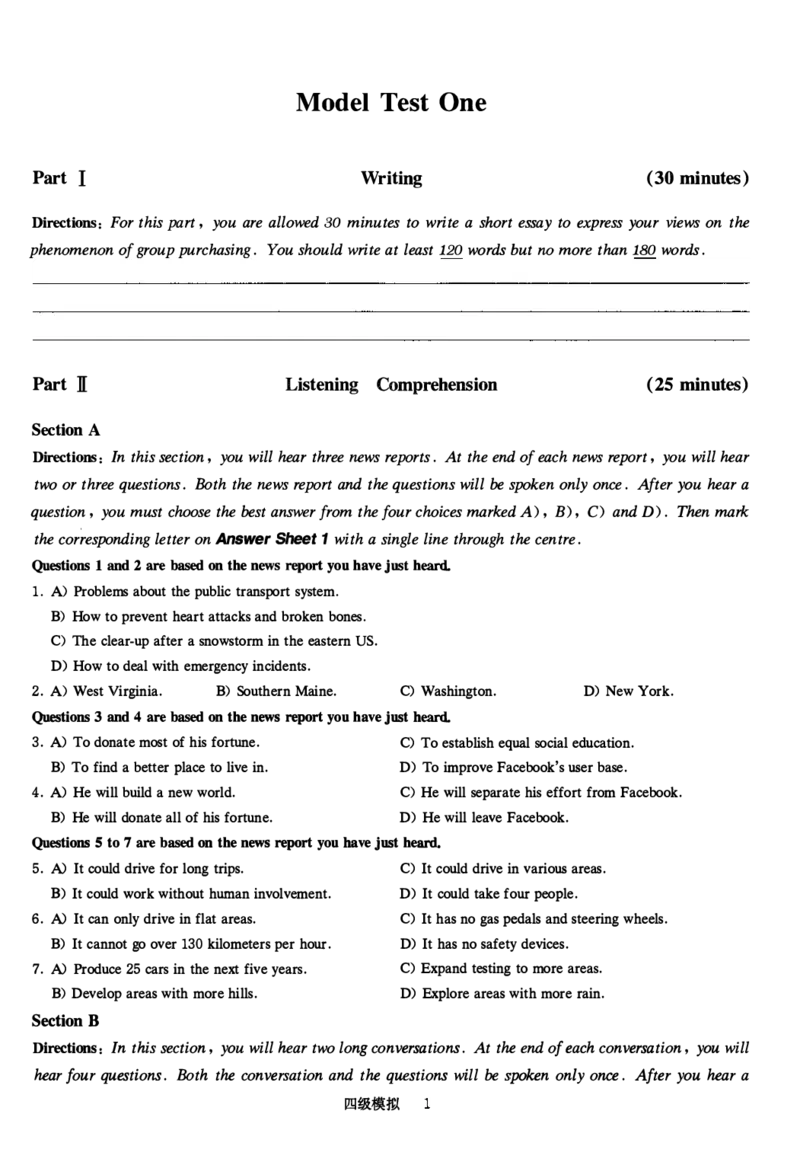
Model Test One
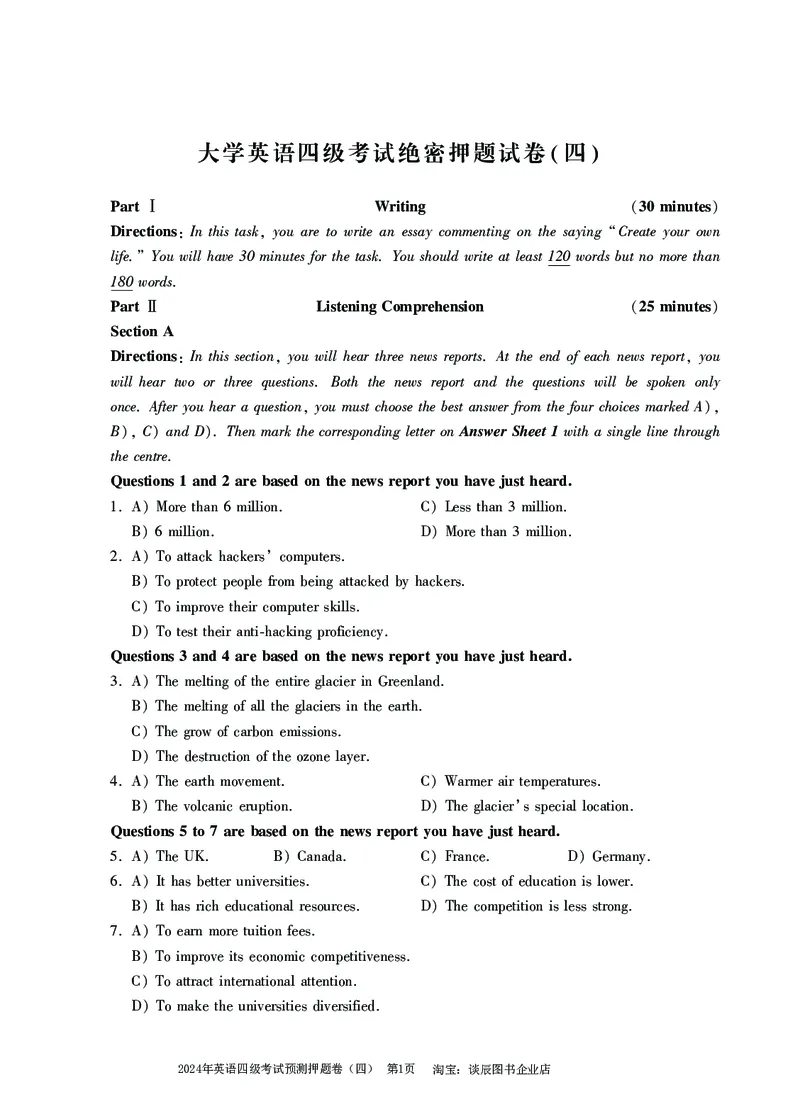
PartI Writing (30minutes)
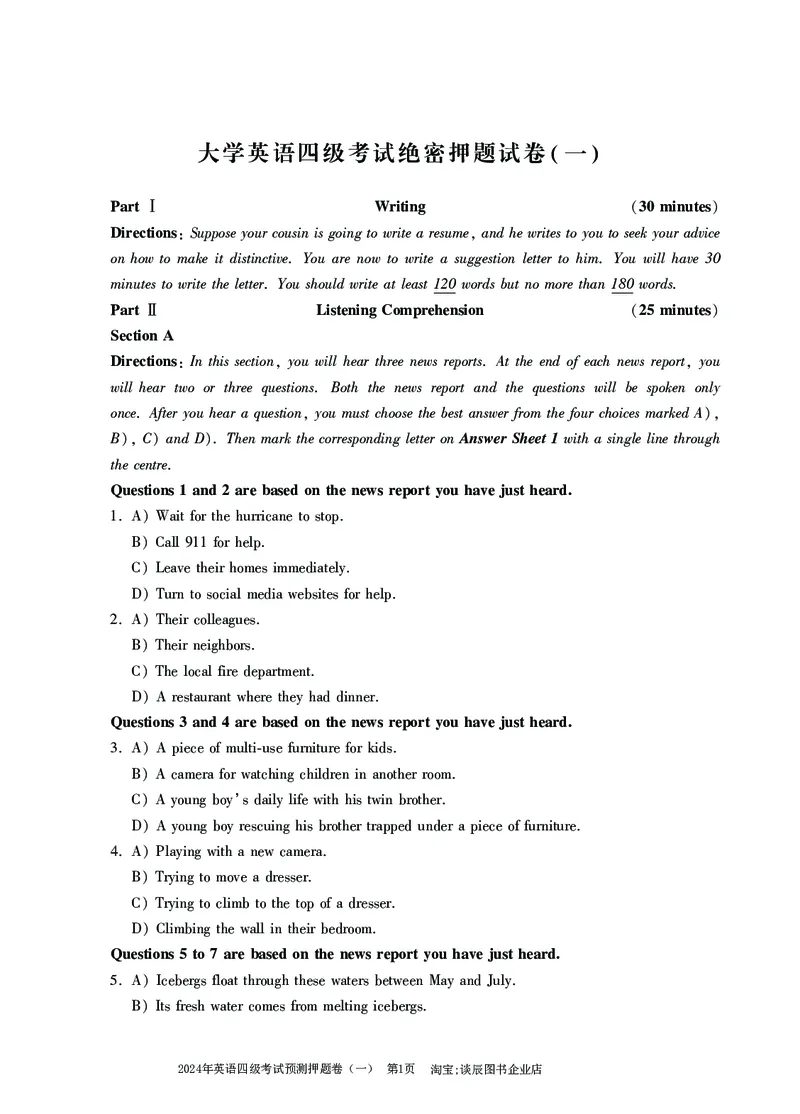
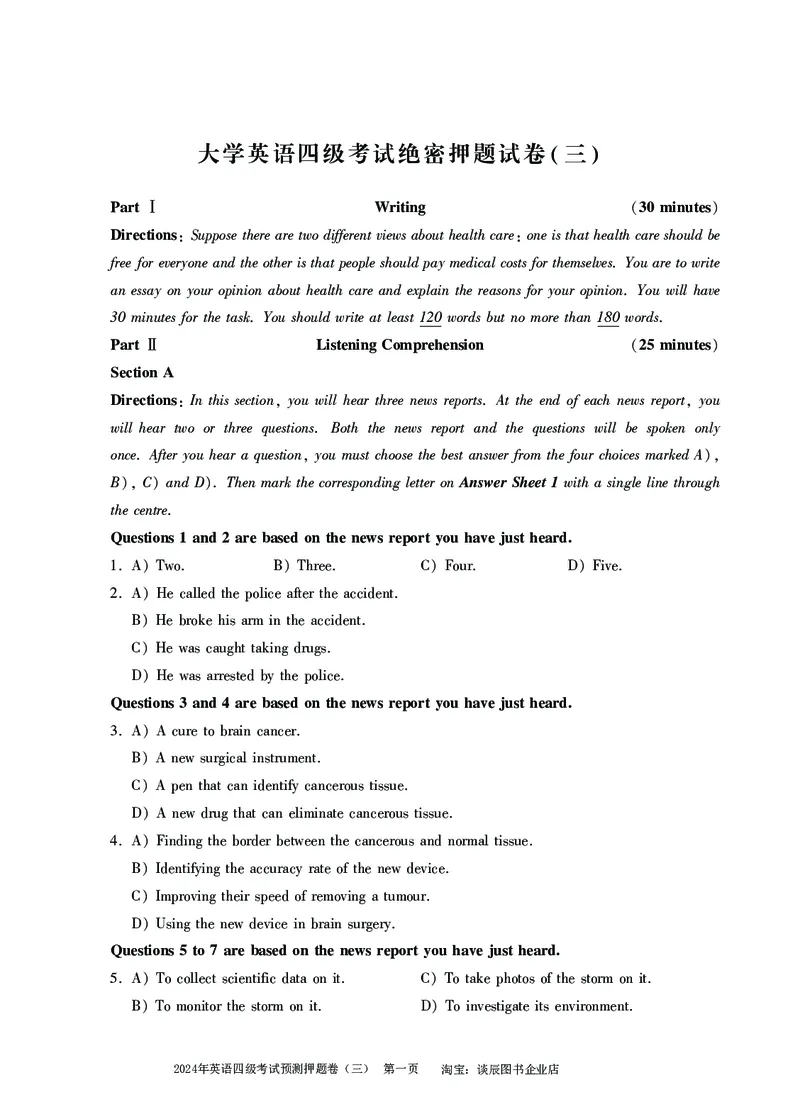
Directions:Forthispart,youareallowed30minutestowritealettertoofferyoursuggestionstoyourcousinwho
sought your advice on how to make his resume distinctive .You should write at least120 words but no more than
180words.
PartII ListeningComprehension (25minutes)
SectionA
Directions: In this section, you will hear three news reports.At the end of each conversation, you will hear four
questions. Both the news report and the questions will be spoken only once.After you hear a question, you must
choose the best answer from the four choices marked A), B), C) and D). Then mark the corresponding letter on
AnswerSheet 1withasinglelinethroughthecentre.
Questions1and2arebasedonthenewsreportyouhavejustheard.
1.A)Two. B)Three. C)Four. D)Five.
2.A)Hecalledthepoliceaftertheaccident.
B)Hebrokehisarmintheaccident.
C)Hewascaughttakingdrugs.
D)Hewasarrestedbythepolice.
Questions3and4arebasedonthenewsreportyouhavejustheard.
3.A)Acuretobraincancer.
B)Anewsurgicalinstrument.
C)Apenthatcanidentifycanceroustissue.
D)Anewdrugthatcaneliminatecanceroustissue.
4.A)Findingtheborderbetweenthecancerousandnormaltissue.
B)Identifyingtheaccuracyrateofthenewdevice.
C)Improvingtheirspeedofremovingatumour.
D)Usingthenewdeviceinbrainsurgery.
Questions5to7arebasedonthenewsreportyouhavejustheard.
5.A)Tocollectscientificdataonit. C)Totakephotosofthestormonit.
B)Tomonitorthestormonit. D)Toinvestigateitsenvironment.
6.A)Ithaslastedfornearly350years. B)Ithaslastedformorethat350months.
C)Itseemstobegettingsmaller. D)Itseemstobegettinglarger.
7.A)Whatinitiallycausedthestorm. C)Whatistheimpactofthestorm.
B)Whatisunderneaththestorm. D)Whatmakesthestormlastforsolong.
SectionB
Directions:In this section, you will hear two long conversations.At the end of each conversation, you will hear
four questions. Both the conversation and the questions will be spoken only once.After you hear a question, you
must choosethe bestanswer fromthe four choices markedA), B), C), andD).Then mark thecorresponding letter
onAnswerSheet 1withasinglelinethroughthecentre.Questions8to11arebasedontheconversationyouhavejustheard.
8.A)It’sfordisabledadults. B)It’sinasportscentre.
C)It’srewardingandchallenging. D)It’scompulsiveinhercommunity.
9.A)Theskillstheyneed. B)Theproductstheyhave.
C)Themarkettheytarget. D)Thelanguagetheyrequire.
10.A)Diversifymarketsandsalesstrategies. B)Reducecostsandjobs.
C)Learnfromothercompanies. D)Listentotheopinionsofexperts.
11.A)Thesalaryandtheworkload.
B)Theofficehourandthepenaltysystem.
C)Thewelfareandtheholidaysystem.
D)Theethicalpolicyandthecarbonfootprint.
Questions12to15arebasedontheconversationyouhavejustheard.
12.A)Double-deckerbuses.
B)ThetrafficinLondon.
C)Busroutes.
D)TravelsinBritain.
13.A)Ithasnowindows.
B)Peoplegetontoitatthefront.
C)Ithastwocarriages.
D)Itisopenattheback.
14.A)Uncomfortable. B)Noisy. C)Dangerous. D)Shabby.
15.A)Bendybusescanhelpreducethetrafficjam.
B)Bendybusesaremoreenvironmentallyfriendly.
C)Bendybusesareconvenientforpeopleinwheelchairs.
D)Bendybusesaremorepopularamongtourists.
SectionC
Directions:Inthissection,youwillhearthreepassages.Attheendofeachpassage,youwillhearsomequestions.
Both the passage and the questions will be spoken only once.After you hear a question,you must choose the best
answer from the fourchoices markedA), B), C)and D).Then mark the corresponding letter on Answer Sheet 1
withasinglelinethroughthecentre.
Questions16to18arebasedonthepassageyouhavejustheard.
16.A)Theyhadfourtoes.
B)Theywerenotasbigasdogs.
C)TheylivedinSouthAmerica.
D)Theylivedinthickforests.
17.A)Theyhadlonglegsandalongtail.
B)Theyweresmallerandhadfronteyes.
C)Theybegantoeatgrassaswellasfruit.
D)Theywerebiggerandhadlonglegs.
18.A)TheyevolvedintodonkeysinAsiaandAfrica.
B)TheyusedtheirlonglegstorunsouthtoSouthAfrica.
C)TheybegantoeatapplesontheNorthAmericanplains.
D)Theypreferredgrasstofruitandvegetables.
Questions19to21arebasedonthepassageyouhavejustheard.
19.A)Beingrejectedbyfriendsandteachers.
B)Stayingawayfromhisnativeland.C)Adaptingtonewstudyexpectations.
D)Keepingabalancebetweenstudyandjob.
20.A)Talkingwitholderbrothersorsisters. C)Startingaconversationwithclosefriends.
B)Havingacasualtalkwithacollegestudent. D)Playingwithfriendsonthesamesportsteam.
21.A)Followtraditionsofwithacollegestudent. C)Respectthecustomsofdifferentcolleges.
B)Takepartinasmanyactivitiesaspossible. D)Takeothers’adviceasreferenceonly.
Questions22to25arebasedonthepassageyouhavejustheard.
22.A) Theytendtoharmwildlife. C)Theyarethrownawayeverywhere.
B)Theyarehardlyrecyclable. D)Theyaremadefromuselessmaterials.
23.A)Itisfatal. B)Itisweird.
C)Itisveryserious. D)Itiscomplicated.
24.A)Theseacreaturesthathavetakeninthenareconsumedbyhumans.
B)Theocean’secologyhasbeenpollutedandaffectedhumans.
C)Humanseattheseabirdsthathaveswallowedplasticparticles.
D)Humansconsumethefishthathaveeatenseacreatureswiththem.
25.A)Itsusehasbeendrasticallyreduced. C)Mostproductsusenaturalmaterials.
B)Itisstillanindispensablematerial. D)Theuseofplasticitemswillbecharged.
PartⅢ Reading Comprehension (40minutes )
SectionA
Directions: In this section, there is a passage with ten blanks.You are required to select one word for each blank
from a list of choices given in a word bank following the passage. Read the passage through carefully before
making your choices. Each choice in the bank is identified by a letter. Please mark the corresponding letter for
each item on Answer Sheet 2 with a single line through the centre. You may not use any of the words in the
bankmorethanonce.
Questions26to35arebasedonthefollowingpassage.
Athird of the planet’s land is severely degraded and fertile soil is being lost at the rate of 24bn tonnes a year,
accordingtoanewUnitedNations-backedstudythatcallsforashiftawayfromdestructivelyintensiveagriculture,
The alarming ____26____, which is forecast to continue as demand for food and productive land increases, will
asstotherisksofconflictsunless____27____actionsareimplemented,warnstheinstitutionbehindthereport.
“As the ready supply of healthy and productive land dries up and the population grows, competition is
___28___for land within countries and globally,” said executive secretary of the UN Convention to Combat
Desertification (UNCCD) at the launch of the Global Land Outlook. “ To ___29____the losses, the outlook
suggestsitisinallourintereststostepbackandrethinkhowwearemanagingthepressuresandthecompetition.”
The Global Land Outlook is ____30____as the most comprehensive study of its type, mapping the interlinked
impacts of urbanization, climate change, erosion and forest loss. But the biggest factor is the ___31___of
industrial farming . Heavy tilling, multiple harvests ans ___32____use of agrochemicals have increased yields at
the____33____oflong-termsustainability.Ifthepast20years,agriculturalproductionhasincreasedthreefoldand
the amount of irrigated land has doubled, notes a paper in the outlook by the Joint Research Centre (JRC) of the
European commission. Over time, however, this ___34___fertility and can lead to abandonment of land and
___35___desertification.A)absorb I)limited
B)abundant J)minimize
C)billed K)occasionally
D)decline L)optimizes
E)diminishes M)rate
F)expansion N)remedial
G)expense O)ultimately
H)intensifying
SectionB
Directions: In this section, you are going to read a passage with ten statements attached to it. Each statement
containsinformationgiveninoneoftheparagraphs.Identifytheparagraphfromwhichtheinformationisderived.
You may choose a paragraph more than once. Each paragraph is marked with a letter. Answer the questions by
markingthecorrespondingletteronAnswerSheet2.
TakeNapsatWork.ApologizetoNoOne
[A] In the past two weeks I’ve taken three naps at work, a total of an hour or so of shut-eye while on the
clock. And I have no shame or uncertainty about doing it. I couldn’t feel better about it, and my productivity
reflectsit,too.
[B] Sleeping on the job is one of those workplace taboos-like leaving your desk for lunch or taking an
afternoon walk-that we’re taught to look down on. If someone naps at 2 p. m. while the rest of us furiously write
memosandrespondtoemails,surelyitmustmeanthey’reslackingoff(偷懒).Orsotheassumptiongoes.
[C] Restfulness and recharging can take a back seat to the perception and appearance of productivity. It’s
easier to stay on a virtual hamster (仓鼠) wheelof activity by immediately responding to every email than it is to
measure aggregate productivity over a greater period of time. But a growing field of occupational and
psychologicalresearchisbuildingthecaseforrestfulnessinpursuitofgreaterproductivity.
[D] Companies aresufferingfrom tremendousproductivity problems becausepeopleare stressedoutandnot
recovering from the workday, said Josh Bersin, Principal and Founder of Bersin by Deloitte. “They’re beginning
to realize that this is their problem ,and they can’t just say to people, ‘Here’s a work-life balance course, go teach
yourselfhowtomanageyourinbox,’”Mr.Bersinsaid.“It’swaymorecomplicatedthanthat.”
[E]Tobesure,theability to napatworkis far fromwidespread,experts said.Few amongushave the luxury
ofbeingabletostepawayforahalf-hoursnoozefest.Butlunchhoursandcoffeebreakscanbegreattimestoduck
out,andyourincreasedproductivityandalertnesswillbealltheevidenceyouneedtomake yourcasetoinquiring
bosses.
[F] In an ideal world, we’d all solve this problem by unplugging early and getting a good night’s sleep.
Here’s our guide on how to do just that .But the next best thing is stealing away for a quick power nap when
you’redraggingafterlunch.
[G] In a study published in Nature Neuroscience, researchers tested subjects on their perceptualperformance
four times throughout the day. Performance deteriorated with each test, but subjects who took a 30-minute nap
betweentestsstoppedthedeteriorationinperformance,andthosewhotooka60-minutenapevenreversedit.
[H] “Naps had the same magnitude of benefits as full nights of sleep if they had a quality of nap.” said Sara
Mednick,aco-authorofthestudyandassociateprofessorofpsychologyattheUniversityofCalifornia,Riverside.
[I] Dr. Mednick, a sleep researcher and the author of Take a Nap! Change Your Life , said daytime napping
canhavemanyofthebenefitsofovernightsleep,anddifferenttypesofnapsofferspecificbenefits.
[J]For example,Dr.Mednicksaida20-to60-minutenapmighthelpwithmemorizationandlearningspecific
bitsofinformation.It’sjustlongenoughtoenterstage-twosleep,ornon-rapideyemovement(R.E.M.)sleep.
[K] After 60 minutes, you start getting into R.E.M. sleep, most often associated with that deep, dreaming
state we all enjoy at night R.E.M. sleep can improve creativity, perceptual processing and highly associativethinking , which allows you to make connections between disparate ideas, Dr. Mednick said. Beyond that , your
bestbetisa90-minutenap,whichwillgiveyouafullsleepcycle.
[L]Any nap, however, can help with alertness and perception and cut through the general fog that creeps in
duringtheday,expertssaid.
[M] So how did we even arrive atthis pointwhereaptitude is inextricably tied (紧密相连) to working long,
concentrated hours? Blame technology,but think broader than smartphones and laptops; the real issue is that tech
hasenabledustobeavailableatalltimes.
[N] “We went through a period where people were in denial and business leaders were ignoring it, ”Mr.
Bersin said. “They were assuming that if we give people more tools, more emails, more Slack , more chatter, and
we’lljustassume theycanfigure outhowtodealwith itall.AndI thinkthey’ve wokenuptothe factthatthis is a
bigproblem,anditisaffectingproductivity,engagement,health,safety,wellnessandallsortsofthings.”
[O] It isn’t just office workers who can benefit from an afternoon siesta (午睡).A2015 study published in
Current Biology looked at the at the sleeping habits of three hunter-gatherer preindustrial societies in Tanzania,
NamibiaandBolivia.
[P] “They’re active in the morning, then they get in the shade under the trees and have a sort of quiet time,
but they’re not generally napping,” said Jerome Siegel, professor of psychiatry and biobehavioral sciences, and
director of the U.C.L.A. Center for Sleep Research, a co-author of the study.“Then they do some work and go to
sleep,andtheysleepthroughthenight.”
[Q] Still, Mr. Siegel said, “the only genuine way to solve daytime sleepiness and fatigue starts the night
beforewith a solid night’s sleep.”The real Holy Grail of restfulness is a regular sleep schedule with ideally seven
oreighthoursofsleepeachnight,whichexpertssayisoptimal.
[R] “Daytime napping certainly does increase alertness,” Mr. Siegel said. “But it’s not as simple as going to
thegasstationandfillingthetank.”
[S] He also advises avoiding caffeine late in the day and waking around the same time every morning, even
if you can’t get to sleep at the same time every night, This helps acclimate (使适应) your body to your regular
wake-uptime,regardlessofhowmuchsleepyougotthenightbefore.
[T] So if you’ve made it this far and you’re interested in giving workday naps a try (or just starting to nod
off),here’saquickguidetotheperfectnap;
Findaquiet,unoccupiedspacewhereyouwon’tbedisturbed.
Try to make your area as dim as possible ( or invest in a sleep mask you can keep in the office ). Earplugs
mighthelp.too.
Aim for around 20 minutes. Any longer than that and you’re likely to wake up with sleep inertia (睡眠惰
性) ,whichwillleaveyouevengroggier(头脑昏沉的)thanbefore.
36. Participants’ perceptual performance became better after sleeping one hour between tests in an article in
NatureNeuroscience.
37. Jerome Siegel found that only by sleeping soundly through the previous night could people tackle their
wearinessduringtheday.
38. Our talent is closely bound to working with concentration for long periods of time because technology
makesusaccessible24/7.
39. Taking a nap at work is normally regarded as laziness that should be held in contempt and avoided in
workplace.
40. Between 20 to 60 minutes, people can get into non-REM sleep which may improve memory and learning
abilityaccordingtoDr.Mednick.
41. People can doze off at lunch and coffee breaks and defended themselves by saying their improved
productivityandalertnesswhenbossesinvestigatedtheirwhereabouts.
42.Theauthor’stipsontakingaperfectnapinvolvesleepingplace,environmentandduration.43. The author believes business leaders are aware that availability at any time due to technology has negative
effectsoneveryaspectofpeople’slife.
44.Theoptimallengthofanapwasanhourandahalfsothatpeoplecouldgothroughacompletesleepcycle.
45. Josh Bersin mentioned the cause of companies’ big productivity problems and the solution which needs
morethatjustemployees’efforts.
SectionC
Directions: There are 2 passages in this section. Each passage is followed by some questions or unfinished
statements. For each of them there are four choices marked A), B), C) and D). You should decide on the best
choiceandmarkthecorrespondingletteronAnswerSheet 2withasinglelinethroughthecentre.
PassageOne
Questions46to50arebasedonthefollowingpassage.
Every office worker hates meetings. But it’s a strange sort of hate, similar to the hatred of Londoners for the
Northern Line, or NewYorkers for tourists who walk too slowly: the dislike is real, yet if the despised thing were
tovanish,it’dbelikesurrenderingapieceofyoursoul.
When researchers probedinto why people put upwith the strain thatmeetings placeon their time and sanity,
they found something-those who resent and dread meetings the moat also defend them as a “necessary evil”,
sometimes with great passion.True,research suggests thatmeetings take up vastly more of the average manager’s
time than they used to. True, done badly, they’re associated with lower levels of innovation and employee
wellbeing(幸福).Butthat’sjustofficelife,right?It’snotsupposedtobefun.That’swhytheycallitwork.
Underlying(引起) this attitude is an assumption that’s drummed into us not just as workers but as children,
parents andromantic partners;that more communication is always a good thing. So suggestions abound for (大量
存在) communicating better in meetings-for example, hold them standing up, so speakers will come to the point
more quickly. But even when some companies consider abolishing meetings entirely, the principle that more
communicationisbetterisn’tquestioned.Ifanything, it’sreinforcedwhensuchfirmsintroduce“flat”management
structures, with bosses always available to everyone, plus plenty of electronic distraction. In fact, constant
connectivityisdisastrousforbothjobsatisfactionandthebottomline.
And anyway,once you give it three seconds’thought , isn’t it cleatthat more communication frequently isn’t
agood thing? Often, the differencebetween a successfulmarriage and asecond-rate oneconsists of leaving about
three or four things a day unsaid.At work, it’s surely many more than four, though for a different reason; office
communication comes at the cost of precisely the kind of focus that’s essential to good work. Yet we’re so
accustomed to seeing talking as a source of solutions-for resolving conflicts or finding new ideas-that it’s hard to
seewhenitistheproblem.
46.Whatdoestheauthorsayaboutmeetings?
A)LondonershatethemaswellastheNorthernLine.
B)Theycanhelptokeepworkers’physicalandspiritualhealth.
C)Workersmightbereluctanttogiveupthemcompletely.
D)NewYorkersdislikemeetingsmorethanLondoners.
47.Whatdidresearchersfindaboutpeople’sattitudetowardsmeeting?
A.Theirattitudeandbehaviorareparadoxical.
B)Peoplewhohatemeetingsthemostareseniorinsane.
C)Thosewholikemeetingsmightbeconsideredinsane.
D)Moremeetingsareregardedasasignoflessinnovation.
48.Whydopeoplethinkthatmorecommunicationisalwaysagoodthing?
A)Becausetheconceptisfirmlybelievedbyworkers.
B)Becauseeveryonelovestocommunicatewithothers.
C)Becausetheideahasbeeninstilledintopeople’smind.D)Becausecommunicationisvitalforbuildingrelationships.
49.Whatdoestheauthorthinkofthe“flat”managementstructure?
A)Itforcesbossestofrequentlycontacttheiremployees.
B)Ithelpstosoftenemployees’bottomlineofwork.
C)Itisdefinitelyadisastertoemployees’jobsatisfaction.
D)Itstrengthenspeople’sdeeply-rootednotionofcommunication.
50.Whatistheauthor’sargumentaboutofficecommunication?
A)Itisaneffectivewaytosolveofficeconflicts.
B)Itaffectsworkefficiencyinanegativeway.
C)Itshouldcometoahaltatintervals.
D)Itisusefulforworkerstofindnewideas.
PassageTwo
Questions51to55arebasedonthefollowingpassage.
TheInternethasenabledthespreadofinformationatlightningspeed.Thisinformationrevolutionhascreated
tremendous business opportunities for online publishers, but not all of them maintain proper quality-control
mechanisms to ensure that only good information is being shared. Instead, many publishers aim simply to make
moneybywhatevermeanspossible,withnoregardfortheimplicationsforsocietyatlarge.
When selfish publishers set up shops online, the primary goal is to publish as much as possible, often at the
cost of quality. In this respect, many publishers start numerous online journals focused on overlapping(重叠
的)disciplines—toincreasetheirtotalnumberofpublishedpapers—andhireyoungbusinessmanagerswhodonot
have any experience in either science or publishing. In some cases, online publishers even give up peer review,
while still presenting themselves as scientific journals—deception designed to take advantage of scientists who
simplywanttosharetheirresearch.
If publishers structure their business to make more revenue, it often does harm to their products. When
publishers start journals with overlapping domains, in combination with the pressure to publish more studies, this
could promote the publication of marginal or even questionable articles. Moreover, publishers with multiple
overlapping journals and journals with very narrow specialties(专业)increase the demands on the time and efforts
of willing reviewers. With the fact that reviewers are generally not compensated for their time and effort, journal
editorsareoftenunabletofindenoughreviewerstokeepupwiththeincreasedpublicationrate.
To improve the situation and increase the trust in scientific community, the pressure to publish must be
reduced. Funding and promotion decisions should not be based on the number of publications, but on the quality
ofthosepublicationsandaresearcher’slong-termproductivityandinstructions.
Andthat’sjustthestart.Weneedadditionalmechanisms,suchasBeall’slistofpredatory(掠夺的)publishers,
to alert scientists to fake journals andfake articles. In addition, the price for online publication must be controlled
andamechanismmustbeputinplacetohonorandrewardhard-workingreviewers.
51.Whatdoestheauthorthinkofonlinepublishers?
A)Asmallproportionofthemcanguaranteetheirpublishingquality.
B)Theyhavelotsofopportunitiestorenovatetheirbusinessmodels.
C)Manyofthemtendtotryeverymeanstomakeabuck.
D)Socialimpactistheirfirstprioritywhenpublishingbooks.
52.Itcanbeinferredfromthesecondparagraphthat______.
A)peerreviewgenerallyisacriteriontoidentifyacademicjournals
B)researchersfocustheirresearchonthecombinationofdisciplines
C)scientistscareabouttheirpublicationsratherthanresearch
D)youngbusinessmanagersarewillingtofacenewchallenges53.Whycan’tpublishersfindenoughreviewerstoreviewpapers?
A)Reviewersarepressedfortimewhenreviewingarticles.
B)Reviewers’gainscan’tmakeupforwhattheyhavedone.
C)Publishersmaycompelreviewerstoacceptmarginalarticles.
D)Publishersurgereviewerstoincreasepublicationraterapidly.
54.Whatistheauthor’ssuggestionforonlinepublication?
A)Moreweightshouldbeputonthequantityofpublications.
B)Itisworthwhiletorewarddiligentreviewersfortheireffort.
C)Fakejournalsshouldbereportedtoaregulatoryorganization.
D)Thepriceofonlinepublicationshouldbeloweredgreatly.
55.Whatisthemainideaofthispassage?
A)Onlinepublishersshouldtakemeasurestofightagainstfakescientificjournals.
B)Onlinepublishersarepursuingtheirworkefficiencyatthecostofquality.
C)Onlinepublishersbusinessmodelsarequitelikelytoharmtheirpublications.
D)Onlinepublishersaresacrificingthequalityofresearcharticlestomakemoney.
PartⅣ Translation (30 minutes)
Directions:Forthispart,youareallowed30minutestotranslateapassagefromChineseinto
English.YoushouldwriteyouransweronAnswerSheet2.
春节是中国的传统节日,相当于美国的圣诞节。美国小孩能从圣诞老人哪里获得圣诞礼物,而中国小
孩则能从长辈哪里得到“压岁钱(luckymoney) ”,这也是每个孩子过节时都热切期盼的礼物。“压岁
钱”是长辈送给孩子的护身符(amulet),表达了长辈对孩子的美好祝福,据说可以使孩子平平安安地度
过新的一年。“压岁钱”可在晚辈磕头拜年后当众赏给,也可在除夕夜孩子睡着时,家长偷偷地放在孩子
的枕头底下。