2022-2023学年九年级英语全一册单元模块满分必刷题(人教版)
Unit 10【刷速度】(模块过关检测练)
时间:60分钟 满分:100分
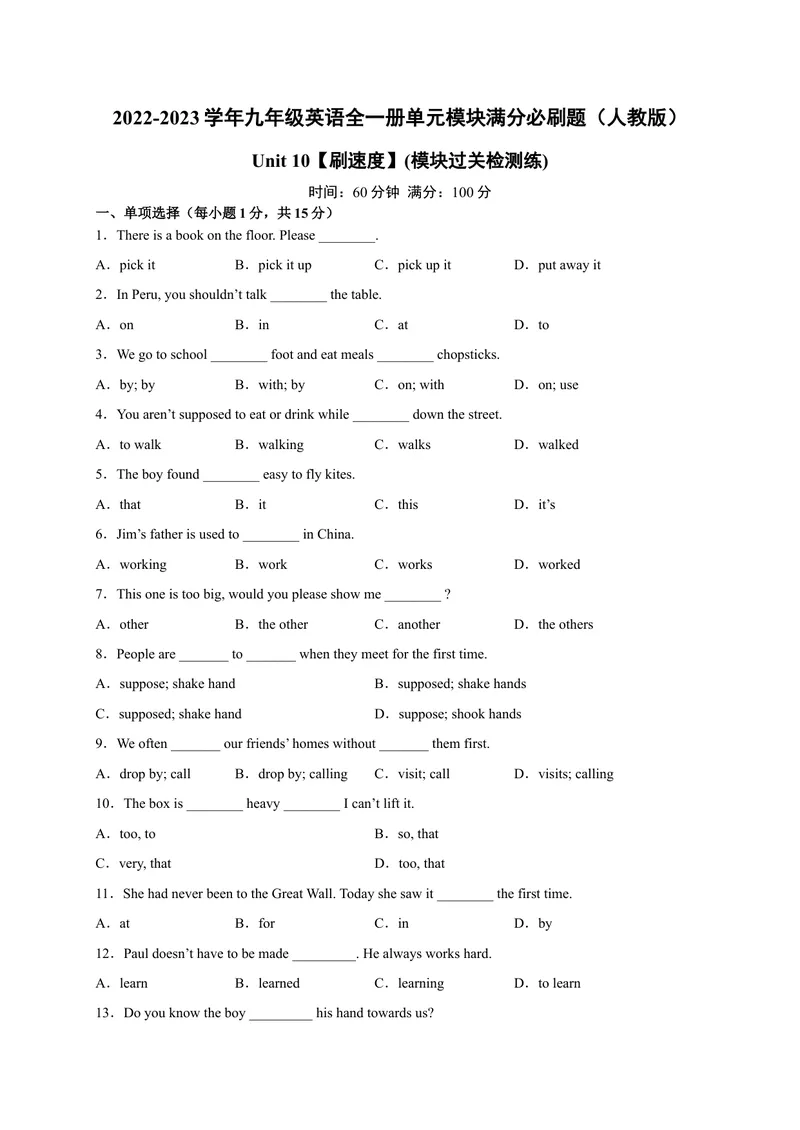
一、单项选择(每小题1分,共15分)
1.There is a book on the floor. Please ________.
A.pick it B.pick it up C.pick up it D.put away it
2.In Peru, you shouldn’t talk ________ the table.
A.on B.in C.at D.to
3.We go to school ________ foot and eat meals ________ chopsticks.
A.by; by B.with; by C.on; with D.on; use
4.You aren’t supposed to eat or drink while ________ down the street.
A.to walk B.walking C.walks D.walked
5.The boy found ________ easy to fly kites.
A.that B.it C.this D.it’s
6.Jim’s father is used to ________ in China.
A.working B.work C.works D.worked
7.This one is too big, would you please show me ________ ?
A.other B.the other C.another D.the others
8.People are _______ to _______ when they meet for the first time.
A.suppose; shake hand B.supposed; shake hands
C.supposed; shake hand D.suppose; shook hands
9.We often _______ our friends’ homes without _______ them first.
A.drop by; call B.drop by; calling C.visit; call D.visits; calling
10.The box is ________ heavy ________ I can’t lift it.
A.too, to B.so, that
C.very, that D.too, that
11.She had never been to the Great Wall. Today she saw it ________ the first time.
A.at B.for C.in D.by
12.Paul doesn’t have to be made _________. He always works hard.
A.learn B.learned C.learning D.to learn
13.Do you know the boy _________ his hand towards us?A.waves B.to wave C.waving D.wave
14.Do you need ________ to read on the train?
A.special anything B.any special thing C.anything specially D.anything special
15.—Will you come to the dinner party?
—I won't come until Jenny ____.
A.will be invited B.can be invited
C.invited D.is invited
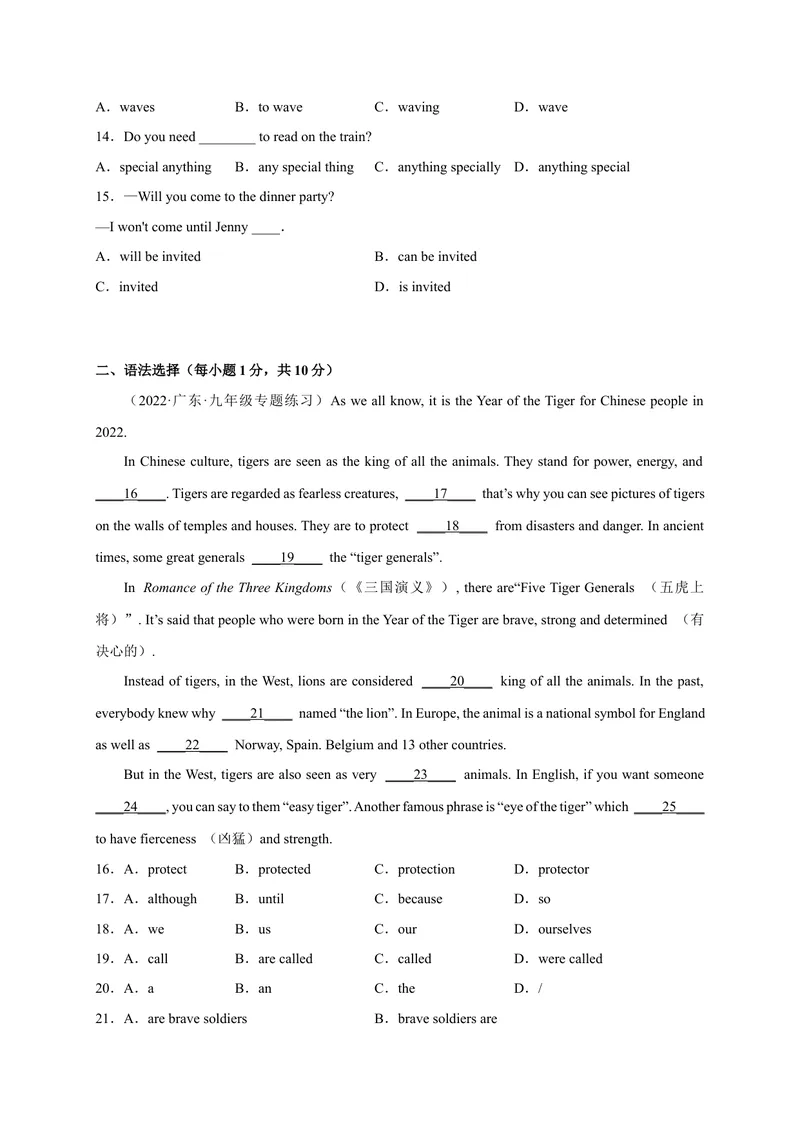
二、语法选择(每小题1分,共10分)
(2022·广东·九年级专题练习)As we all know, it is the Year of the Tiger for Chinese people in
2022.
In Chinese culture, tigers are seen as the king of all the animals. They stand for power, energy, and
____16____. Tigers are regarded as fearless creatures, ____17____ that’s why you can see pictures of tigers
on the walls of temples and houses. They are to protect ____18____ from disasters and danger. In ancient
times, some great generals ____19____ the “tiger generals”.
In Romance of the Three Kingdoms(《三国演义》), there are“Five Tiger Generals (五虎上
将)”. It’s said that people who were born in the Year of the Tiger are brave, strong and determined (有
决心的).
Instead of tigers, in the West, lions are considered ____20____ king of all the animals. In the past,
everybody knew why ____21____ named “the lion”. In Europe, the animal is a national symbol for England
as well as ____22____ Norway, Spain. Belgium and 13 other countries.
But in the West, tigers are also seen as very ____23____ animals. In English, if you want someone
____24____, you can say to them “easy tiger”. Another famous phrase is “eye of the tiger” which ____25____
to have fierceness (凶猛)and strength.
16.A.protect B.protected C.protection D.protector
17.A.although B.until C.because D.so
18.A.we B.us C.our D.ourselves
19.A.call B.are called C.called D.were called
20.A.a B.an C.the D./
21.A.are brave soldiers B.brave soldiers areC.were brave soldiers D.brave soldiers were
22.A.to B.for C.with D.through
23.A.powerful B.more powerful C.most powerful D.the most powerful
24.A.calm down B.calming down C.to calm down D.calmed down
25.A.means B.meant C.is meaning D.has meant
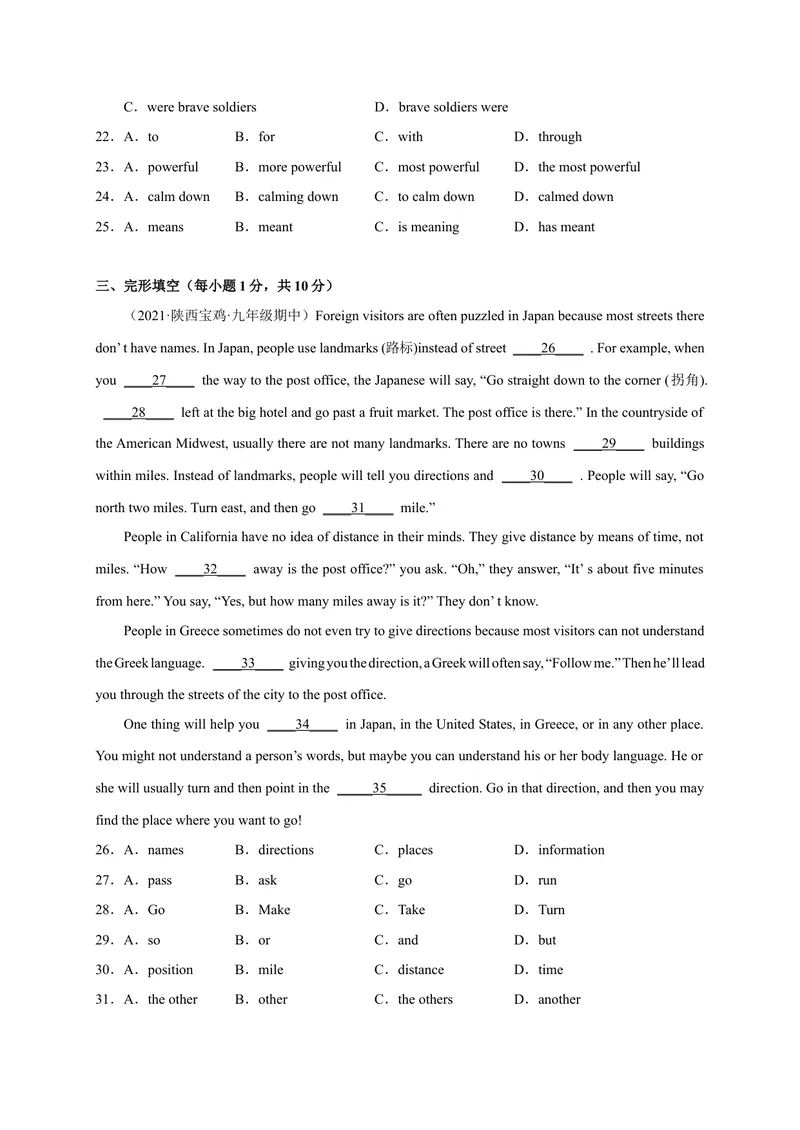
三、完形填空(每小题1分,共10分)
(2021·陕西宝鸡·九年级期中)Foreign visitors are often puzzled in Japan because most streets there
don’ t have names. In Japan, people use landmarks (路标)instead of street ____26____ . For example, when
you ____27____ the way to the post office, the Japanese will say, “Go straight down to the corner (拐角).
____28____ left at the big hotel and go past a fruit market. The post office is there.” In the countryside of
the American Midwest, usually there are not many landmarks. There are no towns ____29____ buildings
within miles. Instead of landmarks, people will tell you directions and ____30____ . People will say, “Go
north two miles. Turn east, and then go ____31____ mile.”
People in California have no idea of distance in their minds. They give distance by means of time, not
miles. “How ____32____ away is the post office?” you ask. “Oh,” they answer, “It’ s about five minutes
from here.” You say, “Yes, but how many miles away is it?” They don’ t know.
People in Greece sometimes do not even try to give directions because most visitors can not understand
the Greek language. ____33____ giving you the direction, a Greek will often say, “Follow me.” Then he’ ll lead
you through the streets of the city to the post office.
One thing will help you ____34____ in Japan, in the United States, in Greece, or in any other place.
You might not understand a person’s words, but maybe you can understand his or her body language. He or
she will usually turn and then point in the _____35_____ direction. Go in that direction, and then you may
find the place where you want to go!
26.A.names B.directions C.places D.information
27.A.pass B.ask C.go D.run
28.A.Go B.Make C.Take D.Turn
29.A.so B.or C.and D.but
30.A.position B.mile C.distance D.time
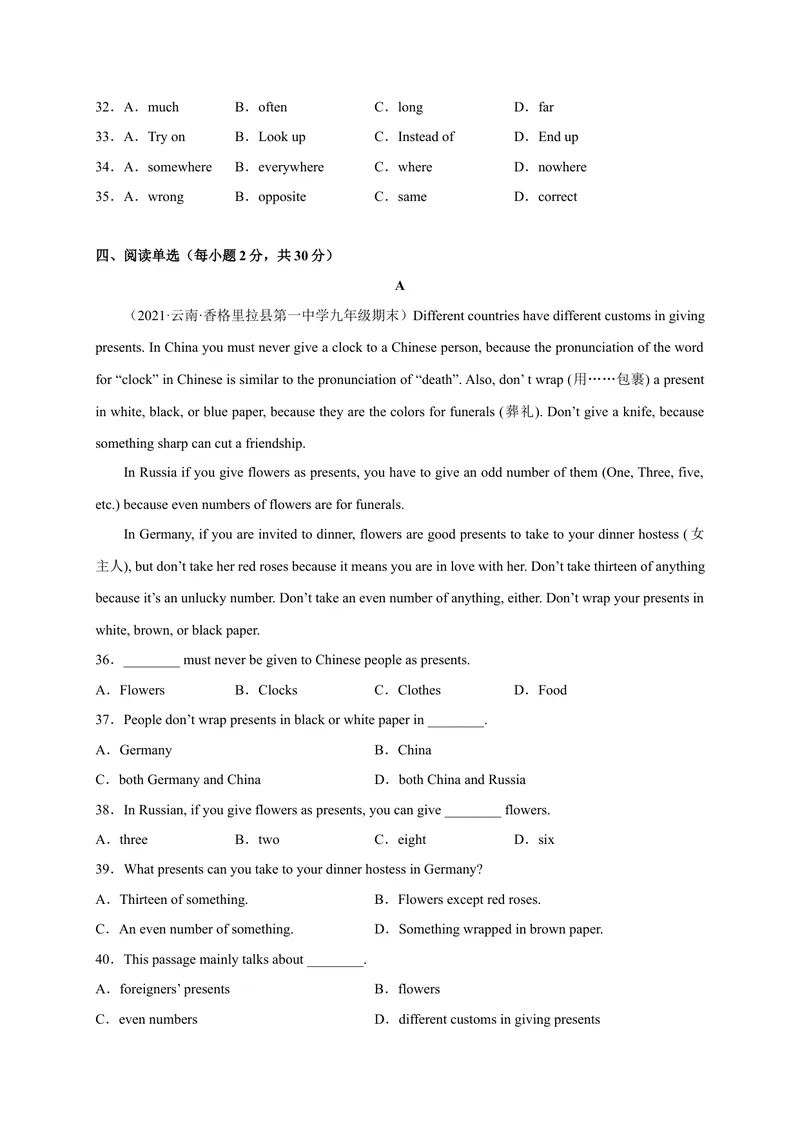
31.A.the other B.other C.the others D.another32.A.much B.often C.long D.far
33.A.Try on B.Look up C.Instead of D.End up
34.A.somewhere B.everywhere C.where D.nowhere
35.A.wrong B.opposite C.same D.correct
四、阅读单选(每小题2分,共30分)
A
(2021·云南·香格里拉县第一中学九年级期末)Different countries have different customs in giving
presents. In China you must never give a clock to a Chinese person, because the pronunciation of the word
for “clock” in Chinese is similar to the pronunciation of “death”. Also, don’ t wrap (用……包裹) a present
in white, black, or blue paper, because they are the colors for funerals (葬礼). Don’t give a knife, because
something sharp can cut a friendship.
In Russia if you give flowers as presents, you have to give an odd number of them (One, Three, five,
etc.) because even numbers of flowers are for funerals.
In Germany, if you are invited to dinner, flowers are good presents to take to your dinner hostess (女
主人), but don’t take her red roses because it means you are in love with her. Don’t take thirteen of anything
because it’s an unlucky number. Don’t take an even number of anything, either. Don’t wrap your presents in
white, brown, or black paper.
36.________ must never be given to Chinese people as presents.
A.Flowers B.Clocks C.Clothes D.Food
37.People don’t wrap presents in black or white paper in ________.
A.Germany B.China
C.both Germany and China D.both China and Russia
38.In Russian, if you give flowers as presents, you can give ________ flowers.
A.three B.two C.eight D.six
39.What presents can you take to your dinner hostess in Germany?
A.Thirteen of something. B.Flowers except red roses.
C.An even number of something. D.Something wrapped in brown paper.
40.This passage mainly talks about ________.
A.foreigners’ presents B.flowers
C.even numbers D.different customs in giving presentsB
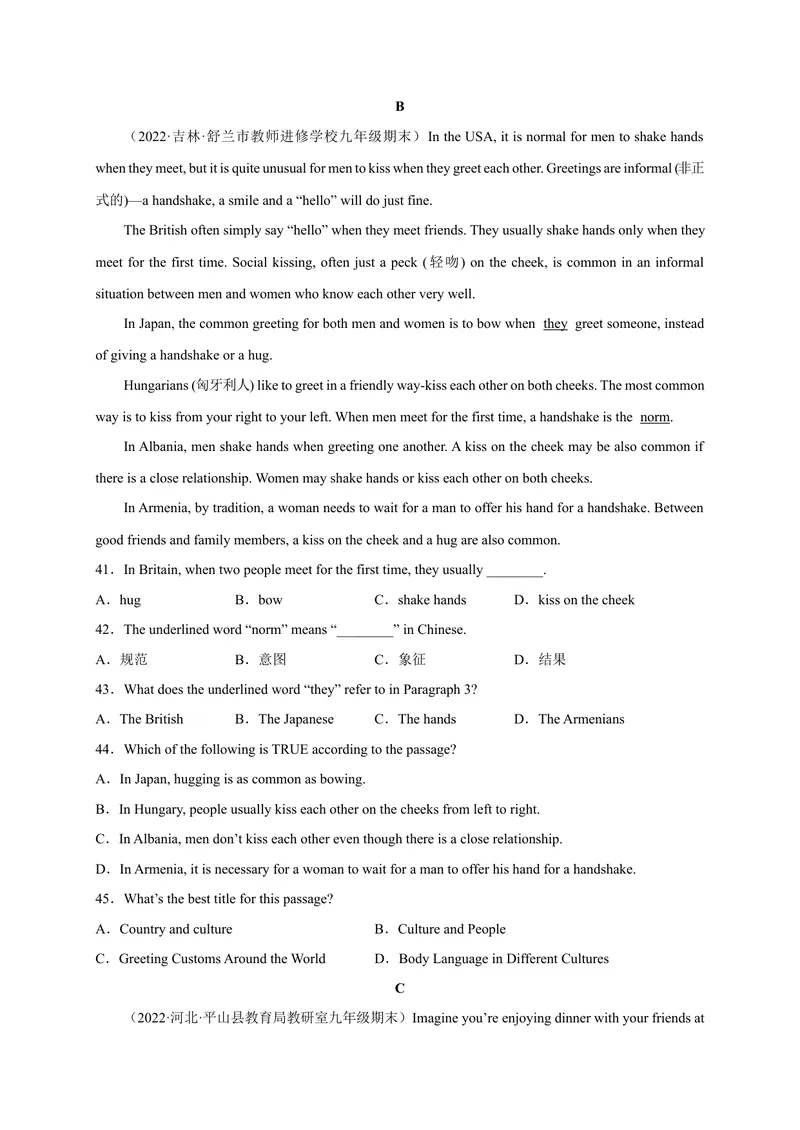
(2022·吉林·舒兰市教师进修学校九年级期末)In the USA, it is normal for men to shake hands
when they meet, but it is quite unusual for men to kiss when they greet each other. Greetings are informal (非正
式的)—a handshake, a smile and a “hello” will do just fine.
The British often simply say “hello” when they meet friends. They usually shake hands only when they
meet for the first time. Social kissing, often just a peck (轻吻) on the cheek, is common in an informal
situation between men and women who know each other very well.
In Japan, the common greeting for both men and women is to bow when they greet someone, instead
of giving a handshake or a hug.
Hungarians (匈牙利人) like to greet in a friendly way-kiss each other on both cheeks. The most common
way is to kiss from your right to your left. When men meet for the first time, a handshake is the norm.
In Albania, men shake hands when greeting one another. A kiss on the cheek may be also common if
there is a close relationship. Women may shake hands or kiss each other on both cheeks.
In Armenia, by tradition, a woman needs to wait for a man to offer his hand for a handshake. Between
good friends and family members, a kiss on the cheek and a hug are also common.
41.In Britain, when two people meet for the first time, they usually ________.
A.hug B.bow C.shake hands D.kiss on the cheek
42.The underlined word “norm” means “________” in Chinese.
A.规范 B.意图 C.象征 D.结果
43.What does the underlined word “they” refer to in Paragraph 3?
A.The British B.The Japanese C.The hands D.The Armenians
44.Which of the following is TRUE according to the passage?
A.In Japan, hugging is as common as bowing.
B.In Hungary, people usually kiss each other on the cheeks from left to right.
C.In Albania, men don’t kiss each other even though there is a close relationship.
D.In Armenia, it is necessary for a woman to wait for a man to offer his hand for a handshake.
45.What’s the best title for this passage?
A.Country and culture B.Culture and People
C.Greeting Customs Around the World D.Body Language in Different Cultures
C
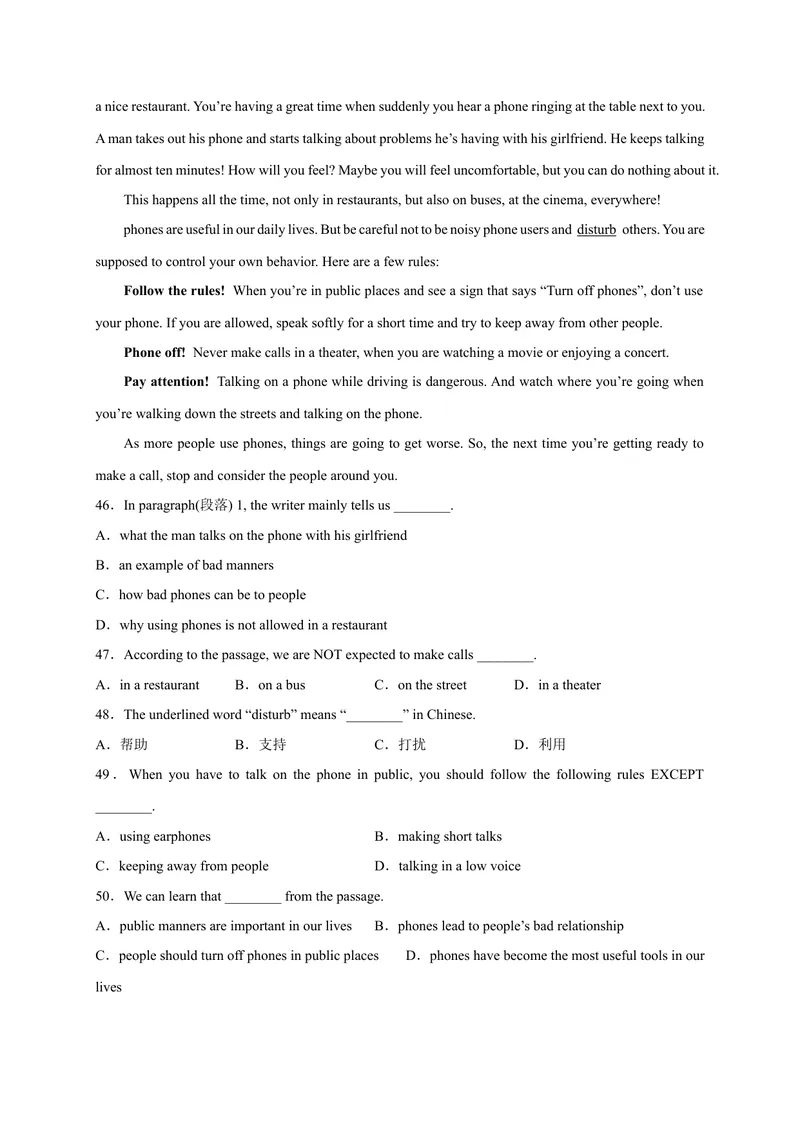
(2022·河北·平山县教育局教研室九年级期末)Imagine you’re enjoying dinner with your friends ata nice restaurant. You’re having a great time when suddenly you hear a phone ringing at the table next to you.
A man takes out his phone and starts talking about problems he’s having with his girlfriend. He keeps talking
for almost ten minutes! How will you feel? Maybe you will feel uncomfortable, but you can do nothing about it.
This happens all the time, not only in restaurants, but also on buses, at the cinema, everywhere!
phones are useful in our daily lives. But be careful not to be noisy phone users and disturb others. You are
supposed to control your own behavior. Here are a few rules:
Follow the rules! When you’re in public places and see a sign that says “Turn off phones”, don’t use
your phone. If you are allowed, speak softly for a short time and try to keep away from other people.
Phone off! Never make calls in a theater, when you are watching a movie or enjoying a concert.
Pay attention! Talking on a phone while driving is dangerous. And watch where you’re going when
you’re walking down the streets and talking on the phone.
As more people use phones, things are going to get worse. So, the next time you’re getting ready to
make a call, stop and consider the people around you.
46.In paragraph(段落) 1, the writer mainly tells us ________.
A.what the man talks on the phone with his girlfriend
B.an example of bad manners
C.how bad phones can be to people
D.why using phones is not allowed in a restaurant
47.According to the passage, we are NOT expected to make calls ________.
A.in a restaurant B.on a bus C.on the street D.in a theater
48.The underlined word “disturb” means “________” in Chinese.
A.帮助 B.支持 C.打扰 D.利用
49.When you have to talk on the phone in public, you should follow the following rules EXCEPT
________.
A.using earphones B.making short talks
C.keeping away from people D.talking in a low voice
50.We can learn that ________ from the passage.
A.public manners are important in our lives B.phones lead to people’s bad relationship
C.people should turn off phones in public places D.phones have become the most useful tools in our
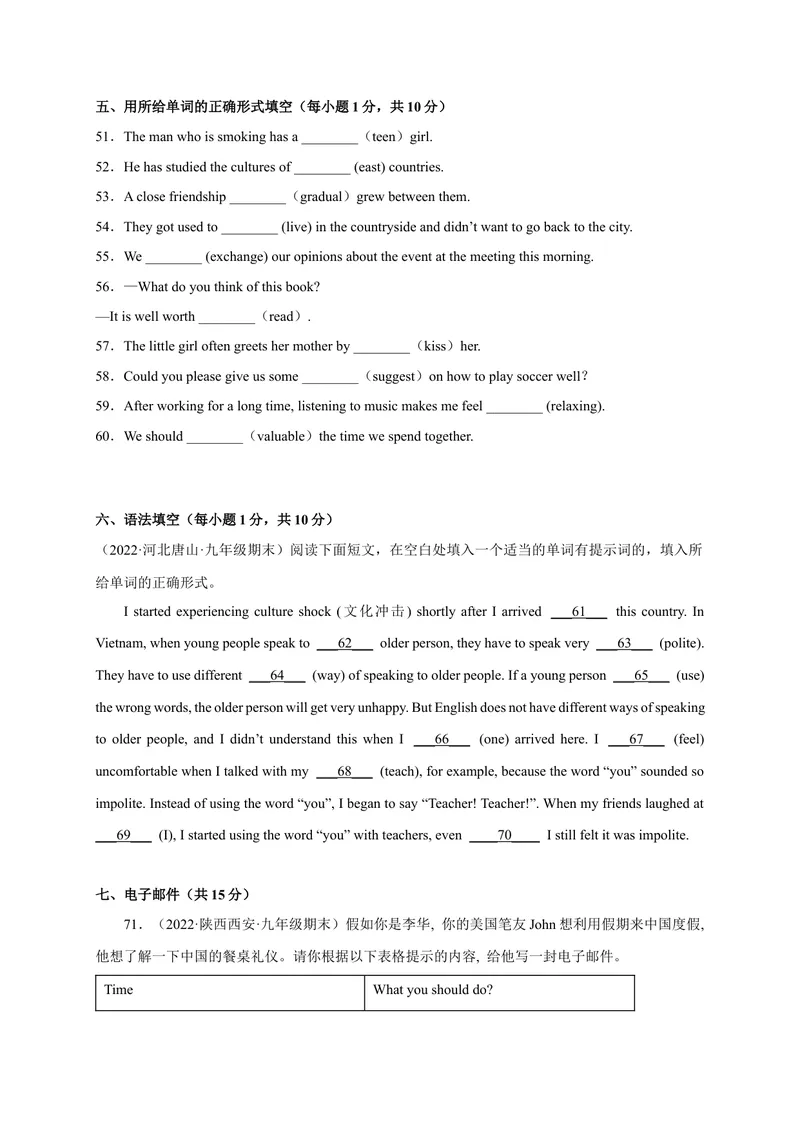
lives五、用所给单词的正确形式填空(每小题1分,共10分)
51.The man who is smoking has a ________(teen)girl.
52.He has studied the cultures of ________ (east) countries.
53.A close friendship ________(gradual)grew between them.
54.They got used to ________ (live) in the countryside and didn’t want to go back to the city.
55.We ________ (exchange) our opinions about the event at the meeting this morning.
56.—What do you think of this book?
—It is well worth ________(read).
57.The little girl often greets her mother by ________(kiss)her.
58.Could you please give us some ________(suggest)on how to play soccer well?
59.After working for a long time, listening to music makes me feel ________ (relaxing).
60.We should ________(valuable)the time we spend together.
六、语法填空(每小题1分,共10分)
(2022·河北唐山·九年级期末)阅读下面短文,在空白处填入一个适当的单词有提示词的,填入所
给单词的正确形式。
I started experiencing culture shock (文化冲击) shortly after I arrived ___61___ this country. In
Vietnam, when young people speak to ___62___ older person, they have to speak very ___63___ (polite).
They have to use different ___64___ (way) of speaking to older people. If a young person ___65___ (use)
the wrong words, the older person will get very unhappy. But English does not have different ways of speaking
to older people, and I didn’t understand this when I ___66___ (one) arrived here. I ___67___ (feel)
uncomfortable when I talked with my ___68___ (teach), for example, because the word “you” sounded so
impolite. Instead of using the word “you”, I began to say “Teacher! Teacher!”. When my friends laughed at
___69___ (I), I started using the word “you” with teachers, even ____70____ I still felt it was impolite.
七、电子邮件(共15分)
71.(2022·陕西西安·九年级期末)假如你是李华, 你的美国笔友John想利用假期来中国度假,
他想了解一下中国的餐桌礼仪。请你根据以下表格提示的内容, 给他写一封电子邮件。
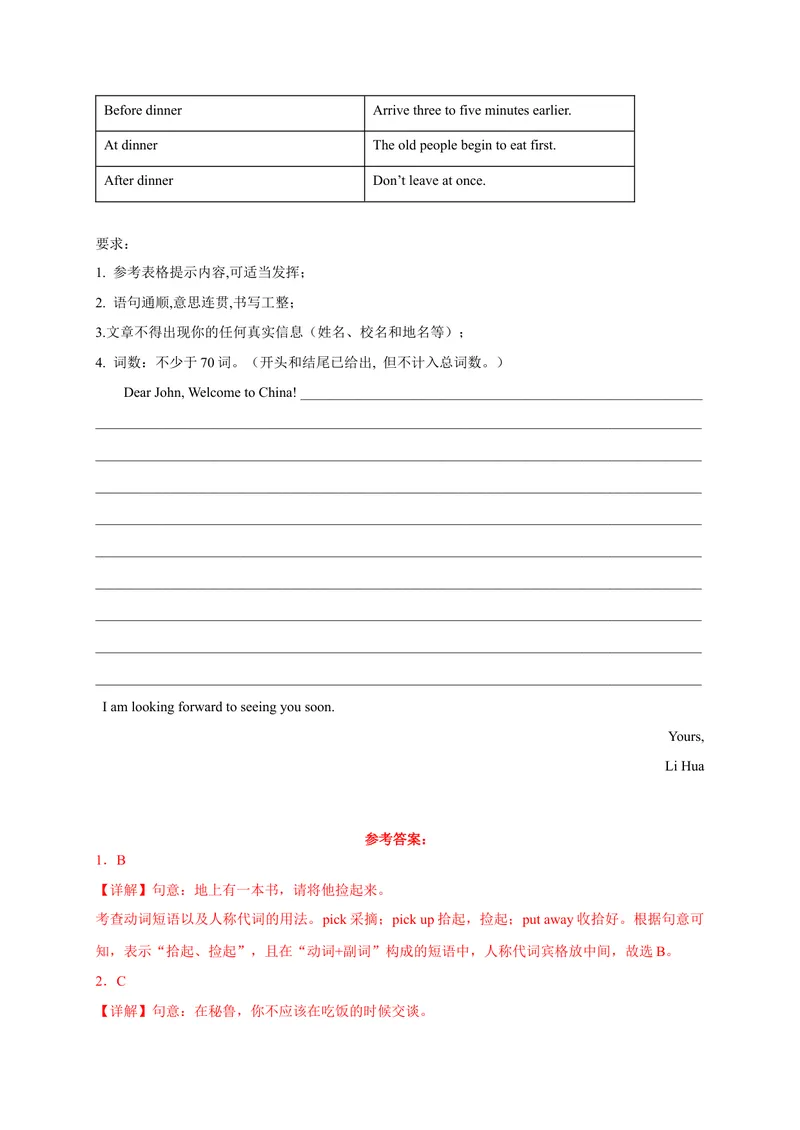
Time What you should do?Before dinner Arrive three to five minutes earlier.
At dinner The old people begin to eat first.
After dinner Don’t leave at once.
要求:
1. 参考表格提示内容,可适当发挥;
2. 语句通顺,意思连贯,书写工整;
3.文章不得出现你的任何真实信息(姓名、校名和地名等);
4. 词数:不少于70词。(开头和结尾已给出, 但不计入总词数。)
Dear John, Welcome to China! _________________________________________________________
______________________________________________________________________________________
______________________________________________________________________________________
______________________________________________________________________________________
______________________________________________________________________________________
______________________________________________________________________________________
______________________________________________________________________________________
______________________________________________________________________________________
______________________________________________________________________________________
______________________________________________________________________________________
I am looking forward to seeing you soon.
Yours,
Li Hua
参考答案:
1.B
【详解】句意:地上有一本书,请将他捡起来。
考查动词短语以及人称代词的用法。pick采摘;pick up拾起,捡起;put away收拾好。根据句意可
知,表示“拾起、捡起”,且在“动词+副词”构成的短语中,人称代词宾格放中间,故选B。
2.C
【详解】句意:在秘鲁,你不应该在吃饭的时候交谈。考查介词短语辨析。on the table在桌面上;in the table在表格中;at the table在吃饭时;to the table
到桌子上。由“shouldn’t talk”可知,此处指的是在吃饭的时候。故选C。
3.C
【详解】句意:我们步行去学校,用筷子吃饭。
考查介词。by通过;with使用;on在……上面;use使用。on foot步行;第二空作状语,修饰动宾
短语eat meals,用介词短语,with chopsticks用筷子。故选C。
4.B
【详解】句意:当走在路上时,你不应该吃东西或喝东西。
考查状语从句的省略。当主从句主语一致(或从句主语为it)时,且从句中含有be动词,则将从句
的主语和be动词省略。从句完整结构为“while you are walking down the street”,即当走在路上时。
故选B。
5.B
【详解】句意:这个男孩发现放风筝很容易。
考查代词词义辨析。that那个;it它;this这个;it’s为it is的缩写。根据find+it+adj.+to do sth.结构
可知,此处使用it作形式宾语,真正的宾语是后面的动词不定式。故选B。
6.A
【详解】句意:吉姆的父亲习惯在中国工作。
考查非谓语动词。习惯干某事:be used to doing sth.,固定用法。故选A。
7.C
【详解】句意:这个太大了,请你给我另一个可以吗?
考查代词辨析。other其他的(后接名词复数,等同于 others);the other(两者中)另一个;
another其他的(表示三者或三者以上);the others(两者中)另一些。根据句意可知,本句话中表
示三者或三者以上,且表示“另一个”,故选C。
8.B
【详解】句意:当人们第一次遇见的时候应该握手。
be supposed to do 应该做某事; shake hands握手;故选B。
9.B
【详解】句意:我们经常拜访朋友的家而不先打电话给他们。without为介词,因此后面用V-ing形
式。故排除A/C。又因为主语为We是复数,谓语用动词原形。排除D。故选B。
10.B【详解】句意:这个箱子是如此的重以致于我无法举起它来。
考查连词。这里是too+形容词或副词+to do sth.;so+形容词或副词+that引导的结果状语从句。I
can’t lift it.为句子,故选B。
11.B
【详解】句意:她从未去过长城,今天她第一次看到长城。
考查介词辨析。at以……;for为了;in在……里;by通过。根据句意可知,表示“第一次”,for
the first time第一次,故选B。
12.D
【详解】句意:保罗不必被强迫学习,他总是努力学习。
考查非谓语。make sb do让某人做某事,变为被动时,需要加上to,即be made to do,故选D。
13.C
【详解】句意:你认识那个正向我们挥手的男孩吗?
考查非谓语动词。waves单三式;to wave动词不定式;waving现在分词;wave动词原形。根据句
意可知,空处的词是修饰名词boy,且动作有正在进行之意,故应用现在分词形式。故选C。
14.D
【详解】句意:在火车上你需要特别的东西阅读吗?
考查不定代词及形容词。special形容词,特别的;anything不定代词,某物,任何物;specially副
词,特别地,副词修饰动词、形容词、其他副词和整个句子,故排除 C;根据形容词修饰不定代词,
放在不定代词的后面。可知排除A,any修饰可数名词的复数,故排除B。故选D。
15.D
【详解】——你什么时候会来晚宴上?——直到Jenny被邀请了我才会来。
考查动词的时态和被动。句子是until引导的时间状语从句,主语用一般将来时,从句要用一般现
在时;Jenny和邀请之间是被动关系,要用被动语态,表示被邀请。故选D。
16.C 17.D 18.B 19.D 20.C 21.D 22.B 23.A 24.C 25.A
【导语】本文是一篇记叙文。本文主要介绍了老虎在不同国家象征着说什么以及在中西方的差异。
16.句意:他们代表着力量,能量和保护。
protect保护,动词;protected保护,过去式;protection保护,名词;protector保护者,名词。根据
and前的“power, energy”可知,此处应该用名词,表达“保护”。故选C。
17.句意:老虎被认为是无所畏惧的生物,所以那就是你能够在寺庙和房屋的墙上看到老虎的原因。although 虽然;until 直到;because 因为;so 所以。根据上文“Tigers are regarded as fearless
creatures”和下文“that’s why you can see pictures of tigers on the walls of temples and houses”可知,两
者中前面是原因,后面是结果,用so连接。故选D。
18.句意:他们保护我们免受灾难和疾病。
we我们,主格;us我们,宾格;our我们的;形容词性物主代词;ourselves我们自己,反身代词。
根据句子结构分析,动词“protect”后面应跟宾语,因此用宾格。故选B。
19.句意:在古代,一些伟大的将军被称作“老虎将军”。
call称作,一般现在时且表主动;are called被称作,一般现在时且表被动;called称作,一般过去时
且表主动;were called一般过去时且表被动。根据“In ancient times”可知,应用过去时态,又由
“great generals”和“tiger generals”之间是被动关系,因此用一般过去时的被动语态。故选D。
20.句意:在西方,狮子被认为是所有动物之王,而不是老虎。
a一个,表泛指,用于辅音音素之前;an一个,表泛指,用于元音音素之前;the表特指;/零冠词。
根据“tigers are seen as the king of all the animals.”可知,此处同样表示特指,用the。故选C。
21.句意:在过去,每个人都知道为什么勇敢的战士被叫作“狮子”。
are brave soldiers勇敢的战士,现在时的一般疑问句形式;brave soldiers are勇敢的战士,一般现在
时的陈述句语序;were brave soldiers勇敢的战士,一般过去时的一般疑问句形式;brave soldiers
were勇敢的战士,一般过去时的陈述句语序。根据“everybody knew why ... named “the lion”.可知,
该句为宾语从句,需用陈述句语序,且主句为一般过去时,因此从句也用一般过去时。故选D。
22.句意:在欧洲,这种动物是英国的国家象征,也是挪威,西班牙,比利时和其他13个国家的
象征。
to到;for为了;with和;through通过。根据“the animal is a national symbol for England”可知,此处
也用for。故选B。
23.句意:但是在西方,老虎也被看做是非常强大的动物。
powerful强大的,原级;more powerful更强大的,比较级;most powerful最强大的,最高级;the
most powerful最强大的,最高级。根据“very”可知此处应用原级。故选A。
24.句意:如果你想要某人冷静下来,你能够对他们说“易虎”。
calm down冷静,一般现在时态;calming down冷静,现在进行时;to calm down冷静,动词不定式;
calmed down冷静,一般过去时。根据“want someone”可知,此处应用动词不定式宾补。故选C。
25.句意:另一个著名的短语是“虎眼”,意味着是拥有凶猛和力量。
means意味着,一般现在时;meant意味着,一般过去时;is meaning意味着,现在进行时;hasmeant已经意味着,现在完成时。根据“Another famous phrase is “eye of the tiger”中的is可知,此处
用一般现在时。故选A。
26.A 27.B 28.D 29.B 30.C 31.D 32.D 33.C 34.B 35.D
【导语】本文是一篇说明文。文章介绍了在日本、美国中西部农村、美国加利福尼亚和希腊等地方
不同的指路方式,并指出懂得人们的肢体语言可以帮助在这些地方找到想去的地方。
26.句意:在日本,人们用路标代替街道名称。
names 名字;directions 方向;places 地方;information 信息。由上文“Foreign visitors are often
puzzled in Japan because most streets there don’t have names. ”可知在日本没有街道名称,所以人们用
路标代替的是街道名称。故选A。
27.句意:例如,当你询问去邮局的路的时候,日本人会说:“一直走到拐角处。”
pass通过;ask询问;go去;run跑。由下文“the Japanese will say, ‘Go straight down to the corner (拐
角) .’”可知日本人在指路,可推知你在询问去邮局的路。故选B。
28.句意:在大酒店处左转,然后经过一个水果市场。
Go走;Make使;Take拿走;Turn转动。由“Go straight down to the corner (拐角) ...left at the big hotel
and go past a fruit market. The post office is there. ”可知日本人在指路,据语境及句意可知,此处为turn
left“向左转”。故选D。
29.句意:几英里内没有城镇也没有楼房。
so因此;or或者;and和;but但是。由“In the countryside of the American Midwest, usually there are
not many landmarks. There are no towns...buildings within miles. ” 可知这里没有多少路标,几英里内
没有城镇也没有楼房;又由“no”可知否定句中的“和”使用连词or。故选B。
30.句意:代替路标,人们将告诉你方向和距离。
position位置;mile英里;distance距离;time时间。由下文“Go north two miles.”可知北走两英里,
指的距离。故选C。
31.句意:人们会说:“向北走两英里。向东转,然后再走一英里。”
the other(两个中)另外一个;other其他的,接名词复数形式;the others其他所有人/物,后不能再
跟名词;another(不确定数目)又,再,接名词单数形式。由前文“Go north two miles.”可推知后文
应是“再走一英里”。故选D。
32.句意: 邮局有多远?much许多;often经常;long长的;far远。由前文“They give distance by means of time, not miles. ”
及后文“It’ s about five minutes from here.”可知此处询问距离。故选D。
33.句意: 代替给你指方向,希腊人会说:“跟我来。”。
Try on试穿;Look up查看;Instead of代替;End up结束。根据下文“a Greek will often say, ‘Follow
me.’”可知希腊人在领路,进而推知希腊人没有给出方向。故选C。
34.句意:一件事将在每个地方帮助你。
somewhere某地;everywhere每个地方;where在哪里;nowhere哪里都不。由下文“in Japan, in the
United States, in Greece, or in any other place.”可知空处指日本、美国、希腊或任何其它地方的每一个
地方。故选B。
35.句意:他或她通常转身然后指向正确的方向。
wrong错误的;opposite相反的;same相同的;correct正确的。由下文“and then you may find the
place where you want to go!”可知你可以找到你想去的地方,所以推知空处应是指向正确的方向。故
选D。
36.B 37.C 38.A 39.B 40.D
【导语】本文主要介绍了不同的国家的送礼习俗。
36.细节理解题。根据“In China you must never give a clock to a Chinese person, because the
pronunciation of the word for ‘clock’ in Chinese is similar to the pronunciation of ‘death’.”可知,时钟绝
对不能作为礼物送给中国人。故选B。
37.细节理解题。根据“Also, don’ t wrap (用……包裹) a present in white, black, or blue paper, because
they are the colors for funerals (葬礼).”和最后一段“Don’t wrap your presents in white, brown, or black
paper.”可知,在中国和德国,人们不用白纸或黑纸包装礼物。故选C。
38.细节理解题。根据“In Russia if you give flowers as presents, you have to give an odd number of them
(One, Three, five, etc,)”可知,在俄罗斯,如果你送花作为礼物,你必须送奇数朵花;结合选项,故
选A。
39.细节理解题。根据“In Germany, if you are invited to dinner, flowers are good presents to take to your
dinner hostess (女主人), but don’t take her red roses because it means you are in love with her.”可知,在
德国,鲜花是送给女主人的好礼物,但不要送她红玫瑰。故选B。
40.主旨大意题,根据“Different countries have different customs in giving presents.”和全文可知,本
文主要介绍了不同的国家有不同的送礼习俗。因此,本文是关于不同国家的送礼习俗。故选D。41.C 42.A 43.B 44.D 45.C
【导语】本文主要介绍了世界各国人们见面时问候的习俗。
41.细节理解题。根据“The British often simply say ‘hello’ when they meet friends. They usually shake
hands only when they meet for the first time.”可知,英国人初次见面时通常握手。故选C。
42.词义猜测题。根据“When men meet for the first time, a handshake is the norm.”可知,当男人第一
次见面时,握手应该是一种规范,所以“norm”的意思是“规范”。故选A。
43.词义猜测题。根据“In Japan, the common greeting for both men and women is to bow when they
greet someone, instead of giving a handshake or a hug.”可知,在日本,男人和女人打招呼时通常都鞠
躬,而不是握手或拥抱。所以“they”指的是“日本人”。故选B。
44.细节理解题。根据“In Armenia, by tradition, a woman needs to wait for a man to offer his hand for a
handshake.”可知,在亚美尼亚,女人需要等待男人伸出手来握手。故选D。
45.标题归纳题。本文主要介绍了世界各国人们见面时问候的习俗,因此 C项“世界各地的问候习
俗”符合。故选C。
46.B 47.D 48.C 49.A 50.A
【导语】本文主要讲述了公共场合手机使用规则。
46.主旨大意题。根据第一段内容可知,主要讲述了公共场合一个不礼貌的行为,故选B。
47.细节理解题。根据“Never make calls in a theater, when you are watching a movie or enjoying a
concert.”可知,当你在看电影或听音乐会时,不要在剧院打电话。故选D。
48.词句猜测题。根据“But be careful not to be noisy phone users and disturb others.”可知,不要成为
吵闹的手机用户,打扰他人,因此“disturb”意为“打扰”,故选C。
49.细节理解题。根据“If you are allowed, speak softly for a short time and try to keep away from other
people.”可知,要远离人群、低声说话以及谈话要简短,故选A。
50.推理判断题。根据全文内容可知,主要讲述了在公共场合要注意手机使用的一些的礼仪问题,
因此公共礼仪在我们的生活中很重要,故选A。
51.teenage
【详解】句意:抽烟的那个男人有一个十几岁的女孩。teen是指“青少年”,此处应用teenage“十
几岁的”修饰girl,故填teenage。
52.eastern【详解】句意:他已经学习了东方国家的文化。空处修饰空后的名词,应用形容词形式,故填
eastern。
53.gradually
【详解】句意:他们之间逐渐建立了亲密的友谊。gradual是形容词,此处应用副词gradually修饰
动词,故填gradually。
54.living
【详解】句意:他们习惯住在乡村,不想回到城里。live“居住”,是动词,get used to doing sth“习
惯做某事”,故填living。
55.exchanged
【详解】句意:今天早晨在会议上我们交换了关于这件事的意见。根据“this morning”可知应用一
般过去时,所以应用其过去式,故填exchanged。
56.reading
【详解】句意:——你认为这本书怎么样?——很值得一读。根据所给单词可知,be worth doing
sth“值得做某事”,故填reading。
57.kissing
【详解】句意:小女孩经常亲吻她母亲来问候她。by是介词,后加动名词作宾语,故填kissing。
58.suggestions
【详解】句意:你能给我们一些关于如何踢好足球的建议吗?根据所给提示单词和 some可知,空
处需要填写可数名词复数,suggestions“建议”,故填suggestions。
59.relaxed
【详解】句意:工作很长时间之后,听音乐让我感到放松。relaxing“令人放松的”,是形容词,描
述事物;作为系动词feel的表语,用形容词;此处me表示人,描述人的感受,用形容词relaxed“放
松的”,故填relaxed。
60.value
【详解】句意:我们应该珍惜在一起度过的时间。情态动词should后接动词原形,结合所给单词
valuable可知,value“珍惜”,动词,故填value。
61.in 62.the 63.politely 64.ways 65.uses 66.first 67.felt 68.teachers 69.me
70.if##though
【导语】本文主要介绍了两个不同的国家的文化差异。61.句意:我来到这个国家后不久就开始经历文化冲击。arrive in“到达大地点”。故填in。
62.句意:在越南,当年轻人和年长的人说话时,他们必须非常礼貌。此处指“老人”,用定冠词
the。故填the。
63.句意:在越南,当年轻人和年长的人说话时,他们必须非常礼貌。此处修饰动词 speak用副词
politely“礼貌地”。故填politely。
64.句意:他们必须用不同的方式与老年人交谈。different 后加名词复数ways“方式”。故填
ways。
65.句意:如果年轻人用错了词,老年人会很不高兴。use“使用”,句子是if引导的条件状语从句,
遵循主将从现,从句用一般现在时,主语是单数,谓语动词用单三。故填uses。
66.句意:我刚来这里时不明白这一点。根据“I...arrived here”可知是第一次来这里,用first。故填
first。
67.句意:当我和老师交谈时,我感到不舒服。根据“I talked...”可知句子用一般过去时,动词用过
去式felt“感觉”。故填felt。
68.句意:当我和老师交谈时,我感到不舒服。根据“I talked with my...”可知是和老师交谈,此处
用名词复数teachers“老师”。故填teachers。
69.句意:当我的朋友嘲笑我时,我开始对老师使用“你”这个词,即使我仍然觉得这是不礼貌的。
介词at后加代词宾格me“我”作宾语。故填me。
70.句意:当我的朋友嘲笑我时,我开始对老师使用“你”这个词,即使我仍然觉得这是不礼貌的。
根据“I started using the word “you” with teachers...I still felt it was impolite.”可知前后两句是让步关系,
用even if/though引导让步状语从句。故填if/though。
71.例文:
Dear John,
Welcome to China! I’m glad to get your letter and excited to know that you’re coming to China. Yes,
Chinese table habits are not the same as those in the USA. Don’t worry, let me tell something about them.
Don’t be late. You’d better arrive early. Arrive three or five minutes earlier. In China, one important thing is
that you’re not supposed to start eating first if there are older people at the table. The old people begin to eat
first. You must not begin to eat until the older people begin eating.
And it’s also impolite to stick your chopsticks into your food. What’s more, you shouldn’t point at
anyone with your chopsticks, either.
Don’t leave at once after dinner. You can have some tea and chat with people.These table habits are really different from those in the USA, aren’t they?
If you don’t know how to behave at the table, you can ask the people next to you. Or you can just see
what the others do and follow them. I’m sure nobody will laugh at you and you will have a good time here
in China.
I am looking forward to seeing you soon.
Yours,
Li Hua
【详解】[总体分析]
① 题材:本文是一封英文电子邮件;
② 时态:时态为“一般现在时”;
③ 提示:写作要点已给出,考生应注意不要遗漏“信息提示表格”中关于“中国餐桌礼仪中的餐
前、就餐中、餐后需要做的事情”的礼仪要点,适当增加细节,并突出写作重点。
[写作步骤]
第一步,表明写作意图。借用“欢迎笔友来中国”来引出重点介绍的内容;
第二步,具体描述写作内容。从“餐前提前 3至5分钟到达、餐中年长者先就餐、餐后不要马上离
开等”几个方面重点介绍中国餐桌礼仪;
第三步,书写结语。表达“希望他玩得开心”和“期待见面”的愿望。
[亮点词汇]
① be glad to do 高兴做某事
② the same as 和……一样
③ had better 最好
④ be not supposed to do sth 不应该做某事
⑤ What’s more 而且
⑥ how to behave 怎么行动
⑦ look forward to 期盼做某事
[高分句型]
① In China, one important thing is that you’re not supposed to start eating first if there are older people at
the table. (表语从句中含有条件状语从句)
② And it’s also impolite to stick your chopsticks into your food. (It’s + 形容词 + to do sth.固定句型)
③ Or you can just see what the others do and follow them. (what引导的宾语从句)