文档文本内容
Unit 5 What are the shirts made of?
Section A(1a-1c)
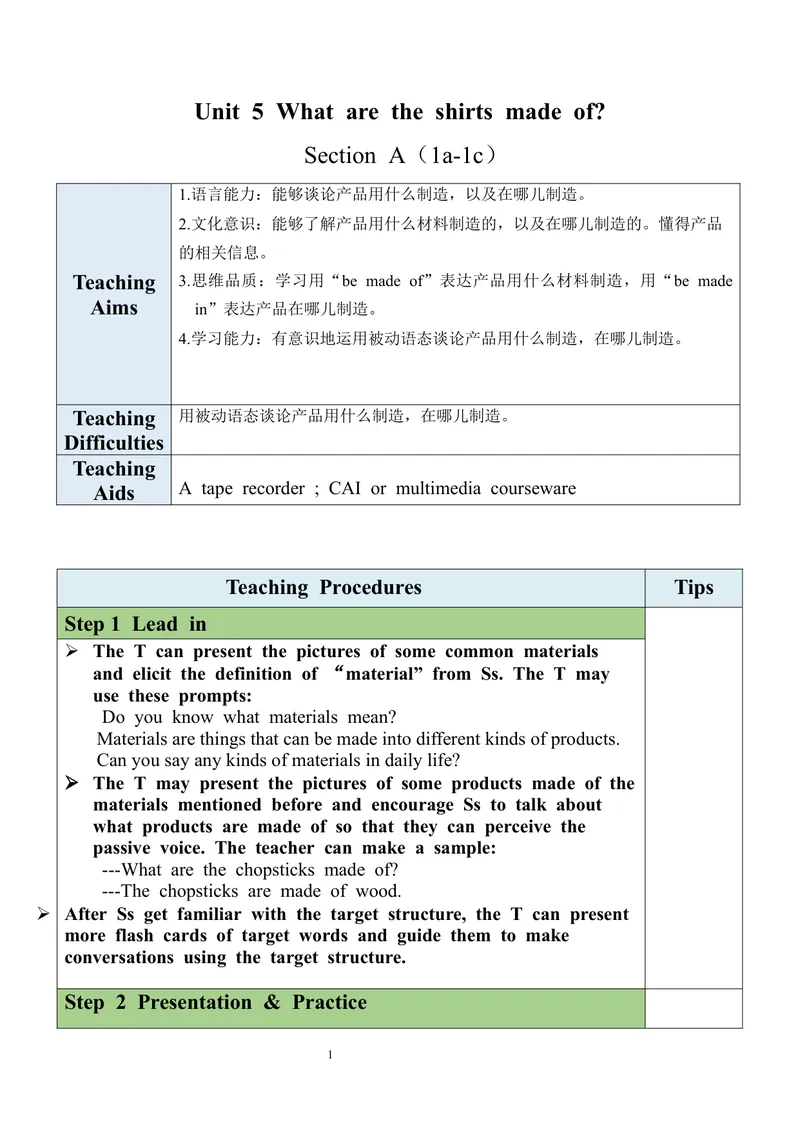
1.语言能力:能够谈论产品用什么制造,以及在哪儿制造。
2.文化意识:能够了解产品用什么材料制造的,以及在哪儿制造的。懂得产品
的相关信息。
Teaching 3.思维品质:学习用“be made of”表达产品用什么材料制造,用“be made
Aims in”表达产品在哪儿制造。
4.学习能力:有意识地运用被动语态谈论产品用什么制造,在哪儿制造。
Teaching 用被动语态谈论产品用什么制造,在哪儿制造。
Difficulties
Teaching
Aids A tape recorder ; CAI or multimedia courseware
Teaching Procedures Tips
Step 1 Lead in
The T can present the pictures of some common materials
and elicit the definition of “material” from Ss. The T may
use these prompts:
Do you know what materials mean?
Materials are things that can be made into different kinds of products.
Can you say any kinds of materials in daily life?
The T may present the pictures of some products made of the
materials mentioned before and encourage Ss to talk about
what products are made of so that they can perceive the
passive voice. The teacher can make a sample:
---What are the chopsticks made of?
---The chopsticks are made of wood.
After Ss get familiar with the target structure, the T can present
more flash cards of target words and guide them to make
conversations using the target structure.
Step 2 Presentation & Practice
1 1a
The T can make Ss talk about the picture in 1a. The T may
use these prompts:
What things do you see in the picture?
What are the things made of?
What are the people doing?
1a
The T can make Ss read the words in chorus and make sure
they know the meanings of the words. Then Ss finish the
task in 1a . The T can check answers by making
conversations with Ss or asking them do this in pairs like
this:
T: What are chopsticks made of?
S1: They’re made of...
S2: What is the window made of?
S3: It’s made of...
Suggested answers:
1.a,c 2.f 3.b.c 4.d 5.a,c 6.e
1a
The T may want to extend the activity by asking Ss to
identify other
objects in the picture and say what they are made of.
Examples:
sofa — fabric, leather curtains — cotton
table— wood lamp— metal, fabric
cushion— cotton box— paper
bowl— porcelain
1b
Before listening, the T should make sure that Ss understand
the requirement of the task. The T can help Ss understand
by asking questions and write the form on the blackboard:
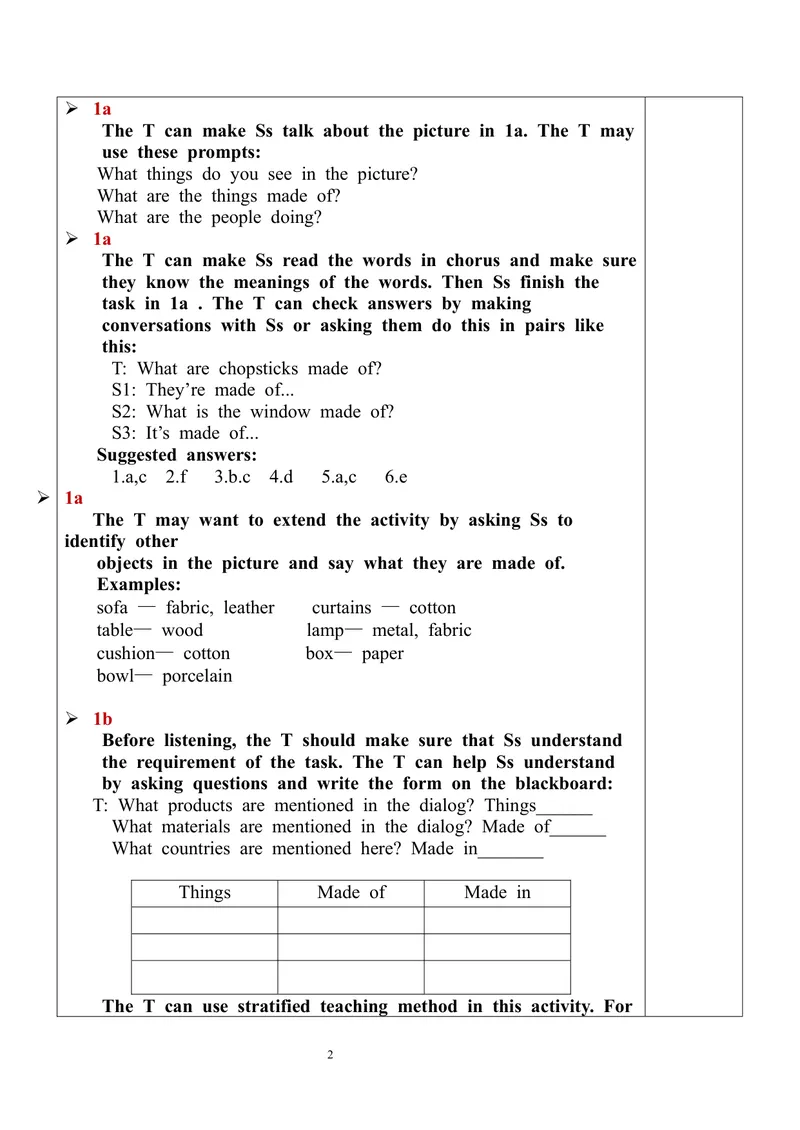
T: What products are mentioned in the dialog? Things______
What materials are mentioned in the dialog? Made of______
What countries are mentioned here? Made in_______
Things Made of Made in
The T can use stratified teaching method in this activity. For
2weaker Ss, the T can ask them to try predicting and
matching before listening so that they can be more focused
when listening to check if their prediction is right. For high
level Ss, the T can ask them to close the textbook and fill in
the form and take notes when listening.
1b
While listening, the T can play the recording without stop
for the first time and Ss finish the task in 1b. This step
aims to develop Ss’ skills of grasping the target information.
Then the T can play a second time to check Ss’ answers.
This time, the T can stop at the key point and check Ss’
answers by asking them to say the complete the sentence, for
example:
The shirts are made of cotton. They were made in America.
Answers:
skirts—cotton—America
chopsticks—steel—Korea
ring—silver—Thailand
1b
While listening, the T may play the recording a third time and
ask Ss to repeat the key sentences. The T may also ask some
questions to consolidate Ss’ understanding of the dialog:
How much did Susan pay for the three shirts?( 29 dollars.)
What does Anita feel about the three shirts?(cheap)
What are the shirts made of?(cotton)
Where were they made?(America)
Where did Susan buy the chopsticks?(Korea)
How does Anita like the chopsticks?(cool)
What else does Susan show?(ring)
Where was the ring made?(Thailand)
What will Susan do with the ring? (give it to her friend)
1c
The T can invite Ss to role-play the conversation in 1c. Then
the Ss
can work in pairs to make conversations without looking at
the textbook . During this step, the T should pay attention to
the fluency of Ss’ speaking instead of the accuracy. Just offer
help to the Ss in need and don’t over correct their small
mistakes so that Ss can speak as much as possible. The T
should draw Ss’ attention to the different tenses used to talk
about what a product is made of and where it was made.
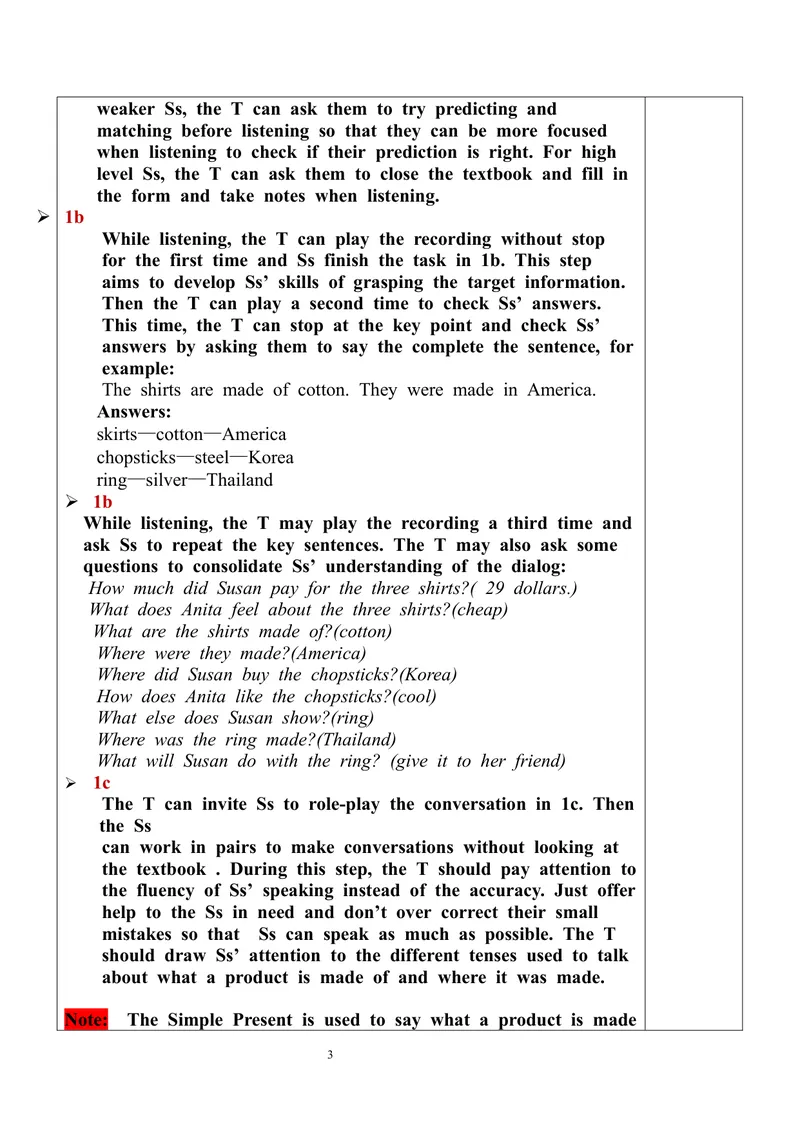
Note: The Simple Present is used to say what a product is made
3of. This is because when we say what a product is made of,
we are describing the current state of the product.
e.g. The ring is made of silver.
The chopsticks are made of steel.
The Simple Past is used to talk about where a product
was made. This is because the process of making the
product has been completed.
e.g. The ring was made in Thailand.
The chopsticks were made in Korea.
Step 4 Language points learning
glass n. 玻璃,是不可数名词。 a piece of glass 一片玻璃 The
glass 还可用作可数名词,意为“玻璃杯,眼镜”。 language
当“眼镜”用时,常用复数形式( glasses)。 points are
be made of 为“be+及物动词的过去分词+of”的被动语态结构,意 for
reference
为“由……制造;由……制作” 。强调从制成品中仍可以看出它的原
only.
材料。
be made from…意为“由……制成”,强调从制成品中看不出它
的
原材料。
be made in…意为“在……制造”,介词in后常接产地。
Step 5 Summary & Homework
Summary The T can encourage Ss to summarize the key points The
of this class to help Ss consolidate the knowledge. homework
Homework: can vary
Preview the conversation in 2d. with the
Do the exercises in students’ book. specific
conditions
.
This is the first period of the unit. Teaching new words and reviewing
learned words through physical display is an effective teaching
method. A picture is worth a thousand words, which can not only
give students more input, but also stimulate students' learning
Teaching enthusiasm. When checking the answers, teachers need not rush to
Reflection judge right or wrong. They should let students speak actively. This
link is a good opportunity to practice the target language, and try to
give students at all levels the opportunity to speak. Guide students to
pay attention to the composition of passive voice. At this stage, it is
OK to understand sentences without explaining for the time being so
4that students can accumulate more perceptual knowledge in the stage
of grammar perception.
5