文档文本内容
Unit 1 How can we become good learners?
Section A(2a-2d)
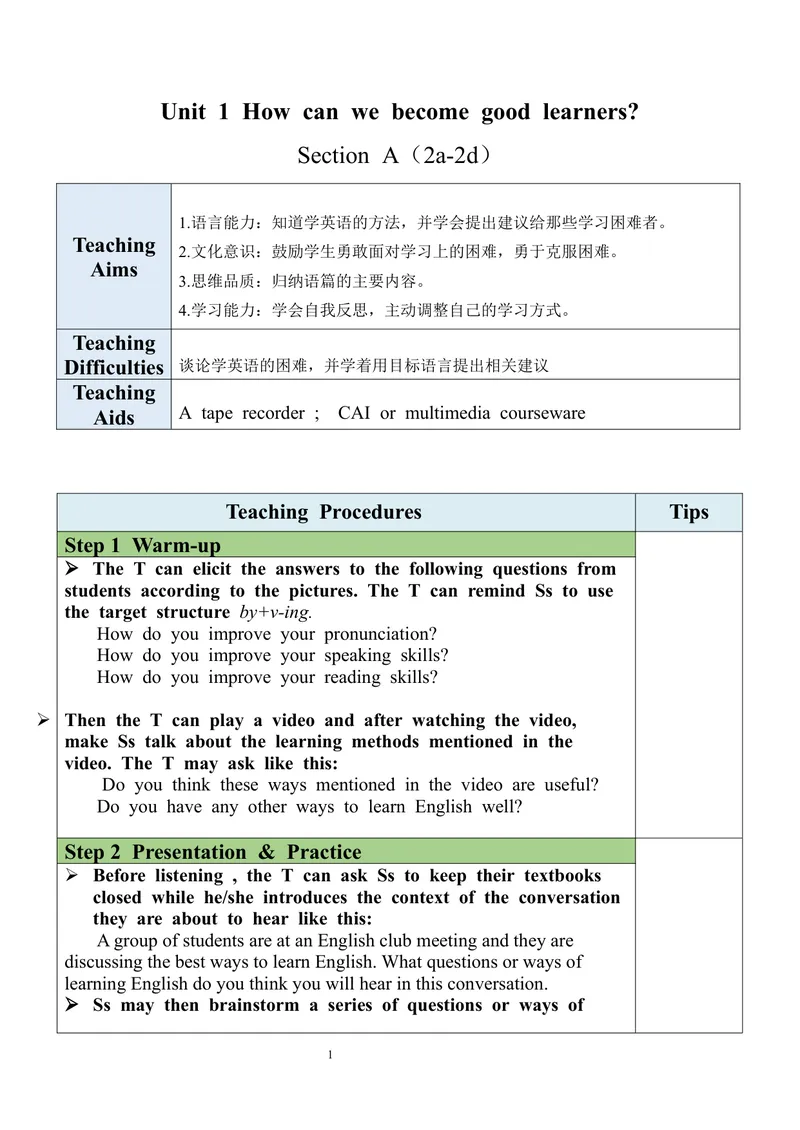
1.语言能力:知道学英语的方法,并学会提出建议给那些学习困难者。
Teaching
2.文化意识:鼓励学生勇敢面对学习上的困难,勇于克服困难。
Aims
3.思维品质:归纳语篇的主要内容。
4.学习能力:学会自我反思,主动调整自己的学习方式。
Teaching
Difficulties 谈论学英语的困难,并学着用目标语言提出相关建议
Teaching
Aids A tape recorder ; CAI or multimedia courseware
Teaching Procedures Tips
Step 1 Warm-up
The T can elicit the answers to the following questions from
students according to the pictures. The T can remind Ss to use
the target structure by+v-ing.
How do you improve your pronunciation?
How do you improve your speaking skills?
How do you improve your reading skills?
Then the T can play a video and after watching the video,
make Ss talk about the learning methods mentioned in the
video. The T may ask like this:
Do you think these ways mentioned in the video are useful?
Do you have any other ways to learn English well?
Step 2 Presentation & Practice
Before listening , the T can ask Ss to keep their textbooks
closed while he/she introduces the context of the conversation
they are about to hear like this:
A group of students are at an English club meeting and they are
discussing the best ways to learn English. What questions or ways of
learning English do you think you will hear in this conversation.
Ss may then brainstorm a series of questions or ways of
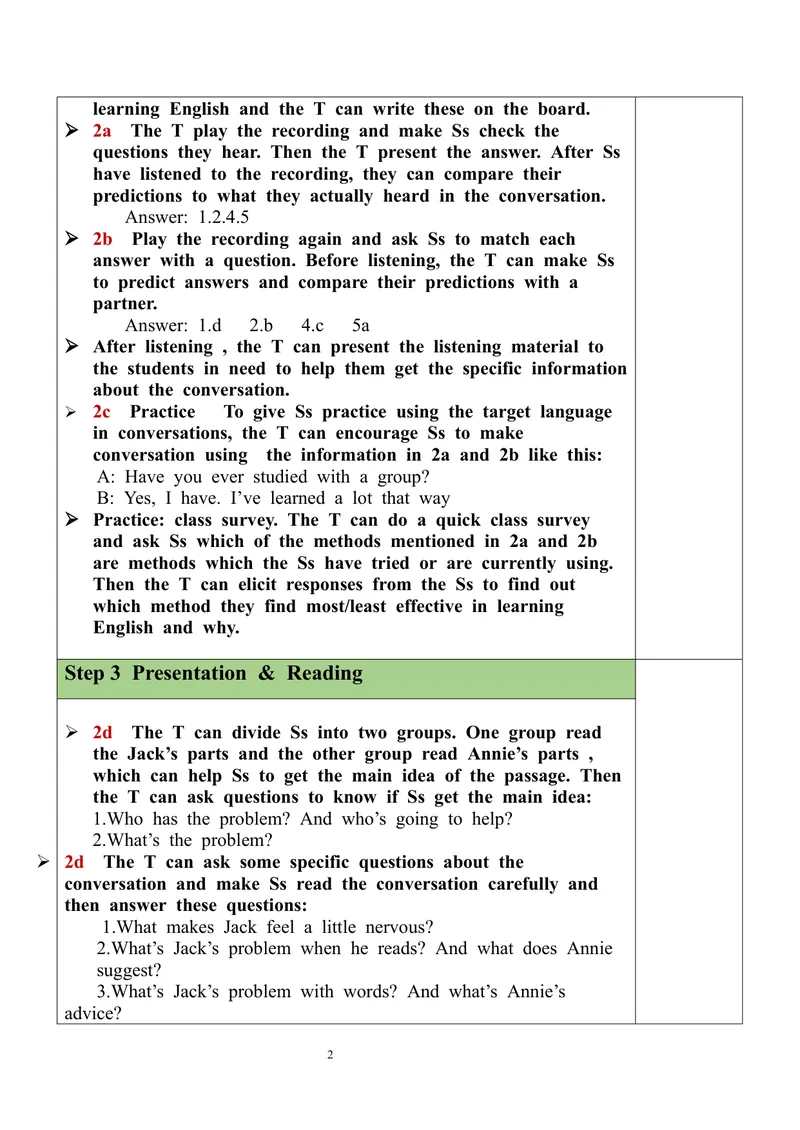
1learning English and the T can write these on the board.
2a The T play the recording and make Ss check the
questions they hear. Then the T present the answer. After Ss
have listened to the recording, they can compare their
predictions to what they actually heard in the conversation.
Answer: 1.2.4.5
2b Play the recording again and ask Ss to match each
answer with a question. Before listening, the T can make Ss
to predict answers and compare their predictions with a
partner.
Answer: 1.d 2.b 4.c 5a
After listening , the T can present the listening material to
the students in need to help them get the specific information
about the conversation.
2c Practice To give Ss practice using the target language
in conversations, the T can encourage Ss to make
conversation using the information in 2a and 2b like this:
A: Have you ever studied with a group?
B: Yes, I have. I’ve learned a lot that way
Practice: class survey. The T can do a quick class survey
and ask Ss which of the methods mentioned in 2a and 2b
are methods which the Ss have tried or are currently using.
Then the T can elicit responses from the Ss to find out
which method they find most/least effective in learning
English and why.
Step 3 Presentation & Reading
2d The T can divide Ss into two groups. One group read
the Jack’s parts and the other group read Annie’s parts ,
which can help Ss to get the main idea of the passage. Then
the T can ask questions to know if Ss get the main idea:
1.Who has the problem? And who’s going to help?
2.What’s the problem?
2d The T can ask some specific questions about the
conversation and make Ss read the conversation carefully and
then answer these questions:
1.What makes Jack feel a little nervous?
2.What’s Jack’s problem when he reads? And what does Annie
suggest?
3.What’s Jack’s problem with words? And what’s Annie’s
advice?
2 2d The T can check Ss’ answers and focus Ss’ attention to the
key words and sentence patterns in the conversation:
A little nervous, be patient, word by word, word groups,
probably understand more than you think, The more you read, the
faster you’ll be...
2d The T can play the recording of the conversation and make
Ss read after it. Pa attention to the pronunciation and
intonation.
2d The T can play the video of the conversation and then
invite some Ss to role-play the conversation as open pairs.
Step 4 Language points learning
conversation n. 交谈;谈话 The
(1) have conversations/a ( long/short)conversation with sb. about language
sth.就某事与某人交谈( 长谈/ 作简短的交谈) points are
(2) make(up) a conversation = make a dialog 编对话 for
(3) to start a conversation 开始对话,主动攀谈 reference
only.
(4) be in conversation with sb. 在与某人谈话(指谈话正在进行中)
表建议的句型:
What about...? =How about... ? ……怎么样?
Why don’t you do sth.?=Why not do sth. ?
你为什么不做某事呢?
Let’s do sth.咱们做某事吧。
You’d better (not) do sth.你最好(不要)做某事。
You should (not) do sth.你应该(不)做某事。
the +比较级(+ 主语+ 谓语),the +比较级(+ 主语+ 谓语)(主语)
越……,(主语就)越……
patient adj. 有耐心的 n. 病人
① patience n . 耐心→in patience 耐心地
② patiently adv . 有耐心地
patient 常用的短语有:
(1)be patient with sb. /sth. 对某人/ 某事有耐心;
(2)be patient to do sth. 有耐心做某事。
Step 5 Summary & Homework
Summary The T can encourage Ss to summarize the key points The
of this class to help Ss consolidate the knowledge. homework
3 Homework: can vary
Preview the passage in 3a. with the
Do the exercises in students’ book. specific
conditions.
In this period, there are more new words and expressions. The T
should provide more practice in listening and speaking and encourage
Teaching Ss to be more involved. In the reading part, Ss can experience more
Reflection practice in using the target language in natural speech. In this part,
the T should teach Ss a reading strategy— the SQ4R(survey,
questions,read, record,recite, review).
4