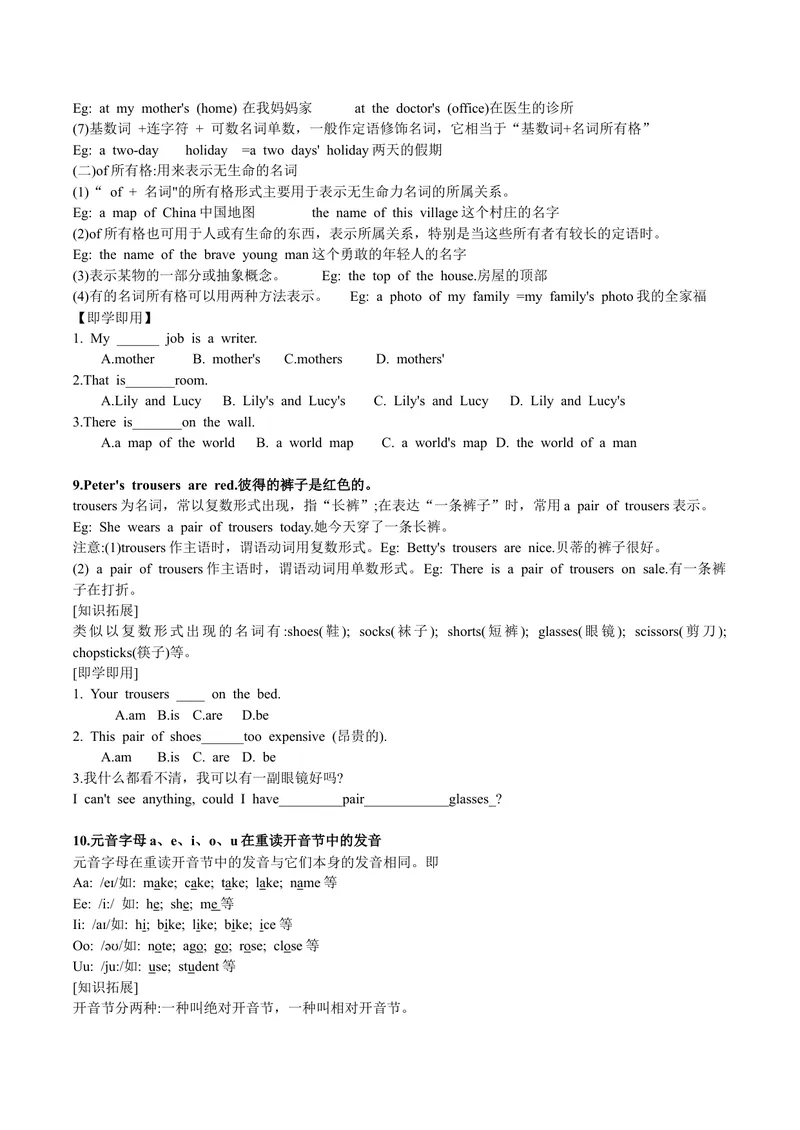
文档文本内容
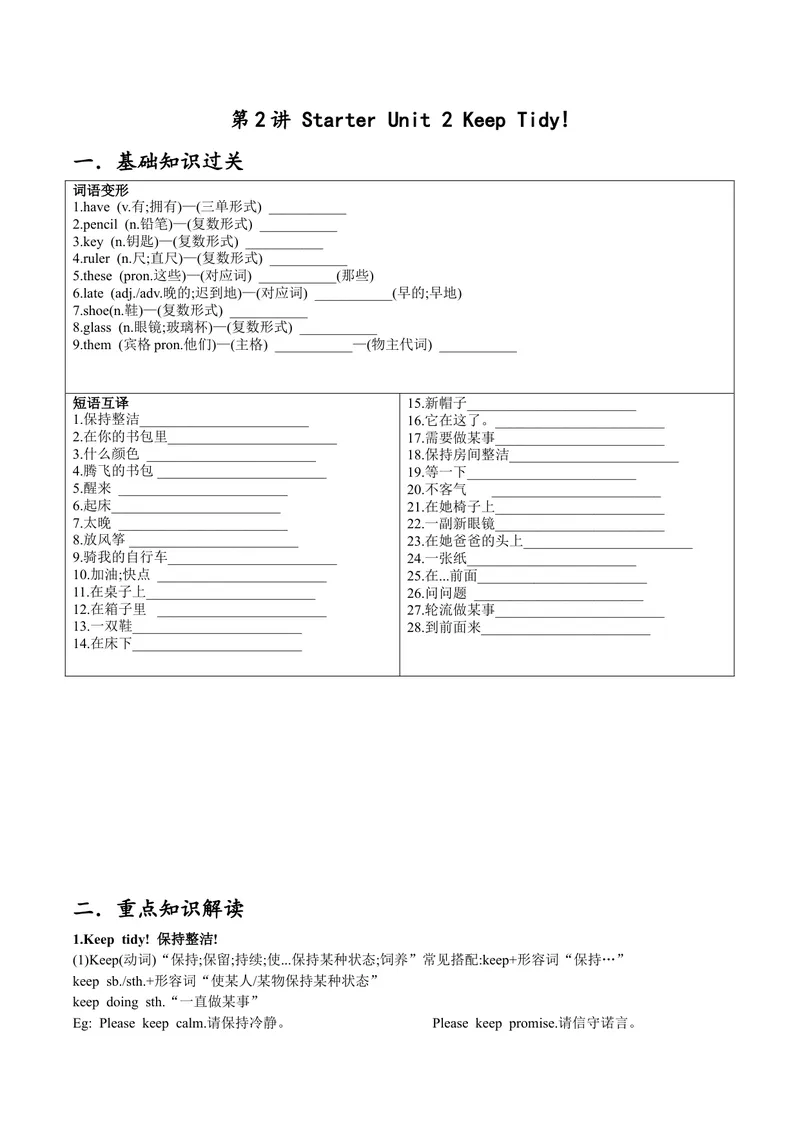
第 2 讲 Starter Unit 2 Keep Tidy!
一.基础知识过关
词语变形
1.have (v.有;拥有)—(三单形式) ___________
2.pencil (n.铅笔)—(复数形式) ___________
3.key (n.钥匙)—(复数形式) ___________
4.ruler (n.尺;直尺)—(复数形式) ___________
5.these (pron.这些)—(对应词) ___________(那些)
6.late (adj./adv.晚的;迟到地)—(对应词) ___________(早的;早地)
7.shoe(n.鞋)—(复数形式) ___________
8.glass (n.眼镜;玻璃杯)—(复数形式) ___________
9.them (宾格pron.他们)—(主格) ___________—(物主代词) ___________
短语互译 15.新帽子________________________
1.保持整洁________________________ 16.它在这了。________________________
2.在你的书包里________________________ 17.需要做某事________________________
3.什么颜色 ________________________ 18.保持房间整洁________________________
4.腾飞的书包________________________ 19.等一下________________________
5.醒来 ________________________ 20.不客气 ________________________
6.起床________________________ 21.在她椅子上________________________
7.太晚 ________________________ 22.一副新眼镜________________________
8.放风筝________________________ 23.在她爸爸的头上________________________
9.骑我的自行车________________________ 24.一张纸________________________
10.加油;快点 ________________________ 25.在...前面________________________
11.在桌子上________________________ 26.问问题 ________________________
12.在箱子里 ________________________ 27.轮流做某事________________________
13.一双鞋________________________ 28.到前面来________________________
14.在床下________________________
二.重点知识解读
1.Keep tidy! 保持整洁!
(1)Keep(动词)“保持;保留;持续;使...保持某种状态;饲养”常见搭配:keep+形容词“保持…”
keep sb./sth.+形容词“使某人/某物保持某种状态”
keep doing sth.“一直做某事”
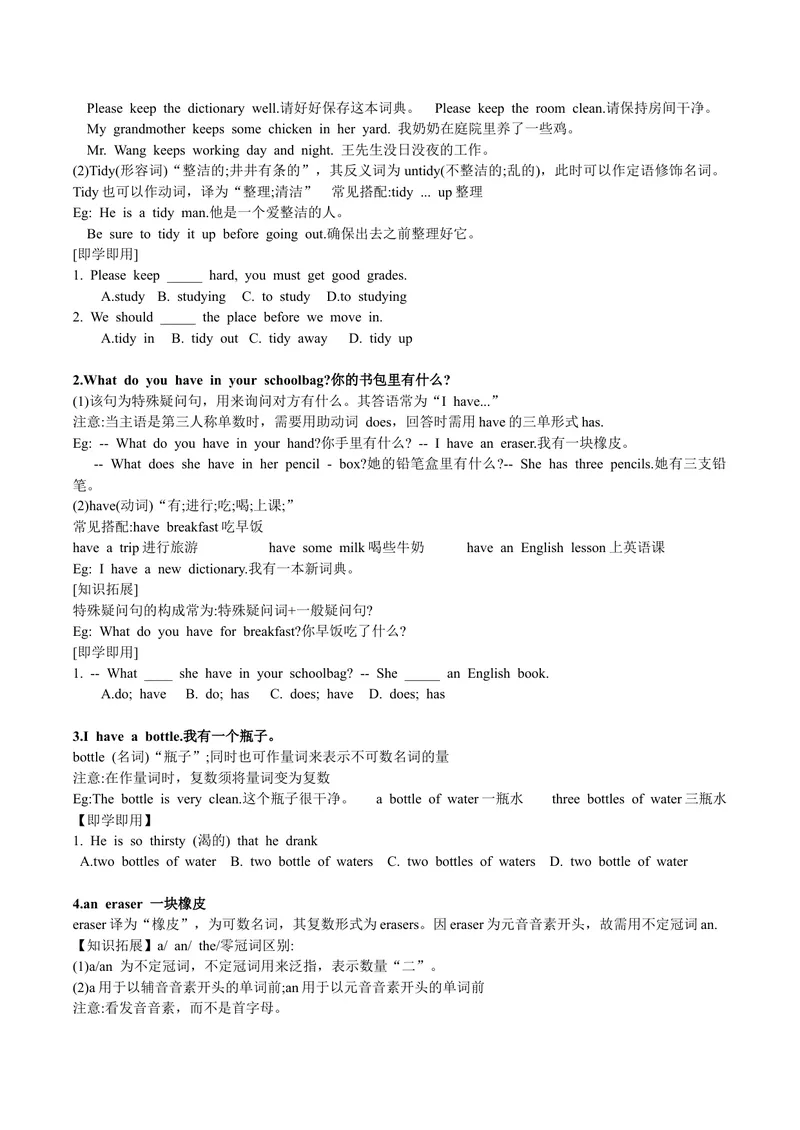
Eg: Please keep calm.请保持冷静。 Please keep promise.请信守诺言。Please keep the dictionary well.请好好保存这本词典。 Please keep the room clean.请保持房间干净。
My grandmother keeps some chicken in her yard. 我奶奶在庭院里养了一些鸡。
Mr. Wang keeps working day and night. 王先生没日没夜的工作。
(2)Tidy(形容词)“整洁的;井井有条的”,其反义词为untidy(不整洁的;乱的),此时可以作定语修饰名词。
Tidy也可以作动词,译为“整理;清洁” 常见搭配:tidy ... up整理
Eg: He is a tidy man.他是一个爱整洁的人。
Be sure to tidy it up before going out.确保出去之前整理好它。
[即学即用]
1. Please keep _____ hard, you must get good grades.
A.study B. studying C. to study D.to studying
2. We should _____ the place before we move in.
A.tidy in B. tidy out C. tidy away D. tidy up
2.What do you have in your schoolbag?你的书包里有什么?
(1)该句为特殊疑问句,用来询问对方有什么。其答语常为“I have...”
注意:当主语是第三人称单数时,需要用助动词 does,回答时需用have的三单形式has.
Eg: -- What do you have in your hand?你手里有什么? -- I have an eraser.我有一块橡皮。
-- What does she have in her pencil - box?她的铅笔盒里有什么?-- She has three pencils.她有三支铅
笔。
(2)have(动词)“有;进行;吃;喝;上课;”
常见搭配:have breakfast吃早饭
have a trip进行旅游 have some milk喝些牛奶 have an English lesson上英语课
Eg: I have a new dictionary.我有一本新词典。
[知识拓展]
特殊疑问句的构成常为:特殊疑问词+一般疑问句?
Eg: What do you have for breakfast?你早饭吃了什么?
[即学即用]
1. -- What ____ she have in your schoolbag? -- She _____ an English book.
A.do; have B. do; has C. does; have D. does; has
3.I have a bottle.我有一个瓶子。
bottle (名词)“瓶子”;同时也可作量词来表示不可数名词的量
注意:在作量词时,复数须将量词变为复数
Eg:The bottle is very clean.这个瓶子很干净。 a bottle of water一瓶水 three bottles of water三瓶水
【即学即用】
1. He is so thirsty (渴的) that he drank
A.two bottles of water B. two bottle of waters C. two bottles of waters D. two bottle of water
4.an eraser 一块橡皮
eraser译为“橡皮”,为可数名词,其复数形式为erasers。因eraser为元音音素开头,故需用不定冠词an.
【知识拓展】a/ an/ the/零冠词区别:
(1)a/an 为不定冠词,不定冠词用来泛指,表示数量“二”。
(2)a用于以辅音音素开头的单词前;an用于以元音音素开头的单词前
注意:看发音音素,而不是首字母。Eg: a boy 一个男孩; a banana一根香蕉; a university 一所大学
an apple 一颗苹果; an hour一个小时
(3)the为定冠词,用来特指上文提到的人或物,也可指说话双方都知道的人或物,亦可\指世界上独一无二
的事物。Eg: the Earth 地球;the girl in red穿红色衣服的女孩;
I have a new book, the book is in my schoolbag.我有一本新书,这本书在书包里。
(4)零冠词即“不填”;常常用在国家、地名、人名等专有名词,节日、季节、月份、星期、一日三餐、球
类运动、学科等名词前。
Eg: Have breakfast吃早饭;play football 踢足球;China 中国;in summer在夏天
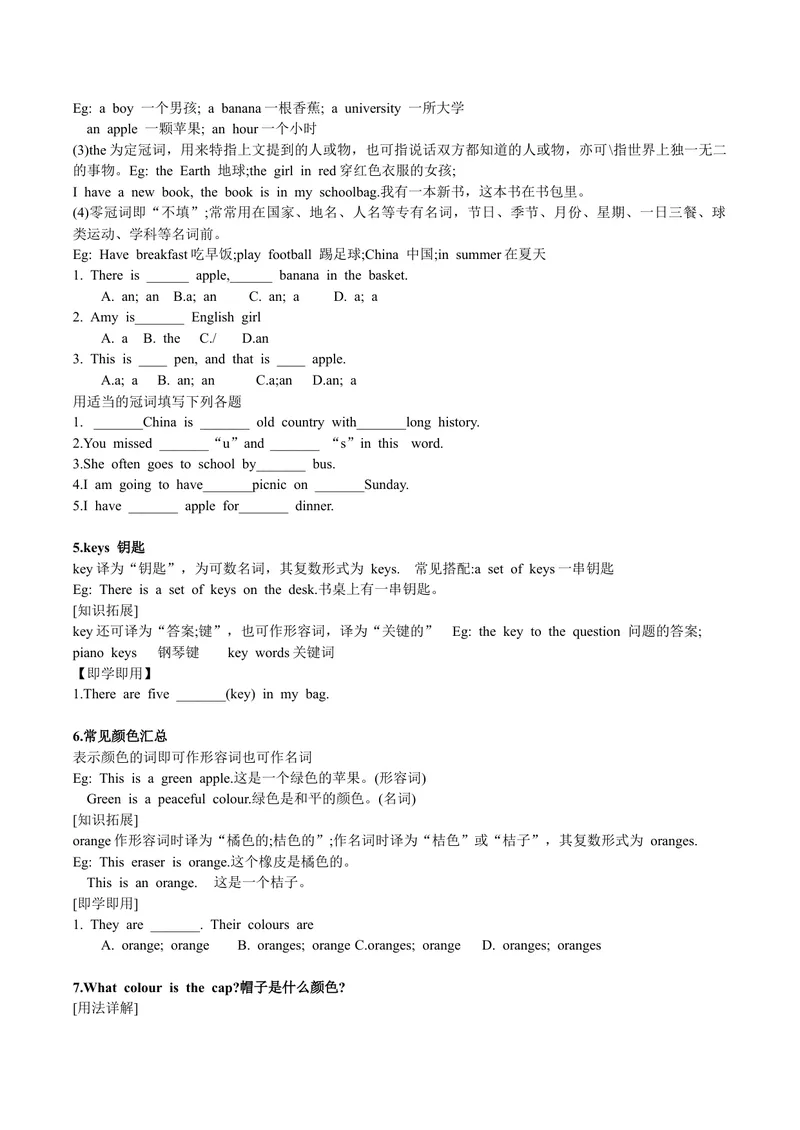
1. There is ______ apple,______ banana in the basket.
A. an; an B.a; an C. an; a D. a; a
2. Amy is_______ English girl
A. a B. the C./ D.an
3. This is ____ pen, and that is ____ apple.
A.a; a B. an; an C.a;an D.an; a
用适当的冠词填写下列各题
1. _______China is _______ old country with_______long history.
2.You missed _______“u”and _______ “s”in this word.
3.She often goes to school by_______ bus.
4.I am going to have_______picnic on _______Sunday.
5.I have _______ apple for_______ dinner.
5.keys 钥匙
key译为“钥匙”,为可数名词,其复数形式为 keys. 常见搭配:a set of keys一串钥匙
Eg: There is a set of keys on the desk.书桌上有一串钥匙。
[知识拓展]
key还可译为“答案;键”,也可作形容词,译为“关键的” Eg: the key to the question 问题的答案;
piano keys 钢琴键 key words关键词
【即学即用】
1.There are five _______(key) in my bag.
6.常见颜色汇总
表示颜色的词即可作形容词也可作名词
Eg: This is a green apple.这是一个绿色的苹果。(形容词)
Green is a peaceful colour.绿色是和平的颜色。(名词)
[知识拓展]
orange作形容词时译为“橘色的;桔色的”;作名词时译为“桔色”或“桔子”,其复数形式为 oranges.
Eg: This eraser is orange.这个橡皮是橘色的。
This is an orange. 这是一个桔子。
[即学即用]
1. They are _______. Their colours are
A. orange; orange B. oranges; orange C.oranges; orange D. oranges; oranges
7.What colour is the cap?帽子是什么颜色?
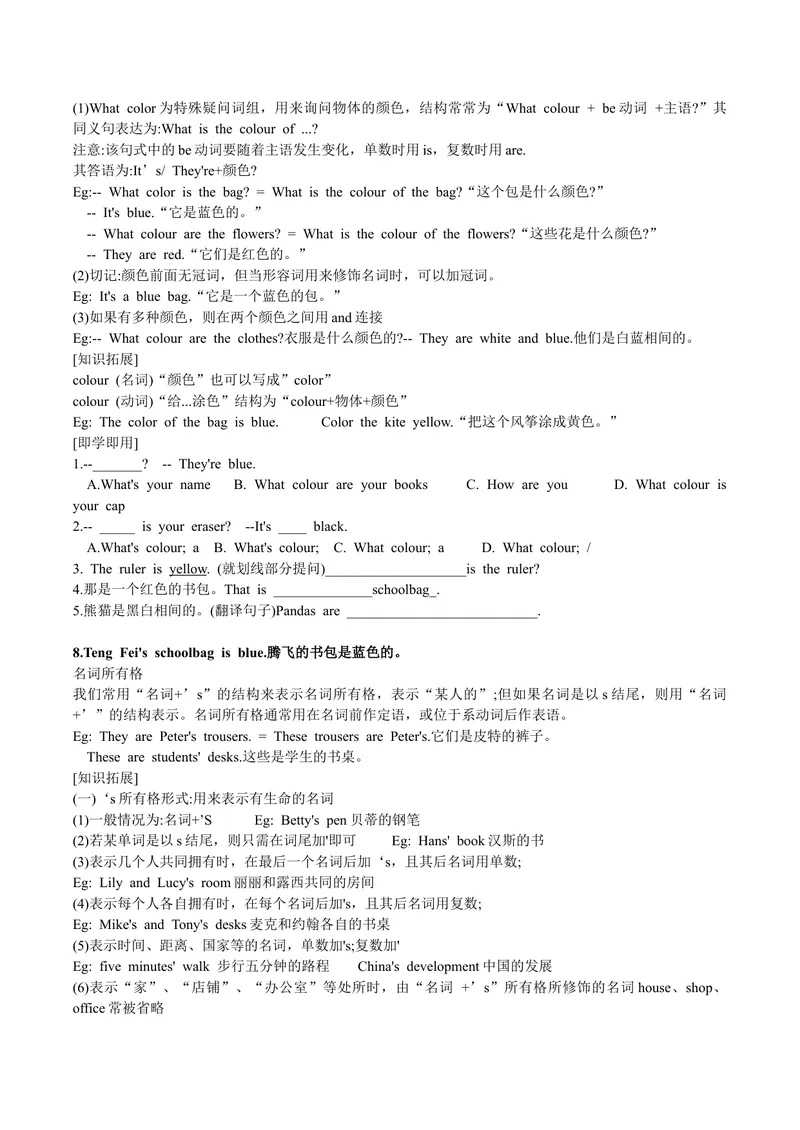
[用法详解](1)What color为特殊疑问词组,用来询问物体的颜色,结构常常为“What colour + be动词 +主语?”其
同义句表达为:What is the colour of ...?
注意:该句式中的be动词要随着主语发生变化,单数时用is,复数时用are.
其答语为:It’s/ They're+颜色?
Eg:-- What color is the bag? = What is the colour of the bag?“这个包是什么颜色?”
-- It's blue.“它是蓝色的。”
-- What colour are the flowers? = What is the colour of the flowers?“这些花是什么颜色?”
-- They are red.“它们是红色的。”
(2)切记:颜色前面无冠词,但当形容词用来修饰名词时,可以加冠词。
Eg: It's a blue bag.“它是一个蓝色的包。”
(3)如果有多种颜色,则在两个颜色之间用and连接
Eg:-- What colour are the clothes?衣服是什么颜色的?-- They are white and blue.他们是白蓝相间的。
[知识拓展]
colour (名词)“颜色”也可以写成”color”
colour (动词)“给...涂色”结构为“colour+物体+颜色”
Eg: The color of the bag is blue. Color the kite yellow.“把这个风筝涂成黄色。”
[即学即用]
1.--_______? -- They're blue.
A.What's your name B. What colour are your books C. How are you D. What colour is
your cap
2.-- _____ is your eraser? --It's ____ black.
A.What's colour; a B. What's colour; C. What colour; a D. What colour; /
3. The ruler is yellow. (就划线部分提问)____________________is the ruler?
4.那是一个红色的书包。That is ______________schoolbag_.
5.熊猫是黑白相间的。(翻译句子)Pandas are ___________________________.
8.Teng Fei's schoolbag is blue.腾飞的书包是蓝色的。
名词所有格
我们常用“名词+’s”的结构来表示名词所有格,表示“某人的”;但如果名词是以s结尾,则用“名词
+’”的结构表示。名词所有格通常用在名词前作定语,或位于系动词后作表语。
Eg: They are Peter's trousers. = These trousers are Peter's.它们是皮特的裤子。
These are students' desks.这些是学生的书桌。
[知识拓展]
(一)‘s所有格形式:用来表示有生命的名词
(1)一般情况为:名词+’S Eg: Betty's pen贝蒂的钢笔
(2)若某单词是以s结尾,则只需在词尾加'即可 Eg: Hans' book汉斯的书
(3)表示几个人共同拥有时,在最后一个名词后加‘s,且其后名词用单数;
Eg: Lily and Lucy's room丽丽和露西共同的房间
(4)表示每个人各自拥有时,在每个名词后加's,且其后名词用复数;
Eg: Mike's and Tony's desks麦克和约翰各自的书桌
(5)表示时间、距离、国家等的名词,单数加's;复数加'
Eg: five minutes' walk 步行五分钟的路程 China's development中国的发展
(6)表示“家”、“店铺”、“办公室”等处所时,由“名词 +’s”所有格所修饰的名词house、shop、
office常被省略Eg: at my mother's (home) 在我妈妈家 at the doctor's (office)在医生的诊所
(7)基数词 +连字符 + 可数名词单数,一般作定语修饰名词,它相当于“基数词+名词所有格”
Eg: a two-day holiday =a two days' holiday两天的假期
(二)of所有格:用来表示无生命的名词
(1)“ of + 名词"的所有格形式主要用于表示无生命力名词的所属关系。
Eg: a map of China中国地图 the name of this village这个村庄的名字
(2)of所有格也可用于人或有生命的东西,表示所属关系,特别是当这些所有者有较长的定语时。
Eg: the name of the brave young man这个勇敢的年轻人的名字
(3)表示某物的一部分或抽象概念。 Eg: the top of the house.房屋的顶部
(4)有的名词所有格可以用两种方法表示。 Eg: a photo of my family =my family's photo我的全家福
【即学即用】
1. My ______ job is a writer.
A.mother B. mother's C.mothers D. mothers'
2.That is_______room.
A.Lily and Lucy B. Lily's and Lucy's C. Lily's and Lucy D. Lily and Lucy's
3.There is_______on the wall.
A.a map of the world B. a world map C. a world's map D. the world of a man
9.Peter's trousers are red.彼得的裤子是红色的。
trousers为名词,常以复数形式出现,指“长裤”;在表达“一条裤子”时,常用a pair of trousers表示。
Eg: She wears a pair of trousers today.她今天穿了一条长裤。
注意:(1)trousers作主语时,谓语动词用复数形式。Eg: Betty's trousers are nice.贝蒂的裤子很好。
(2) a pair of trousers作主语时,谓语动词用单数形式。Eg: There is a pair of trousers on sale.有一条裤
子在打折。
[知识拓展]
类似以复数形式出现的名词有:shoes(鞋); socks(袜子); shorts(短裤); glasses(眼镜); scissors(剪刀);
chopsticks(筷子)等。
[即学即用]
1. Your trousers ____ on the bed.
A.am B.is C.are D.be
2. This pair of shoes______too expensive (昂贵的).
A.am B.is C. are D. be
3.我什么都看不清,我可以有一副眼镜好吗?
I can't see anything, could I have_________pair____________glasses_?
10.元音字母a、e、i、o、u在重读开音节中的发音
元音字母在重读开音节中的发音与它们本身的发音相同。即
Aa: /eɪ/如: make; cake; take; lake; name等
Ee: /i:/ 如: he; she; me 等
Ii: /aɪ/如: hi; bike; like; bike; ice等
Oo: /əʊ/如: note; ago; go; rose; close等
Uu: /ju:/如: use; student等
[知识拓展]
开音节分两种:一种叫绝对开音节,一种叫相对开音节。(1)绝对开音节:以单个元音字母结尾的音节。如he,no等。
(2)相对开音节:单个元音字母后加单个辅音(r除外),再加不发音的字母e构成的音节,即“辅音+单个元音
+单个辅音 +e”的结构。如 name、hope等
[即学即用]
选出划线部分读音与其他三个不同的选项
1.A. likeB. kite C. fine D.ship
2.A. bus B. cute C.use D.student
3.A.cake B. lake C. take D.bad
4.A.we B.egg C. she D. he
5. A.go B. nose C. tone D.shop
11.Don't get up too late!不要起来的太晚!
该句为祈使句的否定形式。
祈使句常常表示命令、请求、警告、劝告、建议等。常常省略主语,用谓语动词原形开头;其否定结构是在
句首加don't或用“No+动词ing”形式及“No+名词”形式,句末常用句号或感叹号。
Eg: Be quiet,please!请保持安静! Don't be late for school!上学不要迟到!
No smoking! 禁止吸烟! No photos! 禁止拍照!
[知识拓展]
late在此处为副词,修饰前面动词短语get up;此外late也可为形容词,在句中常作表语。
常见搭配:be late for...“迟到”
Eg: He went to bed too late last night.昨晚他睡得太晚了。
He was late for school yesterday. 昨天他上学迟到了。
[即学即用]
1. _____ make noise(制造噪音)in the library, it's too impolite(不礼貌的).
A.Don't B. Do C. Does D.Isn't
2.王先生昨天上班迟到了。
Mr. Wang was late____________work yesterday.
12.We can fly my kite.我们可以放我们的风筝。
(1)can为情态动词,译为“能;可以;会”;常常用来表示某种能力或请求等。无人称和数的变化。
其否定形式在can后加not即可(can not = can't);一般疑问句形式将can提前。
Eg: She can speak English very well.她英语说的很好。
-- She can't speak English very well.她英语说的不是很好。
-- Can she speak English very well?她英语说的好吗?
(2)fly作动词时译为“飞;飞行”;作名词用时译为“苍蝇”
Eg: There is a fly flying over there.有只苍蝇正在那飞。
[知识拓展]
fly在作动词时,常见搭配为“fly to +地点”,该结构相当于“take a plane to +地点”或“go to... by
plane”译为“坐飞机去某地”
Eg: We will fly to Beijing. = We will take a plane to Beijing. = We will go to Beijing by plane.
我们将坐飞机去北京。
[即学即用]
1. He wants to join the Music Club because he ____ sing very well.
A.do B. does C. can D. can't2. She can ______ a bike.
A.ride B. to ride C.riding D.to riding
3.他们将坐飞机去巴黎。They will__________________Paris.
4.The boy can look after himself.(变为否定句)_______________________________________________
5.They can run very fast.(变为一般疑问句,并作否定回答)____________________________________
13.A schoolbag is on the desk.一个书包在桌子上。
[句式结构]“物品+be动词 +介词短语”
该句式用来表示“某物在某地”,be动词要随着主语发生变化
Eg: The ruler is in the pencil box. 尺在铅笔盒里。
[用法详解]
本课出现表方位介词有in、on、under,三者区别为:
in 译为“在..里”,指一个物体在另一个物体的内容
on 译为“在...上”,指一个物体在另一个物体上方且有接触
under译为“在...下面”,指一个物体在另一个物体下方,有无接触均可
Eg: The book is in the schoolbag.书在书包里。
The cap is on the bed. 帽子在床上。
The football is under the chair.足球在椅子下面。
[即学即用]
1. -- What can you see _____ this picture? -- I can see a boat ____ the river (河流).
A.in; on B. on; in C. in; in D.on;on
2. There is a bag on the ball, so the ball is _____ the bag.
A.in B.on C. under D.at
14.A pair of socks is under the bed.一双袜子在床下。
a pair of 译为“一对;一双”,用来表示某一名词的量,后面常常接复数名词。在变复数形式时常常将pair
变为复数形式pairs,其作主语时谓语动词要与pair保持一致。
[知识拓展]常见使用a pair of的名词
trousers裤子 ; gloves手套; shoes鞋; socks袜子; glasses眼镜; scissors剪刀
[即学即用]
1. Three ______ of socks ____ eighteen yuan.
A.pair; are B. pairs; are C.pairs; is D. pair; is
2.床下有一双鞋。There is______________________________under the bed.
15.I can't find my new cap.我找不到我的新帽子。
[易混辨析]find及look for区别
find译为“找到;发现”,强调找的结果; look for 译为“寻找”,强调找的动作,找到与否并不清楚
Eg: She looked for her ruler everywhere, but she didn't find it.她到处找她的钥匙,但是她没找到。
[知识拓展]
find的过去式为found,found也可单独作实义动词,译为“建立;创办”,此时过去式为 founded。
Eg: The town was founded in1610. 这个城镇于1610年创办。
[即学即用]
1. The little boy ______ his mother in the park, but he can't ____ her.
A.Looked for; find B. look for; find C. looked for; found D. look for; found2. Do you know when the village was______?
A.found B. founded C. find D. finds
16.Do you see them? 你看见它们了吗?
[用法详解] look、see、watch、read的区别
look“看”,是不及物动词,强调“看”的动作,后面常加介词at,构成短语look at...
Eg: Look at my new book. 看我的新书。
look 也可单独使用,其后不需加任何词,用来引起他人注意,常用于现在进行时中。
Eg: Look! The boy is reading a book.看!那个男孩正在读书。
see“看见;看到”强调看的结果。常用于看电影、戏剧、展览等,也可以译为“理解、明白、看望”等意
思。
Eg: You can see many birds in the tree.你可以在树上看到许多鸟。
Let's see our teacher. 让我们看看我们的老师吧。
watch“观看、注视”多用指感兴趣的观看某物,如电视、比赛等
Eg: I like watching football matches. 我喜欢看足球比赛。
read“阅读”,主要用于看书、报纸、杂志等和纸张有关的带有文字的东西
Eg: The girl likes readingbooks very much.这个女孩非常喜欢读书。
[即学即用]
1. My father likes _____ a newspaper every evening.
A.watching B. seeing C. reading D.looking
2. _____! There is a boy climbing the tree.
A.Look B.Watch C.See D.Read
17.Take turns to come to the front.轮流到前面来。
turn (动词)“转动”;“变成”;“转向”;(名词)“转动”;“轮流”
take turns to do sth.轮流做某事
类似句式为:It's one's turn to do sth.轮到某人做某事
Eg: Take turns to choose a place.轮流选择一个地方。 It's my turn to clean the room.轮到我打扫房间。
[知识拓展]
turn的常见搭配: turn up 出现;把声音调大 turn down减小;把声音调小 turn on打开
turn off关掉 turn out结果是 turn over 翻转 turn into变成;进入
[即学即用]
1. The music is too noisy, please ______.
A.turn it on B. turn in off C. turn it up D. turn it down
2. It’s my turn______________ (be) on duty.
三.随堂小测
一、按相同音素将下列单词归类cake she grape we five bike home rose kite nine hi he name snake face plate cute
tube use hole nose
Aa /eɪ/ ___________________________________________________________
Ee /i:/ ___________________________________________________________
Ii /aɪ/ ___________________________________________________________
Oo /əʊ/ ___________________________________________________________
Uu /ju:/ ___________________________________________________________
二、用所给词的适当形式填空
1.There are two ____________(key) on the desk.
2.Mary ____________ (have) a nice dress.
3.I need a pair of ____________(glass).
4.Mum, where are my shoes? I can't find____________(they)
5.What colour ____________(be) the dog?
6.This is ____________(Betty) room.
7.This pair of trousers ____________ (be) new.
8.____________(not make)noise in the library.
9.She can ____________ (draw) the picture very well.
10.We can take turns ____________(be) the leader.
三、单项选择
( )1. This pair of trousers______ mine, my trousers blue.
A.is; are B.is;is C.are;is D.are; are
( )2. She needs ______ her work in two hours.
A.finish B. finishes C. to finish D. to finishing
( )3. -- Thank you for your invitation. --_____________
A. OK. B. I'm fine, thank you. C. Sorry. D.You're welcome.
( )4. There are many_______ on the counter (柜台).
A.pair of glasses B. pairs of glass C. pairs of glasses D. pair of glass
( )5. You should keep your room ______ at home.
A.untidy B. tidy C. nice D.new
( )6. This is ____ useful dictionary,_____ dictionary is Tony's.
A.a; a B.a: the C.an; a D.an; the
( )7.-- _____ is your new schoolbag? -- It's pink.
A.What B. Where C. What colour D.How
( )8. The dress is yellow, and the shoes are______, too.
A.black B. yellow C. green D.blue
( )9. There is a map of China ______the
A.at B. under C.on D.in
( )10. Mr. Wang has ____ car, that's _____ English car.
A. a; an B. a; a C.an; a D.an; an
( )11. Can you ______ any birds in the tree?
A.look B. see C.read D.watch
( )12.-- What ______ your teacher have in her hand? -- She _____ an egg.
A.do; have B.do; has C. does; have D. does; has
四、根据句意,用in/on/under填写空格1.The ball is __________ the box. 2.The book is __________the sofa (沙发).
3.The dog is __________ the desk. 4.The bag is __________the floor (地板).
5.The book is __________ the bag.
五、句型转换
1.He can sing English songs.(就划线部分提问) ________________________________________________?
2.This tiger is yellow and black.(就划线部分提问) ________________________________________________?
3.Speak loudly, please.(改为否定句) ________________________________________________?
4.书包在桌子下面。(汉译英) ________________________________________________?
5.I need a pair of trousers.(英译汉) ________________________________________________?
六、完形填空
Look! This is Tom's 1.______. It's very nice. There 2._____ a desk, a bed and two chairs 3.______ it. The desk is
near the window. You can see 4.______ English books and beautiful flowers on 5.______. Under the desk, there is
a ball. The bed is next to the desk. Tom's 6.______ are under the bed. There is a 7._____ of China on the 8.______.
There is a photo of his 9._____ on the wall, too. You can see his parents and 10._____ in the photo.
( )1.A.bed B. room C. desk D.map
( )2.A.is B. has C. have D.are
( )3.A.in B.on C.at D. under
( )4.A. some B. any C. a D.an
( )5.A.this B. them C. these D.it
( )6.A.bag B. cap C. shoes D. book
( )7.A.picture B.map C.maps D. pictures
( )8. A. wall B. desk C.bed D. chair
( )9.A. family B. parents C. friends D. teachers
( )10.A.her B. he C.him D.she
七、阅读理解
My name is Cindy. This is my room. It is very tidy. Look! My books are on the desk. My tapes are on the radio.
My keys are in my schoolbag. I have a clock. It's on the desk, too. But my brother's room isn't tidy. His things
are everywhere -- on his bed, on his sofa, on the floor(地板)and under the chair. His schoolbag is under
the bed. He always asks,“Where is my book?”“Where is my pencil?”“Where is my eraser?”
( )1. Cindy's room is very ______.
A.small B.big C. nice D. tidy
( )2. Where are Cindy's books?
A.They are on the radio. B. They are on the floor.
C. They are in her schoolbag. D. They are on the desk.
( )3. Cindy's brother's things are _____.
A.on his bed B. on his sofa C.on the floor D.everywhere
( )4. Is Cindy's brother's schoolbag on the floor?
A.Yes, it is. B. No, it isn't. C. Yes, they are. D. No, they aren't.
( )5.Where is Cindy's keys?
A.They are on the radio. B. They are in her schoolbag.
C. They are on the sofa. D.They are under the chair.