Module 11 模块综合检测
(45 分钟 100 分)
第Ⅰ卷(共40分)
Ⅰ.听力(10分)
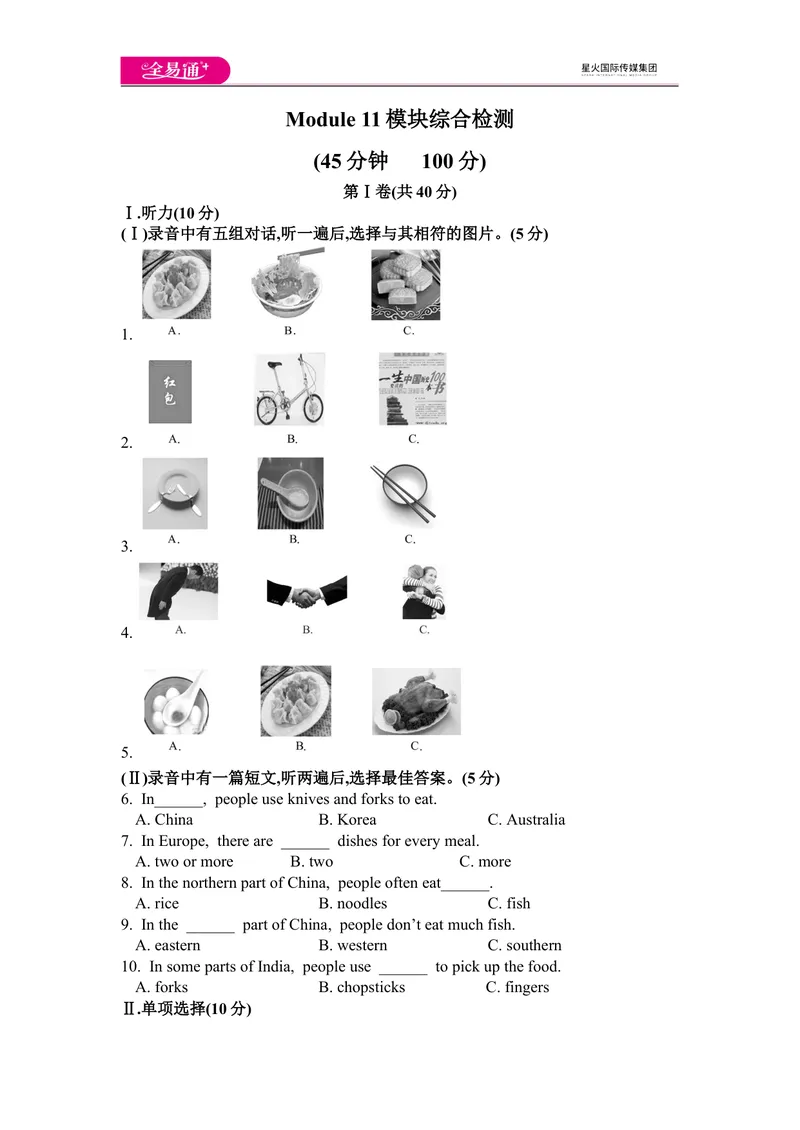
(Ⅰ)录音中有五组对话,听一遍后,选择与其相符的图片。(5分)
1.
2.
3.
4.
5.
(Ⅱ)录音中有一篇短文,听两遍后,选择最佳答案。(5分)
6. In______, people use knives and forks to eat.
A. China B. Korea C. Australia
7. In Europe, there are ______ dishes for every meal.
A. two or more B. two C. more
8. In the northern part of China, people often eat______.
A. rice B. noodles C. fish
9. In the ______ part of China, people don’t eat much fish.
A. eastern B. western C. southern
10. In some parts of India, people use ______ to pick up the food.
A. forks B. chopsticks C. fingers
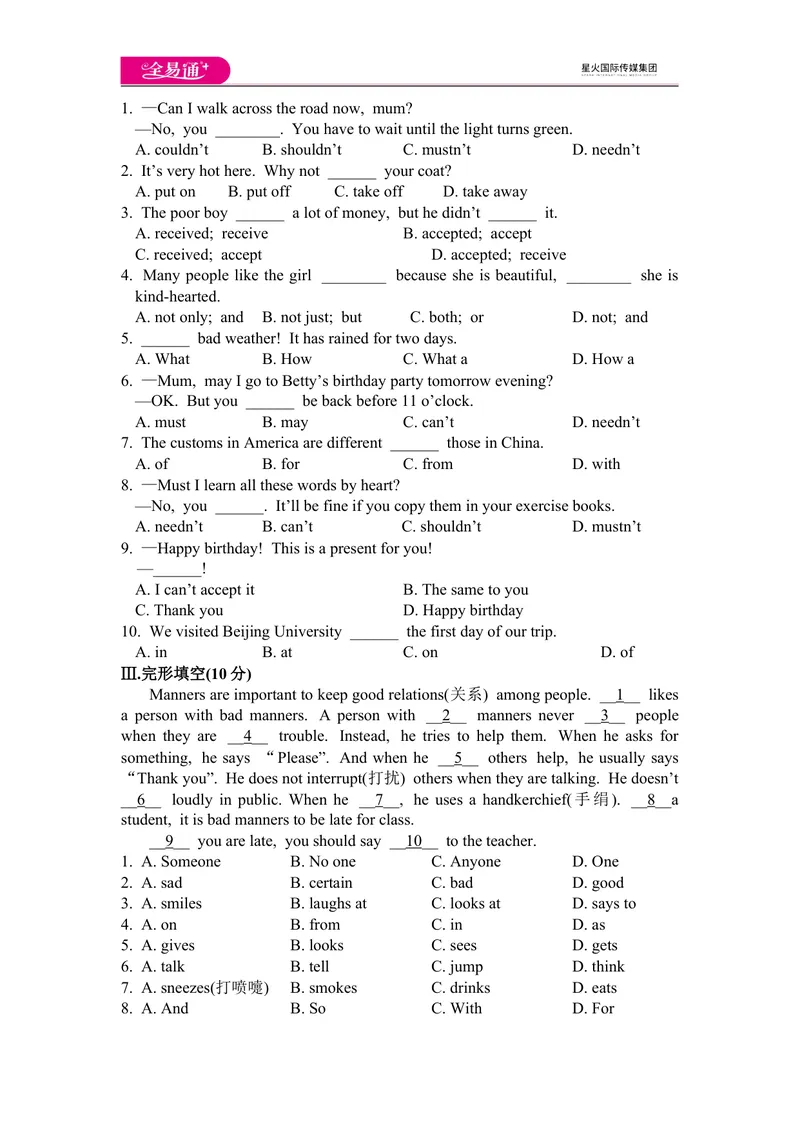
Ⅱ.单项选择(10分)1. —Can I walk across the road now, mum?
—No, you ________. You have to wait until the light turns green.
A. couldn’t B. shouldn’t C. mustn’t D. needn’t
2. It’s very hot here. Why not ______ your coat?
A. put on B. put off C. take off D. take away
3. The poor boy ______ a lot of money, but he didn’t ______ it.
A. received; receive B. accepted; accept
C. received; accept D. accepted; receive
4. Many people like the girl ________ because she is beautiful, ________ she is
kind-hearted.
A. not only; and B. not just; but C. both; or D. not; and
5. ______ bad weather! It has rained for two days.
A. What B. How C. What a D. How a
6. —Mum, may I go to Betty’s birthday party tomorrow evening?
—OK. But you ______ be back before 11 o’clock.
A. must B. may C. can’t D. needn’t
7. The customs in America are different ______ those in China.
A. of B. for C. from D. with
8. —Must I learn all these words by heart?
—No, you ______. It’ll be fine if you copy them in your exercise books.
A. needn’t B. can’t C. shouldn’t D. mustn’t
9. —Happy birthday! This is a present for you!
—______!
A. I can’t accept it B. The same to you
C. Thank you D. Happy birthday
10. We visited Beijing University ______ the first day of our trip.
A. in B. at C. on D. of
Ⅲ.完形填空(10分)
Manners are important to keep good relations(关系) among people. __1__ likes
a person with bad manners. A person with __2__ manners never __3__ people
when they are __4__ trouble. Instead, he tries to help them. When he asks for
something, he says “Please”. And when he __5__ others help, he usually says
“Thank you”. He does not interrupt(打扰) others when they are talking. He doesn’t
__6__ loudly in public. When he __7__, he uses a handkerchief(手绢). __8__a
student, it is bad manners to be late for class.
__9__ you are late, you should say __10__ to the teacher.
1. A. Someone B. No one C. Anyone D. One
2. A. sad B. certain C. bad D. good
3. A. smiles B. laughs at C. looks at D. says to
4. A. on B. from C. in D. as
5. A. gives B. looks C. sees D. gets
6. A. talk B. tell C. jump D. think
7. A. sneezes(打喷嚏) B. smokes C. drinks D. eats
8. A. And B. So C. With D. For9. A. Because B. If C. Although D. Then
10.A. sorry B. thank you C. OK D. not at all
Ⅳ.阅读理解(10分)
Singapore is made up of many kinds of people. The largest groups are Chinese,
Malays and Indians. Each group has its own special wedding customs.
Chinese weddings: Before the wedding, the mothers of the bride(新娘)and the
groom(新郎)do the hair for them. The bride and the groom make tea for the groom’s
parents, aunts and uncles. Then they go to the bride’s family to give gifts. After that
they take some pictures. They ride in a car with red, pink and gold ribbon(缎
带)decoration. In the evening there is a big dinner. The women wear pink or gold
dresses because those are lucky colors. The bride usually wears a red or pink dress at
the dinner.
Malay weddings: A Malay’s wedding lasts two days in the city and many days
in the country. The first day is a Saturday evening. On Sunday morning, the bride
and the groom meet their friends, and the friends throw yellow rice over them to wish
them good luck. In the evening there is a big dinner. The friends usually take some
hard-boiled eggs when they leave for home.
Indian weddings: A tree is planted at the Indian wedding. After the bride and
the groom plant the tree, they change their clothes. Usually the groom gives the
clothes to the bride and the bride puts the clothes on. The friends throw rice at the
bride and the groom to wish them good luck. The friends do not wear black or white
clothes. Bright colors are the best for weddings.
1. What can we learn about Singapore?
A. It is made up of three kinds of people.
B. The largest group of people is Malays.
C. There are different wedding customs.
D. The wedding customs are the same.
2. Which wedding may be the longest?
A. A Chinese Wedding B. A Malay Wedding
C. An Indian Wedding D. It isn’t mentioned in the passage
3. Which is TRUE of all the three wedding customs?
A. The friends have a big dinner for the bride and the groom.
B. The friends wish the bride and the groom good luck.
C. The friends throw rice at the bride and the groom.
D. The friends wear black or white clothes.
4. Which wedding may cost the least money according to the passage?
A. A Chinese Wedding. B. A Malay Wedding.
C. An Indian Wedding. D. We don’t know.
5. Which is TRUE according to the passage?
A. At the Indian wedding, the bride and the groom plant a tree.
B. At the Malay wedding, there is a big dinner on the first day.
C. At the Chinese wedding, all the people wear green clothes.
D. The people wear new clothes at the three weddings.第Ⅱ卷(共60分)
Ⅴ.根据句意及首字母或汉语提示完成单词(10分)
1. Our English teacher is very s________. We are all afraid of him.
2. In the USA, when someone gives you a present, you must open it i________.
3. It’s a t________ in China to give presents to friends during the Spring Festival.
4. Have you had any________(经验) of teaching English?
5. Playing________(电子的) games for a long time is bad for children’s eyes.
Ⅵ.完成句子(20分)
1. 当你参观博物馆时,你不能拍照。
You ________ ________ ________ when you visit a museum.
2. 玛丽每天吃完饭都会帮妈妈洗餐具。
Mary helps her mother ________ ________ after dinner every day.
3. ——你在等谁?
——露西。
—Who are you ________ ________?
—Lucy.
4. 汤姆对中国的传统食物非常感兴趣。
Tom is interested in the Chinese ________ ________ very much.
5. 英国的生活方式与中国的有所不同。
The way of life in England ________ ________ ________ that in China.
Ⅶ.书面表达(30分)
假如你是Tony,你的网友Jim要去韩国参观,他发邮件给你想了解有关韩国
的风俗。请你根据下面提供的信息,用英语给你的网友写一封电子邮件,介绍一下
韩国的风俗。(70个词左右)
1.初次见面要鞠躬问好,互换名片(business card),并仔细看了名片后再放起来;
2.乘坐地铁时不要说话;
3.访问朋友要带礼物,并提前打好招呼。
Dear Jim,
I’m glad to hear that you will go to Korea. _____________________________
_____________________________________________________________________
_____________________________________________________________________
_____________________________________________________________________
_____________________________________________________________________
_____________________________________________________________________
_____________________________________________________________________
Yours,
Tony答案解析
Ⅰ.【听力材料】
(Ⅰ)1. M: Hi! Linlin, what food do you eat on the Spring Festival Eve?
W: Dumplings, of course.
2. W: Do you know why he is very happy?
M: Oh, he has just received a hongbao.
3. M: Can you use chopsticks to eat, Lucy?
W: Sorry, I can’t. Can you help me?
M: OK!
4. W: What do you do when you meet the people for the first time?
M: Shake hands.
5. W: What do you often eat for Thanksgiving Day?
M: Turkeys. They’re delicious.
答案:1~5. AACBC
(Ⅱ)
People around the world have different eating habits.
In North America, Australia and Europe, there are two or more dishes for every
meal and people use knives and forks to eat.
In the southern part of China, people eat rice, and in the north they often eat
noodles. In the central and western parts, people are far away from the sea, so they
don’t eat much fish. But all Chinese people use chopsticks to eat.
In some parts of India, people use their fingers to pick up the food.
In Korea, people use a spoon or chopsticks to eat, but it’s not polite to use both
of them at the same time.
答案:6~10. CABBC
Ⅱ. 1.【解析】 C。本 考 情 的辨析。根据 句句意“ ,我 在可以
选 题 查 态动词 问 妈妈 现
穿 路 ?”和答 后句“你不得不等到 灯亮。”可推出此 答 “不,你
过马 吗 语 绿 处 语为
一定不要”,couldn’t 意 “不能”;shouldn’t“不 ”;mustn’t“一定不
为 应该
要”;needn’t“不必”。故 C。
选
2.【解析】 C。本 考 辨析。put on“穿上”;put off“推 ”; take off“脱
选 题 查词义 迟
掉”;take away“ 走”。句意:天 么 , 什么不脱掉外套呢?故 C。
带 这 热 为 选
3【. 解析】 C。本 考 辨析。receive意 “接到”,指收到某物 一 作,本
选 题 查词义 为 这 动
身有一定的被 性,不包含本身是否愿意接受的意思。accept意 “接受”,指
动 为 经
考 ,由主 意志来决定接受, 作者本身是主 的。句意: 个 的孩子收到
过 虑 观 动 动 这 贫穷
了很多 ,但是他没有接受。故 C。
钱 选
4【. 解析】 B。本 考 固定句式。句意: 多人喜 个女孩不 因 她漂亮而
选 题 查 许 欢这 仅 为
且她很善良。not just...but不 ……而且……。故 B。
仅 选
5【. 解析】 A。本 考 感 句。weather 不可数名 ,故用what引 ,而且不加
选 题 查 叹 为 词 导
冠 。故 A。
词 选
6.【解析】 A。本 考 情 。must意 “一定、必 ”,表示把握性十分
选 题 查 态动词 为 须
大;may意 “或 、可能”,表示可能;can’t意 “一定不是、肯定不是”,是must
为 许 为
的反 。needn’t意 “不需要”。句意:—— ,明天晚上我可以去参加 蒂
义词 为 妈妈 贝
的生日聚会 ?——可以。但是你必 在11点之前回来。故 A。
吗 须 选
7【. 解析】 C。本 考 固定搭配。be different from...意思是“与……不同”。故
选 题 查C。
选
8.【解析】 A。本 考 情 的用法。由must引 的疑 句,否定回答用
选 题 查 态动词 导 问
needn’t。句意:——我必 把 些 都 住 ?——不用。只要你抄在 本上
须 这 单词 记 吗 练习
就可以了。故 A。
选
9.【解析】 C。本 考 交 用 。句意:——祝你生日快 ! 是 你的礼物!
选 题 查 际 语 乐 这 给
—— ! 中只有C 符合 意。故 C。
谢谢 选项 项 题 选
10【. 解析】 C。本 考 介 的用法。句意:在我 旅行的第一天,我 参 了北
选 题 查 词 们 们 观
京大学。on the first day of...在……的第一天。故 C。
选
Ⅲ.1【. 解析】 B。本 考 不定代 的辨析。句意:没有一个人喜 没礼貌的人。
选 题 查 词 欢
no one意 “没有人”。故 B。
为 选
2【. 解析】 D。本 考 形容 辨析。good manners意 “有礼貌”;bad manners
选 题 查 词 为
意 “没礼貌”。句意:当 人 在麻 中 ,从不……可知是有礼貌的人。故
为 别 处 烦 时 选
D。
3.【解析】 B。本 考 辨析。此 “嘲笑”人 。laugh at意 “嘲
选 题 查词义 处应为 们 为
笑”。故 B。
选
4【. 解析】 C。本 考 固定搭配。be in trouble意 “ 在麻 当中”。故 C。
选 题 查 为 处 烦 选
5.【解析】 D。本 考 固定搭配。get othershelp“得到 人的帮助”,故 D。
选 题 查 别 选
6.【解析】 A。本 考 辨析。根据后面的“loudly in public”可知,与loudly
选 题 查动词
相搭配的 talk,故 A。
动词应为 选
7【. 解析】 A。本 考 境理解。由后面的“用手 ”可推出前面 是打 嚏。
选 题 查语 绢 应 喷
故 A。
选
8【. 解析】 D。本 考 境理解。由后面的叙述,上 到没礼貌,可推 是
选 题 查语 课迟 测 针对
学生而言,for是“ 于”的意思。故 D。
对 选
9.【解析】 B。本 考 辨析。此 引 条件状 从句,“如果你 到
选 题 查连词 处 导 语 迟
了……”,故 B。
选
10【. 解析】 A。本 考 常 。如果 到了, 老 “ 不起”,表示歉意。
选 题 查 识 迟 应该对 师说 对
故 A。
选
Ⅳ.1【. 解析】 C。事 。由第一段第三句 “Each group has its own special
选 实细节题 话
wedding customs.”可知,新加坡有不同的婚礼 俗。故 C。
风 选
2.【解析】 B。推理判断 。由第三段第一句 “A Malays wedding lasts two
选 题 话
days in the city and many days in the country.”可知, 来西 人的婚礼是最 的。
马 亚 长
故 B。
选
3【. 解析】 B。推理判断 。 有关三种婚礼的段落可知,三种婚礼都有朋友的祝
选 题 读
福。故 B。
选
4.【解析】 C。事 。比 三种婚礼,只有印度婚礼最 。故 C。
选 实细节题 较 经济 选
5.【解析】 A。推理判断 。由第四段第一句 “A tree is planted at the Indian
选 题 话
wedding.”可知,印度婚礼上植 。故 A。
树 选
Ⅴ.答案:1.serious 2.immediately 3.tradition 4.experience 5.video
Ⅵ.答案:1.can’t take photos 2.wash up 3.waiting for
4.traditional food 5.is different from
Ⅶ.【参考范文】
Dear Jim,
I’m glad to hear that you will go to Korea. There are many special customs in
Korea. When you meet a person for the first time you should bow to him and sayhello. Then you will change business cards with each other, read the card carefully
and then put it in the pocket. When you take the subway, you’d better not speak.
When you want to visit somebody, you should tell him or her about it in advance and
take presents. I hope you can have a good time.
Yours,
Tony