Unit4 General Revision1 知识汇总及课文翻译
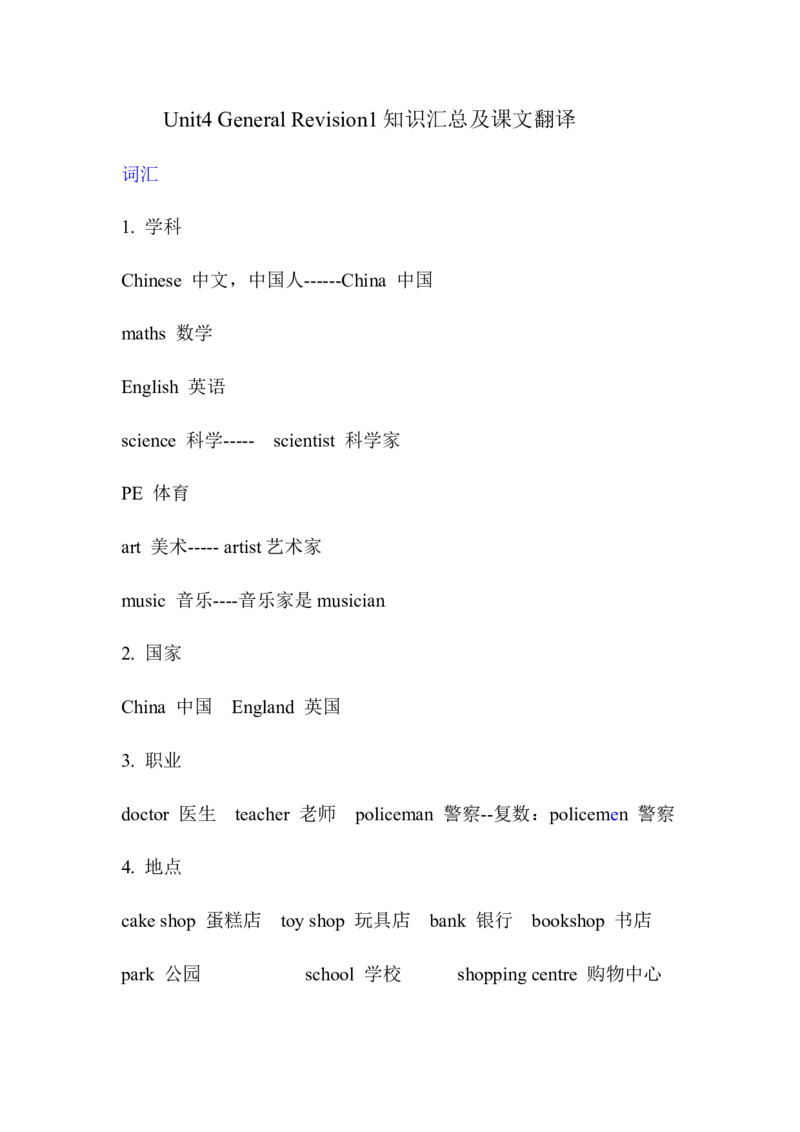
词汇
1. 学科
Chinese 中文,中国人------China 中国
maths 数学
English 英语
science 科学----- scientist 科学家
PE 体育
art 美术----- artist艺术家
music 音乐----音乐家是musician
2. 国家
China 中国 England 英国
3. 职业
doctor 医生 teacher 老师 policeman 警察--复数:policemen 警察
4. 地点
cake shop 蛋糕店 toy shop 玩具店 bank 银行 bookshop 书店
park 公园 school 学校 shopping centre 购物中心5. 序数词
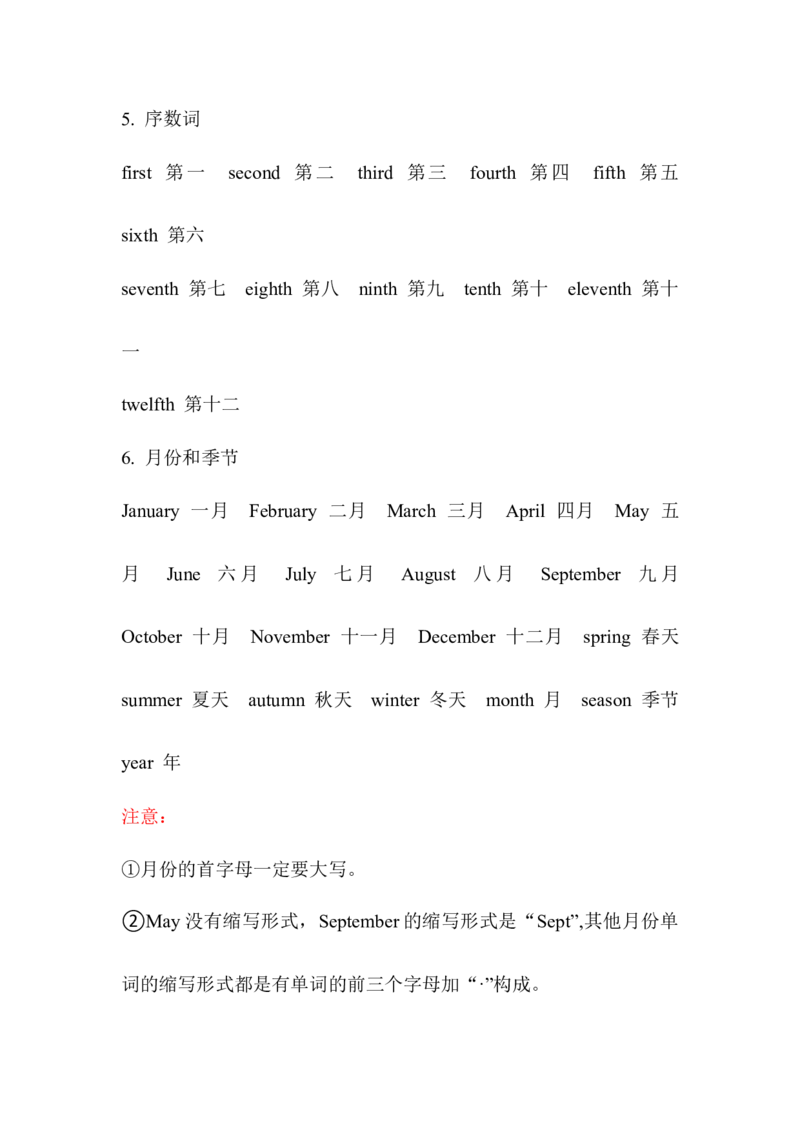
first 第一 second 第二 third 第三 fourth 第四 fifth 第五
sixth 第六
seventh 第七 eighth 第八 ninth 第九 tenth 第十 eleventh 第十
一
twelfth 第十二
6. 月份和季节
January 一月 February 二月 March 三月 April 四月 May 五
月 June 六月 July 七月 August 八月 September 九月
October 十月 November 十一月 December 十二月 spring 春天
summer 夏天 autumn 秋天 winter 冬天 month 月 season 季节
year 年
注意:
①月份的首字母一定要大写。
②May 没有缩写形式,September 的缩写形式是“Sept”,其他月份单
词的缩写形式都是有单词的前三个字母加“·”构成。③月份的缩写形式不用在句子中,只能单独使用。
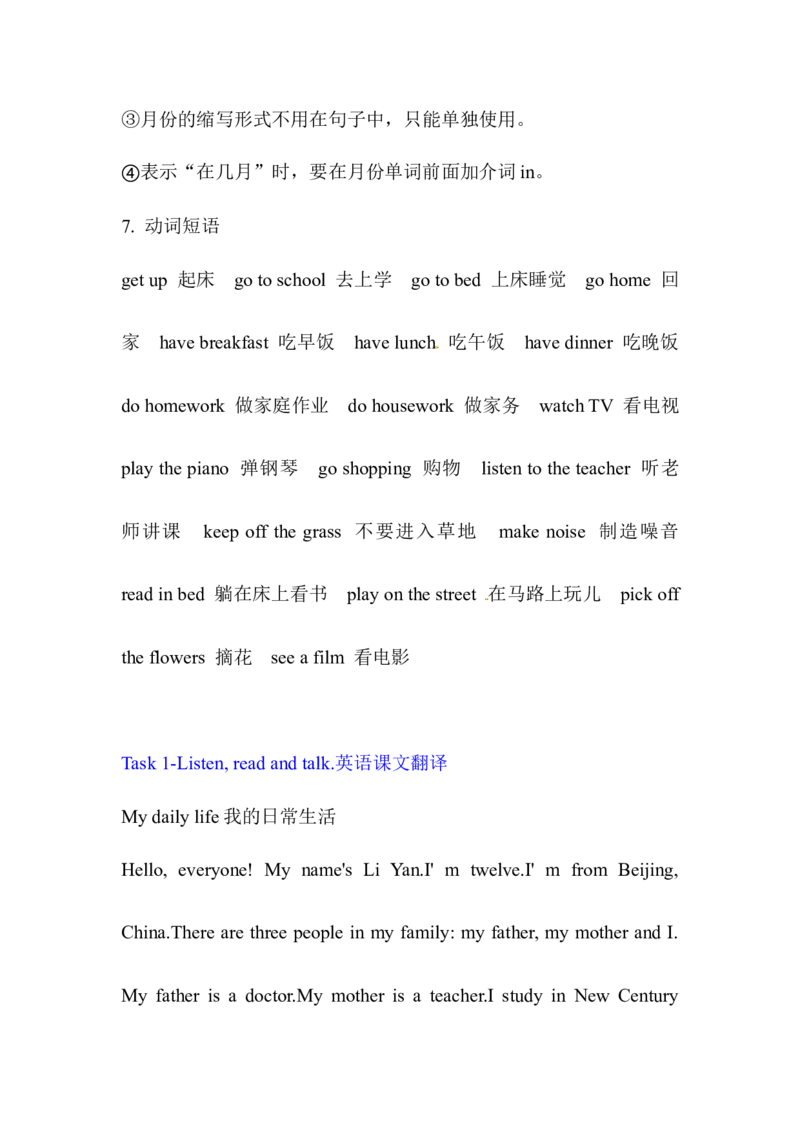
④表示“在几月”时,要在月份单词前面加介词in。
7. 动词短语
get up 起床 go to school 去上学 go to bed 上床睡觉 go home 回
家 have breakfast 吃早饭 have lunch 吃午饭 have dinner 吃晚饭
do homework 做家庭作业 do housework 做家务 watch TV 看电视
play the piano 弹钢琴 go shopping 购物 listen to the teacher 听老
师讲课 keep off the grass 不要进入草地 make noise 制造噪音
read in bed 躺在床上看书 play on the street 在马路上玩儿 pick off
the flowers 摘花 see a film 看电影
Task 1-Listen, read and talk.英语课文翻译
My daily life我的日常生活
Hello, everyone! My name's Li Yan.I' m twelve.I' m from Beijing,
China.There are three people in my family: my father, my mother and I.
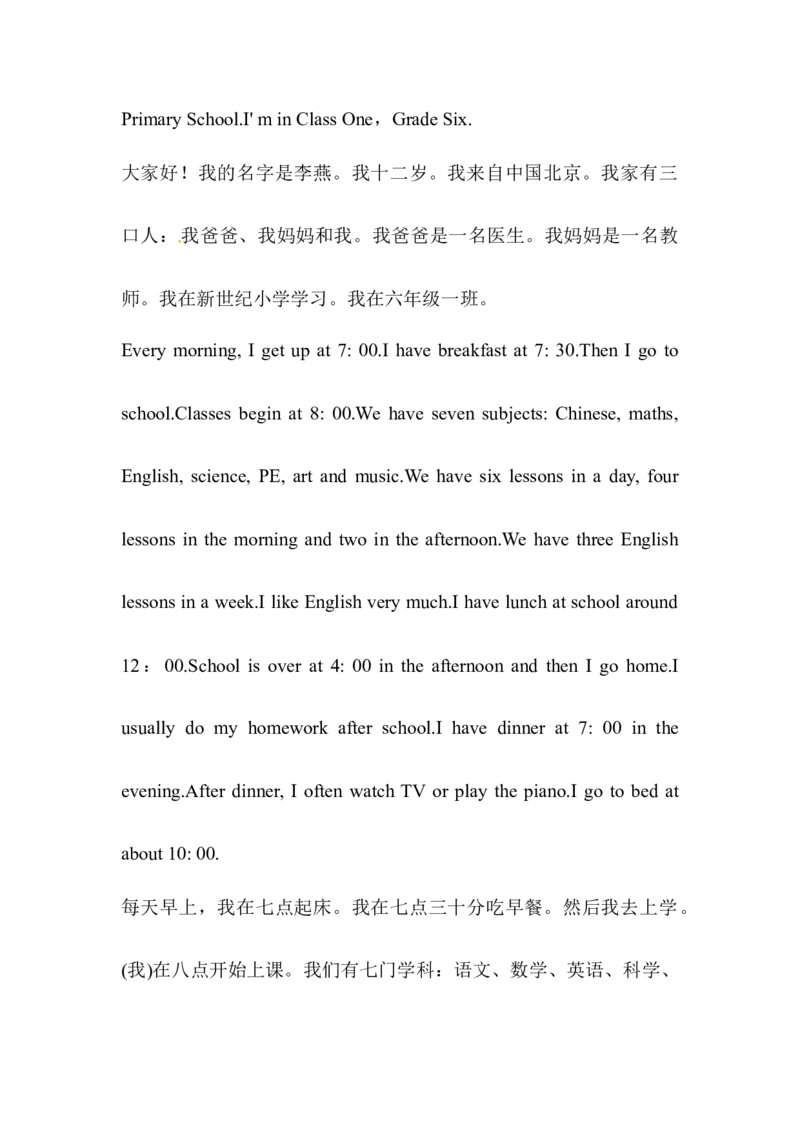
My father is a doctor.My mother is a teacher.I study in New CenturyPrimary School.I' m in Class One,Grade Six.
大家好!我的名字是李燕。我十二岁。我来自中国北京。我家有三
口人:我爸爸、我妈妈和我。我爸爸是一名医生。我妈妈是一名教
师。我在新世纪小学学习。我在六年级一班。
Every morning, I get up at 7: 00.I have breakfast at 7: 30.Then I go to
school.Classes begin at 8: 00.We have seven subjects: Chinese, maths,
English, science, PE, art and music.We have six lessons in a day, four
lessons in the morning and two in the afternoon.We have three English
lessons in a week.I like English very much.I have lunch at school around
12:00.School is over at 4: 00 in the afternoon and then I go home.I
usually do my homework after school.I have dinner at 7: 00 in the
evening.After dinner, I often watch TV or play the piano.I go to bed at
about 10: 00.
每天早上,我在七点起床。我在七点三十分吃早餐。然后我去上学。
(我)在八点开始上课。我们有七门学科:语文、数学、英语、科学、体育、美术和音乐。我们一天有六节课,四节课在上午,两节课在
下午。我们一周有三节英语课。我非常喜欢英语。我在十二点左右
在学校吃午餐。学校在下午四点放学,然后我回家。我通常放学后
做家庭作业。我在晚上七点吃晚餐。晚餐后,我经常看电视或者弹
钢琴。我大约在十点上床睡觉。
On weekends, my parents and I usually go to see my grandpa and
grandma.Sometimes I go to the cinema, the science museum, the theme
park or the zoo with my parents.I also go shopping with my mum.I love
my family and I love my school.I have a very happy life!
在周末,我父母和我通常去看望我外祖父和外祖母。有时我和我父
母去看电影,去科学博物馆,去主题公园或者动物园。我也和我妈
妈去购物。我爱我的家,我爱我的学校。我过着非常幸福的生活!
Task 6-Listen, write and read.英语课文翻译
My Community我的社区
Hello, everyone! Here's the map of my community.There are many new
buildings in my community.Look at that tall building! I live in it. There'sa beautiful park near my community. There's a river behind the
park.There are a lot of trees and flowers in the park.
大家好!这是我的社区的地图。在我的社区里有许多新的建筑物。
看那个高的建筑物!我住在它里面。在我的社区附近有一个漂亮的
公园。在公园后面有一条河。在公园里有许多树和花。
On the main street is a restaurant.Be-side the restaurant is a post
office.There is a hospital between a bank and a hotel.
在主街上是一家饭店。在饭店旁边是一家邮局。在银行和宾馆之间
有一家医院。
Look! There's a school in the centre of our community.It' s my school.On
the left of the school is a bookshop.On the right of the school is a big
shopping centre.There' s a cinema and a supermarket in it.I often go there
on weekends to go shopping and see a film.I like my community.It' s a
busy,clean and nice place.
看!在我们社区的中心有一所学校。它是我的学校。在学校的左边
是一家书店。在学校的右边是一家大的购物中心。在它里面有一个电影院和一家超市。我周末经常去那里购物和看电影。我喜欢我的
社区。它是一个繁忙、干净并且漂亮的地方。
Task 7-Listen, write and read.英语课文翻译
Let's make rules for ourselves!让我们给我们自己制订规则!
We should:我们应该:
1. We should get up early.我们应该早点儿起床。
2. We should listen to the teacher carefully.我们应该认真听老师讲课。
3. We should keep your room clean.我们应该保持你的房间干净。
4. We should go to bed early.我们应该早点儿上床睡觉。
[来源:学,科,网Z,X,X,K]
5. We should help the old people.我们应该帮助老人。
6. We should keep off the grass.
We shouldn't:我们不应该:
1. We shouldn't go to school late.我们不应该上学迟到。
2. We shouldn't make noise in class.我们不应该在课上制造噪音。
3. We shouldn't go home too late.我们不应该回家太晚。
4. We shouldn't read in bed.我们不应该在床上看书。
5. We shouldn't play on the street.我们不应该在街道上玩。
[来源:学#科#网Z#X#X#K]6. We shouldn't pick off the flowers.我们不应该摘花。
Task 8-Listen, write and speak.英语课文翻译
How to be a good student
怎样成为一名好学生
A good student should get up early, go to school on time,listen to the
teacher carefully, ask and answer the teacher' s questions actively in class,
and help his or her classmates.
一名好学生应该早点儿起床,按时上学,认真听老师讲课,在课堂
上积极地提问并回答老师的问题,帮助他的或者她的同班同学们。
A good student should help to do some housework at home, keep his or
her room clean, and go to bed early.
一名好学生应该在家里帮忙做一些家务,保持他的或者她的房间干
净,并且早点儿上床睡觉。
A good student should help the old people, take good care of the younger
children and keep off the grass.
一名好学生应该帮助老人,照顾好年龄小的孩子并且远离草坪。Do you want to be a good student? OK! Go for it!
你想成为一名好学生吗?好的!为之努力吧!
Task 11-Listen, write and read.英语课文翻译
Gao Wei: How many seasons are there in a year?高伟:一年有多少个季
节?
Kate: Oh, there are four seasons in a year.凯特: 哦,一年有四个季节。
Gao Wei: What are they?高伟: 它们是什么?
Kate: They're spring, summer, autumn and winter.
凯特:它们是春季、夏季、秋季和冬季。
Gao Wei: Can you tell me something about them?
高伟:你能告诉我关于它们的事情吗?
Kate: Sure! Spring is the first season of the year.It' s the green
season.Summer is the second season of the year.It' s the hottest
season.Autumn is the third season of the year.It' s the golden
season.Winter is the fourth season of the year.It' s the white season.It' s
cold and it often snows in winter.
凯特:当然!一年的第一个季节是春季。它是绿色的季节。一年的第二个季节是夏季。它是最热的季节。一年的第三个季节是秋季,
它是金色的季节。冬季是一年的第四个季节。它是白色的季节。冬
季天气寒冷并且经常下雪。
Gao Wei: Thank you!高伟:谢谢你!
Kate: My pleasure!凯特:不客气!
句型
1. I’m from Beijing, China. 我来自中国北京。
解读:这是描述某人来自某地的句型。be from 是来自的意思,同义词
组为“come from”。
例: My sister is from England. = My sister comes from England. 我的妹
妹来自英国。
2. There are three people in my family. 我家有三口人。
解读:这是描述某地有某物的句型。there be 表示有。
例: There are four seasons in a year. 一年有四个季节。
3. I’m in Class One, Grade Six. 我在六年级一班。
解读:这是描述某人在几年级几班,要先说班级后说年级,并且班级、年级、数字都要大写。
例: He is in Class One, Grade Three. 他在三年级一班。
4. Every morning, I get up at 7:00. 每天早晨,我七点起床。
解读:这是描述某人习惯性或经常性的动作,用一般现在时。但是当主
语为第三人称单数形式时,动词要用相应的动词的第三人称单数形式。
例: Every morning, he eats breakfast at 8:00. 每天早晨,他八点吃早饭。
5. I often go there on weekends to go shopping and see a film. 在周末的
时候我经常去那里购物和看电影。
解读:本句中的“to”表示目的,也就是去某地要做什么。句型结构为
主语 + go to + 地点 + to + 动作.
例: I go to the park to fly kites. 我去公园放风筝。
6. We should listen to the teacher carefully. 我们应该认真听老师讲课。
解读: should 是情态动词,意思是应该,没有人称和数的变化,后面用动
词的原形,句型结构为主语 + should + 动词原形 + 其他.
例: We should keep the room clean. 我们应该保持房间干净。
7. We shouldn’t make noise in class. 我们不应该在课堂上制造噪音。
解读:本句是含有情态动词“should”的否定形式,句型结构为主语 +shouldn’t + 动词原形 + 其他.
例: We shouldn’t eat too much candy. 我们不应该吃太多的糖。
8. January is the first month of the year. 一月是一年中的第一个月。
解读:这是描述某月是一年中的第几个月的句型。
例: March is the third month of the year. 三月是一年中的第三个月。
句型解读:
一、一般现在时的概念及作用:
1.表示经常性和习惯性的动作。
例如:I get up at six every day.我每天六点起床。
It often rains here. 这儿经常下雨。
2.表示人或事物现在的特征或状态。
例如:他喜欢唱歌。He likes singing.
I am a good student.我是一名好学生。
3.表示客观存在的事实或真理等。
例如:2加8等于10。Two plus eight is ten.
The earth goes around the sun.地球绕着太阳转。
二、一般现在时的构成:1.一般现在时肯定式的构成:
(1)be动词:主语+be动词(am,is,are)+其他。
例如:I am a girl.我是一个女孩。
(2)行为动词:主语+行为动词(+其他)。例如:我们学习英语。We study
English.
(3)当主语为第三人称单数(he, she, it 等)时,要把动词变为其第三人
称单数形式。例如:詹妮喜欢汉语。Jenny likes Chinese.
在一般现在时肯定式的构成中,应注意不同人称作主语时 be动词或实
义动词的正确使用。如:
实意动词 be动词
I like it. I am a student.
You like it. You are a student.
He/She likes it. He/She is a student.
We/You/They like it. We/You/They are student.
2.一般现在时否定式的构成:
一般现在时的否定式一般在动词前加 do(es) not构成,动词用原形;
be 动词则在后面加 not 构成;含有情态动词的在情态动词后面直接加not构成(can和not要合并)。如下表:
实意动词
I/You/They do not like it.
He/She does not like it.
be动词
I am not a student.
He/She is not a student.
We/You/They are not students.
情态动词
I cannot speak English.
He/She cannot speak English.
We/You/They cannot speak English.
3.一般现在时的一般疑问式的构成:
一般现在时的一般疑问句一般在句首加助动词 do或does构成。主语
是第三人称单数加does,其他加do,这时主要动词一概用原形;be动
词只需要与主语位置对调,句末用问号;含有情态动词的将情态动
词提到句首,句末用问号。如下表:实意动词
Do you/I/we/they like it?
Does he/she like it?
be动词
Are you/we/they students?
Am I a student?
Is he/she a student?
情态动词
Can you/we/they speak English?
Can I speak English?
Can he/she speak English?
4.一般现在时的特殊疑问句构成:疑问词+一般疑问句。例如:
She goes to school by bike.她骑自行车去上学。
How does she go to school?她怎么去上学?
总结:
一般现在时的概念及作用:
1.表示经常性和习惯性的动作。2.表示人或事物现在的特征或状态。3.表示客观存在的事实或真理等。
[来源:学科网]
含有 always, often, usually, sometimes, seldom, never, every+时间词等
时间状语的句子要用一般现在时。如果句子中的主语是第一、第二
人称或其他复数形式的名词,动词用原形;如果主语是第三人称单
数形式或其他表示单数概念的名词,动词用第三人称单数形式。
构成:
1.一般现在时肯定式的构成:
[来源:Zxxk.Com]
(1)be动词:主语+be动词(am,is,are)+其他。
(2)行为动词:主语+行为动词(+其他)。
(3)当主语为第三人称单数(he, she, it 等)时,要把动词变为其第三
人称单数形式。
2.一般现在时否定式的构成:
一般现在时的否定式一般在动词前加 do(es) not构成,动词用原形;
be 动词则在后面加 not 构成;含有情态动词的在情态动词后面直接
加not构成(can和not要合并)。
3.一般现在时的一般疑问式的构成:一般现在时的一般疑问句一般在句首加助动词 do或does构成。主语
是第三人称单数加does,其他加do,这时主要动词一概用原形;be动
词只需要与主语位置对调,句末用问号;含有情态动词的将情态动
词提到句首,句末用问号。
4.一般现在时的特殊疑问句构成:疑问词+一般疑问句。
5.动词第三人称单数形式的变化规则
① 一般情况下,直接在动词词尾加s。
如:read—reads,play—plays
②以s, x, o, sh, ch结尾的动词,在词尾加es。
如:go—goes,wash—washes
③以辅音字母加y结尾的动词,把y改为i再加es。
如:study—studies,fly—flies
④殊形式:have—has,be—is do --does
三、介词in 、on、 at的用法。
1、in 的用法。 in 后面+上午/下午/晚上/月份/季节/年份。如:in
the morning, in April, in winter, in 2015. 【来源:21·世纪·教育·网】
[来源:Z.xx.k.Com]
2、on 的用法。 on 的后面+具体的某一天。如:on Monday, on
April 3rd, on Friday morning. 3、at的用法。
3.at 后面+具体的时间点或与其他词构成固定搭配。如:at six
o’clock, at 12:30,at noon。
四、序数词
1.first(1st) 第一 second (2nd) 第二 third (3rd) 第三 fourth (4th)
第四 fifth(5th)第五 sixth(6th) 第六 seventh(7th)第七 eighth(8th)第
八 ninth(9th) 第 九 tenth(10th) 第 十 eleventh(11th) 第 十 一
twelfth(12th)第十二 thirteenth(13th) 第十三 fourteenth(14th) 第十
四 fifteenth(15th)第十五 sixteenth(16th)第十六 seventeenth(17th) 第十
七 eighteenth(18th) 第十八 nineteenth(19th)第十九 twentieth(20th)第
二十 twentieth-first(21th)第二十一 twentieth-second(22nd)第二是二
twentieth-third(23rd)第二十三 thirtieth(30th)第三十 special 特殊的
fool傻瓜
2.用序数词表示具体的日期 在英语中,“几月几日”可以先说“月”,再说“日”,其中“日”要用序数词,书写时序数词前可
以有“the”,也可以没有。但读日期时,the 必须读出来。如果要表
示某年某月某日,通常按照“月、日、年”的顺序。 例如:March
3rd 读法是:March the third 翻译是:3 月 3 日。 June
1st,2014 读法是:June the first,two thousand and fourteen
翻译是:2014年6月1日。
3.基数词变序数词的口诀记忆基变序有规律,结尾加上 th;一二三
特殊记,结尾各是 t,d,d;八减 t九去 e,f来把ve替;y改为 ie,结尾仍
有th;若是遇到几十几,只变个位就可以。