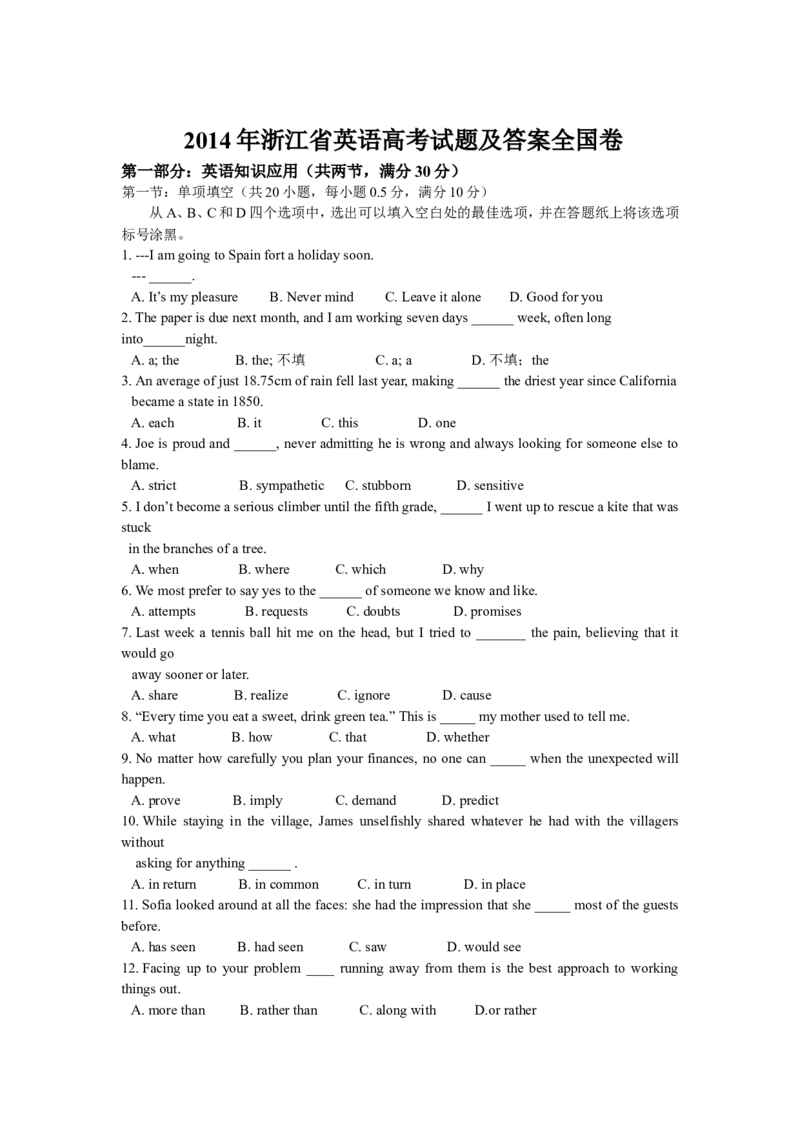
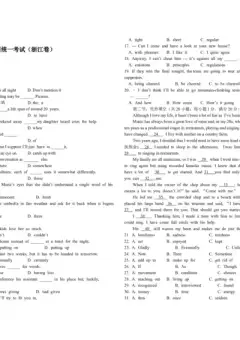
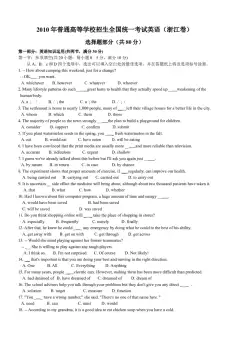
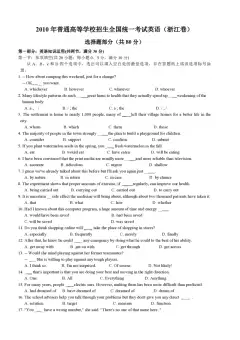
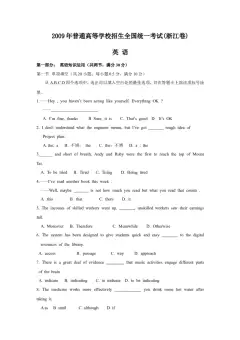
2014 年浙江省英语高考试题及答案全国卷
第一部分:英语知识应用(共两节,满分30 分)
第一节:单项填空(共20 小题,每小题0.5 分,满分10 分)
从A、B、C 和D 四个选项中,选出可以填入空白处的最佳选项,并在答题纸上将该选项
标号涂黑。
1. ---I am going to Spain fort a holiday soon.
   --- ______.
   A. It’s my pleasure         B. Never mind         C. Leave it alone        D. Good for you
2. The paper is due next month, and I am working seven days ______ week, often long
into______night.
   A. a; the                B. the; 不填          C. a; a                 D. 不填;the
3. An average of just 18.75cm of rain fell last year, making ______ the driest year since California
   became a state in 1850.
   A. each                  B. it                 C. this                 D. one
4. Joe is proud and ______, never admitting he is wrong and always looking for someone else to
blame.
   A. strict                  B. sympathetic      C. stubborn             D. sensitive
5. I don’t become a serious climber until the fifth grade, ______ I went up to rescue a kite that was
stuck
  in the branches of a tree.
   A. when                 B. where             C. which                D. why
6. We most prefer to say yes to the ______ of someone we know and like.
   A. attempts              B. requests           C. doubts               D. promises
7. Last week a tennis ball hit me on the head, but I tried to _______ the pain, believing that it
would go
   away sooner or later.
   A. share                B. realize              C. ignore               D. cause
8. “Every time you eat a sweet, drink green tea.” This is _____ my mother used to tell me.
   A. what                B. how                C. that                 D. whether
9. No matter how carefully you plan your finances, no one can _____ when the unexpected will
happen.
   A. prove               B. imply               C. demand             D. predict
10. While staying in the village, James unselfishly shared whatever he had with the villagers
without
    asking for anything ______ .
   A. in return            B. in common           C. in turn               D. in place
11. Sofia looked around at all the faces: she had the impression that she _____ most of the guests
before.
   A. has seen            B. had seen             C. saw                 D. would see
12. Facing up to your problem ____ running away from them is the best approach to working
things out.
   A. more than          B. rather than            C. along with           D.or rather
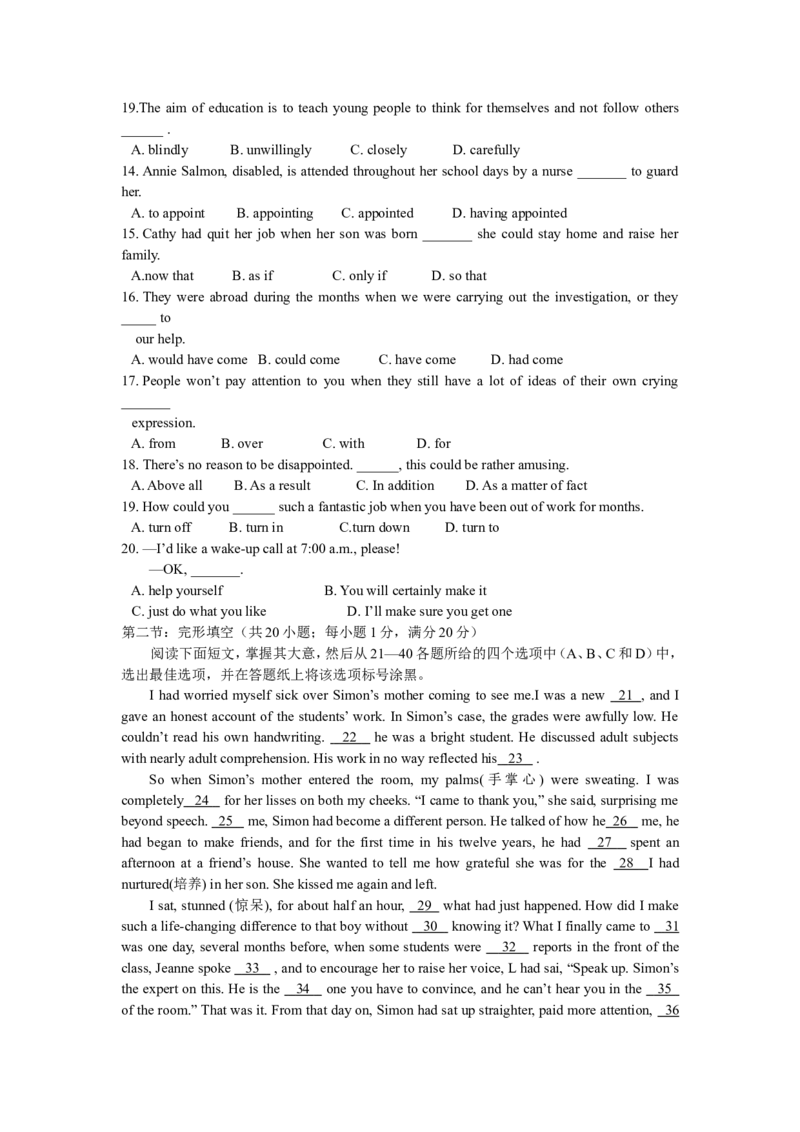
19.The aim of education is to teach young people to think for themselves and not follow others
______ .
   A. blindly            B. unwillingly           C. closely             D. carefully
14. Annie Salmon, disabled, is attended throughout her school days by a nurse _______ to guard
her.
   A. to appoint         B. appointing        C. appointed           D. having appointed
15. Cathy had quit her job when her son was born _______ she could stay home and raise her
family.
   A.now that           B. as if                 C. only if             D. so that
16. They were abroad during the months when we were carrying out the investigation, or they
_____ to
    our help.
   A. would have come   B. could come           C. have come          D. had come
17. People won’t pay attention to you when they still have a lot of ideas of their own crying
_______
   expression.
   A. from             B. over                 C. with               D. for
18. There’s no reason to be disappointed. ______, this could be rather amusing.
   A. Above all         B. As a result             C. In addition         D. As a matter of fact
19. How could you ______ such a fantastic job when you have been out of work for months.
   A. turn off           B. turn in                C.turn down          D. turn to
20. —I’d like a wake-up call at 7:00 a.m., please!
—OK, _______.
   A. help yourself                             B. You will certainly make it
   C. just do what you like                       D. I’ll make sure you get one
第二节:完形填空(共20 小题;每小题1 分,满分20 分)
阅读下面短文,掌握其大意,然后从21—40 各题所给的四个选项中(A、B、C 和D)中,
选出最佳选项,并在答题纸上将该选项标号涂黑。
I had worried myself sick over Simon’s mother coming to see me.I was a new    21

   , and I
gave an honest account of the students’ work. In Simon’s case, the grades were awfully low. He
couldn’t read his own handwriting.       22

      he was a bright student. He discussed adult subjects
with nearly adult comprehension. His work in no way reflected his     23
      .
So when Simon’s mother entered the room, my palms( 手掌心) were sweating. I was
completely     24
      for her lisses on both my cheeks. “I came to thank you,” she said, surprising me
beyond speech.    25

     me, Simon had become a different person. He talked of how he   26

     me, he
had began to make friends, and for the first time in his twelve years, he had    27

      spent an
afternoon at a friend’s house. She wanted to tell me how grateful she was for the  28

     I had
nurtured(培养) in her son. She kissed me again and left.
I sat, stunned (惊呆), for about half an hour,    29

    what had just happened. How did I make
such a life-changing difference to that boy without      30
      knowing it? What I finally came to      31

was one day, several months before, when some students were         32

     reports in the front of the
class, Jeanne spoke     33

     , and to encourage her to raise her voice, L had sai, “Speak up. Simon’s
the expert on this. He is the      34
      one you have to convince, and he can’t hear you in the      35

of the room.” That was it. From that day on, Simon had sat up straighter, paid more attention,    36

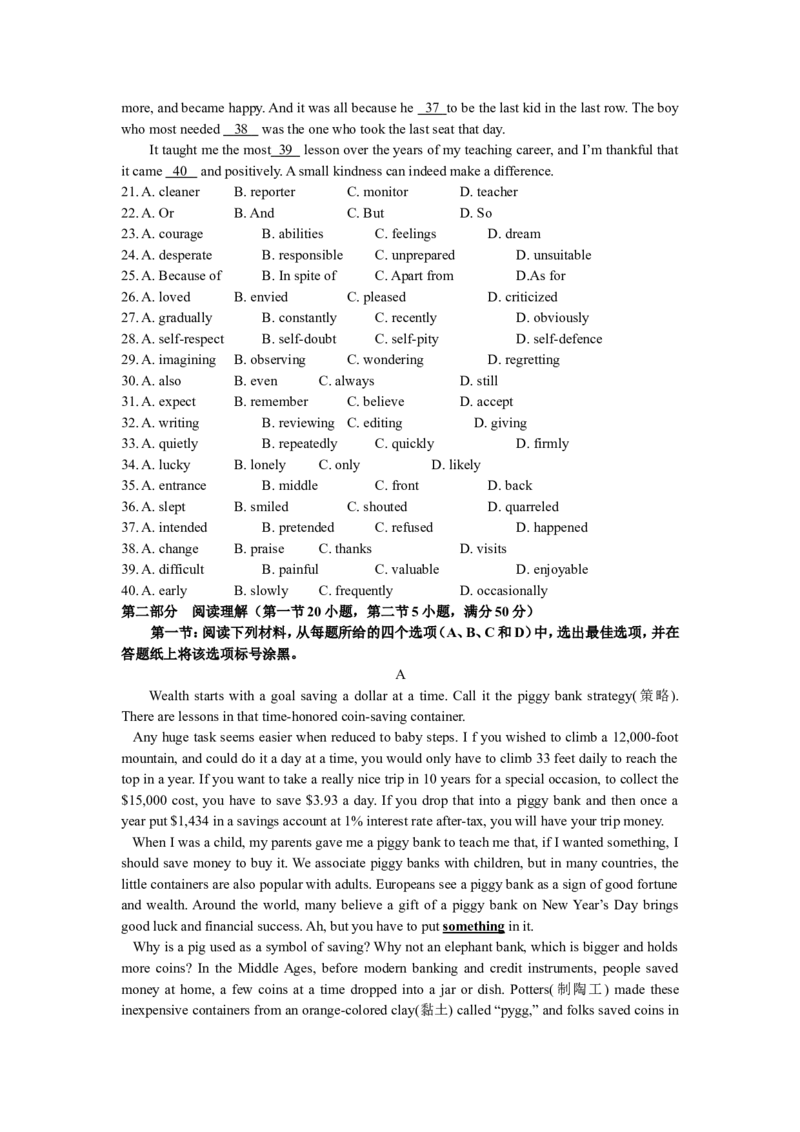
more, and became happy. And it was all because he    37

   to be the last kid in the last row. The boy
who most needed      38
      was the one who took the last seat that day.
It taught me the most   39

    lesson over the years of my teaching career, and I’m thankful that
it came    40

     and positively. A small kindness can indeed make a difference.
21. A. cleaner
B. reporter
C. monitor
D. teacher
22. A. Or
B. And
C. But
D. So
23. A. courage
B. abilities
C. feelings
D. dream
24. A. desperate
B. responsible
C. unprepared
D. unsuitable
25. A. Because of
B. In spite of
C. Apart from
D.As for
26. A. loved
B. envied
C. pleased
D. criticized
27. A. gradually
B. constantly
C. recently
D. obviously
28. A. self-respect
B. self-doubt
C. self-pity
D. self-defence
29. A. imagining    B. observing
C. wondering
D. regretting
30. A. also
B. even
C. always
D. still
31. A. expect
B. remember
C. believe
D. accept
32. A. writing
B. reviewing  C. editing
    D. giving
33. A. quietly
B. repeatedly
C. quickly
D. firmly
34. A. lucky
B. lonely
C. only
D. likely
35. A. entrance
B. middle
C. front
D. back
36. A. slept
B. smiled
C. shouted
D. quarreled
37. A. intended
B. pretended
C. refused
D. happened
38. A. change
B. praise
C. thanks
D. visits
39. A. difficult
B. painful
C. valuable
D. enjoyable
40. A. early
B. slowly
C. frequently
D. occasionally
第二部分  阅读理解(第一节20 小题,第二节5 小题,满分50 分)
第一节:阅读下列材料,从每题所给的四个选项(A、B、C 和D)中,选出最佳选项,并在
答题纸上将该选项标号涂黑。
A
Wealth starts with a goal saving a dollar at a time. Call it the piggy bank strategy( 策略).
There are lessons in that time-honored coin-saving container.
   Any huge task seems easier when reduced to baby steps. I f you wished to climb a 12,000-foot
mountain, and could do it a day at a time, you would only have to climb 33 feet daily to reach the
top in a year. If you want to take a really nice trip in 10 years for a special occasion, to collect the
$15,000 cost, you have to save $3.93 a day. If you drop that into a piggy bank and then once a
year put $1,434 in a savings account at 1% interest rate after-tax, you will have your trip money.
   When I was a child, my parents gave me a piggy bank to teach me that, if I wanted something, I
should save money to buy it. We associate piggy banks with children, but in many countries, the
little containers are also popular with adults. Europeans see a piggy bank as a sign of good fortune
and wealth. Around the world, many believe a gift of a piggy bank on New Year’s Day brings
good luck and financial success. Ah, but you have to put something in it.
   Why is a pig used as a symbol of saving? Why not an elephant bank, which is bigger and holds
more coins? In the Middle Ages, before modern banking and credit instruments, people saved
money at home, a few coins at a time dropped into a jar or dish. Potters( 制陶工) made these
inexpensive containers from an orange-colored clay(黏土) called “pygg,” and folks saved coins in
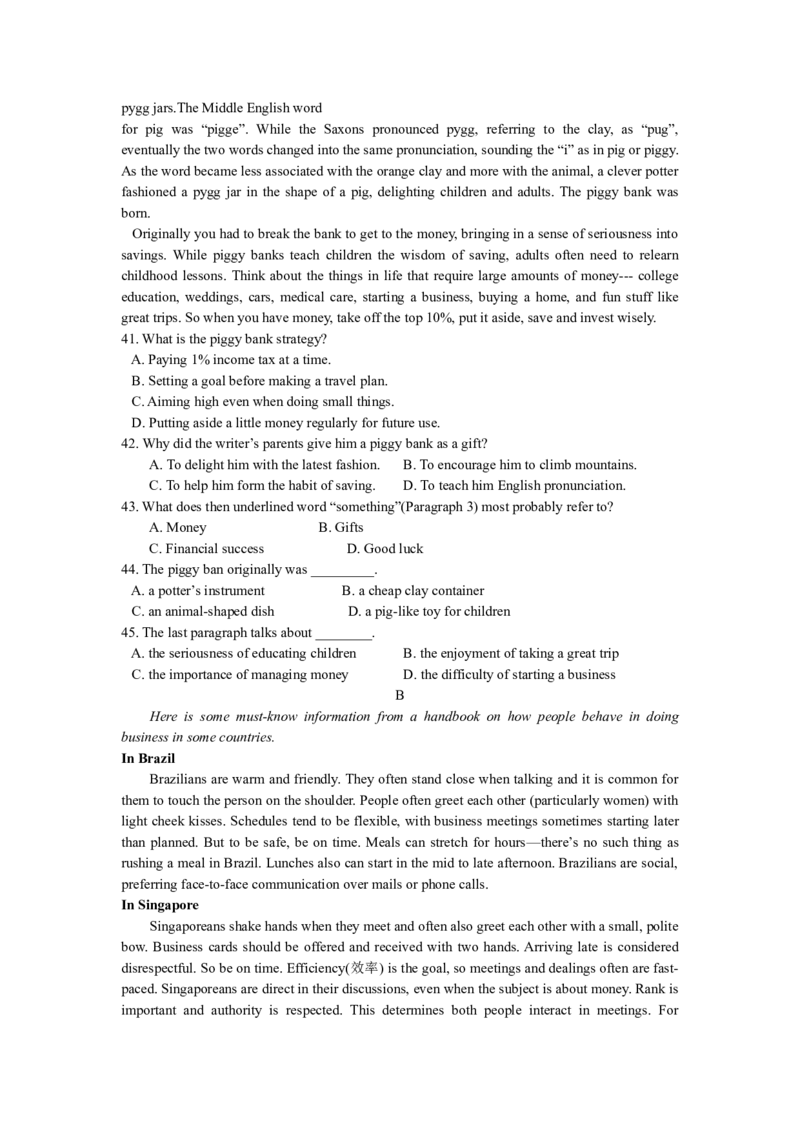
pygg jars.The Middle English word
for pig was “pigge”. While the Saxons pronounced pygg, referring to the clay, as “pug”,
eventually the two words changed into the same pronunciation, sounding the “i” as in pig or piggy.
As the word became less associated with the orange clay and more with the animal, a clever potter
fashioned a pygg jar in the shape of a pig, delighting children and adults. The piggy bank was
born.
   Originally you had to break the bank to get to the money, bringing in a sense of seriousness into
savings. While piggy banks teach children the wisdom of saving, adults often need to relearn
childhood lessons. Think about the things in life that require large amounts of money--- college
education, weddings, cars, medical care, starting a business, buying a home, and fun stuff like
great trips. So when you have money, take off the top 10%, put it aside, save and invest wisely.
41. What is the piggy bank strategy?
   A. Paying 1% income tax at a time.
   B. Setting a goal before making a travel plan.
   C. Aiming high even when doing small things.
   D. Putting aside a little money regularly for future use.
42. Why did the writer’s parents give him a piggy bank as a gift?
A. To delight him with the latest fashion.      B. To encourage him to climb mountains.
C. To help him form the habit of saving.
D. To teach him English pronunciation.
43. What does then underlined word “something”(Paragraph 3) most probably refer to?
A. Money                               B. Gifts
C. Financial success                     D. Good luck
44. The piggy ban originally was _________.
   A. a potter’s instrument                      B. a cheap clay container
   C. an animal-shaped dish                     D. a pig-like toy for children
45. The last paragraph talks about ________.
   A. the seriousness of educating children
        B. the enjoyment of taking a great trip
   C. the importance of managing money
D. the difficulty of starting a business
B
Here is some must-know information from a handbook on how people behave in doing
business in some countries.
In Brazil
Brazilians are warm and friendly. They often stand close when talking and it is common for
them to touch the person on the shoulder. People often greet each other (particularly women) with
light cheek kisses. Schedules tend to be flexible, with business meetings sometimes starting later
than planned. But to be safe, be on time. Meals can stretch for hours—there’s no such thing as
rushing a meal in Brazil. Lunches also can start in the mid to late afternoon. Brazilians are social,
preferring face-to-face communication over mails or phone calls.
In Singapore
Singaporeans shake hands when they meet and often also greet each other with a small, polite
bow. Business cards should be offered and received with two hands. Arriving late is considered
disrespectful. So be on time. Efficiency(效率) is the goal, so meetings and dealings often are fast-
paced. Singaporeans are direct in their discussions, even when the subject is about money. Rank is
important and authority is respected. This determines both people interact in meetings. For
example, people avoid disagreeing outright with someone with a higher rank.
In the United Arab Emirates
In the UAE, status is important, so the most senior or oldest should be greeted first with their
titles. The handshake seems to be longer than elsewhere. So, do not pull away the handshake.
Women should cover themselves when it comes to dress. Men also tend to be covered from neck
to elbows(肘部) and down to the knees. People do not avoid entertaining in their homes, but they
also hold business meals at restaurants. Touching or passing food or eating with your left hand is
to be avoided. When meetings are one-to-one, if your host offers you coffee, you should refuse. It
might seem odd, but it is a cultural tradition. Coffee should only be accepted if it is always set out
or presented.
In Switzerland
The Swiss tend to be formal and address each other by last name. They also are respectful of
private lives. You should be careful not to ask about personal topics. Punctuality (守时) is vital,
something that comes from a deep respect for others’ time. Arrive at any meeting or event a few
minutes early to be safe. They also have clear structure in their companies. Higher-ups make the
final decisions, even if others might disagree. Neat, clean dress is expected. The Swiss follow
formal table manners. They also keep their hands visible at the table and their elbows off the table.
It is polite to finish the food on your plate.
46. The passage is mainly about ________.
   A. communication types                       B. the workplace atmosphere
   C. customs and social manners                 D. living conditions and standards
47. Why do Singaporeans avoid arguing with their boss?
   A. They put efficiency in the first place.
   B. They dislike face-to-face communication.
   C. They want to finish meetings as quickly as possible.
   D. They are supposed to obey the person of a higher rank.
48. In the UAE, when should you refuse the coffee if it is offered?
   A. When greeting seniors.                     B. When meeting the host alone.
   C. When attending a presentation.               D.When dining with business partners.
49. In which country do people care about where to put their hands at the dinner table?
   A. In Brazil.                                B. In Singapore.
   C. In the United Arab Emirate.                 D. In Switzerland.
C
   Last summer, two nineteenth-century cottages were rescued from remote farm fields in
Montana, to be moved to an Art Deco building in San Francisco. The houses were made of wood.
These cottages once housed early settlers as they worked the dry Montana soil; now they hold
Twitter engineers.
   The cottages could be an example of the industry’ s odd love affair with “low technology,” a
concept associated with the natural world, and with old-school craftsmanship ( 手艺) that exists
long before the Internet era. Low technology is not virtual (虚拟的) —so, to take advantage of it,
Internet companies have had to get creative. The rescued wood cottages, fitted by hand in the late
eighteen-hundreds, are an obvious example, but Twitter’s designs lie on the extreme end. Other
companies are using a broader interpretation (阐释) of low technology that focuses on nature.
   Amazon is building three glass spheres filled with trees, so that employees can “work and
socialize in a more natural, park-like setting.” At Google’s office, an entire floor is carpeted in
glass. Facebook’s second Menlo Park campus will have a rooftop park with a walking trail.
   Olle Lundberg, the founder of Lundberg Design, has worked with many tech companies over the
years. “We have lost the connection to the maker in our lives, and our tech engineers are the ones
who feel impoverished ( 贫乏的) , because they’re surrounded by the digital world,” he says.
“They’re looking for a way to regain their individual identity, and we’ve found that introducing
real crafts is one way to do that.”
   This craft based theory is rooted in history, William Morris, the English artist and writer, turned
back to pre-industrial arts in the eighteen-sixties, just after the Industrial Revolution. The Arts and
Crafts movement defined itself against machines. “Without creative human occupation, people
became disconnected from life,” Morris said.
   Research has shown that natural environments can restore(恢复) our mental capacities. In Japan,
patients are encouraged to “forest-bathe,” taking walks through woods to lower their blood
pressure.
   These health benefits apply to the workplace as well. Rachel Kaplvin, a professor of
environmental psychology, has spent years researching the restorative effects of natural
environment. Her research found that workers with access to nature at the office—even simple
views of trees and flowers—felt their jobs were less stressful and more satisfying. If low-tech
offices can potentially nourish the brains and improve the mental health of employees then, fine,
bring on the cottages.
50. The writer mentions the two nineteenth-century cottages to show that ________.
   A. Twitter is having a hard time
   B. old cottages are in need of protection
   C. early settlers once suffered from a dry climate in Montana
   D. Internet companies have rediscovered the benefits of low technology
51. Low technology is regarded as something that _______.
   A.is related to nature
    B. is out of date today
   C. consumes too much energy
D. exists in the virtual world
52. The main idea of Paragraph 5 is that human beings ________.
   A. have destroyed many pre-industrial arts
   B. have a tradition of valuing arts and crafts
   C. can become intelligent by learning history
   D. can regain their individual identity by using machines
53. The writer’s attitude to “low technology” can best be described as ________.
   A. positive        B. defensive               C. cautious           D. doubtful
54. What might be the best title for the passage?
   A. Past Glories, Future Dreams                 B. The Virtual World, the Real Challenge
   C. High-tech Companies, Low-tech Offices       D. The More Craftsmanship, the Less Creativity
    D
     A city child’s summer is spent in the street in front of his home, and all through the long
summer vacations I sat on the edge of the street and watched enviously the other boys on the block
play baseball. I was never asked to take part even when one team had a member missing—not out
of special cruelty, but because they took it for granted I would be no good at it. They were right, of
course.
     I would never forget the wonderful evening when something changed. The baseball ended
about eight or eight thirty when it grew dark. Then it was the custom of the boys to retire to a little
stoop(门廊) that stuck out from the candy store on the corner and that somehow had become
theirs. No grownup ever sat there or attempted to. There the boys would sit, mostly talking about
the games played during the day and of the game to be played tomorrow. Then long silences
would fall and the boys would wander off one by one. It was just after one of those long silences
that my life as an outsider changed. I can no longer remember which boy it was that summer
evening who broke the silence with a question: but whoever he was, I nod to him gratefully now.
“What’s in those books you’re always reading?” he asked casually. “Stories,” I answered. “What
kind?” asked somebody else without much interest.
     Nor do I know what drove me to behave as I did,for usually I just sat there in silence, glad
enough to be allowed to reain among them; but instead of answering his question, I told them for
two hours the story I was reading at the moment. The book was Sister Carrie. They listened bug-
eyed and breathless. I must have told it well, but I think there was another and deeper reason that
made them to keep an audience. Listening to a tale being told in the dark is one of the most
ancient of man’s entertainments, but I was offering them as well, without being aware of doing it,
a new and exciting experience.
     The books they themselves read were the Rover Boys or Tom Swift or G.A.Henty. I had read
them too, but at thirteen I had long since left them behind. Since I was much alone I had become
an enthusiastic reader and I had gone through the books-for-boys series. In those days there was
no reading material between children’s and grownups’books or I could find none. I had gone right
from Tome Swift and His Flying Machine to Theodore Dreiser and Sister Carrie. Dreiser had hit
my young mind, and they listened to me tell the story with some of the wonder that I had had in
reading it.
     The next night and many nights thereafter, a kind of unspoken ritual (仪式) took place. As it
grew dark, I would take my place in the center of the stoop and begin the evening’s tale. Some
nights, in order to taste my victory more completely, I cheated. I would stop at the most exciting
part of a story by Jack London or Bret Harte, and without warning tell them that that was as far as
I had gone in the book and it would have to be continued the following evening. It was not true, of
course; but I had to make certain of my new-found power and position. I enjoyed the long summer
evenings until school began in the fall. Other words of mine have been listened to by larger and
more fashionable audiences, but for that tough and athletic one that sat close on the stoop outside
the candy store, I have an unreasoning love that will last forever.
55. Watching the boys playing baseball, the writer must have felt ________.
   A. bitter and lonely                            B. special and different
   C. pleased and excited                         D. disturbed and annoyed
56. The writer feels grateful even now to the boy who asked the question because the boy
________.
   A. invited him to join in their game
   B. liked the book that he was reading
   C. broke the long silence of that summer evening
   D. offered him an opportunity that changed his life
57. According to Paragraph 3, story-telling was popular among the boys basically because
________.
   A. the story was from a children’s book          B. listening to tales was an age-old practice
   C. the boys had few entertainments after dark     D. the boys didn’t read books by themselves
58. The boys were attracted to Sister Carrie because ________.
   A. it was written by Theodore Dreiser            B. it was specifically targeted at boys
   C. it gave them a deeper feeling of pleasure        D. it talked about the wonders of the world
59. Sometimes the writer stopped at the most exciting part of a story to _______.
   A. play a mean trick on the boys                B. experience more joy of achievement
   C. add his own imagination to the story          D. help the boys understand the story better
60. What is the message conveyed in the story?
   A. One can find his position in life in his own way.
   B. Friendship is built upon respect for each other.
   C. Reading is more important than playing games.
   D. Adult habits are developed from childhood.
第二节:下面文章中有5 个段落需要添加首句(第61—65 题)。请从以下选项(A、B、C、D、E
和F)中选出适合各段落的首句,并在答题纸上将相应选项的标号涂黑。选项中有一项是多余
选项。
A.  Be a good listener.                        B.  Care about the details.
C.  Strike up a conversation.                   D.  Make time for friendships.
E.  Reach out to the newcomers.                F.  Avoid causing inconveniences
Develop Better Relationships with Neighbors
     Good neighbors are a lot like electricity or running water :we don’t know how much we
depend on them until we don’t have them. They make our lives more pleasant and give us a sense
of who we wrte, both as an individual and as a member of the community. Here ‘s how to develop
your relationships with these very important people in your life.
61. _________ Often neighbors don’t even know each other’s names. But it’s okay to be the one
to break
   the ice , even if you’ve lived next door for years.Most neighbors enjoy making small talk with
the
   folks on the other side of the fence. So as you see them at work in their yards, smile, wave, and
say
   hello. Ask how their kids are (whether they’re babies or in college), whether they could use an
extra
   cucumber from your garden, or what they think of the price at the local supermarket.
62. _________ These days, the old Welcome Wagon is a thing of the past. But your new neighbors
may
   be feeling lonely and unsure, especially if they’re far from home, and might appreciate a friendly
face
   bearing fresh-baked chocolate cakes. If they have kids, tell them where the children in the
   neighborhood live. Recommend the best places to eat and sleep. Invite them over for coffee or
tea
   when they get settled, give them your number, and point to your house as you say good-bye.
63. __________ Return anything that you borrow from a neighbor, such as tools, in good repair
and as
   soon as you’ve finished with them. Replace anything that belongs to your neighbor that you,
your
   children, or your pets break or soil. Make sure that your car is not blocking their doorway. Such
   random acts of consideration will have your neighbors talking — and the talk will be good.
64. __________  If you value a friendship with your neighbors, spend time with them. What better
way
   to meet your neighbors than to invite them to an informal barbecue, pool party, or holiday open
   house? Better yet, you might even consider throwing a get-together in their honor. Deliver the
   invitations in person to everyone who lives on your street and chat with each for five minutes
before
   moving on to the next house. This way, you will get an idea of what your neighbors are like so
that
   you can plan for appropriate food and music.
65. ___________ In a good relationship, it’s really the little things that count. Help to bring in the
mail
   for the elderly neighbor when there is a heavy rain. When your neighbor gorgets to take in his
rubbish
   cans, roll them back into his yard. If you’re truly concerned, you’ll know when your neighbor
needs
   some cheering up — a bunch of flowers or a helping hand when it’s needed. All it takes to
develop
   your relationship with neighbors is the respect for their feelings.
非选择题部分(共40 分)
第三部分:写作(共两节,满分40 分)
第一节:短文改错(共10 小题;每小题1 分,满分10 分)
    下面短文中有10 处语言错误。请在有错误的地方增加、删除或修改某个单词。
    增加:在缺词处加一个漏字符号(∧),并在其下面写上该加的词。
    删除:把多余的词用斜线(\)划掉。
    修改:在错的词下划一横线,并在该词下面写上修改后的词。
    注意:1.每处错误及修改均仅限一词;
          2.只允许修改10 处,多者(从第11 处起)不计分。


I was taking a train to London’s Victoria Station. I had noticed that the carriage was noise and
filled with people.
     Before long, a train inspector comes to check out tickets. A passenger realized he couldn’t find
    例如:
    It was very nice to get your invitation to spend ∧weekend
with you.Luckily
                                         the
I was completely tree then,so I'll to say”yes". I'll arrive in Bristol at around
8:00p.m.
 am
in Friday evening.
on
his ticket but became quite upset. Then everyone in the carriage began searching the ticket, which
was eventually found under a seat several rows from his owner. The person who found a ticket
smiled with pleasure at his success.
     No one in the carriage had previous spoken to or even noticed the ticket-owner before. Yet,
they had so quickly offered the strangers their help. If we could show concern to others on need,
the world would be a better place to live in.
第二节:书面表达 (满分30 分)
 学校图书馆需要购置一批新书, 现向学生征求意见。假如你是李越,你认为学校图书馆
最需
要购置科普类图书(popular science books)和文学类图书(literary books)。请你用英语给图书
馆王老师写一封100—120 词的信,推荐这两类书,并分别说明推荐理由。
 注意:信的抬头与落款已给出(不计入词数)。
 Dear Mr. Wang,

_______________________________________________________________________________
_____
                                                      Yours sincerely
                                                       Li Yue