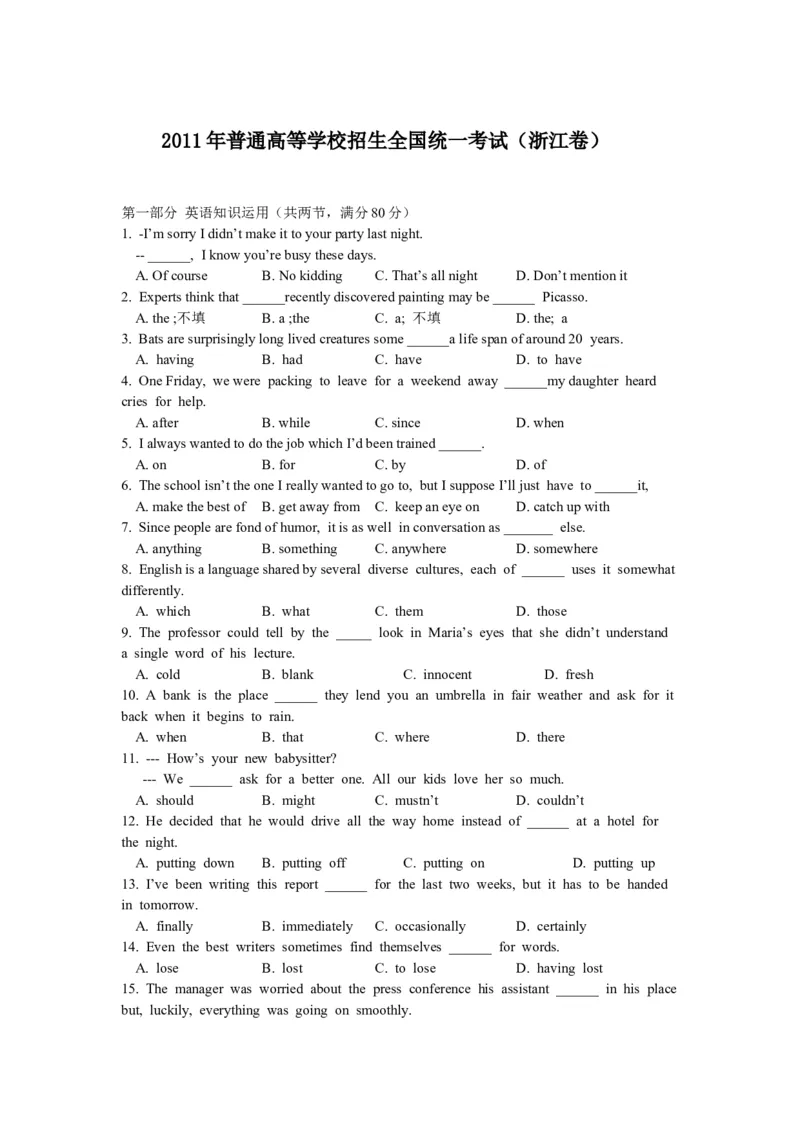
2011 年普通高等学校招生全国统一考试(浙江卷)
第一部分 英语知识运用(共两节,满分80 分)
1. -I’m sorry I didn’t make it to your party last night.
-- ______, I know you’re busy these days.
A. Of course
B. No kidding
C. That’s all night
D. Don’t mention it
2. Experts think that ______recently discovered painting may be ______ Picasso.
  A. the ;不填
B. a ;the
C. a; 不填
D. the; a
3. Bats are surprisingly long lived creatures some ______a life span of around 20 years.
  A. having
B. had
C. have
D. to have
4. One Friday, we were packing to leave for a weekend away ______my daughter heard
cries for help.
A. after
B. while
C. since
D. when
5. I always wanted to do the job which I’d been trained ______.
A. on
B. for
C. by
D. of
6. The school isn’t the one I really wanted to go to, but I suppose I’ll just have to ______it,
A. make the best of
B. get away from
C. keep an eye on
D. catch up with
7. Since people are fond of humor, it is as well in conversation as _______ else.
A. anything
B. something
C. anywhere
D. somewhere
8. English is a language shared by several diverse cultures, each of ______ uses it somewhat
differently.
 A. which
B. what
C. them
D. those
9. The professor could tell by the _____ look in Maria’s eyes that she didn’t understand
a single word of his lecture.
  A. cold
B. blank
C. innocent
D. fresh
10. A bank is the place ______ they lend you an umbrella in fair weather and ask for it
back when it begins to rain.
  A. when
B. that
C. where
D. there
11. --- How’s your new babysitter?
   --- We ______ ask for a better one. All our kids love her so much.
  A. should
B. might
C. mustn’t
D. couldn’t
12. He decided that he would drive all the way home instead of ______ at a hotel for
the night.
  A. putting down
B. putting off
C. putting on
D. putting up
13. I’ve been writing this report ______ for the last two weeks, but it has to be handed
in tomorrow.
  A. finally
B. immediately
C. occasionally
D. certainly
14. Even the best writers sometimes find themselves ______ for words.
  A. lose
B. lost
C. to lose
D. having lost
15. The manager was worried about the press conference his assistant ______ in his place
but, luckily, everything was going on smoothly.
  A. gave
B. gives
C. was giving
D. had given
16. My schedule is very ______ right now, but I’ll try to fit you in.
  A. tight
B. short
C. regular
D. flexible
17. --- Can I come and have a look at your new house?      --- Yes, ______!
  A. with pleasure
B. I like it
C. I quite agree
D. by all means
18. Anyway, I can’t cheat him --- it’s against all my ______.
  A. emotions
B. principles
C. regulations
D. opinions
19. If they win the final tonight, the team are going to tour around the city ______ by
their enthusiastic supporters.
  A. being cheered
B. be cheered
C. to be cheered
D. were cheered
20. – I don’t think I’ll be able to go mountain-climbing tomorrow.
   -- ______?
  A. And how
B. How come
C. How’s it going
D. How about it
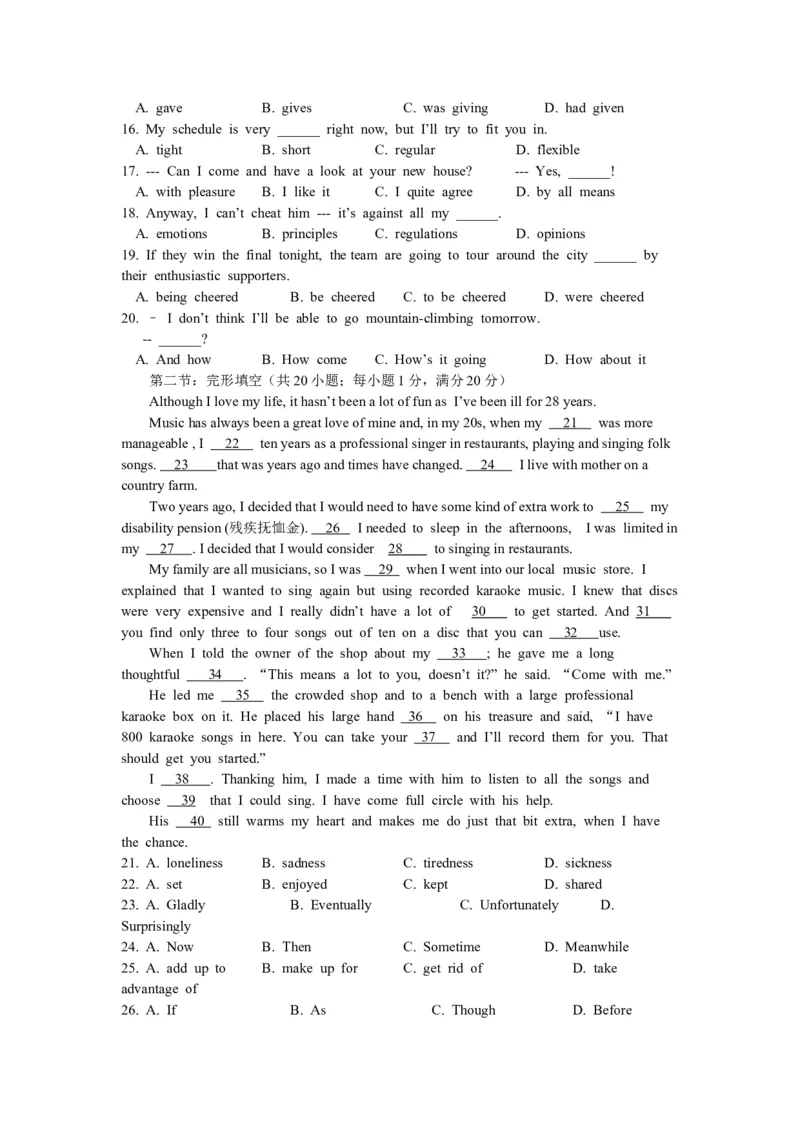
第二节:完形填空(共20 小题;每小题1 分,满分20 分)
Although I love my life, it hasn’t been a lot of fun as I’ve been ill for 28 years.
Music has always been a great love of mine and, in my 20s, when my   21

   was more
manageable , I   22

   ten years as a professional singer in restaurants, playing and singing folk
songs.
  23

   that was years ago and times have changed.
  24

   I live with mother on a
country farm.
Two years ago, I decided that I would need to have some kind of extra work to   25

   my
disability pension (残疾抚恤金).
  26
    I needed to sleep in the afternoons,  I was limited in
my   27

  . I decided that I would consider  28


  to singing in restaurants.
My family are all musicians, so I was
  2 9   when I went into our local music store. I
explained that I wanted to sing again but using recorded karaoke music. I knew that discs
were very expensive and I really didn’t have a lot of   30


  to get started. And 31


you find only three to four songs out of ten on a disc that you can
  32

  use.
When I told the owner of the shop about my
  33

  ; he gave me a long
thoughtful
  34

  . “This means a lot to you, doesn’t it?” he said. “Come with me.”
He led me
  35

   the crowded shop and to a bench with a large professional
karaoke box on it. He placed his large hand  36

   on his treasure and said, “I have
800 karaoke songs in here. You can take your  37

   and I’ll record them for you. That
should get you started.”
I
  38

  . Thanking him, I made a time with him to listen to all the songs and
choose
  39
    that I could sing. I have come full circle with his help.
His
  40
    still warms my heart and makes me do just that bit extra, when I have
the chance.
21. A. loneliness
B. sadness
C. tiredness
D. sickness
22. A. set
B. enjoyed
C. kept
D. shared
23. A. Gladly
B. Eventually
C. Unfortunately
D.
Surprisingly
24. A. Now
B. Then
C. Sometime
D. Meanwhile
25. A. add up to
B. make up for
C. get rid of
D. take
advantage of
26. A. If
B. As
C. Though
D. Before
27. A. movement
B. condition
C. choices
D. positions
28. A. reaching out
B. living up
C. getting on
D. going back
29. A. recognized
B. interviewed
C. found
D. invited
30. A. money
B. time
C. energy
D. knowledge
31. A. thus
B. once
C. seldom
D. often
32. A. actually
B. hardly
C. nearly
D. formerly
33. A. job
B. family
C. idea
D. offer
34. A. face
B. view
C. look
D. sight
35. A. over
B. along
C. towards
D. through
36. A. unhappily
B. lovingly
C. pitifully
D. gratefully
37. A. pick
B. turn
C. role
D. step
38. A. had to cry
B. ought to cry

C. should have cried D. could
have cried
39. A. more
B. the ones
C. few
D. the rest
40. A. courage
B. devotion
C. kindness
D. trust
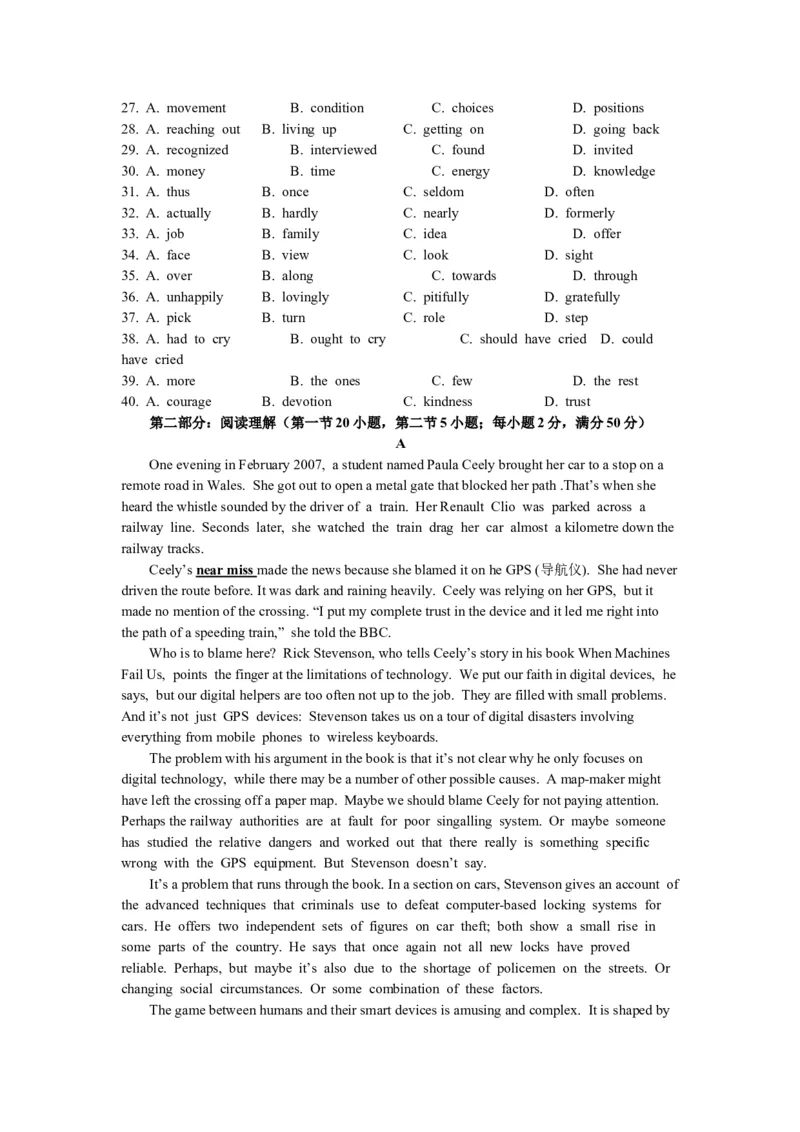
第二部分:阅读理解(第一节20 小题,第二节5 小题;每小题2 分,满分50 分)
A
One evening in February 2007, a student named Paula Ceely brought her car to a stop on a
remote road in Wales. She got out to open a metal gate that blocked her path .That’s when she
heard the whistle sounded by the driver of a train. Her Renault Clio was parked across a
railway line. Seconds later, she watched the train drag her car almost a kilometre down the
railway tracks.
Ceely’s near miss made the news because she blamed it on he GPS (导航仪). She had never
driven the route before. It was dark and raining heavily. Ceely was relying on her GPS, but it
made no mention of the crossing. “I put my complete trust in the device and it led me right into
the path of a speeding train,” she told the BBC.
Who is to blame here? Rick Stevenson, who tells Ceely’s story in his book When Machines
Fail Us, points the finger at the limitations of technology. We put our faith in digital devices, he
says, but our digital helpers are too often not up to the job. They are filled with small problems.
And it’s not just GPS devices: Stevenson takes us on a tour of digital disasters involving
everything from mobile phones to wireless keyboards.
The problem with his argument in the book is that it’s not clear why he only focuses on
digital technology, while there may be a number of other possible causes. A map-maker might
have left the crossing off a paper map. Maybe we should blame Ceely for not paying attention.
Perhaps the railway authorities are at fault for poor singalling system. Or maybe someone
has studied the relative dangers and worked out that there really is something specific
wrong with the GPS equipment. But Stevenson doesn’t say.
It’s a problem that runs through the book. In a section on cars, Stevenson gives an account of
the advanced techniques that criminals use to defeat computer-based locking systems for
cars. He offers two independent sets of figures on car theft; both show a small rise in
some parts of the country. He says that once again not all new locks have proved
reliable. Perhaps, but maybe it’s also due to the shortage of policemen on the streets. Or
changing social circumstances. Or some combination of these factors.
The game between humans and their smart devices is amusing and complex. It is shaped by
economics and psychology and the cultures we live in. Somewhere in the mix of those forces
there may be a way for a wiser use of technology.
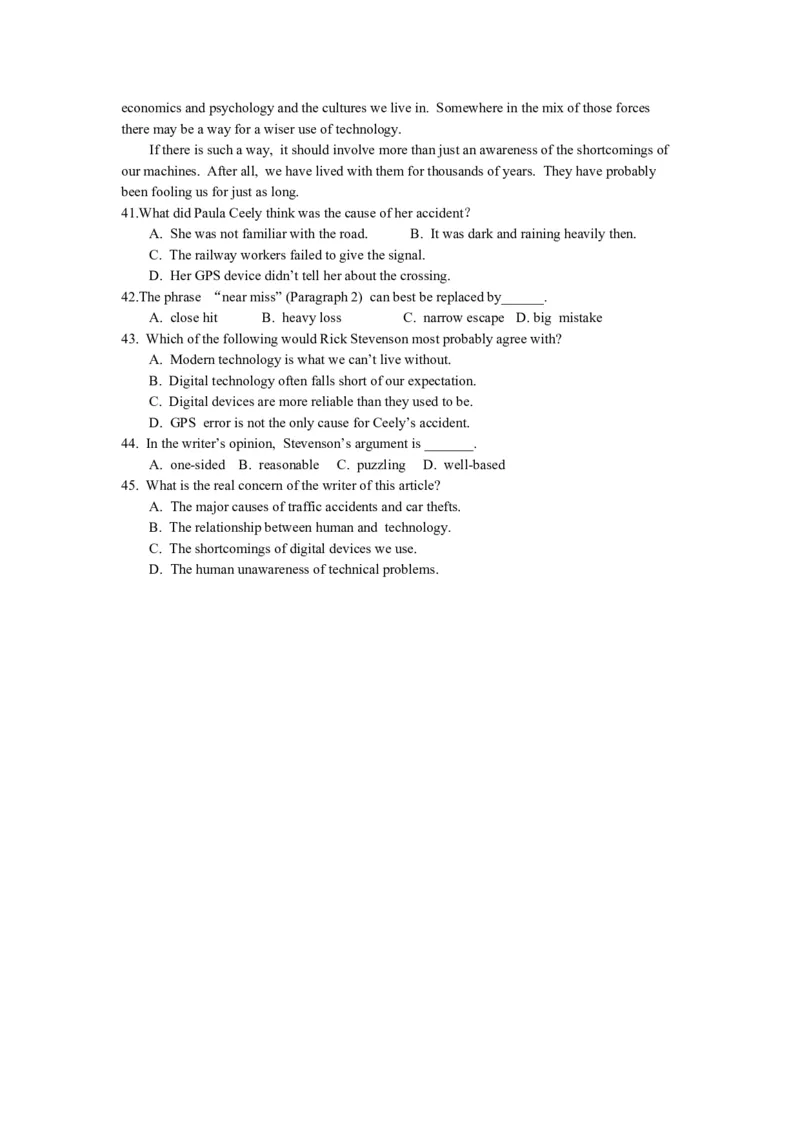
If there is such a way, it should involve more than just an awareness of the shortcomings of
our machines. After all, we have lived with them for thousands of years. They have probably
been fooling us for just as long.
41.What did Paula Ceely think was the cause of her accident?
A. She was not familiar with the road.      B. It was dark and raining heavily then.
C. The railway workers failed to give the signal.
D. Her GPS device didn’t tell her about the crossing.
42.The phrase “near miss” (Paragraph 2) can best be replaced by______.
A. close hit
B. heavy loss
C. narrow escape
D. big mistake
43. Which of the following would Rick Stevenson most probably agree with?
A. Modern technology is what we can’t live without.
B. Digital technology often falls short of our expectation.
C. Digital devices are more reliable than they used to be.
D. GPS error is not the only cause for Ceely’s accident.
44. In the writer’s opinion, Stevenson’s argument is _______.
A. one-sided    B. reasonable     C. puzzling     D. well-based
45. What is the real concern of the writer of this article?
A. The major causes of traffic accidents and car thefts.
B. The relationship between human and technology.
C. The shortcomings of digital devices we use.
D. The human unawareness of technical problems.
B
B
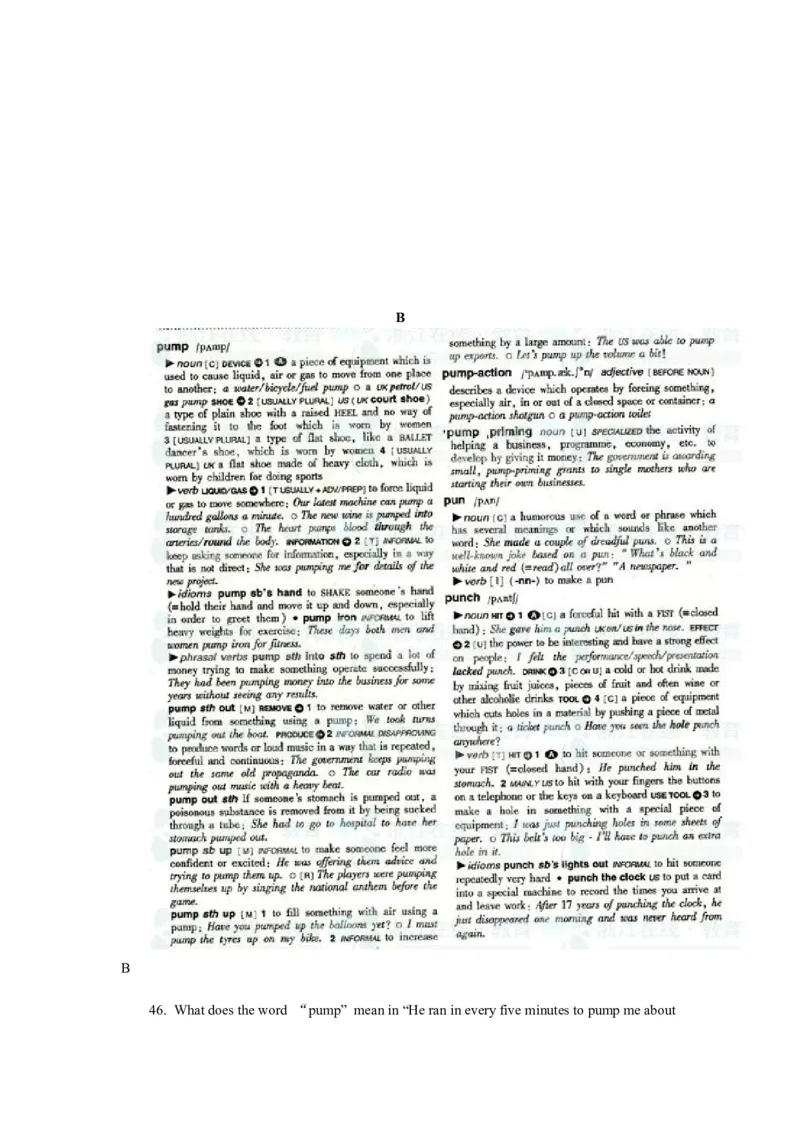
46. What does the word “pump” mean in “He ran in every five minutes to pump me about
the case”?
A. Talk with.
B. Ask for information. C. Listen to.
D. Provide with
evidence.
47. When Sally says “The TV program kept pumping out commercials”, she may
be______.
A. excited
B. interested
C. annoyed
D. worried
48. What will the government most probably provide if it is engaged in a pump-priming
program?
A. Sums of money.  B. Raw materials.
C. Human resources. D. Media
support.
49. When Sylvia says “His speech was OK but it had no real punch”, she thinks it was
not_____.
A. fluent and impressive
B. logical and moving
C. informative and significant
D. interesting and powerful
C
In the more and more competitive service industry, it is no longer enough to promise
customer satisfaction. Today, customer “delight” is what companies are trying to achieve
in order to keep and increase market share.
It is accepted in the marketing industry, and confirmed by a number of researchers, that
customers receiving good service will promote business by telling up to 12 other people; those
treated badly tell tales of woe to up to 20 people. Interestingly, 80 percent of people who
feel their complaints are handled fairly will stay loyal.
New challenges for customer care have come when people can obtain goods and services
through telephone call centers and the Internet. For example, many companies now have to
invest (投资) a lot of money in information technology and staff training in order to cope with
the “phone rage”---- caused by delays in answering calls, being cut off in mid-conversation or
left waiting for long periods.
“Many people do not like talking to machines,” says Dr, Storey, Senior Lecturer in
Marketing at City University Business School. “Banks, for example, encourage staff at call
centers to use customer data to establish instant and good relationship with then. The aim is to
make the customer feel they know you and that you can trust them – the sort of comfortable
feelings people have during face-to-face chats with their local branch manager.”
Recommended ways of creating customer delight include: under-promising and over-
delivering (saying that a repair will be carried out within five hours, but getting it done within
two) replacing a faulty product immediately; throwing in a gift voucher (购物礼券)as an
unexpected “thank you” to regular customers; and always returning calls, even when they
are complaints.
Aiming for customer delight is all very well, but if services do not reach the high level
promised, disappointment or worse will be the result. This can be eased by offering an apology
and an explanation of why the service did not meet usual standards with empathy (for example,
“I know how you must feel”), and possible solutions (replacement, compensation or whatever
fairness suggests best meets the case).
Airlines face some of the toughest challenges over customer care. Fierce competition has
convinced them at that delighting passengers is an important marketing tool, while there is great
potential for customer anger over delays caused by weather, unclaimed luggage and technical
problems.
For British Airways staff, a winning telephone style is considered vital in handling the large
volume of calls about bookings and flight times. They are trained to answer quickly, with their
names, job title and a “we are here to help” attitude. The company has invested heavily in
information technology to make sure that information is available instantly on screen.
British Airways also says its customer care policies are applied within the company and staff
are taught to regard each other as customers requiring the highest standards of service.
Customer care is obviously here to stay and it would be a foolish company that used
slogans such as “we do as we please”. On the other hand, the more customers are promised,
the greater the risk of disappointment.
50. We can learn from Paragraph 2 that _______.
A. complaining customers are hard to satisfy
B. unsatisfied customers receive better
service
C .satisfied customers catch more attention D. well-treated customers promote
business
51. The writer mentions “phone rage”(Paragraph 3)to show that ________.
A. customers often use phones to express their anger
B. people still prefer to buy goods online
C. customer care becomes more demanding
D. customers rely on their phones to obtain services
52. What does the writer recommend to to create customer delight?
A. Calling customers regular.
B. Gibing a “thank you “note..
C. Delivering a quicker service.
D. Promising more gifts.
53. If a manager should show his empathy (Paragraph 6), what would be probably say?
A. “I know how upset you must be.”
B. “I appreciate your understanding.”
C. “I’m sorry for the delay.”
D. “I know it’s our fault.”
54. Customer delight is important for airlines because ________.
A. their telephone style remains unchanged
B. they are more likely to meet with complaints
C. the services cost them a lot of money
D. the policies can be applied to their staff
55. Which of the following is conveyed in this article?
A. Face-to –face service creates comfortable feelings among customers.
B. Companies that promise more will naturally attract more customers.
C. A company should promise less but do more in a competitive market.
D. Customer delight is more important for air lines then for banks.
D
It was Saturday. As always, it was a busy one, for “Six days shall you labor and all your
work” was taken seriously back then. Outside, Father and Mr. Patrick next door were busy
chopping firewood. Inside their own houses, Mother and Mrs. Patrick were engaged in
spring cleaning.
Somehow the boys had slipped away to the back lot with their kites. Now, even at the risk
of having Brother caught to beat carpets, they had sent him to the kitchen for more
string(线). It seemed there was no limit to the heights to which kites would fly today.
My mother looked at the sitting room, its furniture disordered for a thorough
sweeping. Again she cast a look toward the window. “Come on, girls! Let’s take string
to the boys and watch them fly the kites a minute.”
On the way we met Mrs. Patric, laughing guiltily as if she were doing something
wrong, together with her girls.
There never was such a day for flying kites! We played all our fresh string into the
boys’ kites and they went up higher and higher. We could hardly distinguish the orange-
colored spots of the kites. Now and then we slowly pulled one kite back, watching it
dancing up and down in the wind, and finally bringing it down to earth, just for the joy of
sending it up again.
Even our fathers dropped their tools and joined us. Our mothers took their turn,
laughing like schoolgirls. I think we
    were

   all
    beside

   ourselves

 . Parents forgot their duty
and their dignity; children forgot their everyday fights and little jealousies. “Perhaps it’s
like this in the kingdom of heaven,” I thought confusedly.
It was growing dark before we all walked sleepily back to the housed. I suppose we
had some sort of supper. I suppose there must have been surface tidying-up, for the
house on Sunday looked clean and orderly enough. The strange thing was, we didn’t
mention that day afterward. I felt a little embarrassed. Surely none of the others had been
as excited as I. I locked the memory up in that deepest part of me where we keep “the
things that cannot be and yet they are.”
The years went on, then one day I was hurrying about my kitchen in a city
apartment, trying to get some work out of the way while my three-year-old insistently
cried her desire to “go park, see duck.”
“I can’t go!” I said. “I have this and this to do, and when I’m through I’ll be too
tired to walk that far.”
My mother, who was visiting us, looked up from the peas she was shelling. “It’s a
wonderful day,” she offered, “really warm, yet there’s a fine breeze. Do you remember
that day we flew kites?”
I stopped in my dash between stove and sink. The locked door flew open and with
it a rush of memories. “Come on,” I told my little girl. “You’re right, it’s too good a
day to miss.”
Another decade passed. We were in the aftermath(余波) of a great war. All evening
we had been asking our returned soldier, the youngest Patrick Boy, about his experiences
as a prisoner of war. He had talked freely, but now for a long time he had been silent.
What was he thinking of --- what dark and horrible things?
“Say!” A smile sipped out from his lips. “Do you remember --- no, of course you
wouldn’t. It probably didn’t make the impression on you as it did on me.”
I hardly dared speak. “Remember what?”
“I used to think of that day a lot in POW camp (战俘营), when things weren’t too
good. Do you remember the day we flew the kites?”
56. Mrs. Patrick was laughing guiltily because she thought________.
A. she was too old to fly kites
B. her husband would make fun of her
C. she should have been doing her how
D. supposed to the don’t game
57. By “we were all beside ourselves writer means that they all ________.
A. felt confused
B. went wild with joy
C. looked on
D. forgot their fights
58. What did the think after the kite-flying?
  A. The boys must have had more fun than the girls.
  B. They should have finished their work before playing.
  C. Her parents should spend more time with them.
  D. All the others must have forgotten that day.
59. Why did the writer finally agree to take her little girl for an outing?
A. She suddenly remembered her duty as a mother.
B. She was reminded of the day they flew kites.
C. She had finished her work in the kitchen.
D. She thought it was a great day to play outside.
60. The youngest Patrick boy is mentioned to show that ______.
A. the writer was not alone in treasuring her fond memories
B. his experience in POW camp threw a shadow over his life
C. childhood friendship means so much to the writer
D. people like him really changed a lot after the war
第二节:下面文章中有5 处(第61~65 题)需要添加小标题。请从以下选项(A、B、C、D、E 和
F)中选出符合各段意思的小标题,并在答题纸上将相应选项的标号涂黑。选项中有一项是多
余选项。
A. Leadership
B. Conflict Solving
C. Open Communication
D. Respect to All Team Members
E. Measuring Progress against Goals
F. Common Goals with Challenging Target
Team Building Means More Than Throwing a Few People Together
“Teamworking” is found every where within just about every organization. You can’t get
away from “teams” that are supposed to be able to create something that is greater that the sum
of its parts. Or so the theory goes.
There are five measures that need to be taken before you can get the most out of a
team:
61._______
There must be a clear reason for the team to exist. And all the members should realize the
value and significance of what they are going to do. What they are hoping to achieve should be
something achievable but at the same time tough and inspiring enough to attract the members and
keep their motivation alive. What is more, they should also be well prepared for the possible
difficulties they may come across in the process.
62.______
Team members must be able to express their opinions freely without fear of being criticized,
and they must have the feeling that their suggestions will be taken seriously. This is an
important point because the team may need to resolve some complex or thorny issues. For
example, it may discuss a sensitive topic. Should they keep their conclusion within the
team or share it with other employees? This is an issue in itself that all the members
should agree on and frank discussion is required.
63._______
It is easy to think that a junior team  member may have less to contribute than
more experienced ones. This is not only demoralizing or discouraging, it also makes no
sense ---- people that have nothing to contribute. Should not have been selected for the
team in the first place. Since they have become members of your team, you need to
make sure that each of them has an opportunity to add his or her thoughts to discussions.
64.________
Disagreements are natural and, in fact, debate and discussion should be encouraged. A
team made up only of “yes men” can make disastrous decisions that few people honestly
agreed with in the first place. Consequently, there should be rules on how lengthy
disagreements should be handled. For example, team meetings may not be the most
appropriate place for a discussion that involves only two people, so “under-the-table”
method may be effective.
65______
Most high-performing teams are well organized, A good organizer should be able to play to
individuals’ strengths and help them overcome their weaknesses. It should be someone who can
act as a promoter and a constant reminder of what the team needs to achieve. He must, above all,
be skilled in sharing responsibility and setting tasks to others, coaching them to achieve tasks, and
providing constructive feedback on how the tasks went.
Team building isn’t as simple as just throwing a few people together. It requires much more,
but motivating people is most essential. Successful teamworking is not marked by how
much progress the team makes toward its goals, but by how confidently each of its
members completes his or her assigned tasks with a sense of achievement and pride.
非选择题部分(共40 分)
注意事项:
用黑色字迹的签字笔或钢笔将答案写在答题纸上,不能答在试卷上。
第三部分:写作(共两节,满分40 分)
第一节:短文改错(共10 小题;每小题1 分,满分10 分)
下面短文中有10 处语言错误。请在有错误的地方增加、删除或修改某个单词。
增加:在缺词处加一个漏字符号(∧),并在其下面写上该加的词。
删除:把多余的词用斜线(\)划掉。
修改:在错的词下划一横线,并在该词下面写上修改后的词。
注意:1.每处错误及其修改均仅限一词。
2.只允许修改10 处,多者(从第11 除起)不计分。
I was playing at my cousin house. Since his family was rich than mine, he had more toys
例如:
It was very nice to get your invitation to spend ∧weekend with you. Luckily
I was
                                          The                       am
completely free then, so I’ll to say “yes”, I’ll arrive in Bristol at around 8:00 p.m
in Friday
than I did. There was one on particular I’d always wanted. I put into my pocket when he wasn’t
looking. I guessed, even at that age, I would never be able to enjoy to playing with the toy or faced
my cousin again; I would always know I’d done something wrong. Late on, my aunt drove me
home. When she dropped me off, I pulled out the toy slow and gave it back. She knows what had
happened, but she thanked me and ever mentioned it again.
第二节、书面表达(满分30 分)
假设你是高中生李越,有感于校园中存在的随意涂写(to scribble)和乱丢垃圾(to litter)
的行为,请用英语给校长写一封100-120 个词的信。信中应包括以下内容:
1.说明写信目的;
2.对这些行为进行批评;
3.提出建议
注意:信的抬头、落款及信的第一句已给出(不计词数)。
June 8, 2011
Dear Headmaster,
I’m Li Yue, a student from Class 1, Senior Ⅱ.
________________________________________
___________________________________________________________________________
_____________________
Your faithfully,
Li Yue