2011 年北京市高考英语试卷
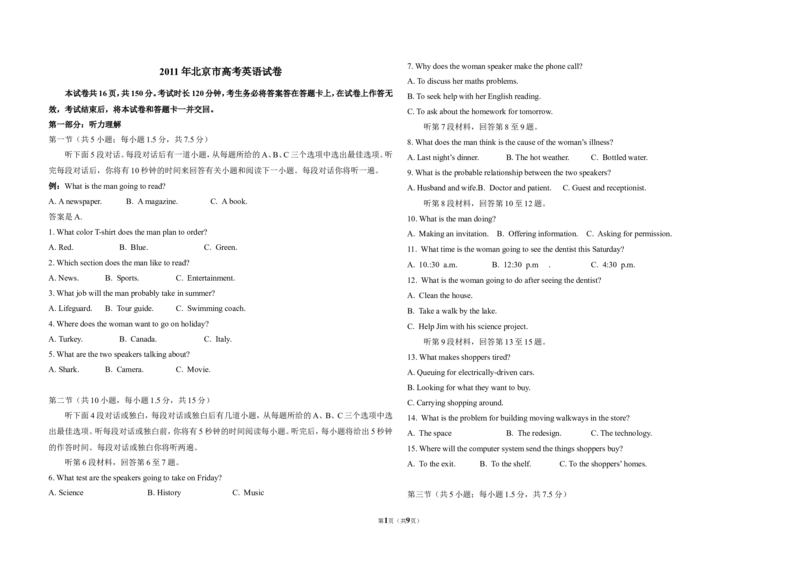
本试卷共16 页,共150 分。考试时长120 分钟,考生务必将答案答在答题卡上,在试卷上作答无
效,考试结束后,将本试卷和答题卡一并交回。
第一部分:听力理解
第一节(共5 小题;每小题1.5 分,共7.5 分)
听下面5 段对话。每段对话后有一道小题,从每题所给的A、B、C 三个选项中选出最佳选项。听
完每段对话后,你将有10 秒钟的时间来回答有关小题和阅读下一小题。每段对话你将听一遍。
例:What is the man going to read?
A. A newspaper.      B. A magazine.        C. A book.
答案是A.
1. What color T-shirt does the man plan to order?
A. Red.
B. Blue.
C. Green.
2. Which section does the man like to read?
A. News.
B. Sports.
C. Entertainment.
3. What job will the man probably take in summer?
A. Lifeguard.    B. Tour guide.
C. Swimming coach.
4. Where does the woman want to go on holiday?
A. Turkey.
B. Canada.
C. Italy.
5. What are the two speakers talking about?
A. Shark.
B. Camera.
C. Movie.
第二节(共10 小题,每小题1.5 分,共15 分)
听下面4 段对话或独白,每段对话或独白后有几道小题,从每题所给的A、B、C 三个选项中选
出最佳选项。听每段对话或独白前,你将有5 秒钟的时间阅读每小题。听完后,每小题将给出5 秒钟
的作答时间。每段对话或独白你将听两遍。
听第6 段材料,回答第6 至7 题。
6. What test are the speakers going to take on Friday?
A. Science
B. History
C. Music
7. Why does the woman speaker make the phone call?
A. To discuss her maths problems.
B. To seek help with her English reading.
C. To ask about the homework for tomorrow.
听第7 段材料,回答第8 至9 题。
8. What does the man think is the cause of the woman’s illness?
A. Last night’s dinner.
B. The hot weather.
C. Bottled water.
9. What is the probable relationship between the two speakers?
A. Husband and wife.B. Doctor and patient.
C. Guest and receptionist.
听第8 段材料,回答第10 至12 题。
10. What is the man doing?
A. Making an invitation.  B. Offering information.  C. Asking for permission.
11. What time is the woman going to see the dentist this Saturday?
A. 10.:30 a.m.
B. 12:30 p.m
.
C. 4:30 p.m.
12. What is the woman going to do after seeing the dentist?
A. Clean the house.
B. Take a walk by the lake.
C. Help Jim with his science project.
听第9 段材料,回答第13 至15 题。
13. What makes shoppers tired?
A. Queuing for electrically-driven cars.
B. Looking for what they want to buy.
C. Carrying shopping around.
14. What is the problem for building moving walkways in the store?
A. The space
B. The redesign.
C. The technology.
15. Where will the computer system send the things shoppers buy?
A. To the exit.      B. To the shelf.       C. To the shoppers’ homes.
第三节(共5 小题;每小题1.5 分,共7.5 分)
第1页(共9页)
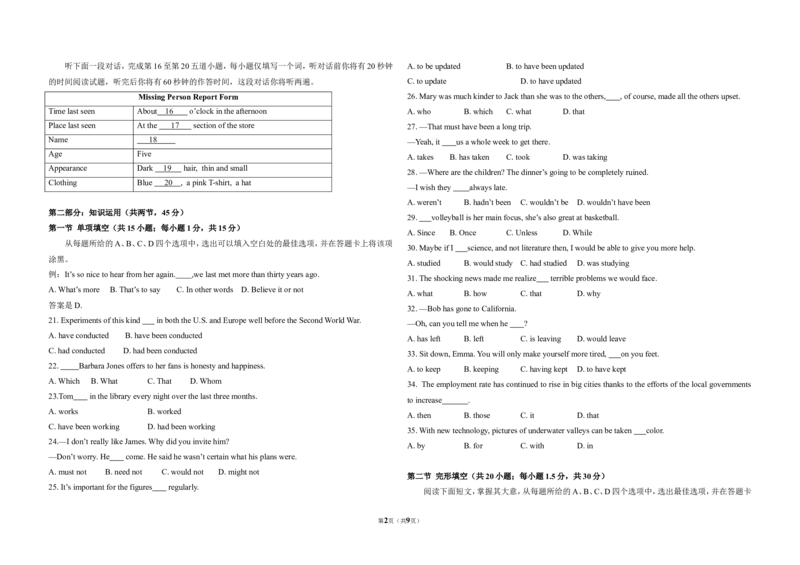
听下面一段对话,完成第16 至第20 五道小题,每小题仅填写一个词,听对话前你将有20 秒钟
的时间阅读试题,听完后你将有60 秒钟的作答时间,这段对话你将听两遍。
Missing Person Report Form
Time last seen
About    16        o’clock in the afternoon
Place last seen
At the       17       section of the store
Name
      18
Age
Five
Appearance
Dark     19      hair, thin and small
Clothing
Blue      20    , a pink T-shirt, a hat
第二部分:知识运用(共两节,45 分)
第一节 单项填空(共15 小题;每小题1 分,共15 分)
从每题所给的A、B、C、D 四个选项中,选出可以填入空白处的最佳选项,并在答题卡上将该项
涂黑。
例:It’s so nice to hear from her again.        ,we last met more than thirty years ago.
A. What’s more     B. That’s to say    C. In other words    D. Believe it or not
答案是D.
21. Experiments of this kind        in both the U.S. and Europe well before the Second World War.
A. have conducted        B. have been conducted
C. had conducted         D. had been conducted
22.          Barbara Jones offers to her fans is honesty and happiness.
A. Which   B. What
C. That
D. Whom
23.Tom        in the library every night over the last three months.
A. works
B. worked
C. have been working
D. had been working
24.—I don’t really like James. Why did you invite him?
—Don’t worry. He        come. He said he wasn’t certain what his plans were.[
A. must not
B. need not
C. would not
D. might not
25. It’s important for the figures        regularly.
A. to be updated
B. to have been updated
C. to update
D. to have updated
26. Mary was much kinder to Jack than she was to the others,       , of course, made all the others upset.
A. who
B. which    C. what
D. that
27. —That must have been a long trip.
—Yeah, it        us a whole week to get there.
A. takes
B. has taken
C. took
D. was taking
28. —Where are the children? The dinner’s going to be completely ruined.
—I wish they         always late.
A. weren’t
B. hadn’t been
C. wouldn’t be
D. wouldn’t have been
29.       volleyball is her main focus, she’s also great at basketball.
A. Since
B. Once
C. Unless
D. While
30. Maybe if I       science, and not literature then, I would be able to give you more help.
A. studied
B. would study
C. had studied
D. was studying
31. The shocking news made me realize       terrible problems we would face.
A. what
B. how
C. that
D. why
32. —Bob has gone to California.
—Oh, can you tell me when he        ?
A. has left
B. left
C. is leaving
D. would leave
33. Sit down, Emma. You will only make yourself more tired,       on you feet.
A. to keep
B. keeping
C. having kept
D. to have kept
34. The employment rate has continued to rise in big cities thanks to the efforts of the local governments
to increase             .[来源:ks5u.com]
A. then
B. those
C. it
D. that
35. With new technology, pictures of underwater valleys can be taken       color.
A. by
B. for
C. with
D. in
第二节 完形填空(共20 小题;每小题1.5 分,共30 分)
阅读下面短文,掌握其大意,从每题所给的A、B、C、D 四个选项中,选出最佳选项,并在答题卡
第2页(共9页)
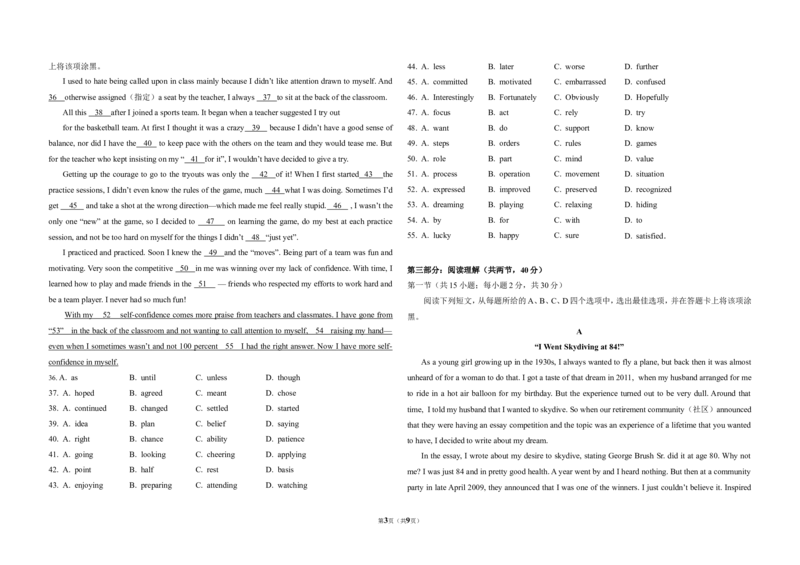
上将该项涂黑。
I used to hate being called upon in class mainly because I didn’t like attention drawn to myself. And
36    otherwise assigned(指定)a seat by the teacher, I always    37   to sit at the back of the classroom.
All this    38    after I joined a sports team. It began when a teacher suggested I try out
for the basketball team. At first I thought it was a crazy   39    because I didn’t have a good sense of
balance, nor did I have the   40   to keep pace with the others on the team and they would tease me. But
for the teacher who kept insisting on my “   41   for it”, I wouldn’t have decided to give a try.
Getting up the courage to go to the tryouts was only the    42   of it! When I first started  43    the
practice sessions, I didn’t even know the rules of the game, much    44  what I was doing. Sometimes I’d
get     45    and take a shot at the wrong direction—which made me feel really stupid.   46    , I wasn’t the
only one “new” at the game, so I decided to    47     on learning the game, do my best at each practice
session, and not be too hard on myself for the things I didn’t    48   “just yet”.
I practiced and practiced. Soon I knew the   49   and the “moves”. Being part of a team was fun and
motivating. Very soon the competitive   50   in me was winning over my lack of confidence. With time, I
learned how to play and made friends in the   51     — friends who respected my efforts to work hard and
be a team player. I never had so much fun!
With my    52    self-confidence comes more praise from teachers and classmates. I have gone from
“53”   in the back of the classroom and not wanting to call attention to myself,   54   raising my hand—
even when I sometimes wasn’t and not 100 percent   55   I had the right answer. Now I have more self-
confidence in myself.
36. A. as
B. until
C. unless
D. though
37. A. hoped
B. agreed
C. meant
D. chose
38. A. continued
B. changed
C. settled
D. started
39. A. idea
B. plan
C. belief
D. saying
40. A. right
B. chance
C. ability
D. patience
41. A. going
B. looking
C. cheering
D. applying
42. A. point
B. half
C. rest
D. basis
43. A. enjoying
B. preparing
C. attending
D. watching
44. A. less
B. later
C. worse
D. further
45. A. committed
B. motivated
C. embarrassed
D. confused
46. A. Interestingly
B. Fortunately
C. Obviously
D. Hopefully
47. A. focus
B. act
C. rely
D. try
48. A. want
B. do
C. support
D. know
49. A. steps
B. orders
C. rules
D. games
50. A. role
B. part
C. mind
D. value
51. A. process
B. operation
C. movement
D. situation
52. A. expressed
B. improved
C. preserved
D. recognized
53. A. dreaming
B. playing
C. relaxing
D. hiding
54. A. by
B. for
C. with
D. to
55. A. lucky
B. happy
C. sure
D. satisfied.
第三部分:阅读理解(共两节,40 分)
第一节(共15 小题;每小题2 分,共30 分)
阅读下列短文,从每题所给的A、B、C、D 四个选项中,选出最佳选项,并在答题卡上将该项涂
黑。
A
“I Went Skydiving at 84!”
As a young girl growing up in the 1930s, I always wanted to fly a plane, but back then it was almost
unheard of for a woman to do that. I got a taste of that dream in 2011, when my husband arranged for me
to ride in a hot air balloon for my birthday. But the experience turned out to be very dull. Around that
time, I told my husband that I wanted to skydive. So when our retirement community(社区)announced
that they were having an essay competition and the topic was an experience of a lifetime that you wanted
to have, I decided to write about my dream.
In the essay, I wrote about my desire to skydive, stating George Brush Sr. did it at age 80. Why not
me? I was just 84 and in pretty good health. A year went by and I heard nothing. But then at a community
party in late April 2009, they announced that I was one of the winners. I just couldn’t believe it. Inspired
第3页(共9页)
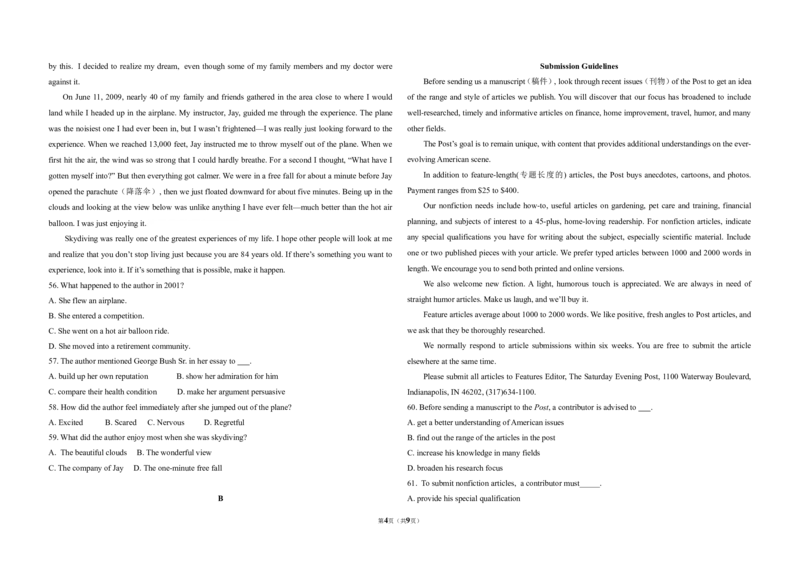
by this. I decided to realize my dream, even though some of my family members and my doctor were
against it.
On June 11, 2009, nearly 40 of my family and friends gathered in the area close to where I would
land while I headed up in the airplane. My instructor, Jay, guided me through the experience. The plane
was the noisiest one I had ever been in, but I wasn’t frightened—I was really just looking forward to the
experience. When we reached 13,000 feet, Jay instructed me to throw myself out of the plane. When we
first hit the air, the wind was so strong that I could hardly breathe. For a second I thought, “What have I
gotten myself into?” But then everything got calmer. We were in a free fall for about a minute before Jay
opened the parachute(降落伞), then we just floated downward for about five minutes. Being up in the
clouds and looking at the view below was unlike anything I have ever felt—much better than the hot air
balloon. I was just enjoying it.[来源:学#科#网Z#X#X#K]
Skydiving was really one of the greatest experiences of my life. I hope other people will look at me
and realize that you don’t stop living just because you are 84 years old. If there’s something you want to
experience, look into it. If it’s something that is possible, make it happen.
56. What happened to the author in 2001?[来源:高考资源网KS5U.COM]
A. She flew an airplane.
B. She entered a competition.
C. She went on a hot air balloon ride.
D. She moved into a retirement community.
57. The author mentioned George Bush Sr. in her essay to       .
A. build up her own reputation       B. show her admiration for him
C. compare their health condition     D. make her argument persuasive
58. How did the author feel immediately after she jumped out of the plane?
A. Excited
B. Scared    C. Nervous
D. Regretful
59. What did the author enjoy most when she was skydiving?
A. The beautiful clouds     B. The wonderful view
C. The company of Jay     D. The one-minute free fall
B
Submission Guidelines
Before sending us a manuscript(稿件), look through recent issues(刊物)of the Post to get an idea
of the range and style of articles we publish. You will discover that our focus has broadened to include
well-researched, timely and informative articles on finance, home improvement, travel, humor, and many
other fields.
The Post’s goal is to remain unique, with content that provides additional understandings on the ever-
evolving American scene.
In addition to feature-length(专题长度的) articles, the Post buys anecdotes, cartoons, and photos.
Payment ranges from $25 to $400.
Our nonfiction needs include how-to, useful articles on gardening, pet care and training, financial
planning, and subjects of interest to a 45-plus, home-loving readership. For nonfiction articles, indicate
any special qualifications you have for writing about the subject, especially scientific material. Include
one or two published pieces with your article. We prefer typed articles between 1000 and 2000 words in
length. We encourage you to send both printed and online versions.
We also welcome new fiction. A light, humorous touch is appreciated. We are always in need of
straight humor articles. Make us laugh, and we’ll buy it.
Feature articles average about 1000 to 2000 words. We like positive, fresh angles to Post articles, and
we ask that they be thoroughly researched.
We normally respond to article submissions within six weeks. You are free to submit the article
elsewhere at the same time.
Please submit all articles to Features Editor, The Saturday Evening Post, 1100 Waterway Boulevard,
Indianapolis, IN 46202, (317)634-1100.
60. Before sending a manuscript to the Post, a contributor is advised to       .
A. get a better understanding of American issues
B. find out the range of the articles in the post
C. increase his knowledge in many fields
D. broaden his research focus
61. To submit nonfiction articles, a contributor must_____.
A. provide his special qualification
第4页(共9页)
B. be a regular reader of the Post
C. produce printed version
D. be over 45 year old
62. From the passage we can learn that the Post         .
A. allows article submission within six weeks
B. favor science articles within 2,000 words
C. have a huge demand for humorous works
D. prefers nonfiction to fiction article
C
Students and Technology in the Classroom
I love my blackberry—it’s my little connection to the larger world that can go anywhere with me. I
also love my laptop computer, as it holds all of my writing and thoughts. Despite this love of technology,
I know that there are times when I need to move away from these devices(设备)and truly communicate
with others.
On occasion, I teach a course called History Matters for a group of higher education managers. My
goals for the class include a full discussion of historical themes and ideas. Because I want students to
thoroughly study the material and exchange their ideas with each other in the classroom, I have a rule —
no laptop, iPads, phones, etc. When students were told my rule in advance of the class, some of them
were not happy.
Most students assume that my reasons for this rule include unpleasant experiences in the past with
students misusing technology. There’s a bit of truth to that. Some students assume that I am anti-
technology. There’s no truth in that at all. I love technology and try to keep up with it so I can relate to my
students.
The real reason why I ask students to leave technology at the door is that I think there are very few
places in which we can have deep conversions and truly engage complex ideas. Interruptions by
technology often break concentration and allow for too much dependence on outside information for
ideas. I want students to dig deep within themselves for inspiration and ideas. I want them to push each
other to think differently and make connections between the course the material and the class discussion.
I’ve been teaching my history class in this way for many years and the evaluations reflect student
satisfaction with the environment that I create. Students realize that with deep conversation and
challenge, they learn at a level that helps them keep the course material beyond the classroom.
I’m not saying that I won’t ever change my mind about technology use in my history class, but until I
hear a really good reason for the change, I’m sticking to my plan. A few hours of technology-free
dialogue is just too sweet to give up.
63. Some of the students in the history class were unhappy with____.
A. the course material             B. others’ misuse of technology
C. discussion topics               D. the author’s class regulations
64. The underlined word “engage” in para.4 probably means ____
A. explore
B. accept
C. change
D. reject
65. According to the author, the use of technology in the classroom may ____.
A. keep students from doing independent thinking
B. encourage students to have in-depth conversations
C. help students to better understand complex themes
D. affect students’ concentration on course evaluation
66. It can be inferred from the last paragraph that the author ____.
A. is quite stubborn
B. will give up teaching history
C. will change his teaching plan soon
D. values technology-free dialogues in his class
D
As the railroads and the highways shaped the American West in the past centuries, a new electrical
generating(发电)and transmission(输送)system for the 21st century will leave a lasting mark on the
West, for better or worse. Much of the real significance of railroads and highways is not in their direct
physical effect on the scenery, but in the ways that they affect the surrounding community. The same is
true of big solar plants and the power lines that will be laid down to move electricity around.
The 19th century saw land grants (政府拨地)offered to railroad companies to build the
第5页(共9页)
transcontinental railroads, leaving public land in between privately owned land. In much of the west,
some of the railroad sections were developed while others remained undeveloped, and in both cases the
landownership has presented unique challenges to land management. With the completion or the interstate
highway system, many of the small towns which sprang up as railway stops and developed well, have lost
their lifeblood and died.
Big solar plants and their power lines will also have effects far beyond their direct footprint in the
West. This is not an argument against building them, we need alternative energy badly, and to really take
advantage of it we need to be able to move electricity around far more readily than we can now.
So trade-offs will have to be made. Some scenic sport will be sacrificed. Some species(物种)will be
forced to move, or will be carefully moved to special accommodations. Deals will be stuck to reduce the
immediate effects.
The lasting effects of these trade-offs are another matter. The 21st century development of the
American West as an ideal place for alternative energy is going to throw off a lot of power and money to
do a lot of good. But is\t is just as likely that they will be spent wastefully and will leave new problems
behind, just like the railroad and the highway.
The money set aside in negotiated trade-offs and the institution that control will shape the west far
beyond the immediate footprint of power plants and transmission lines. So let’s remember the effects of
the railroad and the highways as we construct these new power plants in the West.
67. What was the problem caused by the construction of the railways?
A. Small towns along the railways became abandoned.
B. Some railroad stops remained underused.
C. Land in the West was hard to manage.
D. Land grants went into private hands.
68. What is the major concern in the development of alternative energy according to the last two
paragraphs?
A. The transmission of power.
B. The use of money and power.
C. The conservation of solar energy.
D. The selection of an ideal place.
69. What is the author’s attitude towards building solar plants?
A. Cautious
B. Approving
C. Doubtful
D. Disapproving
70. Which is the best title for the passage?
A. How the Railways Have Affected the West
B. How Solar Energy Could Reshape the West
C. How the Effects of Power Plants Can Be Reduced
D. How the Problems of the Highways Have Been Settled
第二节(共5 小题;每小题2 分,共10 分)
根据短文内容,从短文后的七个选项中选出能填入空白处的最佳选项,选项中有两项为多余选
项。
Public speaking and critical thinking
What is critical thinking? To a certain degree, it’s a matter of logic(逻辑)—of being able to spot
weaknesses in other people’s argument and to avoid them in your own, it also includes related skills such
as distinguishing fact from opinion and assessing the soundness of evidence.
In the broad sense, critical thinking is focused, organized thinking—the ability to see clearly their
relationships among ideas.  71   The greatest thinkers, scientists and inventors have often taken their
information that was readily available and put it together differently to produce new ideas that, too, is
critical thinking.
  72   As the class goes on, for example, you will probably spend a good deal of time organizing your
speeches. While this may seem like a purely mechanical(机械的) exercise, it is closely connected with
critical thinking. If the structure of your speech is loose and confused, chances are that your thinking is
also disordered and confused. If, on the other hand, the structure is clear, there is a good chance your
thinking is too. Organizing a speech is not a matter of arranging the ideas you already have.   73
What is true of organization is true of many aspects of public speaking.   74   As you work on
expressing your ideas in clear, accurate language, you will improve your ability to think clearly and
accurately.    75    As you learn to listen critically to speeches in class. You will be better able to assess
the ideas of speakers in a variety of situations.
第6页(共9页)
If you take full advantage of your speech class, you will be able to develop your skills as critical
thinker in many circumstances. This is one reason public speaking has been regarded as a vital part of
education since the days of ancient Greece.
A. Rather, it is an important part of shaping the ideas themselves.
B. This may seem like a lot of time, but the rewards are well worth it.
C. It may also help you to know that there is no such thing as a perfect speech.
D. It has often been said that there are few new ideas in the world, only reorganized ideas.
E. If you are wondering what this has to do with your public speaking class, the answer is quite a lot.
F. The skills you learn in your speech class can help you become a more effective thinker in a number of
ways.
G. As you study the role of evidence and reasoning in speechmaking ,you will see how they can be used
in other forms of communication as well.
第四部分:书面表达(共两节,35 分)
第一节 情景作文(20 分)
假设你是红星中学高二(1)班的学生李华。下面四幅图表述了近期发生在你们班的一个真实故
事,请根据图片的先后顺序,为校刊“英语园地”写一篇短文,词数不少于60。


第二节 开放作文(15 分)
请根据下面提示,写一篇短文。词数不少于50。
In your spoken English class, your teacher shows you the following picture. You are asked to
describe the picture and explain how you understand it.
第7页(共9页)
第8页(共9页)
第9页(共9页)