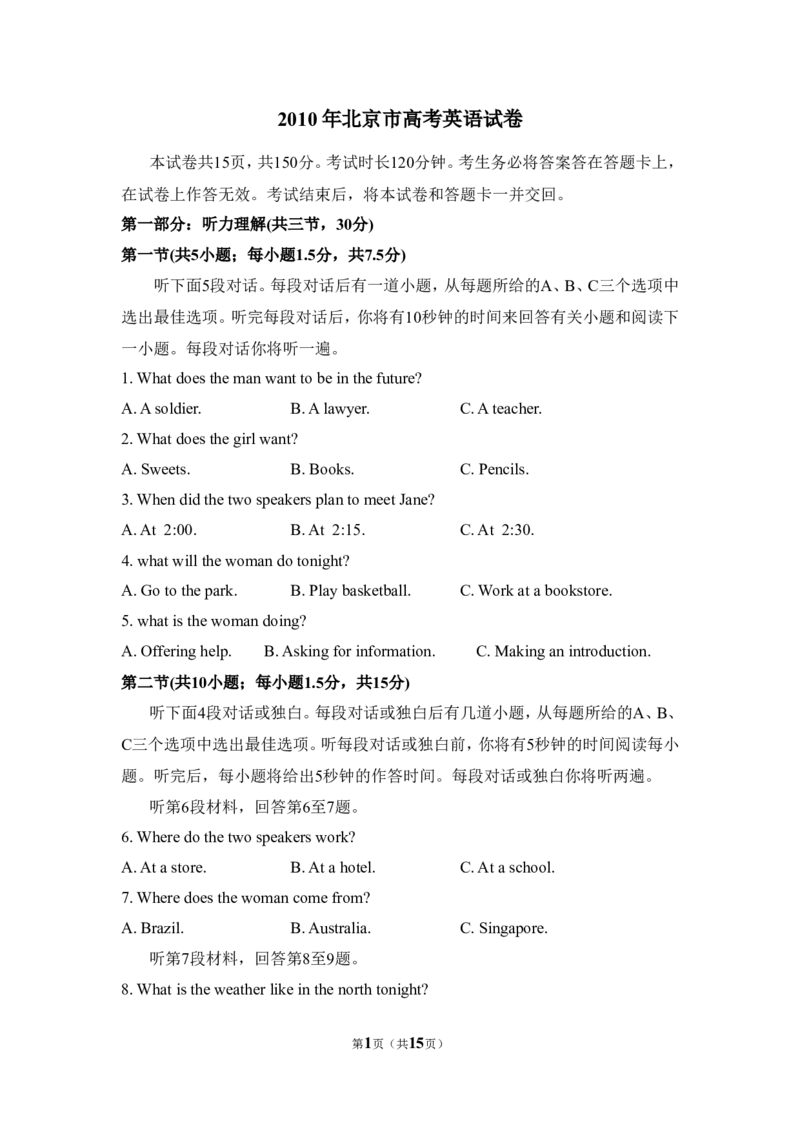
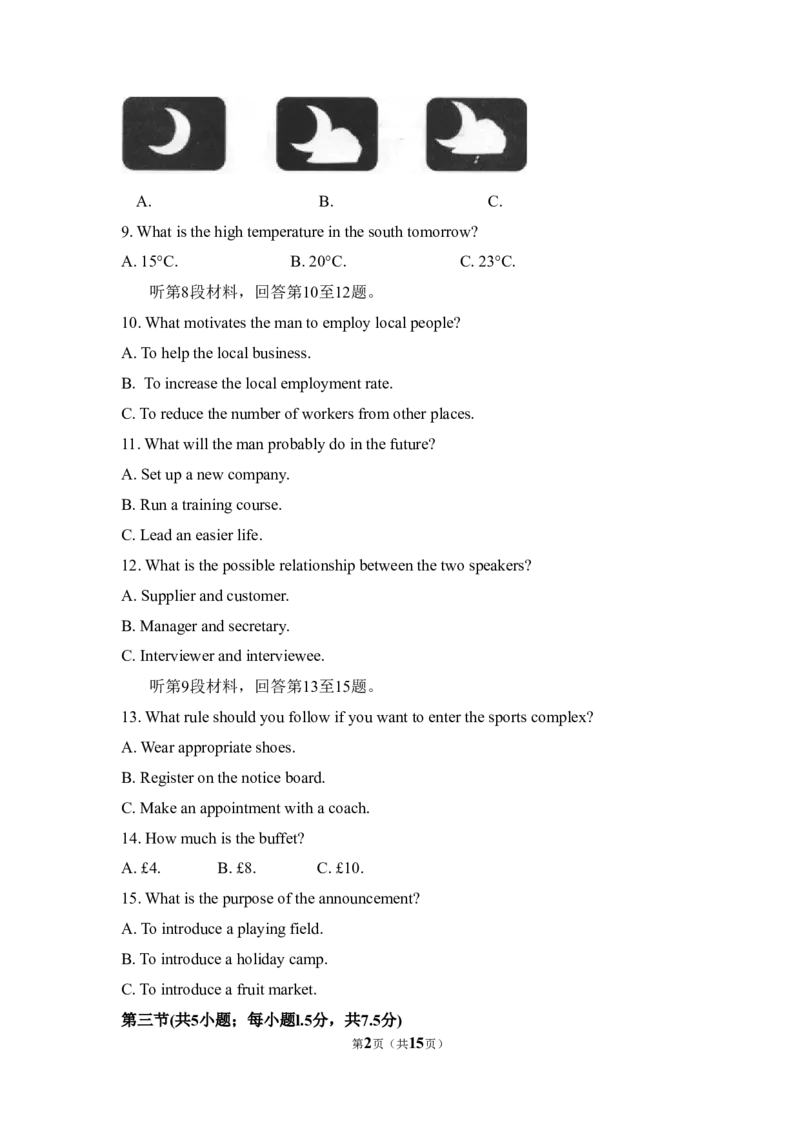
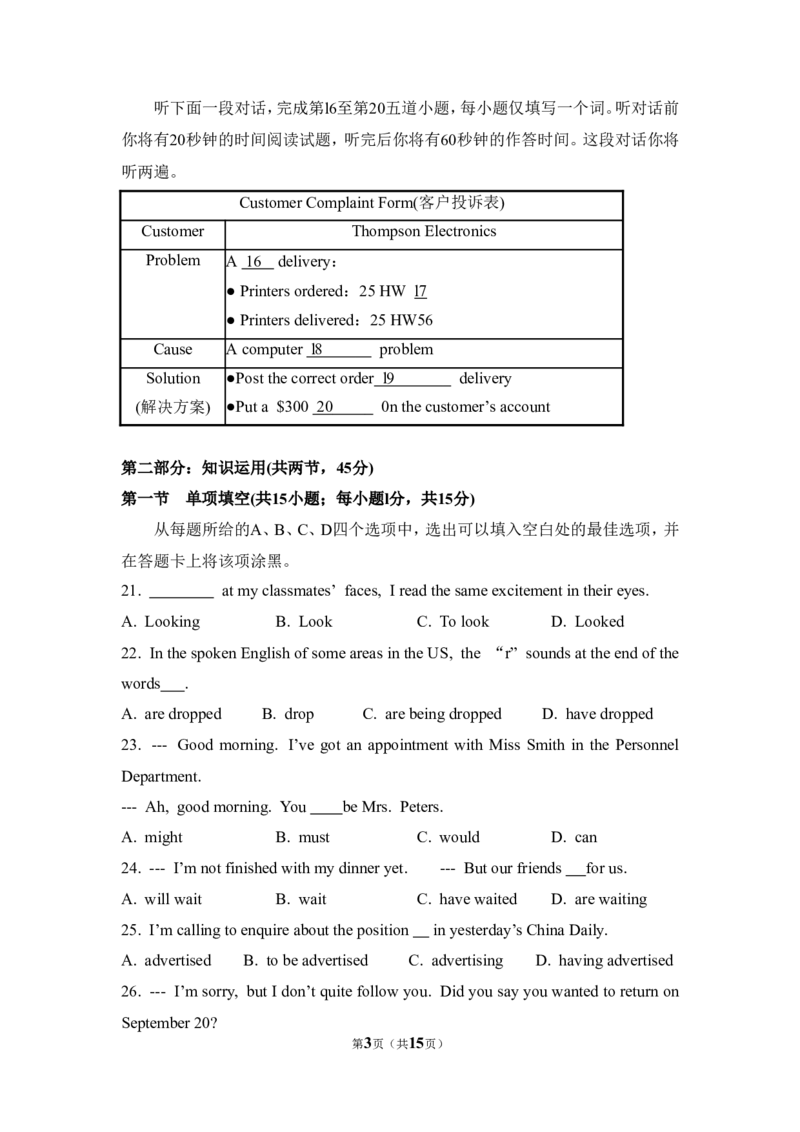
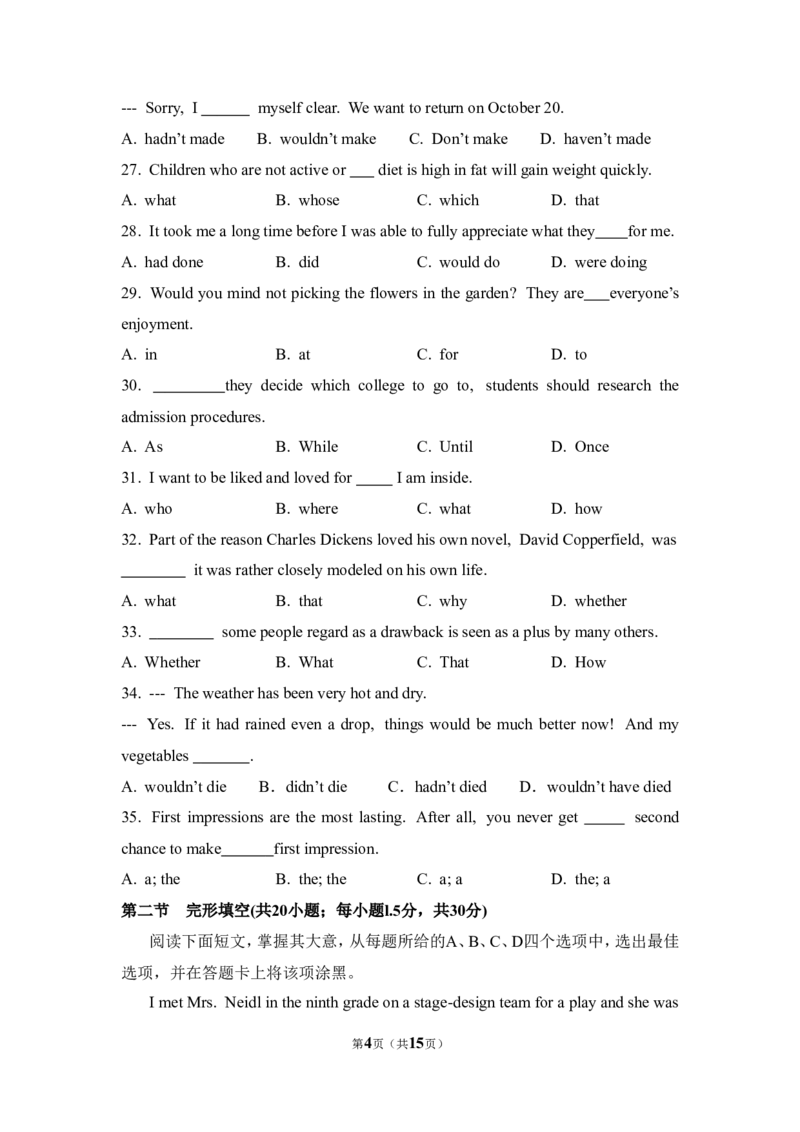
2010 年北京市高考英语试卷
本试卷共15页,共150分。考试时长120分钟。考生务必将答案答在答题卡上,
在试卷上作答无效。考试结束后,将本试卷和答题卡一并交回。
第一部分:听力理解(共三节,30分)
第一节(共5小题;每小题1.5分,共7.5分)
    听下面5段对话。每段对话后有一道小题,从每题所给的A、B、C三个选项中
选出最佳选项。听完每段对话后,你将有10秒钟的时间来回答有关小题和阅读下
一小题。每段对话你将听一遍。
1. What does the man want to be in the future?
A. A soldier.
B. A lawyer.
C. A teacher.
2. What does the girl want?
A. Sweets.
B. Books.
C. Pencils.
3. When did the two speakers plan to meet Jane?
A. At 2:00.
B. At 2:15.
C. At 2:30.
4. what will the woman do tonight?
A. Go to the park.
B. Play basketball.
C. Work at a bookstore.
5. what is the woman doing?
A. Offering help.    B. Asking for information.     C. Making an introduction.
第二节(共10小题;每小题1.5分,共15分)
听下面4段对话或独白。每段对话或独白后有几道小题,从每题所给的A、B、
C三个选项中选出最佳选项。听每段对话或独白前,你将有5秒钟的时间阅读每小
题。听完后,每小题将给出5秒钟的作答时间。每段对话或独白你将听两遍。
听第6段材料,回答第6至7题。
6. Where do the two speakers work?
A. At a store.
B. At a hotel.
C. At a school.
7. Where does the woman come from?
A. Brazil.
B. Australia.
C. Singapore.
听第7段材料,回答第8至9题。
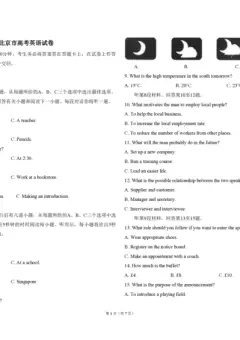
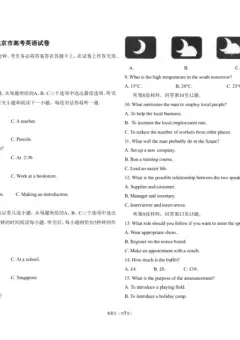
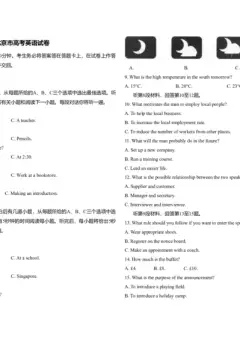
8. What is the weather like in the north tonight?
第1页(共15页)
    A.
B.
C.
9. What is the high temperature in the south tomorrow?
A. 15°C.
B. 20°C.
C. 23°C.
听第8段材料,回答第10至12题。
10. What motivates the man to employ local people?
A. To help the local business.
B. To increase the local employment rate.
C. To reduce the number of workers from other places.
11. What will the man probably do in the future?
A. Set up a new company.
B. Run a training course.
C. Lead an easier life.
12. What is the possible relationship between the two speakers?
A. Supplier and customer.
B. Manager and secretary.
C. Interviewer and interviewee.
听第9段材料,回答第13至15题。
13. What rule should you follow if you want to enter the sports complex?
A. Wear appropriate shoes.
B. Register on the notice board.
C. Make an appointment with a coach.
14. How much is the buffet?
A. £4.              B. £8.               C. £10.
15. What is the purpose of the announcement?
A. To introduce a playing field.
B. To introduce a holiday camp.
C. To introduce a fruit market.
第三节(共5小题;每小题l.5分,共7.5分)
第2页(共15页)
听下面一段对话,完成第l6至第20五道小题,每小题仅填写一个词。听对话前
你将有20秒钟的时间阅读试题,听完后你将有60秒钟的作答时间。这段对话你将
听两遍。
Customer Complaint Form(客户投诉表)
Customer
Thompson Electronics
Problem
A  16    delivery:
● Printers ordered:25 HW  l7
● Printers delivered:25 HW56
Cause
A computer  l8


   problem
Solution
(解决方案)
●Post the correct order  l9


    delivery
●Put a $300  20


    0n the customer’s account
第二部分:知识运用(共两节,45分)
第一节  单项填空(共15小题;每小题l分,共15分)
    从每题所给的A、B、C、D四个选项中,选出可以填入空白处的最佳选项,并
在答题卡上将该项涂黑。
21.          at my classmates’ faces, I read the same excitement in their eyes.
A. Looking
B. Look
C. To look
D. Looked
22. In the spoken English of some areas in the US, the “r” sounds at the end of the
words      .
A. are dropped     B. drop      C. are being dropped     D. have dropped
23. --- Good morning. I’ve got an appointment with Miss Smith in the Personnel
Department.
--- Ah, good morning. You         be Mrs. Peters.
A. might
B. must
C. would
D. can
24. --- I’m not finished with my dinner yet.    --- But our friends      for us.
A. will wait
B. wait
C. have waited
D. are waiting
25. I’m calling to enquire about the position      in yesterday’s China Daily.
A. advertised    B. to be advertised     C. advertising    D. having advertised
26. --- I’m sorry, but I don’t quite follow you. Did you say you wanted to return on
September 20?
第3页(共15页)
--- Sorry, I


  myself clear. We want to return on October 20.
A. hadn’t made    B. wouldn’t make    C. Don’t make    D. haven’t made
27. Children who are not active or        diet is high in fat will gain weight quickly.
A. what
B. whose
C. which
D. that
28. It took me a long time before I was able to fully appreciate what they    for me.
A. had done
B. did
C. would do
D. were doing
29. Would you mind not picking the flowers in the garden? They are     everyone’s
enjoyment.
A. in
B. at
C. for
D. to
30.

 they decide which college to go to, students should research the
admission procedures.
A. As
B. While
C. Until
D. Once
31. I want to be liked and loved for           I am inside.
A. who
B. where
C. what
D. how
32. Part of the reason Charles Dickens loved his own novel, David Copperfield, was
         it was rather closely modeled on his own life.
A. what
B. that
C. why
D. whether
33.

  some people regard as a drawback is seen as a plus by many others.
A. Whether
B. What
C. That
D. How
34. --- The weather has been very hot and dry.
--- Yes. If it had rained even a drop, things would be much better now! And my
vegetables

 .
A. wouldn’t die    B.didn’t die     C.hadn’t died    D.wouldn’t have died
35. First impressions are the most lasting. After all, you never get      second
chance to make

   first impression.
A. a; the
B. the; the
C. a; a
D. the; a
第二节  完形填空(共20小题;每小题l.5分,共30分)
阅读下面短文,掌握其大意,从每题所给的A、B、C、D四个选项中,选出最佳
选项,并在答题卡上将该项涂黑。
I met Mrs. Neidl in the ninth grade on a stage-design team for a play and she was
第4页(共15页)
one of the directors. Almost instantly I loved her. She had an unpleasant voice and a
direct way of speaking,
  36

   she was encouraging and inspiring. For some
reason, she was impressed with my work and me.
Mrs. Neidl would ask me for my
  37
     . She wanted to know how I thought we
should
  38
      things. At first I had no idea how to answer because I knew

  39
       about stage design! But I slowly began to respond to her
  40
      . It was
cause and effect: She believed I had opinions, so I began to
  41
       them. She
trusted me to complete things, so I completed them perfectly. She loved how
  42

I was, so I began to show up to paint more and more. She believed in me, so I began
to believe in myself.
Mrs. Neidl’s
  43
      that year was, “Try it. We can always paint over it
  44

!” I began to take
  45

  . I had been so afraid of failing but suddenly there was no
failing---only things to be
  46

   upon. I learned to dip my brush into the paint
and
  47
        create something.
The shy, quiet freshman achieved success that year. I was
  48

   in the
program as “Student Art Assistant” because of the time and effort I’d put in. It was
that year that I
  49

   I wanted to spend the rest of my life doing stage design.
Being on that stage-design team

 50


  Mrs. Neidl changed me
completely. Not only was I stronger and more competent than I had thought,
but I also
  51


  a strong interest and a world I hadn’t known existed.
She taught me not to
  52


  what people think I should do: She taught
me to take chances and not be
  53


 . Mrs. Neidl was my comforter
when I was upset. Her
  54

   in me has inspired me to do things that I
never imagined
  55


 .
36. A. and
B. yet
C. so
D. for
37. A. opinion
B. impression
C. information
D. intention
38. A. make
B. keep
C. handle
D. change
39. A. anything
B. something
C. everything
D. nothing
40. A. questions
B. comments
C. explanations
D. remarks
41. A. hold
B. follow
C. evaluate
D. form
第5页(共15页)
42. A. happy
B. lively
C. reliable
D. punctual
43. A. message
B. motto
C. saying
D. suggestion
44. A. again
B. more
C. instead
D. later
45. A. steps
B. control
C. charge
D. risks
46. A. improved
B. acted
C. looked
D. reflected
47. A. easily
B. carefully
C. confidently
D. proudly
48. A. introduced
B. recognized
C. identified
D. considered
49. A. confirmed
B. decided
C. realized
D. acknowledged
50. A. with
B. below
C. of
D. by
51. A. developed
B. discovered
C. took
D. fostered
52. A. accept
B. care
C. judge
D. wonder
53. A. bored
B. lazy
C. sad
D. afraid
54. A. trust
B. patience
C. curiosity
D. interest
55. A. accessible
B. enjoyable
C. possible
D. favorable

第三部分:阅读理解(共两节,40分)
第一节(共15小题;每小题2分,共30分)
阅读下列短文,从每题所给的A、B、C、D四个选项中,选出最佳选项,并
在答题卡上将该项涂黑。
A
Goldie’s Secret
She turned up at the doorstep of my house in Cornwall. No way could I have sent
her away. No way, not me anyway. Maybe someone had kicked her out of their car
the night before. “We’re moving house.”; “No space for her any more with the
baby coming.” “We never really wanted her, but what could we have done? She
was a present.” People find all sorts of excuses for abandoning an animal. And she
was one of the most beautiful dogs I had ever seen.
I called her Goldie. If I had known what was going to happen I would have given
her a more creative name. She was so unsettled during those first few days. She
hardly ate anything and had such an air of sadness about her. There was nothing I
第6页(共15页)
could do to make her happy, it seemed. Heaven knows what had happened to her at
her previous owner’s. But eventually at the end of the first week she calmed down.
Always by my side, whether we were out on one of our long walks or sitting by the
fire.
That’s why it was such a shock when she pulled away from me one day when we
were out for a walk. We were a long way from home, when she started barking and
getting very restless. Eventually I couldn’t hold her any longer and she raced off
down the road towards a farmhouse in the distance as fast as she could.
By the time I reached the farm I was very tired and upset with Goldie. But when
I saw her licking (舔) the four puppies (幼犬) I started to feel sympathy towards
them. “We didn’t know what had happened to her,” said the woman at the door.
“ I took her for a walk one day, soon after the puppies were born, and she just
disappeared.” “She must have tried to come back to them and got lost,” added a
boy from behind her.
I must admit I do miss Goldie, but I’ve got Nugget now, and she looks just like
her mother. And I’ve learnt a good lesson: not to judge people.
56. How did the author feel about Goldie when Goldie came to the house?
A. Shocked.     B. Sympathetic.     C. Annoyed.     D. Upset.
57. In her first few days at the author’s house, Goldie      .
A. I felt worried    B. was angry    C. ate a little      D. sat by the fire
58. Goldie rushed off to a farmhouse one day because she     .
A. saw her puppies                B. heard familiar barkings
C. wanted to leave the author        D. found her way to her old home
59. The passage is organized in order of     .
A. time     B. effectiveness    C. importance     D. complexity
B
Open Letter to an Editor
I had an interesting conversation with a reporter recently---one who works for
you. In fact, he’s one of your best reporters. He wants to leave.
第7页(共15页)
Your reporter gave me a copy of his resume(简历)and photocopies of six stories
that he wrote for you. The headlines showed you played them proudly. With great
enthusiasm, he talked about how he finds issues (问题), approaches them, and
writes about them, which tells me he is one of your best. I’m sure you would hate to
lose him. Surprisingly, your reporter is not unhappy. In fact, he told me he really
likes his job. He has a great assignment(分工), and said you run a great paper. It
would be easy for you to keep him, he said. He knows that the paper values him. He
appreciates the responsibility you’ve given him, takes ownership of his profession,
and enjoys his freedom.
So why is he looking for a way out?
He talked to me because he wants his editors to demand so much more of him.
He wants to be pushed, challenged, coached to new heights.
The reporter believes that good stories spring from good questions, but his
editors usually ask how long the story will be, when it will be in, where it can play,
and what the budget is.
He longs for conversations with an editor who will help him turn his good ideas
into great ones. He wants someone to get excited about what he’s doing and to help
him turn his story idea upside down and inside out, exploring the best ways to report
it. He wants to be more valuable for your paper. That’s what you want for him, too,
isn’t it?
So your reporter has set me thinking.
Our best hope in keeping our best reporters, copy editors, photographers,
artists---everyone---is to work harder to make sure they get the help they are
demanding to reach their potential. If we can’t do it, they’ll find someone who can.
60. What does the writer think of the reporter?
A. Optimistic.    B. Imaginative.     C. Ambitious.     D. Proud.
61. What does the reporter want most from his editors in their talks?
A. Finding the news value of his stories.
B. Giving him financial support.
C. Helping him to find issues.
第8页(共15页)
D. Improving his good ideas.
62. Who probably wrote the letter?
A. An editor.      B. An artist.     C. A reporter.     D. A reader.
63. The letter aims to remind editors that they should     .
A. keep their best reporters at all costs
B. give more freedom to their reporters
C. be aware of their reporters’ professional development
D. appreciate their reporters’ working styles and attitudes
C
Pacing and Pausing
Sara tried to befriend her old friend Steve’s new wife, but Betty never seemed to
have anything to say. While Sara felt Betty didn’t hold up her end of the
conversation, Betty complained to Steve that Sara never gave her a chance to talk.
The problem had to do with expectations about pacing and pausing.
Conversation is a turn-taking game. When our habits are similar, there’s no
problem. But if our habits are different, you may start to talk before I’m finished or
fail to take your turn when I’m finished. That’s what was happening with Betty and
Sara.
It may not be coincidental that Betty, who expected relatively longer pauses
between turns, is British, and Sara, who expected relatively shorter pauses, is
American. Betty often felt interrupted by Sara. But Betty herself became an
interrupter and found herself doing most of the talking when she met a visitor from
Finland. And Sara had a hard time cutting in on some speaker s from Latin America
or Israel.
The general phenomenon, then, is that the small conversation techniques, like
pacing and pausing, lead people to draw conclusions not about conversational style
but about personality and abilities. These habitual differences are often the basis for
dangerous stereotyping(思维定式). And these social phenomena can have very
personal consequences. For example, a woman from the southwestern part of the US
第9页(共15页)
went to live in an eastern city to take up a job in personnel. When the Personnel
Department got together for meetings, she kept searching for the right time to break
in---and never found it. Although back home she was considered outgoing and
confident, in Washington she was viewed as shy and retiring. When she was
evaluated at the end of the year, she was told to take a training course because of her
inability to speak up.
That’s why slight differences in conversational style---tiny little things like
microseconds of pause---can have a great effect on one’s life. The result in this case
was a judgment of psychological problems---even in the mind of the woman herself,
who really wondered what was wrong with her and registered for assertiveness
training.
64. What did Sara think of Betty when talking with her?
A. Betty was talkative.          B. Betty was an interrupter.
C. Betty did not take her turn.     D. Betty paid no attention to Sara.
65. According to the passage, who are likely to expect the shortest pauses between
turns?
A. Americans.     B. Israelis.      C. The British.     D. The Finns.
66. We can learn from the passage that     .
A. communication breakdown results from short pauses and fast pacing
B. women are unfavorably stereotyped in eastern cities of the US
C. one’s inability to speak up is culturally determined sometimes
D. one should receive training to build up one’s confidence
67. The underlined word “assertiveness” in the last paragraph probably means
.
A. being willing to speak one’s mind
B. being able to increase one’s power
C. being ready to make one’s own judgment
D. being quick to express one’s ideas confidently
D
第10页(共15页)
The Cost of Higher Education
Individuals(个人)should pay for their higher education.
A university education is of huge and direct benefit to the individual. Graduates
earn more than non-graduates. Meanwhile, social mobility is ever more dependent
on having a degree. However, only some people have it. So the individual, not the
taxpayers, should pay for it. There are pressing calls on the resources(资源)of the
government. Using taxpayers’ money to help a small number of people to earn high
incomes in the future is not one of them.
Full government funding(资助)is not very good for universities. Adam Smith
worked in a Scottish university whose teachers lived off student fees. He knew and
looked down upon 18th-century Oxford, where the academics lived comfortably off
the income received from the government. Guaranteed salaries, Smith argued, were
the enemy of hard work; and when the academics were lazy and incompetent, the
students were similarly lazy.
If students have to pay for their education, they not only work harder, but also
demand more from their teachers. And their teachers have to keep them satisfied. If
that means taking teaching seriously, and giving less time to their own research
interests, that is surely something to celebrate.
Many people believe that higher education should be free because it is good for
the economy(经济). Many graduates clearly do contribute to national wealth, but so
do all the businesses that invest (投资)and create jobs. If you believe that the
government should pay for higher education because graduates are economically
productive, you should also believe that the government should pay part of business
costs. Anyone promising to create jobs should receive a gift of capital from the
government to invest. Therefore, it is the individual, not the government, who
should pay for their university education.
68. The underlined word “them” in Paragraph 2 refers to     .
A. taxpayers   B. pressing calls   C. college graduates  D. government resources
69. The author thinks that with full government funding     .
A. teachers are less satisfied
第11页(共15页)
B. students are more demanding
C. students will become more competent
D. teachers will spend less time on teaching
70. The author mentions businesses in Paragraph 5 in order to     .
A. argue against free university education
B. call on them to finance students' studies
C. encourage graduates to go into business
D. show their contribution to higher education
第二节(共5小题;每小题2分,共10分)
根据短文内容,从短文后的七个选项中选出能填入空白处的最佳选项。选项
中有两项为多余选项。
Muzak
The next time you go into a bank, a store, or a supermarket, stop and listen. What
do you hear?
  71

   It’s similar to the music you listen to, but it’s not exactly the
same. That’s because this music was especially designed to relax you, or to give you
extra energy. Sometimes you don’t even realize the music is playing, but you react to
the music anyway.
Quiet background music used to be called “elevator(电梯)music” because we
often heard it in elevators. But lately we hear it in more and more places, and it has a
new name “Muzak”. About one-third of the people in America listen to “Muzak”
every day. The music plays for 15 minutes at a time, with short pauses in between. It
is always more lively between ten and eleven in the morning, and between three and
four in the afternoon, when people are more tired.

 72

If you listen to Muzak carefully, you will probably recognize the names of many
of the songs. Some musicians or songwriters don’t want their songs to be used as
Muzak, but others are happy when their songs are chosen. Why?
  73

Music is often played in public places because it is designed to make people feel
less lonely when they are in an airport or a hotel. It has been proven that Muzak does
what it is designed to do. Tired office workers suddenly have more energy when they
hear the pleasant sound of Muzak in the background.

 74


   Supermarket
第12页(共15页)
shoppers buy 38 percent more groceries.

  75

   They say it’s boring to hear the same songs all the time. But other
people enjoy hearing Muzak in public places. They say it helps them relax and feel
calm. One way or another, Muzak affects everyone. Some farmers even say their cows
give more milk when they hear Muzak!
A. Some people don’t like Muzak.
B. The music gives them extra energy.
C. Music is playing in the background.
D. Factory workers produce 13 percent more.
E. Muzak tends to help people understand music better.
F. They get as much as $4 million a year if their songs are used.
G. Muzak is played in most of the big supermarkets in the world.

第四部分:书面表达(共两节,35分)
第一节  情景作文(20分)
假设你是红星中学高二(1)班的学生李华,利用上周末的时间帮助祖父母安
排了去北戴河的旅行.请根据以下四幅图的先后顺序,写一篇英文周记,叙述你
从准备到送行的全过程.
注意:1.周记的开头已为你写好.
2.词数不少于60.
第13页(共15页)
Last weekend, I helped my grandparents prepare their trip to Beidaihe.


第二节  开放作文(15分)
请根据下面提示,写一篇短文。词数不少于50。
In your spoken English class, your teacher shows you the following picture. You
are asked to describe the picture and explain how you understand it.
第14页(共15页)

第15页(共15页)