2008 年全国统一高考英语试卷(全国卷I)
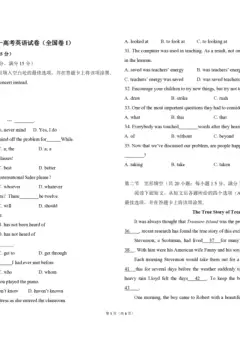
第二部分  英语知识运用(共两节,满分45 分)
第一节  单项填空(共15 小题;每小题1 分,满分15 分)
从A、B、C、D 四个选项中,选出可以填入空白处的最佳选项,并在答题
卡上将该项涂黑。
例: We ______ last night, but we went to the concert instead.
A. must have studied
B. might study


C. should have studied
D. would study
答案是C.
21. — Would you like to join me for a quick lunch before class?
— ______, but I promised Nancy to go out with her.
A. I’d like to

B. I like it.

C. I don’t


D. I will
22. — What fruit is in season now?
— Pears and apples, ______.
A. I know
B. I think
C. I see
D. I feel
23. The performance _______ nearly three hours, but few people left the theatre early.
A. covered
B. reached
C. played

D. lasted
24. Let’s learn to use the problem we are facing ________ a stepping-stone to future
success.
A. to


B. for


C. as


D. by
25. The lawyer seldom wears anything other than a suit __________the season.
A. whatever
B. wherever
C. whenever
D. however
26. I like getting up very early in summer. The morning air is so good _________.
A. to be breathed
  B. to breathe
C. breathing

D. being breathed
27. — Have you known Dr. Jackson for a long time?
— Yes, since she________ the Chinese Society.
A. has joined

B. joins

C. had joined


D. joined
28. You are driving too fast. Can you drive_________?
A. more slowly a bit


B. slowly a bit more

C. a bit more slowly


D. slowly more bit
29. The wet weather will continue tomorrow when a cold front ______ to arrive.
A. is expected
 B. is expecting
C. expects
D. will be expected
30. — Which of the two computer games did you prefer?
— Actually I didn’t like ______.
A. both of them
B. either of them
 C. none of them
D. neither of them
31. — Have you got any idea for the summer vacation?
— I don’t mind where we go ______ there’s sun, sea and beach.
A. as if

B. as long as
 C. now that
D. in order that
32. The weather was ______ cold that I didn’t like to leave my room.
A. really
 B. such

C. too

D. so
33. The English spoken in the United States is only slightly different from ______
spoken in England.
A. which


B. what
 C. that


D. the one
34. After studying in a medical college for five years, Jane ______ her job as a doctor
in the countryside.
A. set out

 B. took over


 C. took up
 D. set up
35. — Sorry, I made a mistake again.  — ______. Practice more and you’ll succeed.
A. Never mind
B. Certainly not
C. Not at all
D. Don’t mention it

第二节  完形填空(共20 小题,每题1.5 分,共30 分)
阅读下面短文,撑握其大意,然后从36—55 各题所给的四个选项(A、
B、C 和D)中,选出最佳选项,并在答题卡上将该项涂黑。
After the birth of my second child, I got a job at a restaurant. Having worked
with an experienced 36  for a few days, I was  37 to wait tables on my own. All
went 38  that first week. When Saturday night came, I was luckily 39  the tables not
far from the kitchen.   40  , I still felt a little hard to carry the heavy trays (托盘).
Before I knew it, the  41  was full of people. I moved slowly,   42  every
step. I remember how 43  I was when I saw the tray stand near the tables, it looked
different from the one I was  44  on. It had nice handles (手柄), which made it  45
to move around. I was pleased with everything and began to 46 I was a natural at this
job.
Then, an old man came to me and said, “Excuse me, dear, my wife and I loved
__47  you work. It seems your tray stand has been very 48  to you, but we are
getting ready to  49  now, and my wife needs her 50  back.”
At first his  51  did not get across. “What was he talking about!” Then I got it.
I had set my trays on his wife’s orthopedic walker (助步器). I stood frozen as ice, but
my face was  52  . I wanted to get into a hole and  53  .
Since then, I have learned from many mistakes such as the one I just  54  , I
have learned to be more 55  and not to be too sure of myself.
36. A. manager

B. assistant
C. cook
D. waitress
37. A. promised

B. invited
 C. allowed
 D. advised
38. A. well

B. quickly

C. safely
 D. wrong
39 A. left


B. given

C. brought
 D. shown
40. A. Therefore

B. However

C. Otherwise    D. Finally
41. A. kitchen

B. street

C. restaurant    D. table
42. A. minding

B. changing

C. taking
 D. saving
43. A. angry

B. calm

C. sad
D. happy
44. A. fixed

B. trained

C. loaded
 D. waited
45. A. slower

B. lighter

C. quieter
 D. easier
46. A. believe

B. agree

C. regret
 D. pretend
47. A. letting

B. making

C. watching    D. having
48. A. useful

B. familiar

C. unusual
D. interesting
49. A. rest

B. order

C. eat
 D. leave
50. A. bag

B. walker

C. tray
 D. coat
51. A. idea

B. praise

C. message
 D. need
52. A. cold

B. full of joy

C. pale
 D. on fire
53. A. lie

B. hide

C. defend
 D. stay
54. A. repeated

B. discovered

C. corrected
 D. described
55. A. careful
 B. patient

C. honest
 D. practical

第三部分  阅读理解(共20 小题;每小题2 分,满分40 分)
阅读下列短文,从每题所给的四个选项(A、B、C 和D)中,选出最佳选
项,并在答题卡上将该项涂黑。
A

Last week my youngest son and I visited my father at his new home in Tucson,
Arizona. He moved there a few years ago, and I was eager to see his new place and
meet his friends.

My earliest memories of my father are a tall, handsome, successful man devoted
to his work and his family, but uncomfortable with his children. As a child I loved
him. He seemed unhappy with me unless I got straight A’s and unhappy with my
boyfriends if their fathers were not as “successful” as he was. Whenever I went out
with him on weekends, I used to struggle to think up things to say, feeling on guard.

On the first day of my visit, we went out with one of my father’s friends for
lunch at an outdoor café. We walked along that afternoon, did some shopping, ate on
the street table, and laughed over my son’s funny facial expressions. Gone was my
father’s critical (挑剔的) air and strict rules. Who was this person I knew as my
father, who seemed so friendly and interesting to be around? What had held him back
before?

The next day dad pulled out his childhood pictures and told me quite a few
stories about his own childhood. Although our times together became easier over the
years, I never felt closer to him at that moment. After so many years, I’m at last
seeing another side of my father. And in so doing, I’m delighted with my new friend.
My dad, in his new home in Arizona, is back to me from where he was.
56. Why did the author feel bitter about her father as a young adult?
A. He was silent most of the time.
B. He was too proud of himself.
C. He did not love his children.
D. He expected too much of her.
57. When the author went out with her father on weekend, she would feel
.
A. nervous

B. sorry
 C. tired
D. safe
58. What does the author think of her father after her visit to Tucson?
A. More critical.
B. More talkative
C. Gentle and friendly.
D. Strict and hard-working.
59. The underlined words “my new friend” in the last paragraph refer to
.
A. the author’s son


B. the author’s father
C. the friend of the author’s father
D. the café owner

B

More than 10 years ago, it was difficult to buy a tasty pineapple (菠萝). The
fruits that made it to the UK were green on the outside and, more often than not, hard
with an unpleasant taste within. Then in 1966, the Del Monte Gold pineapple
produced in Hawaii first hit our shelves.

The new type of pineapple looked more yellowy-gold than green. It was slightly
softer on the outside and had a lot of juice inside. But the most important thing about
this new type of pineapple was that it was twice as sweet as the hit-and-miss
pineapples we had known. In no time, the Del Monte Gold took the market by storm,
rapidly becoming the world’s best-selling pineapple variety, and delivering natural
levels of sweetness in the mouth, up until then only found in tinned pineapple.

In nutrition (营养) it was all good news too. This nice tasting pineapple
contained four times more vitamin C (维生素C) than the old green variety.
Nutritionists said that it was not only full of vitamins, but also good against some
diseases. People were understandably eager to be able to buy this wonderful fruit. The
new type of pineapple was selling fast, and the Del Monte Gold pineapple rapidly
became a fixture in the shopping basket of the healthy eater.

Seeing the growing market for its winning pineapple, Del Monte tried to keep
market to itself. But other fruit companies developed similar pineapples. Del Monte
turned to law for help, but failed. Those companies argued successfully that Del
Monte’s attempts to keep the golden pineapple for itself were just a way to knock
them out the market.
60. We learn from the text that the new type at pineapple is __________.
A. green outside and sweet inside
B. good-looking outside and soft inside
C. yellowy-gold outside and hard inside  D. a little soft outside and sweet inside
61. Why was the new type of pineapple selling well?
A. It was rich in nutrition and tasted nice.   B. It was less sweet and good for health.
C. It was developed by Del Monte.
D. It was used as medicine.
62. The underlined word “fixture” in Paragraph 3 probably refers to something _____.
A. that people enjoy eating
B. that is always present
C. that is difficult to get
D. that people use as a gift
63. We learn from the last paragraph that Del Monte _________.
A. slowed other companies to develop pineapples
B. succeeded in keeping the pineapple for itself
C. tried hard to control the pineapple market
D. planned to help the other companies

C
It is often necessary to release a fish, that is, set it free after catching, because it
is too small, or you just don’t want to take it home to eat. In some cases, releasing fish
is a good measure that will help keep fish variety and build their population size. The
Department of Game and Inland Fisheries (DGIF) encourages fishermen who practice
catch-and-release fishing to use a few simple skills when doing so. The advice
provided below will help make sure that the fish you release will survive (存活) to
bite again another day.
—When catching a fish, play it quickly and keep the fish in the water as much as
possible.
Don’t use a net in landing the fish and release it quickly to prevent it from dying.
—Hold the fish gently. Do not put your fingers in its eyes. Don’t wipe the scales
(鱼鳞) off the fish because it might cause it to develop a disease and reduce its chance
of survival.
—Remove your hook (鱼钩) quickly. If the hook is too deep or hooked in the
stomach, cut the line and leave the hook in. The hook left inside will cause no serious
problem to the fish.
—Take good care of the fish by moving it gently in water. Release the fish when
it begins to struggle and is able to swim.
—Do not hold fish in a bucket or some other containers and later decide to
release it. If you are going to release a fish, do so right away.
With a little care and by following the suggestions given above, you can give the
released fish a better chance of survival.
64. People sometimes set a fish free after catching it because they _________.
A. don’t want it to die
B. hope it will grow quickly
C. don’t want to have it as food
D. want to practice their fishing skills
65. Which of the following will probably make a fish ill?
A. Taking the hook off it.
B. Removing its scales.
C. Touching its eves
D. Holding it in your hand.
66. A proper way to release a fish is to _________.
A .move it in water till it can swim
B. take the hook out of its stomach
C. keep it in a bucket for some time
D. let it struggle a little in your hand
67. What is the purpose of the test?
A. To show how to enjoy fishing.
B. To persuade people to fish less often.
C. To encourage people to set fish free.   D. To give advice on how to release fish.

D
Holidays
Holiday News
Vacancies (空位) now and in the school holidays at a country hotel in Devon.
This comfortable, friendly home-from-home lies near the beautiful quiet
countryside, but just a drive away from the sea. The food is simple but good.
Children and pets are welcome.
Reduced prices for low season.
The Snowdonia Center
The Snowdonia Center for young mountain climbers has a mountain lesson.
The beginners’ costs are £57 for a week, including food and rooms. Equipment is
included except walking shoes, which can be hired at a low cost.
You must be in good health and prepared to go through a period of body
exercises. This could be the beginning of a lifetime of lifetime of mountain
climbing adventure.
The World Sea Trip of a Lifetime
Our World Sea Trip of 2008 will be unlike any holiday you have ever been on
before. Instead of one hotel after another, with all its packing and unpacking
waiting and traveling, you just go to bed in one country and wake up in another.
On board the ship, you will be well taken care of. Every meal will be first-
class and every cabin like your home.
During the trip, you can rest on deck(甲板), enjoy yourself in the games
rooms and in the evening dance to our musical team and watch our wonderful
play.
You will visit all the places most people only dream about --- from Acapulco
and Hawaii to Tokyo and Hong Kong.
For a few thousand pounds, all you’ve ever hoped for can be yours.
68. What can you do if you like to go on holidays with pets?
A. Choose the holiday in Devon.
B. Go to the Snowdonia Centre.
C Join the World Sea Trip of 2008.   D. Visit Acapulco and Hawaii.
69. In what way is the Snowdonia Centre different from the other two holidays?
A. It provides chances of family gatherings.
B. It provides customers with good food.
C. It offers a sport lesson.
D. It offers comfortable room.
70. What is special about the World Sea Trip of 2008?
A. You can have free meals on deck every day.
B. You can sleep on a ship and tour many places.
C. You will have chances to watch and act in a play.
D. You have to do your own packing and unpacking.
71. At the Snowdonia Centre, the beginners’ costs of £57 do not cover
.
A. food
B. rooms
  C. body exercises
D. walking shoes

E
Edward Wilson is America’s, if not the world’s, leading naturalist. In The Future
of Life, he takes us on a tour of the world’s natural resources (资源). How are they
used? What has been lost? What remains and is it able to continue with the present
speed of use? Wilson also points out the need to understand fully the biodiversity (生
物多样性) of our earth.
Wilson begins with an open letter to the pioneer in environment (环境)
protection, Henry David Thoreau. He compares today’s Walden Pond with that of
Thoreau’s day. Wilson will use such comparisons for the rest of the book. The
problem is clear: man has done great damage to his home over the years. Van the
earth, with human help, be made to return to biodiversity levels that will be able to
support us in the future?
Biodiversity, Wilson argues, is the key to settling many problems the earth faces
today. Even our agricultural crops can gain advantages from it. A mere hundred
species (物种) are the basis of our food supply, of which but twenty carry the load.
Wilson suggests changing this situation by looking into ten thousand species that
could be made use of, which will be a way to reduce the clearing of the natural homes
of plants and animals to enlarge farming areas.
At the end of the book, Wilson discusses the importance of human values in
considering the environment. If you are to continue to live on the earth, you may well
read and act on the ideas in this book.
72. We learn from the text that Wilson cares most about ______.
A. the environment for plants
B. the biodiversity of our earth
C. the wastes of natural resources
D. the importance of human values
73. How many species are most important to our present food supply?
A. Twenty.   B. Eighty.
C. One hundred
D. Ten thousand.
74. Wilson suggests that one way to keep biodiversity is to _______.
A. learn how to farm scientifically
B. build homes for some dying species
C. make it clear what to eat
D. use more species for food
75. We can infer that the text is _______.
A. a description of natural resources
B. a research report
C. a book review
D. an introduction to a scientist.

第二卷
第四部分  写作(共两节,满分35 分)
第一节  短文改错(共10 小题,每题1 分,满分10 分)
此题要求改正所给短文中的错误。对标有题号的每一行作出判断:如无错
误,在答题卡的相应位置上画一个勾(√);如有错误(每行只有一个错误),则
按下列情况改正:
此行多一个词:把多余的词写在答题卡相应的位置上,用斜线(\)划掉。
此行缺一个词:在答题卡相应的位置上写出该加的词,并附带前(后)
词。
此行错一个词:在答题卡相应的位置上写出该错词和改正后的词。
Dear Alice,
I have just got some good mews to tell to you.


76. ______
I win a national prize for painting last week.


77. ______
My father was so pleasing that he suggested


78. ______
I go to England for a holiday. I’d like to staying


79. ______
there for half a month, visiting place of interest


80. ______
Or practicing my English as well. We’ve been


81. ______
Writing to each for nearly a year now. I have


82. ______
often dreamed of talk face to with you.

   83. ______
I imagine you’ll be at vacation yourself by that


84. ______
time. Perhaps we could go out to do some


85. ______
sightseeing together.

Best,
Lily

第二节  书面表达(满分25 分)
假定你是李华,从小喜爱大熊猫(panda),一直通过有关网站(website)关注
三年前在美国圣迭哥动物园出生的大熊猫“苏琳”和她的母亲“白云”。现在苏琳
即将三岁。请根据以下要点给动物园工作人员写一封信:
1. 自我介绍;
2. 祝贺苏琳生日;
3. 感谢工作人员;
4. 索取苏琳三岁生日照。
注意:
1. 词数100 左右;

2. 可以适当增加细节,以使行文连贯;

3. 开头语已为你写好。
Dear Sir/Madam,
Greetings from China!
_____________________________________________________________________
_____________________________________________________________________
_____________________________________________________________________
____________________________________________________________________
____________________________________________________________________
____________________________________________________________________
____________________________________________________________________
____________________________________________________________________
Yours truly,
Li Hua