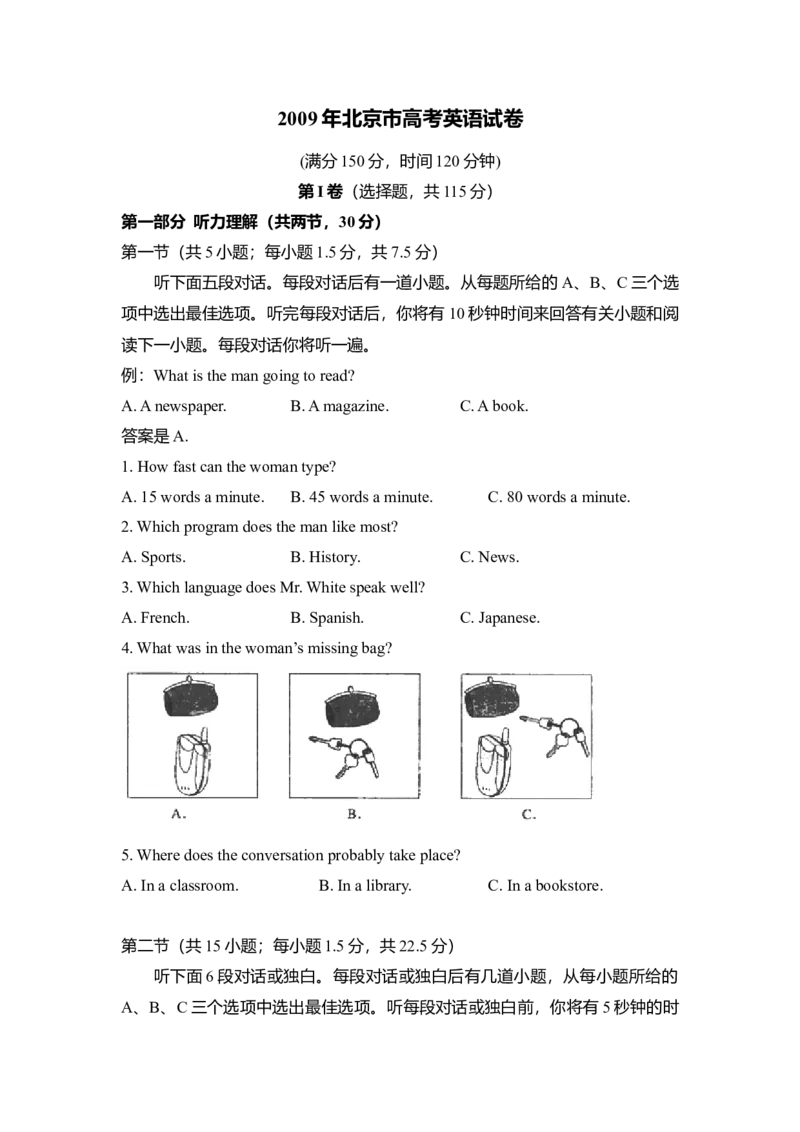
2009年北京市高考英语试卷
(满分150分,时间120分钟)
第I卷(选择题,共115分)
第一部分 听力理解(共两节,30分)
第一节(共5小题;每小题1.5分,共7.5分)
听下面五段对话。每段对话后有一道小题。从每题所给的A、B、C三个选
项中选出最佳选项。听完每段对话后,你将有 10秒钟时间来回答有关小题和阅
读下一小题。每段对话你将听一遍。
例:What is the man going to read?
A. A newspaper. B. A magazine. C. A book.
答案是A.
1. How fast can the woman type?
A. 15 words a minute. B. 45 words a minute. C. 80 words a minute.
2. Which program does the man like most?
A. Sports. B. History. C. News.
3. Which language does Mr. White speak well?
A. French. B. Spanish. C. Japanese.
4. What was in the woman’s missing bag?
5. Where does the conversation probably take place?
A. In a classroom. B. In a library. C. In a bookstore.
第二节(共15小题;每小题1.5分,共22.5分)
听下面6段对话或独白。每段对话或独白后有几道小题,从每小题所给的
A、B、C三个选项中选出最佳选项。听每段对话或独白前,你将有5秒钟的时间阅读每小题。听完后,每小题将给出5秒钟的做答时间。每段对话或独白你
将听两遍。
听第6段材料,回答第6至7题。
6. What’s wrong with the man?
A. He has headaches. B. He has a runny nose. C. He has a temperature.
7. When did the problem begin?
A. Two weeks ago. B. Two months ago. C. Three months ago.
听第7段材料,回答第8至9题。
8. Why did the woman make the phone call?
A. To change her appointment.
B. To discuss a business plan.
C. To arrange an exhibition.
9. When are they going to meet?
A. Wednesday. B. Thursday. C. Friday.
听第8段材料,回答第10至11题。
10. What event will you take part in if you love to dance?
A. River Festival. B. Youth Celebrations. C. Songs of Summer.
11. What is the purpose of the announcement?
A. To introduce performers.
B. To introduce a program.
C. To introduce various countries.
听第9段材料,回答第12至14题。
12. How much are the double rooms?
A. From $180 to $ 240. B. From $ 180 to $270. C. From $270 to $330.
13. What is included in the price?
A. Service charge. B. Breakfast. C. Tax.
14. Why did the man make the phone call?
A. To ask for an extra bed.
B. To check the room rates.
C. To change his reservation.
听第10段材料,回答第15至17题。15. What are the speakers talking about?
A. Picture books. B. Reference books. C. Cookbooks.
16. How much is Worldwide Fish?
A. £12. B. £15 C. £17
17. Which books does the woman decide to buy?
A. Something Fishy. B. Worldwide Fish. C. Tasty Fish.
听第11段材料,回答第18至20题。
18. What did Maria do right after graduation?
A. She entered politics.
B. She worked as a teacher.
C. She worked for her father.
19. Where did Maria set up her first coffee bar?
A. London. B. Singapore. C. New York.
20. How many coffee bars does she have now?
A. 10. B. 80. C. 85.
第二部分:知识运用(共两节,45分)
第一节 单项填空(共15小题;每小题1分,共15分)
从每题所给的A、B、C、D四个选项中,选出可以填入空白处的最佳选项。
并在答题卡上将该项涂黑。
例:It’s so nice to hear from her again. , we last met more than thirty years ago.
A. What’s more B. That’s to say
C. In other words D. Believe it or not
答案是D.
21. John plays basketball well, his favorite sport is badminton.
A. so B. or C. yet D. for
22. You may use the room as you like you clean it up afterwards.
A. so far as B. so long as C. in case D. even if
23. Scientists have many theories about how the universe into being.
A. came B. was coming C. had come D. would come
24. For breakfast he only drinks juice from fresh fruit on his own farm.A. grown B. being grown C. to be grown D. to grow
25. One of the few things you say about English people with certainty is that they
talk a lot about the weather.
A. need B. must C. should D. can
26.--- What do you think of teaching, Bob?
--- I find it fun and challenging. It is a job you are doing something serious but
interesting.
A. where B. which C. when D. that
27. The way the guests in the hotel influenced their evaluation of the service.
A. treated B. were treated C. would treat D. would be treated
28. All of them try to use the power of the workstation______ information in a more
effective way.
A. presenting B. present C. presented D. to present
29. The wine industry in the area has developed in a special way, little foreign
ownership.
A. by B. of C. with D. from
30. When I talked with my grandma on the phone, she sounded weak, but by the time
we up, her voice had been full of life.
A. were hanging B. had hung C. hung D. would hang
31. At first he hated the new job but decided to give himself a few months to see
it got any better.
A. when B. how C. why D. if
32. John was given the same suitcase his father and grandfather with them to
school.
A. took B. had taken C. were taking D. would take
33. The biggest whale is blue whale, which grows to be about 29 meters long---
the height of 9-story building.
A. the; the B. a; a C. a; the D. the; a
34. ____ twice, the postman refused to deliver our letters unless we changed our dog.
A. Being bitten B. Bitten C. Having bitten D. To be bitten
35. Being a parent is not always easy, and being the parent of a child with specialneeds often carries with extra stress.
A. it B. them C. one D. him
第二节 完形填空(共20小题,每小题1.5分,共30分)
阅读下面短文,掌握其大意,从每题所给的A、B、C、D四个选项中,选
出最佳选项。
James’s New Bicycle
James shook his money box again. Nothing! He carefully 36 the coins that lay
on the bed. $24.52 was all that he had. The bicycle he wanted was at least $90! 37
on earth was he going to get the 38 of the money?
He knew that his friends all had bicycles. It was 39 to hang around with people
when you were the only one without wheels. He thought about what he could do.
There was no 40 asking his parents, for he knew they had no money to 41 .
There was only one way to get money, and that was to 42 it. He would have to
find a job. 43 who would hire him and what could he do? He decided to ask Mr.
Clay for advice, who usually had 44 on most things.
“Well, you can start right here,” said Mr. Clay. “My windows need cleaning and
my car needs washing.”
That was the 45 of James’s odd-job(零工) business. For three months he
worked every day after finishing his homework. He was amazed by the 46 of jobs
that people found for him to do. He took dogs and babies for walks, cleared out
cupboards, and mended books. He lost count of the 47 of cars he washed and
windows he cleaned, but the 48 increased and he knew that he would soon have
49 for the bicycle he longed for.
The day 50 came when James counted his money and found $94.32. He 51
no time and went down to the shop to pick up the bicycle he wanted. He rode 52
home, looking forward to showing his new bicycle to his friends. It had been hard 53
for the money, but James knew that he valued his bicycle far more 54 he had
bought it with his own money. He had 55 what he thought was impossible, and that
was worth even more than the bicycle.36. A. cleaned B. covered C. counted D. checked
37. A. How B. Why C. Who D. What
38. A. amount B. part C. sum D. rest
39. A. brave B. hard C. smart D. unfair
40. A. point B. reason C. result D. right
41. A. split B. spend C. spare D. save
42. A. borrow B. earn C. raise D. collect
43. A. Or B. So C. For D. But
44. A. decisions B. experience C. opinions D. knowledge
45. A. beginning B. introduction C. requirement D. opening
46. A. similarity B. quality C. suitability D. variety
47. A. brand B. number C. size D. type
48. A. effort B. pressure C. money D. trouble
49. A. all B. enough C. much D. some
50. A. finally B. instantly C. normally D. regularly
51. A. gave B. left C. took D. wasted
52. A. patiently B. proudly C. silently D. tiredly
53. A. applying B. asking C. looking D. working
54. A. since B. if C. than D. though
55. A. deserved B. benefited C. achieved D. learned
第三部分:阅读理解(共20题,每小题2分,共40分)
阅读下列短文,从每题所给的A、B、C、D四个选项中,选出最佳选项,
并在答题卡上将该项涂黑。
A
How I Turned to Be Optimistic
I began to grow up that winter night when my parents and I were returning from
my aunt’s house, and my mother said that we might soon be leaving for America. We
were on the bus then. I was crying, and some people on the bus were turning around
to look at me. I remember that I could not bear the thought of never hearing again the
radio program for school children to which I listened every morning.I do not remember myself crying for this reason again. In fact, I think I cried very
little when I was saying goodbye to my friends and relatives. When we were leaving I
thought about all the places I was going to see---the strange and magical places I had
known only from books and pictures. The country I was leaving never to come back
was hardly in my head then.
The four years that followed taught me the importance of optimism, but the idea
did not come to me at once. For the first two years in New York I was really lost---
having to study in three schools as a result of family moves. I did not quite know what
I was or what I should be. Mother remarried, and things became even more complex
for me. Some time passed before my stepfather and I got used to each other. I was
often sad, and saw no end to “the hard times.”
My responsibilities in the family increased a lot since I knew English better than
everyone else at home. I wrote letters, filled out forms, translated at interviews with
immigration officers, took my grandparents to the doctor and translated there, and
even discussed telephone bills with company representatives.
From my experiences I have learned one important rule: almost all common
troubles eventually go away! Something good is certain to happen in the end when
you do not give up, and just wait a little! I believe that my life will turn out all right,
even though it will not be that easy.
56. How did the author get to know America?
A. From her relatives. B. From her mother.
C. From books and pictures. D. From radio programs.
57. Upon leaving for America the author felt .
A. confused B. excited C. worried D. amazed
58. For the first two years in New York, the author .
A. often lost her way B. did not think about her future
C. studied in three different schools D. got on well with her stepfather
59. What can we learn about the author from Paragraph 4?
A. She worked as a translator.
B. She attended a lot of job interviews.C. She paid telephone bills for her family.
D. She helped her family with her English.
60. The author believes that .
A. her future will be free from troubles
B. it is difficult to learn to become patient
C. there are more good things than bad things
D. good things will happen if one keeps trying
B
Dear Friend,
The recent success of children’s books has made the general public aware that
there’s a huge market out there.
And there’s a growing need for new writers trained to create the $3 billion worth
of children’s books bought each year ... plus stories and articles needed by over 650
publishers of magazines for children and teenagers.
Who are these needed writers? They’re ordinary folks like you and me.
But am I good enough?
I was once where you might be now. My thoughts of writing had been pushed
down by self-doubt, and I didn’t know where to turn for help.
Then, I accepted a free offer from the Institute to test my writing aptitude(潜能),
and it turned out to be the inspiration I needed.
The promise that paid off
The Institute made the same promise to me that they will make to you, if you
show basic writing ability:
You will complete at least one manuscript(手稿) suitable to hand in to a
publisher by the time you finish our course.
I really didn’t expect any publication before I finished the course, but that
happened. I sold three stories. And I soon discovered that was not unusual at the
Institute.
Since graduation, I have authored 34 nationally published children’s books andover 300 stories and articles.
Free test and brochure
We offer a free aptitude test and will send you a copy of our brochure describing
our recognized home-study courses on the basis of one-on-one training.
Realize your writing dream today. There’s nothing sadder than a dream delayed
until it fades forever.
Sincerely,
Kristi Holl, Instructor
Institute of Children’s Literature
61. From the first three paragraphs, we learn that .
A. children’s books are usually bestsellers
B. publishers are making 3 billion each year
C. magazines for teenagers have drawn public attention
D. there is a growing need for writers of children’s books
62. When finishing the course, you are promised to .
A. be a successful publisher
B. become a confident editor
C. finish one work for publication
D. get one story or article published
63. Kristi Holl mentions her experience mainly to .
A. prove she is a good instructor
B. promote the writing program
C. give her advice on course preparation
D. show she sold more stories than article
C
How Room Designs Affect Our Work and Feelings
Architects have long had the feeling that the places we live in can affect ourthoughts, feelings and behaviors. But now scientists are giving this feeling an
empirical(经验的,实证的)basis. They are discovering how to design spaces that
promote creativity, keep people focused and lead to relaxation.
Researches show that aspects of the physical environment can influence
creativity. In 2007, Joan Meyers-Levy at the University of Minnesota, reported that
the height of a room’s ceiling affects how people think. Her research indicates that
higher ceilings encourage people to think more freely, which may lead them to make
more abstract connections. Low ceilings, on the other hand, may inspire a more
detailed outlook.
In additions to ceiling height, the view afforded by a building may influence an
occupant’s ability to concentrate. Nancy Wells and her colleagues at Cornell
University found in their study that kids who experienced the greatest increase in
greenness as a result of a family move made the most gains on a standard test of
attention.
Using nature to improve focus of attention ought to pay off academically, and it
seems to, according to a study led by C. Kenneth Tanner, head of the School Design
& Planning Laboratory at the University of Georgia. Tanner and his team found
that students in classrooms with unblocked views of at least 50feet outside the
window had higher scores on tests of vocabulary, language arts and maths than did
students whose classrooms primarily overlooked roads and parking lots.
Recent study on room lighting design suggests than dim(暗淡的)light helps
people to loosen up. If that is true generally, keeping the light low during dinner or at
parties could increase relaxation. Researchers of Harvard Medical School also
discovered that furniture with rounded edges could help visitors relax.
So far scientists have focused mainly on public buildings. “We have a very
limited number of studies, so we ’ re almost looking at the problem through a straw
(吸管),” architect David Allison says. “How do you take answers to very specific
questions and make broad, generalized use of them? That’s what we’re all struggling
with.”
64. What does Joan Meyers-Levy focus on in her research?A. Light. B. Ceilings. C. Windows. D. Furniture.
65. The passage tells us that .
A. the shape of furniture may affect people’s feelings
B. lower ceilings may help improve students’ creativity
C. children in a dim classroom may improve their grades
D. students in rooms with unblocked views may feel relaxed
66. The underlined sentence in the last paragraph probably means that .
A. the problem is not approached step by step
B. the researches so far have faults in themselves
C. the problem is too difficult for researchers to detect
D. research in this area is not enough to make generalized patterns
67. Which of the following shows the organization of the passage?
CP:Central Point P:Point SP:Sub-point(次要点) C:Conclusion
D
When students and parents are asked to rate subjects according to theirimportance, the arts are unavoidably at the bottom of the list. Music is nice, people
seem to say, but not important. Too often it is viewed as mere entertainment, but
certainly not an education priority(优先). This view is shortsighted. In fact, music
education is beneficial and important for all students.
Music tells us who we are. Because music is an expression of the beings who
create it, it reflects their thinking and values, as well ad the social environment it
came influence that George Gershwin and other musicians introduced into their music
is obviously American because it came from American musical traditions. Music
expresses our character and values. It gives us identity as a society.
Music provides a kind of perception(感知)that cannot be acquired any other
way. Science can explain how the sun rises and sets. The arts explore the emotive(情
感的)meaning of the same phenomenon. We need every possible way to discover
and respond to our world for one simple but powerful reason: No one way can get it
all.
The arts are forms of thought as powerful in what they communicate as
mathematical and scientific symbols. They are ways we human beings “talk” to each
other. They are the language of civilization through which we express our fears, our
curiosities, our hungers, our discoveries, our hopes. The arts are ways we give form to
our ideas and imagination so that they can be shared with others. When we do not
give children access to an important way of expressing themselves such as music, we
take away from them the meanings that music expresses.
Science and technology do not tell us what it means to be human. The arts do.
Music is an important way we express human suffering, celebration, the meaning and
value of peace and love.
So music education is far more necessary than people seem to realize.
68. According to Paragraph 1, students .
A. regard music as a way of entertainment
B. disagree with their parents on education
C. view music as an overlooked subject
D. prefer the arts to science69. In Paragraph 2, the author uses jazz an example to .
A. compare it with rock music
B. show music identifies a society
C. introduce American musical traditions
D. prove music influences people’s lifestyles
70. According to the passage, the arts and science .
A. approach the world from different angles
B. explore different phenomena of the world
C. express people’s feelings in different ways
D. explain what it means to be human differently
71. What is the main idea of the passage?
A. Music education deserves more attention.
B. Music should be of top education priority.
C. Music is an effective communication tool.
D. Music education makes students more imaginative.
E
Camping wild is a wonderful way to experience the natural world and, at its best,
it makes little environmental influence. But with increasing numbers of people
wanting to escape into the wilderness, it is becoming more and more important to
camp unobtrusively (不引人注目地) and leave no mark.
Wild camping is not permitted in many places, particularly in crowded lowland
Britain. Wherever you are, find out about organizations responsible for managing wild
spaces, and contact them to find out their policy on camping and shelter building. For
example, it is fine to camp wild in remote parts of Scotland, but in England you must
ask the landowner’s permission, except in national parks.
Camping is about having relaxation, sleeping outdoors, experiencing bad weather,
and making do without modern conveniences. A busy, fully-equipped campsite (野营
地) seems to go against this, so seek out smaller, more remote places with easy access
to open spaces and perhaps beaches. Better still, find a campsite with no road access:walking in makes a real adventure.
Finding the right spot to camp is the first step to guaranteeing a good night’s
sleep. Choose a campsite with privacy and minimum influence on others and the
environment. Try to use an area where people have obviously camped before rather
than creating a new spot. When camping in woodland, avoid standing dead trees,
which may fall on a windy night. Avoid animal runs and caves, and possible homes of
biting insects. Make sure you have most protection on the windward side. If you make
a fire, do so downwind of your shelter. Always consider what influence you might
have on the natural world. Avoid damaging plants. A good campsite is found, not
made — changing it should be unnecessary.
72. You needn’t ask for permission when camping in .
A. national parks in England B. most parts of Scotland
C. crowded lowland Britain D. most parts of England
73. The author thinks that a good campsite is one .
A. with easy access B. used previously
C. with modern conveniences D. far away from beaches
74. The last paragraph mainly deals with .
A. protecting animals B. building a campfire
C. camping in woodland D. finding a campsite with privacy
75. The passage is mainly about .
A. the protection of campsites B. the importance of wild camping
C. the human influence on campsites D. the dos and don’ts of wild camping
第二卷 (共35分)
第四部分:书面表达(共两节,35分)
第一节 情景作文(20分)
假设你是红星中学高三一班的学生李华,为响应绿化祖国的号召,你班四
月十二日去郊区植树,请根据以下四幅图的先后顺序,介绍植树活动的全过程,
给某英文杂志的“绿色行动”专栏写一篇以“Green Action in Our Class”为题的英文
稿件。注意:词数不少于60
提示词:郊区 suburbs
第二节 开放作文(15分)
请根据下面提示,写一篇短文,词数不少于50。
In your spoken English class, your teacher shows you the following picture. You
are asked to describe the picture and explain how you understand it.