英语试题
选择题部分(共80 分)
第一部分:英语知识运用(共两节,满分30 分!
第一节:单项填空(共20 小题;每小题0.5 分,满分10 分)
从A、B、C 和D 四个选项中,选出可以填人空白处的最佳选项,并在答题纸上将该选项标
号涂黑。
1. ——‘Hi,John. Are you busy?
——

  A. Yes. I do agree.
B. Yes. That would be nice.
  C. No. Are you sure?
D. No. What’s up?
2. Jane's grandmother had wanted to write         children’s book for many years, but one thing
or another always got in
 way.
A. a;不填
B. the;the
C.不填;the
D. a; the
3. Have you ever heard of the trees that are homes
 animals both on land and sea?
A. about
B. to
C. with
D. over
4. It was so noisy that we
hear ourselves speak.
A. couldn't
B. shouldn't
C. mustn’t
D needn’t
5. Studies have shown that the right and left ear
 sound differently.
  A. produce
B. pronounce
C. process
D. download
6. If you swim in a river or lake, be sure to investigate            is below the water surface.
Often there are rocks or branched hidden in the water.
A. what
B. who
C. that
D. whoever
7. Body language can        a lot about your mood, so standing with your arms folded can send
out a signal that you are being defensive.
  A. take away
B. throw away
C. put away
D. give away
8. Albert Einstein was born in 1879. As a child, few people guessed that he       a famous
scientist whose theories would change the world.
A. has been
B. had been
C. was going to be
D. was
9.        a single world can change the meaning of a sentence, a single sentence can change the
meaning of a paragraph.
A. Just as
B. Even though
C. Until
D. Unless
10. Most people work because it's unavoidable.          , there are some people who actually
enjoy work.
 A. As a result
B. In addition
C. By contrast
D. In conclusion
C. Until
11 .We tend to have a better memory for things that excite our senses or       our amotions than
for straight facts.
A. block off.
B. appeal to
C. subscribe to
D. come across
12. How would you like         if you were watching your favorite TV program and someong
came into the room and just shut it off without asking you?
  A. them
B. one
C. those
D. it
13. Most of us, if we know even a little about where our food comes from, understand that every bite
put into our mouths was
 alive.
 A. steadily
B. instantly
C. formerly
D. permanently
14. Listening is thus an active, not a          , behavior consisting of hearing, understanding and
remembering.
A. considerate
B. sensitive
C. reliable
D. passive
15. One of the most effective ways to reduce         is to talk about feeling with someong you
trust.
A. production
B. stress
C. energy
D. passive
16. If steel is heavier than water, why are ships able to
 on the sea?
A. float
B. drown
C. shrink
D. split
17. These comments came
 specific questions often asked by local newamen.
A. in memory of
B. in response to
C. in touch with
D. in possession of
18. Listening to music at home is one thing, going to hear it
 live is quite another.
A. perform
B. performing
C. to perform
D. being performed
19. Creating an atmosphere
 employees feel part of a team is a big challenge.
A. as
B. whose
C. in which
D. at which
20. 一Why don't you consider a trip to, say, Beijing or Hangzhou?
一
 .
A. I wouldn’t mind that
B. Then we’ll get there quickly
C. Let’s call it a day
D. It’s not a requirement
第二节:完形填空(共20 小题;每小题1 分,满分20 分)

阅读下面短文,掌握其大意,然后从21-40 各题所给的四个选项(A, B, C 和D)
中,选出最佳选项,并在答题纸上将该选项标号涂黑。
Since finishing my studies at Harvard and Oxford. I've watched one friend after another land
high-ranking, high-paying Wall Street jobs. As executives(高级管理人员) with banks, cotasuiung
firms, established law firms, and major corporations, many are now  21  on their way to
impressive careers. By society’s  22  , they seem to have it made.
On the surface, these people seem to be very lucky in life. As they left student life behind,
many had a    23   drink at their cheap but friendly local bar, shook hands with Iongtime
roommates, and  24  out of small apartments into high buildings. They made reservations at
restaurants where the cost of a bottle of wine  25  a college year's monthly rent. They replaced
their beloved old car with expensive new sports cars.
The thing is, a number of them have    26  that despite their success, they aren’t happy.
Some    27   of unfriendly coworkers and feel sad for eight-hour workweeks devoted to tasks
they   28  . Some do not respect the companies they work for and talk of feeling tired and  29 .
However, instead of devoting themselves to their work, they find themselves working to support
the  30  to which they have so quickly become  31 .
People often speak of trying a more satisfying path, and   32   the end the idea of leaving,
their jobs to work for something they   33   or finding a position that would give them more time
with their families almost always leads them to the same conclusion; it’ s   34   . They have
loans, bills, a mortgage(抵押贷款)to   35  , retirement to save for. They recognize there’s
something   36   in their lices , but it’s   37   to step off the track.
In a society that tends to   38   everything in terms of dollars and cents, we learn form a
young age to consider the costs of our   39   in financial terms. But what about the personal and
social costs   40   in pursuing money over meaning? Theae are exactly the kinds of us tend to
ignore — and the very ones we need to consider most.
21. A. much
B. never
C. seldom
D. well
22. A. policies
B. standards
C. experiments   D. regulations
23. A. last
B. least
C. second
D. best
24. A. cycled
B. moved
C. slid
D. looked
25. A. shared
B. paid
C. equaled
D. collected
26. A. advertised
B. witnessed
C. admitted
D. demanded
27. A. complain
B. dream
C. hear
D. approve
28. A. distribute
B. hate
C. applaud
D. neglect
29. A. calm
B. guilty
C. warm
D. empty
30. A. family
B. government   C. lifestyle
D. project
31. A. accustomed
B. appointed
C. unique
D. available
32. A. yet
B. also
C. instead
D. rather
33. A. let out
B. turn in
C. give up
D.believe in
34. A. fundamental
B. practical
C. impossible
D. unforgettable
35. A. take of
B. drop off
C. put off
D. pay off
36. A. missing
B. inspiring
C. sinking
D. shining
37. A. harmful
B. hard
C. useful
D. normal
38. A. measure
B. suffer
C. digest
D. deliver
39. A. disasters
B. motivations
C. campaigns
D. decisions
40. A. assessed
B. involved
C. covered
D. reduced
第二部分: 阅读理解(第一节共20 小题,第二节5 小题;每小题2 分,满分50 分)
阅读下列材料,从每题所给的四个选项(A、B、C 和D)中,选出最佳选项,并在答题纸上
将该选项标号涂黑。

A

From the very beginning of school we make books and reading a constant source of possible
failure and public humiliation. When children are little we make them read aloud, before the teacher
and other children, so that we can be sure they "know" all the words they are reading. This means
that when they don't know a word, they are going to make a mistake, right in front of everyone.
After having taught fifth-grade classes for four years, I decided to try at all costs to rid them of their
fear and dislike of books, and to get them to read oftener and more adventurously.
One day soon after school had started, I said to them, "Now I'm going to say something about
reading that you have probably never heard a teacher say before. I would like you to read a lot of
books this year, but I want you to read them only for pleasure. I am not going to ask you questions to
find out whether you understand the books or not. If you understand enough of a book to enjoy it and
want to go on reading it, that's enough for me. Also I’m not going to ask you what words mean. "
The children sat stunned and silent. Was this a teacher talking? One girl, who had just come to
us from a school where she had had a very hard time, looked at me steadily for a long time after I
had finished. Then, still looking at me, she said slowly and seriously, Mr Holt, do you really mean
that?" I said just as seriously, "I mean every word of it.
During the spring she really astonished me. One day, she was reading at her desk, From a
glimpse of the illustrations I thought I knew what the book was. I said to myself, "It can't be," and
went to take a closer look. Sure enough, she was reading Moby Dick , in edition with woodcuts. I
said, "Don't you find parts of it rather heavy going?" She answered, Oh, sure, but I just skip over
those parts and go on to the next good part. "
This is exactly what reading should be and in school so seldom is,an exciting, joyous adventure.
Find something, dive into it, take the good parts, skip the bad parts, get what you can out of it, go on
to something else. How different is our mean-spirited, picky insistence that every child get every last
little scrap of "understanding" that can be dug out of a book.
41. According to the passage, children's fear and dislike of books may result from .
A. reading little and thinking little
B. reading often and adventurously
C. being made to read too much
D. being made to read aloud before others
42. The teacher told his students to read .
A. for enjoyment
B. for knowledge
C. for a larger vocabulary
D. for higher scores in exams
43. Upon hearing the teacher's talk, the children probably felt that .
A. it sounded stupid
B. it was not surprising at all
C. it sounded too good to be true
D. it was no different from other teachers' talk
44. Which of the following statements about the girl is TRUE according to the passage?
A. She skipped over those easy parts while reading.
B. She had a hard time finishing the required reading tasks.
C. She learned to appreciate some parts of the difficult books.
D. She turned out to be a top student after coming to this school.
45. From the teacher's point of view, .
A. children cannot tell good parts from bad parts while reading
B. children should be left to decide what to read and how to read
C. reading is never a pleasant and inspiring experience in school
D. reading involves understanding every little piece of information
B
Graph can be a very useful tool for conveying information especially numbers, percentages,
and other data . A  graph gives the  reader a picture to interpret .  That can be a lot more pages
and pages and pages explaining the data .
   Graphs can seem frightening, but reading a graph  is a lot like reading a story . The graph has a
title ,a main idea ,and supporting details .You can use your active reading skills to analyze and
understand graphs just like any other text .
  Most graphs have a few basic parts: a caption or introduction paragraph, a title , a legend or key,
and labeled axes. An active reader looks at each part of the graph before trying to interpret the data.
Captions will usually tell you where the data came from (for example, a scientific study of 400
African elephants from 1980 to 2005). Captions usually summarize the author's main point as well.
The title is very important. It tells you the main idea of the graph by stating what kind of information
is being shown. A legend, also called a key ,is a guide to the symbols and colors used in the graph.
Many graphs, including bar graphs and line graphs, have two axes that form a corner, Usually these
axes are the left side and the bottom of the graph .Each axis will always have a label. The label tells
you what each axis measures.

Bar Graphs
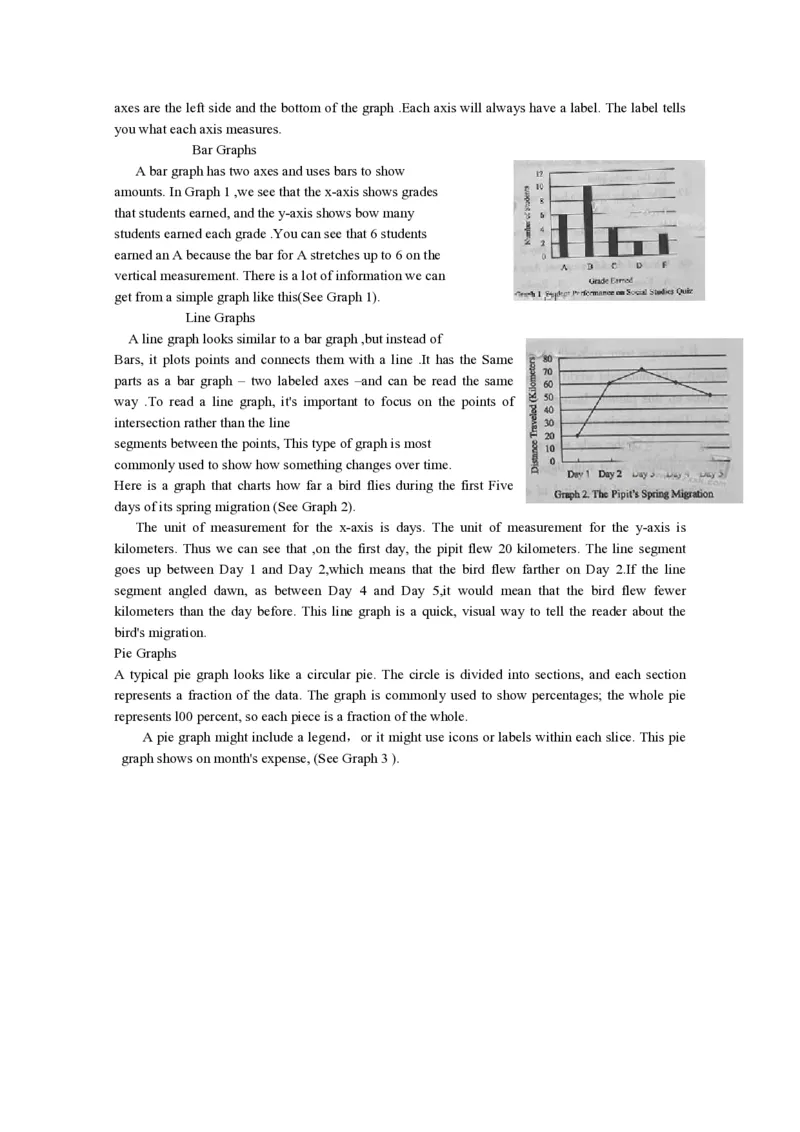
   A bar graph has two axes and uses bars to show
amounts. In Graph 1 ,we see that the x-axis shows grades
that students earned, and the y-axis shows bow many
students earned each grade .You can see that 6 students
earned an A because the bar for A stretches up to 6 on the
vertical measurement. There is a lot of information we can
get from a simple graph like this(See Graph 1).

Line Graphs
  A line graph looks similar to a bar graph ,but instead of
Bars, it plots points and connects them with a line .It has the Same
parts as a bar graph – two labeled axes –and can be read the same
way .To read a line graph, it's important to focus on the points of
intersection rather than the line
segments between the points, This type of graph is most
commonly used to show how something changes over time.
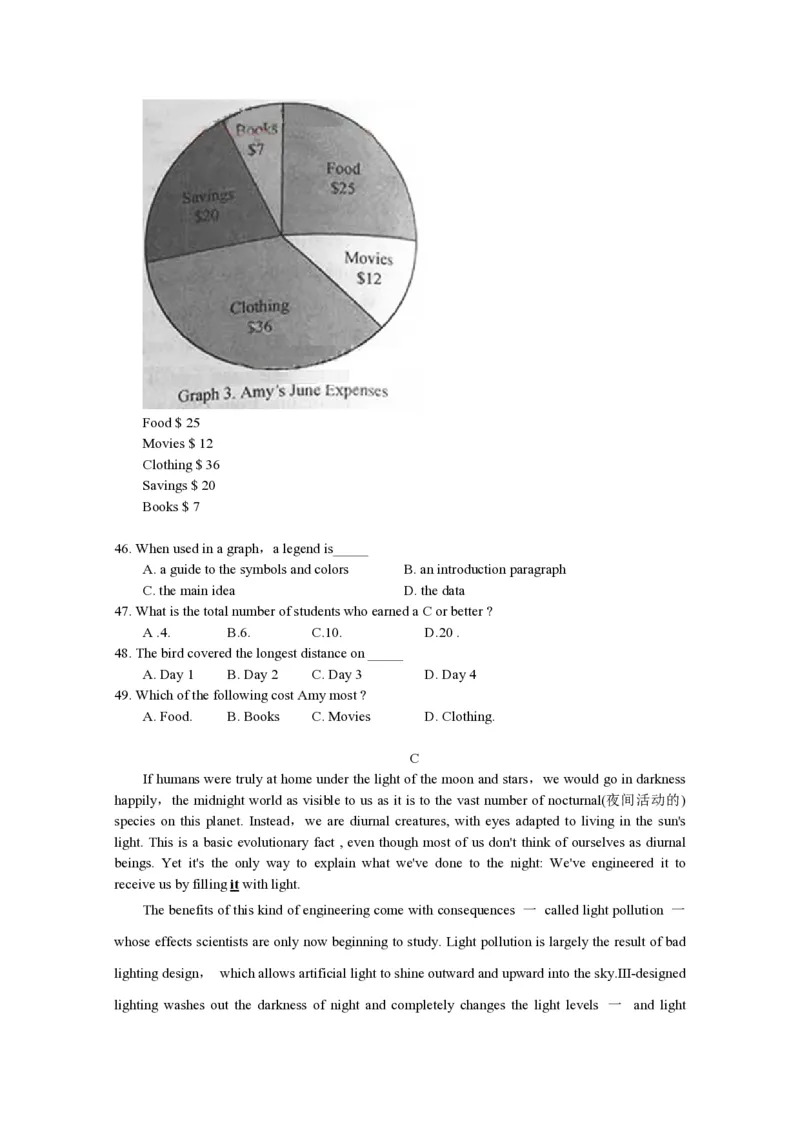
Here is a graph that charts how far a bird flies during the first Five
days of its spring migration (See Graph 2).
   The unit of measurement for the x-axis is days. The unit of measurement for the y-axis is
kilometers. Thus we can see that ,on the first day, the pipit flew 20 kilometers. The line segment
goes up between Day 1 and Day 2,which means that the bird flew farther on Day 2.If the line
segment angled dawn, as between Day 4 and Day 5,it would mean that the bird flew fewer
kilometers than the day before. This line graph is a quick, visual way to tell the reader about the
bird's migration.
Pie Graphs
A typical pie graph looks like a circular pie. The circle is divided into sections, and each section
represents a fraction of the data. The graph is commonly used to show percentages; the whole pie
represents l00 percent, so each piece is a fraction of the whole.
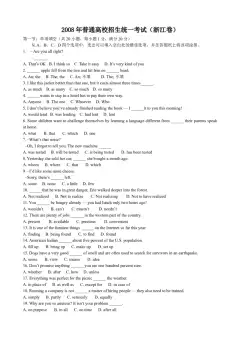
A pie graph might include a legend,or it might use icons or labels within each slice. This pie
graph shows on month's expense, (See Graph 3 ).

Food $ 25
Movies $ 12
Clothing $ 36
Savings $ 20
Books $ 7

46. When used in a graph,a legend is_____
A. a guide to the symbols and colors
B. an introduction paragraph
C. the main idea


D. the data
47. What is the total number of students who earned a C or better ?
A .4.

B.6.

C.10.


D.20 .
48. The bird covered the longest distance on _____
A. Day 1
B. Day 2    C. Day 3

D. Day 4
49. Which of the following cost Amy most ?
A. Food.
B. Books
C. Movies

D. Clothing.

C
If humans were truly at home under the light of the moon and stars,we would go in darkness
happily,the midnight world as visible to us as it is to the vast number of nocturnal(夜间活动的)
species on this planet. Instead,we are diurnal creatures, with eyes adapted to living in the sun's
light. This is a basic evolutionary fact , even though most of us don't think of ourselves as diurnal
beings. Yet it's the only way to explain what we've done to the night: We've engineered it to
receive us by filling it with light.
The benefits of this kind of engineering come with consequences 一 called light pollution 一
whose effects scientists are only now beginning to study. Light pollution is largely the result of bad
lighting design, which allows artificial light to shine outward and upward into the sky.Ⅲ-designed
lighting washes out the darkness of night and completely changes the light levels 一 and light
rhythms — to which many forms of life, including, ourselves, have adapted. Wherever human light
spills into the natural l world ,  some aspect or life is affected .
In most cities the sky looks as though it has been emptied of stars, leaving behind a vacant
haze(霾) that mirrors our fear of the dark. We've grown so used to this orange haze that the original
gloiy of an unlit nigh, - dark enough for the planet Venus to throw shadow on Earth, is wholly
beyond our experience, beyond memory almost.
We’ve lit up the night as if it were an unoccupied country, when nothing could be further form
the truth. Among mammals alone, the number of nocturnal species is astonishing, Light is a
powerful biological force, and on many species it acts as a magnet(磁铁). The effect is so powerful
that scientists speak of songbirds and seabirds being“captured”by searchlights on land or by the light
from gas flares on marine oil platforms. Migrating at night, birds tend to collide with brightly lit tall
buildings.
Frogs living near brightly lit highways suffer nocturnal light levels that are as much as a million
times righter than normal, throwing nearly every aspect of their behavior out of joint including most
other creatures ,we do need darkness .Darkness is as essential to our biological welfare, to our
internal clockwork, as light itself.
Living in a glare of our making ,we have cut ourselves off from our evolutionary and cultural
heritage—the light of the stars and the rhythms of day and night .In a very real sense light pollution
causes us to lose sight of our true place in the universe, to forget the scale of our  being, which is
best measured against the dimensions of a deep night with the Milky Way—the edge of our galaxy
arching overhead.
50. According to the passage, human being
.
A. prefer to live in the darkness
B. are used to living in the day light
C. were curious about the midnight world
D. had to stay at home with the light of the moon
51. What does “it”(Paragraph 1) most probably refer to?
A. The night.

B. The moon

C. The sky

D. The planet
52. The writer mentions birds and frogs to
.
A. provide examples of animal protection
B. show how light pollution affects animals
C. compare the living habits of both species
D. explain why the number of certain species has declined

53. It is implied in the last paragraph that
.
A. light pollution dose harm to the eyesight of animals
B. light pollution has destroyed some of the world heritages
C. human beings cannot go to the outer space
D. human beings should reflect on their position in the universe
54.What might be the best title for the passage?
A. The Magic light.


B. The Orange Haze.
C. The Disappearing Night.


D. The Rhythms of Nature.
D

In 2004 ,when my daughter Becky was ten , she and my husband ,Joe, were united in their
desire for a dog . As for me , I shared none of their canine lust.

But why , they pleaded. “Because I don’t have time to take care of a dog.” But we’ll do it.”
Really? You’re going to walk the dog? Feed the dog? Bathe the dog?” Yes, yes , and yes .”I
don’t believe you .” We will . We promise.

They didn’t . From day two ( everyone wanted to walk the cute puppy that first day ) , neither
thought to walk the dog . While I was slow to accept that I would be the one to keep thrack of her
shots , to schedule her vet appointments , to feec and clean her , Misty knew this on day one . As she
looked up at the ehree new humans in her life ( small , mediurn , and large ) , she calculated ,”The
medium one is the sucker in the pack .”

Quickly , she and I developed something very similar to a Vulcan mind meld ( 心灵融合 ) .
She’d look at me with those sad brown wyes of hers , beam her need , and then wait , trusting I
would understand — which , strangely , I almost always did . In no time , she became my feet as I
read , and splaying across my stomach as I watched television .

Even so , part of me continued to resent walking duty . Joe and Becky had promised . Not
fair , I’d balk ( 不心甘情愿地做 ) silently as she and I walked . “Not fair , ” I’ d loudly remind
anyone within earshot upon our retern home .

Then one day — January 1 , 2007 , to be exact — my huband ‘ s doctor uttered an unthinkable
word : leukemia ( 白血病 ) .With that , I spent eight to ten hours a day with Joe ine the hopital ,
doing anything and everything I could to ease his discomfort . During those six months of
hospitalizations ,Becky , 12 at the time , adjusted to other adults being in the house when she
returned from school. My work colleagues adjusted to my taking off at a moment's notice for
medical emergencies. Every part of my life changed; no part of my old routine remained.

Save one: Misty still needed walking. At the beginning, when friends offered to take her
through her paces, I declined because I knew they had their own households to deal with.

As the months went by,I began to realize that I actually wanted to walk Misty. The walk in
the morning before I headed to the hospital was a quiet, peaceful time to gather my thoughts or to
just be before the day's medical drama unfolded. The evening walk was a time to shake off the day's
upsets and let the worry tracks in my head go to white noise.

When serious illness visits your household, it's , not just your daily routine and your
assumptions about the future that are no longer familiar. Pretty much everyone you acts differently.

Not Misty. Take her for a walk, and she had no interest in Joe's blood counts or bone marrow
test results. On the street or in the park, she had only one thing on her mind: squirrels! She Was so
joyous that even on the worst days, she could make me smile. On a daily basis she reminded me that
life goes on.

After Joe died in 2009,Misty slept on his pillow.
I'm grateful 一to a point. The truth is, after years of balking, I've come to enjoy my walks with
Misty. As I watch her chase after a squirrel, throwing her whole being into the here-and-now of an
exercise that has never once ended in victory, she reminds me, too, that no matter how harsh the nt
or unpredictable the future , there's almost always some measure of joy to be extracted from the
moment.
55. why didn't the writer agree to raise a dog at the beginning of the story?

A. She was afraid the dog would get the family, into trouble.

B. It would be her business to take care of the.dog

C. Her husband and daughter were united as one.

D. She didn't want to spoil her daughter.

56. Which of the following is the closest in meaning to "The medium one is the sucker in the
pack.” (Paragraph 3)?

A."The middle-aged person loves me most.”

B.”The medium-sized woman is the hostess.”

C."The man in the middle is the one who has the final say.”

D. "The woman is the kind and trustworthy one in the family.”
57. It can be inferred from Paragraph 3 that_______.
   A.Misty was quite clever
   B. Misty could solve math problems
   C. the writer was a slow learner
   D. no one walked Misty the first day
58.The story came to its turning point when________.
   A. Joe died in 2009
   B. Joe fell ill in 2007
   C.The walk provided her with spiritual comfort.
   D.She didn't want Misty to be others companion.
60. What is the message the writer wants to convey in the passage?

A. One should learn to enjoy hard times.

B .A disaster can change everything in life.

C. Moments of joy suggest that there is still hope ahead.

D. People will change their attitude toward you when you are in difficulty.
第二节:下面文章中有5 个段落需要添加首句(第61-65 题)。请从以下选项(A, B, C,
D, E 和F)中选出适合各段落的首句,并在答题纸上将相应选项的标号涂黑。选项中有一项是
多余选项。
A. Come in with something to say.
B. Prepare general comments.
C. Bring materials with you.
D. Don’t make them wait.
E. Have no fear.
F. Go it alone.
One of the best things you can do any time in the semester is go see the professor. So hoof on
over to an office hour and have some one-on-one face time with someone who’ll help you master the
material and improve your grade, to boot. But how should you have this conversation with the
professor? Here are five insider tips about how to make that office hour really count:
61.          No need to get all bent out of shape about going to see the professor. The professor
would actually like to see you and answer your questions. Believe it or not, he or she is on your
side and is eager to see you do well. And besides, he or she has seen many students stupider than
you, so nothing you’re gong to ask will set the record for stupidity.
62.          Even though you might feel more comfortable going with a friend or partner, the
office hour will go better if it’s just you and the professor. You’ll get in more questions, the
discussion will be tailored to what you need most help on, and two-party communication is
almost always more productive than committee work. You friend can wait outside for the
discussion.
63.           If you can’t make the official office hours, most professors are willing to make
individual, appointments to help you out. If you’re lucky enough to land such an
accommodation, though, be sure you’re 100 percent on time. There’s nothing that ticks off a
professor more than making him-or herself available for a custom office hour only to find that
you don’t care enough to come on time. And besides, the professor might leave after ten minutes,
which would make your trip a total loss.
64.          If you’re meeting with the professor to go over a paper or test, or to ask questions
about a particular lecture or reading, make sure you bring that paper or test, or your lecture notes
or a copy of the article. The professor doesn’t remember the comments he or she wrote on your
individual piece of work—though he or she will be able to recall them after just a brief glance at
your work. And if you have your lecture notes or the article in hand, you and the professor will
be able to examine specific points that are confusing to you, rather than just talking in a general
way about the contents.
65.          Office hours almost always go better if you bring a few specific questions to the
meeting. It’s almost never good to start a meeting with general comments such as:“I didn’t
understand what you said about [main topic of the course]”or“I couldn’t understand any of your
lectures last week.”Much better is to come in with two or three conversation-starters, about a
specific concept, point, or problem you didn’t understand. Keep in mind that in a fifteen-minute
office hour (which is how long these things usually last), two or three questions are usually the
most you’ll have time to discuss.
非选择题部分(共40 分)
第三部分:写作(共两节,满分40 分)
第一节:短文改错(共10 小题;每小题1 分,满分10 分)
下面短文中有10 处语言错误。请在有错误的地方增加、删除或修改某个单词。
增加:在缺词处加一个漏字符号(∧),并在其下面写上该加的词。
删除:把多余的词用斜线(﹨)划掉。
修改:在错的词下画一横线,并在该词下面写出修改后的词。
注意:1.每处错误及其修改均仅限一词;
2.只允许修改10 处,多者(从第11 处起)不计分。
例如:
It was very nice to get your invitation to spent∧weekend with you. Luckily
the
I was completely free then, so I’ll to say “yes”. I’ll arrive in Bristol at around 8:00 p.m.
am
in Friday evening.
on

My old classroom was interesting because three side of the classroom were made from glass. I
enjoyed sit close to the windows and looking at the view. On the left-hand side of the class, I could
easy see the football field. In the mornings, it was full of students exercising. The view from the
back of the classroom is also splendid. Close to the school there was a beautiful park with many
trees around them. Farther in the distance, I could not enjoy the view of snowy mountains. On the
right side of the class was the road. I was always interested to see the drivers in hurry in the morning.
The position of the classroom with its view made me felt like I was dreaming. If I was only a child
when I studied in that classroom, I will never forget it.
第二节:书面表达(满分30 分)
在班级活动中,当你的想法与大多数同学不一致时,你是坚持自己的观点并说服别人,
还是尊重大多数同学的意见?请你以“When I Have a Different Opinion”为题,用英文写一篇
100~120 个词的短文。要求如下:
1.从以上两种做法中选择一种;
2.以具体事例阐述你选择的理由。
注意:短文中,不得以任何形式透露地区、学校、同学姓名等真实信息。否则,按考试
作弊行为认定。
When I Have a Different Opinion