广东省湛江市2025 届高三下学期二模英语试题
阅读下面材料,根据其内容和所给段落开头语续写两段,使之构成一篇完整的短文。
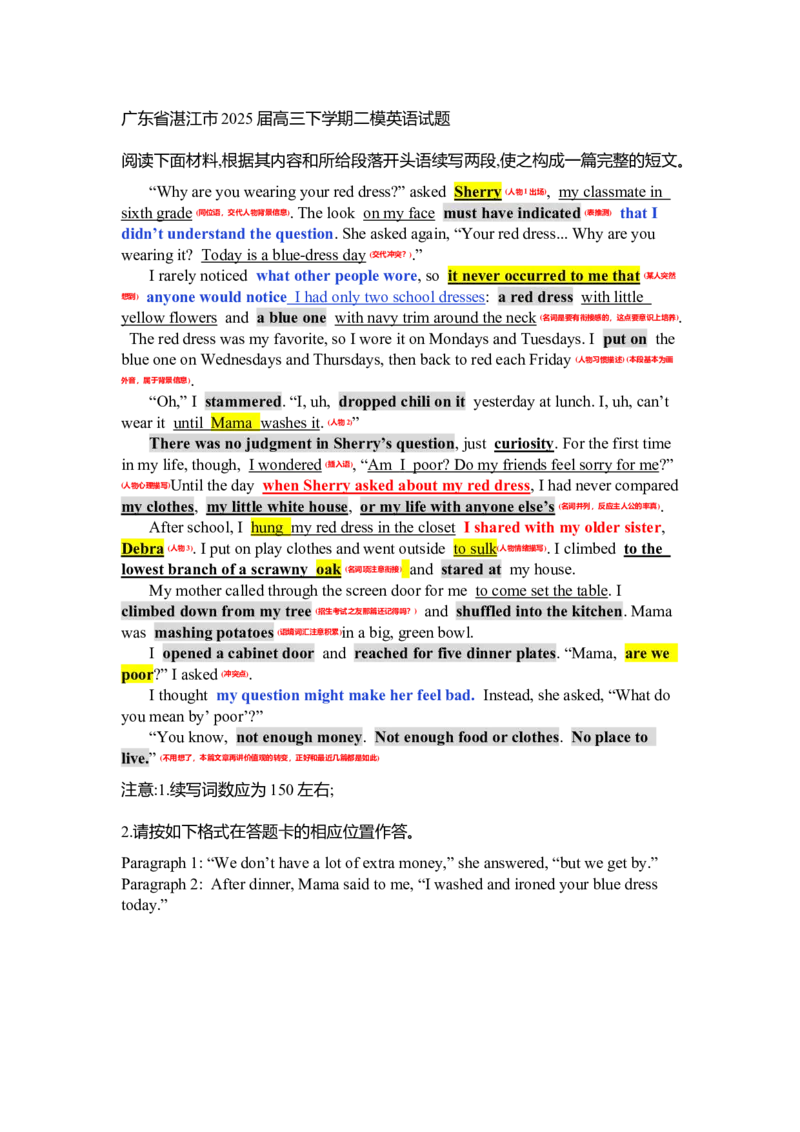
“Why are you wearing your red dress?” asked Sherry (人物1 出场), my classmate in
sixth grade (同位语,交代人物背景信息). The look on my face must have indicated (表推测) that I
didn’t understand the question. She asked again, “Your red dress... Why are you
wearing it? Today is a blue-dress day (交代冲突?).”
I rarely noticed what other people wore, so it never occurred to me that (某人突然
想到) anyone would notice I had only two school dresses: a red dress with little
yellow flowers and a blue one with navy trim around the neck (名词是要有衔接感的,这点要意识上培养).
The red dress was my favorite, so I wore it on Mondays and Tuesdays. I put on the
blue one on Wednesdays and Thursdays, then back to red each Friday (人物习惯描述) (本段基本为画
外音,属于背景信息).
“Oh,” I stammered. “I, uh, dropped chili on it yesterday at lunch. I, uh, can’t
wear it until
Mama
washes it
. (人物2)”
There was no judgment in Sherry’s question, just curiosity. For the first time
in my life, though, I wondered (插入语), “Am
I poor? Do my friends feel sorry for me
?”
(人物心理描写)Until the day when Sherry asked about my red dress, I had never compared
my clothes, my little white house, or my life with anyone else’s (名词并列,反应主人公的率真).
After school, I hung
my red dress in the closet
I shared with my older sister,
Debra (人物3). I put on play clothes and went outside to sulk(人物情绪描写). I climbed to the
lowest branch of a scrawny
oak
(名词项注意衔接) and stared at my house.
My mother called through the screen door for me to come set the table. I
climbed down from my tree (招生考试之友那篇还记得吗?) and shuffled into the kitchen. Mama
was mashing potatoes (语境词汇注意积累)in a big, green bowl.
I opened a cabinet door and reached for five dinner plates. “Mama, are we
poor?” I asked (冲突点).
I thought my question might make her feel bad. Instead, she asked, “What do
you mean by’ poor’?”
“You know, not enough money. Not enough food or clothes. No place to
live.” (不用想了,本篇文章再讲价值观的转变,正好和最近几篇都是如此)
注意:1.续写词数应为150 左右;
2.请按如下格式在答题卡的相应位置作答。
Paragraph 1: “We don’t have a lot of extra money,” she answered, “but we get by.”
Paragraph 2: After dinner, Mama said to me, “I washed and ironed your blue dress
today.”
广东省湛江市2025 届高三下学期二模英语试题
阅读下面材料,根据其内容和所给段落开头语续写两段,使之构成一篇完整的短文。
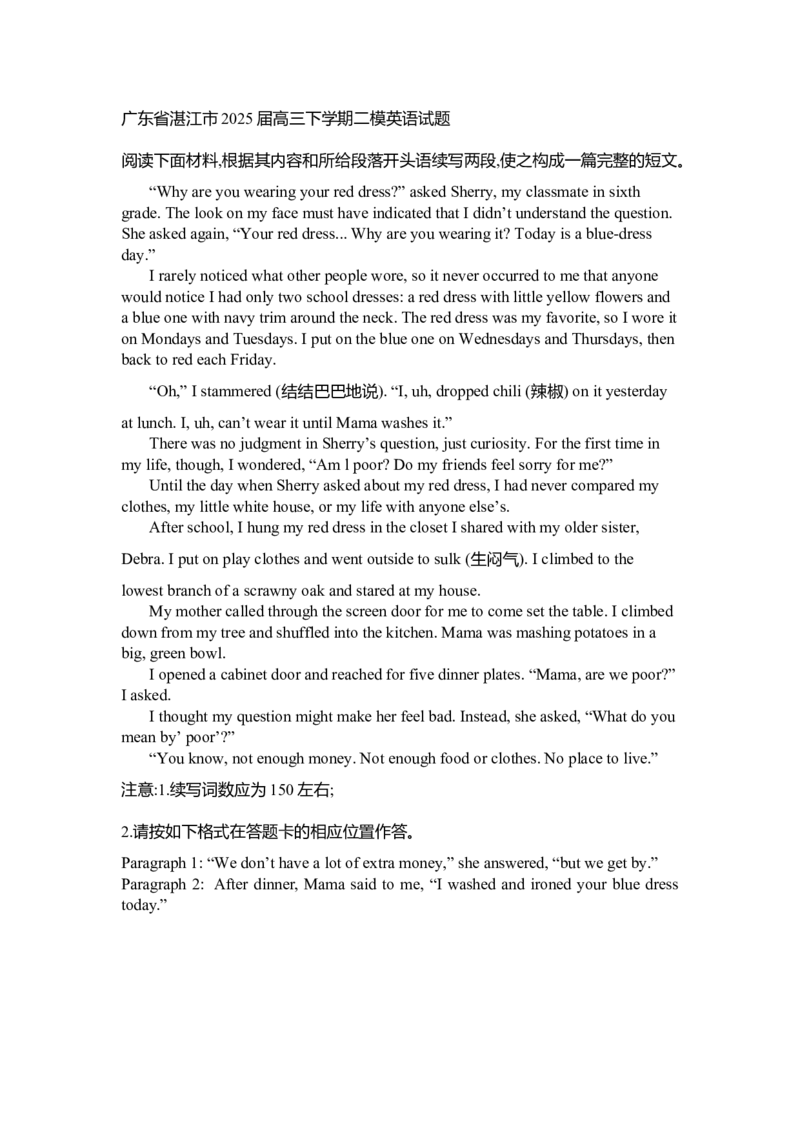
“Why are you wearing your red dress?” asked Sherry, my classmate in sixth
grade. The look on my face must have indicated that I didn’t understand the question.
She asked again, “Your red dress... Why are you wearing it? Today is a blue-dress
day.”
I rarely noticed what other people wore, so it never occurred to me that anyone
would notice I had only two school dresses: a red dress with little yellow flowers and
a blue one with navy trim around the neck. The red dress was my favorite, so I wore it
on Mondays and Tuesdays. I put on the blue one on Wednesdays and Thursdays, then
back to red each Friday.
“Oh,” I stammered (结结巴巴地说). “I, uh, dropped chili (辣椒) on it yesterday
at lunch. I, uh, can’t wear it until Mama washes it.”
There was no judgment in Sherry’s question, just curiosity. For the first time in
my life, though, I wondered, “Am l poor? Do my friends feel sorry for me?”
Until the day when Sherry asked about my red dress, I had never compared my
clothes, my little white house, or my life with anyone else’s.
After school, I hung my red dress in the closet I shared with my older sister,
Debra. I put on play clothes and went outside to sulk (生闷气). I climbed to the
lowest branch of a scrawny oak and stared at my house.
My mother called through the screen door for me to come set the table. I climbed
down from my tree and shuffled into the kitchen. Mama was mashing potatoes in a
big, green bowl.
I opened a cabinet door and reached for five dinner plates. “Mama, are we poor?”
I asked.
I thought my question might make her feel bad. Instead, she asked, “What do you
mean by’ poor’?”
“You know, not enough money. Not enough food or clothes. No place to live.”
注意:1.续写词数应为150 左右;
2.请按如下格式在答题卡的相应位置作答。
Paragraph 1: “We don’t have a lot of extra money,” she answered, “but we get by.”
Paragraph 2: After dinner, Mama said to me, “I washed and ironed your blue dress
today.”
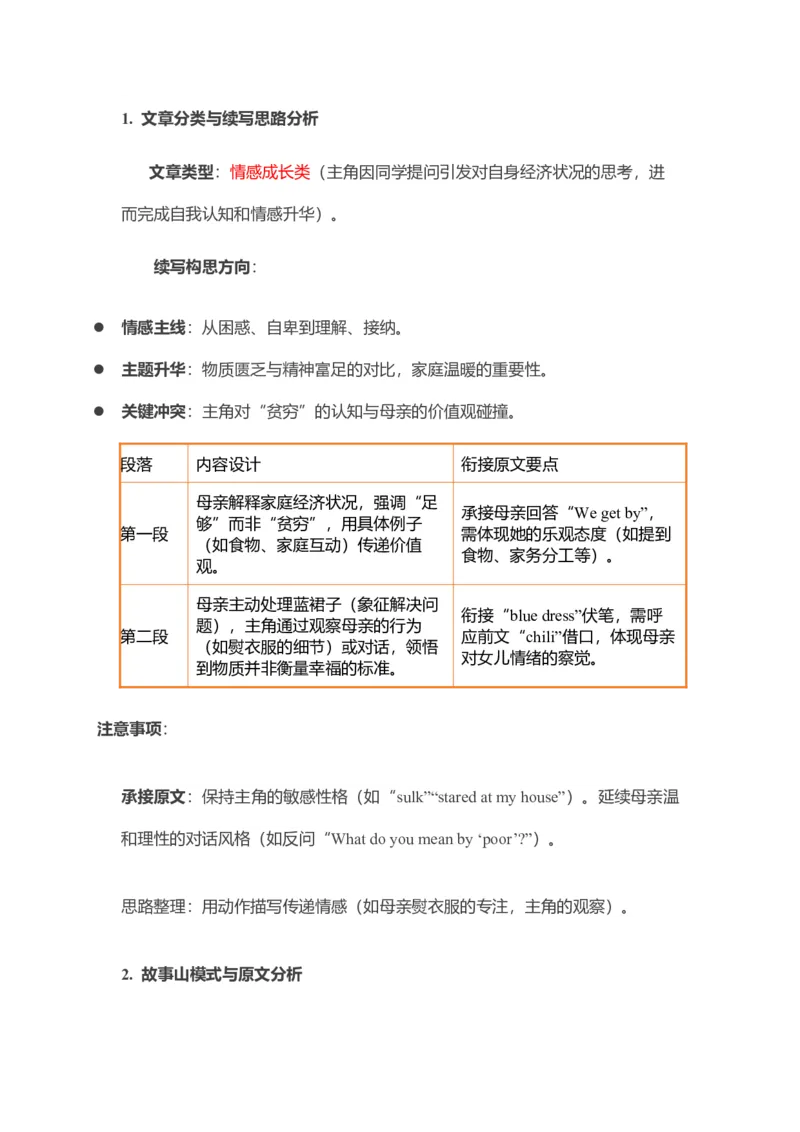
1. 文章分类与续写思路分析
文章类型:情感成长类(主角因同学提问引发对自身经济状况的思考,进
而完成自我认知和情感升华)。
续写构思方向:
情感主线:从困惑、自卑到理解、接纳。
主题升华:物质匮乏与精神富足的对比,家庭温暖的重要性。
关键冲突:主角对“贫穷”的认知与母亲的价值观碰撞。
段落
内容设计
衔接原文要点
第一段
母亲解释家庭经济状况,强调“足
够”而非“贫穷”,用具体例子
(如食物、家庭互动)传递价值
观。
承接母亲回答“We get by”,
需体现她的乐观态度(如提到
食物、家务分工等)。
第二段
母亲主动处理蓝裙子(象征解决问
题),主角通过观察母亲的行为
(如熨衣服的细节)或对话,领悟
到物质并非衡量幸福的标准。
衔接“blue dress”伏笔,需呼
应前文“chili”借口,体现母亲
对女儿情绪的察觉。
注意事项:
承接原文:保持主角的敏感性格(如“sulk”“stared at my house”)。延续母亲温
和理性的对话风格(如反问“What do you mean by ‘poor’?”)。
思路整理:用动作描写传递情感(如母亲熨衣服的专注,主角的观察)。
2. 故事山模式与原文分析
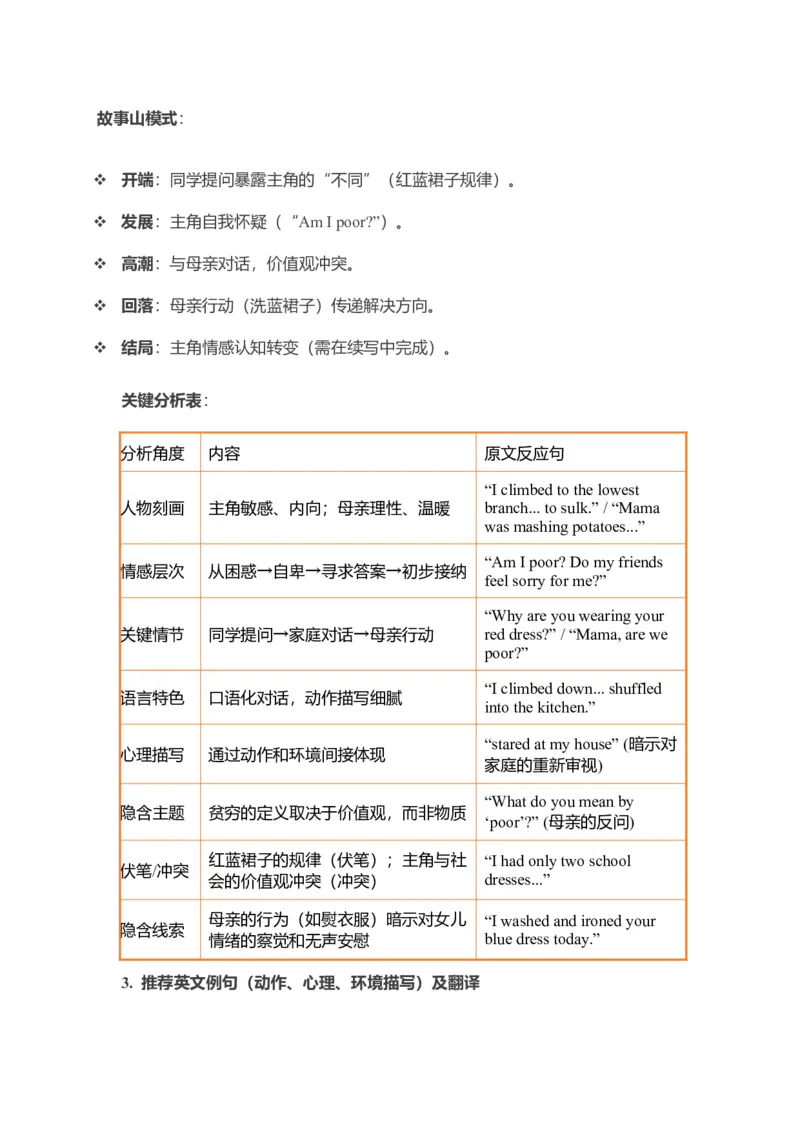
故事山模式:
开端:同学提问暴露主角的“不同”(红蓝裙子规律)。
发展:主角自我怀疑(“Am I poor?”)。
高潮:与母亲对话,价值观冲突。
回落:母亲行动(洗蓝裙子)传递解决方向。
结局:主角情感认知转变(需在续写中完成)。
关键分析表:
分析角度
内容
原文反应句
人物刻画
主角敏感、内向;母亲理性、温暖
“I climbed to the lowest
branch... to sulk.” / “Mama
was mashing potatoes...”
情感层次
从困惑→自卑→寻求答案→初步接纳
“Am I poor? Do my friends
feel sorry for me?”
关键情节
同学提问→家庭对话→母亲行动
“Why are you wearing your
red dress?” / “Mama, are we
poor?”
语言特色
口语化对话,动作描写细腻
“I climbed down... shuffled
into the kitchen.”
心理描写
通过动作和环境间接体现
“stared at my house” (暗示对
家庭的重新审视)
隐含主题
贫穷的定义取决于价值观,而非物质
“What do you mean by
‘poor’?” (母亲的反问)
伏笔/冲突
红蓝裙子的规律(伏笔);主角与社
会的价值观冲突(冲突)
“I had only two school
dresses...”
隐含线索
母亲的行为(如熨衣服)暗示对女儿
情绪的察觉和无声安慰
“I washed and ironed your
blue dress today.”
3. 推荐英文例句(动作、心理、环境描写)及翻译
动作描写
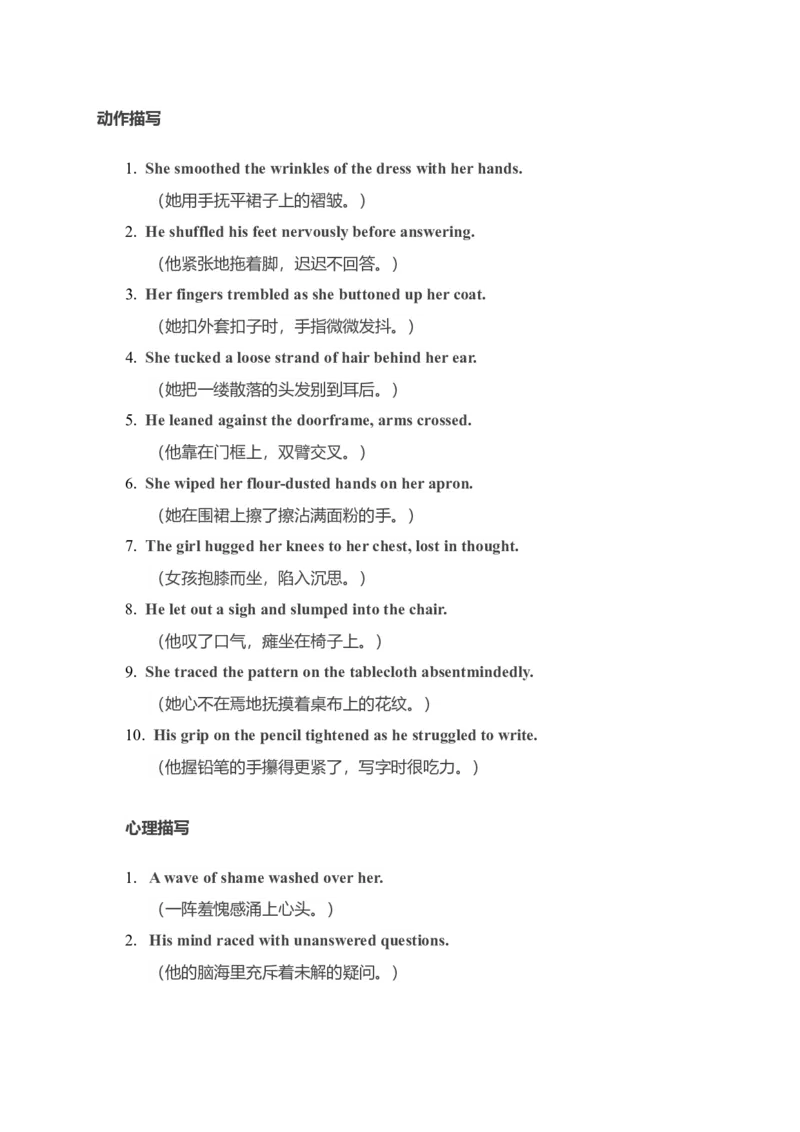
1. She smoothed the wrinkles of the dress with her hands.
(她用手抚平裙子上的褶皱。)
2. He shuffled his feet nervously before answering.
(他紧张地拖着脚,迟迟不回答。)
3. Her fingers trembled as she buttoned up her coat.
(她扣外套扣子时,手指微微发抖。)
4. She tucked a loose strand of hair behind her ear.
(她把一缕散落的头发别到耳后。)
5. He leaned against the doorframe, arms crossed.
(他靠在门框上,双臂交叉。)
6. She wiped her flour-dusted hands on her apron.
(她在围裙上擦了擦沾满面粉的手。)
7. The girl hugged her knees to her chest, lost in thought.
(女孩抱膝而坐,陷入沉思。)
8. He let out a sigh and slumped into the chair.
(他叹了口气,瘫坐在椅子上。)
9. She traced the pattern on the tablecloth absentmindedly.
(她心不在焉地抚摸着桌布上的花纹。)
10. His grip on the pencil tightened as he struggled to write.
(他握铅笔的手攥得更紧了,写字时很吃力。)
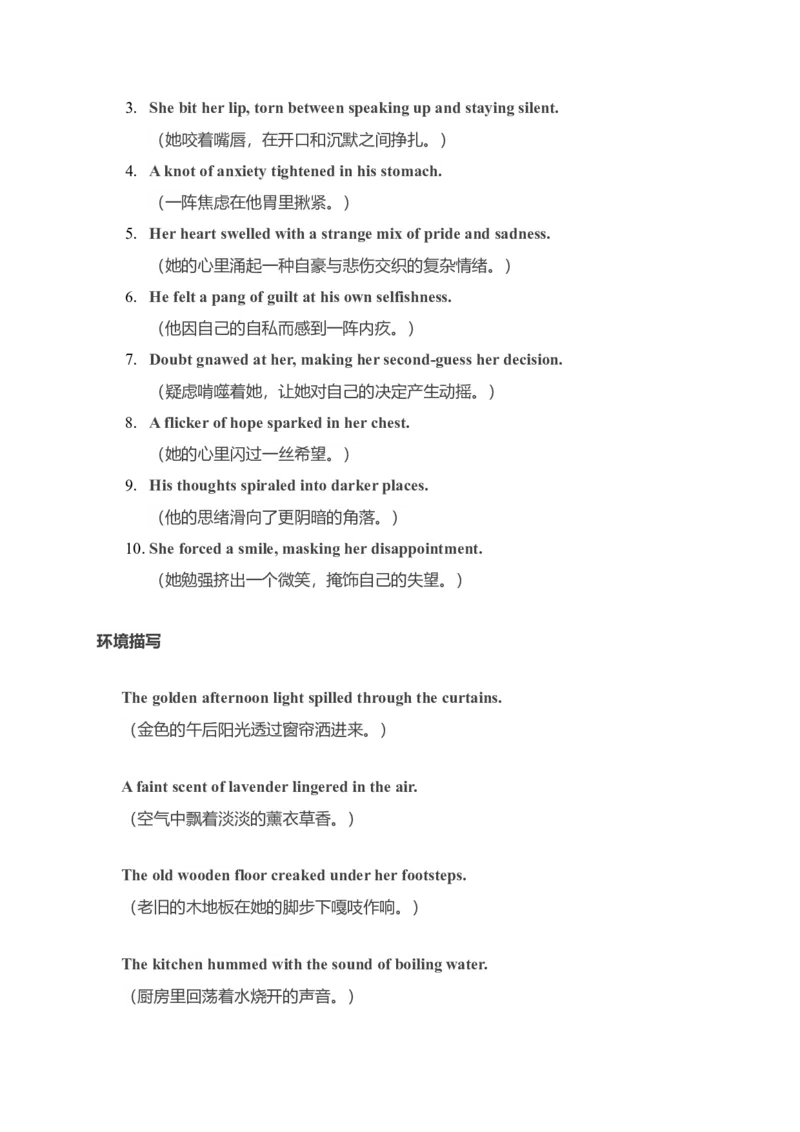
心理描写
1. A wave of shame washed over her.
(一阵羞愧感涌上心头。)
2. His mind raced with unanswered questions.
(他的脑海里充斥着未解的疑问。)
3. She bit her lip, torn between speaking up and staying silent.
(她咬着嘴唇,在开口和沉默之间挣扎。)
4. A knot of anxiety tightened in his stomach.
(一阵焦虑在他胃里揪紧。)
5. Her heart swelled with a strange mix of pride and sadness.
(她的心里涌起一种自豪与悲伤交织的复杂情绪。)
6. He felt a pang of guilt at his own selfishness.
(他因自己的自私而感到一阵内疚。)
7. Doubt gnawed at her, making her second-guess her decision.
(疑虑啃噬着她,让她对自己的决定产生动摇。)
8. A flicker of hope sparked in her chest.
(她的心里闪过一丝希望。)
9. His thoughts spiraled into darker places.
(他的思绪滑向了更阴暗的角落。)
10. She forced a smile, masking her disappointment.
(她勉强挤出一个微笑,掩饰自己的失望。)
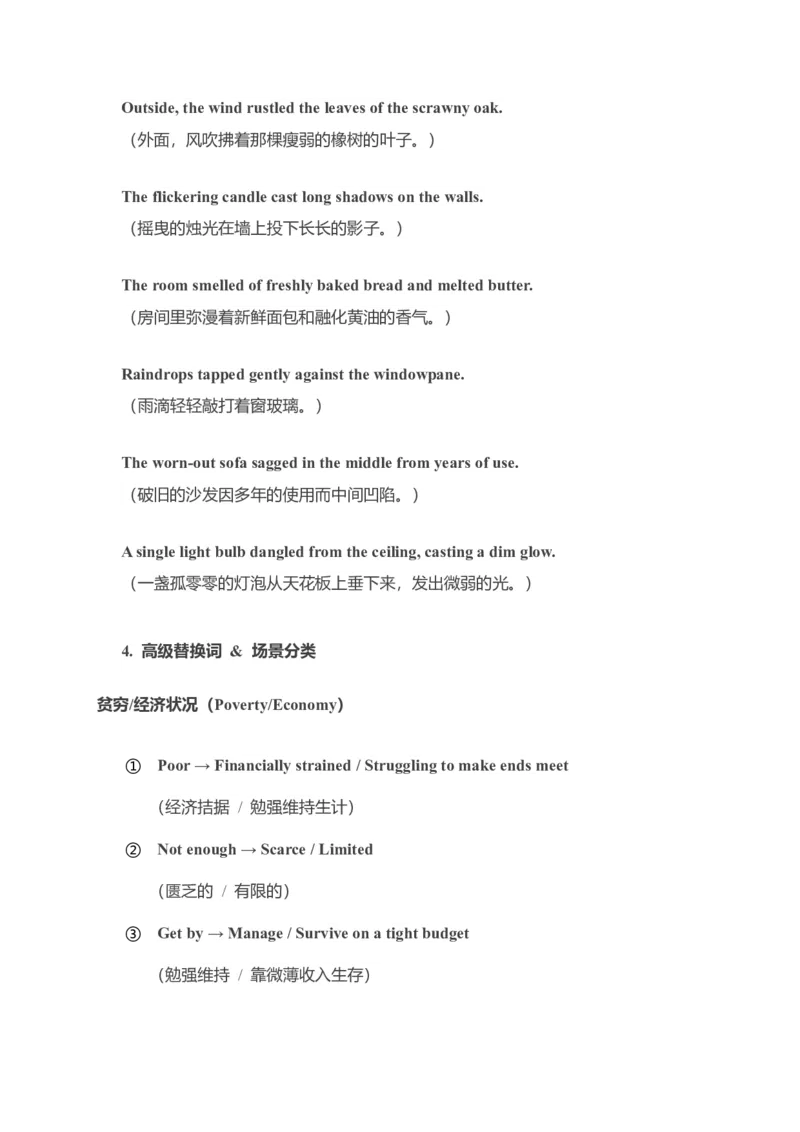
环境描写
The golden afternoon light spilled through the curtains.
(金色的午后阳光透过窗帘洒进来。)
A faint scent of lavender lingered in the air.
(空气中飘着淡淡的薰衣草香。)
The old wooden floor creaked under her footsteps.
(老旧的木地板在她的脚步下嘎吱作响。)
The kitchen hummed with the sound of boiling water.
(厨房里回荡着水烧开的声音。)
Outside, the wind rustled the leaves of the scrawny oak.
(外面,风吹拂着那棵瘦弱的橡树的叶子。)
The flickering candle cast long shadows on the walls.
(摇曳的烛光在墙上投下长长的影子。)
The room smelled of freshly baked bread and melted butter.
(房间里弥漫着新鲜面包和融化黄油的香气。)
Raindrops tapped gently against the windowpane.
(雨滴轻轻敲打着窗玻璃。)
The worn-out sofa sagged in the middle from years of use.
(破旧的沙发因多年的使用而中间凹陷。)
A single light bulb dangled from the ceiling, casting a dim glow.
(一盏孤零零的灯泡从天花板上垂下来,发出微弱的光。)
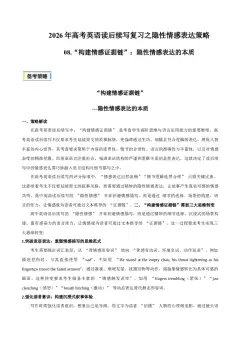
4. 高级替换词 & 场景分类
贫穷/经济状况(Poverty/Economy)
① Poor → Financially strained / Struggling to make ends meet
(经济拮据 / 勉强维持生计)
② Not enough → Scarce / Limited
(匮乏的 / 有限的)
③ Get by → Manage / Survive on a tight budget
(勉强维持 / 靠微薄收入生存)
④ Little money → Meager income / Modest means
(微薄的收入 / 有限的经济条件)
⑤ Cheap → Frugal / Economical
(节俭的 / 经济的)
情感/心理(Emotions/Psychology)
① Sad → Melancholic / Downcast
(忧郁的 / 沮丧的)
② Happy → Content / Elated
(满足的 / 欣喜的)
③ Confused → Perplexed / Bewildered
(困惑的 / 茫然的)
④ Worried → Anxious / Apprehensive
(焦虑的 / 担忧的)
⑤ Angry → Furious / Indignant
(愤怒的 / 愤慨的)
⑥ 动作/行为(Actions/Behavior)
Look → Glance / Gaze / Peer
(瞥 / 凝视 / 窥视)
Walk → Stroll / Trudge / Shuffle
(漫步 / 艰难行走 / 拖着脚走)
Say → Murmur / Whisper / Stammer
(低声说 / 耳语 / 结结巴巴地说)
Hold → Clutch / Grasp / Grip
(紧握 / 抓住 / 攥紧)
Run → Dash / Sprint / Bolt
(猛冲 / 疾跑 / 飞奔)
5. 固定搭配 & 词法解析
常见搭配(Collocations)
Set the table(摆餐具)She helped her mother set the table for dinner.
Wash and iron clothes(洗熨衣服)Mama washed and ironed the blue dress
carefully.
Hang in the closet(挂在衣柜里)She hung her red dress in the closet after
school.
Climb down from a tree(从树上爬下来)The girl climbed down from the oak
tree slowly.
Mask one’s disappointment(掩饰失望)He forced a smile to mask his
disappointment.
单词/短语
词义
词
性
近义词
反义词
例句
Sulk
生闷气
v.
Pout,
Brood
Cheer up
She went outside to sulk
after the argument.
单词/短语
词义
词
性
近义词
反义词
例句
Scrawny
瘦弱的
adj.
Skinny,
Gaunt
Sturdy
The scrawny oak barely
provided shade.
Stammer
结巴地
说
v.
Stutter,
Falter
Speak
fluently
He stammered when asked
about his mistake.
Trim
装饰边
n.
Edging,
Border
Plain
The blue dress had navy
trim around the neck.
Shuffle
拖着脚
走
v.
Drag,
Scuff
March
He shuffled into the room,
avoiding eye contact.
总结:读后续写语料积累方向
动作描写:多用具体动词(如 tuck, trace, slump)增强画面感。
心理描写:用比喻(如 a knot of anxiety, a flicker of hope)表达情绪。
环境描写:通过感官细节(sound, smell, light)营造氛围。
高级替换:避免重复,如 poor → financially strained。
固定搭配:如 set the table, wash and iron,使表达更地道。
6. Possible Versions(3)
【Version 1】
Paragraph 1: “We don’t have a lot of extra money,” she answered, “but we
get by.” Hearing
her calm voice
(从听的动作开始衔接,对应心理描写), I realized that “getting by”
meant more than just having enough — it meant (递进描写) knowing how to be
content. Mama continued, “We always have dinner on the table, a warm house,
and love (名词并列). That’s more than enough.” Her words were simple, but they
wrapped around my heart like a blanket (心理描写). As I wiped a speck of flour off the
counter, I thought about the tree I had climbed earlier — thin, but still standing
strong (补充描写). Maybe we were like that tree: not big, not flashy, but alive and
rooted. (补语,描写树的形象) Mama handed me the bowl of mashed potatoes (衔接原文) with a
smile that didn’t seem poor at all. That night, as we all sat at the table, I noticed
how Debra shared her bread crust with our dog and how Daddy laughed at
Mama’s corny joke (多人物衔接的妙处). For the first time, I saw richness not in things, but
in people (递进描写).
Paragraph 2: After dinner, Mama said to me, “I washed and ironed your
blue dress today.” I hesitated, then nodded (动作反应心理). “Thanks, Mama,” I
whispered, though
my heart still tugged at the red one
(心理描写). As I hung the blue
dress on the door, I noticed how neatly it had been pressed. The navy trim looked
crisp (原文细节点衔接), and the fabric smelled faintly of sunshine and soap (衔接). “You’ll look
sharp tomorrow,” Mama said, ruffling
my hair
(现在分词做伴随动作). I smiled, not because
of the dress, but because she cared enough to wash and iron it so lovingly (递进描写刻画
母亲的爱). At school the next day, when Sherry saw me in the blue dress, she just
grinned and said, “Hey, now we match!” I smiled back, this time without shame.
The dress hadn’t changed, but I had (灵魂变化). I now understood that having only two
dresses didn’t make me less. What mattered (主语从句) was how I wore them — and
how I carried myself (表从). And maybe, I could be proud of that.
【Version 2】
Paragraph 1: “We don’t have a lot of extra money,” she answered, “but we
get by.” I nodded slowly (反应和心理开始衔接), still trying to make sense
of her words
(现在分
词短语做伴随动作). “Getting by” didn’t sound like much — until I saw the way Mama’s
hands worked with quiet strength, stirring, cleaning, comforting. “We may not
have much,” she added gently, “but we make what we have stretch — and we do
it together.” The potatoes were ready (衔接原文), and I carried them to the table,
thinking
about the clothes
(现在分词做伴随动作) I wore and the food we shared. Suddenly,
I saw it differently: my red dress wasn’t something to be ashamed of; it was a
part of my story, just like our white house (衔接原文). As we ate, I noticed Debra
offered me the last spoon of
potato
(人物刻画), and Daddy
saved the biggest biscuit
for
Mama
(人物衔接). Maybe that was what made us rich — not money, but care. My
heart felt less heavy, almost light (人物心理描写).
Paragraph 2: After dinner, Mama said to me, “I washed and ironed your
blue dress today.” I looked at her, surprised (adj 做主语补语), and for the first time,
grateful (adj 做主语补语). “Thanks, Mama,” I said. “It looks nice.” She smiled, her eyes soft
(独立主格刻画人物), and I could tell she had done it just for me. Later, I tried the dress on and
twirled once in front of the mirror as before. It wasn’t the red one, but it was
clean and cared for — and it was mine (对比递进描写). The next morning at school, when
someone commented on the blue dress, I smiled and replied, “It’s my Thursday
dress.” My voice held no apology, only quiet pride (人物心理刻画). That evening, I folded
the dress carefully and hung it back beside the red one. I realized then it wasn’t
about how many clothes I had, but how I saw myself in them. (递进描写,升华主旨) And I
was beginning to see someone strong, someone who could get by — and even
thrive.
【Version 3】
Paragraph 1: “We don’t have a lot of extra money,” she answered, “but we
get by.” Her words were gentle but firm
(人物细节刻画), like a steady hand on my shoulder.
I turned to look at her — flour on her cheek, sleeves rolled up, eyes calm. (3 个独立主格刻
画人物的神态性格) “Some people count coins,” she continued, “but I count blessings —
and we have plenty (递进说明).” I didn’t fully understand then, but something inside
me shifted. (人物变化描写) I remembered the time we together mashed potatoes at
night, or when Debra shared her only chocolate bar with me (人物描写). Those
moments weren’t about money — they were about
love, sacrifice, and grace
(名词并
列). As we sat down to eat, I caught Mama glancing at me. I think she knew I was
thinking hard, trying
to grow
(现在分词做伴随动作). And maybe she also knew I was
learning something she had understood for years: richness isn’t always visible.
Paragraph 2: After dinner, Mama said to me, “I washed and ironed your
blue dress today.” There was something in her tone (衔接人物说话很好的形式) — not just an
announcement, but an offering (递进描写). I touched the fabric, still warm from the
iron (衔接原文). “It’s perfect,” I said softly. That night, I carefully folded the red dress
and placed it on the shelf. It wasn’t about hiding it — it was about honoring it (递
进描写). At school the next day, I walked in wearing my blue dress (现在分词做伴随动作), my
head held higher (独立主格刻画人物神态). Sherry waved at me, and I waved back, no longer
wondering (现在分词做伴随动作)if I measured up. I finally understood: clothes could be clean
or worn, old or new — but dignity came from within. When I returned home, I
told Mama, “Maybe we are rich — just in our own way.” She laughed and kissed
my forehead. That was the day I stopped counting dresses and started counting
love.
亮点表达与积累语料
地道表达搭配
搭配表达
同义替换/解释
get by
make ends meet, manage
feel a tug at one’s heart
feel emotionally affected
a smile that didn’t seem poor at all
a sincere, heartwarming smile
not big, not flashy, but alive and rooted understated but meaningful existence
something inside me shifted
an internal emotional change
情绪/心理描写亮点词组
wrapped around my heart like a blanket
my voice held no apology
I smiled, not because of the dress, but because she cared
I was learning something she had understood for years
a steady hand on my shoulder
动作描写亮点词组
o
ruffling my hair
o
handed me the bowl of mashed potatoes
o
hesitated, then nodded
o
twirled once in front of the mirror
o
carefully folded the red dress
积累词汇
原词/短语
升级替换
同义词
联想表达
poor
underprivileged needy, less fortunate modest background
dress
outfit, attire
clothing, garment
uniform, ensemble
smile
beam, grin
smirk, glow
a soft expression
care about value, treasure
be concerned with
hold dear
Her words wrapped around my heart like a blanket, soft but steady.
I wore my blue dress, but I walked as if it were made of gold.
Our life may not sparkle, but it surely shines in its own quiet way.
Sometimes, the richest moments are the ones that cost nothing at all.
参考范文:
“We don’t have a lot of extra money,” she answered, “but we get by.” Look
around, we have a roof over our heads, food on the table, and clothes on our
backs (名词并列,形成类似排比). She continued, “Your father works hard, and I take care of this
home. We love each other, and that’s what matters most. There will always be
people with more, but that doesn’t make us poor. We have what we need.” I
listened intently, understanding dawning on me (独立主格,刻画人物的理解). Her words made
me feel better. I realized being poor wasn’t about clothes or money.
After dinner, Mama said to me, “I washed and ironed your blue dress today.” She
paused a moment and continued, “You can wear it tomorrow if you want.” I
considered the offer. “No, I want to wear the red dress again. Its little yellow flowers
make me feel good ( 人物内心的转变),” I replied. Enough to get by ( 衔接原文)? Oh, I had more
than that. I was fortunate with an amazing mother. She worked hard, played hard,
and loved easily ( 动词并列,刻画人物). Despite the hard blows of life, Mama chose joy and
contentment. I was rich in every way that mattered.