2026 年高考第一次模拟考试保分卷03(浙江专用)
高三英语
(考试时间:120 分钟  试卷满分:150 分)
注意事项:
1.答卷前,考生务必将自己的姓名、准考证号等填写在答题卡和试卷指定位置上。
2.回答选择题时,选出每小题答案后,用铅笔把答题卡上对应题目的答案标号涂黑。
如需改动,用橡皮擦干净后,再选涂其他答案标号。回答非选择题时,将答案写在答
题卡上。写在本试卷上无效。
3.考试结束后,将本试卷和答题卡一并交回
第一部分  听力(共两节,满分 30 分)
做题时,先将答案标在试卷上。录音内容结束后,你将有两分钟的时间将试卷上的答案
转涂到答题卡上。
第一节(共5 小题;每小题1.5 分,满分7.5 分)
听下面5 段对话。每段对话后有一个小题,从题中所给的A、B、C 三个选项中选出最
佳选项。听完每段对话后,你都有10 秒钟的时间来回答有关小题和阅读下一小题。每段对
话读两遍。
1.What does the woman think of Laura?
A.She’s thin.
B.She’s sick.
C.She’s clever.
2.What are the speakers talking about?
A.How to prepare exams. B.How to relieve pressure.
C.How to keep fit.
3. What has the woman decided to do on Sunday?
A.Meet a friend.
B.Visit an exhibition.
C.Attend a wedding.
4.Why doesn’t the man choose the Polar Primary School?
A.Because it’s far away from his home.
B.Because it doesn’t have school buses.
C.Because its standards of education are low.
5.What did the man’s cousin do for him?
A.He showed him around.
B.He booked him in at a hotel.
C.He offered him temporary accommodation.
第二节(共15 小题;每小题1.5 分,满分22.5 分)
听下面5 段对话或独白。每段对话或独白后有几个小题,从题中所给的A、B、C 三个
选项中选出最佳选项。听每段对话或独白前,你将有时间阅读各个小题,每小题5 秒钟;
听完后,各小题将给出5 秒钟的作答时间。每段对话或独白读两遍。
听第6 段材料,回答第6、7 题。
6.Where does the conversation most likely take place?
A.At a traffic station.
B.At a car service center.
C.In a shopping mall.
7.What will the woman do next?
A.Wait for her turn.
B.Have an oil change.
C.Drive to the town.
听第7 段材料,回答第8 至10 题。
8.What does the woman think of her job?
A.Challenging.
B.Well-paid.
C.Attractive.
9.What has the woman decided to do?
A.Learn a new language.
B.Try for another job.
C.Get full-time education.
10.Where are the speakers going?
A.To a company.
B.To a concert hall.
C.To a school.
听第8 段材料,回答第11 至13 题。
11.What does the part-time job mainly involve?
A.Interviewing.
B.Drawing.
C.Editing.
12.When did Henry hear about the position?
A.The day before yesterday.
B.Yesterday.
C.Just now.
13.What does the woman decide to do at last?
A.Surf the Internet.
B.Ask Mike in person.
C.Buy a magazine.
听第9 段材料,回答第14 至17 题。
14.What type of event did the man recently attend?
A.A family wedding.
B.A graduation ceremony.
C.An opening of a restaurant.
15.What is the relationship between the man and Sasha?
A.Mother and son.
B.Cousins.
C.Brother and sister.
16.Who mainly designed the menu?
A.The hotel.
B.Sasha and Will.
C.The man’s mother.
17.What is the man’s attitude toward the actions of his cousins?
A.Disapproving.
B.Indifferent.
C.Amused.
听第10 段材料,回答第18 至20 题。
18.In which year did Humboldt return from his Latin American journey?
A.1799.
B.1804.
C.1859.
19.What did Humboldt study during his exploration of Latin America?
A.Ancient ruins.
B.A river.
C.Art and culture.
20.What is Humboldt best remembered for?
A.Writing detailed travel journals.
B.Discovering new animal species.
C.Stating two continents were linked.
第二部分  阅读(共两节, 满分50 分)
第一节(共15 小题;每小题2.5 分, 满分37.5 分)
阅读下列短文, 从每题所给的A、B、C 和D 四个选项中选出最佳选项。
A
(新题材)Ready for the U
Ready for the U is your opportunity to engage with the UMass community before the term
starts. During Ready for the U, you’ll meet fellow new students, network with university staff
members, and get ready for the upcoming term. You’ll also:
●Learn about living and acting responsibly in the community;
●Begin the campus life at UMass Amherst;
●Acquire skills to develop academic preparedness.
Various courses are offered to meet the needs of the students, and you’ll:
●Be unable to register for classes, but have to schedule your online New Student Advising
and Course Registration appointment for a different time period during Ready for the U;
●Participate in the entire New Student Experience free of any additional charges.
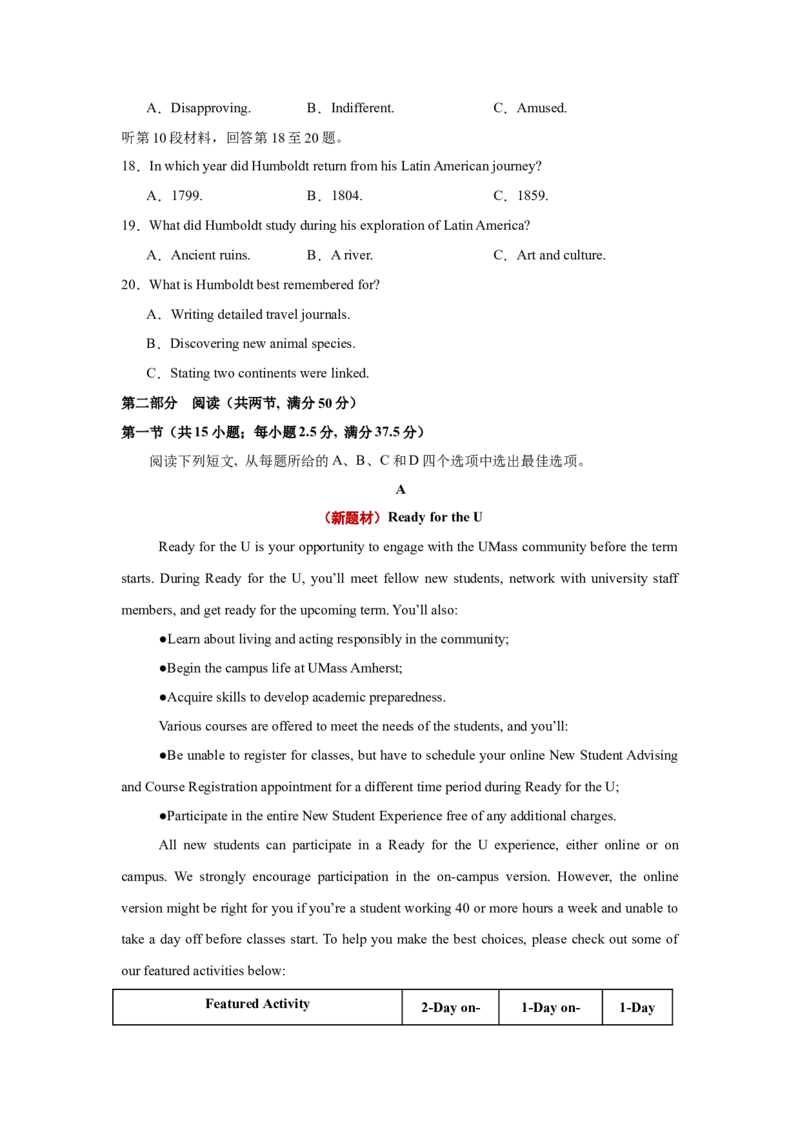
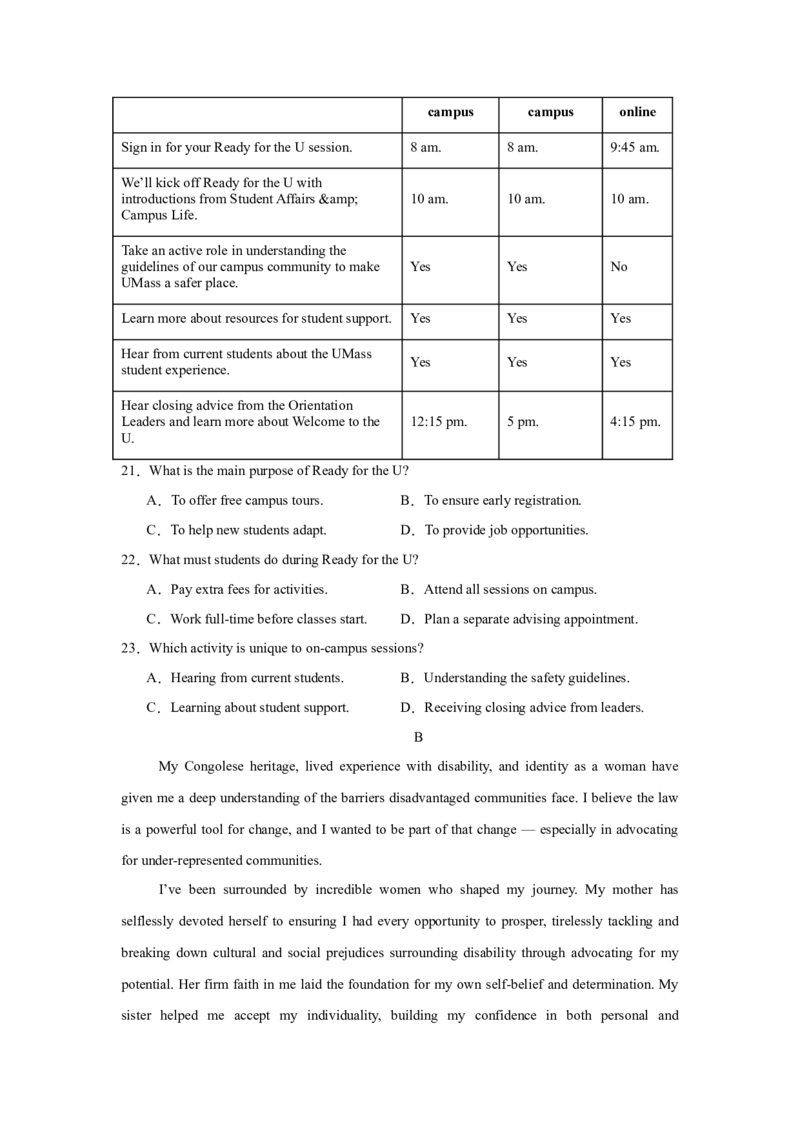
All new students can participate in a Ready for the U experience, either online or on
campus. We strongly encourage participation in the on-campus version. However, the online
version might be right for you if you’re a student working 40 or more hours a week and unable to
take a day off before classes start. To help you make the best choices, please check out some of
our featured activities below:
Featured Activity
2-Day on-
1-Day on-
1-Day
campus
campus
online
Sign in for your Ready for the U session.
8 am.
8 am.
9:45 am.
We’ll kick off Ready for the U with
introductions from Student Affairs &
Campus Life.
10 am.
10 am.
10 am.
Take an active role in understanding the
guidelines of our campus community to make
UMass a safer place.
Yes
Yes
No
Learn more about resources for student support.
Yes
Yes
Yes
Hear from current students about the UMass
student experience.
Yes
Yes
Yes
Hear closing advice from the Orientation
Leaders and learn more about Welcome to the
U.
12:15 pm.
5 pm.
4:15 pm.
21.What is the main purpose of Ready for the U?
A.To offer free campus tours.
B.To ensure early registration.
C.To help new students adapt.
D.To provide job opportunities.
22.What must students do during Ready for the U?
A.Pay extra fees for activities.
B.Attend all sessions on campus.
C.Work full-time before classes start.
D.Plan a separate advising appointment.
23.Which activity is unique to on-campus sessions?
A.Hearing from current students.
B.Understanding the safety guidelines.
C.Learning about student support.
D.Receiving closing advice from leaders.
B
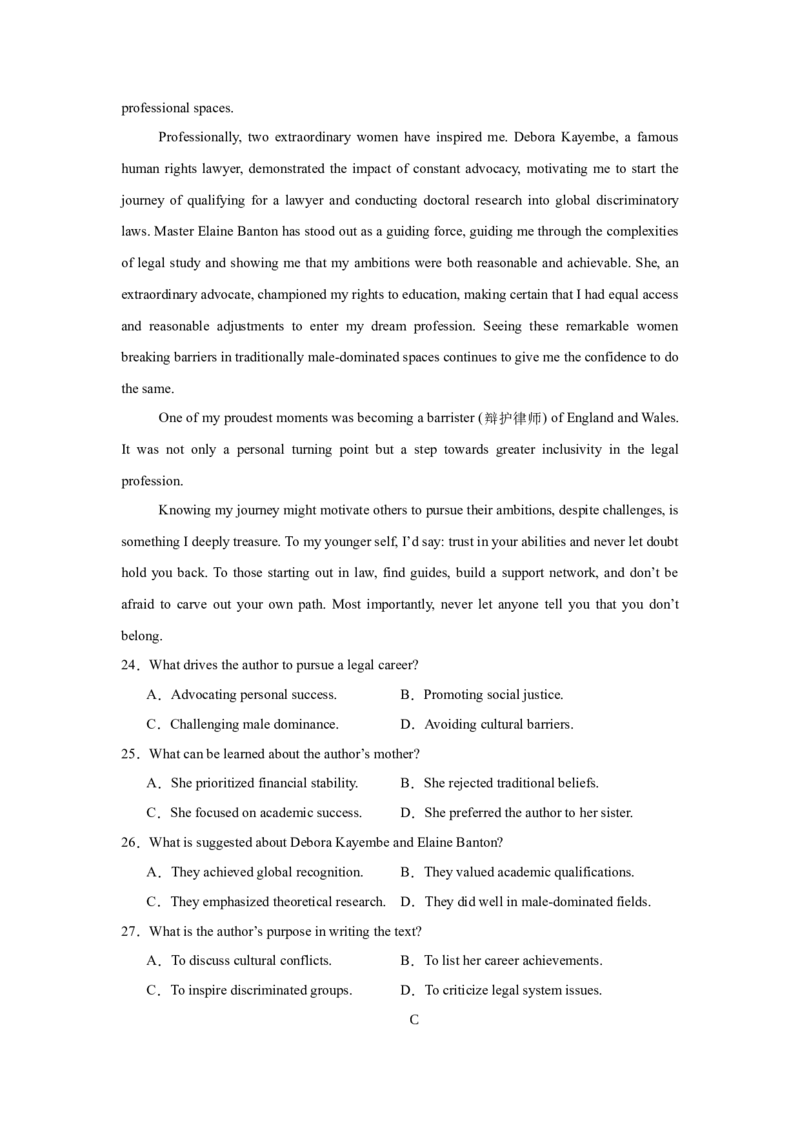
My Congolese heritage, lived experience with disability, and identity as a woman have
given me a deep understanding of the barriers disadvantaged communities face. I believe the law
is a powerful tool for change, and I wanted to be part of that change — especially in advocating
for under-represented communities.
I’ve been surrounded by incredible women who shaped my journey. My mother has
selflessly devoted herself to ensuring I had every opportunity to prosper, tirelessly tackling and
breaking down cultural and social prejudices surrounding disability through advocating for my
potential. Her firm faith in me laid the foundation for my own self-belief and determination. My
sister helped me accept my individuality, building my confidence in both personal and
professional spaces.
Professionally, two extraordinary women have inspired me. Debora Kayembe, a famous
human rights lawyer, demonstrated the impact of constant advocacy, motivating me to start the
journey of qualifying for a lawyer and conducting doctoral research into global discriminatory
laws. Master Elaine Banton has stood out as a guiding force, guiding me through the complexities
of legal study and showing me that my ambitions were both reasonable and achievable. She, an
extraordinary advocate, championed my rights to education, making certain that I had equal access
and reasonable adjustments to enter my dream profession. Seeing these remarkable women
breaking barriers in traditionally male-dominated spaces continues to give me the confidence to do
the same.
One of my proudest moments was becoming a barrister (辩护律师) of England and Wales.
It was not only a personal turning point but a step towards greater inclusivity in the legal
profession.
Knowing my journey might motivate others to pursue their ambitions, despite challenges, is
something I deeply treasure. To my younger self, I’d say: trust in your abilities and never let doubt
hold you back. To those starting out in law, find guides, build a support network, and don’t be
afraid to carve out your own path. Most importantly, never let anyone tell you that you don’t
belong.
24.What drives the author to pursue a legal career?
A.Advocating personal success.
B.Promoting social justice.
C.Challenging male dominance.
D.Avoiding cultural barriers.
25.What can be learned about the author’s mother?
A.She prioritized financial stability.
B.She rejected traditional beliefs.
C.She focused on academic success.
D.She preferred the author to her sister.
26.What is suggested about Debora Kayembe and Elaine Banton?
A.They achieved global recognition.
B.They valued academic qualifications.
C.They emphasized theoretical research.
D.They did well in male-dominated fields.
27.What is the author’s purpose in writing the text?
A.To discuss cultural conflicts.
B.To list her career achievements.
C.To inspire discriminated groups.
D.To criticize legal system issues.
C
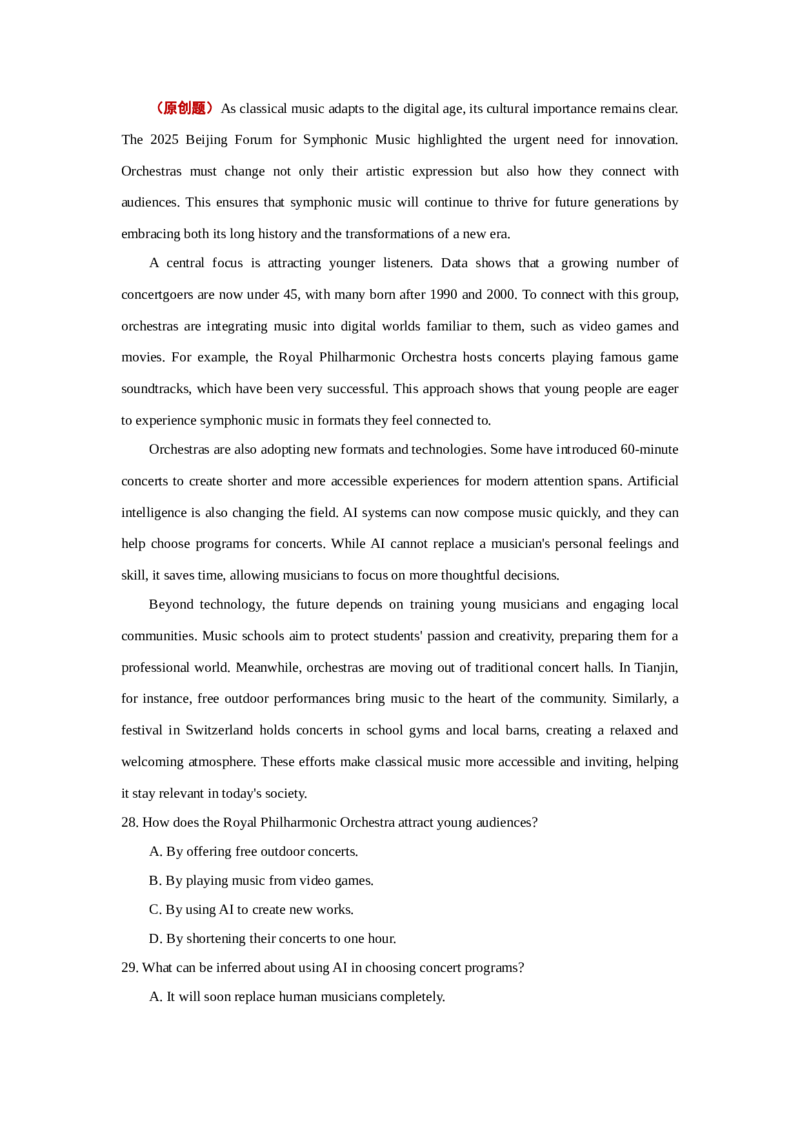
(原创题)As classical music adapts to the digital age, its cultural importance remains clear.
The 2025 Beijing Forum for Symphonic Music highlighted the urgent need for innovation.
Orchestras must change not only their artistic expression but also how they connect with
audiences. This ensures that symphonic music will continue to thrive for future generations by
embracing both its long history and the transformations of a new era.
A central focus is attracting younger listeners. Data shows that a growing number of
concertgoers are now under 45, with many born after 1990 and 2000. To connect with this group,
orchestras are integrating music into digital worlds familiar to them, such as video games and
movies. For example, the Royal Philharmonic Orchestra hosts concerts playing famous game
soundtracks, which have been very successful. This approach shows that young people are eager
to experience symphonic music in formats they feel connected to.
Orchestras are also adopting new formats and technologies. Some have introduced 60-minute
concerts to create shorter and more accessible experiences for modern attention spans. Artificial
intelligence is also changing the field. AI systems can now compose music quickly, and they can
help choose programs for concerts. While AI cannot replace a musician's personal feelings and
skill, it saves time, allowing musicians to focus on more thoughtful decisions.
Beyond technology, the future depends on training young musicians and engaging local
communities. Music schools aim to protect students' passion and creativity, preparing them for a
professional world. Meanwhile, orchestras are moving out of traditional concert halls. In Tianjin,
for instance, free outdoor performances bring music to the heart of the community. Similarly, a
festival in Switzerland holds concerts in school gyms and local barns, creating a relaxed and
welcoming atmosphere. These efforts make classical music more accessible and inviting, helping
it stay relevant in today's society.
28. How does the Royal Philharmonic Orchestra attract young audiences?
A. By offering free outdoor concerts.
B. By playing music from video games.
C. By using AI to create new works.
D. By shortening their concerts to one hour.
29. What can be inferred about using AI in choosing concert programs?
A. It will soon replace human musicians completely.
B. It makes the process more efficient and thoughtful.
C. It can fully understand the audience's emotions.
D. It always produces better music than humans do.
30. What is the main purpose of holding concerts in community places like school gyms?
A. To show off the students' musical skills.
B. To promote tourism in the local cities.
C. To make classical music feel more welcoming.
D. To test new sound equipment and technology.
31. What is the author's main attitude toward the future of symphonic music?
A. Worried about its disappearance.
B. Optimistic about its innovative potential.
C. Critical of its move away from tradition.
D. Uncertain about the impact of AI.
D
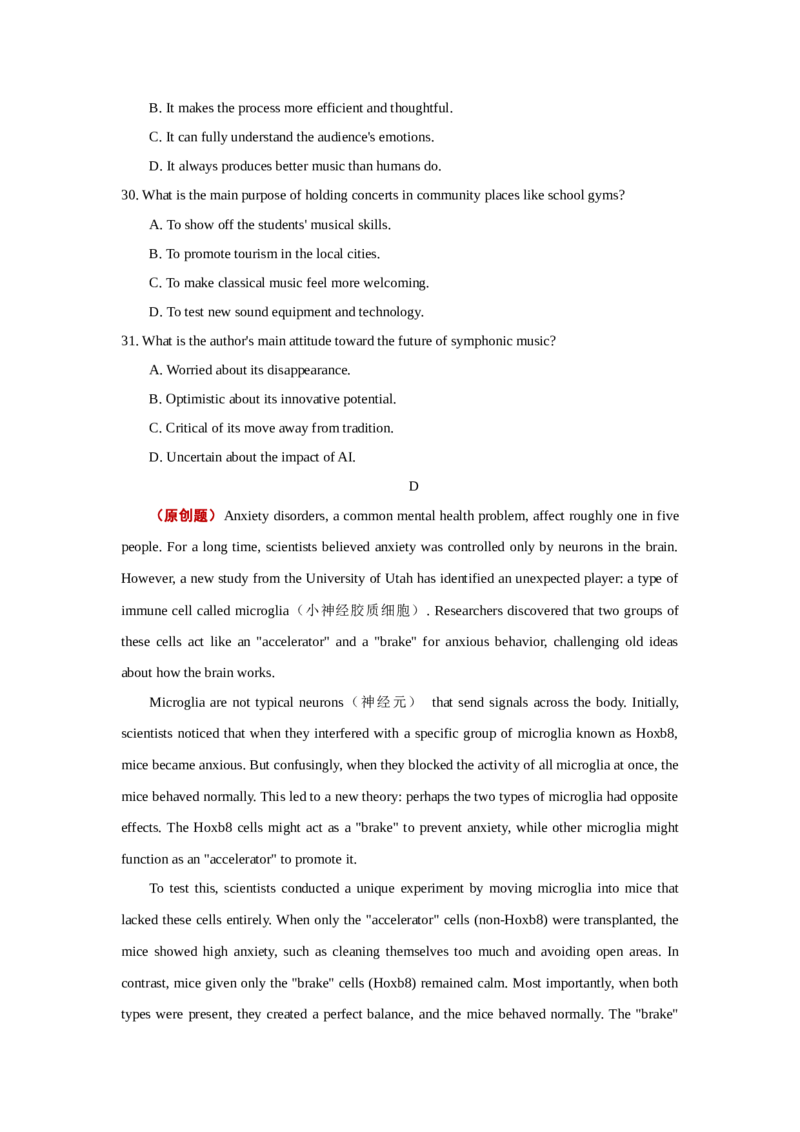
(原创题)Anxiety disorders, a common mental health problem, affect roughly one in five
people. For a long time, scientists believed anxiety was controlled only by neurons in the brain.
However, a new study from the University of Utah has identified an unexpected player: a type of
immune cell called microglia(小神经胶质细胞). Researchers discovered that two groups of
these cells act like an "accelerator" and a "brake" for anxious behavior, challenging old ideas
about how the brain works.
Microglia are not typical neurons(神经元) that send signals across the body. Initially,
scientists noticed that when they interfered with a specific group of microglia known as Hoxb8,
mice became anxious. But confusingly, when they blocked the activity of all microglia at once, the
mice behaved normally. This led to a new theory: perhaps the two types of microglia had opposite
effects. The Hoxb8 cells might act as a "brake" to prevent anxiety, while other microglia might
function as an "accelerator" to promote it.
To test this, scientists conducted a unique experiment by moving microglia into mice that
lacked these cells entirely. When only the "accelerator" cells (non-Hoxb8) were transplanted, the
mice showed high anxiety, such as cleaning themselves too much and avoiding open areas. In
contrast, mice given only the "brake" cells (Hoxb8) remained calm. Most importantly, when both
types were present, they created a perfect balance, and the mice behaved normally. The "brake"
cells effectively canceled out the effects of the "accelerator" cells.
This discovery could change the way anxiety disorders are treated. It suggests the brain's
immune system plays a crucial role in mental health. The researchers explain that humans have
similar microglia populations. Since most current medicines target neurons, they may not address
the root cause. Future treatments could focus on boosting the "brake" cells or reducing the
"accelerator" cells, helping patients regain control over their anxiety. This represents a major shift
in the field of mental health.
1. What happened to the mice when they received only non-Hoxb8 microglia?
A. They lost the ability to clean themselves.
B. They showed signs of extreme anxiety.
C. They became more interested in open spaces.
D. Their anxiety levels remained unchanged.
2. What can be inferred about the current anxiety medications?
A. They are mostly ineffective for patients.
B. They are too expensive for most people.
C. They may not target the fundamental cause of anxiety.
D. They often produce serious side effects.
3. Which of the following is the best title for the passage?
A. Neurons: The Master Control of Anxiety
B. A New Discovery about Anxiety and Its Treatment
C. The Harmful Effects of Anxiety Disorders
D. How to Live a Life Free from Anxiety
4. What does the author suggest about the future of anxiety treatment?
A. It will focus on correcting the balance of immune cells.
B. It will completely stop using drugs that target neurons.
C. It will depend heavily on complex brain surgeries.
D. It will face greater challenges due to the new findings.
第二节(共5 小题;每小题2. 5 分, 满分12. 5 分)
阅读下面短文, 从短文后的选项中选出可以填入空白处的最佳选项。选项中有两项为
多余选项。
“Generally, it’s recommended that people commit to 150 minutes of moderate activity per
week to see sufficient health benefits,” said Dr. Wei Zheng, director of the Vanderbilt
Epidemiology Center.    36   . Fortunately, fast walking for a minimum of 15 minutes every
day can have the same health benefits, according to recent research led by Zheng.
Zheng and his coworkers recruited (招募) nearly 85,000 people from 2002 to 2009, who
were given a comprehensive questionnaire about their exercise habits, average time spent working
out, walking speed and health. Then the participants completed another questionnaire about 16
years later.    37   . What were the results? On average, study participants who fast walked for
at least 15 minutes every day saw a nearly 20% reduction in premature death compared with a 4%
reduction among participants who walked slowly for over three hours a day.
So, are you too busy to hit the gym? Don’t worry — you can stay healthy by including at
least 15 minutes of fast walking into your everyday routine. In general, you can tell you’re fast
walking when you’re able to talk but not sing.    38   .
“Walking is not just about your lower body.    39   ,” said Dana Santas, a mind-body
coach in professional sports. “So, following good walking form is of great importance. Standing
tall with your shoulders back and swinging your arms when you’re walking fast can help keep you
balanced.”
   40   . When doing fast walking exercise, try to practice conscious breathing, which is
when you breathe in through your nose and breathe out through your mouth. This helps regulate
(控制) blood pressure and can possibly prevent high blood pressure.
A.And the analysis began in 2023
B.It’s actually a full-body movement
C.Don’t forget to focus on your breathing
D.It means that the faster you walk, the better you do
E.However, sometimes this may be too difficult to manage
F.Fast walking has been found to reduce the risk of heart failure
G.Alternatively, you can increase your walking pace by a couple of steps
第三部分 语言运用(共两节,满分30 分)
第一节(共15 小题,每小题1 分,满分15 分)
阅读下面短文, 从每题所给的A、B、C 和D 四个选项中选出可以填入空白处的最佳选
项。
(新情境)It’s often the simple things in life that make the most significant impact on us.
It was late one afternoon in mid-September. My three-month-old son was napping in his     41
. As I wandered through our living room, I     42     to look out of my balcony window.
Puddles (水坑) had     43     on the ground and the rain had slowed.
Down below     44     a boy of about four. Filled with a mixture of fascination and
happiness, he stomped ( 踩) through the puddle, mud and     45     flying. He walked,
stomped, splashed through that puddle     46    , happily enjoying what mother nature had left
for him.
Not more than ten feet away stood his mother. She didn’t scold him.     47    , she
watched with a pleasant smile on her face. She showed no     48     for a little mud and for the
laundry she would later have to do. As for me, it was a (n)    49    moment that changed the
way I will forever view my role as a mother.
The little boy probably will     50     each afternoon that his mother takes him outside,
as he     51    . He may not remember each little thing that happens each time his mother lets
him     52     his world. But,     53    , he will remember that his mother     54

him and he will know that she helps him to learn and grow in a pleasant and fun environment.
Maybe we can all learn from the innocence of childhood that views a rainstorm not as
something to run through or to avoid, but something meant to explore, to     55     and to
love.
41.A.desk
B.bed
C.toy
D.bench
42.A.attempted
B.subscribed
C.happened
D.yielded
43.A.formed
B.left
C.saved
D.collected
44.A.waved
B.trembled
C.stood
D.slid
45.A.birds
B.cars
C.ash
D.water
46.A.by and by
B.more or less
C.now and then
D.again and again
47.A.Instead
B.However
C.Therefore
D.Also
48.A.concern
B.respect
C.desire
D.interest
49.A.embarrassing
B.confusing
C.touching
D.exhausting
50.A.experience
B.remember
C.forget
D.recall
51.A.grows up
B.loses heart
C.turns in
D.cries out
52.A.visit
B.explore
C.find
D.understand
53.A.occasionally
B.eventually
C.immediately
D.suddenly
54.A.loves
B.helps
C.scolds
D.kisses
55.A.await
B.share
C.stop
D.enjoy
第二节(共10 小题;每小题1.5 分 ,满分15 分)
阅读下面短文,在空白处填入1 个适当的单词或括号内单词的正确形式。
(原创题)Hezhen Yimakan storytelling(赫哲族伊玛堪说唱艺术), a precious oral
tradition from northeast China, has recently gained global recognition. A key UN cultural
committee has decided to move it
  56

   a list requiring urgent protection to the main
Representative List of the Intangible Cultural Heritage of Humanity. This important move
recognizes the great progress made in protecting this unique art form,
  57

   is performed by
artists like You Mingfang, who is devoted to its survival.
This achievement
  58

   (marks)a significant milestone. The safeguarding program for
Yimakan storytelling is now also included in a register of good safeguarding practices. It is the
first time a project
  59

    (achieve) both honors at the same time, highlighting its outstanding
protection work. This success further strengthens China's leading position on UNESCO's cultural
heritage lists, with a total of 45 items, the highest number in the world.
The Hezhen people, with
  60

    population of just over 5,000, are one of China's smallest
ethnic groups,
  61

    they have a rich cultural heritage. For centuries, they have lived in the
Heilongjiang and Songhua river valleys. Yimakan storytelling is central to their culture, told in
their native language. It skillfully mixes prose with verse to convey their history and moral values.
Since 2011, a wide range of measures
  62

   (take) to enhance its vitality and public
awareness. Community members, storytellers, research institutions, and government bodies have
worked together. Their goal has been
  63

   (ensure) this living heritage continues for future
generations.
In late 2023, China submitted a detailed report,
  64

   (formal)applying for the transfer.
The committee approved the report in December 2024,
  65

   (praise) China's efforts and
encouraging the continuous practice and transmission of this tradition, with special emphasis on
the central role of the local community.
第四部分 写作(共两节, 满分40 分)
第一节(满分15 分)
    假定你是李华。最近,围绕学生周末休息制度的改革,你所在的学校进行了一场讨论。
主要有两种观点:一是实行“单休”制(即周末仅休息一天,one-day weekend);二是继
续当前的“双休”制(即周末休息两天,two-day weekend)。请写一篇短文陈述你的观点
和理由。内容包括:
1. 你的选择;
2. 你的理由。
注意:1. 写作词数应为80 个左右;
2. 请按如下格式在答题卡的相应位置作答。
My Views on Weekend Break
_______________________________________________________________________________
_______________________________________________________________________________
_______________________________________________________________________________
_______________________________________________________________________________
_______________________________________________________________________________
_________________________________________________________
第二节(满分25 分)
阅读下面材料,根据其内容和所给段落开头语续写两段,使之构成一篇完整的短文。
Michael saw it all. For a whole year, the cold war between his father and uncle had hung
over their family like a winter fog that wouldn’t go away. It all started because of an old toolbox
— made by hand by Grandpa’s father, and both brothers really loved it. When Dad and Uncle
Thomas were boys, they’d crowded around Grandpa at that toolbox every weekend and did many
interesting things. It was more than a toolbox — it’s what holds their most precious childhood
memories. After Grandpa died, Uncle Thomas took it home to fix it up, but Dad thought he was
keeping it for himself. “You always take the best things first,” Dad said angrily. Uncle Thomas
said right back, “At least I’m not letting it go bad!” After that, doors were shut hard, and they
never spoke again.
Dad used to laugh so loudly that the neighbours would knock on the wall. But now he
moved around like a shadow— mornings were quiet without the sound of his favourite coffee cup;
evenings were spent looking at the dark fireplace without a word, where he and Uncle Thomas
once roasted bread at Christmas.
One weekend afternoon, Michael found his dad on the porch ( 门廊) looking at an old
photo. It showed Dad and Uncle Thomas standing side by side at the workbench, big smiles on
their faces. “Why don’t you call Uncle Thomas?” Michael asked. His father said in a low voice,
“Some things can’t be fixed, son.” But Michael didn’t agree. He had seen his mum mend his torn
jumper with a needle and thread, and he knew Auntie Lucy still called Mum to ask how Dad was
doing. Maybe broken relationships just needed someone to try and make them better.
The next day, Michael found his dad’s old lunchbox, the very one Grandpa had given to
Dad and Uncle Thomas when they were teenagers, and that the two brothers had even shared
when they worked together. Michael then went to the market and bought all of Uncle Thomas’s
favourite foods with his pocket money: warm meat pies, hot sauce, and sweet biscuits. Even
though his shirt got dirty and his shoes muddy, Michael was happy seeing the lunchbox full.
注意:
1.续写词数应为150 左右;
2.请按如下格式在答题卡的相应位置作答。
Standing at Uncle Thomas’s door, Michael’s heart was beating fast.
_______________________________________________________________________________
_______________________________________________________________________________
_______________________________________________________________________________
_______________________________________________________________________________
_______________________________________________________________________________
_________________________________________________________________
A few minutes later, the doorbell rang again.
_______________________________________________________________________________
_______________________________________________________________________________
_______________________________________________________________________________
_______________________________________________________________________________
_______________________________________________________________________________
_________________________________________________________________