2026 年高考第一次模拟考试提分卷01(广东专用)
高三英语
(考试时间:120 分钟  试卷满分:120 分)
注意事项:
1.答卷前,考生务必将自己的姓名、准考证号等填写在答题卡和试卷指定位置上。
2.回答选择题时,选出每小题答案后,用铅笔把答题卡上对应题目的答案标号涂黑。
如需改动,用橡皮擦干净后,再选涂其他答案标号。回答非选择题时,将答案写在答
题卡上。写在本试卷上无效。
3.考试结束后,将本试卷和答题卡一并交回
第二部分  阅读(共两节, 满分50 分)
A
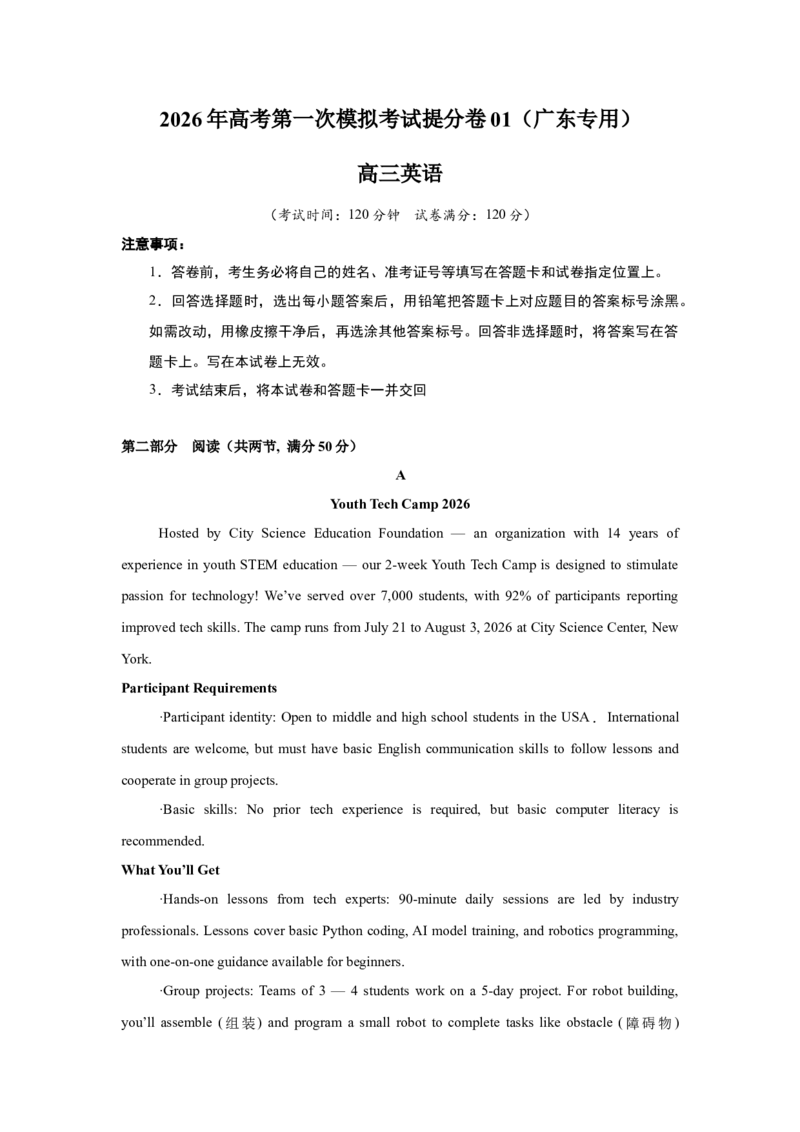
Youth Tech Camp 2026
Hosted by City Science Education Foundation — an organization with 14 years of
experience in youth STEM education — our 2-week Youth Tech Camp is designed to stimulate
passion for technology! We’ve served over 7,000 students, with 92% of participants reporting
improved tech skills. The camp runs from July 21 to August 3, 2026 at City Science Center, New
York.
Participant Requirements
·Participant identity: Open to middle and high school students in the USA .International
students are welcome, but must have basic English communication skills to follow lessons and
cooperate in group projects.
·Basic skills: No prior tech experience is required, but basic computer literacy is
recommended.
What You’ll Get
·Hands-on lessons from tech experts: 90-minute daily sessions are led by industry
professionals. Lessons cover basic Python coding, AI model training, and robotics programming,
with one-on-one guidance available for beginners.
·Group projects: Teams of 3 — 4 students work on a 5-day project. For robot building,
you’ll assemble ( 组装) and program a small robot to complete tasks like obstacle ( 障碍物)
avoidance. For app design, you’ll create a simple app (e.g., a to-do list or weather tracker) and
present it on the last day of the camp.
·Field trip to a tech company: A full-day visit to TechNova, a leading tech firm. You’ll tour
their AI lab, attend a talk by a senior engineer, and get a chance to test new tech products.
·Certificate of completion: A personalized certificate with your name, camp achievements,
and a feedback note from your instructor, which can be added to college applications.
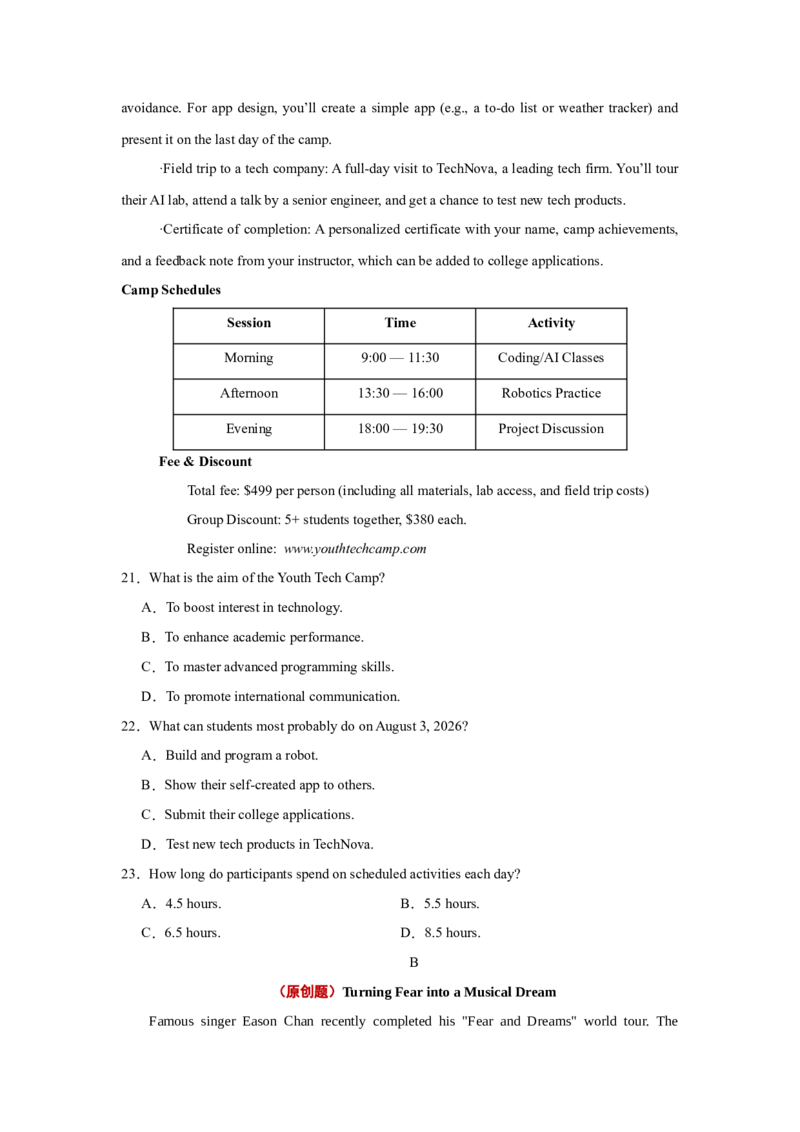
Camp Schedules
Session
Time
Activity
Morning
9:00 — 11:30
Coding/AI Classes
Afternoon
13:30 — 16:00
Robotics Practice
Evening
18:00 — 19:30
Project Discussion
Fee & Discount
Total fee: $499 per person (including all materials, lab access, and field trip costs)
Group Discount: 5+ students together, $380 each.
Register online: www.youthtechcamp.com
21.What is the aim of the Youth Tech Camp?
A.To boost interest in technology.
B.To enhance academic performance.
C.To master advanced programming skills.
D.To promote international communication.
22.What can students most probably do on August 3, 2026?
A.Build and program a robot.
B.Show their self-created app to others.
C.Submit their college applications.
D.Test new tech products in TechNova.
23.How long do participants spend on scheduled activities each day?
A.4.5 hours.
B.5.5 hours.
C.6.5 hours.
D.8.5 hours.
B
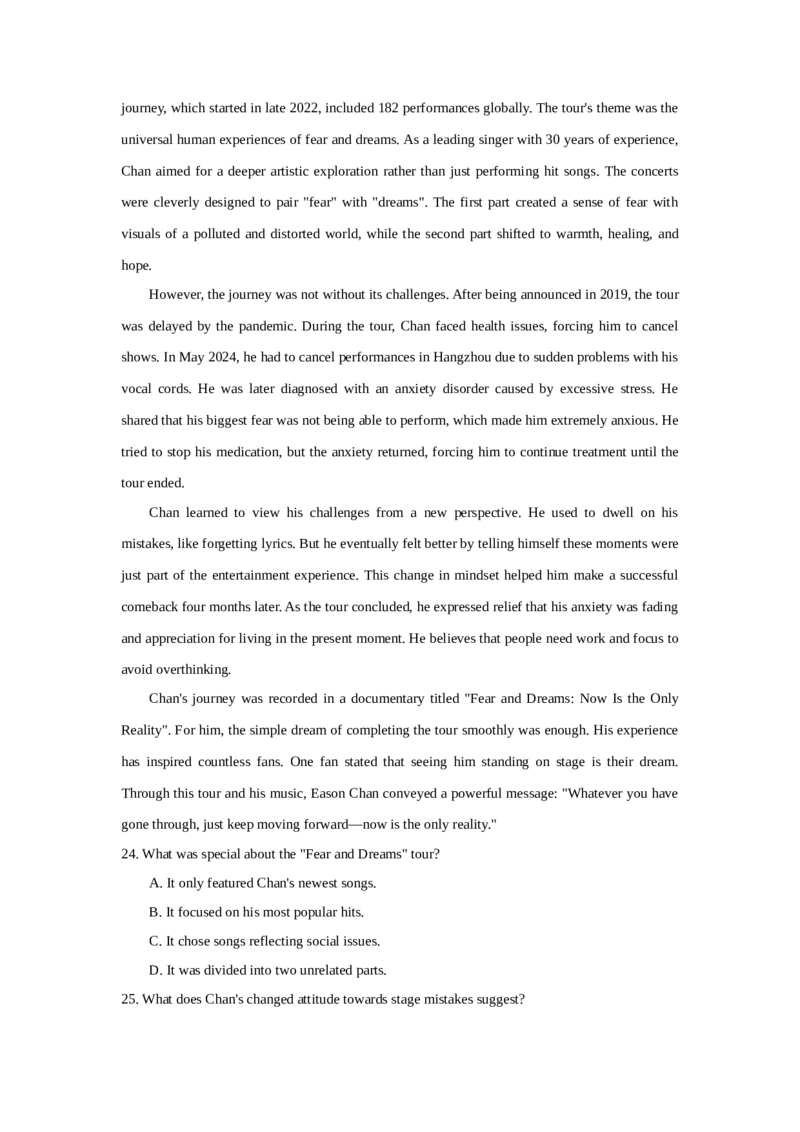
(原创题)Turning Fear into a Musical Dream
Famous singer Eason Chan recently completed his "Fear and Dreams" world tour. The
journey, which started in late 2022, included 182 performances globally. The tour's theme was the
universal human experiences of fear and dreams. As a leading singer with 30 years of experience,
Chan aimed for a deeper artistic exploration rather than just performing hit songs. The concerts
were cleverly designed to pair "fear" with "dreams". The first part created a sense of fear with
visuals of a polluted and distorted world, while the second part shifted to warmth, healing, and
hope.
However, the journey was not without its challenges. After being announced in 2019, the tour
was delayed by the pandemic. During the tour, Chan faced health issues, forcing him to cancel
shows. In May 2024, he had to cancel performances in Hangzhou due to sudden problems with his
vocal cords. He was later diagnosed with an anxiety disorder caused by excessive stress. He
shared that his biggest fear was not being able to perform, which made him extremely anxious. He
tried to stop his medication, but the anxiety returned, forcing him to continue treatment until the
tour ended.
Chan learned to view his challenges from a new perspective. He used to dwell on his
mistakes, like forgetting lyrics. But he eventually felt better by telling himself these moments were
just part of the entertainment experience. This change in mindset helped him make a successful
comeback four months later. As the tour concluded, he expressed relief that his anxiety was fading
and appreciation for living in the present moment. He believes that people need work and focus to
avoid overthinking.
Chan's journey was recorded in a documentary titled "Fear and Dreams: Now Is the Only
Reality". For him, the simple dream of completing the tour smoothly was enough. His experience
has inspired countless fans. One fan stated that seeing him standing on stage is their dream.
Through this tour and his music, Eason Chan conveyed a powerful message: "Whatever you have
gone through, just keep moving forward—now is the only reality."
24. What was special about the "Fear and Dreams" tour?
A. It only featured Chan's newest songs.
B. It focused on his most popular hits.
C. It chose songs reflecting social issues.
D. It was divided into two unrelated parts.
25. What does Chan's changed attitude towards stage mistakes suggest?
A. He began to take performances more seriously.
B. He learned to accept imperfection more easily.
C. He decided to quit performing to avoid errors.
D. He realized his fans did not care about mistakes.
26. What is the relationship between "fear" and "dreams" in Chan's view?
A. They are entirely opposite and cannot coexist.
B. Dreams are the natural result of overcoming fear.
C. They are two connected aspects of life's journey.
D. Dreams are more important than fear for success.
27. What core message does Chan want to share through his tour experience?
A. The pursuit of success is the most important goal.
B. One should move forward and live in the present.
C. Mental health problems are impossible to overcome.
D. Canceling shows is irresponsible to the audience.
C
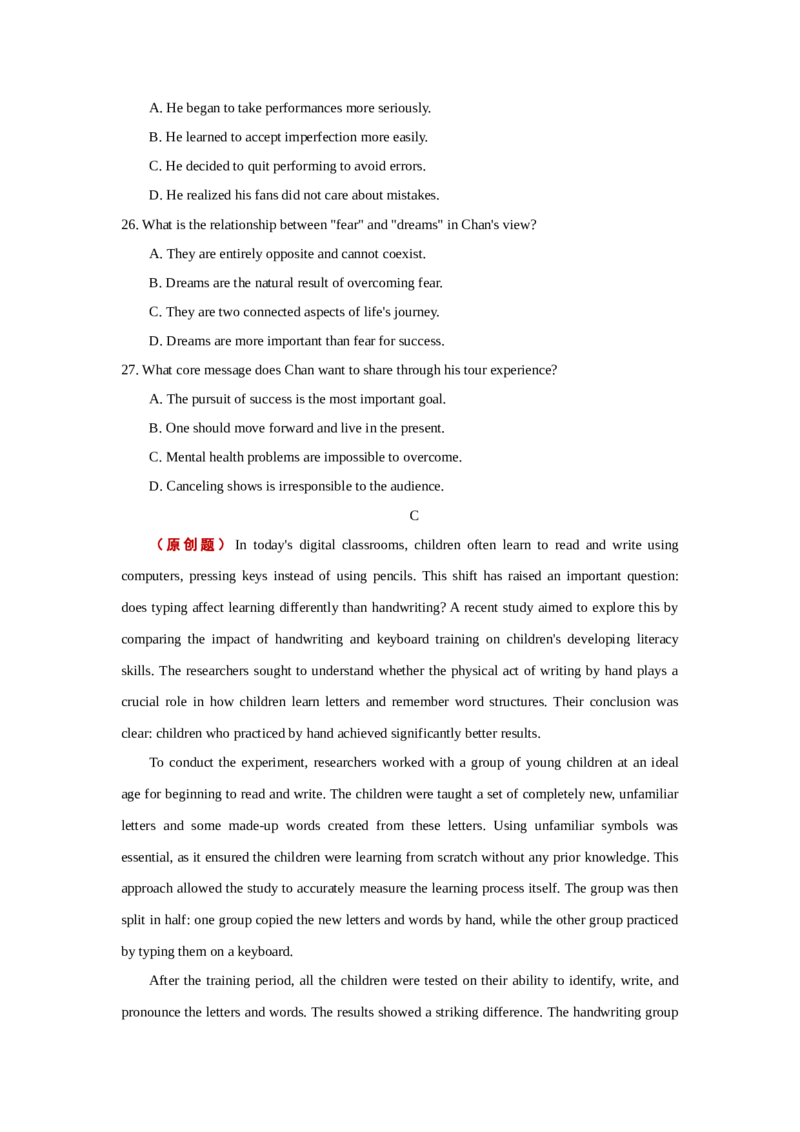
(原创题)In today's digital classrooms, children often learn to read and write using
computers, pressing keys instead of using pencils. This shift has raised an important question:
does typing affect learning differently than handwriting? A recent study aimed to explore this by
comparing the impact of handwriting and keyboard training on children's developing literacy
skills. The researchers sought to understand whether the physical act of writing by hand plays a
crucial role in how children learn letters and remember word structures. Their conclusion was
clear: children who practiced by hand achieved significantly better results.
To conduct the experiment, researchers worked with a group of young children at an ideal
age for beginning to read and write. The children were taught a set of completely new, unfamiliar
letters and some made-up words created from these letters. Using unfamiliar symbols was
essential, as it ensured the children were learning from scratch without any prior knowledge. This
approach allowed the study to accurately measure the learning process itself. The group was then
split in half: one group copied the new letters and words by hand, while the other group practiced
by typing them on a keyboard.
After the training period, all the children were tested on their ability to identify, write, and
pronounce the letters and words. The results showed a striking difference. The handwriting group
demonstrated much stronger skills, particularly in remembering and writing the made-up words.
This finding strongly supports the idea that the physical process of forming letters with your hand
is vital for memorization. When typing, one simply presses a key, but when writing, the brain
connects with the hand movements to create the letter's shape, strengthening the learning.
Furthermore, the study explored the best methods for handwriting practice. It compared
children who learned by tracing dotted lines with those who copied the letters freely on a blank
page. Interestingly, while both handwriting groups outperformed the typists, the children who
practiced free writing showed the highest level of skill. This suggests that although guided tracing
is helpful for absolute beginners, moving on to free writing is more beneficial for deeper learning.
In conclusion, the study highlights the irreplaceable value of handwriting in early education.
The physical connection between the hand and the brain is a powerful tool for learning. While
technology can be a useful resource, it should play a supporting, not a leading, role. Prioritizing
pencil-and-paper practice gives children the best possible foundation for developing strong
reading and writing abilities.
28. Why did researchers use unfamiliar letters and made-up words in the experiment?
A. To make the learning process more enjoyable for children.
B. To test the children's ability to learn different languages.
C. To compare the difficulty of various writing systems.
D. To ensure the children started from the same knowledge level.
29. What can be inferred about the relationship between handwriting and memory?
A. The physical act of writing strengthens memory.
B. Visual information is the only factor for memory.
C. Typing requires more mental effort than writing.
D. Children must use pencils to learn new skills.
30. What did the study find regarding the methods of handwriting practice?
A. Free writing is more effective than tracing after basic skills are learned.
B. Tracing letters should always be avoided for beginners.
C. Using different letter styles improves typing skills.
D. The method of handwriting has little impact on the outcome.
31. What is the author's primary suggestion for children's literacy education?
A. Digital tools should completely replace traditional methods.
B. Handwriting should be the main focus, with technology as a supplement.
C. Free writing is the only necessary skill for early learners.
D. Keyboard training is more efficient than handwriting.
D
(原创题)Researchers have recently uncovered a hidden danger in the world of software
development: the threat posed by artificial intelligence (AI) tools. As AI models become
increasingly popular among programmers for writing code, a new study reveals a serious security
risk known as "package hallucination." This occurs when an AI model generates or recommends a
third-party software library that does not actually exist. This seemingly simple error can create a
pathway for attackers to harm users.
The attack method is surprisingly direct. Imagine a developer asking an AI for help with
coding. The AI provides code that includes a command to install a software package. If this
package is a hallucination, it doesn't exist. However, a clever attacker can notice the AI
recommending this fake package. The attacker can then easily create a real package with the exact
same name and fill it with harmful code. The next time the AI suggests this package to another
trusting developer, that developer might download and install it, unknowingly introducing
malware onto their own computer.
This risk is growing because the use of AI in programming is now very common, and
developers are placing more trust in AI's abilities. As AI tools get better at coding tasks, users are
less likely to question their suggestions. This blind trust is precisely what attackers exploit. The
real danger is not just the bad code itself, but how it takes advantage of the confidence people
have in new technology, leading them into a trap without their awareness.
In their tests across different AI models, researchers found that commercial models were
significantly less likely to produce these hallucinations than open-source ones. They also noted
that the programming language Python was safer than JavaScript in this regard. While checking
packages against official lists might help reduce the risk, experts agree that the best solution is to
fix the problem at its source during the AI's development. Researchers have shared their findings
with major AI companies, hoping to encourage them to address this critical vulnerability in their
systems.
32. How do attackers make use of AI’s package hallucination?
A. By providing false information to the AI model.
B. By directly accessing the developer’s computer through the AI.
C. By creating a package with the same name but containing harmful code.
D. By preventing the installation of legitimate software packages.
33. Why is this threat particularly dangerous to developers according to the passage?
A. Because most developers lack basic coding skills.
B. Because AI tools are becoming increasingly trusted.
C. Because the majority of software packages are unsafe.
D. Because AI tools are unable to generate correct code.
34. Which of the following is the best title for the passage?
A. The Future of AI in Coding
B. How to Use AI Tools Effectively
C. The Hidden Danger of AI Coding Assistants
D. Open-source vs. Commercial AI Models
35. What does the researchers' action of sharing findings with AI companies imply?
A. They believe the problem can be solved.
B. They want to sell their research to these companies.
C. They consider AI companies as the attackers.
D. They have lost all trust in AI technology.
第二节(共5 小题;每小题2. 5 分, 满分12. 5 分)
阅读下面短文, 从短文后的选项中选出可以填入空白处的最佳选项。选项中有两项为
多余选项。
Many of us were told from an early age that, “you learn from your mistakes”. But is this
actually true?     36     Failure can be a teachable moment. But learning from our mistakes is,
in reality, very hard because we don’t like to fail. It doesn’t feel good, so we react to failure in
emotional ways, like giving up on a task too early, telling ourselves we don’t care whether we
succeed, or finding fault with the task itself.     37     “Most of us want to think of ourselves
as capable”, says Hallgeir Sjastad, a professor of psychology and leadership at the Norwegian
School of Economics, so when we fail “it poses a serious threat to our self-image”.
Fortunately, there is research to suggest that there are some strategies to help us overcome
the emotional barriers around failure.     38     Instead of asking “Why did I fail?” we could
ask “Why did Sam fail?”, for example. Multiple studies by psychologist Ethan Kross at the
University of Michigan show that adopting this perspective ( 视角) helps to soften our negative
emotional reactions, allowing us to look at failure more objectively.
    39     This strategy led to better levels of motivation and academic success in the test
groups — involving both adults and children — that were asked to give advice based on their own
failures.
The writer Samuel Beckett once said, “Fail again, fail better”. But it now seems that we
should be saying: “Fail again, fail smarter”.     40     But by learning to overcome the
emotional barriers around it, we may find the road to success is a little easier to navigate.
A.The short answer is “yes”.
B.Failure is an unavoidable part of life.
C.This is actually a kind of self-protection.
D.Smart people usually learn from others’ mistakes.
E.One of them is to adopt a third-person perspective.
F.The more mistakes you make, the less progress you’ll make.
G.Another strategy is giving advice to those who have similar experiences with us.
第三部分 语言运用(共两节,满分30 分)
第一节(共15 小题,每小题1 分,满分15 分)
阅读下面短文, 从每题所给的A、B、C 和D 四个选项中选出可以填入空白处的最佳选
项。
The weight of anxiety had been pressing down on me for months. The world seemed     41
, and I felt powerless. Then, one day, I     42     a local environmental group organizing a
tree-planting event. Something about the idea of contributing     43     to the planet attracted
me. I decided to give it a try, hoping it might make me feel better.
On the day of the     44    , I arrived at the park, feeling nervous and excited. The
group was already very     45    . People of all ages were digging holes, placing young trees,
and chatting happily. I grabbed a shovel and joined in. The physical work was tiring, but there was
a sense of     46     that I hadn’t felt in a long time.
As I planted each tree, I felt a sense of calm     47     over me. My hands were dirty,
but my mind was     48    . Planting a young tree felt like a     49     step towards
something bigger. I was making a difference, no matter how small.
During the breaks, I talked to the other     50    . They shared their stories and
motivations, and I realized I wasn’t alone in my     51     to create positive change. Their
enthusiasm was     52    , and I found myself laughing and connecting with people I had
never met before.
By the end of the day, I was tired but also felt full of     53    . Looking at the rows of
newly planted trees, I felt a sense of accomplishment. The anxiety didn’t disappear, but it had
54    . I had taken action, and in doing so, I had found a way to     55     myself.
41.A.disordered
B.developed
C.dynamic
D.distant
42.A.called for
B.set up
C.came across
D.depended on
43.A.positively
B.desperately
C.permanently
D.historically
44.A.ceremony
B.activity
C.tradition
D.contest
45.A.tense
B.patient
C.busy
D.formal
46.A.direction
B.purpose
C.progress
D.humour
47.A.jump
B.knock
C.flee
D.wash
48.A.clearing
B.suffering
C.imagining
D.wandering
49.A.standard
B.challenging
C.heavy
D.genuine
50.A.conductors
B.specialists
C.volunteers
D.members
51.A.desire
B.permission
C.ability
D.courage
52.A.innocent
B.sensitive
C.precise
D.infectious
53.A.sorrow
B.relief
C.regret
D.guidance
54.A.entered
B.developed
C.lessened
D.finished
55.A.trust
B.persuade
C.trap
D.heal
第二节(共10 小题;每小题1.5 分 ,满分15 分)
阅读下面短文,在空白处填入1 个适当的单词或括号内单词的正确形式。
In China's Palace Museum, experts are busy working on a plaque ( 匾额)    56
(weather) by centuries. According to Ma Yue, deputy head of the group, the calligraphy consists of
a silk layer carrying the ink    57    a paper layer supporting it. The restoration group must
separate the two layers.
Technological methods come into play,    58    (help) experts analyze the components of
the ink and silk that ancient people used, and source historically consistent materials. Ma says for
some    59    (severe) worn pieces, they have created replicas with digital technology, while
the restored originals will be placed in storage.
For the ancient paintings and calligraphy, the mounting ( 装裱) methods and restoration
techniques are    60    national-level intangible cultural heritage item. "Even today, we
maintain a master-apprentice (师徒) system. Graduates of various majors joining our group must
train    61    their masters' guidance for three years, refining their mounting and restoration
skills. That's how our restorers    62    (cultivate)," says Ma.
In recent years, more young    63    (profession) have joined the museum's restoration
teams, including Jin Dazhao, 34, from the metal artifacts group. Jin believes that restoring cultural
relics is not simply mending    64    is broken, but about continuing a chain of human
creativity and memory. "Through each careful stroke and polish," he adds, "we are enabling
history     65    (breathe) again."
第四部分 写作(共两节, 满分40 分)
第一节(满分15 分)
    假定你是李华,你校体育文化节设置了“中国传统体育项目体验区”,吸引了在校外
籍交换生参与。你的英国笔友Henry 来信询问详情。请你给他回复一封邮件,内容包括:
1.体验区主要活动;
2.交换生参与情况;
3.活动感想与意义。
注意:
1.词数80 个词左右;
2.可适当增加细节,以使行文连贯;
3.开头和结尾已给出,不计入总词数。
Dear Henry,
I’m glad to receive your email asking about the “Chinese Traditional Sports Area”.
_______________________________________________________________________________
_______________________________________________________________________________
_______________________________________________________________________________
_______________________________________________________________________________
_______________________________________________________________________________
_______________________________________________________________________________
_______________________________________________________________________________
_________________________________________________________________
Yours sincerely,
Li Hua
第二节(满分25 分)
阅读下面材料,根据其内容和所给段落开头语续写两段,使之构成一篇完整的短文。
I still remember that day well: it was a cold, dreary (沉闷的) day in late October. My son
Gary and I had just finished setting out the last of our Halloween decorations. Although we only
lived a few dozen miles outside of Indianapolis, our home might as well have been located in the
remote wilderness for how isolated we were. With only a long, winding driveway connecting our
home to a sleepy road, we weren’t expecting many visitors for Halloween in our neck of the
woods.
I had just settled down for some hot cocoa and the evening news on TV when I heard
Gary’s voice ring out from the outside. “Dad! I need your help Hurry!”
Throwing my shoes on, I rushed outside to see what was the matter. My feet crushed over
wet red and orange leaves as I made my way over to the garbage cans at the end of the long
driveway. I came to stop next to my son as I bent over panting, asking what was the matter
between gasps of air. Barely taller than the trash can he was standing next to, he waved me over as
we both peered into the trash can together.
Only seeing the pile of wet leaves we had raked together from earlier, I was about to scold
Gary for playing a trick on me when, suddenly, I noticed some movement and rustling. Worried
that it might be some dangerous animal, I went over to grab a rake that we had left on the lawn
and slowly lowered it into the trash can with the stick-end first.
Suddenly, I could see the streaks of black and gray fur: a raccoon (浣熊)! After making eye
contact with us, the raccoon began squeaking for our attention. It seemed cold, wet and miserable.
Although I was initially against the idea of even touching the thing, Gary begged and pleaded (恳
求) with me for us to help the creature. At last, I gave in to his pleading.
注意:
1.续写词数应为150 个左右;
2.请按如下格式在答题纸的相应位置作答。
We took a spare towel from the house and wrapped the raccoon like a furry baby.
_______________________________________________________________________________
_______________________________________________________________________________
_______________________________________________________________________________
_______________________________________________________________________________
_______________________________________________________________________________
____________________________________________________________
A year later, we spotted something moving in the woods in our backyard.
_______________________________________________________________________________
_______________________________________________________________________________
_______________________________________________________________________________
_______________________________________________________________________________
_______________________________________________________________________________
____________________________________________________________