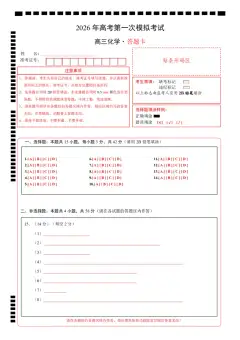
2026 年高考第一次模拟考试
高三英语
本试卷共10 页,满分120 分,考试时间120 分钟。
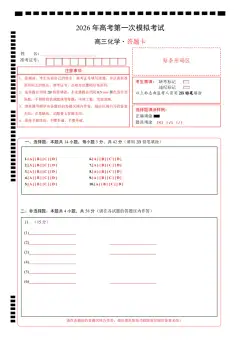
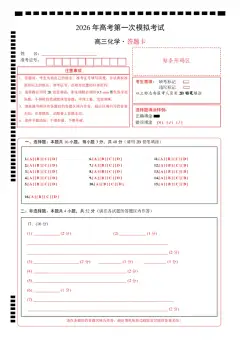
注意事项:
1.答卷时,考生应清晰识字过的词汇或者书写自己的学校、班级、姓名座位号和考号填写在答题卡相应的
位置上,再用2B 铅笔把号码对应填涂黑。
2.选择题每小题选出答案区后,用2B 铅笔把答案卡上对应题目的答案标号涂黑;如需改动,用橡皮擦干净
后,再选涂其他答案;不能答在试卷上。
3.非选择题必须用黑色字迹的钢笔或签字笔作答,答案必须写在答题卡各题目指定区域内的相应位置上;
如需改动,先划掉原来的答案,然后再写上新的答案;不准使用铅笔或涂改液。不按以上要求作答的答案
无效。
4.考生必须保证答题卡的整洁,考试结束后,将试卷和答题卡一并交回。
第二部分 阅读(共两节,满分50 分)
第一节(共15 小题;每小题2.5 分,满分37.5 分)
阅读下列短文,从每题所给的A、B、C、D 四个选项中选出最佳选项。
A
The news cycle is driving us to the edge of madness, so why not switch off, unplug and pick up a book? We
know you could use a laugh right now — and luckily, several thousands of you told us all about the books, stories
and poems that make you laugh.
We took your votes and with the help of our panel (专家小组) of expert judges we created this list of 100
reads designed to make you laugh out loud. Want slice-of-life essays? Loopy poetry? Texts from famous literary
figures? Scroll down — we’ve got it all.
As with all our reader polls, this is a curated ( 精心筹划的) list and not a straight-up popularity contest;
unlike last year, you’ll see the books are grouped into categories rather than ranked from one to 100.
And, as always, there are a few things that didn’t make the list — surprisingly, Shakespeare didn’t get
enough votes to make it to the semifinals. Then there were books that didn’t quite stand the test of time, or were so
new we couldn’t tell whether they’d stand up.
Some of the authors on this list are incredibly popular, and you voted them in over and over again. Because
space is limited, we try to hold each author to one spot on the list, but there are some exceptions such as Nora
Ephron, who our judges thought was perfect.
And speaking of our judges, you will find a couple of their works on the list this year — we don’t let judges
vote for their own works, but readers loved works such as Samantha Irby’s We Are Never Meeting In Real Life, so
the panel agreed they should stay.
Laughter is the best medicine. Just click here and start reading!
1.How is the list of this year different from that of last year?
A.More books are included.
B.It is made all by readers.
C.It mainly focuses on poetry.
D.The listed books are classified.
2.What can we learn about Nora Ephron?
A.She fails to stand the test of time.
B.She is not so popular as other authors.
C.She gets more than one spot on the list.
D.She belongs to the panel of expert judges.
3.Why is We Are Never Meeting In Real Life kept on the list?
A.It is written by a judge.
B.It reflects real life.
C.It gets enough readers’ votes.
D.It attracts the experts.
B
Kristin Kimball, a travel writer, drove from New York studio to Pennsylvania to write about a young
sustainable farmer she’d heard of. When she arrived at the farm, the farmer said he was too busy to be interviewed,
even though they had previously scheduled it.
“Instead,” Kimball remembers,“ he handed me a garden tool and said, ‘There’s the vegetable land.’ That was
the first time that I actually did any farm work, and yet when I started doing the work, I was shocked at how
viscerally I responded.”
“And something happened that day. I just fell in love with the work.” she adds. “I think that human beings
are in some way born to be farmers. This is what most people in the history of the world have focused their energy
on.”
In a way, Kristin Kimball was lucky. When she decided to move to a farm in upstate New York, she had no
idea what she was getting into. Seven years after her life-changing move from Manhattan to Essex Farm, Kimball
has documented her adjustment to rural living in her new book, The Dirty Life. The title of her book, Kimball says,
comes from the fact that farm work is consistently dirty. “I had no idea you could be dirty in so many different
ways,” she says. “There’s dirt. There’s blood. There’s sweat. There’s your own sweat, and the sweat of the
animals.”
In spite of the constant hard work, Kimball’s farm still has its quiet, romantic moments. The first year she
planted potatoes, the yield (收获) was enormous — around 10,000 pounds. Friends were called to help. “It was
truly fall,” Kimball writes:
The air was still cold at noon despite the bright sun. We boiled potatoes in their skins in the field, and served
them steaming in napkins (餐巾纸). We all warmed our chilled fingers on them, popped them open, invested them
with quantities of butter and salt. If there is a more perfect way to celebrate the potato’s earthy, sustaining essence
(本质), I have not discovered it yet.
4.Which of the following can best describe Kimball’s path to farming?
A.Well-planned. B.Interest-based.
C.Unexpectedly-taken. D.Curiosity-driven.
5.What does the underlined word “viscerally” in paragraph 2 mean?
A.Naturally.
B.Patiently.
C.Passively.
D.Hesitantly.
6.Why did Kimball write the book?
A.To share the joy of harvest.
B.To promote the benefits of farming.
C.To record her adaptation to country life. D.To introduce the farming skills she learned.
7.What does Kimball intend to express in the last paragraph?
A.The happiness in cooking potatoes.
B.The satisfaction gained from farm life.
C.The significance of teamwork in farming.
D.The challenges of farming in cold weather.
C
Urban traffic gridlock ( 交通堵塞) has evolved into a pressing global issue, with studies linking it to
economic losses, air pollution, and reduced quality of life. A 2024 meta-analysis (元分析) published in the Journal
of Urban Planning and Transport — combining data from 127 cities across 38 countries — reveals that the average
commuter spends 97 hours annually stuck in traffic, translating to a 4.2% drag on regional GDP. The research, led
by Dr. Elena Marquez from the Global Transport Institute, identifies three core drivers: uncoordinated urban
sprawl, inadequate public transit capacity, and outdated traffic management systems.
To tackle this, nations have adopted divergent strategies rooted in empirical (实证的) research. In Singapore,
the Electronic Road Pricing (ERP) system — first implemented in 1998 and updated in 2023 — adjusts tolls
dynamically based on real-time traffic flow. Dr. Marquez’s team found that ERP reduced peak-hour congestion by
31% and cut carbon emissions by 22% in targeted zones. Crucially, the revenue generated is reinvested in
expanding metro lines, creating a self-sustaining cycle. Meanwhile, Copenhagen has prioritized active transport:
since 2010, the city has built 420 kilometers of dedicated bike lanes, paired with subsidies for electric bicycles. The
study notes that 47% of commutes in the city are now by bike, and traffic-related air pollution has dropped by 38%
— a model hailed as “cost-effective and environmentally synergistic.”
However, not all approaches yield equal results. Los Angeles’s 2019 “Congestion Pricing Pilot” faced
backlash due to flawed implementation: tolls were set uniformly instead of dynamically, leading to traffic diversion
to residential streets and minimal overall improvement. Dr. Marquez emphasizes that successful interventions
“require alignment with local urban structures and behavioral patterns, not one-size-fits-all policies.” Another case
in point is Tokyo: the city’s integrated transit network, which connects subways, buses, and commuter trains with
seamless ticketing, has reduced car dependency by 58% over the past two decades. The research highlights that
Tokyo’s success stems from “integrated planning that treats transport as a system, not isolated components.”
The meta-analysis concludes that sustainable congestion relief demands a multi-pronged ( 多方面的)
approach: combining demand-side measures (like dynamic pricing), supply-side investments (in public transit), and
behavioral incentives (for active transport). Dr. Marquez warns, “Delaying action will only exacerbate the crisis, as
urban populations grow and car ownership rises in emerging economies.” For cities grappling with gridlock, the
research offers a clear roadmap: evidence-based policies tailored to local contexts, not ideological or short-term
fixes.
8.What can we infer about Singapore’s ERP system from the passage?
A.It has remained unchanged since its initial implementation in 1998.
B.Its tolls are adjusted according to real-time traffic conditions.
C.It directly reduces regional GDP by 4.2% due to toll expenses.
D.It uses all generated revenue to subsidize electric vehicles.
9.What can be inferred about Copenhagen’s traffic strategy?
A.It has eliminated all traffic-related air pollution in the city.
B.It relies solely on dedicated bike lanes to reduce congestion.
C.It has made cycling the only form of commuter transport.
D.It combines infrastructure construction with financial incentives.
10.Why did Los Angeles’s Congestion Pricing Pilot fail to achieve significant results?
A.It lacked financial support for public transit expansion.
B.It adopted a one-size-fits-all tolling strategy.
C.It ignored the potential of active transport like cycling.
D.It diverted all traffic to residential areas intentionally.
11.Which of the following best reflects the core conclusion of Dr. Marquez’s research?
A.Congestion relief requires context-specific, multi-dimensional evidence-based policies.
B.Active transport is the most effective solution to traffic congestion worldwide.
C.Dynamic toll systems are superior to all other congestion management strategies.
D.Urban sprawl is the sole root cause of global traffic gridlock.
D
Radiation, the emission of energy as waves or particles, is ubiquitous (普遍存在的) in daily life — from
sunlight to smartphone signals. It is divided into two main types: ionizing ( 电离的) and non-ionizing radiation,
with distinct properties and health impacts. Understanding their differences is key to minimizing risks.
Ionizing radiation has high energy, capable of removing electrons from atoms and damaging DNA .
Common sources include medical imaging (X-rays, CT scans), radioactive elements in the Earth’s crust, and
cosmic rays. High-dose short-term exposure causes acute sickness (nausea, organ failure), while long-term low-
dose exposure increases cancer risk. For example, Chernobyl disaster survivors exposed as children had much
higher thyroid cancer rates.
Non-ionizing radiation, with lower energy, cannot ionize atoms. It includes radio waves (cell phones, Wi-Fi),
microwaves, visible light, and UV radiation. Most is harmless, but UV from the sun or tanning beds damages skin,
causing sunburn, premature aging, and skin cancer. Damaged microwaves may cause tissue burns, though standard
ones are safe.
Biologically, ionizing radiation is a confirmed carcinogen (致癌物), with cumulative risks. Non-ionizing
radiation (except high-intensity UV) rarely damages DNA directly, but emerging research suggests prolonged
exposure to some forms (e.g., low-frequency fields from power lines) may have subtle effects — evidence for
significant risks remains inconclusive.
Global safety standards limit exposure: medical procedures use the lowest effective dose, and devices like
cell phones have restricted power output. In daily life, wearing sunscreen, limiting unnecessary imaging, and
keeping distance from active microwaves reduce risks.
12.Which of the following is a source of ionizing radiation?
A.Wi-Fi routers
B.CT scans
C.Household microwaves
D.Lamp light
13.The Chernobyl example is used to show that .
A.nuclear accidents cause acute radiation sickness
B.children are more sensitive to all radiation
C.long-term low-dose ionizing radiation may lead to cancer
D.ionizing radiation results in immediate organ failure
14.What can be inferred about non-ionizing radiation?
A.It is totally harmless due to low energy. B.Only high-intensity UV is harmful.
C.Its potential risks need further study.
D.Power lines’ radiation causes cancer.
15.The passage implies radiation safety mainly depends on .
A.radiation type and exposure duration
B.distance from sources and user age
C.regional regulatory standards
D.device technological design
第二节(共5 小题, 每小题2. 5 分, 共12. 5 分)
阅读下面短文, 从短文后的选项中选出可以填入空白处的最佳选项。选项中有两项为多余选项。
Artificial Intelligence (AI) geolocation (互联网定位技术) solutions are changing the way researchers track
and monitor wildlife, enabling more powerful conservation efforts. These systems use advanced sensors, satellite
imagery, and machine learning algorithms ( 算法) to gather real-time data on animal movements, habitat
preferences, and migration patterns.

 1  6
Traditional tracking methods often rely on non-automatic tracking or inconvenient necklace-like systems,
which may cause stress and discomfort to the animals.

 1  7

  The devices can work as tags and the camera
traps can be set up remotely, which decreases human impact on wildlife.
In addition, AI-powered devices collect and analyze data precisely. Through their assistance, scientists can
gain insights into habitat choices and evaluate the effect of global warming on wild animal locations.

 1  8

For example, by analyzing the collected data, conservationists can promote targeted habitat restoration efforts
according to the patterns and connections they discovered with the help of AI geolocation devices.


 1  9

  By monitoring animals’ behavioral changes in real-time, researchers can quickly detect signs of
environmental issues. Sudden changes in an animal’s movements could indicate threats or problems. Researchers
can then respond immediately, potentially saving the animal’s life.
Sharing geolocation data through online platforms can also help raise awareness about protecting endangered
species.

 2  0

  This help them feel more connected to the issues wildlife face in habitats. The bond promotes
a sense of responsibility among individuals and encourages them to contribute to wildlife conservation efforts
through various means, such as donations, volunteer work, and so on.
A.This knowledge enables them to make accurate and efficient decisions.
B.However, AI tracking does not require disturbing contact with the animals.
C.AI monitoring needs fewer battery replacements than the traditional methods.
D.The solutions have offered the following key benefits to wildlife conservation.
E.Directly engaging with conservation efforts gives people a first-hand experience.
F.The AI geolocation technology significantly reduces the need for massive fieldwork.
G.With real-time data, the AI solutions also function as an early warning for wildlife risks.
第三部分 语言运用(共两节, 满分30 分)
第一节(共15 小题;每小题1 分, 共15 分)
阅读下面短文,从每题所给的A、B、C、D 四个选项中选出可以填入空白处的最佳选项。
I experienced a day when I was extraordinarily

 2  1

 . I’m never a picture of grace, but on this particular
day, I seemed to be

 2  2

  everything. It’s an old church, and the floor is

 2  3

  in some places, so my fall
was the floor’s fault. But when I fell again on my way out to the car, and yet again in my own home, I began to
grow

 2  4

 . Had I let myself get so stressed out that I had

 2  5

  become sick?
Having been raised by devoted Christian parents who also worked in the mental-health field, I tended to look
for spiritual and emotional reasons before I headed to the local

 2  6

 . I have the calming practice that

 2  7
a yoga pose with a breath prayer. I went to

 2  8

  more comfortable clothes for the exercise, and as I removed
my shoes, I was

 2  9

 !
I wasn’t having a stroke at all. I had completely worn out my favorite pair of sandals. The soles (鞋底) of
both shoes were split in two! I had

 3  0

  all the possibilities to figure out what was causing my clumsiness.
It never occurred to me to check my soles.
So often when we start to feel

 3  1

 , we look for ways to make things better. But just as it never
occurred to me to check the soles of my shoes, our own souls are the very

 3  2

  thing we think of to check.
Take a moment to remember the last time you sat still, meditating. If you can’t remember when that was, it might
be a(n)

 3  3

 .
The local cobbler (鞋匠) said my soles were irreparable. We had a good

 3  4

 , but it was time to let
them go. Fortunately for us, our souls can be mended and restored — once we realize they are in need of

 3  5
.
21.A.busy
B.clumsy
C.stressed
D.bored
22.A.going through B.stepping on
C.falling off
D.tripping over
23.A.uneven
B.sharp
C.stained
D.shallow
24.A.inspired
B.grieved
C.concerned
D.interested
25.A.luckily
B.literally
C.obviously
D.doubtfully
26.A.doctor
B.coach
C.tailor
D.psychologist
27.A.exchanges
B.equips
C.associates
D.combines
28.A.wrap up
B.take off
C.change into
D.look after
29.A.rescued
B.cured
C.injured
D.slipped
30.A.exhausted
B.predicted
C.ignored
D.discussed
31.A.delighted
B.divided
C.overwhelmed
D.thrilled
32.A.best
B.last
C.easiest
D.hardest
33.A.mistake
B.solution
C.test
D.clue
34.A.run
B.exercise
C.yoga
D.gesture
35.A.repair
B.review
C.response
D.replacement
第二节(共10 小题;每小题1. 5 分, 满分15 分)
阅读下面短文,在空白处填入1 个适当的单词或括号内单词的正确形式。
In China, calligraphy refers to the art of writing Chinese characters with a special pen or a brush. Over the
history of Chinese art, calligraphy has always been held in equal importance to painting.
Seal script (篆书) is one of the ancient styles of writing Chinese characters that

 3  6

  (be) common
throughout the latter half of 1000 BC. It developed

 3  7

  (organic) out of the Zhou Dynasty script. In the
beginning, seal script had no uniformity and many characters were written

 3  8

  different forms till 221
BC,

 3  9

  the first emperor of Qin united the whole of China under one central government. He ordered Li
Si to collect and sort all the different systems of writing still common in different parts of the country in an effort
4  0

  (unite) the written language under one system. Li Si successfully completed the task,

 4  1

  (create)
the ancient zhuan(small seal)script. From then on, the Qin version of seal script finally became the standard and
4  2

  (adopt) as the formal script for all of China during the Qin Dynasty.
Today, we have a

 4  3

  (culture) relic(遗迹)of this ancient writing on a stone standing in the Dai
Temple of Mount Tai in Shandong Province, which was created by Li Si.

 4  4

  2,200-year-old stone, worn
by age and weather, has only nine and a half characters

 4  5

  (leave) on it. However, the stone still remains
a crucial artwork for studying early Chinese calligraphy.
第四部分 写作(共两节,满分40 分)
第一节(满分15 分)
46.假定你是李华,在即将到来的学校趣味体育运动会中,你想邀请你的交换生同学Chris 共同报名参加
一项体育运动。请给他发一封电子邮件,内容包括:
(1)写信的目的;
(2)介绍你想参加的运动项目;
(3)期待回复。
注意:
(1)写作词数应为80 个左右;
(2)请按如下格式在答题卡的相应位置作答。
Dear Chris,
____________________________________________________________________________________________
____________________________________________________________________________________________
____________________________________________________________________________________________
____________________________________________________________________________________________
_______________________________________________________________________________________
Yours,
Li Hua
第二节(满分25 分)
47.阅读下面材料,根据其内容和所给段落开头语续写两段,使之构成一篇完整的短文。
It was the last day before moving into the new house. Mr. and Mrs. Martin wanted to make it warm and
lovely, so they decided to do some decorating themselves. That morning, Mrs. Martin stood at the door, reminding
her busy husband. “Don’t climb too high, don’t move heavy boxes, and don’t forget to rest,” she said again and
again, before she eventually headed out to buy curtains.
Earlier, their daughter Emily had called. She said she was tied up with her job in another city, but promised,
“Don’t worry, we’ll celebrate together soon.” The couple missed her, of course, but they smiled at each other and
agreed it would be meaningful to get the new home ready, a warm welcome awaiting their daughter’s arrival.
Mr. Martin waved goodbye to his wife and went back to his decorating work, confident and full of energy at
first. But soon the living room turned into a battlefield. Boxes, nails, a hammer and screwdrivers lay everywhere.
Paint splashed onto the floor, and the wall looked like a child’s drawing. And several photo frames were scattered
on the ground.
“A spider!” Mr. Martin climbed onto a shaky stool to chase it away-his wife hated those things — but instead
he slipped and broke a photo frame. “Ouch, my back!” he groaned, sweat trickling down his forehead. He began to
wonder whether he was really able to do this job alone.
Then came a sharp smell from the kitchen. “Oh no, my cake!” Mr. Martin dragged himself to open the oven.
The cake, which he had planned to surprise his wife, was now nothing but a hard black rock. He stared at it,
shaking his head. “Should I admit the mess? Or pretend nothing happened?” he whispered. Suddenly, the door
creaked open. Mrs. Martin stepped inside with the new curtains in her arms.
注意:
(1)续写词数应为150 左右;
(2)请按如下格式在答题卡的相应位置作答。
Paragraph 1: For a moment, Mrs. Martin stood frozen.
____________________________________________________________________________________________
____________________________________________________________________________________________
____________________________________________________________________________________________
____________________________________________________________________________________________
___________________________
Paragraph 2: With the new curtains finally in place, the doorbell rang.
____________________________________________________________________________________________
____________________________________________________________________________________________
____________________________________________________________________________________________
____________________________________________________________________________________________
___________________________