2026 年高考第一次模拟考试
高三英语
本试卷共10 页,满分120 分,考试时间120 分钟
注意事项:
1.答卷时,考生应清晰识字过的词汇或者书写自己的学校、班级、姓名座位号和考号填写在答题卡相应的
位置上,再用2B 铅笔把号码对应填涂黑。
2.选择题每小题选出答案区后,用2B 铅笔把答案卡上对应题目的答案标号涂黑;如需改动,用橡皮擦干净
后,再选涂其他答案;不能答在试卷上。
3.非选择题必须用黑色字迹的钢笔或签字笔作答,答案必须写在答题卡各题目指定区域内的相应位置上;
如需改动,先划掉原来的答案,然后再写上新的答案;不准使用铅笔或涂改液。不按以上要求作答的答案
无效。
4.考生必须保证答题卡的整洁,考试结束后,将试卷和答题卡一并交回。
第二部分 阅读(共两节,满分50 分)
第一节(共15 小题;每小题2.5 分,满分37.5 分)
阅读下列短文,从每题所给的A、B、C、D 四个选项中选出最佳选项。
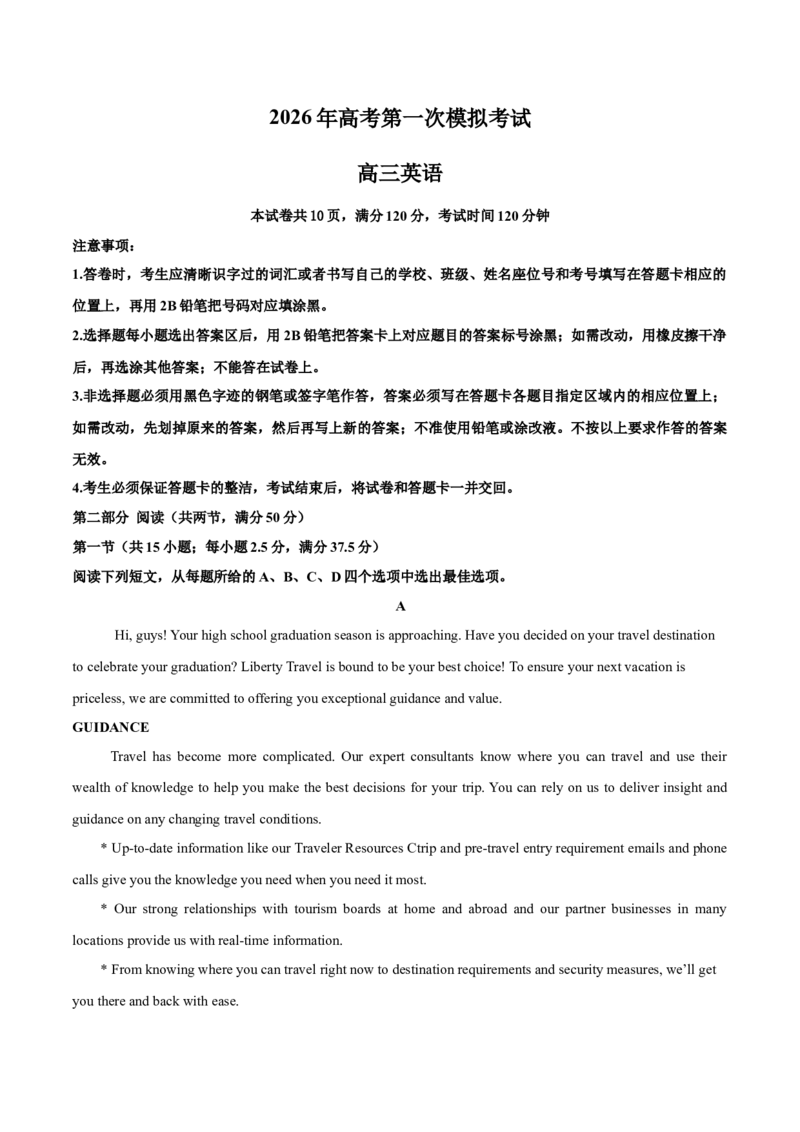
A
Hi, guys! Your high school graduation season is approaching. Have you decided on your travel destination
to celebrate your graduation? Liberty Travel is bound to be your best choice! To ensure your next vacation is
priceless, we are committed to offering you exceptional guidance and value.
GUIDANCE
Travel has become more complicated. Our expert consultants know where you can travel and use their
wealth of knowledge to help you make the best decisions for your trip. You can rely on us to deliver insight and
guidance on any changing travel conditions.
* Up-to-date information like our Traveler Resources Ctrip and pre-travel entry requirement emails and phone
calls give you the knowledge you need when you need it most.
* Our strong relationships with tourism boards at home and abroad and our partner businesses in many
locations provide us with real-time information.
* From knowing where you can travel right now to destination requirements and security measures, we’ll get
you there and back with ease.
VALUE
* We know traveling. Liberty Travel takes pride in our selection of partners, and the rates and benefits tailored
for our customers. We always have a fresh range of deals that are irresistible.
* We offer incredible value through our irresistible deals, exclusive benefits, and expert picks from the best
deals in the industry.
* The one-to-one customer service offline and personalized travel planning come at no extra cost.
At Liberty Travel it’s the customers who make a difference. Our travel experts craft the perfect trip for every
traveler through our award-winning customer service. Please contact us. We bet you will have an unforgettable
graduation journey of a lifetime.
1.What service can Liberty Travel offer?
A.The most convenient transportation.
B.Expert consultants’ guidance.
C.Cheapest travel packages.
D.Regular customers’ reviews.
2.What can customers get for free?
A.Travel insurance.
B.Business partners.
C.Exclusive benefits.
D.Tailored planning.
3.What is the type of the text?
A.A story.
B.A guide.
C.An advertisement.
D.A plan.
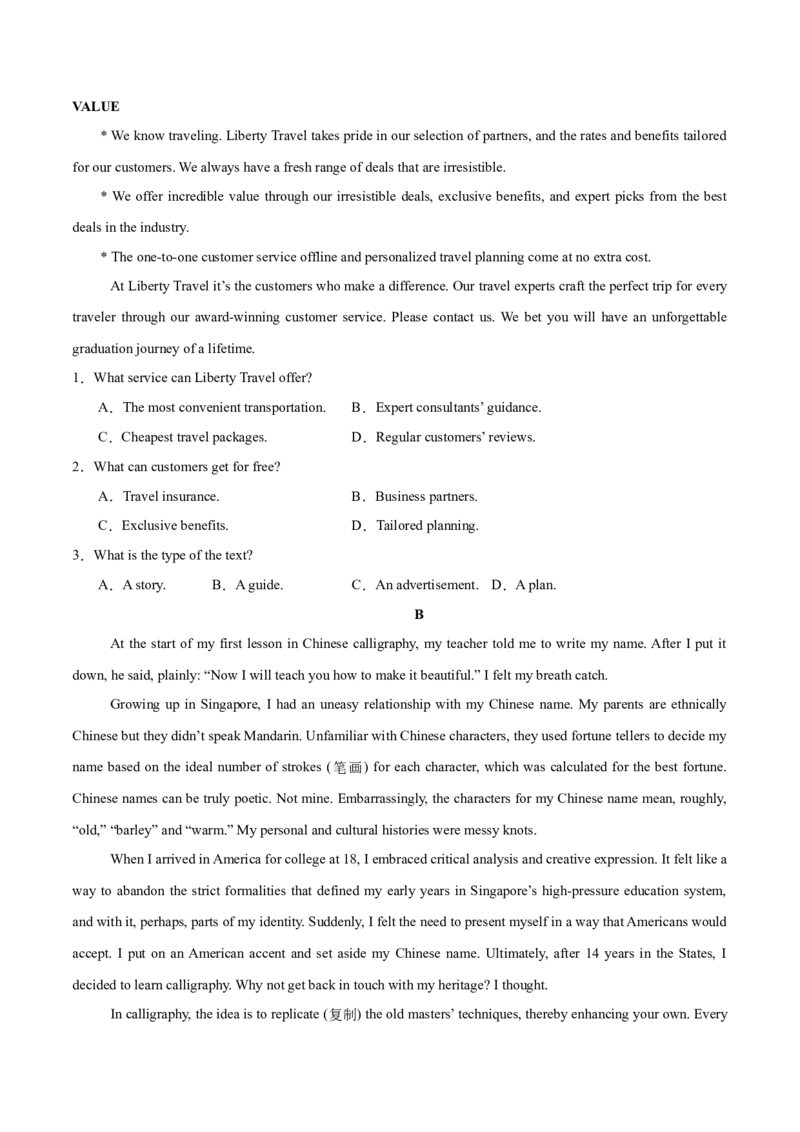
B
At the start of my first lesson in Chinese calligraphy, my teacher told me to write my name. After I put it
down, he said, plainly: “Now I will teach you how to make it beautiful.” I felt my breath catch.
Growing up in Singapore, I had an uneasy relationship with my Chinese name. My parents are ethnically
Chinese but they didn’t speak Mandarin. Unfamiliar with Chinese characters, they used fortune tellers to decide my
name based on the ideal number of strokes (笔画) for each character, which was calculated for the best fortune.
Chinese names can be truly poetic. Not mine. Embarrassingly, the characters for my Chinese name mean, roughly,
“old,” “barley” and “warm.” My personal and cultural histories were messy knots.
When I arrived in America for college at 18, I embraced critical analysis and creative expression. It felt like a
way to abandon the strict formalities that defined my early years in Singapore’s high-pressure education system,
and with it, perhaps, parts of my identity. Suddenly, I felt the need to present myself in a way that Americans would
accept. I put on an American accent and set aside my Chinese name. Ultimately, after 14 years in the States, I
decided to learn calligraphy. Why not get back in touch with my heritage? I thought.
In calligraphy, the idea is to replicate (复制) the old masters’ techniques, thereby enhancing your own. Every
week, my teacher would evaluate my writing. “You need to be braver,” he once observed. “Your challenge is in
producing a bold stroke.” For years, I had prided myself on developing an image of integration and confidence
despite deep insecurities, but my writing betrayed me.
I had been learning calligraphy to try to get in touch with my cultural roots, but what I was really seeking
was a return to myself. That first lesson came with the terrific promise that what had been shameful in myself could
be made beautiful—and that I could be the one to do that work. I know now that what calligraphy teaches me is not
the value of replication but the possibility that I could know myself more fully.
4.What criterion guided the selection of the author’s Chinese name?
A.Poetic sound patterns.
B.Ideal symbolic images.
C.Favorable stroke counts.
D.Positive literal meanings.
5.Why did the author adopt an American accent?
A.To break with tradition.
B.To fit into the community.
C.To achieve academic success.
D.To facilitate language learning.
6.What have we learned about the author’s experience with calligraphy?
A.It revealed her inner self.
B.It improved her public image.
C.It presented no challenge to her.
D.It enhanced her replication skills.
7.What has the author learned from calligraphy?
A.Fortune favors the bold.
B.Embrace who you truly are.
C.Our roots define our identity.
D.Planning is good, but doing is better.
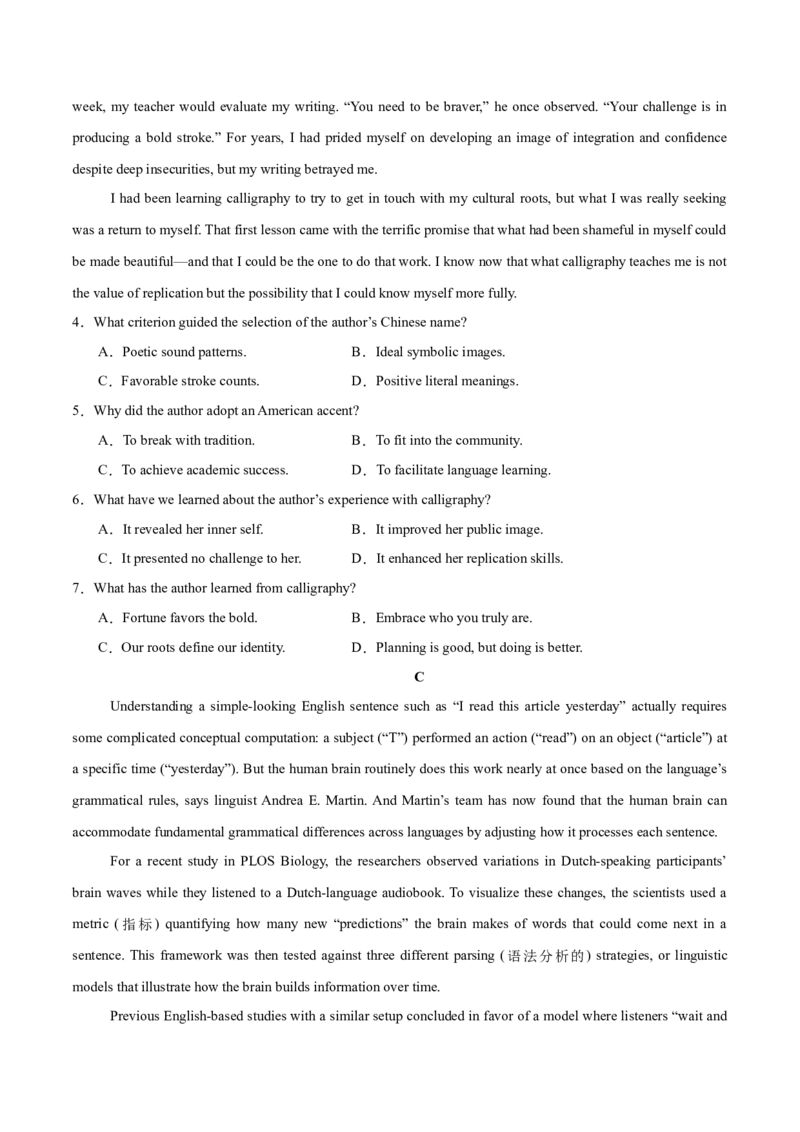
C
Understanding a simple-looking English sentence such as “I read this article yesterday” actually requires
some complicated conceptual computation: a subject (“T”) performed an action (“read”) on an object (“article”) at
a specific time (“yesterday”). But the human brain routinely does this work nearly at once based on the language’s
grammatical rules, says linguist Andrea E. Martin. And Martin’s team has now found that the human brain can
accommodate fundamental grammatical differences across languages by adjusting how it processes each sentence.
For a recent study in PLOS Biology, the researchers observed variations in Dutch-speaking participants’
brain waves while they listened to a Dutch-language audiobook. To visualize these changes, the scientists used a
metric ( 指标) quantifying how many new “predictions” the brain makes of words that could come next in a
sentence. This framework was then tested against three different parsing ( 语法分析的) strategies, or linguistic
models that illustrate how the brain builds information over time.
Previous English-based studies with a similar setup concluded in favor of a model where listeners “wait and
see” how each phrase in a sentence will end before interpreting it. But the Dutch speakers in Martin’s study leaned
strongly toward a highly predictive model; participants tended to finish each phrase in their head preemptively
before it was complete. (A third model, in which listeners wait to hear all of the phrases in a sentence before
interpreting any part of it, is seldom used in either language.)
In Dutch language structure, verbs come near the end of a sentence rather than immediately after the subject
like they do in English, while in Korean, the subject is usually left out and in Arabic verbs often come first. So
flexibility is vital in processing different languages simply because they have different properties.
The findings support the need for scientists to include more diversity when crafting linguistic models. “This
is going to help us capture how the brain is understanding the structured meaning of language, and the social
application of language,” Martin says. “There’s so much yet to be understood in the brain.”
8.Why does the author cite the example in paragraph 1?
A.To introduce a grammar rule.
B.To analyze an English sentence.
C.To bring in a new research finding.
D.To stress the complexity of human brain.
9.What does the underlined word “preemptively” in paragraph 3 probably mean?
A.By accident.
B.In advance.
C.On time.
D.By mistake.
10.Which sentence can match the Dutch language structure?
A.Universe the about documentary saw.
B.Saw I a documentary about the universe.
C.I saw a documentary about the universe. D.I a documentary about the universe saw.
11.What does Martin try to stress in the last paragraph?
A.The challenges of brain researches.
B.The application of the present findings.
C.The purposes of different linguistic models.
D.The necessity to diversify subjects in studies.
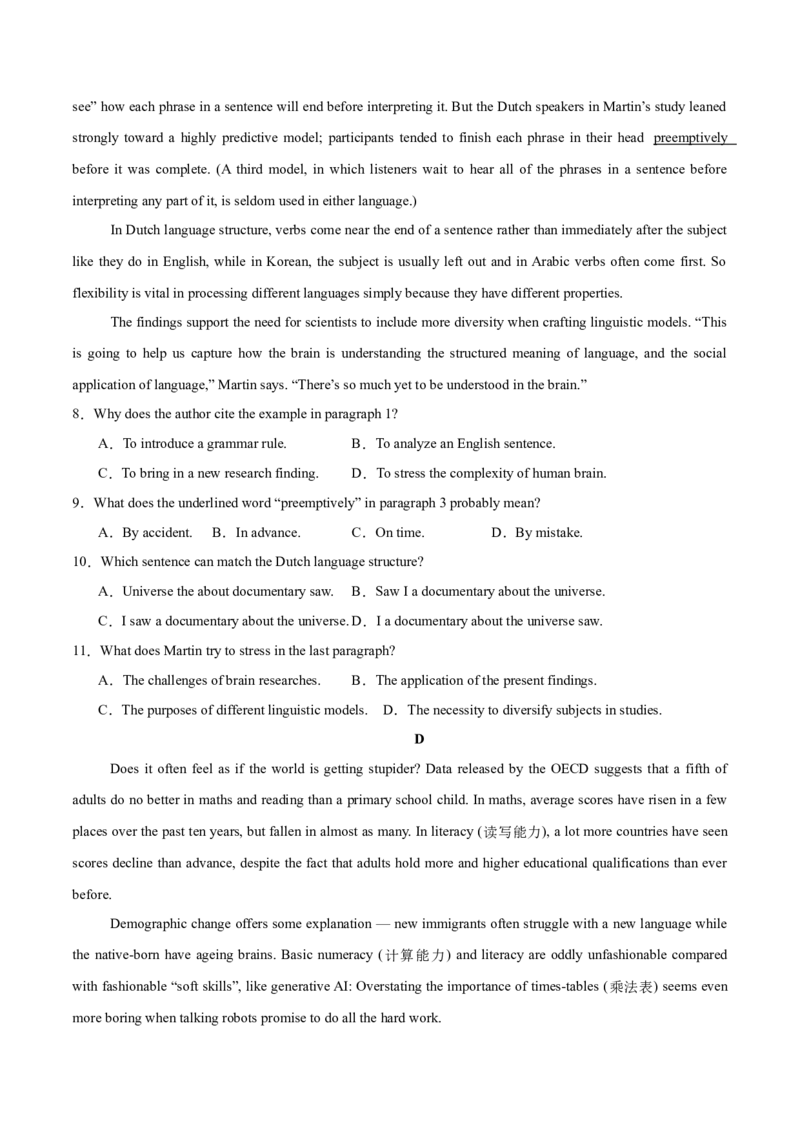
D
Does it often feel as if the world is getting stupider? Data released by the OECD suggests that a fifth of
adults do no better in maths and reading than a primary school child. In maths, average scores have risen in a few
places over the past ten years, but fallen in almost as many. In literacy (读写能力), a lot more countries have seen
scores decline than advance, despite the fact that adults hold more and higher educational qualifications than ever
before.
Demographic change offers some explanation — new immigrants often struggle with a new language while
the native-born have ageing brains. Basic numeracy ( 计算能力) and literacy are oddly unfashionable compared
with fashionable “soft skills”, like generative AI: Overstating the importance of times-tables (乘法表) seems even
more boring when talking robots promise to do all the hard work.
Yet a century of technological development has not cut demand for people who are good with numbers or
words. Adults who do badly in the OECD’s tests earn much less than those who top them. They are also in poorer
health, less satisfied with their life, less trusting of others and more likely to feel that they have no voice in politics.
What to do? Improving lessons for children is the surest way of creating more capable grownups. England’s
adults have gradually improved their position in the OECD’s rankings, mostly because the youngest ones are
scoring better than before. The second task is to modernize outdated systems for educating adults. These give
dropouts a second chance; they also serve people who change careers and help immigrants integrate.
In too many places, a craze for universities has cut back on funding and focus on the kinds of lessons that
people aged 18 and above could be offered. Degrees are becoming less meaningful: the OECD has found that even
some university graduates post numeracy and literacy scores that might embarass a child. Meanwhile, those adults
who want to return to class without beginning with long, expensive university courses often find good alternatives
are lacking. Faster actions to fix all these problems seem like a bright idea.
12.What does the data released by the OECD show?
A.Adults may be less literate than before.
B.The majority of adults are well-educated.
C.Children can have easier access to education.
D.Adults find numeracy and literacy less useful.
13.What does paragraph 3 mainly talk about?
A.The effectiveness of education.
B.The role of advanced technology.
C.The value of literacy and numeracy.
D.The decline in political engagement.
14.Why is England mentioned in paragraph 4?
A.To criticize its outdated education system.
B.To reveal the decrease in its dropout rate.
C.To demonstrate its high ranking in the OECD.
D.To highlight the significance of children’s education.
15.What can be inferred from the last paragraph?
A.University students are financially supported.
B.Children are embarrassingly worse in numeracy.
C.Degrees and abilities are not necessarily matched.
D.Expensive university courses have good alternatives.
第二节(共5 小题, 每小题2. 5 分, 共12. 5 分)
阅读下面短文, 从短文后的选项中选出可以填入空白处的最佳选项。选项中有两项为多余选项。
Sometimes it seems that we can’t feel any joy in life. We all have such bad days. However, an inability to
feel joy is not the norm and requires attention.

 1  6

  Luckily, there are steps we can take to generate joy.


 1  7

  Learning to recognize emotions that inhibit (抑制) our ability to access joy. This can help us
gain access to our positive core emotions. For example, when we feel anxious, slow down, breathe and name the
emotion. Once the body feels calm, we get curious about the emotion’s meaning. We may ask, “What is this
emotion protecting me from?” and “If you move this emotion aside, what’s underneath?”
Pay someone a compliment (称赞).

 1  8

  So witnessing someone else’s happiness can make us
smile, too. Complimenting a friend or co-worker can help. Saying “It’s nice to see you today” goes a long way.
They may smile or show appreciation for your kind words. Witnessing their joy and happiness will lift your spirits.
Enjoy small moments of pleasure. Imagine you’re a joy detective and try to identify one positive interaction
that you’ve experienced recently.

 1  9

  When you notice a positive feeling, try to stay with the moment. In
the long run, it will lengthen our experience of positive emotions.
Smile, even when you don’t feel like it. When we’re feeling down, smiling may be the last thing on our
mind. However, turning up the corners of your mouth can lower stress and boost your mood. It is a good way to
watch a funny movie. Notice what happens when you laugh or smile.

 2  0


A.Get out of a bad mood.
B.Watch out for joy blockers.
C.Emotions tend to spread rapidly among people.
D.This may remind you of a past pleasant experience.
E.Perhaps it was a warm conversation or dinner with a friend.
F.Chances are that you’ll experience a wave of joy, even for a moment.
G.Joylessness can affect our mental health, relationship and well-being.
第三部分 语言运用(共两节, 满分30 分)
第一节(共15 小题;每小题1 分, 共15 分)
阅读下面短文,从每题所给的A、B、C、D 四个选项中选出可以填入空白处的最佳选项。
As a fitness expert, Miller has gained great popularity for his contributions to the community health.
Recently, he

 2  1

  a nonprofit organization, Fit2Give, to provide

 2  2

  personal training to
underserved communities. “Not everyone can attend a group exercise class — some need a one-on-one

 2  3

,” Miller says.
“The trainers will be paid; that’s why we’re raising

 2  4

 ,” he explains. “We’re paying for their
certification, their

 2  5

  and their ability to establish a harmonious relationship with someone.”
Miller’s own

 2  6

  to fitness started when he was young. Later, he was

 2  7

  to weights (哑
铃) and started visiting the gym. “While I was

 2  8

  at the gym, a supervisor suggested I take the exam and
become a trainer,” he recalls. “They

 2  9

  me their books. I took the exam and passed.”


 3  0

  about the increasing rate of prediabetes (糖尿病), Miller decided to do something for those
patients. Helping to improve their physical and mental health brings Miller

 3  1

 . He says one client who
lost 100 pounds through

 3  2

  diet and exercise. “At her weigh-in, her family was there, and they came up
to me

 3  3

  and expressed their gratitude, telling me their mom seemed like a(n)

 3  4

  different
individual. It was amazing to me that I had made a great difference not only to her but also to her family. That
3  5

  my heart.”
21.A.volunteered
B.financed
C.launched
D.expanded
22.A.basic
B.free
C.dear
D.crucial
23.A.treat
B.battle
C.approach
D.dialogue
24.A.funds
B.prices
C.standards
D.questions
25.A.strength
B.patience
C.generosity
D.knowledge
26.A.journey
B.secret
C.objection
D.subscription
27.A.driven
B.opposed
C.committed
D.drawn
28.A.sitting around B.working out
C.carrying on
D.wandering about
29.A.sold
B.loaned
C.sent
D.bought
30.A.Informed
B.Confused
C.Concerned
D.Astonished
31.A.fame
B.wealth
C.fortune
D.pleasure
32.A.improved
B.delayed
C.reduced
D.advanced
33.A.in chorus
B.by turns
C.by chance
D.in tears
34.A.partially
B.entirely
C.simply
D.accurately
35.A.hurt
B.melted
C.warmed
D.broke
第二节(共10 小题;每小题1. 5 分, 满分15 分)
阅读下面短文,在空白处填入1 个适当的单词或括号内单词的正确形式。
The Guangdong Lion Dance, a national tradition popular in Foshan and Guangzhou, is a typical Southern
Lion Dance.
Lion dancing

 3  6

  (date) back thousands of years, to the Tang Dynasty, and a legend about the
emperor having a dream

 3  7

  a lion saved his life. And later it

 3  8

  (introduce) to the south by
migrants from the north. The Guangdong Lion Dance developed into

 3  9

  (it) modern form during the Ming
Dynasty (AD 1368-1644). In Chinese tradition, people regard the lion as

 4  0

  symbol of braveness and
strength, which can drive away evil and protect humans and livestock. Lion dancing

 4  1

  (main) focuses on
the performance of the lion dance, attaching much attention

 4  2

  movements like scratching an itch (抓痒),
shaking the mane (鬃毛) and licking (舔) the hair.
The Guangdong Lion Dance, a

 4  3

  (combine) of martial arts, dance and music, is popular not only in
Guangdong and Guangxi provinces, but also among overseas Chinese in Southeast Asian countries,

 4  4
(make) it a cultural bridge for overseas Chinese keeping in touch with their national roots. It is considered to be a
tradition with far-reaching cultural value. Lunar New Year is the perfect time

 4  5

  (share) and celebrate
that culture and heritage.
第四部分 写作(共两节,满分40 分)
第一节(满分15 分)
46.假定你是某国际学校的学生李华,你校将对图书馆进行升级改造,面向全校师生征求意见。请你给校
长Mr. David 写一封信,内容包括:
1.图书馆存在的问题:
2.你的建议。
注意:
1.写作词数应为80 个左右;
2.请按如下格式在答题卡的相应位置作答。
Dear Mr. David,
____________________________________________________________________________________________
____________________________________________________________________________________________
____________________________________________________________________________________________
____________________________________________________________________________________________
_______________________________________________________________________________________
Yours,
Li Hua
第二节(满分25 分)
47.阅读下面材料,根据其内容和所给段落开头语续写两段,使之构成一篇完整的短文。
Emma, a fifteen-year-old girl, lived with her grandma on the farm. Every day she would spend some time in
the woods nearby. Some birds even came close to her, pecking at bread pieces from her hands and singing away.
One evening, a young man carrying a gun approached their farm house. Putting down the gun, he said, “I’ve
lost my way. Could I have a night’s lodging here?” Emma’s warm-hearted grandma agreed.
Then, the man introduced himself as an ornithologist, who collected and studied birds. “Do you put them in a
cage?” Emma asked. “No,” he shook his head, “I shoot them and get them preserved. I have over one hundred
kinds of bird specimens (标本) in my studio.” Emma felt her heart trembling as she imagined so many birds being
shot.
“Emma loves climbing trees, just like a naughty monkey! And she knows a lot about birds, too,” her
grandmother said proudly. The man became excited. “I have followed a rare white heron in this direction for two
days. Have you seen it, too?” he asked Emma. “The heron has soft white feathers and long slender legs. It probably
has its nest at a tree-top,” he added. Emma’s heart gave a wild beat. She had frequently seen the strange bird flying
back to its nest on the top of a tall tree near the other side of the woods! The young man then stared at Emma with
the hope of the heron being one of Emma’s acquaintances. “I would give one hundred dollars to whoever shows me
where the white heron is!” But Emma somehow shook her head. He then sighed, “They have never been seen here.
Perhaps it was only migrating, or had been driven out of its own region by some fierce predator.”
That night, long after the moon came out and the young man had fallen asleep, Emma was broad awake. Her
mind was alternately visited by the bird specimens and her long-awaited smart phone one hundred dollars could
buy.
注意:
(1)续写词数应为150 个左右;
(2)请按如下格式在答题卡的相应位置作答。
Finally, Emma made up her mind.
____________________________________________________________________________________________
____________________________________________________________________________________________
____________________________________________________________________________________________
____________________________________________________________________________________________
_______________________________________________________________________________________
Before dawn, Emma returned to the farm house quietly, holding the cage covered with her jacket.
____________________________________________________________________________________________
____________________________________________________________________________________________
____________________________________________________________________________________________
____________________________________________________________________________________________
_______________________________________________________________________________________