2026 年高考第一次模拟考试突破卷04(浙江专用)
高三英语
(考试时间:120 分钟  试卷满分:150 分)
注意事项:
1.答卷前,考生务必将自己的姓名、准考证号等填写在答题卡和试卷指定位置上。
2.回答选择题时,选出每小题答案后,用铅笔把答题卡上对应题目的答案标号涂黑。
如需改动,用橡皮擦干净后,再选涂其他答案标号。回答非选择题时,将答案写在答
题卡上。写在本试卷上无效。
3.考试结束后,将本试卷和答题卡一并交回
第一部分  听力(共两节,满分 30 分)
做题时,先将答案标在试卷上。录音内容结束后,你将有两分钟的时间将试卷上的答案
转涂到答题卡上。
第一节(共5 小题;每小题1.5 分,满分7.5 分)
听下面5 段对话。每段对话后有一个小题,从题中所给的A、B、C 三个选项中选出最
佳选项。听完每段对话后,你都有10 秒钟的时间来回答有关小题和阅读下一小题。每段对
话读两遍。
1.Why does the woman recommend the series?
A.It features famous actors.
B.It runs short episodes.
C.It has surprising plots.
2.What will the woman do tomorrow?
A.Go shopping.
B.Play basketball.
C.See a match.
3.What is the man going to do this afternoon?
A.Lend a paintbrush.
B.Have a class.
C.Return an artwork.
4.What are the speakers mainly talking about?
A.An AI painting tool.
B.A unique art style.
C.A digital art competition.
5.What does the woman mean?
A.The dog will sleep well.
B.The dog is still sick.
C.The dog won’t bark.
第二节(共15 小题;每小题1.5 分,满分22.5 分)
听下面5 段对话或独白。每段对话或独白后有几个小题,从题中所给的A、B、C 三个
选项中选出最佳选项。听每段对话或独白前,你将有时间阅读各个小题,每小题5 秒钟;
听完后,各小题将给出5 秒钟的作答时间。每段对话或独白读两遍。
听第6 段材料,回答第6、7 题。
6.What is the subject of the conversation?
A.The history of writing.
B.Ways to speak English.
C.The writing style of a famous author.
7.How did the man feel about what he read?
A.Confused.
B.Upset.
C.Delighted.
听第7 段材料,回答第8 至10 题。
8.Which might the woman enjoy?
A.A novel.
B.A math problem.
C.A chemistry experiment.
9.Who was both an artist and a scientist?
A.Isaac Newton.
B.Leonardo da Vinci.
C.William Shakespeare.
10.What does the woman suggest they do?
A.Read about artists.
B.Share their knowledge.
C.Learn from famous people.
听第8 段材料,回答第11 至13 题。
11.What is the reason the man doesn’t need to pack socks?
A.He dislikes wearing them.
B.He will buy them in Mexico.
C.He doesn’t need them on the beaches.
12.What is the weight limit for baggage allowed by the airplane company?
A.About 6 kilograms.
B.About 16 kilograms.
C.About 22 kilograms.
13.Where is the conversation taking place?
A.At the speakers’ house. B.At an airport.
C.At a hotel.
听第9 段材料,回答第14 至17 题。
14.What does the woman think at first?
A.The man is in a good mood.
B.The man is confused about something.
C.The man has found out some bad news.
15.Where do the speakers live now?
A.In France.
B.In Canada.
C.In Australia.
16.Why didn’t the man tell the woman he applied for a new job?
A.Because he wasn’t really sure of it.
B.Because he wanted to give her a surprise.
C.Because he knew she wouldn’t want to move.
17.What can we learn about the speakers?
A.They have more than one child.
B.They will wait to make a decision.
C.They speak more than one language.
听第10 段材料,回答第18 至20 题。
18.Why does the speaker give the talk?
A.To introduce a course.
B.To announce a campus fund.
C.To promote a student-led project.
19.What is Madeline Kizer’s major?
A.Psychology.
B.Film production.
C.Marketing.
20.Which aspect of requirements is mentioned?
A.Commitment to the project.
B.Time of admission to the university.
C.Hours of academic study in a major.
第二部分  阅读(共两节, 满分50 分)
第一节(共15 小题;每小题2.5 分, 满分37.5 分)
阅读下列短文, 从每题所给的A、B、C 和D 四个选项中选出最佳选项。
A
From the nature of dark matter and dark energy to the origins of the universe itself,
scientists are tackling with questions that challenge our fundamental understanding of reality. Join
4 world-leading experts from astronomy, astrophysics and cosmology (宇宙学) as they reveal the
latest research about our universe.
At this Instant Expert, you’ll:
* Learn about the most recent breakthroughs in cosmology.
* Discover how scientists are using cutting-edge technology, such as the James Webb Space
Telescope, to explore the universe.
* Explore cosmic problems such as dark matter and the special implications of general
relativity.
* Gain insights into the future of cosmology and its potential impact on humanity.
Information about Talks:
TALK l: Exploring the universe with the first light
Unlock the secrets of the Universe’s origins and discover groundbreaking projects shaping
the future of cosmology.
TALK 2: What will gravitational waves teach us about find amental physics?
Explore how powerful new gravitational wave detectors and simulations will reveal new
insights into gravity, dark matter, and unknown physics.
TALK 3: Unlocking the secrets of the Universe with the James Webb Space Telescope
Explore how the James Webb Space Telescope is revolutionizing our understanding of the
early universe, from the birth of the first galaxies and stars to the formation of black holes.
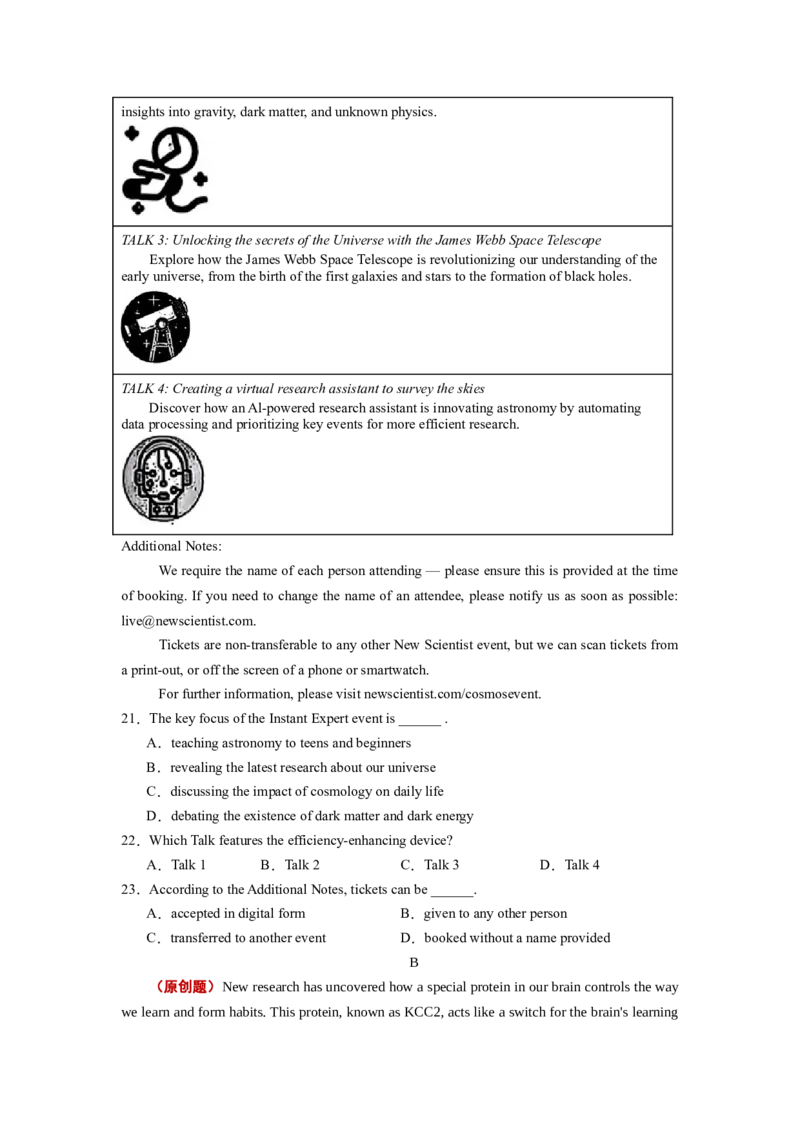
TALK 4: Creating a virtual research assistant to survey the skies
Discover how an Al-powered research assistant is innovating astronomy by automating
data processing and prioritizing key events for more efficient research.
Additional Notes:
We require the name of each person attending — please ensure this is provided at the time
of booking. If you need to change the name of an attendee, please notify us as soon as possible:
live@newscientist.com.
Tickets are non-transferable to any other New Scientist event, but we can scan tickets from
a print-out, or off the screen of a phone or smartwatch.
For further information, please visit newscientist.com/cosmosevent.
21.The key focus of the Instant Expert event is ______ .
A.teaching astronomy to teens and beginners
B.revealing the latest research about our universe
C.discussing the impact of cosmology on daily life
D.debating the existence of dark matter and dark energy
22.Which Talk features the efficiency-enhancing device?
A.Talk 1
B.Talk 2
C.Talk 3
D.Talk 4
23.According to the Additional Notes, tickets can be ______.
A.accepted in digital form
B.given to any other person
C.transferred to another event
D.booked without a name provided
B
(原创题)New research has uncovered how a special protein in our brain controls the way
we learn and form habits. This protein, known as KCC2, acts like a switch for the brain's learning
system. It determines whether our brains create strong connections between everyday signals and
positive results, or ignore signals linked to harmful behaviors. This process is often disrupted in
conditions like addiction, where substances can interfere with the normal function of KCC2 and
hijack the learning process.
The key to this mechanism lies in how KCC2 influences a brain chemical called dopamine,
which is essential for feeling pleasure and reward. Scientists discovered that when the levels of
KCC2 protein are reduced, the brain's dopamine system becomes more active. This increased
activity speeds up the formation of new reward associations. In experiments with animals,
researchers observed that this faster learning helps the brain quickly assign value and meaning to
signals connected to rewards, like a sound predicting a treat.
These findings help explain why powerful and unwanted habits form so easily in daily life.
For example, a person who always smokes a cigarette with their morning coffee will eventually
find that just the smell or taste of coffee can trigger a strong desire to smoke. The brain has
learned to link the signal (coffee) with the expected reward (the feeling from smoking). This
strong association can make breaking such habits very challenging.
Furthermore, the study explored how certain drugs might influence this learning process.
Researchers found that some calming medicines can support a more coordinated pattern of brain
cell activity, which helps transmit information more effectively. This suggests that it might be
possible to restore healthy learning mechanisms. By understanding and controlling how the brain
manages these connections, scientists hope to develop better treatments for a wide range of brain
disorders beyond just addiction, offering new hope for many people.
24. What is the main function of the KCC2 protein according to the text?
A. To directly produce dopamine for pleasure.
B. To act as a signal for harmful substances.
C. To calm the brain during stressful situations.
D. To control the speed of forming reward-based habits.
25. What can be inferred from the coffee-smoker example?
A. All habits are formed through repeated rewards.
B. Drinking coffee is a primary cause of addiction.
C. Dopamine is most active in the morning for smokers.
D. Breaking a habit may involve avoiding related signals.
26. What does the study suggest about coordinated brain cell activity?
A. It is less effective than rapid neuron firing.
B. It can be supported by some calming drugs.
C. It only happens during reward-learning tasks.
D. It is the main cause of brain disorders.
27. What is the ultimate goal of this research?
A. To prove the dangers of everyday signals.
B. To compare the learning speed of humans and animals.
C. To find new approaches to treat brain-related problems.
D. To explain the chemical structure of the KCC2 protein.
C
Feeling stressed by daily troubles like work deadlines or disagreements? Science suggests a
simple solution: feeling more in control. A new study reveals that on days when people feel a
greater sense of control over their problems, they are much more likely to take action to solve
them. This sense of control acts as a powerful psychological resource, helping people manage
stress and improve their overall well-being over time.
To understand this connection, researchers conducted a long-term study. They followed a
large group of adults, asking them to report their daily stressors and their sense of control over
these issues for over a week. The process was repeated ten years later. The results showed that
people’s sense of control is not a fixed trait but changes daily. Interestingly, the positive effect of
feeling in control became even stronger as participants grew older.
The key finding was clear: when individuals felt more in control than they usually did, they
were significantly more likely to resolve their stressors that day. This pattern held true regardless
of the type of stress, whether it was an argument, work pressure, or a problem affecting loved
ones. The study suggests that this ability to use perceived control to manage challenges effectively
improves with age.
The good news is that this sense of control can be developed. Experts suggest practical
strategies to build it. For example, you can focus on what you can change, break big tasks into
smaller, manageable steps, and make a to-do list to track your progress. These small successes can
build momentum and reduce feelings of stress. Don't hesitate to ask for help, as this can also
increase your sense of support and control.
In conclusion, while daily stress is unavoidable, our perception of control is a key factor in
how we handle it. By consciously building this sense of control, we can not only solve everyday
problems more effectively but also support our long-term health and happiness.
28. What does the study suggest about a sense of control?
A. It varies from day to day.
B. It is a fixed personal trait.
C. It is determined by one's age.
D. It remains unchanged throughout life.
29. What can be inferred about older people from the text?
A. They experience fewer daily stressors.
B. They are less likely to ask for help.
C. They prefer to handle challenges alone.
D. They are better at using control to manage stress.
30. Which of the following is the best title for the text?
A. The Harm of Daily Stress
B. A New Study on Aging
C. Control: A Key to Reducing Stress
D. How to Solve All Your Problems
31. What is the author's main purpose in writing the text?
A. To criticize previous research methods.
B. To introduce a practical way to handle stress.
C. To argue that stress is always harmful.
D. To compare different types of stressors.
D
(原创题)The traditional school model, largely unchanged since the 19th century, is failing
to prepare students for the future. Past reforms, like system-wide policies, have not brought real
change. Evidence shows that many graduates, even with degrees, are not ready for the modern
workforce. The core reason for this failure is a rigid, required curriculum that fills the school day,
leaving students with little say in their own education. This lack of student choice often leads to
disengagement, raising questions about whether what is taught today will remain valuable
tomorrow.
To address this, a new approach is proposed: the "school within a school" model. This idea
draws inspiration from nature and technology. Consider how a successful new technology spreads:
early users try it, and if it proves valuable, it naturally becomes widespread. No one forces
everyone to buy it. In contrast, education reforms often fail because they are forced upon entire
systems, creating resistance from teachers, parents, and students.
The "school within a school" model offers a more natural, ecological path to change. Instead
of requiring all schools to transform, it allows for small, voluntary programs to exist within a
larger school. Interested students and parents can choose to participate in a setting where students
have more autonomy. With the guidance of teachers, they can pursue their own interests, set
personal learning goals, and discover their unique strengths.
This small-scale approach avoids major resistance and allows for innovation to grow
organically. It creates an environment where students are more engaged and motivated because
they have a stake in their own learning. They learn to find and solve meaningful problems,
developing skills that are truly valuable for their future.
Ultimately, these small, successful innovations can gradually influence the entire education
system, much like a healthy ecosystem adapts and evolves. By reducing top-down control and
fostering student autonomy, education can become more adaptable and effective, better serving
generations to come.
32. Why did past educational reforms fail according to the author?
A. They lacked enough financial support.
B. They were forced on the entire system.
C. They ignored the importance of technology.
D. They focused too much on student autonomy.
33. What does the iPhone example in paragraph 2 suggest?
A. Technology should be banned in schools.
B. Successful changes spread naturally.
C. All schools should use smartphones.
D. Apple is a leader in education.
34. What is a key feature of the "school within a school" model?
A. It requires all students to participate.
B. It focuses on a standardized national curriculum.
C. It offers students more learning choices.
D. It relies heavily on artificial intelligence.
35. What is the author's attitude toward the traditional school system?
A. Supportive and proud.
B. Satisfied but hopeful.
C. Critical and concerned.
D. Indifferent and uncaring.
第二节(共5 小题;每小题2. 5 分, 满分12. 5 分)
阅读下面短文, 从短文后的选项中选出可以填入空白处的最佳选项。选项中有两项为
多余选项。
What’s the Best Kind of Sunscreen?
 Sunscreen comes in chemical and mineral formulas (配方). Mineral sunscreens sit on the
surface of the skin, reflecting UV rays, while chemical sunscreens absorb UV rays.     36    ,
but their application and safety profiles differ.
Is chemical or mineral sunscreen better?
Mineral sunscreens leave a visible white cast but offer longer-lasting protection, making them
ideal for extended sun exposure. They’re also gentler for sensitive or acne-prone (易长粉刺的)
skin, as zinc in them may reduce breakouts and formulas stay on the surface, minimizing allergy
risks. Chemical sunscreens absorb smoothly but face safety inspection: studies show their
ingredients enter the bloodstream, with animal research suggesting potential hormone disorder.
37    . The Environmental Working Group only recommend mineral options. However, skin
experts stress that any sunscreen — chemical or mineral — is better than none for skin cancer
prevention.
Which SPF is best?
SPF measures UVB protection. The FDA recommends at least SPF 15;     38    . Higher
SPF (e.g., 50) blocks slightly more rays, but no product offers 100% protection. Fair-skinned
individuals may benefit from SPF 50+, but reapplication every two hours (or after
swimming/sweating) matters most. Always choose“broad-spectrum (用途广泛的)” formulas to
guard against both UVA (aging) and UVB (burning) rays, which contribute to skin cancer.
Is sunscreen best as a spray, lotion, or stick?
    39    . Sticks work for small areas like faces but require multiple passes. Sprays risk
uneven application due to wind or inadequate dosing, and breathing them in could be risky.
Powders are not proven effective by the FDA .However, any format is better than skipping
sunscreen — except powders, which experts caution against. For full-body use, creams remain the
gold standard.
Key takeaways:
Mineral sunscreens suit sensitive skin and offer durability, while chemical versions appeal for
invisibility. Prioritize SPF 30+ broad-spectrum formulas, reapply regularly, and choose lotions
when possible.     40    , but consistent use of any sunscreen outweighs possible risks.
A.There is broad support for that idea
B.Both prevent sunburns and skin damage
C.Safety debates around chemicals persist
D.Lotions provide thicker, more reliable coverage
E.Skin experts advise SPF 30+ for stronger coverage
F.The higher the SPF, the more ingredients your skin absorbs
G.While these findings are concerning, human health impacts remain unclear
第三部分 语言运用(共两节,满分30 分)
第一节(共15 小题,每小题1 分,满分15 分)
阅读下面短文, 从每题所给的A、B、C 和D 四个选项中选出可以填入空白处的最佳选
项。
I often felt there was a lack of ceremony in my life. The ceremony of passage to mark
transitions was      41     . Therefore, I was especially      42      when a friend invited
me to go with him for a hike that would mark his      43      entry into elderhood. We would
be      44      by three other companions. One of them was a wise and gentle elder who
would serve as our guide. But whether it involved a      45      or not, an opportunity to walk
in the backcountry with people who knew where they were going sounded      46      to me,
and yes was what I said.
We started out early and drove along a rough and steep mountain road      47      to a
campground at the edge of a wilderness area where we met our guide. We then walked along a
gently rising trail. Along the way there was green grass and bursts of colorful      48     , and
we soon got down into a sandy creek bed, which we followed for some time. The wonders of the
wilderness      49      before us, and every now and then our guide stopped to call our
50       to the shift of the environment, instructing us to       51       the spirit of
attentiveness and gratitude.
Occasionally, he paused to adjust the leg brace (支架) he was wearing to support his knee, but
these too were teachable moments. “Getting       52       slows us down,” he said, “but
when we slow down, we become aware of things. That’s one of the       53       of being an
elder. We are allowed to slow down and notice. Life may not have so many ceremonies, so we
need to       54       changes. We should move forward with the right       55      :
being humble, appreciative and positive.”
41.A.happening
B.missing
C.developing
D.recovering
42.A.curious
B.puzzled
C.confident
D.excited
43.A.secret
B.seeming
C.symbolic
D.secure
44.A.arranged
B.accompanied
C.acknowledged
D.appointed
45.A.ceremony
B.occasion
C.episode
D.reminder
46.A.awful
B.plain
C.fantastic
D.dynamic
47.A.walking
B.climbing
C.jumping
D.winding
48.A.wildflowers
B.branches
C.jungles
D.maples
49.A.uncovered
B.unfolded
C.unlocked
D.unearthed
50.A.attraction
B.application
C.attention
D.addiction
51.A.forget
B.keep
C.break
D.change
52.A.lighter
B.cleverer
C.healthier
D.older
53.A.gifts
B.plans
C.purposes
D.disadvantages
54.A.subscribe to
B.contribute to
C.object to
D.adapt to
55.A.purpose
B.influence
C.attitude
D.function
第二节(共10 小题;每小题1.5 分 ,满分15 分)
阅读下面短文,在空白处填入1 个适当的单词或括号内单词的正确形式。
China’s moon-landing spacesuit witnesses China’s commitment to innovation and precision
engineering. Designed to tolerate the extreme lunar environment     56     severe
temperatures, lack of the atmosphere and lasting radiation     57     (expose) bring significant
challenges, the suit features multiple layers. The inner layer provides comfort to keep taikonauts
(航天员) cool and dry, one of the middle layers maintains atmospheric pressure essential for
survival, and the outer layer, made of strong and heat-resistant materials,     58     (safeguard)
taikonauts from the tough lunar conditions.
The suit is equipped with     59     (remark) features, one of which is its mobility.
60     the multiple layers and many protective elements, the suit remains flexible. The suit’s
gloves, for example, are specially designed to allow for fine motor skills, making it easier for the
taikonaut     61     (handle) tools and equipment.
The suit marks     62     major breakthrough in space technology. It employs cutting-
edge materials that     63     (perfect) since their development, including the use of smart
materials that adapt to changing conditions for enhanced protection and comfort. The suit is also
packed with high-tech communication and navigation systems, and a range of sensors and     64
(monitor) devices that provide real-time updates on the taikonaut’s health.
As China continues to extend     65     (boundary) of space exploration, its moon-
landing spacesuit will play an important role in the nation’s pursuit of knowledge and discovery.
第四部分 写作(共两节, 满分40 分)
第一节(满分15 分)
假定你是李华,你的英国好友Chris 所在学校的“Music Club”和“Sports Club”正在招
募新成员,他想选择其中一个参加,请你给些建议,给他写一封邮件,内容包括:
1. 你的建议;
2. 说明理由。
注意:(1)写作词数应为80 个左右;
(2)可适当增加细节,使行文连贯。
_______________________________________________________________________________
_______________________________________________________________________________
____________________________________________________________
第二节(满分25 分)
阅读下面材料,根据其内容和所给段落开头语续写两段,使之构成一篇完整的短文。
Grandma Agnes is ninety-nine years old and still lives in the same house she’s lived in for
more than sixty years. She was one of thirteen children raised on a farm, and now, she is rather set
in her ways. For twelve years, Grandma Agnes enjoyed the company of her dog, Snoopy. The
black-and-white spotted mutt (杂种狗) was a constant presence in her home and yard. As time
went on, Grandma Agnes began showing signs of dementia ( 老年痴呆). My family worked
together to keep her living independently yet safe.
It was heartbreaking for my dad when he removed the battery from her car to prevent her
from driving with her still-valid license. After that, every visit ended with Grandma insisting he
buy her a new battery, claiming hers was “dead again.” Dad would no d and promise, though he
knew she’d forget.
Three years ago, Snoop y passed away. My dad, Aunt Carol, and Uncle Ed tried to help
Grandma understand. They held a small funeral in the backyard. Uncle Ed framed a photo of
Snoopy with “Rest in Peace” written below and stuck it on the fridge. Yet during daily visits,
Grandma still asked about Snoopy, accusing neighbors of stealing him because she “heard his
barking.”
Caring for someone with dementia is emotionally exhausting. For years, Dad warned me
before each visit: “She might not recognize you or your kids.” We’d patiently answer the same
questions repeatedly. Grandma Agnes is still stubbornly independent, but she struggles to make
sense of the world. Still, she insists on living alone and never stops asking about Snoopy.
注意:
1.续写词数应为150 左右:
2.请按如下格式在答题卡的相应位置作答。
A few months ago, Uncle Ed came up with a good idea and bought a robotic dog for
Grandma Agnes.
_______________________________________________________________________________
_______________________________________________________________________________
_______________________________________________________________________________
_________________________________________________________________
Everyone was pleased that Grandma Agnes liked “Snoopy” a lot.
_______________________________________________________________________________
_______________________________________________________________________________
_______________________________________________________________________________
_________________________________________________________________