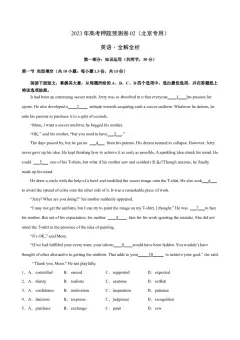
2025 年高考押题预测卷(北京专用 02)
英语·全解全析
(考试时间:90分钟 试卷满分:100分)
注意事项:
1、考生务必在答题卡指定区域作答,在试卷上作答无效。
2、考试结束后,将本试卷和答题卡一并交回。
第一部分 知识运用(共两节,30 分)
第一节 (共 10 小题;每小题 1.5 分,共 15 分)
阅读下面短文,掌握其大意,从每题所给的 A 、B 、C 、D 四个选项中,选出 最佳选项,并在答
题卡上将该项涂黑。
It was hot. And it was Saturday! “I 1 pulling weeds!” I thought. Still, I made sure to pull every
annoying weed. My dad could 2 a single weed a mile away. And if he spotted even one, I’d be stuck working
all day.
“Dad, I’m done,” I shouted from the garden, feeling sure that I had done a good job. But then Dad 3
out of the house.
“Don’t shout!” he said, waving an angry finger, “you missed a spot.”
I sighed and went back to work. Atter a while, I looked back at Dad. He still wore that mad look on his face,
his eyes searching the garden as if he could find every tiny imperfection.
“Okay,” he said, 4 , “I guess you’ re done.” As Dad walked back to the house, I wondered if he liked me.
Two weeks later, on the morning of another weed picking weekend, I woke up feverish. “Let’s go,” Dad said,
5 me from the bed. “You need to see a doctor.” “Please, no,” I said in a 6 voice, “I’d rather pull weeds.” He
took me anyway, and the doctor said I had pneumonia (肺炎).
That night a (n) 7 woke me from my sleep. I saw my dad who came up to me and put his hand against
my 8 . Then, I saw him 9 something on my table. When he left, I found a necklace with a charm shaped
like a small dog, just like my favorite pet. I held it to my heart and cried. My dad, who never hugged me or said, “I
10 you”, had just said it all.
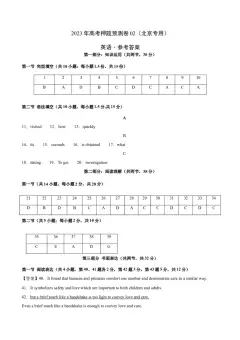
1.A.prefer B.tolerate C.avoid D.hate
2.A.see B.mark C.remove D.ignore
3.A.bounded B.struggled C.slipped D.stormed4.A.turning away B.breaking down C.nodding off D.rushing forward
5.A.waking B.lifting C.shaking D.rescuing
6.A.confident B.strange C.cheerful D.weak
7.A.scream B.noise C.alarm D.whisper
8.A.arm B.shoulder C.forehead D.wrist
9.A.lay B.throw C.write D.adjust
10.A.respect B.trust C.love D.miss
第二节(共 10 小题;每小题 1.5 分,共 15 分)
阅读下列短文,根据短文内容填空。在未给提示词的空白处仅填写 1 个恰当 的单词,在给出提示
词的空白处用括号内所给词的正确形式填空。请在答题卡指 定区域作答。
A
Director Yang Yu, better known as Jiaozi, has spent over a decade enhancing his skills in China’s competitive
animation industry. Early in his career, however, he 11 (face) constant rejections and financial struggles.
His breakthrough came in 2019 with the masterpiece Ne Zha 12 proved Chinese animation could rival
global giants. To create a follow-up movie, he immersed 13 (he) in perfecting storytelling and cutting-
edge effects, often working 16-hour days. His journey — from a self-taught artist to a pioneer 14
(reshape) an industry — inspires dreamers worldwide: greatness isn’t born overnight, but built through
commitment.
B
AI and learning have a powerful and collaborative relationship. AI acts as a smart tool, personalizing lessons
15 (match) each student’s pace and needs, which makes learning more effective. It also supports teachers by
automating tasks like grading, allowing them to focus more on instruction and student interaction.
However, it is important to use AI responsibly — it should complement, not replace, the role of teachers and
students. Ensuring 16 (fair), privacy, and ethical use is essential. When 17 (use) wisely, AI
can transform education for the better.
C
Emma, a kind-hearted volunteer, has visited over 50 orphanages globally to bring joy to needy kids. Her aim
is to inspire others 18 (share) with the less fortunate selflessly. Lately, she went to a charitable institution
for kids in Kenyan, 19 the children welcomed her with pleasant smiles and songs. Emma threw herself into
various activities 20 hesitation, immediately making the atmosphere even more lively. Emma has touched
countless children, showing them boundless love.第二部分 阅读理解(共两节,38 分)
第一节(共 14 小题;每小题 2 分,共 28 分)
阅读下列短文,从每题所给的 A 、B 、C 、D 四个选项中,选出最佳选项,并 在答题卡上将该项
涂黑。
A
The app store is flooded with astronomy-based apps that can help guide you towards celestial (天体的)
wonders. But what if you’re ready to look deeper into the night sky using a telescope? Nobody wants to make a big
investment, and then aimlessly scan the stars trying to find an object. Help is needed. Thankfully, there is a solution
to that.
Celestar is a leader in the world of telescopes and its StarSmart Explorer app and dock have been designed to run
on its telescopes. The free StarSmart Explorer app uses information based on precise location and time to tell you
which stars and planets can be seen in the night sky.How it works
Connect the phone with the telescope and select your intended celestial target. The phone will be held over
an integrated mirror, so that star patterns can reflect off the mirror and into the phone’s camera. StarSmart Explorer
processes the information and your telescope will adjust accordingly, placing the target in the middle.
As well as locating your desired target, StarSmart Explorer holds detailed information about your chosen object.
Listen to an audio presentation while you observe. The app will even give you observing tips on how to get the best
view.Why it’s special
Most astronomy apps use a smartphone’s compass to estimate its position. The pointing accuracy of a
smartphone has margin for error. Precision matters when it comes to stargazing.
StarSmart Explorer is the only astronomy app to use modern plate solving technology to find its target, and it
claims a typical pointing accuracy of 0.25°. The app takes a picture of the night sky and matches the star pattern
within the image to its internal database. It’s similar, in essence, to facial recognition.
Plate solving would normally require specialised technology, such as sensitive imaging camera, lens and
astronomical software, all at great cost. The StarSmart Explorer app is free and works well with StarSmart Explorer
telescopes, starting from £299.99.
If you’re ready to take a deeper dive into astronomy, Celestar’s StarSmart Explorer technology will make a
fine companion. You can discover more at www.celestar.com/starsmart.
21.StarSmart Explorer can help ________.
A.decide observation duration B.locate stars preciselyC.record information on stars D.find unknown planets
22.StarSmart Explorer is unique because________
A.it matches different types of telescopes
B.it uses a smartphone’s built-in compass
C.it is powered by advanced technology
D.it is equipped with the latest database
23.What is the purpose of this passage?
A.To introduce a set of equipment. B.To promote a stargazing product.
C.To recommend a science project. D.To present an astronomical discovery.
B
In 2010, four friends, carrying 32 kg worth of camera equipment, sunk beneath the waves of Sodwana Bay,
off the east coast of South Africa. It was then that photographer, Laurent Ballesta stared directly into the eyes of a
creature once thought to have died out with the dinosaurs — making him the first diver to photograph a living
coelacanth (腔棘鱼).
But what does it take to be a truly great ocean photographer? Danger, says Ballesta. “I realised that every
time a dive is easy, my photos are not good,” he says. “I need to feel I’m in an uncomfortable situation to give my
best. If you put me in the Red Sea in 20 m of warm water — I don’t take better images than others.” In an extreme
situation on the other hand — one in which he feels he shouldn’t be allowed, that his time is limited, there is an
urgency — a switch clicks.
Thanks to Ballesta’s work, we now know the coelacanth is among the longest-living fish species, with a life
of around 100 years, and has one of the slowest life histories of all ocean fish. Long-lived species are especially
sensitive to natural and human stressors, and it is only by observing these creatures in their own habitat that we can
really begin to understand them.
The coelacanth exploration was a springboard for Ballesta’s exploration career. In2019, Ballesta pioneered a
new diving technique, which would allow commercial divers to sink to great depths. He used an electronically
managed rebreather for autonomous deep sea exploration — making him the first person to take what could be
described as an untied spacewalk deep under the ocean.
Ballesta is both an artist and a scientist. His work acts as a window into the unknown — one that we can all
look through.
24.What was Laurent Ballesta’s significant achievement in 2010?
A.Exploring beneath the Sodwana Bay. B.Taking photos of a living coelacanth.C.Finding the secret of dinosaur extinction. D.Diving with the heaviest camera equipment.
25.What makes Laurent Ballesta give his best?
A.Fierce competitions. B.New diving technique.
C.Sea animal knowledge. D.Challenging situations.
26.We learn that long-lived fish species ___________.
A.live a life of over 100 years B.have the slowest life histories
C.are sensitive to human activities D.are easy to adapt to new ecosystems
27.What kind of person is Laurent Ballesta?
A.Careful and passionate. B.Brave and creative.
C.Modest and hardworking. D.Tough and competitive.
C
When people view photographs of frightening spiders, scientists usually observe increased electrical activity
deep in their brain, in a region called the periaqueductal gray (PAG). The obvious conclusion is that the PAG
controls fight-or-flight responses in threatening situations. But what if brains don’t have dedicated circuits for
fighting and flighting? Is threat detection really a primary mode of the brain with its own neural circuitry (神经回
路)?
This idea of fight-or-flight circuits originates from the “triune brain” model dividing brains into the so-called
lizard brain, including the PAG, for survival functions, the “limbic system” for emotions, and the “neocortex” for
higher-order reasoning. If you know anything about evolution, you might know that something is spurious. The
only animal on this planet with a lizard brain is a lizard. Also, there’s no unified limbic “system” or the “neocortex”
for emotions or rationality (理性) respectively. So where does this leave the fight-or-flight story?
Recently, changes in PAG activity have been observed in nonthreatening tasks, such as reading a fascinating
article about the brain. The PAG has also been proved to regulate bodily systems continuously. Incidentally, this
explains why antianxiety medications manage anxiety disorders without healing them. They target brain circuits
that aren’t dedicated to anxiety or fight-or-flight but that simply regulate the body.
Researches on the brain’s powers also cast new light on our understandings. In daily life, individuals might
feel like they perceive and react to various stimuli as either threatening or safe. Actually, the brain, using past
experiences, skillfully predicts and formulates action plans in anticipation of events before stimuli occur. The
brain’s preparatory mechanism, metabolically (新陈代谢地) expensive, involves complicated neuronal activities
for sustaining multiple predictions and corresponding action plans over extended periods. But the experiences in
fight-or-flight responses crafted by your brain don’t reveal how it works.Moreover, your brain, which does much more than avoid threats, handles a complex social world full of
uncertainty. That’s a recipe for stress. And what is stress? It reflects energy preparation for anticipated challenges.
Your brain often makes sense of metabolic cost of uncertainty, if it drags on for long enough, as anxiety, but that’s
not a must. People seek uncertainty out — and its positive cousin, novelty — when they try new foods or learn new
skills.
Uncertainty is common, but these days, with social media and round-the-clock news coverage, it sometimes
bombards us and leaves us anxious and exhausted. But these feelings don’t emerge from fight-or-flight circuits.
They may just mean, in an ever changing and only partly predictable world, that you’re doing something hard.
28.The author asks the questions in Paragraph 1 to ________.
A.evaluate a statement B.justify an assumption
C.challenge an argument D.introduce a new concept
29.Which does the underlined word “spurious” in Paragraph 2 probably mean?
A.Rare. B.Wrong. C.Limited. D.Unexpected.
30.What can we infer from this passage?
A.Hunting for novelty reduces stress and anxiety.
B.Medicine targeting PAG cures anxiety disorders.
C.Uncertainty is a product of modern media and news cycles.
D.The “Fight or Flight” idea overlooks the brain’s predictive power.
D
The artificial intelligence (AI) sector has oscillated between enthusiasm and skepticism in recent years. Tech
giants including Alphabet, Amazon, and Microsoft collectively poured nearly 200 billion into AI infrastructure in
2024 alone, surpassing the GDP of nations like Hungary or New Zealand. Nvidia, dominating the AI-chip market,
witnessed its valuation skyrocket to 3.4 trillion as chip sales doubled — a growth rate three times faster than the
semiconductor industry average. Meanwhile, server providers like Dell reported unprecedented demand, with AI
server shipments jumping 78% year-on-year, signaling AI’s transformative potential across industries from drug
discovery to autonomous driving.
Yet beneath the surface, challenges loom. Training advanced AI models consumes staggering energy —
equivalent to powering 15 million US households annually — raising concerns about long-term viability (可持续
性). In regions like Ireland, data centers already consume 18% of national electricity, straining aging power grids.
Server manufacturers and energy firms struggle to meet data-center demands, with delivery delays for AI-optimized
servers extending to 48 weeks in 2024. Critics argue that current investments mirror past tech bubbles: the $200billion AI infrastructure spending represents 65% of the 1999 dot-com bubble’s peak investment adjusted for
inflation. Alan Smith, a tech analyst, defends the spending, “AI’s capacity to revolutionize healthcare—such as
cutting cancer drug development time from 10 years to 18 months — justifies short-term costs.” However,
opponents counter that profit-driven corporations prioritize market dominance over ethical considerations, citing
Meta’s 2023 AI ethics board disbandment as evidence.
Amid these mounting pressures, competition is going to further complicates the landscape of AI
development. Upstart (新兴的) firms like UK-based Graphcore and China’s Cambricon challenge industry leaders
by creating compact, energy-efficient AI tools. For instance, startups now offer specialized chips such as
Graphcore’s IPU (Intelligence Processing Unit) at 40% lower costs than Nvidia’s products, democratizing access to
AI technology. This fragmentation mirrors the 1980s PC market shakeup, where IBM’s dominance was eroded by
agile competitors. Investors, initially infatuated with AI’s promise, grow wary of over-commitment. A recent
McKinsey survey revealed 62% of shareholders believe AI firms must clarify their financial strategies within two
years, a demand intensified by OpenAI’s $540 million quarterly losses despite ChatGPT’s success.
In addition, the environmental effects make it increasingly urgent to tackle this challenge head-on. Data
centers account for 3% of global electricity use — a figure matching aviation’s carbon footprint — projected to
triple by 2030. The International Energy Agency warns that unregulated AI growth could increase global CO₂
emissions by 1.5% annually, undermining climate goals. While companies like Microsoft invest in renewable
energy, constructing solar farms to power Arizona data centers, critics demand stricter regulations. The EU’s
proposed Artificial Intelligence Act now includes provisions requiring energy transparency for AI systems. Dr.
Emily Zhou, a sustainability researcher at Tsinghua University, warns, “Unless accompanied by robust regulatory
measures, AI’s ecological environment risks offsetting its technological advancements, as exemplified by China’s
carbon tax initiative targeting data centers — a policy framework to balance industrial progress with environmental
management.”
As the AI sector grapples with escalating energy consumption, ethical controversies, and speculative
investment patterns, the AI industry stands at a crossroads. Its potential to reshape economies is undeniable — PwC
estimates AI could contribute $15.7 trillion to global GDP by 2030—but unchecked growth risks ecological harm
and market instability. The 2024 global AI Governance Summit highlighted the need for international standards, yet
consensus remains elusive. But, the path forward requires both technological breakthroughs and a shift in priorities
— making carbon-neutral data centers and transparent AI governance essential, not optional.
31.Regarding Alan Smith’s defence of AI spending, the author is ______.A.supportive B.doubtful C.critical D.unconcerned
32.What does the word “infatuated” underlined in Paragraph 3 most probably mean?
A.Shocked. B.Protected. C.Attracted. D.Challenged.
33.What can we learn from this passage?
A.AI’s environmental costs may reduce its benefits without policy intervention.
B.Renewable energy investments can resolve sustainability issues completely.
C.Stricter regulations should prioritize ecological protection over market instability.
D.Tech companies’ ethical considerations are sufficient to address energy demands.
34.Which would be the best title for the passage?
A.AI Investment: Balancing Short-Term Costs and Long-Term Viability
B.Data Centers’ Energy Use: The Hidden Crisis Behind AI Development
C.When Innovation Breeds Chaos: Why AI Development Must Slow Down
D.Artificial Intelligence: Navigating Transformation Amid Emerging Challenges
第二节(共 5 小题;每小题 2 分,共 10 分)
根据短文内容,从短文后的七个选项中选出能填入空白处的最佳选项,并在答题卡上将该项涂黑。选
项中有两项为多余选项。
Whether it’s the echo (回声) of beeping tills in a supermarket or the hissing of a coffee machine in your local
café, the brain is constantly working to decode (解码) hundreds of noises each day.
But for individuals like 25-year-old Sophie, these background noises can be stressful. 35 She says
she can’t figure out where they’re coming from and can’t compute them fast enough. After a hearing test came back
normal, Sophie met a private audiologist (听觉矫正专家) for further testing. She was eventually diagnosed (诊断)
with auditory processing disorder (APD). 36 However, her audiologist believes the overuse of noise-
canceling headphones, which Sophie wears for up to five hours a day, could have a part to play.
Noise-canceling headphones do have advantages for long-term ear health. But some experts warn that by
blocking everyday sounds, the brain may “forget” how to filter (过滤) noise. 37 Over-reliance on noise-
canceling headphones during this period might delay the ability to process speech and noise. Great Ormond Street
Hospital for Children have seen an increase in demand for assessments of children struggling to hear certain words
in noisy environments. 38 Audiologists are calling for more research into the impact of noise-canceling
headphones on teen’s auditory processing.
39 Mobile apps with “word in noise” training exercises are popular for helping patients distinguish
speech from background noise. Additionally, microphones and low-gain hearing aids can assist in specificsituations. Choosing headphones that don’t completely block the ears is also suggested.
A.The cause of Sophie’s APD diagnosis is unknown.
B.Treatment for APD can make a significant positive difference.
C.Despite having normal hearing, she often struggles to recognize voices.
D.She would leave bars and restaurants early because of the stressful noise.
E.They note that the high-level listening skills don’t fully develop until late teens.
F.One survey showed 61% of 18-24 year olds prefer to watch TV with subtitles on.
G.Hearing a diversity of sounds helps the brain decide what is important to focus on.
第三部分 书面表达(共两节,32 分)
第一节 (共 4 小题; 第 40、41 题各 2 分, 第 42 题 3 分, 第 43 题 5 分, 共 12 分)
阅读下面短文,根据题目要求用英文回答问题。请在答题卡指定区域作答。
A Journey with a Painting Drone
In the messy garage of their home, 16-year-old Emma stared at the pieces of her brother’s old broken drone
(无人机). Her physics teacher had given the class a task — turning old technology into something “magical.”
While most students built simple things like solar chargers, Emma dreamed of something bigger — a drone that
could paint pictures while flying! She drew designs mixing science and art — brushes attached to propellers (螺旋
桨) and colours guided by GPS. Her classmates laughed, calling it a “flying junk,” but Emma kept working.
One rainy afternoon, she adjusted the drone’s settings to match music. Every beat released a paint drop. The
first try was a mess — bright paints spread everywhere. But Emma noticed a pattern in the chaos. After five tries,
the drone danced to Beethoven’s Fifth Symphony, creating a beautiful abstract painting. Her project won the
school’s top prize and even inspired local artists to use her technology for large outdoor artworks.
Emma’s success wasn’t just about imagination. It teaches us three essential keys to unlocking creativity.
First, balance is crucial. Creativity grows not in daydreams alone, but when wild ideas meet real-world logic.
Emma didn’t just imagine a painting drone; she grounded her vision in maths and physics, calculating how to keep
brushes steady mid-flight. Second, bravery grows through small steps. Early on, Emma almost abandoned her idea,
fearing others would laugh. But she fought doubt by practising creativity daily. Finally, fun fuels persistence.
Emma’s first test spread paints everywhere, but instead of giving up, she found joy in the chaos. Her attempts
reminded her that “impossible” ideas can awaken wonder. Creativity isn’t a rare gift for the chosen few; it’s a
muscle that strengthens when we laugh at failures and celebrate small wins.
Most importantly, Emma’s journey mirrors a universal truth: creativity, like a child learning to walk,demands patience. Every wobble (蹒跚) and every fall is a track of progress. When we cheer for effort rather than
perfection — whether for a child’s first steps or our own messy drafts — we unlock the courage to keep moving
forward.
40.What task did Emma’s physics teacher give to the class?
41.According to the author, what are the essential keys to unlocking creativity?
42.Please decide which part is false in the following statement, then underline it and explain why.
Emma, valuing the final result instead of small wins, learned from failures and eventually achieved her goal.
43.How do you unlock your creativity? Please give one example. (In about 40 words)
第二节 (20 分)
假设你是红星中学高三学生李华。你的朋友Jim打算暑假到中国旅游,他对中国的科技发展很感兴趣,发
来邮件请你推荐一座能深度体验中国最新科技发展的城市。请给他回复邮件,内容包括:
1. 推荐城市;
2. 推荐理由;
3. 表达祝愿。
注意:
1. 词数100左右;
2. 开头和结尾已给出,不计入总词数。
Dear Jim,
____________________________________________________________________________________________
____________________________________________________________________________________________
____________________________________________________________________________________________
____________________________________________________________________________________________
Yours,
Li Hua