2025 年高考押题预测卷(北京卷 01)
英语·全解全析
(考试时间:90分钟 试卷满分:100分)
注意事项:
1、考生务必在答题卡指定区域作答,在试卷上作答无效。
2、考试结束后,将本试卷和答题卡一并交回。
第一部分 知识运用(共两节,30 分)
第一节 (共 10 小题;每小题 1.5 分,共 15 分)
阅读下面短文,掌握其大意,从每题所给的 A 、B 、C 、D 四个选项中,选出 最佳选项,并在答
题卡上将该项涂黑。
Last year, five homeless cats lived in the shadows in our neighborhood, silently asking for help. Every day, I
saw them huddled together, their fur matted and eyes filled with hope and 1 . As I watched them, I
couldn’t shake the feeling that I needed to take action.
Every morning, I put cat food near our building. The cats appeared, 2 at first, then rushing toward
me as if they had been waiting all along. Feeding them became a ritual that strengthened our bond. As winter
approached, my 3 grew. I couldn’t bear the thought of those 4 creatures suffering in the biting
cold. I then set up cozy corners for them in the damp basement of our building.
However, not everyone shared my compassion. One neighbor insisted on getting rid of the cats. He called
Animal Control to have them 5 . Our debates were heated, but I advocated for them as I knew they had no
one else to defend them.
As weeks passed, I felt an urge to find loving homes for the cats. I 6 friends and posted on social
media. To my delight, four of them found new families. Each 7 felt like a victory in my mission to make
a difference. Then there was one cat, Joy, who stole my heart completely. When I took him in, it was as if he had
always 8 in my home. His playful and silly behaviour brought laughter to my days, and his gentle
purring at night brought me peace.
Through this experience, I’ve found 9 in my voice, learning to advocate for the voiceless. I’ve
learned we all have the power to make the world a better place for all beings, no matter how small our actions may
seem. Whether it’s feeding a stray, advocating for animal welfare, or merely 10 kindness in our
communities, every effort counts.1.A.joy B.fear C.curiosity D.anger
2.A.quietly B.aimlessly C.bravely D.cautiously
3.A.concern B.depression C.excitement D.expectation
4.A.smelly B.energetic C.innocent D.noisy
5.A.fed B.removed C.examined D.cleaned
6.A.reached out to B.looked up to C.caught up with D.got on with
7.A.devotion B.decision C.admission D.adoption
8.A.slept B.hidden C.belonged D.waited
9.A.strength B.truth C.comfort D.secret
10.A.repaying B.spreading C.receiving D.teaching
第二节(共 10 小题;每小题 1.5 分,共 15 分)
阅读下列短文,根据短文内容填空。在未给提示词的空白处仅填写 1 个恰当 的单词,在给出提示
词的空白处用括号内所给词的正确形式填空。请在答题卡指 定区域作答。
A
Researchers have discovered that dogs can identify the voices of different members of their human family.
The research team tested 31 pet dogs. Three human caretakers of each dog 11 (ask) to record their
voices. Then they sat quietly in front of the dog while the recording played. The dogs usually approached — or at
least spent more time looking at — the person 12 voice they heard. Experts hope to study whether other
mammals have this skill, so they can better understand 13 different species learn to communicate with
each other.
B
When her 14 (edit), Dave Ellis, saw the photo of the couple, he suggested they go back and restore
damaged photos for even more people. So in January 2006, with 15 (pay) time off from the paper, the
two set up shop in Pass Christian. After posting a notice in the community newsletter, Rebecca and Dave received
500 photos in four days. For each, the pair 16 (take) a new digital picture, then used high-tech software
to erase water spots and restore colors. It just so happened that a popular website linked to Dave’s blog about the
experience, and soon Operation Photo Rescue, 17 we all know, had emails from hundreds of volunteers,
including photographers and restoration experts, eager to help.
C
Ne Zha 2, 18 (base) on a Chinese folk character, earned more than 8 billion yuan during the week-
long Chinese New Year holiday. It broke the record set by 2021’s The Battle of Lake Changjin. Hot off its domesticsuccess, it 19 (show) overseas next week, including in the US, Canada and Australia. “It not only shows the
strong power of Chinese animation, but also 20 (demonstrate) the endless possibilities of traditional
Chinese stories in the modern context,” reads one review.
第二部分 阅读理解(共两节,38 分)
第一节(共 14 小题;每小题 2 分,共 28 分)
阅读下列短文,从每题所给的 A 、B 、C 、D 四个选项中,选出最佳选项,并 在答题卡上将该项
涂黑。
A
Part of STEM learning is seeing and doing, and then recording and analyzing the results. But not all online or
homeschool programs are set up to accommodate science experiments or other STEM learning activities. Let’s take
a look at a few mind-blowing labs that can help bring STEM topics alive for your child’s online school
experience.Weather Laboratories
To make learning about weather accessible and fun, the National Oceanic and Atmospheric Administration
(NOAA) created a lot of informative weather activities and virtual labs they recommend for students and educators.
In fact, their weather science content for kids features a Weather Lab application that allows middle school students
to predict weather patterns, and learn what happens when ocean currents and air masses interact.Simulations (模
拟) for Science and Math
It is a project of the University of Colorado Boulder and one of the richest single databases of online science
interactives and virtual labs. Investigate more than 150 physics, chemistry, math, biology, and Earth science topics.
Available in dozens of languages, the interactives are searchable by grade level, subject, and accessibility.Space
Exploration Simulations
The National Aeronautics and Space Administration (NASA) features many STEM learning activities for
students in grades K-12. The interactive simulations are also gamified and make learning engaging and fun for your
child. The app allows users to explore the universe and unlock stories of trailblazing scientists and their
contributions to space exploration and science.
21.Who are the intended readers?
A.Parents. B.Students. C.Teachers. D.Researchers.
22.What makes Simulations for Science and Math different from the other labs?
A.It covers the most subjects. B.It has a translation centre.
C.It offers gamified learning experiences. D.It provides multiple tools for recording.
23.What do all the three labs have in common?A.They centre on problem solving skills.
B.They facilitate advanced scientific research.
C.They provide virtual scientific exploration.
D.They help students with STEM projects from school.
B
In my early forties, I began painting with watercolours. Each brushstroke on paper turned into a personal
language, allowing me to express the inexpressible. The feeling of colour being absorbed into the paper was
calming, yet it left me longing for something deeper. Over time, I became more interested in oil paints. Although
they took longer to dry, they offered me a sense of control. Layers of paints combined smoothly, creating a three-
dimensional effect that watercolours couldn’t copy. Oil paints granted me the precious opportunity to take a few
steps back, as if I were a curious explorer approaching a hidden landscape.
However, working with oil paints wasn’t easy. Getting the right shine or thickness required patience, and at
times, I felt annoyed by my lack of progress. Colours didn’t always behave as expected, and I struggled to achieve
the vision in my mind. But the more I persisted, the more I understood oil paints. They balanced softness with
depth, giving me the chance to create both delicate and grand images. The process of painting became reflective, a
practice of exploring colours, textures (纹理) and emotions — sometimes rough, sometimes peaceful, but always
rewarding.
One evening, I noticed a strange shade of blue on my canvas (画布). It seemed out of place, as if it didn’t
belong. My heart skipped a beat, and I stared at it, uncertain if it was part of my recent work or a trick of the eye.
As I stepped back to examine the canvas, the blue shade slowly began to make sense. It was not an error but an
invitation — an unplanned element that added depth to the piece in a way I hadn’t expected. At that moment, I
realised that painting, much like life, was not about complete control but about embracing the unexpected.
From then on, I approached my work with a new sense of curiosity. I let colours blend more freely, allowed
accidental mistakes to become part of the composition, and accepted that every brushstroke carried its own story.
Oil painting not only gave me a medium to express myself but also taught me patience, resilience, and the beauty of
discovery.
Looking at my finished work, I no longer saw just layers of paints. I saw moments of struggle, joy, and
growth woven into the canvas — a reminder that art, like any, is as much about the process as it is about the final
masterpiece.
24.Why did the author turn to oil paints?A.To enhance creativity. B.To save painting time.
C.To seek deeper artistic control. D.To improve painting skills.
25.What challenge did the author face when working with oil paints?
A.Balancing softness and sharpness. B.Creating a three-dimensional effect.
C.Achieving the right shine and thickness.D.Controlling the drying time of the paints.
26.What message does the author want to convey?
A.Art is a journey of welcoming imperfections.
B.A good picture is worth a thousand words.
C.Beauty is the ultimate goal of fine art.
D.Creating is about exploring ideal self.
C
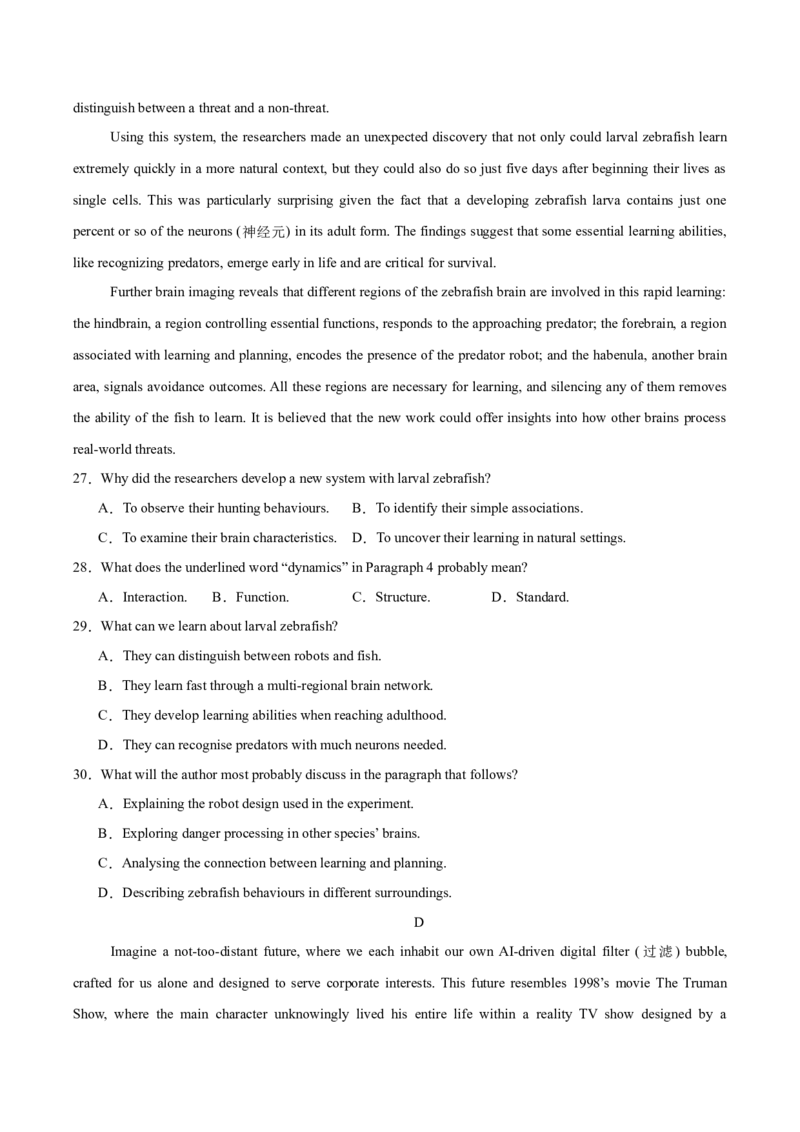
Researchers from the NeuroMind Institute have developed a new system that uses predator (捕食者) robots
to chase (追逐) larval (幼体的) zebrafish in an open water. This innovative approach is helping scientists study
how the young fish rapidly learn and adapt in real-world conditions.
Larval zebrafish are a valuable tool for neuroscientists because their transparency enables easy study of the
brain and behaviour. However, it’s been difficult for scientists to study learning in these developing vertebrates (脊
椎动物) — an important part of understanding how the brain works. Previous research found young zebrafish
could learn simple associations. But this type of learning happens slowly and often unreliably, and it was still
unclear whether days-old zebrafish can learn fast enough to use their memory in natural situations, like recognizing
and avoiding new predators.
The researchers thought that traditional ways of testing learning in larval zebrafish in the lab, where the
conditions were far from what the fish would encounter in the wild, might not be effective for uncovering how the
fish learn. To model a real-life situation, the researchers used small robotic cylinders (圆柱体), with some
programmed to show predator-like characteristics.
The researchers created the dynamics: they first placed a robot that stayed still with a free-swimming
zebrafish; after the robot chased the fish for a minute, the fish began avoiding the robot’s area for more than an
hour — a big change from the non-avoidant behaviour before the chase experience. When a second robot was
introduced that did not chase the fish, the zebrafish only avoided the chasing robot, showing that they coulddistinguish between a threat and a non-threat.
Using this system, the researchers made an unexpected discovery that not only could larval zebrafish learn
extremely quickly in a more natural context, but they could also do so just five days after beginning their lives as
single cells. This was particularly surprising given the fact that a developing zebrafish larva contains just one
percent or so of the neurons (神经元) in its adult form. The findings suggest that some essential learning abilities,
like recognizing predators, emerge early in life and are critical for survival.
Further brain imaging reveals that different regions of the zebrafish brain are involved in this rapid learning:
the hindbrain, a region controlling essential functions, responds to the approaching predator; the forebrain, a region
associated with learning and planning, encodes the presence of the predator robot; and the habenula, another brain
area, signals avoidance outcomes. All these regions are necessary for learning, and silencing any of them removes
the ability of the fish to learn. It is believed that the new work could offer insights into how other brains process
real-world threats.
27.Why did the researchers develop a new system with larval zebrafish?
A.To observe their hunting behaviours. B.To identify their simple associations.
C.To examine their brain characteristics. D.To uncover their learning in natural settings.
28.What does the underlined word “dynamics” in Paragraph 4 probably mean?
A.Interaction. B.Function. C.Structure. D.Standard.
29.What can we learn about larval zebrafish?
A.They can distinguish between robots and fish.
B.They learn fast through a multi-regional brain network.
C.They develop learning abilities when reaching adulthood.
D.They can recognise predators with much neurons needed.
30.What will the author most probably discuss in the paragraph that follows?
A.Explaining the robot design used in the experiment.
B.Exploring danger processing in other species’ brains.
C.Analysing the connection between learning and planning.
D.Describing zebrafish behaviours in different surroundings.
D
Imagine a not-too-distant future, where we each inhabit our own AI-driven digital filter (过滤) bubble,
crafted for us alone and designed to serve corporate interests. This future resembles 1998’s movie The Truman
Show, where the main character unknowingly lived his entire life within a reality TV show designed by aproduction studio.
One subset of AI, large language models (LLM), won’t turn our lives into reality TV shows. Instead,
personalized AI agents threaten to cage each of us in an individualized and illusory (虚假的) unreality, profiting
from our digital activities and walling us off from genuine connections. Many companies are developing
individualized LLM. The underlying principle is that AI will learn about the individual user and adapt accordingly.
For example, if you’re a super fan of a football team, you’ll be fed updates, ads, and videos tailored to your
interests 24 hours a day. Some algorithms may even learn your schedule, pushing information at you during
precisely those times when you’re most likely to be looking.
This may sound harmless. But the next step is to use LLM to create memes, or even fake articles,feeding you
conspiracy theories about rival teams. This is a miserable reality for at least two reasons.For one, there are neither
computational methods or ethical incentives (激励) in place to ensure that the information you receive is true. But
just as frightening as the lack of regard for the truth is an even scarier element. You will no longer live with an
accurate understanding of football team that is fully compatible with anyone else’s. You will run on information
generated only for yourself. This vision is unsettling, even in sports and entertainment. But what of institutions that
have more direct social consequences?Education? Politics?
With the fall of the press and polarization of everything,conversations around holiday table have already
become impossible for many extended families. Bad as the status quo might be, stranger times lie ahead that make
us long for today’s echo chambers (信息茧房). Soon, our bubbles will shrink further and further,until our digital
worlds involve only ourselves. In an Al-mediated future,everyone will live in a private Truman Show. As a society,
we will be completely incapable of making fruitful collective decisions because we will have no shared
understanding of the world.
What’s the way out? Find your entertainment in spaces with actual people, exchanging thoughts and
creations with each other. Even online, we must keep our understanding of the world grounded in human-authored
documents and artifacts. Valuing what humans create is not merely a matter of authenticity; it also ensures we focus
on arguments that an author cared enough to make, on conservations that speakers cared enough to have.
Otherwise,The Truman Show’s premise becomes our reality, unknowingly inhabiting a fake world where our
every experience is designed for profit. Even more existentially alienating? Living in a Truman Show where the
director, producer and the only one watching is an AI.
31.The author mentions The Truman Show in Paragraph 1 to .
A.make a comparison B.illustrate a situationC.support an argument D.propose a suggestion
32.According to the passage, personalized AI agents may .
A.isolate individuals in false realities
B.confirm the credibility of the content
C.discourage the companies’ ethical incentives
D.improve user behavior by feeding targeted ads
33.What can be inferred from the passage?
A.Algorithms have raised concerns over privacy.
B.LLMs are in great need of computational upgrade.
C.Echo chambers weaken collective decision-making.
D.Technology development results in polarized society.
34.Which would be the best title for this passage?
A.AI and the Future of Human Interaction
B.AI Will Turn Our Lives into The Truman Show
C.The Truman Show Predicts AI’s Impact on Media
D.Algorithmic Bubbles and the Value of Human Creations
第二节(共 5 小题;每小题 2 分,共 10 分)
根据短文内容,从短文后的七个选项中选出能填入空白处的最佳选项,并在答题卡上将该项涂黑。选
项中有两项为多余选项。
When I think of my friends, I am mostly filled with love and warmth: I simply can’t wait to see them again
for their affection and support. 35 In the right mood, these individuals can deliver a fun-filled evening,
but at the wrong moment, they can drain (耗尽) all my goodwill.
If this sounds familiar, then you too have frenemies, who psychologists call “ambivalent relationships”.
These love-hate relationships could include a friend, a parent, a colleague or even a husband or wife. Their
ambivalence can come in many forms. 36 It could be a partner love-bombing you one day, but fiercely
critical the next, leaving you unsure about their true feelings.
37 At the very least, you would expect them to be better for us than our aversive (令人厌恶的)
relationships. Unfortunately, research suggests things aren’t so simple. A team at the University of Utah asked
people to take a reaction-time test and they found that rapidly flashing the name of an ambivalent connection on a
screen intensified stress response of participants. Another study at Brigham Young University found that simply
knowing an ambivalent connection was nearby as participants prepared to give a speech was enough to send theirblood pressure rocketing. 38
Cutting ties with our ambivalent connections isn’t always possible or desirable if they are deeply mixed into
our social network. So, what can be done? Simply being aware of the ambivalent nature of a relationship might
offer some protection. We can manage our expectations and mentally prepare ourselves for the mixed feelings when
interacting with frenemies. 39 As importantly, be a little more mindful of any interactions with all our
ties. Show others the appreciation and respect we feel for them, for accidental neglect could be taken as a sign of
indifference.
A.It might be a friend who is often unavailable when you need his support.
B.We might hope that in such relationships, the good would outweigh the bad.
C.In fact, even unconscious reminders of a frenemy can break our peace of mind.
D.This allows us to focus on their good qualities and show empathy for the unpleasant ones.
E.If you feel someone too negative a presence in your life, you may decide to cut off contact.
F.A handful, however, stimulate quite different emotions—a mixture of eagerness and anxiety.
G.After all, the benefits of social connection come from feeling well understood and supported.
第三部分 书面表达(共两节,32 分)
第一节 (共 4 小题; 第 40、41 题各 2 分, 第 42 题 3 分, 第 43 题 5 分, 共 12 分)
阅读下面短文,根据题目要求用英文回答问题。请在答题卡指定区域作答。
The famous marshmallow (棉花糖) test, where children were given the choice between eating one
marshmallow immediately or waiting for two later, may have revealed more than just willpower — it might help
explain why some people maintain sharper cognitive function as they age. A recent research suggests that the
ability to delay satisfaction could help protect people from developing memory or thinking problems.
Think of your brain as a muscle that gets stronger with practice. Every time you choose a long-term benefit
over immediate pleasure, you’re essentially doing a mental workout. This workout engages particularly the brain
area that is responsible for planning, reasoning, and controlling urges. Regularly exercising self-control may help
maintain cognitive function.
The science behind this connection is fascinating. When we resist immediate rewards, we stimulate “cool”
regulation strategies in the rational (理性的) reasoning center of decision-making. In contrast, giving in to
immediate satisfaction typically involves “hot” strategies in the brain areas associated with emotional decision-
making. The more we practice using these “cool” strategies, the stronger our brain pathways become. This could
help delay or prevent memory loss or thinking problems.
The good news is that these skills can be developed at any age. Simple strategies like setting specific goals,creating detailed action plans, and using monitoring techniques can help. Also, physical activity plays a particularly
important role.
Remember, it’s never too late to start building these protective cognitive skills. The key is consistent practice
and a conscious (有意识的) effort to make choices that prioritize long-term benefits over immediate rewards.
40.According to the recent research, what could the ability to delay satisfaction help?
41.Which brain area does delayed satisfaction particularly work out?
42.Please decide which part is false in the following statement, then underline it and explain why.
As we grow older, we can strengthen our brain pathways that could help delay or prevent memory loss or
thinking problems.
43.Please share one of your experiences of delayed satisfaction. (In about 40words)
第二节 (20 分)假设你是红星中学高三学生李华。你校正在举办以“美丽校园”为主题的原创作品征集活
动,交换生Jim打算参加,发来邮件询问你的建议。请你用英文给他回复,内容包括:
1. 建议创作内容;
2. 就以上建议简要说明理由。
注意:1. 词数100左右;
2. 开头和结尾已给出,不计入总词数。
Dear Jim,
____________________________________________________________________________________________
____________________________________________________________________________________________
Yours,
Li Hua