绝密★考试结束前
2025 年高考第二次模拟考试(北京卷 01)
英语
(考试时间:100分钟 试卷满分:100分)
注意事项:
1.本试卷分第Ⅰ卷(选择题)和第Ⅱ卷(非选择题)两部分。答卷前,考生务必将自己的姓名、准
考证号填写在答题卡上。
2.回答第Ⅰ卷时,选出每小题答案后,用2B铅笔把答题卡上对应题目的答案标号涂黑。如需改动,
用橡皮擦干净后,再选涂其他答案标号。写在本试卷上无效。
3.回答第Ⅱ卷时,将答案写在答题卡上。写在本试卷上无效。
4.考试结束后,将本试卷和答题卡一并交回。
第一部分:知识运用(共两节,30分)
第一节 完形填空(共10小题:每小题1.5分,共15分)(改编)
阅读下面短文,掌握其大意,从每题所给的A、B、C、D四个选项中,选出最佳选项,并在答题纸上
将该选项涂黑。
During the summer of 2019, I cycled alone from London to Istanbul. This 1 bicycle tour took me
89 days and through 11 countries. However, it was also an incredible journey, which saw me pass through
some of Europe’s greatest cities, 2 some amazing people, and witness some of its most beautiful
scenery.
It’s becoming more and more important for us to think about the impact that travel can have on our
environment. This was the 3 for my bicycle tour: I wanted to find more responsible ways to protect the
planet and 4 traveling by plane where possible.
I discovered that bicycle touring is one of the most 5 ways to travel, as using nothing but a bicycle
and your own pedal (脚踏) power, you can carry everything you need while covering surprising 6 each
day.
The 7 of life and the free time I spent just cycling alone gave me a lot of time to think. This really
helped me to learn a lot about myself. So I’ve managed to 8 a lot of problems from my past and feel
that my confidence and independence have grown.
Finally, I arrived in Istanbul with a huge mixture of 9 over the past three months: loneliness, joy,liberation, pride and anxiety. As a result, the journey makes me feel like a 1 0 person. What a cycling
trip to remember!
1.A.amusing B.challenging C.boring D.confusing
2.A.recognize B.entertain C.welcome D.meet
3.A.strategy B.inspiration C.barrier D.achievement
4.A.enjoy B.finish C.avoid D.practice
5.A.old-fashioned B.well-organized C.up-to-date D.eco-friendly
6.A.distances B.expense C.messages D.amount
7.A.pressure B.value C.simplicity D.expectation
8.A.get away with B.go on with C.be sensitive to D.be open to
9.A.opinions B.emotions C.worries D.memories
10.A.strange B.new C.smart D.lonely
第二节 语法填空(共10小题,每小题1.5分,共15分)
A
阅读下列短文,根据短文内容填空。在未给提示词的空白处仅填写1个恰当的单词,在给出提示词的空白
处用括号内所给词的正确形式填空。
During my summer vacation in the US, I once asked for a cup of hot water at a restaurant. The waiter’s 11
(confuse) look suggested my request seemed strange. In America, people love to drink ice-cold water. But in China,
we prefer hot water. The waiter 12 (come) back with a glass of room temperature water. I politely asked
again, “Can I please have some hot water?” The waiter finally understood and brought me a steaming cup of hot
water. 13 (learn) something new about each other’s cultures, we both smiled.
B
阅读下列短文,根据短文内容填空。在未给提示词的空白处仅填写1个恰当的单词,在给出提示词的空白
处用括号内所给词的正确形式填空。
One of China’s 14 (old) types of art is Neolithic pottery (陶器). 15 (name) for the period
when it appeared, this type of art can date back to around10,000 BCE. Though early Neolithic pottery was left
unpainted, many works were decorated by pressing cords (绳索) into them, 16 (leave) special patterns.
Some of the most amazing pieces were created by Yangshao people 17 lived along the Yellow River
from 5,000 BCE to 3,000 BCE.C阅读下列短文,根据短文内容填空。在未给提示词的空白处仅填写1个恰当的单词,在给出提示词的空白
处用括号内所给词的正确形式填空。
Today, many people wonder 18 electric cars are better than gasoline cars. Some argue they are clean,
not-polluting and cheaper, 19 gasoline cars are still very popular. They can drive long distances 20
needing to recharge, and they also refuel more quickly, taking only a few minutes at a gas station. Additionally,
there are more gas stations than charging stations, making gasoline cars more convenient for long trips.
第二部分:阅读理解(共两节,38分)
第一节(共14小题,每小题2分,共28分)
阅读下列短文,从每题所给的A、B、C、D四个选项中,选出最佳选项,并在答题卡上将该项涂黑。
A
THE TEMPE FESTIVAL OF THE ARTS
December 6–8, 2024, Friday–Saturday 10:00 AM–5:30 PM & Sunday 10:00 AM–4:30 PM
KIDS BLOCK
A hands-on interactive block for young artists and a youth exhibition featuring over 450 student works from
around the Valley - on display and for sale. Get the young creatives involved with the festival in a new way with
community partners, who will be on site doing take-away projects with young visitors! Youth can start their
appreciation for the arts at a young age by visiting Young Collectors on Saturday and Sunday. For just $5 children
can begin their art collecting journey.
YOUNG ARTIST EXHIBITION
Each festival we receive hundreds of pieces of artwork created by talented Valley youth who are interested in
having their works exhibited for a chance to win a cash prize, and for the opportunity to sell their works (please
refer to each nameplate to identify which pieces are for sale). You can visit the exhibition near Kids Block, Friday-
Sunday at the festival.
YOUNG COLLECTORS GALLERY
Each year, our artists have the option to donate a piece to the gallery, offering children the chance to
purchase and bring home their very own piece. We encourage young collectors to shop on their own, learning
freedom in what they like. Volunteers will be in place to assist children. The Young Collectors section will be open
on Saturday and Sunday of the festival.
APPLICATIONS ARE NOW OPEN!All students MUST have a signed and completed digital Permission Form to enter the festival.
21.When can children visit KIDS BLOCK?
A.10:00 AM-5:30 PM Friday. B.10:30 AM-4:00 PM Sunday.
C.9:00 AM-5:00 PM Saturday. D.10:00 AM-7:00 PM Saturday.
22.What is special about YOUNG ARTIST EXHIBITION?
A.It requires on-site registration.
B.It offers cash assistance to youth.
C.It includes a competition for participants.
D.It gives kids a chance to recreate their works.
23.What do the three sections have in common?
A.Kids can make an art purchase. B.Visitors may donate their works.
C.Volunteers will be badly needed. D.Young artists can gain more profit.
B
Two years ago, fueled by my envy for those with gardens, I signed up for a plot, a place where I could read
and write in the sun, safe from distractions. A few months ago, I was presented a half-plot of available land. The
plot, which was bigger than I could dream of, was beautiful but overgrown — getting it started would require hard
work. I wasn’t sure I had it in me.
Fast forward to now. After seeking guidance from my family and watching beginners’ gardening videos, I
spend hours a week sowing, weeding, watering and harvesting. My summer at the plot has so far offered countless
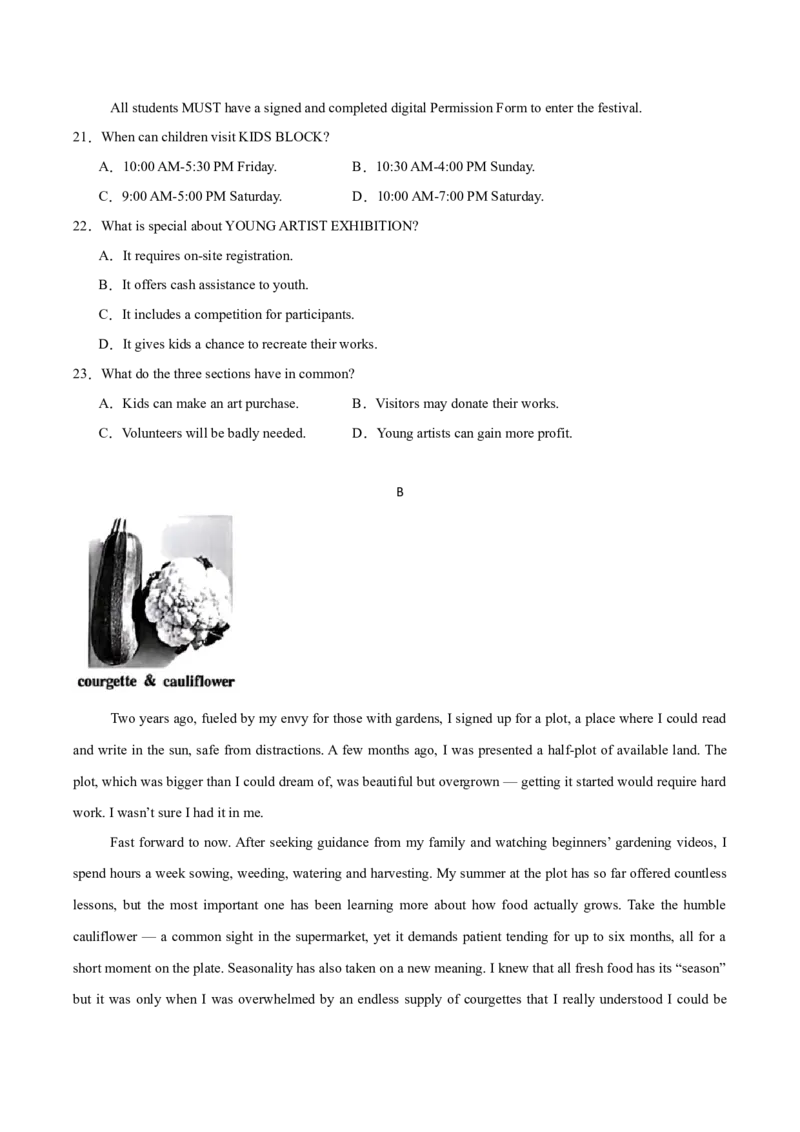
lessons, but the most important one has been learning more about how food actually grows. Take the humble
cauliflower — a common sight in the supermarket, yet it demands patient tending for up to six months, all for a
short moment on the plate. Seasonality has also taken on a new meaning. I knew that all fresh food has its “season”
but it was only when I was overwhelmed by an endless supply of courgettes that I really understood I could beeating them for months.
Yet abundant harvests come with a lesson in impermanence. Fresh produce goes off quickly once ripened
and picked. And so I’ve turned to the old craft of preservation — learning what to boil and freeze, or make into jam
— to make things last. When the harvest has been more than I can manage, I’ve shared the abundance with friends
and family, spreading the joy.
While gardening is a welcome escape from the chaos of the modern world, you can’t avoid the reality of the
climate crisis. It’s one thing to read these in the news or see them reflected in prices, but it’s quite another when you
have to be in tune with weather patterns, praying for prolonged sunshine without the unbearable heat.
As I continue to tend my plot, I do so with a sense of humility, wonder and excitement. What started as a
desire for a small patch of green has grown into something much more significant — a connection to my local
environment, a respect for the food I eat and an awareness of the fragile natural systems that sustain us. In the
beginning, I was worried I would fail the plot; instead, I’m finding myself growing alongside it.
24.How did the author feel when getting the plot?
A.Proud but anxious. B.Grateful but puzzled.
C.Amazed but worried. D.Moved but disappointed.
25.While working on the plot, the author learned to __________.
A.remove chaos from life B.create seasonal recipes
C.identify common plants D.respect laws of nature
26.What does the author’s experience tell us?
A.Labor is the most reliable wealth. B.Every season brings its own lessons.
C.The land is made better and so is the gardener.D.One should stay hungry for constant progress.
C
Artificial intelligence-powered medical treatment options are on the rise and have the potential to improve
diagnostic (诊断的) accuracy, but a new study led by University of Arizona Health Sciences researchers found that
about 52% of participants would choose a human doctor rather than AI for diagnosis and treatment.
“While many patients appear resistant to the use of AI, accuracy of information, encouragement and a
listening patient experience may help increase acceptance,” Marvin Slepian, who led the research, said. “To ensure
that the benefits of AI are secured in clinical practice, future research on best methods of physician incorporation
and patient decision making is required.”
In this study, participants were placed into settings as mock (模拟的) patients and asked whether and underwhat circumstances they would prefer to have an AI system or a physical doctor for diagnosis and treatment.
In the first phase, researchers conducted structured interviews with actual patients, testing their reactions to
current and future AI technologies. In the second phase, researchers surveyed 2,472 participants across diverse
ethnic, racial and socioeconomic (社会经济学的) groups using a blinded, randomized survey.
Overall, participants were almost evenly split (分开), with more than 52% choosing human doctors as a
preference and about 47% choosing an AI diagnostic method. If study participants were informed that their primary
care physician felt AI was superior, the acceptance of AI by study participants on re-questioning increased. This
signaled the significance of the human physician in guiding a patient’s decision.
Disease severity did not affect participants’ trust in AI. Compared to white participants, black participants
selected AI less often and Native Americans selected it more often. Older participants were less likely to choose AI,
as were those who self-identified as politically conservative. These findings suggest that differing groups will need
specific sensitivity and attention as to informing them about the value and usefulness of AI to enhance diagnoses.
“I really feel this study has the importance for national reach. It will guide many future studies and clinical
transitional decisions even now,” Slepian said. “The onus will be on physicians and others in health care to ensure
that information in AI systems is accurate, and to continue to maintain and enhance the accuracy of AI systems as
they play an increasing role in the future of health care.”
27.What can we infer about AI treatment from Paragraph 2?
A.Further clinical research is required.
B.Its benefits remain to be confirmed.
C.It can ensure a good listening patient experience.
D.Physician involvement will increase patients’ acceptance.
28.What may affect participants’ preference for AI treatment according to the research?
A.Their sensitivity to AI’s value. B.The questions they were asked.
C.The access to the physicians. D.Their personal backgrounds.
29.What does the underlined word “onus” in the last paragraph probably mean?
A.Attempt. B.Responsibility. C.Impression. D.Opportunity.
30.Which would be the best title for this passage?
A.The Trust in AI: A Split Among Patients
B.Bridging the Gap: Human Doctors and AI
C.An Important Study: The Future of AI Systems
D.Improving Diagnostic Accuracy: The Role of AID
The age of artificial intelligence has begun, and it brings plenty of anxieties. Almost all of the conversations
about risk have to do with the potential consequences of AI systems pursuing goals that depart from what they were
programmed to do and that are not in the interests of humans. But this is only one side of the danger. Imagine what
could unfold if AI does do what humans want.
“What humans want,” of course, isn’t a monolith. Different people have countless ideas of what constitutes
“the greater good.” Even if we could get everyone to focus on the well-being of the entire human species, it’s
unlikely we’d be able to agree on what that might look like.
That seems to be the reason that DeepMind recently founded an internal organization focused on AI safety
and preventing its manipulation by bad actors. But it’s not ideal that what’s “bad” is going to be determined by a
handful of individuals at this one particular corporation — complete with their blind spots and personal and cultural
biases (偏见). The potential problem goes beyond humans harming other humans. What’s “good” for humanity has,
many times throughout history, come at the expense of other sentient (有知觉力的) beings. Such is the situation
today.
In the US alone, we have billions of animals kept in confinement, subjected to cruel treatment, and denial of
their basic psychological and physiological needs at any given time. Entire species are dominated and systemically
butchered so that we can have omelets, burgers and shoes.
If AI does exactly what “we” want it to, that would likely mean enacting this mass cruelty more efficiently,
at an even greater scale and with more automation and fewer opportunities for sympathetic humans to step in and
flag anything particularly horrifying.
A better goal than aligning AI with humanity’ s immediate interests would be what I would call “sentient
alignment” — AI acting in accordance with the interests of all sentient beings, including humans, all other animals
and, should it exist, sentient AI. This will strike some as aggressive, because what’s good for all sentient life might
not always agree with what’s good for humankind. It might sometimes, even often, be in opposition to what
humans want or what would be best for the greatest number of us.
Peter Singer, a philosopher, argued that an AI system’s ultimate goals and priorities are more important than
it being aligned with humans. “The question is really whether this super intelligent AI is going to be benevolent
and want to produce a better world,” Singer said, “and even if we don’t control it, it still will produce a better world
in which our interests will get taken into account.”I’m with Singer on this. Decentering humankind to any extent, and especially to this extreme, is an idea that
will challenge people. But that’s necessary if we’re to prevent our current belief from spreading in new and awful
ways.
31.The author mentions the organization founded by DeepMind to __________.
A.question a solution B.clarify a belief
C.illustrate an example D.explain a practice
32.Which of the following can best present the idea of “sentient alignment”?
A.AI extends the same rights to living beings. B.AI promotes the interaction among species.
C.AI benefits from the development of humans. D.AI meets the demands of perceptive creatures.
33.What does the underlined word “benevolent” in Paragraph 7 probably mean?
A.Ambitious. B.Generous. C.Resourceful. D.Competitive.
34.The author’s major concern in developing AI is that __________.
A.AI poses a threat to the world B.society’s morals are in decline
C.humans prioritize their own needs D.sentient beings deepen cultural biases
第二节(共5小题;每小题2分,共10分)
根据短文内容,从短文后的七个选项中选出能填入空白处的最佳选项。选项中有项为多余选项。
Personal development goals are objectives that we set to improve our skills, habits, mindset, relationships,
and overall wellbeing. 35 Some common examples include the following.
Enhance communication skills to foster better relationships. 36 It may include practicing active
listening, and empathy, as well as learning conflict resolution techniques. After honing communication skills,
individuals can strengthen relationships with others, leading to deeper understanding, trust, and mutual respect.
Set boundaries to prioritize self-care. It is essential to clear limits and guidelines for personal space, time,
and energy to protect wellbeing. It involves learning to say no to commitments that waste resources and setting
realistic expectations for ourselves and others. 37
Develop a growth mindset to embrace challenges. Adopting a mindset that views challenges, setbacks, and
failures as opportunities for growth undoubtedly helps us grow. 38 With a growth mindset, individuals
can overcome obstacles with adaptability, leading to greater confidence, achievement, and personal fulfillment.
39 Integrating mindfulness-based techniques and practices into daily life to cultivate greater
awareness, presence, and emotional regulation is an exciting personal development goal to work on. By cultivating
mindfulness, individuals can reduce stress, and anxiety, improve focus and concentration, and foster a greater senseof calm, and overall emotional wellbeing.
A.They are tailored to individuals’ unique needs for growth.
B.Focus on self-reflection and mindfulness to realize dreams.
C.This goal involves actively improving communication abilities.
D.Cultivate mindfulness practices to enhance emotional wellbeing.
E.They encourage individuals to reflect on what truly matters to them.
F.By setting boundaries, individuals can create space for self-care activities.
G.It requires building a belief in the ability to develop skills and improve over time.
第三部分 书面表达(共两节,共32分)
第一节 阅读表达(共4小题,第40、41题各2分,第42题3分,第43题5分,共12分)
阅读下面短文,根据题目要求回答问题。
My path was long to recognizing my vocation (职业) , much longer than it had to be. My parents were
professors of engineering. Science was the horizon of possibility in my family; nothing else counted or even
existed. No matter how much I loved to read and write, it never occurred to me to major in anything else.
I had been curious about biology and psychology in high school, so when I knew Columbia offered a joint
major in the two fields, I chose it on the spot. The feeling, other than excitement, was one of relief. I couldn’t bear
the uncertainty that college represented. Instead of opening options up, I needed to shut them down. I had locked up
three-quarters of my courses for the next four years, and I hadn’t even gone to a single class.
There was no one there to stop me. I would mope (消沉) in the back of those lectures, reading a novel
behind my notebook, unaware of the fact that I was trying to tell myself something. I don’t know exactly when
things went wrong with my chosen course of study. By the time I realized that I should have been an English major,
it was too late to make the switch. I ended up working in a tiny nonprofit that meant nothing to me, with no idea
where I should go next.
And then I happened to be visiting a friend in architecture school. She wasn’t happy, either; her program was
way too pretentious and theoretical. We were walking along and she said, “I have to get out of graduate school. ”
And I immediately thought “I have to go to graduate school. ” Meaning, I’ll never be happy until I give myself the
chance to study English literature after all. Meaning, it’s not too late - I’m not going to let it be too late. Everything
was suddenly clear and calm.
It wasn’t easy getting in at that point. But for the first time in a long while, I performed at the top of myability. I’d study for eighty hours a week and I had never been happier.
40.What family factor (s) influenced the author’s choice of major?
41.What did the author realize at college?
42.Please decide which part is false in the following statement, then underline it and explain why.
The author was determined to get into graduate school because his friend persuaded him to do so.
43.What have you learned from the author’s experience of choosing a major in college? (In about40 words)
第二节: 书面表达(共一题,20分)
假设你是红星中学高三(1)班班长李华,你班的英国交换生Jim对即将举办的“劳动最光荣”主题教育活
动很感兴趣,请你写一封邮件告知他相关事宜,邮件内容包括:
1. 活动目的及形式;
2. 活动内容及你的收获。
注意:1. 词数100左右;
2. 开头和结尾已给出,不计入总词数。
Dear Jim,
____________________________________________________________________________________________
____________________________________________________________________________________________
___________________________________________________________________________________________
Yours
Li Hua