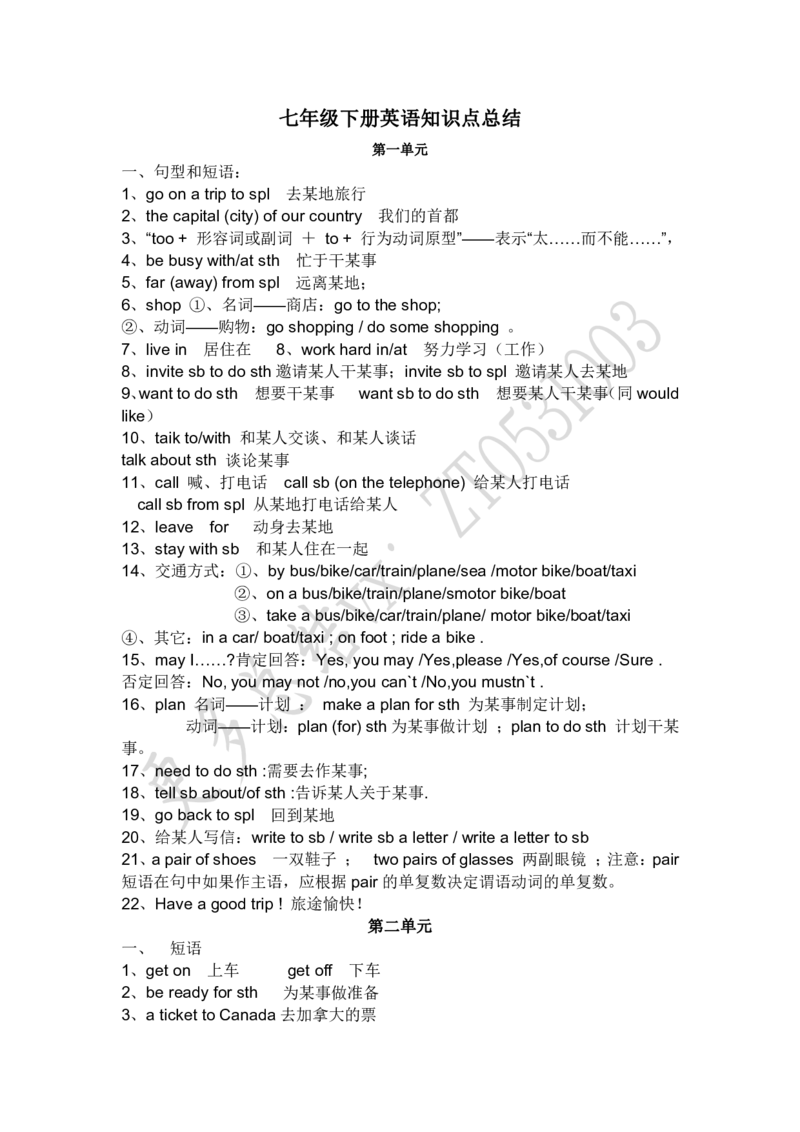
七年级下册英语知识点总结
第一单元
一、句型和短语:
1、go on a trip to spl
去某地旅行
2、the capital (city) of our country
我们的首都
3、“too + 形容词或副词+to + 行为动词原型”——表示“太……而不能……”,
4、be busy with/at sth
忙于干某事
5、far (away) from spl
远离某地;
6、shop ①、名词——商店:go to the shop;
②、动词——购物:go shopping / do some shopping 。
7、live in
居住在
8、work hard in/at
努力学习(工作)
8、invite sb to do sth 邀请某人干某事;invite sb to spl 邀请某人去某地
9、want to do sth
想要干某事
want sb to do sth
想要某人干某事(同would
like)
10、taik to/with 和某人交谈、和某人谈话
talk about sth 谈论某事
11、call 喊、打电话
call sb (on the telephone) 给某人打电话
call sb from spl 从某地打电话给某人
12、leave
for
动身去某地
13、stay with sb
和某人住在一起
14、交通方式:①、by bus/bike/car/train/plane/sea /motor bike/boat/taxi
②、on a bus/bike/train/plane/smotor bike/boat
③、take a bus/bike/car/train/plane/ motor bike/boat/taxi
④、其它:in a car/ boat/taxi ; on foot ; ride a bike .
15、may I……?肯定回答:Yes, you may /Yes,please /Yes,of course /Sure .
否定回答:No, you may not /no,you can`t /No,you mustn`t .
16、plan 名词——计划:make a plan for sth 为某事制定计划;
动词——计划:plan (for) sth 为某事做计划;plan to do sth 计划干某
事。
17、need to do sth :需要去作某事;
18、tell sb about/of sth :告诉某人关于某事.
19、go back to spl
回到某地
20、给某人写信:write to sb / write sb a letter / write a letter to sb
21、a pair of shoes
一双鞋子;two pairs of glasses 两副眼镜;注意:pair
短语在句中如果作主语,应根据pair 的单复数决定谓语动词的单复数。
22、Have a good trip ! 旅途愉快!
第二单元
一、
短语
1、get on
上车
get off
下车
2、be ready for sth
为某事做准备
3、a ticket to Canada 去加拿大的票
4、in +某种语言——用某种语言
speak+某种语言——说某种语言
5、pardon me 对不起、请重复一遍=Excuse me
6、have to(客观的必须)=must(主观上的必须)
必须、不得不、一定得
7、look out of
从……向外看
out of sth
某物的外面
8、here and there
到处、四处
9、point to 指向
point at 指着
point out
指出
10、at the top of
在……的顶端
at the bottom of 在……的底部
11、try to do sth 努力、设法干某事
12、be from spl = come from spl
来自某地
13、of course / Sure / Ok
当然
14、place of interest /the interesting place 名胜古迹
15、enjoy doing sth 喜欢干某事
16、hope to do sth 希望干某事
hope+宾语从句
希望……
17、It’s time for sth / It’s time to do sth / It’s time for sb to do sth
该干某事的
时候了
18、wait for sb/sth 等待某人、某物
wait for (sb) to do sth
等待(某人)干
某事
19、feel+形容词/ be +形容词:感觉怎么样
20、a bowl of /a bottle of /a glass of /a cup of / a can of pop 一碗/ 一瓶
/
一
杯/
一听汽水
21、be quiet
安静
keep quiet
保持安静
22、play a word game
玩一个单词游戏
play with sb
和某人一起玩
play with sth
玩弄某物
如:Don’t play with fire !
不要玩火!
play +球类名词(不要the)play+the +乐器名词(必须要the)如:play the
piano
23、watch TV / a football match / a movie
see a flim 看电影
read the book / the newspaper
24、show sb sth=show sth to sb
给某人看某物
25、take care of = look after
照看、照料、照顾
26、look for 寻找
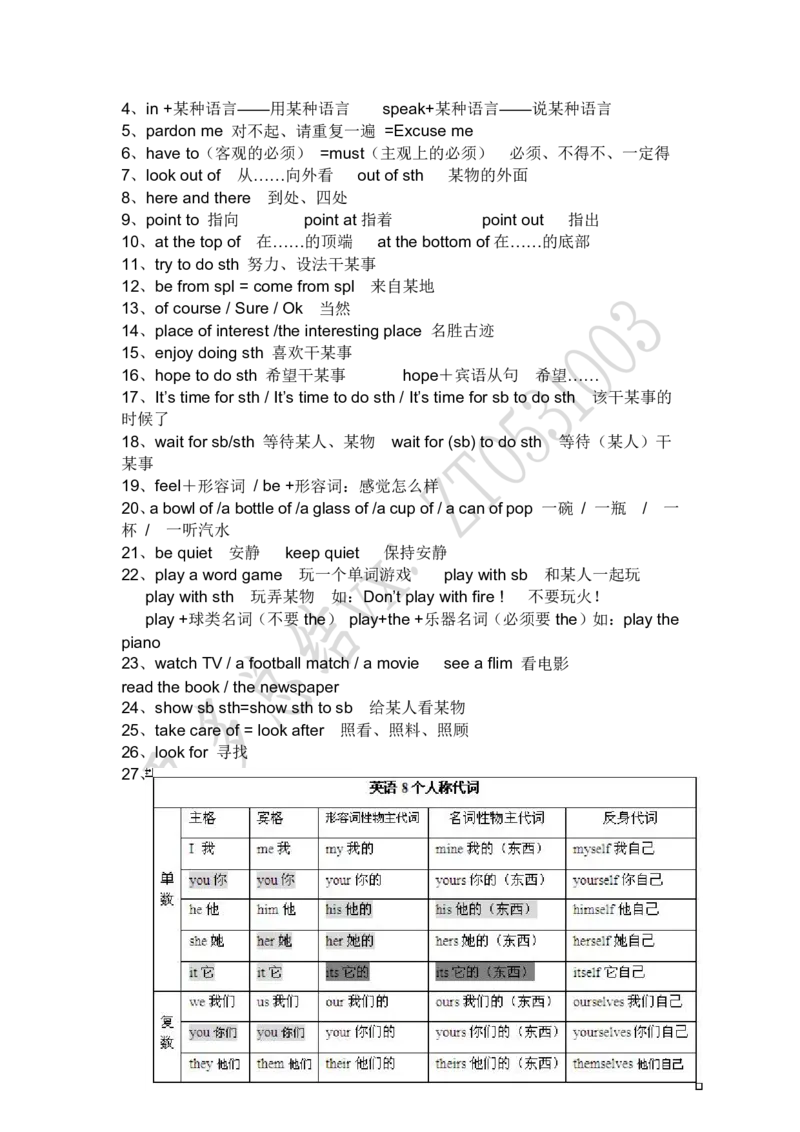
27、
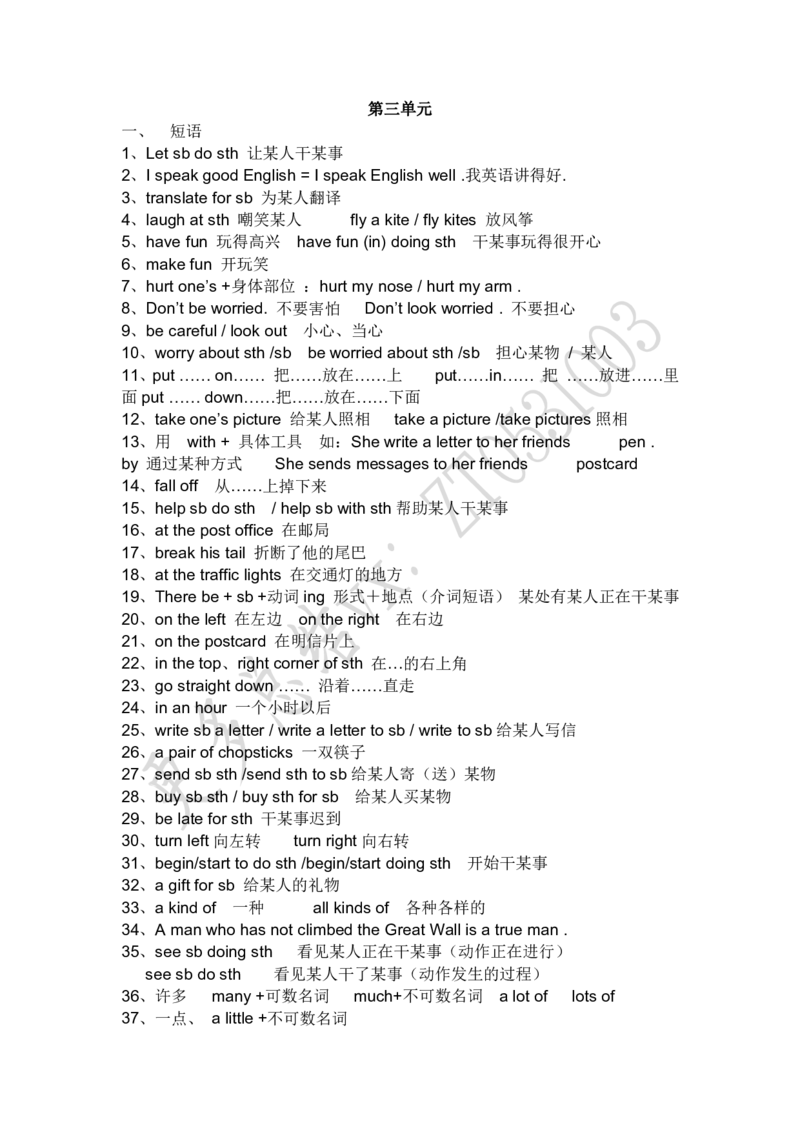
第三单元
一、
短语
1、Let sb do sth 让某人干某事
2、I speak good English = I speak English well .我英语讲得好.
3、translate for sb 为某人翻译
4、laugh at sth 嘲笑某人
fly a kite / fly kites 放风筝
5、have fun 玩得高兴
have fun (in) doing sth
干某事玩得很开心
6、make fun 开玩笑
7、hurt one’s +身体部位:hurt my nose / hurt my arm .
8、Don’t be worried. 不要害怕
Don’t look worried . 不要担心
9、be careful / look out
小心、当心
10、worry about sth /sb
be worried about sth /sb
担心某物/ 某人
11、put …… on…… 把……放在……上
put……in…… 把……放进……里
面put …… down……把……放在……下面
12、take one’s picture 给某人照相
take a picture /take pictures 照相
13、用
with + 具体工具
如:She write a letter to her friends
pen .
by 通过某种方式
She sends messages to her friends
postcard
14、fall off
从……上掉下来
15、help sb do sth
/ help sb with sth 帮助某人干某事
16、at the post office 在邮局
17、break his tail 折断了他的尾巴
18、at the traffic lights 在交通灯的地方
19、There be + sb +动词ing 形式+地点(介词短语)某处有某人正在干某事
20、on the left 在左边
on the right
在右边
21、on the postcard 在明信片上
22、in the top、right corner of sth 在…的右上角
23、go straight down …… 沿着……直走
24、in an hour 一个小时以后
25、write sb a letter / write a letter to sb / write to sb 给某人写信
26、a pair of chopsticks 一双筷子
27、send sb sth /send sth to sb 给某人寄(送)某物
28、buy sb sth / buy sth for sb
给某人买某物
29、be late for sth 干某事迟到
30、turn left 向左转
turn right 向右转
31、begin/start to do sth /begin/start doing sth
开始干某事
32、a gift for sb 给某人的礼物
33、a kind of
一种
all kinds of
各种各样的
34、A man who has not climbed the Great Wall is a true man .
35、see sb doing sth
看见某人正在干某事(动作正在进行)
see sb do sth
看见某人干了某事(动作发生的过程)
36、许多
many +可数名词
much+不可数名词
a lot of
lots of
37、一点、a little +不可数名词
一些a few +可数名词
some 用于肯定句
any 用于否定句和疑问句
38、put on 穿上、戴上(穿的动作)
wear
穿着、戴着(穿的状态)
39、turn on 打开
9、turn up
调大……
turn off 关闭
turn down
调小……
40、停止干某事stop to do sth
停下来去做另外一件事
stop doing sth
停止正在干的事
41、在……的前面
in front of
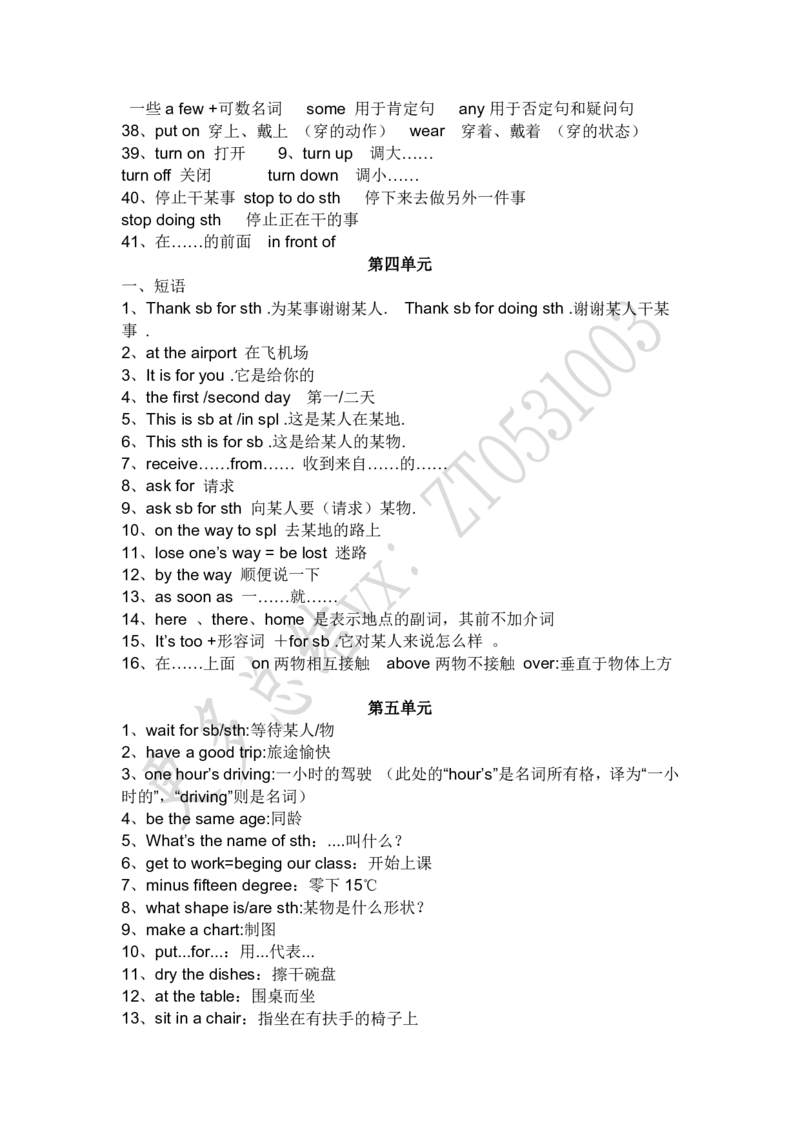
第四单元
一、短语
1、Thank sb for sth .为某事谢谢某人.
Thank sb for doing sth .谢谢某人干某
事.
2、at the airport 在飞机场
3、It is for you .它是给你的
4、the first /second day
第一/二天
5、This is sb at /in spl .这是某人在某地.
6、This sth is for sb .这是给某人的某物.
7、receive……from…… 收到来自……的……
8、ask for 请求
9、ask sb for sth 向某人要(请求)某物.
10、on the way to spl 去某地的路上
11、lose one’s way = be lost 迷路
12、by the way 顺便说一下
13、as soon as 一……就……
14、here 、there、home 是表示地点的副词,其前不加介词
15、It’s too +形容词+for sb .它对某人来说怎么样。
16、在……上面
on 两物相互接触
above 两物不接触over:垂直于物体上方
第五单元
1、wait for sb/sth:等待某人/物
2、have a good trip:旅途愉快
3、one hour’s driving:一小时的驾驶(此处的“hour’s”是名词所有格,译为“一小
时的”,“driving”则是名词)
4、be the same age:同龄
5、What’s the name of sth:....叫什么?
6、get to work=beging our class:开始上课
7、minus fifteen degree:零下15℃
8、what shape is/are sth:某物是什么形状?
9、make a chart:制图
10、put...for...:用...代表...
11、dry the dishes:擦干碗盘
12、at the table:围桌而坐
13、sit in a chair:指坐在有扶手的椅子上
第六单元
1、感叹句
1)以What 引导
What+a/an+adj.(形容词)+n.(名词)单数+主语+谓语+其他;
What+adj.(形容词)+n.(名词)复数+主语+谓语+其他;
Example:What a small box it is!
What a little boy you are!
What little boys you are!
2)以How 引导
How+adj(形容词)/adv(副词)+主语+谓语+其他:
Example:How small the box is!
How great you are!
How beautiful the girls are!
2、learn:学习的过程
study:学习的结果
3、play in the snow:打雪仗
4、make a snowman:堆雪人
5、tell sb about sth:告诉某人关于...
6、pick up:捡起拿起
7、It one’s turn to do sth:该轮到某人做某事了
8、on Spring Festival :在春节
9、on rainy days:在雨天
10、不规则形容词、副词比较级、最高级:little-less-least
many/much-more-most
good/well-better-best
bad/badly/ill-worse-worst
far-farther-farthest 或far-further-furthest(进一步的)
第七、八单元
1.teach sb to do sth:叫某人做某事
2.learn to do:学做某事
3.get ready to do sth/be ready to do sth:准备好做某事
4.
like to do sth :喜欢做某事(偶然性)like doing sth:喜欢做某事(指个
人习惯)
5.
be called:被叫做...
6.
chear for:为...欢呼
7.
在比分中表示几比几用“to”,如:3:4 读作:three to four
8.
be good/bad for:对....有益/害
9.
How often:对频率进行提问eg.How often do you play tennis? Twice a
week.
10.
need:(实义动词)need to do:需要做...
(情态动词)need+动词
原形
11.
It takes sb sometime to do sth:做某事花费某人多少时间
12.
for example:例如(通常放在句首)
13.
a helpful person:一个有益的人
14.
look+形容词:看起来...
15.
go+动名词:去做某事go swimming/shopping/fishing:去游泳/购物/
钓鱼
16.
make sb/sth +形容词:是某人/物处于某种状态
17.
run into a tree:撞树
18.
look like:看起来像
19.
like...better than...:喜欢...胜过...
20.
exam paper:试卷
21.
be good at/do well in:擅长于...
22.
for+一段时间:表示该动作持续了一段时间
23.
fly home:坐飞机回家
24.
buy sth for sb/buy sb sth:给某人买某物
25.
in+一段时间:表示.....之后,用于将来时
初一英语语法总结
1.动词be(is,am,are)的用法
我(I)用am, 你(you)用are,is 跟着他(he),她(she),它(it)。单数名词用is,复数名词全用
are。变否定,更容易,be 后not 加上去。变疑问,往前提,句末问号莫丢弃。还有一条须
注意,句首大写莫忘记。
2.this,that 和it 用法
(1)this 和that 是指示代词,it 是人称代词。
(2)距离说话人近的人或物用this, 距离说话人远的人或物用that。如:
This is a flower. 这是一朵花。(近处)
That is a tree. 那是一棵树。(远处)
(3)放在一起的两样东西,先说this, 后说that。如:
This is a pen. That is a pencil. 这是一支钢笔。那是一支铅笔。
(4)向别人介绍某人时说This is…, 不说That is…。如:
This is Helen. Helen, this is Tom. 这是海伦,海伦,这是汤姆。
(5)This is 不能缩写, 而That is 可以缩写。如:
This is a bike. That’s a car. 这是一辆自行车。那是一辆轿车。
(6)打电话时,介绍自己用this, 询问对方用that。如:
—Hello! Is that Miss Green? 喂,是格林小姐吗?
—Yes, this is. Who’s that? 是的,我是,你是谁?
注意:虽然汉语中使用“我”和“你”,但英语中打电话时绝不可以说:I am…, Are you…?
/Who are you?
(7)在回答this 或that 作主语的疑问句时, 要用it 代替this 或that。如:
①—Is this a notebook? 这是笔记本吗?
—Yes, it is. 是的,它是。
②—What’s that? 那是什么?
—It’s a kite. 是只风筝。
3.these 和those 用法
this, that, these 和those 是指示代词,these 是this 的复数形式,指时间,距离较近的或下面要
提到的人或事;those 是that 的复数形式,指时间、距离较远或前面已经提到过的人或事物。
①This is my bed. That is Lily’s bed. 这是我的床。那是莉莉的床。
②These pictures are good. 那些画很好。
③Are those apple trees? 那些是苹果树吗?
在回答主语是these 或those 的疑问句时,通常用they 代替these 或those 以避免重复。如:
④Are these/those your apples? 这些(那些)是你的苹果吗?
Yes, they are. 是的,他们是。
4.名词+’s 所有格
单数名词后直接加“ ’s ”:
Jim’s coat 吉姆的外套Jeff’s mother 杰夫的妈妈
以s 结尾的复数名词,只加“’”
Teachers’ Day 教师节the twins’ books 双胞胎的书
不以s 结尾的不规则的名词复数,加“ ’s ”
Children’s Day 儿童节men’s shoes 男式鞋
表示两者共同拥有时,只在最后一个名词后加’s
Lucy and Lily’s mother 露茜和莉莉的妈妈(共同的妈妈,一个妈妈)
表示两者各自拥有时,要在每个名词后加’s
Lucy’s and Kate’s rooms 露茜和凯特的房间(各自的房间,两间房子)
5.There be 句型
(1)There be 句型主要用以表达“某处(某时)有某人(某物)。”其基本结构为“There be
+某物(某人)+某地(某时)”其中there 是引导词,没有词义;主语是be 后面的名词,be
是谓语动词,在一般现在时中be 只用is 和are 两种形式。下面这首歌诀可帮你巧记there be
句型结构:
There be 放句首,主语跟在后。地、时放句末,强调置前头。如:
There is a book on the desk.
有时为了强调地点,也可把介词短语放在句首。如:
On the desk there is a book.
(2)There be 句型中的be 动词如何确定呢?请先看看下面这首歌诀:
Be 动词,有三个,am,is 还有are。“There be”真特别,不留am 只留俩,那就是is 还有
are。要用is 还是are,须看其后的名词是单数还是复数。若是单数或不可数名词用is,否则
就用are。如:
①There is a tree behind the house.
②There is some water(水)in the bottle(瓶子).
③There are some pears in the box.
(3)注意:如果“be”后的主语是由and 连接的两个或两个以上的名词,那么be 的形式要遵
循“远亲不如近邻”的原则。也就是说,“be”的形式是由与它最近的那个名词来确定的。
若那个名词是单数或不可数名词要用is,是复数就用are。如:
①There is a book and some pens on the floor.
②There are some pens and a book on the floor.
6.like 一词的用法
like 用作及物动词,译为“喜欢”。
(1)后接名词或代词,表示喜欢某人或某物。如:
I like the baby very much. 我非常喜欢这个小孩。
(2)后接动名词(v. -ing),表示“喜欢做某事”,着重于习惯、爱好。如:
Tom likes playing football. 汤姆喜欢踢足球。
(3)后接动词不定式(to do ),表示“偶尔地喜欢做某事”,着重于某次具体的行为。如:
I like reading, but I like to watch TV this evening. 我喜欢读书,但我今晚想看电视。
7.句子单数变复数,注意以下五要素
(1)主格人称代词要变成相应的复数主格人称代词,即I→we, you→you,she,he,it→they。
如:She is a girl. →They are girls.
(2)am,is 要变为are。如:
I’m a student. →We are students.
(3)不定冠词a,an 要去掉。如:
He is a boy. →They are boys.
(4)普通单数名词要变为复数形式。如:
It is an apple. →They are apples.
(5)指示代词this,that 要变为these,those。如:
This is a box. →These are boxes.
8.英语日期的表示法
英语中月份和星期名称都是专有名词,它们的首字母必须大写,并且前面无需用冠词。
用英语表示日期,其顺序为月+日+年,日和年之间需用逗号隔开。如:August 2nd,2003(2003
年8 月2 日)。也可以用日+月+年来表示。如:10th May,2003(2003 年5 月10 日)英语日期
前介词的使用:若指在哪一年或哪一月,则用介词in,若具体到某一天,则需用介词on。
9.时间的表达法
(1) 直读式,即直接读出时间数字
7: 05 seven five 8:16 eight sixteen
(2) 过、差式,即几点差几分,几点过几分。(以30 分为分界线)
1:25 twenty-five past one 2:30 half past two
3:43 seventeen to four 4:38 twenty-two to five
(3)12 小时制
6:00 a.m. 上午6 点8:20 p.m. 下午8 点20 分
(4)24 小时制
13:00 13 点钟22:15 22 点15 分
(5)15 分可用quarter
4:15 a quarter past four 5:45 a quarter to six
(6)时间前通常用at.
at 5 o’clock at 7:30 p.m.
10. want 用法
(1)想干什么用want to do sth
They want to join the sports club. 他们想加入运动俱乐部。
(2)第三人称单数作主语,want 要作变化
①He wants to play basketball.
②Li Xia wants to play the piano.
(3)变疑问句,否定句要借助助动词do 或does.
①-Do you want to play soccer ball ? -Yes , I do . / No , I don’t.
②-Does he want to go home by bus ? -Yes , he does . / No , he doesn’t
1. 形容词的用法:
形容词用以修饰名词,表示人或事物的特征。在句中可以作定语、表语,用于限定被修饰
语的特征,如长短、大小、重量、颜色、高矮、胖瘦、新旧等,。
The little girl is very pretty. 这个小女孩很好看。
--I want that one. 我想要那个。
--Which one? 哪一个?
--The new blue one. 那个蓝色新的。
Can I have a look at the big nice one? 我能看一看那个大的漂亮的吗?
2、人称代词:
是用来表示人的代词,有单数和负数之分,有主格和宾格之分。人称代词的主格在句中作
主语;人称代词的宾格在句中作宾语,是作动词或介词的宾语。
主格:I, we, you, he, she, it, they 在句子中作主语
宾格:me, us, you, him, her, it, them 在句子中作宾语
He and I are in the same class. 我和他在同一个班级。
Can you see them in the street? 你能看见他们在街上吗?
3、可数名词和不可数名词
英语中名词分为可数名词和不可数名词。凡是可数计数的名词叫做可数名词;凡是不可以
计数的名词叫做不可数名词。
(1)可数名词分为单数和复数两种形式。可数名词前可以用不定冠词、数词或some many
等修饰。如:a man a desk an apple an orange some books some children tow pens
(2)不可数名词没有复数形式,前面不能用不定冠词、数词或many 等词语修饰,但可以用
some a little much 等词语来修饰。有时可以与一些量词短语搭配,这些量词短语中的名词一
般是可数的,有单数形式,也可以有复数形式。如:some water a little milk much food a piece
of bread tow bottles of ink some glasses of water
4、祈使句
祈使句用来表示请求、命令等,句中没有主语,肯定形式由谓语或者谓语+宾语(+宾语补
足语)构成,否定形式则在句前加Don’t.
Stand up, please. 请起立。
Don’t worry. 别担心。
can 的用法:
can 是情态动词,表示“能,会,可以,被允许等”,其后接动词原形,否定形式为cannot,
可缩写为can’t.
She can speak Japanese. 她会讲日语。
I can’t remember his name. 我不记得他的名字了。
Can you spell your name? 你会拼写你的名字吗?
5、现在进行时态:
概念:表示现在(说话瞬间)正在进行或发生的动作,也可以表示目前一段时间内或现阶段
正在进行的活动。
结构:由be 动词(am, is, are) + 动词ing 构成,其中be 动词要与主语保持性数一致。
Mary is flying a kite in the park. 玛丽正在公园里放风筝。
--What are you doing now? 你现在在干什么?
--I’m reading English. 我正在读英语。
Are they drawing the pictures now? 他们正在画画吗?
动词现在分词是动词原形变化而来的,规则变化如下:
动词ing 形式叫动词现在分词,其构成如下:
1) 直接在动词后加ing
play—playing, do—doing, talk—talking, sing--singing
2) 以不发音的字母e 结尾的动词,先去e,再加ing
make—making, write—writing, have—having, take—taking
3) 以重读闭音节结尾的动词且词尾只有一个辅音字母,应双写这个辅音字母,再加ing
run—running, stop—stopping, put—putting, swim—swimming
注意对现在进行时态的判断。判断一个英语句子用什么时态,主要看句子的时间状语,一
般说来,每种时态都有与之相对应的时间状语。现在进行时表示现在(说话瞬间)正在进行或
发生的动作。因此,这个时态最常用的时间状语是now;但有不少句子并没有now,只能通
过提示语如look、listen 等或者通过上下文来确定用现在进行时。
She is cleaning her room now. 她正在打扫房间。
Look! The girl is dancing over there. 看!那个女孩在那里跳舞。
--Can you go and play games with me? 你能和我们一起做游戏吗?
--Can’t you see I am doing my homework? 你没看见我正在做作业吗?
6、have/ has 的用法:
1) 谓语动词have 表示“有”,有两种形式:have 和has,前者用于第一人称(I, we),第二
人称(you)和第三人称复数(they),后者用于第三人称单数(he, she, it)或单数名词。
I have an apple and he has two bananas. 我有一个苹果,他有两个香蕉。
You have a new English teacher. 你们有了一个新的英语老师。
It has two big eyes. 它有一双大眼睛。
Julie and Jack have a nice car. 朱莉和杰克有一辆好看的车。
2) have/has 句型与there be 句型的比较:两者都表示“有”,但用法不同。前者表示所属关
系,即表示“某人或某物有什么”,而后者表示存在,表示“某地有什么”。
They have some new books. 他们有一些新书。
There are some new books on their desks. 他们桌子上有一些新书。
She has a lot of pretty skirts. 她有很多漂亮的裙子。
There are a lot of pretty skirts in the shop. 商店里有很多漂亮的裙子。
3) have/ has 的否定句,一般要加助动词do/ does,再加not 构成,即do not have (don’t have)/
does not have (doesn’t have)
. She does not have a sister. 她没有姐姐。
We don’t have any classes on Saturday. 我们星期六没有课。
Ann and I don’t have a big room. 我和安没有一个大房间。
4) 一般疑问句由“助动词Do/ Does + 主语+ have + 宾语”构成,回答用Yes, … do/ does.
或者No, … don’t/ doesn’t.
--Do you have a big house? 他们的房子大吗?
--No, they don’t. 不,他们的房子不大。
--Does he have an eraser? 他有橡皮吗?
--Yes, he does. 他有的。
5) 特殊疑问句由特殊疑问词+ 助动词do/ does + have (+状语)构成。
What do they have? 他们有什么?
What does he have? 他有什么?
How many telephones do they have? 他们有几部电话?
7、介词用法:
1) 具体时间前介词用at。
. He gets up at half past seven every day. 他每天七点半起床。
She goes to bed at eleven o’clock. 她十一点睡觉。
2) 表示“在早上,在下午,在晚上”的短语中用介词in,且定冠词the 不能省略;表示“在
中午,在夜里”的短语中介词用at,不加冠词。
in the morning 在早上,in the afternoon 在下午,in the evening 在晚上
at noon 在中午,at night 在夜里
3) 表示“在某天”、“在某天的上午、下午等”的短语用介词on。
What do you usually do on Monday morning? 星期一上午你通常做什么?
Do you sometimes go out to eat on Friday evening? 有时你星期五晚上出去吃饭吗?
He watches DVDs on Saturday night. 星期六晚上他看DVD。
Parents take children to parks on June 1. 六月一日,家长们带着孩子去公园。
4) 在this, last, next, every 等词前面既不加介词,也不用冠词。
What are you doing this afternoon? 今天下午你做什么?
He visits his grandma every Friday. 他每个星期五都去看望祖母。
She is going to Shanghai next Monday. 她下个星期一去上海。
8、一般现在时
一般现在时表示经常性或习惯性的动作,或表示现在的特征或状态。
其动词形式是:动词原形(只有第三人称单数作主语时除外,要加-s)其疑问句和否定句需
要用助动词do 或does
1) 肯定句用行为动词原形表示
They get up very early every morning. 他们每天早晨起来很早。
I visit my grandparents four times a month. 我一个月去看望祖父母四次。
2) 否定句用don’t + 动词原形来表示
We do not go shopping on Sundays. 我们周日不去购物。
I don’t think you like this colour. 我想你不喜欢这个颜色。
3) 一般疑问句则是把助动词do 提前至句首,后面动词用原形。回答时,肯定用“Yes, 主
语+do”;否定句用“No, 主语+don’t”。
–Do they go to school at seven o’clock? 他们七点去上学吗?
--Yes, they do.
--Do you like this skirt? 你喜欢这条裙子吗?
--No, I don’t. 不,我不喜欢。
一般现在时用来表示经常的或习惯性的动作,常与以下的时间状语连用:often 经常,always
总是,sometimes 有时,usually 通常,every day/ week 每天/ 周等。
He usually goes to school by bike. 通常他骑车上学。
I visit my grandparents every week. 我每个星期都去看祖父母。
She is always late for class. 她总是上课迟到。
My parents and I sometimes go out to eat. 我和父母有时出去吃饭。
It often rains here. 这儿常常下雨。
主语为第三人称单数时的一般现在时
一般现在时态,当主语为第三人称单数时,谓语动词也要是第三人称单数,后要加-s 或-es。
He likes reading at night. 他喜欢夜里读书。
She usually goes to school by bike. 她平时骑车上学。
The little cat drinks milk every day. 小猫每天都喝牛奶。
转换成否定句要加doesn’t,其后的动词用原形。
Kelly doesn’t get up early on Saturdays and Sundays. 凯丽星期六星期天起床不早。
He doesn’t feel well today. 他今天感觉不舒服。
转换成一般疑问句,句首用Does,其后的动词用原形。
Does he have lunch at school? 他在学校吃午饭吗?
Does it take long by train? 乘火车要很长时间吗?