� �
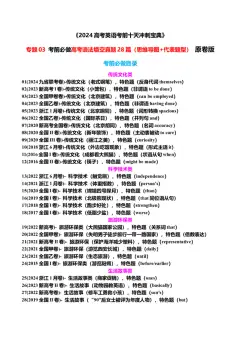
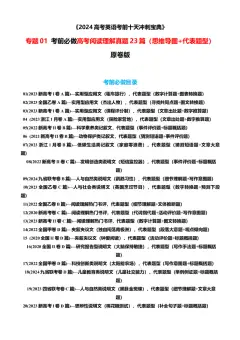
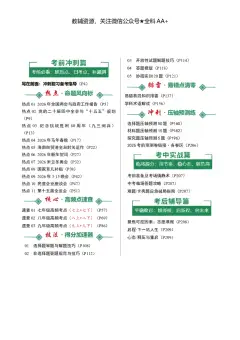
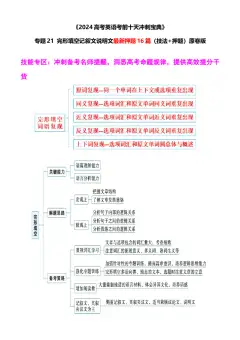
倒计时20 天
➤����
��
������(�����)…………………………2
以文本具体信息为载体,考查定位筛选、比对甄别关键信息的能力
倒计时19 天
➤����
��
������(�����)…………………………2
以文本逻辑链与隐含线索为载体,考查合理推断、把握作者言外之意的能力
倒计时18 天
➤���� �
���� (� !"�+#$%&�)…………………………2
以篇章结构与核心论点为载体,考查归纳总结、提炼标题或写作意图的能力
以上下文语境与构词法线索为载体,考查推测生词、短语或指代含义的能力
倒计时17 天
➤���� '()*+,�-./�……………………………………………2
以语篇连贯性与逻辑衔接手段为载体,考查还原句子、匹配段落逻辑关系的能力
倒计时16 天
➤0123 4�54678………………………………………………………2
������
��
������������������
教辅资源,关注微信公众号★全科AA+
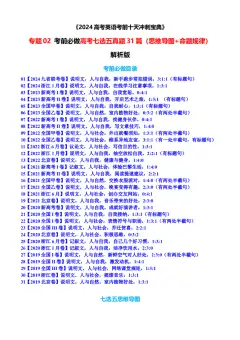
倒计时20 天
Believe you can, and you’re halfway there.
— Theodore Roosevelt
����
��
���(�)(�����)
94:;--把脉命题 直击重点
�<��=>
��
��
A � !"�#
B � $%�#
C/D � &�� / '(�#
)*�+,
-.
/ I
�
012�345
65789:;
<=>
John Todd ?@A
BCDEFGH
IJKL.
C �MNOPQRSDTUV
D �M“W�XY”Z!
6
2023
-.
/ II
�
[\]^_`a
b�cdefg
d�
Abby Jaramillo h
ijkl� Urban
Sprouts m`d�
C �: nopq:rstuv�w
xyS
D �Mz{k|}~��D6
tuv:
wx
8
-.
/ I
�
�
]"�
�UV
C �: ¡¢At£¤rs¥NOr
s(¦§J¨©)�z{ª«
D �M|¬D N®�¯¨°
8
2024
-.
/ II
�
±²³´T
µ¶·¸¹º»
¼½¾¿À�Á
Â6ÃÄÅÆ
C �: ÇÈÉÊËÌ(BMF)
D �MÍuXÎÏÐM¥uX
ÎÑD�ÐÒÓ-pÔÕ
7
2025
-.
/ I
�
¼½Ö×�ØÙ
ÚÛÜ�Ý!t
UÞ
Bß��àj�
à¨á âãä
å
C �: æ7R=�}~çÒ vs 5
uèé�DTêëìí
D �MÊîïKðÝ!tUñ
6
2025
-.
/ II
�
±CòóB>�
ô]õö÷ø
ùàj
C �: úûüýtÛþ�ÿP
D �MBlue Hill Āā wastED Ăă
5
�?9@A>
ĄÐą 2026 ��ą!"�Ć&��:$%��rs�+��ćĈĉĊwt)*�+,�/ċČ)*�
+,BčĎ®À�ab�ď:ÂĂ45aĐ�đ,uĒĒ½ēt��)*ĉ�Ĕ�H/ċ/Dĕ��+
)*�ÎĖČ)*�+,ą./rs�+�ėĘęĚ�Èě�BčĜĝM
1ĞğĠď,——ąġ��¦ğĠĢģĤÞ�ĥ" who�what�when�where�why : how haĐČ
2ĞëĠď,——Ħxć,�ď¥ġ�Ęħď45Ĩy��ĩĪ�īĬąĭĮ��įİ�ıĦx
45ĉIJij�UÎóĴ(Č
教辅资源,关注微信公众号★全科AA+
3ĞNOÐĵ,/ĶĭĆĶķ,--�ğĠĸĴHĘħN®�xĹē��ÐĵĺÎĻóĴĤÞČ
BC9D
9D 01 E*FG�
9DHI--核心精粹 高效速记
/D¦�ļ“ħĽľĿßñ”�ŀ“ŁłĐ,ĢĤÞ”�Uñ�½ēĿßĢ,ŃČńŅ,ņ�aļħĽ
°ľĨ(,Ń)�Ň�ňʼnŊŋ�Ō"ōsÝŎs�ŏŐº»ą���ŎĢ¥ňħĽľĘħ�őŒĆĨœ�
º»ĿßŔ,¥ŕBőŕBœħ�ŇŖ)ŗŘ�Ŗ)ÈřŚĸśd¥��)*�)ʹ��ąĕ��
+)*�Ŝaŝ�ŞŇ�ĿĤÞČQşä�¦"“BĢŠĿšÈt”�UñČŀM
1.Ţţt�Ťť�Ŧŧ,Ũěũ,ŪuŪşĴ,,ūĦxrsŦŧ�ěũ,ŪşŜŇ�ûŬ�Ň¥śdŭtČ
2.ąĴ|BŮħĽľ�ů howeverĆbutĆmoreoverĆthereforeĆ thus ı�x��ĊyœũŜŇyS�ĩŰ�
ű4�Ų«hħųČ
3.)*,�ĤÞBčŴŵSŶĪdIJŵSĩĪdČŷ
4.śd�ŸtĨŹľ�BčźŴĤÞČůMmust, never, the most, all, merely, only, have to, any, no, completely,
none,hČŻźŴŸt�żěŽČ
5.Ċyśd��žľ�ſŬľ:ÔľÀĨh¥ġ�ŴƀBƁČůM must, may, often, should, usually, might, most,
more or less, likely, all, never�few hĬąƂƃźŵ�ĹĥƄƅĪ�ĒĒƄƆ§Č
6.)*,ņƇd��M¥ġ�ûŬĘƈƉ¥ġ�ûŬBƊĘŦ�BƊźŵƉ%¢ēƋŸtJƉġ�ƌaÝ.
ƍ()*�+,�Ǝ²UVaĴĐ,�/DƏ!Ɛ$BC+,ġƑ——“ƒƒRS”�ŀƓƔ�ġ�ʼnƕ®�
ƍĦrsƖCőŒƗƘƙ�Ň45ƚƛƜIJƝƞŗ��Ɵ�ĤÞĒĒt!ġ���ƠC�ďČğĠ)
*,�"“ġ�Ŀß”:“ġľ|”�UV+ĤƉ ,ņIJśdƣĴ|ġ�ğĠďıƤ�ƥ"“ŵ
SĩĪ�ôôƦƧ”�UVŎĢƟ��ĤÞČąċĢŵSď�ıƤ�źÎūĢĘƨ�t!ľƩƪƆōij�
Ĩ�ƫƬČ
J�KL--复盘经典 把握规律
ƭě 1Ʈ2025 -./Ư� Aư
English Market Towns to Visit in the UK
English market towns come in many shapes and sizes. Each has a personality shaped by the goods and
services produced and traded for centuries. But each town has more to do than shop.
Hereford� Herefordshire
Hereford has remained a lively market town since 1189. Skirting the town square, you’ll find lovely shops,
eateries, and the Black and White House Museum. The Hereford Cathedral is the most impressive building in town.
It’s also home to an ancient library. One of the four original copies of the Magna Carta is displayed there.
Ludlow, Shropshire
Ludlow is known as the Foodie Center of England. Butcher shops, greengrocers, bakeries, and cheese shops
line the town square. Bordering the square, the Ludlow Castle is a “must explore” medieval stronghold. The
three-day Ludlow Food Festival is held each September.
Shrewsbury, Shropshire
Getting to Shrewsbury Town Center from London is challenging but worth the anxiety. The River Severn has
a significant turn through town, almost making an island of Shrewsbury Town Center. The shape creates a perfect
market where goods could be shipped and received using the river as a highway. Flowers are everywhere-hanging
baskets, window boxes, and planters-just what you imagine in an attractive English market town.
Mevagissey, Cornwall
Even if you haven’t been to the small fishing village Mevagissey, you’ve probably seen it in a movie or British
TV show. The working harbor(ƱƲ) took shape in 1774. Fishermen go out to sea daily and sell their fish in
harbor-side markets. Don’t leave the harbor without a traditional Comish pie. It’s delicious.
1. Where can you find an original copy of the Magna Carta?
A. In the Ludlow Castle.
B. In the Foodie Center of England.
C. In the Hereford Cathedral.
D. In the Black and White House Museum.
2. What is a feature of Shrewsbury Town Center?
A. It’s situated near a big island.
B. It’s almost surrounded by water.
Ï,UV
ƳWhen/Where did the story happen?
ƴWhich of the following statements is (not) correct/wrong/false?
ƵWhich of the following statements is (not) mentioned/included in the passage?
ƶWho would most probably enter for Take a view?
ƷAll the statements are true except ________.
ƸWhich of the following is TRUE about ________ƹ
ƺWhich of the maps/diagrams shows the right position of...?
教辅资源,关注微信公众号★全科AA+
C. It’s known for its flower festival.
D. It’s easily accessible from London.
3. What does the author suggest visitors do in Mevagissey?
A. Try the Cornish pie.
B. Watch a British TV show.
C. Go fishing in the sea.
D. Take pictures of the harbor.
Ĩ�+s
ħĽľ
English market towns, Visit, come in many shapes and sizes, personality
RƻƼx
ƒ�ŴB�!"��ƽ¢A±CòóB>�ƾƿǀǁĆǂǃDŽİ�ô]õö÷ø�ŁÖs
Dž6¥u�ǃdž�LJäČ
ġ�ĴLj
ś6 TRAVEL AWAITS ljNJB�Ūʼn 5 Charming English Market Towns To Visit In The UK
���Č
https://www travelawaits.com/2727110/best-english-market-to-wns-uk/
Nj¯ nj
Magna CartaÍĚǍ�ÓM1215 �ôǎǏ]ǐǑǒƄǓǔǕ:ǖǗ�ĆǘǙôǎǏ_ǚǛ
:ñǜǝƥ�wxƾƿ�Ǟ�ĥƄ§�|¬ôǎǏñǜ�ǟǠČ
The River Severn ǡ�ǢMô]ƬûŞǣ�ǢǤ�ƙǣ 354 ǥǦ�Ǒ 220 ôǧČ
Ĩş nj
wǨ�ľ
shape v. [ǩľDS]î@�; skirt v. [ŪľJ]Ǫł……�ǫǬǭ�ƫǮ....�±ǯ; eatery
n. [ǰƟV]ĀDZ�DzdzǴ; copy n. ġǵ�Ƕǵ; foodie n. [ǰƟV]dz^(=foody); line v. [Ū
ľJ]Ǫ......ª5; border v. [ŪľJ]Ǫ.....ǫM:……ǷǸ; medieval adj. �ǹǺ�;
stronghold n. ǻǼ; significant adj. ĘęĚ�; ship v. [ŪľJ]"ǽŌǾ; hanging basket n.
ǿmȀ�ǿmȁ; window box n.ȂƲmȃ�ȂȄmȅ; planter n. mȁ; harbor-side adj. ƱƲ
ǫ��ƱȆ�; accessible adj. ȇģĮ��ȇ4¿�
wǨ�ľ
Ȉ
come in many/all shapes and sizes(uIJ )ſſȉȉ�DŽ²DŽ; original copy ġǞ; take
shape ſª�?ª; go out to sea ĴȊ
9D 02 M*FG�
9DHI--核心精粹 高效速记
ĘÈğĠď,�đ,�ȋȌ°Ĉȍ�Ɵ�śdBčƏȎąġ�ǟǠ�45Ĕ@Čňv,�Ħx/D
ć,�ď¥ġ�Ęħď45ĨS��ĩĪ�ıȏĦx4B´�ĉIJij�Č
ëĠď, Ħxtġ�ƖLjĘħď45ĩĪIJij#MȐń�s,ņ���ħĽľ:Ĥ,UȑƉ
Ň�Ŀߥ,ņħĽľĘħ�ȒSľĆƈSľIJ+ȓ°ďƉŞŇ�ƥ"Ɵ�śd�� ȒSľŶĪġ�
ďĆȔĪġ�ĨEĆľ°IJľſĆQJIJƼĝġ�ĆƟȕƈ&h#��ĿĤÞČ
教辅资源,关注微信公众号★全科AA+
J�KL--复盘经典 把握规律
NO 2【2025 新高考I 卷 D】
Microplastics have become a common source of pollution across the Earth — they have settled in the deep sea
and on the Himalayas, stuck inside volcanic rocks, filled the stomachs of seabirds and even fallen in fresh Antarctic
snow. They are even appearing inside humans.
Now, new research suggests that a simple, cheap measure may significantly reduce the level of microplastics
in water from your tap (LȖȗ): boiling and filtering (ēȘ) it. In a study published Wednesday in Environmental
Science & Technology Letters, researchers from China found that boiling tap water for just five minutes — then
filtering it after it cools — could remove at least 80 percent of its microplastics.
Crucially, this process relies on the water containing enough calcium carbonate (ØșȚ) to trap the plastics.
In the study, boiling hard water containing 300 milligrams of calcium carbonate led to an almost 90 percent drop in
plastics. But in samples with less than 60 milligrams of calcium carbonate, boiling reduced the level of plastics by
just 25 percent. Additionally, the research didn’t include all types of plastics. The team focused only on three
common types — polystyrene, polyethylene and polypropylene — and they didn’t study other chemicals previously
found in water such as vinyl chloride.
Still, the findings show a potential path forward for reducing microplastic exposure — a task that’s becoming
increasingly difficult. Even bottled water, scientists found earlier this year, contains 10 to 1,000 times more
microplastics than originally thought.
Scientists are still trying to determine how harmful microplastics are — but what they do know has raised
concerns. The new study suggests boiling tap water could be a tool to limit intake. “The way they demonstrated
how microplastics were trapped through the boiling process was nice,” Caroline Gauchotte-Lindsay, an
environmental engineer of the University of Glasgow in Scotland who was not involved in the research, tells New
Scientist. “We should be looking into upgrading drinking water treatment plants so they remove microplastics.”
12. How does the author present the issue in the first paragraph?
A. By quoting an expert.
B. By defining a concept.
C. By giving examples.
D. By providing statistics.
13. What determines the effectiveness of trapping microplastics in water?
A. The hardness of water.
B. The length of cooling time.
ƳWhich is the right order of the events given in the passage?
ƴBy the first sentence of the passage, the author means that…ƹ
ƵWhat’s the right order of the events related to…?
ƶIn the passage, the author states that…
ƷWhat was the reason for…?
ƸWhat can we learn about the pet lizard …?
教辅资源,关注微信公众号★全科AA+
C. The frequency of filtering.
D. The type of plastic in water.
14. What does the author try to illustrate by mentioning bottled water in paragraph 4?
A. The importance of plastic recycling.
B. The severity of the microplastic problem.
C. The danger in overusing pure water.
D. The difficulty in treating polluted water.
15. What is Gauchotte-Lindsay’s suggestion about?
A. Choice of new research methods.
B. Possible direction for further study.
C. Need to involve more researchers.
D. Potential application of the findings.
'(��
� PQ
��������
��
������������������� !"#��
$%&'()�*+,-./01232456738�
��9:;<=>?# 3�
@A(BCD9:)�EFG*+HI�JKLM;�NOP
����QR�ST� !U
VW�XYZ673[\] ^_�
����QR;
RSTU
��`1Smithsonian magazineab2024c3d1efgBoiling Tap Water Could Help Remove
80 Percent of Its Microplastics, Study Suggests ��N;
https://www.smithsonianmag.com./smart-news/boiling-tap-water-could-help-remove-80-percent-of
-its-microplastics-study-suggests-180983874/
VWXY
@3(hard water):?9hijkl�Dmnopq�3;
'ZXY
[\D#
microplastic n.
��(micro- + plastic); stick v. rs tu; significantly adv. vwx; cool v.
(y)z{|remove v. }~; crucially adv. JKx Jx; trap v. ; drop n.
; additionally adv. } ; previously adv. ^ ; still adv. ;
exposure n. ; originally adv. 2 ; intake n. u : u : (in + take);
demonstrate v. |upgrade v. (y)YZ(up + grade); quote v. 7 ; hardness n. @A
(hard +-ness); severity n. S(severe + -ity); overuse v. /Ay7(over- +use)
[\D#]
settle in �......
2; volcanic rock ; rely on ; hard water @3; lead to ¡ ¢
£; bottled water ¤¥3; raise concerns about/over/for sth. "#�¦§�¨©; look into P
ª <=; pure water «¬3
9D 03 ^_`a�
9DHI--核心精粹 高效速记
NOÐĵ,BčȎțÝıëĆ�ȜĆȝȞĆNȟĆȠȡh�QȢÐĵČBčH&�ÐĵȟƏÈř÷�
ŬȇÐĵČŻŴôĨrs��NOÐĵȣȤxĢĴÐĵȥŇŚȋȦ�ďČȧŮ“Ȩ”ďȎțÝtƠCǨœ
��+�ŅȧCȩƃ�Ȫ��+��Ę!�ȫœŴ+ȧv,�ħĽČ
NOÐĵ,�ȕ,M1.ȬȭvƉ2.ÁÂvƉ3. ¯Ȯ njvƉ4.ƿ6vƉ5.�JàȯvČÏĐUV
� when�in which year�how many/much hȰĐľ(ȱ)Ȳȗ¾ĴĐ,Č+ňvȳ,ĥ"“ijŗĵ”ñČ
ġ�ĿßMƕ®,ņħĽľ�ŇŎsġ��ŵıť$NOĆıëĆ�¬hĘħďČ
��ħųMN®¥ġ�N®�ȴȵħų�ȶ45ĉȷȸȹÐĵČ
��ħĊMdecade Ⱥ� fortnight īǯ double īȻ couple īC score ŠȺ dozen ȺŠ off ȼȝ�ȷȝ
discount ŰȽČ
J�KL--复盘经典 把握规律
NO 1Ʈ2025 -./ I � Aư
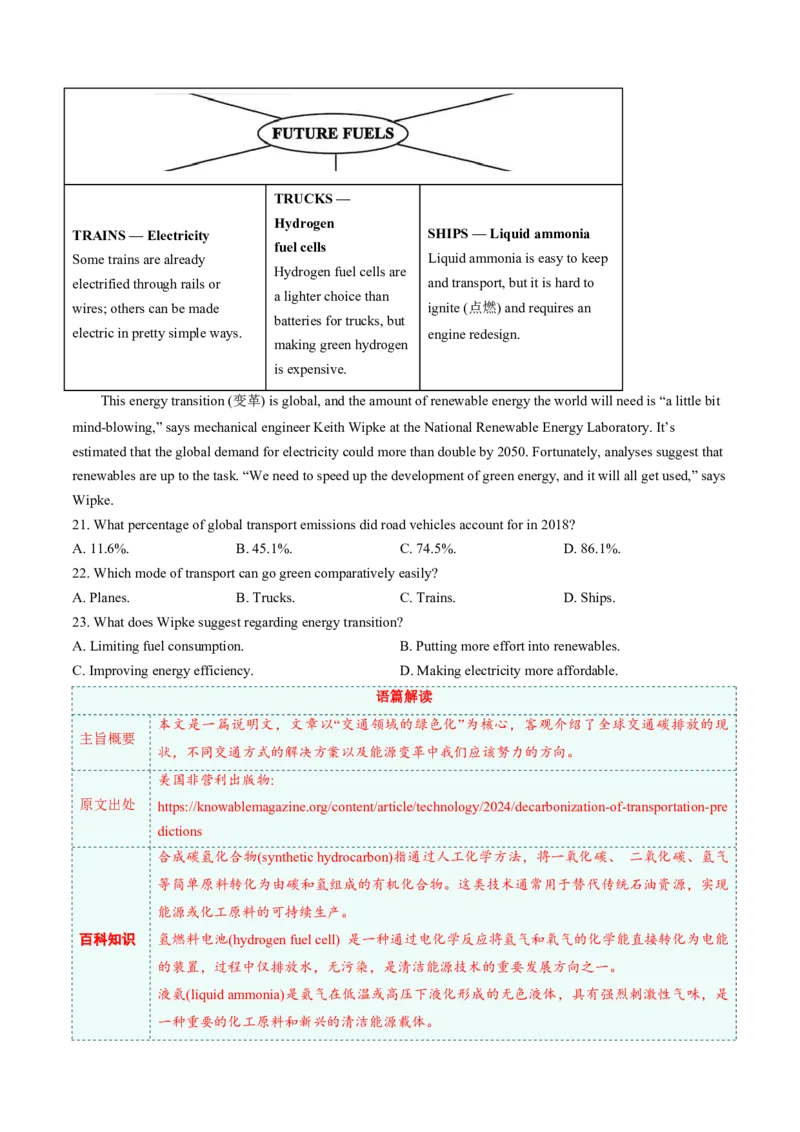
The greening of planes, trains and automobiles
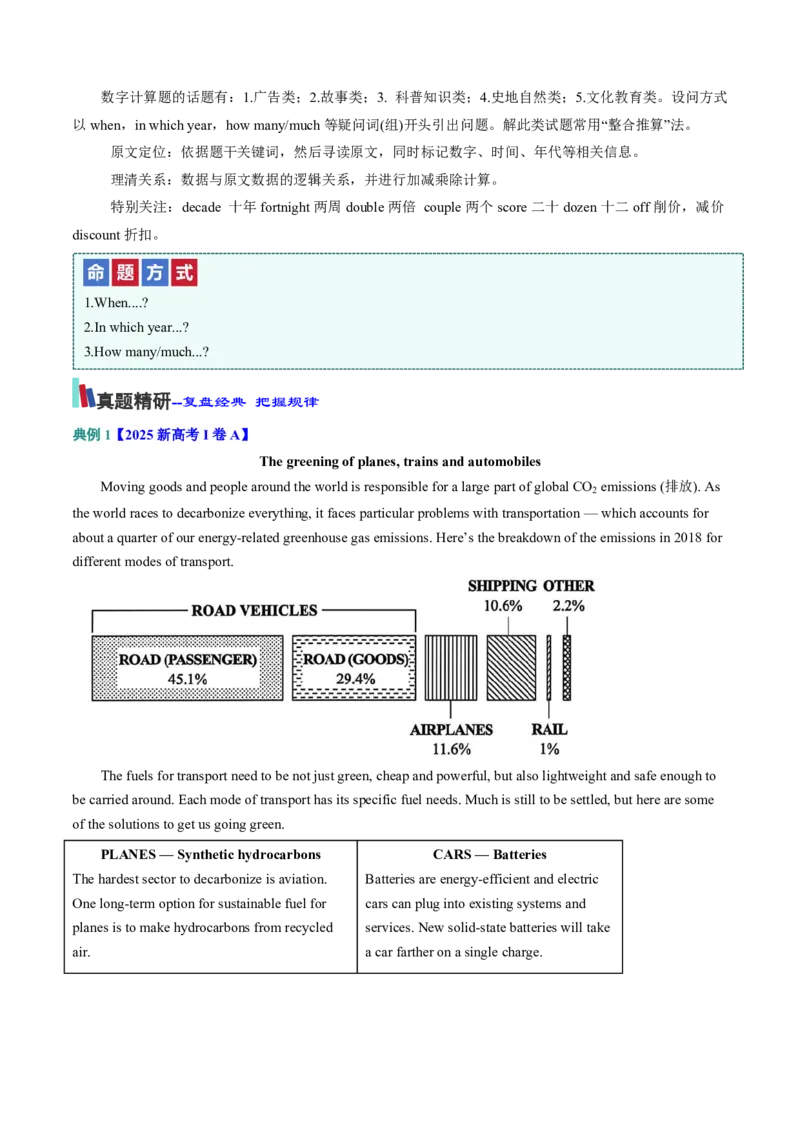
Moving goods and people around the world is responsible for a large part of global CO2 emissions (ÙÚ). As
the world races to decarbonize everything, it faces particular problems with transportation — which accounts for
about a quarter of our energy-related greenhouse gas emissions. Here’s the breakdown of the emissions in 2018 for
different modes of transport.
The fuels for transport need to be not just green, cheap and powerful, but also lightweight and safe enough to
be carried around. Each mode of transport has its specific fuel needs. Much is still to be settled, but here are some
of the solutions to get us going green.
PLANES — Synthetic hydrocarbons
The hardest sector to decarbonize is aviation.
One long-term option for sustainable fuel for
planes is to make hydrocarbons from recycled
air.
CARS — Batteries
Batteries are energy-efficient and electric
cars can plug into existing systems and
services. New solid-state batteries will take
a car farther on a single charge.
1.When....?
2.In which year...?
3.How many/much...?
TRAINS — Electricity
Some trains are already
electrified through rails or
wires; others can be made
electric in pretty simple ways.
TRUCKS —
Hydrogen
fuel cells
Hydrogen fuel cells are
a lighter choice than
batteries for trucks, but
making green hydrogen
is expensive.
SHIPS — Liquid ammonia
Liquid ammonia is easy to keep
and transport, but it is hard to
ignite (�Ⱦ) and requires an
engine redesign.
This energy transition (Ȕȿ) is global, and the amount of renewable energy the world will need is “a little bit
mind-blowing,” says mechanical engineer Keith Wipke at the National Renewable Energy Laboratory. It’s
estimated that the global demand for electricity could more than double by 2050. Fortunately, analyses suggest that
renewables are up to the task. “We need to speed up the development of green energy, and it will all get used,” says
Wipke.
21. What percentage of global transport emissions did road vehicles account for in 2018?
A. 11.6%.
B. 45.1%.
C. 74.5%.
D. 86.1%.
22. Which mode of transport can go green comparatively easily?
A. Planes.
B. Trucks.
C. Trains.
D. Ships.
23. What does Wipke suggest regarding energy transition?
A. Limiting fuel consumption.
B. Putting more effort into renewables.
C. Improving energy efficiency.
D. Making electricity more affordable.
Ĩ�+s
RƻƼx
�������� �N^“®¯°�±²o”g³´ µ¶
��·¸®B¹º�»
¼ ½¾®*¿�ÀÁ*Â^�ÃÄÅÆ8ÇÈ_GÉÊ�*Ë;
ġ�ĴLj
ÌÍÎÏÐ#Ñq:
https://knowablemagazine.org/content/article/technology/2024/decarbonization-of-transportation-pre
dictions
VWXY
p£BÒopq(synthetic hydrocarbon)?®/�ÓoÔ*+ Õ�ÖoBm ×ÖoBmÒØ
Ù%&�ÚogÛB.ÒÜ£�hÝopq;Þ�ßà®á7âãäåæçèéÄ ê»
ÃÄëoÓ��kìíîï;
Òð�ñò(hydrogen fuel cell) ��$®/ñoÔó_ÕÒØ.ÖØ�oÔÃôÚogñÃ
�¥õ /ö8÷¹º3 ø�� �ùúÃÄßà�û*Ë�;
üý(liquid ammonia)�ýØ�þÿëĀā
üoĂ£�ø²üă ĄhOąĆć�ØĈ �
�$�oÓ�.ĉĊ�ùúÃÄċă;
Ĩş nj
wǨȢľ
greening n. ±²ÚČ(green + -ing); decarbonize v. čB(de- + carbonize); greenhouse gas n. ÿĎ
Øă(ď?×ÖoB)|breakdown n. [ĐđîĒ]�ē(break + down); mode n.*¿; specific adj.
Ĕĕ�; settle v. [ĐđîĒ]ÀÁ(ĖėmĘęÙ); sector n. ¯°/Ěě; aviation n. ĜĝÓě;
sustainable adj. kìí�(sustain + -able); recycled adj. Ğ�(recycle + -ed); energy-efficient
adj. ğÃ�(energy + efficient); solid-state adj. Ġġ�(solid + state); electrify v. yñØo
(electric + -fy); redesign n. ĉĢģ(re- + design); mind-blowing adj. ÎáĤ�ĥĦ�(mind +
blow + -ing); analysis n. Ęħ
wǨľȈ
be responsible Ĩĩ; account for (Ī:mīĬĭ)Į; plug (sth.) into sth. (Õ¦q)į¦q®;
renewable energy kİîÃÄ; It is estimated (that)... ıIJģ……; up to ijĴ(¦ĵĶķ); speed
up (y)ĸĹĺA
BCb&
BCb&--压轴实战 稳拿高分
A
2026 ɀǢɁɂɃ~ŌǢ¹Ƀ~ɄB�¨ŠɅ#
Four Pet-Friendly Hotels
Montage Palmetto Bluff
Location: Bluffton, South Carolina
Price: $150 pet fee, rooms start at $645 a night
In this great riverside hotel, your pet will be treated to a fancy pet bed, toy gifts, and a special menu. For you
there’re spa treatments, golf and eight dining experiences. With 20,000 acres (ôɆ) to explore, you and your dog
can spend hours visiting and playing.
Kinship Landing
Location: Colorado Springs, Colorado
Price: $49 per night pet fee, rooms start at $249 a night
Inside this new hotel, you’re greeted with hundreds of green plants, along with an event space that houses nearly a
forest. You can also order your dog a bowl made with sweet potatoes and eggs at the hotel’s café, and then head out
to travel in the Rocky Mountains.
Inn By The Sea
Location: Cape Elizabeth, Maine
Price: $544 a night in a pet-friendly single-bedroom room, 2-night stay required
In the hotel, book the pet package, and your dog will receive a personalized bed and a toy dog, a bowl, and an
evening selection from the pet menu. You will be provided with a list of nearby walking paths and pet-friendly
beaches. The hotel also gives a temporary (ɇı�) home to dogs that are looking for their forever families. 154
have been adopted (ÖɈ) by guests.
Kimpton Sawyer Hotel
Location: Sacramento, California
Price: No pet fee; rooms start at $249 a night
There’s no limit on pets you can bring — so pack up your dog and your cat. Awaiting them will be pet beds,
food, water bowls and a list of pet-friendly restaurants and parks. When the free nightly wine party begins in the
hall, your pet can join you for socializing.
1ĞWhich hotel provides chance to explore the mountains?
AĞMontage Palmetto Bluff.
BĞKinship Landing.
CĞInn By The Sea.
DĞKimpton Sawyer Hotel.
2ĞWhat is special about Inn By The Sea?
AĞIts guests can take pets to the party.
BĞIt serves pets sweet potatoes and eggs.
CĞIt offers spa treatments to its guests.
DĞIts guests might adopt a pet there.
3ĞWhere will you go if you want to save money?
AĞTo Bluffton, South Carolina.
BĞTo Cape Elizabeth, Maine.
CĞTo Sacramento, California.
DĞTo Colorado Springs, Colorado.
B
2026 ɀɉɊǟĚɋ/ Ɍ½ĆɍɃ 2.5 Ʌ#.š 4 Ɏ¤ȟɏɐ#
A 19-year-old runner with Down syndrome (ɑɒɓɔ) has become the youngest person with a learning
disability to complete a marathon. Lloyd Martin created history by finishing the 26.2-mile (42 km) course of the
London Marathon guided by his mother Ceri Hooper, 54, on Sunday.
After undergoing surgery on both of his knees in 2021, Martin began running 5 kilometers at a time. The
Daily Mail reported that the teenager began training for the marathon in December, coached by his mother, an
experienced marathoner. After Christmas, he began increasing his mileage and prepared for London.
More than 50,000 excellent and charitable runners took to the streets of the British capital, with a record
578,000 people entering the ballot (ɕǔ) for this event, making it the most popular marathon in the world.
The Guinness World Records awarded Lloyd Martin a certificate at the end of the race. He is the youngest
person to complete a marathon in the intellectual impairment (ɖɗ) category, the book of records announced.
The teenager and his mother broke down in tears after finishing the race. “In Lloyd’s words, it’s achieving
his dream.” Ms. Hooper was quoted by the BBC as saying. “Really anything is possible if you put your mind to it.
With a bit of work, you can achieve it.”
Martin ran the first 14 miles of the marathon without stopping, which was the farthest he had ever run, his
mother said. He then walked the rest of the miles till the finish line as the crowd cheered for him.
“It was tough, but we had a ball,” Ms. Hooper said, adding that her son’s achievement was important for
people with Down syndrome. “We did not say a lot when we crossed the finish line. We just both burst into tears,”
she said. Prior to the marathon, Mr. Martin had run the farthest distance of 5 km in November last year.
The London Marathon shared a touching video of Martin finishing the race and celebrating his
accomplishment with his mom.
4ĞWhat do we know about Lloyd Martin?
AĞHe had the determination for a race.
BĞHe competed with a disabled runner.
CĞHe maintained a speed in the Marathon.
DĞHe participated in the match on his own.
5ĞWhat is the key to Martin’s accomplishment?
AĞHis mom’s encouragement.
BĞHis physical strength.
CĞThe professional training.
DĞThe crowd’s cheers.
6ĞWhy did Martin and his mother both burst into tears after crossing the finish line?
AĞThey were too exhausted after the race.
BĞThey were overcome by the excitement.
CĞThey were disappointed with the result.
DĞThey were moved by the loud applause.
7ĞWhat can we learn from Martin’s story?
AĞNothing is impossible for a willing heart.
BĞA great coach is the key to sports success.
CĞEveryone adds fuel and the flames rise high.
DĞAll things are difficult before they are easy.
C
2026 ɀɘɉəɃĆɚɃĆɛL 4 Ɏš~.šŠɅ#
Two months into my Ph.DĞ, I was on the verge of quitting. My broken English made it hard to keep up with
colleagues. At lab meetings, the conversation progressed so quickly that by the time I understood a question, the
discussion had already moved on. I once ruined an experiment due to misunderstanding instructions. In a
presentation, I embarrassed myself by confusing “gene dilution” with “gene deletion”. I felt out of place, uncertain
about my future in science.
I had moved to Hong Kong from the Chinese mainland, excited to become a scientist, but quickly felt
overwhelmed. The lab was full of complex instruments I had only ever seen in textbooks, and I had no idea how to
use them. Most of all, the language barrier made everything harder. Classes were taught in English, and I struggled
to follow the discussions.
After a particularly embarrassing presentation, a senior lab member pulled me aside and said, “You are not
here because of your English. You are here because you can think.” His words gave me the strength to continue. I
began recording every class and replaying the discussions at night. Slowly, my English improved, and I grew more
confident in expressing my ideas.
Years later, after training in Hong Kong, Canada, and the United States, I returned to my hometown to run
my own lab. My students all spoke Mandarin, and I assumed they wouldn’t struggle as much as I had because they
didn’t face the same language barrier. But I soon realized they too battled doubts about their careers and abilities. I
realized my job was to teach them to think critically and solve problems creatively, just as I had been taught. When
I saw a student struggling with an experiment, I told her, “You are not here because your experiments always work.
You are here because you can think.” Her smile told me she was encouraged by these words.
Today, what I value most in my job is the transformation I see in the students who arrive uncertain, but who
leave with enough confidence to challenge me, their professor. For me, helping others cross the bridge is the true
reward of scientific life.
8ĞWhy did the author almost quit her Ph. DĞaccording to paragraph 1?
AĞShe disliked lab discussions.
BĞShe lacked future plans in science.
CĞShe messed up her presentation.
DĞShe struggled with language barriers.
9ĞWhat was the turning point for the author during her Ph.DĞstudies?
AĞHer embarrassing presentation.
BĞReturning to her hometown to run a lab.
CĞThe senior lab member’s supportive remark.
DĞMoving to Hong Kong from the Chinese mainland.
10ĞWhich word would best describe the author as a teacher?
AĞInspirational.
BĞStrict.
CĞHumorous.
DĞAuthoritative.
11ĞWhat does the underlined phrase “cross the bridge” in the last paragraph refer to?
AĞTravel between countries for education. BĞChange from a student to a professor.
CĞGrow from uncertainty to confidence.
DĞBuild bonds between professors and students.
D
2026 ɀɜɝɞɁ~.šɄŠɟ¤ȟɏɐ#
Killer whales in the coastal waters off Washington have been seen massaging each other by rubbing pieces
of kelp (ȊŁ) between their bodies. Researchers filmed the animals selecting and biting off the kelp into long, thin
pieces, then placing one piece onto the back of another whale. The scientists think this might have a health or
cleanliness function, but they also believe they are a form of social bonding. The findings appear to be an example
of tool use in whales, with the animals fashioning a piece of kelp and using it for a planned purpose.
During 12 days of studying a population of killer whales, the team recorded 30 times of kelp massage. “We
see it multiple times per day,” said lead researcher Dr Weiss. This could be a marine version of behaviour seen in
monkeys, where animals spend hours picking through fur, cleaning and removing harmful insects. Physical touch in
animals is important for building and maintaining social relationships, and killer whales are highly social animals.
The view from the air has provided new insight into underwater behaviour, including how the animals
interact. High-quality video showed that whales with rougher skin were more likely to engage in the behaviour,
suggesting it may help with skin health. It is not yet clear whether this behaviour is unique to this group or more
widespread among other whale populations. However, scientists say the discovery is exciting, as these objects were
being used in a way never before reported in marine mammals.
The study of this threatened killer whale population was started by Dr Balcomb more than 50 years ago.
Initially, he wanted to examine the threats to their survival, particularly as the population was targeted for capture
and sale to some marine parks. Long-term research on this population has revealed many insights into their social
structure, and this new finding highlights the complexity of their society and the importance of protecting them.
12ĞWhat are the killer whales observed doing in paragraph 1?
AĞUsing kelp to feed each other.
BĞShaping kelp to rub another whale.
CĞCollecting kelp from the ocean floor.
DĞTeaching young whales to clean with kelp.
13ĞWhat can be inferred about killer whales in comparison with monkeys?
AĞThey use tools more often.
BĞThey rely less on interaction.
CĞThey are physically far stronger.
DĞThey show similar social behaviours.
14ĞWhy do scientists consider the discovery exciting?
AĞIt provides clear video evidence.
BĞIt suggests rubbing is common among whales.
CĞIt is the first report of such tool use in marine mammals.
DĞIt explains why whales with skin problems behave this way.
15ĞWhich is the most suitable title for the text?
AĞKiller Whales Use Tools for Social Purposes
BĞThe Role of Food in Whales’ Communication
CĞA Behaviour Observed in Killer Whales Hunting
DĞHow Killer Whales Adapt to Changes in the Ocean
E
2026 ɀ·ɠɡɌ~.šɄŠɟɅɢ#
On a snowy morning in Stockholm, the Candela C-8 looks like a standard speedboat. Once it picks up speed,
something extraordinary happens: the hull (ǽ�) lifts entirely out of the water, “flying” half a meter above the
surface. This is the new generation of electric hydrofoils (Lɣǽ).
They are ideal for urban transport, says Gustav Hasselskog, the founder of Candela technology company.
They are quiet, emission-free and cheap to run — the C-8’s cost per mile is about 5% of that of a traditional
speedboat. In many cities, to reduce the disturbance caused by large waves, boats are usually speed-limited.
Hydrofoils, however, cause almost no wake and thus travel faster. Hasselskog believes they could reshape urban
transport by shifting traffic from blocked roads to underused waterways, which he terms “blue highways”.
The Candela C-8 is supported by three thin, red struts (ɤɥ), which are linked to two underwater wings that
turn forward motion into lift. By lifting the hull out of the water, the boat reduces drag by as much as 80 percent,
saving a huge amount of energy. Sensors around the boat measure waves and control systems adjust the wings 100
times a second, providing such a solid, smooth ride that the boat feels as though it is on rails.
The power needed to drive a hydrofoil varies directly with its mass, so minimizing a hull’s overall weight is
also of importance. The wings must be small enough to reduce drag and strong enough to bear the boat’s weight.
The solution is to borrow from aerospace and motor racing, and use carbon fiber. As for motors, Candela now has a
partnership with makers of electric vehicles, allowing electric boats to use standard fast-chargers designed for cars.
The potential impact is significant with nearly half of the world’s population living in coastal regions where
cities are often stuck in traffic. While large traditional public boats will still be needed for heavy routes, on short
passenger-only routes in cities, electric hydrofoils may be about to take off.
16ĞWhat does Gustav Hasselskog expect the Candela C-8 to do?
AĞBoost coastal tourism.
BĞRemodel urban traffic.
CĞLower travel expenses.
DĞPromote road building.
17ĞWhich part of the Candela C-8 plays a vital role in its high energy efficiency?
AĞIts type of drive.
BĞIts power source.
CĞIts control systems.
DĞIts underwater wings.
18ĞWhat does the author think of the large traditional public boats?
AĞThey are out of date.
BĞThey show huge potential.
CĞThey are irreplaceable.
DĞThey need to be improved.
19ĞWhat can be a suitable title for the text?
AĞElectric Hydrofoils: A New Solution to City Traffic
BĞTraditional Speedboats: Features and Cost Analysis
CĞThe Candela C-8: Reshaping Heavy-route Transport
DĞCarbon Fiber: Equipping the Candela C-8 with Wings
F
2026 ɀǢɌĚɋ/.šŝ¨ɦ 3 Ɏ¤ȟɧɐ ŠɅ#
Crestwood Creative Art Festival Volunteer Call
The festival’s immersive children’s zone, ArtVenture Hub, seeks energetic volunteers to facilitate hands-on
activities, manage art supplies, and encourage our young creators. Expect a lively, joyful atmosphere — ArtVenture
Hub is designed to spark imagination and foster playful learning for children and helpers alike. We invite you to
join us from March 14th to March 16th.
We depend on about 120 volunteers to operate six interactive stations, featuring activities such as collaborative
mural painting, upcycled material crafts, sensory clay modeling, illustrated storytelling, paper engineering, and
nature-inspired weaving. Our volunteers’ enthusiasm and dedication are essential to delivering an engaging and
smooth festival experience.
Apply To Volunteer
Registration begins on January 10th. Early applicants (by February 18th) receive priority assignment. All
applications must be submitted by the final deadline — March 5th.
Volunteer Benefits
◇ A limited-edition festival volunteer T-shirt
◇ A meal voucher (ɨɩ) for use at any festival food vendor
◇ A 20% discount on purchases from featured artist booths
◇ A post-festival personalized thank-you certificate
◇ Free admission to select festival workshops on the day of service
Volunteer Requirements
◇ Must be over 16 years of age
◇ Shifts are 2.5 hours in length (each volunteer can select 1 to 2 shifts for this festival)
◇ Full attendance for the selected shift is mandatory (ȍɪ�)
◇ On-site registration is not permitted under any circumstances
◇ A brief online training course must be completed during the week before the festival begins
◇For community service verification, documentation will be signed at the Volunteer Check-Out Tent within 15
minutes after the end of each shift; volunteers must present their own forms
Contact & Registration
Volunteer Coordinator: Naomi Shah (436-5867)
Application Portal: volunteer.crestwoodfest.org
20ĞWhich date qualifies volunteers for priority assignment?
AĞJanuary 8th.
BĞFebruary 13th.
CĞFebruary 20th.
DĞMarch 15th.
21ĞWhat can volunteers receive for their service?
AĞA free ticket to all festival workshops.
BĞA volunteer T-shirt signed by featured artists.
CĞA food voucher valid at any festival vendors.
DĞA standard appreciation certificate available after each shift.
22ĞWhat are the volunteers required to do?
AĞBring a completed form for check-in.
BĞWork for a minimum of two and a half hours.
CĞArrive fifteen minutes prior to their shift start time.
DĞComplete the online training course two weeks prior to the festival.
G
2026 ɀɫɬɫɭ T8 ɋ/.š�ɮ±Ɏɯőɏɐ#
This weekend I had the pleasure of seeing the Latvian animated film Flow in the theater. I’d never heard of it,
but all of the other options were sequels (ɰõ) or Christmas movies. Flow had a great trailer (Ąȭɱ), excellent
reviews, and won many awards. I was sold.
It is about the adventures of a black cat, a yellow dog, and several other animals that band together to survive
a catastrophic flood. There are no people in the film. In fact, there is no dialogue at all in the hour and a half.
You would think that a movie without any human characters or dialogue would be boring. Well, Flow is
anything BUT. On the contrary, I was often on the edge of my seat, terrified for the danger these little guys faced.
They’re constantly escaping enemies and rising water. Eventually, our black cat finds himself in a new land. At the
start of the movie he is alone, but by the end he is surrounded by new friends.
What, if anything, does this movie “mean”? Clearly, one of the basic themes is unity — different species that
initially don’t get along eventually learn to help each other survive. But I think the fact that humans are completely
absent seems intentional. The animals pass through run-down, abandoned towns, implying that humanity may have
been wiped out by a disaster. Combined with the flood, this suggests a metaphor about climate change and sea level
rise. The movie’s metaphors are subtle: water is an ever-present symbol in the film, and it is constantly flowing
forward, pushing the action and our characters. With the title literally named FLOW, temporariness seems to be the
main message: things constantly changing, the world moves on. We often can’t control storms of life. What we can
control are our own actions. You can choose to fight the current or go with it and make the best of what you find
down river.
Or it could mean something else completely different to you! Like the best poems, this movie is open to
multiple interpretations.
23ĞWhat initially motivated the author to watch the film Flow?
AĞRecommendations from strangers.
BĞCuriosity about an unknown movie.
CĞIts positive reception and many awards. DĞIts unique theme concerning animals.
24ĞWhich of the following is a distinctive feature of Flow?
AĞIt contains no spoken dialogue.
BĞIt involves more than human characters.
CĞIt is a short animation within 90 minutes.DĞIt is primarily a Christmas-themed story.
25ĞIn the author’s opinion, what does humans’ absence from the film imply?
AĞThe difficulty of survival.
BĞThe loss of humanity.
CĞThe unpredictability of life.
DĞThe unity of diverse species.
26ĞWhere is the text probably from?
AĞA textbook on animation.
BĞAn eco-tour journal.
CĞAn entertainment website.
DĞAn editorial on global warming.
H
2025-2026 ¨�əɌǣɲ~ŝ¨ɦŪɭɋɳ 4 ɎŠɅ#
Scientists have known that sperm whales communicate through patterns of clicks known as codas. These
sounds are not random. Instead, they form complex sequences that whales use when interacting with members of
their family groups. Yet the real meaning of these signals has long remained a mystery. Hidden within the ocean’s
depths is a communication system far more complicated than researchers once imagined. Many experts believe that
such a system may even include something similar to a basic language, but no one has been able to fully figure it
out so far.
To solve this long-standing puzzle, scientists have turned to AI for help. By feeding thousands of whale
recordings into advanced computer models, scientists have begun to detect patterns that human ears alone could
never recognize. Similar to the way large language models learn patterns in human speech, AI systems can analyze
enormous collections of whale codas and identify repeating structures within them. In early experiments, these
systems were able to predict the type of coda and even identify which whale produced it with remarkable accuracy.
Inspired by these results, researchers launched Project CETI Cetacean Translation Initiative # , an
international collaboration bringing together marine biologists, linguists, engineers and computer scientists to
interpret the communication system of sperm whales. By combining underwater recording devices with powerful
AI models, the team hopes to map the hidden structure of whale sounds and eventually understand how whales
exchange information.
If successful, the project could transform how humans understand animal intelligence. Not only might it
reveal that whales possess a complicated communication system, but it could also show that language-like
structures exist far beyond the human world. In this sense, AI may become more than a technological tool. Properly
used, it could help humans listen, perhaps for the first time, to the voices of another species.
27ĞWhat can we learn about sperm whales’ codas from paragraph 1?
AĞThey can only be heard in the deep ocean.
BĞThey are simple signals for daily communication.
CĞThey carry meanings that are waiting to be explained.
DĞThey differ greatly from other sea animals’ sound patterns.
28ĞWhat does paragraph 2 mainly focus on?
AĞThe importance of large language models.
BĞThe process of collecting whale recordings.
CĞThe role AI plays in studying whale codas.
DĞThe achievements in whale protection research.
29ĞWhat does the author say about Project CETI?
AĞIt has solved the mystery of animal intelligence.
BĞIt aims to make whale research a separate discipline.
CĞIt helps develop advanced underwater recording devices.
DĞIt may improve human understanding of animal language.
30ĞWhich of the following is the best title for the text?
AĞAI: A Bridge to Sperm Whales’ Hidden Communication.
BĞSperm Whales: Creatures with Special Languages.
CĞNew Discoveries in Ocean Ecosystem Protection.
DĞInternational Efforts to Study Ocean Animals.
倒计时19 天
It always seems impossible until it’s done.
— Nelson Mandela
����
��
���(�) (�����)
94:;--把脉命题 直击重点
�<��=>
��
��
A � ! "
�#
B � $%�#
C/D � &�� / '(�#
ŗ�ɴɵ,
-./ I
�
012�3
45657
89:;<
=>
John Todd ?
@ABCDE
FGHIJK
L.
C �MNOPQRSDTU
V
D �M“W�XY”Z!
7
2023
-./ II
�
[\]^_
`ab�c
defgd
�
Abby
Jaramillo hi
j k l �
Urban Sprouts
m`d�
C �: nopq:rstu
v�wxyS
D �Mz{k|}~��
D6tuv:
wx
4
-./ I
�
�
]"
��
UV
C �: ¡¢At£¤rs¥
NOrs(¦§J¨©)�z
{ª«
D �M|¬D N®�
¯¨°
4
2024
-./ II
�
±²³´T
µ¶·¸¹º
»¼½¾¿À
�ÁÂ6ÃÄ
ÅÆ
C �: ÇÈÉÊËÌ(BMF)
D �MÍuXÎÏÐM¥u
XÎÑD�ÐÒÓ-pÔ
Õ
4
-./ I
�
¼½Ö×�
ØÙÚÛÜ
�Ý!tU
Þ
Bß��àj
�à¨á â
ãäå
C �: æ7R=�}~çÒ
vs 5uèé�DTêëì
í
D �MÊîïKðÝ!tU
ñ
7
2025
-./ II
�
ĻĵļĽ�
ľ�ĿÍ
ŀŁł
ŃńŅņ
C �: Ďұň�ʼnŊ�ŋ
ŌEF
D �MBlue Hill ōŎ wastED
êŏ
7
�?9@A>
ŗ�ɴɵɶƋRdž°řȍ�.ɷɟrs�+,�Ŵɸą�+ġ�OɹyS�ǟǠ��½ētĨ�ȴȵ
ħų�Ɲƞ:)*�Ȩɺ��ĴBĿ�ɴɵ:ŗ��ŅƪóĴ���ɻɷȦSÝȋȦySČ./tƋŗ�
ɴɵ�/ċxí/DĎ®��Śab�ÂĂÝ6ɼ�BŮĥnj45��ŗɵ�ɴɵ��yĶĆu �
FÝ°ǎ�ɽ:ÂǞkD�ŜŲŇ«hČ+ĤŔvɾ,�ıxŅij��ɿʀĨ�ûŬ�ąĨ��ĭɹȦ
S¥ȋȦySĆʁ ď¥ƣ ďëʂlʃʄ�ʅēOǧ5ë�ʆ�Ȏ��“ʇŽʈ”Č
BC9D
9D 01 cd���
9DHI--核心精粹 高效速记
ȋȦŗɵ,Ŵ./rs�+��ĥʉ,ɾ�ǨȇƂƃźhČ+Ĥňv,�Ħą�+ġ�ĭɹ�Oď�
ǟǠä��sʊġ���+ʇŽäʈ�ʋĴ��ŗɵČʌĿ,ņ� infer�conclude�suggest�imply�
indicate�assume hľ���Ĥ,Uȑ;Ď®Ĩ��tÂǞ¦ÎʍD�ʎIJŝő¦ÎțÝ�ûŬh45ŗ�;
ʏʐ±Cśd�ȐńÙȹ¥ġ�ďB�śd;ʑʒġ��ĨƬ:ĥnj�ąOɹyS�ǟǠ�45
ʓȴȵ�ŗɵ
1.Ŀßď �Ŀ,ņħĽľ�ƥ"ʔsą��ĿßĘħď(ŀÎĻ45ŗ��ƕ®)
2. ɓƝƞ �
ġ�ħĽď��ƙ�Rƻ:��ʼnƕ®�ą�+OɹyS�ǟǠ��45ȴȵ�ŗ
ɵ��+��şŽäy
3. Ɵ�śdƟ�śd�yʕ¥ġ�ď�ɶƋŵS�ĭĮ�yʕĘȒƉŴʑʒġ�ŗɵĴ�ûŬ,źŴġ�
ğĠ%¢�ďČ
B. ȋȦŗɵ,MŗɵȋȦyS�,ņ�½ĥȦ infer, suggest, imply, conclude hť°ľĨ�Ď®,
ņûŬ�ą��ĢģĿßľIJœ��+ďœ�Oɹyʕ�ʁĥnj�45ŦÛ��ŗɵČ
ŠĞdž�Eƃ,Mŗɵ��dž�:Eƃ�xĊy�IJ��u �ʖʗÝĭĮÛ
ĆEƃIJdž��ľ
ĨĆœũ���ŴĐʘtʙʚÂ�Eƃ���Ŵ�IJ��u �dž�ƪǰRdžʛɵČ
šĞ��yĶ,Mŗɵ��yĶ�x½ē��Śʜ ʝs
DžģʞŚʟű�ʠñČ
±.��LjLj,���vɾ,�stʡ,Mŗɵ��ĴLjIJstʡ�ĦxĎ®���ʢĆ,ʣĆû
ŬĆʖʗɴɵ�ȧvĐ,!Ņ���ûŬIJʤHɴɵʞĴLjČ
ÏĐUVM
ƳIt can be inferred from the text thatŷŷ .
ƴAccording to..., we can infer thatŷŷ .
ƵThe story implies that ŷŷ .
ƶCompared with other similar products, the new design ________.
ƷIt can be concluded from the passage that ________.
ƸThe passage/writer/author indicates/suggests/implies that ________.
J�KL--复盘经典 把握规律
ƭě 1Ʈ2025 ɘɉ 1 Ɏ Bư
When I was a child I was often told what not to eat. “You don’t want to get fat” was on constant repeat
throughout my childhood. It really messed up my relationship with food — something that took me years to
overcome. Because of this, I’m careful not to connect what my kids weigh with their worth as people. I encourage
my daughter to make healthy snack choices and often dissuade (ʧʨ) her from a second dessert. But one day when
I heard her saying “I think I’m too fat,” my heart sank. It made me wonder if giving her advice on snacks was
having an unintentionally negative impact.
According to Charlotte Markey, a professor of psychology, food is one of the rare subjects where, as parents,
saying less is more. “There are so many things in parenting that are good to talk through, but I’m not convinced that
food is one of them,” she says. “It just creates some worries and insecurities in kids that aren’t necessarily healthy.”
Instead, she recommends applying a well-known concept among nutrition experts called the “Division of
Responsibility,” where parents provide a variety of mostly healthy foods to their kids at fixed times, and the kids
themselves decide what and how much they want to consume — even if that means occasionally eating more
cookies than carrots.
Allowing kids to eat what they want also exposes them to the natural consequences of their decisions. “When
your child says, ‘My stomach hurts,’ you can say, ‘Well you had a lot of sugary foods and you might feel better if
you made some other choices,’” says Markey. “Let them feel like they have some control over it.”
I’ve been trying out these strategies and I’ve found that when I’m less restrictive, they do make better
decisions. “Feeding is a long game,” says Markey. “The food you have available makes a huge difference. Even if
they don’t eat it, they’ re seeing it. And then all of a sudden it clicks.”
24. What can be inferred about the author from the first paragraph?
A. She is upset by her kids’ weight.
B. She is critical of the way she was fed.
C. She is interested in making food.
D. She is particular about what she eats.
25. Which of the following would Markey disapprove of?
A. Allowing kids to eat cookies occasionally.
B. Offering various foods to kids at fixed times.
C. Explaining to kids the risks of taking snacks.
D. Talking with kids about school at mealtimes.
26. What should kids do according to the “Division of Responsibility”?
A. Make diet decisions on their own.
B. Share their food with other kids.
C. Eat up what is provided for them.
D. Help their parents do the dishes.
27. What does the author think of the strategies she has been following?
A. Costly.
B. Complex.
C. Workable.
D. Contradictory.
Ĩ�+s
ħĽľ
food, kids, advice, parenting, Division of Responsibility
RƻƼx
ƒ�ŴB�&��Č��ʩʪAʫʬtʭʮũDzdz�àȯUV�?'ʫʬşĨʯƃȶǟƋ
“ʰʱƝ”ʲÃʮũ?ʑDzdz©ʳČ
教辅资源,关注微信公众号★全科AA+
ġ�ĴLj
ƒ�*ś6]ȯʴljNJ Parents
https://www.parents.com/kids/nutrition/trying-to-teach-my-kids-about-nutrition/
Ĩş nj
wǨ�ľ
constant adj. ʵɰ��źɵ�; overcome v. ʶÄ; worth n. ȝò
; unintentionally adv. ƍy
; rare adj. ʷʉ�; parenting n. Ɉȯ; convince v. ʝďÄ; insecurity n. źɜƙ
;
recommend v. ?'; apply v. ʝ"; concept n. ƼʸƉnutrition n. ʹɈ(¨); division n. Ɲ
; consume v. [ƟV"Ĩ]ʺ�ʻ; consequence n. «�Ň«; sugary adj. Ȧʼ�; restrictive
adj. Ǒʽ°�; click v. [ǩľDS]âȲʾ/�ʿ; costly adj. ¬ȝ.�; workable adj. ¦5
��Z�; contradictory adj. ĘƦˀˁ�
wǨ�ľȈ
mess up ˂˃; sb.’s heart sinks �Û˄w�Ûþ˅Œ; a variety of DŽ²DŽ�; expose sb. to
sth. ʝɹɇ; try out ȳ"�ɏă; make a huge difference ˆĚ�"; be critical of ˇˈ……;
be particular about t......ˆˉˊ; disapprove of ƈt
ǣǨœƝƞ
Instead, she recommends applying a well-known concept among nutrition experts called the
“Division of Responsibility,” where parents provide a variety of mostly healthy foods to their
kids at fixed times, and the kids themselves decide what and how much they want to
consume--even if that means occasionally eating more cookies than carrots.
œyʼnMĘƈ�ˋ?'"ʹɈ¨ˌ^ˍǩ �BCƼʸ�ŀ“ʰʱƝ”Čąȧ²ɅVŝ�
^ǣĿıʼnʮũabƖ²dz �ˎʮũ6ɼˏĿʺʙʚ�ÝʺƖː--ŀˑȧy˒łʮ
ũ˓˔ʺ�˕ņȎÈ˖˗˘ƖČcalled the “Division of Responsibility”Ŵľ-ed ſV�Ň˙
Ŀ Ĩ � ˚ concept, where ¾ = � ǰ ˛ ɪ ° Ŀ Ĩ Ņ œ , ˚ ń 5 ľ “Division of
Responsibility”�ʞ� decide Ň˜ĠBC˝ĨŅœ�even if ¾=˞´˟ĨŅœČ
9D 02
Def�
9DHI--核心精粹 高效速记
./��dž�Eƃ,Ï,UVˠHˠˡT�ƪÏ˙�,��ǨƃżŚˢĉČŗɵ���tƠÂŚʵ
�EƃIJdž�Ɖŗɵ����u t�� IJûŬ�dž�IJEƃČ
1.ˣ�ˤŴ�ȏŴ��u tʙʚ�dž�IJEƃ˥ĿßħĽď45Ɲƞ
2.ƥ"��ƽ�ƫƬ�ÝĭĮ
Ûȉ˦Ćdž�IJEƃ�ľĨIJœũŗɵ��dž�Eƃ
3.ƥ"��u �ȕĨɴɵʞdž�IJEƃ
4.˧˨"6ɼ�dž�¬Ŷ�IJ��u �dž�
5. ĊyBŮħĽľ
①ɤʵĆ˩Ŀ ů:favorable ˪ŵ��ƥ�; approving ˪ª�; positive ÿP��˩Ŀ�; reasonable ��;
enthusiastic ˫Û�
②ƈtĆƀĿ ů:critical ˇˈ�; negative ƀĿ�; disapproving ź˪ª�; impractical źĂˬ�; radical ˭4
�; prejudiced ªʉ�
③�ʑĆˮdž ů:objective ˮdž�; neutral �ʑ�; unconcerned ˯źħ��; indifferent ˯�
J�KL--复盘经典 把握规律
NO 2【2025 新高考II 卷 C】
When Sonja Detrinidad opened her online shop selling houseplants, she didn’t have high hopes for it. But the
opposite happened: She was flooded, shipping out 1,200 orders in June of 2020 alone. In the past year, Detrinidad
sent out more than 70,000 plants. Her success is just one example of increased time at home leading to an explosion
in the houseplant industry.
“Plants are in fashion right now,” says Dr. Melinda Knuth, a researcher from the University of Florida.
“People who live in plant-rich environments report a higher life satisfaction rating, ” she says. “Adding more nature
to our environment can change our mood and how we think.” Plants can improve our state of mind in a few ways
but the biggest is by decreasing our level of cortisol, the stress hormone (˭˰) in our body.
“Students who are around plants perform better academically than students who are in a classroom without
plants,” says Knuth. “This productivity also translates into the workplace for adults. Our study showed that there
was a 30% decrease in sick leave for people who were in plant-rich workplaces.”
If you’re among the groups of people who are enjoying the mental and physical health benefits of surrounding
yourself with plants, don’t beat yourself up if one (or a few!) doesn’t make it. “Doctors practice medicine and
lawyers practice law and you should allow yourself the practice it takes to sustain a plant. Tending to plants is an
exercise in patience and learning. Be invested in taking care of it, but if it dies, go get another one,” Detrinidad
says.
8. How was Detrinidad’s business when it started?
A. It faced tough competition.
B. It suffered a great loss.
C. It got lots of financial support.
D. It went surprisingly well.
9. What is one of Knuth’s findings about plants?
A. They appeal more to students.
B. They purify the environment.
C. They raise the cortisol level.
D. They enhance productivity.
10. What does Detrinidad try to explain by mentioning doctors and lawyers?
ÏĐUV:
ƳIt can be inferred from the passage that ________.
ƴWhat conclusion can be drawn from the passage?
ƵFrom the passage we can conclude that ________.
ƶThe attitude of the author towards somebody/something is ________.
ƷThe author's attitude towards ...can be best described as ________.
ƸThe tone of this passage is best described as _______.
A. The necessity of social skills.
B. The meaning of sustainability.
C. The importance of repeated efforts.
D. The value of professional opinions.
11. What can be a suitable title for the text?
A. Time to Replace Houseplants
B. Plants Boost Your Mood
C. Tips on Choosing Houseplants
D. Plants Brighten Your Home
Ĩ�+s
ħĽľ
houseplants, mood, state of mind, productivity
RƻƼx
ƒ�ŴB�&���½ēŊ�üýǴR Sonja Detrinidad �ª˲Þě:˳˴ǧĮ̨z{
Melinda Knuth ˵˶�dž��&�Aúûüý�Ǥ5˷˸Ýʞt˹�Ć�Z˺�Ɩw
˻Lj��Ýuˍ!tɈeüýŚʵ�ÿPEƃČ
ġ�ĴLj
ġ�ĴLjś6 House Beautiful ljNJŪʼn How the Pandemic Has Changed the Houseplant
Industry--and Why ���Č
https://www.househeautiful.com/lifestyle/a35966943/how-the-pandemic-has-changed
the-houseplant-industry/
Ĩş nj
wǨ�ľ
houseplant n. úûȁʢý ; ship v. [ŪľJ]k˼�ŌǾ; order n. ˽Ȣ; alone adv. ˾˾�
ū; explosion n. ˿k�˭ˢ; industry n. 5̀
; plant-rich adj. üý́̂
�; rating n. Ƃƃ�h
ɮ; state of mind n. Ûþ��E; academically adv. ῭
�; productivity n. DʍZ˺; sick
leave n. ̃̄
Ɖpractice v. & n. ̅
©�Ă̆
; allow v. ̇
Ĵ�ĸ̈
; sustain v. ̉
ʵ�Ɉe; tough
adj. ˭̊
��̋ Ǩ�; purify v. IJ; enhance v. a.; sustainability n. ¦ʵɰ°; boost v. a
.�ˢȍ; brighten v. ʝ�̌
�ʝĈ̍
wǨ�ľȈ
have high hopes for t......̎
ɦʭ; send out kĴ; in fashion Ǥ5; translate into ʯ"Ƌ��|
ʼn�ĩJʼn; surround oneself with :......ąBl; beat oneself up ēƝ6ʰ; make it ĬT�ª
˲; tend to ̏
ï�̏
ˣ(to ŴÔľ); be invested in̐
¿ģ......; go well 4̑
�ƥ; appeal to ̒
¾
9D 03 gh"i�
9DHI--核心精粹 高效速记
DŽ²ȕ,�rsʣïƏ¦Î/ċ��yĶ,Č
1. ̇
y��
ÁÂvMto tell a story/to share a(n)...experience/to amuse/to entertain/to inspire…
Ȭȭv!"�Mto sell a product/to attract visitors/to persuade/to promote
¯Ȯv&��Mto introduce/to explain/to inform…
'(�Mto argue/to prove/to analyze/to show/to persuade
�JvMto inform…
-̓
vMto inform/to report…
2.ƚƛRƻ
Ď®źŵ�����ĿR,œ�ɿʀ��Rƻ�ŗɵ��yĶ
3. )ˣ)*
ʑʒ,ņŚɸőŒ�ʌĿħĽď�ƥ"Ŕő�ŝ�ûŬ�ĿƠBőŒIJ)*���yĶ
4. ��Ƕñ
ą��ȲȗaĴĐ,IJÔÕ¥R,ħ�ʞ̔
 Mto bring in/to introduce the topic ŨěIJ¾"Ơu�ȕM
to support/to show
J�KL--复盘经典 把握规律
NO 3【2025 ɘɉ 1 Ɏ D】
As new technologies take on increasingly humanlike qualities, there’s been a push to make them genderless.
“People are stereotyping (ſª̖̕
nʡ) their gendered objects in very traditional ways,” says Ashley Martin, a
Stanford associate professor of organizational behavior. Removing gender from the picture altogether seems like a
simple way to fix this. Yet as Martin has found in her work, gender is one of the fundamental ways people form
connections with objects, particularly those designed with human characteristics.
In her study, Martin asked participants to rate their attachment to male, female, and genderless versions of a
digital voice assistant and a self-driving car known as “Miuu.” It was found that gender increased users’ feelings of
attachment to these devices and their interest in purchasing them. For example, participants said they would be less
likely to buy a genderless voice assistant than versions with male or female voices.
While gendering a product may be good marketing, it may also strengthen outdated or harmful ideas about
power and identity. The stereotypes commonly associated with men, such as competitiveness and dominance, are
more valued than those associated with women. These qualities, in turn, are mapped onto products that have been
assigned a gender.
Martin’s study also found that creating a genderless object was difficult. For instance, if an object’s name was
meant to sound genderless, like Miuu, participants would still assign a gender to it — they would assume Miuu was
a “he” or “she.”
ÏĐUV:
ƳThe main purpose of this text is ________.
ƴWhat's the author's purpose in writing this article?
ƵIt can be concluded that the passage is mainly written for ________.
ƶThe author writes this passage to ________.
ƷThe author in this passage intends to ________
Martin sees a silver lining, however: She believes that anthropomorphism (ɢuJ) “provides an opportunity
to change stereotypes.” When women are put into positions of leadership like running companies, it reduces
negative stereotypes about women. Similarly, anthropomorphized products could be created to take on
stereotype-inconsistent roles — a male robot that assists with nursing or a female robot that helps do calculations,
for instance.
32. What is the purpose of making new technologies genderless?
A. To reduce stereotypes.
B. To meet public demand.
C. To cut production costs.
D. To encourage competition.
33. What were the participants probably asked to do in the study?
A. Design a product.
B. Respond to a survey.
C. Work as assistants.
D. Take a language test.
34. Why is it difficult to create genderless objects?
A. They cannot be mass-produced.
B. Naming them is a challenging task.
C. People assume they are unreliable.
D. Gender is rooted in people’s mind.
35. What does the last paragraph mainly talk about?
A. The quality of genderless products.
B. The upside of gendering a product.
C. The meaning of anthropomorphism.
D. The stereotypes of men and women.
Ĩ�+s
ħĽľ
technology, genderless
RƻƼx
ȧ���ʩʪAŏ̗
ʍ̘
��°�J|ʡ�ɸĴʆ°�JĨ�ȣx°�Ý°�ąʍ̘
ÏÐ
��ɻɷȦSČ
ġ�ĴLj
ƒ�H62̙
̨̚
¨ùljNJ 2023 � 5 Ɏ 17̛
Ūʼn Is That Self-Driving Car a Boy or a
Girl?���
https://www.gsb.stanford.edu/insights/self-driving-car-boy-or-girl
Nj¯ nj
1.ȱ̜
5ʼn¨(organizational behaviour�Q̝
OB)�ŴB̞̟
¨¯Ö×�ɓŌ"��¨Ć̠
Ȏ¨Ćuv¨̡
�¨hƖ¨¯ nj�ų̢
z{ȱ̜
ûC�ĆW��ÝijCȱ̜
ų̢
�5
ʼnĭ|Ć5ʼnɅVÝʞȥŇ�Ų˰���Ŵa.ȱ̜̣
ZĆ̤
4ȱ̜
k̑
�Ýḁ
g
̎
yƃhČ
2.ɢuJ(anthropomorphism)�IJ̝
“XY�J”�Ŵćuv(IJ̝
“XY�”)�ſEĆŽdžĆ�
ɽĆÛ
Ć°ǎ�¤ĉäƋǰuv�D Ć ̘
Ć6IJ̦
6|ʡ(IJ̝
“ǰXY�”)Č
ʗ¨��ɢuŀɸ̧̈
ɕʡÂ �̨
ɢ�u�ſʡČ
Ĩş nj
wǨ�ľ
humanlike adj. ̩
uv�; push n. [ǩľDS]̪̫
�˭̫
; genderless adj. ƍ°��; gender v.
[ŪľJ]̧̈
°�; organizational adj. ȱ̜
�; fundamental adj. ǟƒ�; connection n. ɋ
ų; rate v. [ŪľJ]ˈȝ; attachment n. ̬̭
; version n. ̮
ƒ; outdated adj. ēı�;
identity n. ˹�; competitiveness n. ̯̰
Ė; dominance n. ɤ̱
ß; value v. [ŪľJ]w
§; assign v. Ɲ̱
; assume v. ̄
Ŀ�Ĩáʼn; inconsistent adj. źBƁ�; calculation n. Ðĵ;
upside n. é�Bɹ
wǨ�ľȈ
take on ̲
|�̴̳
; map sth. on/onto sth. ɿ¥Ęɋų; associated with ¥......ɋų�; silver
lining ÿP�Bɹ; respond to sth. ̵
Ĥ; be rooted in ĎýƋ
ǣǨœƝƞ
Similarly, anthropomorphized products could be created to take on stereotype-inconsistent
roles--a male robot that assists with nursing or a female robot that helps do calculations, for
instance.
œyʼnMŵ�ɢuJ�ʍ̘
¦�ƄÏЪ¥̖̕
nʡźBƁ�ȩȉ--ěů�̶
Ãe��̷
°FGu�IJʲÃ45Ðĵ�̸
°FGuČƒœRœŴ anthropomorphized products could
be created to take on stereotype-inconsistent rolesƉãŰŧŇɹ̹
ƝŴ stereotype-inconsistent
roles �ŵßĨ�ʞ�ĜȦīCĿĨŅœ�Ɲ�Ŵ that assists with nursing�˚ń5ľ a male
robot,�Ý that helps to calculations�˚ń5ľ a female robotČ
9D 04 SjTU�kSjlm�k�nop�
9DHI--核心精粹 高效速记
ʋ��ĴLjĆ��vɾ,stʡ,xÎĻĎ®���RxûŬ:ħĽďŗɵ���ĴLj:vɾ�ʋs
tʡ,xĎ®��Ŭ:ʖʗŗɵ���stʡČ
1.ġƑMŅ���ûŬIJʤɴɵlĴLj
2.Uñtŧ¿̺
——̻
£MŜɹĥȎĴ|̛
ɦĆ�IJ½̼̠
Ū̝
ȬȭMǎV�Ť�Ŭȇ̽
á
ʍ̘
&�MĥȦ̾
�UVĆʝ"Uñh
lj̿
Mĥȏlj̿
�ƭɾ"Ĩ
J�KL--复盘经典 把握规律
NO 4Ʈ2024 -./ I � Cư
ÏĐUVM
Ƴ The text is most likely to be taken from ________.
ƴ Where can we most probably read this text?
Ƶ The passage is likely to appear in _________.
ƶ Where is the passage most likely to have been taken from?
Ʒ Where is this text most likely from?
Ƹ Where can the text be found?
Is comprehension the same whether a person reads a text onscreen or on paper? And are listening to and
viewing content as effective as reading the written word when covering the same material? The answers to both
questions are often “no.” The reasons relate to a variety of factors, including reduced concentration, an
entertainment mindset(�E) and a tendency to multitask while consuming digital content.
When reading texts of several hundred words or more, learning is generally more successful when it’s on
paper than onscreen. A large amount of research confirms this finding. The benefits of print reading particularly
shine through when experimenters move from posing simple tasks – like identifying the main idea in a reading
passage – to ones that require mental abstraction – such as drawing inferences from a text.
The differences between print and digital reading results are partly related to paper’s physical properties. With
paper, there is a literal laying on of hands, along with the visual geography of distinct pages. People often link their
memory of what they’ve read to how far into the book it was or where it was on the page.
But equally important is the mental aspect. Reading researchers have proposed a theory called “shallowing
hypothesis(̄
&).” According to this theory, people approach digital texts with a mindset suited to social media,
which are often not so serious, and devote less mental effort than when they are reading print.
Audio(ʈ̀
) and video can feel more engaging than text, and so university teachers increasingly turn to these
technologies – say, assigning an online talk instead of an article by the same person. However, psychologists have
demonstrated that when adults read news stories, they remember more of the content than if they listen to or view
identical pieces.
Digital texts, audio and video all have educational roles, especially when providing resources not available in
print. However, for maximizing learning where mental focus and reflection are called for, educators shouldn’t
assume all media are the same, even when they contain identical words.
28. What does the underlined phrase “shine through” in paragraph 2 mean?
A. Seem unlikely to last.
B. Seem hard to explain.
C. Become ready to use.
D. Become easy to notice.
29. What does the shallowing hypothesis assume?
A. Readers treat digital texts lightly.
B. Digital texts are simpler to understand.
C. People select digital texts randomly.
D. Digital texts are suitable for social media.
30. Why are audio and video increasingly used by university teachers?
A. They can hold students’ attention.
B. They are more convenient to prepare.
C. They help develop advanced skills.
D. They are more informative than text.
31. What does the author imply in the last paragraph?
A. Students should apply multiple learning techniques.
B. Teachers should produce their own teaching material.
C. Print texts cannot be entirely replaced in education.
D. Education outside the classroom cannot be ignored.
Ĩ�+s
ħĽľ
print and digital reading
RƻƼx
ÔÕA£¤rs¥NOrs(¦§J¨©)ą�+:$́
Uɹ�͂̓
�ȍ̈́
£¤rstƋɻ
ƃ¨©:$́
�wx°Č
ġ�ĴLj
https://theconversation.com/why-we-remember-more-by-reading-especially-print-than-from-
audio-or-video-159522
Nj¯ nj
①NOrs|˟Mͅ
łƦɋlj:͆
ũÏ͇
�ȮÝ�NOrs�Èěźɵ�̥
ČÍɄ 52 ɟ�
]Ʀɋlj͈
k̑
˟Ü̢
Ð̻
ȭÓ͉
ɺ�͊
Ƙ 2023 � 6 Ɏ�͋
]lj͈
�¨"͌
çɅĮ 5.35͍
�ėljǚij�� 48.6%�ƈ͎
ĴNOrsąuˍDT��wxßČ
②£¤rs͂
˸z{MƖdz{ĭ��£¤rsą�+:$́
Uɹ͂
˸Čěů�͏͐
2͑͒
ą̌�z{k|�rs£¤p�¨Dąrs�+ɐȳ��ĭ|Èrs͆
ũp�¨
DĈéČȧ¦ÎŴŲʼn£¤pÎabĈğdž�êëŊŋ�ʲÃsĈéʤ? nj͓
ʂČ
③ƖʱÅLj�t¨©�MąNOƫƬ��uˍĈŬȇ45ƖʱÅLj��ůBǫrsB
ǫċˣ̠
¼͔
�IJ̵
͕
Č]͖͗
Ď̨�z{ɸĴ�ƖʱÅLj�ȎƝ͘
ĊyĖ�͙
˅¨©Z˺�t nj��+:͚
ʀČ
④ʈ̀
:§̀
¨©�!"MąàȯÖ×�ʈ̀
:§̀
¨©͛͜
ˠHˠDžģw§Č͝
ƖąŊ
àȯ͟͞
ab͠͡
�§̀͢
Ƃ:ʈ̀͛
ï�Uˑ¨Dͅ
ıͅ
¨©Čƪ�z{żk|�ͣ
ʈ̀
:§̀
Îˢĉ¨©�̍
˒°�Żą nj�ɻƃ�+:$́
Uɹ�¦Îźůrs�
ƒZČ
Ĩş nj
wǨ�ľ
1. view v. [ŪľJ]ˣ 2. content n. ûŬ 3.multitask v. ŵıͤ
5ƖdʱÅ 4.consume v.͕ͥ
�͕ͦ
5.confirm v. ͧ
Ă 6.identifyν. nj��Ģģ 7.mental adj. ʕ/��ʕʠ��ͨͩ
�
8.literal adj. ��ĂĂ��ͪ
Ă� 9.visual adj. §ͫ
� 10.distinct adj. źŵ� 10.aspect n. Uɹ
11.propose v. aĴ 12.shallow v. Ȕͬ
13.approach v. Lj��tʭ 14.assign v. Ǘ˙ 15.demonstrate
v. ͧ
� 16.identical adj. ͭ
ƙĘŵ� 17.maximize v. ʝˢĉģŞĚ˛ƃ�ʝŞĚJ 18.imply v.
Ȩɸ 19.apply v. Ō" 20.multiple adj. Ɩ²� 21.technique n. ŏŐ 22. produce v. ɪ�
wǨ�ľȈ
1. relate to țÝ�¥……Ęħ 2. a variety of DŽ²DŽ� 3.. draw … from Ņ……�ŗɵĴ(
4.along with ¥……Bl 5.link...to ... ć……ŵ……ɋųlH 6.(be) suited to ʯ……
7.call for Ħx
ǣǨœƝƞ
1. The benefits of print reading particularly shine through when experimenters move from posing
simple tasks – like identifying the main idea in a reading passage – to ones that require mental
abstraction – such as drawing inferences from a text.
œyMęĂăŅǗ˙QȢʱÅ ÈůĢĴrs���Rƻ#ĩȑĦx45ɕʡʕ̉
�ʱ
Å ÈůŅ�ƒ�ŗɵ(#ı�£¤rs�͂
˸ͮͯ
ʼn�͉
Č
ƝƞMƒœŴœČThe benefits of print reading ŴRĨ�shine through ŴͰĨƉwhen
experimenters move from posing simple tasks to ones...Ŵıë˟ĨŅœ�ʞ�ãŰŧû�ûŬ
Ŵt simple tasks : ones �Ũě&�Ɖthat require mental abstraction ŴĿĨŅœ�˚ onesČ
2. According to this theory, people approach digital texts with a mindset suited to social media,
which are often not so serious, and devote less mental effort than when they are reading print. œ
yMĎ®ȧB�(�uˍ�B²ʯ̠
¼͔
���Eʆrs͆
ũ�ƒ�ƪ̠
¼͔
��ûŬ
ĒĒźͱͲͳ�ȶʹ¥rs£¤�ƒĘÈ�uˍąrs͆
ũ�ƒı̐
¿�͵ĖĈːČ
ƝƞMƒœŴœČAccording to this theory Ŵ˟Ĩ�people ŴRĨ�īCȶʜ�ͰĨ
ľ approach : devoteƉwith a mindset suited to social media ŴͶͅ
˟Ĩ�ʞ� suited to socia
media ŴŇ˙ĿĨ�˚ mindsetƉwhich are often not so serious ŴĿĨŅœ�˚ social
mediaƉthan when they are reading print ŴÈř˟ĨŅœČ
BCb&
BCb&--压轴实战 稳拿高分
A
2026 ɀəɌͷ~ɄB�¨.šŝ¨ɦ 3 Ɏ̅
#
Like other cities in New Jersey’s Rust Belt (ͺͻŁ), Paterson has fallen on hard times, with its once-famous
textile (ͼ̜̘
) industry in disrepair and its schools abandoned.
Strickland, an expert in school design and instructor at MIT in Boston, had been hired as a consultant to help
Paterson find sites for new schools. The architect hatched a grand plan to help revitalize (ͽ) Paterson’s schools
and the city itself.
Six career academies are holding classes at old sites. These small changes have not gone unnoticed. The city, as
the residents expected, has the potential to shine.
A nearly unoccupied three-story shopping mall houses two schools, one focused on medical careers, the other on
media arts and urban planning. English and math teachers for the two schools lead classes in storefronts that were
empty just a year ago. Across town, under the thick wooden beams (;ʄ) of an old textile factory and a train engine
plant, students with disabilities will learn about careers with the region’s transportation systems.
Strickland requires his graduate students at MIT to help Paterson construct models for new building projects in
the city. Jane Riesman, one of Strickland’s students, has been working with her kids on an educational park that
would replace a wasteland of lifeless asphalt (Ϳ) and grass that stretches between two downtown schools. The
surrounding neighborhood is hardly inspiring; pulling-down of a high-rise housing project is underway, showering
dust everywhere. But Riesman’s students envision a very different place. One of the student models includes a
swimming pool, skating court, climbing wall, sandbox, and a pond with a fountain and lots of trees. “It’s fun, and it
makes us feel like we’re in charge and helping the community,” says 15-year-old Marilyn Medina, one of the model’s
creators.
Strickland says it’s important for the students to dream. “They’re setting a tone for the town,” he says. “The kids
can push the envelope and change the culture.”
1. What was Paterson like in the past according to Paragraph 1?
A. It fell into severe disrepair.
B. It rarely produced any iron.
C. Its textile industry was well-known.
D. Its schools were completely deserted.
2. What was the residents’ attitude towards Strickland’s plan?
A. Opposed.
B. Favorable.
C. Dismissive.
D. Uncaring.
3. What can we infer about Riesman’s students?
A. Diligent and innocent.
B. Funny and responsible.
C. Honest and trustworthy.
D. Imaginative and helpful.
4. What does the text focus on?
A. Transforming old buildings to shine.
B. Revitalizing the city’s shopping mall.
C. Developing students’ logical thinking.
D. Witnessing the rise and fall of Paterson.
B
2026 ɀǢɌȲ~.š�ɮɄŠɟ¤ȟɏɐ#
International sportswear giants have long competed to place their high-tech running shoes on the feet of elite (ͨ
ô) athletes. Now, they eye a fresh opportunity: targeting the extended hours when runners shift from gear designed
for speed to footwear made for comfort.
Companies that once focused only on fashion or outdoor recreation are rushing into the so-called “recovery
footwear” market. “After a long run or intense workout, there’s a moment when you just want your feet to breathe,”
explains Sam Poser, a senior industry analyst. “This isn’t a new trend, but what’s different now is the scale.”
Traditionally, post-run shoes have been a specialized product. However, leading brands are now making a
concerted effort to carve out a mainstream market. A recent survey suggests over 50% of U.S. consumers are
interested in recovery footwear, not just to comfort the tired feet post-exercise but also to suit everyday casual wear.
Many office workers have also joined runners as key customers, seeking relief from standing all day in rigid shoes.
The trend is led by Oofos, a brand that initially sought to design a shoe to propel (ŗ, ) wearers faster and
higher. Instead, the patent foam they developed had the opposite effect; it absorbed energy like a soft cushion, rather
than delivering a springy bounce. Recognizing the potential, Oofos turned to focus exclusively on recovery, creating
shoes that reduce impact and ease pressure on the body.
In contrast, Birkenstock takes a different approach. While Oofos emphasizes soft, shock-absorbent foam,
Birkenstock prioritizes firm support. “Tired feet need stability, not just softness,” the brand argues. Its iconic soles,
typically crafted from cork, provide the rigid structure that many adults seek after a long day on their feet.
According to Jeff Henderson, a franchise owner of four Fleet Feet stores in Ohio, the sector has rapidly
transformed into big business. “Oofos is among the fastest-growing brands this decade,” he says. “And while
Birkenstock is chipping away at its market share, the recovery category as a whole has really taken off.”
5. What differs the current recovery footwear market from the traditional one?
A. Involving international sportswear giants.
B. Boosting athletic performance via targeted design.
C. Focusing on outdoor recreation rather than sports.
D. Building a mainstream market through large-scale joint efforts.
6. What can we learn about recovery footwear from the passage?
A. Popularity among ordinary office workers.
B. Design of springy bounce for daily activities.
C. Exclusivity for professional runners after intense training.
D. Similarity in materials and design concepts across brands.
7. Why did Oofos change its direction to focus on recovery footwear?
A. Purpose of meeting casual wear demand.
B. Failure to improve athletic performance.
C. Reduction of foam material for shoes.
D. Desire for high-end market competition.
8. What can be inferred from Jeff Henderson’s words?
A. The recovery footwear industry is booming.
B. Oofos will surely become the top-selling brand.
C. Birkenstock has taken most of Oofos’ market share.
D. Fleet Feet profits mainly from selling running shoes.
C
2026 ɀȬɠ 2026 �Ȯ½.h¨ɭDƙ]̢
B/ȳɅɢɐȳ Š#
Topiary, the practice of training plants into defined shapes, might remind people of scenes from Alice in
Wonderland. Michael Gibson believes its lessons go beyond the aesthetic (). “Topiary teaches patience. After
trimming (΄), you have to wait for new growth,” he explained. “It can also reduce anxiety and improve focus.” In
other words, it benefits both plants and humans.
To that end, Gibson uses his training in therapeutic horticulture (΅`Ά) to serve communities. He is known
for his distinctive style, based on what he calls the “Gibson method,” which has five elements: storytelling; geometry
for balance and harmony; a special tree-trimming technique that shapes trees; visual effects for striking appearances;
and directional trimming, which smooths the surface like brushing hair.
Depending on the plant variety and location, a single tree can take 5 to 10 hours to complete, while larger
projects may take 20 to 30 hours and need to be maintained two or three times a year. At home in South Carolina, he
retrims his topiaries every six to eight weeks, and a design can take years to fully develop.
Gibson started developing his signature method early in life. His mother, a beautician, taught him to cut hair, and
his artist father introduced him to the fundamentals of art — geometric shapes, proportional faces, and 3D images.
After years of practice in the yard, he turned topiary into a side job while doing other work. Gradually, clients and
neighbors noticed his vision, and by 2021 he transformed it into a full-time career, focusing on and continuing to
refine his topiary art.
Gibson is now creating a therapeutic sensory garden. He hopes it will be a place both children and adults keep
returning to, while teaching them lessons in horticulture they can apply in everyday life. “When we’re throwing away
dead wood and branches we don’t need anymore, think of those as bad habits,” he said. “You need to cut off the bad
habits so they don’t affect your design later. That’s a life lesson.”
9. Which aspect of topiary does Gibson stress in paragraph 1?
A. Its aesthetic value.
B. Its psychological benefits.
C. Its traditional methods.
D. Its commercial potential.
10. Which of the following best describes the Gibson method?
A. Tech-driven.
B. Time-efficient.
C. Straightforward.
D. Multidimensional.
11. What is paragraph 4 mainly about?
A. The impact of family education.
B. Gibson’s path to his craft.
C. The challenge of topiary career.
D. The popularity of topiary art.
12. What is the life lesson from horticulture according to Gibson?
A. Life is a journey of rises and falls.
B. Beauty is in the eye of the beholder.
C. Removing what holds us back helps us grow.
D. What doesn’t defeat you makes you stronger.
D
2026 ɀ·ΈɬĂă�¨.š�ɮɅɢ#
For his 80th birthday, my grandfather, a man who had fixed everything with his large hands, received a tablet
from my cousin. We gathered around, expecting him to be pleased. Instead, he held the device as if it were a foreign
object, his thumb hovering awkwardly over the screen. He gave a polite smile that didn’t reach his eyes, and then set
it aside.
Later that day, I found him in his workshop — his true kingdom, filled with the smell of wood and oil. The tablet
was lying untouched on a shelf, gathering dust next to jars of nails. “It’s too... clean,” he explained to me. “There’s no
weight to it, no resistance. How can you truly fix something you can’t feel?”
Then, one Saturday morning, he announced he was clearing out the garage. But what emerged from the garage
was not bags of trash, but a parade of neighborhood kids, each carrying a bicycle with a problem: a loose chain, a
wobbling wheel, a stubborn brake.
Grandpa had placed a small sign at the end of the driveway: “Doc’s Bike Shop — Payment by Story.” And so the
driveway became his new workshop. He traded his expertise not for money, but for tales of school adventures and
summer dreams. His rough, worn hands, once hesitant around a tablet, were sure and steady as they spun a wheel or
tightened a bolt. The laughter of children and the ringing of bicycle bells replaced the previous silence of the
community.
He didn’t need to enter their digital world; he created a real one in his own driveway. He wasn’t rejecting the
new; he was simply reminding us that some connections can’t be downloaded. They have to be built, piece by piece,
with the touch of a hand.
13. What can be inferred about the grandfather’s response to the tablet?
A. He hated to learn new technology.
B. He accepted it politely, though uninterested.
C. He considered it a waste of money and time.
D. He disliked the products made in foreign countries.
14. Why does the author mention the tablet gathering dust?
A. To imply the tablet was out of date.
B. To showcase grandfather’s attitude to the gift.
C. To highlight grandpa’s passion for his hobby.
D. To introduce the workshop’s messy condition.
15. What does the underlined word “wobbling” mean in Paragraph 3?
A. Running steadily.
B. Shining like a star.
C. Singing softly.
D. Moving from side to side.
16. What did the grandfather achieve by starting the service in the driveway?
A. He proved his capability and productivity.
B. He demonstrated the complexity of craftsmanship.
C. He successfully earned himself money and fame.
D. He found a way to connect with younger generation.
E
2026 ɀǢɁΉΊ~.šŠɅ#
When my children were little, they happily went along on our travels. But around age 10, my son made it clear: “I
don’t really like to travel.” It broke my heart.
My daughter caught the travel bug early, but my son showed little enthusiasm — whether in Barcelona, the Louvre,
or even a trip to see white whales. Still, I kept pushing. Before my daughter left for college, I proposed one last family
trip. The rest of the family voted for Egypt. My son suggested we stay home. I bribed (Ό) him with more screen
time, and he agreed.
Egypt turned out to be the destination that clicked. At the Grand Egyptian Museum, my son — who usually
speedwalked through museums — stopped. He read the information cards and stayed over artifacts. My husband and
I kept quiet, afraid to break the spell. At the Temple of Karnak, he listened attentively as our guide explained its
history. At the Valley of the Kings, he stood fascinated in Tutankhamun’s burial tomb, recalling what he’d learned in
ninth grade. Watching our son discover that maybe travel wasn’t so bad after all, I suddenly realized what had been
wrong all along.
I had been dragging him through my version of travel — the Mona Lisa, Barcelona’s Gothic Quarter —
experiences viewed through my camera. But my son needed something to attract him, a tale he could follow and
historical contexts he could connect with what he’d learned.
Our Egypt trip taught me that not all kids love travel the same way. My daughter gets great pleasure from aesthetic
(�) experiences; my son needs a connection he can make. I’m glad I let go of my own travel dreams long
enough to figure out what might fuel my children’s curiosity. Egypt worked for my son because it is consistent with
who he is as a learner at this moment in his life. Maybe your unwilling traveller doesn’t hate travel — they’re just
waiting for you to help them find their version of it.
17. What did the author do to persuade her son to join the Egypt trip?
A. She promised to buy him a gift.
B. She offered him extra screen time.
C. She let him choose the destination.
D. She told him about the white whales.
18. Why did the author and her husband keep quiet in the museum?
A. They were too surprised to speak.
B. They feared to interrupt their son.
C. They were busy in taking pictures.
D. They wanted to focus on the guide.
19. What do we know about the author’s son?
A. He was drawn to nature exploration.
B. He was fond of aesthetic experiences.
C. He enjoyed traveling without a set plan.
D. He was keen on trips linked to his learning.
20. What is the main lesson the author learned from the Egypt trip?
A. Kids’ travel preference is changeable.
B. Parents can follow their own dreams.
C. Travel should be tailored to children.
D. Egypt is the best destination for kids.
F
Karen de Boer still remembers the morning when she almost missed her choir’s (Ύ�) performance during
her freshman year in 1990. The choir, selected for an international tour to China, would perform at a church an hour
away. But Karen overslept, missed the bus, and panicked.
Tears welled up in her eyes as she imagined the consequences. “This was my big chance. If I missed this
performance, I might get kicked out of the choir. No choir meant no international tour.” Karen recalled, her voice still
trembling slightly at the memory.
In desperation, she ran into the dorm hallway. “I was just standing there, completely lost, when I heard a door
open behind me.”
It was Pam, Karen’s neighbor from across the hall. Karen and her friends had repeatedly interrupted her study
with their loud laughter and practical jokes just weeks before.
“What’s wrong?” Pam asked, her voice surprisingly gentle despite their rocky history.
Karen swallowed hard. “I... I missed the choir bus. Our performance will start in less than an hour and no taxi
will get there.”
To her astonishment, Pam didn’t hesitate. “Wait here,” she said firmly. Two minutes later, she returned with car
keys. “I know where that church is. Let’s go.”
The ride was quiet at first. Then Karen finally found the courage to speak. “Pam... I’m sorry we kept you up at
night...”
Pam kept her eyes on the road but smiled slightly. “Everyone deserves a second chance.”
They arrived with just minutes to spare. As Karen rushed to join her choir members, she turned back to see Pam
waving encouragingly.
Years later, Karen sees Pam’s act as more than just a ride — it was forgiveness. “She showed me kindness I
didn’t deserve,” Karen said. If she could speak to Pam today, she would apologize again for her past behavior and
thank Pam. “That decision changed my life. It taught me the power of grace.”
21. Why was Karen concerned that morning?
A. She missed the choir bus.
B. She forgot the international tour.
C. She mistook the performance time.
D. She was kicked out of the choir.
22. How did Pam help Karen?
A. She called a taxi for her.
B. She took her on a bike.
C. She drove her to the destination.
D. She encouraged her to perform.
23. What can we infer about Pam’s character?
A. Strict but fair.
B. Shy and quiet.
C. Ambitious but easy-going.
D. Kind and forgiving.
24. What does the story mainly teach us?
A. Time management matters.
B. True kindness changes lives.
C. Friendship requires efforts.
D. Performance connects people.
G
(2026 ɀ·ΈΏΐ~Ɩɭɋ/±Ɏ./¤ȟ̈́
zôĨȳ� ŠɅ#
Here on the side of Mount Everest, Kaji Bista has spent a decade keeping a lonely watch over a largely
abandoned scientific laboratory. He expects the world’s highest research station to once again come to life.
The laboratory opened in 1990 and for more than 2 decades, it served as a special spot for scientists seeking to
keep an eye on changing conditions on Earth’s tallest mountain. In 2015, shifting scientific priorities cost the lab most
of its funding, and its 15-person staff were reduced to just Bista. Now, the tall, soft-spoken man spends 10 months a
year working to keep the aging facility functioning. “My emotional attachment to the lab... keeps me going,” he said.
Bista began working at the station in 2006. He states that it was originally established to settle a disagreement
between Italian and U. S. mountaineers over whether Everest or K2 was the world’s tallest. Researchers used GPS
measurements to prove Everest was taller, as the Italian climbers maintained. That work ultimately evolved into a
plan, backed by the National Research Council of Italy (CNR) and the Nepal Academy of Science and Technology
(NAST), to develop a facility that could do much more.
Climate scientist Sudeep Thakuri says that he is grateful the lab has played an important role in not only his own
studies of the region’s glaciers (ΑΒ), but also in studies of regional biodiversity, the long-range transport of
pollutants, etc. In response to the appeal of scientists, Suresh Kumar Dhungel, a senior scientist at NAST, reports
discussions with CNR officials have recently resulted in moves to restore labaratory operations. And Agostino Da
Polenza, president of Ev-K2-CNR, says he is working to regenerate lab programs. And his group plans to launch a
crowdfunding campaign later to raise more money.
Bista does his best to repair those aging instruments. “When I face any problem, I turn to experts in Italy and
then act accordingly,” he said. But sometimes it can take months for spare parts to arrive. “I am helpless in this case,”
he said. Yet, Bista hasn’t lost hope. “This laboratory will soon be renovated (ij), ” he said. This is my belief.
25. What can we infer about the research station?
A. It has set off a disagreement.
B. It has been fully functioning.
C. It involves high repair costs.
D. It has been lightly regarded for years.
26. What was the station initially intended for?
A. Conducting a geographic survey.
B. Providing accommodation for mountain climbers.
C. Studying the effect of human activities on Everest.
D. Establishing a barmonious relationship between Italy and America.
27. What challenge is Bista encountering in his work?
A. Lack of timely guidance from professionals.
B. Pressure from administrative management.
C. Conflicts between research team members.
D. Delays in transporting the repair parts.
28. Which can be a suitable title for the text?
A. Mountaineers fuel debate over Everest
B. Scientists make the most of a lab on Everest
C. A lone caretaker struggles to keep a lab alive
D. Scientific research on Everest matters a lot
H
(2026 ɀΓɃΔɭɋɳ.š�ɮ 4 Ɏ./Ă"°ɋ/ôĨ�(š)
If those crucial nineteen minutes of “system maintenance” is taken from the brain every night, it may fail to
complete its repair work. Over time, white noise, once considered a helpful sleep aid, may in fact damage the brain.
The debate over “noise-assisted sleep” has lasted for years. Researchers at the French National Institute of
Health and Medical Research once pointed out that even when we are asleep, our ears never stop working. Joëlle
Adrien explained that all sounds are captured by the auditory nerve and sent to the brain. A meaningless background
noise may not wake you, yet a baby's cry can instantly awaken a mother. This shows that the brain continues to filter
information and consume energy during sleep.
For a long time, white noise was seen as a practical solution. Compared to “white light,” it contains a wide range
of sound frequencies and is believed to mask sudden noises such as traffic or slamming doors. Under this logic, white
noise was regarded as a lesser problem used to fight a greater one. Some studies even suggested that gentle sounds
could reduce anxiety and slow the heart rate, which led to the growing popularity of sleep-aid apps.
However, more experts are now questioning this idea. Pierre Philip from Bordeaux University Hospital argues
that using one noise to cover another is only a false solution. Across Europe, millions of people are exposed to
nighttime noise levels that exceed the limit recommended by the World Health Organization. Long-term exposure not
only disrupts sleep but also increases the risk of high blood pressure and heart disease.
In fact, human evolution has never equipped us with the ability to block out continuous background noise. This
approach may help people fall asleep in the short term, but at a deeper level of sleep structure, it may break the most
valuable time for the brain’s self-repair.
29. What did the researchers point out about the brain while sleeping?
A. It ignores all meaningless noises.
B. It continues to process sounds.
C. It only reacts to sudden noises.
D. It stops working until wake-up.
30. Why was white noise once regarded as beneficial?
A. It covers abrupt noise with steady sound.
B. It removes environmental noise entirely.
C. It enhances auditory sensitivity at night.
D. It creates a perfectly silent setting.
31. What can be inferred from Pierre Philip’s statement?
A. White noise is a reliable long-term solution.
B. Noise pollution is no longer a health concern.
C. Masking noise does not solve the key problem.
D. The brain can easily adapt to continuous sound.
32. What is a consequence of using noise to assist sleep according to the last paragraph?
A. It helps the brain adjust better to environmental noise.
B. It may interfere with the brain's essential self-repair.
C. It eliminates the need for natural sleep cycles.
D. It significantly improves sleep efficiency.
倒计时18 天
If you can dream it, you can do it.
— Walt Disney
���� �
���� (� !"�+#q%&�)
94:;--把脉命题 直击重点
�<��=>
��
��
A � ! "
�#
B � $%�#
C/D � &�� / '(�#
RƻĚy,
ľœΕɐ,
-./ I
�
012�3
45657
89:;<
=>
John Todd ?
@ABCDE
FGHIJK
L.
C �MNOPQRSDTU
V
D �M“W�XY”Z!
1
1
2023
-./ II
�
[\]^_
`ab�c
Abby
Jaramillo hi
C �: nopq:rstu
v�wxyS
1
1
defgd
�
j k l �
Urban Sprouts
m`d�
D �Mz{k|}~��
D6tuv:
wx
-./ I
�
�
]"
��
UV
C �: ¡¢At£¤rs¥
NOrs(¦§J¨©)�
z{ª«
D �M|¬D N®�
¯¨°
1
1
2024
-./ II
�
±²³´T
µ¶·¸¹º
»¼½¾¿À
�ÁÂ6ÃÄ
ÅÆ
C �: ÇÈÉÊËÌ(BMF)
D �MÍuXÎÏÐM¥
uXÎÑD�ÐÒÓ-p
ÔÕ
1
1
-./ I
�
¼½Ö×�
ØÙÚÛÜ
�Ý!tU
Þ
Bß��àj
�à¨á â
ãäå
C �: æ7R=�}~çÒ
vs 5uèé�DTêëì
í
D �MÊîïKðÝ!tU
ñ
2
1
2025
-./ II
�
ĻĵļĽ�
ľ�ĿÍ
ŀŁł
ŃńŅņ
C �: Ďұň�ʼnŊ�ŋ
ŌEF
D �MBlue Hill ōŎ wastED
êŏ
2
1
�?9@A>
RƻĚy,RxŴɐȳ/DtB���IJBő�O�ɻɷ�+Ƃƃ�Ýąº»�ĕ�ɿʀRƻĚy�
ÎĖČBčţtƠBĨőIJƠBĨ��R,ť,IJ��Ï,Čȧv,�/ċ�ΖΗŴǟƒ(�Ć��ť,Ć
R,IJőŒĚyhČxí/Dą�+ƙ��ǟǠ�ÎřéŌ"ƼĝĆɴɵĆƚƛĆŗ�hȴȵʕ̉
Uñ�
t��45.ƃƼĝIJƜ�ĨşBčQΘĆΙ̅
�ʞņƇd�Ï˙ĒĒÈřΚΛ°�ɶƋ.ɷɟ�r
s�+,Č
ľœΕɐ,�Ɵ��+��ȢľIJÀĨ�ȦSŴ�+���ɄB´�żŴ�+���ǟǠ�źʊȢľ
ȦSĎƒͮ
Μź��+��ČŻôĨȢľĆÀĨ�ȦSȶǰͭ
ƙhŵƋľƭ�ŚťĊ�ΝĨyʕ�ʞȦSͅ
źŵĨƬȎŚźŵČÎĎ®�ŝ��+ˡTȔJ�ľS�ĺĵŴͪ
ƟΞ´͇
ABĿ�rs�+ÎĖČ
ą./rs�+��ľSΕɐ,½ĥ�ŝš²ÛÜMŗɐÒŊȢľIJÀĨ�ȦSƉŗɐÒŊ¬ľɸ¬Ȧ
SƉŗɐÒŊœũ�ȦSČ
BC9D(�)(� !"�)
9D 01 rs!"�
9DHI--核心精粹 高效速记
őŒĚy,Rx/ċ/D"ĕ��ĆQ̅
�ĨşɿBCőŒ�Rxyʕ��ƪͭ
ijĭĮĴH�ÎĖČ/
Dąʋ,ıx��Ċy“ȐΟΠΡ”ŀŚĐőŒ�Ȑœ:ΟœČ
1.ƜƝV(ƜƝ/ƜƝƜ) őŒȐœʼnR,œ�őŒʞ̔
DŽœŴěũIJ(ͧ
�ĥĴ|ą&��IJ'(��
2.ƝƜV őŒȲȗŴŨěũIJɷɷŗ4�)*ĭ¢�őΟĺŴőŒR,œ
3.ƝƜƝV őŒȲȗʜŨ�Âě�½ēÂěóĴ(�ȧC(ͮ
ŴőŒR,œ�Ňɹ�ûŬūŴɰ
IJΣ̑
Ŕ(
4.ƍR,œV őŒͣ
ƍR,œ�Ż¦½ēBŮħĽľIJĘƨʤƚƛĴőŒR,œ
1.RƻĚy,
Ď®����œ�aΤR,ľ́
ę��ť,
ę�����tʡ��řƖı�ĥ"��tʡ�Ū̝́
��,�
ć�����tʡ:ʞRx��ĆySIJij́
��,�
ΥÃőŒR,œƚƛ——ĥʉß˙——őȐĆő�ĆőΦ
ΥÃ��R,őƚƛ——ĥʉß˙——Ȑő -̻̓
ΧĆ'(�Ć&��#ĆΦő $%�Ć'(�#
ΥÃR,ľƚƛ——�
��Ĵ|̀
˺ř.�R,ľ�Ňtʞ45Ƽĝ:ƚƛ��Ŀ���RƻĚy
xĕ�ƼĝƠő�Ěy�Åȣx ΧŔő�ȴȵʤČ
2. ľœΕɐ,
tƋŗɐÒŊȢľIJÀĨ�ȦS�¦�ƕ®ĿSĆŵßĨĆ����ěũĆtÈħųIJÈřħųĆʤ
ľñĆȶʜʤĆŲ«ħųhH+,Ɖ
tƋŗɐ¬ľȦS�¦�ŅΨdž�́
Ɲɿʀ¬ľɸ¬ûŬțÝőŒ�ij�ȦS�ȶŅÊdž¿Ƕ�
ħ
ĽľIJħĽœ�˂�ȴȵħų Ų«ħų�ĩŰħų�Ώ
&��tÈħųh#H+,Ɖ
ħƋŗɐÒŊœȦS�"š´ñ—BĿß�Ϊ̵
ġ��ĿßÒŊœũ���œũʤƉŠƝƞ�Ɲ
ƞÒŊœũŜŇĨƬ�Ď®ħĽď:ȴȵħų Ų«ħų�ĩŰħų�Ώ
&��tÈħųh#�ŗ
ɵœyƉšÈř�Èřśd�ĢĴ¥ŗɵĴ�œSĘƨ�śdČ
J�KL--复盘经典 把握规律
ƭě 1Ʈ2025 -./ II � Dư
Does your soul die a little every time you throw away unused food? Mine does. Maybe that feeling comes
from growing up in South Africa, where the phrase “there are children starving in Africa” was more of an
uncomfortable reminder of fact than a prayer at dinner time.
Food waste is a growing concern in the restaurant, supermarket, and supply chain industries. From
technological solutions to educational campaigns, food producers and sellers are looking for ways to use more of
what we’re already growing. But last month, one popular New York City restaurant tried a different way: It
changed its menu to exclusively (ˌ̞
) offer food that would otherwise be thrown away.
For two weeks in March, Greenwich Village’s Blue Hill restaurant was renamed wastED, and served items
like fried skate cartilage, a juice pulp burger, and a dumpster diver’s vegetable salad. Each dish was tailor-made to
raise awareness regarding food waste.
A study by the Food Waste Alliance determined that the average restaurant generates 33 pounds of food waste
for every $1,000 in revenue (Ϋ¿), and of that waste only 15.7% is donated or recycled. Up to 84.3% is simply
thrown out. Restaurants like Silo in the UK have experimented with zero-waste systems, but wastED took the
concept to its logical conclusion.
It should be noted that none of the items on wastED’s menu was technically made from garbage. Instead, all
the ingredients (̱
ï) used were examples of meat cuts and produce that most restaurants would never consider
serving. Things like kale ribs, fish collars, rejected sweet potatoes, and cucumber butts were all re-appropriated and,
with the help of a number of good chefs, turned into excellent cuisine.
Though wastED received enthusiastic reviews, it was designed from the start as a short-lived experiment; Blue
Hill has since returned to its regular menu. Nevertheless, it serves as a reminder that there are many ways to address
problems of sustainability, and that you can make an amazing meal out of almost anything.
Ĩ�+s
ħĽľ
food waste, wastED, sustainability
RƻƼx
ƒ�ŴB�&��Č��ÔÕAάǑ^Āā�ÀɦĂă wastED�ŔĀā"ǫȩïdzʣɪ�
˒έή�ί=ȷːdz ΰͥ
: αʞ"�¦ʵɰk̑
�ʸČ
ġ�ĴLj
ś6 Reviewed ljNJŪʼn Let Them Eat Waste: Chefs Turn Trash Into Haute Cuisine ���Č
ÏĐUVM
ƳWhat does the author tell us in Paragraph...?
ƴThe main idea of the second paragraph probably is ______.
ƵThe first paragraph is mainly about ________.
ƶWhich of the following can best summarize Para.1?
https://www.reviewed.com/ovens/features/chefs-turn-trash-into-haute-cuisine-blue-hill-
wasted-food-waste
Nj¯ nj
άǑ Blue Hill ĀāŴˎŪβ Dan Barber γʑ�ǦʞfδɮĀā�ßƋǎf͐
ε
(Greenwich Village)��“ËÌģĀζ”�¦ʵɰ�ʸ̓
ŪČĀāğ˜6^ËÌ(Blue Hill at
Stone Barns)�80%dzʣH6ƒ�Ȳγ°ćĥƄηθ�dzʣǫȩïĩJʼnͨ
Ɓï�Č2015
�ʞŗĴ� wastED Ăăd�¾kƙιtdz ΰͥ
�ħĊ�κλÍı¬Óǯμ“ĔȔĀDz̀
� 10 ĚĀā”̝
ŧČ
Ĩş nj
wǨ�ľ
reminder n. aνu� ; prayer n.ξο�οȭ; concern n. ̴
��πρ; supply chain n. b
!ς; campaign n.Ō�T; rename v. w-đŪ�ĈŪ; item n. ̘̚
�σ̘
; skate n. τυ
(φ�Ȋυ); tailor-made adj. �ɪ�; regarding prep. ħƋ(about); determine v. ċ���Ŀ;
generate v. ʍD�γ@; cut n . [ǩľDS]˧ŝ�BȈχ; reject v. [ǩľDS](Ų¤ȟźéƪ)
ψθ�ωϊ; re-appropriate v. w-ƥ"(appropriate v. [ǩľDS]͏
"); short-lived adj. Àϋ
�; address v. [ǩľDS]Lj�; sustainability n. ¦ʵɰ°; witness v. �ό; shortage n. Àύ;
customize v. Ŀɪ; processing n. ů�Lj�
wǨ�ľȈ
be more of sth. than sth. ¥ʞ&……�ώźů&……; throw out Ϗϐ�ηϐ; experiment with
ȳă�ϑȳ; it should be noted that… !ŔĊy�Ŵ; meat cuts χȈ; fish collars υϒχ;
receive enthusiastic reviews λóéˈ; from the start ŅBȲƓ; serve as ́
ę
ǣǨœƝƞ
Maybe that feeling comes from growing up in South Africa, where the phrase "there are children
starving in Africa" was more of an uncomfortable reminder of fact than a prayer at dinner time.
œyʼnMȧ²
DžIJ͜͝
Ƌ͋
ąɌǰ�ªǣĹƾ--ąϓǧ�“ǰϔʮũąϕϖ”ȧœȕ�
¥ʞ&ŴϗŜ�οȭľ�źů&Ŵt|ĂϘuźɜ�aνČƒœŴ where ¾=�ǰ˛ɪ°
ĿĨŅœ�ĿĨŅœ�Ȧ more of…than..ʤČ
9D 02 Sj!"�
9DHI--核心精粹 高效速记
��Ěy,Ŵ/ċ/Dɻɷ�+���Ýą»s�ĕ�Ŀß��RƻĚy�ÎĖČ����ϙBőƏŴ
ΗǮƠBR,̑
Ȳ�,ɿϙCőŒ�R,œɓlHͮ
¦�ƼĝĴƙ����ʕʠČ
1. R,œą��Ȳȗ -̻̓
Χ:̈́
ċz{v��Rƻ½ĥąȲȗ̹
ƝƉůȐőR,œĨşͨ
Τ��ëőƖ
ȩƃ&�IJ(ͧ
�ʹ¥ΟőR,œϚ!�ƑȐőR,œŴƙ�R,œ
2.R,œą�Φ ϛ%ϛ'v$%��Φ�'(̹
ƝȋȦR,œ
3.R,œą�ëő ��ȐőŴŨěũIJΜ(C�|ʡı�R,œƑąŇɹ�őŒ
4. R,œĦƚƛ→R,œź��ı,ƚƛϙBőR,œ�ijʼnƙ�Ěy
5. ŞŇdž�ʼnR,œ→���Ĵ|ī²IJī²���źŵdž��Ƒ��ŞŇ��dž�ʼnR,œ
6. Ċywľ→���ƈĴ|�ľBčͮ
Ŵ�|Rƻ�ħĽľ
7.̇
�ĩŰľ→butĆyetĆ howeverĆ althoughĆby contrastĆon the contrary ȧŮľĨ/ÀĨŇ�ûŬĒĒŴ
J�KL--复盘经典 把握规律
NO 2【2025 新高考I 卷 B】
In my ninth-grade writing class last year, I met a cowboy who saved his town, a strict father who demanded
his son earn straight A’s, and a modern-day Juliet who died of heartbreak after her parents rejected the love of her
young life. More than once, I found myself wondering just how my students, who’d created these people, knew
their subjects so well.
But things were different for their first essay, which was about the question: “Why is writing important?” Most
of the essays filled less than one page, and few contained a sentence that could be interpreted as a thesis ((�)
statement. I was shocked. Then I realized that the problem was the question itself. They could have written pages
on the necessity of computers, but writing, in and of itself, simply didn’t strike them as important. This would have
to change.
As a new unit started, I asked everyone to write a persuasive piece on a health-related topic of their choice.
This time they found the exercise much more interesting. For the next two assignments, a personal-narrative unit
followed by a creative-writing workshop, I only required that the piece meet the specifications of its genre (�ʢ)
and that it contain a thesis. The results were staggering. The students took on diverse topics and turned in stories,
10 to 20 pages each, with characters that broadened my view and touched my heart.
I walked into class believing that writing is important as a means of communication. However my students
demonstrated something more important to me. When the final bell rang in June, I walked away with a yearbook
full of messages about writing’s most powerful significance — the ability to connect people, to put us in another’s
,
ÏĐUV:
Ƴ This passage chiefly deals with/is mainly concerned about ________.
ƴWhat's the topic of the article?
ƵWhat is the subject discussed in the text?
ƶWith what topic is the passage chiefly concerned?
ƷWhat's the main idea/point of the passage?
ƸThe subject discussed in this text is ________.
ƺFrom the passage we know that ________.
ʥWhich of the following best states the main idea of the passage?
ʦWhich of the following statements best expresses the main idea/theme of the passage?
ϜIn this passage the author discusses primarily ________.
\
11The general/main idea of the passage is about ________.
skin, to teach us what it means to be human.
4. Who are the people mentioned at the beginning of paragraph 1?
A. Ninth graders.
B. Students’ parents.
C. Modern writers.
D. Fictional characters.
5. Why did the students perform poorly in writing their first essay?
A. They were not given enough time.
B. They had a very limited vocabulary.
C. They misunderstood the question.
D. They had little interest in the topic.
6. What does the underlined word “staggering” in paragraph 3 mean?
A. Mixed.
B. Amazing.
C. Similar.
D. Disturbing.
7. What does the author’s experience show?
A. Teaching is learning.
B. Still waters run deep.
C. Knowledge is power.
D. Practice makes perfect.
Ĩ�+s
ħĽľ
writing, important, persuasive piece, connect
RƻƼx
ƒ�ŴB�$%��Ȫ¢ϝ�ɮ��͢
��àj½ē̈́
ijà¨UV�˞¨DŅŞΞ��ĭ
|źέģγ�Ĵ͂
Ϟ�̘
�ȶÖϟ��ΘĠu�Ćʟűu°�ySČ
Ĩş nj
wǨ�ľ
heartbreak n. �Ϡ; reject v. ϡŸĠDž; subject n. ƽ¢tʡ; contain v. ĜȦ; statement n.
(state + -ment)Ϣ¢; necessity n. ȣx°; persuasive adj. &ÄĖ�; assignment n. (¨D�)
�̀
(assign + -ment); workshop n. zʪȎ, z©ϣƉdiverse adj. Ɩ²Ɩ�; demonstrate v.
ĭ�; yearbook n. ¨ɭ�μ
wǨ�ľȈ
straight A's ƙ A(̎
Ɲ)ª̣
; modern-day Juliet |¬̮
Ϥɛϥ(ÈϦŲ̭
ÛϧϨDžϩ�u );
be interpreted as Ƅ�+ʼn……; in and of itself ƒ˹�ƒ¤�; strike sb. as ĸƠu̇
ŝ……n
ʡ; meet the specifications ŦçΖ/xí; take on ̲
|; turn in �¼; broaden one’s view Σ
ϪƠu�§; touch one’s heart ϫƠu�û�; a means of B².....�UV; walk away
with ŞƔΫλ; put us in another's skin Ï˹Lj�Īßʕ/
9D 03 t�uv�
9DHI--核心精粹 高效速记
ť,Ŵ����ʕʠ�ͨ
ΤĭĮ�Rx/ċ/DɿʀR,:�+��ʕʠ�ÎĖ�xí/Dą�+�
��ǟǠ�Ō"ɴɵĆƚƛĆƼĝhUñ�t���R,45aΤIJ.ƃƼĝ�ŞƔĕ�śĴ���ť
,ČĊyť,ƚƛMƼĝRƻ�Ĩşxͨ
ΤƉ�dž��ĭĮxĕ�ƉÎ̢
ÖƼĝƙ�Ɖť,-Ϭ̍
1.ħĽľñ ƈĴ|�ľĨ�Ɩɟw�dž�ͮ
Ŵ�|Rƻ�ħĽľ
2. R,œñ Ď®��R,œ��Ŀ��ľ́
ęť,
3. śϭ˜Ϯñ Ɲƞ��)*��ĿÑŵ��ůŵϯϭč�/ρÎϯϭ¾Ŋ�Rƻ��Ŀť,
4. ϰȑñ Ď®±Cśd�/ρʞ¦ÎûŬ�t̏
ġ��ŞĘƨʼnŞέśdČ
J�KL--复盘经典 把握规律
NO 3Ʈ2025 -./ I � Cư
While safety improvements might have been made to our streets in recent years, transport studies also show
declines in pedestrian (5u) mobility, especially among young children. Many parents say there’s too much traffic
on the roads for their children to walk safely to school, so they pack them into the car instead.
Dutch authors Thalia Verkade and Marco te Brömmelstroet are bothered by facts like these. In their new book
Movement: How to Take Back Our Streets and Transform Our Lives, they call for a rethink of our streets and the
role they play in our lives.
Life on city streets started to change decades ago. Whole neighbourhoods were destroyed to make way for
new road networks and kids had to play elsewhere. Some communities fought back. Most famously, a Canadian
journalist who had moved her family to Manhattan in the early 1950s led a campaign to stop the destruction of her
local park. Describing her alarm at its proposed replacement with an expressway, Jane Jacobs called on her mayor
(~ǣ) to champion “New York as a decent place to live, and not just rush through.” Similar campaigns occurred in
Australia in the late 1960s and 1970s as well.
Although these campaigns were widespread, the reality is that the majority of the western cities were
completely redesigned around the needs of the motor car. The number of cars on roads has been increasing rapidly.
In Australia we now have over twenty million cars for just over twenty-six million people, among the highest rate
of car ownership in the world.
We invest a lot in roads that help us rush through, but we fail to account for the true costs. Do we really
recognise what it costs us as a society when children can’t move safely around our communities? The authors of
Movement have it right: it’s time to think differently about that street outside your front door.
8. What phenomenon does the author point out in paragraph 1?
A. Cars often get stuck on the road.
B. Traffic accidents occur frequently.
C People walk less and drive more.
D. Pedestrians fail to follow the rules.
.
ÏĐUV:
ƳThe best title/headline for this passage might be ________.
ƴThe text/passage could be entitled ________.
ƵWhat is the best title for the passage?
ƶWhich of the following would be suitable as a title for the passage?
ƷWhich of the following is the best title of the passage?
ƸWhat would be the best title for the passage?
ƺThe most appropriate title of the passage is ________.
9. What were the Canadian journalist and other campaigners trying to do?
A. Keep their cities livable.
B. Promote cultural diversity.
C. Help the needy families.
D. Make expressways accessible.
10. What can be inferred about the campaigns in Australia in the late 1960s and 1970s?
A. They boosted the sales of cars.
B. They turned out largely ineffective.
C. They won government support.
D. They advocated building new parks.
11. What can be a suitable title for the text?
A. Why the Rush?
B. What’s Next?
C. Where to Stay?
D. Who to Blame?
Ĩ�+s
ħĽľ
pedestrian mobility, d rethink of our streets, road networks
RƻƼx
ƒ�ŴB�'(��½ē¾¢ϱǏ��-pÍĴ5äΧÓ�ˇˈA}~ϲΧÏÐēƃÄ
Åæ7ĆƆ§5uͯ
ʞŴʴϳĴ5ɜƙ�Đ,�ϚϚuˍw-ʕ/ϲΧ�˲Î�?Ïʯϴ
ϵǚDT�}~ƫƬČ
ġ�ĴLj
ś6 Inside Story ljNJ 2023 � 1 Ɏ 21̛
Ūʼn Why the rush? ���
https://insidestory.org.au/why-the-rush/
Nj¯ nj
Q·϶DŽǗ2(Jane Jacobs)Ŵ 20 ǹǺŞĖ�}~çÒʕʠ^äBČˋaί�uʼnƒ�
}~ÏÐ�ƈt�æ7ʼn���}~w?�RϷǘe̠
¹�TĖ:ϲΧ�Ɩ°Č
Ĩş nj
wǨ�ľ
decline n. ŝ͙
; bother v. ʝ̴
π; destroy v. ϸϹ; destruction n. ãϺ; alarm n. ϻϼ;
champion v. ϽϾ; decent adj. ϴϵ�; motor car n. æ7Ɖrecognise v. ynjģ
wǨ�ľȈ
pack sb. into sth. ą(˛êëǧ)ǡ4(Ěȟ�u); take back Ͽ̵
; call for (_Ȳ)xí; make
way for ĸ˞Ѐ; fight back ƈЁ; lead a campaign Ö=Ō; call on sb. to do sth. ϚϚƠuʋ
ƠÂ; rush through º»½ē; account for /ρģ
ªľĆЂ
Dľ
improvement n. ĔЃ(improve + -ment); mobility n. Ǥ(°)(mobile + ity); transform v. ʝĔ
Ȕ(trans- + form); rethink n. w-/ρ(re- + think); journalist n. -̓
$(journal + -ist);
proposed adj . a'�(propose +-d); replacement n. ļ¬(replace + -ment); expressway n. .
»_Ѐ(express + way); widespread adj. ȬЄ�(wide + spread); majority n. ĚƖN(major +
-ity); redesign v. w-ÏÐ(re + design); ownership n. Śǝ(owner + -ship)
ǣǨœƝƞ
In their new book Movement: How to Take Back Our Streets and Transform Our Lives, the call
for a rethink of our streets and the role they play in our lives.
œyʼn:ą̔
ˍ�-pÍĴ5äΧ: ůƎϿ̵͋
ˍ�ϲΧȶĔȔ͋
ˍ�DTÓ���ϚЅ
w-§ϲΧÝʞą͋
ˍDT�ІЇ�ȩȉČƒœRņŴ they call for a rethinkƉ of our
streets and the role they play in our lives ŴÔľÀĨ�Ň˙ĿĨ˚ rethink�ʞ� they play in
our lives Ŵɬō that /which �ĿĨŅœ�˚ roleČ
BC9D(�)(#$%&�)
9D 01 #q%&�
9DHI--核心精粹 高效速记
1.ƥ"ȴȵħųΕɐľS, Ј̏
BĿ�ȴȵħų̑
Ȳ��Ď®ȴȵħų¦�ЉōŗɵĴDľľSČtΕɐ
ľSʲÃřĚ�ȴȵħųƈSħųĆŵSħų:Ų«ħųhČ
①ƈSħų: ů:ĩŰ: butĆhoweverĆotherwiseĆthoughĆeven though; tÈ: unlikeĆin contrastĆwhileĆon the
contraryĆon the other handĆrather thanĆinstead ofĆcontrary to;
②ŵSħų ů: similarlyĆlikeĆorĆnamelyĆin other wordsĆthat is to sayĆjust asĆandĆalsoĆas well asĆ
the same asĆas...as…;
③Ų«ħų ů:ġŲ: becauseĆbecause ofĆsinceĆdue toĆthanks toĆforĆas a result of; «: soĆthereforeĆ
so thatĆso/such...that…Ćlead to/result in/contribute toĆas a result
2. ƥ"Ĩñħų(ŝĿSĆŵßĨĆŵßĨŅœĆĿĨŅœĆŨěĆť�Ŧŧh)ΕɐľSŴB²º»Z�
UñäB
①ŝĿSMbeĆmeanĆrefer toĆbe called/namedĆnamelyĆthat isĆbe considered hľĨŇɹ�ûŬŴtŜɹ
ûŬ�Ċ+°&��ĘęƋtŜɹ�ľĨŝĿS
②ŵßĨ(Ņœ)MŵßĨ(Ņœ)ŴtʞŜûŬ�+ȓ&��ż¦�ʲÃΕɐľS
③ĿĨŅœMͯ
ʞĊy which/who Ňɹ�ǰ˛ɪ°ĿĨŅœ
④ŨěMfor exampleĆfor instanceĆsuch asĆlikeĆincludeĆincluding hŇ�ûŬżÃƋΕɐľS
⑤ť�ŦŧMĊyãŰŧ(--)ĆЊŧ(M)ĆƝŧ(Ɖ)Ňɹ�ûŬ�Ċy¾ŧ(“”)IJĝŧ��ûŬ
3. ƥ"ʤľñΕɐľS
ʝ"ʤľñ¦�źΥÃrs�ŝ�ˑÎĚ�ΕĴľS�Ň˥ĨƬΕɐ,ȧÂƊ˲Ȼ�ƪʹЋw
ǘЌ�ĚĚa.A+,Z˺:Ɵ�˺ČŚ�ʋ,ı¦�ƥ"ʤľñ��BĿńƥ"ʤľñ�˥ĨƬ+
,Č
①ЂDñ ů:ƀĿŜЍIJŇЍ�¥ġȢľʤªƈSľ�ů dis-Ćun-Ćim-Ć-legg h; ŜЍ②re-ĭɺ“ЎĆ
˥”Ɖco-ĭɺ“Ñŵ”ů coauthor“Џ”Ɖtele-ĭɺ“А�; ③ªñʤª-ľ Ď®ªľDŽCȱªľ�yS
ġ�ĕ�ΕɐľS�ů teammate“è”④ĩJñ B²ľ°"�БB²ľ°ƪľſźȔ
4. ƥ"�ŝ�ĨƬΕɐľS
ŮľSΕɐ,Ģźģ��ť°Ŋŋ�¦�ƥ"�ŝ�ab�Ûǃ:Ŋŋ45ʓȴȵ�ɓƝƞ�4
ƪŗɐľSČȧżŴȒc�H.//ċ�˫�Čƥ"�ŝ�ĨƬΕɐľS�!ƙɹ/ρ; ħĽľ��+
���yʕ; ƥ"ľ�ВГ°�ÝľĨ�ȱД̱
�a.Εɐ�ĕ�˺
J�KL--复盘经典 把握规律
NO 1Ʈ2025 ɘɉ 1 Ɏ Cư
A novel design approach to gardening has been gaining in popularity worldwide. Referred to as matrix
planting, this approach aims for nature to do a lot more of the heavy lifting in the garden, and even some of the
designing. Eschewing fertilizers(JЕ) and power tools, it’s based on an elegantly simple principle: to garden more
like nature does.
The concept was born when German city planners sought to plant large areas of parkland after World War II
in a reproducible way that would need minimal maintenance. Planners created planting mixes that could be used
modularly (ɅȈJ). In a matrix garden, plants with similar cultural needs are grouped so that they will grow
together above and below ground, forming a cooperative ecosystem that conserves water and discourages weeds.
Dutch plantsman and designer Piet Oudolf’s gardens popularized this style, adding artistic flavors to the
planting mixes while playing with color and form, including four-season interest and serving the needs of wildlife.
Beautiful year-round, they invite you to enjoy the smallest detail, from the sound of grasses in the gentle wind to
the sculpture of odd-looking seed heads.
It takes a lot of thought to look this natural. While matrix gardens appear wild, they are carefully planned, with
cultural needs the first consideration. Led by the concept of “right plant, right place,” they match plants that enjoy
the same soil, sun and weather conditions, and arrange them according to their patterns of growth.
The benefits are substantial for both gardener and planet. With human inputs dramatically reduced, the
garden’s ecology can develop well. Established matrix gardens should not need the life support we give most
gardens: fertilizer, dividing, regular watering. Compared to traditional garden plots, they increase carbon absorption,
reduce stormwater runoff and boost habitat and biodiversity significantly.
28. What does the underlined word “Eschewing” in the first paragraph mean?
A. Running out of.
B. Keeping away from.
C. Putting up with.
D. Taking advantage of.
29. Why was the idea of matrix planting introduced?
ÏĐUVM
1. What does the underlined word in paragraph 1 mean?
2. What does the underlined phrase in paragraph 2 probably refer to?
3. What do the underlined words “…” probably mean?
4. What could the phrase “…” in the sentence be replaced by?
5. What do the underlined words “…” in paragraph 1 refer to?
6. What does the underlined word in the first/second/... paragraph mean?
7. What does “…” underlined in paragraph 1 refer to?
8. Which of the following is the closest in meaning to the phrase
A. To control weeds in large gardens.
B. To bring in foreign species of plants.
C. To conserve soil and water resources.
D. To develop low-maintenance parkland.
30. Which of the following best describes Piet Oudolf’s gardens?
A. Traditional.
B. Odd-looking.
C. Tasteful.
D. Well-protected.
31. Which of the following can be a suitable title for the text?
A. The future of gardening is WILD
B. Nature treats all lives as EQUALS
C. Matrix gardens need more CARE
D. Old garden plots work WONDERS
Ĩ�+s
ħĽľ
matrix planting, matrix garden
RƻƼx
ƒ�ŴB�&���ÔÕAЖЗV²ýUñ��ʸĆl͜
Ćk̑
ĆġƑÝʞŁH�˻LjČ
ȧ²²ýUñ½ēͨ
�çÒý ȱ�ȷːuņĄ�kИ6�ŞĚ�"�Ņƪγ?B
C6ĸ6ʒ�DEų̢
�ź˾dž�ȏÎ͉
Џḁ
ƫƬZ˻Č
ġ�ĴLj
ƒ�@6`Άȫ Horticulture �B�Ū The Matrix Planting Approach to Garden Design �
��Č
https://www.hortmag.com/gardens/matrix-planting-garden-design
Nj¯ nj
ƝЙ(dividing)Ŵćý �ĎĆǟǟ̹
ǣĴ�÷ƝК¥ʬЙĘ˜�U˧ɵ�ŇƝЛʢý�
ʝäǣªМʑ�-ýЙ�НОUñČ
Ĩş nj
wǨ�ľ
novel adj. -Ϭ�; garden v. [ŪľJ]ʋ`Ά�; power adj. ͆
Ė�; principle n. ġ
Ƒ; reproducible adj. ¦˥D�; maintenance n. ǘɈ�̉ e; mix n. П ; cultural adj. [ǩľ
DS]²ý�; group v. [ŪľJ]ɿ……Ɲv/Ɲȱ; cooperative adj. ̶
��; discourage v.
[ǩľDS]Рɪ�ʨС; popularize v. ТУ�ŗȬ; artistic adj. Ά̗
°��ͨ
�; flavor n.
[ǩľDS]�ȉ; interest n. ̒
¾Ė�̍ ˒; serve v. ̎
ʒ……�Ħx; odd-looking adj. ŽſФ
��; substantial adj. wĚ�; input n. ̐
¿; dramatically adv. ХϨ; established adj. ʁ�
ʑ��Цʁ̐
¿ʝ"�; dividing n. ƝЙ; plot n. (ˌ"�)÷ȈЧ; absorption n. ̒
Ϋ;
runoff n. (ШĆLIJʞ̔
Щ��)ЪǤ; boost v. ̤
4
wǨ�ľȈ
approach to +ˏ....�Uñ; gain in popularity ˠHˠDžЫЬ; be referred to as Ƅ̝
ʼn……;
heavy lifting w̴
�̋
Э��; seek to do sth. ȳĶʋƠÂ; play with ŐЮƥ"�-ФŌ
"; run out of "ͭ
�ͦ
α; keep away from ЯаĠȒ�Аȡ; put up with Ŭб�бDž
ǣǨœƝƞ
In a matrix garden, plants with similar cultural needs are grouped so that they will grow together
above and below ground, forming a cooperative ecosystem that conserves water and discourages
weeds.
œyʼnMąЖЗVm`��ĘƨвгĦí�ý ƄƝȱ²ý�ȧдˍąĭ:ŝ
ƏÎÑŵDǣ�ſªBC̶
ŵ�DEų̢
�Ņƪ*Ǒ"LȶРɪȫеDǣČƒœœũRņ
ŴMplants with similar cultural needs are grouped, so that ¾=��˟ĨŅœ�forming a
cooperative ecosystem... weeds Ŵľ-ing ſV�Ͷͅ
˟Ĩ�ʞ�ĜȦBCˎ that ¾=�Ŀ
ĨŅœ�˚ a cooperative ecosystemČ
9D 02 w#xw�
9DHI--核心精粹 高效速记
¬ľɸ¬,ĥĴ|ąu IJ ȔĪƖĆ�ĩĪ̀
Н�ĨƬ��/D!Ď®ĨƬɴɵu̝
¬ľĆźĿ
¬ľ:ɸɺ¬ľČıżȎ/ċĿĨŅœ�ħų¬ľ�ɸ¬ûŬČ
ǩж¬ľȦS�ƥ"“ͮ
ȒġƑ”Ņ¬ľŚąœ�ŜBœIJŜcœ�ĢĴŚɸ¬ûŬ,ŶĪķŊ¬ľ�
ŇŭĂœyŴƀ�,ŜŇûŬŴƀBƁ�Ņƪ�ĿŞƔĤÞ
J�KL--复盘经典 把握规律
NO 2Ʈ2025 -./ II � Bư
Kathy Ho teaches high school inside Lucile Packard Children’s Hospital Stanford (LPCH). “Sometimes I
don’t like saying that I’m a teacher,” says Ho. “People get in their minds an idea of what teachers do, but that’s not
really what it is here.”
“Here” is room 386, where each year, about 500 LPCH patients also become students. The hospital school is
free of parents, doctors, and medical procedures. It’s a place of learning. About half of Ho’s students stay for a
week or less; others are there for more than a year. Most of Ho’s students will recover, which means that preparing
them to return to school is an increasingly important component of care.
Still, in room 386, academics don’t come first. Physical health and mental health are the priority. “If you’re
scared about something and thinking only about that, there’s no way you’re going to be able to learn,” Ho says.
“I’m a coach, an adviser, and a comforter, and that’s what it means to be a hospital teacher.”
There are up to 30 students at any given time in Ho’s class. She generally works with their regular teachers to
get lessons and tests being used at their home schools. Some teachers don’t give the kids any assignments; they
express sympathy instead. “I feel like it is a disservice to the kids,” Ho says. “They think their teachers don’t care
about their schoolwork.”
Ho recognizes the psychological benefit of helping kids keep up with their peers (ŵȜu) outside the hospital.
“I actually think the medicine is only a small piece for some problems,” says Julie Good, director of pain
management services at LPCH. “It’s about problem-solving around what it means to have a full life. Those kids
have dreams. School can keep those dreams alive by giving kids a way to learn and grow.”
4. Who does Ho teach at LPCH?
ÏĐUVM
1. What does the underlined word “this/it/them/which/…” refer to?
2. The underlined word “it/that/they/which/…” in paragraph…refers to________.
A. Sick children.
B. Young nurses.
C. Medical students.
D. Patients’ parents.
5. What is a characteristic of Ho’s job?
A. Prioritizing academics.
B. Encouraging innovation.
C. Treating various diseases.
D. Playing multiple roles.
6. What does the underlined word “it” refer to in paragraph 4?
A. Offering regular lessons.
B. Paying extra attention.
C. Assigning no schoolwork.
D. Showing no sympathy.
7. How does the hospital school benefit the students according to Good?
A. It eases peer pressure.
B. It helps them live in hope.
C. It frees them from aches.
D. It entertains them with stories.
Ĩ�+s
ħĽľ
hospital school, hospital teacher, patients, students
RƻƼx
ƒ�ŴB�&���Ȫ¢Aùàjз·иůƎʲÃй̃
¨Dą
ùɦëǘʵкʠĆɰ
45̀͢
¨©�ÁÂČ
ġ�ĴLj
ś6 STANFORD MAGAZINE ljNJ�B�Ūʼn The Hospital Teacher ���Č
https://stanfordmag.org/contents/the-hospital-tcacher
Ĩş nj
wǨ�ľ
procedure n. Ƃ��Ƕɰ; component n. ȱª̹
Ɲ; academics n. (¨ɭIJ¨ù�)͢
Ƃ; priority
n. ͂
ńÂd�Şwx�Â; comforter n. ɜл�Ϙu
ģɜл�u ; given adj. �Ŀ�;
assignment n. (¨D�)�̀
; disservice n. ɗм�нм(dis-Ęƈ+service); prioritize v. Јwx
°Ùʜ��Ŀ͂
ńɟ�; assign v. ƝЂ�Ǘ˙; ease v. ȷо�п+; peer pressure n. ŵȜu
ë�рĖ
wǨ�ľȈ
be free of ƍ……�; up to ƖĮ; keep up with с��т�; have a full life ḗ
�DT;
free…from ʝ……уф
9D 03 $"%&�
9DHI--核心精粹 高效速记
œyΕɐ,BčĴ|ąŜŇ�+ȓ�Ć�ŤȦS�ĨœIJ.ƃƼĝœ��xí/D"ʯ�œũ+
ȓȧBĨœIJȧBĨœ�ƠB̹
ƝČʌĿĨœŜŇŎĢ�ySхŴ+,ħĽČ
1. Ϊ̵
ġ��ĿßķŊœ
2. ŎĢķŊœŜŇ�ďœ
3. )s¥ķŊœySħɋ�ďœ��ŗɵķŊœ�œy
4. ƚƛƜ�Ŗ)Ètśd��ĿĤÞ
J�KL--复盘经典 把握规律
NO 3Ʈ2024 -./ II � Dư
Given the astonishing potential of AI to transform our lives, we all need to take action to deal with our
AI-powered future, and this is where AI by Design: A Plan for Living with Artificial Intelligence comes in. This
absorbing new book by Catriona Campbell is a practical roadmap addressing the challenges posed by the
forthcoming AI revolution(Ȕȿ).
In the wrong hands, such a book could prove as complicated to process as the computer code(¬ц) that
powers AI but, thankfully, Campbell has more than two decades’ professional experience translating the heady into
the understandable. She writes from the practical angle of a business person rather than as an academic, making for
a guide which is highly accessible and informative and which, by the close, will make you feel almost as smart as
AI.
As we soon come to learn from AI by Design, AI is already super-smart and will become more capable,
moving from the current generation of “narrow-AI” to Artificial General Intelligence. From there, Campbell says,
will come Artificial Dominant Intelligence. This is why Campbell has set out to raise awareness of AI and its future
now — several decades before these developments are expected to take place. She says it is essential that we keep
control of artificial intelligence, or risk being sidelined and perhaps even worse.
Campbell’s point is to wake up those responsible for AI — the technology companies and world leaders — so
they are on the same page as all the experts currently developing it. She explains we are at a “tipping point” in
history and must act now to prevent an extinction-level event for humanity. We need to consider how we want our
future with AI to pan out. Such structured thinking, followed by global regulation, will enable us to achieve
greatness rather than our downfall.
AI will affect us all, and if you only read one book on the subject, this is it.
32. What does the phrase “In the wrong hands” in paragraph 2 probably mean?
A. If read by someone poorly educated.
B. If reviewed by someone ill-intentioned.
C. If written by someone less competent.
D. If translated by someone unacademic.
33. What is a feature of AI by Design according to the text?
A. It is packed with complex codes.
B. It adopts a down-to-earth writing style.
C. It provides step-by-step instructions.
D. It is intended for AI professionals.
34. What does Campbell urge people to do regarding AI development?
ÏĐUVM
1. What does the underlined sentence in paragraph... mean?
2. Which of the following best explains the underlined sentence in paragraph...?
A. Observe existing regulations on it.
B. Reconsider expert opinions about it.
C. Make joint efforts to keep it under control.
D. Learn from prior experience to slow it down.
35. What is the author’s purpose in writing the text?
A. To recommend a book on AI.
B. To give a brief account of AI history.
C. To clarify the definition of AI. D. To honor an outstanding AI expert.
Ĩ�+s
ħĽľ
A Plan for Living with Artificial Intelligence
RƻƼx
ƒ�ˈ¢A Catriona Campbell �-p《uXÎÏÐM¥uXÎÑD�ÐÒ》�ƝƞAęŜ
AI �k̑
˷˸:ŀćģH� AI ȿđ�ϚЅuˍÑŵɹt�ŏ̗
_ч:ǹшÖщ!¥ AI ˌ^ˍ
ĮªÑnj、ъǶÑ4;
ġ�ĴLj
https://www.blackpoolgazette.co.uk/must-read/must-read-of-the-week-ai-by-design-a-plan-fo
r-living-with-artificial-intelligence-by-catriona-campbell-3696983
Nj¯ nj
①AI k̑
|˟M�Ŝ AI RxLjƋ“ы AI”ɯő�ą�ĿÖ×ĭ|Ĵȉ�Żȡ͇
½"ÎĖ�
AGI ȏȠȡČěů�Ĩʈnj�ĆĶ̩
nj�hŏ̗
ʁȬЄ!"�Żąȫŗ�ĆÛ
�+hU
ɹь˛Č
②AGI ¥ ADIMAGI Artificial General Intelligence�½"uXÎ#ŴɸÎĻ̩
uvB�+Ć
¨©:ʯ!DŽ²ʱÅ�XÎų̢
ƉADI Artificial Dominant Intelligence�uR=XÎ#ƑŴ
Ĉ.ɮ�ɯő�¦Îtuv̠
ȎʍDwĚČ�ŜħƋ AGI : ADI �k̑
ıëĬąźŵĄ
ɐ�ŻƏáʼnȧŴƣH AI k̑
�wxUȑČ
③AI ǂЌ¥ˉэMAI ¦ÎŁHю̀
ĆȋяѐёĆÉ�ΧђhĐ,Čěů�6Jŏ̗
¦Î=
ƁĚȟ�ѓßƄļ¬Ɖɻƃє@ŏ̗
¦ÎƄ"Ƌ̨̄
ďʟѕ:іїČ
④ƙιɧ̡
5MDŽ]Ǜј:]ˬȱ̜
ȲƓw§ AI �ɧ̡
ČљɳŗĴAͽ"N®ǘeњěÓ
GDPR#�t AI �N®ʝ":ȋяǘeaĴAͲǎxíƉ�]żĴ͟
AĘħǛћ�çΖ AI �
k̑
:!"Č
⑤pqŗќMȹAÍAI by Design: A Plan for Living with Artificial IntelligenceÓ�ȏÍDđ
3.0MuXÎı¬uv�4J¥ƣHÓÍuvQƿMŅ ģ�ѝÓhpqżʩʪA AI tuv̠
Ȏ�Č
Ĩş nj
wǨ�ľ
1Ğpotential n. ўĖ adj. ўĖ� 2. transform v ĩȔ 3. complicated adj. ȫ� 4. capable adj.
ÎĖ�Ɖ5. essential adj. ͭ
ƙȣx� 6.competent adj. ÎĖ�Ɖ7.feature n. �� 8.prior adj.
ńŜ� 9.clarify v. ¡� 10. address n. џ[ň�ɸ�Ŵ]v. Lj��!Ѡ
11. pose n. ѡ˸ v. уѡ˸[ň�ɸ�Ŵ]v.@ª 12. process n. ēƂ[ň�ɸ�Ŵ] v.Lj�
13.power n. ǝĖ [ ň�ɸ�Ŵ] v. 14.point n.� [ň�ɸ�Ŵ]dž� 15. honor . n. Ѣѣ
[ň�ɸ�Ŵ]v.ĭѤ
w Ǩ � ľ
Ȉ
1. take action ļ5 2. come in Ĵ| 3. translate. into..ć……Ȕʼn……4. make for̤
ª
5.by the close ʽı 6.set out to do sth.łǶʋƠÂ 7.keep control of ѥɪ 8.wake up Ѧν 9.be
responsible for t……ѧʰ 10. enable sb, to do sth..ʝƠuÎĻʋƠÂ 11. be packed with.́̎
……12. be intended for sb./ sth.ŴʼnƠu/Ơ ƪÏÐ�13.urge sb.to do sth. Ѩ̤
ƠuʋƠÂ
14.make joint efforts to do sth. ÑŵѩĖʋƠÂ 15.keep sth under control ѥɪ
Ơ 16.give a
brief account of QxÔÕ
BCb&
BCb&--压轴实战 稳拿高分
A
(2026 ɀΓɃΔɭɋɳ.š�ɮ 4 Ɏ./Ă"°ɋ/ôĨ�(š)In Antarctica, where ice and wind once set
a steady rhythm for life, penguins are now changing their schedule in a striking way. A long-term study led by
researchers from the University of Oxford has found that several penguin species are breeding (Нȯ) much earlier
than before, apparently in response to rising temperatures. So rapid is this shift that some species now begin their
nesting season more than three weeks earlier than any record in the past.
The study followed three species — Adélie, chinstrap and gentoo penguins — over a ten-year period. Using
automatic cameras, scientists recorded the first days when penguins settled and stayed in their nesting areas. At the
same time, air temperatures were measured. The results were clear: All the three species are advancing their breeding
season, with gentoo penguins showing the most dramatic change, in some places moving forward by nearly a month.
Why does this matter? Penguins need their breeding time to match when food is plentiful, especially krill and
fish for their young. If they breed too early, there may not be enough food. Without enough to eat in the first weeks,
many may die. The problem is made worse because different penguin species may now compete for the same food
and nesting areas as their breeding seasons start to overlap.
Among the three, gentoo penguins seem better able to adapt. They can switch between krill and fish. By contrast,
Adélie and chinstrap penguins rely more heavily on krill and are already declining in number. As warming continues,
the balance among species may be further disturbed.
Penguins are not just symbols of the Antarctic; they are key parts of its food web, helping move nutrients
through the ocean system. If their populations fall sharply, the effects could spread throughout the ecosystem. The
shifting breeding seasons, therefore, are not merely a change in timing. They are a warning that even the most remote
and seemingly stable environments are being reshaped by climate change, and that the future of Antarctic wildlife
now hangs on a delicate and uncertain balance.
1. What does the Oxford-led study reveal?
A. Penguins break a new hunting record in Antarctica.
B. Antarctica is facing a clear pattern of climate change.
C. Antarctica’s biodiversity is witnessing a sharp decline.
D. Penguins’ nesting season is changing due to rising temperatures.
2. What does the underlined word “overlap” in paragraph 3 probably mean?
A. Meet.
B. Stabilize.
C. Delay.
D. Lengthen.
3. What sets gentoo penguins apart from Adélie and chinstrap penguins?
A. Their group hunting habit.
B. Their dietary flexibility.
C. Their fixed breeding season.
D. Their adaptation to seasonal migration.
4. What can be learned from the last paragraph?
A. Nature’s clock is being reset.
B. Survival favors the strongest.
C. Change always brings progress.
D. Cold regions remain untouched.
B
(2026 ɀѪfѫmɉ�¨.š�ɮ 4 ɎɅɢ#Since Francis Galton coined the phrase “nature vs nurture (ƫ
ƬŲ˰)” 150 years ago, the debate about what makes us who we are has dominated the human sciences.
Today, however, a new scientific field is set to reshape the debate — not by declaring victory for one side or the
other, nor even by calling a tie, but rather by revealing they were never in opposition in the first place. Through this
new perspective, nature and nurture are not even entirely distinguishable, because genes and environment don’t
operate in isolation; they influence each other and to a very real degree even create each other.
The new field is called sociogenomics, an integration of behavioral science and genetics. Despite being a
relatively new area of study, it has the potential to rewrite a great deal of what we think we know about who we are
and how we got that way.
Genes don’t affect who we become just on their own, inside our bodies — they work, in part, by shaping the
environments we look for or produce. At other times, the nature-nurture feedback circle may be more pernicious. It’s
no surprise that terrible setbacks — the loss of a job, the end of a marriage — can cause people to fall into depression.
I was astonished to learn, however, that people with a high genetic tendency for depression are more likely to
encounter these setbacks, which in turn contribute to their depression. That’s not to say that any of it is their fault, just
that the way we’re supported and the world we pilot are closely linked.
Here is the part of this research that really blows me away. The research suggests that your partner’s genes
influence your likelihood of depression almost a third as much as your own genes do. It also shows when a small
number of students with a genetic tendency to smoke are present in a high school, smoking rates can rise rapidly
across an entire grade — even among those students who didn’t personally know those classmates.
Genes alone aren’t enough to determine these outcomes and neither is environment. Nature and nurture both
shape each other, with nature influencing the way we experience nurture and nurture influencing the way our nature
expresses itself. The more opportunities and information the environment provides — the more varied environments
become — the greater the influence that genetic variation has in sorting us into different categories.
Nature and nurture aren’t separate forces — they’re endlessly circling back on each other.
5. Prior to the emergence of sociogenomics, it was widely believed that ________.
A. genes and environment functioned separately
B. there was no clear line between nature and nurture
C. environment shaped our perception of who we are
D. nature mattered more than nurture for personal growth
6. The underlined word “pernicious” (paragraph 4) is closest in meaning to “________”.
A. disastrous
B. generative
C. pointless
D. questionable
7. It can be inferred that the research shocked the writer by suggesting that ________.
A. our genes may change because of the people we live with
B. nature determines our behaviour just as much as nurture does
C. people with the same genes are more likely to interact with each other
D. the genes of people around us can affect the environment we experience
8. Which of the following pictures correctly illustrates how nature and nurture make us who we are?
A.
B.
C.
D.
C
(2026 ɀǢɁΉΊ~.šɄŠɟɅɢ)
In 1944, two psychologists conducted a simple experiment: they showed people a short film featuring only
shapes — two triangles and a circle moving in and out of a rectangle (ǣUſ). Yet most viewers told stories
involving love, violence, and abandonment. The experiment revealed a fundamental human tendency: our brains can
find a story in anything.
This insight lies at the heart of Kevin Ashton’s book The Story of Stories. Ashton, a technologist, traces the
history of storytelling from its earliest origins. He begins with ancient fires, around which ancestors gathered at night,
sharing tales of remembered and imagined events. From there, the book explores how stories have been transmitted
through curious stories and revolutionary technologies — from the printing press to electricity to social media.
Ashton has a gift for unearthing memorable historical details. For example, he notes that in the mid-1800s,
American paper was made from worn cloth, some of which was taken from Egyptian mummies (ѬѭѮ) and smelled
terrible. Paper plants often hid this fact to avoid public anger.
The book’s structure can feel unorganized at times, jumping between stories. Yet it builds toward a contrast: the
soft orange glow (ѯ) of ancient fires gives way to the blue light of smartphone screens. In the digital age, Ashton
argues we have moved from a world where few told stories to few to one where everyone can tell stories to everyone.
This expansion brings both promise and danger. Generative AI now makes it easier to create realistic fake
images and videos, allowing powerful people to shape reality. As AI improves, Ashton warns, it may become
possible to make it seem as though people said things they never did — or unsaid things they actually said.
With more and more stories appearing, the way forward, according to Ashton, requires recognizing that our
minds are often too trusting. Anyway, the proliferation of stories holds the power to reveal “diverse expressions of
beauty and glory of all humanity.”
9. What can be known about the book?
A. It intentionally avoids using any stories.
B. It is strictly organized by historical period.
C. It deals with the negative effects of technology.
D. It feels disjointed but focuses on a central idea.
10. What’s the author’s attitude to the digital age of storytelling?
A. Objective.
B. Critical.
C. Dismissive.
D. Positive.
11. What does the underlined word “proliferation” in the last paragraph probably mean?
A. Limitation.
B. Increase.
C. Control.
D. Distribution.
12. Which of the following would be the best title for the text?
A. The Dangers of Digital Lies
B. To Become a Better Storyteller
C. The Science Behind Shapes and Stories
D. From Ancient Fires to Smartphone Screens
D
(2026 ɀǢɌȲ~.š�ɮɄŠɟ¤ȟɏɐ#Growing up in the UK, I was utterly fascinated by the tiny
world of insects. At five, my dog wrecked an ant nest I’d spent weeks building, so I set out to rebuild it better. I carved
tiny dwellings for ants from twigs and leaf fragments, then moved on to fashioning teacups from silver foil for
imaginary sprites. When my mother saw my work, she whispered, “The smaller your creations, the larger your impact
will be.”
As I matured, my designs grew fiendishly complex. Sculpting is no casual hobby; I often work 16 - hour
stretches without breaks, and a single piece can take three months to finish. I must hold my breath during the entire
sculpting process to avoid disturbing the fragile forms.
Once, a fly landed on a tiny Cinderella carriage I was carving. Its wingbeat blew the delicate work away, and it
was lost forever. Another time, I accidentally exhaled (ϚŹ) on a minuscule Alice from Alice in Wonderland, and
she vanished. Yet these failures taught me to refine my technique, leading to even more precise work on the second
try.
My micro - sculptures have taken me to extraordinary places. In 2012, I met the Queen, presenting her with a
crown perched on the head of a pin. In 2013, I earned my first Guinness World Record for the smallest sculpture: a 24
- carat gold motorbike that fit inside a human hair. In 2017, I broke my own record with a human fetus sculpture
measuring just 0.078 mm by 0.053 mm.
Although I was diagnosed with autism as an adult, I was once labeled a “failure” by my schoolteachers. Now, I
see my autism as a superpower — it has given me the laser focus to excel in my craft. I run workshops for
neurodiverse kids, sharing my story and helping them build their own tiny worlds.
The micro - kingdom has always been my happy place. I’ve tried larger sculptures, but small is where I shine.
We must learn to value the little things in life, for they can hold immense power.
13. What can we infer from the comment of the author’s mother?
A. Small art was less valuable than large-scale works.
B. The author’s work was too delicate to be practical.
C. The author was encouraged to pursue tiny world passion.
D. The author’s focus on tiny things would limit his success.
14. What does the underlined word “fiendishly” in Paragraph 2 mean?
A. Extremely.
B. Frighteningly.
C. Surprisingly.
D. Conveniently.
15. What specific achievement did the author accomplish in 2017?
A. Creating a tiny gold motorbike in a hair.
B. Being granted an audience with the Queen.
C. Holding workshops for neurodiverse children.
D. Breaking his own Guinness record with a fetus sculpture.
16. Why does the author view his autism as a “superpower”?
A. To win public sympathy through it.
B. To give intense focus for micro-sculpture.
C. To allow easier communication with others.
D. To make him popular among schoolteachers.
E
(2026 �ȬɠȮ½.h¨ɭDƙ]̢
B/ȳɅɢɐȳŠ#What if we could fight farm weeds with a
precise strike instead of blanket chemicals? This vision is now becoming a reality in the farmlands of China. The HG
LaserWeederr, a new machine developed by Huagong Tech, marks a major breakthrough in precision agriculture by
making targeted weed control a practical reality.
This advancement responds directly to the persistent problems associated with traditional farming. Decades of
heavy reliance on chemical herbicides ( ȹ е Ѱ ) have caused significant environmental harm, including soil
degradation and water pollution. For China, a nation with vast agricultural lands, finding a sustainable solution is a
matter of particular urgency.
So, how does this “robot farmer” work? At its core, it combines artificial intelligence with advanced light
technology. Its AI-powered visual system, trained on a vast database of plant images, acts as a smart “eye” that can
distinguish weeds from crops in milliseconds. Once a weed is spotted, the robot delivers a precise laser beam (˭ѯʽ)
to each weed’s growth center, destroying key cells and causing the plant to die naturally, all without harming the
surrounding crops or the soil.
The advantages of this approach are substantial. In terms of efficiency, an advanced model equipped with 32
laser heads can destroy up to 320,000 weeds per hour, which is four to eight times more efficient than traditional
methods. Through continuous operation, it achieves a weed control rate of over 95%, far outperforming hand
weeding and obviating the need for this back-breaking task. Ecologically, it significantly reduces the use of chemicals,
thereby cutting off a primary source of agricultural pollution.
The introduction of this technology is part of a broader shift toward automated and sustainable agriculture in
China and abroad. As farms worldwide seek to enhance efficiency while minimizing environmental impact, robotic
solutions like the Hg LaserWeeder are likely to become increasingly common. This technology signals a move
toward precision agriculture, where data-driven tools enable farmers to manage their crops with greater accuracy and
less dependence on chemicals, pointing the way for a cleaner, more efficient future for farming.
17. What is the main factor behind the development of the Hg LaserWeeder?
A. The shortage of clean water.
B. The vast farmlands in China.
C. The pollution from chemicals.
D. The failing power of herbicides.
18. What is the main role of the visual system in the Hg LaserWeeder?
A. To deliver laser beams.
B. To protect nearby crops.
C. To capture plant images.
D. To identify target weeds.
19. What does the underlined word “obviating” in paragraph 4 mean?
A. Facing.
B. Removing.
C. Sharing.
D. Delaying.
20. What can we infer about future agriculture from the last paragraph?
A. It will rely more on smart robotic tools.
B. It will witness more global cooperation.
C. It will prioritize environment over yields.
D. It will improve the social status of farmers.
F
(2025-2026 ¨�əɌͷ~ɄB�¨.šŝ¨ɦ 3 Ɏ̅
#Ever notice how some days feel like you’re
walking through life surrounded by an invisible force field? There may be random smiles exchanged with strangers,
the brief chat with your local barista (ѱѲj) who remembers your order, the knowing glance shared with another
traveller when something amusing happens on the train. These microconnections might seem insignificant, but
they’re actually the building blocks of our social universe.
Microconnections refer to short, shared moments with strangers or acquaintances,ranging from a smile or a
wave to a casual conversation. They happen everywhere. A coffee order, a bus wait, or a door hold — all count. Ever
notice how one positive interaction in the morning can set off a chain reaction of pleasant encounters throughout your
day? That’s what we call “social momentum”, and it’s about to get even more interesting.
Such interactions matter greatly in modern society. Although social media keeps us digitally connected,
loneliness is on the rise. People now have fewer chances to communicate face-to-face, as many daily tasks can be
completed online. Worse still, deep social divisions reduce trust between individuals. Microconnections offer a
simple way to fight the state of being separate.
Microconnections contribute to the overall health and vitality (TĖ) of our social ecosystem. These small acts
of kindness create a two-way benefit, making both speakers and listeners feel seen and valued. In a world that often
feels increasingly disconnected, these small moments of genuine human connection aren’t just nice-they’re
necessary.
What’s more, talking with strangers exposes us to different ideas and perspectives. Unlike close friends,
strangers often hold different opinions, allowing us to learn new things and become more open-minded. Over time,
frequent microconnections improve trust and strengthen the sense of community.
The good news is that anyone can practise microconnections. Like any language, the more you practice, the
more natural you become in creating social situations. Your brain starts to recognize patterns, anticipate responses,
and generate real connections with the ease of a native speaker.
21. What does the author try to illustrate about microconnections by mentioning “social momentum”?
A. It goes with little notice.
B. It is all-too-common.
C. It is usually insignificant.
D. It has positive returns.
22. Why are people suffering more from loneliness nowadays?
A. They lack real-life contact.
B. They are considered untrustworthy.
C. They share too much online.
D. They ignore community connections.
23. What is the benefit of microconnections according to paragraph 5?
A. Bridging cultural differences.
B. Forming a new community.
C. Helping avoid limited viewpoints.
D. Strengthening the independence.
24. What is the best title for the text?
A. How Microconnections Change Friendship
B. Microconnections: Power in Social Life
C. Microconnections: Product of the Digital Age
D. Ways to Improve Communication Skills
G
(2026 � 4 Ɏ·ΈɬĂă�¨.š�ɮɅɢ/ȳ#For his 80th birthday, my grandfather, a man who had
fixed everything with his large hands, received a tablet from my cousin. We gathered around, expecting him to be
pleased. Instead, he held the device as if it were a foreign object, his thumb hovering awkwardly over the screen. He
gave a polite smile that didn’t reach his eyes, and then set it aside.
Later that day, I found him in his workshop — his true kingdom, filled with the smell of wood and oil. The tablet
was lying untouched on a shelf, gathering dust next to jars of nails. “It’s too... clean,” he explained to me. “There’s no
weight to it, no resistance. How can you truly fix something you can’t feel?”
Then, one Saturday morning, he announced he was clearing out the garage. But what emerged from the garage
was not bags of trash, but a parade of neighborhood kids, each carrying a bicycle with a problem: a loose chain, a
wobbling wheel, a stubborn brake.
Grandpa had placed a small sign at the end of the driveway: “Doc’s Bike Shop — Payment by Story.” And so the
driveway became his new workshop. He traded his expertise not for money, but for tales of school adventures and
summer dreams. His rough, worn hands, once hesitant around a tablet, were sure and steady as they spun a wheel or
tightened a bolt. The laughter of children and the ringing of bicycle bells replaced the previous silence of the
community.
He didn’t need to enter their digital world; he created a real one in his own driveway. He wasn’t rejecting the
new; he was simply reminding us that some connections can’t be downloaded. They have to be built, piece by piece,
with the touch of a hand.
25. What can be inferred about the grandfather’s response to the tablet?
A. He hated to learn new technology.
B. He accepted it politely, though uninterested.
C. He considered it a waste of money and time.
D. He disliked the products made in foreign countries.
26. Why does the author mention the tablet gathering dust?
A. To imply the tablet was out of date.
B. To showcase grandfather’s attitude to the gift.
C. To highlight grandpa’s passion for his hobby.
D. To introduce the workshop’s messy condition.
27. What does the underlined word “wobbling” mean in Paragraph 3?
A. Running steadily.
B. Shining like a star.
C. Singing softly.
D. Moving from side to side.
28. What did the grandfather achieve by starting the service in the driveway?
A. He proved his capability and productivity.
B. He demonstrated the complexity of craftsmanship.
C. He successfully earned himself money and fame.
D. He found a way to connect with younger generation.
H
(2026 ɀɫɬɫɭ T8 ɋ/.š�ɮ±Ɏɯő̅
©#At a party I encountered a museum director, who would
soon be leaving on an African safari (džå5). Feeling fascinated, my partner Hugh and I enthusiastically booked
one, the sort where you shoot wildlife with a camera rather than a gun.
A month later at Maasai Mara, a 583-square-mile nature reserve, we were in a vehicle surrounded by seven lions,
none of which seemed to care about us. On the drive to our camp, we saw every animal that was in The Lion King. But
a herd of eight elephants eating grass stole the show. Despite their impressive size, what surprised me, and was so
magnificent, was the sound of the tall grass being torn with their trunks. I closed my eyes to listen, imagining creating
a best-selling perfume that would smell the way grass being ripped from the ground by elephants.
The world can be a wild place, but that’s not the lesson you want to carry home with you. Yes, we humans are
cruel and often dangerous, but there’s still nature, and before it’s too late we need to appreciate it. Admittedly, not
everyone can hang out with elephants, but look at that bird landing on your feeder, and at that squirrel chasing the bird
away from the feeder. Look at the rats slipping before you on a city street, at the spider that somehow got smashed in
your elevator.
We’re all on a safari of one kind or another — it’s just that some of us aren’t returning with two brilliant
souvenirs of Maasai and a bacteria infection.
29. What can we learn about the safari the author booked?
A. It involved photographing wild animals.
B. It was recommended by the museum director.
C. It required the author to carry a gun for safety.
D. It was a last-minute booking due to excitement.
30. What can be inferred from paragraph 2?
A. Lions were the most impressive animals they saw.
B. They spotted a great variety of classic wild animals.
C. The author recommended the movie The Lion King.
D. Maasai Mara was the filming location of The Lion King.
31. What does the underlined phrase “stole the show” in paragraph 2 probably mean?
A. Failed to meet expectations.
B. Caused a sudden disturbance.
C. Created a dangerous situation.
D. Became the most attractive part.
32. What is the author’s main purpose of writing the text?
A. To call for timely appreciation of nature.
B. To share an unforgettable safari experience.
C. To remind readers of the cruelty of humans.
D. To describe the beauty of wildlife in Africa.
倒计时17 天
Where there is a will, there is a way.
(Proverb)
���� (-./) '()*+,
94:;--把脉命题 直击重点
�<��=>
Ï,ß˙
R,
d�
��
őȐ
ő�
őΦ
Ĩ�vɾ
ĨƬ
R,ĨƬûŬ
-./ I �
0
4
1
$%�
u¥̠
Ȏ
˫̭
Ầ
�ѱѲDZg
2025
-./`�
2
2
1
&��
u¥̠
Ȏ
^ѳÄÅ�éLj
-./ I �
1
4
0
&��
u¥6͋
ʝ"Oƭ�Ĺă:Ѵ̍
2024
-./`�
1
3
1
&��
u¥̠
Ȏ
ůƎЯа"ēѵå>”
-./ I �
0
4
1
&��
u¥6͋
6͋
ϪѶ
2023
-./`�
1
3
1
&��
u¥̠
Ȏ
ȲƓΆ̗
äå�éLj
�?9@A>
./rs�+ѷśѸÏ,˷˸t¨Dɿʀ��ʤѹ͈
Ćȴȵʕ̉
ÎĖ:ĨşɓŌ"ÎĖ�Ĉ.
�xíČ�ŝ�ĨƬ�Ď®ÏêLjŜĆŇœIJŜĆŇő�yS:ȴȵħų�ȶĨƬ�ħĽľ:R
,ľ�Ѻѻ“ˎȇģǨ”����ŅŞ���êʿLj¿Ƕ�Ѽ´�ĿŚĤÞśdČ“rs�+ѷśѸ”ąÏê
ı�śd�Ï˙ĒĒѺѻ“ÎɕĴÎȏġ”�ġƑ�ɕĴ�œũą�ŝ�ĨƬ�BčƏÎĢģĘ!�ȏġƕ®Č
Ųň�ʋ,ıBĿxŅ�ŝ�ĨƬ�ĢģɤѽĘħśd��ÂĂď�ıȏĦxĎ®ĭɷď45ŗ
�:ɴɵĺÎ�ĿŞέśdČ
BC9D
9D 01 ryz3�
9DHI--核心精粹 高效速记
ÏêąőȐ�ů«ÏêLjѾéLjƋőŒRƻœ�ß˙�ƑŔLj!ŔʼnőŒRƻœ�ŇĎ®ƒő�ûŬ
ʋĴśѿČ
ŢŴţtőŒ÷ť,Ïê�ʞ̲
|ſV!Ŕ:ʞ̔
÷ť,Ęŵ�Ųň�ąʋ,�ıƤ�ĦxdžҀʞ̔
ő
Œ÷ť,�œVʤ�Ď®ʤĘŵ�ġƑ�ҁ÷ΖΗ�śѿÀ÷ͨ
҂�ƖʼnŪľľȱ�ľ-ing ſVÀĨ
IJξʝœʼn÷ť,Č
1#Ņyʕ�ɴɵ ąʋ,ıŞwx�ŴxsʊêʿŜŇ�œũ�Ɵ��+AȧŮœũŇ�Ď®yʕ�
˜҃
°Ćȴȵ°IJŊŋľŅśd�śļƟ�ĤÞČąsʊyʕ�ǟǠ��˥ƥ"Ŋŋ�ɽľh4B´�
áĤÞČ
2#ŅľƩ�ʌĿŊŋ ʋǘʵtBŮŊŋľ�҄
Ŵǰĥwx��xééħĊêʿŜŇ�Ūľ:ľ�
Ňąśd�ċĢдˍ�ȒSľĆƈSľĆŵSľĆŵvľhČʞɟŴBŮˌŪľ�Èů&NľĆ¬
ľĆıëĆ�¬Ć�/Ū̝
hČͯ
ʞŴąsźʊœũ�ÛÜŝ�ƥ"ȧ�ŊŋľŎĢĤÞŴˆZ�
UñČ
3#Ņħɋľ�ʼn˧¿� ½ĥ�ôĨ�œőäëĹĥȎŌ"ħɋľĭɺēѵ:҅
Ġ�˞���ʕЀ¥
Ĉ�ˤĆȴȵĈ˜҃
�Ųň���:śd�ĭɺDŽ²ȴȵħų�Ѐť°ďŧľąśѿĤÞıƏŴˆwx
�ŊŋČąʋ,ı¦ćȧšCɷɹ�ŊŋˆélHČěů�ąˣģĭɺȶʜIJű4ħų�ħɋľ
ı�BčĭɺŜŇœũ�ŪľIJœyŵɸ°;ƪĭɺĩŰ˞´ħų�ľƑĒĒĭɺŜŇœũ�Ūľ
ŵɸ�Żœytʑ�IJВГtʑIJ˩ƀtʑ;ƪĭɺěͧ
ħų�ľƑy˒łąŨěäŜIJäŇĭ¢Ƽʸ
IJƠBdž��œũ�ĒĒȎNŪľĴ|Č�ŝ±vʼnĥ"�ħɋľ�҆
Ě^BĿxȥǩM
Ƴ ȶʜ¥ű4Mand, or, also�neither… nor…, either…or…,likewise, similarly, equally, in the same way,
that is to say ,as well as, the same „as, besides, additionally, furthermore, moreover, in addition to ,what is more
ƴ Ų«Mbecause, for, since, as, thus, hence, therefore, so, so…that, consequently, accordingly, due to,
thanks to, as a result, because of, in that, for this reason, of course
ƵĩŰ˞´
ů«ÏêLjąőȐ�ƑĤÞ½ĥŴőŒR,œ�ʋ,ı�!áͪ
rsƒőûŬ�ƼĝőŒĚy�ċĢŵ
SľIJʞ̔
Ęħ�ľ�ŗɵĴR,œČ
J�KL--复盘经典 把握规律
ƭě 1Ʈ2025 -./ I �ư
An Unsung Hero
Need a break between classes or just a quick pick-me-up in the morning? The College Cafe has just that, and
more. _____16_____
Catherine Murphy, a cafe worker in a green shirt and black hat, makes sure that each customer gets exactly
what they order. She goes back and forth between machines to make the drinks. _____17_____ As the customer
grabs the drink from her hand, she smiles and says, “Hello, how is your day?” Even when the line is getting longer,
she doesn’t let it get in the way of her genuine conversations.
Murphy gets up at a quarter to five and drives thirty minutes every day to get to work on time. _____18_____
“I do so because I like to make coffee for the students. I know they need it in the morning,” Murphy said. Being a
mother and wife has helped her become the woman she is. She believes she is here to serve.
One thing Murphy may not know is that her smile is contagious (
ðĖ) and can be the difference in a
student having a much better day than they were having before seeing her. Joanna Wright, a senior political science
major, loves coffee and goes to the cafe at least six days a week. _____19_____ “Catherine always has a huge
smile on her face, which always puts me in a cheerful mood,” Wright said.
“I enjoy working in the cafe,” Murphy said. _____20_____ She has every intention of staying and continuing
doing what she loves.
A. The cafe closes at 9 pm every day.
B. She has two children aged eight and four.
C. Sometimes she arrives early to serve the students early.
D. After finishing an order, she calls out the name on the cup.
E. Not only does this cafe serve up drinks, it also serves up smiles.
F. Going to the cafe starts her day off good and gets her ready for class.
G. She has served here for 17 years and can’t imagine working anywhere else.
Ĩ�+s
ħĽľ
cafe worker, genuine conversations, smile
RƻƼx
ƒ�ŴB�$%��Ȫ¢ABß̨ѱѲDZg�҇
҈�ʼn¨DΡˮ҉ҊÄÅ�ÁÂ�
�|ҋ�ȝò�ʟű҇
Ҍҍ̀
�ҋàȯͪ
ҎČ
Ĩş nj
wǨ�ľ
unsung adj.ƣƄҏУ��ƄҐƌ�; pick-me-up n. aͩ
̘
; grab v. �
�ґģ; line n.
Ғ; genuine adj. ͪ
Ҋ�; political science n. Ǜ¨; major n. Ơˌ̀
�¨D
wǨ�ľȈ
back and forth ƈH̵
; get in the way of ғҔ; on time ĕı�Јı; have a huge smile on
one's face ҕŬ̎
ɹ; in a cheerful mood �ÛҖҗ; have every intention of doing sth. B�ʠ
ʋƠÂ; call out ĚҘϚҙ�ϚѦ; serve up ab; start sth. off ʝƠÂȲƓ
9D 02 r{z3
9DHI--核心精粹 高效速记
1. ů«Ŵ)*œM͋
ˍx)sêǎŜŇûŬ�ť$ħĽľČrsDŽCśd�ť$ħĽľ�ÈřҚ̱
ħĽľ�
�ĿĤÞ�ƥ"ľƩ|�ĿĤÞ�ƥ"ĭɺȶʜ�ĩŰ�˞´IJŲ«ħų�ēѵ҅
ĠľH�ĿĤÞČ
2. ů«Ŵēѵœ�)sêǎŜŇûŬ�ɿʀûą�ȴȵħųƉrsDŽCśd�ť$ĭɺȶʜ�ĩŰ�˞´
IJŲ«ħų�ēѵ҅
ĠľƉĊyľĨ|�ŵ͜
�ŵS�ȒSIJƈSľ|�źŵ�ıEſV�ľ
hČ
J�KL--复盘经典 把握规律
NO 2【2025 新高考II 卷 】
Unexpected Benefits of Volunteering as a Family
Are you looking for a way to bring your family together? Hoping to find a hobby that can be shared by both
the little ones and adults? ___16___ You may know the “feel-good” emotions that come with helping others, but
there are even more unexpected ways volunteering will positively affect the whole family.
bR��9�� feel like you have more time.
People often feel they are too busy to volunteer. Yet, research has found that giving your time to community
causes actually makes you feel like you have more of it. ___17___
bR�� can live longer if you volunteer regularly.
___18___ Washington University found that adults 55 and older who volunteered had better memory and
maintained overall health longer than others their age. Volunteers are also more likely to look after their own health
and are more focused on adding physical activity into their lives.
b ___19___
Volunteering during teenage years has been linked to some major positive effects such as improved grades and
increased self-confidence. These effects aren’t just short-term but have been proved to affect a teen’s well-being in
the years to come.
bR��9�� have more time with family.
Families who volunteer together have the unique experience of working toward a common goal. ___20___
Everyone brings something unique to the table and can connect with each other in a new way. And, there are tasks
for every age and ability, so all your children can feel proud of their work.
A. Helping the community lowers rates of depression.
B. Volunteering as a family may be just the thing you need.
ÏêLjąő��ő��êʿLjƖßƋőŒR,œäŇ�¥�ŝ�ʤª�͉
�ȴȵħųMůĥʉ�
Ɲ¢)JR,�ȶʜħųĆĨSkDȔJ�ĩŰħų�t�ìƼʸ�+ȓ&�ĆŨě(ͧ
�ȧŮ
œũl҅
Ġ�ŝ���"�Ųňªʼnƾ�./Ĩ�/ċ�w�äwČ
C. Volunteering has a lifelong effect on kids and teenagers.
D. Volunteering can be the first step in breaking down prejudice.
E. For adults, volunteering can provide significant physical health benefits.
F. You may even learn that your kid has a talent you didn’t know about before.
G. Volunteering makes you feel capable and inspires you to make the most of each day.
Ĩ�+s
ħĽľ
volunteer, benefit, family
RƻƼx
ƒ�ŴB�&���ÔÕA^ѳÄÅ�éLjČ
ġ�ĴLj
https://www fecdin gamerica. org/hunger-blogs- uncxpccted-ben efis-volunteering-family
Ĩş nj
wǨ�ľ
feel-good adj. ʝuҖҗ�; emotion n. Ûþ; cause n. Ầ
; maintain v. ̉
ʵ�ǘʵ; overall
adj. ƙɹ�; improved adj. Ĕ4�; self-confidence n. 6ď; short-term adj. Àɦ�;
well-being n. ; lower v. ͙
˅; rate n. È˺:depression n. Рқ(ɔ); lifelong adj. Ɣ˹��
ҜD�; prejudice n. ҝʉƉcapable adj. Îņ�
wǨ�ľȈ
focus on õ�Ƌ�ҞҟƋ; be linked to ¥.....ħ; bring sth. to the table ʼn(ʪ(Ćd�h)ʋ
ĴҠҡ�DŽ̑
Śǣ; break down Ңã�͕
ȹ; make the most of ́
Ɲƥ"
9D 03 r|z3�
9DHI--核心精粹 高效速记
1. ů«ŴƜœ rsêŜőŒûŬ��
Rƻ�ƜêŜ�ûŬ�ȶʹƥ"ľƩ|hŏŐśĴƟ�śd
w�rs�ʌĿħĽľČʋ,ıĊyąśd�ċĢĭɺ«Ć(ĆƜh�ďŧľů therefore, as a result,
thus, hence, in short, to sum up, to conclude, in a word hľĨČů«ąśd�ĢźĴ¥Ŝ�äë�ħɋ�ňı
¦/ρ¥ŝBőȲȗŴƀBĿ�҅
Ġ�ŀêʿLjlŜŇīőēѵ�"Č
2. ů«Ŵēѵœ ңŜΡŇĢҤɺƉ rsÏêŜBœ�ŝBőȲȗ�̇
y҅
Ġľ:ħĽľČĊyŚś
ĤÞŴƀ҅
Ġ�ŝő�ûŬČ
J�KL--复盘经典 把握规律
NO 3Ʈ2025 ɘɉ 1 Ɏư
ÏêLjąőΟ�ƑĤÞ½ĥŴ(IJƼĝ°�ĨœČêʿLjŜ�BœIJīœŴw�Ĩœ�ů«źŴ�
Ƒx/ρŴēѵœČ½ēêǎɿƒő�ûŬ¥ŝBő�ûŬ҅
ĠlHČ
One of the most common mistakes in communication is trying to do too much. ___36___ There’s no value in
delivering any kind of communication, whether written, spoken, formal, or informal, if the message doesn’t come
across clearly. Being clear and brief — while maintaining interest and including everything your listeners need to
know — is a high-level communication skill.
Here are some tips worth following in order to communicate more effectively.
Keep your audience in mind.
Your audience will naturally be more interested and engaged when you tailor your communications to their
interests. ___37___ This will engage their desire to understand and interact with the information.
Don’t use ten words when one will do.
Even the most engaged and committed audience will eventually get bored. Keeping your message simple and
clear will make it easier for people to understand. ___38___ However, they’re hearing it for the first time. Keep it
simple.
FFF/7FFF
If you’ve ever worked as an instructor, manager, trainer or coach, you’ll know that there are few better ways to
learn new information than to teach it. Ask the audience to contribute their ideas or to take a role in explaining new
concepts and policies to others. Allow them to lead discussions and meetings to develop their communication skills.
Consider the best method to deliver your message.
If the information you’re communicating isn’t urgent, consider sending an email. Written communication will
give your audience more time to review it, think it over, and follow up with questions. ___40___
Building effective communication skills takes time, but the effects are worth the effort.
A. Be patient.
B. Get the audience involved.
C. The best messages are often simple.
D. Speak directly to what matters to them.
E. You may be surprised by what your listeners offer.
F. It will also give them a handy record to refer back to.
G. As the speaker, you already know what you’re going to say.
Ĩ�+s
ħĽľ
communication, clear and brief, effectively
RƻƼx
ƒ�ŴB�&���Ȫ¢AZҥ½�UVČ
ġ�ĴLj
https://www.linkedin.com/pulse/rnd-soft-tech-communication-training-srimathi-n-f5p8c
Ĩş nj
wǨ�ľ
deliver v. ʟű; engaged adj. ̐
¿�; engage v. ¾l�̒ ¾; committed adj. ˌĊ��ҦĿ�;
instructor n. Ȫj; urgent adj. ҧХ�; handy adj. ˑƥ�
wǨ�ľȈ
come across Ƅ�+; keep...in mind ć......$ą��; tailor... to Ď®......̈́
ij……; interact
with ¥……Ʀ; take a role kИƠ²�"; think over Ŗ)/ρ; follow up (with) t……
ļ4B´5; be worth the effort òóѠĴѩĖ; refer to ċr
BCb&
BCb&--压轴实战 稳拿高分
A
(2026 ɀǢɁΉΊ~.šɄŠɟɅɢ)Research shows that a satisfying life requires regularly experiencing
three elements: achievement, meaningfulness and joy. Many ambitious professionals excel in the first two but
struggle with joy. Based on studies of professionals who have found joy, here are five strategies to maximize it in
your limited time.
★ Engage with others.
____1____ The Harvard Study of Adult Development found that strong, supportive relationships are the
strongest factor of life satisfaction. Shared experiences increase joy — activities done with others are almost always
more enjoyable than solo pursuits, regardless of personality type.
★ ____2____
After a demanding day, many unwind with passive leisure like TV or social media. However, active pursuits like
exercising, hobbies, or volunteering bring significantly more joy (scoring 2.4 vs. 1.7 on a 0-3 scale). Increasing time
in active activities boosts life satisfaction, while passive habits reduce it.
★ Follow your passion.
Joy arises when we choose activities consistent with our personal values, not external expectations. ____3____
Pursuits you find personally rewarding increase life satisfaction four times more than generic “beneficial” activities.
True joy comes from doing what you love.
★ Diversify your activities.
____4___ Variety prevents boredom and the loss of enjoyment over time, where repeated exposure reduces
enjoyment. Balancing different activities keeps experiences fresh and exciting, enhancing overall happiness.
★ Protect your time.
Professionals often let work take over free time, but overworking reduces well-being. Studies show that
psychologically avoiding work improves happiness and even job performance. Dedicating time to leisure — such as
hobbies, socializing, or family — boosts joy and creates a virtuous cycle, enhancing both personal and professional
life. ____5____
By protecting leisure time, prioritizing social and active experiences, following personal passions, and
embracing variety, you can find more joy within the time you already have.
A. Avoid passive pursuits.
B. Pursue leisure and joy.
C. Overcommitting to one hobby can decrease joy.
D. Inner motivation is a key driver of life satisfaction.
E. While socializing requires effort, the benefits outweigh the costs.
F. You don’t need more hours or to sacrifice meaning and achievement.
G. Most professionals believe that joy comes at the price of intense efforts.
B
(2026 ɀǢɌȲ~.š�ɮɄŠɟ¤ȟɏɐ)
For so long, we had been told by our parents, teachers, and society that the reason why we have not achieved our
goals is that we don’t want them hard enough, we don’t have discipline or we’re not motivated. We have always felt
guilty for not being where we want to be. Guilt doesn’t create progress either. So we feel guilty and we are still stuck.
The book Atomic Habits offers a different perspective. ____6____. Instead, it says that you need to make your habits
as easy as possible to do. That’s the only way to stick to them. It provides four laws or systems that you can apply to
good habits.
b To make good habits obvious: make them more visible in your routine or environment. For example, add a
new habit to something you already do. ____7____. This is called habit stacking.
b To make good habits attractive: pair them with a current habit or activity that you enjoy. I have started carrying
a book whenever I go to the park. Instead of scrolling on my phone, I’ll read. My brain has started connecting a new
desired habit (reading) with a habit I enjoy (going to the park). ____8____.
b To make good habits easy: start small and reduce friction. To become a runner, start by going on brisk walks,
build up to a one-mile run and so on. ____9____.
b ____10____. This can be buying yourself something nice or taking yourself out to dinner if you stick to a habit
for a period of time like a week or a month. Charting your progress on the calendar or in a diary can also be enough of
a reward.
So now use this mantra before you find yourself trying to avoid reciting words, “One percent better every day.”
A. Eat a fruit after work or read a page before bed.
B. Habit formation focuses on outcome rather than process.
C. Reading becomes more attractive, even when not in the park.
D. This method contrasts with traditional discipline and motivation.
E. To eat healthily, start with one daily fruit instead of extreme diets.
F. To make good habits satisfying: reward yourself after consistent practice for a period.
G. To make good habits rewarding: offer yourself instant rewards after each small behavior.
C
(2026 �ȬɠȮ½.h¨ɭDƙ]̢
B/ȳɅɢɐȳ)
Did you know that your stylish jacket or favorite jeans might once have been plastic bottles? This is the world of
rPET, also known as recycled polyester (˥DҞҨҩ̉
). ____1____ As a result, a used water bottle can take on a
new life as activewear or even high-fashion pieces.
____2___ First, plastic bottles are collected, sorted, and cleaned. After cleaning, they are cut, melted into liquid,
and stretched into thin fibers. These fibers are then spun into yarn (ҪŊ), which can be woven into different kinds of
fabric. Finally, the fabric goes through finishing processes such as printing or coating to achieve the desired color,
pattern, and performance.
Some people assume that clothing made from “waste” must be cheap or low-quality. It is true that plastic-based
fabrics can be less breathable and may feel rough for people with sensitive skin. ____3____ According to a Textile
(ͼ̜̘
) Exchange report, the use of rPET grew by 20% between 2020 and 2021, and made up about 14% of all
global polyester production in 2022. This growth comes from rising awareness of both its practical advantages and its
environmental value.
In terms of performance, rPET is strong, durable, and quick-drying — qualities that make it ideal for
sportswear. ____4____ Beyond performance, rPET supports the environment. Producing it uses 99% less water than
producing traditional polyester, an important benefit for water-stressed regions involved in textile manufacturing. It
also helps reduce waste. About 25 rPET bottles can be turned into the fibers for one jacket. ____5___
rPET is not a perfect solution to plastic pollution, but it is a meaningful step toward more sustainable fashion and
a cleaner planet.
A. It is also lightweight and wrinkle-resistant.
B. However, market trends tell a different story.
C. The transformation happens through several steps.
D. This keeps millions of plastic bottles out of landfills each year.
E. Recycling rPET fabric back into new fabric can be challenging.
F. While it is safe to wear, it releases microplastics when it is washed.
G. Unlike traditional polyester made from petrol, rPET uses existing plastic.
D
(2025-2026 ¨�əɌͷ~ɄB�¨.šŝ¨ɦ 3 Ɏ̅
#
The violin’s roots can be traced back to Renaissance Italy in the 1500s, where it emerged from earlier string
instruments like the rebec and the viola da gamba. These instruments, while simple, laid the foundation for the
violin’s eventual form.
____16____. During this time, some of the world’s most renowned violin makers — Antonio Stradivari,
Giuseppe Guarneri, and Nicolò Amati — perfected their iconic violin designs. Their violins are still celebrated today
for their unmatched craftsmanship and legendary sounds. ____17____.
Antonio Stradivari, in particular, is often regarded as the peak of violin making. His instruments, known as
Stradivarius violins, are much prized possessions of musicians. ____18____. These violins are not only masterpieces
of art but also produce a sound that’s rich, warm, and full of life — a sound that still captures the imagination of
musicians and music lovers.
As the violin itself evolved, so too did the way it was played. In the late 1700s, French bow (ҫҬ) maker
François Tourte introduced the modern bow, which allowed violinists to play with greater expression and precision.
____19____, opening the door to new techniques and sounds.
The 19th century saw the rise of skilled violinists like Niccolò Paganini, who became a household name for his
extraordinary skill. Paganini’s ability to perform feats of technical brilliance inspired violinists around the world to
push the limits of what was possible on the violin. His influence continues to motivate musicians today.
In today’s world, the violin is as relevant as ever. It graces concert halls, orchestras, and solo performances
around the globe. ____20____. Whether you’re a beginner or a seasoned player, the violin offers a way to express
yourself, connect with others, and experience the joy of music.
A. The violin is more than just an instrument
B. This was a game-changer for violin playing
C. It lives in the hands of everyday people as well
D. It continued to hold a special place in the world of music
E. The 17th and 18th centuries were a golden age for the violin
F. Many modern violin makers still copy their models to this day
G. They have been played by some of the greatest violinists in history
E
(2026 �·ΈɬĂă�¨ 4 Ɏ.š�ɮɅɢ/ȳ)
Volunteer with the Telephone Friendship Service
Just 30 minutes of your time a week could make a big difference to an older person’s life. If you’re empathetic
and good at talking on the phone, you could be a Telephone Friendship Service volunteer.
What is the Telephone Friendship Service?
As people get older, some may find they spend more time on their own. ____21____ We offer free telephone
friendship services for older people over 60 so they can enjoy chatting with someone over the phone at a regular time
once a week. ____22____ If you’re over 18 and can give 30 minutes of your time every week to chat with an older
person, volunteering with the Telephone Friendship Service could be right for you.
What’s great about becoming a telephone friend?
____23____ And it can be a very rewarding experience where new friendships can be formed. Your calls can
make a massive difference to the happiness and well-being of an older person.
What are the steps to becoming a volunteer?
You sign up and start your application online. This involves completing references, online training, passing an
ID check and having an interview with our team. ____24___ Finally, we Age UK will connect you with your
telephone friend to begin your weekly calls. We try to find you the best match based on shared interests and
availability.
____25____
We are looking for people with excellent listening skills. If you can strike up a friendship easily over the phone,
this volunteer role is for you. You’ll need to show your telephone friend respect, patience, empathy and
understanding. You are to make a 30-minute call on the same day and time each week. You will volunteer with us for
a minimum of 12 months.
A. How am I supported as a volunteer?
B. What's expected of me as a volunteer?
C. It’s a free, simple way to give something back to an older person.
D. For many older people these chats are the highlight of their week.
E. This can make people feel lonely, bored or miss their friends or families.
F. Then, we match you with a suitable older person based on your interests.
G. You’ll receive a Telephone Friendship Service Volunteer Handbook to help you.
F
(2026 ɀɫɬɫɭ T8 ɋ/.š�ɮ±Ɏɯő̅
©#
You may have already noticed the nights getting darker, quicker and the days getting shorter, colder and darker.
____26____ However, stress management expert Sam Wones has shared some top tips for staying sharp-minded.
____27____ A 20-minute nap is the best because anything past 30 minutes risks waking up in a deep sleep.
Afternoon decline in energy and focus (1-3 p. m., or 7 hours after waking) is normal, a natural feature of circadian
rhythm (ҭҮ*ǜ). Napping is frowned upon in a productivity-driven society, but it’s how we’re hardwired.
____28____ For non-nappers, just be gentle with yourself, take a lunch break, step outside for fresh air or a walk, or
focus on less taxing work. Moreover, Wones recommended prioritizing 7.5 hours of nightly sleep. Alack of sleep
causes countless health risks beyond brain fog (͵ү). Research found sleeping over 9 hours can have similar harmful
effects.
He also suggested high-protein meals with slow-release carbs to stabilize energy. ____29____ Dates with butter
and salt, for instance, help sustain blood sugar while satisfying a sweet tooth. Dehydration (фL), even mild, can
severely disrupt cognitive function, so try to introduce electrolytes (͆
+¤) and minerals to your daytime water.
Screens drain energy too, so it’s important to move away from your screen from time to time. Suggested
work-and-rest ratios are 25:5, 50:10, or 90:15. For your breaks, look away from a screen, move your head, eyes, and
stretch. ____30____
A. Breaks are a tool, not something to avoid.
B. One of the most effective is taking a strategic short nap.
C. Blood sugar levels influence focus, attention and output.
D. Use it strategically to increase your capacity and productivity.
E. Irregular sleep patterns often harm concentration during the day.
F. These food choices keep blood sugar stable, preventing energy drops.
G. As winter comes, it is hard to keep your energy levels up in the day.
G
2026 ɀɌҰ�ұ}BɅ#
One early morning, as I walked around the block, a friend’s “hi” from my phone nearly stopped me in my tracks.
____31____ She talked me through a life update from the opposite side of the country. It felt like the surprise of an
unexpected letter because we normally didn’t communicate that way.
At the time, I only sent voice messages occasionally. Stage fright would kick in. I worried that I’d say the wrong
thing, or that others would experience the same cringe (ʎ̤
źɜ) upon hearing my voice that I do.____32____
But recently, I’ve found myself recalling how my friend’s voice broke through loneliness.Particularly during a
season that’s supposed to be all about love, I think about all the ways that can look-specifically, how we reach out and
connect. As I’ve sent more random voice messages to loved ones, it’s become obvious how much I was longing for
this point of connection with them. _____33____There’s a level of closeness that comes with this kind of listening.
____34____ It allows you to take your time and speak without the pressure of an immediate response. You can
fill it with laughter, pauses, and tone that a text message can’t convey. It’s a small act of presence, a way to say, “I’m
thinking of you, and I want to connect in a way that feels human.”
In a world where so much of our communication is quick, instrumental, and screen-based, voice messages are a
rebellion (ƈҲ). They’re a choice to be unpolished, to be real, and to invest time in someone else. ____35____ It’s
just a friend’s “hi” in your pocket, waiting for you to hit play.
A. In fact, I’m a late adopter of voice messaging.
B. I find comfort in their voices even if I can’t see their faces.
C. It was the first voice message I remember clicking play on.
D. When we reach out, we can better understand others’ difficulties.
E. Sometimes, connection doesn’t have to be grand to be meaningful.
F. I think better in writing, I’d tell myself, holding on to my text messages
G. A voice message is a conscious choice for thoughtful, heartfelt connection.
H
(2026 ɀɜɝҳə~ƍʼn�¨hɭŝ¨ɦ.š 3 Ɏ/ȳ#Author Desha Peacock works and writes in several
locations in her Vermont home but her favorite is a space she carved out in her bedroom. ____36____ “It’s great for
clarity,” Peacock says.
Peacock says that there are several key factors to consider when creating a home work space. ____37____ In
summer, she is often found on her front porch. However, when it comes time for serious work, she retreats to an office
in her bedroom, which is her favorite place to work. Here are Peacock’s top tips.
· Tidy up and organize: “Too much stuff can overwhelm us, so try to cut down on paper,” suggests Peacock. Set
aside a specific place for all printed items: notes, bills and invitations. ____38____ Do the same with newspapers and
magazines after you finish reading them.
· Make the space bright: Natural light is ideal. If you’re fortunate to have windows, try not to use curtains;
uncovered windows let in more sunlight. Avoid fluorescent (Ҵѯ) lights — they can lead to headaches and tired eyes.
____39____
· Less is more: How much furniture do you actually need? A desk, a chair, a storage unit? Keep it simple.
Remember, the storage cabinet doesn’t have to be an unattractive metal box, and the desk doesn’t need to be a large
wooden piece. You can find nice-looking choices without spending much.
· Make it your own: ____40____ You should feel at ease and motivated each time you step inside.
A. Printing materials will save you a lot of time.
B. Attractive options are available at minimal cost.
C. Throw away unwanted mail right away in the recycling bin.
D. This is your own area, so make sure it shows your personality.
E. Other than a single wall of wallpaper, the room is painted white.
F. She explains that she has several creative work spaces in her home.
G. Instead, choose the desk lamps that allow you to adjust the brightness.
倒计时16 天 The secret of getting ahead is getting started.
— Mark Twain
0123 4�}4678
94:;--把脉命题 直击重点
�<��=>
R,
/�
d�
��
�ʢ
R,ĨƬ
R,Ƽx
œûɷ
ɟ,
œȱɷ
ɟ,
Ĩ�ɷ
ɟ,
-.
/ I �
$%�
u¥̠
Ȏ
ҵ^̍
Âä“ҶuҷҸ�Ƕҹ
Һ”
10
3
2
2025
-.
/Ư
�
$%�
u¥̠
Ȏ
˹һһϰҼ�˭̫̔
u
9
3
3
-.
/� I
$%�
u¥6͋
�ąźŵɯőtźŵŌ�
ánj
8
6
1
2024
-.
/Ư
�
u¥̠
Ȏ
�ąyĚƥĿϵ�ġŲ�Ý
yĚƥ�ǂЧuÛČ
9
4
1
-.
/� I
$%�
u¥̠
Ȏ
ˠҽ��Melanie Bailey ȥł
БBCҾҽ Danielle Lenoue
ēƔ�ŊȶĠDžɏċ�Ѓ
5SŨČ
10
3
2
2023
-.
/Ư
�
$%�
u¥̠
Ȏ
½ē Pilots N Paws ljNJʲÃB
^ҵ^�uć̔
ˍ�ҿĠģБ
BC}~�ēƂČ
10
3
2
�?9@A>ͭ
ſӀê,ʣƖӁJ�Ѻѻ“��ûŬDTJ”ġƑ�ʟűƟÎȟČӂw/ċą�ĨƬ�Ō"ľƩ�Î
Ė�ŭ�/�ʼnȴȵŗ�Č,ɾ¦Ɲʼnœûɷɟ�œȱɷɟ:Ĩ�ɷɟšCɷɹ��œûɷɹ:œȱɷɹ
,ʼnR�Ĩ�ɷɹ,ʼnӃČ/�Ï˙�ĂľʼnR�ʞ�tľ�Ūľ�ÝſŬľ�/ċNȟřƖČĚ̹
Ɲ
,�ƥ"ř÷�ĨƬ:ľƩ̽
ƞŀ¦+ˏČČ
BC9D
9D 01 $%�
9DHI--核心精粹 高效速记
1. sʅȐœ�͚
ʀRƻƉħĊΦő�Ċy
ʠ
w§Ȑœ�A+À�ȕ,���%¢ȩƃČ%¢ȩƃƖʼnɄBu̝
IJɄšu̝
ČɄBu̝
Ņ“6͋
Ҿ¥”
�ȩƃ45%¢�ŅOǧ5ë¦sĴ�tu Ć IJǃȉ�Û
EƃČɄšu̝
Ņ“ӄdž”�ȩƃˮdž
$uĆ%ÂĆ˟ ČŞŇBő½ĥŴ��
ƪkĆ���ăIJĹăàhČ$%��ŞƔ��ŴΥ
Ã%ÂH¡�BCΧ��ĸu�ҤӅČŲňxáͪ
�Ȏ��������
���RƻČ
2. ʔê»sƙ�������������x˰
ʔēêǎ�º»rs�ÖȎĚy�ɿʀ��ČŅij��ɿʀ���%¢��:��x˰Č�ĒĒ
"�%Ćώ%IJӆ%hUñ45%¢Čǟƒ���x˰ĜĝÂÛkD�ıë(when)Ć�(where)ĆÂǞ�
ûŬ(what)Ću (who)ĆġŲ(why)hČ˂�AȧŮx˰żͮ
ǟƒ��
A���R���+Aij���Č
3. ˹ɇʞƬ�ÁÂwʤ
ʋ,ı¦"“ȩȉӇʅñ”�ŀ̄
Ï6ɼŴ���ȩȉȎʙʚ
DžĆʋĴӈ�śѿh�ǭ4�ʕ̉
�ɻ¿�+���ȦS��ă���Û�Ýdž�:Eƃh�ȧĺÎtÁÂIJÂǞBCӉ˧�ɿʀ�
ŵıx�Jȥǃ nj:DTĥnjČ
4. ʏʐƙ��ċŭĿ
Ď®$%��Ŋŋ�/DBĿx45̵
ċ�Ŗ)ŗŘ�ɭƟƙ��ʝÁÂӊġӋČɏċx�ĜĝĨ
yŴƀŜŇBƁƉ�ŝ�Ŵƀ½�˜҃
�ûŬŴƀͭ
ijƉŚśľƩŴƀŦĨñĆœñʤ�Ý�Jȥǃ
nj:DTĥnjŴƀ�Čͭ
ſӀêŴǟƋľƩ/ċ�B²,ɾČŵ¨ˍȐń!ĉȍÿӌ�Ӎé�ľƩá �ǩľDS�BľƖ
SŴʋéͭ
ſ�ȣ͇
ÎĖČʞɟ�ŵ¨ˍ!ǩжĨ�ʤ�w§R,œ:ħĽœ�ɿʀ���R,ʕʠ:
��EƃČ͚ ʀͭ
ſӀêĤ,ŏŐ�ŵıȏxtĨş nj��Jynj:ʕ̘̉
¤h¨¯ŭ�˰Ɉ45ӇʅČ
Ɯ�ƪş�ͭ
ſӀê�+,´ӎʼnM1.»sƙ��ɿʀRƻ 2.�҃
ŝ˜�ńȇŇǨ 3.sƙ��ăͧ
ĤÞČ
ĥ"Ĥ,ÊŏÎůŝM1.ƥ"ħɋľƩƉ2.ƥ"ȴȵŗɵƉ3.ƥ"ĨƬaɺƉ4.ƥ"ȥǃĥnjČ
J�KL--复盘经典 把握规律
ƭě 1Ʈ2025 -./ I �ư
One August afternoon, I sat in my kitchen staring at a glass vase that hadn’t seen daylight since my wedding.
My husband and I had just sold our house and we were busy ___21___ the beloved home our family had spent
23 years filling up. We had decided on key items for the ___22___ we were moving to in town, donated what we
could, and rented a place to ___23___ our supposedly important objects. That left a house still ___24___ with
things that, while not particularly ___25___, didn’t belong in a landfill (ӏӐӀҐÌ).
I took a picture of the vase and posted it online, for $10. A couple of messages came in, one wanting
additional ___26___, another asking for a price cut. As our ___27___ day drew near, I settled on a new price ($0)
and reposted it. The ___28___: “I hate this vase. Maybe you won’t.” In an instant, a woman raced into my house
and left happily with the vase.
___29___, I posted more. My daily posts and the ___30___ I received became a precious ray of light in the
chaos of my house. Each exchange provided a chance to ___31___ the landfill and to please another person I might
not otherwise have ___32___.
I sit in my apartment today, loving each of the ___33___ that share our small space. I take ___34___ in
knowing that, somewhere nearby, someone is ___35___ something that couldn’t come with us.
21. A. painting over
B. looking around
C. emptying out
D. pulling down
22. A. hotel
B. office
C. cottage
D. apartment
23. A. store
B. display
C. sell
D. repair
24. A. covered
B. decorated
C. stuffed
D. equipped
25. A. conventional
B. valuable
C. complicated
D. tolerable
26. A. fees
B. photos
C. receipts
D. models
27. A. move
B. pay
C. market
D. work
28. A. warning
B. request
C. description
D. reply
29. A. Confused
B. Interested
C. Disappointed
D. Encouraged
30. A. visits
B. reports
C. advice
D. money
31. A. remove
B. spare
C. find
D. check
32. A. investigated
B. recognized
C. encountered
D. recommended
33. A. giveaways
B. posts
C. contributions
D. belongings
34. A. joy
B. part
C. care
D. time
$%�Ŵͭ
ſӀêĥ/��ʢ�¦Ɲʼn%Â:$uī²ſV�RxĜĝӑӒÁÂ�Ūuʟ$�ÂǞ%¢
hČ���śʣĚƏŴ¨Dǩж�ȕ,�ÎĻʟűƟÎȟ�ӓУ̠
ȎRSŭ�ȝòdž�sŇÎŁH�ˡ�Ҥ
ӅČ��ĚƖġӔġ˒�ĨşΧ�Ċwʕʠ°:àȯ°��|ÍȮ½.�ôĨ͢
ƂťĕÓŚȍ̈́
�t¨D
ôĨ¨¯ŭ�˰Ɉ�гɈxíČ$%�ͭ
ſ�BčēʆıʼnR�ʞ̔
ıEʼnӃƉĚȟʝ"ľƉʯęĴ|ğ
Ġ¾ĨČ
35. A. anticipating
B. appreciating
C. delivering
D. withdrawing
Ĩ�+s
ħĽľ
vase, apartment, move, post, belongings, empty out
RƻƼx
ƒ�ŴB�$%��RxȪ¢A�ąҵ^ēƂ�½ēƝӕźĦx� ̘
ȷːΰͥ
�¥̔
u?ʑɋų�Ņ�λóAºѴČ
ġ�ĴLj
ś6New Jersey Monthly MagazineljNJ�B�ŪʼnFree for All: The Joys of Giving Stuf4way
on Facebook ���
https//njmonthly.com/articles/news/ free-for-all-the-joys-of-giving- stuff-away-on-facebook
Nj¯ nj
landfill(ӏӐӀҐÌ)Ŵɸ"ƋŞƔLj˙Ӗ�ψ (RxŴDTӏӐ�żĜĝ̹
Ɲ?ӗӏӐĆ
ƍм̀
ӏӐh)�ƂJÏӘČдźŴͅ
yәώӏӐ�Ì�ƪŴĹēͨ
�ÏÐ:̡
��
ÌŚ�ƻąŞĚ˛ƃȷːtƫƬ:uv�ѧɹČ
Ĩş nj
wǨ�ľ
vase n. mӚ; wedding n. ӛӜ; beloved adj. ӝ̭
�; item n. BǞ( ̘
); donate v. ӞҶ;
supposedly adv. ®&�BčˣH(supposed + -ly); particularly adv. ���ͯ
ʞ(particular +
-ly); additional adj. ӟĉ��ӠŽ�(addition + -al); repost v. w-kǗ(ӡũ)(re-+ post); race
v. º»Ӣ; chaos n. Пӣ; exchange n. ¼Ǥ�¼Μ; please v. (ʝ).ͽ/̎
y; otherwise adv.
ƀƑ�xź; apartment n. _Ӥ; cottage n. ӥε÷Ӧ; store v. ӧĬ; decorate v. Ө˚; stuff
v. ǡ̎
; equip v. Ө͇
�̱͇
; conventional adj. ʟ̢
��ĥç�(convention + -al); valuable
adj. ȝò��өΓ�(value + -able); complicated adj. ȫ�; tolerable adj. ¦бDž�
(tolerate +-able); fee n. ͥ
; receipt n. Ϋ ® ; spare v. ʝ а Ӫ …...; investigate v. ̈́
ċ ;
encounter v. ˓ ӫ ģ ( Ơ u ); recommend v. ŗ ќ Ɖ giveaway n. Ҷ̘
(give + away);
belongings n. Ś �Ӭʍ; anticipate v. Ąï�ĄÐ; appreciate v. ӭӮ�
˭; deliver v.
űǾ; withdraw v. ӯ̵
wǨ�ľȈ
stare at Ӱł�Ι§; see daylight (see the light of day) ґĴH�ʉӱ̛
; fill up Ө̎
; decide
on/upon sth. śĿƠÂ ; a couple of cC; come in ƄΫģ; a price cut ȷȝ; draw near Ġ
Ȓ�ӲȒ; settle on ˏĿ�śĿ; in an instant ӳ�; a ray of light BӴѯŊ; take joy in �......
ʼnѴ; paint over oӵӶӷӸ; looks around ±ŝƫΡ�ģLjŎĢ; empty out �ê�ӹê; pull
down ӺϹ
ǣǨœƝƞ
We had decided on key items for the apartment we were moving to in town, donated what we
could, and rented a place to store our supposedly important objects.
œyʼn:͋
ˍˏĿAxŁģ~¹-_Ӥ�ħĽ ̘
�ӞҶAÎӞҶ�ɠ�ȶ8ABCU
ĬÚϓŮ͋
ˍáʼnwx� ̘
Č
ƒœȦšCȶʜ�̈́
Ĩ�Ɲ�ʼn had decided onĆdonatedĆrentedČɄBCƝœ�ĜȦB
CɬōA that/which �ĿĨŅœ�˚ apartmentƉɄŠCƝœ�ĜȦ what ¾=�˝ĨŅœ�
could ŇɬōAƒœ�ʁĴ|� donateƉɄšCƝœ�� to store our supposedly important
objects ŴľźĿV���˟ĨČ
That left a house still stuffed with things that, while not particularly valuable, didn't belong in a
landfill.
œyʼn:«ӻũǧȏŴǡ̎
łͣ
źŴ��ȝòŻżź!ŔϏ4ӏӐӀҐÌ�ɠČ
ƒœ�œũRņʼn That left a house, stuffed with ...ʼnľ-ed ſV�ſŬľľȱ�¥Ŝɹ�
Ūľʤª˝ĨƉwhile not particularly valuable ʼnӆ¿Ĩ�¥ that didn't belong in a landfill
ŅœBŵ˚ thingsČ
9D 02 ϛ%ϛ'�
9DHI--核心精粹 高效速记
1. ħĊȐΟ�ɿʀRƻĚy
ȧǧ�“ȐΟ”Ĝĝ Ĩ��#ȐőΟőĆ(őŒ�)ȐœΟœČ½ēȐœ/Ȑő¦����ȕ,�A+��
ʤ�ӼBӽƪ ƙӾ ɿʀRƻĚy�ŀ“�y”#ČΟœĒĒŴ���ӿäԀ�½ēΟő/ΟœBč¦�
Ĉĉͪ
ĂĆ�˧�Ȏģ����yĶĆtʭÂǞ�ͪ
ĂEƃhŭ�ûŬČ
2. �
RŊ���Û*k̑
�
ÁÂ�RŊ ���“�ѹ”:őŒ�“�ѹ”#��łȧŮRŊ���À�DŽőÛ*k̑
�ѹ͈
Č/D
xħĊ�u%Â�Uñ tÈĆȍ̈́
ĆŨěĆ+ȓĆű4hh#����ʤ���ƕ®҅
ĠľHƟ�
�+ÁÂÛ*�k̑
Č
3. ĊwĨƬ��+5�ȴȵ
ϛ%ϛ'��%¢ʼnR�Ě̹
Ɲ�ԁąƽ¢u ĆÂǞ���dž�ÝEƃıͮ
ȋȦąʞ�Ɖː̹
Ɲ
�ԁkĭ'(�'(̹
Ɲ¥%¢̹
Ɲ҅
Ġҧ͖
ĆȴȵͲԂ ½ē“�ñ”H�|#Čȧͮ
xí/DˢȍĨ�ȴ
ȵynj�˂���ûąȴȵħų�Ď®�ŝ�ûŬ�ȶʯę45ȴȵŗ�HʋĴśѿČ
J�KL--复盘经典 把握规律
NO 2【2025 新高/Ⅱ卷 】
ϛ%ϛ'�v�ͭ
ſӀêŚś��ĥĥą͞
ԃ�ÁÂ�ԄȦł͠͡
�ԅ���Ԇ¦�˞s
ŅBCQȢ�ÁÂ��ȎģDT�yS�ЎÎ¾l�tuDĆDTĆ̠
Ȏȝò�ʕ/Ýtu
ˬħųhȕ,�6ɬƈʕČȧv���ȱ̜
UVBč�ŝš²ʤMÂěBdž�Ɖdž�BÂěƉ
dž�BÂěBdž�Č
Evelyn Donohue is a 65-year-old grandma. She only started to ___21___ seven years ago after having a
___22___ call. She’d been struggling with eating disorders and health issues, which ___23___ led her to getting
surgery. After that experience, she knew that she needed to make a ___24___. Determined to turn her life around,
Ms Donohue began to work out and follow a ___25___ lifestyle, before discovering a ___26___ for weightlifting.
Since setting out on the journey, the ___27___ lover has not only managed to ___28___ an impressive set of
muscles — but also a huge following on social media.
The well-liked grandma regularly posts workout content, explaining there’s no ___29___ others can’t look this
good. She said it was all down to some key aspects.
“Hold on: Consider failure as a ___30___ to success and never give up. Stick to your plan,” she said.
“___31___ others: Lift others up on your journey. Success is sweeter when ___32___.” She previously explained
that “you do not need to have an amazing body to exercise... the ___33___ is to feel good, not look good.”
Ms Donohue used to be laughed at for being too old to work out, but she has proved the ___34___ wrong in
the best possible way and has indeed become an ___35___ or many social media users.
21. A. write
B. travel
C. exercise
D. recover
22. A. goodwill
B. timeout
C. long-distance
D. wake-up
23. A. normally
B. ultimately
C. suddenly
D. automatically
24. A. change
B. fortune
C. wish
D. deal
25. A. risky
B. traditional
C. comfortable
D. healthy
26. A. demand
B. secret
C. passion
D. cure
27. A. peace
B. fitness
C. fun
D. nature
28. A. grow
B. control
C. activate
D. relax
29. A. need
B. choice
C. reason
D. difference
30. A. green light
B. road block
C. passing mark
D. stepping stone
31. A. Help
B. Consult
C. Follow
D. Forgive
32. A. accepted
B. shared
C. expected
D. celebrated
33. A. goal
B. case
C. duty
D. cost
34. A. instructors
B. admirers
C. beginners
D. doubters
35. A. authority
B. excuse
C. inspiration
D. option
Ĩ�+s
ħĽľ
change, exercise/work out, healthy lifestyle, inspiration, social media
RƻƼx
ƒ�ŴB�$%��Ȫ¢ABß 65 ԇһһ˹ª˲�ĔЃADTUV:˟Ü�ȶª
ʼn̫
ljԈ�˭̫̔
uҦʵŌ�ÁÂČ
ġ�ĴLj
ś6 news.com.au ljNJŪʼn Nan, 65, reveals the reason behind her fit physiyue ���Č
https://www.news.com.au/lifestyle/fitnessfimspirationfnan-65-reveals-the-reason-behind-her-
it-physiquenews-story917562d18c58939887c6d1154e4e6736
Ĩş nj
wǨ�ľ
eating disorder n. Dz dz ˲ Î ю̈́
; weightlifting n. Ũ w ; impressive adj. Ϙ u ˪ ԉ � ;
following n. BWԊͅ
; well-liked adj. ɻDž̬̭
�; post v. kǗ(ӡũ); workout n.ԋΤ�
˹; goodwill n. èЃ; timeout n. (Èҽ��)ϋԌ; wake-up call n. ԍɺ; ultimately adv. ŞƔ;
automatically adv. 6; activate v. ˭TƉroad block n. ЀǙ�ǙҔ; passing mark n. Ýǎ
ƝN; stepping stone n. Ԏԏ\; inspiration n. ̪
Ԑu��u
wǨ�ľȈ
struggle with ¥......̰
; lead sb. to sth. ƁʝƠuӪԑƠÂ; (be) determined to do sth. ˏ�ʋ
ƠÂ; turn sth. around ʝ……éĩ; work out ԋΤ; set out Ĵk�ҤƂ; be down to ˎ.....¾l/
@ª; hold on Ҧʵ
; stick to sth. ҦʵƠÂ; lift up ʝḁ
9D 03 &��+'(�
9DHI--核心精粹 高效速记
&��M
1. º»͚
ʀ��Ěy
tƋňv��͋
ˍśѿd�45ЉsIJōs�t���ĚyxńBCĚ��A+Č&��ĒĒD
ľřƖ�ƪ,ʣЎÈřȬЄ�Ś�rsı�ȐńxÎĻ͚
ʀ���ĚyČ
2. ��&���
ɿʀA&����ͮ
Îĕ�ɿʀ���ѹ͈
�ĉȍtij�����+Č
3. ɿʀ���ȱ̜
ʤ:ÂĂ)*
&�°���BčƏŴB�ͭ
ij�ĆyʕĭĮ�ˤ�ĆȴȵÈřͲ͖
�À�Čąrsȧv��ı�xŖ
)zs���Ȳȗ:Ο�ŅR,œłǶ�ĢĴɤʵœ�ŇŎĢ���(�źxƄĭɹ�BŮ)*Ś
ΚΛ�ą�+)*�ǟǠ��ȏxԒԓ�O�ûԔyS�Ņƪt��45ɻɷɟ��+Č
4. Ċw�ŝ�ĨƬ
t�Ŀ�ĨƬ�ɻ¿��+�ʶÄ“ʕ̉
Ŀ˸”�Ď®ƙ�Ěy:ľźȡœĆœźȡ��ġƑѼdӀêČ
'(�M
1. ɿʀȐő:Ȑœͭ
ij�ď�ɿʀƙ��RƻĚy
2. ɿʀ��dž�:Eƃ
'(�ĒĒ�|�tƠB �dž��ƪ��dž�ͮ
Ŵ���(�Č/Dxɿʀ��dž��ɿʀ
�tƠB ŴВȏŴГ�Ŵ˪ªȏŴƈt�ƪ½ĥɿʀA��dž�żͮ
ĢĕA���(�Č
3. (�Ć(®�ĢĴƟ�śd
Bč&H�Î&�(®RxûŬ�ĤÞ¦�ą(�ǧóģnͧ
�ƪ(�ǧ�ƠŮĤÞż¦�¥(®F
lH�ʝ(�Ć(®ſªĘӃĘª�ħų�ŲƪijC���ŝBƁČů«͋
ˍŚś�ĤÞŜŇˀˁ�
(®¥(�Ęƈ�ŞŇ�(¥(�Ęˀˁ�ϓʚ͋
ˍͮ
xw-̵
ēȗH�����DŽC̹
Ɲ�ğģ�ˤ
ʼnС�ȧĺÎśĴƟ�ĤÞČ
4. ½�rs�ΗǮR, (�#ŗŘȰĐ�,��ȶŞƔ�ĿĤÞČ
Ѽ,Ј̏
���ûŬÝĨƬśѿͭ
ҜŇ�B�ͭ
ij���ˑ̲
|ĴH�ňı�xĊyBĿx½sƙ��
�ăͧ
C�,��ĤÞŴƀ¥R,ҝȡ��íĈ.�ĕ�ƃČ
J�KL--复盘经典 把握规律
NO 3Ʈ2025 ɘɉ 1 Ɏư
Manuela Ribeiro has a healthy addiction. It’s ___41___. A few months ago, the 30-year-old teacher decided it
was time to put her ___42___ to good use. She signed up on the website Bookalokal, and now welcomes ___43___
into her Brussels flat twice a week for dinner parties.
Ribeiro ___44___ €35 per person for what is usually a three-course meal that can last up to three hours. For
Ribeiro, it has become a perfect platform for ___45___ her hobby of buying food, ___46___ new recipes and
holding dinner parties.
“It’s a great opportunity to share my passion for food and to ___47___ new people,” said Ribeiro. Sometimes
she prepares traditional Brazilian dishes ___48___ her native home; other times she ___49___ dinner courses with
her favorite beers.
The platform has enabled Ribeiro to realise her dream with a great deal of freedom, as ___50___ to a
restaurant where the service is ___51___, the menu is known in advance, and the meal is expected to be no
___52___.
“But it’s also a great ___53___, for it can sometimes take days to ___54___ a single event,” Ribeiro said.
“This platform is not only ___55___ for professional cooks, but also for those willing to discover new
experiences.”
41. A. reading
B. traveling
C. cooking
D. teaching
42. A. hobby
B. energy
C. education
D. money
43. A. coworkers
B. students
C. relatives
D. strangers
1.&��ĒĒΗǮBCĐ,Ņźŵ�ӂɹHĉ�&��½ĥʤͲԂ�œũʤȫ�ŲňżŴ./ͭ
ſӀê
,�řǨ�+�B²��ČʞRx��ʼnM1.�Bčą���ȐœğĠaĴ&��tʡ�ȧŴ͚
ʀ&�)*
�ŜaƉ2.BčЈBĿ���̑
Ȳ������&����tƋƟ�ɿʀ�y:�ŝ��ȴȵħų�śѿƟ�
ĤÞwxySƉ3.ĒĒ"ÈřƟV����ĭ¢ĕ�ͲԂ�Dľ̗
ĨřƖ�œũřǣ�ʤřʼnȫƉ
4.Bč"Q̅
�Ĩş�ЈBĿ�UñÔÕ �v�Ć°¤Ć��Ćʤ@ĆªŲĆħųIJ �ŌȔJĆ
k̑
�ēƂÝʞçǜƉ5.Ȫ{њ�°�Bčļıë��Ćêë��Ćȴȵ��IJá ��H&� IJÂ�Č
2. '(�ŴB²ԕƞ Ć(¢Â�Ćkĭʉ+IJaĴRϷ�&�°���RxŴͮ
ƠBR,�ąуĴƟƈ
īUɹdž��ǟǠ��½ē(ͧ
Ćŗ�ĆԖ(hǶő�ȳĶ˞sŞƔĠDž�tȧBR,�Ơ²dž�Č'
(�ƏŴˎ(�Ć(®:(ͧ
ȧšCx˰ʤª��ȧżŴBCaĴĐ,—ƝƞĐ,—+ˏĐ,�ēƂČ д�
Ĩş6ĆˮdžĆɕʡĆƼĝČ
44. A. pays
B. charges
C. owes
D. raises
45. A. pursuing
B. choosing
C. discussing
D. changing
46. A. passing on
B. trying out
C. going over
D. taking down
47. A. hire
B. help
C. meet
D. train
48. A. in addition to
B. in return for
C. in honor of
D. in line with
49. A. replaces
B. tastes
C. orders
D. pairs
50. A. opposed
B. related
C. subject
D. vital
51. A. invaluable
B. impersonal
C. unsuitable
D. unprofessional
52. A. surprise
B. end
C. need
D. problem
53. A. lesson
B. pleasure
C. success
D. challenge
54. A. celebrate
B. record
C. attend
D. organise
55. A. selected
B. reserved
C. evaluated
D. requested
Ĩ�+s
ħĽľ
cooking, hobby, dinner party, platform, share
RƻƼx
ƒ�ŴB�$%��RxȪ¢ABßÇԗijƥ"̠
¼͟͞
�ćʞԘԙ̭
éȔªB²-
ɾ̠
¼ɅV�ÁÂČ
ġ�ĴLj
ś6 BBC ljNJB�Ūʼn Eat with strangers, make money?���Č
https://www.bbc.com/w orklife/article20150429-eat-with-strangers-make-money
Nj¯ nj
Bookalokal ŴBCƻą½ēabМ��ĀDz�ă˜Ġå5:ę̠
¹�ąŊ͟͞
�"͌
¦�ąŔ͟͞
�Ą˽ˎęϵǚRԚ�яuĀԛĆԘԙ͢
ƂIJ�JT��ăΧ�dz
:�JԜΗČ
Ĩş nj
wǨ�ľ
addiction n. ԝé;charge v. Ϋͥ
; course n. BΧσ; pursue v. Ԋí; pair v. ̱
t; invaluable
adj. PөΓ�; impersonal adj. ƌuÛ˒ʴ�; reserve v. ǘ̇
; evaluate v. ˈȝ�ˈԞ
wǨ�ľȈ
put sth. to good use ééƥ"ƠÂ ; sign up Ċԟ; as opposed to sth. ¥ƠÂ Ęƈ�ƪǰƠ
 ; pass on ʟű; try out ȳ"�ȳă; go over Ŗ)ɏċ�ƈz{; take down �ŝ�$
Ԡ; in return for sth. �ʼntƠÂ �̵̻
IJ̵
!; in honor of sth. ǺʸƠÂ ; in line with
sth. ¥ƠÂ BƁ
ǣǨœƝƞ
The platform has enabled Ribeiro to realise her dream with a great deal of freedom, as opposed
to a restaurant where the service is impersonal, the menu is known in advance, and the meal is
expected to be no surprise.
œyʼnMȧC͟͞
ʝ Ribeiro ÎĻ�PĚ�6ˎĂ|ˋ�кʠ�ƪźŴ̩
ĀDZϓ�ÄÅ
ƌʙʚuÛ˒ʴ�σȢʁĄń
�ϗσżԡƍ-yČƒœRņʼn The platform has enabled
Ribeiro to realise her dream with a great deal of freedom ʼnÔľÀĨ�˟Ĩ�˚ realise�as
opposed to ŇсBCtÈʤ�ƽ¢ĀDZ¥ Ribeiro ŚÏ^ԛźŵ�šC���½ēšCȶ
ʜœ�ſV̲
|ąˎ where ¾=�ĿĨŅœ�Č
BCb&
BCb&--压轴实战 稳拿高分
A
(2026 ɀǢɁΉΊ~.šɄŠɟɅɢ)
Moroccans are known for their hospitality (éˮ). My husband and I ____1____ their kindness firsthand during
a 10-day trip. On our second-to-last day in Morocco, we visited Essaouira, a small seaside town. During the journey,
we ____2____ at a local shop where we tried some honey.
We arrived at our small guesthouse around dinnertime. On our way to a ____3____, my husband started to feel
____4____. So he went back to the guesthouse, and I had dinner with friends.
When I ____5____, I found my husband sitting on the bathroom floor, looking very pale. I went down to the front
desk to buy a bottle of water.
A young man — no older than 18 — was working there. I ____6____ that my husband was sick and I needed
water. The receptionist said they didn’t sell drinks, so I ____7____ where the nearest shop was. I ____8____ and my
heart started to race. I ____9____ didn’t want to walk through the unfamiliar streets alone in the dark.
Instead of giving me ____10____, the young man asked me to ____11____. He stepped outside and returned 15
minutes later, ____12____ a large bottle of water. The ____13____ I felt was enormous. I tried to pay him, but he
wouldn’t ____14____ any money.
I was so ____15____ for that small act of kindness.
1. A. tested
B. evaluated
C. challenged
D. experienced
2. A. stopped
B. knocked
C. stared
D. pointed
3. A. hotel
B. restaurant
C. bank
D. station
4. A. unclear
B. unsure
C. unwell
D. unhappy
5. A. returned
B. recalled
C. cleaned
D. left
6. A. screamed
B. explained
C. doubted
D. argued
7. A. asked
B. remembered
C. learned
D. expressed
8. A. took over
B. settled down
C. chickened out
D. pulled over
9. A. gradually
B. slightly
C. hardly
D. definitely
10. A. chances
B. drinks
C. options
D. directions
11. A. chat
B. decide
C. wait
D. pick
12. A. dropping
B. pouring
C. filling
D. carrying
13. A. relief
B. guilt
C. pride
D. stress
14. A. make
B. accept
C. need
D. spend
15. A. responsible
B. eager
C. grateful
D. relaxed
B
(2026 ɀǢɌȲ~.š�ɮɄŠɟ¤ȟɏɐ)
Hungarian writer László Krasznahorkai has been awarded the 2025 Nobel Prize in Literature, becoming only the
second Hungarian author ever to receive the honor. The Swedish Academy announced the decision on October 9,
2025, praising his “compelling and visionary” works that ____1____ the power of art in the face of “apocalyptic
terror” (Φ̛
ϼԢ).
Born in 1954 in the small town of Gyula, Krasznahorkai ____2____ his literary breakthrough with his novel
Satantango. The book became a ____3____ in Hungary when it came out, ____4____ him as one of Central Europe’s
most extraordinary literary voices. The Academy specifically thought highly of his unique writing style, ____5____
by long, flowing sentences that can continue for pages with ____6____ any punctuation. According to Yu Zemin, the
Chinese translator of Satantango, Krasznahorkai had a deep ____7____ for Chinese culture. He often enjoyed
Chinese food, listened to Beijing Opera, and made ____8____ references to China in his daily conversations. The
writer particularly valued ancient Chinese ____9____, repeatedly studying Dao De Jing, which he _____10_____ a
work of “ultimate wisdom”. In May 1998, Krasznahorkai _____11_____ a long-held dream by tracing the journey of
Tang poet Li Bai across nearly ten Chinese cultural cities, _____12_____ by Yu serving as his companion, translator
and assistant. This experience _____13_____ him profoundly and later inspired him to feature Yu in his writings.
This year, the People’s Literature Publishing House _____14_____ Krasznahorkai’s The World Goes On, a
collection of twenty-one short stories. This collection _____15_____ a piece titled Nine Dragon Crossing, which was
inspired by a specific pillar in Shanghai.
1. A. weaken
B. uphold
C. reduce
D. overlook
2. A. achieved
B. missed
C. sought
D. confirmed
3. A. failure
B. hit
C. burden
D. classic
4. A. establishing
B. denying
C. preventing
D. discouraging
5. A. created
B. polished
C. characterized
D. simplified
6. A. merely
B. nearly
C. almost
D. hardly
7. A. fear
B. fondness
C. doubt
D. respect
8. A. rare
B. occasional
C. frequent
D. vague
9. A. philosophy
B. poetry
C. architecture
D. painting
10. A. recalled
B. labeled
C. defined
D. considered
11. A. abandoned
B. realized
C. forgot
D. challenged
12. A. protected
B. followed
C. led
D. accompanied
13. A. influenced
B. annoyed
C. shocked
D. disappointed
14. A. printed
B. translated
C. released
D. reviewed
15. A. excludes
B. hides
C. contains
D. ignores
C
(2025-2026 ¨�əɌͷ~ɄB�¨.šŝ¨ɦ 3 Ɏ̅
)
Like many post-00s, 22-year-old Lin Yue grew up in a digital world filled with short videos and online games.
For years, she never showed much ___1___ in the paper-cutting art her grandma had practiced as a national
intangible cultural heritage inheritor for 40 years. She thought the traditional art was too ___2___ and out of date for
young people like her.
That all ___3___ last winter holiday. Stuck at home, Lin accidentally filmed her grandma ___4___a piece of red
paper into a lively rabbit with a few simple cuts. She posted the 15-second video online ___5___, not expecting it to
get over 100,000 views overnight. Hundreds of young people left comments, saying they had ___6___ seen such
amazing traditional art and wanted to learn it.
The unexpected ___7___ made Lin rethink the value of paper-cutting. She decided to ___8___ the art from her
grandma seriously. She not only mastered the basic skills, but also ___9___ new elements popular with young people,
such as cartoon characters and festival themes, into her works.
She kept posting videos and even started live streams to ___10___ paper-cutting skills. In just one year, she gained
over 200,000 fans, and was ___11___ as the youngest inheritor of the local intangible cultural heritage. She also went
to middle schools to give lessons, helping more teenagers fall in love with the ___12___ art.
“Traditional art doesn’t have to be ___13___ and far away from young people,” Lin said. “___14___ we give it
a new form of expression, it can always attract the younger generation. It’s our ___15___ to pass down these treasures
and make them alive in the modern world.”
1. A. joy
B. respect
C. interest
D. attention
2. A. old
B. dull
C. boring
D. complex
3. A. fell
B. ended
C. changed
D. appeared
4. A. cut
B. fold
C. carve
D. design
5. A. soon
B. quickly
C. casually
D. carelessly
6. A. ever
B. never
C. rarely
D. scarcely
7. A. win
B. fame
C. views
D. feedback
8. A. try
B. learn
C. master
D. practice
9. A. put
B. added
C. included
D. introduced
10. A. show
B. teach
C. explain
D. introduce
11. A. seen
B. named
C. honored
D. recognized
12. A. old
B. great
C. wonderful
D. traditional
13. A. blank
B. old
C. shallow
D. distant
14. A. If
B. When
C. Though
D. Because
15. A. job
B. response
C. mission
D. responsibility
D
(2026 ɀ·ΈΏΐ~Ɩɭɋ/ŠɅ#
When Sarah turned 60, she had a sudden thought: “Death is near!” She ____1____ her life, realizing there was
still something she had always wanted to achieve.
Decades earlier, she entered the field of ____2____, devoting years to delivering babies. Her roles as a wife,
mother, and on-call midwife distanced her from her ____3____ side. At 60, she knew it was time to ____4____ with
what had once been on her mind. She got support from her family and began her journey to becoming a(n)
____5____.
Sarah ____6____ the performing arts, completing courses and performing at open mics ( ф Ʋ Ϟ ). She
discovered her ability to make people ____7____, and her determination earned her praise as a positive role model at
her age. Those initial performances gave her great ____8____. She dived deeper and her new career started to
____9____.
While preparing her solo show Midwife Crisis, a(n) ____10____ event occurred. Her husband Mark was
diagnosed (ԣɵ) with cancer. She found herself with ____11____ feelings. “Obviously, I must support my loved one.
That was my ____12____ but at the same time I felt depressed. I might have to ____13____ my shows. Who knows
when another opportunity would come?” Sarah said.
____14____, she stepped onto the stage of her solo show with the support of her son, daughter, friends and
relatives. To her joy, the show was a big ____15____, and Mark’s surgery was successful. Sarah will perform on
bigger stages, spreading joy and laughter, and her story shows that it’s never too late to chase a dream.
1. A. put aside
B. reflected on
C. carried on
D. got through
2. A. education
B. business
C. medicine
D. engineering
3. A. literary
B. artistic
C. athletic
D. mathematical
4. A. correspond
B. contrast
C. disagree
D. reconnect
5. A. comedian
B. consultant
C. accountant
D. architect
6. A. advertised
B. alleviate
C. sponsored
D. explored
7. A. laugh
B. dance
C. frown
D. resist
8. A. comfort
B. confidence
C. pressure
D. anxiety
9. A. give way
B. break down
C. fall away
D. take root
10. A. significant
B. unreliable
C. memorable
D. unexpected
11. A. conflicting
B. appealing
C. striking
D. fascinating
12. A. prospect
B. property
C. priority
D. privilege
13. A. cancel
B. deliver
C. entitle
D. license
14. A. Occasionally
B. Thankfully
C. Subsequently
D. Normally
15. A. alternative
B. item
C. hit
D. honor
E
(2026 ɀɌҰ~Ćұ}~.š�ɮɄBɟɅɢ/ȳ)
I used to work in a center for people with alcohol use disorder in Aberdeen. I took some of them hillwalking
occasionally, and the sense of ____1____ in getting to a peak for them was really beneficial. ____2____ the scenery,
birds and wildlife really helped to build up confidence.
I recall an occasion when I was planning a ____3____, and one center resident asked how using a map and
compass ____4____ people to find the way in the hills — so I showed him how to ____5____them. Next day, when
we set off, he ____6____ the map, checked the compass and led us towards the peak. I had done this hill several times
before and conditions were ____7____.
We started on the path, then headed up onto the open hillside and stepped onto the wide and flat plateau (.ġ).
I watched him adjust the____8____ with the compass, no need to ____9____, for he did it exactly right. He used the
map and compass ____10____, and led us right to the top. He was so ____11____ that he had been able to do this.
People with alcohol use disorder often ____12____ low self-worth. I believe the chance to successfully take
responsibility for ____13____ a group up this hill really helped this individual on his way to ____14____, and even
perhaps gave him the ____15____ to be able to take on tasks and jobs in everyday life.
1. A. security
B. achievement
C. belonging
D. responsibility
2. A. Identifying
B. Describing
C. Assessing
D. Protecting
3. A. lecture
B. party
C. walk
D. meeting
4. A. reminded
B. enabled
C. forced
D. prepared
5. A. fix
B. choose
C. store
D. use
6. A. folded
B. sought
C. set
D. fetched
7. A. tough
B. special
C. clear
D. changeable
8. A. direction
B. plan
C. speed
D. destination
9. A. hurry
B. apologize
C. criticize
D. disturb
10. A. desperately
B. accurately
C. hesitantly
D. directly
11. A. happy
B. shocked
C. relaxed
D. lucky
12. A. escape from
B. reflect on
C. focus on
D. suffer from
13. A. attending
B. filming
C. leading
D. following
14. A. recovery
B. cooperation
C. independence
D. exploration
15. A. inspiration
B. confidence
C. passion
D. patience
F
(2026 ɀɫɬɫɭ T8 ɋ/.š�ɮ±Ɏɯő#I can’t remember exactly how the story was told, but it
sounded like a fairy tale. The people celebrated with drums, but cruel rulers banned the instruments, wanting them to
work day and night. Not ____1____, the people found old, rusty oil drums by the sea, heated them with fire, and
____2____ them with hammers. “Ping-pong, ping-pong”, the sounds ____3____ music. They played together in the
streets, and the rulers couldn’t stop them.
I learned to play the Trinidadian steel pan when I was 12. Most kids at my Toronto middle school, like me, were
immigrants. Our teacher Pat McNeilly told us the pan was invented in the 1930s from oil drums ____4____ by the US
military, with deep roots in African culture. The pan brought me joy and ____5____ my life choices. But public
music education — especially about non-Western ____6____, is often at risk of cancellation. This affects
lower-income ____7____ neighborhoods, as families can’t afford private lessons. More than a ____8____ of music,
it’s silencing an already hushed (˅Ҙ�), united history.
In my twenties, I learned the steel pan was a symbol of colonial (Оǚ�) ____9____. The pan is an innovation
born from a ____10____ to create art even in hard times. On Toronto streets, pan players’ melodies still ____11____
something in me. Music like this should be ____12____ to every student, as it can change lives.
Now in my forties, I see how connected our histories are and how our survival depends on embracing this
____13____. The pan’s magic ____14____ listeners and we might find ourselves ____15____ in to its sound like a
magnet to metal.
1. A. giving up
B. turning up
C. calming down
D. showing off
2. A. dug
B. held
C. covered
D. beat
3. A. drowned
B. promised
C. polished
D. ruined
4. A. sold
B. donated
C. left
D. repaired
5. A. shaped
B. limited
C. broke
D. recorded
6. A. musicians
B. instruments
C. toys
D. entertainments
7. A. resident
B. native
C. immigrant
D. foreigner
8. A. shift
B. boom
C. shortage
D. loss
9. A. ignorance
B. resistance
C. cooperation
D. acceptance
10. A. curiosity
B. habit
C. chance
D. desire
11. A. stir
B. disturb
C. save
D. amuse
12. A. convenient
B. accessible
C. familiar
D. foreign
13. A. relation
B. origin
C. connection
D. history
14. A. confuses
B. encourages
C. worries
D. attracts
15. A. looking
B. turning
C. tuning
D. breaking
G
(2026 ɀɜɝҳə~ƍʼn�¨hɭŝ¨ɦ.š 3 Ɏ/ȳ#
For a long time, reading was an individual habit for me. I usually finished books ____1____, closed them, and
went on, carrying my thoughts alone. Last spring, however, pressure from exams and uncertainty about the future
made it hard for me to ____2____. Instead of choosing something light, I ____3____ a Chinese classic, Dream of the
Red Chamber, hoping its depth might offer a different kind of ____4____.
However, the novel felt ____5____. The language was incomprehensible, the characters complex, and the
emotions hidden beneath layers of tradition. Reading it by myself, I often paused (ϋԌ), unsure whether I truly
____6____ the sadness and beauty behind the lines. I realized that if I continued alone, I might ____7____ halfway.
So I ____8____ several classmates to read it together. We made a simple plan and ____9____ once a week after
school. In the beginning, our discussions were full of ____10____. Yet slowly, through different voices and
perspectives, the story began to open itself. The joys and sorrows of the characters no longer felt ____11____; they
reflected our own worries about friendship, family, and growing up.
By the time we ____12____ the final chapter, the book had become more than a ____13____. It had become a
bridge connecting our thoughts and emotions. I ____14____ difficult reading is not meant to be faced all by yourself.
When ____15____, reading turns into a journey where minds support one another and courage grows naturally.
1. A. in silence
B. on time
C. with difficulty
D. by chance
2 A. imagine
B. concentrate
C. communicate
D. discover
3. A. turned to
B. reflected on
C. gave up
D. passed down
4. A. style
B. comment
C. comfort
D. truth
5. A. convincing
B. pointless
C. creative
D. challenging
6. A. grasped
B. conveyed
C. recorded
D. accepted
7. A. understand
B. try
C. quit
D. repeat
8. A. reminded
B. invited
C. assisted
D. promised
.
9. A. competed
B. wandered
C. relaxed
D. gathered
10. A. inspiration
B. meaning
C. confusion
D. energy
11. A. distant
B. predictable
C. familiar
D. simple
12. A. expected
B. revised
C. skipped
D. reached
13. A. test
B. story
C. gift
D. reward
14. A. suspected
B. pretended
C. concluded
D. recalled
15. A. appreciated
B. shared
C. reserved
D. witnessed
H
(2026 ɀΓɃΔɭɋɳ.š�ɮ 4 Ɏ./Ă"°ɋ/#In a coastal town in seventeenth-century Portugal, an
old mapmaker, called Senhor Albuquerque, worked alone in a studio, and was said to draw the most ____1____
charts in Lisbon. Sailors trusted his maps because he never drew what he did not know — empty spaces remained
empty, ___2____ only by the word INCOGNITA.
A boy named Diogo came to study under him. He had hoped to learn the secrets of the trade — how to shade
coastlines, how to ____3____ names, how to make maps beautiful enough to sell to wealthy ____4____. But for
weeks, Albuquerque gave him only one task: grind (zԤ) pigments.
Diogo grew ____5____. “When will you teach me to draw?” he asked one afternoon.
The old man looked up from his work. “What do you see when you look at the sea?”
Diogo was confused. “Water. Waves.”
“Then you are not ____6____.”
Months passed. Diogo often watched the old man work, noticing how his hand ___7____ before marking a new
coastline, how he left certain areas blank even when sailors claimed to have seen islands there.
One evening, a famous captain came to the studio. He brought gold coins and a(n) ____8____: remove the blank
spaces from the next map. Fill them with islands, with cities, with anything that would make his voyages look more
____9____ than they actually were.
Albuquerque listened, then shook his head. “I cannot.”
The captain’s face darkened. “Other mapmakers will. They will sell more maps than you.”
After the captain _____10_____, Diogo asked, “Why did you refuse? The money would have...”
“The map is not for the mapmaker,” Albuquerque _____11_____. “It is for the sailor who trusts it. If I draw an
island where none exists, I may send a ship to its _____12_____.”
Diogo looked at the blank spaces on the current map — vast, empty, _____13_____. “But they look so
incomplete.”
Albuquerque smiled slightly. “They are not empty. They are _____14_____.”
Years later, after Albuquerque died, Diogo took over his teacher’s position. He never filled the unknown spaces.
He left them blank, as his teacher had taught him. Captains complained, merchants _____15_____, but he refused.
Later, Diogo became Lisbon’s most respected mapmaker.
1. A. expensive
B. decorative
C. ordinary
D. accurate
2. A. covered
B. marked
C. filled
D. painted
3. A. copy
B. measure
C. letter
D. fold
4. A. soldiers
B. farmers
C. servants
D. merchants
5. A. frightened
B. frustrated
C. curious
D. disappointed
6. A. ready
B. patient
C. careful
D. proud
7. A. rushed
B. trembled
C. waved
D. hesitated
8. A. suggestion
B. invitation
C. demand
D. request
9. A. dangerous
B. impressive
C. adventurous
D. successful
10. A. slipped away
B. stepped aside
C. stormed out
D. walked off
11. A. interrupted
B. encouraged
C. warned
D. reminded
12. A. fortune
B. victory
C. ruin
D. safety
13. A. attractive
B. colorful
C. crowded
D. uninviting
14. A. honest
B. perfect
C. complete
D. artistic
15. A. praised
B. pressured
C. supported
D. persuaded