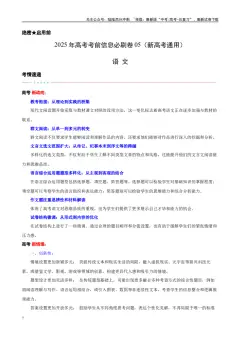
《2024高考英语考前十天冲刺宝典》
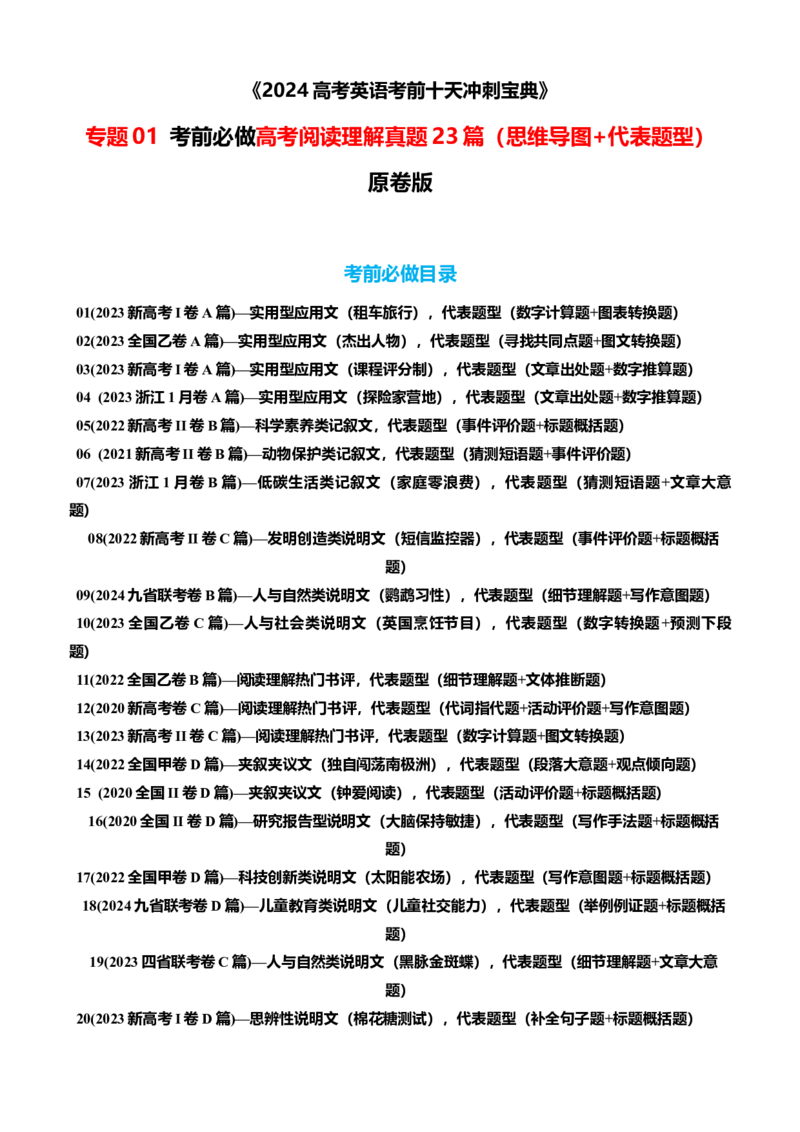
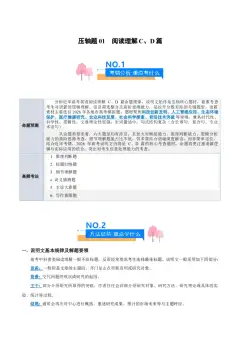
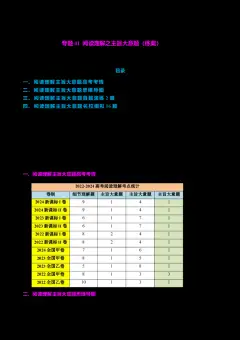
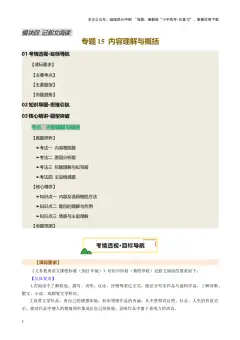
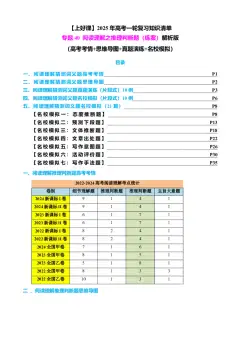
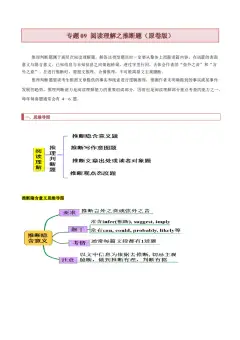
专题 01 考前必做高考阅读理解真题 23 篇(思维导图+代表题型)
原卷版
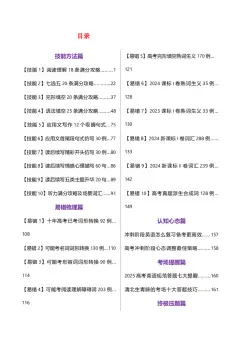
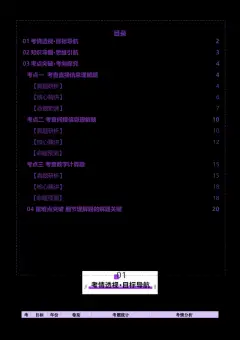
考前必做目录
01(2023新高考I卷A篇)—实用型应用文(租车旅行),代表题型(数字计算题+图表转换题)
02(2023全国乙卷A篇)—实用型应用文(杰出人物),代表题型(寻找共同点题+图文转换题)
03(2023新高考I卷A篇)—实用型应用文(课程评分制),代表题型(文章出处题+数字推算题)
04 (2023浙江1月卷A篇)—实用型应用文(探险家营地),代表题型(文章出处题+数字推算题)
05(2022新高考II卷B篇)—科学素养类记叙文,代表题型(事件评价题+标题概括题)
06 (2021新高考II卷B篇)—动物保护类记叙文,代表题型(猜测短语题+事件评价题)
07(2023浙江1月卷B篇)—低碳生活类记叙文(家庭零浪费),代表题型(猜测短语题+文章大意
题)
08(2022新高考II卷C篇)—发明创造类说明文(短信监控器),代表题型(事件评价题+标题概括
题)
09(2024九省联考卷B篇)—人与自然类说明文(鹦鹉习性),代表题型(细节理解题+写作意图题)
10(2023全国乙卷C篇)—人与社会类说明文(英国烹饪节目),代表题型(数字转换题+预测下段
题)
11(2022全国乙卷B篇)—阅读理解热门书评,代表题型(细节理解题+文体推断题)
12(2020新高考卷C篇)—阅读理解热门书评,代表题型(代词指代题+活动评价题+写作意图题)
13(2023新高考II卷C篇)—阅读理解热门书评,代表题型(数字计算题+图文转换题)
14(2022全国甲卷D篇)—夹叙夹议文(独自闯荡南极洲),代表题型(段落大意题+观点倾向题)
15 (2020全国II卷D篇)—夹叙夹议文(钟爱阅读),代表题型(活动评价题+标题概括题)
16(2020全国II卷D篇)—研究报告型说明文(大脑保持敏捷),代表题型(写作手法题+标题概括
题)
17(2022全国甲卷D篇)—科技创新类说明文(太阳能农场),代表题型(写作意图题+标题概括题)
18(2024九省联考卷D篇)—儿童教育类说明文(儿童社交能力),代表题型(举例例证题+标题概括
题)
19(2023四省联考卷C篇)—人与自然类说明文(黑脉金斑蝶),代表题型(细节理解题+文章大意
题)
20(2023新高考I卷D篇)—思辨性说明文(棉花糖测试),代表题型(补全句子题+标题概括题)21(2019全国I卷D篇)—思辨性说明文(青少年受欢迎度),代表题型(段落大意题+标题概括题)
22(2023新高考I卷D篇)—思辨性说明文(“群体智慧”效应),代表题型(段落大意题+态度推断
题)
23(2021新高考I卷D篇)—思辨性议论文(情商研究期望),代表题型(举例例证题+态度推断题)01(2023新高考I卷A篇)—实用型应用文(租车旅行),代表题型(数字计算题+图表转换题)
Bike Rental & Guided Tours
Welcome to Amsterdam, welcome to MacBike. You see much more from the seat of a bike! Cycling is the most
economical, sustainable and fun way to explore the city, with its beautiful canals, parks, squares and countless lights.
You can also bike along lovely landscapes outside of Amsterdam.
Why MacBike
MacBike has been around for almost 30 years and is the biggest bicycle rental company in Amsterdam. With
over 2,500 bikes stored in our five rental shops at strategic locations, we make sure there is always a bike available
for you. We offer the newest bicycles in a wide variety, including basic bikes with foot brake (刹车), bikes with hand
brake and gears (排挡), bikes with child seats, and children’s bikes.
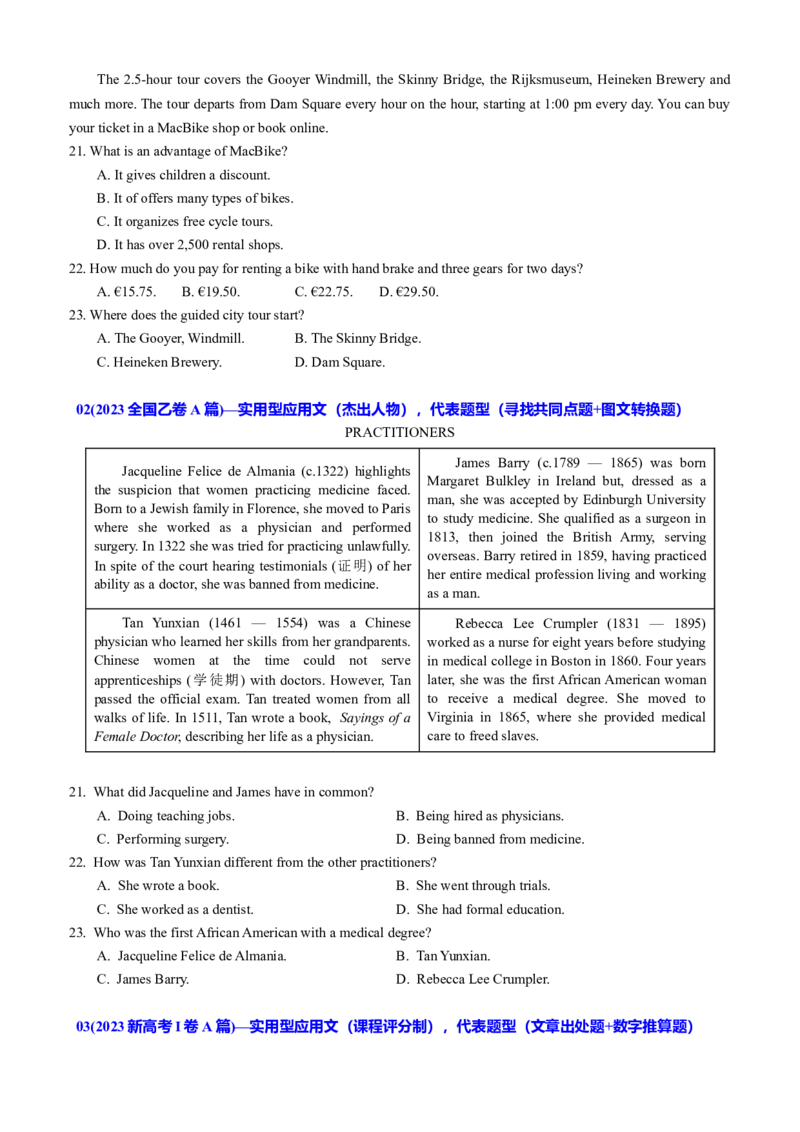
Prices
Hand Brake, Three Gears Foot Brake, No Gears
1 hour €7.50 €5.00
3 hours €11.00 €7.50
1 day (24 hours) €14.75 €9.75
Each additional day €8.00 €6.00
Guided City ToursThe 2.5-hour tour covers the Gooyer Windmill, the Skinny Bridge, the Rijksmuseum, Heineken Brewery and
much more. The tour departs from Dam Square every hour on the hour, starting at 1:00 pm every day. You can buy
your ticket in a MacBike shop or book online.
21. What is an advantage of MacBike?
A. It gives children a discount.
B. It of offers many types of bikes.
C. It organizes free cycle tours.
D. It has over 2,500 rental shops.
22. How much do you pay for renting a bike with hand brake and three gears for two days?
A. €15.75. B. €19.50. C. €22.75. D. €29.50.
23. Where does the guided city tour start?
A. The Gooyer, Windmill. B. The Skinny Bridge.
C. Heineken Brewery. D. Dam Square.
02(2023全国乙卷A篇)—实用型应用文(杰出人物),代表题型(寻找共同点题+图文转换题)
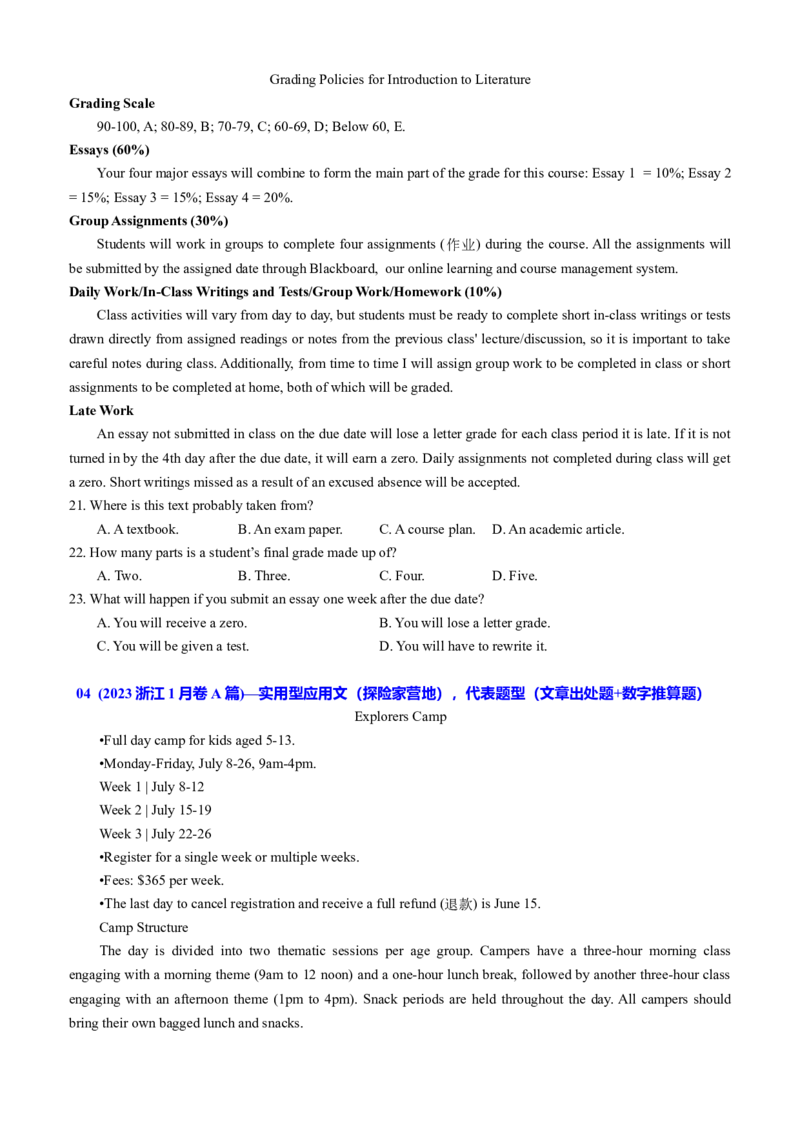
PRACTITIONERS
James Barry (c.1789 — 1865) was born
Jacqueline Felice de Almania (c.1322) highlights
Margaret Bulkley in Ireland but, dressed as a
the suspicion that women practicing medicine faced.
man, she was accepted by Edinburgh University
Born to a Jewish family in Florence, she moved to Paris
to study medicine. She qualified as a surgeon in
where she worked as a physician and performed
1813, then joined the British Army, serving
surgery. In 1322 she was tried for practicing unlawfully.
overseas. Barry retired in 1859, having practiced
In spite of the court hearing testimonials (证明) of her
her entire medical profession living and working
ability as a doctor, she was banned from medicine.
as a man.
Tan Yunxian (1461 — 1554) was a Chinese Rebecca Lee Crumpler (1831 — 1895)
physician who learned her skills from her grandparents. worked as a nurse for eight years before studying
Chinese women at the time could not serve in medical college in Boston in 1860. Four years
apprenticeships (学徒期) with doctors. However, Tan later, she was the first African American woman
passed the official exam. Tan treated women from all to receive a medical degree. She moved to
walks of life. In 1511, Tan wrote a book, Sayings of a Virginia in 1865, where she provided medical
Female Doctor, describing her life as a physician. care to freed slaves.
21. What did Jacqueline and James have in common?
A. Doing teaching jobs. B. Being hired as physicians.
C. Performing surgery. D. Being banned from medicine.
22. How was Tan Yunxian different from the other practitioners?
A. She wrote a book. B. She went through trials.
C. She worked as a dentist. D. She had formal education.
23. Who was the first African American with a medical degree?
A. Jacqueline Felice de Almania. B. Tan Yunxian.
C. James Barry. D. Rebecca Lee Crumpler.
03(2023新高考I卷A篇)—实用型应用文(课程评分制),代表题型(文章出处题+数字推算题)Grading Policies for Introduction to Literature
Grading Scale
90-100, A; 80-89, B; 70-79, C; 60-69, D; Below 60, E.
Essays (60%)
Your four major essays will combine to form the main part of the grade for this course: Essay 1 = 10%; Essay 2
= 15%; Essay 3 = 15%; Essay 4 = 20%.
Group Assignments (30%)
Students will work in groups to complete four assignments (作业) during the course. All the assignments will
be submitted by the assigned date through Blackboard, our online learning and course management system.
Daily Work/In-Class Writings and Tests/Group Work/Homework (10%)
Class activities will vary from day to day, but students must be ready to complete short in-class writings or tests
drawn directly from assigned readings or notes from the previous class' lecture/discussion, so it is important to take
careful notes during class. Additionally, from time to time I will assign group work to be completed in class or short
assignments to be completed at home, both of which will be graded.
Late Work
An essay not submitted in class on the due date will lose a letter grade for each class period it is late. If it is not
turned in by the 4th day after the due date, it will earn a zero. Daily assignments not completed during class will get
a zero. Short writings missed as a result of an excused absence will be accepted.
21. Where is this text probably taken from?
A. A textbook. B. An exam paper. C. A course plan. D. An academic article.
22. How many parts is a student’s final grade made up of?
A. Two. B. Three. C. Four. D. Five.
23. What will happen if you submit an essay one week after the due date?
A. You will receive a zero. B. You will lose a letter grade.
C. You will be given a test. D. You will have to rewrite it.
04 (2023浙江1月卷A篇)—实用型应用文(探险家营地),代表题型(文章出处题+数字推算题)
Explorers Camp
•Full day camp for kids aged 5-13.
•Monday-Friday, July 8-26, 9am-4pm.
Week 1 | July 8-12
Week 2 | July 15-19
Week 3 | July 22-26
•Register for a single week or multiple weeks.
•Fees: $365 per week.
•The last day to cancel registration and receive a full refund (退款) is June 15.
Camp Structure
The day is divided into two thematic sessions per age group. Campers have a three-hour morning class
engaging with a morning theme (9am to 12 noon) and a one-hour lunch break, followed by another three-hour class
engaging with an afternoon theme (1pm to 4pm). Snack periods are held throughout the day. All campers should
bring their own bagged lunch and snacks.Camp Content
Explorers Camp organizes engaging arts, history and science-related activities in every class, and focuses on a
range of topics that emphasize active learning, exploration and, most of all, fun! All camp sessions are created with
age-appropriate activities that are tailored to the multiple ways that kids learn.
Camp Staff
Campers enjoy a staff-to-child ratio ranging from 1:4 to 1:7 depending on the age group. Instructors are
passionate educators who are experts in their fields and have undergone training and a background check.
21. On which of the following dates can you cancel your registration with a full refund?
A. June 12. B. June 22. C. July 19. D. July 26.
22. How are campers divided into different groups?
A. By gender. B. By nationality. C. By interest. D. By age.
23. How many hours of class will you have altogether if you register for a single week?
A. 15. B. 21. C. 30. D. 42.
05(2022新高考II卷B篇)—科学素养类记叙文,代表题型(事件评价题+标题概括题)
Turning soil, pulling weeds, and harvesting cabbage sound like tough work for middle and high school kids.
And at first it is, says Abby Jaramillo, who with another teacher started Urban Sprouts, a school garden program at
four low-income schools. The program aims to help students develop science skills, environmental awareness, and
healthy lifestyles.
Jaramillo’s students live in neighborhoods where fresh food and green space are not easy to find and fast food
restaurants outnumber grocery stores. “The kids literally come to school with bags of snacks and large bottles of soft
drinks,” she says. “They come to us thinking vegetables are awful, dirt is awful, insects are awful.” Though some are
initially scared of the insects and turned off by the dirt, most are eager to try something new.
Urban Sprouts’ classes, at two middle schools and two high schools, include hands-on experiments such as soil
testing, flower-and-seed dissection, tastings of fresh or dried produce, and work in the garden. Several times a year,
students cook the vegetables they grow, and they occasionally make salads for their entire schools.
Program evaluations show that kids eat more vegetables as a result of the classes. “We have students who say
they went home and talked to their parents and now they’re eating differently,” Jaramillo says.
She adds that the program’s benefits go beyond nutrition. Some students get so interested in gardening that they
bring home seeds to start their own vegetable gardens. Besides, working in the garden seems to have a calming effect
on Jaramillo’s special education students, many of whom have emotional control issues. “They get outside,” she
says, “and they feel successful.”
24. What do we know about Abby Jaramillo?
A. She used to be a health worker. B. She grew up in a low-income family.
C. She owns a fast food restaurant. D. She is an initiator of Urban Sprouts.
25. What was a problem facing Jaramillo at the start of the program?
A. The kids’ parents distrusted her. B. Students had little time for her classes.
C. Some kids disliked garden work. D. There was no space for school gardens.
26. Which of the following best describes the impact of the program?
A. Far-reaching. B. Predictable.
C. Short-lived. D. Unidentifiable.27. What can be a suitable title for the text?
A. Rescuing School Gardens B. Experiencing Country Life
C. Growing Vegetable Lovers D. Changing Local Landscape
06 (2021新高考II卷B篇)—动物保护类记叙文,代表题型(猜测短语题+事件评价题)
I have worked as a keeper at the National Zoo, Paris for 11 years. Spot and Stripe are the first tiger cubs that
have ever been born here. Globally, a third of Sumatran cubs in zoos don't make it to adulthood, so I decided to give
them round-the-clock care at home.
I've got two children—the younger one, Kynan, was extremely happy about the tigers arriving - but all of us
really looked forward to being part of their lives and watching them grow. I wasn't worried about bringing them into
my home with my wife and kids. These were cubs. They weighed about 2.5 kg and were so small that there was
absolutely no risk.
As they grew more mobile, we let them move freely around the house during the day, but when we were asleep
we had to contain them in a large room, otherwise they'd get up to mischief. We'd come down in the morning to find
they'd turned the room upside down, and left it looking like a zoo.
Things quickly got very intense due to the huge amount of energy required to look after them. There were some
tough times and I just felt extremely tired. I was grateful that my family was there to help. We had to have a bit of a
production line going, making up “tiger milk”, washing baby bottles, and cleaning the floors.
When Spot and Stripe were four months old, they were learning how to open doors and jump fences, and we
knew it really was time for them to go. It was hard for us to finally part with them. For the first few days, Kynan was
always a bit disappointed that the cubs weren't there.
I'm not sad about it. I'm hands-on with them every day at the zoo, and I do look back very fondly on the time
that we had them.
24. Why did the author bring the tiger cubs home?
A. To ensure their survival. B. To observe their differences.
C. To teach them life skills. D. To let them play with his kids.
25. What do the underlined words “get up to mischief” mean in paragraph 3?
A. Behave badly. B. Lose their way. C. Sleep soundly. D. Miss their mom.
26. What did the author think of raising the tiger cubs at home?
A. Boring. B. Tiring. C. Costly. D. Risky.
27. Why did the author decide to send Spot and Stripe back to the zoo?
A. They frightened the children. B. They became difficult to contain.
C. They annoyed the neighbours. D. They started fighting each other.
07(2023浙江1月卷B篇)—低碳生活类记叙文(家庭零浪费),代表题型(猜测短语题+文章大意
题)
Live with roommates? Have friends and family around you? Chances are that if you’re looking to live a more
sustainable lifestyle, not everyone around you will be ready to jump on that bandwagon.
I experienced this when I started switching to a zero waste lifestyle five years ago, as I was living with my
parents, and I continue to experience this with my husband, as he is not completely zero waste like me. I’ve learned a
few things along the way though, which I hope you’ll find encouraging if you’re doing your best to figure out howyou can make the change in a not-always-supportive household.
Zero waste was a radical lifestyle movement a few years back. I remember showing my parents a video of Bea
Johnson, sharing how cool I thought it would be to buy groceries with jars, and have so little trash! A few days later,
I came back with my first jars of zero waste groceries, and my dad commented on how silly it was for me to carry
jars everywhere. It came off as a bit discouraging.
Yet as the months of reducing waste continued, I did what I could that was within my own reach. I had my own
bedroom, so I worked on removing things I didn’t need. Since I had my own toiletries (洗漱用品), I was able to start
personalising my routine to be more sustainable. I also offered to cook every so often, so I portioned out a bit of the
cupboard for my own zero waste groceries. Perhaps your household won’t entirely make the switch, but you may
have some control over your own personal spaces to make the changes you desire.
As you make your lifestyle changes, you may find yourself wanting to speak up for yourself if others comment
on what you’re doing, which can turn itself into a whole household debate. If you have individuals who are not on
board, your words probably won’t do much and can often leave you feeling more discouraged.
So here is my advice: Lead by action.
24. What do the underlined words “jump on that bandwagon” mean in the first paragraph?
A. Share an apartment with you. B. Join you in what you’re doing.
C. Transform your way of living. D. Help you to make the decision.
25. What was the attitude of the author’s father toward buying groceries with jars?
A. He disapproved of it. B. He was favorable to it.
C. He was tolerant of it. D. He didn’t care about it.
26. What can we infer about the author?
A. She is quite good at cooking. B. She respects others’ privacy.
C. She enjoys being a housewife. D. She is a determined person.
27. What is the text mainly about?
A. How to get on well with other family members.
B. How to have one’s own personal space at home.
C. How to live a zero waste lifestyle in a household.
D. How to control the budget when buying groceries.
08(2022新高考II卷C篇)—发明创造类说明文(短信监控器),代表题型(事件评价题+标题概括
题)
Over the last seven years, most states have banned texting by drivers, and public service campaigns have tried a
wide range of methods to persuade people to put down their phones when they are behind the wheel.
Yet the problem, by just about any measure, appears to be getting worse. Americans are still texting while
driving, as well as using social networks and taking photos. Road accidents, which had fallen for years, are now
rising sharply.
That is partly because people are driving more, but Mark Rosekind, the chief of the National Highway Traffic
Safety Administration, said distracted(分心)driving was "only increasing, unfortunately."
"Big change requires big ideas." he said in a speech last month, referring broadly to the need to improve road
safety. So to try to change a distinctly modern behavior, lawmakers and public health experts are reaching back to an
old approach: They want to treat distracted driving like drunk driving.An idea from lawmakers in New York is to give police officers a new device called the Textalyzer. It would
work like this: An officer arriving at the scene of a crash could ask for the phones of the drivers and use the
Textalyzer to check in the operating system for recent activity. The technology could determine whether a driver had
just texted, emailed or done anything else that is not allowed under New York's hands-free driving laws.
"We need something on the books that can change people's behavior,” said Félix W. Ortiz, who pushed for the
state's 2001 ban on hand-held devices by drivers. If the Textalyzer bill becomes law, he said, "people are going to be
more afraid to put their hands on the cell phone."
28. Which of the following best describes the ban on drivers' texting in the US?
A. Ineffective. B. Unnecessary.
C. Inconsistent. D. Unfair.
29. What can the Textalyzer help a police officer find out?
A. Where a driver came from. B. Whether a driver used their phone.
C. How fast a driver was going. D. When a driver arrived at the scene.
30. What does the underlined word "something" in the last paragraph refer to?
A. Advice. B. Data. C. Tests. D. Laws.
31. What is a suitable title for the text?
A. To Drive or Not to Drive? Think Before You Start
B. Texting and Driving? Watch Out for the Textalyzer
C. New York Banning Hand-Held Devices by Drivers.
D. The Next Generation Cell Phone: The Textalyzer.
09(2024九省联考卷B篇)—人与自然类说明文(鹦鹉习性),代表题型(细节理解题+写作意图题)
Parrots are prey animals, which means that other predators (捕食者) in the wild, such as hawks or snakes, are
looking to make them into a meal. This one factor influences parrots’ behavior in your house more than any other.
Parrots are most easily hurt when feeding on the ground; membership in a group plays an important function in
ensuring their safety and improving their chances of survival from attacks by predators. The most common predators
of parrots include hawks, snakes, cats, monkeys, and bats. Some predators make attacks only during the day while
others hunt in the night.
As prey animals, parrots are constantly watching out for danger and they instinctively (本能地) react to risks.
Their first choice is to take flight. However, if this is not possible, they will fight with their powerful beaks to defend
themselves.
Because their biggest enemy is the hawk, parrots are especially reactive to quick movements from above and
behind. For this reason, it is wise to avoid quick, sudden movements near your bird. This is a built-in reaction not
subject to logic or reason. Simple and relatively harmless household objects can draw extreme fear responses from a
bird. For example, a balloon may represent a hawk or a vacuum hose (吸尘器软管) may be the same as a snake in
your bird’s mind.
As prey animals, parrots are often frightened by exposure to new household items or strangers. It is important to
expose your bird to safe experiences and changes starting at a very young age to build flexibility and improve their
adaptability. Variety in diet and toys, travel, and exposure to new people and places all help to make your bird more
flexible and adaptable to change.
24. What is important for parrots to better survive from attacks in the wild?A. Living in a group. B. Growing beautiful feathers.
C. Feeding on the ground. D. Avoiding coming out at night.
25. What is parrots’ first response to an immediate risk?
A. To attack back. B. To get away.
C. To protect the young. D. To play dead.
26. Why would a balloon frighten a parrot?
A. It may explode suddenly. B. It may be in a strange shape.
C. It may have a strong color. D. It may move around quickly.
27. What is the author’s purpose of writing the text?
A. To explain wild parrots' behavior. B. To give advice on raising a parrot.
C. To call for action to protect animals. D. To introduce a study on bird ecology.
10(2023全国乙卷C篇)—饮食与媒体类说明文,代表题型(数字转换题+预测下段题)
What comes into your mind when you think of British food? Probably fish and chips, or a Sunday dinner of
meat and two vegetables. But is British food really so uninteresting? Even though Britain has a reputation for less-
than-impressive cuisine, it is producing more top class chefs who appear frequently on our television screens and
whose recipe books frequently top the best seller lists.
It’s thanks to these TV chefs rather than any advertising campaign that Britons are turning away from meat-and-
two-veg and ready-made meals and becoming more adventurous in their cooking habits. It is recently reported that
the number of those sticking to a traditional diet is slowly declining and around half of Britain’s consumers would
like to change or improve their cooking in some way. There has been a rise in the number of students applying for
food courses at UK universities and colleges. It seems that TV programmes have helped change what people think
about cooking.
According to a new study from market analysts, 1 in 5 Britons say that watching cookery programmes on TV
has encouraged them to try different food. Almost one third say they now use a wider variety of ingredients (配料)
than they used to, and just under 1 in 4 say they now buy better quality ingredients than before. One in four adults
say that TV chefs have made them much more confident about expanding their cookery knowledge and skills, and
young people are also getting more interested in cooking. The UK’s obsession (痴迷) with food is reflected through
television scheduling. Cookery shows and documentaries about food are broadcast more often than before. With an
increasing number of male chefs on TV, it’s no longer “uncool” for boys to like cooking.
28. What do people usually think of British food?
A. It is simple and plain. B. It is rich in nutrition.
C. It lacks authentic tastes. D. It deserves a high reputation.
29. Which best describes cookery programme on British TV?
A. Authoritative. B. Creative. C. Profitable. D. Influential.
30. Which is the percentage of the people using more diverse ingredients now?
A. 20%. B. 24%. C. 25%. D. 33%.
31. What might the author continue talking about?
A. The art of cooking in other countries. B. Male chefs on TV programmes.
C. Table manners in the UK. D. Studies of big eaters.11(2022全国乙卷B篇)—阅读理解热门书评,代表题型(细节理解题+文体推断题)
In 1916, two girls of wealthy families, best friends from Auburn, N. Y.—Dorothy Woodruff and Rosamond
Underwood—traveled to a settlement in the Rocky Mountains to teach in a one-room schoolhouse. The girls had
gone to Smith College. They wore expensive clothes. So for them to move to Elkhead, Colo. to instruct the children
whose shoes were held together with string was a surprise. Their stay in Elkhead is the subject of Nothing Daunted:
The Unexpected Education of Two Society Girls in the West by Dorothy Wickenden, who is a magazine editor and
Dorothy Woodruff’s granddaughter.
Why did they go then? Well, they wanted to do something useful. Soon, however, they realized what they had
undertaken.
They moved in with a local family, the Harrisons, and, like them, had little privacy, rare baths, and a blanket of
snow on their quilt when they woke up in the morning. Some mornings, Rosamond and Dorothy would arrive at the
schoolhouse to find the children weeping from the cold. In spring, the snow was replaced by mud over ice.
In Wickenden’s book, she expanded on the history of the West and also on feminism, which of course
influenced the girls’ decision to go to Elkhead. A hair-raising section concerns the building of the railroads, which
entailed (牵涉) drilling through the Rockies, often in blinding snowstorms. The book ends with Rosamond and
Dorothy’s return to Auburn.
Wickenden is a very good storyteller. The sweep of the land and the stoicism (坚忍) of the people move her to
some beautiful writing. Here is a picture of Dorothy Woodruff, on her horse, looking down from a hill top: “When
the sun slipped behind the mountains, it shed a rosy glow all around them. Then a full moon rose. The snow was
marked only by small animals: foxes, coyotes, mice, and varying hares, which turned white in the winter.”
24. Why did Dorothy and Rosamond go to the Rocky Mountains?
A. To teach in a school. B. To study American history.
C. To write a book. D. To do sightseeing.
25. What can we learn about the girls from paragraph 3?
A. They enjoyed much respect. B. They had a room with a bathtub.
C. They lived with the local kids. D. They suffered severe hardships.
26. Which part of Wickenden’s writing is hair-raising?
A. The extreme climate of Auburn. B. The living conditions in Elkhead.
C. The railroad building in the Rockies. D. The natural beauty of the West.
27. What is the text?
A. A news report. B. A book review. C. A children’s story. D. A diary entry.
12(2020新高考卷C篇)—阅读理解热门书评,代表题型(代词指代题+活动评价题+写作意图题)
In the mid-1990s, Tom Bissell taught English as a volunteer in Uzbekistan. He left after seven months,
physically broken and having lost his mind. A few years later, still attracted to the country, he returned to Uzbekistan
to write an article about the disappearance of the Aral Sea.
His visit, however, ended up involving a lot more than that. Hence this book, Chasing the Sea: Lost Among the
Ghosts of Empire in Central Asia, which talks about a road trip from Tashkent to Karakalpakstan, where millions of
lives have been destroyed by the slow drying up of the sea. It is the story of an American travelling to a strange land,
and of the people he meets on his way: Rustam, his translator, a lovely 24-year-old who picked up his colorful
English in California, Oleg and Natasha, his hosts in Tashkent, and a string of foreign aid workers.This is a quick look at life in Uzbekistan, made of friendliness and warmth, but also its darker side of society. In
Samarkand, Mr Bissell admires the architectural wonders, while on his way to Bukhara he gets a taste of police
methods when suspected of drug dealing. In Ferghana, he attends a mountain funeral(葬礼)followed by a strange
drinking party. And in Karakalpakstan, he is saddened by the dust storms, diseases and fishing boats stuck miles
from the sea.
Mr Bissell skillfully organizes historical insights and cultural references, making his tale a well-rounded picture
of Uzbekistan, seen from Western eyes. His judgment and references are decidedly American, as well as his delicate
stomach. As the author explains, this is neither a travel nor a history book, or even a piece of reportage. Whatever it
is, the result is a fine and vivid description of the purest of Central Asian traditions.
28. What made Mr Bissell return to Uzbekistan?
A. His friends' invitation. B. His interest in the country.
C. His love for teaching. D. His desire to regain health.
29. What does the underlined word “that” in paragraph 2 refer to?
A. Developing a serious mental disease.
B. Taking a guided tour in Central Asia.
C. Working as a volunteer in Uzbekistan.
D. Writing an article about the Aral Sea.
30. Which of the following best describes Mr Bissell's road trip in Uzbekistan?
A. Romantic. B. Eventful. C. Pleasant. D. Dangerous.
31. What is the purpose of this text?
A. To introduce a book. B. To explain a cultural phenomenon.
C. To remember a writer. D. To recommend a travel destination.
13(2023新高考II卷C篇)—阅读理解热门书评,代表题型(数字计算题+图文转换题)
Reading Art: Art for Book Lovers is a celebration of an everyday object — the book, represented here in almost
three hundred artworks from museums around the world. The image of the reader appears throughout history, in art
made long before books as we now know them came into being. In artists’ representations of books and reading, we
see moments of shared humanity that go beyond culture and time.
In this “book of books,” artworks are selected and arranged in a way that emphasizes these connections between
different eras and cultures. We see scenes of children learning to read at home or at school, with the book as a focus
for relations between the generations. Adults are portrayed (描绘) alone in many settings and poses —absorbed in a
volume, deep in thought or lost in a moment of leisure. These scenes may have been painted hundreds of years ago,
but they record moments we can all relate to.
Books themselves may be used symbolically in paintings to demonstrate the intellect (才智), wealth or faith of
the subject. Before the wide use of the printing press, books were treasured objects and could be works of art in their
own right. More recently, as books have become inexpensive or even throwaway, artists have used them as the raw
material for artworks — transforming covers, pages or even complete volumes into paintings and sculptures.
Continued developments in communication technologies were once believed to make the printed page outdated.
From a 21st-century point of view, the printed book is certainly ancient, but it remains as interactive as any battery-
powered e-reader. To serve its function, a book must be activated by a user: the cover opened, the pages parted, the
contents reviewed, perhaps notes written down or words underlined. And in contrast to our increasingly networkedlives where the information we consume is monitored and tracked, a printed book still offers the chance of a wholly
private, “off-line” activity.
28. Where is the text most probably taken from?
A. An introduction to a book. B. An essay on the art of writing.
C. A guidebook to a museum. D. A review of modern paintings.
29. What are the selected artworks about?
A. Wealth and intellect. B. Home and school.
C. Books and reading. D. Work and leisure.
30. What do the underlined words “relate to” in paragraph 2 mean?
A. Understand. B. Paint.
C. Seize. D. Transform.
31. What does the author want to say by mentioning the e-reader?
A. The printed book is not totally out of date.
B. Technology has changed the way we read.
C. Our lives in the 21st century are networked.
D. People now rarely have the patience to read.
14(2022全国甲卷D篇)—夹叙夹议文,代表题型(段落大意题+观点倾向题)
Sometime in the early 1960s, a significant thing happened in Sydney, Australia. The city discovered its harbor.
Then, one after another, Sydney discovered lots of things that were just sort of there — broad parks, superb beaches,
and a culturally diverse population. But it is the harbor that makes the city.
Andrew Reynolds, a cheerful fellow in his early 30s, pilots Sydney ferryboats for a living. I spent the whole
morning shuttling back and forth across the harbor. After our third run Andrew shut down the engine, and we went
our separate ways — he for a lunch break, I to explore the city.
“I’ll miss these old boats,” he said as we parted.
“How do you mean?” I asked.
“Oh, they’re replacing them with catamarans. Catamarans are faster, but they’re not so elegant, and they’re not
fun to pilot. But that’s progress, I guess.”
Everywhere in Sydney these days, change and progress are the watchwords ( 口号), and traditions are
increasingly rare. Shirley Fitzgerald, the city’s official historian, told me that in its rush to modernity in the 1970s,
Sydney swept aside much of its past, including many of its finest buildings. “Sydney is confused about itself,” she
said. “We can’t seem to make up our minds whether we want a modern city or a traditional one. It’s a conflict that we
aren’t getting any better at resolving (解决).”
On the other hand, being young and old at the same time has its attractions. I considered this when I met a
thoughtful young businessman named Anthony. “Many people say that we lack culture in this country,” he told me.
“What people forget is that the Italians, when they came to Australia, brought 2000 years of their culture, the Greeks
some 3000 years, and the Chinese more still. We’ve got a foundation built on ancient cultures but with a drive and
dynamism of a young country. It’s a pretty hard combination to beat.”
He is right, but I can’t help wishing they would keep those old ferries.
32. What is the first paragraph mainly about?
A. Sydney’s striking architecture. B. The cultural diversity of Sydney.
C. The key to Sydney’s development. D. Sydney’s tourist attractions in the 1960s.33. What can we learn about Andrew Reynolds?
A. He goes to work by boat. B. He looks forward to a new life.
C. He pilots catamarans well. D. He is attached to the old ferries.
34. What does Shirley Fitzgerald think of Sydney?
A. It is losing its traditions. B. It should speed up its progress.
C. It should expand its population. D. It is becoming more international.
35. Which statement will the author probably agree with?
A. A city can be young and old at the same time.
B. A city built on ancient cultures is more dynamic.
C. modernity is usually achieved at the cost of elegance.
D. Compromise should be made between the local and the foreign.
15 (2020全国II卷D篇)—夹叙夹议文(钟爱阅读),代表题型(活动评价题+标题概括题)
I have a special place in my heart for libraries. I have for as long as I can remember. I was always an
enthusiastic reader, sometimes reading up to three books a day as a child. Stories were like air to me and while other
kids played ball or went to parties. I lived out adventures through the books I checked out from the library.
My first job was working at the Ukiah Library when I was 16 years old. It was a dream job and I did everything
from shelving books to reading to the children for story time.
As I grew older and became a mother, the library took on a new place and an added meaning in my life. I had
several children and books were our main source(来源) of entertainment. It was a big deal for us to load up and go to
the local library, where my kids could pick out books to read or books they wanted me to read to them.
I always read, using different voices, as though I were acting out the stories with my voice and they loved it! It
was a special time to bond with my children and it filled them with the wonderment of books.
Now, I see my children taking their children to the library and I love that the excitement of going to the library
lives on from generation to generation.
As a novelist, I’ve found a new relationship with libraries. I encourage readers to go to their local library when
they can’t afford to purchase a book. I see libraries as a safe haven(避风港) for readers and writers, a bridge that
helps put together a reader with a book. Libraries, in their own way, help fight book piracy(盗版行为) and I think all
writers should support libraries in a significant way when they can. Encourage readers to use the library. Share
library announcements on your social media. Frequent them and talk about them when you can.
32. Which word best describes the author’s relationship with books as a child?
A. Cooperative. B. Uneasy.
C. Inseparable. D. Casual.
33. What does the underlined phrase “an added meaning” in paragraph 3 refer to?
A. Pleasure from working in the library.
B. Joy of reading passed on in the family.
C. Wonderment from acting out the stories.
D. A closer bond developed with the readers.
34. What does the author call on other writers to do?
A. Sponsor book fairs. B. Write for social media.
C. Support libraries. D. Purchase her novels.35. Which can be a suitable title for the text?
A. Reading: A Source of Knowledge
B. My Idea about writing
C. Library: A Haven for the Young
D. My Love of the Library
16(2020全国II卷D篇)—研究报告型说明文(大脑保持敏捷),代表题型(写作手法题+标题概括
题)
Challenging work that requires lots of analytical thinking, planning and other managerial skills might help your
brain stay sharp as you age, a study published Wednesday in the journal Neurology suggests.
Researchers from the University of Leipzig in Germany gathered more than 1, 000 retired workers who were
over age 75 and assessed the volunteers’ memory and thinking skills through a battery of tests. Then, for eight years,
the scientists asked the same group to come back to the lab every 18 months to take the same sorts of tests.
Those who had held mentally stimulating(刺激), demanding jobs before retirement tended to do the best on the
tests. And they tended to lose cognitive(认知) function at a much slower rate than those with the least mentally
challenging jobs. The results held true even after the scientists accounted for the participants’ overall health status.
“This works just like physical exercise, ” says Francisca Then, who led the study. “After a long run, you may
feel like you’re in pain, you may feel tired. But it makes you fit. After a long day at work-sure, you will feel tired,
but it can help your brain stay healthy. ”
It's not just corporate jobs, or even paid work that can help keep your brain fit, Then points out. A waiter’s job,
for example, that requires multitasking, teamwork and decision-making could be just as stimulating as any high-level
office work. And “running a family household requires high-level planning and coordinating(协调), ” she says. “You
have to organize the activities of the children and take care of the bills and groceries. ”
Of course, our brains can decline as we grow older for lots of reasons-including other environmental influences
or genetic factors. Still, continuing to challenge yourself mentally and keeping your mind busy can only help.
28. Why did the scientists ask the volunteers to take the tests?
A. To assess their health status B. To evaluate their work habits.
C. To analyze their personality. D. To measure their mental ability.
29. How does Francisca Then explain her findings in paragraph 4?
A. By using an expert’s words. B. By making a comparison.
C. By referring to another study. D. By introducing a concept.
30. Which of the following is the best title for the text?
A. Retired Workers Can Pick Up New Skills
B. Old People Should Take Challenging Jobs
C. Your Tough Job Might Help Keep You Sharp
D. Cognitive Function May Decline As You Age
17 (2022全国甲卷D篇)—科技创新类说明文(太阳能农场),代表题型(写作意图题+标题概括题)
According to the Solar Energy Industry Association, the number of solar panels installed(安装)has grown
rapidly in the past decade, and it has to grow even faster to meet climate goals. But all of that growth will take up a
lot of space, and though more and more people accept the concept of solar energy, few like large solar panels to beinstalled near them.
Solar developers want to put up panels as quickly and cheaply as possible, so they haven’t given much thought
to what they put under them. Often, they’ll end up filling the area with small stones and using chemicals to control
weeds. The result is that many communities, especially in farming regions, see solar farms as destroyers of the soil.
“Solar projects need to be good neighbors,” says Jordan Macknick, the head of the Innovative Site Preparation
and Impact Reductions on the Environment(InSPIRE)project. “They need to be protectors of the land and contribute
to the agricultural economy.” InSPIRE is investigating practical approaches to “low-impact” solar development,
which focuses on establishing and operating solar farms in a way that is kinder to the land. One of the easiest low-
impact solar strategies is providing habitat for pollinators(传粉昆虫).
Habitat loss, pesticide use, and climate change have caused dramatic declines in pollinator populations over the
past couple of decades, which has damaged the U.S. agricultural economy. Over 28 states have passed laws related
to pollinator habitat protection and pesticide use. Conservation organizations put out pollinator-friendliness
guidelines for home gardens, businesses, schools, cities—and now there are guidelines for solar farms.
Over the past few years, many solar farm developers have transformed the space under their solar panels into a
shelter for various kinds of pollinators, resulting in soil improvement and carbon reduction. “These pollinator-
friendly solar farms can have a valuable impact on everything that’s going on in the landscape,” says Macknick.
32. What do solar developers often ignore?
A. The decline in the demand for solar energy.
B. The negative impact of installing solar panels.
C. The rising labor cost of building solar farms.
D. The most recent advances in solar technology.
33. What does InSPIRE aim to do?
A. Improve the productivity of local farms.
B. Invent new methods for controlling weeds.
C. Make solar projects environmentally friendly.
D. Promote the use of solar energy in rural areas.
34. What is the purpose of the laws mentioned in paragraph 4?
A. To conserve pollinators.
B. To restrict solar development.
C. To diversify the economy.
D. To ensure the supply of energy.
35. Which of the following is the best title for the text?
A. Pollinators: To Leave or to Stay
B. Solar Energy: Hope for the Future
C. InSPIRE: A Leader in Agriculture
D. Solar Farms: A New Development
18(2024九省联考卷D篇)—儿童教育类说明文(儿童社交能力),代表题型(举例例证题+标题概括
题)
For lots of kids, toddlerhood (幼儿期) is an important time for friendship. Studies show that the earlier kids
learn to form positive relationships, the better they are at relating to others as teenagers and adults. Playing togetheralso helps these kids practice social behaviors, such as kindness, sharing, and cooperation.
Even so, how quickly your child develops into a social creature may also depend on his temperament (性格).
Some toddlers are very social, but others are shy. In addition, the way' that toddlers demonstrate that they like other
children is markedly different from what adults think of as expressions of friendship. Research at Ohio State
University in Columbus found that a toddler’s way of saying “I like you” during play is likely to come in the form of
copying a friend’s behavior.
This seemingly unusual way of demonstrating fondness can result in unpleasant behavior, Regardless of how
much they like a playmate, they may still grab his toys, refuse to share, and get bossy. But experts say that this is a
normal and necessary part of friendship for kids this age. Through play experiences, toddlers learn social rules.
That’s why it's so important to take an active role in your toddler’s social encounters by setting limits and offering
frequent reminders of what they are. When you establish these guidelines, explain the reasons behind them.
Begin by helping your child learn sympathy (“Ben is crying. What's making him so sad?”), then suggest how he
could resolve the problem (“Maybe he would feel better if you let him play the ball.”). When your child shares or
shows empathy (同理心) toward a friend, praise him (“Ben stopped crying! You made him feel better.”).
Another way to encourage healthy social interaction is by encouraging kids to use words -- not fists -- to
express how they feel. It's also important to be mindful of how your child's personality affects playtime. Kids are
easy to get angry when they’re sleepy or hungry, so schedule playtime when they’re refreshed.
32. What does it indicate when toddlers copy their playmates’ behavior?
A. They are interested in acting.
B. They are shy with the strangers.
C. They are fond of their playmates.
D. They are tired of playing games.
33. What does the author suggest parents do for their kids?
A. Design games for them.
B. Find them suitable playmates.
C. Play together with them.
D. Help them understand social rules.
34. What is the function of the quoted statements in paragraph 4?
A. Giving examples. B. Explaining concepts.
C. Providing evidence. D. Making comparisons.
35. Which of the following is the best title for the text?
A. How Children Adapt to Changes
B. How to Be a Role Model for Children
C. How Your Baby Learns to Love
D. How to Communicate with Your Kid
19(2023四省联考卷C篇)—人与自然类说明文(黑脉金斑蝶),代表题型(细节理解题+文章大意
题)
For years, David James, who studies insects at Washington State University, had wanted to examine the
migration (迁徙)patterns of West Coast monarch butterflies (黑脉金斑蝶). The route the butterflies travel has been
hardly known because the populations are too small to follow. For every 200 monarchs tagged (打标签)by aresearcher, only one is usually recovered at the end of its trip, James says, and finding even 200 in the wild to tag is
unlikely. Knowing the route is vital to conservation efforts, but James had no way to figure it out- until he got a
phone call from Washington State Penitentiary in Walla Walla.
The prison was looking for new activities to improve the mental health of those serving long-term sentences. So
James began working with prisoners to raise monarchs through the whole process of their transformation. The adult
insects were then tagged and released from the prison. Over five years, nearly 10, 000 monarchs flew from the
facility. Elsewhere in Washington, Oregon and Idaho, researchers released another few thousand.
The tags included email addresses, and soon after the first butterflies took off, James started receiving messages
from people who had spotted them. The butterflies, the reports confirmed, wintered in coastal California. Twelve of
them landed at Lighthouse Field State Beach in Santa Cruz. Several more headed to Bolinas and Morro Bay.
The work helps researchers identify ideal places to plant milkweed and other vegetation that are important to
the life cycle of West Coast monarch butterflies. It also brought out the gentler side of some of the prisoners. “They
were very worried that they were going to harm the butterflies, ”James says. Watching the monarch change their
form also touched the men. “This butterfly changed, ” James recalls prisoners telling him, “and maybe we can too. ”
28. What was hard for David to do in his study?
A. Gain financial support. B. Hire qualified workers.
C. Build a new laboratory. D. Find enough monarchs.
29. Why are the butterflies tagged before being released?
A. To guarantee their safety.
B. To enable them to fly longer distances.
C. To track their travel routes.
D. To distinguish them from other species.
30. What makes the prisoners feel that they can change?
A. The patience the butterflies showed.
B. The hardship the butterflies underwent.
C. The transformation of the butterflies.
D. The devotion of James to the butterflies.
31. What is the last paragraph mainly about?
A. The impact of the research.
B. The findings of James’ study.
C. The release of the prisoners.
D. The life cycle of the butterflies.
20(2023新高考I卷D篇)—思辨性说明文(棉花糖测试),代表题型(补全句子题+标题概括题)
The Stanford marshmallow (棉花糖) test was originally conducted by psychologist Walter Mischel in the late
1960s. Children aged four to six at a nursery school were placed in a room. A single sugary treat, selected by the
child, was placed on a table. Each child was told if they waited for 15 minutes before eating the treat, they would be
given a second treat. Then they were left alone in the room. Follow-up studies with the children later in life showed a
connect ion between an ability to wait long enough to obtain a second treat and various forms of success.
As adults we face a version of the marshmallow test every day. We’ re not tempted (诱惑) by sugary treats, but
by our computers, phones, and tablets — all the devices that connect us to the global delivery system for varioustypes of information that do to us what marshmallows do to preschoolers.
We are tempted by sugary treats because our ancestors lived in a calorie-poor world, and our brains developed a
response mechanism to these treats that reflected their value — a feeling of reward and satisfaction. But as we’ve
reshaped the world around us, dramatically reducing the cost and effort involved in obtaining calories, we still have
the same brains we had thousands of years ago, and this mismatch is at the heart of why so many of us struggle to
resist tempting foods that we know we shouldn’t eat.
A similar process is at work in our response to information. Our formative environment as a species was
information-poor, so our brains developed a mechanism that prized new information. But global connectivity has
greatly changed our information environment. We are now ceaselessly bombarded (轰炸) with new information.
Therefore, just as we need to be more thoughtful about our caloric consumption, we also need to be more thoughtful
about our information consumption, resisting the temptation of the mental “junk food” in order to manage our time
most effectively.
32. What did the children need to do to get a second treat in Mischel’s test?
A. Take an examination alone.
B. Show respect for the researchers.
C. Share their treats with others.
D. Delay eating for fifteen minutes.
33. According to paragraph 3, there is a mismatch between ___________.
A. the calorie-poor world and our good appetites
B. the shortage of sugar and our nutritional needs
C. the rich food supply and our unchanged brains
D. the tempting foods and our efforts to keep fit
34. What does the author suggest readers do?
A. Absorb new information readily.
B. Be selective information consumers.
C. Use diverse information sources.
D. Protect the information environment.
35. Which of the following is the best title for the text?
A. Eat Less, Read More
B. The Bitter Truth about Early Humans
C. The Later, the Better
D. The Marshmallow Test for Grownups
21(2019全国I卷D篇)—思辨性说明文(青少年受欢迎度),代表题型(段落大意题+标题概括题)
During the rosy years of elementary school(小学), I enjoyed sharing my dolls and jokes, which allowed me to
keep my high social status. I was the queen of the playground. Then came my tweens and teens, and mean girls and
cool kids. They rose in the ranks not by being friendly but by smoking cigarettes, breaking rules and playing jokes
on others, among whom I soon found myself.
Popularity is a well-explored subject in social psychology. Mitch Prinstein, a professor of clinical psychology
sorts the popular into two categories: the likable and the status seekers. The likables’ plays-well-with-others qualities
strengthen schoolyard friendships, jump-start interpersonal skills and, when tapped early, are employed ever after inlife and work. Then there’s the kind of popularity that appears in adolescence: status born of power and even
dishonorable behavior.
Enviable as the cool kids may have seemed, Dr. Prinstein’s studies show unpleasant consequences. Those who
were highest in status in high school, as well as those least liked in elementary school, are “most likely to engage(从
事) in dangerous and risky behavior.”
In one study, Dr. Prinstein examined the two types of popularity in 235 adolescents, scoring the least liked, the
most liked and the highest in status based on student surveys (调查研究). “We found that the least well-liked teens
had become more aggressive over time toward their classmates. But so had those who were high in status. It clearly
showed that while likability can lead to healthy adjustment, high status has just the opposite effect on us."
Dr. Prinstein has also found that the qualities that made the neighbors want you on a play date-sharing, kindness,
openness — carry over to later years and make you better able to relate and connect with others.
In analyzing his and other research, Dr. Prinstein came to another conclusion: Not only is likability related to
positive life outcomes, but it is also responsible for those outcomes, too. "Being liked creates opportunities for
learning and for new kinds of life experiences that help somebody gain an advantage ” he said.
32. What sort of girl was the author in her early years of elementary school?
A. Unkind. B. Lonely. C. Generous. D. Cool.
33. What is the second paragraph mainly about?
A. The classification of the popular.
B. The characteristics of adolescents.
C. The importance of interpersonal skills.
D. The causes of dishonorable behavior.
34. What did Dr. Prinstein’s study find about the most liked kids?
A. They appeared to be aggressive.
B. They tended to be more adaptable.
C. They enjoyed the highest status.
D. They performed well academically.
35. What is the best title for the text?
A. Be Nice--You Won’t Finish Last
B. The Higher the Status, the Beer
C. Be the Best--You Can Make It
D. More Self-Control, Less Aggressiveness
22(2023新高考I卷D篇)—思辨性说明文(“群体智慧”效应),代表题型(段落大意题+态度推断
题)
On March 7, 1907, the English statistician Francis Galton published a paper which illustrated what has come to
be known as the “wisdom of crowds” effect. The experiment of estimation he conducted showed that in some cases,
the average of a large number of independent estimates could be quite accurate.
This effect capitalizes on the fact that when people make errors, those errors aren’t always the same. Some
people will tend to overestimate, and some to underestimate. When enough of these errors are averaged together,
they cancel each other out, resulting in a more accurate estimate. If people are similar and tend to make the same
errors, then their errors won’t cancel each other out. In more technical terms, the wisdom of crowds requires that
people’s estimates be independent. If for whatever reasons, people’s errors become correlated or dependent, theaccuracy of the estimate will go down.
But a new study led by Joaquin Navajas offered an interesting twist (转折) on this classic phenomenon. The key
finding of the study was that when crowds were further divided into smaller groups that were allowed to have a
discussion, the averages from these groups were more accurate than those from an equal number of independent
individuals. For instance, the average obtained from the estimates of four discussion groups of five was significantly
more accurate than the average obtained from 20 independent individuals.
In a follow-up study with 100 university students, the researchers tried to get a better sense of what the group
members actually did in their discussion. Did they tend to go with those most confident about their estimates? Did
they follow those least willing to change their minds? This happened some of the time, but it wasn’t the dominant
response. Most frequently, the groups reported that they “shared arguments and reasoned together.” Somehow, these
arguments and reasoning resulted in a global reduction in error. Although the studies led by Navajas have limitations
many questions remain the potential implications for group discussion and decision-making are enormous.
12. What is paragraph 2 of the text mainly about?
A. The methods of estimation.
B. The underlying logic of the effect.
C. The causes of people’s errors.
D. The design of Galton’s experiment.
13. Navajas’ study found that the average accuracy could increase even if ________.
A. the crowds were relatively small
B. there were occasional underestimates
C. individuals did not communicate
D. estimates were not fully independent
14. What did the follow-up study focus on?
A. The size of the groups.
B. The dominant members.
C. The discussion process.
D. The individual estimates.
15. What is the author’s attitude toward Navajas’ studies?
A. Unclear. B. Dismissive. C. Doubtful. D. Approving.
23(2021新高考I卷D篇)—思辨性议论文(情商研究期望),代表题型(举例例证题+态度推断题)
Popularization has in some cases changed the original meaning of emotional (情感的) intelligence. Many
people now misunderstand emotional intelligence as almost everything desirable in a person’s makeup that cannot be
measured by an IQ test, such as character, motivation, confidence, mental stability, optimism and “people skills.”
Research has shown that emotional skills may contribute to some of these qualities, but most of them move far
beyond skill-based emotional intelligence.
We prefer to describe emotional intelligence as a specific set of skills that can be used for either good or bad
purposes. The ability to accurately understand how others are feeling may be used by a doctor to find how best to
help her patients, while a cheater might use it to control potential victims. Being emotionally intelligent does not
necessarily make one a moral person.
Although popular beliefs regarding emotional intelligence run far ahead of what research can reasonablysupport, the overall effects of the publicity have been more beneficial than harmful. The most positive aspect of this
popularization is a new and much needed emphasis (重视) on emotion by employers, educators and others interested
in promoting social well-being. The popularization of emotional intelligence has helped both the public and
researchers re-evaluate the functionality of emotions and how they serve people adaptively in everyday life.
Although the continuing popular appeal of emotional intelligence is desirable, we hope that such attention will
excite a greater interest in the scientific and scholarly study of emotion. It is our hope that in coming decades,
advances in science will offer new perspectives (视角) from which to study how people manage their lives.
Emotional intelligence, with its focus on both head and heart, may serve to point us in the right direction.
32. What is a common misunderstanding of emotional intelligence?
A. It can be measured by an IQ test.
B. It helps to exercise a person's mind.
C. It includes a set of emotional skills.
D. It refers to a person’s positive qualities.
33. Why does the author mention “doctor” and “cheater” in paragraph 2?
A. To explain a rule. B. To clarify a concept.
C. To present a fact. D. To make a prediction.
34. What is the author's attitude to the popularization of emotional intelligence?
A. Favorable. B. Intolerant. C. Doubtful. D. Unclear.
35. What does the last paragraph mainly talk about concerning emotional intelligence?
A. Its appeal to the public.
B. Expectations for future studies.
C. Its practical application.
D. Scientists with new perspectives.