绝密★启用前
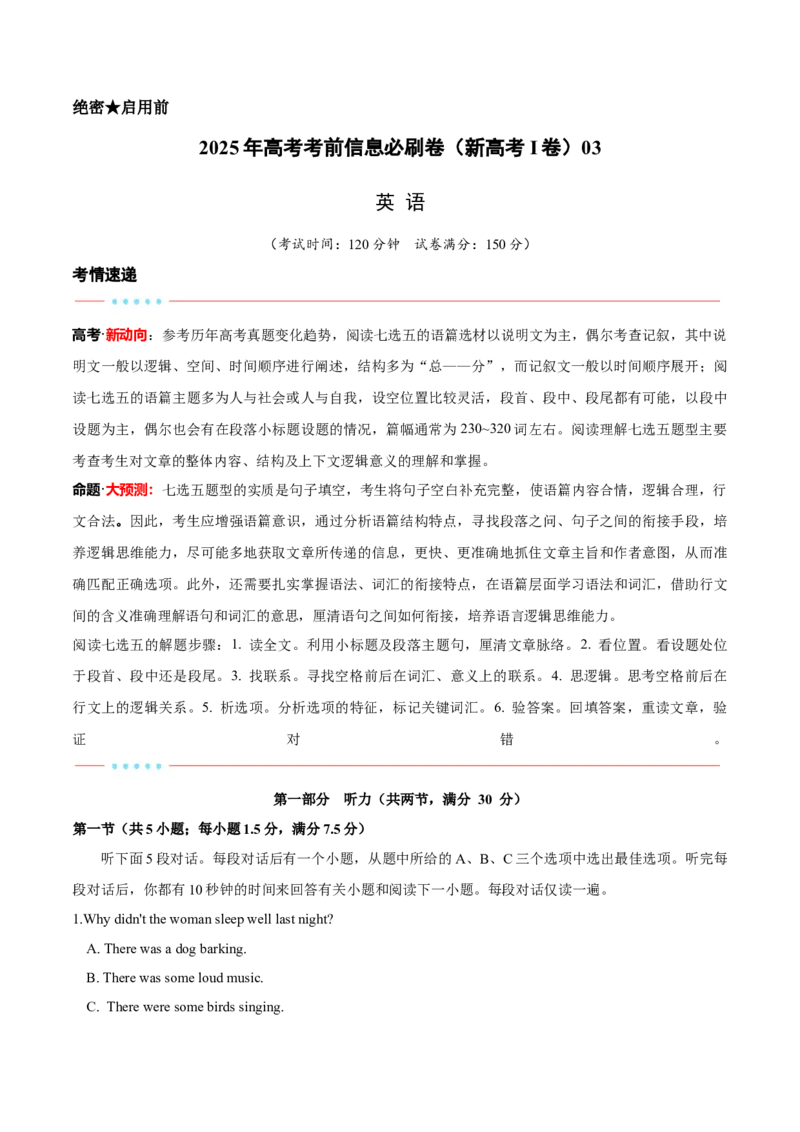
2025年高考考前信息必刷卷(新高考I卷)03
英 语
(考试时间:120分钟 试卷满分:150分)
考情速递
高考·新动向:参考历年高考真题变化趋势,阅读七选五的语篇选材以说明文为主,偶尔考查记叙,其中说
明文一般以逻辑、空间、时间顺序进行阐述,结构多为“总——分”,而记叙文一般以时间顺序展开;阅
读七选五的语篇主题多为人与社会或人与自我,设空位置比较灵活,段首、段中、段尾都有可能,以段中
设题为主,偶尔也会有在段落小标题设题的情况,篇幅通常为 230~320词左右。阅读理解七选五题型主要
考查考生对文章的整体内容、结构及上下文逻辑意义的理解和掌握。
命题·大预测:七选五题型的实质是句子填空,考生将句子空白补充完整,使语篇内容合情,逻辑合理,行
文合法。因此,考生应增强语篇意识,通过分析语篇结构特点,寻找段落之问、句子之间的衔接手段,培
养逻辑思维能力,尽可能多地获取文章所传递的信息,更快、更准确地抓住文章主旨和作者意图,从而准
确匹配正确选项。此外,还需要扎实掌握语法、词汇的衔接特点,在语篇层面学习语法和词汇,借助行文
间的含义准确理解语句和词汇的意思,厘清语句之间如何衔接,培养语言逻辑思维能力。
阅读七选五的解题步骤:1. 读全文。利用小标题及段落主题句,厘清文章脉络。2. 看位置。看设题处位
于段首、段中还是段尾。3. 找联系。寻找空格前后在词汇、意义上的联系。4. 思逻辑。思考空格前后在
行文上的逻辑关系。5. 析选项。分析选项的特征,标记关键词汇。6. 验答案。回填答案,重读文章,验
证 对 错 。
第一部分 听力(共两节,满分 30 分)
第一节(共5小题;每小题1.5分,满分7.5分)
听下面5段对话。每段对话后有一个小题,从题中所给的A、B、C三个选项中选出最佳选项。听完每
段对话后,你都有10秒钟的时间来回答有关小题和阅读下一小题。每段对话仅读一遍。
1.Why didn't the woman sleep well last night?
A. There was a dog barking.
B. There was some loud music.
C. There were some birds singing.2.What is the man doing?
A. Driving a car. B. Checking a map. C. Pointing the directions.
3.What does the woman mean in the end?
A. The man is the only one to take the subway.
B. The train is unreliable on rainy days.
C. The man made a poor excuse.
4.Where does the conversation probably take place?
A. In a car shop. B. At a garage, C. At a car park.
5.What are the speakers mainly talking about?
A. A budget. B. An event. C. The boss.
第二节(共15小题;每小题1.5分,满分22.5分)
听下面5段对话或独白。每段对话或独白后有几个小题,从题中所给的A、B、C三个选项中选出最佳
选项。听每段对话或独白前,你将有时间阅读各个小题,每小题5秒钟;听完后,各小题将给出5秒钟的
作答时间。每段对话或独白读两遍。
听下面一段对话,回答第6和第7两个小题。
6.What are the speakers discussing?
A. When to get full prepared.
B. When to meet the accountant.
C. When to visit a customer.
7.What will the woman do at 2:30 p.m.?
A. Attend an appointment.
B. Talk with the accountant.
C. Meet the man.
听下面一段对话,回答第8和第9两个小题。
8.What's the best language study method according to the man?
A. Speaking with local people.
B. Listening to news.
C. Using an App.
9.What does the man value most?
A. Touring the country.
B. Exploring local cafes.
C. Getting involved in culture.听下面一段对话,回答第10至第12三个小题。
10.Where is Pizza Delight?
A. In the city center.
B. Near the man's house.
C. By the movie theatre.
11.What is the woman's opinion of the pizza in Pizza Delight?
A. It's fancy. B. It's fine. C. It's bad.
12.How soon will the speakers leave?
A. In 15 minutes. B. In 30 minutes. C. In 45 minutes.
听下面一段对话,回答第13至第16四个小题。
13.What is the key factor in windsurfing?
A. High-quality equipment.
B. Personal physical condition.
C. Previous sporting experience.
14.What advice does Lily give on safety?
A. Use noticeable board and sail.
B. Prepare life-saving equipment.
C. Tell someone how you can be identified.
15.What does Lily enjoy most about windsurfing?
A. Forgetting everyday worries.
B. Learning new techniques.
C. Developing her muscles.
16.What might Lily do in the future?
A. Give up windsurfing.
B. Act as a windsurfing coach.
C. Take part in windsurfing competitions.
听下面一段独白,回答第17至第20四个小题。
17.What can the listeners do during the opening?
A. Enter a competition. B. Meet a sportsman. C. Get a signed copy.
18.What will all competitors receive?
A. Tickets for sports events.
B. Sports calendars.C. Signed copies of CDs.
19.How much does the fitness test cost this month?
A.£ 15. B.£ 30. C. £150.
20.What does the speaker encourage listeners to do in the end?
A. To book a place via email.
B. To try out equipment at opening mornings.
C. To open an account for more offers.
第二部分 阅读(共两节, 满分50分)
第一节(共15小题;每小题2.5分, 满分37.5分)
阅读下列短文, 从每题所给的A、B、C和D四个选项中选出最佳选项。
A
When creative architectural minds are given free reign over their creations, some truly unique buildings are
born.
Habitat 67(Montreal, Canada)
Habitat 67's unique architecture was designed by a young Canadian-Israeli immigrant named Moshe Safdie for
Montreal's 1967 Universal Exposition (博览会). The building was designed to integrate the advantages of suburban
living — namely privacy, gardens and multiple floors — in an urban environment.
Sagrada Familia(Barcelona, Spain)
When modernist architect Antoni Gaudi took the reins in 1883, a year after the construction began, he turned
just another church into his masterpiece. Its complex designs and themes make the Sagrada Familia among the most
unique architecture in the world. When it's finally finished in 2026, its iconic design will have long since been
established as one of the great achievements of architecture.
Longaberger Basket Building(Newark, America)
There are plenty of buildings out there that reflect their purpose, like the Kansas City library that looks like a
row of books. The Longaberger Basket Building is one of this kind. Head office of the Longaberger Company
produces baskets which can be found around the world. The Longaberger founder's son wanted all the other
Longaberger buildings to look like its products too.
Atomium(Brussels, Belgium)
Another example of an offbeat construction for a World's Fair, the Atomium was built for the 1958 edition of
the Universal Exposition held in Brussels, Belgium by André Waterkeyn. Unlike Habitat 67, it wasn't meant to be a
residential building. Instead it contains exhibition rooms and public halls. The building itself is designed to be acopy of the structure of iron crystal.
21.Which of the following building hasn't been completed by now?
A.Habitat 67. B.Sagrada Familia.
C.Longaberger Basket Building. D.Atomium.
22.What does Longaberger Basket Building look like?
A.A basket. B.A garden. C.A row of books. D.An iron crystal.
23.What do Habitat 67 and Atomium have in common?
A.They are residential buildings. B.They were built for World's Fairs.
C.They were designed by Moshe Safdie. D.They contain exhibition rooms and public halls.
B
Having grown up in northern Arizona with the Grand Canyon and the plateaus of Sedona in my backyard, I
believed that the southwestern state was home to the most beautiful landscapes on the planet. I spent many a
youthful day fantasizing that my cozy valley was a flatland base, protected all around by mountain titans and with
an infinite blue sky that promised impossible potential for exploration. These scenes are permanently in printed on
my mind, forever the litmus test(试金石)for comparing the beauty of newly discovered sights. Thus far, no
landscapes had come close.
That is, until I was invited to explore Guizhou province by the China Storyteller Partnerships Tour. Had
someone articulately described how beautiful Guizhou can be in poetic detail, they would not have done it justice.
There is no substitute for seeing with one’s own eyes. I will attempt to do so here.
My father used to drag my brothers and me on yearly fishing trips around Arizona. We would compete to
catch the largest fish, which we jokingly called “Jeffs”. I recall sitting in a small boat in the middle of the lake,
fishing pole limp in my impatient hands while my father attempted to share with me the whispers of the wind, a fish
dancing on the surface of the lake or the majesty of a hawk hunting for prey overhead. On my trip to Guizhou I had
the opportunity to kayak on Wanfeng lake. At one point I rested, floating at the center of the lake, listening to the
spaces between silence and taking in the surrounding karst mountains. I thought about my childhood, and wished I
had listened more closely to my father’s fishing musings.
During my trip around the city of Xingyi, in Guizhou, I saw the artwork of the Bouyei ethnic group. They
use dyes produced from local plants to make clothing of striking blues and greens, and blankets. Local elders still
practice weaving with wooden machines and pass that tradition on to their grandchildren. The history here is
palpable, one could reach out and touch it, breathe it, even. My mother loved to decorate our home with paintings,
jewelry and pottery. The designs were ancient, and carried tangible wisdom within them. This Earth is our home,and we celebrate its wonders. I caught that same feeling while gazing upon the art on display in Xingyi.
24.What did the author think about the most beautiful landscapes initially?
A.They were highly similar. B.They were hard to access.
C.They were located in Arizona. D.They were situated in Guizhou.
25.What does the author learn from his experience in Xingyi?
A.The preservation of cultural traditions.
B.The appreciation of the Earth wonders.
C.The similarity between Arizona and Guizhou.
D.The secret of the Bouyei ethnic group's artwork.
26.Which one can describe the author’s feeling about Guizhou tour?
A.Regretful but excited. B.Lonely and homesick.
C.Familiar but upset. D.Surprised and content.
27.What can be a suitable title for the passage?
A.The deepest affection for my parents.
B.A discovery of Chinese ethnic culture.
C.A tour bringing me back to my childhood.
D.My harvest away from my hometown Arizona.
C
People may typically think of memory as the recollection of the past. Memory enables people to learn from
past experiences and apply that knowledge in present circumstances. It is a vital part of our identity. So is culture,
the way of life specific to a group of people.
Cultural memory is the constructed understanding of the past that is passed from one generation to the next
through text, oral traditions, monuments and other symbols. Cultural memory is often amassed in objects, such as
museums or historical monuments. To understand culture, humans access a mass of cultural symbols, such as
books. Artifacts (历史文物) of the past provide insights into where we came from. Libraries and the Internet keep a
seemingly boundless amount of data on what it means to be part of a culture. Cultural memory is the longest-lasting
form of memory.
Like all forms of memory, cultural memory has important functions. For example, it makes the experiences a
nation owns clear. It provides us with an understanding of the past and the values of the group to which we belong.
Besides, it creates a form of shared identity and a means for communicating this identity to new members. The
most powerful forms of cultural memory may involve memories of past disastrous experiences undergone (经历)by groups of victims. For example, in Russia, their role in World War II— in which tens of millions of Russians
were killed — is still an important part of modern Russian identity. Because all groups have cultural memory, it can
bring about a spirit of resistance or survival among threatened groups.
The main function of cultural memory is not to recall the past, whether it is good or bad. Rather, it is to use
knowledge of past experiences to avoid making the same mistakes again and again. Aleida Assmann, a professor
who has worked on memory theory since the 1960s, calls this “remembering forward”. Cultural memory enables
people to adapt to their culture; it enables cultures to adapt to new circumstances by keeping traces (痕迹) of what
worked in the past.
28.What is the function of the first paragraph?
A.Reporting a discovery of cultural memory.
B.Leading to the concept of cultural memory.
C.Introducing the importance of memory in identity.
D.Making a connection between memory and culture.
29.Which can replace the underlined word “amassed” in paragraph 2?
A.Stored. B.Overlooked. C.Evaluated. D.Created.
30.Russia is mentioned in paragraph 3 to indicate ______.
A.the features of cultural memory
B.the formation of cultural memory
C.the role of big events in Russian identity
D.the impact of cultural memory on identity
31.What is cultural memory mainly expected to do?
A.Pass previous wisdom down.
B.Keep traces of history.
C.Get people to know about the past.
D.Remind people of their identity.
D
For thousands of years, people have known that the best way to understand a concept is to explain it to
someone else. “While we teach. we learn.” said Roman philosopher Seneca. Now scientists are bringing this
ancient wisdom up-to-date. They are documenting why teaching is such a fruitful way to learn, and designing
innovative ways for young people to engage in instruction.
Researchers have found that students who sign up to tutor others work harder to understand the material,recall it more accurately and apply it more effectively. Student teachers score higher on tests than pupils who are
learning only for their own sake. But how children, still learning themselves, teach others? One answer. They can
tutor younger kids. Some studies have found that first-born children are more intelligent than their later-born
siblings. This suggests their higher IQs result from the time they spend teaching their siblings. Now educators are
experimenting with ways to apply this model to academic subjects. They engage college undergraduates to teach
computer science to high school students, who in turn instruct middle school students on the topic.
But the most cutting-edge tool under development is the “teachable agent” —a computerized character who
learns, tries, makes mistakes and asks questions just like a real-world pupil. Computer scientists have created an
animated figure called Betty’s Brain, who has been “taught” about environmental science by hundreds of middle
school students. Student teachers are motivated to help Betty master certain materials. While preparing to teach,
they organize their knowledge and improve their own understanding. And as they explain the information to it, they
identify problems in their own thinking.
Feedback from the teachable agents further enhances the tutors learning. The agents’ questions compel
student tutors to think and explain the materials in different ways, and watching the agent solve problems allows
them to see their knowledge put into action.
Above all, it’s emotions one experiences in teaching that facilitate learning. Student tutors feel upset when
their teachable agents fail, but happy when these virtual pupils succeed as they derive pride and satisfaction from
someone else’s accomplishment.
32.What are researchers rediscovering through their studies?
A.Seneca’s thinking is still applicable today. B.Better learners will become better teachers.
C.Human intelligence tends to grow with age. D.Philosophical thinking improves instruction.
33.What do we learn about Betty’s Brain?
A.It is a character in a popular animation. B.It is a teaching tool under development.
C.It is a cutting-edge app in digital games.D.It is a tutor for computer science students.
34.What is the key factor that benefits student tutors’ learning?
A.Their sense of responsibility. B.The learning strategy acquired.
C.Their emotional involvement. D.The teaching experience gained.
35.What’s the author’s attitude towards student tutors’ learning?
A.Opposed B.Indifferent C.Ambiguous D.Favorable
第二节(共5小题;每小题2. 5分, 满分12. 5分)
阅读下面短文, 从短文后的选项中选出可以填入空白处的最佳选项。选项中有两项为多余选项。The heat and humidity in summer can make even the most dedicated runners want to stay inside. Here are
some tips which can help you remain on track even when the weather is less than ideal.
First, do remember to stay hydrated when running in summer. When it’s hot, you will sweat more and lose
essential electrolytes (电解质). To avoid heat exhaustion, dizziness and other heat-related issues, drink plenty of
fluids before, during, and after your run. 36
Another way to make summer running easier is to get an early start. The temperature is typically cooler in
the morning, and the sun will become more intense as the day goes on. 37 Further, starting your run early
will even help you make the most of your day.
38 However, it’s essential to dress appropriately for summer running. One tip is to choose light-
colored clothing, as darker colors absorb more heat. You should also look for fabrics that are breathable and quick-
drying.
When running in the summer, pay attention to your body, and take breaks as needed in case of overexertion
(过度负荷) which can lead to heat stroke. 39 Just slow down your usual pace and focus on running for
long, rather than trying to cover a lot of ground quickly, and you will be able to enjoy your run while staying safe.
After a hot run, drink plenty of fluids and take a few minutes to stretch. 40 By cooling down
properly, you’ll be able to beat the heat. In addition, it helps to regulate your body temperature and prevent muscle
soreness.
A.Then, hop in a shower or take a dip in the pool.
B.The heat will make it challenging to run outside.
C.This will help you keep your body functioning at its best.
D.Hence, on top of tips above, it’s important to pace yourself.
E.So listen to your body and take breaks if you start feeling overheated or tired.
F.By doing it, you can avoid the heat and crowds that often build up later in the day.
G.As the weather gets warmer, it can be tempting to put on your shorts and tank top for a run.
第三部分 语言运用(共两节,满分30分)
第一节(共15小题,每小题1分,满分15分)
阅读下面短文, 从每题所给的A、B、C和D四个选项中选出可以填入空白处的最佳选项。
Chusovitina retired from her legendary career after competing at a record eighth Olympic Games. After
failing to 41 a spot in Sunday’s vault final, the 46-year-old, representing Uzbekistan, waved goodbye to
the small crowd.
Born in Uzbek capital Tashkent in 1976, Chusovitina 4 2 gymnastics at age 7. She made her firstOlympic 4 3 at the 1992 Barcelona Games. She then 4 4 Uzbekistan, later competed for
German, but 4 5 back to Uzbekistan in 2013.
When Chusovitina’s 3 - year - old son was 4 6 with leukemia in 2002, she sold her possesions and
used any prize money earned to pay for his medical 4 7 . Her switch to German 48 was
motivated by the promise of a higher income and better medical care. After her son’s recovery, Chusovitina
continued to compete, but this time it was her love of 49 that kept her going. “There is no 5 0 .
I just love gymnastics and no one ever 5 1 me to compete. I do so with pleasure,” she said.
In a sport renowned for its 5 2 champions, Chusovitina has become a global fan favorite thanks
to her persistence. She was selected into the International Gymnastics Hall of Fame, and was 5 3 the Best
Athlete of the Decade (2011-2020) in a public vote. She has 5 4 11 medals at major global
championships and has five eponymous (以主角/创作者命名的) gymnastics 55 to her name. She’s a
legendary athlete, a great mother.
41.A.show B.secure C.mark D.choose
42.A.put up B.made up C.took up D.set up
43.A.expression B.impression C.contribution D.appearance
44.A.left B.represented C.recognized D.confirmed
45.A.reunited B.held C.took D.switched
46.A.checked B.diagnosed C.connected D. treated
47.A.research B.conditions C.treatment D.record
48.A.citizenship B.membership C.leadership D.relationship
49.A.gymnastics B.medicine C.medals D.family
50.A.benefit B.doubt C.secret D.way
51.A.forced B.encouraged C.appointed D.allowed
52.A.competitive B.strong C.global D.youthful
53.A.named B.given C.shown D.offered
54.A.arranged B.counted C.sold D.collected
55.A.thoughts B.events C.skills D.habits
第二节(共10小题;每小题1.5分 ,满分15分)
阅读下面短文,在空白处填入1个适当的单词或括号内单词的正确形式。
Every year, hundreds of international students travel thousands of miles to study in China, 56
(leave) their homes and native languages behind. As some of them immerse 57 (they) in intensiveChinese language study at Tongji University in Shanghai, one unique assignment helps them bridge the miles
58 lie in between -writing a letter home in Chinese.
The letter-home activity has become 59 annual tradition in Tongji’s pre-university Chinese
program. After months of studying vocabulary, grammar, and composition, students from all over the world
60 (task) with composing a letter to their families, written 6 1 (entire) in Chinese characters.
“At first, this activity was operated in a few classes. But when other students saw the letters on display, they
took the initiative 6 2 (write) home letters on their own,” explained Zong Qian, associate dean of the
International School of the university.
As the letters started coming in, the teachers were impressed and touched by the students’ efforts to express
emotions across 6 3 (culture). Zong noted that most of the students had zero prior Chinese ability
6 4 arriving in Shanghai for the first time just months ago.
“We realized that these letters offered a special window into the students’ experiences and 65
(grow) in China,” said Zong. “The letters were very moving to read.”
第四部分 写作(共两节, 满分40分)
第一节(满分15分)
66.你校英文报正在征集用英文讲述“国之脊梁(The Backbone of China)”故事的文章,请写一篇短文
投稿。内容要点包括:
1. 你介绍的伟人及其成就;
2. 你的感想及启发。
注意:
1. 词数80左右;
2. 可适当增加细节,以使行文连贯。
The Backbone of China
____________________________________________________________________________________________
____________________________________________________________________________________________
____________________________________________________________________________________________
____________________________________________________________________________________________
________________________________________________________________________________________
第二节(满分25分)
67. 阅读下面材料,根据其内容和所给段落开头语续写两段,使之构成一篇完整的短文。
I remember a time when I learned the true meaning of forgiveness. It was a period in my life that tested mypatience and my ability to understand others.
It all started when I was in middle school. I had a close friend named Emily, and we spent a lot of time
together. One day, Emily introduced me to a new girl in our class, named Olivia. Olivia was quiet and shy, but we
quickly became friends as well.
One afternoon, after school, we were all working on a project in the classroom. As we were discussing our
ideas, Olivia suddenly exclaimed out something that completely contradicted what I had been saying. I was
shocked and felt a little embarrassed. I tried to explain my point of view, but Olivia was very stubborn and insisted
on her own idea.
Emily, who was sitting next to me, tried to mediate (调节) the situation. But Olivia got angry and said some
unkind words to me. I was hurt and angry, and I couldn’t believe that Olivia would treat me like that. I stormed out
of the classroom, leaving Emily and Olivia behind.
The next few days were very difficult for me. I avoided Olivia as much as possible, and our friendship with
Emily seemed to be stressed. I felt like I had been betrayed by Olivia, and I couldn’t understand why she would do
such a thing.
One day, I asked Emily why she was still friends with Olivia after what she had done. Emily looked at me
with a sad expression and said, “You know, Olivia has been through a lot lately. Her parents are going through a
divorce, and she’s really struggling. Maybe she was rude to you because she was feeling overwhelmed and
insecure.”
Hearing this, I felt a surge of guilt. I realized that I hadn’t taken the time to understand Olivia’s situation. I
had been too quick to judge her and too focused on my own feelings of hurt. I decided to talk to Olivia and
apologize for my behavior.
注意:
1.续写词数应为 150 个左右;
2.请按如下格式在答题卡的相应位置作答。
When I found Olivia, she was sitting alone in the hallway.________________________________________
____________________________________________________________________________________________
____________________________________________________________________________________________
____________________________________________________________________________________________
____________________________________________________________________________________________
_________________________________________________________________________________
Olivia accepted my apology and we had a long conversation.__________________________________________________________________________________________________________________________________
____________________________________________________________________________________________
____________________________________________________________________________________________
____________________________________________________________________________________________
_________________________________________________________________________________