第 08 讲 阅读理解议论文
目录
01 考情透视·目标导航····························································································································1
02 知识导图·思维引航····························································································································2
03 考点突破·考法探究····························································································································3
考点一 题型破解······································································································································3
知识点1 文体特点·······················································································································3
知识点2 高分技巧·······················································································································3
知识点3 选项规律·······················································································································4
知识点4 解法要点·······················································································································5
考点二 夹叙夹议文 ································································································································5
考点三 议论文 ······································································································································6
04真题练习·命题洞现
1.真题实战 ····································································································································8
2.命题演练 ··································································································································11
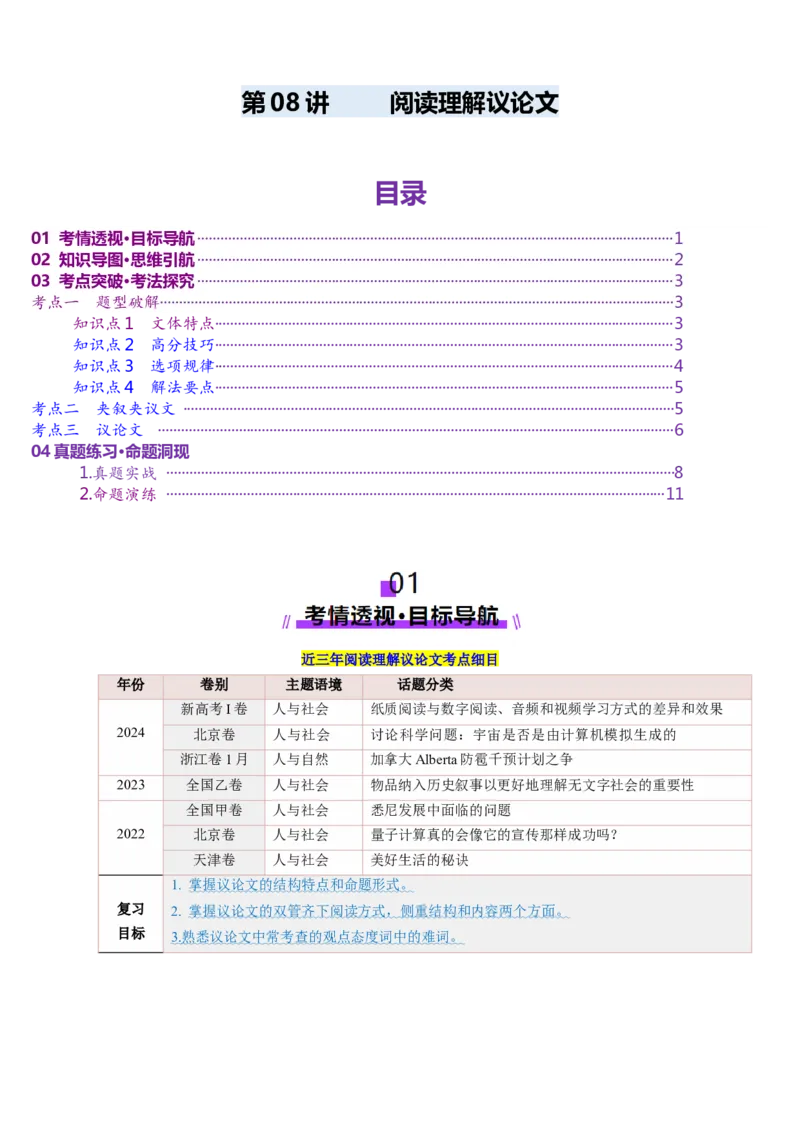
近三年阅读理解议论文考点细目
年份 卷别 主题语境 话题分类
新高考I卷 人与社会 纸质阅读与数字阅读、音频和视频学习方式的差异和效果
2024 北京卷 人与社会 讨论科学问题:宇宙是否是由计算机模拟生成的
浙江卷1月 人与自然 加拿大Alberta防雹千预计划之争
2023 全国乙卷 人与社会 物品纳入历史叙事以更好地理解无文字社会的重要性
全国甲卷 人与社会 悉尼发展中面临的问题
2022 北京卷 人与社会 量子计算真的会像它的宣传那样成功吗?
天津卷 人与社会 美好生活的秘诀
1. 掌握议论文的结构特点和命题形式。
复习 2. 掌握议论文的双管齐下阅读方式,侧重结构和内容两个方面。
目标 3 . 熟悉议论文中常考查的观点态度词中的难词。考点一 题型破解
知识点1 文体特点
议论文是一种剖析事物、论述事理、发表意见、提出主张的文体。这类文章或从正面提出某种见解,或驳斥别人的
错误观点,以说服读者同意自己的观点为主要目的。分析近三年高考真题议论文可知,文章涉及的论题具有生活化的特征,与社会生活密切相关。从体裁特点看,议论
文有夹叙夹议文和议论文两种。
文章通常由论点、论据、论证三部分构成,论点是议论文的核心,即中心思想,是论据和论证的服务对象。论据是
作者所引用的用以支持和证明论点的材料,这些材料可以是名人名言、事实例证或统计数据等。论证是作者组织、运用
论据的手法。
结构特点:议论文说理性强,语言庄重,逻辑缜密,重点考查考生的思维能力和判断能力,常用难词、长词和复杂句,
给阅读理解带来一定的难度。
夹叙夹议类文章主要有三种类型: 1.先叙述作者的某一个生活经历或见闻,然后针对这一事件发表自己对生活
的看法,或揭示生活的真理。2. 作者先提出一种观点或看法,然后围绕这一观点或看法用具体的事例加以说明,有时也
可能是用几个事例从不同的侧面来说明。3. 提出一种观点或见解,然后用某一事例来阐述这一观点,最后再进一步地总
结和升华。
无论那种议论文,作者均通过摆事实、讲道理、辨是非的方法,来论证某种观点正确与否,肯定或否定某种主张。
即提出问题(引论)--分析问题(本论)一一解决问题(结论)”。
命题分布:常见的有细节理解题、推理判断题、主旨大意题、词义猜测题、情感态度题等题型。
难度分析:高考英语阅读理解中议论文说理性强,语言庄重,逻辑缜密,常用难词、长词和复杂句,,因此属于难度较
大的文章。命题人经常在长难句处设置命题点,遇到长难句,不可慌乱,耐心拆解出主干部分,再依次定位其修饰语,
如定语、状语等,便可化繁为简,读懂句意。
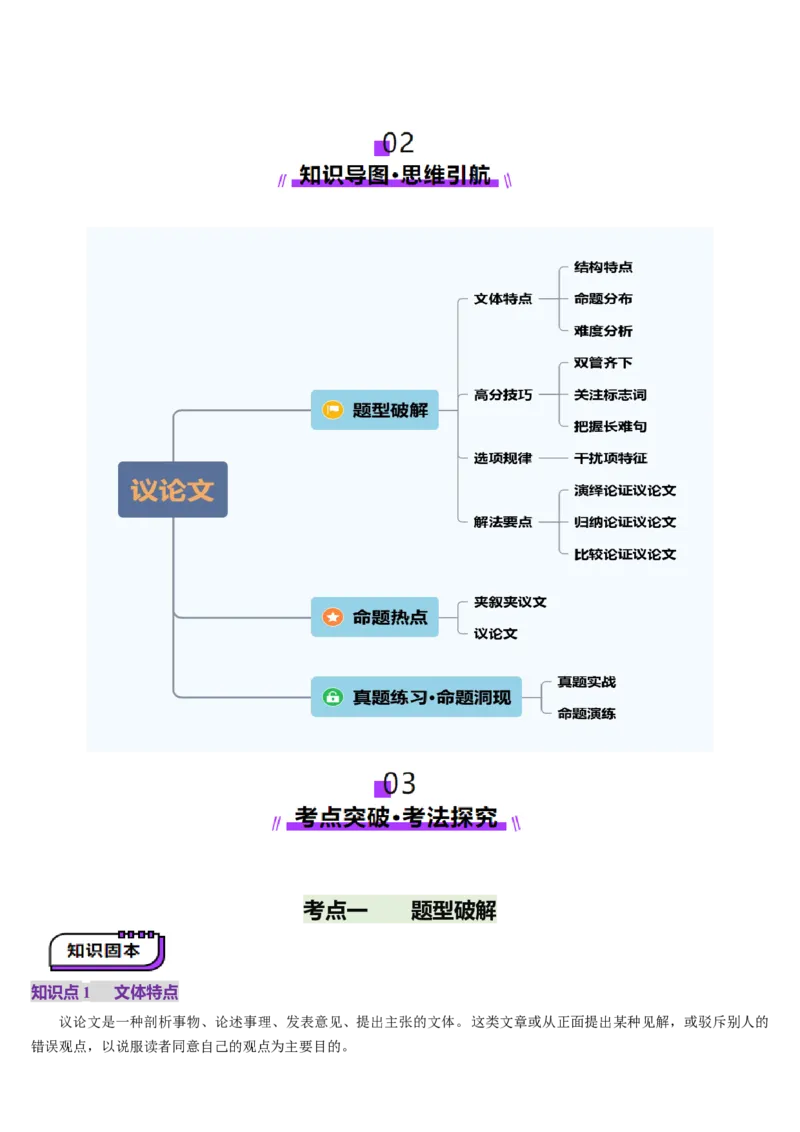
知识点2 高分技巧
1. 双管齐下法 :从结构和内容两方面同时入手,先通读全文,再区分事实和观点。
2. 关注标志词 :句子间的逻辑关系和衔接手段不外乎列举、原因、结果、让步、对照、补充、目的、条件等。
表示列举的词:for example, for instance;表罗列的词:first,second, third, to begin with,to conclude;
表转折: however, but, whereas;
表原因: because, since,as;
表结果:so,therefore, thus, consequently, as a result;
表对照:on the contrary, by contrast, in comparison;
表目的: so that, in order that等。
标志词就像指路牌一样,指明作者思路发展的方向和思路之间的逻辑联系。标志词前后的信息往往都是命题和答题的主
要线索或依据,因此,识别标志词对考生更快、更好地理解文章具有举足轻重的作用。
3. 把握长难句 :议论文中的长难句常是命题点。遇到长难句,不可慌乱,耐心拆解出主干部分,再依次定位其修饰语,
如定语、状语等,便可化繁为简,读懂句意。
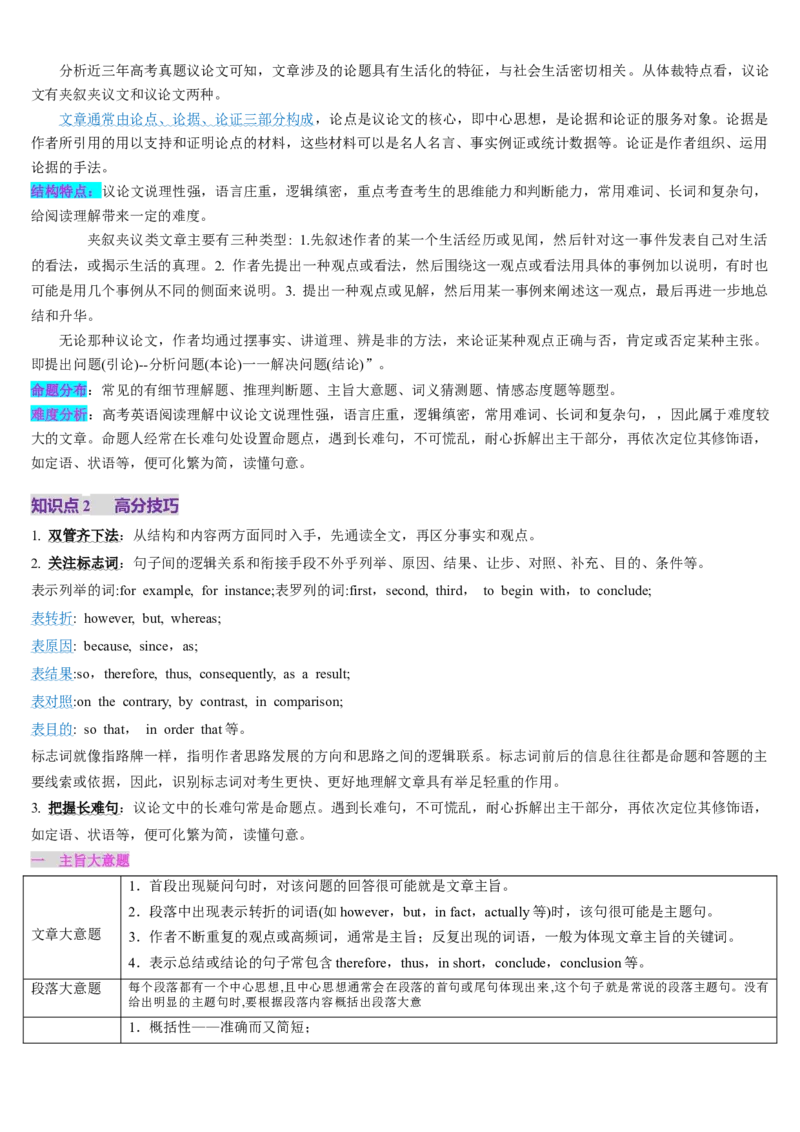
一 主旨大意题
1.首段出现疑问句时,对该问题的回答很可能就是文章主旨。
2.段落中出现表示转折的词语(如however,but,in fact,actually等)时,该句很可能是主题句。
文章大意题 3.作者不断重复的观点或高频词,通常是主旨;反复出现的词语,一般为体现文章主旨的关键词。
4.表示总结或结论的句子常包含therefore,thus,in short,conclude,conclusion等。
段落大意题 每个段落都有一个中心思想,且中心思想通常会在段落的首句或尾句体现出来,这个句子就是常说的段落主题句。没有
给出明显的主题句时,要根据段落内容概括出段落大意
1.概括性——准确而又简短;2.针对性——标题外延正好与文章内容相符;
标题归纳题 3.醒目性——能引发读者的阅读欲望。
在提炼主旨大意的基础上关注上述好的标题的三大特征进行总结。
二 词义猜测题
1.根据定义或上下文解释进行猜测
2.根据同位关系进行猜测
3.根据构词法(前缀、后缀、派生等)进行猜测
4.根据因果关系进行猜测
5.根据上下文的指代关系进行猜测
6.根据同义或近义关系进行猜测
7.根据转折或对比关系进行猜测
三 推理判断题
议论文中的推理判断题务必以事实为依据,但其结构绝不是事实本身。主要考查考生的逻辑思维能力,侧重于推理
但务必忠实于原文,且不可过度推断。
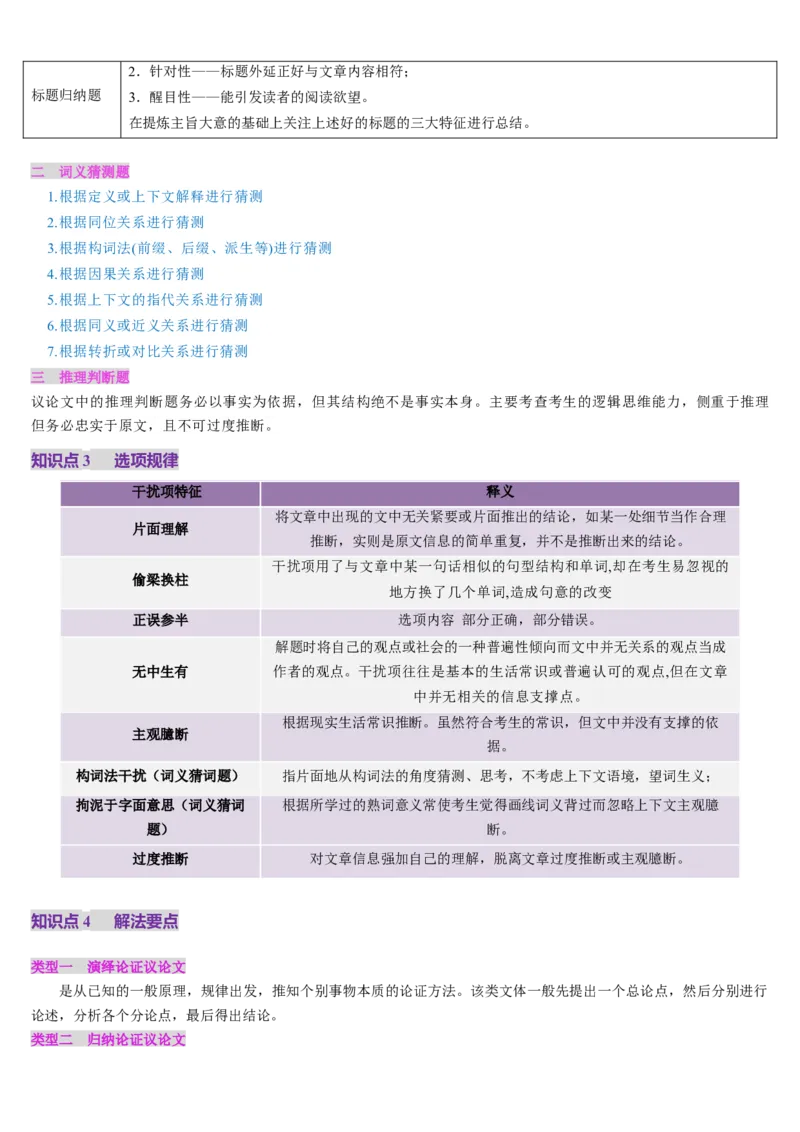
知识点3 选项规律
干扰项特征 释义
将文章中出现的文中无关紧要或片面推出的结论,如某一处细节当作合理
片面理解
推断,实则是原文信息的简单重复,并不是推断出来的结论。
干扰项用了与文章中某一句话相似的句型结构和单词,却在考生易忽视的
偷梁换柱
地方换了几个单词,造成句意的改变
正误参半 选项内容 部分正确,部分错误。
解题时将自己的观点或社会的一种普遍性倾向而文中并无关系的观点当成
无中生有 作者的观点。干扰项往往是基本的生活常识或普遍认可的观点,但在文章
中并无相关的信息支撑点。
根据现实生活常识推断。虽然符合考生的常识,但文中并没有支撑的依
主观臆断
据。
构词法干扰(词义猜词题) 指片面地从构词法的角度猜测、思考,不考虑上下文语境,望词生义;
拘泥于字面意思(词义猜词 根据所学过的熟词意义常使考生觉得画线词义背过而忽略上下文主观臆
题) 断。
过度推断 对文章信息强加自己的理解,脱离文章过度推断或主观臆断。
知识点4 解法要点
类型一 演绎论证议论文
是从已知的一般原理,规律出发,推知个别事物本质的论证方法。该类文体一般先提出一个总论点,然后分别进行
论述,分析各个分论点,最后得出结论。
类型二 归纳论证议论文是一种由个别到一般的论证方法。它通过许多个别的事例或分论点,然后归纳出它们所共有的特性,从而得出一个一般
性的结论。
类型三 比较论证议论文
是一种由个别到个别的论证方法。通常分为类比法和对比法两类。类比法是将性质或特点在某一方面相同或相近的
不同事物加以比较而引出结论的方法。对比法是通过性质或特点在某一方面相反或对立的不同事物的比较来证明论点的
方法。
考点二 夹叙夹议文
典例1.(2024·江苏泰州·模拟预测)How long will it take you to read this article? On average, adults read about 240 words a
minute, but I always take longer. I should probably feel embarrassed-but instead, I take joy in it.
I got the habit of reading for pleasure from my mum. Reading is what I do first thing in the morning and last thing at night.
But it’s always taken me a long time. When I started reviewing books, I was averaging 20 pages an hour. I have improved to about
30 pages, but that’s still slow, according to some literary critics.
Book reviewers aren’t the only ones under pressure to read quickly. Pictures of “all the books I read this month” are all over
social media. And reading has become a way of keeping up with the world. It is understandable that we try to make sense of
events, but it can also fuel the idea that reading is a chore (苦差事), which it absolutely is not.
Why would pleasure be equal to pace? My slow reading seems to be down to a combination of slower processing speeds,
and “subvocalising” — sounding out words as I read them. But especially when it comes to the latter, I wouldn’t want to train
myself to go faster. It was news to me that not everyone subvocalises, because one of my favourite things about reading is hearing
the language in my mind. Without subvocalising, I wouldn’t have caught the music of those words.
Recently, I finished a book of poetry. For two years, I read the poems each morning in the four minutes it took my coffee to
be ready. It was a wonderful reminder that reading is never about quantity and always about the quality of time you spend with a
text.
So when you read, don’t stick a number on it ---- resolve to read for pleasure, not as a chore.
1.Why does the author like slow reading?
A.It wins her fame online. B.It is a delightful practice.
C.It comes from her mom. D.It helps her reach goals.
2.What do fast readers focus on?
A.Quantity. B.Quality. C.Content. D.Sound.
3.What do the underlined words “the latter” in paragraph 4 refer to?
A.Slower processing speeds.
B.Learning language.
C.Combining speeds and sounds.
D.Reading words out.
4.What would the author agree with?
A.Reading is a demanding task.
B.Pace equals reading pleasure.
C.Beauty of words needs tasting.D.Poetry takes no effort to digest.
考点三 议论文
典例1.(23-24高三·江苏泰州·期中)For most of human history, we have been very good observers because we had to
be. We used all of our senses—touch, smell, taste, hearing, and sight—to detect and discern. The sudden sounds of animals or the
running of birds warned us that someone was approaching. At a distance, by examining posture, way of walking, arms wing,
clothing, and equipment, our ancestors could discern friend from foe (敌人).
As generations evolved and eventually moved to cities, closeness changed how we viewed and assessed each other.
Because everyone was so close, we had less time to observe. Close quarters and circumstances demanded we interact on first
meeting rather than later. This was the opposite of what we had done for thousands of years, which was to assess first at a distance
and then interact. Closeness also made us more sensitive to being observed, which is why we are uncomfortable when others stare
at us.
Have we allowed ourselves to become careless when it comes to our own safety and that of our loved ones? I see people
distracted while driving (applying makeup or texting). Or someone knocks at the front door and we open it without first seeing
who is there and asking what they want Perhaps, in an attempt to be polite, we have ended our responsibility to ourselves, and
each other, to be good observers.
We should all look around and listen to our inner voice, which is in fact the limbic (边缘的) brain telling us to be careful
that something is wrong, as security special it Gavin de Becker pointed out in The Gift of Fear, So often, after an encounter or a
relationship turns problematic, one hears, “You know I had a feeling, in the beginning, that something wasn’t right.”
However failure to observe, if we are honest, leads to avoidable circumstances as well as accidents, How we feel about
something often completes the picture so that we can fully understand it Anyway, it is never too late to start observing.
Observation is not about being judgmental, it is not about good or bad. It is about seeing the world around you, having situational
awareness, and interpreting what it is that others are communication both verbally and nonverbally. To observe is to see but also to
understand, and that requires listening to how you feel.
1.What does the underlined word “discern” in paragraph 1 mean?
A.Disclose. B.Discover. C.Distinguish. D.Disguise.
2.Why did we spend less time observing?
A.Observing involves too much and is complicated.
B.We felt uneasy when others were staring at us.
C.We got more sensitive to others’ observation.
D.Closeness required people to communicate on first meeting.
3.Possibly for what have we given up being good observers?
A.Being careless. B.Avoiding rudeness.
C.Paying no attention. D.Being irresponsible.
4.What is the best title?
A.Be good observers B.Discern friend from foe
C.Care about our safety D.Start observing now
典例2.(23-24高三·江西赣州·期中) The 3D DinosaurJohn Simpson
Call me the youngest dinosaur in the world. Not the kind who attacks you in a 3D movie. The other kind: a dinosaur of old-
fashioned opinion. How old-fashioned? Let’s just say I consider 3D physically dangerous, economically greedy, artistically self-
defeating and imaginatively silly.
That kind of dinosaur.
When you watch a 3D film, your brain receives two slightly different 2D images and is forced to make sense of them by
combining them into one. The immediate result of this combination is an enhanced sense of apparent depth (the “third”
dimension). The not-so-immediate result is, for at least 15 percent of us, eye strain, headaches and a dangerous dis-orientation (定
向障碍). These risks are greatest for children and teenagers. It is even possible that children will develop permanent problems
with depth perception (感知) if they are over-exposed to 3D.
Why do film-makers bring about these risks on us? So they can charge us extra at the ticket office. Who wins out of this?
Not us. So who does? The film-makers themselves?
They might think they do, but they should think again. If 3D becomes the new standard, we will see a shift in the kind of
films that are made. Setting and action take over. Character, relationships and plot become weaker. No film that lacks the promise
of a 3D thrill will even find the financial backing to be made. So stand back, all you serious film-makers, and make room for kids’
movies and animation.
But the most annoying thing about 3D is that it is not necessary. There is already depth in 2D media. The imagination finds
it there. If we depend on special glasses to find it, we have already begun to replace the wonders of imagination with the tricks of
technology.
I heard a child leaving a cinema recently announce, “I wish life was 3D!”That should be sad, not just to us dinosaurs, but to
everyone.
5.What kind of dinosaur does John Simpson claim to be?
A.The kind that is youthful and creative. B.The kind that is found in many forms.
C.The kind that disapproves of new ideas. D.The kind that appears in many popular films.
6.Why are the incomplete sentences used in the first two paragraphs?
A.They make people feel the language of a debate.
B.They cast doubt on John Simpson’s credibility.
C.They suggest John Simpson is a hesitant character.
D.They show that the subject of the text is not serious.
7.Which aspect of 3D films does the text emphasize most strongly?
A.The cost of production. B.The number of films made.
C.The effect on audiences. D.The special skills of film-makers.
8.What does the author claim to find most disturbing about 3D films?
A.They make people feel unwell. B.Their ticket prices are too high.
C.They lead to a loss of imagination. D.They reduce the range of films available.一、 真题实战
1.(2024新课标I卷)
Is comprehension the same whether a person reads a text onscreen or on paper? And are listening to and viewing content as
effective as reading the written word when covering the same material? The answers to both questions are often “no.” The reasons
relate to a variety of factors, including reduced concentration, an entertainment mindset (心态) and a tendency to multitask while
consuming digital content.
When reading texts of several hundred words or more, learning is generally more successful when it’s on paper than
onscreen. A large amount of research confirms this finding. The benefits of print reading particularly shine through when
experimenters move from posing simple tasks – like identifying the main idea in a reading passage – to ones that require mental
abstraction – such as drawing inferences from a text.
The differences between print and digital reading results are partly related to paper’s physical properties. With paper, there is
a literal laying on of hands, along with the visual geography of distinct pages. People often link their memory of what they’ve read
to how far into the book it was or where it was on the page.
But equally important is the mental aspect. Reading researchers have proposed a theory called “shallowing hypothesis (假
说).” According to this theory, people approach digital texts with a mindset suited to social media, which are often not so serious,
and devote less mental effort than when they are reading print.
Audio (音频) and video can feel more engaging than text, and so university teachers increasingly turn to these technologies –
say, assigning an online talk instead of an article by the same person. However, psychologists have demonstrated that when adults
read news stories, they remember more of the content than if they listen to or view identical pieces.
Digital texts, audio and video all have educational roles, especially when providing resources not available in print. However,
for maximizing learning where mental focus and reflection are called for, educators shouldn’t assume all media are the same, even
when they contain identical words.
28. What does the underlined phrase “shine through” in paragraph 2 mean?
A. Seem unlikely to last. B. Seem hard to explain.
C. Become ready to use. D. Become easy to notice.
29. What does the shallowing hypothesis assume?
A. Readers treat digital texts lightly.
B. Digital texts are simpler to understand.
C. People select digital texts randomly.
D. Digital texts are suitable for social media.
30. Why are audio and video increasingly used by university teachers?
A. They can hold students’ attention.
B. They are more convenient to prepare.
C. They help develop advanced skills.
D. They are more informative than text.
31. What does the author imply in the last paragraph?A. Students should apply multiple learning techniques.
B. Teachers should produce their own teaching material.
C. Print texts cannot be entirely replaced in education.
D. Education outside the classroom cannot be ignored.
2.(2021全国甲卷)
Who is a genius? This question has greatly interested humankind for centuries.
Let's state clearly: Einstein was a genius. His face is almost the international symbol for genius. But we want to go beyond
one man and explore the nature of genius itself. Why is it that some people are so much more intelligent or creative than the rest of
us? And who are they?
In the sciences and arts, those praised as geniuses were most often white men, of European origin. Perhaps this is not a
surprise. It's said that history is written by the victors, and those victors set the standards for admission to the genius club. When
contributions were made by geniuses outside the club—women, or people of a different color or belief—they were
unacknowledged and rejected by others.
A study recently published by Science found that as young as age six, girls are less likely than boys to say that members of
their gender (性别) are “really, really smart.” Even worse, the study found that girls act on that belief: Around age six they start to
avoid activities said to be for children who are “really, really smart.” Can our planet afford to have any great thinkers become
discouraged and give up? It doesn't take a genius to know the answer: absolutely not.
Here's the good news. In a wired world with constant global communication, we're all positioned to see flashes of genius
wherever they appear. And the more we look, the more we will see that social factors(因素)like gender, race, and class do not
determine the appearance of genius. As a writer says, future geniuses come from those with “intelligence, creativity, perseverance
(毅力), and simple good fortune, who are able to change the world.”
12. What does the author think of victors' standards for joining the genius club?
A. They're unfair.
B. They're conservative.
C. They're objective.
D. They're strict.
13. What can we infer about girls from the study in Science?
A. They think themselves smart.
B. They look up to great thinkers.
C. They see gender differences earlier than boys.
D. They are likely to be influenced by social beliefs
14. Why are more geniuses known to the public?
A. Improved global communication.
B. Less discrimination against women.
C. Acceptance of victors' concepts.
D. Changes in people's social positions.
15. What is the best title for the text?
A. Geniuses Think Alike
B. Genius Takes Many Forms
C. Genius and IntelligenceD. Genius and Luck
3.(2021新课标I卷)
Popularization has in some cases changed the original meaning of emotional (情感的) intelligence. Many people now
misunderstand emotional intelligence as almost everything desirable in a person’s makeup that cannot be measured by an IQ test,
such as character, motivation, confidence, mental stability, optimism and “people skills.” Research has shown that emotional skills
may contribute to some of these qualities, but most of them move far beyond skill-based emotional intelligence.
We prefer to describe emotional intelligence as a specific set of skills that can be used for either good or bad purposes. The
ability to accurately understand how others are feeling may be used by a doctor to find how best to help her patients, while a
cheater might use it to control potential victims. Being emotionally intelligent does not necessarily make one a moral person.
Although popular beliefs regarding emotional intelligence run far ahead of what research can reasonably support, the overall
effects of the publicity have been more beneficial than harmful. The most positive aspect of this popularization is a new and much
needed emphasis (重视) on emotion by employers, educators and others interested in promoting social well-being. The
popularization of emotional intelligence has helped both the public and researchers re-evaluate the functionality of emotions and
how they serve people adaptively in everyday life.
Although the continuing popular appeal of emotional intelligence is desirable, we hope that such attention will excite a
greater interest in the scientific and scholarly study of emotion. It is our hope that in coming decades, advances in science will
offer new perspectives (视角) from which to study how people manage their lives. Emotional intelligence, with its focus on both
head and heart, may serve to point us in the right direction.
32. What is a common misunderstanding of emotional intelligence?
A. It can be measured by an IQ test.
B. It helps to exercise a person's mind.
C. It includes a set of emotional skills.
D. It refers to a person’s positive qualities.
33. Why does the author mention “doctor” and “cheater” in paragraph 2?
A. To explain a rule.
B. To clarify a concept.
C. To present a fact.
D. To make a prediction.
34. What is the author's attitude to the popularization of emotional intelligence?
A. Favorable. B. Intolerant. C. Doubtful. D. Unclear.
35. What does the last paragraph mainly talk about concerning emotional intelligence?
A. Its appeal to the public.
B. Expectations for future studies.
C. Its practical application.
D. Scientists with new perspectives.
二、 命题演练
1.(2024·辽宁·模拟预测)“Quick, quick, slow, slow,” my husband said as I was trying to focus. We frequently stepped
on each other’s feet. Both of us were being rhythmically challenged, and we figured a series of lessons might help us looksomewhat elegant on the floor. However, it didn’t.
It didn’t matter that the lessons didn’t pay off. Our learning something new together gave us a string of good memories,
such as taking a Thai cooking class on a cold Chicago night and learning how to make classic cocktails (鸡尾酒) in a common bar.
These experiences are my best memories from the past 10 years. We always have such a great time when we’re trying something
new together. It seems to have strengthened our relationship, and makes me feel like we have a closer connection.
It turns out that my theory is backed by research. One study shows that learning new things with your spouse (配偶),
friends, or partners, can strengthen your connection or friendship. But how exactly does this work? The key is vulnerability (弱点).
“Learning new things together strengthens bonds because it is at those moments that we can show our vulnerability to one
another,” says Dr. Hisla Bates. When we are learning a new task, misfortunes and failures are bound to happen. In those moments
when we fail, the other party can be there in favor of us. We can work together to find a solution, and working together helps
deepen the connection.
The benefits gained from learning new things with your partner can come from activities as small as hiking, trying a new
recipe, going boating in the local lake or taking a fitness class together. You don’t have to go bungee jumping or skydiving to grow
closer. Try selecting activities that both partners are unfamiliar with, as this will ensure you’re on the same page.
Trying to learn something new together once a month will benefit you and your spouse or friends. Overall, some of my best
memories with my husband are the moments when we are learning something new together.
1.What were the author and her husband doing in Paragraph 1?
A.Playing sports. B.Practising dancing.
C.Teaching lessons. D.Taking a walk.
2.What can we learn from the author’s experiences?
A.Practice makes perfect.
B.Good memories last a long time.
C.Processes matter more than results.
D.Well begun is half done.
3.Why does learning new things together strengthen partners’ relationship?
A.It can encourage them to teach and praise each other.
B.It helps improve the understanding of each other.
C.It can reduce each other’s loneliness and boredom.
D.It helps find each other’s weaknesses and offer support.
4.What’s the best title for the text?
A.The power of learning new things together
B.The advantages of taking different lessons
C.The challenge of acquiring new knowledge
D.The importance of improving people’s bonds
2.(2024·山西太原·高三统考期末)
Taking an end-of-season break sounds simple, right? You may think a carefree week spent on a beach is what’s most desired.
But actually most athletes would spend hours trying to convince their coaches that they really don't need to rest at all,
subsequently filling up all of their given time with as many replacement activities as possible.
This year I was given a week’s holiday by my coach to enjoy absolute relaxation. For the first three days I remained happilywrapped up in the satisfaction of my last race result, embracing pajama days, taking all morning just to have breakfast and using
my spare time to socialize more than I usually do. I was enjoying it, and yet···All this resting made me feel restless. Then came
Thursday. I laced up my shoes and headed back to the track.
The simple part of resting is the physical act of it, but given that I usually train with focus and tension, learning to check out
mentally doesn’t always come naturally after a season, especially when I’m on holiday. After a season with good results, some
well-meaning people excitedly ask “What's next?” It can wander in my mind and raise doubt over what I should be doing
according to other people’s opinions.
In this case I talked to some experienced athletes and raised my concern, one of whom suggested establishing a general
outline of the next season’s goals prior to holidays. I find it helpful, not only preventing me from feeling rushed to get back into
workouts too soon and giving a sense of purpose to the rest itself, but also ensuring that I will not spend my break making plans
but allow my mind to rest too.
We all fear losing the fitness and the achievements that we worked so hard to gain, but in reality, taking the appropriate rest
and knowing how to take it is a help. Here’s hoping that I’ll get the balance next year. But if I didn’t, at least I would enjoy myself.
5.What do most athletes do during a holiday after a season?
A.Negotiate with coaches. B.Do alternative workouts.
C.Enjoy absolute relaxation. D.Travel to a seaside destination.
6.What can we infer about the author’s holiday from paragraph 2?
A.It was carefully arranged. B.It followed the coach’s plan.
C.It was ended ahead of schedule. D.It was interrupted by unexpected tasks.
7.What is the author’s real need during the break time?
A.Mind rest. B.Physical recovery.
C.Time management. D.Professional guidance.
8.What can be a suitable title for the text?
A.Secrets to Winning on Tracks
B.Plans for Next Season’s Training
C.End-of-season Break: A New Beginning
D.From Legs to Brain: True Relaxation for Athletes
3.(2023·江苏·高三无锡市第一中学阶段练习)
“Lei ming m ming baak ngo gong ge waa ah? Do you understand what I am saying?” I stare back at the speaker dumbly, my
lips parted, the ideas clear in my mind but a response unable to express itself in a language in my distant range. After an
uncomfortable pause, a bunch of words spill out of my mouth, sounding forced and unnatural.
The anecdote (轶事) above is a semi-conversation I had in Malaysia years ago. A three-week stay in Malaysia once every few
years was often the highlight of my summers—what more can you ask from a food paradise? But besides the family, food, and
escape that Malaysia offered, trips also brought accompanying feelings of guilt that I just couldn’t seem to translate. For one
month every few summers, I got a taste of what it feels to be an outsider in my own culture, peering in. I was a girl lost in
translation, passively absorbing the various tongues shouted between the stalls in the wet markets, quietly nodding along at my
grandparents’ huge family dinners.
In America though, I am a different person. I don’t think twice about my grammar when speaking. I don’t struggle with the
words and fear that my logic and stories won’t get through to people. So as a native English speaker, I do not have to worry dailyabout whether I’m judged for having an accent or whether I’m misunderstood across languages. In Malaysia, I naturally burst out
“have you eaten?” instead of recalling the Malaysian equivalent “you makan already?” In Malaysia, everything about the way I
speak-my accent, intonation, sentence structure, slang-gives me away. My American-ness is seen in the way I talk, dress, and act.
Maybe my face could pass for a Malaysian local, but once I open my mouth to speak I am so clearly not. It is uncomfortable and
awkward, and sometimes I wonder if I did not look Asian at all would it be better, since there would be no more language
expectation for me than for a white tourist.
9.How did the author feel in the anecdote?
A.Confused and scared. B.Embarrassed and nervous.
C.Curious and surprised. D.Upset and puzzled.
10.Why did the author feel guilt according to Paragraph 2?
A.Because she had to stay away from her family
B.Because she didn’t enjoy speaking the language
C.Bccause she had to accept what grandparents said
D.Because she found it hard to understand the culture.
11.What can we learn about the author from the last paragraph?
A.She was a good language learner. B.She didn’t like being an Asian.
C.She was judged unfairly in Malaysia D.She spoke English unconsciously in Malaysia.
12.From which column of the website does this article probably come from?
A.Opinion B.News. C.Education. D.Humor