秘籍 01 阅读理解
目录
阅读理解
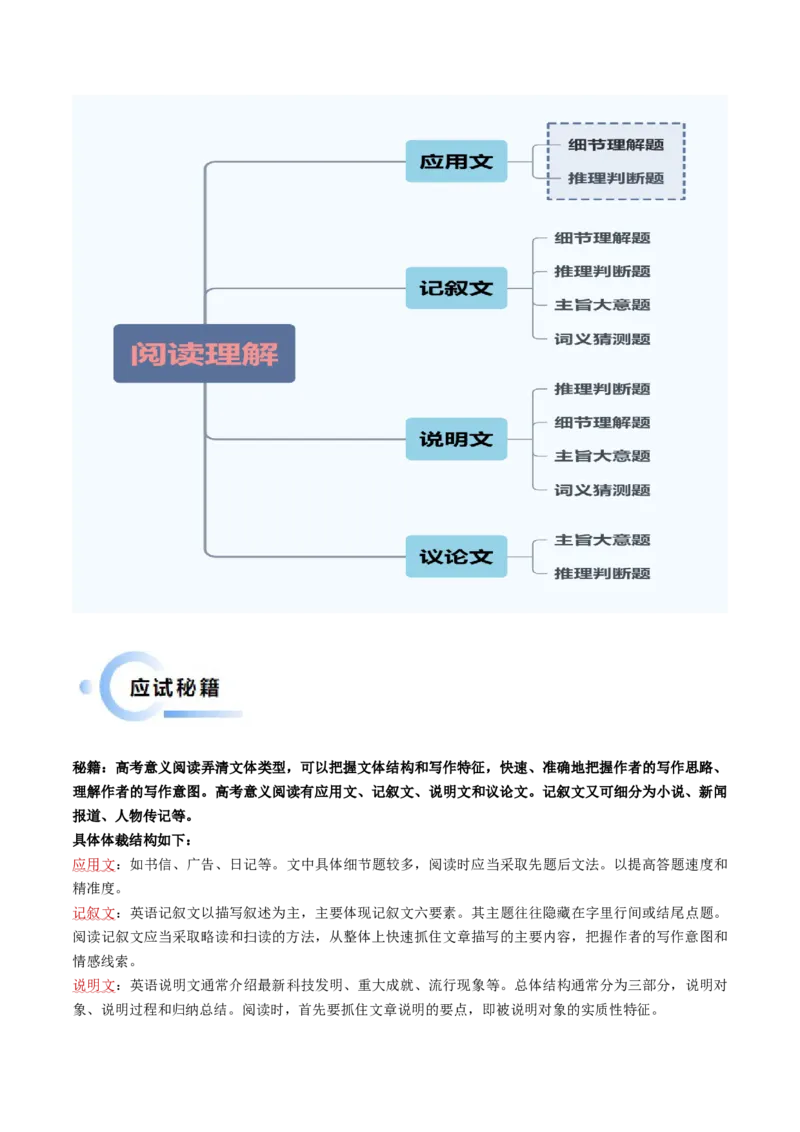
【高考预测】阅读理解概率预测+题型预测+考向预测........................................................................................01
【思维导图】阅读理解考点考向思维导图............................................................................................................02
【应试秘籍】阅读理解常考点及应对的策略........................................................................................................02
【误区点拨】阅读理解点拨常见的易错点............................................................................................................03
【抢分通关】阅读理解押题新高考方向,讲解通关策略(含新考法)............................................................07
概率预测 ☆ ☆ ☆ ☆ ☆
题型预测 细节理解题、推理判断题、主旨大意题、词义猜测题
体裁:应用文1篇、 记叙文0-1篇、 说明文1-3篇、 议论文0-1篇
考向预测 细节理解题7-8题、推理判断题7-9题、主旨大意题1-2题、词义猜测题1题
☆ ☆ ☆ ☆ ☆秘籍:高考意义阅读弄清文体类型,可以把握文体结构和写作特征,快速、准确地把握作者的写作思路、
理解作者的写作意图。高考意义阅读有应用文、记叙文、说明文和议论文。记叙文又可细分为小说、新闻
报道、人物传记等。
具体体裁结构如下:
应用文:如书信、广告、日记等。文中具体细节题较多,阅读时应当采取先题后文法。以提高答题速度和
精准度。
记叙文:英语记叙文以描写叙述为主,主要体现记叙文六要素。其主题往往隐藏在字里行间或结尾点题。
阅读记叙文应当采取略读和扫读的方法,从整体上快速抓住文章描写的主要内容,把握作者的写作意图和
情感线索。
说明文:英语说明文通常介绍最新科技发明、重大成就、流行现象等。总体结构通常分为三部分,说明对
象、说明过程和归纳总结。阅读时,首先要抓住文章说明的要点,即被说明对象的实质性特征。议论文:英语议论文由“论点、论据、结论”三部分组成。借助某一现象引出论点,通过论据从各个层面
加以推理论证,最后得出结论。应当把握每一段的主题句。
易错点一:细节理解题
秘籍:细节理解题主要考查对文章中某一特定句子的理解,解题时可以使用快速阅读的方法,找到文章中
对应的关键词,然后再仔细阅读相关的句子,理解其含义。
具体步骤如下:
第一步:采用先题后文法,先仔细审读题干,标出关键词。
第二步:采用原词复现、近义词、同义词甚至反义词等方法,迅速在原文中查询关键词句,再精准翻译。
第三步:核对选项,注意细节是否有替换或曲解。
(2024年九省联考)
......
One poster from the exhibition—Henry Wellge’s “Yellowstone National Park” from1904—was recently
purchased with donated funds and is now part of UW Libraries’ Emmett D. Chisum Special Collections. Wellge, a
productive bird’s-eye-view artist, designed the piece for the Northern Pacific Railroad, which used it to advertise
the park. This is a unique piece, as posters such as this one were printed on soft paper and very few have survived.
3. What do we know about the 1904 poster Henry Wellge designed?
A. It is rare in the world. B. It is in black and white.
C. It is printed on cloth. D. It is owned by a professor.
变式:(2024年浙江1月真题)
When was the last time you used a telephone box? I mean to make an actual phone call — not to shelter from
,
the rain. Ages ago right? The last time I used a phone box for its intended purpose was 2006. I was conducting
auditions (试演) for my play in my tiny old shared house in London. Hoping to impress some talented actors to
come and work for me for nothing, I spread some throws over the sofas and lit candles to make it seem a bit more
”young professional”.
As I rushed outdoors to empty the wastepaper baskets, the door swung shut behind me. Suddenly I was locked
outside. My mobile phone was inside, but luckily there was a telephone box across the street. So, I called Directory
Assistance, got put through to our landlady’s managing agent, and had a spare key sent to me with just enough time
to get back in before the actors arrived.
......
5. Why did the author use the telephone box in 2006?A. To place an urgent call. B. To put up a notice.
C. To shelter from the rain. D. To hold an audition.
易错点二:推理判断题
1. 秘籍:推理判断题需要采用深度阅读法,采用文题结合的阅读方式,理解文章中隐含的意思和逻辑关
系,从而得出正确的推断。
第一步:采用先文题结合法,阅读文章主旨段落,以便把握作者写作意图和方向。
第二步:审读题干,提取关键词,定位到原文相关句子,再精准翻译。注意长难句的结构划分,长难句中
常会设置题目。
第三步:注意细节和逻辑关系,核对选项,得出正确答案。
(204高三·广东·阶段练习)
Photographer Xie Jianguo’s passion for photo graphing wild animals and polar eco logy is evident in his
extensive travels. He has traveled to destinations such as Kenya, Botswana and Madagascar nine times.
Furthermore, he has visited the Arctic and Antarctic continents more than 30 times. Xie also has explored diverse
regions across Europe, North America, South America, Asia and Australia, catching the remarkable beauty of
nature through his cameras on numerous occasions.
Since 2012, Xie has redirected his cameras towards his homeland, focusing on taking pictures of wildlife in
China. Now his footprints have covered nearly all the provinces and regions throughout the country. He has
explored nearly 100 wildlife protection areas, such as Source of the Three Rivers, Hoh Xil, Qilian Mountain and
Xishuangbanna. From the adorable pandas in Sichuan to the playful Pallas’s cats in Inner Mongolia, Xie has
devoted himself to documenting the country’s rare and endangered animals, which showcases unique natural and
ecological wonders of China.
......
What can we learn about Xie from the first two paragraphs?
A.He focused on taking pictures of Chinese wonders.
B.He was enthusiastic about photographing wild animals.
C.He went to many places to enjoy the beautiful scenery.
D.He traveled abroad to know more about foreign culture.
变式1:(2024·河北保定·一模)
......
EHang has ambitions beyond China, too. The firm’s closest competitors are Volocopter, a German company,
and a pair of Californian firms, Joby Aviation and Archer Aviation. All three are conducting test flights of piloted
eVTOLs of various designs.What can we infer from the last paragraph?
A.EVTOLs will definitely bring in a huge profit.
B.EVTOLs are popular worldwide.
C.EHang may face challenges in expanding future market.
D.EHang will improve its design to defeat competitors.
变式2:
......
In fact, many species grow out of their spots, and the reasons aren’t entirely understood. According to
Gotanda, patterning is typically considered more energetically costly to produce than a single, solid color. But spots
don’t take a lot of energy to grow and maintain at least in the case of white spots. There must be other reasons to
explain their loss, he said.
......
Which statement might Gotanda agree with?
A.Animals with spots on the body are more energetic.
B.Spotted animals often exist in uniform surroundings.
C.The growth of animal spots will consume lots of energy.
D.There are more to explore about the loss of animal spots.
易错点三: 主旨大意题
秘籍:主旨大意题中的标题归纳题属于文章中心思想的精炼表达。标题具有一定的特征,如以短语或祈使
句形式出现,醒目鲜明。段落大意题解题时重点关注段落第一句,段落第一句往往是段落的主旨句,有时
会和段落结尾句首尾呼应。文章大意题解答时应当重点关注文章第一段和最后一段。第一段往往会点明文
章的主要内容和线索,有时在各个段落的主旨句中也可以提炼文章的大意。
......
In lab studies, children tested at ages 4 and 6 showed more willingness to give up the tokens (代金券) they
had earned to fictional children in need when two conditions were present—if they showed bodily changes when
given the opportunity to share and had experienced positive parenting that modeled such kindness. The study
initially included 74 preschool-age children and their mothers. They were invited back two years later, resulting in
54 mother-child pairs whose behaviors and reactions were analyzed when the children were 6.
......
What is the second paragraph mainly about?
A.The process of the research. B.The result of the experiment.
C.The reactions of the children. D.The importance of Mom’s love.变式1:(2024·山东济南·一模)
A new study reveals that pigeons (鸽子) can tackle some problems just like artificial intelligence, enabling
them to solve difficult tasks that might challenge humans. Previous research has theorized that pigeons employ a
problem-solving strategy, involving a trial-and- error approach, which is similar to the approach used in AI models
but differs from humans’ reliance on selective attention and rule use. To examine it, Brandon Turner, a psychology
professor at the Ohio State University, and his colleagues conducted the new study.
In the study, the pigeons were presented with various visual images, including lines of different widths and
angles, and different types of rings. The pigeons had to peck (啄) a button on the right or left to indicate the
category to which the image belonged. If they got it correct, they received food; if they were wrong, they received
nothing. Results showed that, through trial and error, the pigeons improved their accuracy in categorization tasks,
increasing their correct choices from about 55% to 95%.
Researchers believed pigeons used associative learning, which is linking two phenomena with each other. For
example, it is easy to understand the link. between “water” and “wet”. “Associative learning is frequently assumed
to be far too primitive to. explain complex visual categorization like what we saw the pigeons do,” Turner said. But
that’s exactly what the researchers found.
The researchers’ AI model tackled the same tasks using just the two simple mechanisms that pigeons were
assumed to use: associative learning and error correction. And, like the pigeons, the AI model learned to make the
right predictions to significantly increase the number of correct answers. For humans, the challenge when given
tasks like those given to pigeons is that they would try to come up with rules that could make the task easier. But in
this case, there were no rules, which upsets humans.
What’s interesting, though, is that pigeons use this method of learning that is very similar to AI designed by
humans, Turner said. “We celebrate how smart we are that we designed artificial intelligence: at the same time, we
regard pigeons as not clever animals,” he said.
What can be a suitable title for the text?
A.Pigeons’ trial-and-error method is revealed
B.Pigeons outperform humans in tough tasks
C.“Not smart” pigeons may be as smart as AI
D.AI models after pigeons’ learning approach
易错点四: 词义猜测题
秘籍:对于词义猜测题,可以根据上下文和语境的例证关系推断词义,也可以根据近义词和反义词帮助猜
测词义。
(2024·河北保定·一模)
Anyone eager to view from high the cityscapes of Guangdong, a province in southern China, may soon be ableto do so from the cabin of a flying taxi. On October 13th the Civil Aviation Administration of China
(CAAC)awarded a “type certificate”, a crucial piece of aviation paperwork, to the world’s first electric vertical
take-off and landing (eVTOL) taxi. And in case that does not sound futuristic enough, the small two-seater, called
the EH216-s, was also cleared to fly without a pilot on board.
The EH216-S is made by EHang, a company based in Guangdong. It looks like a scaled-up consumer drone
(无人机) with a passenger bubble mounted on top. Propulsion (动力) is provided by 16 small rotors (转子),
mounted on the tips of eight arms that fold away when the vehicle is not in use, allowing it to park in small spaces.
......
What does the underlined word “cleared” in Paragraph 1 probably mean?
A.Produced. B.Approved. C.Removed. D.Tested.
变式1:They found that farmers typically use hybrid (杂交) seeds, which must be repurchased each year, to grow
a diverse range of vegetables in the floating gardens. The gardens are also sensitive to pests, so farmers end up
spending some money on both pesticides and fertilizers. But even with those expenses, they found, benefits
outweighed costs. One farmer told the research team that he earns up to four times as much money from the
gardens as from traditional rice fields.
变式2:“It is not as overt a pattern as something like a stick insect that becomes something else entirely, which
can be clearly identified. But spots do create these three-dimensional effects that help some species hide better,”
said Gotanda.
What does the underlined word “overt” in Paragraph 4 probably mean?
A.Obvious. B.Strange. C.Hidden. D.Complex.
1. (2024高三·广东东莞·模拟测试)
Hibernation (冬眠) is a classic topic of science fiction. In movies such as 2001: A Space Odyssey, Alien, or
Passengers, crew members are put into a state of sleep to take year-long journeys to space. Now a new study from
Washington University has shown that human hibernation may soon become a reality.
The research team carried out tests on rats — animals that do not naturally hibernate. They first identified a
group of neurons (神经元) in a deep brain region, which were found to be involved in controlling body temperature
during hibernation. They showed that, in mice, these neurons could be stimulated using ultrasound (超声波), which
was delivered through a helmet without causing an injury.
When receiving the ultrasound, the mice showed a drop in body temperature of about3°C, and their heart rates
fell by about 47%. When the ultrasound system was switched off, they woke up again. The result was “surprisingand fascinating”, said Hong Chen, a professor who led the work.
Researchers are also trying to determine how to harness the power of hibernation to help humans. They
believe that it could be key to addressing health conditions like heart disease, and Alzheimer’s. Furthermore,
hibernation’s ability to slow aging, which was observed in bats, could benefit space exploration, enabling longer
missions with less food requirements. Research in animals also suggests that bodies of hibernating astronauts might
lose less bone and muscle, making them fit and ready to start challenging exploration soon after they wake up.
By unlocking the secrets of this remarkable process, researchers may uncover ways to improve human health,
as well as gain new insights into the natural world. Therefore, the exploration of hibernation is an exciting area that
is sure to yield numerous benefits in the years to come.
The scientists now plan to look at how lowered body temperature might affect the cognitive abilities of
humans. “Our next experiments will test working memory in monkeys. This is important because while astronauts
physically hibernate as they fly into deep space, their brain still needs to be working,” said Chen.
1.How did researchers put rats into hibernation?
A.By lowering their body temperature.
B.By activating specific brain neurons.
C.By putting a regular helmet on them.
D.By using ultrasound through an operation.
2.What does the underlined word “harness” in Paragraph 4 probably mean?
A.Employ. B.Challenge. C.Overlook. D.Discover.
3.What advantage might hibernation bring to humans?
A.It improves people’s mental health.
B.It predicts a variety of heart diseases.
C.It helps astronauts keep physically fit.
D.It enables astronauts to build up muscle.
4.What’s the purpose of the last paragraph?
A.To point out the significance of the study.
B.To bring out the focus of follow-up studies.
C.To discuss other factors affecting hibernation.
D.To explain practical applications of the finding.
2. (2024·山东济南·一模)
Making tiny furniture is no piece of cake. In this course, join Amanda Kelly, who is now pursuing her Master’s
degree of Fine Arts in Sculpture at Radford University, to learn how to create realistic furniture from the beginning.
While students who have taken this course are highly encouraged to sign up, students of all levels are welcome!
Course Overview
This course includes five sessions, each lasting for 2 hours on five Tuesdays beginning on November 7.
Session 1 (Tuesday, 11/7, 7—9:00 PM) Foundations and ScaleSession 2 (Tuesday, 11/14, 7—9: 00 PM) Making the Side Table
Session 3 (Tuesday, 11/21, 7—9:00 PM) Making the Bed
Session 4 (Tuesday, 11/28, 7—9: 00 PM) One Person’s Waste Is Another’s Tiny Treasure
Session 5 (Tuesday, 12/5, 7—9:00 PM) Sharing Your Creations
Pricing Options
In addition to full-price tickets of $225, a limited number of no-pay tickets are available for this course. Please
note that these tickets are reserved for those who would not otherwise be able to take this course and who expect to
attend all sessions. No-pay tickets are distributed via a random drawing two weeks before each course begins. For
more information and to apply for a no-pay spot, please click here.
What Else to Know
This is an interactive, small-group workshop. Students are encouraged to participate in discussions and work
on assignments outside of class. Due to the interactive nature of this course, we strongly recommend students
attend as many live sessions as possible. If students are unable to attend the live sessions, after each session they
will receive access to a recording of the live session, which they can watch for up to two weeks after the course
concludes.
5.In which session may students display their works?
A.Session 2. B.Session 3. C.Session 4. D.Session 5.
6.What can students do if they miss a live session?
A.Reach out to other students.
B.Email the instructor immediately.
C.Make up for the class within 72 hours.
D.Watch the recorded class within 14 days.
7.What is the text?
A.A research paper. B.A submission guide.
C.A course introduction. D.A furniture brochure.
3. (2024高三下·河北石家庄·阶段练习)
“Thank you for applying for the position,” the email read. “Your application has not been successful. We wish
you every success in securing a suitable position in the future.” I received the email 2 weeks after an interview.
When I read it, I felt disappointed and angry. I’d spent hours preparing for the interview and in the end, I
didn’t even know why I wasn’t successful! “How can I adapt my job search approach if I don’t know what went
wrong?”
The value of that kind of feedback (反馈) became obvious to me a few months later. After applying for a job at
a consulting company, I spent months working my way through the interview process before getting a phone call.
“Unfortunately, we decided to offer the job to someone else,” the voice said. Again, the feeling I got from that
rejection email appeared. But the conversation wasn’t over. “Would you like to hear feedback from us?” the
company representative asked.
The representative went on to tell me I hadn’t clearly shown my motivation for applying for the position andwhy I wanted to work for the company. The feedback was tough to hear. But I quickly realized they were right.
After completing my Ph. D.in Germany, my top priority had been to find a position in Poland. So I wasn’t very
selective about what I had applied for. The job at the consulting company was something I could do, but I didn’t
feel passionate about it—and that was clearly shown in the interview process.
From then on, I only pursued the jobs that I was passionate about. In my applications, I also began stating
more clearly why I wanted that job. Soon the approach paid off. I got an offer for a postdoc position in Poland that I
was truly excited about.
Now, when early-career scientists interview for positions in my lab, I keep that experience in mind. If they
don’t get the position, I will tell them why and what they can do to improve their job applications going forward.
8.What did the author expect to read in the rejection email?
A.Reasons for failure. B.Useful guidelines.
C.Encouraging words. D.Sincere apologies.
9.How did the author feel when receiving the call at first?
A.Embarrassed. B.Discouraged. C.Nervous. D.Guilty.
10.What made the author lose a second chance to land a job?
A.His inexperience in consulting. B.An overstatement of his capability.
C.His lack of passion for the position. D.His bad performance in the interview.
11.Which words can best describe the author as a postdoc?
A.Devoted and ambitious. B.Knowledgeable and modest.
C.Courageous and warm-hearted. D.Responsible and thoughtful.
4.(2024高三·广东·阶段练习)
China launched a Long March 2F carrier rocket on December 14,2023 from the Jiuquan Satellite Launch
Center in Northwest China’s Gobi Desert, sending a reusable experimental spacecraft into orbit. The test vehicle is
scheduled to stay in orbit for a certain period of time and then return to its preset landing site in China. During the
orbital flight, it has been tasked with verifying (核实) reusable technologies and space science experiments, which
will both be used as technical support for the peaceful use of space.
It did not reveal the details of the mission and the spacecraft, such as launch time and specific plans, or publish
pictures of the rocket’s liftoff or scenes inside the ground control hall. The mission is the third that China has made
public related to reusable experimental spacecraft.
The country’s first orbital test of a trial vehicle took place in September 2020, and the craft was in orbit for just
under two days. The second test started in August 2022 and the spaceplane stayed in the Earth’s orbit for 276 days
before landing in May 2023.The second test’s success marked a major breakthrough in China’s reusable
spacecraft technology, which is aimed at providing a convenient and affordable way to travel between Earth and
outer space, the Jiuquan center said after the experimental spaceplane’s landing.
In recent years, advances in science and technology have reignited (重新激起) the space industry’s enthusiasm
for reusable spaceships, especially robotic spaceplanes such as the Boeing X-37B that are smaller, cheaper, and less
complex in their design, production and operation.According to experts, reusable spacecraft will have a wide range of applications, including space tours for
civilians, transporting astronauts, resupplying space stations, and placing satellites into orbit at a lower cost than
through traditional methods.
12.What is revealed about the third test spacecraft?
A.The tasks it performed. B.The details of its mission.
C.The pictures taken of its launch. D.The scenes in the ground control hall.
13.What is the target of China’s reusable spacecraft technology?
A.To make outer space travel more available.
B.To mark a major breakthrough in flight speed.
C.To have the spaceplane stay in the orbit for 276 days.
D.To get the spacecraft to return to its preset landing site.
14.What does the author intend to tell us in the last paragraph?
A.The reusable products. B.The potential applications.
C.The experimental spacecraft cost. D.The individual estimate.
15.Which may be a suitable title for the text?
A.Great Progress in Space Exploration
B.Details of the Third Spaceplane Mission
C.A Wide Range of Applications of Reusable Spacecraft
D.Reusable Spacecraft Launched to Orbit on Experimental Mission
5.(2024高三·山东济南·考试)
Tropical (热带的) forests could become so hot that some kinds of leaves will no longer be able to conduct
photosynthesis (光 合 作用), according to a study. The photosynthetic machinery in tropical trees begins to fail at
about 46.7℃ on average. The research suggests that forests may be nearing dangerous temperature sooner than
expected. Models predict that once we hit a global temperature increase of 3.9℃, these forests might experience
mass leaf damage.
Chris Doughty, an associate professor at Northern Arizona University and the lead researcher of the study, said
the leaf-warming experiments had revealed a nonlinear rise in temperatures. “We were really surprised that when
we warmed leaves by 2, 3 or 4℃, the highest leaf temperatures actually increased by 8℃. This shows a concerning
nonlinear feedback that we were not expecting.” said Doughty. “If we adopt a do-nothing response to climate
change and tropical forest air temperatures increase by greater than 4℃, there could be massive leaf death.” he
added.
Avoiding high emissions (排放) in the first place is key to stabilizing temperatures. “We should do all we can
to avoid high-emissions. Under low-emissions, almost all tropical forest tree leaves can avoid death from
overheating and the trees will survive,” said Simon Lewis, a professor of global change science at University
College London. “Yet what the study doesn’t look at is heatwaves. We still might see tree deaths from overheating
for limited periods during heatwaves under lower emissions.”Researchers suggest that the damage is not yet unchanged. “Vote for people who are serious about addressing
climate change and transferring to low-carbon economies, ”Disney, one researcher, advocated. More generally, we
can all recognize the importance of supporting those countries and people who live in and rely on tropical forests
economically, But the serious changes to tropical forests don’t just affect the local people it’s a global issue.
16.Which of the following can best replace the underlined word “nonlinear” in Paragraph 2?
A.Global. B.Dramatic. C.Steady. D.Minor.
17.What is most crucial in keeping temperatures stable?
A.Planting more trees. B.Exploring heatwaves.
C.Conducting researches. D.Pursuing low emissions.
18.What was Disney’s suggestion in the last paragraph?
A.Promoting global efforts.
B.Seeking economic support.
C.Helping tropical countries.
D.Boosting low-carbon education.
19.What can be a suitable title for the text?
A.Global warming harms trees.
B.Tropical forests lose functions.
C.Tropical leaves struggle in heat.
D.Forests near dangerous temperature.
6. (2023-2024学年·河南南阳·一模)
Do you want to ensure your child hits their expected developmental milestones? New UBC research suggests
living in areas with high exposure to green space can help set them up for success.
For the study, the researchers at UBC analyzed the developmental scores of 27,372 children in Metro
Vancouver who attended kindergarten between 2005 and 2011.They estimated the amount of green space around
each child’s residence from birth to age five. They also assessed levels of traffic-related air pollution and
community noise.
The results highlight the fundamental importance of natural green spaces like street trees, parks and
community gardens. “Most of the children were doing well in their development, in terms of language skills,
cognitive (认知的) capacity, socialization and other outcomes,” says Ingrid Jarvis, a PhD candidate in the
department of forest and conservation sciences at UBC. “But what’s interesting is that those children living in a
residential location with more vegetation and richer natural environments showed better overall development than
their peers with less green space.”
According to the researchers, the reason for this is partly green spaces’ ability to reduce the harmful effects of
air pollution and noise - environmental challenges that have been shown to adversely (不利地) affect children’s
health and development through increased stress, sleep disturbances and central nervous system damage. “Few
studies have investigated this pathway linking green space and developmental outcomes among children,” addsJarvis.
The researchers assessed early childhood development using the Early Development Instrument (EDI), a
survey completed by kindergarten teachers for each child. The tool measures a child’s ability to meet age-
appropriate developmental expectations.
“More research is needed, but our findings suggest that urban planning efforts to increase green space in
residential neighbourhoods and around schools are beneficial for early childhood development, with potential
health benefits throughout life,” says the study’s senior author Matilda Bosch. “Time in nature can benefit
everyone, but if we want our children to have a good head start, it’s important to provide an enriching environment
through nature contact.”
20.Which is a key factor in the researchers’ study?
A.The kids’ scores from school exams.
B.The average IQ score of the subjects.
C.The green space where the kids lived.
D.The air pollution level of the whole city.
21.What’s the message implied in Paragraph 4?
A.Air pollution is largely to blame for kids’ failures.
B.Kids living in a noisy area tend to feel more stressed.
C.Pollution harms kids’ nervous system more than noise.
D.Greenspace is directly linked to kids’ mental development.
22.What does Matilda Bosch stress in the last paragraph?
A.The importance of nature in kids’ growth.
B.The role of research in scientific work.
C.The proper way of giving a good start to kids.
D.The urgency of expanding greenspace in cities.
23.What could be a suitable title for the text?
A.What Are the Health Effects of Noise Pollution?
B.Green Spaces: A guarantee for Kids’ Future Success
C.Urban Green Space and Its Impact on Human Health
D.Time in Nature Aids Early Childhood Development
7. (2023-2024学年吉林长春实验中学试题)
When I was seven, my family and I were coming back from a T-ball game. In our driveway, we spotted two
adult geese and a small gosling. The adults were frightened by our return and flew away, but their baby was still too
young to fly and couldn’t follow.
Hours passed and night fell. The tiny little thing was wandering around our yard, unaware of what could
happen, and it was clear that the gosling needed protection, warmth and food to make it to the morning. At that
point, we had to bring him into our backyard.We all pretty much slept with one eye open for several days. Each morning, we would try to rush the goose
over to his parents, who kept coming back to our yard. He wouldn’t go to them, though, and they wouldn’t come
close enough to claim him. The young goose had clearly decided we were his new family, and my twin sister
Joanna called the little guy Peeper.
Almost a year passed and we settled into a routine filled with feathery hugs and company. One evening my
uncle came over, and my dad threw Peeper up into the air to show he could fly around the house, but this time,
Peeper just flew off. Everyone was very sad. Twenty years passed, and Peeper became a fond memory for my
family.
In 2019, an aging adult goose made his way back to my home. At first, I assumed it was just another Canada
goose. After two weeks of the goose coming back repeatedly, it became clear to me that this wasn’t a random
goose. He did all of the same things Peeper used to, like trying to come in through the front door and sleeping in
our enclosed pool area. Besides, this goose responded to the name Peeper. Much to my amazement, my old best
friend had returned, 20 years later.
24.Why did the author bring the little goose home that night?
A.It couldn’t find its parents.
B.It was too fragile to survive.
C.It wanted to stay in the yard.
D.It enjoyed the author’s company.
25.What does the underlined word “claim” in paragraph 3 mean?
A.Get.
B.Forgive.
C.Challenge.
D.Annoy.
26.What can we infer about the author from the text?
A.She named the goose Peeper.
B.She set Peeper free on purpose.
C.She had a deep feeling to Peeper.
D.She trained the goose to fly daily.
27.Which of the following can be the best title for the passage?
A.A Feathered Family Member
B.The Return of a Long Lost Friend
C.The Reunion of a Goose Family
D.An Adventurous Journey Home
8.(湖北省高中名校联盟2023-2024学年高三联合测评试题)
Desperately ill and seeking a miracle, David Bennett Sr. took the last bet on Jan. 7. when be became the first
human to be successfully transplanted with the heart of a pig. “It creates the beat; it creates the pressure; it is hisheart,” declared Bartley Griffith, director of the surgical team that performed the operation at the University of
Maryland Medical Center.
Bennett, 57, held on through 60 tomorrows, far longer than any previous patient who’d received a heart from
another species. His remarkable run offered new hope that such procedures, known as xenotransplantation (异种
移植), could help relieve the shortage of replacement organs, saving thousands of lives each year.
The earliest attempts at xenotransplantation of organs, involving kidneys from rabbits, goats, and other
animals, occurred in the early 20th century, decades before the first successful human-to-human transplants.
Rejection, which occurs when the recipient’s body system recognizes the donor organ as a foreign object and
attacks it, followed within hours or days. Results improved after some special drugs arrived in the 1960s, but most
recipients still died after a few weeks. The record for a heart xenotransplant was set in 1983, when an infant named
Baby Fae survived for 20 days with an organ from a baboon (狒狒).
In recent years, however, advances in gene editing have opened a new possibility: re-edit some genes in
animals to provide user-friendly spare parts. Pigs could be ideal for this purpose, because they’re easy to raise and
reach adult human size in months. Some biotech companies. including Revivicor, are investing heavily in the field.
The donor pig was offered by Revivicor from a line of animals in which 10 genes had been re-edited to improve the
heart’s condition. Beyond that, the pig was raised in isolation and tested regularly for viruses that could infect
humans or damage the organ itself.
This medical breakthrough provided an alternative for the 20% of patients on the heart transplant waiting list
who die while waiting or become too sick to be a good candidate.
28.What does the underlined word “run” in paragraph 2 refer to?
A.Donating his heart to a patient.
B.Performing the heart operation.
C.Living for 60 days after the operation.
D.Receiving a new heart from a pig.
29.Which aspect of xenotransplantation does paragraph 3 mainly focus on?
A.Its history. B.Its procedure. C.Its consequence. D.Its significance.
30.What makes pigs ideal for providing spare parts in xenotransplantation?
A.Their growth rate and health condition.
B.Their life pattern and resistance to viruses.
C.Their easiness of keeping and rapid growth.
D.Their investment value and natural qualities.
31.Why was Bennett’s operation regarded as a breakthrough?
A.It introduced new medications to prevent organ rejection.
B.It proved the potential for using organs from various animals.
C.It guaranteed a sufficient supply of donor pigs for transplants.
D.It offered a prospect of replacement organs through gene editing.9.(江苏省镇江第一中学2023-2024学年高三检测)
The invasive (入侵的) species, also called introduced species or foreign species, is any nonnative species that
significantly changes or damages the ecosystem it invades. Such species may arrive in new areas through natural
migration, but they are often introduced by the activities of other species. Human activities, such as those involved
in global commerce and the pet trade, are considered to be the most common ways in which invasive plants,
animals, microbes, and other organisms are transported to new habitats.
Most introduced species do not survive extended periods in new habitats, because they do not possess the
necessary adaptations to adjust to the challenges posed by their new surroundings. Some introduced species may
become invasive when they possess a built-in competitive advantage over native species in invaded areas. They
change native food chains and in some cases even get to the top of the food chains, which means the ecosystem
lacks natural enemy capable of keeping them in check. Under these circumstances, new arrivals can get the chance
to reproduce in large numbers.
The ecological damage that tends to follow such invasions often reduces the ecosystem’s biodiversity and
causes economic harm to people who depend on the ecosystem’s biological resources. Invasive species may be so
good at catching preys that victim populations decline over time, and many victim species die out in the affected
ecosystem. Other invasive species, in contrast, may prevent native species from obtaining food, living space, or
other resources. Over time, invasive species can effectively replace native ones, often forcing the localized
extinction of many native species. Invasive plants and animals may also serve as disease carriers that spread
parasites (寄生虫) and viruses that may further do harm to the invaded area.
32.How do introduced species mainly travel to a new place?
A.Through natural reproduction. B.Through natural migration.
C.Through human activities. D.Though social interactions.
33.What happens to most introduced species in new habitats?
A.They become extinct worldwide. B.They survive from any challenges.
C.They dominate the new world. D.They die off in a short period.
34.What does the underlined word “preys” in paragraph 3 refer to?
A.Creatures that are hunted and eaten.
B.Species that die out in a new place.
C.Species at the top of food chains.
D.Creatures at the bottom of food chains.
35.Which can be a suitable title for the text?
A.Invasive Species Around the World
B.Invasive Species and Their Impact
C.The Ways Invasive Species Spread
D.The Classification of Introduced Species
10.(江苏省常州市十校2023年高三联合调研)Road trips can seem extra-long when someone else’ s unpleasant music fills the car. What if you could listen to
only your music without headphones and no one else would hear it? Now researchers in France are working lo
deliver such personal sound zones that adapt as conditions in your car change.
Why bother? Headphones are good at controlling what you hear, but they can be uncomfortable and even
damage your hearing.
Personal listening zones inside a car could let you hear well without having to drown out other sounds with
high volume. They also would bring many new possibilities. Everyone in a car could listen to their own audio
privately. GPS alerts (警报) could go only to the driver. Passengers could make phone calls without being
overheard.
Engineers are working to create these personal sound zones using multiple loudspeakers. They don’t tall
broadcast the same signal, but the signals are coordinated (协调的). A listener whose head is in some “sweet spot”
hears high-quality sound. But as one gels farther from the sweet spot, the sound diminishes. That’s because sound
waves from different loudspeakers interact to cancel out each other’s sound.
According to Patricia Davies, an engineer studying sound, creating quiet zones anywhere in a three-
dimensional space, like the inside of a vehicle, is challenging. One reason is that sound waves are sensitive.
Changes in temperature can change how fast the waves travel. So can the number of people in the car and other
factors. A small change in even one of these can have a big impact.
Still, it’s easier to create personal sound zones in cars than in other spaces. In a car, what’s interesting is that
we know where the people are. The loudspeakers can be built right into the headrests.
Personal sound zones will only catch on if they work as well as headphones. If you turn on the air conditioner
or pick up a passenger, the sound quality can’t go downhill. With this in mind, Melon and his team recently
modified an existing system.
36.What is mainly talked about in paragraph 3?
A.The popularity of personal listening zones.
B.The advantages of personal listening zones.
C.The safety offered by personal listening zones.
D.The differenccs among 8ounds with high volume.
37.What does the underlined word “diminishes” in paragraph 4 probably mean?
A.Becomes lower. B.Travels faster.
C.Gets sweeter. D.Sounds nicer.
38.Why is creating quiet zones in a car difficult?
A.The speed of a car is uncontrollable.
B.Sound waves are easy to be affected.
C.The places of loudspeakers are fixed.
D.The temperatures of passengers are changeable.
39.What might be talked about next?
A.What the team did.B.Who made up the team.
C.Which system worked best.
D.How popular the system was.