绝密★启用前
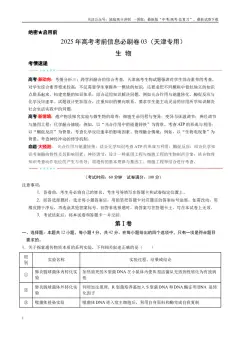
2026 年高考二轮信息必刷卷(天津卷)03
英  语
考情速递
高考·新动向:天津高考英语卷在保持整体稳定的基础上呈现新趋势。各题型延续原有风格的同时,阅读部
分通过提升词汇判定与语句分析难度,加强对学生语言综合能力及词汇积累的考查。试题选材立足学生日
常生活,融入社会热点话题,既检测语言运用能力,又引导关注现实问题。这种"稳中求变"的命题特点,
突显出对语言实用性、思维深度及时代性的综合考量,彰显了试卷与时俱进的教育导向。
高考·新情境:天津高考英语卷选材突出语言地道性与思想教育性,近年更强调素材的思想深度与广度。试
题多选用英语国家原版素材并适度改编,内容涵盖文化、科技、社会等多元领域,展现英语文化多样性。
考生通过研读此类篇章,既能提升语言应用能力,又可拓展国际视野,理解中外文化差异。这种选材模式
既彰显对语言实用价值的重视,又通过创设文化新情境,体现命题引导学生关注思想内涵与跨文化认知的
双重导向,强化了试卷的时代性与育人功能。
命题·大预测:基于本卷题目结构与内容,并结合近年高考英语真题命题趋势作出如下预测。
1. 语境化与实用性进一步加强:单项填空题目(如第10 题“D.Thanks a million”)强调在具体语境中选
择最佳答案,而非单纯依赖语法规则。2026 高考英语将继续强化语境化命题,要求考生通过上下文理解语
言的实际应用,例如日常对话、社会情境中的词汇和语法选择。
2. 跨学科融合与创新情境:阅读理解选材涵盖文化(A 篇哥斯达黎加的三类志愿项目)、自然(B 篇人类
与动物之间的界限)、科技(写作“航天科技主题展”)、社会问题(阅读表达自动驾驶汽车事故),体
现多领域知识融合。2026 高考英语阅读材料将更多涉及科技、环境、文化等跨学科话题,要求考生具备信
息整合能力和跨学科思维。
4. 写作题型多样化,强调社会热点与创新:书面表达要求围绕“中国传统文化节”撰写邀请信,结合传统
文化与社会实际,强调创新性与问题解决能力。2026 高考英语写作可能涉及环保、文化传承、科技伦理等
热点,需考生提出具体建议并体现社会责任感。
(考试时间:100 分钟  试卷满分:130 分)
注意事项:
1.本试卷分第Ⅰ卷(选择题)和第Ⅱ卷(非选择题)两部分。答卷前,考生务必将自己的姓名、准
考证号填写在答题卡上。
2.回答第Ⅰ卷时,选出每小题答案后,用2B 铅笔把答题卡上对应题目的答案标号涂黑。如需改动,
用橡皮擦干净后,再选涂其他答案标号。写在本试卷上无效。
3.回答第Ⅱ卷时,将答案写在答题卡上。写在本试卷上无效。
4.考试结束后,将本试卷和答题卡一并交回。
第一部分:英语知识运用(共两节,满分45 分)
第一节:单项填空(共15 小题;每小题1 分,满分15 分)
从A、B、C、D 四个选项中,选出可以填入空白处的最佳选项。
1.— The campus library now offers easy online access to all academic journals.
— ______! This will save me so much time for my research.
A.Good to know
B.I wouldn’t say that C.Don’t mention it
D.You are telling me
2.The well-known historian ______ a groundbreaking theory that re-examined the economic causes of the
Renaissance.
A.reflected
B.delayed
C.proposed
D.simplified
3.Elon Musk’s company Neuralink, ______ specializes in brain-computer interfaces, recently implanted its first
chip (芯片) in a human volunteer.
A.who
B.which
C.where
D.whose
4.The experience in Austria gave the young musician a unique ______ into how nature inspired music
composition.
A.privilege
B.origin
C.insight
D.fascination
5.
______ the global push to reduce carbon emission, many countries are investing heavily in wind and
solar energy.
A.In spite of
B.On behalf of
C.By means of
D.In line with
6.The documentary achieved widespread popularity on social media, ______ the destructive effects of plastic
pollution in a visually striking way.
A.to highlight
B.highlighting
C.highlighted
D.being highlighted
7.
—The AI assistant provides a(n) ______ solution for language learning, as it adapts to each user’s
pace and offers real-time feedback.
—That’s why it’s so popular among students.
A.effective
B.random
C.fashionable
D.economical
8.______ the weather forecast predicts heavy rain this weekend, we’ll have to postpone the camping trip.
A.Even if
B.Since
C.In case
D.If only
9.The new translation app is ______ accurate, achieving 98% correctness in complex literary texts.
A.originally
B.completely
C.remarkably
D.occasionally
10.— I heard your company won the national innovation award. Congratulations!
— ______. Our team put in years of effort to make it happen.
A.That’s all right B.It’s my pleasure
C.You’re kidding
D.Thanks a million
11.Scientists are still uncertain ______ the mysterious radio signals are evidence of civilizations from outer space.
A.whether
B.why
C.how
D.that
12.Over the past decade, the number of electric vehicles on the road ______ by nearly 800%.
A.increased
B.has increased
C.was increasing
D.had increased
13.
—My smartwatch says my heart rate is abnormally high today.
—You ______ ignore it. Go see a doctor immediately!
A.mustn’t
B.wouldn’t
C.needn’t
D.might not
14.To reduce e-waste, some companies ______ programs encouraging customers to recycle old devices.
A.gave away
B.turned over
C.put forward
D.set up
15.
—Will you take over when we exit the highway? I feel a little tired.
— Certainly. You ______ for about three hours by that time.
A.have driven
B.have been driving
C.will have been driving
D.will be driving
第二节:完形填空(共20 小题;每小题1.5 分,满分30 分)
阅读下面短文,掌握其大意,然后从16-35 各题所给的A、B、C、D 四个选项中,选出最佳选项。
I was tired and hungry after a long day of work.
 When I walked into the living-room, my 12-year-old son looked    16    at me and said, “I love you.” I
didn’t know what to say.    17    several seconds all I could do was to stand there and    18    down at him.
My first thought was that he must need   19    with his homework or he was trying to    20    me for some
news.
 Finally I asked, “What was that all about?”
“Nothing ,” he said. “My teacher said we should    21    our parents that we love them and see what they
say. It’s a(n)    22   .”
 The next day I called his teacher to find out more about this“experiment” and how the other parents had
23   .
“Most of the fathers had the    24    reacting ( 反应) as you did ,” the teacher said. “When I first
suggested we try this, I asked the children     25     they thought their parents would say. Some of them
thought their parents would have heart trouble. The     26     is, the teacher explained, feeling loved is an
important part of     27    It is something all people     28    . What I'm trying to tell the children is that it’s
too     29     that we don’t all express those feeling. A boy should be     30     to tell his dad he loves
him.”
 The teacher, a middle-aged man, understands how     31     it is for some of us to say the things that
would be good for us to say.
 When my son came to me that evening, I held on to him for a(n)     32     second. And just     33
he pulled away, I said in my deepest, most manly voice, “Hey, my boy,I love you, too.”
I don’t know if saying that made either of us healthier, but it did feel pretty good. Maybe next time one of my
children said“I love you”, it would not take me a whole     34     to think of the right     35     .
16.A.down
B.away
C.out
D.up
17.A.Before
B.For
C.At
D.On
18.A.sit
B.get
C.look
D.knock
19.A.rest
B.time
C.help
D.paper
20.A.help
B.prepare
C.answer
D.excuse
21.A.answer
B.tell
C.ask
D.make
22.A.matter
B.experiment
C.word
D.sentence
23.A.helped
B.asked
C.reacted
D.explained
24.A.same
B.different
C.strange
D.hard
25.A.what
B.where
C.when
D.why
26.A.point
B.puzzle
C.way
D.cause
27.A.body
B.health
C.research
D.study
28.A.leave
B.know
C.take
D.need
29.A.new
B.good
C.bad
D.early
30.A.healthy
B.rude
C.worth
D.able
31.A.easy
B.much
C.often
D.difficult
32.A.little
B.better
C.exact
D.extra
33.A.before
B.after
C.because
D.if
34.A.day
B.year
C.month
D.week
35.A.question
B.key
C.answer
D.experiment
第二部分:阅读理解(共20 小题;每小题2.5 分,满分50 分)
阅读下列短文,从每题所给的A、B、C、D 四个选项中,选出最佳选项。
A
Costa Rica is a Central American country. It’s a great country to travel around and explore! Call our Costa Rica
Project Consultant ( 顾问), Karen Herring, for free advice on which volunteer project would be best for you.
+44(0)1903502595
Conservation, Care and Release in Esparza
Work with a project launched by a zoological park and non-profit organization. You’ll be able to help with various
kinds of work to protect these wonderful animals.
Care for Children in Kindergartens and Care Centers in Heredia
Teach and take care of children in kindergartens and care centers. You’ll care for children ranging from 2 to 5 years
old. The activities are mainly based on basic English lessons and playing educational games. Apart from general
caring, you can also be involved in teaching them the alphabet, colors, names of animals, etc.
Teach English and Other Subjects to Children in Schools
Teach in a few schools around Heredia and Alajuela close to the capital of San Jose or at a beach town along the
Pacific Coast. You can help with English, Drama, Sport, Maths or Music, particularly if you have an interest in one
of these areas. You’ll act as an assistant to the regular English teacher.
Your bucket list for Costa Rica:
* Zip line (飞索) over the Cloud Forest
* See the Stone Spheres
* Hike to Arenal Volcano or Poas Volcano on a clear day
* Eat delicious Costa Rica desserts
* Walk through the streets of San Jose
* Book a Coffee Tour
* Visit the National Theatre and Gold Museum in San Jose
* Explore as many National Parks as possible
* Travel to Cocos Island, a World Heritage (遗产) Site
* Celebrate the Pura Vida Life
36.How can you get in touch with Karen Herring?
A.By phone.
B.By e-mail.
C.By sending messages.
D.By visiting her office.
37.If you like animals, you can take part in the project in __________.
A.Heredia
B.Alajuela
C.Esparza
D.San Jose
38.Volunteers who want to work in care centers in Heredia have to _________.
A.be good at English
B.get along well with teenagers
C.help care for animals
D.know skills in sports
39.What can you enjoy when you volunteer in Costa Rica?
A.A sailing trip.
B.Visiting the National Theatre in Heredia.
C.Zip line over Poas Volcano.
D.Delicious local food.
40.This text is written for the purpose of _________.
A.telling us what to do to help the children in Costa Rica
B.attracting more visitors to Costa Rica
C.showing us different places in Costa Rica
D.introducing some projects in Costa Rica
B
In my first year living in Los Angeles, I worked as a birthday-party clown. which made me struggle with my
identity. I saw myself as a filmmaker, but everyone else only saw me as a clown. This job itself involved hiding my
true self; I wore makeup and sometimes even masks to cover my face.
For some parties, I had to dress as specific characters. The company would drop off costumes in a trash bag
at a CVS parking lot, which felt like a bad drug deal. Instead of getting drugs, I received a smelly costume that had
been worn by many failed actors. I would be told to dress as “Mickey Mouse” or “Sponge Bob Square Pants,” but
since those are trademarked characters, I had to go as “Ricky Mouse” or “Sponge Guy Short Pants.”
One night, I was given a costume to be Batman. At the time, I wore a big mustache, which I thought would
be a problem for parents. I decided not to shave because I didn’t want to admit I was more of a clown than an artist.
The next day, I parked far from the party site, so the kids wouldn’t see Batman arriving in my PT Cruiser. As I
walked towards the party, I worried that my lack of surprise would ruin the experience.
As I got closer, I regretted not shaving. When the kids finally saw my face, they burst into laughter, and I felt
embarrassed. However, their laughter soon turned into cheers and applause, which surprised me. I started to feel
warm and supported, something new for me. Inspired, I decided to make an entrance and began running towards
the party, which made the kids cheer even louder. In that moment, I truly felt like Batman.
When I arrived, the birthday boy’s dad laughed and said, “I told you, son. Batman has a mustache.” I was
confused until I saw the birthday cake, which featured a Batman with a thick black mustache just like mine. The
kids had initially laughed at the cake, insisting that Batman didn’t have a mustache, but the dad insisted he just
shaves it for movies. My mustache accidentally helped convince the kids that I was the real Batman.
That day, I realized I might not have been the hero they expected, but I was the hero they needed. I struggled
with my identity as a filmmaker or a clown, but at that moment, I knew I was making a difference in those kids’
lives.
41.Why did the author struggle with his identity while working as a clown?
A.The author was embarrassed by his clown costume.
B.The author felt defined by others’ perceptions.
C.The author struggled with the job’s physical demands.
D.The author had difficulty balancing two different roles.
42.How did the author feel about wearing the costume provided by the company?
A.Disappointed and angry.
B.Annoyed and frightened.
C.Curious and amused.
D.Embarrassed and disgusted.
43.Why didn’t the author shave his mustache before the party?
A.To maintain a sense of artistic dignity.
B.To keep his clown identity covered.
C.To preserve the surprise for children.
D.To achieve recognition as a clown.
44.What can be learned from paragraph 4 and 5?
A.Mistakes can lead to surprising negative outcomes.
B.Being yourself can lead to expected acceptance.
C.Laughter can transform into genuine support.
D.New identity can be beneficial in amazing ways.
45.What does the author mean by saying he was “the hero they needed” in the last paragraph?
A.He met their specific character demands. B.He fulfilled their expectations in a unique way.
C.He provided a unique experience for them.
D.He taught them to accept imperfections.
C
Ask most scientists if we’re animals and you’ll get a funny look. Of course, we’re humans! But
very commonly, humans are set apart from animals using random division. In 2018,a pair of long-tailed
macaques(猕猴)were cloned to be used in biomedical research. A few years earlier, the United Nations stated that
cloning people goes against human dignity. That may be a good ruling. But what exactly is dignity, and why do
humans have it while intelligent, aware primates(灵长目动物)such as macaques do not? A macaque may not think
or talk about dignity, but does that mean it doesn’t possess it? The fact is, biology won’t leap to our assistance here
because dignity is a human invention.
“Dignity” originates in Enlightenment dualist( 二元论者)ideas separating cognition from physicality and
instinct, and later a new binary emerged: the human mind and our physical bodies. In this worldview, the impulses
and feelings of animal bodies(including our own)are viewed as less important than our mental experiences.
Many of our laws and guidelines today create hard borders between humans and other animals on the basis
of our supposedly superior mental properties. To maintain a strict boundary between our experiences and those of
all other animals, we find ourselves prioritizing what we consider mind-based phenomena when making policies.
So we demote(使降级)experiences of fear and promote the idea that knowing fear—recognizing it, naming it—is
what matters morally. We brush under the carpet the fact that these cognitive capacities, if present at all, change
throughout our lives without altering our moral status. For example, babies experience fear but can’t
conceptualize(概念化)it. This doesn’t alter our belief in their moral subjecthood(主体地位).
I look at the history of science and psychology research to understand how our discomfort with some aspects
of being animals from moral confusion to mortality—can spur us to tell ourselves that we’re not really animals. I
conclude that it’s time for a much-needed change in belief that no longer splits the world into unhelpful and
unscientific binaries(二进制). The overwhelming bulk(主体)of scientific data from the past few decades points to
how essential our animal, physical life is to our actions, feeling and thoughts. A research into child development has
shown that significant, measurable advantages in acquiring language and mathematics follow the use of physical
movement and gesture.
We urgently need to get a handle on what it means to be an animal and move beyond old-fashioned
dualism.It’s not just that we’ re animals: embodied( 亲身体验的), physical experiences are richer and more
meaningful than we’ve recognized. If that means we need to rethink our relationship to other animals, so be it.
46.What can we know about “dignity” in the passage?
A.It is a term which separates humans from animals.
B.It is a cognitive standard shared by all primates.
C.It is an" idea combining human body and mind.
D.It is an emotional feature of human being.
47.Why does the author mention the example of babies in Para.3?
A.To prove cognitive ability is needed for moral subjecthood.
B.To show the change of cognitive ability in moral development.
C.To highlight the importance of cognitive ability in policy making.
D.To stress the existence of moral status regardless of level of cognition.
48.What does the author highlight as key to human life in the last two paragraphs?
A.Cognitive development.
B.Physical experiences.
C.Dualistic thinking.
D.Action, feeling and thoughts.
49.What is the writer trying to propose?
A.A shift away from dualistic thinking.
B.A new method for scientific research.
C.Less emphasis on physical experiences.
D.More attention to cognitive development.
50.What does the author suggest about human-animal relationships?
A.Maintain current boundaries
B.Rethink and redefine them
C.Focus only on human dignity
D.Ignore scientific evidence
D
No one can accuse Howard Schultz of inaction since he returned as chief executive of Starbucks,
the firm he built into a multinational only to watch it stumble under his successor. Barely a month has gone by over
the past year without the firm announcing some new initiative or other. The latest came on February 17th in New
York, when Mr Schultz unveiled Via, an instant coffee which, he claims, tastes just as good as Java brewed in the
shop by one of the firm’s baristas (咖啡师).
Mr Schultz hopes to win a share of the $17 billion or so the world spends on instant coffee — a product
which, he sniffs, has not improved in decades. Starbucks itself has spent 20 years pursuing the holy grail of an
instant coffee that tastes as good as the fresh stuff. Don Valencia, the firm’s first head of research and development,
who created the blended and frozen frappuccino drinks that earn Starbucks $2 billion a year, could never find a way
to nail down an instant formula he had developed at home. When Mr Schultz returned as chief executive, he
noticed that there had been some technological advances, allowing finer grinding, for example. So he tasked the
R&D team to repeat the recently deceased (亡故的)Valencia’s experiments, and found that “we had broken the
code”. The name Via is a hat-tip to Valencia—though during development it was known as Java (just stir).
Starbucks says it has patents that should fast deter competitors from quickly replicating Via, which will go
on sale in some American stores next month. The opportunity may, however, be biggest in other countries: in
Britain over 80% of coffee sold is instant, compared with just 10% in America.
Assuming Starbucks drinkers decide that Via tastes good, the company will have to get the price right. At
first, it will come in packets of 12 or 3 individual servings, for $3 and 98 cents respectively. That is much more than
other instant coffee, but much less than a cup of coffee at one of Starbucks’ stores. The risk is that that would
encourage customers to visit Starbucks less often and start making their own cup of instant. That the firm’s existing
customers may abandon counter service, a trend is already gathering pace with the recession. For the first time in
Starbucks’ history, same-store sales have fallen.
Mr Schultz has had to accelerate the store-closure programme that he had started in order to correct the over-
expansion which prompted his return to the helm. To keep customers coming to remaining outlets, he wants to
experiment with discounts such as “cheap” combination meals of a drink and food. He also wants a visit to
Starbucks shops to be a uniquely uplifting experience. Improving the smell in stores by changing the cheese used in
breakfast sandwiches was a start. But ensuring that staff are enthusiastic will be especially difficult when jobs are
disappearing. Mr Schultz remains hostile to unions but has decided to maintain the firm’s popular health benefits,
while cutting his own pay.
Will it all be enough? So far, investors seem sceptical: Starbucks’ share price remains barely a quarter of its
all-time high in 2006.
51.The reason why the author maintains that Howard Schultz should not be blamed of inaction is most probably
because ________.
A.he would not allow his successor to destroy Starbucks.
B.Starbucks spent the entire last year developing the new instant coffee.
C.the new instant coffee is of the same quality as that brewed in the shop.
D.he launched the new instant coffee after his return.
52.The word “hat-tip” (Line 8, Paragraph 2) most probably means ________.
A.reward.
B.achievement.
C.surprise.
D.tribute.
53.The risk of launching the instant coffee Via is that ________.
A.it can be quickly imitated by market competitors.
B.customers may visit Starbucks store less often.
C.it may fail to cater to customers’ taste.
D.the high price will prohibit people from mass purchase.
54.From the text, which of the following was a common practice in Starbucks before?
A.Starbucks hired baristas to guarantee the quality of the coffee brewed.
B.Starbucks was a major player in the market of instant coffee.
C.Starbucks provided “combination meals” with fair discounts.
D.In Starbucks, employees had a high pressure of losing jobs.
55.The author’s attitude towards Schultz’s new measures seems to be ________.
A.biased.
B.critical.
C.objective.
D.pessimistic.
第二部分:写作(共两节,满分35 分)
第一节:阅读表达(共5 小题;每小题2 分,满分10 分)
阅读下面短文,并根据短文内容完成下列各题。
Last summer, my tech-fan cousin Alex bought an advanced self-driving car.
One misty evening, as we drove on a narrow and winding cliff-side road, Alex, full of confidence, turned on
the self-driving mode. At that time, I was nervous, holding the armrest tightly, while Alex casually scrolled (滚屏)
through social media, completely ignoring the increasingly dangerous road conditions. Suddenly, a strong deer
appeared in the headlights. At that critical moment, the car’s sensors, which had been failing unnoticed, went
wrong. Instead of braking, the car sped towards the deer. Alex, realizing the danger at the last second, tried to reach
for the steering wheel, but it was too late. The car crashed into the deer, and we were shaken hard. Surprisingly, the
deer ran into the woods, unhurt. We sat in the damaged car, shocked.
This accident made me reflect on technology’s issues. In healthcare, AI robots, sometimes, for speed,
misread symptoms, causing incorrect diagnoses. In education, speed-focused AI graders may score essays by
keywords, missing emotional depth in student stories — like a child writing of sadness, whose words become data,
not cries for sympathy. In other words, AI prioritizes speed over correct diagnosis or students’ emotional
expressions. Philosopher Sherry Turkle’s words make sense — “We’re sacrificing exactness and sympathy for
efficiency.”
But this doesn’t mean we should reject technology. We should use it carefully and wisely. Just like a compass
helps a sailor but doesn’t replace his skills, technology should help our judgment, not take over. Doctors could use
AI technology as an extra opinion, and compare it with their own knowledge. Teachers can use AI technology to
analyze student data and adjust lessons with their own insights, and not to let algorithms (算法) control teaching.
That night, standing by the broken car, I realized that technology, for all its power, depends on us. Over-
reliance on it weakens our ability to adapt and think. In the end, we, not machines, should shape the future.
56.How did the author and Alex feel during the drive before the accident? (no more than 10 words)

57.What contributed to the accident of the self-driving car according to the Paragraph 2? (no more than 10 words)

58.What is the meaning of the underlined part in Paragraph 3? (no more than 10 words)

59.What is the main idea of Paragraph 4? (no more than 10 words)

60.Do you consider AI technology as a tool to make important decisions in our lives? Please explain in your own
words. (no more than 25 words)

第二节:书面表达(满分25 分)
61.
假设你是晨光中学的李津,你校近期举办了“航天科技主题展”(Aerospace Technology
Exhibition),通过图片和视频等多种方式,展示了中国航天事业的飞速发展和伟大成就。请你以
“Reaching for the Stars”为题,为学校公众号英文栏目写一篇活动报道。
内容提示:
(1)主题展的主要内容(天宫空间站建设、月球探测成果、航天工作者贡献等);
(2)师生们对展览活动的反响;
(3)你参观展览后的感受。
注意:(1)词数不少于100;(2)可适当增加细节,使行文连贯。
参考词汇:月球探测 lunar exploration;自主创新 independent innovation
____________________________________________________________________________________________
____________________________________________________________________________________________
____________________________________________________________________________________________
____________________________________________________________________________________________
_______________________________________________________________________________________