绝密★启用前
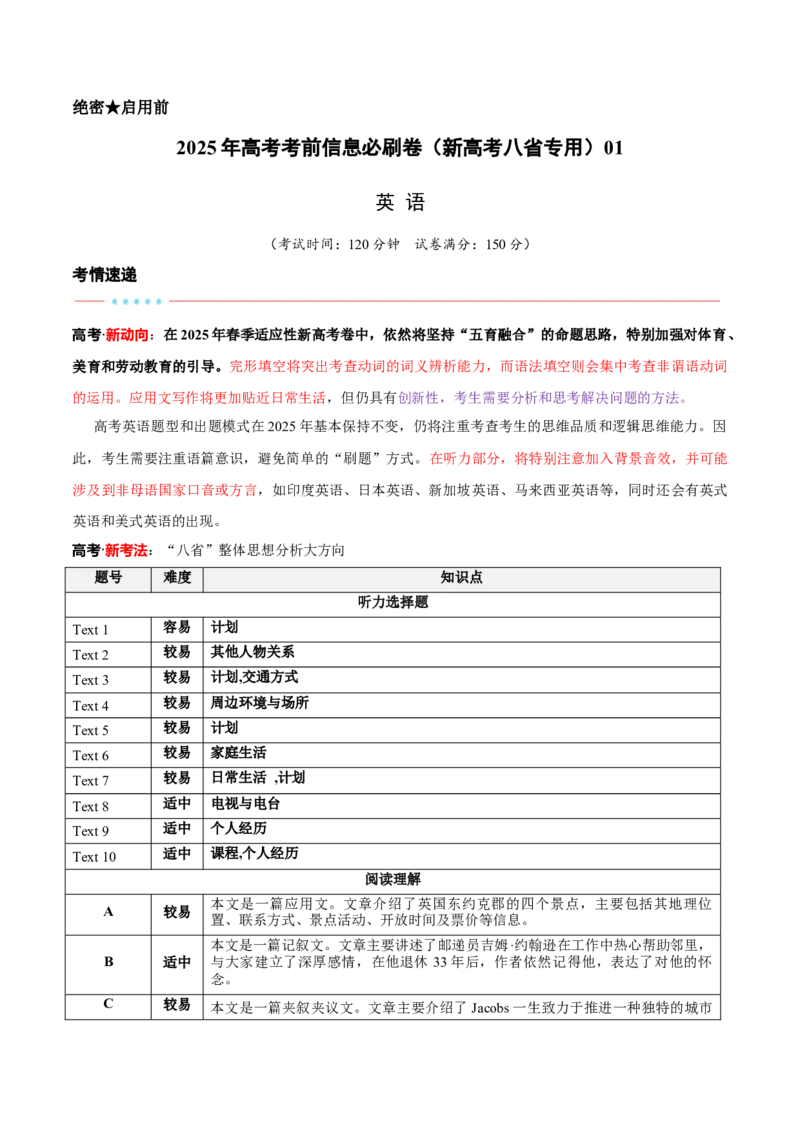
2025 年高考考前信息必刷卷 01(广东专用)
英 语
(考试时间:120分钟 试卷满分:150分)
考情速递
命题·大预测
高考·新动向:2025年高考英语将更注重核心素养,强调语言的实际运用能力,减少机械记忆,增加
对文化意识和思维品质的考查,体现“立德树人”的教育理念。
高考·新考法:2025年高考英语试题将更加灵活多样,可能增加开放性题目,如写作中的观点表达、
阅读中的批判性思维题,语言运用部分可能融入更多真实语境,考查学生的综合语言能力。
此信息卷聚焦核心素养与语言实际运用。阅读文章涵盖社会热点、文化多样性与个人成长等主题,考
查文化意识与批判性思维;写作要求介绍中国传统美食节,既考语言表达,又引导文化传承,落实 “立
德树人”。语言运用在真实语境中考查综合能力,减少机械记忆。题型设计灵活,契合新考法趋势。阅读
不仅考文本理解,还设批判性思维题测逻辑能力;写作让学生写宣传稿,开放性强,考观点表达与组织能
力。阅读材料基于真实语境,更重综合语言能力,而非单一知识点。
第二部分 阅读(共两节, 满分50分)
第一节(共15小题;每小题2.5分, 满分37.5分)
阅读下列短文, 从每题所给的A、B、C和D四个选项中选出最佳选项。
A
In the highly competitive college admissions landscape, extracurriculars are often the key differentiators (区
分因素). Academic competitions not only highlight your intellectual abilities but also help demonstrate teamwork
and problem-solving skills.
The Slingshot Challenge
The Slingshot Challenge is an initiative by the National Geographic Society that encourages young people
aged 13 to 18 to come up with innovative solutions to environmental issues. Participants can submit a one-minute
video outlining their ideas for a chance to win up to $10,000 in funding to implement their projects.
Chemical Educational Foundation’s The ChallengeAlthough it’s only open to middle school students in grades 5-8, the Chemical Education Foundation’s The
Challenge is an opportunity for budding scientists to explore their interests in STEM fields! Teams of 3-
4participants compete in exciting, time-based rounds of questions and responses. Additionally, teams get to create
original videos to “launch a start-up company” around community-based sustainability solutions.
John Locke Institute Competition
The John Locke Institute is a unique essay competition for high schoolers. The top prize is one of the most
exciting writing awards for high schoolers in the country. Participants can select one of three topics to address in a
2,000-word essay. The topics change from year to year but always relate to philosophy, politics, history, law,
theology, economics, or psychology.
National Young Composers Challenge
The National Young Composers Challenge is a wonderful competition for instrumental composers between
13 and 18 years old in the United States. Participants are asked to submit one original composition, either for
orchestra or for a small (2-6 instruments) ensemble. The compositions. must be under five minutes. The top three
composers in each category receive cash prizes, as well as professional performances and recordings of their
works!
1.Which requires participants to submit articles?
A.The Slingshot Challenge B.Chemical Educational Foundation’s The Challenge
C.John Locke Institute Competition D.National Young Composers Challenge
2.What do The Slingshot Challenge and National Young Composers Challenge have in common?
A.Participants are required to submit videos.
B.Participants focus on environmental problems.
C.Winners will obtain professional suggestions.
D.Winners will be financially rewarded.
3.What is the author’s purpose in writing the text?
A.To show the process of college admission.
B.To recommend contests for students.
C.To stress the importance of extracurriculars.
D.To demonstrate skills required for competitions.
B
Born into a farmer’s family in Dalian, northeast China’s Liaoning Province, Dong Lina suffered from
congenital (先天的) eye disease and went blind at the age of 10.Like many visually-impaired children, she finished compulsory education at a school for disabled people and
began learning Tuina. In 2003, she finally obtained a job. Her life then was like a fixed route, but Dong was
unwilling to take it for granted. “Teachers always told me not to give up learning new knowledge because it could
give me more options in life,” she said.
One day she found an anchor (节目主持人) training program for visually-impaired youth. Dong realized that
this might be her big moment, and she made a life-changing phone call.
After the training at the organization, Dong was recommended to a workshop at a radio station where she
was the only visually-impaired person in the class. Her physical disability forced her to make an extra effort in her
spare time. “My pronunciation was often not accurate, yet I could not correct it by looking into the mirror, and the
teacher figured out a way that I touched his mouth to follow the way he pronounced,” said Dong.
Despite all the difficulties, Dong achieved the top level in the Mandarin proficiency test. In 2015, she
became the host of a radio program and in 2020, she returned to the Communication University of China to pursue
a master’s degree in broadcast and television.
“Life may not be perfect, but we can make up for it with our own hard work and the support of society,” said
Dong.
4.Why did Dong learn Tuina?
A.To have a fixed route. B.To make a living.
C.To become an anchor. D.To pursue a degree.
5.How did Dong improve her pronunciation?
A.By following the way directly. B.By touching her own mouth.
C.By feeling the teacher’s mouth. D.By looking into the mirror.
6.What may mainly contribute to Dong’s success?
A.Her long-lasting effort. B.Her physical disability.
C.The compulsory education. D.The social donation.
7.Which of the following can best describe Dong?
A.Determined and honest. B.Faithful and creative.
C.Committed and optimistic. D.Gifted and courageous.
C
One of my bad habits is saying “busy” when people ask me how I’m doing. Sometimes it’s because I
actually am busy, but other times it’s because that’s what I think I’m supposed to say. That’s what important people
say. That’s what people who get promoted say. But working long hours doesn’t drive better results. Never taking avacation won’t lead to a promotion. So why are we so proud to talk about how busy we are all the time?
In 2016, researchers from Columbia, Harvard, and Georgetown conducted a study to figure it out. They
found busy people are perceived to be of high status, and interestingly, these status attributions are heavily
influenced by our own beliefs about social mobility. In other words, the more we believe that one has the
opportunity for success based on hard work, the more we tend to think that people who skip leisure and work all the
time are of higher standing.
That’s why we feel like we have to appear busy, and there’s a real perception that if someone is knee-deep in
meetings, emails and stress, then they’re probably a big deal. This culture of busyness is making it hard for
employees to find work-life balance. According to a recent study, one in five highly engaged employees are at risk
of burnout.
Personally, I’m going to stop saying “busy” when people ask me how I am. It sounds self-righteous (自以为
是的) and sets the wrong tone. Phrases like “I have limited access to email” and “I’ll respond as soon as I get back”
sound like you’re being held against your will from working as opposed to making the most of your time off.
That’s why we recently launched the Out of Office Email Generator, a free tool you can use before your next
long weekend or trip. You can share loud and proud that you won’t be checking email until you’re back. Managers
need to think twice about emailing their teams on the weekend and talking about how busy they are. Leaders should
take time off themselves and encourage employees to do the same.
8.Why do people tend to say they are busy?
A.Busyness ensures accomplishments.
B.Busyness is a symbol of social status.
C.Opportunities for success never come easily.
D.Busy employees are favored by their superiors.
9.What will the author reply when asked how he is on weekends?
A.I’m enjoying every bit of my vacation. B.I have limited access to email.
C.I’m knee-deep in meetings and emails. D.I’m buried in a pile of work.
10.Why was the Out of Office Email Generator launched?
A.To remind employees to answer emails immediately.
B.To ensure employees make the best of their time off.
C.To inspire leaders to set an example by taking time off.
D.To encourage managers to feel free to email their teams.
11.What message does the author want to convey?A.Live life to the fullest. B.Promote the culture of busyness.
C.Make work-life balance a priority. D.Work harder to achieve higher status.
D
Negative news stories about social media platforms appear to be highly effective at pressuring companies
into changing their policies. Katzenbach at the University of Bremen analyzed policy changes across Facebook,
Twitter (now X) and YouTube between 2006 and 2024, as well as how media reporting from 26major English-
language publications affected their policies. “There are significantly more changes in the policies by the platforms
in the weeks and months after an increase of negative reporting,” says Katzenbach. For every negative story about a
platform, the possibility of that platform changing its user policies increased by 6 per cent.
To measure negative reporting, the researchers looked at the content of news stories using an AI model that
classifies emotions. The AI had been trained on a dataset of 11,000 news stories about US politics.
Facebook was the subject of the most negative reporting, with around 37 per cent of news stories from the 26
major English-language publications being seen as negative. Around 26 per cent of reporting about YouTube and
Twitter was considered negative. The percentage of negative reporting about all platforms significantly increased
after 2018, when accusing of the misuse of Facebook user data by the consulting firm Cambridge Analytica came to
light.
“We’ve seen that platforms do respond to public criticism,” says Katzenbach. For example, in 2014, a
campaign called Free the Nipple pressured Facebook into allowing users to post photos of breastfeeding. However,
those rules, and how they are enforced (强制实行), remain a topic of debate. Meta’s oversight board (监督委员
会)told the platform to explain its policies in January 2024 following confusion over what did and didn’t break
policy.
Carolina at Northumbria University says a more active approach is needed to regulate social media
platforms, including laws that check how policies affect users. “We’ re taking for granted that platforms are always
going to run the system as they are — while we need to hold them far more responsible than that,”Katzenbach
agrees with this view. “Definitely you need regulation, and strong regulation,” he says. “Media reporting cannot
replace that.”
12.What’s the main focus of Katzenbach’s analysis of social media platforms?
A.User behavior patterns on social media. B.Policy changes and media influence.
C.Technological advancements of platforms. D.Advertising strategies on social media.
13.What caused a sharp increase in negative reporting after 2018?
A.A new AI measurement system. B.The exposure of a data issue.C.The increased public criticism. D.The growth of social media users.
14.How does the author explain the platforms’ response to public criticism?
A.By quoting official statements. B.By presenting statistical data.
C.By conducting a public survey. D.By giving a specific example.
15.What can be the best title of the text?
A.Social Media: Policy Shifts in the Media Focus
B.Social Media: Advertising Trends and Their Impacts
C.Social Media: User Reactions and Platform Responses
D.Social Media: Technological Innovations and Challenges
第二节(共5小题;每小题2. 5分, 满分12. 5分)
阅读下面短文, 从短文后的选项中选出可以填入空白处的最佳选项。选项中有两项为多余选项。
Are all the emails and social media notifications making you anxious or getting you down? Is having to learn
yet another new piece of software stressing you out? Are the boundaries between family life and work life unclear
because of technology? 16 The term is used to describe the negative psychological effect that using new
technologies can have.
Though many people may not be familiar with technostress, they probably are familiar with the feelings of
having too much technology in their lives. Technostress can be broken down into a few subcategories including
techno-overload, techno-complexity and techno-invasion. 17
Technostress may make people feel down or burned-out and even suffer from depression. Some may feel
tension in the body, which can lead to headaches and back pain. 18 That is why dealing with technostress is
vital to overall health.
19 Acknowledge that it’s a sign of strength and courage to recognize a mental health challenge and
take steps to manage it. Experts encourage people struggling with technostress to take steps in the workplace to get
involved in how technology may be used.
Taking time each day to get outside is also a great way. By all accounts, there’s almost nothing that aids in
stress management so much as a few hours spent in the park, the woods or the mountains. 20 Hours spent
on the computer may be perceived as stressful but the stressors can be seen as more bearable if on this day one can
look forward to a walk in nature. Just go outside and nature never disappoints.
A.All of them can have significant effects on health.
B.It’s not a medical problem but can lead to diseases.
C.Such time is one ready resource available to most people.D.In the connected world, most people continuously multitask.
E.You may be experiencing a phenomenon known as technostress.
F.Engaging in activities that are grounding and centering is helpful.
G.The first thing to do is to accept that it’s normal to have stress from technology.
第三部分 语言运用(共两节,满分30分)
第一节(共15小题,每小题1分,满分15分)
阅读下面短文, 从每题所给的A、B、C和D四个选项中选出可以填入空白处的最佳选项。
As I stood in front of the grand university gates on my first day, my heart pounded with a mixture of
excitement and nervousness. The 21 buildings and busy crowd of students made me feel both insignificant
and part of something significant.
My dormitory room was a small but 22 space shared with three other freshmen from different
backgrounds. We quickly 23 over late-night study sessions, shared meals, and stories about our homes and
dreams. It felt like finding a new 24 away from home.
Classes were filled with new information and challenges. Professors spoke 25 about subjects I had
only glanced at in high school. I found myself staying up late, digging into textbooks and articles, desperate to 26
. But among the hard work, there were 27 of clarity and joy when a complex concept finally 28 , or
when I connected with a classmate over a 29 interest.
Weekends were a time for exploration. I 30 through the city’s streets, discovered hidden cafes, and
31 cultural events. Each new experience broadened my horizons and made me appreciate the 32 of
life.
Looking back, my first year at university was a roller coaster of 33 and growth. It was a time of
self-discovery, friendship, and the pursuit of knowledge. And as I 34 my second year, I carry these
memories with me, as a beacon (灯塔) of hope and 35 .
21.A.broken B.tiny C.tall D.distant
22.A.comfortable B.crowded C.empty D.dirty
23.A.lived B.fought C.studied D.bonded
24.A.family B.shelter C.place D.team
25.A.passionately B.casually C.quietly D.unwillingly
26.A.keep down B.keep back C.keep off D.keep up
27.A.periods B.moments C.intervals D.flashes
28.A.appeared B.failed C.clicked D.changed29.A.competed B.argued C.shared D.studied
30.A.raced B.wandered C.drove D.rushed
31.A.forgot B.ignored C.avoided D.attended
32.A.similarity B.diversity C.simplicity D.difficulty
33.A.ideas B.worries C.emotions D.fears
34.A.reflect on B.embark on C.bring about D.take up
35.A.foundation B.promotion C.determination D.inspiration
第二节(共10小题;每小题1.5分 ,满分15分)
阅读下面短文,在空白处填入1个适当的单词或括号内单词的正确形式。
The drum and gong (鼓和锣) have been essential to Chinese culture for thousands of years. In ancient China,
the drum and gong 36 (play) a vital role on the battlefield. It is said that the drum marked 37
beginning of an attack while the gong’s sound signaled its end. The powerful sound of the drum and gong spread
across the battlefield, 38 boosted soldiers’ fighting spirit. Also, they were strongly believed to be a soul
connection with 39 (ancestor). Afterwards, the drum and gong came to represent authority, power and
governance. For example, drums were used to mark 40 (significance) events or official announcements
in government offices and courts.
41 time going by, the drum and gong have taken on new meanings. They have become central to
big festivals, especially the Spring Festival. When 42 (accompany) by lion and dragon dances, the two
instruments have helped create a festival atmosphere, symbolizing unity and good luck and showcasing the richness
of Chinese traditions. Attracted by the drum and gong, many musicians are now 43 (creative) blending
the traditional instruments with modern music.
From ancient battlefields to modern festivals, the drum and gong 44 (carry) their powerful sounds
through the ages. They remain key symbols of strength, joy and unity, 45 (connect) people in
celebrations.
第四部分 写作(共两节, 满分40分)
第一节(满分15分)
46.假定你是李华,你校将举办一场面向留学生的中国传统美食节。请你向学校英文报投稿,介绍并宣传
此次活动,内容包括:
(1)活动内容; (2)活动意义; (3)邀请留学生参与。
注意:1. 写作词数应为80个左右;
2. 请按如下格式在答题卡的相应位置作答。Chinese Traditional Food Festival
____________________________________________________________________________________________
____________________________________________________________________________________________
______________________
第二节(满分25分)
47.阅读下面材料,根据其内容和所给段落开头续写两段,使之构成一篇完整的短文。
Whenever asked why I chose to become a doctor, I would always explain by telling the story of my
adolescence(青春期).
As a fresh graduate of high school, I found it difficult to choose a career path before college. In those days in
Pakistan, there were limited choices: be-coming an engineer, a doctor or a financial worker. I wasn't interested in
engineering, so that I was left with medicine or business. I couldn't decide.
My uncle suggested that I do a work placement (实习) to experience business for a month in an international
company, and then medicine for another month in a hospital. After that, I could make a decision. It seemed like a
good idea.
I began a month's placement at a foreign bank. I got to know the rules of financial world, made new friends,
and generally enjoyed the mostly easy-going work surroundings.
The month passed rapidly, and soon I began working at a leading hospital. The experience couldn't have
been more different. The hospital had a stressful environment. The days started early at 7a. m., compared to 9a. m.
at the bank, and were filled with endless duties and the night calls! This was crazy, working all day, through the
night, and again the next day.
I began thinking about my two experiences. The bank had offered a more relaxing environment, better
working hours and less stress; while the hospital was full of excitement and difficult studying and training. It
seemed that the business choice was going to win out.
Near the end of my month at the hospital, I was driving home after an especially busy night call. In front of
me was a public bus, with college students sitting on the top. As the driver weaved through (穿梭) traffic, I could
see the boys shaking from side to side.
注意:
1.所续写的短文词数应为150左右;
2.续写部分分为两段,每段的开头语已经为你写好。
Suddenly, a boy fell off the back of the bus.
________________________________________________________________________________________________________________________________________________________________________________________
____________________________________________________________________________________________
____________________________________________________________________________________________
The next day, when I went to the hospital to see the boy, all his family got up, with grateful smiles on their
faces.
____________________________________________________________________________________________
____________________________________________________________________________________________
____________________________________________________________________________________________
____________________________________________________________________________________________
____________________________________________________________________________________________