绝密★启用前
2026 年高考二轮信息必刷卷03
英  语
考情速递
高考・新动向
题型严格契合上海高考英语框架,全面考查语言基础、阅读理解、语篇表达等核心能力。
选材聚焦生态保护、文化传承、科学探索等主题,凸显 “立德树人” 与跨学科融合:语
法填空围绕 “环保驾驶” 展开,衔接生态保护与生活实践;阅读 A 篇(公益旅游)探讨
善意与实效的平衡,B 篇(未探索之地)融合地理、生态与探险精神,C 篇(蝙蝠保护)
聚焦环保成效与挑战,D 篇(左撇子运动优势)融入科学研究与运动常识。命题强调语篇
真实性与实用性,侧重在真实情境中考查语言运用与逻辑思维能力。
高考・新情境
命题情境紧扣时代议题与科学探索,覆盖三大主题语境。语法填空以 “环保驾驶与出行选
择” 为情境,提供绿色生活方案,贴合生态保护趋势;阅读 A 篇(公益旅游的反思)聚
焦国际援助的伦理思考,引导理性行善;B 篇(马里亚纳海沟、雅瓦里谷等未探索之地)
融合地理知识与探险精神,激发认知兴趣;C 篇(英国蝙蝠保护)探讨环保政策与发展的
平衡,体现辩证思维;六选四(左撇子运动优势)融入科学研究过程,培养科学素养。情
境设置兼具知识性与思想性,引导学生关联现实、深度思考。
命题・大预测
阅读语篇选材将持续聚焦生态保护、科学探索、文化伦理(如公益旅游、蝙蝠保护、未探
索之地),说明文侧重科学知识与现实问题结合,记叙文注重实践反思与情感体验,应用
文强调信息传递与实用价值。命题将强化深度思维与科学逻辑考查,推理判断题、词义猜
测题需结合科学常识与语篇逻辑(如蝙蝠种群变化原因、左撇子运动优势的科学依据),
信息整合题注重对多维度内容的归纳(如环保政策的成效与挑战),引导辩证思考现实问
题。语用能力考查更灵活务实,六选四聚焦科学研究的逻辑衔接(如左撇子优势的研究过
程),完形填空侧重语境化词义辨析(如共享文档协作中的行为与心理关联),翻译与书
面表达聚焦真实情境(如摄影工作坊选择建议),强调表达的准确性与实用性。
(时间105 分钟,满分115 分)
考生注意:
1. 答题前,考生务必在答题纸上用钢笔或水笔清楚填写姓名、准考证号,并用铅笔正 确
涂写准考证号。
2. 答案必须全部涂写在答题纸上。如用铅笔答题,或写在试卷上也一律不给分。
I. Grammar and Vocabulary   (每题1 分;共20 分)
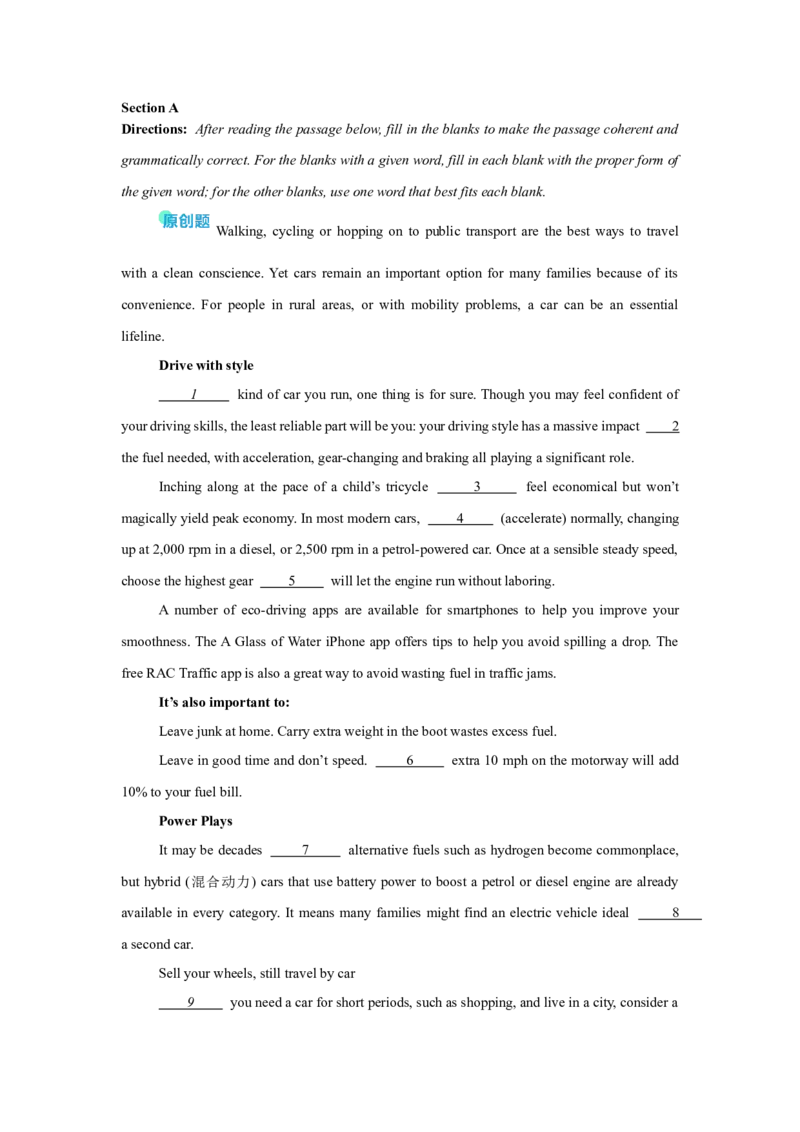
Section A
Directions: After reading the passage below, fill in the blanks to make the passage coherent and
grammatically correct. For the blanks with a given word, fill in each blank with the proper form of
the given word; for the other blanks, use one word that best fits each blank.
Walking, cycling or hopping on to public transport are the best ways to travel
with a clean conscience. Yet cars remain an important option for many families because of its
convenience. For people in rural areas, or with mobility problems, a car can be an essential
lifeline.
Drive with style
    1     kind of car you run, one thing is for sure. Though you may feel confident of
your driving skills, the least reliable part will be you: your driving style has a massive impact     2
the fuel needed, with acceleration, gear-changing and braking all playing a significant role.
Inching along at the pace of a child’s tricycle     3     feel economical but won’t
magically yield peak economy. In most modern cars,     4     (accelerate) normally, changing
up at 2,000 rpm in a diesel, or 2,500 rpm in a petrol-powered car. Once at a sensible steady speed,
choose the highest gear     5     will let the engine run without laboring.
A number of eco-driving apps are available for smartphones to help you improve your
smoothness. The A Glass of Water iPhone app offers tips to help you avoid spilling a drop. The
free RAC Traffic app is also a great way to avoid wasting fuel in traffic jams.
It’s also important to:
Leave junk at home. Carry extra weight in the boot wastes excess fuel.
Leave in good time and don’t speed.     6     extra 10 mph on the motorway will add
10% to your fuel bill.
Power Plays
It may be decades     7     alternative fuels such as hydrogen become commonplace,
but hybrid (混合动力) cars that use battery power to boost a petrol or diesel engine are already
available in every category. It means many families might find an electric vehicle ideal     8

a second car.
Sell your wheels, still travel by car
    9     you need a car for short periods, such as shopping, and live in a city, consider a
short-term car-hire service such as Zipcar     10     _______ owning a car.
Section B
Directions: Fill in each blank with a proper word chosen from the box. Each word can be used
only once. Note that there is one word more than you need.
A.targeted    B.limit    C. subject        D.insightful        E. justify        F. projected
G. chiefly        H. accessible        I. admittedly        J. purchase        K. prized
We live today indebted to McCardell, Cashin, and other women who freed
American fashion from the    11    of Parisian design. These designers established the modern
dress code, letting playsuits and other active outfits suit casual clothing, allowing pants to enter
the wardrobe, and promoting rationalism and utility (实用性) in dress, in contrast to dressing for
an occasion. Fashion in America was logical and    12    only to the will of the women who
wore it. American fashion addressed a democracy, whereas traditional Paris-based fashion was
conventional and imposed on women, willing or not.
In an earlier time,    13   , American fashion had followed the lead of Paris, or even
pirated (窃用) specific French designs. However, designer sportswear was not modeled on that of
Europe; it was genuinely invented and developed in America. The design objective and the
business commitment were    14    at sportswear, and the distinctive traits were problem-
solving ingenuity (独创性) and realistic lifestyle applications. Ease of care was most important:
summer dresses and outfits, in particular, were    15    cotton, readily capable of being washed
and pressed at home. Clothes were simple, practical, and    16   , as the modern woman
depended on no personal maid to dress her. American designers    17    the freedom of women
who wore the clothing.
Many have argued that the women designers of that time    18    their own clothing
values into a new style. Of course, much of this argument in the 1930s-40s was advanced because
there was little or no experience in designing clothes on the basis of utility. But could utility alone
19    the new ideas of the American designers? Fashion is often regarded as a pursuit of beauty,
and some cherished fashion’s relationship to the fine arts. What the designers of the American
sportswear proved was that fashion is a design art, answering to the demanding needs of service.
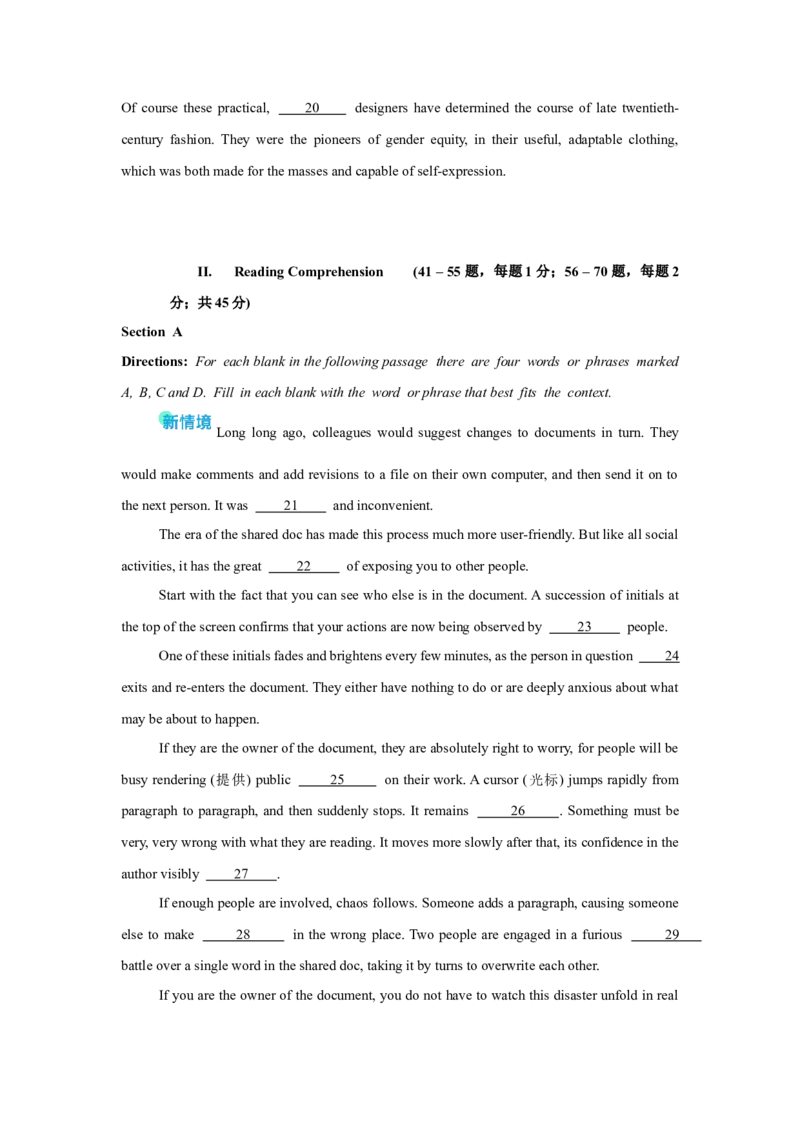
Of course these practical,    20    designers have determined the course of late twentieth-
century fashion. They were the pioneers of gender equity, in their useful, adaptable clothing,
which was both made for the masses and capable of self-expression.
II.
Reading Comprehension    (41 – 55 题,每题1 分;56 – 70 题,每题2
分;共45 分)
Section A
Directions: For each blank in the following passage there are four words or phrases marked
A, B, C and D. Fill in each blank with the word or phrase that best fits the context.
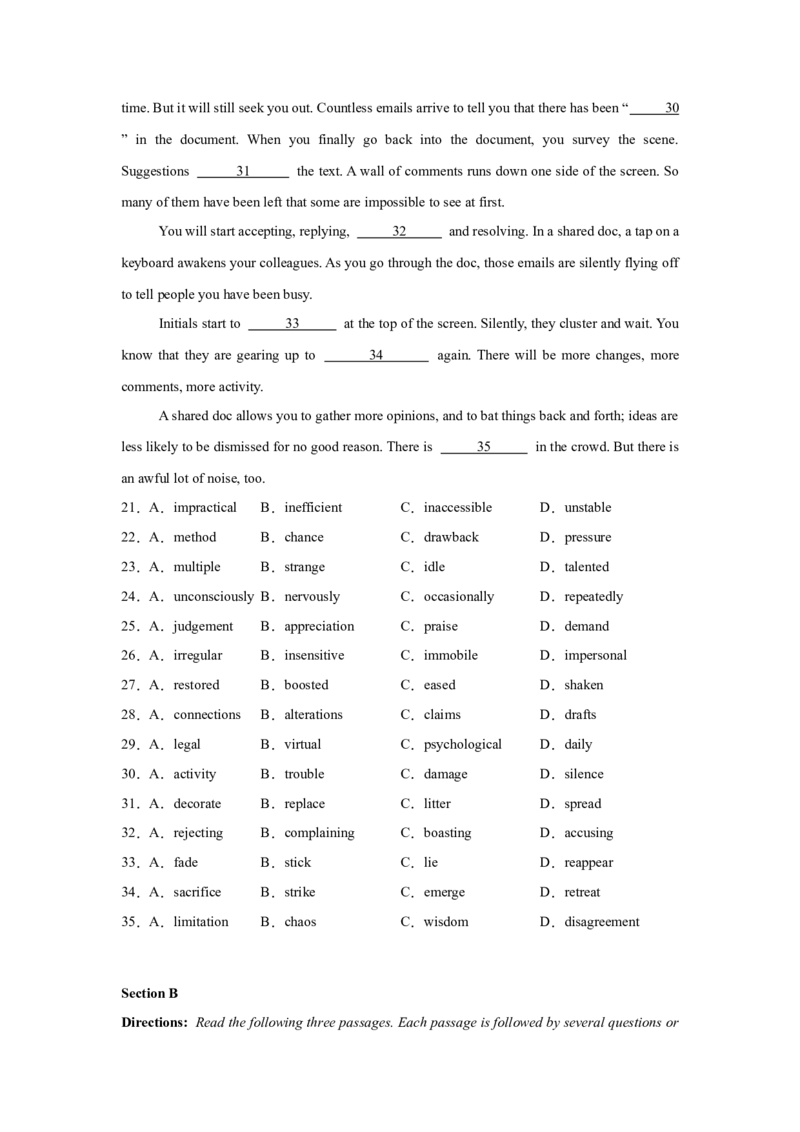
Long long ago, colleagues would suggest changes to documents in turn. They
would make comments and add revisions to a file on their own computer, and then send it on to
the next person. It was     21     and inconvenient.
The era of the shared doc has made this process much more user-friendly. But like all social
activities, it has the great     22     of exposing you to other people.
Start with the fact that you can see who else is in the document. A succession of initials at
the top of the screen confirms that your actions are now being observed by     23     people.
One of these initials fades and brightens every few minutes, as the person in question     24
exits and re-enters the document. They either have nothing to do or are deeply anxious about what
may be about to happen.
If they are the owner of the document, they are absolutely right to worry, for people will be
busy rendering (提供) public     25     on their work. A cursor (光标) jumps rapidly from
paragraph to paragraph, and then suddenly stops. It remains     26    . Something must be
very, very wrong with what they are reading. It moves more slowly after that, its confidence in the
author visibly     27    .
If enough people are involved, chaos follows. Someone adds a paragraph, causing someone
else to make     28     in the wrong place. Two people are engaged in a furious     29

battle over a single word in the shared doc, taking it by turns to overwrite each other.
If you are the owner of the document, you do not have to watch this disaster unfold in real
time. But it will still seek you out. Countless emails arrive to tell you that there has been “     30
” in the document. When you finally go back into the document, you survey the scene.
Suggestions      31      the text. A wall of comments runs down one side of the screen. So
many of them have been left that some are impossible to see at first.
You will start accepting, replying,      32      and resolving. In a shared doc, a tap on a
keyboard awakens your colleagues. As you go through the doc, those emails are silently flying off
to tell people you have been busy.
Initials start to      33      at the top of the screen. Silently, they cluster and wait. You
know that they are gearing up to      34      again. There will be more changes, more
comments, more activity.
A shared doc allows you to gather more opinions, and to bat things back and forth; ideas are
less likely to be dismissed for no good reason. There is      35      in the crowd. But there is
an awful lot of noise, too.
21.A.impractical
B.inefficient
C.inaccessible
D.unstable
22.A.method
B.chance
C.drawback
D.pressure
23.A.multiple
B.strange
C.idle
D.talented
24.A.unconsciously B.nervously
C.occasionally
D.repeatedly
25.A.judgement
B.appreciation
C.praise
D.demand
26.A.irregular
B.insensitive
C.immobile
D.impersonal
27.A.restored
B.boosted
C.eased
D.shaken
28.A.connections
B.alterations
C.claims
D.drafts
29.A.legal
B.virtual
C.psychological
D.daily
30.A.activity
B.trouble
C.damage
D.silence
31.A.decorate
B.replace
C.litter
D.spread
32.A.rejecting
B.complaining
C.boasting
D.accusing
33.A.fade
B.stick
C.lie
D.reappear
34.A.sacrifice
B.strike
C.emerge
D.retreat
35.A.limitation
B.chaos
C.wisdom
D.disagreement
Section B
Directions: Read the following three passages. Each passage is followed by several questions or
unfinished statements. For each of them there are four choices marked A, B, C and D. Choose the
one that fits best according to the information given in the passage you have just read.
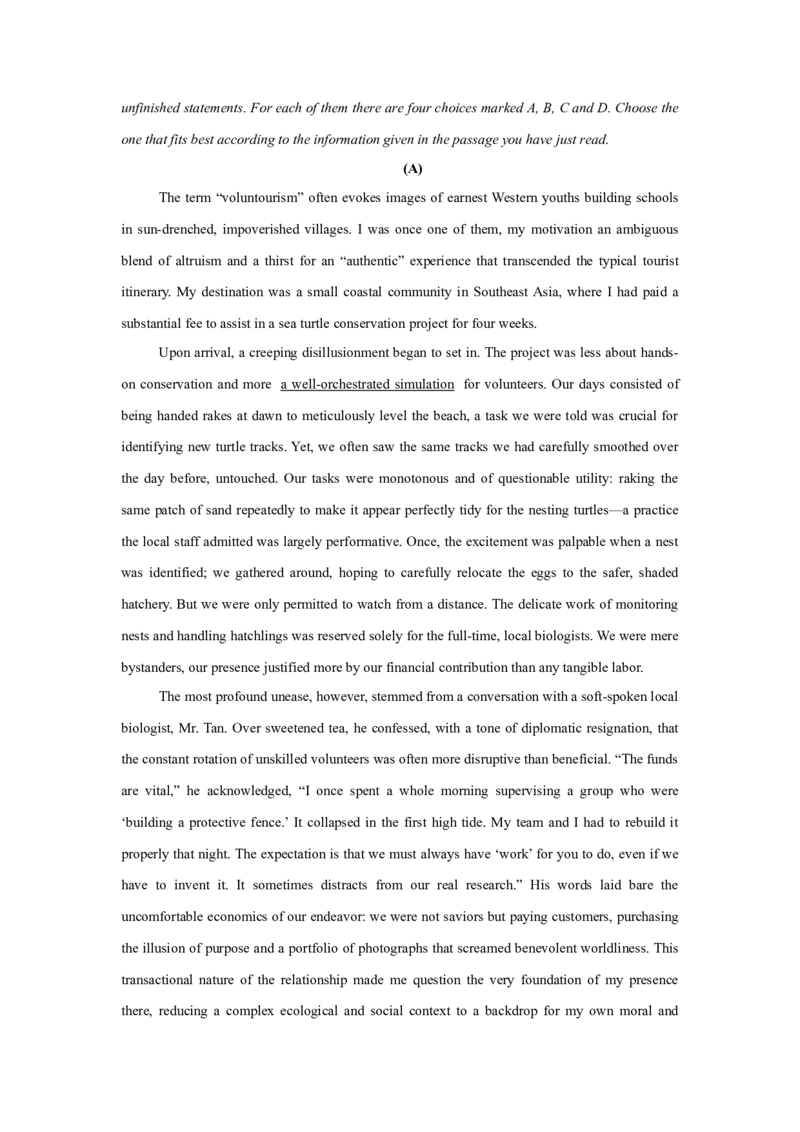
(A)
The term “voluntourism” often evokes images of earnest Western youths building schools
in sun-drenched, impoverished villages. I was once one of them, my motivation an ambiguous
blend of altruism and a thirst for an “authentic” experience that transcended the typical tourist
itinerary. My destination was a small coastal community in Southeast Asia, where I had paid a
substantial fee to assist in a sea turtle conservation project for four weeks.
Upon arrival, a creeping disillusionment began to set in. The project was less about hands-
on conservation and more a well-orchestrated simulation for volunteers. Our days consisted of
being handed rakes at dawn to meticulously level the beach, a task we were told was crucial for
identifying new turtle tracks. Yet, we often saw the same tracks we had carefully smoothed over
the day before, untouched. Our tasks were monotonous and of questionable utility: raking the
same patch of sand repeatedly to make it appear perfectly tidy for the nesting turtles—a practice
the local staff admitted was largely performative. Once, the excitement was palpable when a nest
was identified; we gathered around, hoping to carefully relocate the eggs to the safer, shaded
hatchery. But we were only permitted to watch from a distance. The delicate work of monitoring
nests and handling hatchlings was reserved solely for the full-time, local biologists. We were mere
bystanders, our presence justified more by our financial contribution than any tangible labor.
The most profound unease, however, stemmed from a conversation with a soft-spoken local
biologist, Mr. Tan. Over sweetened tea, he confessed, with a tone of diplomatic resignation, that
the constant rotation of unskilled volunteers was often more disruptive than beneficial. “The funds
are vital,” he acknowledged, “I once spent a whole morning supervising a group who were
‘building a protective fence.’ It collapsed in the first high tide. My team and I had to rebuild it
properly that night. The expectation is that we must always have ‘work’ for you to do, even if we
have to invent it. It sometimes distracts from our real research.” His words laid bare the
uncomfortable economics of our endeavor: we were not saviors but paying customers, purchasing
the illusion of purpose and a portfolio of photographs that screamed benevolent worldliness. This
transactional nature of the relationship made me question the very foundation of my presence
there, reducing a complex ecological and social context to a backdrop for my own moral and
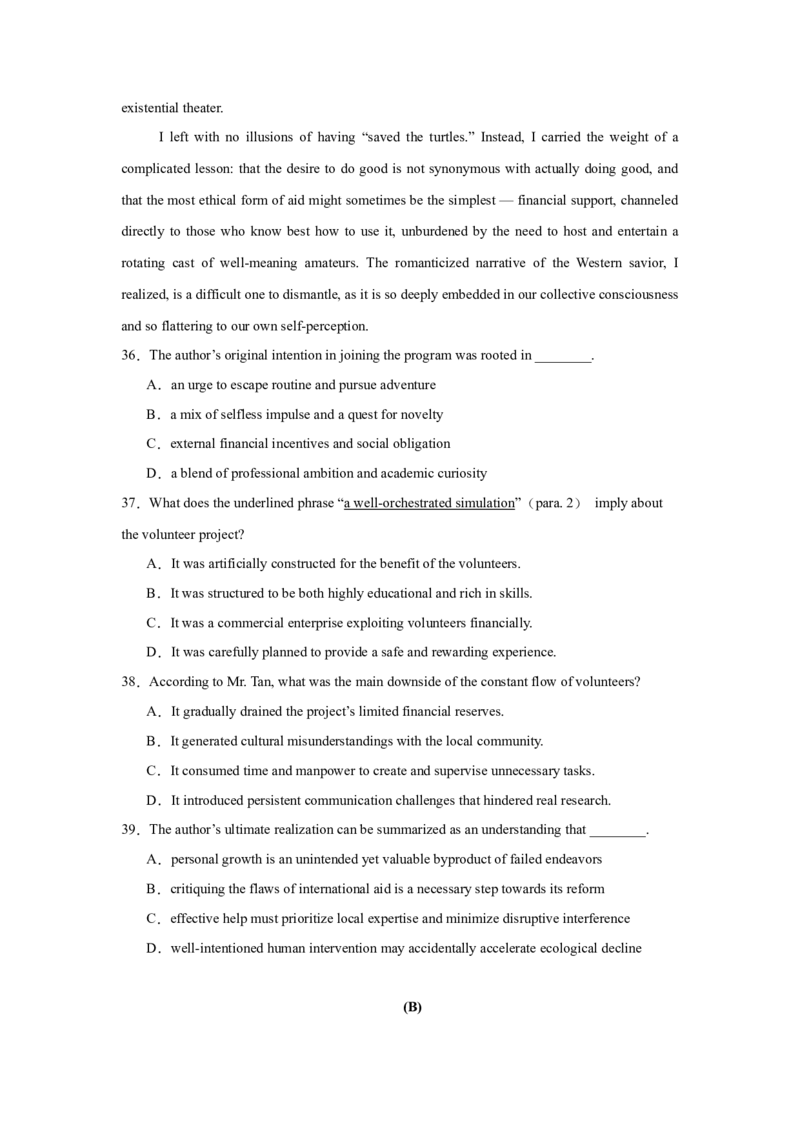
existential theater.
I left with no illusions of having “saved the turtles.” Instead, I carried the weight of a
complicated lesson: that the desire to do good is not synonymous with actually doing good, and
that the most ethical form of aid might sometimes be the simplest — financial support, channeled
directly to those who know best how to use it, unburdened by the need to host and entertain a
rotating cast of well-meaning amateurs. The romanticized narrative of the Western savior, I
realized, is a difficult one to dismantle, as it is so deeply embedded in our collective consciousness
and so flattering to our own self-perception.
36.The author’s original intention in joining the program was rooted in ________.
A.an urge to escape routine and pursue adventure
B.a mix of selfless impulse and a quest for novelty
C.external financial incentives and social obligation
D.a blend of professional ambition and academic curiosity
37.What does the underlined phrase “a well-orchestrated simulation”(para. 2) imply about
the volunteer project?
A.It was artificially constructed for the benefit of the volunteers.
B.It was structured to be both highly educational and rich in skills.
C.It was a commercial enterprise exploiting volunteers financially.
D.It was carefully planned to provide a safe and rewarding experience.
38.According to Mr. Tan, what was the main downside of the constant flow of volunteers?
A.It gradually drained the project’s limited financial reserves.
B.It generated cultural misunderstandings with the local community.
C.It consumed time and manpower to create and supervise unnecessary tasks.
D.It introduced persistent communication challenges that hindered real research.
39.The author’s ultimate realization can be summarized as an understanding that ________.
A.personal growth is an unintended yet valuable byproduct of failed endeavors
B.critiquing the flaws of international aid is a necessary step towards its reform
C.effective help must prioritize local expertise and minimize disruptive interference
D.well-intentioned human intervention may accidentally accelerate ecological decline
(B)
Humans are born explorers and adventurers. We have this “desire” to explore new places
and to go beyond.
We have already climbed the highest mountain, explored the vastness of the Antarctica and
the emptiness of Sahara. We have also reached outer space, stepped on the surface of our
neighbour, the moon, and one day might even explore the vastness of our universe.
There seems to be no end to humanity’s appetite for exploring our surroundings and the
unknown. However, there are still some places on Earth that have not yet been reached or fully
explored. And these places are some of the most isolated and mysterious places on this planet.
Mariana Trench, Pacific Ocean
Located in the western part of the Pacific Ocean, the Mariana Trench is the deepest part
of the world’s oceans. The trench measures around 2,550 km long and 70 km wide on average,
and reaches a depth of over 10,994 metres at one small part known as the Challenger Deep.
The Mariana Trench is considered one of the least explored parts of the world due to its
extreme depth. At this depth, the water pressure can be very dangerous. Still, life can be found
in this part of the ocean. Previous expeditions to the trench have revealed a number of
organisms and sea creatures, living in the deep sea.
Vale do Javari, Brazil
With an area of about 85,444. 82 km², Vale do Javari is one of the largest indigenous
territories in Brazil. The rainforest was named after the vast Javari River, which is the most
important river system in the region. It is one of the most isolated places on Earth and also one
of the hardest places to reach.
The isolation of this remote place is largely due to the thick forest and extreme
geographic location. In spite of its isolation, the tropical rainforest is home to a great number of
indigenous people or Indian tribes. Those tribes, believed to be as many as 200 to 3,300 people,
were first discovered through satellite images of the vast rainforest.
Entering the region is prohibited by Brazilian law and the Vale do Javari is especially
well-protected from outsiders and explorers by a local organisation dedicated to maintaining its
rich biodiversity and protecting the forest from exploitation.
Tsingy de Bemaraha
Located near the western coast of Madagascar, the Tsingy de Bemaraha has been on the
list of UNESCO World Heritage Site since 1990 to protect its unique geography and preserve
the mangrove forests. The place is also home to huge numbers of animals and even new
species.
Some of the biggest attractions in this protected reserve are the incredibly needle-shaped
limestone formations. However, those formations pose great dangers to explorers. In fact, the
word “Tsingy” is derived from a local word, which means “the place where one cannot walk
barefoot.” The limestone formations are terribly sharp and can easily cut through flesh with
deadly effect, which makes exploring them extremely difficult and dangerous. Access to this
nature reserve is limited, although tourists can reach the area either by road or plane.
40.Why is the Mariana Trench considered one of the least explored places on Earth?
A.It is located too far from any continent.
B.Its width makes it impossible to map accurately.
C.It lacks any signs of life or scientific value.
D.Its extreme depth leads to dangerous water pressure.
41.Based on the description of Vale do Javari, which of the following can be inferred about its
indigenous tribes?
A.They actively engage with modern society through trade.
B.Their existence was confirmed through technological means.
C.They rely on the Javari River for transportation to cities.
D.Their population is precisely documented by Brazilian authorities.
42.What can be concluded about the Tsingy de Bemaraha from the local meaning of “Tsingy”?
A.It is a popular tourist destination for hiking enthusiasts.
B.The area is primarily covered by mangrove forests.
C.Its limestone formations are exceptionally sharp and hazardous.
D.Visitors must remove their shoes to enter the reserve.
(C)
Soon after sunset, a strange clicking fills the air at Hanningfield Reservoir in
Essex. Some noises come from bat detectors, which change the high sounds made by bats into
ones people can hear. Others come from small counters used by volunteers to count the bats flying
out of a building. The noise sounds like experimental electronic music.
About 20 years ago, conservationists first noticed soprano pipistrelles — tiny British bats
— at Hanningfield. Since then, the colony has grown from around 500 in the early 2010s to over
2,000 today. This is just one example of a wider trend. Bat numbers are rising in Britain, which
shows that some environmental laws are working, even if they sometimes make building new
homes or roads more difficult.
Bats are harder to count than birds because they come out at night and make sounds we
can’t hear. But studies of their feeding and roosting (栖息) habits show that nearly all common bat
species have increased since the late 1990s. One type, the greater horseshoe bat, has tripled in
number. In contrast, many bird populations are still falling.
Still, Britain likely has fewer bats than it did in the past. In the 18th century, the naturalist
Gilbert White reported seeing hundreds at once over the Thames. But after World War II,
poisonous chemicals, bad weather, and modern farming reduced their numbers. Old farm
buildings, piles of dry grass, and broken farm machines, once perfect bat homes, disappeared.
Because bats live long lives, have only one baby a year, and depend on group homes, losing
even one large roost can hurt their numbers for years. Thankfully, strict environmental laws have
made these losses rare. British bats also seem less affected by white-nose syndrome, a deadly
disease that has wiped out many bats in North America.
These days bats have the magical power of blocking housing and infrastructure, or raising
its cost. In Norfolk, plans for a new road have been suspended because of rare barbastelle bats. A
special bridge for bats along the HS2 railway is costing over £100 million. For a government
eager for growth, this is unacceptable. A new law may reduce bat protections, letting developers
destroy habitats as long as they pay to restore them elsewhere. For bat protectors, this creates a
“licence to kill”. Public attitudes to bats have warmed over the years, though not to the point of
adoration. Technology, like better bat detectors, might help more people learn to love them. The
better you know something, the more you worry about it.
43.What do we know about the bats at Hanningfield Reservoir?
A.Their sounds are being monitored by devices and volunteers.
B.Their numbers have grown because of the relaxed regulations.
C.They have caused huge disturbances to nearby construction.
D.They represent the largest bat colony ever recorded in Britain.
44.Which line chart shows the correct trend of the bats population?
A.
B.
C.
D.
45.Why are bats subject to habitat losses?
A.Because their natural habitats can keep them from various deadly diseases.
B.Because they lose the magical power to protect the modern farm buildings.
C.Because individual bats cannot survive without constant group communication.
D.Because their low reproduction rate and long lifespan require stability for growth.
46.Which of the following would be the most appropriate title for the passage?
A.Habitat Loss and Disease: The Ongoing Threats to Bat Survival
B.Bats and Technology: How Detectors Are Changing Conservation
C.From Past to Present: The Tragic Fate of UK’s Bat Populations
D.The Comeback of Bats: A Conservation Success Story with Challenges
Section C
Directions: Read the following passages. Fill in each blank with a proper sentence given in
the box. Each sentence can be used only once. Note that there are two more sentences than
you need.
In some sports, left- handed athletes seem to have an inborn advantage
The left- handed have long struggled in a right- handed world.    47    The conventional
explanation for this is that the rarity of lefties, means right-handed athletes lack familiarity with
them as opponents. But this may be only part of the story.
Tim Simon at the University of Trento, in Italy, suspected the left- handed enjoy some
inborn advantage in these sports, over and above their unfamiliarity. To test his idea, Dr. Simon
reasoned that were unfamiliarity the sole explanation for left-hander advantage, then the difference
should decrease at the highest levels of a sport, where players would be wise to leftists’ tricks.
48    He therefore analysed the performances over more than a decade of the world’s top athletes
in badminton, table tennis, tennis and three types of fencing.
    49    For example, 18% of the top 200 male epee fencers and 23% of the top male
foil fencers were lefties, but that went up to 28% and 31% respectively when only the top100 were
considered. The other three sports, however, did not show this effect.
The difference, Dr. Simon suspects, is that foil and epee involve stabbing (刺,戳) with
small and rapid movements. Table tennis requires similar quickness. Sabre fencing, by contrast,
involves larger swinging movements similar to those employed in tennis and badminton.    50
He assumes that the explanation may stem from left-handed people’s greater reliance than
right-handers on their brains’ right hemispheres, which are more important than the left for
processing visual and spatial inputs and generating motor responses. Though the benefits thus
granted are probably tiny, they matter at the top — where being a split second faster than an
opponent separates victory from defeat.
A.They consistently lose more matches across various sports than the right-handed athletes.
B.He theorises this difference may be why lefties dominate in the first three sports but not the
others.
C.But they are overrepresented in one field: one-to-one sports such as fencing and tennis.
D.This finding challenges the long-held belief that left-handers are at a disadvantage in most
activities.
E.It’s surprising that in foil and epee fencing, and table tennis, there was indeed an increase in
left-handedness at the top.
F .If, however, some inborn factor associated with left handedness were a cause, then the
difference might actually increase.
IV. Summary Writing   (10 分)
Directions: Read the following passage. Summarize the main idea and the main point(s) of the
passage in no more than 60 words. Use your own words as far as possible.
51.Directions: Read the following passage. Summarize in no more than 60 words the main idea
and the main point (s) of the passage. Use your own words as far as possible.
Why People Watch Sports
On a weekend afternoon, millions of people sit before screens or gather in stadiums, their
hearts rising and falling with every goal, every swing, every shout. To an outsider, this passion
might seem puzzling — after all, the result changes nothing about their own lives. Yet for those
watching, the experience feels deeply real, even necessary.
Part of the appeal lies in emotion. Sports compress the drama of life into a few exciting
hours, offering joy, tension, relief, and sometimes heartbreak—all without lasting harm. A match
can stir the same chemical reactions as adventure or love, releasing energy that makes spectators
feel vividly alive. The emotional rollercoaster is not chaos but a kind of shared rhythm that binds
people together.
That sense of connection is what keeps fans returning. Sitting among strangers who cheer
for the same team, or chatting online with distant supporters, we become part of a temporary
community that breaks the boundaries of daily life. Victories and losses alike strengthen this
invisible bond, giving fans the warmth of belonging and the comfort of shared identity.
Research suggests that these moments matter. Studies in England and Belgium have found
that people who regularly watch or attend sporting events tend to feel less lonely and more
satisfied with life. Even those who follow games on TV often describe a lift in mood and
motivation, as if each match renews their sense of participation in the wider world.
Beyond the excitement, sports offer stories — of discipline, courage, and persistence —
that mirror the struggles of ordinary people. Watching athletes push limits or recover from failure
reminds us what effort and hope can achieve.
Sometimes, when the crowd falls silent just before a decisive play, time itself seems to
pause. In that breathless space between hope and outcome, every spectator feels the same
heartbeat — a quiet reminder of how deeply alive we are.
_______________________________________________________________________________
_______________________________________________________________________________
_______________________________________________________________________________
_______________________________________________________________________________
_______________________________________________________________________________
V. Translation  (第1-2 句,每句3 分;第3 句,4 分;第4 句5 分;共15 分)
Directions: Translate the following sentences into English, using the words given in the brackets.
52.显而易见,这个地区的人随时能吃到新鲜的乳制品。(available)

53.截至上月末,这个野生动物保护组织已经筹集了超过一万美元。 (raise)

54.与预期相反,正是团队成员的紧密协作而非个人能力,最终赢得董事会的赞同,确保
了项目的成功。(contrary)

55.为了让孩子们提高艺术品味,家长们常常会在暑期带孩子参观美术馆,欣赏那些名艺
术家的杰作。(acquire)

VI. Guided Writing (25 分)
56.假设你是Alex,你的朋友Lora 对摄影非常感兴趣,计划在今年寒假参加一个摄影工作
坊(workshop)进一步研习。她发现了两个不同主题的工作坊,一个专注于自然风光摄影,
另一个则是城市街头摄影。Lora 对于选择哪个方向感到犹豫不决,因此她通过电子邮件向
你求助。请你给Lora 回复一封邮件,分享你的看法。你的回复需要包括:
1.对比两个工作坊;
2.根据Lora 的情况,给出你认为她更适合参加的工作坊的建议。
_______________________________________________________________________________
_______________________________________________________________________________
_______________________________________________________________________________
_______________________________________________________________________________
_______________________________________________________________________________
_______________________________________________________________________________
_______________________________________________________________________________
_______________________________________________________________________________
_______________________________________________________________________________
_______________________________________________________________________________
_______________________________________________________________________________
_______________________________________________________________________________
_______________________________________________________________________________