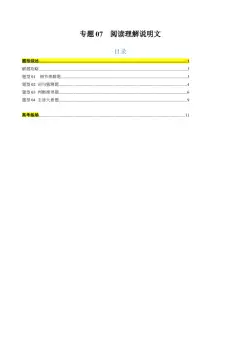
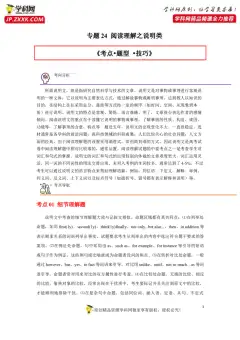
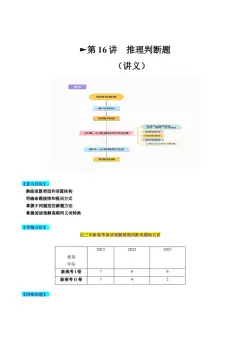
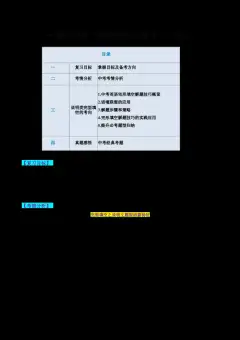
第 07 讲 阅读理解说明文
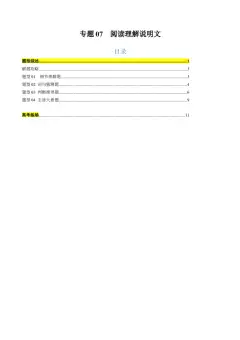
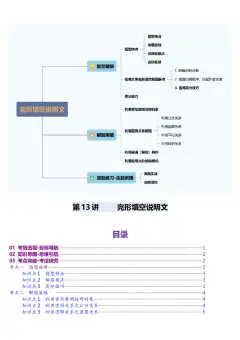
目录
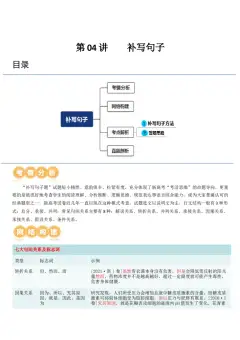
01 考情透视·目标导航····························································································································1
02 知识导图·思维引航····························································································································3
03 考点突破·考法探究····························································································································3
考点一 题型破解······································································································································3
知识点1 文体特点·······················································································································3
知识点2 高分技巧·······················································································································4
知识点3 选项规律·······················································································································5
知识点4 解法要点·······················································································································5
考点二 科普类说明文·····························································································································6
考点三 动植物介绍类说明文·················································································································7
考点四 社会文化类说明文·····················································································································8
04真题练习·命题洞现
1.真题实战 ··································································································································10
2.命题演练 ··································································································································14
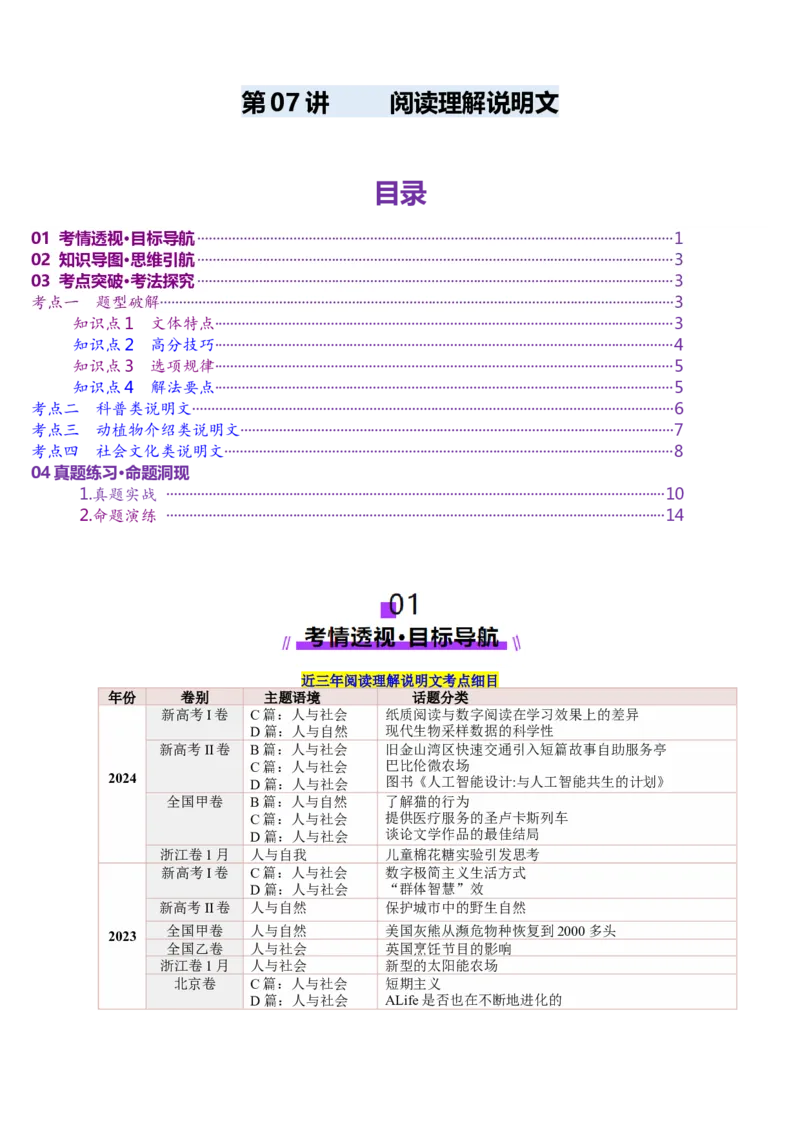
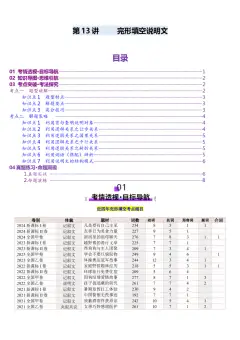
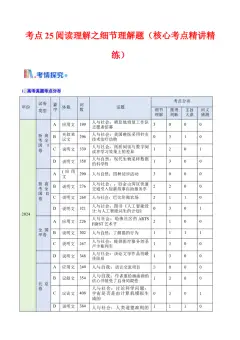
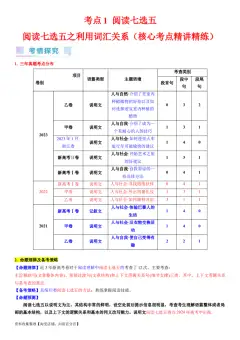
近三年阅读理解说明文考点细目
年份 卷别 主题语境 话题分类
新高考I卷 C篇:人与社会 纸质阅读与数字阅读在学习效果上的差异
D篇:人与自然 现代生物采样数据的科学性
新高考II卷 B篇:人与社会 旧金山湾区快速交通引入短篇故事自助服务亭
C篇:人与社会 巴比伦微农场
2024 D篇:人与社会 图书《人工智能设计:与人工智能共生的计划》
全国甲卷 B篇:人与自然 了解猫的行为
C篇:人与社会 提供医疗服务的圣卢卡斯列车
D篇:人与社会 谈论文学作品的最佳结局
浙江卷1月 人与自我 儿童棉花糖实验引发思考
新高考I卷 C篇:人与社会 数字极简主义生活方式
D篇:人与社会 “群体智慧”效
新高考II卷 人与自然 保护城市中的野生自然
全国甲卷 人与自然 美国灰熊从濒危物种恢复到2000多头
2023
全国乙卷 人与社会 英国烹饪节目的影响
浙江卷1月 人与社会 新型的太阳能农场
北京卷 C篇:人与社会 短期主义
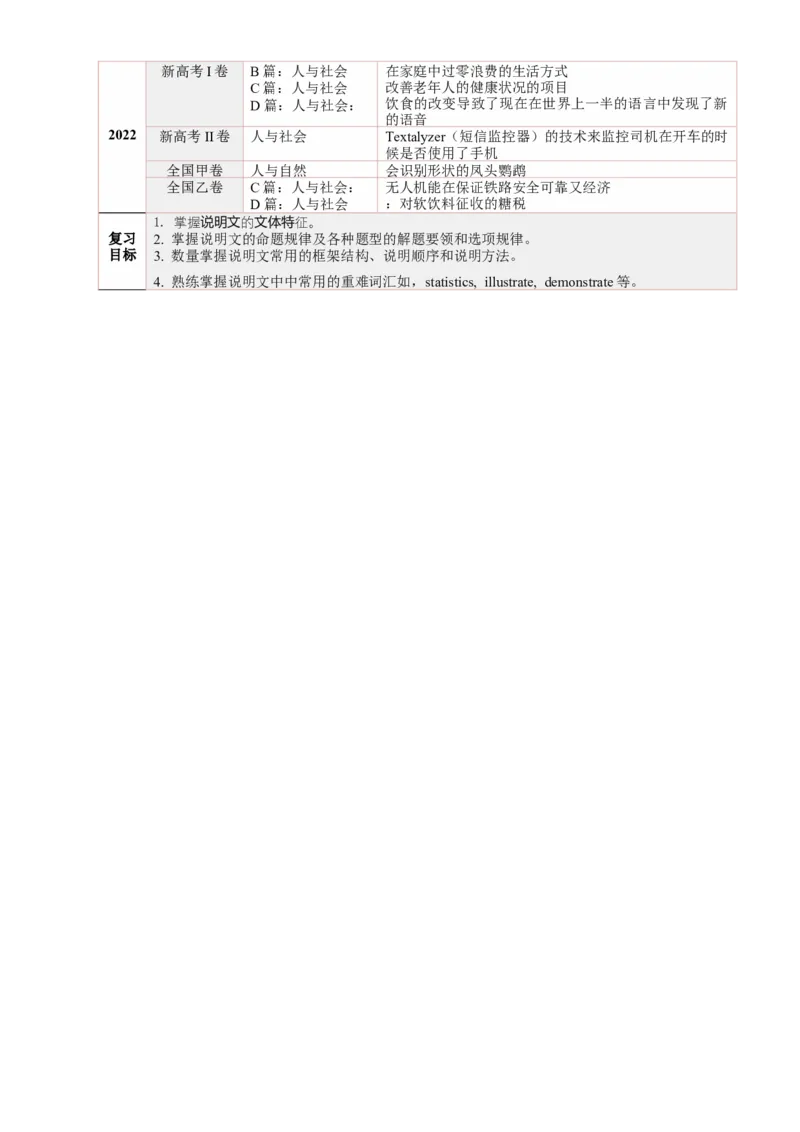
D篇:人与社会 ALife是否也在不断地进化的新高考I卷 B篇:人与社会 在家庭中过零浪费的生活方式
C篇:人与社会 改善老年人的健康状况的项目
D篇:人与社会: 饮食的改变导致了现在在世界上一半的语言中发现了新
的语音
2022 新高考II卷 人与社会 Textalyzer(短信监控器)的技术来监控司机在开车的时
候是否使用了手机
全国甲卷 人与自然 会识别形状的凤头鹦鹉
全国乙卷 C篇:人与社会: 无人机能在保证铁路安全可靠又经济
D篇:人与社会 :对软饮料征收的糖税
1. 掌握说明文的文体特征。
复习 2. 掌握说明文的命题规律及各种题型的解题要领和选项规律。
目标 3. 数量掌握说明文常用的框架结构、说明顺序和说明方法。
4. 熟练掌握说明文中中常用的重难词汇如,statistics, illustrate, demonstrate等。考点一 题型破解
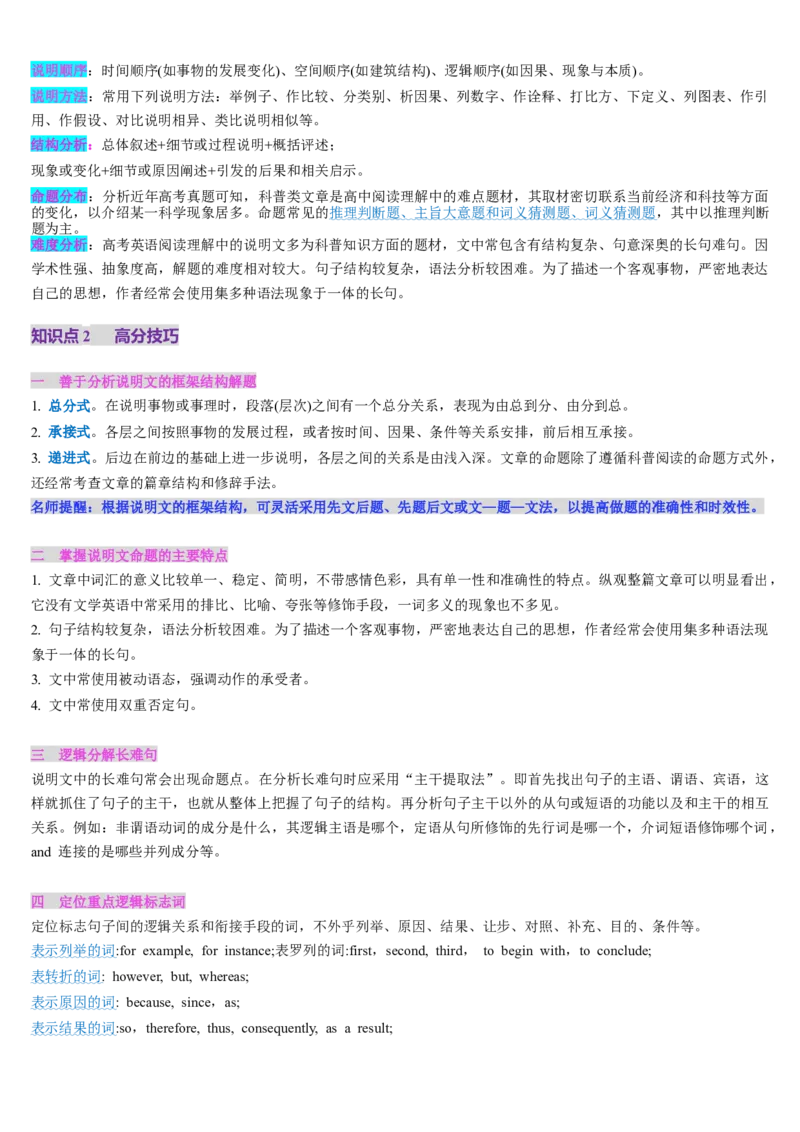
知识点1 文体特点
分析近年高考阅读真题可知,说明文都具备客观地解说事物、阐明事理,给人以知识的文体特征。它通过对实体事物(如
仪器、产品、自然环境)的解说,或对抽象事理(如概念、原理、定律)的阐释,使人们对事物的形态、特征、构造、性能、
种类、成因、功能等有所了解,或对事理的特点、来源、演变、异同等有所认识,从而获得有关的知识。词汇运用灵活,
同一词的不同词性的用法交替出现,未列入考纲的生词较多。
题材分布:选材涉及科技、社会和文化生活等各个领域。如:介绍科学领域的最新成果、机器的制造过程、产品工艺流
程或使用说明、工程项目的规划、社会经济发展过程中出现的新生事物、生物的生存状况、自然或社会现象产生的原因
和解决办法、人文地理知识等。说明顺序:时间顺序(如事物的发展变化)、空间顺序(如建筑结构)、逻辑顺序(如因果、现象与本质)。
说明方法:常用下列说明方法:举例子、作比较、分类别、析因果、列数字、作诠释、打比方、下定义、列图表、作引
用、作假设、对比说明相异、类比说明相似等。
结构分析:总体叙述+细节或过程说明+概括评述;
现象或变化+细节或原因阐述+引发的后果和相关启示。
命题分布:分析近年高考真题可知,科普类文章是高中阅读理解中的难点题材,其取材密切联系当前经济和科技等方面
的变化,以介绍某一科学现象居多。命题常见的推理判断题、主旨大意题和词义猜测题、词义猜测题,其中以推理判断
题为主。
难度分析:高考英语阅读理解中的说明文多为科普知识方面的题材,文中常包含有结构复杂、句意深奥的长句难句。因
学术性强、抽象度高,解题的难度相对较大。句子结构较复杂,语法分析较困难。为了描述一个客观事物,严密地表达
自己的思想,作者经常会使用集多种语法现象于一体的长句。
知识点2 高分技巧
一 善于分析说明文的框架结构解题
1. 总分式。在说明事物或事理时,段落(层次)之间有一个总分关系,表现为由总到分、由分到总。
2. 承接式。各层之间按照事物的发展过程,或者按时间、因果、条件等关系安排,前后相互承接。
3. 递进式。后边在前边的基础上进一步说明,各层之间的关系是由浅入深。文章的命题除了遵循科普阅读的命题方式外,
还经常考查文章的篇章结构和修辞手法。
名师提醒:根据说明文的框架结构,可灵活采用先文后题、先题后文或文—题—文法,以提高做题的准确性和时效性。
二 掌握说明文命题的主要特点
1. 文章中词汇的意义比较单一、稳定、简明,不带感情色彩,具有单一性和准确性的特点。纵观整篇文章可以明显看出,
它没有文学英语中常采用的排比、比喻、夸张等修饰手段,一词多义的现象也不多见。
2. 句子结构较复杂,语法分析较困难。为了描述一个客观事物,严密地表达自己的思想,作者经常会使用集多种语法现
象于一体的长句。
3. 文中常使用被动语态,强调动作的承受者。
4. 文中常使用双重否定句。
三 逻辑分解长难句
说明文中的长难句常会出现命题点。在分析长难句时应采用“主干提取法”。即首先找出句子的主语、谓语、宾语,这
样就抓住了句子的主干,也就从整体上把握了句子的结构。再分析句子主干以外的从句或短语的功能以及和主干的相互
关系。例如:非谓语动词的成分是什么,其逻辑主语是哪个,定语从句所修饰的先行词是哪一个,介词短语修饰哪个词,
and 连接的是哪些并列成分等。
四 定位重点逻辑标志词
定位标志句子间的逻辑关系和衔接手段的词,不外乎列举、原因、结果、让步、对照、补充、目的、条件等。
表示列举的词:for example, for instance;表罗列的词:first,second, third, to begin with,to conclude;
表转折的词: however, but, whereas;
表示原因的词: because, since,as;
表示结果的词:so,therefore, thus, consequently, as a result;表示对照的词:on the contrary, by contrast, in comparison;
表示目的的词: so that, in order that等。
标志词就像指路牌一样,指明作者思路发展的方向和思路之间的逻辑联系。标志词前后的信息往往都是命题和答题的主
要线索或依据,因此,识别标志词对考生更快、更好地理解文章具有举足轻重的作用。
知识点3 选项规律
干扰项特征 释义
将文章中出现的文中无关紧要或片面推出的结论,如某一处细节当作合理
片面理解
推断,实则是原文信息的简单重复,并不是推断出来的结论。
干扰项用了与文章中某一句话相似的句型结构和单词,却在考生易忽视的
偷梁换柱
地方换了几个单词,造成句意的改变
正误参半 选项内容 部分正确,部分错误。
解题时将自己的观点或社会的一种普遍性倾向而文中并无关系的观点当成
无中生有 作者的观点。干扰项往往是基本的生活常识或普遍认可的观点,但在文章
中并无相关的信息支撑点。
根据现实生活常识推断。虽然符合考生的常识,但文中并没有支撑的依
主观臆断
据。
构词法干扰(词义猜词题) 指片面地从构词法的角度猜测、思考,不考虑上下文语境,望词生义;
拘泥于字面意思(词义猜词 根据所学过的熟词意义常使考生觉得画线词义背过而忽略上下文主观臆
题) 断。
知识点4 解法要点
考点一推理判断题
说明文中的推理判断题属于高层次阅读理解题,要求考生根据文章提供的事实和线索进行逻辑推理,推测作者未明确
提到的事实或某事件发展的趋势。 解答该类型题目时一定要从整体上把握语篇内容,在语篇的表面意义与隐含意义 、
已知信息与未知信息之间架起桥梁 ,去体会作者的“弦外之音”和“言外之意”。进行推断时,要据文推理、不可脱
离原文主观臆断。
名师提醒:选项一般具有以下特征。1.“立足原文,只推一步”,即根据原文内容,一步即可推得。2.选项中一般不可以出现
绝对概念。如only, never, all, absolutely等,正确答案的表述一般有一点模糊,会用一些相对能够留有一些余地的词汇,如
often, usually, sometimes, some, may, might, can, could, possibly, probably等。
考点二 细节理解题
说明文的细节理解题常在下列处命题,1.列举处:如first(1y)、second(1y)、third(1y)finally、not only„but also、then、in a
ddition等表示顺承关系的词处常命题。2.例证处,如as、such as、for example、for instance等词处常命题。3.在转折或对
比处,如however、but、yet、while、in fact、unlike、until、not so much…as等词处常命题。4.在长难句处,主要考查
考生对复杂句中的语法关系、指代关系和整体句意的理解能力。
考点三 词义猜测题说明文常出现一些反映现代科技的生词,常以科学新发明、新创造、人们对社会热点话题名词的理解态度等为题点命制
试题,解题时一定要认真阅读原文,分析画线词上下句围绕对该科学新发明、新创造、 热点话题所给的是如何解释、
如何定义的,在此基础上根据长难句的逻辑意义推理概括出生词词义。
考点四 主旨大意题
说明文文章大意题考查考生对文章的主题或中心意思的概括和归纳。答题时首先阅读题干,掌握问题的类型,了解试题
题干以及各个选项所包含的信息,然后有针对性地对文章进行扫读,对有关信息进行快速定位,再将相关信息进行整合、
甄别、分析、对比,有根有据地排除干扰项,选出正确答案。通常说明文的主旨大意会在第一关开篇点题或者第一段抛
砖引玉,第二段点题。或者在文章 结尾段 点明主旨。
考点二 科普类说明文
典例1.(2024·江苏南京·模拟预测)Last year I averaged 9,370 steps a day. My smartphone counted. My daily aim? Ten
thousand steps. Because goals.
Yet the concept of taking 10,000 steps a day to maintain health is rooted not in science but in marketing. In the 1960s, a
Japanese company invented an early pedometer (计步器). Because the Japanese character for “10,000” looks like a person
walking, the company called its device the 10,000-step meter. “It was just sort of a catchy phrase,” says I-Min Lee, a scientist at
Harvard Medical School.
In 2019, Lee published a study investigating the actual effects of meeting the 10,000-step goal. The result? Some movement
is good, and more is better, but the benefits decline at some point. Your personal peak depends on your age. People younger than
60 should indeed walk 8,000 to 10,000 steps a day to get the best benefits in terms of lifespan (寿命). People older than 60 show
the most benefit between 6,000 and 8,000 steps.
The difference is energy consumption. “We basically relate energy consumption to health outcomes,” Lee says. Walking for
60 minutes at 3.3 miles an hour and running for 30 minutes at 6 miles an hour use the same amount of energy. “The older you are,
the less efficient you are with your steps,” Lee says. “Per step, older people use more energy.” Thus, they need fewer steps to
achieve the same benefits.
Newer studies are moving beyond death rates to ask questions about the way steps may help to control blood pressure and
weight. The goal, after all, is not just to live longer but to live healthier. Ful results are not in yet, so Lee’s advice is: “Tailor your
steps according to what you are trying to achieve and according to who you are.”
1.The concept of taking 10,000 steps daily arises from ______.
A.the findings of scientific surveys B.the formation of a Japanese character
C.a marketing trick D.a healthy habit
2.What does Lee’s research find?
A.Walking step targets vary with age.
B.Walking more makes one look younger.
C.Old people benefit more from walking longer.
D.Reaching 10,000 steps daily appeals to many.
3.What is paragraph 4 mainly about?
A.The difference in energy consumption among age groups.
B.The contrast between the benefits of walking and running.C.The reason for setting different step goals based on age.
D.The link between energy consumption and health outcomes.
4.What will newer studies focus on?
A.How steps change one’s lifestyle. B.How steps affect one’s lifespan.
C.How steps reduce death rates. D.How steps boost healthy living.
考点三 动植物介绍类说明文
典例1.(23-24高三·江西赣州·期末)“Help!” “Land here!” “Conserve resources!” “Get off!” “My fruits are ready to
eat!” These are just some of the many messages we know plants can send.
To react to the environment, a single plant must communicate among its roots, stems, leaves, flowers, and fruits. Instead of
signals moving through a nervous system like ours, Simon Gilroy, a professor of botany at University of Wisconsin-Madison, says
in plants, it’s more like plumbing (管路系统). Electrical signals travel through the movement of chemicals in those tubes, explains
Courtney Jahn, a biologist who studies plant interactions. For example, roots can detect drought and tell leaves to limit
transpiration (蒸腾作用) and conserve water.
Researchers can observe this electrical communication by placing devices in two different places on a plant. We’ve even
made instruments that can translate that electric charge into sounds we can hear. If a plant is wounded, electrical signals come out
of that wound, Gilroy says. And plants can pass these electrical signals between individuals if they are touching. Researchers
found that with special microphones that detect bat calls, you can hear plants, too. They are listening to these sounds to find new
methods to diagnose, treat, and monitor plants without touching them.
As humans, we may not be able to naturally hear them, but we can often smell plant messages. When grass is cut, it releases
chemicals—a signal of asking for help. This smelly signal belongs to a group of chemicals called volatiles, which can travel far as
gases both above and below ground. Each plant species has their own special volatile compounds. Natalia Dudareva, biochemist at
Purdue University, says these volatile compounds have many different functions. Volatiles can draw in pollinators (传粉昆虫)
when a flower is ready, and even direct them to flowers, while some are sent from leaves to deter animals that feed on only
plants.
So, next time you walk on some grass or pick a flower, remember that the poor injured plant might be screaming out to its
neighbours.
1.Why is the example given in Paragraph 2?
A.To clarify how chemicals travel in a plant.B.To describe how roots of a plant work well.
C.To confirm a plant has a nervous system. D.To show a plant can communicate internally.
2.How do plants pass electrical signals to others?
A.By using their wounds. B.By touching each other.
C.By detecting electric charge. D.By changing them into sounds.
3.What does the underlined word “deter” in Paragraph 4 mean?
A.Preserve. B.Attract. C.Drive away. D.Turn to.
4.What can be a suitable title for the text?
A.The Secret Language of Plants B.The Incredible Power of Nature
C.The Value of Interacting with Wildlife D.The Trick of Getting Along with Nature考点四 社会文化类说明文
典例1.(2024·江西新余·二模)When it comes to popular symbols of marriage, one can not look past the wedding ring.
The wedding ring serves as a perfect symbol of everlasting love — a ring is a circle and thus has no beginning or end, representing
the never-ending union of marriage. Wedding rings have long and rich histories.
Evidence suggests that wedding rings were used in ancient Egypt around 6,000 years ago. However, unlike the metals and
gemstones used today, they were crafted from materials such as reeds, leather or bone. In the centuries that followed, the wedding
ring tradition was picked up in the West, where it spread first in ancient Rome and Greece, subsequently throughout Europe during
the Middle Ages and eventually to Eastern culture. Throughout history, the circular shape of the ring has endured, and so has the
tradition of wearing it on the fourth finger of the left hand. The latter practice stemmed from an ancient belief that a vein ran
directly from this finger to the heart. Although this belief has since been proved false, the custom has persisted.
Regarding customs surrounding wedding rings, there was a time when only the bride wore a wedding ring. It wasn’t until
the early 20th century that the practice of grooms wearing rings gained popularity. This change was influenced by soldiers going
off to war, who wore rings as reminders of their loved ones waiting for them at home. Today, the exchange of wedding rings
remains an integral part of the wedding ceremony, symbolizing the commitment and love shared between two individuals
embarking on a life together.
Wedding rings hold a symbolic significance that binds the two members of a married couple. In an ever-changing world, the
wedding ring stands as an ancient tradition that is likely to continue for generations to come, reflecting the timeless and eternal
love celebrated through marriage.
1.What is the main reason wedding rings are considered symbols of marriage?
A.They are made of precious materials. B.They have profound histories.
C.They are worn on left hands. D.They have circular shapes.
2.According to the passage, what is an example of a common myth instead of a fact?
A.Women were wearing wedding rings long before men were.
B.One finger on the left hand contains a vein leading to the heart.
C.Both ancient Romans and Egyptians wore the ring on the same finger.
D.The wedding ring tradition began in Egypt thousands of years ago.
3.Which of the following aspects of a wedding ring is NOT discussed in the passage?
A.How the tradition of it spread around the world.
B.What couples do with their wedding rings.
C.How to choose suitable wedding rings.
D.Materials used to make early rings.
4.How does the author feel about the tradition of wedding rings?
A.It will most likely last forever. B.It has already fallen out of date.
C.It should be taken more seriously. D.It holds no significance in modern society.
典例2.(2024·江西·二模)From beautiful bronze (青铜) wine cups to grand bronze ding (food containers), this exhibitionfeatures discoveries that will fundamentally change visitors’ understanding of ancient Chinese civilization.
At about the same time that Stonehenge was rising in England, a Bronze Age culture was developing in China that in many
respects was seldom equaled and never surpassed. This development seemed to have begun by 1600 BC in the Shang (about 1600
BC — 1046 BC) along the Yellow River. For thousands of years, this area had witnessed cultures of increasing complexity,
which laid the foundation of the Chinese civilization. By the time of the Bronze Age, this culture was characterized by a
strong centralized government, urban communities with obvious social classes, a distinctive system of writing, strict religious
rituals, diversified art forms, and advanced bronze-producing methods.
Unlike other cultures, where bronze was first used chiefly for tools and weapons, in China, bronze was used to make
vessels (容器) that played central roles in official ceremonies and ancestor worship for more than 1,000 years, even after the
official beginnings of the Iron Age in 400 BC. Possession of bronze vessels thus became a symbol for the holding of power and
rulers used bronze cups and food containers to present offerings of food and wine to royal ancestors and gods.
During Shang times, wine played a major part in such ceremonies, and containers for wine therefore far outnumbered other
types. Then, the Shang were criticized for too much wine drinking by its enemy, the Zhou, who felt that the drinking had offended
Heaven and given the Zhou the right to overthrow the Shang. Safeguarding its own dynasty, the Zhou replaced the wine vessels
with more practical cooking and storage tools.
After the Shang period, bronze vessels became more important as expressions of personal status than as vehicles for official
ceremonies. This is evident from the changing content of bronze inscriptions. Carved into the surface of a vessel, these writings
first appeared during the late Shang period as an identification of the vessel’s owner or of the ancestor to whom it was dedicated.
During the Western Zhou period, inscriptions became increasingly common and lengthier, praising the achievements of the
owners.
5.By the time Stonehenge was rising in England, ________.
A.the Chinese had yet to invent their writing system
B.China was still relatively backward in many respects
C.China had already had a strong centralized government
D.social classes just started to emerge in the Chinese cities
6.What is the third paragraph mainly about?
A.The main applications of bronze in China.
B.The complex official ceremonies in China.
C.The significance of the discovery of bronze.
D.The differences between China and other countries.
7.Which of the following most probably belongs to the Zhou?
A.Huge bronze ding with short religious texts.
B.Bronze vessels showing the kings’ achievements.
C.An unearthed temple with lots of bronze wine cups.
D.An ancient kitchen with lots of bronze cooking pots.
8.From which is the text most probably taken?
A.A science report. B.An exhibit brochure.
C.A history textbook. D.A research paper.一、 真题实战
1.(2023新课标II卷)
Reading Art: Art for Book Lovers is a celebration of an everyday object — the book, represented here in almost three
hundred artworks from museums around the world. The image of the reader appears throughout history, in art made long before
books as we now know them came into being. In artists’ representations of books and reading, we see moments of shared
humanity that go beyond culture and time.
In this “book of books,” artworks are selected and arranged in a way that emphasizes these connections between different
eras and cultures. We see scenes of children learning to read at home or at school, with the book as a focus for relations between
the generations. Adults are portrayed (描绘) alone in many settings and poses —absorbed in a volume, deep in thought or lost in a
moment of leisure. These scenes may have been painted hundreds of years ago, but they record moments we can all relate to.
Books themselves may be used symbolically in paintings to demonstrate the intellect (才智), wealth or faith of the subject.
Before the wide use of the printing press, books were treasured objects and could be works of art in their own right. More recently,
as books have become inexpensive or even throwaway, artists have used them as the raw material for artworks — transforming
covers, pages or even complete volumes into paintings and sculptures.
Continued developments in communication technologies were once believed to make the printed page outdated. From a 21st-
century point of view, the printed book is certainly ancient, but it remains as interactive as any battery-powered e-reader. To serve
its function, a book must be activated by a user: the cover opened, the pages parted, the contents reviewed, perhaps notes written
down or words underlined. And in contrast to our increasingly networked lives where the information we consume is monitored
and tracked, a printed book still offers the chance of a wholly private, “off-line” activity.
8. Where is the text most probably taken from?
A. An introduction to a book. B. An essay on the art of writing.
C. A guidebook to a museum. D. A review of modern paintings.
9. What are the selected artworks about?
A. Wealth and intellect. B. Home and school.
C. Books and reading. D. Work and leisure.
10. What do the underlined words “relate to” in paragraph 2 mean?
A. Understand. B. Paint.
C. Seize. D. Transform.
11. What does the author want to say by mentioning the e-reader?
A. The printed book is not totally out of date.
B. Technology has changed the way we read.
C. Our lives in the 21st century are networked.
D. People now rarely have the patience to read.
2.(2023全国甲卷)
I was about 13 when an uncle gave me a copy of Jostein Gaarder’s Sophie’s World. It was full of ideas that were new to me,
so I spent the summer with my head in and out of that book. It spoke to me and brought me into a world of philosophy (哲学).That love for philosophy lasted until I got to college. Nothing kills the love for philosophy faster than people who think they
understand Foucault, Baudrillard, or Confucius better than you — and then try to explain them.
Eric weiner’s The Socrates Express: In Search of Life Lessons from Dead Philosophers reawakened my love for philosophy.
It is not an explanation, but an invitation to think and experience philosophy.
Weiner starts each chapter with a scene on a train ride between cities and then frames each philosopher’s work in the context
(背景) of one thing they can help us do better. The end result is a read in which we learn to wonder like Socrates, see like Thoreau,
listen like Schopenhauer, and have no regrets like Nietzsche. This, more than a book about undestanding philosophy, is a book
about learning to use philosophy to improve a life.
He makes philosophical thought an appealing exercise that improves the quality of our experiences, and he does so with
plenty of humor. Weiner enters into conversation with some of the most important philosophers in history, and he becomes part of
that crowd in the process by decoding (解读) their messages and adding his own interpretation.
The Socrates Express is a fun, sharp book that draws readers in with its apparent simplicity and gradually pulls them in
deeper thoughts on desire, loneliness, and aging. The invitation is clear: Weiner wants you to pick up a coffee or tea and sit down
with this book. I encourage you to take his offer. It’s worth your time, even if time is something we don’t have a lot of.
28. Who opened the door to philosophy for the author?
A. Foucault. B. Eric Weiner.
C. Jostein Gaarder. D. A college teacher.
29. Why does the author list great philosophers in paragraph 4?
A. To compare Weiner with them.
B. To give examples of great works.
C. To praise their writing skills.
D. To help readers understand Weiners book.
30. What does the author like about The Socrates Express?
A. Its views on history are well-presented.
B. Its ideas can be applied to daily life.
C. It includes comments from readers.
D. It leaves an open ending.
31. What does the author think of Weiners book?
A. Objective and plain.
B. Daring and ambitious.
C. Serious and hard to follow.
D. Humorous and straightforward.
3.(2023全国乙卷)
What comes into your mind when you think of British food? Probably fish and chips, or a Sunday dinner of meat and two
vegetables. But is British food really so uninteresting? Even though Britain has a reputation for less-than-impressive cuisine, it is
producing more top class chefs who appear frequently on our television screens and whose recipe books frequently top the best
seller lists.
It’s thanks to these TV chefs rather than any advertising campaign that Britons are turning away from meat-and-two-veg and
ready-made meals and becoming more adventurous in their cooking habits. It is recently reported that the number of those sticking
to a traditional diet is slowly declining and around half of Britain’s consumers would like to change or improve their cooking in
some way. There has been a rise in the number of students applying for food courses at UK universities and colleges. It seems thatTV programmes have helped change what people think about cooking.
According to a new study from market analysts, 1 in 5 Britons say that watching cookery programmes on TV has encouraged
them to try different food. Almost one third say they now use a wider variety of ingredients (配料) than they used to, and just
under 1 in 4 say they now buy better quality ingredients than before. One in four adults say that TV chefs have made them much
more confident about expanding their cookery knowledge and skills, and young people are also getting more interested in
cooking. The UK’s obsession (痴迷) with food is reflected through television scheduling. Cookery shows and documentaries
about food are broadcast more often than before. With an increasing number of male chefs on TV, it’s no longer “uncool” for boys
to like cooking.
28. What do people usually think of British food?
A. It is simple and plain. B. It is rich in nutrition.
C. It lacks authentic tastes. D. It deserves a high reputation.
29. Which best describes cookery programme on British TV?
A. Authoritative. B. Creative.
C. Profitable. D. Influential.
30. Which is the percentage of the people using more diverse ingredients now?
A. 20%. B. 24%. C. 25%. D. 33%.
31. What might the author continue talking about?
A. The art of cooking in other countries.B. Male chefs on TV programmes.
C. Table manners in the UK. D. Studies of big eaters.
4.(2022新课标I卷)
The elderly residents (居民) in care homes in London are being given hens to look after to stop them feeling lonely.
The project was dreamed up by a local charity (慈善组织) to reduce loneliness and improve elderly people’s wellbeing, It is
also being used to help patients suffering dementia, a serious illness of the mind. Staff in care homes have reported a reduction in
the use of medicine where hens are in use.
Among those taking part in the project is 80-year-old Ruth Xavier. She said: “I used to keep hens when I was younger and
had to prepare their breakfast each morning before I went to school. ”
“I like the project a lot. I am down there in my wheelchair in the morning letting the hens out and down there again at night
to see they’ve gone to bed.”
“It’s good to have a different focus. People have been bringing their children in to see the hens and residents come and sit
outside to watch them. I’m enjoying the creative activities, and it feels great to have done something useful.”
There are now 700 elderly people looking after hens in 20 care homes in the North East, and the charity has been given
financial support to roll it out countrywide.
Wendy Wilson, extra care manager at 60 Penfold Street, one of the first to embark on the project, said: “Residents really
welcome the idea of the project and the creative sessions. We are looking forward to the benefits and fun the project can bring to
people here.”
Lynn Lewis, director of Notting Hill Pathways, said: “We are happy to be taking part in the project. It will really help connect
our residents through a shared interest and creative activities.”
28. What is the purpose of the project?
A. To ensure harmony in care homes.
B. To provide part-time jobs for the aged.C. To raise money for medical research.
D. To promote the elderly people’s welfare.
29. How has the project affected Ruth Xavier?
A. She has learned new life skills.
B. She has gained a sense of achievement.
C. She has recovered her memory.
D. She has developed a strong personality.
30. What do the underlined words “embark on” mean in paragraph 7?
A. Improve. B. Oppose.
C. Begin. D. Evaluate.
31. What can we learn about the project from the last two paragraphs?
A. It is well received. B. It needs to be more creative.
C. It is highly profitable. D. It takes ages to see the results.
二、 命题演练
1.(2024·江苏南京·模拟预测)We go through life assuming we’re in charge of our own minds — until temptation (诱惑)
strikes. Few things better illustrate how little control we really have. You can know exactly what you should do (decline the
second slice of cake or the third cocktail), but that hardly seems to matter when the urge arises. More self-discipline is rarely the
answer, though. Instead, if you can understand what’s going on inside your head when temptation comes, you’ll be far better
placed to make a healthier choice.
Sometimes, you need to push yourself, the idea behind which, in psychology, is to make the better choice the easier choice.
(School pupils eat more healthily, it’s been shown, when the salads are within easier reach than the chips.) So, instead of relying
on willpower, stop keeping ice creams in your freezer! Use StayFocused or similar apps to block distracting websites. Change
your environment, and temptation will be a non-issue.
For every person, behind every bad habit, there's a reasonable desire: some people eat or drink too much because they're
lonely, or smoke to get a break from a busy schedule. Once you’ve uncovered this underlying need, find a different way to meet it:
call a friend; take a coffee break instead of a cigarette break. There’s nothing wrong with the need — only with the way you’re
currently meeting it.
It’s a strange truth that we’ll break all sorts of promises to ourselves — yet most of us would never fail to show up at a
prearranged meeting with a friend. Involve others in your temptation-resistance efforts, whether it's asking someone to check in
weekly to see if you’re sticking to your plan, or never going shopping alone if you’re subject to impulse purchases. Best of all,
launch a joint plan, in which two of you decide to give up a bad habit. That turns a challenge into a fun game.
1.What does “that” mean in paragraph 1?
A.Temptation. B.Self-awareness.
C.Choice. D.Self-motivation.
2.Which should be a good choice if you feel worn out from a packed timetable?
A.Exercise strong willpower over it.
B.Keep ice creams within easy reach.
C.Use StayFocused to refresh yourself.
D.Chat with a friend over a cup of coffee.3.What does the author suggest you do according to paragraph 4?
A.Seek partners’ support. B.Leave challenges behind.
C.Keep your promises. D.Say no to playing games.
4.What is the text mainly about?
A.What causes temptation. B.How to keep temptation at bay.
C.Why urges set in. D.How to keep life under control.
2.(24-25高三·山西大同·阶段练习)During Yang Zhongkai’s early years, a 500-year-old majestic ginkgo (银杏) tree
that did not sprout leaves for two to three years at a stretch used to be a daily sight for him on his way to and from high school.
Since villagers widely regarded the tree as having the power to make their wishes come true, they used to kneel down in front of
the “lucky” tree and burn offerings under it, which led to prolonged heat exposure at its roots, stunting its growth.
“Millions of such old trees are in urgent need of protection given their importance as vital biological resources and symbols
of ecological civilization,” said Yang, who started the team — Zhiyue — dedicated to protecting ancient trees. “But the recording
and management of ancient and famous trees nationwide commonly rely on Excel spreadsheets (电子表格), which present issues
such as information silos, lack of real-time updates and incomplete content,” he said.
However, things have changed of late. Yang and his team now use the artificial intelligence technology developed by
Tencent Cloud to identify and register trees accurately based on individual traits and GPS tracking. “With the acceleration of a
new generation of technological revolution and industrial transformation, new technologies bring more excitement to the
protection of ancient trees,” Yang said. “We can now collect data on the trees’ growth, health and environment in real time, which
helps us make informed decisions on how to better protect them.”
“In addition to applying cutting-edge technologies such as AI and large models to assist in the development of traditional
industries, the company also makes great efforts to promote the development of charitable causes through technological and
platform advantages,” Wu. Yunsheng said, vice-president of Tencent Cloud, adding that “the power of technology can change the
world”.
5.What does the underlined word “stunting” in paragraph I probably mean?
A.Preventing. B.Boosting. C.Keeping. D.Recording.
6.What can we infer about Tencent Cloud’s new technology?
A.It will replace Excel spreadsheets in the future.
B.It is an effective tool to protect ancient trees.
C.It will be widely used in modern industries.
D.It has remarkable advantages over other AI.
7.What is Wu Yunsheng’s attitude towards the application of technology?
A.Skeptical. B.Cautious. C.Supportive. D.Indifferent.
8.What’s the purpose of the passage?
A.To emphasize the importance of technology.
B.To show technology’s aid to ancient trees.
C.To introduce Tencent Cloud’s new function.
D.To arouse the awareness of protecting trees.
3.(2024·重庆·三模)“A fish out of water.” “A bike without a chain.” There are many metaphors for culture shock, all ofwhich attempt to describe the unique experience of being far from one’s home country and culture.
Scientists have studied culture shock for over a century. Rather than focus on the purely negative aspects, psychologists
describe it as a process of stress and adjustment. The first stage is the honeymoon phase, when we are filled with excitement about
being in another country. Eventually, as daily challenges arise, we enter a state of crisis and anxiety, harboring unfriendly feelings
about the host culture. The longer we are immersed in the culture, we adjust and recover from those negative feelings. Finally,
after some time we adjust even more and fully accept the new culture.
One of the factors that determines how we react to cultural stress is our personality. Not surprisingly, extraverts (外向者)
tend to have an easier time adjusting to new cultures. That is because being in a new country means meeting many new people and
spending a lot of time around them, and extraverts thrive in these situations. But introverts simply prefer to be alone after spending
time in groups, and only have limited energy to spend in social settings.
Cultural intelligence, or CQ, also plays its part. Cultural intelligence is defined as the capability of an individual to function
effectively in situations characterized by cultural diversity. It has to do with our interest in interacting with people from culturally
diverse backgrounds, and our ability to adapt to new cultural context. It is argued that the higher our CQ, the lesser the effect of
culture shock on our ability to cope in new situations.
Many effective coping strategies are interpersonal. A recent study found that relating to others with empathy is significantly
associated with lower stress levels abroad. The more we are able to take on other people’s points of view, the more positive our
interpersonal relationships and thus our adaptation to the stress of culture shock.
9.What is the function of the first paragraph?
A.Explaining the quotes. B.Raising an argument.
C.Introducing the topic. D.Presenting an example.
10.How will a person feel the moment he arrives in a foreign country?
A.Anxious. B.Thrilled. C.Shocked. D.Grateful.
11.Who will most probably be affected by the cultural shock?
A.An active boy interested in anything new.
B.A shy boy unwilling to socialize with strangers.
C.A quiet girl open to diverse cultural backgrounds.
D.A communicative girl fluent in the local language.
12.What is important for dealing with the cultural shock?
A.Lowering the stress level. B.Developing self-awareness.
C.Analyzing the cause of discomfort. D.Understanding others with sympathy.