绝密★启用前
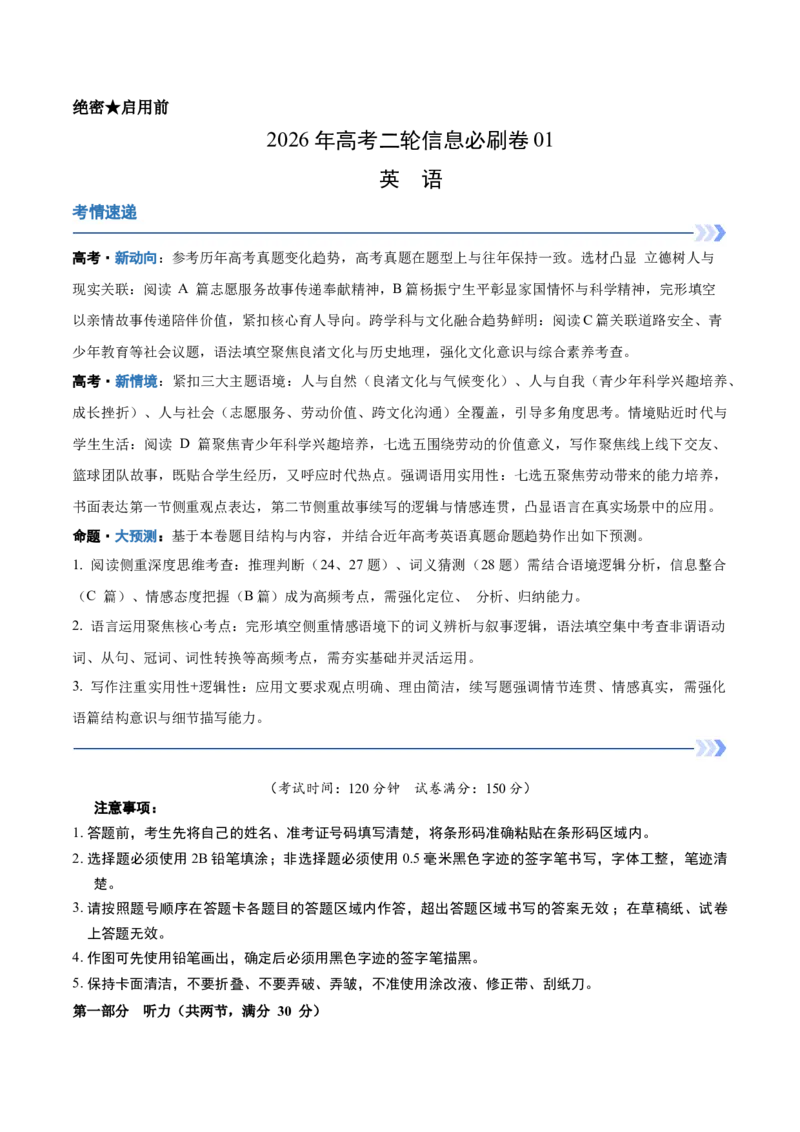
2026 年高考二轮信息必刷卷 01
英 语
考情速递
高考·新动向:参考历年高考真题变化趋势,高考真题在题型上与往年保持一致。选材凸显 立德树人与
现实关联:阅读 A 篇志愿服务故事传递奉献精神,B篇杨振宁生平彰显家国情怀与科学精神,完形填空
以亲情故事传递陪伴价值,紧扣核心育人导向。跨学科与文化融合趋势鲜明:阅读C篇关联道路安全、青
少年教育等社会议题,语法填空聚焦良渚文化与历史地理,强化文化意识与综合素养考查。
高考·新情境:紧扣三大主题语境:人与自然(良渚文化与气候变化)、人与自我(青少年科学兴趣培养、
成长挫折)、人与社会(志愿服务、劳动价值、跨文化沟通)全覆盖,引导多角度思考。情境贴近时代与
学生生活:阅读 D 篇聚焦青少年科学兴趣培养,七选五围绕劳动的价值意义,写作聚焦线上线下交友、
篮球团队故事,既贴合学生经历,又呼应时代热点。强调语用实用性:七选五聚焦劳动带来的能力培养,
书面表达第一节侧重观点表达,第二节侧重故事续写的逻辑与情感连贯,凸显语言在真实场景中的应用。
命题·大预测:基于本卷题目结构与内容,并结合近年高考英语真题命题趋势作出如下预测。
1. 阅读侧重深度思维考查:推理判断(24、27题)、词义猜测(28题)需结合语境逻辑分析,信息整合
(C 篇)、情感态度把握(B篇)成为高频考点,需强化定位、 分析、归纳能力。
2. 语言运用聚焦核心考点:完形填空侧重情感语境下的词义辨析与叙事逻辑,语法填空集中考查非谓语动
词、从句、冠词、词性转换等高频考点,需夯实基础并灵活运用。
3. 写作注重实用性+逻辑性:应用文要求观点明确、理由简洁,续写题强调情节连贯、情感真实,需强化
语篇结构意识与细节描写能力。
(考试时间:120分钟 试卷满分:150分)
注意事项:
1. 答题前,考生先将自己的姓名、准考证号码填写清楚,将条形码准确粘贴在条形码区域内。
2. 选择题必须使用2B铅笔填涂;非选择题必须使用0.5毫米黑色字迹的签字笔书写,字体工整,笔迹清
楚。
3. 请按照题号顺序在答题卡各题目的答题区域内作答,超出答题区域书写的答案无效;在草稿纸、试卷
上答题无效。
4. 作图可先使用铅笔画出,确定后必须用黑色字迹的签字笔描黑。
5. 保持卡面清洁,不要折叠、不要弄破、弄皱,不准使用涂改液、修正带、刮纸刀。
第一部分 听力(共两节,满分 30 分)做题时,先将答案标在试卷上。录音内容结束后,你将有两分钟的时间将试卷上的答案转涂到答题卡上。
第一节(共5小题;每小题1.5分,满分7.5分)
听下面5段对话。每段对话后有一个小题,从题中所给的A、B、C三个选项中选出最佳选项。听完每
段对话后,你都有10秒钟的时间来回答有关小题和阅读下一小题。每段对话仅读一遍。
1. Who is the man probably talking to?
A. A shop assistant. B. His wife. C. His co-worker.
【答案】C
【原文】M: Your gold necklace is so nice. I want to buy one for my wife.
W: Thanks. I think it can hold its value well. I bought it...
M: Shush! Mr Longman is coming towards us with the meeting papers.
2. What are the speakers mainly discussing?
A. The woman’s photo. B. A scenic spot. C. A TV drama.
【答案】B
【原文】W: The waterfall in this photo looks familiar.
M: It has appeared in many TV dramas, and as a result, lots of tourists visit it every day.
W: It explains the matter.
3. What does the man mean?
A. E-commerce is a double-edged sword.
B. Local specialties should be exported.
C. Commercials are of no use.
【答案】A
【原文】W: Thanks to ecommerce platforms and video bloggers, the local specialities in my hometown can be
traded all over China, which is entirely unexpected.
M: To some extent it is true, but many videos are too commercial. False online advertisements are emerging in an
endless stream.
4. What will the man do next?
A. Close a window. B. Catch a mouse. C. Leave the room.
【答案】C
【原文】W: I just found a mouse when I was cleaning my room. Please help me get it out of here.
M: All right. Well, I looked around, but I didn’t find it. Maybe it has escaped through the window. Anyway, I have
to go to the gym now.
5. When does the conversation take place?A. On Friday. B. On Saturday. C. On Sunday.
【答案】C
【原文】M: Are there any workers in the burning factory?
W: It is supposed to be empty, because they only work on weekdays.
M: But the factory is so badly damaged that they won’t be able to work tomorrow.
第二节(共15小题;每小题1.5分,满分22.5分)
听下面5段对话或独白。每段对话或独白后有几个小题,从题中所给的A、B、C三个选项中选出最佳
选项。听每段对话或独白前,你将有时间阅读各个小题,每小题5秒钟;听完后,各小题将给出5秒钟的
作答时间。每段对话或独白读两遍。
听第6段材料,回答第6、7题。
6. Which year of college are the speakers in?
A. The first year. B. The second year. C. The third year.
7. What did the woman do in public?
A. She had a dance. B. She did jumping jacks. C. She performed a song.
【答案】6. B 7. C
【原文】M: The freshmen will start their military training this month.
W: Yeah. It was extremely hot during our military training at this time last year.
M: It remains fresh in my memory. I got made to do 80 jumping jacks for being late.
W: Haha, it was so funny. I sang a song in front of others during a break in our military training. I remember some
students also performed various dances. It's still nice to think about it.
听第7段材料,回答第8、9题。
8. What does the man expect to do on the 3rd?
A. Sign a contract. B. Go on a tour. C. Return to New York.
9. What does the man finally decide to do?
A. Cancel the reservation. B. Contact another airline. C. Advance the departure date.
【答案】8. A 9. C
【原文】W: Hello. What can I do for you?
M: I’d like a flight from New York to Boston, leaving on the 3rd.
W: Sorry. The flights on the 3rd are fully booked.
M: I am out of luck. The same is true of another airline.
W: What about the 4th?
M: Unfortunately, that won’t work for me. I’m not going on a tour. I’m meeting an important business partner.Being punctual is crucial for my chances of securing the contract.
W: I’m sorry, sir.
M: Well, please tell me what flights are available on the 2nd.
听第8段材料,回答第10至12题。
10. Who might the woman be?
A. A hostess. B. A director. C. An actress.
11. What does the woman think of the award-winning film?
A. It is her personal favorite.
B. It is worthy of the award.
C. It is terribly disappointing.
12. What is the man going to do next?
A. Call a meeting. B. Watch a video. C. Have a job interview.
【答案】10. A 11. B 12. B
【原文】M: I heard you took charge of the red carpet interview for the film festival yesterday.
W: Yes! I’m so proud. I had the opportunity of interviewing many movie stars, including my favorite actress Anna.
She succeeded in earning the Best Actress Award. While the awardwinning film isn’t my personal favorite, I do
believe it deserves the award.
M: Oh, that’s great to hear! Unfortunately, I missed your interview part because of an emergency meeting. Would
you mind if we watch it now?
W: Not at all. You know I always strive to do my best, so I’m sure it won’t let you down. Plus, your favorite movie
actor Colin is in the interview.
M: What are we waiting for? Let’s get started.
听第9段材料,回答第13至16题。
13. What is the man?
A. A fresh graduate.
B. A software engineer.
C. A computer repairman.
14. What does the example of the man's group project prove?
A. He has great leadership skills.
B. He is a good team player.
C. He pays attention to detail.
15. How does the woman describe the man?A. Motivated. B. Creative. C. Industrious.
16. What will the woman most probably talk about next?
A. The employment situation.
B. The internal promotion.
C. The company culture.
【答案】13. A 14. B 15. A 16. B
【原文】W: Could you please introduce yourself?
M: Yes. My name is Peter Barnes. I recently graduated with a degree in Computer Science from Carnegie Mellon
University. During my studies, I developed a strong passion for software development and worked on various
projects, including an internship at ABC Tech, where I gained some experience in programming.
W: That sounds impressive. We value teamwork here. Can you provide an example of a time when you worked
effectively in a team?
M: Absolutely. During my senior year, I participated in a group project. I took on the task of making slides. I
actively listened to everyone else's ideas and maintained a positive atmosphere. We delivered the project on time
and won first place.
W: Excellent. Attention to detail is also crucial in our industry. How do you ensure the accuracy of your work?
M: Before starting a task, I carefully analyze the requirements, break it down into smaller subtasks, and create a
detailed plan. Additionally, I always ask for and welcome feedback from others to continuously minimize errors.
W: Good. I appreciate employees who take the initiative in their work. Finally, do you have any questions for us?
M: Yes. I’d like to inquire about the professional development opportunities within the company.
W: Sure...
听第10段材料,回答第17至20题。
17. How much did disabled travelers spend in the US in 2018?
A. About $45.8 billion. B. About $58.7 billion. C. About $81 billion.
18. What is the best thing about Singapore in Nilesh Joshi’s opinion?
A. It treats the disabled with understanding and respect.
B. It offers the disabled accessible public transport.
C. Its tourist attractions are free for the disabled.
19. What do we know about John Morris?
A. He spoke highly of the hotel rooms in Las Vegas.
B. He buys magazines 3 or 4 times a week.
C. He once lived in Sydney.20. Where is Julie Jones employed?
A. At a hotel. B. In a travel agency. C. In a publishing company.
【答案】17. B 18. A 19. A 20. C
【原文】What do disabled travelers look for when choosing a city to visit?
In 2018, the value of the socalled “purple pound” (the spending power of disabled people) to UK tourism was
estimated at £15.3 billion, while 27 million travelers with disabilities in the US took 81 million trips and spent
about $58.7 billion (£45.8 billion) in that same year.
There was a survey about a city’s appeal to disabled travelers. Now, let's find out what the respondents think of the
top 3 cities — Singapore, Las Vegas and Sydney.
According to Nilesh Joshi, who has mobility challenges but doesn't use a wheelchair, “Singapore allows me to
independently move around using public transport.” Overwhelmingly, however, the most important factor for
survey respondents was not physical accessibility but being treated with understanding and respect. Joshi said,
“Always smiling, welcoming and helpful, the people of Singapore make a big difference for the disabled to feel
accepted and looked after.” Besides, one of Singapore’s major tourist attractions, Gardens by the Bay, is fully
wheelchair accessible.
According to prominent wheelchair blogger John Morris, who visits Las Vegas 3 or 4 times a year, “The city has
one of the highest concentrations of accessible hotel rooms in the world.”
Julie Jones, publisher of Travel Without Limits, the world’s only print magazine dedicated to accessible travel,
praises Sydney’s accessibility. She said, “The majority of the public transport system is accessible to wheelchair
users.”
第二部分 阅读(共两节, 满分50分)
第一节(共15小题;每小题2.5分, 满分37.5分)
A
阅读下列短文, 从每题所给的A、B、C和D四个选项中选出最佳选项。
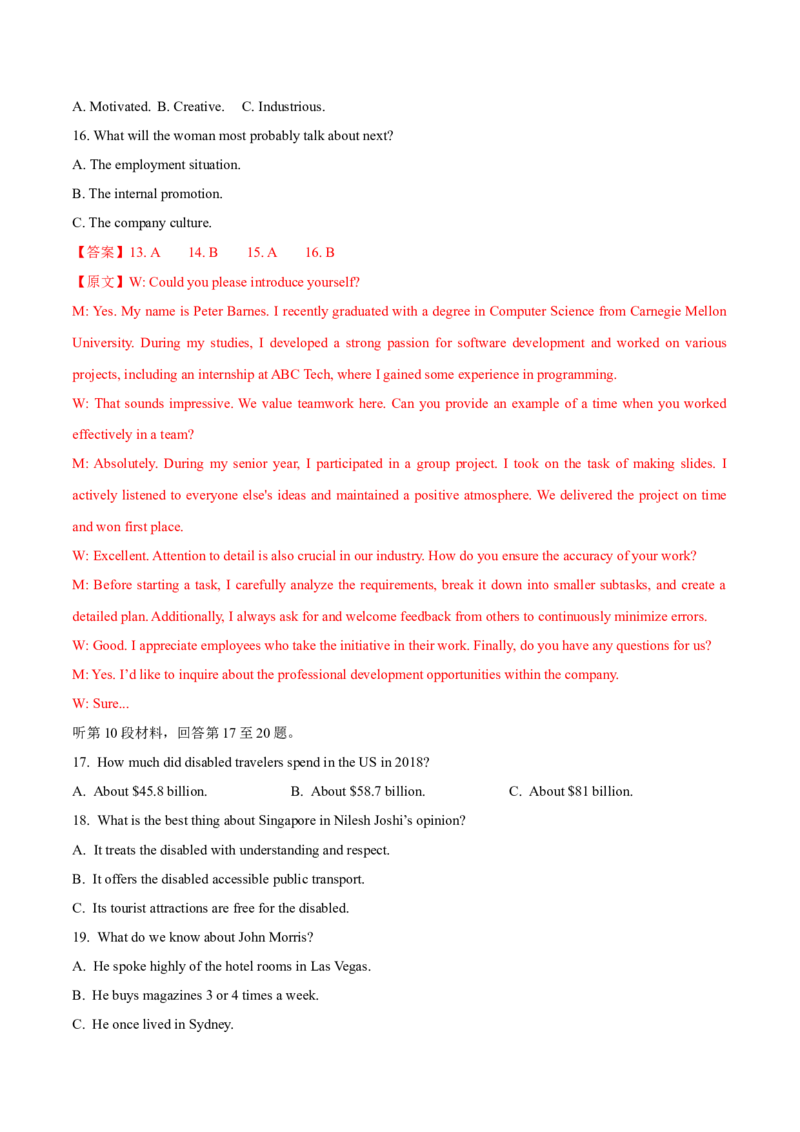
Dear Meghan, My 5-year-old daughter has been coming home and complaining
frequently about a particular classmate. They have been good friends, but she’s mentioned
several instances of hurt feelings. For example, he commented on her physical appearance
and told another friend to say they hate my kid.
What would you do here? How do you talk with your young kid about this in a way
that’s supportive? How do you talk with teachers in a way that’s cooperative? I’m a bit
sad that all this is already happening!
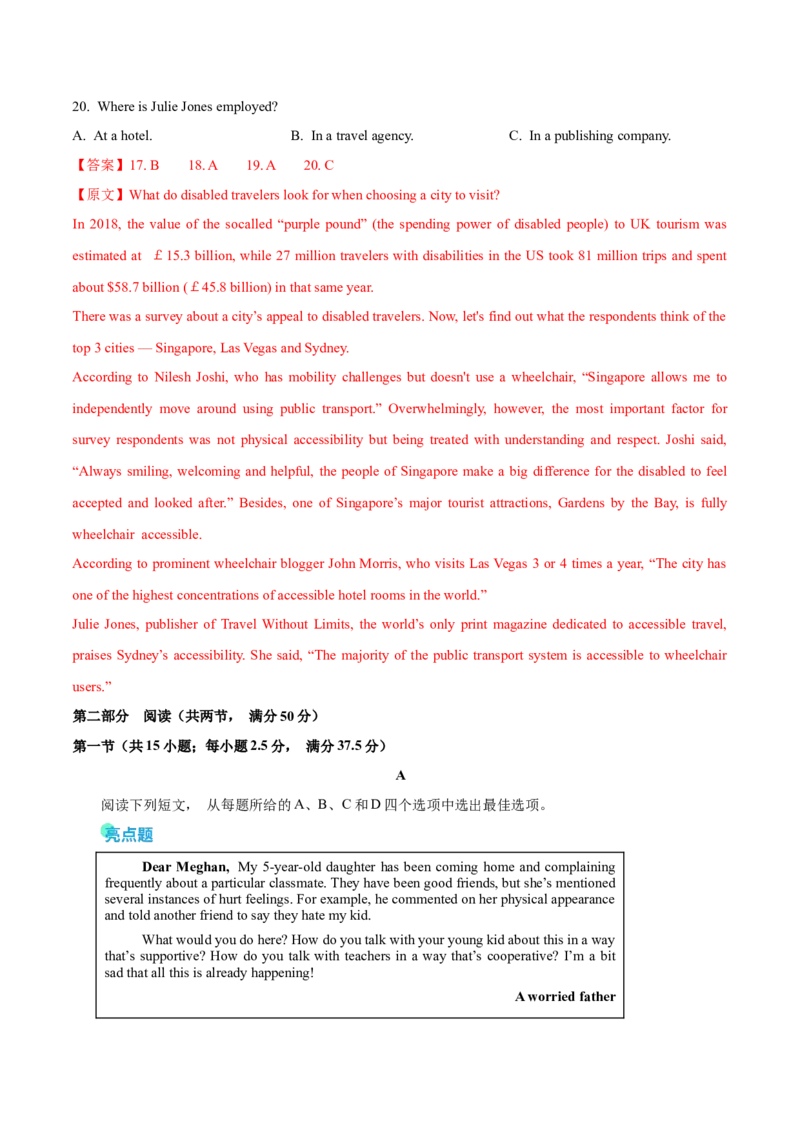
A worried fatherDear Sir, How lucky your daughter has such a wise father. It is worth calling the
teacher and saying, “Henry and Janet are exchanging some mean phrases. Have you seen
anything? Can you keep your eyes and ears open for anything that seems over the line?”
Keep the conversation with the teacher more curious and non-accusatory (非指责的).
Ask if there is anything you can do to help at home.
You can respond to your kid’s complaints in a way that centers on her feelings. If
your daughter comes home, saying, “Henry is mean,” and you respond, “We don’t speak
like that, that’s not nice,” the child learns to not share her emotions with her parents.
Similarly, if you say, “Tell me every single thing that he said to you, when and where,”
and begin an investigation, you are still teaching your child that her feelings don’t matter
because that’s not what’s being discussed. The best way is listening and reflecting back
the emotions that are behind the details. Every child feels better when their parent can
listen, reflect back and love them through it. Let her express sadness, anger and fear,
helping her slow down, reflect and own her experience more. It might be tempting to give
your kid specific ways to respond to these mean comments. You can use things like TV
shows and books where their favorite characters say “no”. You can also play a “fighting”
game and teach the child to say “no” or “stop” and then walk away. You can sign up for a
parenting class or find a parenting coach to support you. Emotion coaching takes lots of
practice, failure and some smart persistence; it’s a lifelong practice. Good luck.
Meghan
21.Why does the father write to Meghan?
A.His daughter complains of tough classes.
B.His daughter fails to cooperate with others.
C.His daughter is unsatisfied with her looks.
D.His daughter is upset about her friend’s words.
22.What’s Meghan’s purpose in writing the first paragraph of the reply?
A.To praise the father. B.To advise on the problem.
C.To accuse the teacher. D.To analyse the cause.
23.How does Meghan advise him to respond to his kid?
A.Tell the kid to speak nicely. B.Ask the kid to behave herself.
C.Investigate the details for the kid. D.Listen and reflect back her emotions.
【答案】21.D 22.B 23.D
【解析】本文是一篇应用文。文章为一位父亲写给Meghan的信,信中讲述了女儿的烦恼并寻求建议及
Meghan的回信。
21.细节理解题。根据第一封信中第一段“My 5-year-old daughter has been coming home and complaining
frequently about a particular classmate. They have been good friends, but she’s mentioned several instances of hurt
feelings. For example, he commented on her physical appearance and told another friend to say they hate my kid.
(我5岁的女儿回家后经常抱怨一个同学。他们一直是好朋友,但她提到了几个感情受到伤害的例子。例
如,他评论她的外表,并告诉另一个朋友说他们讨厌我的孩子)”可知,父亲给Meghan写信是因为他的女儿为她朋友的话而烦恼。故选D。
22.推理判断题。根据第二封信中第一段“How lucky your daughter has such a wise father. It is worth calling
the teacher and saying, “Henry and Janet are exchanging some mean phrases. Have you seen anything? Can you
keep your eyes and ears open for anything that seems over the line?” Keep the conversation with the teacher more
curious and non-accusatory (非指责的). Ask if there is anything you can do to help at home.(你女儿有这么聪
明的父亲真是幸运。有必要打电话给老师说:“亨利和珍妮特在互相骂脏话。你看到什么了吗?您可以睁
大眼睛,竖起耳朵,留意任何可能越界的东西吗?”保持与老师的对话更加好奇且非指责。问问自己在家
里是否有什么可以帮忙的)”可知,在回信中写第一段是为了对父亲提出的这个问题给出建议。故选B。
23.细节理解题。根据第二封信中“The best way is listening and reflecting back the emotions that are behind
the details. Every child feels better when their parent can listen, reflect back and love them through it. Let her
express sadness, anger and fear, helping her slow down, reflect and own her experience more.(最好的方法是倾
听并反映隐藏在细节背后的情绪。当父母能倾听、反映并通过这些来爱他们时,每个孩子都会感觉更好。
让她表达悲伤、愤怒和恐惧,帮助她放慢脚步,更多地反思和拥有自己的经历)”可知,Meghan建议父
亲能倾听并反映孩子的情绪。故选D。
B
Chinese Nobel Prize-winning physicist Zhen Ning Yang, one of the most influential scientists in
modern physics, passed away in Beijing on October 18 due to illness at the age of 103.
Born in 1922, Yang was brought up surrounded by the Tsinghua campus, where his father was a math
professor. After finishing his undergraduate degree, he obtained his master’s degree from Tsinghua. He enrolled in
the University of Chicago in the United States to pursue a doctorate in 1946 and was strongly influenced by Italian-
American physicist Enrico Fermi, who had won the same Nobel Prize in 1938. He later became a professor at the
Institute for Advanced Study in Princeton.
Yang won the Nobel Prize in 1957 with Tsung-Dao Lee for their investigation of the so-called parity laws
that led to “important discoveries regarding the elementary particles,” according to the Nobel Prize website. They
were the first Chinese-born Nobel Prize winners in physics.
Professor Yang was deeply devoted to his homeland, making remarkable contributions to China’s scientific
and educational developments. His visit to China in 1971 led to a wave of visits by overseas scholars, earning him
recognition as the pioneer in building the bridge of academic exchange between China and the United States. He
later proposed the restoration and strengthening of basic scientific research to China’s central leadership. He also
raised funds to establish the “Committee on Educational Exchange with China”, which has continuously sponsorednearly 100Chinese scholars for advanced studies in the United States. These scholars later became the backbone of
China’ s scientific and technological development. He undertook extensive work to promote China’s scientific and
technological exchange and progress, offering advice and exercising significant influence on major Chinese
scientific projects and the formulation (制定) of science and education policies.
After returning to Tsinghua University in 1999, he took on developing the Institute for Advanced Study as
his new mission. He poured enormous effort into advancing fundamental disciplines like physics and cultivating
talents at Tsinghua, making remarkable contributions that greatly impacted the reform and development of Chinese
higher education.
Professor Yang’s life stands as a timeless chapter in human history — one that shines not only for China but
for the global community of thinkers and innovators.
24.What is the article mainly about?
A.Yang’s lifelong contributions to China. B.Yang’s research on elementary particles.
C.Yang’s influence on global science policy.D.Yang’s educational background in America.
25.Why was Yang’s 1971 visit significant?
A.It focused on political dialogue. B.It promoted cultural activities in China.
C.It aimed to win a Nobel Prize for China. D.It initiated academic exchanges with the US.
26.What did Yang do for Chinese scholars?
A.He funded their advanced studies abroad.B.He helped them win international awards.
C.He taught them advanced physics personally. D.He offered them jobs in American universities.
27.How does the author view Yang’s contributions?
A.It is primarily for Chinese scientists. B.It belongs to the whole world.
C.It lies in his Nobel Prize achievement. D.It is mainly about educational reform.
【答案】24.A 25.D 26.A 27.B
【解析】本文是一篇记叙文。文章记述了诺贝尔奖得主物理学家杨振宁的生平事迹及其对中外科学界与教
育事业作出的卓越贡献。
24.主旨大意题。通读全文,特别是根据第四段中心句“Professor Yang was deeply devoted to his homeland,
making remarkable contributions to China’s scientific and educational developments.(杨教授对祖国深怀热爱,
为中国的科学和教育事业作出了卓越的贡献。)”和第五段中心句“After returning to Tsinghua University in
1999, he took on developing the Institute for Advanced Study as his new mission. (1999年回到清华大学后,他
把发展高等研究院作为自己的新使命。)”可知,文章重点展现杨振宁教授毕生对祖国的奉献。故选A。
25.细节理解题。根据第四段中“His visit to China in 1971 led to a wave of visits by overseas scholars, earninghim recognition as the pioneer in building the bridge of academic exchange between China and the United States.
(1971年,他对中国的访问引发了一波海外学者的访问浪潮,他被公认为建立中美学术交流桥梁的先
驱。)”可知,此次访问开创了中美学术交流。故选D。
26.细节理解题。根据第四段“ He also raised funds to establish the “Committee on Educational Exchange
with China”, which has continuously sponsored nearly 100Chinese scholars for advanced studies in the United
States.(他还筹集资金成立了“中美教育交流委员会”,该委员会已连续资助了近100名中国学者前往美
国深造)”可知,他为学者提供海外研修资助。故选A。
27.推理判断题。根据末段作者评价“Professor Yang’s life stands as a timeless chapter in human history—one
that shines not only for China but for the global community of thinkers and innovators.(杨教授的一生是人类历
史上永恒的篇章,不仅为中国,也为全球的思想家和创新者闪耀着光辉。)”可知,其贡献具有世界意义。
故选B。
C
Laura Mitchell, a cycling enthusiast, believes bikes bring kids independence and joy. Yet when
teaching her 6 and 9-year-olds to ride, she had to use a school parking lot — their neighborhood has dangerous
roads and intersections. Now skilled riders, the kids still can’t cycle unsupervised (无人监督的). Mitchell
worries about road safety, not her kids’ rule-following, admitting, “It’s chaotic out there, and I’ve had close calls.”
America’s roads have grown more chaotic in decades: higher speed limits, bigger vehicles, and more
aggressive, phone-distracted drivers. Though child injuries or deaths from cars while walking or biking have fallen
since the 1970s, the CDC says this is because fewer kids go outside, not safer streets. This creates a cycle: drivers
unaccustomed to kids drive less safely, causing more accidents. Thus, parents are more anxious and restrictive.
Peter Gray, a Boston College professor, notes that fewer kids are outside, which isn’t just for fear of cars.
Since the 1980s, society has seen kids as fragile, shrinking their ability to explore independently. He argues
childhood’s purpose is building independence, and without it, kids miss out on growing up. Though he advocates
for kids’ freedom, he won’t let his 5-year-old granddaughter bike outside — her road has no sidewalks and
speeding cars.
Esther Walker, from youth cycling nonprofit Outride, says fewer kids walk or bike to school. Outride works
with over 400 American and Canadian schools to teach safe riding. 20-50% of middle-schoolers in the program
have never touched a bike. After the program, kids value the freedom, confidence, joy, and new friendships biking
brings.
Some parents advocate for safer communities. San Francisco’s Mahdi Rahimi started Safe Streets Bernal topush for better intersection visibility, lower speeds, and protected bike lanes, hoping his kids can walk to the store
alone. Eric and Mary Beth Olson’s 5-year-old daughter Sidney was killed by a tractor-trailer in 2023. They founded
the Rainbow Fund to improve child safety after learning neighbors also avoided the dangerous intersection.
Mitchell now leads Our Streets, a transit safety nonprofit. She notes parents should push for safer spaces,
prepare kids for dangers, and wait for the right time to let them explore.
28.What is Laura Mitchell concerned about?
A.Traffic safety. B.Kids’ growth.
C.Kids’ independence. D.Cycling rules.
29.What does paragraph 2 mainly illustrate?
A.Parents’ anxiety and expectation.
B.Current dangerous road situation.
C.Declining road accidents in America.
D.Present condition of American vehicles.
30.What does the author want to convey by the cases of Gray and Walker?
A.Vehicle speeds must be limited.
B.Kids’ freedom needs safer roads.
C.Cycling to school requires more attention.
D.Kids’ exploring abilities are to be enhanced.
31.Why do some parents establish organizations?
A.To create safer environment for kids.
B.To arouse drivers’ safety awareness.
C.To call for government recognition.
D.To build up community responsibility.
【答案】28.A 29.B 30.B 31.A
【解析】这是一篇说明文。主要介绍了美国道路混乱致家长不敢让孩子独立骑行,专家指出这影响孩子独
立性,相关非营利组织开展骑行教学,部分家长成立机构推动社区安全。
28.细节理解题。根据第一段中“Mitchell worries about road safety, not her kids’ rule-following, admitting,
“It’s chaotic out there, and I’ve had close calls.”(米切尔担心的是道路安全,而不是孩子们是否遵守规则,她
承认:“外面很混乱,我差点就出事了。”)”可知,劳拉·米切尔担心交通安全。故选A项。
29.主旨大意题。根据第二段“America’s roads have grown more chaotic in decades: higher speed limits,
bigger vehicles, and more aggressive, phone-distracted drivers. Though child injuries or deaths from cars whilewalking or biking have fallen since the 1970s, the CDC says this is because fewer kids go outside, not safer streets.
This creates a cycle: drivers unaccustomed to kids drive less safely, causing more accidents. Thus, parents are more
anxious and restrictive.( 几十年来,美国的道路变得越来越混乱:更高的限速,更大的车辆,以及更激进、
更分心的司机。尽管自20世纪70年代以来,儿童在步行或骑自行车时因汽车受伤或死亡的人数有所下降,
但美国疾病控制与预防中心表示,这是因为外出的孩子减少了,而不是因为街道更安全。这就形成了一个
循环:不习惯有孩子的司机开车不安全,导致更多的事故。因此,父母更加焦虑和限制。)”可知,第二
段主要讲的是目前危险的道路情况。故选B项。
30.推理判断题。根据第三段中“Since the 1980s, society has seen kids as fragile, shrinking their ability to
explore independently. He argues childhood’s purpose is building independence, and without it, kids miss out on
growing up. Though he advocates for kids’ freedom, he won’t let his 5-year-old granddaughter bike outside — her
road has no sidewalks and speeding cars.( 自20世纪80年代以来,社会一直认为孩子是脆弱的,削弱了他们
独立探索的能力。他认为,童年的目的是建立独立,没有独立,孩子们就错过了成长的机会。虽然他提倡
孩子们的自由,但他不会让5岁的孙女在外面骑自行车——她(所在街道)的路上没有人行道,也没有超
速行驶的汽车。)”以及第四段中“Esther Walker, from youth cycling nonprofit Outride, says fewer kids walk or
bike to school. Outride works with over 400 American and Canadian schools to teach safe riding. 20%~50% of
middle-schoolers in the program have never touched a bike. 来自非营利青少年自行车组织Outride的埃斯特·沃
克(Esther Walker)表示,步行或骑自行车上学的孩子越来越少了。Outride与400多所美国和加拿大学校
合作,教授安全骑行。参与该项目的20%~50%的中学生从未接触过自行车。)”可推知,作者想通过格雷
和沃克的案例传达孩子的自由需要更安全的道路。故选B项。
31.推理判断题。根据第五段中“Some parents advocate for safer communities. San Francisco’s Mahdi Rahimi
started Safe Streets Bernal to push for better intersection visibility, lower speeds, and protected bike lanes, hoping
his kids can walk to the store alone. 一些家长提倡更安全的社区。旧金山的马赫迪·拉希米(Mahdi Rahimi)
创办了“安全街道Bernal”,以推动更好的十字路口能见度、更低的车速和保护自行车道,希望他的孩子们
可以独自步行去商店。)”可推知,有些家长建立组织是为了给孩子们创造更安全的环境。故选A项。
D
One of the best parts of being a parent has to be watching children discover the world around
them. “What’s that in your hand? Is it — a ball? Do you think it will roll down this hill?” you might ask your kid.
Then you get to enjoy their shouts of delight as they explore just that. Yet over time parents may find that their child
is becoming less curious about science. Why does this shift happen?There are, of course, a number of different factors at play, but according to a recent study, this loss of
interest may be partly the result of subtle (微妙的) language cues children hear.
When talking to children, many adults might say things like “Let’s be scientists today!” (to promote
curiosity) or “You’re such a good scientist!” (to praise a child). But this kind of language, which focuses on science
as an identity rather than a set of activities and actions that people do, can be demotivating. One study showed that
kids as young as four persisted longer when their cue to participate in science activities was “Let’s do science”
rather than “Let’s be scientists.”
But it’s also true that during adolescence, kids are actively trying on and ultimately forming different
identities for themselves. So in contrast to its demotivating effects on young children, identity focused language
may help teens stay interested in science. In one study, cueing a future identity based on science (such as “scientist”
or “doctor”) motivated middle schoolers to do more homework and was associated with higher grades. That might
be because if teens think of themselves as scientists, then they are willing to do what it takes to be the person they
want to become.
Focusing on these actions when children are young might help them persist in hard tasks or lessons. But as
older children gain experience in these areas and start forming ideas of whom they want to become, emphasizing
future science-dependent identities might also be helpful in maintaining an interest in science.
How these two versions of subtle language cues might work together has yet to be tested. Perhaps this
research could be done by your future scientist.
32.How do parents motivate their child’s curiosity about science?
A.By playing ball games. B.By keeping them company.
C.By giving language cues. D.By encouraging them to reply.
33.In which sentence, “at play” means the same with the underlined one?
A.This time curiosity is at play.
B.Unlucky in love, lucky at play.
C.The toy reminds us of when we were at play.
D.Pause and smell a rose or watch children at play.
34.What determines the effectiveness of language hints according to the research?
A.Language focus and kids’ age group.
B.Language diversity and kids’ grades.
C.Adults’ motivation and kids’ interest.
D.Adults’ identities and kids’ willingness.35.Which column is this text probably taken from?
A.Environment. B.Parenting. C.Health. D.Lifestyle.
【答案】32.C 33.A 34.A 35.B
【解析】这是一篇说明文。文章探讨孩子对科学的好奇心逐渐减弱的原因,指出语言暗示有影响——幼儿
适合“做科学”类表达,青少年适合身份类表达,可维持其科学兴趣。
32.推理判断题。根据第三段“When talking to children, many adults might say things like “Let’s be scientists
today!” (to promote curiosity) or “You’re such a good scientist!” (to praise a child). But this kind of language,
which focuses on science as an identity rather than a set of activities and actions that people do, can be
demotivating. One study showed that kids as young as four persisted longer when their cue to participate in science
activities was “Let’s do science” rather than “Let’s be scientists.”当和孩子们交谈时,许多成年人可能会说“今
天让我们成为科学家吧!”(激发好奇心)或者“你真是个好科学家!”(表扬孩子)。但这种把科学作
为一种身份而不是人们所做的一系列活动和行动的语言,可能会让人失去动力。一项研究表明,当参与科
学活动的提示是“让我们做科学”而不是“让我们成为科学家”时,四岁的孩子坚持的时间更长)”可推知,
父母通过给予语言暗示激发孩子对科学的好奇心。故选C项。
33.词句猜测题。根据第二段中“There are, of course, a number of different factors at play, but according to a
recent study, this loss of interest may be partly the result of subtle (微妙的) language cues children hear.(当
然,有许多不同的因素at play,但根据最近的一项研究,这种兴趣的丧失可能部分是孩子们听到的微妙语
言暗示的结果)”由此可知,此处为有许多不同的因素在起作用。故可猜测划线短语“at play”意为“起作
用、在发挥影响”,和A选项“This time curiosity is at play.( 这一次是好奇心在起作用。)”中的“at
play”意思一致。故选A项。
34.推理判断题。根据第四段中“So in contrast to its demotivating effects on young children, identity focused
language may help teens stay interested in science. In one study, cueing a future identity based on science (such as
“scientist” or “doctor”) motivated middle schoolers to do more homework and was associated with higher grades.
(因此,与其对幼儿的消极影响相反,以身份为中心的语言可能有助于青少年保持对科学的兴趣。在一项研
究中,基于科学的未来身份提示(如“科学家”或“医生”)激励中学生做更多的家庭作业,并与更高的
成绩相关)”可推知,根据研究,语言焦点和儿童年龄段决定了语言暗示的有效性。故选A项。
35.推理判断题。根据文章大意以及第一段“One of the best parts of being a parent has to be watching
children discover the world around them. “What’s that in your hand? Is it—a ball? Do you think it will roll down
this hill?” you might ask your kid. Then you get to enjoy their shouts of delight as they explore just that. Yet over
time parents may find that their child is becoming less curious about science. Why does this shift happen?(为人父母最好的部分之一就是看着孩子们发现他们周围的世界。“你手里拿的是什么?”它是一个球吗?你可能
会问你的孩子:“你觉得它会滚下山吗?”然后你就可以享受他们在探索的时候发出的喜悦的叫声了。然
而,随着时间的推移,父母可能会发现他们的孩子对科学的好奇心越来越少。为什么会发生这种转
变?)”可知,文章围绕“父母如何通过语言暗示激发不同年龄段孩子的科学好奇心” 展开,核心是育
儿相关的方法与研究,属于“育儿”专栏范畴。故选B项。
第二节(共5小题;每小题2. 5分, 满分12. 5分)
阅读下面短文, 从短文后的选项中选出可以填入空白处的最佳选项。选项中有两项为多余选项。
In the journey of life, there’s an often ignored hero — labor. Yes, that’s right, good old-fashioned hard work.
Whether it’s mowing lawns, babysitting, or washing dishes, the act of laboring not only fills pockets but also shapes
characters and molds futures.
Let’s face it, we live in a world where instant satisfaction is the norm (标准). But what if we told you
that delaying that satisfaction and putting in some good, honest sweat can actually be beneficial? It’s true! 36
37 Imagine a teenager tasked with mowing lawns for a summer job. Suddenly, they’re responsible
for showing up on time, doing a thorough job, and managing their earnings. These are life skills that no classroom
lecture can match.
Moreover, labor breeds (培养) perseverance. 38 Instead of throwing in the towel, they
persevere, learning from each setback and growing stronger in the process. This perseverance becomes a
cornerstone (基石) for success in all aspects of life.
But perhaps the most profound impact of labor is its ability to foster empathy and appreciation. 39
As teenagers serve meals to the less fortunate, they gain a newfound perspective on privilege and gratitude.
Suddenly, that new smartphone doesn’t seem as important as lending a helping hand to those in need.
In conclusion, labor isn’t just about earning a paycheck but it’s also about shaping character and building a
foundation for success. So, the next time you see a teenager sweating it out on a hot summer day, remember —
40
A.Labour is significantly beneficial to health.
B.Take, for instance, volunteering at a local soup kitchen.
C.Labor isn’t just about earning money and training skills.
D.First, labor gradually acquires a sense of responsibility.
E.Imagine a young adult facing rejection after rejection while job hunting.
F.they’re not just mowing lawns, they’re paving their path to a brighter future.G.The process of laboring teaches invaluable lessons that textbooks simply can’t convey.
【答案】36.G 37.D 38.E 39.B 40.F
【解析】这是一篇说明文。文章主要说明了在人生的旅程中,劳动和劳动技能的培养不仅赚了钱,而且塑
造了性格,塑造了未来,这是从书本上不能获得的。
36.上文“But what if we told you that delaying that satisfaction and putting in some good, honest sweat can
actually be beneficial? It’s true!(但如果我们告诉你,推迟这种满足,投入一些好的、诚实的劳动实际上是
有益呢?这是真的!)”是肯定劳动是有好处的,那么下文将说明劳动有哪些好处。选项G“The process of
laboring teaches invaluable lessons that textbooks simply can’t convey. (劳动的过程教会了教科书无法传达的
宝贵教训。)”符合语境。故选G。
37.这是段首句,是标题句。下文“Suddenly, they’re responsible for showing up on time, doing a thorough
job, and managing their earnings. These are life skills that no classroom lecture can match. (突然之间,他们很
负责,会按时到场,从头到尾多做工作,并管理自己的收入。这些都是任何课堂讲座都无法匹配的生活技
能。)”是说明劳动会培养责任感。选项D“First, labor gradually acquires a sense of responsibility (首先,
劳动逐渐获得了一种责任感。)”,同时,First与下文的Moreover呼应。故选D。
38.根据上文“Moreover, labor breeds perseverance. (此外,劳动还能培养出毅力。)”和下文“Instead
of throwing in the towel, they persevere, learning from each setback and growing stronger in the process. This
perseverance becomes a cornerstone for success in all aspects of life. (他们没有认输,而是坚持不懈,从每一
次挫折中学习,并在这个过程中变得更强大。这种毅力成为在生活的各个方面取得成功的基石。)”,可
知空格处要举例说明劳动如何培养出毅力。选项E“Imagine a young adult facing rejection after rejection while
job hunting. (想象一下,一个年轻人在求职时面临被一而再地拒绝。)”符合此语境。故选E。
39.根据上文“But perhaps the most profound impact of labor is its ability to foster empathy and appreciation.
(但也许劳动最深刻的影响是它培养共情心和欣赏的能力。)”和下文“As teenagers serve meals to the less
fortunate, they gain a newfound perspective on privilege and gratitude. (当青少年为不幸的人提供食物时,他
们对特权和感激有了一种新的看法。)”,可知空格处引出了如何培养共情心和欣赏的能力的例子,可以
承接上文,引出下文。选项B“Take, for instance, volunteering at a local soup kitchen. (以在当地的施粥所做
志愿者为例。)”符合此语境。故选B。
40.本句是文章尾段的尾句,结合上文“In conclusion, labor isn’t just about earning a paycheck but it’s also
about shaping character and building a foundation for success. (总之,劳动不仅仅在于挣钱,还在于塑造性
格和为成功奠定基础。)”,可知破折号后对劳动的意义进一步说明,给出了忠告。选项F“So, the next
time you see a teenager sweating it out on a hot summer day, remember — they’re not just mowing lawns, they’repaving their path to a brighter future (所以,下次当你看到一个青少年在炎热的夏天大汗淋漓的时候,请记
住——他们不只是在修剪草坪,他们还在为通往更光明的未来铺平道路。)”符合语境。故选F。
第三部分 语言运用(共两节,满分30分)
第一节(共15小题,每小题1分,满分15分)
阅读下面短文, 从每题所给的A、B、C和D四个选项中选出可以填入空白处的最佳选项。
Ella, together with her dad and grandma, moved to Alaska when dad got a railroad job there. Ella loved the
new place 41 . Grandma, though, hated it. She 42 about the bone-chilling cold. She spent her
days by the window, her knitting needles idle in her lap, longing for the Kansas sun and her 43 .
Ella’s worry grew into a tight knot in her chest. 44 , she turned to her new friend, Sarah, and her
kind aunt, Grace. “She 45 her sunflowers,” Ella explained. Grace suggested making a sunflower-
patterned quilt. The three secretly sewed it, using 46 threads for sunflowers Ella fetched from home.
Yet Ella soon noticed grandma growing 47 — she even cried one day, saying, “I’m so 48
.” Ella realized she’d been so busy sewing that she’d 49 grandma. What grandma needed wasn’t a quilt,
but 50 .
Ella took grandma to Sarah’s house, where she 51 the quilt project. Tears filled grandma’s eyes.
“You did this for me?” She 52 them, and the four sewed together. They talked, 53 stories of
Kansas and Alaska, laughed at Sarah’s jokes, and listened to Grace’s wisdom. Grandma’s skilled fingers guided the
younger ones, her laughter joining theirs. Ella knew then that they weren’t just sewing a quilt; they were 54
her grandmother’s heart, and in doing so, they were building a new 55 , together, under the vast Alaskan
sky.
41.A.consequently B.instantly C.finally D.casually
42.A.worried B.inquired C.complained D.commented
43.A.quilts B.garden C.neighborhood D.sunflowers
44.A.Desperate B.Confused C.Disappointed D.Awkward
45.A.admires B.cuts C.misses D.plants
46.A.strong B.bright C.expensive D.rare
47.A.weaker B.older C.stranger D.sadder
48.A.exhausted B.worthless C.hopeless D.homesick
49.A.deserted B.neglected C.blamed D.spoiled
50.A.encouragementB.help C.company D.pity
51.A.revealed B.evaluated C.accomplished D.designed52.A.comforted B.observed C.congratulated D.joined
53.A.shared B.read C.invented D.adapted
54.A.opening B.winning C.softening D.mending
55.A.relationship B.life C.identity D.style
【答案】
41.B 42.C 43.D 44.A 45.C 46.B 47.D 48.D 49.B 50.C
51.A 52.D 53.A 54.D 55.B
【解析】这是一篇记叙文。讲述了Ella随家人搬到阿拉斯加后,通过和朋友、阿姨一起为奶奶缝制被子,
在阿拉斯加开启新生活的故事。
41.考查副词词义辨析。句意:Ella立刻就爱上了这个新地方。A. consequently因此;B. instantly立刻;C.
finally最终;D. casually随意地。根据前文“Ella loved the new place”可知,Ella对新地方的喜爱是即时的。
故选B。
42.考查动词词义辨析。句意:她抱怨刺骨的寒冷。A. worried担心;B. inquired询问;C. complained抱怨;
D. commented评论。根据前文“Grandma, though, hated it.”可知奶奶不喜欢阿拉斯加,会抱怨寒冷。故选
C。
43.考查名词词义辨析。句意:她整天坐在窗边,编织针在腿上闲置着,渴望堪萨斯的阳光和她的向日葵。
A. quilts被子;B. garden花园;C. neighborhood街区;D. sunflowers向日葵。根据后文“She her
sunflowers”可知,此处是指向日葵。故选D。
44.考查形容词词义辨析。句意:绝望中,她向她的新朋友Sarah和善良的阿姨Grace求助。A. Desperate
绝望的;B. Confused困惑的;C. Disappointed失望的;D. Awkward尴尬的。根据前文“Ella’s worry grew
into a tight knot in her chest.”可知Ella很担心,所以是绝望地寻求帮助。故选 A。
45.考查动词词义辨析。句意:“她想念她的向日葵,”Ella 解释道。A. admires钦佩;B. cuts切割;C.
misses想念;D. plants种植。根据前文“longing for the Kansas sun and her.”以及后文“Grace suggested
making a sunflower-patterned quilt.”可知,此处是指奶奶想念向日葵。故选C。
46.考查形容词词义辨析。句意:三个人秘密地缝制它,使用 Ella 从家里拿来的明亮的线来制作向日葵。
A. strong强壮的;B. bright鲜艳的,明亮的;C. expensive昂贵的;D. rare稀有的。向日葵颜色明亮,所以
用明亮的线制作。根据前文“making a sunflower-patterned quilt”可知,用颜色鲜艳的线缝制贴合向日葵花
瓣的特征。故选B。
47.考查形容词词义辨析。句意:然而,Ella很快注意到奶奶变得更悲伤了。有一天她甚至哭了,说:
“我太想家了。”A. weaker更弱的;B. older更老的;C. stranger更陌生的;D. sadder更悲伤的。根据后文
“she even cried one day”可知,此处是指奶奶更悲伤了。故选D。48.考查形容词词义辨析。句意:然而,Ella很快注意到奶奶变得更悲伤了。有一天她甚至哭了,说:
“我太想家了。”A. exhausted疲惫的;B. worthless无价值的;C. hopeless绝望的;D. homesick想家的。
根据前文“Ella loved the new place . Grandma, though, hated it.”以及“longing for the Kansas sun”可知,此处
是指奶奶想家。故选D。
49.考查动词词义辨析。句意:Ella意识到她一直忙着缝纫,忽视了奶奶。A. deserted抛弃;B. neglected
忽视;C. blamed责备;D. spoiled宠坏。根据前文“she even cried one day”以及“Ella realized she’d been so
busy sewing”可知,此处是指Ella忽视了奶奶。故选B。
50.考查名词词义辨析。句意:奶奶需要的不是被子,而是陪伴。A. encouragement鼓励;B. help帮助;
C. company陪伴;D. pity同情。根据前文“she’d been so busy sewing”可知,此处是指Ella忙于做被子,以
至于没能陪伴奶奶。故选C。
51.考查动词词义辨析。句意:Ella带奶奶去Sarah家,在那里她透露了被子的计划。A. revealed透露,揭
示;B. evaluated评估;C. accomplished完成;D. designed设计。根据前文“secretly sewed it”可知,之前是
秘密缝制,现在告诉了奶奶,所以是透露被子的计划。故选A。
52.考查动词词义辨析。句意:她加入了她们,四个人一起缝制。A. comforted安慰;B. observed观察;C.
congratulated祝贺;D. joined加入。根据前文“The three secretly sewed it”以及后文“the four sewed
together” 可知,此处是指奶奶加入了她们三人当中一起织被子。故选D。
53.考查动词词义辨析。句意:她们分享堪萨斯和阿拉斯加的故事,听Sarah的笑话大笑,聆听Grace的
智慧。A. shared分享;B. read阅读;C. invented发明;D. adapted适应。根据后文“stories of Kansas and
Alaska” 可知,此处是指她们聚在一起聊天谈心、分享故事。故选A。
54.考查动词词义辨析。句意:Ella那时知道,她们不仅仅是在缝制一床被子,更是在修补奶奶的心,在
这个过程中,她们在阿拉斯加广阔的天空下,共同构筑一种崭新的生活。A. opening打开;B. winning赢得;
C. softening软化;使柔和;缓和;D. mending修补。根据前文“she even cried one day”和后文“Grandma’s
skilled fingers guided the younger ones, her laughter joining theirs.”可知,此处侧重修补奶奶受伤的心情,
mending更贴合弥补思念带来的心灵空缺的语境。故选D。
55.考查名词词义辨析。句意:Ella那时知道,她们不仅仅是在缝制一床被子,更是在修补奶奶的心,在
这个过程中,她们在阿拉斯加广阔的天空下,共同构筑一种崭新的生活。A. relationship关系;B. life生活;
C. identity身份;D. style风格。根据前文“moved to Alaska”可知,搬到阿拉斯加后,她们一起在新的城市
构筑了新的生活。故选B。
第二节(共10小题;每小题1.5分 ,满分15分)
阅读下面短文,在空白处填入1个适当的单词或括号内单词的正确形式。Some 4,000 years ago, the Liangzhu culture, known for its sophisticated city of canals 56 (call)
“China’s Venice of the Stone Age,” suddenly disappeared. Historians debated whether war, disease, or starvation
caused its collapse, but recent research points to climate change 57 a key factor.
Located near the East China Sea, Liangzhu 58 (be) home to an advanced Stone Age civilization
for about 1,000 years, supporting an active agricultural system through its canals. Liangzhu City was listed as
59 UNESCO World Heritage Site in 2019.
Researchers from the University of Innsbruck had long sought to explain 60 Liangzhu was
abandoned, and the discovery of a thin layer of clay on the ruins suggested a possible connection between the ends
of the advanced civilization 61 floods of the Yangtze River or floods from the East China Sea. However,
no clear conclusions on the cause were possible from the mud layer 62 (it).
A breakthrough came when scientists studied stalagmites (石笋) from two nearby underwater caves. As
Dr. Peter Dockrill reported for Science Alert, their team discovered chemical signatures from about 4,300 years ago
that showed extremely high rainfall, 63 (probable) caused by the 64 (warm) of ocean waters
in the Pacific — an event known as the El Niño (厄尔尼诺).
The study notes that wet conditions lasted for several hundred years following the collapse of Liangzhu,
eventually paving the way for the rise of the Xia dynasty in 2070 B.C.E. Its celebrated 65 (found), Yu
the Great, introduced more extensive flood-control methods and is known as the “Tamer of the Flood.”
【答案】
56.called 57.as 58.was 59.a 60.why 61.and 62.itself 63.probably
64.warming 65.founder
【解析】本文是一篇说明文。主要介绍良渚文化的历史地位、消失之谜,以及最新研究揭示的气候变化
(厄尔尼诺)这一关键致因。
56.考查非谓语动词。句意:大约4000年前,以其复杂的运河城市——被称为“石器时代的中国威尼斯”
——而闻名的良渚文化突然消失了。此处为非谓语动词,canals与call为被动关系,用过去分词called作后
置定语。故填called。
57.考查介词。句意:历史学家们争论是战争、疾病还是饥饿导致了它的崩溃,但最近的研究指出气候变
化是一个关键因素。此处为固定搭配“point to...as...”,意为“指出……是……”,用介词as。故填as。
58.考查动词时态和主谓一致。句意:良渚位于中国东海附近,在约1000年的时间里一直是先进石器时代
文明的发源地,通过其运河支撑着活跃的农业系统。此处为谓语动词,描述良渚文化存续期间的状态,用
一般过去时;主语Liangzhu为单数,所以谓语动词用was。故填was。
59.考查冠词。句意:良渚古城于2019年被列为联合国教科文组织世界遗产。UNESCO World HeritageSite为可数名词单数,空前无限定词,所以此处使用冠词,结合句意,此处泛指“一处世界遗产”,且
UNESCO是以辅音音素开头的单词,用不定冠词a。故填a。
60.考查宾语从句。句意:因斯布鲁克大学的研究人员长期以来一直试图解释良渚为何被遗弃,而在废墟
上发现的一层薄薄的黏土表明,这个先进文明的终结与长江洪水或东海洪水之间可能存在联系。此处为连
接词引导的宾语从句,从句中缺少原因状语,用连接词why。故填why。
61.考查连词。句意:因斯布鲁克大学的研究人员长期以来一直试图解释良渚为何被遗弃,而在废墟上发
现的一层薄薄的黏土表明,这个先进文明的终结与长江洪水或东海洪水之间可能存在联系。此处为固定搭
配“between...and...”,意为“……和……之间”,用连词and。故填and。
62.考查反身代词。句意:然而,仅从黏土层本身无法得出关于原因的明确结论。此处强调“黏土层本
身”,用it的反身代词itself作同位语,起强调作用。故填itself。
63.考查副词。句意:正如彼得·多克里尔博士为《科学警报》所报道的那样,他们的团队发现了大约
4300年前的化学特征,显示当时降雨量极大,这可能是由太平洋海水变暖——一种被称为厄尔尼诺的现象
——引起的。此处修饰动词caused,用probable的副词形式probably,意为“可能地”。故填probably。
64.考查名词。句意:正如彼得·多克里尔博士为《科学警报》所报道的那样,他们的团队发现了大约
4300年前的化学特征,显示当时降雨量极大,这可能是由太平洋海水变暖——一种被称为厄尔尼诺的现象
——引起的。此处作介词by的宾语,用warm的名词形式warming,意为“变暖”,为不可数名词。故填
warming。
65.考查名词。句意:它著名的创始人大禹引入了更广泛的防洪方法,被称为“治水英雄”。此处作主语,
用found的名词形式founder,意为“创始人、建立者”,由后文Yu the Great(大禹)可知用单数形式。故
填founder。
第四部分 写作(共两节, 满分40分)
第一节(满分15分)
学校英文报发起一个“Making friends online or offline”的讨论。请你写一篇短文投稿,内容包括:
1. 你的看法;
2. 说明理由。
注意:
1. 写作词数应为80个左右;
2. 请按如下格式在答题卡的相应位置作答。
____________________________________________________________________________________________
________________________________________________________________________________________________________________________________________________________________________________________
____________________________________________________________________________________________
____________________________________________________________________________________________
____________________________________________________________________________________________
____________________________________________________________________________________________
【答案】
As for making friends online or offline, I prefer online friendships. In my view, they offer unique advantages
that offline ones cannot match.
Firstly, online platforms break geographical limits. I can connect with people from different countries, learning
about diverse cultures and perspectives that broaden my horizons. Secondly, it’s easier to find like-minded friends
online. Sharing specific hobbies, like reading classic novels or playing musical instruments, helps build deep
connections quickly. Finally, online communication allows me to be more open. When talking to strangers, I feel
less pressured to hide my true thoughts.
Though offline friendships are valuable, online ones enrich my life in special ways.
【解析】本篇书面表达属于应用文。要求考生就“线上或线下交友”发表观点,阐述倾向线上交友的理由。
【详解】1. 词汇积累
独特的:unique → distinctive
优势:advantages → merits
连接:connect → link
多样的:diverse → varied
珍贵的:valuable → precious
2. 句式拓展
合并简单句
原句:Secondly, it’s easier to find like-minded friends online. Sharing specific hobbies, like reading classic novels
or playing musical instruments, helps build deep connections quickly.
拓展句:Secondly, it’s easier to find like-minded friends online, with whom I can share specific hobbies, like
reading classic novels or playing musical instruments, which helps build deep connections quickly.
【点睛】【高分句型1】In my view, they offer unique advantages that offline ones cannot match. (运用了that
引导的限制性定语从句)
【高分句型2】When talking to strangers, I feel less pressured to hide my true thoughts. (运用了when引导的
时间状语从句的省略)第二节(满分25分)
阅读下面材料,根据其内容和所给段落开头语续写两段,使之构成一篇完整的短文。
Peter and Oliver were crazy about basketball. After school, you could always find them on the school
basketball court, sweat dripping from their foreheads as the sun dipped low. Peter had a natural talent for shooting
hoops, while Oliver struggled a little with his dribbling (运球). Though Oliver didn’t play as well as Peter, he
was a warm-hearted child willing to accept others’ opinions. The basketball court often witnessed their laughter
mixed with the sound of the ball bouncing on the concrete.
A piece of exciting news came one day: the school would attend a youth basketball tournament of the city.
All boys buzzed with excitement. Almost every one of them wanted to join the school team, and Peter and Oliver
wanted it more than anyone else. “Imagine us playing together on the court, representing our school!” Peter said
one day, grinning. Oliver’s eyes lit up. From that day on, they trained even harder. They woke up early to practice
before school, worked on passing drills during lunch breaks, and stayed late to perfect their shots. Oliver’s skills
got better, but he still looked up to Peter.
The day the school team list was announced finally arrived. Everyone sat on the edge of their seats, waiting
for the headmaster, Mr. Lee, to speak. Peter sat up straight, confident he’d make it. But Oliver’s hands were
shaking, and he stared at his desk, too nervous to look up. Peter gently nudged (轻推) him. “Don’t worry,” he
whispered. “We’re both getting in. I know it.”
Mr. Lee started reading the names: “Tom, Jake, Sam… Peter.” A big smile spread across Peter’s face. He
turned to high-five Oliver, only to see Oliver’s pale face. Mr. Lee finished the list, and Oliver’s name wasn’t there.
Oliver’s shoulders slumped, and he stared out the window, blinking hard to hold back tears. After Mr. Lee left,
Oliver dashed out of the room.
注意:
1. 续写词数应为150左右;
2. 请按如下格式在答题卡的相应位置作答。
Peter ran after Oliver, trying to comfort him.
____________________________________________________________________________________________
____________________________________________________________________________________________
____________________________________________________________________________________________
____________________________________________________________________________________________
________________________________________________________________________________________________________________________________________________________________________________________
____________________________________________________________________________________________
____________________________________________________________________________________________
____________________________________________________________________________________________
The match day saw Oliver sitting beside the court, happily watching.
____________________________________________________________________________________________
____________________________________________________________________________________________
____________________________________________________________________________________________
____________________________________________________________________________________________
____________________________________________________________________________________________
____________________________________________________________________________________________
____________________________________________________________________________________________
____________________________________________________________________________________________
____________________________________________________________________________________________
【答案】
Peter ran after Oliver, trying to comfort him. Peter sat silently beside him. “Don’t be sad. You have your
advantages. Don’t give up on yourself just because of one failure.” He patted Oliver on the shoulder, looking
straight into his eyes sincerely. Then Peter told Oliver that because he was meticulous, considerate and had strong
organizational skills, the team needed him. Serving the team was as meaningful as playing on the court. Oliver
lowered his head and thought for a while, then nodded, knowing what he should do. Oliver and Peter smiled
knowingly at each other.
The match day saw Oliver sitting beside the court, happily watching. He brought water bottles for everyone,
wiped the sweat off their faces with towels, and shouted loudest when Peter scored a three-pointer. In the final
minute, Tom twisted his ankle and had to stop. Mr. Lee looked worried — until Peter pointed at Oliver. “Let him
play!” he yelled. Oliver froze, then rushed onto the court. With the crowd cheering, he made a perfect pass to Peter,
who won the game with a last-second shot. Afterward, Oliver grinned at Peter. “We did it,” he said. Peter laughed.
“Told you we’d play together.”
【解析】本文以人物为线索展开,讲述了Peter和Oliver热爱篮球,为参加青年篮球锦标赛刻苦训练,学校
公布校队名单时,Peter入选而Oliver落选,Oliver伤心地冲出教室,Peter追出去安慰他。
【详解】段落续写:①由第一段首句内容“彼得追着奥利弗跑,试图安慰他。”可知,第一段可描写彼得安慰奥利弗,告诉他
落选并不意味着他不够好,他有自己的优势,团队需要他,奥利弗思考后点头。
②由第二段首句内容“比赛当天,奥利弗坐在球场边,开心地看着。”可知,第二段可描写奥利弗在比赛
时为队员服务,在最后关键时刻,奥利弗上场并完美传球给彼得,彼得投进最后一球赢得比赛。
续写线索:彼得安慰——奥利弗思考——奥利弗为队员服务——奥利弗上场——完美传球——赢得比赛
词汇激活
行为类
①轻拍:pat/tap
②大喊:yell/exclaim
③冲上:rush onto/dash onto
情绪类
①真诚地:sincerely/genuinely
②担心的:worried/concerned