绝密★启用前
2026 年高考二轮信息必刷卷02
英 语
(考试时间:120 分钟 试卷满分:130 分)
注意事项:
1. 答题前,考生先将自己的姓名、准考证号码填写清楚,将条形码准确粘贴在条形码区域内。
2. 选择题必须使用2B 铅笔填涂;非选择题必须使用0. 5 毫米黑色字迹的签字笔书写,字体工整,笔迹清楚。
3. 请按照题号顺序在答题卡各题目的答题区域内作答,超出答题区域书写的答案无效;在草稿纸、试卷上
答题无效。
4. 作图可先使用铅笔画出,确定后必须用黑色字迹的签字笔描黑。
5. 保持卡面清洁,不要折叠、不要弄破、弄皱,不准使用涂改液、修正带、刮纸刀。
第一部分 听力(略)
第二部分 阅读(共两节, 满分50 分)
第一节(共15 小题;每小题2.5 分, 满分37.5 分)
阅读下列短文, 从每题所给的A、B、C 和D 四个选项中选出最佳选项。
A
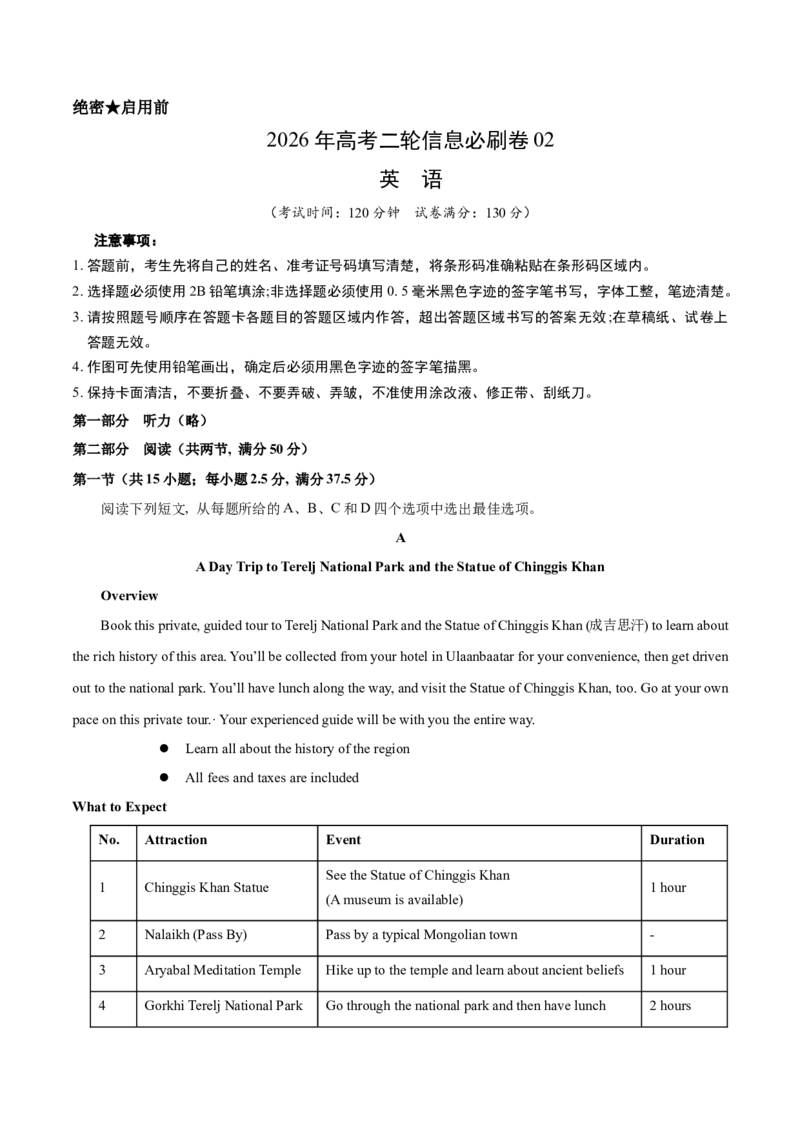
A Day Trip to Terelj National Park and the Statue of Chinggis Khan
Overview
Book this private, guided tour to Terelj National Park and the Statue of Chinggis Khan (成吉思汗) to learn about
the rich history of this area. You’ll be collected from your hotel in Ulaanbaatar for your convenience, then get driven
out to the national park. You’ll have lunch along the way, and visit the Statue of Chinggis Khan, too. Go at your own
pace on this private tour.· Your experienced guide will be with you the entire way.
Learn all about the history of the region
All fees and taxes are included
What to Expect
No.
Attraction
Event
Duration
1
Chinggis Khan Statue
See the Statue of Chinggis Khan
(A museum is available)
1 hour
2
Nalaikh (Pass By)
Pass by a typical Mongolian town
-
3
Aryabal Meditation Temple
Hike up to the temple and learn about ancient beliefs
1 hour
4
Gorkhi Terelj National Park
Go through the national park and then have lunch
2 hours
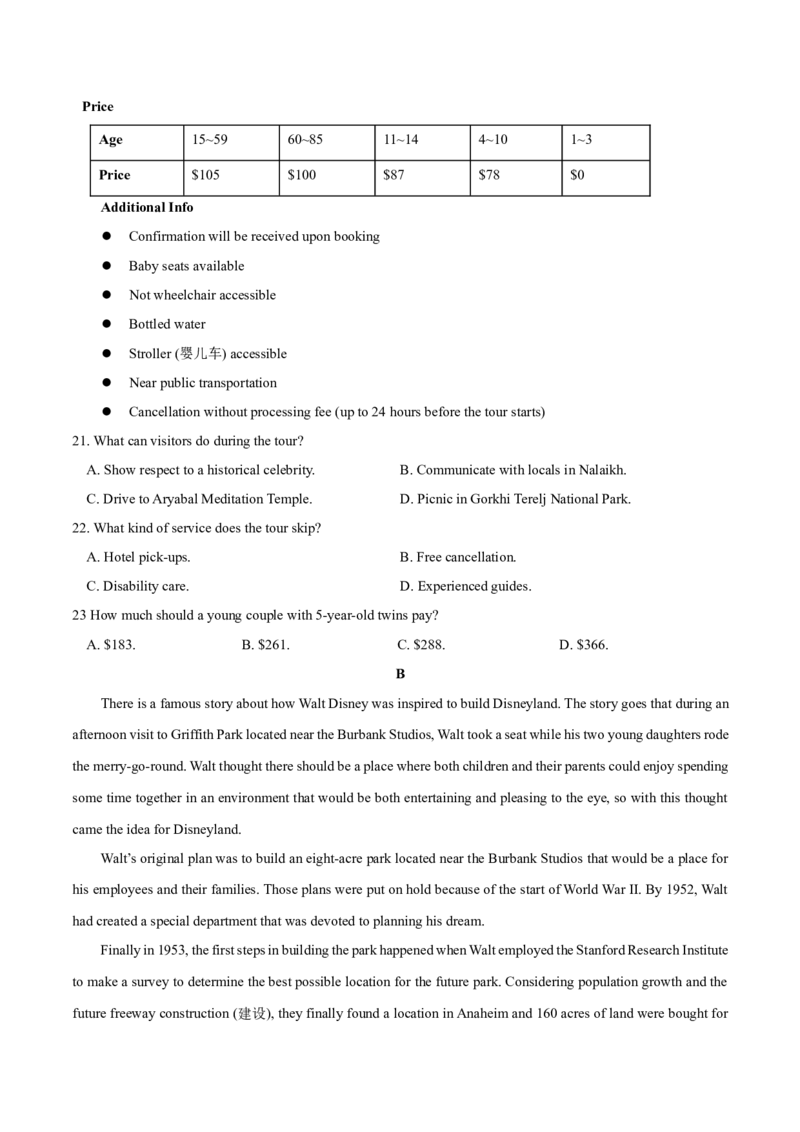
Price
Age
15~59
60~85
11~14
4~10
1~3
Price
$105
$100
$87
$78
$0
Additional Info
Confirmation will be received upon booking
Baby seats available
Not wheelchair accessible
Bottled water
Stroller (婴儿车) accessible
Near public transportation
Cancellation without processing fee (up to 24 hours before the tour starts)
21. What can visitors do during the tour?
A. Show respect to a historical celebrity.
B. Communicate with locals in Nalaikh.
C. Drive to Aryabal Meditation Temple.
D. Picnic in Gorkhi Terelj National Park.
22. What kind of service does the tour skip?
A. Hotel pick-ups.
B. Free cancellation.
C. Disability care.
D. Experienced guides.
23 How much should a young couple with 5-year-old twins pay?
A. $183.
B. $261. C. $288.
D. $366.
B
There is a famous story about how Walt Disney was inspired to build Disneyland. The story goes that during an
afternoon visit to Griffith Park located near the Burbank Studios, Walt took a seat while his two young daughters rode
the merry-go-round. Walt thought there should be a place where both children and their parents could enjoy spending
some time together in an environment that would be both entertaining and pleasing to the eye, so with this thought
came the idea for Disneyland.
Walt’s original plan was to build an eight-acre park located near the Burbank Studios that would be a place for
his employees and their families. Those plans were put on hold because of the start of World War II. By 1952, Walt
had created a special department that was devoted to planning his dream.
Finally in 1953, the first steps in building the park happened when Walt employed the Stanford Research Institute
to make a survey to determine the best possible location for the future park. Considering population growth and the
future freeway construction (建设), they finally found a location in Anaheim and 160 acres of land were bought for
the site of the new park.
The building of the park was very expensive and to collect money for the project, Walt developed the idea of the
“Walt Disney’s Disneyland” television show. It turned out to be a marvelous idea—not only gaining the money to
build the park but also presenting the park to the American public.
Construction officially began on July 21, 1954, and it was an ambitious (野心勃勃的) building schedule of less
than one year to complete the new park for the projected opening day. Walt watched over the park’s construction and
progress continued with just a few minor hold-ups. Finally, the park was ready for the Opening Day on July 17,
1955.
24. What inspired Walt Disney to build Disneyland?
A. The special design of Griffith Park.
B. A trip to a park with his daughters.
C. Requests from his family and employees.
D. The idea to build a park for his daughters.
25. What is mainly considered in choosing the location of Disneyland?
A. Walt Disney’s personal preference.
B. The natural environment.
C. The advice of the public.
D. Local traffic.
26. What can we learn about the construction process?
A. It was smooth generally.
B. It was affected by World War II.
C. It was completed later than expected.
D. It was influenced by a shortage of money.
27. Where is the next most likely from?
A. A travel journal.
B. An autobiography.
C. A magazine.
D. A guidebook.
C
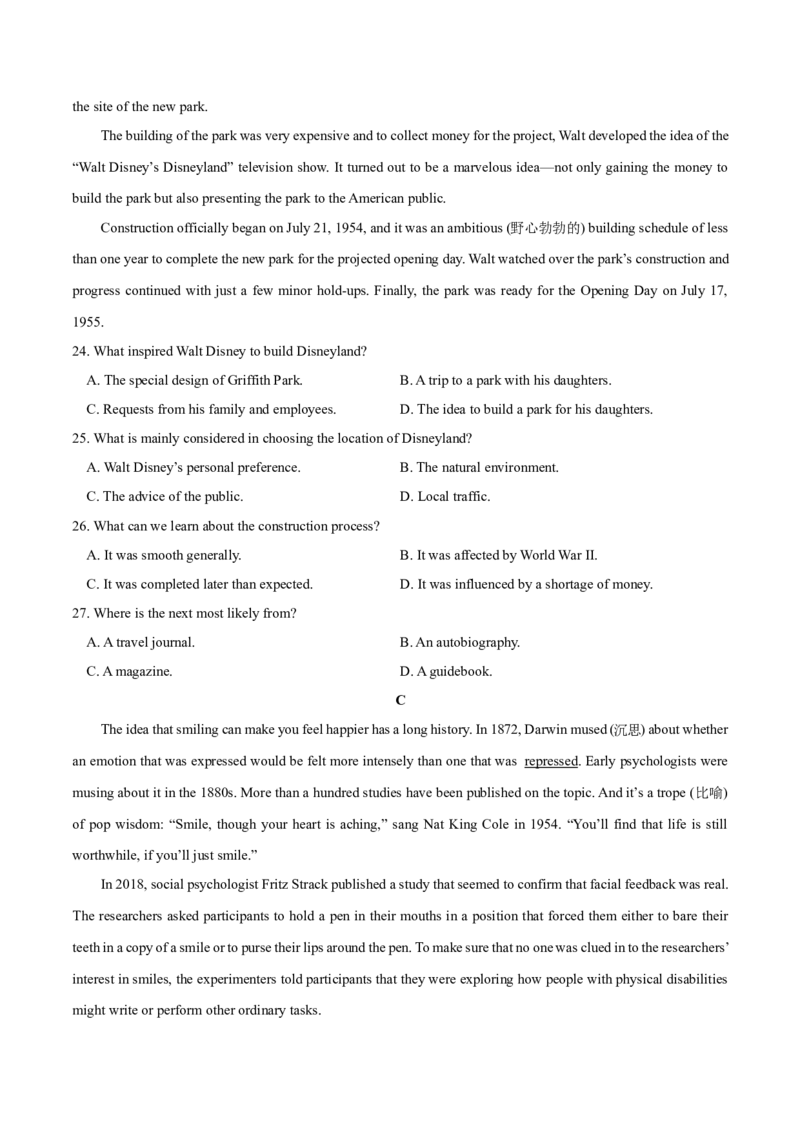
The idea that smiling can make you feel happier has a long history. In 1872, Darwin mused (沉思) about whether
an emotion that was expressed would be felt more intensely than one that was repressed. Early psychologists were
musing about it in the 1880s. More than a hundred studies have been published on the topic. And it’s a trope (比喻)
of pop wisdom: “Smile, though your heart is aching,” sang Nat King Cole in 1954. “You’ll find that life is still
worthwhile, if you’ll just smile.”
In 2018, social psychologist Fritz Strack published a study that seemed to confirm that facial feedback was real.
The researchers asked participants to hold a pen in their mouths in a position that forced them either to bare their
teeth in a copy of a smile or to purse their lips around the pen. To make sure that no one was clued in to the researchers’
interest in smiles, the experimenters told participants that they were exploring how people with physical disabilities
might write or perform other ordinary tasks.
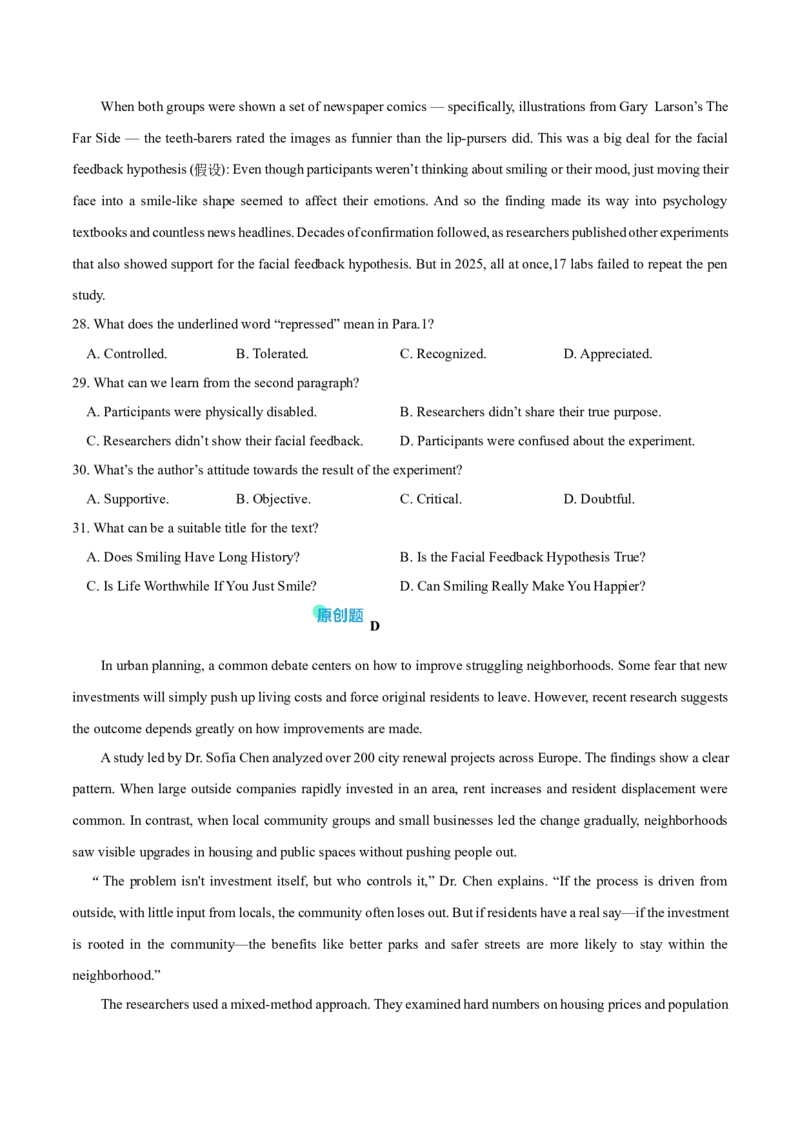
When both groups were shown a set of newspaper comics — specifically, illustrations from Gary Larson’s The
Far Side — the teeth-barers rated the images as funnier than the lip-pursers did. This was a big deal for the facial
feedback hypothesis (假设): Even though participants weren’t thinking about smiling or their mood, just moving their
face into a smile-like shape seemed to affect their emotions. And so the finding made its way into psychology
textbooks and countless news headlines. Decades of confirmation followed, as researchers published other experiments
that also showed support for the facial feedback hypothesis. But in 2025, all at once,17 labs failed to repeat the pen
study.
28. What does the underlined word “repressed” mean in Para.1?
A. Controlled.
B. Tolerated.
C. Recognized.
D. Appreciated.
29. What can we learn from the second paragraph?
A. Participants were physically disabled.
B. Researchers didn’t share their true purpose.
C. Researchers didn’t show their facial feedback.
D. Participants were confused about the experiment.
30. What’s the author’s attitude towards the result of the experiment?
A. Supportive.
B. Objective.
C. Critical.
D. Doubtful.
31. What can be a suitable title for the text?
A. Does Smiling Have Long History?
B. Is the Facial Feedback Hypothesis True?
C. Is Life Worthwhile If You Just Smile?
D. Can Smiling Really Make You Happier?
D
In urban planning, a common debate centers on how to improve struggling neighborhoods. Some fear that new
investments will simply push up living costs and force original residents to leave. However, recent research suggests
the outcome depends greatly on how improvements are made.
A study led by Dr. Sofia Chen analyzed over 200 city renewal projects across Europe. The findings show a clear
pattern. When large outside companies rapidly invested in an area, rent increases and resident displacement were
common. In contrast, when local community groups and small businesses led the change gradually, neighborhoods
saw visible upgrades in housing and public spaces without pushing people out.
“The problem isn't investment itself, but who controls it,” Dr. Chen explains. “If the process is driven from
outside, with little input from locals, the community often loses out. But if residents have a real say—if the investment
is rooted in the community—the benefits like better parks and safer streets are more likely to stay within the
neighborhood.”
The researchers used a mixed-method approach. They examined hard numbers on housing prices and population
changes. They also conducted in-depth interviews with residents, shop owners, and local officials. In several cases,
such as in neighborhoods managed by community trusts, improvements were achieved while keeping the area
affordable for long-time residents.
Dr. Chen believes the debate should move beyond the simple choice between no investment and disruptive
investment. “The key question for policymakers should be: ‘How can investment be guided to truly benefit the people
already living here?’ Supporting local ownership and giving communities genuine power in planning are practical
ways to make neighborhood renewal both fair and lasting.”
32. What is the main purpose of the research led by Dr. Sofia Chen?
A. To prove that all urban investment causes harm to existing residents.
B. To compare the economic growth rates of different European cities.
C. To argue for stopping all large-scale development projects in cities.
D. To explore how different approaches to investment affect neighborhood communities.
33. According to the study, what is crucial for preventing residents from being forced to move out?
A. The total amount of money invested in the area.
B. The speed of construction and development.
C. Whether local people have control over the renewal process.
D. The modern design and style of the new buildings.
34. What does paragraph 4 mainly tell us?
A. The history of the cities that were studied.
B. How the researchers gathered and analyzed their information.
C. The personal challenges faced by the research team.
D. Why some residents refused to participate in interviews.
35. What solution does Dr. Chen propose in the final paragraph?
A. Avoiding any new investment to protect current residents.
B. Relying only on large companies for efficient development.
C. Focusing on who guides the investment to ensure it benefits the community.
D. Asking residents to move away before any neighborhood improvement begins.
第二节(共5 小题;每小题2.5 分,满分12.5 分)
阅读下面短文,从短文后的选项中选出可以填入空白处的最佳选项。选项中有两项为多余选项。
Multitasking is really bad for how much work you can get done. When we do multiple tasks at once,
we keep “switching tasks”. ___36___ Switching between tasks a lot makes you less productive. Even though each
switch cost might be small, when we keep changing between tasks over and over, those small costs add up to a lot.
Multitasking might seem efficient at first, but in the end, it can take more time and lead to more mistakes. So, how
do we start mono-tasking that is doing one task at a time?
Try to work deeply, focusing on one thing. Instead of working in short 15 — 20-minute bursts, set aside 2 to 4
hours each day to work on a single project without any interruptions. Extending focused working time can improve
work efficiency as well as work quality. ___37___
Get rid of distractions in your work environment. Mono-tasking is as much about getting rid of distractions as it
is about focusing. ___38___ Mark fixed time on your calendar for specific work.
___39___ Schedule your day around peak performance times. Whether it’s early in the morning , right after
lunch, or late at night, everyone has times of the day when they’re more productive. Once you identify your peak
performance time, guard it!
Focus on what’s important. Try to remember: At the end of our lives, no one will remember how quickly we
responded to emails; no one on their deathbed asks for more time to sit through another budget meeting. ___40___ This
is the key part of doing one task at a time.
A. Avoiding distraction is of vital importance.
B. Plan deep work for times when you work best.
C. This causes a “switch cost” — the time needed to get used to a new task.
D. Instead, we look for more time to concentrate on the meaningful thing.
E. Frequent task switching can boost productivity a lot.
F. Shut down your phones’ apps or anything else that sends notification.
G. It can also reduce your work stress to some extent.
第三部分 语言运用(共两节,满分30 分)
第一节 (共15 小题;每小题1 分,满分15 分)
阅读下面短文,从每题所给的A、B、C、D 四个选项中选出可以填入空白处的最佳选项。
I remember playing a lot when I was younger and being filled with a sense of openness, curiosity and joy.
____41____, my attitude began changing from having fun to perfectionism. Instead of being present and ____42____
the process, I started focusing on performance. The more I did this, the more anxious, critical and ____43____ I
grew.
I first developed perfectionist when I was ____44____ piano lessons in school. I got the idea that I had to
____45____ each note again and again to perform each song perfectly. I started hating playing the piano and eventually
____46____. My perfectionism ____47____ into other areas of my life, too. In school, I ____48____ myself to get
straight As. At this time in my life, if I did anything less, I would feel rather ____49____ and think it was a failure.
One of the major things that helped me do so was recovering a sense of _____50_____. About this time, my
friend Amy and I started taking fencing (击剑) lessons together. I was quite bad at it, but it didn’t matter. I didn’t care
about performing perfect moves. _____51_____, I cared about being present and staying open and curious. I felt free
and _____52_____, and I realized that I had been _____53_____ from such pleasure for many years. Fencing helped
me rediscover play and leave perfectionism _____54_____, which eventually made my life a (an) _____55_____.
41. A. Luckily
B. Unfortunately
C. Interestingly
D. Surprisingly
42. A. holding
B. hating
C. making
D. enjoying
43. A. positive
B. discouraged
C. embarrassed
D. satisfied
44. A. acknowledging
B. obtaining
C. taking
D. adopting
45. A. practice
B. beat
C. perform
D. analyze
46. A. appreciated
B. quit
C. escaped
D. failed
47. A. broke
B. disappeared
C. slid
D. spread
48. A. pushed
B. persuaded
C. prohibited
D. pulled
49. A. thrilled
B. frightened
C. defeated
D. delighted
50. A. sharpness
B. openness
C. playfulness
D. gracefulness
51. A. Otherwise
B. Instead
C. Therefore
D. Besides
52. A. anxious
B. alive
C. still
D. bored
53. A. amused
B. amazed
C. absent
D. eager
54. A. alone
B. away
C. behind
D. off
55. A. adventure
B. experiment
C. challenge
D. preference
第二节(共10 小题;每小题1. 5 分, 满分15 分)
阅读下面材料,在空白处填入适当的内容(1 个单词)或所给单词的正确形式。
The guqin, or qin, is a seven-stringed classical instrument and has a history in China of about 5,000 years.
Some scholars consider the qin as ___56___unique type of instrument that captures the nature of traditional Chinese
culture.
The guqin is usually about four feet _____57_____ length, with a head, neck, shoulders and waist, and a tail
_____58_____ resembles that of a phoenix (凤凰). The curved surface board represents Heaven, _____59_____ the
flat underside represents the Earth.
With more than 1,000 different finger techniques, the guqin is one of the most _____60_____ (complicate)
instruments in the world to learn and requires great devotion to master. The hands are used in plucking, picking,
sliding, pushing, and vibrating the strings _____61_____ (produce) a variety of sound, from _____62_____ (flow)
water to loud and bright tones.
The Chinese word zhiyin _____63_____ (originate) from an ancient story about the qin. During the Spring and
Autumn period, Boya was a master in playing the qin. His friend Ziqi could understand him _____64_____ (complete)
and share the spiritual journey with him to different realms. Thus, they became kindred souls and zhiyin
______65______ (employ) widely to refer to soulmates since then.
In 2003, guqin music was recognized by UNESCO as one of the “Masterpieces of the Oral and Intangible
Heritage of Humanity”.
第四部分 写作(共两节, 满分40 分)
第一节(满分15 分)
66. 假设你是李华,你的英国笔友Chris 在邮件中提到他因学业压力大、睡眠不足而焦虑,影响了
学习效率。请你给他写一封回信,内容包括:
1. 表示理解与关心;
2. 提出具体建议;
3. 表达祝愿。
注意:
1. 词数80 左右;
2. 可适当增加细节,以使行文连贯。
____________________________________________________________________________________________
____________________________________________________________________________________________
____________________________________________________________________________________________
____________________________________________________________________________________________
____________________________________________________________________________________________
第二节(满分25 分)
67. 阅读下面材料, 根据其内容和所给段落开头语续写两段, 使之构成一篇完整的短文。续写的词数应为
150 左右。
The Canvas of Heart
On a cold, drizzly Saturday afternoon, Leo sat hunched on a wooden stool in his tiny bedroom, his eyes fixed
on the blank canvas before him. Once celebrated as the most promising young painter in his school, he now felt
utterly empty. The upcoming National Youth Art Competition, which his parents and teachers eagerly expected him
to win, loomed like a mountain. For weeks, every attempt to paint had ended in frustration. “What if I’m not good
enough? What if I disappoint everyone?” The doubts swirled in his mind, freezing his creativity.
Just as a heavy sigh escaped him, the door creaked open. His grandmother entered, carrying a tray with two
steaming mugs of cocoa. “I thought you might need a break,” she said softly, her eyes kind. She placed the tray on
the desk and sat beside him. “You know, your grandfather faced moments like this too.” Curious, Leo glanced up.
His grandfather had been a humble carpenter, not an artist.
Grandmother opened an old, leather-bound album. She pointed to a faded photograph: a young man smiling
proudly next to a gracefully carved wooden horse. “He spent nearly three months on this piece,” she recalled. “There
were cracks, uneven curves… He’d often sand down whole sections and start over. I asked him once if he ever got
discouraged.” Leo leaned closer, listening intently. “He told me, ‘The beauty isn’t in making something perfect. It’s
in the patience you give it, the heart you pour into it. Every piece carries the maker’s spirit.’”
Leo stared at the photograph. He imagined his grandfather’s hands—rough, careful, persistent. He thought about
the love embedded in that wooden horse, an object never entered in any competition, yet deeply alive. Outside, the
rain began to lighten. A faint ray of sunlight broke through the clouds, casting a soft glow across the room. In that
quiet moment, something shifted inside Leo. The pressure didn’t vanish, but it no longer felt like a chain. He looked
at his canvas, then at the world outside his window, and a gentle, clear idea began to take shape—not of grandeur,
but of truth.
注意:
(1)续写词数应为150 个左右;
(2)请按如下格式在答题纸的相应位置作答。
Without hesitation, Leo dipped his brush into the paint.
____________________________________________________________________________________________
____________________________________________________________________________________________
____________________________________________________________________________________________
____________________________________________________________________________________________
____________________________________________________________________________________________
The day of the competition results arrived sooner than expected.
____________________________________________________________________________________________
____________________________________________________________________________________________
____________________________________________________________________________________________
____________________________________________________________________________________________
____________________________________________________________________________________________