绝密★启用前
2026 年高考二轮信息必刷卷(天津卷)02
英  语
考情速递
高考·新动向:天津高考英语卷在保持整体稳定的基础上呈现新趋势。各题型延续原有风格的同时,阅读部
分通过提升词汇判定与语句分析难度,加强对学生语言综合能力及词汇积累的考查。试题选材立足学生日
常生活,融入社会热点话题,既检测语言运用能力,又引导关注现实问题。这种"稳中求变"的命题特点,
突显出对语言实用性、思维深度及时代性的综合考量,彰显了试卷与时俱进的教育导向。
高考·新情境:天津高考英语卷选材突出语言地道性与思想教育性,近年更强调素材的思想深度与广度。试
题多选用英语国家原版素材并适度改编,内容涵盖文化、科技、社会等多元领域,展现英语文化多样性。
考生通过研读此类篇章,既能提升语言应用能力,又可拓展国际视野,理解中外文化差异。这种选材模式
既彰显对语言实用价值的重视,又通过创设文化新情境,体现命题引导学生关注思想内涵与跨文化认知的
双重导向,强化了试卷的时代性与育人功能。
命题·大预测:基于本卷题目结构与内容,并结合近年高考英语真题命题趋势作出如下预测。
1. 语境化与实用性进一步加强:单项填空题目(如第1 题“A.that’s the case”)强调在具体语境中选择
最佳答案,而非单纯依赖语法规则。2026 高考英语将继续强化语境化命题,要求考生通过上下文理解语言
的实际应用,例如日常对话、社会情境中的词汇和语法选择。
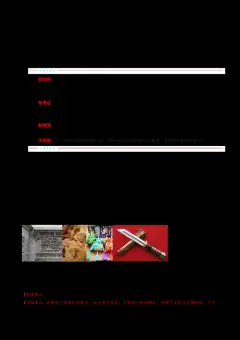
2. 跨学科融合与创新情境:阅读理解选材涵盖文化(阅读表达法国艺术家文森特
卡泽纳夫在中国四川的
・
艺术探索经历)、环保(C 篇煮沸并过滤自来水可以显著减少水中的微塑料含量)、科技(写作“未来的
人工智能”)、社会问题(D 篇“防止年轻男性女性化”的必要性),体现多领域知识融合。2026 高考英
语阅读材料将更多涉及科技、环境、文化等跨学科话题,要求考生具备信息整合能力和跨学科思维。
4. 写作题型多样化,强调社会热点与创新:书面表达要求围绕“中国传统文化节”撰写邀请信,结合传统
文化与社会实际,强调创新性与问题解决能力。2026 高考英语写作可能涉及环保、文化传承、科技伦理等
热点,需考生提出具体建议并体现社会责任感。
(考试时间:100 分钟  试卷满分:130 分)
注意事项:
1.本试卷分第Ⅰ卷(选择题)和第Ⅱ卷(非选择题)两部分。答卷前,考生务必将自己的姓名、准
考证号填写在答题卡上。
2.回答第Ⅰ卷时,选出每小题答案后,用2B 铅笔把答题卡上对应题目的答案标号涂黑。如需改动,
用橡皮擦干净后,再选涂其他答案标号。写在本试卷上无效。
3.回答第Ⅱ卷时,将答案写在答题卡上。写在本试卷上无效。
4.考试结束后,将本试卷和答题卡一并交回。
第一部分:英语知识运用(共两节,满分45 分)
第一节:单项填空(共15 小题;每小题1 分,满分15 分)
从A、B、C、D 四个选项中,选出可以填入空白处的最佳选项。
1.—So, you’re saying we need to submit the report by tomorrow?
—Yes, ________. We don’t have much time left.
A.that’s the case
B.I agree with you
C.you got it wrong
D.that’s exactly how I feel
2.Sheep have been so changed by breeding that their wild ancestors are hard ________.
A.identifying
B.being identified
C.to identify
D.to be identified
3.After months of waiting and wondering about his job application status, ________ suddenly, struck her that she
should check her email for any updates or notifications.
A.what
B.that
C.this
D.it
4.The new device, though technically ________, was too expensive for most customers and did not sell well in
stores.
A.superior
B.plain
C.primary
D.proper
5.
These days, my father ________ to stop smoking and playing cards as well, so his life will have
changed completely soon.
A.is trying
B.tried
C.had to try
D.has tried
6.
I’m worried about him as she went directly to bed ________ hardly touching his dinner.
A.while
B.before
C.after
D.until
7.Even on New Year’s Eve, ________ most of us are celebrating, the ambulance service staff are working.
A.where
B.when
C.that
D.which
8.She was furious when she found her younger sister ________ on her clothes.
A.try
B.being tried
C.having tried
D.trying
9.—We need to get away for a while and think about the situation more clearly.
—________. At the moment we can’t see the wood for the trees.
A.Good idea
B.Me too
C.Never mind
D.Guess what
10.We discussed our finances and realized that buying a new car is ________ right now, so we postponed it.
A.behind schedule B.beyond our reach C.above average
D.out of control
11.—Marketing research is ________ expensive undertaking.
—Yes, and its costs are built into ________ prices of products.
A.an; the
B./; /
C.the; /
D./; the
12.________ urgently callers say they need to speak to me, I do not want any calls for the next hour.
A.Provided that
B.However
C.The moment
D.Even if
13.I will support ________ decides to take the lead in this project, as their success is important to us.
A.whatever
B.whom
C.whoever
D.what
14.
As a teacher, he always tries to ________ their fault, focusing instead on encouraging their growth
and positive behavior.
A.expand
B.overlook
C.admit
D.accept
15.Living cells exist in a variety of shape; for example, they ________ cube-shaped or flat.
A.may be
B.must be
C.ought to be
D.shall be
第二节:完形填空(共20 小题;每小题1.5 分,满分30 分)
阅读下面短文,掌握其大意,然后从16-35 各题所给的A、B、C、D 四个选项中,选出最佳选项。
My sixth-grade daughter was being kicked out of school. The teacher explained, “She may not be     16
what we’re trying to accomplish.” He was     17     saying she didn’t have the     18    , which made me
mad because I knew she was smart, just as my father had known about me when I was     19     in school. We
had her     20     and found that the troubles she was going through were exactly what I had suffered from —
dyslexia (诵读困难症). Just then I was a     21     television writer, and had been awarded Emmy Award for
“The Rockford Files.”
If I had known earlier that something beyond my     22     could explain why I was a low     23    ,
I may not have worked so hard in my late 20s and early 30s. I was working for no other reason than to hear people
24     me, because I did      25      in all my courses.
I once asked a friend why he always got an A, “How long did you study for this?” He replied, “I didn’t. I just
26      it.” So he must be smarter. “What if I’m not good at anything?” I began to ask. Despite my      27

, I did become successful, and people now say to me, “So you’ve      28      dyslexia.”
No, I don’t. I learn to      29      it. I      30      making a call if possible, because I sometimes
have to try many times to get the number right.
Despite these weaknesses, I view dyslexia as a(n)      31     . Many dyslexics are good at right-brain,
abstract thought, and that’s what my kind of creative writing is.
I can write quickly, and can get up to 15 pages a day. Writing is my      32     .
The real      33      I have for dyslexic children is not they have to      34      in school, but that
they will be quitters before they get out of school. Parents have to create      35      for them, whether it’s
music, sports or art. You can make your dyslexic child able to say, “Yeah, reading is hard. But I have other pride.”
16.A.content with
B.used to
C.equal to
D.familiar with
17.A.hardly
B.actually
C.partly
D.merely
18.A.independence B.confidence
C.preference
D.intelligence
19.A.failing
B.progressing
C.changing
D.crying
20.A.informed
B.questioned
C.tested
D.surveyed
21.A.loyal
B.successful
C.traditional
D.typical
22.A.admiration
B.appreciation
C.consumption
D.control
23.A.composer
B.achiever
C.performer
D.observer
24.A.inspire
B.call
C.praise
D.neglect
25.A.actively
B.badly
C.fast
D.well
26.A.glanced at
B.stared at
C.got rid of
D.put up with
27.A.confusion
B.effort
C.dream
D.sacrifice
28.A.overlooked
B.confirmed
C.overcome
D.cured
29.A.keep up with
B.make up for
C.hold on to
D.make use of
30.A.repeat
B.enjoy
C.risk
D.avoid
31.A.adventure
B.pleasure
C.gift
D.punishment
32.A.purpose
B.challenge
C.contribution
D.strength
33.A.fear
B.joy
C.favor
D.respect
34.A.struggle
B.apply
C.achieve
D.accomplish
35.A.surprises
B.competitions
C.imaginations
D.victories
第二部分:阅读理解(共20 小题;每小题2.5 分,满分50 分)
阅读下列短文,从每题所给的A、B、C、D 四个选项中,选出最佳选项。
A
Smart Kids Festival Events
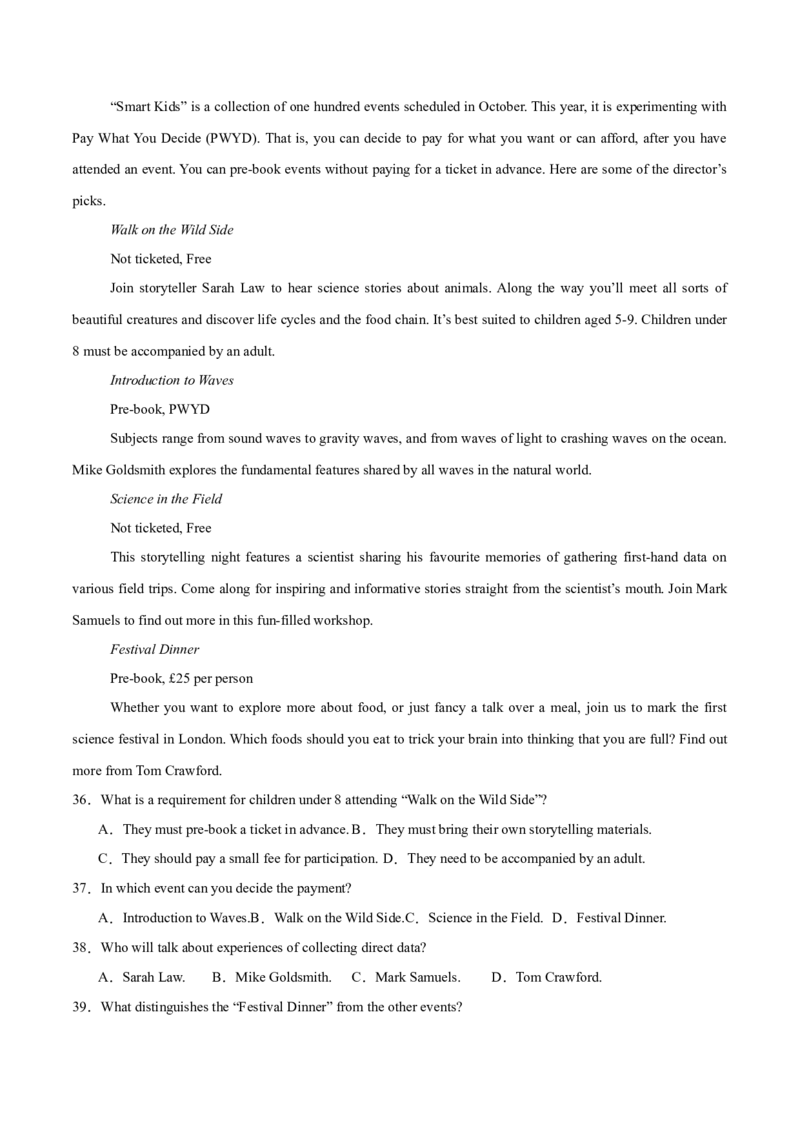
“Smart Kids” is a collection of one hundred events scheduled in October. This year, it is experimenting with
Pay What You Decide (PWYD). That is, you can decide to pay for what you want or can afford, after you have
attended an event. You can pre-book events without paying for a ticket in advance. Here are some of the director’s
picks.
Walk on the Wild Side
Not ticketed, Free
Join storyteller Sarah Law to hear science stories about animals. Along the way you’ll meet all sorts of
beautiful creatures and discover life cycles and the food chain. It’s best suited to children aged 5-9. Children under
8 must be accompanied by an adult.
Introduction to Waves
Pre-book, PWYD
Subjects range from sound waves to gravity waves, and from waves of light to crashing waves on the ocean.
Mike Goldsmith explores the fundamental features shared by all waves in the natural world.
Science in the Field
Not ticketed, Free
This storytelling night features a scientist sharing his favourite memories of gathering first-hand data on
various field trips. Come along for inspiring and informative stories straight from the scientist’s mouth. Join Mark
Samuels to find out more in this fun-filled workshop.
Festival Dinner
Pre-book, £25 per person
Whether you want to explore more about food, or just fancy a talk over a meal, join us to mark the first
science festival in London. Which foods should you eat to trick your brain into thinking that you are full? Find out
more from Tom Crawford.
36.What is a requirement for children under 8 attending “Walk on the Wild Side”?
A.They must pre-book a ticket in advance. B.They must bring their own storytelling materials.
C.They should pay a small fee for participation. D.They need to be accompanied by an adult.
37.In which event can you decide the payment?
A.Introduction to Waves.B.Walk on the Wild Side.C.Science in the Field. D.Festival Dinner.
38.Who will talk about experiences of collecting direct data?
A.Sarah Law.
B.Mike Goldsmith.
C.Mark Samuels.
D.Tom Crawford.
39.What distinguishes the “Festival Dinner” from the other events?
A.It allows attendees to decide payment after the event.
B.It combines scientific discussion with a meal.
C.It is open to participants without pre-booking.
D.It focuses on wildlife conservation topics.
40.What do the four events have in common?
A.Family-based. B.Picked by children. C.Science-themed.
D.Filled with adventures.
B
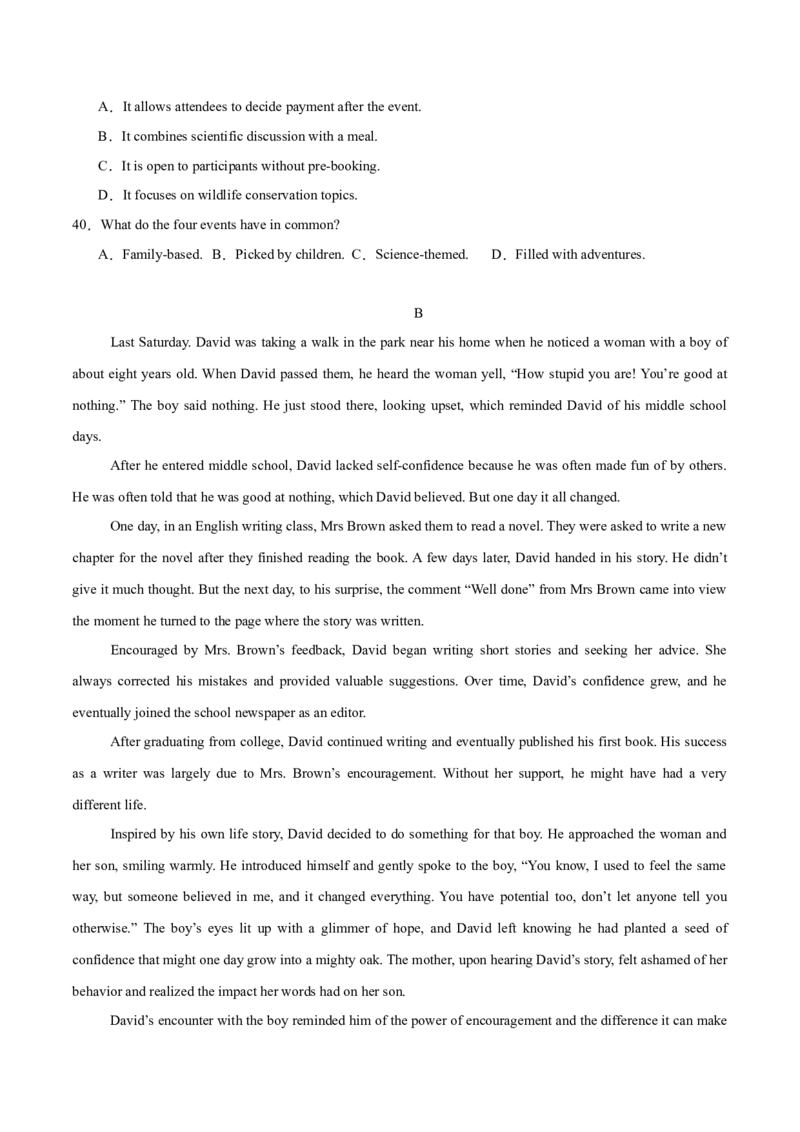
Last Saturday. David was taking a walk in the park near his home when he noticed a woman with a boy of
about eight years old. When David passed them, he heard the woman yell, “How stupid you are! You’re good at
nothing.” The boy said nothing. He just stood there, looking upset, which reminded David of his middle school
days.
After he entered middle school, David lacked self-confidence because he was often made fun of by others.
He was often told that he was good at nothing, which David believed. But one day it all changed.
One day, in an English writing class, Mrs Brown asked them to read a novel. They were asked to write a new
chapter for the novel after they finished reading the book. A few days later, David handed in his story. He didn’t
give it much thought. But the next day, to his surprise, the comment “Well done” from Mrs Brown came into view
the moment he turned to the page where the story was written.
Encouraged by Mrs. Brown’s feedback, David began writing short stories and seeking her advice. She
always corrected his mistakes and provided valuable suggestions. Over time, David’s confidence grew, and he
eventually joined the school newspaper as an editor.
After graduating from college, David continued writing and eventually published his first book. His success
as a writer was largely due to Mrs. Brown’s encouragement. Without her support, he might have had a very
different life.
Inspired by his own life story, David decided to do something for that boy. He approached the woman and
her son, smiling warmly. He introduced himself and gently spoke to the boy, “You know, I used to feel the same
way, but someone believed in me, and it changed everything. You have potential too, don’t let anyone tell you
otherwise.” The boy’s eyes lit up with a glimmer of hope, and David left knowing he had planted a seed of
confidence that might one day grow into a mighty oak. The mother, upon hearing David’s story, felt ashamed of her
behavior and realized the impact her words had on her son.
David’s encounter with the boy reminded him of the power of encouragement and the difference it can make
in someone’s life. He vowed to continue spreading positivity and confidence wherever he went.
41.How did the boy feel after hearing the woman’s words?
A.Unhappy and bothered.
B.Confident and calm.
C.Joyful and relaxed.
D.Uncomfortable and angry.
42.Why did David lack self-confidence in middle school?
A.He was often abused by his classmates. B.He was often laughed at by others.
C.He didn’t like his teachers.
D.He had learning disabilities.
43.How did Mrs. Brown’s comment affect David?
A.It made him angry.
B.It made him sad.
C.It gave him self-confidence.
D.It gave him enough experience.
44.According to David, what was the reason for his success?
A.His own talent and hard work.
B.His parents’ support and deep love.
C.Mrs. Brown’s encouragement.
D.Mrs. Brown’s constant complaint.
45.How did the mother feel upon hearing David’s story?
A.Proud of her son for the success.
B.Happy that David had changed.
C.Indifferent to the entire situation.
D.Regretful about her behavior.
C
Microplastics have become a common source of pollution across the Earth — they have settled in the deep
sea and on the Himalayas, stuck inside volcanic rocks, filled the stomachs of seabirds and even fallen in fresh
Antarctic snow. They are even appearing inside humans.
Now, new research suggests that a simple, cheap measure may significantly reduce the level of microplastics
in water from your tap (水龙头): boiling and filtering (过滤) it. In a study published Wednesday in Environmental
Science Technology Letters, researchers from China found that boiling tap water for just five minutes — then
filtering it after it cools — could remove at least 80 percent of its microplastics.
Crucially, this process relies on the water containing enough calcium carbonate (碳酸钙) to trap the plastics.
In the study, boiling hard water containing 300 milligrams of calcium carbonate led to an almost 90 percent drop in
plastics. But in samples with less than 60 milligrams of calcium carbonate, boiling reduced the level of plastics by
just 25 percent. Additionally, the research didn’t include all types of plastics. The team focused only on three
common types — polystyrene, polyethylene and polypropylene — and they didn’t study other chemicals previously
found in water such as vinyl chloride.
Still, the findings show a potential path forward for reducing microplastic exposure — a task that’s becoming
increasingly difficult. Even bottled water, scientists found earlier this year, contains 10 to 1,000 times more
microplastics than originally thought.
Scientists are still trying to determine how harmful microplastics are — but what they do know has raised
concerns. The new study suggests boiling tap water could be a tool to limit intake. “The way they demonstrated
how microplastics were trapped through the boiling process was nice,” Caroline Gauchotte-Lindsay, an
environmental engineer of the University of Glasgow in Scotland who was not involved in the research, tells New
Scientist. “We should be looking into upgrading drinking water treatment plants so they remove microplastics.”
46.How does the author present the issue in the first paragraph?
A.By quoting an expert.
B.By defining a concept.
C.By giving examples.
D.By providing statistics.
47.What determines the effectiveness of trapping microplastics in water?
A.The hardness of water.
B.The length of cooling time.
C.The frequency of filtering.
D.The type of plastic in water.
48.What does the author try to illustrate by mentioning bottled water in paragraph 4?
A.The importance of plastic recycling.
B.The severity of the microplastic problem.
C.The danger in overusing pure water.
D.The difficulty in treating polluted water.
49.What is Gauchotte-Lindsay’s suggestion about?
A.Choice of new research methods.
B.Possible direction for further study.
C.Need to involve more researchers.
D.Potential application of the findings
50.What is the main purpose of the passage?
A.To argue for replacing bottled water with boiled tap water.
B.To explain the experimental process of removing microplastics.
C.To propose a simple yet limited solution to microplastic pollution.
D.To introduce the arguments about the global spread of microplastics.
D
“Girls are weak, and boys are strong. This is what is being subconsciously communicated to
hundreds of millions of young boys and girls all over the world, just like it was with me,” said American actor
Justin Baldoni. As a boy, all he wanted was to be accepted by other people. That acceptance meant he had to
pretend to be strong when he was weak, confident when he felt insecure, and tough when he was actually hurting.
Is that a healthy lifestyle? A member of the CPPCC Standing Committee might say “yes”. In his proposal, he
spoke of a need to “prevent the feminization of male youths”. In response to his call, China’s Ministry of Education
has recently demanded that schools should hire more physical education teachers and improve teaching methods to
cultivate masculinity in students.
The response has been widely debated online, with many people saying that it reinforces gender stereotypes.
The state broadcaster CCTV wrote on its Weibo account, “Education is not simply about cultivating men and
women. It’s more important to develop a willingness to take responsibility.” You might be wondering now: What is
masculinity, and why is this so controversial?
Well, by itself, “masculinity” refers to the qualities traditionally considered to be typical of men. While there
is not really a single “correct” set of qualities, the term is often associated with strength, courage, assertiveness, and
emotional control. Sometimes, however, these seemingly admirable qualities can be extended in unrealistic ways.
But boys are also human. Blindly asking them to control their feelings “like a man” can only increase their stress
when they grow up.
As an educator who has spent years teaching in China, I agree that attaching more importance to physical
education would definitely benefit students. Sports provide opportunities for physical fitness. More importantly,
they can help develop lifelong skills, such as leadership and communication skills. However, putting the emphasis
on masculinity is far from a sound reason for which to do so.
It is unnecessary for all boys to build up their muscles, but it is essential that they all learn how to be strong
inside. It is also fine for boys to cry and to show their weakness. Schools should work on equipping students with
the skills and values they will need to be successful in life, not reinforcing stereotypes of masculinity borrowed
from a bygone age.
51.Why did young Justin Baldoni think it necessary to pretend to be what he was actually not?
A.He was trying to be strong and confident.
B.He wanted to be accepted as a real man.
C.It was necessary for an actor to be strong and tough.
D.He felt it secure and safe to do so.
52.The underlined expression “masculinity” in Paragraph 2 most probably means “__________”
A.manly qualities
B.potential abilities
C.self-centredness
D.steady strength
53.What is the argument against the demand of China’s Ministry of Education?
A.It is necessary to prevent the feminization of male youths.
B.Physical education should be paid more attention to.
C.We should teach students according to their individual qualities.
D.Importance should be attached to developing students’ sense of responsibility.
54.What can we learn from the passage?
A.Masculinity is out of date.
B.Masculinity is overstated.
C.Masculinity shows physical strength.
D.Masculinity only focuses on physical fitness.
55.What does the author want to say in the article?
A.We should do everything we can to guarantee students’ health.
B.Schools should differentiate between boys and girls while educating them.
C.It is important to prepare students with necessary skills and right values.
D.It is time to weaken stereotypes of masculinity.
第二部分:写作(共两节,满分35 分)
第一节:阅读表达(共5 小题;每小题2 分,满分10 分)
阅读下面短文,并根据短文内容完成下列各题。
In Sichuan Province, long-time resident French artist Vincent Cazeneuve, is integrating traditional Chinese
lacquerware (漆器) skills with techniques taken from Western modern art into his creations.
Born in Toulouse, Vincent has been living in southwest China for more than a decade. With the influence of
French artists Jean Dunand and Gaston Suisse, his journey to unravel the secrets of Chinese lacquerware and his
fascination for lacquer art started. “I studied their artworks and often wondered why they used Chinese lacquer. In
those days, lacquer could not be found in France.” said the artist.
Native to Asia, lacquer trees are planted and tapped for their liquid. It is almost impossible to find lacquer
trees in Europe. So, instead of continually transporting lacquer back to France, Vincent chose to send himself to
China.
Having explored his connections with lacquer over the years, the artist also learned a range of techniques,
which he integrated into his own artworks. To dive deep into the art of lacquerware, Vincent traveled to Liangshan
Yi Autonomous Prefecture ( 自治州) in Sichuan Province, where lacquer craftsmanship is famous. In fact, he
actually met two lacquerware craftsmen, who taught him almost everything they knew.
“I used to know about lacquerware of Yi just by looking at it. But I had never seen the Yi people before. I
have never heard their language. I've never seen their villages. It’s only when I came here that I felt the power of
their culture.” said Vincent.
This field trip gave the artist new inspiration for his exhibition. After seeing Vincent’s exhibition, Liu
Guanzhong, a professor at the School of Fine Arts of Tsinghua University said, “What he presents is China in his
eyes. Vincent has explored a path: the ideas of a modern artist, but rooting the ancient skills in modern life. He
finds new soil for an old seed to bloom into a new flower.”
56.What is Vincent devoted to according to the text? (no more than 15 words)

57.What does the underlined word “unravel” in paragraph 2 mean? (1 word)

58.Why did Vincent travel to Liangshan Yi Autonomous Prefecture? (no more than 10 words)

59.How did the field trip to Liangshan Yi Autonomous Prefecture benefit Vincent? (no more than 15 words)

60.In your opinion, what should artists do to develop art better? Please explain in your own words. (no more than
20 words)

第二节:书面表达(满分25 分)
61.
假定你是李华,最近你们班进行了一次题为“未来的人工智能”的讨论。请根据以下要点给
校英语报投稿,介绍讨论结果,并谈谈你自己的看法。要点如下:
*人工智能的优势;
*人工智能的劣势;
*你的看法。
参考词汇:人工智能 artificial intelligence
注意: *词数不少于100;
*题目和开头已给出,不记入总词数;
*可适当加入细节,以使内容充实,行文连贯。
Artificial Intelligence (AI) in the Future
Recently our class had a heated discussion about the future of artificial intelligence (AI).The results are as
follows.
____________________________________________________________________________________________
____________________________________________________________________________________________
____________________________________________________________________________________________