绝密★启用前
2026 年高考二轮信息必刷卷03(浙江专用)
英  语
考情速递
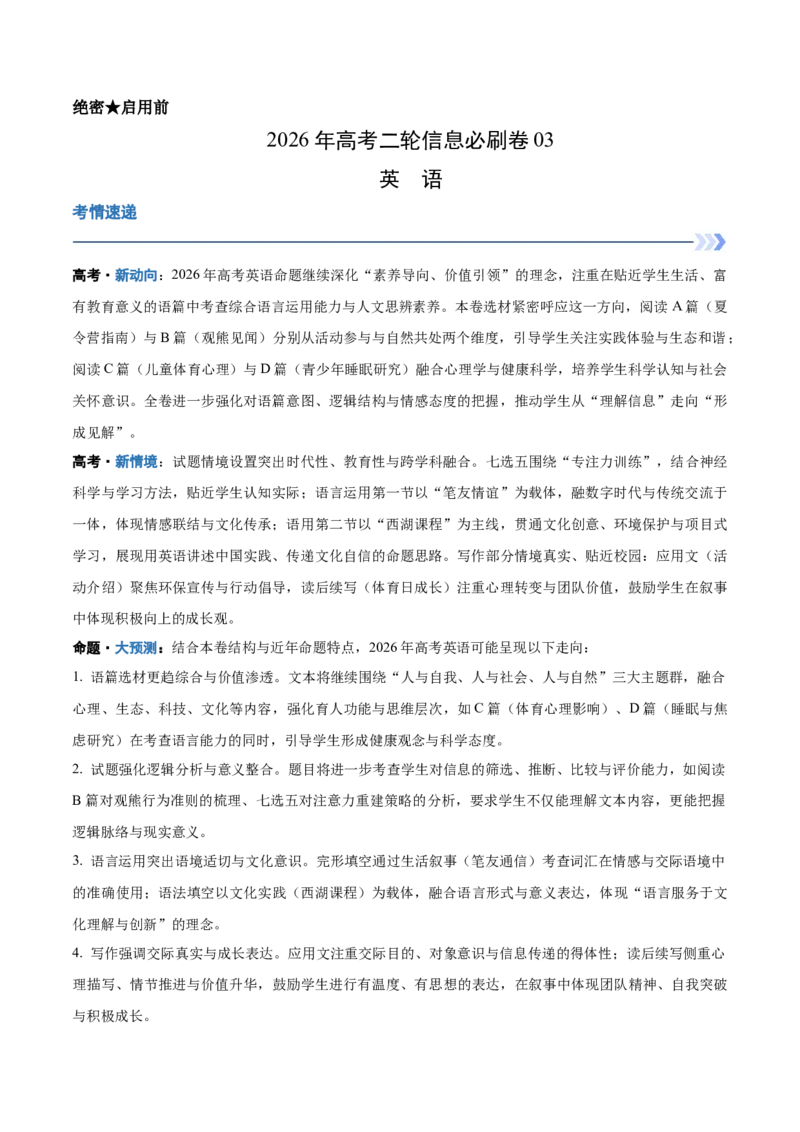
高考·新动向:题型保持稳定,选材与命题凸显两大核心:一是真实语境与实用价值,如
阅读A 篇“绿色步行”倡议聚焦校园生活,完形填空以“人与宠物共成长”传递人文关怀,
均贴近现实场景;二是跨域融合与素养导向,阅读C 篇职场情感研究、D 篇AI 与青少年关
系,融合心理学、科技等多学科,语法填空“元阳哈尼梯田”关联历史、生态与文化,体
现“人与自然、人与社会”核心主题。
高考·新情境:语篇设置紧扣时代与复合主题:阅读B 篇非洲草原观象构建“自然观察
+心灵触动”情境,引导反思人与自然关系;完形填空通过跨国生活经历,创设“自我蜕
变+跨文化适应”的鲜活语境,均融合思想性与教育性。
命题·大预测:基于本卷题目结构与内容,并结合近年高考英语真题命题趋势作出如下预
测。
1. 选材趋势:阅读将更多聚焦科技突破(如AI、科考)、社会治理(如心理健康),
语法填空倾向“中国故事+科学成就”主题。
2. 思维与素养考查:阅读侧重“跨文本对比”“信息迁移”等高阶能力,完形填空强
化“情感线索—词汇选择—叙事逻辑”联动,渗透价值观。
3. 语用能力要求:语法填空或增加词性转换等语境依赖型考点,整体更强调真实语境
中的语言运用与核心素养落地。
(考试时间:120 分钟  试卷满分:150 分)
注意事项:
1. 答题前,考生先将自己的姓名、准考证号码填写清楚,将条形码准确粘贴在条形码区域
内。
2. 选择题必须使用2B 铅笔填涂;非选择题必须使用0. 5 毫米黑色字迹的签字笔书写,字体
工整,笔迹清楚。
3. 请按照题号顺序在答题卡各题目的答题区域内作答,超出答题区域书写的答案无效;在
草稿纸、试卷上答题无效。
4. 作图可先使用铅笔画出,确定后必须用黑色字迹的签字笔描黑。
5. 保持卡面清洁,不要折叠、不要弄破、弄皱,不准使用涂改液、修正带、刮纸刀。
第一部分  听力(共两节,满分 30 分)
做题时,先将答案标在试卷上。录音内容结束后,你将有两分钟的时间将试卷上的答案转
涂到答题卡上。
第一节(共5 小题;每小题1.5 分,满分7.5 分)
听下面5 段对话。每段对话后有一个小题,从题中所给的A、B、C 三个选项中选出最
佳选项。听完每段对话后,你都有10 秒钟的时间来回答有关小题和阅读下一小题。每段对
话仅读一遍。
1. What is the woman probably doing?
A.Taking exercise.
B.Hanging a curtain.
C.Working on a project.
2. How will the man’s sister help the woman?
A.Buy her a dress.
B.Alter her dress.
C.Make her a new dress.
3.What do we know about the woman's cousin?
A.He has been busy studying.     B.He is an experienced doctor.
C.He finds learning medicine hard.
4.What might the woman have done recently?
A.She landed a new job.   B.She failed a challenge.   C.She mastered a new skill.
5.What are the speakers complaining about?
A.Inaccurate weather report.   B.The arrival of a cold front.   C.Rising temperatures.
第二节(共15 小题;每小题1.5 分,满分22.5 分)
听下面5 段对话或独白。每段对话或独白后有几个小题,从题中所给的A、B、C 三个
选项中选出最佳选项。听每段对话或独白前,你将有时间阅读各个小题,每小题5 秒钟;
听完后,各小题将给出5 秒钟的作答时间。每段对话或独白读两遍。
听第6 段材料,回答第6、7 题。
6.Why does Alex make the call?
A.To discuss a new project.   B.To confirm a meeting.
 C.To arrange a visit.
7.Where will the speakers meet on Tuesday?
A.At the restaurant.
B.At Sarah’s office.
C.At the coffee shop.
听第7 段材料,回答第8 至10 题。
8.Where will Lily begin her swimming lessons?
A.In the practice area.
B.In the deep pool.
C.In the shallow pool.
9.Why was the number of students reduced in each class?
A.To fit in more classes.
       B.To ensure personalized attention.
C.To follow safety regulations.
10.Why should Lily arrive early on the first day?
A.To complete a level test.    B.To meet her coach.
C.To change clothes.
听第8 段材料,回答第11 至13 题。
11.What is the probable relationship between the speakers?
A.Relatives.
B.Strangers.
C.Workmates.
12.How does the woman confirm the ownership of the phone?
A.By checking the phone case.     B.By studying the phone’s model.
C.By trying the phone’s password.
13.Where will the speakers meet?
A.At the bus stop.
B.At the hotel entrance.
C.At the meeting room.
听第9 段材料,回答第14 至16 题。
14.What is the probable relationship between the speakers?
A.Interviewer and interviewee.   B.Teacher and student.
C.Writer and publisher.
15.What first inspired the man to start writing?
A.Short story collections. B.Newspaper articles.
C.Book club discussions.
16.What will the man do next?
A.Share his experiences. B.Read a short story.
C.Teach a writing class.
听第10 段材料,回答第17 至20 题。
17.Who is the Mini Camp intended for?
A.Four-year-olds.
B.Five-year-olds.
C.Six-year-olds.
18.Which activity does the Older Summer Camp organize?
A.Museum visits.
B.Bowling games.
C.Family gatherings.
19.What is a requirement for joining the field trips?
A.Camping experience.
B.Parental permission.
C.Swimming skills.
20.What will the speaker do next?
A.Collect fees.
B.Answer questions.
C.Show a short video
第二部分  阅读(共两节, 满分50 分)
第一节(共15 小题;每小题2.5 分, 满分37.5 分)
阅读下列短文, 从每题所给的A、B、C 和D 四个选项中选出最佳选项。
A
WALK FOR GREEN
How often do you walk around the campus instead of getting straight onto the shuttle bus?
The beauties of our campus deserve to be better explored and can best be explored on foot.
Walking is also a greener and healthier alternative to using vehicles. To encourage more students
and staff members to walk around the campus, our school has launched a new “Walk for Green”
initiative.
Programme
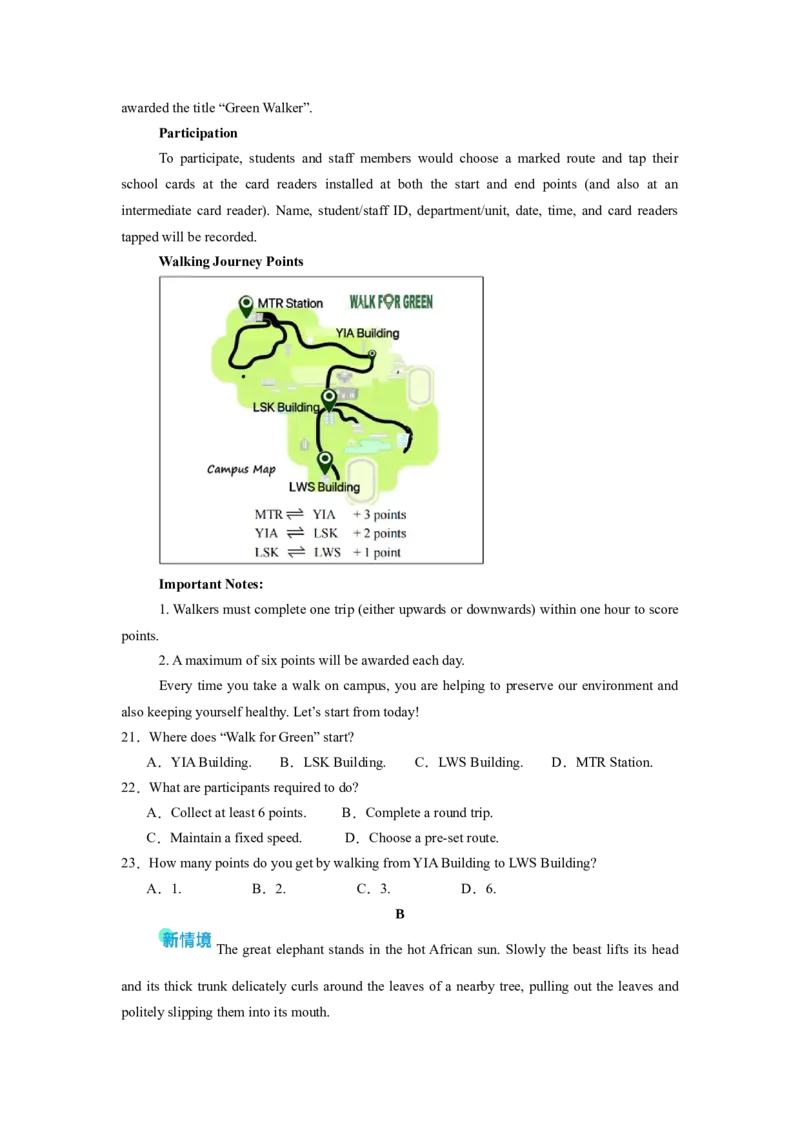
Setting out from the MTR Station, “Walk for Green” recommends various walking routes
on campus, one of which covers the YIA Building, LSK Building and LWS Building. Card readers
for different walking routes have been installed (安装) to record the number of points completed
by “Walk for Green” participants. Participants who collect 60 points within 30 days will be
awarded the title “Green Walker”.
Participation
To participate, students and staff members would choose a marked route and tap their
school cards at the card readers installed at both the start and end points (and also at an
intermediate card reader). Name, student/staff ID, department/unit, date, time, and card readers
tapped will be recorded.
Walking Journey Points
Important Notes:
1. Walkers must complete one trip (either upwards or downwards) within one hour to score
points.
2. A maximum of six points will be awarded each day.
Every time you take a walk on campus, you are helping to preserve our environment and
also keeping yourself healthy. Let’s start from today!
21.Where does “Walk for Green” start?
A.YIA Building.    B.LSK Building.    C.LWS Building.    D.MTR Station.
22.What are participants required to do?
A.Collect at least 6 points.     B.Complete a round trip.
C.Maintain a fixed speed.      D.Choose a pre-set route.
23.How many points do you get by walking from YIA Building to LWS Building?
A.1.          B.2.          C.3.          D.6.
B
The great elephant stands in the hot African sun. Slowly the beast lifts its head
and its thick trunk delicately curls around the leaves of a nearby tree, pulling out the leaves and
politely slipping them into its mouth.
The beast’s great grey skin is partly broken and aged from the African sun. Some mud
drops on one side from its last trip to a nearby river. Its rough hair sticks out from all over its skin
and two large, white tusks curve elegantly from either side of its mouth.
Somewhere a lion roars and something else gives a loud high shout. A vulture (秃鹫) drifts
over far above this world, barely a black dot in the sky. The buzzing of the countless bush insects
seems to collectively shift up in high tune, almost like the whole of the savanna (热带草原) was
singing some song that only they knew.
I peer through the lens (镜头) at this scene. The zoom lens shows almost every detail of the
elephant: the three small cuts in its left ear from playing as a baby around thorn trees, the scar
down its front leg where a lion caught it unaware as a young adult, and weathering on its great,
valuable tusks from decades of living in this unforgiving grassland on a dusty continent.
And then the elephant looks at me. It looks at me with those big, eyelashed eyes with a
warmth coming outwards from a vast, hidden depth there. I can suddenly feel its soul, and feel the
line of elephants that came before this one, trailing back to the very beginnings of this great
savanna. We will never understand what wonders this ancient being and its kind have seen and
whispered to each other across the ages on this old, sacred grassland.
It looks at me, and it looks through me and sees me. The elephant knows I am there. It
always did. It is not running away, nor is it fighting. It accepts and forgives. It loves. But, mostly,
it just feels sad. It feels sorry for me. I cannot do this anymore.
I take my eye off the sights and hand the gun back to my partner. “Let’s go home,” I said in
a quiet voice, “let’s just go home.”
24.According to the first two paragraphs, which word can best describe the elephant?
A.Mysterious.
B.Depressed.
C.Aggressive.
D.Graceful.
25.When the author sees through the lens, he is ________.
A.deeply moved and filled with sympathy B.overwhelmed by the elephant’s strength
C.annoyed at the presence of other animals D.shocked and scared by the elephant’s scars
26.What does the shift in focus from the elephant to the vulture and insects imply?
A.The elephant is about to be attacked.
B.The author is losing interest in the elephant.
C.The elephant is part of a larger and living world. D.The author wants to show the
savanna’s dangers.
27.What can we learn from the passage?
A.Nature calms our anger.
B.Nature purifies our souls.
C.Nature heals our wounds.
D.Nature enriches our imagination.
C
New research suggests that in the workplace, the way people express their
feelings while helping others is as important as the help itself. This emotional expression
can decide whether the help is welcomed, accepted, or even returned. Helpers who show
positive emotions like gratitude and sympathy are often seen as having good intentions.
This builds trust and encourages future teamwork. On the other hand, when helpers show
negative feelings such as pride or dislike, their true reasons for helping may be
questioned, which can damage relationships and reduce the chance of getting help back in
the future.
The study explains that people receiving help are not passive. They actively pay
attention to emotional signs to guess the real reasons behind the help. If they feel the
helper is acting out of personal gain or just because they have to, it changes how they
see the help and whether they want to return the favor. The findings came from several
studies with working adults and students, who were asked to recall real-life helping
situations or respond to stories about coworkers.
For leaders and managers, the research offers a clear lesson. Instead of just
encouraging helping, they should focus on creating a work environment where employees
feel real gratitude for their colleagues and develop a natural sense of care for others'
challenges. When leaders themselves show these positive emotions when they help their
teams, they set a good example. This helps create a more supportive and engaged
workplace culture.
At the individual level, employees can also benefit. They can think about their own
experiences of receiving help, or practice looking at things from other people’s points of
view. These practices can help them develop more real and sincere feelings when they
offer help. By expressing genuine gratitude or sympathy, people are not just helping
others; they are building stronger workplace relationships and a more resilient culture of
teamwork. This creates a positive cycle where everyone feels more connected and willing
to support each other.
28.How do people decide whether to accept help?
A. By checking the helper's past behavior.
B. By observing the helper's emotional signs.
C. By asking the helper directly for the reason.
D. By considering if the help is truly necessary.
29.What are leaders advised to do to build a helpful culture?
A. To require employees to help each other.
B. To reward helpful behavior with prizes.
C. To show real care and thankfulness themselves.
D. To organize teamwork activities regularly.
30.What can be inferred when a helper shows pride?
A. The help is likely to be refused directly.
B. The helper may be seen as self-centered.
C. The receiver will feel pressured to return the favor.
D. The workplace relationship will not be affected.
31.What is the key to building a helpful work culture according to the text?
A. Setting strict rules for helping.        B. Focusing only on the act of helping.
C. Encouraging true emotional expression. D. Training employees on communication
skills.
D
A recent report from the American Psychological Association highlights the
dual nature of artificial intelligence's impact on teenagers. While AI offers new
opportunities, its deeper integration into daily life requires careful consideration to ensure
these tools are safe, especially for adolescents. The report urges all involved parties to
prioritize youth safety early in AI's development to avoid repeating the harmful mistakes
made with social media, which have weakened real-life connections for many young
people.
The report emphasizes that adolescence, defined as the period from ages 10 to 25, is
a crucial time for brain development. This makes teenagers potentially more sensitive to
AI’s negative effects. For instance, some teenagers have developed unhealthy and even
dangerous "relationships" with chatbots, often without realizing they are interacting with an
AI and not a human. This situation clearly shows the urgent need for developers to build
protective measures into their systems from the start.
To address these concerns, the report puts forward several key recommendations for
AI developers. First, healthy boundaries should be set for AI-simulated relationships, as
teenagers are less likely than adults to question the accuracy and intent of a bot's
information. Second, age-appropriate privacy settings and interaction limits should be
created as defaults. Furthermore, developers must limit teenagers’ exposure to harmful
and inaccurate content and protect their personal data from being used for advertising or
sold to other companies.
Despite the risks, the report also acknowledges AI’ s potential to support healthy
development. When used for tasks like brainstorming, creating, or summarizing
information, AI can be a powerful tool to help students understand and master key
concepts. However, it is vital for students to be aware of AI's limitations. Therefore, the
report calls for comprehensive AI literacy education to be integrated into school curricula,
helping young people use these tools wisely and critically.
In conclusion, the report’s leader notes that many of these changes can be started
immediately by parents, educators, and teenagers themselves. However, other more
significant changes require the joint efforts of developers, policymakers, and technology
professionals. Ensuring the well-being of young people in the age of AI is a shared
responsibility that demands action now from all parts of society.
32.What does the report suggest developers do about AI interactions?
A. Encourage deeper relationships with AI.
B. Limit AI use purely to academic tasks.
C. Set healthy boundaries and promote positive uses.
D. Make AI interactions indistinguishable from humans.
33.What risk concerning teenagers and AI is highlighted in the report?
A. They might over-rely on AI for daily decisions.
B. They could form unhealthy attachments and trust information too easily.
C. They lack the technical skills to use AI for schoolwork.
D. They primarily use AI for entertainment instead of education.
34.Why does the report specifically focus on the 10-25 age group?
A. Because this group is the largest user of AI technology.
B. Because their brains are still developing, making them more vulnerable.
C. Because they have more free time than other age groups.
D. Because they have a stronger ability to learn new technologies.
35.What can be inferred from the last paragraph?
A. Protecting teens from AI is mainly the parents' job.
B. Developers cannot act without policymakers' support.
C. Solving AI safety issues requires a joint societal effort.
D. Teenagers themselves play the smallest role in ensuring AI safety.
第二节(共5 小题;每小题2. 5 分, 满分12. 5 分)
阅读下面短文, 从短文后的选项中选出可以填入空白处的最佳选项。选项中有两项为
多余选项。
When we fall behind others or perform less well in areas we care about, a feeling
of envy arises. Envy has always been a part of human experience.
    36     The former brings misery but drives self-improvement and emulation (效仿).
Malicious envy, however, leads to harm, like hostile thoughts. Benign envy comes when you think
others deserve admiration; malicious envy when you don’t. That’s why you might envy a war hero
but not wish him ill, yet enjoy a Hollywood actor’s failed marriage.
Envy — especially malicious — is harmful. Neuroscientists find it activates the brain’s
anterior cingulate cortex, linked to physical and mental pain. A 2018 Social Science &
Medicine study of 18,000 people found envy predicts worse future mental health. It even stops the
natural trend of better mental health with age.     37
Different people envy different things. I don’t care about others’ fancy boats, but envy men
my age with full hair. Scholars note patterns: young people envy education, looks or romance;
older people envy money.     38     Studies show men envy social status most, women
physical attractiveness. Both envy others’ romantic success second.
Envy needs exposure to “luckier” people. Social media worsens this — strangers show only
admirable and enviable lives. Social media plays an important role in fueling envy.     39

Experiments prove passive social media use lowers well-being via more envy.
It is impossible to end envy.     40     Next time envy hits, think of loved ones or your
own good fortune.
A.However, gratitude helps.
B.Academics call this “Facebook envy”.
C.And it doesn’t bring economic success.
D.Envy often causes fights between people.
E.Women are more likely to show envy than men.
F.Men and women tend to envy different qualities.
G.Scholars categorize envy into benign and malicious envy.
第三部分 语言运用(共两节,满分30 分)
第一节(共15 小题,每小题1 分,满分15 分)
阅读下面短文, 从每题所给的A、B、C 和D 四个选项中选出可以填入空白处的最佳选
项。
Before meeting my “Tinder”, I was an emotionally isolated, cocky senior executive.     41
a seemingly successful 25+ years in my professional career, I was on the brink of emotional
bankruptcy.
Then came a ripple in the universe. My friend asked me for a     42     adopting her
dog, Twinkles, a small lapdog. I reluctantly     43    . Twinkles had lived a(n)     44

existence and had never even walked on green grass. She wouldn’t go out with me initially, but I
45     her out the door, knowing it would do her and me good. A special bond and growing trust
46    . After all, discomfort is often the external     47     needed to jump-start growth, and
that day was a good beginning!
Happy time flew! Twinkles and I had to move to Medellin, Colombia. I believe it was a
good chance to change. “Aggressive Tom” would not be     48     tolerated; I had to become
“Gentle Tom.” Relaxed,     49    , and calm. Similarly, Twinkles was presented with the     50
to become “Twinkles Princess.”
Twinkles and I shared remarkable     51    , from walks in the local parks to exploring
the transformative neighborhood of Comuna 13. She was a natural star, and her charm effortlessly
52     the locals, fostering conversations that     53     cultural gaps. I gradually had a sense
of belonging.
After three adventurous years, we returned to America. “Aggressive Tom” and “Timid
Twinkles” were     54     by “Gentle Tom” and “Twinkles Princess”, more patient,
empathetic, confident, and brave. We had done things we didn’t want to do, weren’t supposed to
do, and never imagined we could do. Together, we     55     the joy of doing incredible
things.
41.A.With
B.Despite
C.Without
D.Except
42.A.favor
B.gift
C.tip
D.permission
43.A.rejected
B.quit
C.agreed
D.replied
44.A.isolated
B.spoiled
C.ruined
D.sheltered
45.A.dragged
B.dropped
C.threw
D.shut
46.A.changed
B.suffered
C.developed
D.delivered
47.A.force
B.means
C.value
D.pressure
48.A.limitlessly
B.socially
C.tirelessly
D.normally
49.A.adaptable
B.reliable
C.admirable
D.adorable
50.A.chance
B.title
C.award
D.choice
51.A.events
B.experiences
C.journeys
D.achievements
52.A.grew on
B.took after
C.drew in
D.spoke to
53.A.bridged
B.expanded
C.applauded
D.identified
54.A.greeted
B.expected
C.decided
D.replaced
55.A.celebrated
B.communicated
C.pictured
D.interpreted
第二节(共10 小题;每小题1.5 分 ,满分15 分)
阅读下面短文,在空白处填入1 个适当的单词或括号内单词的正确形式。
The Yuanyang Hani Terraces ( 梯田) in southwest China’s Yunnan Province, already
recognized as     56     UNESCO World Cultural Heritage site, were further honored by being
added     57     the 2025 World Heritage Irrigation Structures list on Sept. 10, 2025.
This mountain farming irrigation system, which has been in place for over 1,300 years,
vividly demonstrates the Chinese nation’s ecological     58     (wise) of harmonious
coexistence between humans and nature.
The Yuanyang Hani Terraces are located in the Ailao Mountains along the Red River in
Yunnan. This     59     (impress) irrigation system covers an area of 3,740 hectares.
According to research, the terraces     60     (build) as early as the Tang. Dynasty. The local
Hani people carved the terraces along the mountain slopes ( 山坡), passing down their unique
agricultural     61     (method) through generations. Today, a network made up of 305 canals
62     (run) through the area, channeling water to the vast terraced fields.
Far from being isolated, this remarkable system integrates perfectly with the surrounding
forests, water systems, and villages,     63     (create) a harmonious ecosystem. The forests at
the mountain tops conserve water sources, while canals channel water through the villages     64
(irrigate) the terraces.
Today, the region’s distinct water culture,     65     emphasizes fair water distribution,
conservation, and harmonious relationships between people and water, has become the essence of
Hani Terrace culture.
第四部分  写作(共两节, 满分40 分)
第一节(满分15 分)
    假定你是李华,爱尔兰友好学校的师生代表团将来你校参观,现需一名学生接待员。
请你给负责人 Ms. Smith 写一封邮件推荐自己,内容包括:
(1)邮件目的;
(2)自荐理由;
(3)表达期待。
注意:
(1)写作词数应为80 个左右;
(2)请按如下格式作答。
Dear Ms. Smith,
_______________________________________________________________________________
_______________________________________________________________________________
_______________________________________________________________________________
______________________________________________________________________________
Yours sincerely,
Li Hua
第二节(满分25 分)
阅读下面材料,根据其内容和所给段落开头语续写两段,使之构成一篇完整的短文。
Daniel was a 12-year-old boy who loved trying new things. He always asked his dad to take
him to the park to watch other kids ride bikes, and he’d often stand there, eyes shining, imagining
himself on one. When his birthday came closer, he finally worked up the courage to tell his dad
what he really wanted.
“Dad, for my birthday, can I have a blue bike?” Daniel said one evening while they were
eating dinner. His dad put down his fork and looked at him seriously. “I’m worried about your
safety, Daniel,” he said. “Riding a bike can be dangerous if you’re not careful.” Daniel’s face fell,
but he didn’t give up. He sat up straight and said, “I promise I won’t ride on busy streets. I’ll only
practice in the small park near our home. There are no cars there. And I’ll finish all my homework
before I go, so my studies won’t be affected.”
His dad looked at Daniel’s determined eyes and thought for a minute. He knew how much
Daniel wanted a bike, and he also saw the effort his son was willing to make. At last, he nodded
with a smile. “Okay, Daniel. I’ll buy you a bike for your birthday.” Daniel jumped up from his
chair and gave his dad a big hug. “Thank you, Dad! You’re the best!”
The next weekend, Daniel’s dad brought home a bright blue bike. Daniel couldn’t wait to
try it. He pushed the bike to the park, got on it, and held the handlebars (把手) tightly. But as soon
as he tried to ride, he lost his balance and fell off. Luckily, he didn’t hurt much, but he felt a little
sad. He got up, brushed the dirt off his clothes, and tried again. This time, he went a few meters
before falling. Again and again, he got on the bike, rode, and fell. His knees turned a little red, but
he never said “I quit”.
注意:
(1)续写词数应为150 个左右;
(2)请按如下格式在答题卡的相应位置作答。
Seeing Daniel fall over several times, his father went over to him.
_______________________________________________________________________________
_______________________________________________________________________________
_______________________________________________________________________________
_
That day, Daniel rode his bike around the park for a long time.
_______________________________________________________________________________
_______________________________________________________________________________
_______________________________________________________________________________
_