绝密★启用前
2026 年高考二轮信息必刷卷01
英  语
考情速递
高考・新动向:贴合真实语境,坚守育人本质
题型稳定性:试卷严格遵循 “知识运用 + 阅读理解 + 书面表达” 的高考经典结构,完形填空、语法填
空、阅读 A-D 篇、七选五、书面表达等题型与高考完全一致,适配高三期中备考节奏。
选材现实导向:完形填空以 “AI 工程师克服幽闭恐惧修复医院服务器” 为载体,传递职业责任与勇气,
紧扣 “立德树人” 导向;阅读 A 篇聚焦青少年志愿服务组织(Habitat for Humanity 等),兼具实用信
息传递与奉献精神引领,贴合 “志愿服务” 类育人主题。
跨学科融合:阅读 C 篇 “情绪与决策的关系” 融合神经科学、心理学知识,解读 “躯体标记假说”,
增强科学素养;阅读 D 篇 “粮食需求与气候变化” 跨农业、环境科学领域,探讨人类发展与生态保护的
平衡,呼应高考跨学科趋势。
高考・新情境:覆盖三大主题,凸显时代生活
三大主题语境全覆盖:
人与自然:阅读 D 篇聚焦 “粮食增产与气候保护” 的矛盾,呼吁 “不破坏地球的前提下养活世界”,
紧扣生态保护主题;
人与自我:阅读 B 篇讲述沃尔顿克服寄养背景、逆袭成为 MIT 骨干并回馈社会的故事,读写任务中作者
从理科博士转向科学传播的自我探索,均贴合 “个人成长与自我实现” 主题;
人与社会:阅读 A 篇志愿服务、阅读 D 篇农业发展的社会影响、七选五 “逆境中建立自我信任”,聚
焦人际联结与社会议题,契合 “人与社会” 关联属性。
时代性与生活化凸显:完形填空的 AI 服务器维修、语法填空 B 篇 “蹦床运动热潮” 贴近当下潮流;阅
读 D 篇的气候变化、粮食安全是全球热点;书面表达 “校园文化建设” 创意征集,结合校园场景与文化
交流需求,兼具实用性与育人功能。
命题・大预测:聚焦思维语用,契合考查导向
阅读选材贴近真实语境:
说明文:C 篇(神经科学与决策)、D 篇(农业与环境),侧重逻辑分析与社会议题探讨;
应用文:A 篇志愿服务组织介绍,清晰传递参与方式与核心使命,强调实用价值;
记叙文:B 篇个人成长故事,注重情感体验与细节描写,完全契合高考 “文体功能明确、选材真实” 的
预测。
深度思维考查突出:推理判断题(24、26、27 题)需结合语境分析人物动机与主旨;词义猜测题(29 题
“somatic”)依赖上下文逻辑推导;阅读 C、D 篇需整合多段信息归纳核心观点,D 篇还隐含对 “发展与
保护” 的深度反思,符合预测要求。
第一部分 知识运用(共两节,30 分)
第一节(共10 小题;每小题1.5 分,共15 分)
阅读下面短文,掌握其大意,从每题所给的A、B、C、D 四个选项中,选出最佳选项,并在答题卡上将该
项涂黑。
When AI engineer Lila Marquez received the emergency alert, she didn’t know she’d be facing her deepest fear.
The data center’s core AI server—which powered a local hospital’s real-time patient monitoring system—had
malfunctioned, and a critical circuit board needed immediate on-site replacement. The issue wasn’t a wandering child
(like the roof scenario), but the circuit board was housed in a tiny, enclosed equipment vault. Lila could feel her panic
rising, yet she knew action was urgent. However, there was one _____1_____: she was deathly afraid of tight,
enclosed spaces (claustrophobia).
Choosing _____2_____ over fear, Lila grabbed her anti-static toolkit and rushed to the vault. Quickly yet
carefully, she just _____3_____ the faulty circuit board and started planning how she could _____4_____ swap it
out without disrupting the hospital’s backup systems. “I could barely breathe in that small space,” Lila told the tech
team later. “Every second felt like an hour because of my fear.” Amazingly, she _____5_____ the board, replaced it
smoothly, and restored the AI server—completing the repair without disrupting patient care.
The hospital’s IT director was ____6______ that the monitoring system was back online in under 10 minutes.
They were grateful to the entire tech team, but especially Lila. “As someone tasked with patient safety, I can’t express
how much it means to have professionals committed to ____7______ and serving with such bravery,” the director
wrote in a thank-you email. Lila was _____8_____ by the director’s words and shared that it could’ve been any team
member’s responsibility—she just did what needed to be done.
Many would praise Lila’s work as skilled even if she wasn’t afraid of tight spaces, but knowing her claustrophobia
made her calm, quick action even more _____9_____. This act isn’t just a server repair; it’s a reminder of the human
_____10_____ behind every tech professional’s work badge.
1. A. delay
B. problem        C. misunderstanding        D. miscalculation
2. A. duty
B. trust
C. efficiency
D. convenience
3. A. ran into
B. picked up
C. locked onto
D. knocked over
4. A. politely
B. safely
C. warmly
D. casually
5. A. reached
B. tied
C. lowered
D. hit
6. A. proud
B. hopeful
C. surprised
D. relieved
7. A. inspired
B. humbled        C. comforted
D. challenged
8. A. cooperating
B. protecting
C. volunteering
D. instructing
9. A. complex        B. common
C. impressive
D. mysterious
10. A. courage        B. honesty
C. patience
D. confidence
第二节(共10 小题;每小题1.5 分,共15 分)
A
阅读下列短文,根据短文内容填空。在未给提示词的空白处仅填写1 个适当的单词,在给出提示词的空白
处用括号内所给词的正确形式填空。
Many people like travelling abroad. The extra money ____11____ (bring) in can be of great benefit to these
countries. However, for years, tourism ____12____ (cause) harm to the environment. First, transporting millions of
tourists to their holiday destinations pollutes the air and the seas. Secondly, some beautiful landscapes are destroyed
forever due to the newly-built hotels. And finally, fresh water supplies are running low ____13____ tourists consume
much water. To conclude, I think tourism has a lot of negative consequences on nature. If we want our planet to be a
healthy place, we need to travel less.
B
阅读下列短文,根据短文内容填空。在未给提示词的空白处仅填写1 个适当的单词,在给出提示词的空白
处用括号内所给词的正确形式填空。
In recent years, trampolining (蹦床) has become a new craze among Chinese youths. Short videos ___14___
(show) people's excitement about jumping back and forth on the colourful trampolines are regularly uploaded to
social media. Most videos feature teenagers, but adults too have jumped on the trend, hoping to relive their
childhood.
Compared with soccer, basketball, tennis or any other competitive sports, ___15___ various injuries occur from
time to time, trampolining is relatively ___16___ (safe). However, preparation and safety always come first. You
must do warm-up exercises before playing and you can't lose concentration during the movements.
C
阅读下列短文,根据短文内容填空。在未给提示词的空白处仅填写1 个适当的单词,在给出提示词的空白
处用括号内所给词的正确形式填空。
It’s said that for the Englishman, his house is his castle. However, this does not mean that his house is a beautiful
palace that others are invited to see. For the British, the home is ____17____ they regard as protection from the
outside world. It’s a private place in which he goes to hide away ____18____ the troubles of life. To the American,
the home is an expression of ____19____ (he). Much money is often spent on each and every room ____20____
(maintain) the right atmosphere according to the person’s lifestyle. Therefore, he is happy to show his house to
others.
第二部分 阅读理解(共两节,38 分)
第一节(共14 小题;每小题2 分,共28 分)
阅读下列短文,从每题所给的A、B、C、D 四个选项中,选出最佳选项,并在答题卡上将该项涂黑。
A
You’re never too young to make an impact on your community.
Members of Gen Z are exceptionally creative, cause-oriented, and hyper-aware of the world around them,
making them perfectly ready to help handle the world’s problems through volunteering.
If you want to make a difference in your community, be a part of something bigger than yourself, or just need
to earn some required volunteer hours, then this is the place to start. Here are a few organizations of Gen Z with
volunteer opportunities for teens!
Habitat for Humanity
Everyone deserves to have a place they call home. By volunteering with Habitat for Humanity, you can play a
role in building 么啊、 up your community. Their Habitat Youth Programs accept volunteers between the ages of 5
and 40 for everything from home construction to affordable housing advocacy.
Meals on Wheels
For those teens who just got their licenses and love any reason to get behind the wheel, here’s a volunteer
opportunity that ‘ll make driving worthwhile. Meals on Wheels is on a mission to meet the nutritional and social
needs of seniors. 225 million meals have been delivered so far-connect with your local provider to find out how
you can get involved.
Key Club
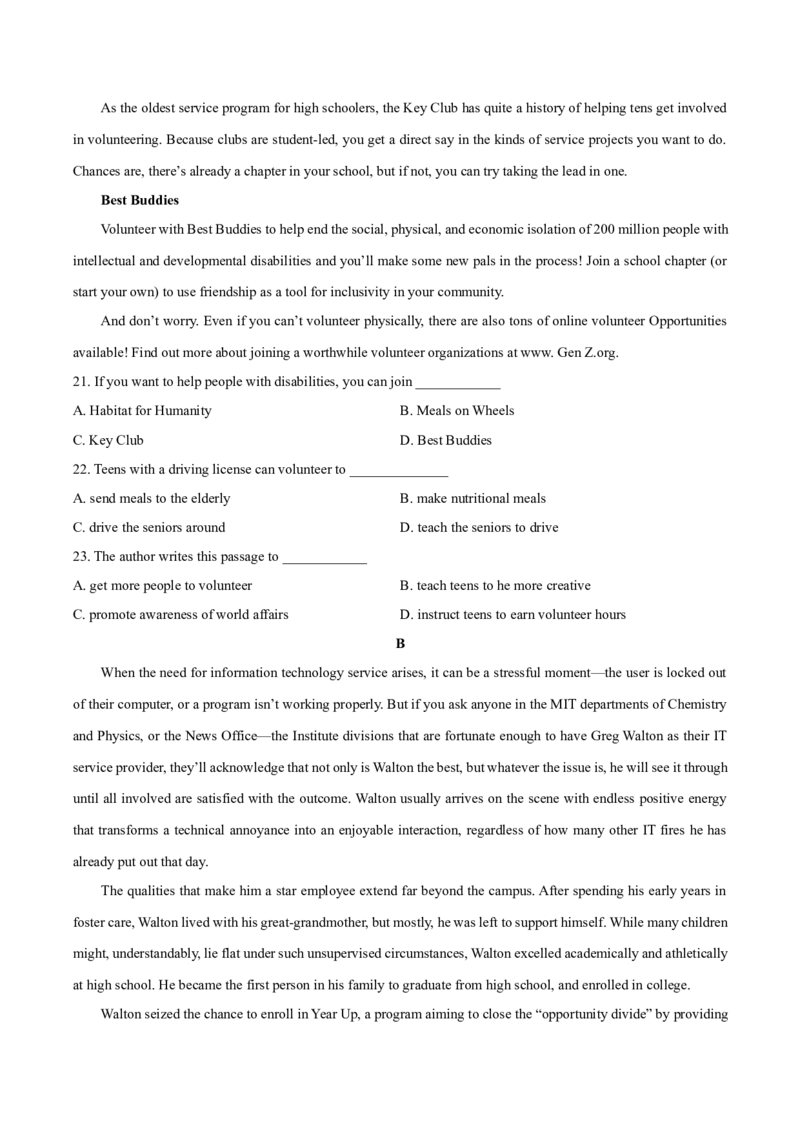
As the oldest service program for high schoolers, the Key Club has quite a history of helping tens get involved
in volunteering. Because clubs are student-led, you get a direct say in the kinds of service projects you want to do.
Chances are, there’s already a chapter in your school, but if not, you can try taking the lead in one.
Best Buddies
Volunteer with Best Buddies to help end the social, physical, and economic isolation of 200 million people with
intellectual and developmental disabilities and you’ll make some new pals in the process! Join a school chapter (or
start your own) to use friendship as a tool for inclusivity in your community.
And don’t worry. Even if you can’t volunteer physically, there are also tons of online volunteer Opportunities
available! Find out more about joining a worthwhile volunteer organizations at www. Gen Z.org.
21. If you want to help people with disabilities, you can join ____________
A. Habitat for Humanity
B. Meals on Wheels
C. Key Club
D. Best Buddies
22. Teens with a driving license can volunteer to ______________
A. send meals to the elderly
B. make nutritional meals
C. drive the seniors around
D. teach the seniors to drive
23. The author writes this passage to ____________
A. get more people to volunteer
B. teach teens to he more creative
C. promote awareness of world affairs
D. instruct teens to earn volunteer hours
B
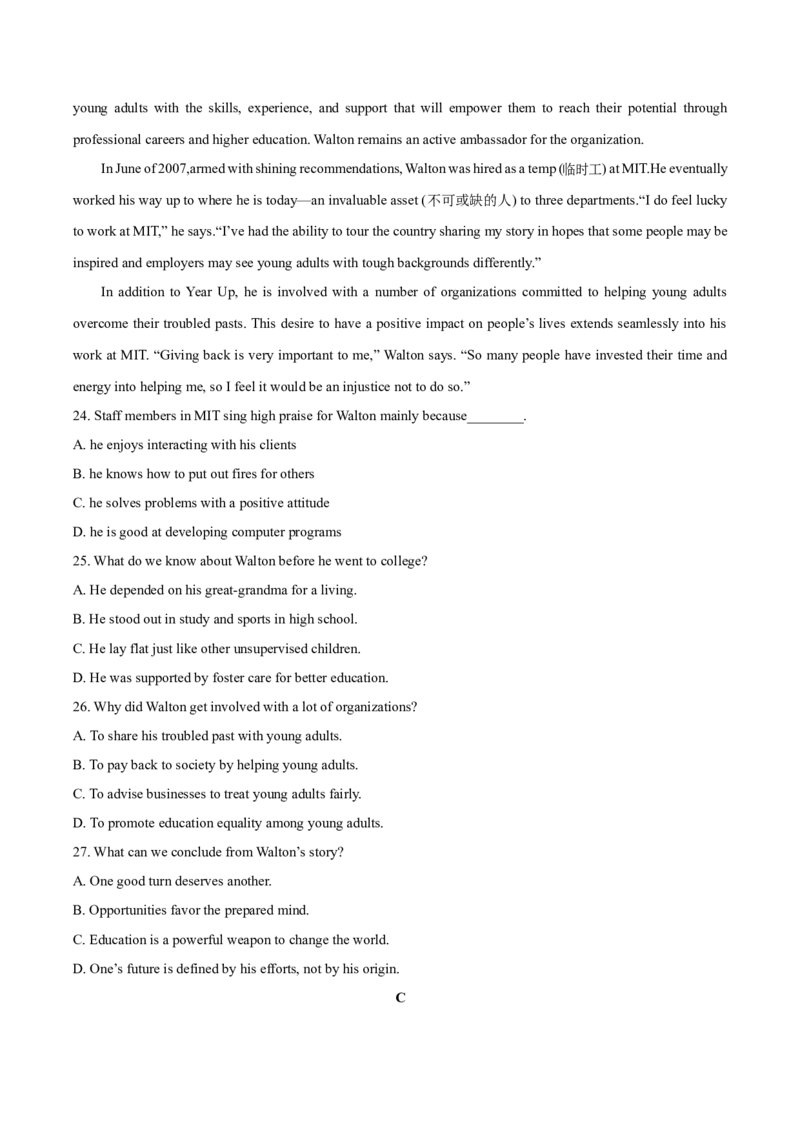
When the need for information technology service arises, it can be a stressful moment—the user is locked out
of their computer, or a program isn’t working properly. But if you ask anyone in the MIT departments of Chemistry
and Physics, or the News Office—the Institute divisions that are fortunate enough to have Greg Walton as their IT
service provider, they’ll acknowledge that not only is Walton the best, but whatever the issue is, he will see it through
until all involved are satisfied with the outcome. Walton usually arrives on the scene with endless positive energy
that transforms a technical annoyance into an enjoyable interaction, regardless of how many other IT fires he has
already put out that day.
The qualities that make him a star employee extend far beyond the campus. After spending his early years in
foster care, Walton lived with his great-grandmother, but mostly, he was left to support himself. While many children
might, understandably, lie flat under such unsupervised circumstances, Walton excelled academically and athletically
at high school. He became the first person in his family to graduate from high school, and enrolled in college.
Walton seized the chance to enroll in Year Up, a program aiming to close the “opportunity divide” by providing
young adults with the skills, experience, and support that will empower them to reach their potential through
professional careers and higher education. Walton remains an active ambassador for the organization.
In June of 2007,armed with shining recommendations, Walton was hired as a temp (临时工) at MIT.He eventually
worked his way up to where he is today—an invaluable asset (不可或缺的人) to three departments.“I do feel lucky
to work at MIT,” he says.“I’ve had the ability to tour the country sharing my story in hopes that some people may be
inspired and employers may see young adults with tough backgrounds differently.”
In addition to Year Up, he is involved with a number of organizations committed to helping young adults
overcome their troubled pasts. This desire to have a positive impact on people’s lives extends seamlessly into his
work at MIT. “Giving back is very important to me,” Walton says. “So many people have invested their time and
energy into helping me, so I feel it would be an injustice not to do so.”
24. Staff members in MIT sing high praise for Walton mainly because________.
A. he enjoys interacting with his clients
B. he knows how to put out fires for others
C. he solves problems with a positive attitude
D. he is good at developing computer programs
25. What do we know about Walton before he went to college?
A. He depended on his great-grandma for a living.
B. He stood out in study and sports in high school.
C. He lay flat just like other unsupervised children.
D. He was supported by foster care for better education.
26. Why did Walton get involved with a lot of organizations?
A. To share his troubled past with young adults.
B. To pay back to society by helping young adults.
C. To advise businesses to treat young adults fairly.
D. To promote education equality among young adults.
27. What can we conclude from Walton’s story?
A. One good turn deserves another.
B. Opportunities favor the prepared mind.
C. Education is a powerful weapon to change the world.
D. One’s future is defined by his efforts, not by his origin.
C
Why do we get angry, fearful, joyful, or anxious? What’s the point in having emotions? In many instances in
life we wish we could do away with emotions altogether, particularly the unpleasant ones like fear, anxiety, and anger.
Remaining calm and peaceful often feels preferable to experiencing extreme ups and downs.
But what if we regard emotions as key to decision making — and start to see that without them we would start
to make some truly unwise choices? Emotions then become more than childlike yelps (joy) and screams (anger);
instead, they are bodily processes that signal value, influence risk assessment, and speed up judgements in uncertain
situations.
Neuroscientist Antonio Damasio developed the “somatic marker hypothesis” in response to observations made in
neurological patients who had suffered damage to the brain’s frontal lobe. Before the onset of brain damage, the
patients were intelligent, creative, and successful— but after damage the patients struggled to organise their workday,
had problems planning their future over immediate, medium and long-range goals, and could no longer choose
suitable friends, partners, and activities. The plans they organised, the groups they elected to join, or the activities
they undertook often led to financial losses, losses in social standing, and losses to family and friends, Damasio writes
in his paper, The Somatic marker Hypothesis and the Possible Functions of the Prefrontal Cortex. Not only were the
choices made by patients no longer personally advantageous, but they were also demonstrably different from the
choices the patients were known to have made prior to brain damage. But in all other aspects of intellect— basic
attention and working memory, the ability to use logic in the solution of problems, the learning of factual knowledge
and skills, even their knowledge of social issues — the patients were otherwise perfectly fine.
Interestingly, in conjunction with impaired decision making, patients also suffered a compromised ability to
express emotion and to experience feelings. “Along with normal intellect and abnormal decision making, there were
abnormalities in emotion and feeling,” writes Damasio.
When we feel joy, rage, disgust — the entire body’s internal environment, including muscles, organs, fluids, and
physiological states including blood pressure and temperature, shift in response, and this “somatic” response is what
drives decision making. We meet someone who gives us a “bad taste in the mouth” and we don’t invite them around
for dinner. Without emotion and the accompanying somatic markers — a pounding heart rate, tight face, lump in the
throat, dry mouth, butterflies in the stomach, sweaty hands, and so forth — we would, more often than not, according to
Damasio’s hypothesis, make sub-optimal decisions in our everyday life.
28. What did Damasio find about patients with frontal lobe damage?
A. Failure to learn some social skills.
B. Decline in their working memory.
C. Inability to express their emotions.
D. Difficulty in making wise decisions.
29. What does the word “somatic” underlined in Para.3 most possibly mean?
A. Intellectual.
B. Emotional.
C. Bodily.
D. Logical.
30. Which would be the best title for the passage?
A. Feeling Our Way
B. Head Ruling Heart
C. Trusting the Senses
D. Calm Before Storm
D
In the fall of 1944, Norman Borlaug moved to Mexico to produce a new variety of wheat. Finally, he got lucky.
His wheat proved to be not just high-yielding (高产的) but also surprisingly varied. But, as proud as he was of his
seeds, Borlaug also saw their limits. When he received the Nobel Peace Prize in 1970, he used his Nobel address to
caution against self-satisfaction. The new varieties of wheat he had reproduced represented, he said, only a “temporary
success in man’s war against hunger.” The world’s population, he worried out loud, would continue to grow, and
eventually the demand for food would again outpace the supply.
Now in 2025, Michael Grunwald says in his new book, We Are Eating the Earth, that humanity is facing “some
terrible math.” On one side of the equation is the growing need for food. On the other side is climate change.
Agriculture is a major source of greenhouse gases, depending on how you calculate it. We need to “feed the world
without frying the world” is how Grunwald puts it.
What’s to be done? A good first step, Grunwald advocates, would be to stop making things worse. We could
start with biofuels. Every year in the US, some fourteen billion gallons of a corn-based additive get mixed in gas. The
practice is supposed to reduce greenhouse-gas emissions. Almost certainly, though, it has the opposite outcome.
Redirecting corn from grocery stores to gas tanks pushes up goods prices — which, in turn, encourages farmers to
change forests into cropland. Since forests store a lot of carbon, cutting down them increases atmospheric \( CO_2
\). Grunwald quotes a song:
Biofuel use is gonna burn up all my food
Deforestation can only ruin our nation.
Immoral men with that bad intention
What is your plan? Is it life or ruination?
Were it not for Borlaug, the world in the late twentieth century would have been a very different place. In the
eight years since Borlaug arrived in Mexico, farming in much of the world has been transformed. New tools that
could make farms even more productive are constantly being developed. At the same time, the world, too, has been
transformed, by such things as climate change, groundwater exhaustion, and soil pollution. The new tools and the
new threats are bound up in each other—two sides, as it were, of the same leaf. If it is reasonable to imagine that we
will, somehow or other, find ways to feed ten billion people, it is also reasonable to fear how much damage will be
done in the process.
31. What are the first two paragraphs mainly about?
A. The downstream consequences of food shortage.
B. The significance of inventing high-productive seeds.
C. The problems humans face in the course of development.
D. Two contrary perspectives on the growing demand for food.
32. Why does the author mention the song?
A. To illustrate a current attempt of biofuels.
B. To reveal convention is still better than innovation.
C. To raise public awareness of redirecting food for fuel.
D. To prove good intentions may bring about bad results.
33. What can we learn from the passage?
A. Farming transformation lacks recognition.
B. The issue of hunger should be prioritized.
C. It is urgent to treat human-caused damage.
D. We need view food and environment as one.
34. Which would be the best title for the passage?
A. Can We Satisfy Our Growing Appetites?
B. Farming: Will It Be Life without Ruination?
C. Is Agriculture to Blame for Climate Change?
D. Environment: Are We Transforming or Harming It?
第二节(共5 小题;每小题2 分,共10 分)
根据短文内容,从短文后的七个选项中选出能填入空白处的最佳选项,并在答题纸上将该项涂黑。选项中
有两项为多余选项。
Martin Luther King, Jr. once said, “Only when it is dark enough can you see the stars.” ___35___ Darkness and
fear may cloud our vision, but moments of light — like flashes in a storm — reveal that our goals and dreams
remain.
When overwhelmed by uncertainty, helplessness often takes over. Yet, as Thich Naht Hanh teaches, “The only
way out is in.” ___36___ Positive psychology shows that trusting yourself depends on cultivating inner peace and
recognizing your character strengths.
Researchers studied 16,716 individuals from over 50 countries to understand traits linked to self-trust during
uncertainty. They found that those with strong trust consistently reported greater inner peace. This group excelled in
three emotional character strengths — gratitude, love, and hope. ___37___
Gratitude, the most studied of the three, is particularly powerful. It focuses on what has already happened,
requiring no invention or manipulation. ___38___ Instead of recalling only average events, asking for “three things
you were grateful for yesterday” directs the brain to retrieve positive experiences. Over time, this reshapes our
perspective, helping us savor moments and feel better. Daily challenges — political, financial, or personal — are
unavoidable, but they need not consume us. By practicing gratitude, we train our minds to notice what uplifts us. This
shift in perception fosters self-trust, reminding us that peace and strength lie within.
___39___ Savor them. This simple practice opens the door to inner peace, proving that storms may rage, but
stars still shine. With gratitude comes self-trust, and with self-trust comes a life of resilience and meaning.
A. Practicing gratitude changes how our brain searches memories.
B. This reminds us that even in difficult times, we can find guidance and hope.
C. Inner strength allows us to shift our focus inward, finding calm amid chaos.
D. Try it now: recall three experiences from the last 24 hours that made you grateful.
E. They promote harmony and resilience, and importantly, they can be taught and developed.
F. These strengths are valuable as they arise naturally in times of crisis and play a vital role in hardship.
G. It mainly helps people forget negative experiences, allowing the brain to erase unpleasant memories over time.
第三部分 书面表达(共两节,32 分)
第一节(共4 小题;第40、41 题各2 分,第42 题3 分,第43 题5 分,共12 分)
阅读下面短文,根据题目要求用英文回答问题。
When I began my Ph. D. in science four years ago, I started feeling like a fish out of water. Everyone around me
seemed to be driven by their burning love of science. I felt out of place, uninspired, and incompetent. “Mary, don’t
worry. It’s just self-doubt,” everyone told me. For years, I believed them, thinking that with more experience and
confidence, things would change.
But as time went on, the feelings only got stronger. The idea of quitting made me feel relieved. But I knew I had
too much fight in me to leave my program. So I decided to get my degree and then pursue something else entirely.
Partly in search of this “something else,” I began writing. At first, I mainly used it as a creative outlet. But
eventually, it led me to explore science communication. In writing about newly published scientific papers, I felt
curious, enlightened, and empowered. I began to entertain the idea that my problem wasn’t self-doubt — maybe I
truly was a fish out of water, and all I needed to do was leave my life on land.
I decided to tell my academic teachers about my new passion. However, they could not understand why I would
want to pursue anything other than research. Truthfully, I did worry about what my life would look like if I left the
world of scientific research. I expressed my concerns to a writing teacher. “Follow your heart, and the rest will
follow,” she told me. I knew in my heart that I wanted to pursue science communication after graduation. And once
I chose to trust that feeling, I found that I no longer struggled to breathe. I still felt out of place in academic research.
But I now knew where I belonged and how to get there.
40. How did the author feel when she began Ph. D. in science?
_____________________________________________________________
41. What did the author use as a creative outlet?
_____________________________________________________________
42. Please decide which part is false in the following statement, then underline it and explain why.
After learning about the author’s concerns, the writing teacher encouraged her to quit scientific research
immediately.
_____________________________________________________________
43. Use an example to show how you would apply the inspiration from the story in your life. (In about 40 words)
_____________________________________________________________
第二节(20 分)
44. 假设你是红星中学高三学生李华。你的外国好友Jim 的学校正在组织“校园文化建设”(Shaping School
Culture)的创意征集活动。Jim 打算参加,为此发来邮件,就创意内容询问你的建议。请你用英文给他回复,
内容包括:
1.你的建议;
2.说明理由。
注意:1.词数100 左右;
2.开头和结尾已给出,不计入总词数。
Dear Jim,
____________________________________________________________________________________________
____________________________________________________________________________________________
____________________________________________________________________________________________
____________________________________________________________________________________________
_______________________________________________________________________________________
Yours,
Li Hua