绝密★启用前
2025年高考考前信息必刷卷(新高考八省专用)01
英 语
(考试时间:120分钟 试卷满分:150分)
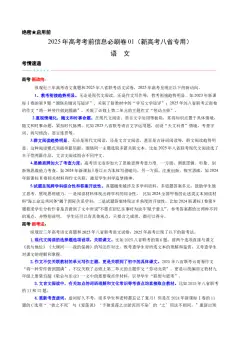
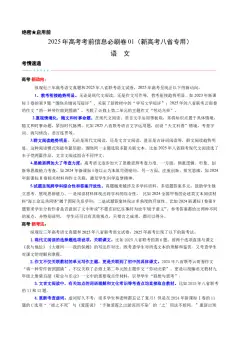
考情速递
高考·新动向:在2025年春季适应性新高考卷中,依然将坚持“五育融合”的命题思路,特别加强对体育、
美育和劳动教育的引导。完形填空将突出考查动词的词义辨析能力,而语法填空则会集中考查非谓语动词
的运用。应用文写作将更加贴近日常生活,但仍具有创新性,考生需要分析和思考解决问题的方法。
高考英语题型和出题模式在2025年基本保持不变,仍将注重考查考生的思维品质和逻辑思维能力。因
此,考生需要注重语篇意识,避免简单的“刷题”方式。在听力部分,将特别注意加入背景音效,并可能
涉及到非母语国家口音或方言,如印度英语、日本英语、新加坡英语、马来西亚英语等,同时还会有英式
英语和美式英语的出现。
高考·新考法:“八省”整体思想分析大方向
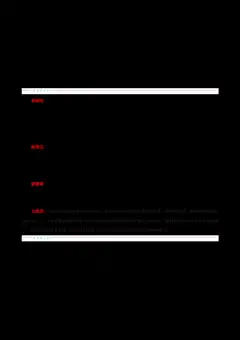
题号 难度 知识点
听力选择题
Text 1 容易 计划
Text 2 较易 其他人物关系
Text 3 较易 计划,交通方式
Text 4 较易 周边环境与场所
Text 5 较易 计划
Text 6 较易 家庭生活
Text 7 较易 日常生活 ,计划
Text 8 适中 电视与电台
Text 9 适中 个人经历
Text 10 适中 课程,个人经历
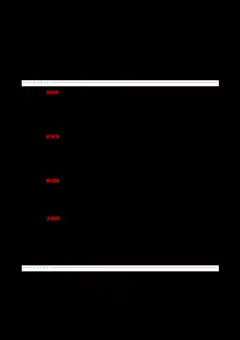
阅读理解
本文是一篇应用文。文章介绍了英国东约克郡的四个景点,主要包括其地理位
A 较易
置、联系方式、景点活动、开放时间及票价等信息。
本文是一篇记叙文。文章主要讲述了邮递员吉姆·约翰逊在工作中热心帮助邻里,
B 适中 与大家建立了深厚感情,在他退休 33年后,作者依然记得他,表达了对他的怀
念。
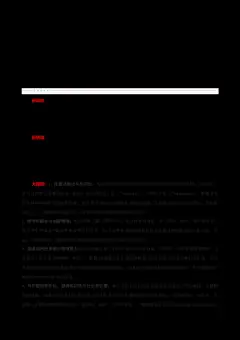
C 较易 本文是一篇夹叙夹议文。文章主要介绍了 Jacobs一生致力于推进一种独特的城市愿景,尤其关注是什么造就了一个成功的城市社区。
本文是一篇说明文。文章主要介绍了一项新研究——锻炼可以帮助刺激大脑将新
D 适中
信息转化为长期记忆的区域,以及进行锻炼以最大程度提高学习的最佳时间。
本文是一篇说明文。文章主要介绍了大学艺术博物馆之友的成员构成、会员意
七选五 较易
义、福利待遇及加入方式,鼓励公众参与。
本文是一篇记叙文。文章讲述了作者喜欢去一个海滨地区的公园看日落,常看到
完形填空 适中 一位老妇人喂鸽子。一个特别的晚上,老妇人的项链掉落,一只鸽子竟捡起项链
放回到她腿上,这让作者和老妇人都很吃惊,也都非常欣喜。
语法填空 较易 本文是一篇说明文。文章主要讲述了联合国设立语言日的目的及中文日的意义。
本篇书面表达属于应用文。要求考生对于你的留学生朋友Beth想学打乒乓球,发
书信写作 适中
邮件向你求教这一情况,给她回封邮件。
本文以人物为线索展开,讲述了作者在费城参加会议期间,看到酒店附近剧院有
一场关于动物救助站救助流浪狗的纪录片放映及筹款活动,作者因喜爱动物想去
读后续写 适中
参加,却在剧院外看到一群看起来凶巴巴的摩托骑手,犹豫后还是进入剧院,希
望电影结束时骑手们已离开。
2025年第五批高考综合改革省、自治区将要首考落地,适应性测试卷结合这些省区的实际情况,在结构、
考查内容和要求上进行了合理设计。试卷立足高考内容改革,遵循课程标准,重点考查必备知识、能力和
核心素养,强化基础性、综合性、应用性、创新性的考查要求。试卷坚持素养导向,深化基础考查学科主
干知识,突出考查思维过程与方法,体现了重视思维、关注应用、鼓励创新的指导思想,助力拔新人才选
拔。
命题·大预测:阅读理解B篇是一篇记叙文。本文主要讲述了前NASA绘图员库尔特·温纳转型为专业艺术
家,擅长创作粉笔绘制的三维立体错觉画,这些画作看似雕刻于路面上而非绘制而成。他在欧洲自学成才,
最终发明了3D路面艺术,其作品在世界30多个国家受到观众喜爱,引导学生关注美育;完形填空主要讲
述了高中毕业后,作者因经济困难从社区大学退学,但牢记凡事有好的一面,花了七年时间边打工,边获
取社区大学的学分,后来上了四年制大学,如今快拿到博士学位,作者很高兴自己没有放弃童年的梦想,
引导学生要树立梦想并追求。语法填空讲述了儋州调声这一传统歌舞形式的起源、特点、发展困境以及保
护措施,引导学生关注传统文化。
第一部分 听力(共两节,满分 30 分)
第一节(共5小题;每小题1.5分,满分7.5分)
听下面5段对话。每段对话后有一个小题,从题中所给的A、B、C三个选项中选出最佳选项。听完每
段对话后,你都有10秒钟的时间来回答有关小题和阅读下一小题。每段对话仅读一遍。
1.Which country does the man want to know about?
A.Australia. B.America. C.Canada.
2.Which color jacket does the man think is best?A.Pink. B.Blue. C.Yellow.
3.What suggestion does the man give to the woman?
A.Finding the owner by using the phone.
B.Handing in the phone to the security office.
C.Taking the phone to the teaching building.
4.What will the man do next?
A.Go to the lecture. B.Wait for his friend. C.Talk with his roommate.
5.What sport does the woman like?
A.Golf. B.Tennis. C.Badminton.
第二节(共15小题;每小题1.5分,满分22.5分)
听下面5段对话或独白。每段对话或独白后有几个小题,从题中所给的A、B、C三个选项中选出最佳
选项。听每段对话或独白前,你将有时间阅读各个小题,每小题5秒钟;听完后,各小题将给出5秒钟的
作答时间。每段对话或独白读两遍。
听下面一段较长对话,回答以下小题。
6.What does the man want to do?
A.Change his seat. B.Have some drinks. C.Go to the non-smoking area.
7.Where does the conversation take place?
A.On a flight. B.In a restaurant. C.In an office.
听下面一段较长对话,回答以下小题。
8.What does the man teach at college?
A.English. B.French. C.Chinese.
9.Why does the woman come to China?
A.To go to college. B.To visit some friends. C.To go for a trip.
听下面一段较长对话,回答以下小题。
10.Where did the man probably lose the key?
A.In the restaurant. B.In the taxi. C.At the market.
11.What is in the man’s safe?
A.His passport. B.A photo. C.His ID card.
12.Who left the safe to the man?
A.His mother. B.His sister. C.The woman.听下面一段较长对话,回答以下小题。
13.Why does the man want to buy flowers for his girlfriend?
A.She loves flowers.
B.Her birthday is coming.
C.There is a discount on flowers.
14.What kinds of flowers does the man buy for his girlfriend?
A.Roses. B.Lilies. C.Tea roses.
15.How much does the man pay for the flowers?
A.90 yuan. B.98 yuan. C.100 yuan.
16.When is the man’s girlfriend’s birthday?
A.Next Monday. B.Next Thursday. C.Next Saturday.
听下面一段独白,回答以下小题。
17.Where did the lady come across the parrot?
A.In a pet store. B.On her way to school. C.Outside a pet store.
18.How was the lady’s mood after listening to the parrot’s words?
A.She was angry. B.She was happy. C.She was confused.
19.What did the lady want to do to the bird?
A.She wanted to buy it. B.She wanted to fly it. C.She wanted to kill it.
20.How many times did the parrot talk to the lady?
A.Four times. B.Three times. C.Six times.
第二部分 阅读(共两节, 满分50分)
第一节(共15小题;每小题2.5分, 满分37.5分)
阅读下列短文, 从每题所给的A、B、C和D四个选项中选出最佳选项。
A
Faculty Teaching Workshop Announcement
There is an upcoming faculty teaching workshop opportunity this summer, Monday, August 5. The
workshop, which will be a half-day event, is co-sponsored by Academic Affairs and the Center for Collaborative
Learning. It will focus on employing effective and creative tools in the classroom, with a particular emphasis on
collaborative learning.Dr Brad Garner, PhD, the Director of Faculty Enrichment at Indiana Wesleyan University, will be serving as
our facilitator. I had the pleasure of attending Dr Garner’s session at a National Conference on the First Year
Experience this semester, which was entitled Teachapalooza: A Festival of Bedazzling Strategies, Tools and Tactics.
It was both inspiring and practical, perfect for relatively new faculty, as well as for more experienced faculty, in
learning about a variety of the most effective teaching strategies that can be employed in the classroom.
All faculty are invited to attend the workshop, particularly applicable given our cross-campus focus on
collaborative learning. Dr Garner’s brief bio is included below.
Brad Garner
Brad Garner serves as Director of Faculty Enrichment in the Center for Learning and Innovation at Indiana
Wesleyan University’s National & Global Campus. Garner has been actively involved for several years in
directing and teaching the first-year seminar on his campus. Currently, he leads faculty enrichment efforts across
the entire university. One of his greatest passions is helping faculty learn new and creative ways to teach and
engage students.
21.What is the main purpose of the workshop mentioned in the text?
A.To recruit new faculty.
B.To enhance teaching strategies.
C.To discuss administrative duties.
D.To review student performance.
22.Who is the facilitator of the upcoming workshop?
A.A representative from Academic Affairs.
B.A professor from the Center for Collaborative Learning.
C.The Head of National Conference on the First Year Experience.
D.The Director of Faculty Enrichment at Indiana Wesleyan University.
23.What experience does Dr Garner have that is relevant to leading this workshop?
A.Directing faculty enrichment efforts.
B.Managing university finances.
C.Writing academic textbooks.
D.Developing online courses.
B
Kurt Wenner, a former NASA illustrator (绘图员) turned professional artist, specializes in chalk-drawnthree-dimensional illusions that seem carved into the pavement rather than drawn on it.
Born and raised in Santa Barbara, California, Kurt Wenner attended both the Rhode Island School of Design
and ArtCenter in Pasadena and was quickly recruited to work for NASA while studying at the school. There, he was
among the few highly skilled artists whose work was done merely by hand. Eventually, Kurt left the agency and
moved to Europe to study some of the world’s greatest works of art. Disappointed to find no class on the principles
of classicism, the young artist came up with his own self-learning program which involved spending countless
hours drawing from the magnificent art collection of the Vatican Museums and the Pantheon.
Every morning, Kurt would draw some of the world’s most famous works of art and sell them to tourists in
order to support himself. It was during this period that he discovered the world of pavement illusions. One day, on
his way to the Vatican to see the paintings that had become his inspiration, Kurt passed by artists creating images
with chalk on the pavement. After being invited to try his hand at it, he spent only a few months developing a new
art form known as 3D pavement art.
Inspired by a wide range of subjects, Kurt Wenner creates sophisticated pavement artworks that, admired
from just the right angle, have an impressive depth that makes them look sculpted into the pavement. The American
artist is generally regarded as the inventor of 3D pavement art and his works have fascinated audiences in over 30
countries around the world.
“In photographs of my 3D images, the art can appear as ‘real’ as the audience. Although I employ many
visual tools to create illusion, the classical language of form is the most vital. Classicism is vastly superior to other
forms of realism for the creation of illusion as it is based on human perception. Every stroke has the purpose of
communicating form and space to the viewers. My perspective technique enables me to bring classicism into the
present by creating a visual and geometrical link between a work of art and its contemporary surroundings,” said
Kurt Wenner.
24.What made Kurt Wenner create his own self-learning program?
A.His major in college.
B.His work experience in NASA.
C.The visit to the Vatican Museums.
D.The lack of classes on the principles of classicism.
25.How did Kurt Wenner make a living in Europe at first?
A.By teaching art classes. B.By selling his artworks.
C.By working in a local museum. D.By creating pavement illusions.
26.What is special about Kurt Wenner’s 3D pavement artworks?A.They primarily show American culture.
B.They are created based on famous artworks.
C.They bring a “real” visual space to viewers.
D.They combine digital and ancient elements.
27.What can be the best title for the text?
A.The development of classicism in modern art
B.Kurt Wenner: A NASA illustrator
C.The origin and growth of 3D pavement art
D.Kurt Wenner: Pioneer of 3D pavement illusions
C
If you find yourself sleepy during your daily activities in your older age, you may need to consider it more
than an inconvenience - since the fatigue may indicate you’re at higher risk for developing a condition that can
lead to dementia (痴呆), a new study has found.
Among participants who experienced excessive daytime sleepiness and a lack of enthusiasm, 35.5%
developed motoric cognitive risk syndrome (运动认知风险综合征), or MCR compared with 6.7% of people
without those problems, according to the study.
MCR is marked by slow walking speed and complaints of memory problems among older people who don’t
already have dementia or a mobility disability. The risk of developing dementia more than doubles in those with
this syndrome, which was first described in 2013.
The findings are based on 445 adults who were aged 76 on average. Participants walked on treadmills (跑步
机) so their initial gaits could be recorded, then were assessed annually from 2011 to 2018. The study authors also
collected yearly data on participants’ recollections of their sleep quality and quantity in the two weeks leading up to
the assessments.
Over a follow-up period of roughly three years on average, 36 participants developed MCR syndrome.
Compared with “good” sleepers, “poor” sleepers had only a slightly higher risk of MCR.
“The study findings may help physicians and patients be more open to asking questions about sleep patterns,
and to looking more closely at walking speed when making an early diagnosis,” said Dr. Richard Isaacson, director
of research at the Institute for Neurodegenerative Diseases in Florida.
“If you’re already experiencing mobility issues, fall prevention can help,” Isaacson said, “that can include
physical and occupational therapy evaluation, and at-home adaptations such as installing bars in the shower,removing clutter (杂物) and using night-lights.”
“MCR syndrome is newly identified, so experts still have a lot to learn before they can explain in detail what
causes it and how it affects the body,” Isaacson said.
28.What does the underlined word “fatigue” probably mean in paragraph 1?
A.Weakness. B.Tiredness. C.Comfort. D.Happiness.
29.What might be the feature of MCR?
A.Slow movement. B.More complaints.
C.Excessive sleepiness. D.Rapid cognitive declines.
30.How did the study collect data on participants’ sleep?
A.By writing sleep diaries. B.By doing treadmill tests.
C.By conducting annual interviews. D.By monitoring sleep at home.
31.What should a senior with mobility issues do?
A.Live normally. B.Reduce activity. C.Stay awake. D.Avoid falls.
D
Nostalgia (怀旧), or the experience of lovingly recalling and longing for your past, is seemingly fitting into
our culture right now, with movie and TV screens especially expanded. On its surface, it seems simple: picturing
fond feelings from our past just makes us feel good. But there’s a lot more going on.
In the recent research, researchers at the Chinese Academy of Sciences asked study participants to rate their
level of pain from heat stimulation (刺激) while looking at pictures that were nostalgic-showing images of old
cartoons, childhood games or candy-compared with another group of people who were given with modern pictures.
During the tasks, a machine examined the 34 participants. After obtaining brain scans, researchers found that
observing pictures that activated childhood memories was linked to participants reporting weaker feelings of pain.
By managing their discomfort, rather than reducing the unpleasant stimuli, people can use nostalgia to rebuild their
painful experiences.
But Swets, another nostalgia expert, warned that using nostalgia for pain relief might not be a blanket
solution for everyone. He highlights that nostalgia is a personal emotional experience that varies in terms of
frequency and intensity. “What nostalgia is the feeling of connectedness with other people,” Swets said, noting that
the clues in many studies are designed to make people think of good times with family and friends. “So, people
who are a little more avoidant of intimate (亲密的) relationship with other people, or more likely to prefer distance
don’t get the same results of nostalgia.” As with other positive psychology interventions, the impacts can depend onthe person.
The researchers involved in the studies also have plans to use different age groups in future research to look
into the impacts of more personal nostalgic clues rather than common nostalgia ones such as old music and movies.
32.In which aspect were the two groups different in terms of research design?
A.Heat resistance. B.Anxiety level.
C.Childhood experience. D.Picture cues.
33.What does the research find about nostalgia?
A.It reduces bad stimuli. B.It makes brain active.
C.It relieves one’s pain. D.It reshapes one’s past memory.
34.What does Swets say about nostalgia?
A.It’s a good way to recall fine times. B.It’s a universal solution to pain relief.
C.Its effect is influenced by relationships. D.Its form is similar to other interventions.
35.What will the follow-up study focus on?
A.Nostalgic experience types. B.Personal nostalgia effects.
C.The impact of nostalgia on all age groups. D.The reason for the popularity of nostalgia.
第二节(共5小题;每小题2. 5分, 满分12. 5分)
阅读下面短文, 从短文后的选项中选出可以填入空白处的最佳选项。选项中有两项为多余选项。
There’s nothing like the end of the year to bring up a lot of different feelings. Stress, anxiety, anticipation,
excitement, and dread are some examples of emotions that people feel when they realize it is fast approaching.
36 There are some common reasons for feeling year-end anxiety. For example, realizing we have goals and
experiences we didn’t get to, feeling like we’re running out of time to do the things that matter, and anticipating
end-of-the-year social obligations and responsibilities. How to cope with it?
Reflect on the positive experiences you had and acknowledge the wins from this past year. 37
When we’re so busy and wrapped up in what’s next, we quickly dismiss the good. So list your best memories,
proudest moments, and small-to-big wins from this year so far.
Recall the goals or experiences you hoped to have this year. Be clear on what you think you should do and
what you genuinely want to do. 38 It’s liberating to just accept that not everything you hoped for will
happen and that is okay. To tackle it, choose one to two things you want to turn your attention to and can do.
39 Rather than wait until next year to “restart”, take action now. Just make plans and reach out to
friends. Tell them what you’re excited about and what you plan to do.Besides, helpful mindset may shift to feel less anxious. Hence, avoid the rigid attitude that if you don’t get
something done by December 31 then all hope is lost. 40 Being understanding and forgiving yourself
will help you keep going with the precious time that remains this year.
A.Instead, be kind to yourself.
B.Permit yourself to let some go for now.
C.Do one thing related to your goal today.
D.List what went well compared to this time last year.
E.It’s easy to lose sight of the positive experiences you have had.
F.Remember that the end of the year is only an arbitrary marker of time.
G.It’s normal to become more self-reflective and emotional during year-end period.
第三部分 语言运用(共两节,满分30分)
第一节(共15小题,每小题1分,满分15分)
阅读下面短文, 从每题所给的A、B、C和D四个选项中选出可以填入空白处的最佳选项。
After completing high school, I had the hope of continuing my education at a university. But the 41
kept piling up. I had no money despite working three jobs, so I had to 42 from the community college. Still,
I held on to a lesson my parents had 43 in me: everything bad comes with something good.
As the eldest daughter of five children of an immigrant family to the US, I worked at 44 jobs and at
16 became 45 independent. Through it all, my education meant everything to me. I thought if I did well in
my 46 work, everything else would fall into place. But when I gained 47 to many top public
universities across the state, my heart 48 since I couldn’t afford it. I couldn’t take out large amounts of
student loan debt given my family’s economic 49 . Besides, being first generation from an immigrant
household, I didn’t understand what scholarships were and how to 50 - and even if I did, scholarships
wouldn’t replace my 51 as my family’s economic provider if I left.
I spent 7 years working many jobs while slowly 52 community college credits. Then, as my sisters
were older, I moved on to a 4-year university. I 53 organic chemistry with Dr. Farmer. In his office hours,
I discovered my 54 . Within 6 months, I was running columns in his lab. Now I’m close to getting my
Ph.D.degree in organic chemistry. I am so glad I never 55 my childhood dream.
41.A.opportunities B.functions C.challenges D.consequences
42.A.benefit B.withdraw C.borrow D.slide
43.A.planted B.delivered C.assessed D.arranged44.A.positive B.multiple C.adorable D.efficient
45.A.technically B.normally C.visually D.financially
46.A.reasonable B.academic C.elegant D.familiar
47.A.reputation B.recognition C.admission D.adoption
48.A.beat B.stopped C.failed D.sank
49.A.situation B.recovery C.policy D.system
50.A.compare B.observe C.apply D.avoid
51.A.advantage B.desire C.behavior D.role
52.A.marking B.earning C.donating D.decreasing
53.A.viewed B.mentioned C.took D.designed
54.A.mood B.standard C.disadvantage D.curiosity
55.A.gave up B.picked up C.kept up D.cleared up
第二节(共10小题;每小题1.5分 ,满分15分)
阅读下面短文,在空白处填入1个适当的单词或括号内单词的正确形式。
Danzhou Diaosheng, is a traditional song-and-dance form that originates in the city of Danzhou. 56
dynamic music and catchy lyrics, singers battle each other on stage in 57 (performance) that echo
modern-day rap. Nevertheless, Diaosheng, 58 (include) in the first national intangible cultural heritage
list (非遗名录), is something much older and with very different roots.
“The music makes you happy because the melodies are cheerful.” said Tang Baoshan, 59 started
learning the folk songs when he was a child and soon demonstrated a talent for the form. In 1976, Tang began
composing songs and rose to 60 (famous) three years later. However, as time passed, he saw fewer young
people willing to learn the art as the income was too low 61 (attract) them.
To rescue the art, Tang joined with local experts to collect the songs by 62 (knock) on doors in
local communities. More than 1,000 songs were recorded. Also, the city of Danzhou has put the art form into the
curriculum (课程) of primary schools, hosted art and 63 (culture) events featuring Diaosheng, and
promoted it in tourist attractions.
Nowadays, Danzhou Diaosheng becomes a pastime (消遣) for local people. Tang says it is 64
vital part of Danzhou culture and will never 65 (erase), because people pass it down from generation
to generation.第四部分 写作(共两节, 满分40分)
第一节(满分15分)
66.假定你是李华,你的外教Sam开设抖音(Tiktok)账号。他发布了一些短视频(vlog),以记录在中
国的见闻。为了把视频做得更好,他写邮件向你寻求建议。请你给外教回一封邮件,内容包括:
1.观后的感受;
2.提出建议。
注意:1.写作词数应为80左右;
2.请按如下格式在答题卡的相应位置作答。
Dear Sam,
____________________________________________________________________________________________
____________________________________________________________________________________________
____________________________________________________________________________________________
____________________________________________________________________________________________
____________________________________________________________________________________
Yours sincerely,
Li Hua
第二节(满分25分)
67.阅读下面材料,根据其内容和所给段落开头语续写两段,使之构成一篇完整的短文。
Gina walked her way towards the school building. Her stomach fluttered (照动) with butterflies. It was not
just any day. It was her first day in a new school in a new town, and the sense of starting over was enormous. She
looked back to wave goodbye to her parents, who responded with thumbs-up and encouraging smiles. If they only
knew how nervous she was.
Back in her old school, Gina had a solid circle of friends who had been with her since kindergarten. They
had experienced countless adventures together, shared secrets, and supported each other through every challenge.
Even when Gina got braces (牙套), her friends never made her feel embarrassed about it. However, all those
comforting memories were now part of a closed chapter. As Gina stood before the impressive doors of her new
school, she realized she was on the edge of a new chapter in her life.
Inside, the students in Gina’s class seemed welcoming and friendly. They smiled and offered greetings,
making an effort to include her. Despite their kindness, Gina found herself smiling less and less due to her lack of
confidence in her appearance. She was constantly worried that she couldn’t fit into the new group.
Now it was the gym class. The coach announced they would be playing volleyball.“Gina,” the coach called out, “you’re playing libero (自由人) today, okay? The libero in volleyball is a
player who specializes in defense and moves around the court quickly and freely to pass the ball.
“Sure thing!” Gina replied. She put on her sports shirt and took her position, focusing on the area near the
back of the court. She scanned the court and looked over to the position where her teammate was preparing to serve
(发球).
注意:
1. 续写词数应为150左右;
2. 请按如下格式在答题卡的相应位置作答。
As the volleyball game began, Gina felt her anxiety increase.
____________________________________________________________________________________________
____________________________________________________________________________________________
____________________________________________________________________________________________
____________________________________________________________________________________________
____________________________________________________________________________________________
_______________
The game continued, and with the coach’s encouragement ringing in her mind, Gina felt a newfound
confidence.
____________________________________________________________________________________________
____________________________________________________________________________________________
____________________________________________________________________________________________
____________________________________________________________________________________________
____________________________________________________________________________________________
_______________