绝密★启用前
2026 年高考二轮信息必刷卷01(浙江专用)
英  语
考情速递
高考·新动向:参考历年高考真题变化趋势,高考真题在题型上与往年保持一致。选材上
阅读材料更加注重现实生活场景;命题更注重语篇的真实性、实用性与育人价值,强调真
实语境与跨域融合并重。如应用文聚焦实用技能(A 篇媒介素养培养方法),说明文融合
多学科主题 ——C 篇北极科考结合地质、生物与地外生命探索,D 篇澳大利亚教师危机
关联教育管理与心理健康,体现 “人与自然、人与社会” 的核心主题。。
高考·新情境:在命题中,所选的语篇情境设置紧跟时代热点,围绕人与自然、人与自我
人与社会三大主题语境,融合思想性和教育性,引导学生多角度思考。例如:语法填空以
“良渚消失” 为叙事线索,通过 “黏土层发现 — 石笋研究 — 厄尔尼诺致洪” 的推理
链条,构建 “历史文化 + 科学探究” 的复合情境,让语法考查融入文化理解过程。
命题·大预测:基于本卷题目结构与内容,并结合近年高考英语真题命题趋势作出如下预
测。
1. 选材的真实化、跨域化、时代化。语篇将更多融合科技突破(如深海科考、气候研
究)、社会治理(如教育减负、心理健康)等主题。
2. 试题设置突出思维分层与素养导向。如完形填空可能聚焦 “文化传承、青年成
长” 等主题,强化情感逻辑与价值观关联;语法填空的语篇将更倾向 “中国故事 + 科
学成就”(如非遗保护、航天突破),渗透核心素养。
3.能力考查体现语用灵活与语境绑定深化。完形填空将进一步强化 “情感线索 — 词
汇选择 — 叙事逻辑” 的联动考查;语法填空可能增加 “词性转换”等语境依赖型考点;
阅读理解将更注重 “跨文本对比”“信息迁移应用” 等高阶能力。
(考试时间:120 分钟  试卷满分:150 分)
注意事项:
1. 答题前,考生先将自己的姓名、准考证号码填写清楚,将条形码准确粘贴在条形码区域
内。
2. 选择题必须使用2B 铅笔填涂;非选择题必须使用0. 5 毫米黑色字迹的签字笔书写,字体
工整,笔迹清楚。
3. 请按照题号顺序在答题卡各题目的答题区域内作答,超出答题区域书写的答案无效;在
草稿纸、试卷上答题无效。
4. 作图可先使用铅笔画出,确定后必须用黑色字迹的签字笔描黑。
5. 保持卡面清洁,不要折叠、不要弄破、弄皱,不准使用涂改液、修正带、刮纸刀。
第一部分  听力(共两节,满分 30 分)
做题时,先将答案标在试卷上。录音内容结束后,你将有两分钟的时间将试卷上的答案转
涂到答题卡上。
第一节(共5 小题;每小题1.5 分,满分7.5 分)
听下面5 段对话。每段对话后有一个小题,从题中所给的A、B、C 三个选项中选出最
佳选项。听完每段对话后,你都有10 秒钟的时间来回答有关小题和阅读下一小题。每段对
话仅读一遍。
1.What will the woman do for the man?
A.Pick up his client.
B.Drive him to work.
C.Postpone his meeting.
2.What is the probable relationship between the speakers?
A.Teacher and student.
B.Boss and worker.
C.Guide and visitor.
3.What can be inferred about the girl?
A.She was ill in bed.
B.She passed the exam.
C.She is telling a lie.
4.What did Jenny do yesterday?
A.She got a gold medal.   B.She played baseball.  C.She watched a basketball game.
5.What happened to the man’s socks?
A.They no longer fit.  B.They are lost at the laundry. C.They have been worn by Tom.
第二节(共15 小题;每小题1.5 分,满分22.5 分)
听下面5 段对话或独白。每段对话或独白后有几个小题,从题中所给的A、B、C 三个
选项中选出最佳选项。听每段对话或独白前,你将有时间阅读各个小题,每小题5 秒钟;
听完后,各小题将给出5 秒钟的作答时间。每段对话或独白读两遍。
听第6 段材料,回答第6、7 题。
6.Why does the man want to work at Camp Elizabeth?
A.He knows some people there.   B.People think highly of it.   C.It offers a good
salary.
7.What does the man care about?
A.The workmates.
B.The camping site.
C.The accommodation.
听第7 段材料,回答第8 至10 题。
8.What is the relationship between the speakers?
A.Mother and son.
B.Teacher and student.
C.Friends.
9.Why is the woman angry with the man?
A.He made a mess in her car.           B.He dropped litter into the trees.
C.He performed terribly in today’s class.
10.What does the woman think of the man’s explanation?
A.Irresponsible.
B.Surprising.
C.Reasonable.
听第8 段材料,回答第11 至14 题。
11.What does the woman think of Kids Clay?
A.Inspiring.
B.Well-organized.
C.Amusing.
12.What can kids develop by working with clay according to Kevin?
A.Courage.
B.Patience.
C.Concentration.
13.Which of the following has played a significant role in shaping Kevin’s career path?
A.Professional training.
B.Practical experience.
C.Formal qualifications.
14.What is Kevin’s teaching style?
A.Offering kids incredible ideas.         B.Showing kids every step clearly.
C.Encouraging kids to release creativity.
听第9 段材料,回答第15 至17 题。
15.How did the woman feel when she gave the speech?
A.Excited.
B.Anxious.
C.Confident.
16.What was Mr. Giles’ advice for the woman?
A.Delivering speeches in the street.           B.Practicing with different partners.
C.Focusing on just one person in the audience.
17.What does the woman plan to do?
A.Cook dinner.
B.Go to sleep.
C.Handle her work.
听第10 段材料,回答第18 至20 题。
18.What was the best part of Ireland according to the speaker?
A.The local pubs.
B.The National Museum.
C.The rural scenery.
19.What was Ireland’s weather like during the speaker’s stay?
A.It was hot.
B.It was damp.
C.It was changeable.
20.What happened on the speaker’s birthday?
A.A football star joined his table.         B.He got a photo with Mel Gibson.
C.His friend upset Mel Gibson in the end.
第二部分  阅读(共两节, 满分50 分)
第一节(共15 小题;每小题2.5 分, 满分37.5 分)
阅读下列短文, 从每题所给的A、B、C 和D 四个选项中选出最佳选项。
A
Media literacy isn’t just a nice-to-have skill anymore - it’s essential. At its core,
media literacy means understanding how media works - who created a message, why it was made,
and how it’s meant to influence the audience. Students are constantly surrounded by messages:
some are helpful, others misleading. Teaching them to analyze, question, and evaluate media gives
them the tools to think critically and make informed choices. The good news? You can build
media literacy into what you’re already doing, one step at a time.
Use Headlines as Warm-Ups
Start class with a real-world headline - ideally one related to your subject area.
Ask students:
● Is this information reliable?
● Where did it come from?
● What might be missing?
This five-minute routine builds awareness and can lead to great discussions.
Compare Two Sources
Pick two texts on the same topic but from different perspectives. This could be editorials,
news articles, or video content. Ask students to compare:
● Language and tone.
● Choice of images.
● What facts are emphasized or ignored?
This is a great way to teach bias (偏见) and point of view, especially in ELA or social studies.
Build Visual Literacy
Use political cartoons, advertisements, or photos to practise interpreting:
● What’s the message?
● How is it being communicated visually?
● Who benefits from this image?
This kind of analysis helps students read beyond the text.
This is about teaching students to be curious, and you just need to model curiosity. When
you say, “Let’s figure out where this came from,” you’re demonstrating to students how to think
critically. And when they see you do it regularly, they start doing it too.
21.What is the primary purpose of teaching media literacy to students?
A.To arouse their interest in media.         B.To enhance their literature skills.
C.To develop their critical thinking ability.   D.To broaden their general media
knowledge.
22.Which technique of teaching media literacy is recommended?
A.Using visual aids in teaching.           B.Asking students to connect two sources.
C.Providing materials that include pictures.  D.Having students figure out better
headlines.
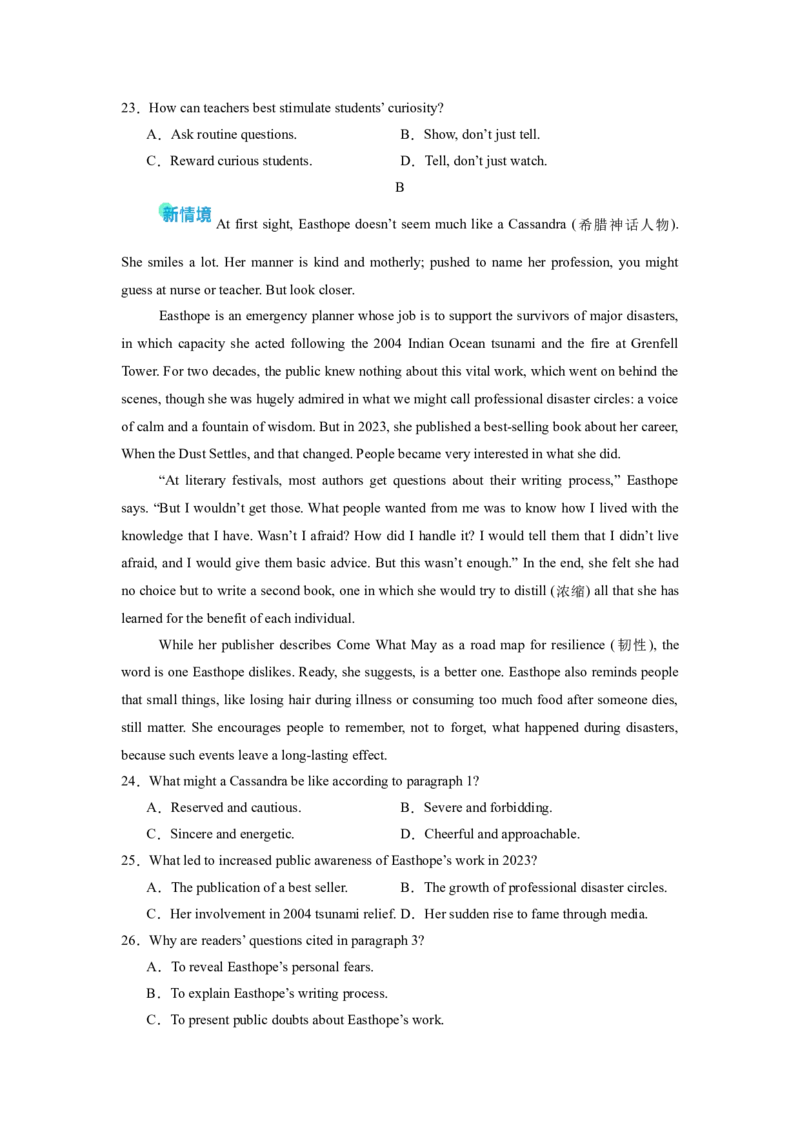
23.How can teachers best stimulate students’ curiosity?
A.Ask routine questions.
B.Show, don’t just tell.
C.Reward curious students.
D.Tell, don’t just watch.
B
At first sight, Easthope doesn’t seem much like a Cassandra (希腊神话人物).
She smiles a lot. Her manner is kind and motherly; pushed to name her profession, you might
guess at nurse or teacher. But look closer.
Easthope is an emergency planner whose job is to support the survivors of major disasters,
in which capacity she acted following the 2004 Indian Ocean tsunami and the fire at Grenfell
Tower. For two decades, the public knew nothing about this vital work, which went on behind the
scenes, though she was hugely admired in what we might call professional disaster circles: a voice
of calm and a fountain of wisdom. But in 2023, she published a best-selling book about her career,
When the Dust Settles, and that changed. People became very interested in what she did.
“At literary festivals, most authors get questions about their writing process,” Easthope
says. “But I wouldn’t get those. What people wanted from me was to know how I lived with the
knowledge that I have. Wasn’t I afraid? How did I handle it? I would tell them that I didn’t live
afraid, and I would give them basic advice. But this wasn’t enough.” In the end, she felt she had
no choice but to write a second book, one in which she would try to distill (浓缩) all that she has
learned for the benefit of each individual.
While her publisher describes Come What May as a road map for resilience ( 韧性), the
word is one Easthope dislikes. Ready, she suggests, is a better one. Easthope also reminds people
that small things, like losing hair during illness or consuming too much food after someone dies,
still matter. She encourages people to remember, not to forget, what happened during disasters,
because such events leave a long-lasting effect.
24.What might a Cassandra be like according to paragraph 1?
A.Reserved and cautious.
B.Severe and forbidding.
C.Sincere and energetic.
D.Cheerful and approachable.
25.What led to increased public awareness of Easthope’s work in 2023?
A.The publication of a best seller.
B.The growth of professional disaster circles.
C.Her involvement in 2004 tsunami relief. D.Her sudden rise to fame through media.
26.Why are readers’ questions cited in paragraph 3?
A.To reveal Easthope’s personal fears.
B.To explain Easthope’s writing process.
C.To present public doubts about Easthope’s work.
D.To show Easthope’s writing motivation.
27.What does Easthope agree on handling disasters?
A.Resilience matters most.
B.Forgetting aids recovery.
C.Minor sufferings deserve attention.
D.Positive thinking takes the lead.
C
Chinese scientists have completed a pioneering expedition to a remote part
of the Arctic Ocean. Using a deep-sea vehicle named "Fendouzhe," they explored the
previously unvisited eastern section of the Gakkel ridge, an underwater volcanic mountain
chain. This mission marked the first intensive geological survey of this challenging and
fascinating area, with over 40 dives conducted beneath the Arctic sea ice.
The scientific goal of the expedition was to search for hot-water vents(喷口) on
the ocean floor. These vents are geologically significant because the Gakkel ridge creates
new Earth crust at an extremely slow rate. More importantly, similar vents on other parts
of the ridge support unique living systems that do not depend on sunlight. Studying these
ecosystems offers valuable insights into how life might exist in dark, icy oceans on other
worlds, such as Jupiter's moon Europa.
Exploring this region was extremely difficult due to the thick sea ice. The vehicle
had to enter the water through temporary openings in the ice and, upon returning,
carefully search for a way back to the surface. At times, the expedition's icebreaker had
to create a path. This risky operation highlights the dedication required to study one of
Earth's last unexplored frontiers.
During the dives, researchers studied interesting geological features and observed the
remarkable marine life that survives in the deep-sea environment. The team collected a
large number of rock, water, and animal samples. According to the expedition's chief
scientist, analyzing these findings will take several years but is considered "the last piece
of the puzzle" for fully understanding this unique Arctic environment, suggesting that
major new discoveries are on the horizon.
28. What makes the Chinese expedition special?
A. It used a new icebreaker.           B. It first explored the eastern Gakkel ridge.
C. It discovered new hot-water vents.   D. It proved life exists on Europa.
29. What was the main challenge during the exploration?
A. The depth limit of the vehicle.      B. The extreme sea ice conditions.
C. The lack of financial support.       D. The danger from unknown sea creatures.
30. What can be inferred about studying the vents?
A. It helps find new energy sources.     B. It expands knowledge of life's
conditions.
C. It can predict future volcanic activities. D. It improves deep-sea diving technology.
31. What does the last paragraph suggest about the future?
A. The initial results are disappointing.    B. The expedition was a one-time event.
C. Significant findings are expected.     D. All data will be shared immediately.
D
A recent large-scale study has painted a worrying picture of the teaching profession
in Australia, revealing a crisis that extends far beyond the classroom. The research found that an
overwhelming majority of teachers are suffering from extreme stress and mental health problems
at rates much higher than the average person. This situation is not just a personal struggle for
educators; it has become a significant challenge for the entire education system, threatening the
quality of learning for future generations.
The root of this widespread problem, according to the findings, is not the act of teaching
itself. Instead, teachers reported feeling crushed by the weight of non-teaching duties. They are
overwhelmed by administrative tasks, complex paperwork, and the constant demand to collect and
report data. These responsibilities take away precious time and energy from what they are trained
to do: planning meaningful lessons and engaging with students. This shift in focus has led to
widespread feelings of exhaustion and disappointment in their profession.
The consequences of this crisis are severe and far-reaching. There is a clear connection
between poor teacher mental health and their desire to leave the job, which worsens the existing
shortage of skilled educators. Furthermore, the impact does not stop with the teachers. The study
confirms a strong link between a teacher's well-being and student success. When teachers are
constantly under pressure, it can lead to lower student achievement and a less positive school
environment for everyone.
In response to these urgent findings, experts are calling for immediate and meaningful action.
They suggest that the focus should be on creating better working conditions. This includes
introducing policies to reduce unnecessary administrative burdens and providing accessible mental
health support for all school staff. The message is clear: to ensure a high-quality education for
students, we must first prioritize the health and support of our teachers. Investing in teachers is, in
essence, investing in the future of the country.
32. According to the passage, what is the main source of pressure for Australian teachers?
A. The difficulty of managing student behavior in class.
B. The increasing amount of administrative and data-related work.
C. The lack of professional training for modern teaching methods.
D. The low salaries and limited opportunities for career advancement.
33. What is the primary focus of the solutions proposed by the experts in the passage?
A. Recruiting more new teachers to fill the shortage.
B. Providing students with extra tutoring to improve their scores.
C. Improving the working conditions and reducing unnecessary tasks for teachers.
D. Holding workshops to help teachers develop better personal stress management skills.
34. What can be inferred from the passage about the relationship between teachers' stress and the
education system?
A. Teacher stress is an isolated issue that only affects individual educators.
B. The education system is likely to suffer if the well-being of teachers is ignored.
C. Students are generally unaware of the stress their teachers are experiencing.
D. The best way to improve the education system is to introduce stricter evaluations for teachers.
35. What’s he author's attitude towards the situation of Australian teachers?
A. Critical and demanding.       B. Indifferent and objective.
C. Sympathetic and concerned.    D. Optimistic and hopeful.
第二节(共5 小题;每小题2. 5 分, 满分12. 5 分)
阅读下面短文, 从短文后的选项中选出可以填入空白处的最佳选项。选项中有两项为
多余选项。
According to the World Health Organization (WHO), over 55% of people live in
urban areas. The number is expected to rise to 68% by 2050.     36     WHO estimates that the
majority of city-dwellers experience inadequate housing, transportation, sanitation ( 卫生) and
waste management, as well as low air quality. For those living in such an urban environment,
exploring to find even a small natural reprieve (缓解) can be extremely helpful.     37
Spend Time in a Nearby Park
No matter how much we love the city life, it is always nice to have a little greenery around.
Luckily, most cities have parks where you can escape the busyness and enjoy some nature. Taking
a purposeful five-minute break during the day in this type of environment can provide a benefit. It
allows your mind and body to reset, which helps to reduce stress.     38
Visit a Botanical Garden
    39     Some even provide opportunities for recreational activities like birdwatching
or fishing for those who are feeling adventurous. Not only is it a beautiful way to spend your day,
but it also offers numerous benefits, such as relieving anxiety and boosting your mood.
Create a Balcony or Windowsill Garden
Creating a garden on your balcony or windowsill is a fantastic way to bring greenery into
your home.     40     You can plant some herbs which not only add beauty but can also be
used in cooking, and maybe a few small pot plants that are ideal for brightening up your space
without requiring extensive care. Gardening is a fun and rewarding hobby, and it is also a
wonderful way to express your creativity.
A.Slow down, go outside and notice what’s around you.
B.Select plants that grow well indoors or in small spaces.
C.Nature can be a perfect effective tool to improve memory.
D.However, this increasing urbanization can bring unique health challenges.
E.A trip to a botanical garden is an amazing way to reconnect with nature.
F.Plus, it can also help to enhance your focus and overall work efficiency.
G.Keep reading to discover ways to connect to nature in any city for improved mental health.
第三部分 语言运用(共两节,满分30 分)
第一节(共15 小题,每小题1 分,满分15 分)
阅读下面短文, 从每题所给的A、B、C 和D 四个选项中选出可以填入空白处的最佳选
项。
Thirty years ago, I was a young father struggling to feed my family. To     41     that, I
went back to college to earn a teaching degree. I     42     it clearly: a lasting classroom and a
stable paycheck. However, all of the full-time teaching positions were     43    . So I joined
the substitute (替补) list, waiting each day for the phone to ring, telling me where I’d work that
day.
Such days lasted for nearly three months. We never had extra, but we could     44

the basics. In late May, the school year     45     its end, and my anxiety turned into dread (恐
惧), as it     46     the possibility that I would have no paycheck for three months.
One Thursday, during a break, I stood     47     outside while the children ran and
played happily. I wished I could     48     their pleasure, but regretfully, I was weighed down
with the pains and problems of adulthood. I used to be that     49    . Now, every thought was
a     50    .
Just before the bell rang, a little girl ran up to me and     51     some dandelions (蒲公
英) to me. I looked down at her and thanked her for her     52    . Then when the bell rang, I
walked back inside with her. Suddenly, I     53     something. My heart no longer felt heavy.
My     54     seemed to fade away. And my spirit felt lifted up.
I quit working in schools years ago, but I still teach. That day, the girl     55     me that
we are all teachers because whatever we do can make others know something. And the best
teacher is a loving heart.
41.A.confirm
B.understand
C.hide
D.fix
42.A.pictured
B.signed
C.remembered
D.explained
43.A.recorded
B.advertised
C.filled
D.mentioned
44.A.ignore
B.produce
C.stress
D.cover
45.A.delayed
B.neared
C.advanced
D.missed
46.A.meant
B.removed
C.challenged
D.tested
47.A.firmly
B.patiently
C.sadly
D.secretly
48.A.prove
B.discover
C.check
D.share
49.A.talented
B.joyful
C.careful
D.determined
50.A.stone
B.chance
C.suggestion
D.reason
51.A.sold
B.returned
C.handed
D.lent
52.A.gift
B.word
C.courage
D.invitation
53.A.imagined
B.encountered
C.noticed
D.repeated
54.A.dreams
B.worries
C.habits
D.weaknesses
55.A.promised
B.warned
C.cheated
D.reminded
第二节(共10 小题;每小题1.5 分 ,满分15 分)
阅读下面短文,在空白处填入1 个适当的单词或括号内单词的正确形式。
Some 4,000 years ago, the Liangzhu culture, known for its sophisticated city of canals
56     (call) “China’s Venice of the Stone Age,” suddenly disappeared. Historians debated
whether war, disease, or starvation caused its collapse, but recent research points to climate
change     57     a key factor.
Located near the East China Sea, Liangzhu     58     (be) home to an advanced Stone
Age civilization for about 1,000 years, supporting an active agricultural system through its canals.
Liangzhu City was listed as     59     UNESCO World Heritage Site in 2019.
Researchers from the University of Innsbruck had long sought to explain     60

Liangzhu was abandoned, and the discovery of a thin layer of clay on the ruins suggested a
possible connection between the ends of the advanced civilization     61     floods of the
Yangtze River or floods from the East China Sea. However, no clear conclusions on the cause
were possible from the mud layer     62     (it).
A breakthrough came when scientists studied stalagmites ( 石笋) from two nearby
underwater caves. As Dr. Peter Dockrill reported for Science Alert, their team discovered chemical
signatures from about 4,300 years ago that showed extremely high rainfall,
   63

(probable) caused by the     64     (warm) of ocean waters in the Pacific — an event known as
the El Niño (厄尔尼诺).
The study notes that wet conditions lasted for several hundred years following the collapse
of Liangzhu, eventually paving the way for the rise of the Xia dynasty in 2070 B .C.E. Its
celebrated     65     (found), Yu the Great, introduced more extensive flood-control methods
and is known as the “Tamer of the Flood.”
第四部分  写作(共两节, 满分40 分)
第一节(满分15 分)
    假定你是李华, 暑假期间你去美国参加Summer School 项目学习。在教室里,你目
睹了一次同学之间的霸凌现象,你一个人无法改变现状,于是你写信给负责老师Mr. Smith
向他求助, 希望能够帮助那个被霸凌的同学Mike,内容包括:
1. 事情经过;
2. 你对校园霸凌的看法。
注意:
1. 写作词数应为80 左右;
2. 可适当增加细节,以使行文连贯。
参考词汇: 霸凌 bully
Dear Mr. Smith,
_______________________________________________________________________________
_______________________________________________________________________________
_______________________________________________________________________________
____________________________________________________________
Yours sincerely,
Li Hua
第二节(满分25 分)
阅读下面材料,根据其内容和所给段落开头语续写两段,使之构成一篇完整的短文。
Amy walked into the noisy gym and pulled her kneepads (护膝) up over her knees. She was
excited about volleyball camp, but also really nervous. She’d never been alone at a camp like this
before! She hoped she would make friends soon.
She looked around at the girls talking excitedly to each other. “I wish I was more like
Lucy,” she thought. Lucy was her sister. She could talk to anyone and become good friends.
But Amy was more ... quiet. At school, she usually liked to read her book instead of talking
before class. She didn’t mind working by herself on school projects. And when it was her birthday,
she invited just a few friends to go skating instead of having a big party.
The coach blew her whistle, and Amy jogged over to join the others for warm-up exercises.
Amy felt a little awkward, but she tried to talk to a few of the girls.
After hours of serving, passing, and playing get-to-know-you games, it was finally time for
lunch. Amy brought her food to a round table and sat next to some other players. Everyone was
talking loudly and singing in funny voices. Amy bit quietly on her carrot sticks.
One of the older girls at the table noticed Amy being quiet. “Hey!” She put her hand on
Amy’s shoulder and shook it playfully. “Be yourself! Just be crazy!”
Amy felt embarrassed. “But what if I am being myself?” she thought. “What if I don’t want
to be crazy?” Maybe there was something wrong with her. Everyone seemed to like the girls who
were loud.
At the end of the day, Amy was glad to see Mom’s car pull up. “How was it?” Mom asked.
“Fun,” Amy said as she climbed into her seat. And it had been fun ... sort of.
Amy sighed. Tomorrow would be another day of camp, surrounded by people she didn’t
know. She would have to be brave all over again.
注意:1.续写词数应为150 个左右;2.请按如下格式在相应位置作答。
Mom seemed to read her mind and told Amy that she was proud of her.
_______________________________________________________________________________
_______________________________________________________________________________
_______________________________________________________________________________
______________________________________________________________________________
The next day, Amy was still her quiet self
_______________________________________________________________________________
_______________________________________________________________________________
_______________________________________________________________________________
______________________________________________________________________________